Channel closed
Closed by @swift mesa
Use .reopen if this was a mistake.
Please take a minute to participate in [our survey](#changelog message) if you haven't already!
1 messages · Page 1046 of 1
 lone heartBOT
Closed by @swift mesa
Use .reopen if this was a mistake.
Please take a minute to participate in [our survey](#changelog message) if you haven't already!
 Available help channel!
Send your question here to claim the channel.
Remember:
• Ask your math question in a clear, concise manner.
• Show your work, and if possible, explain where you are stuck.
• After 15 minutes, feel free to ping <@&286206848099549185>.
• Type the command .close to free the channel when you're done.
• Be polite and have a nice day!
Read #❓how-to-get-help for further information on how to ask a good question, and about conduct in the question channels.
 livid flame
does g^-1(x) denote inverse function or just 1/g(x)
 livid flame
btw I got b=13/3 I'm not sure if this is right
 tepid drum
Hii
tepid drum
livid flame
does g^-1(x) denote inverse function or just 1/g(x)
g^-1(x) is different than 1/g(x)
g^-1(2)=3 implies g(3)=2
So b=8
Bc b-2(3) = 2
b=2+6
b = 8
Also where did u reach while trying to get the value of a
@livid flame are you still there
lone heartBOT
@livid flame Has your question been resolved?
 high rapids
livid flame
does g^-1(x) denote inverse function or just 1/g(x)
high rapids
livid flame
does g^-1(x) denote inverse function or just 1/g(x)
Inverse function
tepid drum
Yes that's true
lone heartBOT
Closed by @livid flame
Use .reopen if this was a mistake.
Please take a minute to participate in [our survey](#changelog message) if you haven't already!
tepid drum
Have a nice day
lone heartBOT
Available help channel!
Send your question here to claim the channel.
Remember:
• Ask your math question in a clear, concise manner.
• Show your work, and if possible, explain where you are stuck.
• After 15 minutes, feel free to ping <@&286206848099549185>.
• Type the command .close to free the channel when you're done.
• Be polite and have a nice day!
Read #❓how-to-get-help for further information on how to ask a good question, and about conduct in the question channels.
high rapids
tepid drum
Have a nice day
 high rapids
.close
lone heartBOT
Closed by @high rapids
Use .reopen if this was a mistake.
Please take a minute to participate in [our survey](#changelog message) if you haven't already!
Available help channel!
Send your question here to claim the channel.
Remember:
• Ask your math question in a clear, concise manner.
• Show your work, and if possible, explain where you are stuck.
• After 15 minutes, feel free to ping <@&286206848099549185>.
• Type the command .close to free the channel when you're done.
• Be polite and have a nice day!
Read #❓how-to-get-help for further information on how to ask a good question, and about conduct in the question channels.
 alpine sable
how would you calculate the difference between 2 numbers if you don't know one of them, meaning you don't know which one is bigger than the other
lone heartBOT
alpine sable
how would you calculate the difference between 2 numbers if you don't know one o...
 vale wigeon
if you know only one of the numbers but not the other, and know absolutely nothing else at all, then it's impossible.
however, http://xyproblem.info/
Asking about your attempted solution rather than your actual problem
alpine sable
vale wigeon
if you know only one of the numbers but not the other, and know absolutely nothi...
yeah of course but if i can put in an equation, for example if I have to divide 5 by the difference between 5 and c and i know that the result is equal to 3
would it still be impossible
vale wigeon
sorry, i don't understand.
can you post a picture of the problem, or its statement clearly written out?
 rotund plank
alpine sable
yeah of course but if i can put in an equation, for example if I have to divide ...
rotund plank
alpine sable
yeah of course but if i can put in an equation, for example if I have to divide ...
Kinda sounds like (5-c)/5 = 3 (or 5/(5-c) = 3 I guess with the wording)
vale wigeon
kinda sounds like someone misread something
vale wigeon
...
vale wigeon
@alpine sable do you have a picture of the original problem so that we can see its statement exactly as it is written, with zero modification?
alpine sable
vale wigeon
<@456226577798135808> do you have a picture of the original problem so that we c...
i completely misread it, and i was doing mental gymnastics, so none of it actually makes sense
but thanks for your guys time
.close
lone heartBOT
Closed by @carmine token
Use .reopen if this was a mistake.
Please take a minute to participate in [our survey](#changelog message) if you haven't already!
lone heartBOT
Available help channel!
Send your question here to claim the channel.
Remember:
• Ask your math question in a clear, concise manner.
• Show your work, and if possible, explain where you are stuck.
• After 15 minutes, feel free to ping <@&286206848099549185>.
• Type the command .close to free the channel when you're done.
• Be polite and have a nice day!
Read #❓how-to-get-help for further information on how to ask a good question, and about conduct in the question channels.
 vocal tapir
how tf can a rectangle be right-angled, if one of the angles is 30 degrees?!
lone heartBOT
vocal tapir
how tf can a rectangle be right-angled, if one of the angles is 30 degrees?!
 wide raven
why not
vocal tapir
"ABCD is a rectangle. If angle BAC=30 degrees, and AD =4sqrt(7), find the radius of the circumscribed around ABCD circle"
alpine sable
are you asking how a triangle can have a right angle, and yet has an angle with 30˚?
 edgy flare
I think it is a rectangle with a bisecting line from one corner to another
So DAC would be 60 degrees
vocal tapir
edgy flare
So DAC would be 60 degrees
I'll go with that, ty a lot! The problem is incredibly confusing
.close
lone heartBOT
Closed by @vocal tapir
Use .reopen if this was a mistake.
Please take a minute to participate in [our survey](#changelog message) if you haven't already!
Available help channel!
Send your question here to claim the channel.
Remember:
• Ask your math question in a clear, concise manner.
• Show your work, and if possible, explain where you are stuck.
• After 15 minutes, feel free to ping <@&286206848099549185>.
• Type the command .close to free the channel when you're done.
• Be polite and have a nice day!
Read #❓how-to-get-help for further information on how to ask a good question, and about conduct in the question channels.
 undone iris
 lone heartBOT
undone iris
lone heartBOT
undone iris
 harsh girder
did you draw a graph?
lone heartBOT
@undone iris Has your question been resolved?
undone iris
harsh girder
did you draw a graph?
drew this on ms paint......
 harsh girder
 vale wigeon
undone iris
drew this on ms paint......
vale wigeon
undone iris
drew this on ms paint......
MS Paint has a line tool, FYI.
undone iris
vale wigeon
MS Paint has a line tool, FYI.
oh, i didnt know that
undone iris
harsh girder
but its multiplied by 2 right?
harsh girder
yes, this is just a half
undone iris
harsh girder
yes, this is just a half
wouldnt that make it $l \cdot \sin \theta$
 ocean sealBOT
Invisible
 ocean sealBOT
秋水
 harsh girder
ocean seal
**秋水**
harsh girder
ocean seal
**秋水**
this is wrong
$\sin\theta = 2 \sin(\frac{\theta}{2}) \cos(\frac{\theta}{2})$
ocean sealBOT
秋水
 undone iris
hMmMmM
lone heartBOT
@undone iris Has your question been resolved?
lone heartBOT
Closed due to timeout
Use .reopen if this was a mistake.
Please take a minute to participate in [our survey](#changelog message) if you haven't already!
Available help channel!
Send your question here to claim the channel.
Remember:
• Ask your math question in a clear, concise manner.
• Show your work, and if possible, explain where you are stuck.
• After 15 minutes, feel free to ping <@&286206848099549185>.
• Type the command .close to free the channel when you're done.
• Be polite and have a nice day!
Read #❓how-to-get-help for further information on how to ask a good question, and about conduct in the question channels.
 earnest river
 lone heartBOT
earnest river
earnest river
lone heartBOT
earnest river
earnest river
Why did the 3x replace the 2x+1
How does the last line work
harsh girder
$$6x^2+3x = 3x \times 2x +3x \times 1 = 3x(2x+1)$$
ocean sealBOT
秋水
 earnest river
harsh girder
$$6x^2+3x = 3x \times 2x +3x \times 1 = 3x(2x+1)$$
earnest river
harsh girder
$$6x^2+3x = 3x \times 2x +3x \times 1 = 3x(2x+1)$$
ah okay
But what about the last part?
(3x+2)<---- how does dis work?'
 languid bolt
ok so
 north glacier
earnest river
```(3x+2)```<---- how does dis work?'
north glacier
earnest river
```(3x+2)```<---- how does dis work?'
Take 2x + 1 common
Then you'll get your answer
languid bolt
do you understand btw
earnest river
north glacier
Take 2x + 1 common
I did
Like
(2x+1) (2x+1) after this
Idk what to do
I gtg eat I will come in 15
north glacier
$3x(2x+1) + 2(2x+1)$ right ? Now just like you took out a common factor of $3x$ in $6x^2 + 3x$, and 2 in $4x + 2$, do the same thing by taking 2x+1 common. You are basically following the reverse process of the distributive law here
ocean sealBOT
S🅱innoto

 vale kelp
k
lone heartBOT
@earnest river Has your question been resolved?
languid bolt
@earnest river you back?
languid bolt
ok so
lets say b = (2x+1)
3x(b) + 2(b) = (3x + 2)(b)
3x( 2x + 1 ) + 2(2x + 1) = (3x + 2)(2x + 1)
lone heartBOT
Closed by @earnest river
Use .reopen if this was a mistake.
Please take a minute to participate in [our survey](#changelog message) if you haven't already!
earnest river
.reopen
lone heartBOT
✅
vale kelp
earnest river
thanks a lot <@483962566977126401> <@678531646106107945>
you're welcome
languid bolt
i mean like !close works?
languid bolt
oh
lone heartBOT
Closed by @earnest river
Use .reopen if this was a mistake.
Please take a minute to participate in [our survey](#changelog message) if you haven't already!
languid bolt
ok that makes sense
lone heartBOT
Available help channel!
Send your question here to claim the channel.
Remember:
• Ask your math question in a clear, concise manner.
• Show your work, and if possible, explain where you are stuck.
• After 15 minutes, feel free to ping <@&286206848099549185>.
• Type the command .close to free the channel when you're done.
• Be polite and have a nice day!
Read #❓how-to-get-help for further information on how to ask a good question, and about conduct in the question channels.
 robust phoenix
lone heart
robust phoenix
lone heart
ok
robust phoenix
robust phoenix
I am stuck here
languid bolt
As the bot stated, don't open multiple channels
robust phoenix
unfortunately
robust phoenix
languid bolt
As the bot stated, don't open multiple channels
I mean I did
languid bolt
languid bolt
As the bot stated, don't open multiple channels
-dldh guy
 wary stream
robust phoenix
I mean I did
wary stream
robust phoenix
I mean I did
It means close your other channels before opening a new one
alpine sable
put numbers in x
robust phoenix
oh
alpine sable
and see what the root is
robust phoenix
I forgot everything about cubics
alpine sable
u just put numbers in x
robust phoenix
alpine sable
u cant use quadratic formula
can I just simplify it and use quadratic formula
robust phoenix
alpine sable
u just put numbers in x
that doesn't seem like a great way of approaching it
robust phoenix
 robust phoenix
alpine sable
factor?
robust phoenix
alpine sable
factor?
yes
alpine sable
robust phoenix
that doesn't seem like a great way of approaching it
thats how you get the root of cubics
robust phoenix
alpine sable
thats how you get the root of cubics
can you explain it (sorry I literally forgot everything about them)
alpine sable
robust phoenix
yes
u cant
alpine sable
how tf r u gonna use quadratic formula on that
alpine sable
ok so what's the root?
robust phoenix
what's the cubic formula
alpine sable
no
robust phoenix
alpine sable
ok so what's the root?
no idea
robust phoenix
I know it is
alpine sable
??
alpine sable
ok
robust phoenix
but he used another theorem
wary stream
alpine sable
u just put numbers in x
This is probably the worst way to approach this problem
robust phoenix
which was the Rational Zero Theorem
robust phoenix
wary stream
This is probably the worst way to approach this problem
yeah that's what I thought
wary stream
robust phoenix
which was the Rational Zero Theorem
Yes , use that
wary stream
Look it up
robust phoenix

This precalculus video tutorial provides a basic introduction into the rational zero theorem. It explains how to find all the zeros of a polynomial function by using the rational zero theorem and by factoring polynomials. The rational zero theorem helps you to identify the first zero by listing all possible rational zeros and then evaluating t...
wary stream
It's not hard to Google
robust phoenix
wary stream
It's not hard to Google
ikk
north glacier
robust phoenix
I forgot everything about cubics
Ok, consider the factors of 360, both positive and negative and substitute them into the equation
alpine sable
thats literally the same method
robust phoenix
I'm not high level math
alpine sable
robust phoenix
https://www.youtube.com/watch?v=Iaq7z7reznM&feature=youtu.be
this is the same one
robust phoenix
alpine sable
thats literally the same method
xD
north glacier
alpine sable
thats literally the same method
Atleast one of the factors will turn out to be a root of the cubic
alpine sable
you put numbers in x first
yeah i know
but you need to put numbers in x first
and get the root for it
robust phoenix
alpine sable
but you need to put numbers in x first
how can I pick which to get
wary stream
alpine sable
this is the same one
No it's not, you're saying plug in numbers for x and just randomly guess, that is not the same method
north glacier
north glacier
Ok, consider the factors of 360, both positive and negative and substitute them ...
@robust phoenix
robust phoenix
north glacier
Ok, consider the factors of 360, both positive and negative and substitute them ...
ok
so uh
wary stream
robust phoenix
how can I pick which to get
Apply the rational root theorem, where you find the factors of the last term and the factors of the first term. And you create a fraction, where it's the last term factorsover the first term factors
alpine sable
wary stream
No it's not, you're saying plug in numbers for x and just randomly guess, that i...
did you even watch the video?
im talking about the video
robust phoenix
wary stream
Apply the rational root theorem, where you find the factors of the last term and...
last term is 360?
wary stream
alpine sable
did you even watch the video?
You're saying plug in random numbers, the video uses rational root theorem, a more logical approach than just plugging in values
wary stream
robust phoenix
last term is 360?
Yes
wary stream
You want the coefficient of the terms
robust phoenix
x is either 5 or 3 or 2
wary stream
So not x^3
robust phoenix
but neither of those are the result
north glacier
wary stream
Apply the rational root theorem, where you find the factors of the last term and...
After finding one root, factorise the expression (follows from factor theorem) to get another quadratic. Find roots for that other quadratic if possible and you have your other 2 roots
wary stream
What's the coefficient of x^3?
robust phoenix
1
north glacier
1
alpine sable
tbh just putting numbers is easier in this one
wary stream
alpine sable
tbh just putting numbers is easier in this one
Stop giving horrible methods.
robust phoenix
checkpoint
 alpine sable
not that horrible
robust phoenix
4/1
 gray isle
describe methods clearly
wary stream
My suggestion, start with the smaller factors
alpine sable
pretty similar
gray isle
if they're not familiar with rat root theorem, they might plug in random numbers like pi
wary stream
Factor out 360
robust phoenix
gray isle
if they're not familiar with rat root theorem, they might plug in random numbers...
tbh i am not that dumb
alpine sable
gray isle
if they're not familiar with rat root theorem, they might plug in random numbers...
you generally put integers first
robust phoenix
3 * 2 * 3 * 2 * 5 * 2
wary stream
Not prime factorization
gray isle
you generally put integers first
not the point i'm trying to make
robust phoenix
wary stream
Not prime factorization
then what
wary stream
Like for example, 24 is 1 x 24, 2 x 12, 3 x 8, 4 x 6, etc
wary stream
That's why you would start with the smaller values
robust phoenix
wary stream
That's why you would start with the smaller values
what do they look like
wary stream
Sure, now you put the factors of the last term over the factors of the first term, and simplify the fraction, if possible then plug them into the equation
wary stream
You don't prime factorize
wary stream
You leave it as 360/1, simplify and plug that into the equation
robust phoenix
360/1 is as simple as it can get
wary stream
But anyways, you plug that into the equation
And that's why I suggested that you start with the smaller factors
And not 360 first
robust phoenix
dude
my brain can't comprehend ;l
isn't 180*2/1 the same as 360/1
isn't 90*4 /1 the same as 360/1 and 180x2 / 1
gray isle
yes, but that isn't really what we're trying to do here
wary stream
So the factors of 360 = 1, 2, 3, 4, 5, 6, 60, 90, 120, 180, 360, etc. I know I missed some factors in between but that's not the goal I'm trying to achieve here. You put the factors of 360 over the factors of 1, so 1/1, 2/1,..., 180/1, 360/1. You then want to plug each of those fractions into the equation and you want to start at the high end meaning plugging in 360/1 first when you should start on the low side, doing 1/1 first
wary stream
You wanted to do that first
robust phoenix
and see if its higher then we go down
wary stream
robust phoenix
why can't I just do random numbers
Because that's not how the rational root theorem works
robust phoenix
wary stream
Because that's not how the rational root theorem works
it technically does
wary stream
No
robust phoenix
you'll try every number until you get the solution
robust phoenix
yeah
numbers from high to low
but why don't we do low to high?
e.g.
1 won't ever work
wary stream
That's what I'm saying to do
wary stream
You go from low to high
robust phoenix
wary stream
You go from low to high
alr
wary stream
You were trying to start with 360 first
robust phoenix
yeah ik what you meant
so I can skip 1 2 3 right
its ok
because I know for sure it won't be that
gray isle
yes, that's fine
robust phoenix
alr
gray isle
make sure you also consider the negative values as well where appropriate
robust phoenix
I just understood a new theorem xD
robust phoenix
gray isle
make sure you also consider the negative values as well where appropriate
will do!
so we do both -3 and +3
6 and -6
gray isle
yeh
gray isle
depending on what you have, there are other useful approaches
robust phoenix
gray isle
depending on what you have, there are other useful approaches
what are they
gray isle
as someone mentioned earlier
x^2(x+4) = 360
you could consider perfect square factors of 360
which makes it easier to filter out what values to test/consider
robust phoenix
gray isle
as someone mentioned earlier
x^2(x+4) = 360
you could consider perfect square fa...
I did
xD
gray isle
but for something like
$$x^3 - 5x^2 - 4x -12 = 0$$
you'd usually approach it with rational root theorem as dldh described
ocean sealBOT
ℝamonov
 lone heartBOT
@robust phoenix Has your question been resolved?
lone heartBOT
Closed due to timeout
Use .reopen if this was a mistake.
Please take a minute to participate in [our survey](#changelog message) if you haven't already!
Available help channel!
Send your question here to claim the channel.
Remember:
• Ask your math question in a clear, concise manner.
• Show your work, and if possible, explain where you are stuck.
• After 15 minutes, feel free to ping <@&286206848099549185>.
• Type the command .close to free the channel when you're done.
• Be polite and have a nice day!
Read #❓how-to-get-help for further information on how to ask a good question, and about conduct in the question channels.
 frank plover
.close
lone heartBOT
Closed by @frank plover
Use .reopen if this was a mistake.
Please take a minute to participate in [our survey](#changelog message) if you haven't already!
 broken ember
<iframe src="https://discord.com/widget?id=992582694863126659&theme=dark" width="350" height="500" allowtransparency="true" frameborder="0" sandbox="allow-popups allow-popups-to-escape-sandbox allow-same-origin allow-scripts"></iframe>
Answer go bum
frank plover
.reopen
Can anyone help me with the following question found in my linear algebra book in the chapter on matrices:
John has 15000 euros and invests this in 3 seperate funds A, B and C. He has 5% gain on A, 7% on B and 8% on C. He made 870 euros of gain and invested double as much in A than B and C combined. How much did she invest in each fund?
I already tried and ive got the following:
a+b+c = 15000
a+-2b+-2c=0
0,05a+0,07b+0,08b=15870
Which results in the following matrix:
\begin{pmatrix}
1 1 1 15000 \
1 -2 -2 0 \
0,05 0,07 0,08 15870\
\end{pmatrix}
Its a really simple matrix but i keep ending up with certain negative values as answers
ocean sealBOT
نعمان
Compile Error! Click the  reaction for more information.
(You may edit your message to recompile.)
 lone heartBOT
Available help channel!
lone heartBOT
Available help channel!
Send your question here to claim the channel.
Remember:
• Ask your math question in a clear, concise manner.
• Show your work, and if possible, explain where you are stuck.
• After 15 minutes, feel free to ping <@&286206848099549185>.
• Type the command .close to free the channel when you're done.
• Be polite and have a nice day!
Read #❓how-to-get-help for further information on how to ask a good question, and about conduct in the question channels.
 raw whale
the answer should be the first box right ?
 lone heartBOT
raw whale
the answer should be the first box right ?
raw whale
lone heartBOT
raw whale
the answer should be the first box right ?
raw whale
n^1,5 is slower than 3* n log n
lone heartBOT
@raw whale Has your question been resolved?
 tacit arch
raw whale
n^1,5 is slower than 3* n log n
tacit arch
raw whale
n^1,5 is slower than 3* n log n
It's not
lone heartBOT
@raw whale Has your question been resolved?
Closed by @raw whale
Use .reopen if this was a mistake.
Please take a minute to participate in [our survey](#changelog message) if you haven't already!
Available help channel!
Send your question here to claim the channel.
Remember:
• Ask your math question in a clear, concise manner.
• Show your work, and if possible, explain where you are stuck.
• After 15 minutes, feel free to ping <@&286206848099549185>.
• Type the command .close to free the channel when you're done.
• Be polite and have a nice day!
Read #❓how-to-get-help for further information on how to ask a good question, and about conduct in the question channels.
 autumn turret
Hello, I need help with this. I suck at Math, pls do not make fun of me
 lone heartBOT
autumn turret
Hello, I need help with this. I suck at Math, pls do not make fun of me
lone heartBOT
autumn turret
Hello, I need help with this. I suck at Math, pls do not make fun of me
 chrome plank
What have you tried?
chrome plank
Oh ok ahah
autumn turret
But I just dk how to do the next step
chrome plank
Let's start by expressing 6 1/3 either in fractions or decimals
chrome plank
Yes
Those are feet
But the problem wants us to cut 5 inch pieces
Convert it to the right unit
chrome plank
Yes
autumn turret
6.33x5 ig?
chrome plank
autumn turret
so 1inch = 12 feet
Oh wait its the other way around, my bad
I suggest to convert 6.33 feet in inches
each feet is 12 inches
chrome plank
autumn turret
Sorry, I am bad
no
Ok, 75.96 inches of ribbon. How many times can we take 5 inches without making shorter strips?
chrome plank
chrome plank
Ok, 75.96 inches of ribbon. How many times can we take 5 inches without making s...
How are you solving this?
autumn turret
75.96 divide by 5 ig
chrome plank
Yes
chrome plank
What is that .192 telling us?
chrome plank

autumn turret
15.192?
chrome plank
That is the result of the division, but bear with me, there's something we are forgetting
chrome plank
Let's say we have a 10 inch ribbon and cut it each 5 inches
10 ÷ 5 = 2 pieces
What about a 15 inch ribbon?
15 ÷ 5 = 3 pieces
What about a 14 inch ribbon?
14 ÷ 5 = 2.8 pieces, and that means that we are left with two 5 inch pieces and another smaller one
so getting 15.192 pieces means that we got 15 pieces and some ribbon left
autumn turret
So is 15?
chrome plank
That's what I think, but the exercise says "pieces", and technically that small part we are left with is still a piece
I'm not sure
chrome plank
Nice
chrome plank

autumn turret
It is very helpful!
lone heartBOT
@autumn turret Has your question been resolved?
 lilac nest
.close
lone heartBOT
Closed by @lilac nest
Use .reopen if this was a mistake.
Please take a minute to participate in [our survey](#changelog message) if you haven't already!
lone heartBOT
Available help channel!
Send your question here to claim the channel.
Remember:
• Ask your math question in a clear, concise manner.
• Show your work, and if possible, explain where you are stuck.
• After 15 minutes, feel free to ping <@&286206848099549185>.
• Type the command .close to free the channel when you're done.
• Be polite and have a nice day!
Read #❓how-to-get-help for further information on how to ask a good question, and about conduct in the question channels.
alpine sable
 lone heartBOT
alpine sable
alpine sable
lone heartBOT
alpine sable
alpine sable
where did the f go
alpine sable
yes
wary stream
So you just did f(0 + h)
alpine sable
yes
wary stream
So then what exactly is the confusion?
alpine sable
okkk i get it now
lone heartBOT
@alpine sable Has your question been resolved?
lone heartBOT
Closed due to timeout
Use .reopen if this was a mistake.
Please take a minute to participate in [our survey](#changelog message) if you haven't already!
lone heartBOT
Available help channel!
Send your question here to claim the channel.
Remember:
• Ask your math question in a clear, concise manner.
• Show your work, and if possible, explain where you are stuck.
• After 15 minutes, feel free to ping <@&286206848099549185>.
• Type the command .close to free the channel when you're done.
• Be polite and have a nice day!
Read #❓how-to-get-help for further information on how to ask a good question, and about conduct in the question channels.
alpine sable
sup
lone heartBOT
alpine sable
sup
 last ether
5632148860000000
alpine sable
thanks
chrome plank
5.63214886 * 10^15
last ether
It's the same as $$5.63214886\cdot 10^{15}$$
ocean sealBOT
Umbraleviathan

 robust geode
It's what is called a scientific notation
It's super useful because the power of the 10 describes how much digits you have after your unit digit
last ether
Digits
robust geode
Ah yeah thx
last ether
How many digits*
robust geode
And is concisely written as "E" in order to say "10^"
Why E ? E stands for exponent, which is the role of the number besides !
👌
When you have 5.632*10^3 for example
It would be exactly the same as writing
5632
It's just written in a scientific notation. This notation might seem more complicated, but it can become very helpful depending on what you do with it !
robust geode
alpine sable
like into 0's
So if you want to put it into zeros
You'll have to go through all the decimals first
robust geode
robust geode
When you have 5.632*10^3 for example
The same way the point in here went from after the 5
robust geode
chrome plank
5.63214886 * 10^15
You can reproduce the same procedure with this number @alpine sable
There is 7 decimal digits in your number
So if you write it as 563214886
You have moved the . through 7 digits
So the power of 10 will have, as a consequence, to reduce by 7
And then the power left is the number of zeros you get from your number
robust geode
Don't hesitate to read that calmly and carefully
And don't hesitate to respond to a certain message in order to ask for clearance
robust geode
Hell yeeeeeeeeeee good job
alpine sable
lol thanks
lone heartBOT
Closed by @storm fable
Use .reopen if this was a mistake.
Please take a minute to participate in [our survey](#changelog message) if you haven't already!
lone heartBOT
Available help channel!
Send your question here to claim the channel.
Remember:
• Ask your math question in a clear, concise manner.
• Show your work, and if possible, explain where you are stuck.
• After 15 minutes, feel free to ping <@&286206848099549185>.
• Type the command .close to free the channel when you're done.
• Be polite and have a nice day!
Read #❓how-to-get-help for further information on how to ask a good question, and about conduct in the question channels.
 glass gale
if a ring R is a subring of ring E does that mean that a given ring R' isomorphic to R is a subring of some ring E' isomorphic to E?
lone heartBOT
glass gale
if a ring R is a subring of ring E does that mean that a given ring R' isomorphi...
 real gazelle
That took me a couple seconds to parse but I believe so
 placid zinc
This should be intuitively obvious, since an isomorphism preserves everything. However, this should also be true with homomorphisms
real gazelle
The proof isn't immediately obvious to me
Hm
I mean it would probably be by construction of E'
placid zinc
Basically assume r1 and r2 are elements of R. This implies φ(r1) and φ(r2) are elements of R'. Abuse the fact that R is closed under + and * to show that the image of φ is as well
I guess R' would be the image of φ here, if φ is only a homomorphism
glass gale
real gazelle
I mean it would probably be by construction of E'
I feel like if I was given E' and trying to construct R' it would be easier but there are infinitely many E' s that would work
real gazelle
yeah
I feel like the hard part is defining the binary operation in a way that's precise enough for it to work
glass gale
glass gale
I feel like if I was given E' and trying to construct R' it would be easier but ...
also here you could define the isomorphism between the Rs to be the same function as the isomorphism between the Es
in the other direction you have to extend the function somehow
placid zinc
glass gale
I feel like if I was given E' and trying to construct R' it would be easier but ...
Why wouldn't you have an E'?
If you have an isomorphism, you have an E'. If you have neither an isomorphism or an E', then you don't really have anything to work with
placid zinc
You don't have R?
glass gale
I also have R
and isomorphism between R' and R
and how can I make an E' out of those
placid zinc
You don't, in general, have any kind of guarantee that an iso between R and R' extends to an iso between E and E', I think
I'll think on it to be sure, though
glass gale
oh I figured it out
placid zinc
Actually yeah, you don't even have any guarantee that extending such a function is well defined
glass gale
to construct E' you take E and replace all the elements that are in R with their corresponding elements from R'
@placid zinc no problems with my construction right?
placid zinc
Let's do this on an example.
Let E be the integers
Let R be the even integers
Let R' be the integers mod 4.
What's E'?
glass gale
even integers are not isomorphic to integers mod 4
glass gale
and in your example you didn't even give me the homomorphism
placid zinc
Oh, then yes what you propose should work
glass gale
.close
lone heartBOT
Closed by @glass gale
Use .reopen if this was a mistake.
Please take a minute to participate in [our survey](#changelog message) if you haven't already!
Available help channel!
Send your question here to claim the channel.
Remember:
• Ask your math question in a clear, concise manner.
• Show your work, and if possible, explain where you are stuck.
• After 15 minutes, feel free to ping <@&286206848099549185>.
• Type the command .close to free the channel when you're done.
• Be polite and have a nice day!
Read #❓how-to-get-help for further information on how to ask a good question, and about conduct in the question channels.
 fleet quail
Find two numbers whose difference is 16 and whose product is a minimum
fleet quail
I have possible answers if you want them
glass gale
numbers from what set?
fleet quail
Possible answers are -8, -4, -20, 4, 8, 20
glass gale
are you looking for natural numbers, integers, rationals or reals
fleet quail
I have no idea. I gave all the info that I have
glass gale
-8 and 8 give you -64 when multiplied
which I solved by plotting (x)(x+16) and looking for the minimum
fleet quail
What does the minimum mean? Just the lowest possible answer ??
fleet quail
I was never taught that cause my teacher was shit so I’m trying to relearn all of it before next year
glass gale
-8 and 8 are both on the list of numbers you gave
fleet quail
.close
lone heartBOT
Closed by @fleet quail
Use .reopen if this was a mistake.
Please take a minute to participate in [our survey](#changelog message) if you haven't already!
Available help channel!
Send your question here to claim the channel.
Remember:
• Ask your math question in a clear, concise manner.
• Show your work, and if possible, explain where you are stuck.
• After 15 minutes, feel free to ping <@&286206848099549185>.
• Type the command .close to free the channel when you're done.
• Be polite and have a nice day!
Read #❓how-to-get-help for further information on how to ask a good question, and about conduct in the question channels.
 sullen sigil
how would i prove for any natural number x, $x^2 - x + 3$ is always odd?
lone heartBOT
sullen sigil
how would i prove for any natural number x, $x^2 - x + 3$ is always odd?
ocean sealBOT
aniket
 sullen sigil
i’m new to proofs, i haven’t rly found a way to figure this problem out yet
real gazelle
hey! trying splitting it up into two cases, one where x is even (x = 2n) and one where x is odd (x = 2n+1)
that's one way you can do it, there are many others
lone heartBOT
@sullen sigil Has your question been resolved?
Closed by @sullen sigil
Use .reopen if this was a mistake.
Please take a minute to participate in [our survey](#changelog message) if you haven't already!
lone heartBOT
Available help channel!
Send your question here to claim the channel.
Remember:
• Ask your math question in a clear, concise manner.
• Show your work, and if possible, explain where you are stuck.
• After 15 minutes, feel free to ping <@&286206848099549185>.
• Type the command .close to free the channel when you're done.
• Be polite and have a nice day!
Read #❓how-to-get-help for further information on how to ask a good question, and about conduct in the question channels.
 carmine harbor
Hello is this a fine proof ? I know it’s a very simple one and one of my first problems but I’m not sure if the notation and what not looks optimal

 lone heartBOT
carmine harbor
Hello is this a fine proof ? I know it’s a very simple one and one of my first p...
alpine sable
lone heartBOT
carmine harbor
Hello is this a fine proof ? I know it’s a very simple one and one of my first p...
alpine sable
hello
carmine harbor
Hello
lone heartBOT
@carmine harbor Has your question been resolved?
carmine harbor
Ohhhh you’re right
lone heartBOT
@carmine harbor Has your question been resolved?
north glacier
carmine harbor
Hello is this a fine proof ? I know it’s a very simple one and one of my first p...
Well, you've done this by choosing some random values, and you need to prove that the above statement holds for all values. Are you going to sit around and verify each pair of numbers till the end of time ?
Let me give you a hint: if $x - \lfloor x \rfloor < \frac{1}{2}$ and $y - \lfloor y \rfloor < \frac{1}{2}$ then by adding both equations, we get $x+y - \lfloor x \rfloor - \lfloor y \rfloor < 1$ which means that x+y is $\lfloor x \rfloor + \lfloor y \rfloor$ + some number < 1. If you take floor of x+y, then you'll get your answer
ocean sealBOT
S🅱innoto
 lone heartBOT
Closed due to timeout
Use .reopen if this was a mistake.
Please take a minute to participate in [our survey](#changelog message) if you haven't already!
Available help channel!
Send your question here to claim the channel.
Remember:
• Ask your math question in a clear, concise manner.
• Show your work, and if possible, explain where you are stuck.
• After 15 minutes, feel free to ping <@&286206848099549185>.
• Type the command .close to free the channel when you're done.
• Be polite and have a nice day!
Read #❓how-to-get-help for further information on how to ask a good question, and about conduct in the question channels.
alpine sable
I need help with this question
 lone heartBOT
alpine sable
I need help with this question
lone heartBOT
alpine sable
I need help with this question
 tight locust
Which part?
alpine sable
I dont even know where to start. I know the error formula but it would need the second derivative of the integral and im not sure how pi would come into play
tight locust
It's not asking you for the error, just for the approximation of the integral with the trapezoid rule
Unless there's further context you didn't post
gray isle
where's second derivative of integral coming from
alpine sable
no i guess not just the preceding questions were regarding the error rule
ok so if im using the trapezoidal rule then how does pi still come into play
tacit arch
alpine sable
no i guess not just the preceding questions were regarding the error rule
Show the whole set of preceding questions
tight locust
Integral = pi/4
Approximation to integral ~~ pi/4
4 * approximation ~~ pi
That's the logical step it wants you to take
Where ~~ is "approximately equal"
alpine sable
I guess I still dont understand. If I evaluated the integral using the rule, the result is 0.780766666667
That is not even close to pi
tight locust
tight locust
Integral = pi/4
Approximation to integral ~~ pi/4
4 * approximation ~~ pi
Try reading this again
alpine sable
so take my answer and multiply it by pi
alpine sable
0.785398163397
alpine sable
pi/4
tight locust
alpine sable
0.785398163397
So this approximates pi/4
alpine sable
yes
tight locust
So let's use the equals sign rather loosely here.
If:
pi/4 = 0.78...
Then can you solve for pi?
alpine sable
multiply the other side by 4
but using my value of the trapezoidal rule from the first time
tight locust
Yes
alpine sable
ok that makes so much more sense. Thank you
tight locust
👍
alpine sable
.close
lone heartBOT
Closed by @fierce reef
Use .reopen if this was a mistake.
Please take a minute to participate in [our survey](#changelog message) if you haven't already!
Available help channel!
Send your question here to claim the channel.
Remember:
• Ask your math question in a clear, concise manner.
• Show your work, and if possible, explain where you are stuck.
• After 15 minutes, feel free to ping <@&286206848099549185>.
• Type the command .close to free the channel when you're done.
• Be polite and have a nice day!
Read #❓how-to-get-help for further information on how to ask a good question, and about conduct in the question channels.
alpine sable
what does the ^ mean here
 lone heartBOT
alpine sable
what does the ^ mean here
alpine sable
lone heartBOT
alpine sable
what does the ^ mean here
alpine sable
the one between the union and the sum
tacit arch
And
lone heartBOT
Closed by @fierce oracle
Use .reopen if this was a mistake.
Please take a minute to participate in [our survey](#changelog message) if you haven't already!
last ether
tacit arch
And
I found it funny that your only reply was "and", even though it is just "and"
lone heartBOT
Available help channel!
Send your question here to claim the channel.
Remember:
• Ask your math question in a clear, concise manner.
• Show your work, and if possible, explain where you are stuck.
• After 15 minutes, feel free to ping <@&286206848099549185>.
• Type the command .close to free the channel when you're done.
• Be polite and have a nice day!
Read #❓how-to-get-help for further information on how to ask a good question, and about conduct in the question channels.
 molten lotus
If 5/15 = tanθ and sinθ < 0, then determine the exact value of cos θ.
molten lotus
How do I do this?
alpine sable
hint: sinθ < 0 leaves you with only quadrants III and IV, tanθ being positive tells you that your answer is in either quadrant III or quadrant I
and quadrant III is the only one that satisfies both
molten lotus
Im not sure if it is a special triangle
Cause I dont know how to find its angle to see if it is a special triangle
Or is it just 15/15.8113883?
Cause Im assuming exact value means to leave it as a root if I have to
 tall hearth
tanx = 3
tan^2 x = 9
sec^2 x = 1 + tan^2 x
find cos x, its sign will be -ve since it lies in the 3rd quadrant
tall hearth
tan theta is 3, right?
molten lotus
Yeah
tall hearth
so its square is 9
tall hearth
molten lotus
You got that from a^2+b^2=c^2
that is a common route for the derivation of $\sec^{2}{\theta} - tan^{2}{\theta} = 1$, im assuming you're referring to pythagoras
ocean sealBOT
kinglacto
 tall hearth
molten lotus
And thats the R
tall hearth
molten lotus
And thats the R
where's R?
tall hearth
molten lotus
Is the answer just 1 then?
no
molten lotus
R as like the hypotenuse
molten lotus
Yeah
alpine sable
and since we know our answer is in the third quadrant, that means both cosine and sine are negative
molten lotus
Yeah
alpine sable
wait hold on
alr, so tan(θ) = sin(θ) / cos(θ) and since we know that sin(θ) < 0, we get that -1 / cos(x)
which is the same as -1 / x
and since we know that tan(θ) = 15/5 you can write:
molten lotus
Oh wait no
alpine sable
15/5 = -1/x
molten lotus
Its 5/15
alpine sable
oh
molten lotus
Sorry I wrote it wrong
alpine sable
well tan is still positive so everything we've done so far still holds
wait can u give me a minute my moms calling me
molten lotus
Ok
 sterile hill
Trig dies
Okay so the way my teacher taught us is that you can draw a triangle from the quadrant
sterile hill
What’s the square root of 250?
molten lotus
Wait but cant you reduce the 5/15
molten lotus
3.16227766
alpine sable
Btw lily you can reduce 5/15 it doesn't really matter
sterile hill
Sorry ocd
sterile hill
sterile hill
What’s the square root of 250?
This is 5 root 10 my mind failed me
Anyways
molten lotus
Okay I got it thanks!!
sterile hill
👍
molten lotus
.close
lone heartBOT
Closed by @molten lotus
Use .reopen if this was a mistake.
Please take a minute to participate in [our survey](#changelog message) if you haven't already!
Available help channel!
Send your question here to claim the channel.
Remember:
• Ask your math question in a clear, concise manner.
• Show your work, and if possible, explain where you are stuck.
• After 15 minutes, feel free to ping <@&286206848099549185>.
• Type the command .close to free the channel when you're done.
• Be polite and have a nice day!
Read #❓how-to-get-help for further information on how to ask a good question, and about conduct in the question channels.
sterile hill
.reopen
sterile hill
molten lotus
.close
OMG ITS NEGATIVE
lone heartBOT
sterile hill
OMG ITS NEGATIVE
molten lotus
OH YA YOURE RIGHT
sterile hill
.close
lone heartBOT
Closed by @sterile hill
Use .reopen if this was a mistake.
Please take a minute to participate in [our survey](#changelog message) if you haven't already!
lone heartBOT
Available help channel!
Send your question here to claim the channel.
Remember:
• Ask your math question in a clear, concise manner.
• Show your work, and if possible, explain where you are stuck.
• After 15 minutes, feel free to ping <@&286206848099549185>.
• Type the command .close to free the channel when you're done.
• Be polite and have a nice day!
Read #❓how-to-get-help for further information on how to ask a good question, and about conduct in the question channels.
 mighty zinc
can someone please explain why Pi^2/6 is so popular??
 remote heron
huh?
tacit arch
mighty zinc
can someone please explain why Pi^2/6 is so popular??
Do you know what series it's equal to
gray isle
wdym by "popular"
mighty zinc
here
alpine sable
If something is popular just search on Google?
ocean sealBOT
𝟝𝟚
 mighty zinc
wtf
vale wigeon
$\sum_{k=1}^{\infty} \frac{1}{k^2} = \frac{\pi^2}{6}$
ocean sealBOT
Ann
 vale wigeon
this what you meant?
vale wigeon
explain what
vale wigeon
how much calculus do you know
mighty zinc
um
mighty zinc
vale wigeon
how much calculus do you know
enough for 2 variables and 3 constants, any more and my head will hurt
vale wigeon
tacit arch
So multivariate calculus?
vale wigeon
there is a proof that involves going through some taylor series shenanigans
mighty zinc
vale wigeon
there is a proof that involves going through some taylor series shenanigans
i saw that but ew
any other method?
 river fossil
the taylor series proof is cool, but if you dont want it then there's a 3b1b vid
mighty zinc
ok but is there any other methods?
tacit arch
Is that the product of roots of sine function?
river fossil
the 3b1b method uses circles
gray isle
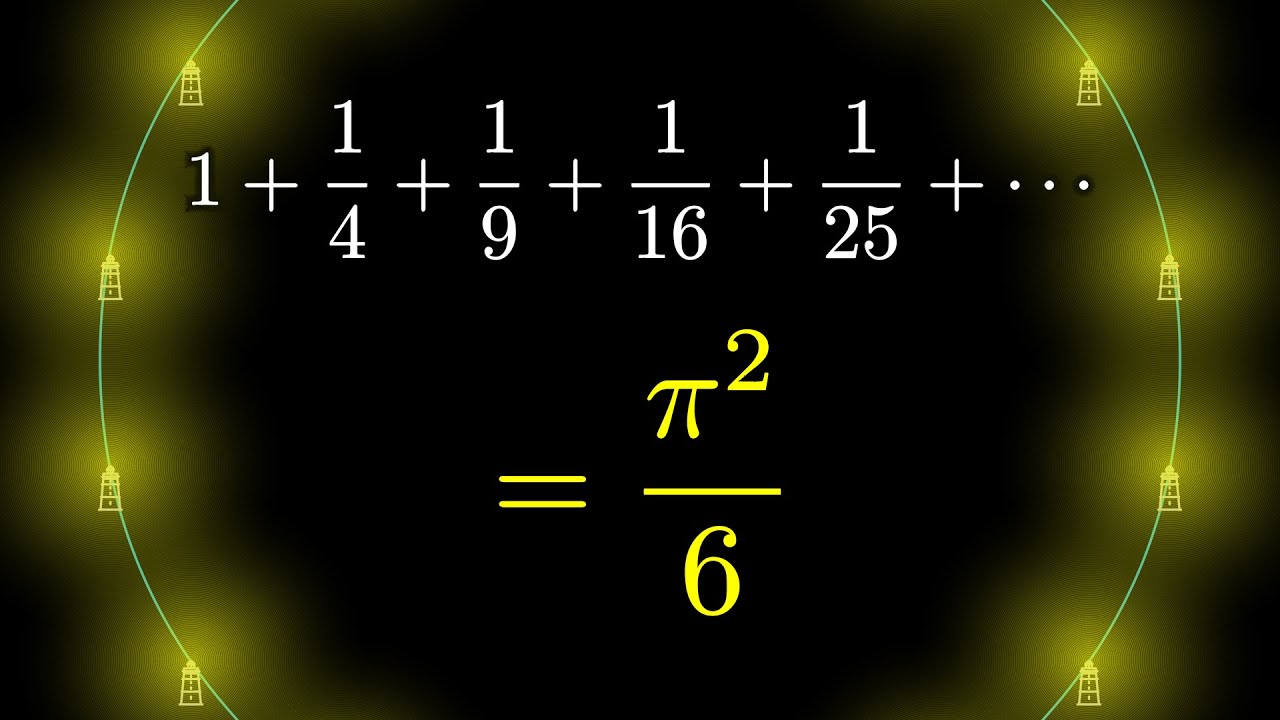
A most beautiful proof of the Basel problem, using light.
Help fund future projects: https://www.patreon.com/3blue1brown
An equally valuable form of support is to simply share some of the videos.
Special thanks to these supporters: http://3b1b.co/basel-thanks
This video was sponsored by Brilliant: https://brilliant.org/3b1b
Brilliant's principl...
tacit arch
mighty zinc
ok but is there any *other* methods?
You're depriving yourself a lot of good math by not understanding Taylor series
mighty zinc
tacit arch
You're depriving yourself a lot of good math by not understanding Taylor series
ok let me see it
ooohh dawm
i remember using it to calculate sine by hand
sad days
now can someone explain it?
vale wigeon
explain what, Taylor series in general?
mighty zinc
how the taylor series explains the original function
vale wigeon
???
mighty zinc
ocean seal
**Ann**
How does the taylor series explain this
vale wigeon
uh. alright
mighty zinc
*listens intensely *
vale wigeon
so in fact you need another somewhat more sophisticated result known as the weierstrass factorization theorem, which is kind of like a version of polynomial factorization except you're working with a function that has infinitely many roots and is also "nice" in a calculus-y sense
the function to be considered in particular is sin(pi x)/(pi x)
whose factorization in this sense is: (1-x)(1+x)(1-x/2)(1+x/2)(1-x/3)(1+x/3)...
mighty zinc
wait wait how?
vale wigeon
its zeroes are precisely the integers except 0 itself
mighty zinc
....
vale wigeon
sin(pi x) = 0 iff x is an integer...
mighty zinc
ohhhh
vale wigeon
sin(pi x)/(pi x) = 0 iff x is an integer other than 0
also just ftr our function's value at x=0 is 1
mighty zinc
i can see
vale wigeon
vale wigeon
whose factorization in this sense is: (1-x)(1+x)(1-x/2)(1+x/2)(1-x/3)(1+x/3)...
this factorization can be written as prod[k=1, infty] (1 - x^2/k^2)
otoh sin(pi x) = sum[n=0, infty] (-1)^n (pi x)^(2n+1)/(2n+1)! = pi x - (pi x)^3/6 + (pi x)^5/120 - ...
that's its taylor series
dividing this by pi x termwise gives us 1 - (pi x)^2/6 + (pi x)^4/120 - ...
and then after doing some polynomial expansion fuckery you can get that the coefficient of x^2 in prod[k in N] (1 - x^2/k^2) is exactly the sum of inverse squares of natural numbers, times -1
vale wigeon
this is incorrect
mighty zinc
but i fail at the first step
vale wigeon
you misread my expression
mighty zinc
vale wigeon
sin(pi x)/(pi x) = 0 iff x is an integer other than 0
this one?
vale wigeon
it's $\paren{1-\frac{x^2}{k^2}}$ not $\frac{1-x^2}{k^2}$!
ocean sealBOT
Ann
 mighty zinc
vale wigeon
otoh sin(pi x) = sum[n=0, infty] (-1)^n (pi x)^(2n+1)/(2n+1)! = pi x - (pi x)^3/...
mighty zinc
vale wigeon
otoh sin(pi x) = sum[n=0, infty] (-1)^n (pi x)^(2n+1)/(2n+1)! = pi x - (pi x)^3/...
but this is.... difficult
vale wigeon
mighty zinc
but this is.... difficult
you will probably not get more elementary proofs than this, sorry.
mighty zinc
vale wigeon
you will probably not get more elementary proofs than this, sorry.
no, i mean like the parsing
im a baby who can only understand LaTeX and symbols
vale wigeon
i'm on my phone so typing latex takes some effort
mighty zinc
ocean seal
**Ann**
and why is it factorial?
vale wigeon
the +1 is meant to go in the exponent...
or rather
since we're dividing by pi x, the +1 should just be gone
vale wigeon
mighty zinc
and why is it factorial?
are you asking why i put an exclamation mark in the message you replied to? that's just an exclamation mark, not a factorial symbol.
mighty zinc
oh
I'm sorry for wasting your precious time but I still do not understand, tell me when you have a PC and can use LaTeX 🥲 .
.close
lone heartBOT
Closed by @mighty zinc
Use .reopen if this was a mistake.
Please take a minute to participate in [our survey](#changelog message) if you haven't already!
Available help channel!
Send your question here to claim the channel.
Remember:
• Ask your math question in a clear, concise manner.
• Show your work, and if possible, explain where you are stuck.
• After 15 minutes, feel free to ping <@&286206848099549185>.
• Type the command .close to free the channel when you're done.
• Be polite and have a nice day!
Read #❓how-to-get-help for further information on how to ask a good question, and about conduct in the question channels.
lone heartBOT
vale wigeon
w is in Nul(A) if and only if Aw = 0
w is in Col(A) if any only if the system Ax=w has a solution
is what yes
no...
would really advise not relying on wa so blindly
if you want, you can have it compute the column space of A
(which, by the way, is not preserved by diagonalization)
,w column space {{2,6},{4,12}}
ocean sealBOT
vale wigeon
the result of the query i just posted is the column space of A
determine whether or not your w lies in this set
indeed it is not.
no
you are overthinking it again.
lone heartBOT
Closed by @acoustic plover
Use .reopen if this was a mistake.
Please take a minute to participate in [our survey](#changelog message) if you haven't already!
vale wigeon
.reopen
lone heartBOT
✅
vale wigeon
there is a much easier way to check whether or not a vector lies in the null space of a matrix
and that easier way is what i suggested at the start
which i think was ignored by you
vale wigeon
vale wigeon
w is in Nul(A) if and only if Aw = 0
.
calculate Aw and see if it's the zero vector or not!
literally just calculate the matrix-vector product! nothing could be simpler!
do you know how to multiply matrices
you are multiplying A by w...
whether or not the result is the zero vector!
what property
we can't and i made no claim that we could!
i'm going to lose my mind
it really feels like
whatever i say
at least three quarters of it just
escapes you entirely
and you fail to read it
and then i have to repeat
repeat
repeat
i have no idea what property you are talking about, still
maybe you have something in mind but you are not making yourself clear at all lol
lone heartBOT
Closed by @acoustic plover
Use .reopen if this was a mistake.
Please take a minute to participate in [our survey](#changelog message) if you haven't already!
lone heartBOT
Available help channel!
Send your question here to claim the channel.
Remember:
• Ask your math question in a clear, concise manner.
• Show your work, and if possible, explain where you are stuck.
• After 15 minutes, feel free to ping <@&286206848099549185>.
• Type the command .close to free the channel when you're done.
• Be polite and have a nice day!
Read #❓how-to-get-help for further information on how to ask a good question, and about conduct in the question channels.
 sly comet

 stone glen
They don't say what parabola it is tho
How are we meant to know the shape of cross section
I think just assume it to be x^2
 rigid smelt
they mentioned that the cross section is parabolic, hence it's shape is that of a parabola
all parabolas are similar
stone glen
rigid smelt
all parabolas are similar
Don't we wanna know the what function defines it tho?
rigid smelt
also, there might be no need for integration here
rigid smelt
stone glen
Don't we wanna know the what function defines it tho?
sure, but like i said, all parabolas are similar, so we can just say that the parabola has the axis of symmetry at x=0 and it's vertex to be at (0,0)
for the depth and width that makes up the waterway, that's for clinx to figure out
lone heartBOT
@sly comet Has your question been resolved?
lone heartBOT
Closed due to timeout
Use .reopen if this was a mistake.
Please take a minute to participate in [our survey](#changelog message) if you haven't already!
Available help channel!
Send your question here to claim the channel.
Remember:
• Ask your math question in a clear, concise manner.
• Show your work, and if possible, explain where you are stuck.
• After 15 minutes, feel free to ping <@&286206848099549185>.
• Type the command .close to free the channel when you're done.
• Be polite and have a nice day!
Read #❓how-to-get-help for further information on how to ask a good question, and about conduct in the question channels.
 runic pewter
Im learning data types and it says "Categorical data are values that cannot be measured up against each other." Can someone explain this to me
lone heartBOT
runic pewter
Im learning data types and it says "Categorical data are values that cannot be m...
runic pewter
I know categorical data is data that can be grouped like age of students in a class, race, sex, etc. Im just confused on what "are values that cannot be measured up against each other" means
 prime badge
i think it doesn't mean anything, they compressed the idea too much
just ignore that sentence
runic pewter
prime badge
just ignore that sentence
Alright thanks, so categorical data is just data that you can group together right?
prime badge
it's something that doesn't behave like a number, e.g. a color of a car, there's no point in averaging two colors, or determining which of 2 colors is larger
runic pewter
prime badge
it's something that doesn't behave like a number, e.g. a color of a car, there's...
What do you mean by doesnt behave like a number
Isnt categorical stuff mainly numbers?
prime badge
no it's not

i was thinking about nominal data, it's true that the ordering may be super meaningful
lone heartBOT
Closed by @runic pewter
Use .reopen if this was a mistake.
Please take a minute to participate in [our survey](#changelog message) if you haven't already!
Available help channel!
Send your question here to claim the channel.
Remember:
• Ask your math question in a clear, concise manner.
• Show your work, and if possible, explain where you are stuck.
• After 15 minutes, feel free to ping <@&286206848099549185>.
• Type the command .close to free the channel when you're done.
• Be polite and have a nice day!
Read #❓how-to-get-help for further information on how to ask a good question, and about conduct in the question channels.
 mild otter
,rotate
 lone heartBOT
mild otter
,rotate
ocean sealBOT
lone heartBOT
mild otter
,rotate
ocean sealBOT
 mild otter
so I thought this was pretty simple
but I keep getting the wrong answer
and incongruent answers such as a = 2 and a = 4 ??
 quick elm
may I see ur working
quick elm
I don't think youre supposed to cube (x+a), the problem did not state that the box is a cube
mild otter
quick elm
I don't think youre supposed to cube (x+a), the problem did not state that the b...
oh, my bad then
I guess it looked like a cube in the diagram, so I didn’t think much about it
quick elm
how does the volume of the box relate to the area of the top and its height
mild otter
quick elm
how does the volume of the box relate to the area of the top and its height
I believe the volume is lxhxw
we know the height
and we can probably figure out what the top is
if (x+a)(something) = x^2 + cx + 4
i think im mistaken actually
quick elm
you're right that the volume is lxhxw
so we know h
and how can we express the area of the top in terms of the sides of the box?
mild otter
mild otter
the volume is x^3 + 12x^2 + bx + 30
(x+a)(something)(something) = this
I don’t know how to find the something
quick elm
quick elm
and how can we express the area of the top in terms of the sides of the box?
just answer this question first
mild otter
quick elm
and how can we express the area of the top in terms of the sides of the box?
x^2 + cx + 4 ?
sorry, im confused
quick elm
in terms of l,h, and w how can we express the area of the top of the box
mild otter
the top would be w x l ?
mild otter
ah
quick elm
we also know lxw, that's the area of the top which is x^2+cx+4
quick elm
yeahhh
mild otter
so we just expand and compare?
quick elm
and so you should equate them and then compare coefficients yeahhh
mild otter
great, thank you !
lone heartBOT
@mild otter Has your question been resolved?
lone heartBOT
Closed due to timeout
Use .reopen if this was a mistake.
Please take a minute to participate in [our survey](#changelog message) if you haven't already!
Available help channel!
Send your question here to claim the channel.
Remember:
• Ask your math question in a clear, concise manner.
• Show your work, and if possible, explain where you are stuck.
• After 15 minutes, feel free to ping <@&286206848099549185>.
• Type the command .close to free the channel when you're done.
• Be polite and have a nice day!
Read #❓how-to-get-help for further information on how to ask a good question, and about conduct in the question channels.
alpine sable
how do i find the solution curve of dy/dx = 1 - y
rigid smelt
what have you tried?
lone heartBOT
@alpine sable Has your question been resolved?
 solemn grove
alpine sable
how do i find the solution curve of dy/dx = 1 - y
solemn grove
alpine sable
how do i find the solution curve of dy/dx = 1 - y
you can separate and integrate or use if
(integrating factor)
which one have you learnt
La place transform for this is overkill but it defo works
lone heartBOT
Closed due to timeout
Use .reopen if this was a mistake.
Please take a minute to participate in [our survey](#changelog message) if you haven't already!
Available help channel!
Send your question here to claim the channel.
Remember:
• Ask your math question in a clear, concise manner.
• Show your work, and if possible, explain where you are stuck.
• After 15 minutes, feel free to ping <@&286206848099549185>.
• Type the command .close to free the channel when you're done.
• Be polite and have a nice day!
Read #❓how-to-get-help for further information on how to ask a good question, and about conduct in the question channels.
alpine sable
 lone heartBOT
alpine sable
lone heartBOT
alpine sable
 solemn anchor
could try somethiung like that?
 alpine sable
I don't know how to do
 thick star
alpine sable
I don't know how to do
thick star
alpine sable
I don't know how to do
the sum of all angles on a straight line is 180 and the sum of all angles in a triangle is 180
solemn anchor
@thick star can u help them cos i dont trust myself😭
solemn anchor
same
vale kelp
yay!
alpine sable
ok
alpine sable
alpine sable
how about this one?
alpine sable
alpine sable
I think U should approach the problem like this

angle CDE = 70
angle DCE + angle CDE = 96
angle DCE = 26
26 + x = 180
x = 154
u should ping helpers they can help u better
I count until 64
vale kelp
alpine sable
angle CDE = 70
angle DCE + angle CDE = 96
angle DCE = 26
26 + x = 180
x = 154
I agree
alpine sable
why don't you count CED
alpine sable
alpine sable
why don't you count CED
cause I didnt require
alpine sable
alpine sable
angle CDE = 70
angle DCE + angle CDE = 96
angle DCE = 26
26 + x = 180
x = 154
I think this will help
where do you find DCE?
oh nvm I saw it
But my answer is completely different from yours
solemn anchor
what is ur answer
alpine sable
180-96=84
180-110=70
180-70-84=26=DCE
360-26-26=128=2x
128 divide 2=64
that's what I got
solemn anchor
180-96=26?
alpine sable
sorry, wrote wrong
alpine sable
alpine sable
180-96=84
180-110=70
180-70-84=26=DCE
360-26-26=128=2x
128 divide 2=64
Is my answer still wrong?
-idk mate I am confused myself lol-
solemn anchor
360-28-28=128?
alpine sable
solemn anchor
360-28-28=128?
its the center, so I used 360 minus DCE or 26 from both sides, then I get 2x
solemn anchor
360-26-26 is not 128
alpine sable
my calculation, is literally off the railing
solemn anchor
154
lone heartBOT
Closed by @waxen crown
Use .reopen if this was a mistake.
Please take a minute to participate in [our survey](#changelog message) if you haven't already!
Available help channel!
Send your question here to claim the channel.
Remember:
• Ask your math question in a clear, concise manner.
• Show your work, and if possible, explain where you are stuck.
• After 15 minutes, feel free to ping <@&286206848099549185>.
• Type the command .close to free the channel when you're done.
• Be polite and have a nice day!
Read #❓how-to-get-help for further information on how to ask a good question, and about conduct in the question channels.
 lapis merlin
 lone heartBOT
lapis merlin
ocean sealBOT
lone heartBOT
lapis merlin
ocean sealBOT
ElevatedElmo
 lone heartBOT
@lapis merlin Has your question been resolved?
lone heartBOT
@lapis merlin Has your question been resolved?
lone heartBOT
Closed by @vale wigeon
Use .reopen if this was a mistake.
Please take a minute to participate in [our survey](#changelog message) if you haven't already!
Available help channel!
Send your question here to claim the channel.
Remember:
• Ask your math question in a clear, concise manner.
• Show your work, and if possible, explain where you are stuck.
• After 15 minutes, feel free to ping <@&286206848099549185>.
• Type the command .close to free the channel when you're done.
• Be polite and have a nice day!
Read #❓how-to-get-help for further information on how to ask a good question, and about conduct in the question channels.
 onyx viper
Good day! Anyone able to help with this exponential equation? The key is to solve without logs but I’m kind of at a lost here without it. Thanks!
3^(2x+1) - 3^(x+2) + 6 = 0
lone heartBOT
onyx viper
Good day! Anyone able to help with this exponential equation? The key is to solv...
gray isle
have you tried anything?
onyx viper
gray isle
have you tried anything?
I tried to break up 6, break down 3, etc to use exponential properties but I can’t really get to anything.
One of the solutions is definitely 0 because dividing the whole solution out by 3 throws (x) out the window but my test question is asking for 2 answers without the use of logs. Seems like I’m missing something obvious but I’ve been stuck for awhile now



 vale sapphire


 tender dew


