#help-0
1 messages · Page 937 of 1
 echo socket
 covert agate
oh

wait how did he multiply by sec/|sec| outside?
sec/|sec| is still a function
not a constant
<@&286206848099549185>
 lone heartBOT
@covert agate Has your question been resolved?
 little drum
What's the issue Chromium?
covert agate
integrating |sec|
covert agate
covert agate
wait how did he multiply by sec/|sec| outside?
?
little drum
hmm
little drum
covert agate
sec/|sec| is still a function
Indeed, $\frac{\sec x}{|\sec x|}$ is still a function, that outputs the sign of sec x in the interval for which the integral is done
 ocean sealBOT
Ansh
 little drum
the thing is, for whichever interval sec x is Riemann integrable, it's sign function remains the same throughout the interval
so the area under the curve is simply the area under the curve of sec x, with a sign function of sec x attached so that the interval decides on the sign of the area under curve
covert agate
i don’f get it
little drum

"the area is just the area under the curve of "sec x" with the sign of "sec x" in the interval
little drum
we're not talking about shit in general (@_@;)
rn, we're talking about |sec x|
If you're soooo hell bent on generalizing though, at most you'd want to talk about some function that has an absolute value function involved
covert agate
yea
how do we find int |f|
in terms of F
or is there no general antiderivative expression?
little drum
We don't lol.. that's the point.. there's no general antiderivative expression as such
the most realistic approach is to break the |f| into intervals and add up to the respective areas to conclude
,w plot |x| + |x-1| + |x-2|
ocean sealBOT


 Requested by Ansh#3502
little drum
Requested by Ansh#3502
little drum
consider this for example 
 velvet pelican
hmm that actually looks integrable 
covert agate
it’s always bigger than 0 lol
ocean sealBOT
 Requested by Ansh#3502
little drum
Requested by Ansh#3502
little drum
theree
velvet pelican
iirc $\int |x| dx = x|x|/2 +c$
ocean sealBOT
Frosty
 little drum
hmm yep
covert agate
how..?
little drum
same thing, x > 0 => x²/2 ; x<0 => -x²/2
You really don't want to think about generalizing it tbh, or it'd be a mess if you start coming across integrals that'd be far easily dealt with by just being flexible with them, than being crude and using the generalized approach
covert agate
huh
velvet pelican
yea, im not sure whether you can generalise to |f|
covert agate
little drum
we're not talking about shit in general (@_@;)
rn, we're talking about |sec x|
so how do we continue about sec
little drum
Start with integrating: $\int |x| \dd{x}$
ocean sealBOT
Ansh
 little drum
Note: $|x| = x\cdot sgn(x)$
ocean sealBOT
Ansh
 little drum
sign function - signum function, whichever you call it
ocean sealBOT
Ansh
 covert agate
😋
covert agate
ocean seal
**Ansh**
anyway, what then?
ocean sealBOT
Ansh
 covert agate
yea..?
little drum
$=sgn(\sec x) \int \sec x \dd{x}$
ocean sealBOT
Ansh
 little drum
that's it :|
covert agate
why can we just take it out???
ocean sealBOT
Ansh
 little drum
No it doesn't :/
covert agate
why can we take out the signum thing again?
little drum
Signum thing, within the interval of "x" is just the sign of the area
which is +1 or -1, i.e., a constant
 pulsar aspen
little drum
Signum thing, within the interval of "x" is just the sign of the area
pulsar aspen
little drum
Signum thing, within the interval of "x" is just the sign of the area
Wait, the proof might be less obvious than you think. Imagine a continous but nowhere differentiable function.
little drum
:o
pulsar aspen
Splitting the case where f(x) = +1, f(x)=-1, or f(x)=0 might not work because it may create a nonmeasurable set.
little drum
 why would differentiability affect the integral
covert agate
covert agate
why can we take out the signum thing again?
can this be rigorously proven
pulsar aspen
I'm just being careful. I might still be wrong, though. Just look what if f is a weierstrass function.
covert agate
int |f| = signum(f) int f?
little drum
the proof lies within the separation of intervals
covert agate
covert agate
int |f| = signum(f) int f?
wait so this is true????
holy shit it is
differentiate the rhs
you get |f| right?
little drum
Well I prefer to think as integrals as the area under the curve rather than the "opposite of derivative" so, yeah that holds true for me
ocean sealBOT
 Requested by Ansh#3502
little drum
Requested by Ansh#3502
little drum
what do you think 👀
pulsar aspen
little drum
the proof lies within the separation of intervals
No, I mean, how does separation of intervals work on a function like Weierstrass function which is fractal
covert agate
isn’t it always 0..?
little drum
yha
little drum
pulsar aspen
No, I mean, how does separation of intervals work on a function like Weierstrass...
hmmm.. abs(....) function basically flips the -ve graph w.r.t. the x axis :o
so whatever the interval is, say any arbitrary interval, when W was negative, is now positive, and the integral in the interval is still sgn(W) int W, in the interval
covert agate
so we can’t differentiate sgn(x) • f?
little drum
$\lim_{h\to 0} \frac{sgn(x+h)f(x+h) - sgn(x)f(x)}{h}$
ocean sealBOT
Ansh
 little drum
*y = |x| is not differentiable at x = 0
pulsar aspen
little drum
hmmm.. abs(....) function basically flips the -ve graph w.r.t. the x axis :o
so...
The problem is, the "interval" may not actually be interval. Is it always the case that {x | f(x) >0} can be decomposed into open intervals and countably many singletons if f is a nowhere differentiable function?
little drum
no (@_@;)
the point remains the same still though, although you can't really generalize.. flexibly checking on the intervals for your function should give you a thorough understanding of why your sgn(f(x)) is free to come out of the integral
Also @covert agate I found a decent site for you that I myself refer to when stuck with some questions
If you'd like to check https://tutorial.math.lamar.edu/classes/calci/ProofIntProp.aspx#Extras_IntPf_FToCII
In this section we prove some of the facts and formulas from the Integral Chapter as well as a couple from the Applications of Integrals chapter.
covert agate
yea
thats what i use often
so
we assume sec θ > 0, then we’re done with the signum issue?
(will also need a caae where sec θ < 0, but that’s just sec θ > 0 negated)
little drum
mhmm
little drum
and sgn(sec theta) take cares to adjust that dependency
covert agate
original integral 1/√(x² + 1)
little drum
and for all practical purposes, you can assume that no-one's smart enough to ask you to integrate |sec x| in interval: say [pi/4, 3pi/4] (@_@;)
because there's a vertical asymptote at pi/2 right there
covert agate
little drum
and sgn(sec theta) take cares to adjust that dependency
wdym
little drum

the integral will be done in one of these intervals no?
the sgn(sec theta) derives the sign of the area accordingly and you're done
btw, ngl, the x = tan(u) substitution is hella dodgy too lol
 little drum
nope it's correct
covert agate
!?
little drum
I'm only solely concerned about the x = tan(u) part
has something to do with how inverse trig works but nvm
 pale kestrel
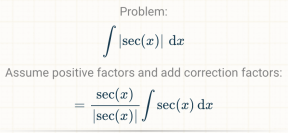
Do you understand this?
if you do, then there is no modulus sign to worry about any more.
little drum
the sgn(secx) coming out was the issue
covert agate
(and i still don’t get it)
pale kestrel
For a general f, check if this is true, then.
covert agate
(ffs)
pale kestrel
by drawing a graph
covert agate
pale kestrel
For a general f, check if this is true, then.
int |f| = sgn(f) F?
but sgn is not differentiable lol
covert agate
aren’t we working with antiderivatives
pale kestrel
wtf
covert agate
instead of area
pale kestrel
urghhhhhhhhhhhhh
little drum
hmmmmmmm
little drum
I read absolute value function has no antiderivative
pale kestrel
$$\int^b_a |f(x)| \dd x = \frac{f}{|f|}\int^b_af(x) \dd x$$
 hasty elk
This is so much more entertaining as a lurker
little drum
Camilleone saves the day
ocean sealBOT
Shuri2060
 little drum
help
covert agate
👏
covert agate
pale kestrel
You can see this is true right?
uhh not really
pale kestrel
draw an example while I write some latex 💤
covert agate
yea i tried lol
pale kestrel
just draw a general f
that goes positive negative
then draw what the modulus version looks like
Then notice how the area is flipped by the f/|f|
covert agate
wait what even is modulus lol
pale kestrel
????????//
| . |
^absolute value signs
$$\frac{f}{|f|}(x) = \begin{cases}1&f(x)>0\\-1&f(x)<0\end{cases}$$
ocean sealBOT
Shuri2060
 pale kestrel
$$\int^b_a |f(x)| \dd x = \int^b_a\frac{|f(x)|}{f(x)}f(x) \dd x$$
ocean sealBOT
Shuri2060
 pale kestrel
@covert agate do u follow?
covert agate
yea
pale kestrel
But you wouldn't follow if I just took that fraction outside?
covert agate
i wouldnt
pale kestrel
Let
$$S_{>0}=\bigcup_i\left{(a_i, b_i):a_i<x<b_i, f(x)>0\right}$$
$$S_{<0}=\bigcup_i\left{(a_i, b_i):a_i<x<b_i, f(x)<0\right}$$
hmmmm
no.
ocean sealBOT
Shuri2060
 echo socket
Wouldn't it be easier to write {x : f(x) > 0} tho?
pale kestrel
I want to break the integral into bits
depending on the sign of f
So I need to involve the limits right?
ok no no no
I should just use the indicator function
$$\bd{1}_A(x) = \begin{cases}1&x\in A\0&x\not\in A\end{cases}$$
ocean sealBOT
Shuri2060
 pale kestrel
$$\bd{1}_{\bR^+}(x) = \begin{cases}1&x\in \bR^+\0&x\not\in \bR^+\end{cases}$$
ocean sealBOT
Shuri2060
 pale kestrel
$$\bd{1}_{\bR^+}(x) = \begin{cases}1&x>0\0&x\leq0\end{cases}$$
ocean sealBOT
Shuri2060
 pale kestrel
$$\bd{1}_{\bR^-}(x) = \begin{cases}1&x<0\0&x\geq0\end{cases}$$
ocean sealBOT
Shuri2060
 pale kestrel
$$\int^b_a |f(x)| \dd x = \int^b_a\frac{|f(x)|}{f(x)}\bd{1}{\bR^+}(x)f(x) \dd x + \int^b_a\frac{|f(x)|}{f(x)}\bd{1}{\bR^-}(x)f(x) \dd x$$
@covert agate ok ok this is the next step
pale kestrel
ocean seal
**Shuri2060**
This is the indicating function
And I'm using it to indicate if f(x) is positive or not
covert agate
ocean seal
**Shuri2060**
not good with union notation
pale kestrel
Chuck that
Just the indicating function is needed.

I'm setting A to be the positive reals and the negative reals in the 2 cases
$$\int^b_a |f(x)| \dd x = \int^b_a\frac{|f(x)|}{f(x)}f(x) \dd x$$
$$= \int^b_a\frac{|f(x)|}{f(x)}\bd{1}{\bR^+}(f(x))f(x) \dd x + \int^b_a\frac{|f(x)|}{f(x)}\bd{1}{\bR^-}(f(x))f(x) \dd x$$
ocean sealBOT
Shuri2060
 pale kestrel
I then split up the right integral into positive and negative area, essentially.
ocean sealBOT
Shuri2060
 covert agate
i don’t get this
pale kestrel
$$\bd{1}_{\bR^+}(f(x)) = \begin{cases}1&f(x)>0\0&f(x)\leq0\end{cases}$$
ocean sealBOT
Shuri2060
 pale kestrel
^Do you get this?

Let's start with the definition of indicating function
Does that make sense
covert agate
yea
pale kestrel
ocean seal
**Shuri2060**
Continuing on from this
$$\bd{1}_{\bR^+}(f(x))f(x) = \begin{cases}f(x)&f(x)>0\0&f(x)\leq0\end{cases}$$
ocean sealBOT
Shuri2060
 covert agate
yea
pale kestrel
$$\bd{1}_{\bR^-}(f(x))f(x) = \begin{cases}f(x)&f(x)<0\0&f(x)\geq0\end{cases}$$
ocean sealBOT
Shuri2060
 pale kestrel
And the same for the other case

Next I get to here
By 'splitting' my integral
The left term represents all the 'positive' area (above x-axis)
The right term represents all the 'negative' area (below x-axis)

The left term is the blue area
The right term is the green area

$$\int^b_a f(x)\dd x= \int^b_a\bd{1}{\bR^+}(f(x))f(x) \dd x + \int^b_a\bd{1}{\bR^-}(f(x))f(x) \dd x$$
Sorry to make things clearer
JUST consider this for now.
ocean sealBOT
Shuri2060
 pale kestrel
This is my claim for any general f
covert agate
yea
pale kestrel
So back to this
ahhh
1 sec
no ok i should get rid of this
Stick with this
$$\int^b_a f(x)\dd x= \int^b_a\bd{1}{\bR^+}(f(x))f(x) \dd x + \int^b_a\bd{1}{\bR^-}(f(x))f(x) \dd x$$
ocean sealBOT
Shuri2060
 pale kestrel
$$\int^b_a |f(x)|\dd x= \int^b_a\bd{1}{\bR^+}(f(x))f(x) \dd x - \int^b_a\bd{1}{\bR^-}(f(x))f(x) \dd x$$
ocean sealBOT
Shuri2060
 pale kestrel
Next claim
Modulus sign on function means I add the positive area and subtract the negative area

^I can't take the fraction outside for a definite integral
The outside has no x's (my mistake)
pale kestrel
ocean seal
**Shuri2060**
So instead, I will work with this
Ok now I'm suddenly unconvinced by this

🤔 🤔 🤔 🤔 🤔
@hasty elk @little drum is this actually correct?
covert agate
(wait i can just tag you guys???)
hasty elk
LOL
little drum
kek
hasty elk
Did you confuse yourself shuri
pale kestrel
yes.
im thinking antiderivatives and it makes sense (i think)
but when i go back to areas, i ?????
hasty elk
It makes sense
pale kestrel
 little drum
$\int^{\frac{3\pi}{8}}_{\frac{\pi}{4}} |\sec x|$... yeah makes sense
When you go to anti derivative, the antiderivative is piecewise defined
hasty elk
The idea is that ./|.| acts as a reflection of the negative part
ocean sealBOT
Ansh

 pale kestrel
 little drum
what's the integral |sec x| from pi/4 to 3pi/4? would you just plug in the value in the anti-derivative and get F(3pi/4)-F(pi/4)?
pale kestrel
Ok, no, this is pretty much as far as we get for the definite integral
pale kestrel
little drum
what's the integral |sec x| from pi/4 to 3pi/4? would you just plug in the value...
Are you crossing poles? If yes, you can't
hasty elk
When you get down to it, it's abusing the hell to goddamn mars and back that the negative of the integral is the integral of the negative
little drum
ofc right, you're crossing the asymptotes
forget that, the integral itself is divergent when the upper limit is pi/2 :/ but that doesn't stop you from writing the integral in a finite interval as an antiderivative right?
pale kestrel
You can write down the antiderivative
Which is indeed an antiderivative
For the domain of the original function
However, if your definite integral spans across poles
It means you chop it up
little drum
hmm?
pale kestrel
(and it will be improper pieces)
little drum
yeah
pale kestrel
$$\int_{-1}^1 x^{-1}\dd x = \lim_{a\to0}\int_{-1}^a x^{-1}\dd x + \lim_{a\to0}\int_{a}^1 x^{-1}\dd x $$
ocean sealBOT
Shuri2060
 pale kestrel
Is how we interpret this, I believe. (if it doesn't exist, the integral doesn't)
hasty elk
Provided it exists
pale kestrel
So I am going to have to go back to unions
$$\int^b_a |f(x)|\dd x= \int^b_a\bd{1}{\bR^+}(f(x))f(x) \dd x - \int^b_a\bd{1}{\bR^-}(f(x))f(x) \dd x$$
ocean sealBOT
Shuri2060
 pale kestrel
$$= \sum\int^{b_i}{a_i}\bd{1}{\bR^+}(f(x))f(x) \dd x - \sum\int^{b_j}{a_j}\bd{1}{\bR^-}(f(x))f(x) \dd x$$
ocean sealBOT
Shuri2060
 pale kestrel
$$=\left(\sum F(b_i) - F(a_i)\right) - \left(\sum F(b_j) - F(a_j)\right)$$
ocean sealBOT
Shuri2060
 pale kestrel
ocean seal
**Shuri2060**
pale kestrel
ocean seal
**Shuri2060**
Split the positive parts into bits.
pale kestrel
ocean seal
**Shuri2060**
Then you'll find the definite integral corresponds
little drum
Ahhhhhhh I seee how you were tryna put it >_<
honestly though, being flexible between switching to antiderivative and area arguments is for the best at hs/early uni level
pale kestrel
Sure. Well it's not bad being sus of stuff like this
although in calculus... well hmm
hasty elk
In calculus things tend to be sufficiently nice
little drum
no no.. I'm not trying to dissuade them here.. Just,
You'll get to know your stuff better as you go one step at a time
pale kestrel
It's a lot easier to look back and question later
hasty elk
You really only run into issues once you hit the more mindscrewy parts of real analysis, and at that point you have the tools to understand in far greater detail
pale kestrel
ocean seal
**Shuri2060**
Like I'm doing rn lol, still not 100% convinced algebraically
little drum
The only use for the "antiderivative argument" which I see, at this level, is if you're proficient enough to assume a F and differentiate it, make some alterations and conclude your integral that way and correspondingly saves a hell lot of time than say, u-substituting/using IBPs etc. on several occasions
pale kestrel
ok ok 1 sec


I'm confused how the heck that antiderivative corresponds to the definite integral
Surely it doesnt and you have to chop that integral and then use that antiderivative
pale kestrel
pale kestrel
Surely it **doesnt** and you have to chop that integral and **then** use that an...
I'm like hoping I'm wrong and just thinking about something wrong but
hasty elk
We're back to the same argument that the area is really specific to a...well, a specific antiderivative
pale kestrel
pale kestrel
Surely it **doesnt** and you have to chop that integral and **then** use that an...
Am I wrong lol. If yes, just gonna figure it out haha
hasty elk
For modulus functions antiderivatives tend to require piecewise definitions
And that makes sense because there's no actual way to integrate |x| in one shot using only elementary functions without resorting to piecewise chopping
pale kestrel

Ok I am right
You have to take the definite integral piecewise
The area clearly isn't negative.
@covert agate sorry, does that make more sense?
pale kestrel

Back to the original problem
Your 'anti-derivative' IS gonna end up being piece wise
covert agate
little drum
btw, ngl, the x = tan(u) substitution is hella dodgy too lol
uhh this is the og integral? (shouldn’t we end up with |sec u| instead of sec u)
pale kestrel
And not continuous in most cases
 pale kestrel
In this case it wasn't.
hasty elk
Desmos is actually screwing this up a bit
pale kestrel
pale kestrel
But sure as hell not like this
little drum
:o
hasty elk
Yeah
pale kestrel
You want to shift the purple thingies up and down
to connect
So that antiderivative from the calculator is only valid over joined up bits
hasty elk
But saying antiderivatives are not continuous kind of breaks things very badly because antiderivates need to be differentiable
pale kestrel
So when you calculate the definite integral it needs to be broken up
pale kestrel
hasty elk
But saying antiderivatives are not continuous kind of breaks things very badly b...
In that case the calculator approached wrongly surely
What it spat out wasn't an antiderivative
It was only one over piecewise domains
 hasty elk
Yes
hasty elk
LOL
pale kestrel
This reminds me of winding numbers if we take mod 2
hasty elk
This reminds me of how integral of 1/x is not ln |x| + C
In my year 1 everyone went wtf at it
hasty elk
^ there we go
pale kestrel
hasty elk
This reminds me of how integral of 1/x is _not_ ln |x| + C
elaborate 😢
it is over the original domain
(but the C is not constant everywhere)
hasty elk
Precisely
pale kestrel
That's the special property of the constant of integration 😉
hasty elk
C can differ at less than 0 and more than 0, so the true integral is written piecewise
Very mindscrew

 covert agate
bruh
pale kestrel
@covert agate On a more serious note, I can't imagine anyone being asked to find the antiderivative of |f(x)| properly
Like where the hell did that question come from smh
covert agate
little drum
btw, ngl, the x = tan(u) substitution is hella dodgy too lol
original problem
little drum
=_= don't involve me smh
Your problem was: antiderivative = integral
maybe, I'm not even sure lol... that statement was only in concern of the substitution
hasty elk
I don't even know what the original problem was HAHA
 hasty elk
I just came here after finishing writing a four page latex on parameterizing a general circle in 3D
pale kestrel
 hasty elk
Saw entertainment
covert agate
 tawny orchid
I think?
tawny orchid
I think?
3rd line should’ve been |sec x| no?
pale kestrel
bottom.
little drum
the original problem in context 🤦♂️
 pale kestrel
I'd honestly hate doing this kind of problem without limits
(i mean definite integral)
pale kestrel
Wellll I don't find being able to do hard integrals by hand thaaattttttt important 😂 😂 😂
Realistically, most integrals are impossible to solve and we have computers 😏
hasty elk
Gotta keep on the ball if i don't want to do shady things
hasty elk
pale kestrel
Wellll I don't find being able to do hard integrals by hand thaaattttttt importa...
Two words: Pure. Math.
covert agate
wait what do you do in phd math lol
pale kestrel
cami is phd?
covert agate
yes
covert agate
shuri are you bsc
hasty elk
I'm working on functional analysis, harmonic analysis, and statistics all rolled in one
pale kestrel
and riemann
hasty elk
I don't even know how i got to this point
covert agate
hasty elk
I'm working on functional analysis, harmonic analysis, and statistics all rolled...
how cursed is phd statistics like
hasty elk
It's all integrals
pale kestrel
that sounds nicer than normal stats
covert agate
multidimensional ones?
 pale kestrel
$\int\int\int\int\int\int\int\int\int\int f(A,B,C,D,E,F,G,H,Z)$
ocean sealBOT
Shuri2060
 hasty elk
One dimension, two dimensions, n dimensions, countably many dimensions...
All sorts of shady things appear
hasty elk
Phd courses: here have n dimensional integrals for free
covert agate
in fucking statistics??
hasty elk
Phd research: here have countably many integrals for free
Yes, in fucking statistics
Tbh i like it better this wY
I actually understand things
Not like bullshit shady hypo testing
 sterile idol
hasty elk
Phd research: here have countably many integrals for free
sterile idol
hasty elk
Phd research: here have countably many integrals for free
no thanks :)
hasty elk
Give me countably many integrals any day
sterile idol
sterile idol
no thanks :\)
do we even have a choice
pale kestrel
@covert agate Ok back to the original problem, when you do your substitution I think you're meant to separately consider the integral over different domains
If you do sub in sec
covert agate
pale kestrel
<@!701895792763600896> Ok back to the original problem, when you do your substit...
wdym
ocean sealBOT
Shuri2060
 covert agate
yea
ocean sealBOT
Shuri2060
 pale kestrel
$$\dv{x}{u} = \sec^2 u$$
ocean sealBOT
Shuri2060
 pale kestrel
$$\dd{x} = (\sec^2 u)\dd u$$
ocean sealBOT
Shuri2060
 pale kestrel

Ok, so whenever we substitute for indefinite integrals
We have to be able to undo the substitution
covert agate
yea
pale kestrel
to get the final answer in terms of x
Therefore, we only consider bijective versions of tan
 covert agate
bijective??
pale kestrel
Yes, we only let u go from -pi/2 to pi/2
uhhh you know what bijective means or not?
covert agate
no
pale kestrel
D:
covert agate
not surjective
hasty elk
uh oh
covert agate
maybe injective
covert agate
isn’t it analysis
hasty elk
NO
pale kestrel
Not really?
Its just like basic functions stuff
Elementary set theory???
Like something you should know anyways.
hasty elk
bijective functions is like everyone should know
covert agate
(can barely do sets, fuck)
pale kestrel
what do u mean barely do
if u can union intersection complement
you're good to go for now lol
pale kestrel
the heck?
hasty elk
wat.
pale kestrel
$A\cap B$
ocean sealBOT
Shuri2060
 covert agate
yea
covert agate
cup as to or
cap as to and
pale kestrel
$${(x, y)}$$
ocean sealBOT
Shuri2060
 pale kestrel
Curious, have you seen functions denoted like this
covert agate
no
pale kestrel
as a set of ordered pairs (x, y)
ocean sealBOT
Shuri2060
 pale kestrel
This notation is familiar?
covert agate
yea
pale kestrel
f is a function that maps to domain A to codomain B
covert agate
codomain is superset of range
pale kestrel
yes.
pale kestrel
yes
pale kestrel
$f(x) = f(y) \implies x=y$
ocean sealBOT
Shuri2060
 pale kestrel
ocean seal
**Shuri2060**
pale kestrel
ocean seal
**Shuri2060**
this is injective
covert agate
ocean seal
**Shuri2060**
injectivity
pale kestrel
what do you mean surjective
superset
what
anyways, range = codomain
means surjective
covert agate
superset is like anti subset?
pale kestrel
look, i never use that word
hasty elk
i have a feeling i need to track down a good book
pale kestrel
almost
ever
$${(a, f(a)) : a\in A}$$
@covert agate so this is an alternate way to represent functions
ocean sealBOT
Shuri2060
 covert agate
huh
pale kestrel
This represents f
For example, if f(x) = x^2 for real x
(1, 1) is in the set
(2, 4) is in the set
(sqrt2, 2) is in the set
(-sqrt2, 2) is in the set
hasty elk
think of it in terms of a graph, the set of all coordinates of the function f is exactly that set
covert agate
oh yea coordinates
pale kestrel
Why I bring this up
sterile idol
ocean seal
**Shuri2060**
Oh I know this y = f(a) so (x, y) and a is in some set?
pale kestrel
Well if a function has an inverse
pale kestrel
no
covert agate
wait, how do we define codomain lol
pale kestrel
bijective = injective AND surjective
pale kestrel
sterile idol
Oh I know this y = f(a) so (x, y) and a is in some set?
yes.
its just a superset of the range
sterile idol
Some of this is recognizable from haskell
pale kestrel
lel
hasty elk
pale kestrel
Inverse exists iff bijective
hasty elk
it's got nice colours
pale kestrel
If inverse exists, then the inverse function will be all those coordinates but swapped

And you kinda should be familiar with this stuff
before doing idk
calculus
When substituting in indefinite integrals, you need a bjective substitution
or you can't undo it (since the final answer needs to be in terms of the original variable)
hasty elk
before doing any kind of mathematics at the high school level even
pale kestrel
which bit.
pale kestrel
Readup on chapter 5
covert agate
covert agate
wait, how do we define codomain lol
?
pale kestrel
cami sent
pale kestrel
$$f:\bR\to\bR$$
ocean sealBOT
Shuri2060
 pale kestrel
We usually do stuff like this
even though f might not map to all of R
Just for convenience/generalisation
sterile idol
Wait what's the difference between codomain and range
pale kestrel
Codomain can be any superset of the range
The range is everything f can map to
$$\Im(f) := f(X) := {f(x) : x\in A}$$
ocean sealBOT
Shuri2060
 sterile idol
pale kestrel
Not relevant to this, but yes?
sterile idol
pale kestrel
Not relevant to this, but yes?
Yeah it wasn't supposed to be
ocean sealBOT
Shuri2060
 sterile idol
ocean seal
**Shuri2060**
sterile idol
ocean seal
**Shuri2060**
What's Im here
pale kestrel
Image of f
sterile idol
and :=
sterile idol
pale kestrel
Image of f
image?
sterile idol
Ah ok
covert agate
pale kestrel
Therefore, we only consider bijective versions of tan
alright then?
pale kestrel
so we restrict the domain of tan
to
(-pi/2, pi/2)
that makes tan bijective and therefore invertible

We only consider the middle curve this way

Now we have a substitution function that is invertible
This is important for indefinite integral substitution. After substituting and integrating, you need to undo the substitution to have the final answer in terms of the correct variable
Definite integral substitution --- you don't necessarily need a bijective substitution.
pale kestrel
You also convert the limits of the integral when you substitute for definite.
So there is no need to undo the sub
sterile idol
Oh ok
I have only reached till limits in school till now
so I don't know any of this
Good day
lone heartBOT
@covert agate Has your question been resolved?
Channel closed
Closed by @covert agate
Use .reopen if this was a mistake.
 Available help channel!
Send your question here to claim the channel.
Remember:
• Ask your math question in a clear, concise manner.
• Show your work, and if possible, explain where you are stuck.
• After 15 minutes, feel free to ping <@&286206848099549185>.
• Type the command .close to free the channel when you're done.
• Be polite and have a nice day!
Read #❓how-to-get-help for further information on how to ask a good question, and about conduct in the question channels.
 oblique vigil
 lone heartBOT
oblique vigil
oblique vigil
lone heartBOT
oblique vigil
oblique vigil
I’m absolutely clueless as to how and why exactly this happened. Thank you to whoever helps me!!!!
I need it explained like I’m 5, because I’ve been literally trying to understand how and why for the past 2 days
lone heartBOT
@oblique vigil Has your question been resolved?
 sage bronze
oblique vigil
sage bronze
oblique vigil
(-log(3) -4log(8))x = -2log3
(-1)[log(3)+4log(8)]x = (-1)(2log3)
divide both sides by -1
oblique vigil
Do you know why we divide both sides by -1?
 placid zinc
"Divide both sides by -1"
Is a way to change the sign of both sides
If -x = -3
Then x = 3
If (-log3 - 4log8)x = -2log3
Then (log3 + 4log8)x = 2log3
You can also think of this as "Multiply both sides by -1", same thing.
oblique vigil
Can we do that because the entire equation is negative on both sides?
placid zinc
You can just always do that
You can multiply both sides by 2 any time you want. You can multiply both sides by -1 any time you want
That is, you can flip the sign on both sides any time you want
oblique vigil
Ok, now this is making a lot of sense!!!!!!!!!!!
So no matter what the equation, this isn’t special to logs or anything
placid zinc
Ye the logs aren't doing anything to make this happen
oblique vigil
Thank you so incredibly much!!!!!
placid zinc
Np, feel free to ask if you have anything else.
lone heartBOT
Channel closed
Closed by @oblique vigil
Use .reopen if this was a mistake.
Available help channel!
Send your question here to claim the channel.
Remember:
• Ask your math question in a clear, concise manner.
• Show your work, and if possible, explain where you are stuck.
• After 15 minutes, feel free to ping <@&286206848099549185>.
• Type the command .close to free the channel when you're done.
• Be polite and have a nice day!
Read #❓how-to-get-help for further information on how to ask a good question, and about conduct in the question channels.
 warped spruce
 lone heartBOT
warped spruce
warped spruce
lone heartBOT
warped spruce
warped spruce
is it the answer the this question?

just wanna make sure
you need to simplify
?
 alpine sable
Yes
warped spruce
are you sure bro?
alpine sable
Yeah
warped spruce
thank you my friend
alpine sable
Np
lone heartBOT
Channel closed
Closed by @warped spruce
Use .reopen if this was a mistake.
alpine sable
U too
lone heartBOT
Available help channel!
Send your question here to claim the channel.
Remember:
• Ask your math question in a clear, concise manner.
• Show your work, and if possible, explain where you are stuck.
• After 15 minutes, feel free to ping <@&286206848099549185>.
• Type the command .close to free the channel when you're done.
• Be polite and have a nice day!
Read #❓how-to-get-help for further information on how to ask a good question, and about conduct in the question channels.
 near nest
 near nest
hello
 glass lichen
You got help with this already.
lone heartBOT
Channel closed
Closed by @near nest
Use .reopen if this was a mistake.
Available help channel!
Send your question here to claim the channel.
Remember:
• Ask your math question in a clear, concise manner.
• Show your work, and if possible, explain where you are stuck.
• After 15 minutes, feel free to ping <@&286206848099549185>.
• Type the command .close to free the channel when you're done.
• Be polite and have a nice day!
Read #❓how-to-get-help for further information on how to ask a good question, and about conduct in the question channels.
 astral wasp
 lone heartBOT
astral wasp
astral wasp
lone heartBOT
astral wasp
astral wasp
Can someone tell me the steps to solve it?
 gray isle
what are the options?
astral wasp

 gray isle
start by explicitly marking the lengths on the sides of the triangle
as well as marking the location of the angle
then based on the relative positions of the sides you know to the angle you want to find
identify the appropriate trig function to use and set up your equation
astral wasp
I don't understand how to identify the appropriate trig function
gray isle
did you do that
start by explicitly marking the lengths on the sides of the triangle
as well as marking the location of the angle
astral wasp
I did the 1st part I don't understand the 2nd part
gray isle
wdym by first part
astral wasp
I marked the lengths on the sides of the triangle.
Do I put hypotenuse where I marked AB and 90 where C is?
gray isle
can you show me how you marked your diagram
Do I put hypotenuse where I marked AB and 90 where C is?
you can if you want
astral wasp
 gray isle
can you identify whether BC (the side of length 13) is opposite or adjacent to angle A?
astral wasp
Opposite
gray isle
and you've also already identified that AB (the side with length 16) as the hypotenuse
are you familiar with
soh cah toa?
astral wasp
No
gray isle
its a mnemonic to help remember what sin,cos,tan do in a right triangle
and it would be helpful to look that up
if you don't know it
lone heartBOT
@astral wasp Has your question been resolved?
lone heartBOT
@astral wasp Has your question been resolved?
lone heartBOT
Channel closed
Closed due to timeout
Use .reopen if this was a mistake.
Available help channel!
Send your question here to claim the channel.
Remember:
• Ask your math question in a clear, concise manner.
• Show your work, and if possible, explain where you are stuck.
• After 15 minutes, feel free to ping <@&286206848099549185>.
• Type the command .close to free the channel when you're done.
• Be polite and have a nice day!
Read #❓how-to-get-help for further information on how to ask a good question, and about conduct in the question channels.
 strong fractal
Does this look right?
 lone heartBOT
strong fractal
Does this look right?
strong fractal
lone heartBOT
strong fractal
Does this look right?
strong fractal
anyone/
echo socket
You wrote that intersection of A and B is {1, 3, 9}?
strong fractal
I wrote A'∩ B is {1, 3, 9}
echo socket
What's A' ?
echo socket
Ah
Yeah it's {1, 3, 9}
I think iii is wrong
It should have elements that are in A or are not in B
So that'd be every element except 1 3 and 9
strong fractal
Yes well spotted thanks
lone heartBOT
@strong fractal Has your question been resolved?
lone heartBOT
Channel closed
Closed due to timeout
Use .reopen if this was a mistake.
lone heartBOT
Available help channel!
Send your question here to claim the channel.
Remember:
• Ask your math question in a clear, concise manner.
• Show your work, and if possible, explain where you are stuck.
• After 15 minutes, feel free to ping <@&286206848099549185>.
• Type the command .close to free the channel when you're done.
• Be polite and have a nice day!
Read #❓how-to-get-help for further information on how to ask a good question, and about conduct in the question channels.
 fresh relic
Let f be a function, a in the domain of f .
State the definition of f continuous at a.
lone heartBOT
fresh relic
Let f be a function, a in the domain of f .
State the definition of f continuous...
fresh relic
Can anyone explain to me what this question is telling me to do?
 wanton junco
it just tells you to say what does it mean for function f to be continuous at a
fresh relic
It has no holes or jumps?
echo socket
Have you been introduced to definition of continuity at a point?
wanton junco
at point a
fresh relic
echo socket
Have you been introduced to definition of continuity at a point?
Not yet
echo socket
Well you need that
fresh relic
It just says state the definition of f continuous at a
pale kestrel
the limit of f as x goes to a is equal to f(a)
fresh relic
thats the answer?
ocean sealBOT
Shuri2060

 tacit arch
Sometimes the questions are really that easy
tacit arch
It's probably in your textbook
wanton junco
oddly enough on one of the exams this answer was not accepted because it was not rigorous enough
they expected an epsilon delta definition instead
 pale kestrel
?
 tight locust
??
pale kestrel
ocean seal
**Shuri2060**
Well whatever your exam wants.
 last tendon
I don't really buy that, there is nothing to prove when asking for a definition
wanton junco
last tendon
I don't really buy that, there is nothing to prove when asking for a definition
I corrected it
pale kestrel
I can write it out in full if I want
tacit arch
I assume if OP knew the epsilon delta definition, they wouldn't ask
Sorry for side railing. Feel free to .close @fresh relic
lone heartBOT
Channel closed
Closed by @fresh relic
Use .reopen if this was a mistake.
Available help channel!
Send your question here to claim the channel.
Remember:
• Ask your math question in a clear, concise manner.
• Show your work, and if possible, explain where you are stuck.
• After 15 minutes, feel free to ping <@&286206848099549185>.
• Type the command .close to free the channel when you're done.
• Be polite and have a nice day!
Read #❓how-to-get-help for further information on how to ask a good question, and about conduct in the question channels.
 inner sentinel
how do i go go about doing this one
 lone heartBOT
inner sentinel
how do i go go about doing this one
pale kestrel
lone heartBOT
inner sentinel
how do i go go about doing this one
pale kestrel
'best' 🤔
I think what they want you to do is draw it
and decide which way of chopping it up is smarter
inner sentinel
pale kestrel
and decide which way of chopping it up is smarter
i drew it but idk how to understand which way to chop it
pale kestrel
can u show diagram
inner sentinel
 pale kestrel
eh?
you should get used to just sketching on paper but ok
You should shade in which region is of interest
inner sentinel
pale kestrel
You should shade in which region is of interest
the y-axis about the x-axis?
inner sentinel
the question says rotated about the y-axis about the x-axis
pale kestrel
the part of the solid you're rotating
inner sentinel
 pale kestrel
wrong.

They give you 2 equations
what is the 3rd equation which forms the last side of the triangle
inner sentinel
y = x ?
pale kestrel
where is there any mention of that
inner sentinel
wdym 3rd equation
 pale kestrel
huh?
y=3x
y=-x+8
y-axis
Are the 3 lines that bound your region
ie. triangle.
inner sentinel
the third equation is the y axis?
inner sentinel
 pale kestrel
no.
 inner sentinel
pale kestrel
Now this thing is going to be rotated about the x axis.
inner sentinel
pale kestrel
Now this thing is going to be rotated about the x axis.
ya
inner sentinel
pale kestrel
Visualize this solid
how do i visualize it
like i can only visualize it being rotated around the red line function
pale kestrel
??
no, rotate this thing around the x-axis
Use a 3d graphing program if necessary
/draw the thing on paper
and try
inner sentinel
is it shell with respect to x
lone heartBOT
@inner sentinel Has your question been resolved?
lone heartBOT
Channel closed
Closed due to timeout
Use .reopen if this was a mistake.
lone heartBOT
Available help channel!
Send your question here to claim the channel.
Remember:
• Ask your math question in a clear, concise manner.
• Show your work, and if possible, explain where you are stuck.
• After 15 minutes, feel free to ping <@&286206848099549185>.
• Type the command .close to free the channel when you're done.
• Be polite and have a nice day!
Read #❓how-to-get-help for further information on how to ask a good question, and about conduct in the question channels.
alpine sable
I asked this question last night, but apparently it was unsolvable. I'm going to add some more information now and ask if it's solvable.
lone heartBOT
alpine sable
I asked this question last night, but apparently it was unsolvable. I'm going to...
alpine sable

So, I want to solve for function f.
I know that the curve has no inflection points in range [0,8], that it is concave-down and increasing, and that it passes through 2 specific points.
With this information, is it possible to solve for f?
 ebon condor
No
I’m sure you can find a polynomial that solves that
But imagine you had something like 1/100000 x^6
You can just add a bunch of insignificant terms that change the curvature slightly
alpine sable
What if there were a stationary point in [1,8], and I knew where it was?
lone heartBOT
@alpine sable Has your question been resolved?
Channel closed
Closed by @solemn folio
Use .reopen if this was a mistake.
Available help channel!
Send your question here to claim the channel.
Remember:
• Ask your math question in a clear, concise manner.
• Show your work, and if possible, explain where you are stuck.
• After 15 minutes, feel free to ping <@&286206848099549185>.
• Type the command .close to free the channel when you're done.
• Be polite and have a nice day!
Read #❓how-to-get-help for further information on how to ask a good question, and about conduct in the question channels.
alpine sable
 lone heartBOT
alpine sable
alpine sable
lone heartBOT
alpine sable
alpine sable
Because of x^2?
pale kestrel
the numerator should always be 1 degree less than the denominator.
alpine sable
oh so it's not the form (ax^2 + bx + c) but degree?
I thought we were only allowed to use Cx + D if the denominator's in ax^2 + bx + c form
placid zinc
It isn't only about degree, as something like x/(x + 1)² has a different form
But you do have the form ax² + bx + c there
alpine sable
placid zinc
It isn't only about degree, as something like x/(x + 1)² has a different form
that looks painful


guys I can't solve these equations
I think I'm stupid
sigh
@pale kestrel help pls
alpine sable
oh right, now that I have a new equation I should try that
so what I do is find the values that make each of these undefined and substitute them in right?
 alpine sable
yeah
so
ohh
alright
I managed to find A and B but not C and D
A = 1/4 and B = -1/4
oh 1 sec
Found C using x = 0
but if I sub plus or minus 1 for D I get either A or B?
so what should I do in this case? @pale kestrel
C = -1/2
 frigid geyser
when is $x^2 +1 = 0$?
ocean sealBOT
xdk1235

 frigid geyser
alpine sable
frigid geyser
alpine sable
huh this has +1
 alpine sable
frigid geyser
huh this has +1
alpine sable
frigid geyser
huh this has +1
am i supposed to go by the fractions or the resulting equation? I'm pretty sure it's the resulting euqation because that's what i see on my textbook
little drum
$\frac{1}{4}(x+1)(x^2+1) - \frac{1}{4}(x-1)(x^2+1)+C(x^3-x)+D(x^2-1) = 1$
alpine sable
frigid geyser
are you not using the cover up method?
These two are the only methods I've been taught
 little drum
You could totally compare the coefficients at this point after getting A and B-
ocean sealBOT
Ansh
 alpine sable
for D?
little drum
For both C and D
alpine sable
I already found A, B and C
little drum
oh
alpine sable
C = -1/2
but I ndo what to put in for D because it becomes a zero
oh my God
it could be 0
why did I think it couldn't be zero?
oh no wait
C's not zero
little drum
tbh, I don't see how you got C = -1/2
 little drum
:p right? so you get C = 0, D = -1/2
 lone heartBOT
Channel closed
Closed by @tight osprey
Use .reopen if this was a mistake.
Available help channel!
Send your question here to claim the channel.
Remember:
• Ask your math question in a clear, concise manner.
• Show your work, and if possible, explain where you are stuck.
• After 15 minutes, feel free to ping <@&286206848099549185>.
• Type the command .close to free the channel when you're done.
• Be polite and have a nice day!
Read #❓how-to-get-help for further information on how to ask a good question, and about conduct in the question channels.
 sullen trout
Hey friends. Starting taking Calculus II this semester, and I haven't been in a calculus course in a few years. I get the priviledge of uncovering all of the gaps in my mathematical knowledge.
I'm stuck on finding the integral of a function. I feel like I'm overthinking the u-substitution.
 lone heartBOT
sullen trout
Hey friends. Starting taking Calculus II this semester, and I haven't been in a ...
sullen trout
lone heartBOT
sullen trout
Hey friends. Starting taking Calculus II this semester, and I haven't been in a ...
sullen trout
I have u = (x^2) + 1.
du = 2x
And my trouble is substituting this back into the equation
 little drum
Coffee's translation: Put $u= x^2 - 1$ and the expression converts to- \
$\int \frac{1}{2\sqrt{u}} \dd{u}$
sullen trout
What is being substituted in the place of x in the numerator?
ocean sealBOT
Ansh
 sullen trout
I also saw that calculation on an external website. What I'm tying to figure out is where the x in the numerator goes.
pale kestrel
 sullen trout
Sorry, I'm also working while doing homework.
I'm confused why dx was substituted into the equation when we're solving in terms of u.
why would it not be sqrt(u-1) / sqrt(u)
alpine sable
oh because we can't have u inside the integral when we have dx or vice versa
I learned that here 
sullen trout
also good to know, thank you
i'm thinking more so of how dx = (1/2x) was substituted into the function when du is already present
it looks like dx (du)
It makes sense how the x's cancel out to leave 1/2
but why was thewait
WAIT
it clicked
holy heck
I see it now. The u-substitution was distributed to du/2x, which is du (1/2x).
because you're replacing dx in terms of du, the du is also accompanied by 1/2x
cool. Thanks for the help yall!
alpine sable
POG
@sullen trout could you type .close please?
@pale kestrelwanna see something I solved on my own?
Can I dm you? It's not a question
pale kestrel
go for it
sullen trout
.close
lone heartBOT
Channel closed
Closed by @sullen trout
Use .reopen if this was a mistake.
Available help channel!
Send your question here to claim the channel.
Remember:
• Ask your math question in a clear, concise manner.
• Show your work, and if possible, explain where you are stuck.
• After 15 minutes, feel free to ping <@&286206848099549185>.
• Type the command .close to free the channel when you're done.
• Be polite and have a nice day!
Read #❓how-to-get-help for further information on how to ask a good question, and about conduct in the question channels.
 lucid wadi
Hi
lone heartBOT
lucid wadi
Hi


 pale kestrel
$$x = 7 - A$$
ocean sealBOT
Shuri2060
 pale kestrel
$$A = 7 - x$$
ocean sealBOT
Shuri2060
 lucid wadi
I still dont get it
lone heartBOT
Channel closed
Closed by @lucid wadi
Use .reopen if this was a mistake.
Available help channel!
Send your question here to claim the channel.
Remember:
• Ask your math question in a clear, concise manner.
• Show your work, and if possible, explain where you are stuck.
• After 15 minutes, feel free to ping <@&286206848099549185>.
• Type the command .close to free the channel when you're done.
• Be polite and have a nice day!
Read #❓how-to-get-help for further information on how to ask a good question, and about conduct in the question channels.
 astral solstice
I want to prove $2^n>n^3$ for n grater or equal than 10