#help-0
1 messages · Page 902 of 1
 fallen tartan
 lone heartBOT
Channel closed
Closed by @fallen tartan
Use .reopen if this was a mistake.
 Available help channel!
Send your question here to claim the channel.
Remember:
• Ask your math question in a clear, concise manner.
• Show your work, and if possible, explain where you are stuck.
• After 15 minutes, feel free to ping <@&286206848099549185>.
• Type the command .close to free the channel when you're done.
• Be polite and have a nice day!
Read #❓how-to-get-help for further information on how to ask a good question, and about conduct in the question channels.
 willow stump
hey guys
lone heartBOT
willow stump
hey guys
willow stump
how do I rotate e^x
by 45 degrees?
like from this

to something a bit like this

I tried using a rotation matrix but I don't know how that works
what do I plug into desmos for it to work?
 vale wigeon
$\frac{x-y}{\sqrt{2}} = e^{\frac{x+y}{\sqrt{2}}}$
 ocean sealBOT
Kanga Gang Annihilator Ann
 willow stump
ah ok I just messed up the matrix multiplication
thanks
wait this isn't occupied anymore
how do I make it not occupied
thanks
doesn't that free the room?
.close
lone heartBOT
Channel closed
Closed by @willow stump
Use .reopen if this was a mistake.
Available help channel!
Send your question here to claim the channel.
Remember:
• Ask your math question in a clear, concise manner.
• Show your work, and if possible, explain where you are stuck.
• After 15 minutes, feel free to ping <@&286206848099549185>.
• Type the command .close to free the channel when you're done.
• Be polite and have a nice day!
Read #❓how-to-get-help for further information on how to ask a good question, and about conduct in the question channels.
 zinc tiger
how do i solve 2e)
 lone heartBOT
zinc tiger
how do i solve 2e)
lone heartBOT
lone heartBOT
zinc tiger
how do i solve 2e)
lone heartBOT
@zinc tiger Has your question been resolved?
 median dirge
Hi... what do you have to do in this question?
 raven rover
zinc tiger
how do i solve 2e)
raven rover
zinc tiger
how do i solve 2e)
To solve for x: You can use log properties to combine the LHS into one logarithm, and then exponentiate both sides
raven rover
zinc tiger
e ln ( ) = e ln2 ?
Exponentiate: this ^^
lone heartBOT
Channel closed
Closed due to timeout
Use .reopen if this was a mistake.
lone heartBOT
✅
raven rover
I'd try it yourself first
zinc tiger
okay, im right on it
raven rover
As long as you're careful and you do the algebra correctly, the math will reward you with the correct answer :)
$\ln{x} - \ln(x - 1) = \ln{2}$
ocean sealBOT
Shen


 lone heartBOT
@zinc tiger Has your question been resolved?
zinc tiger
i made ln (x -1 ) into ln (x/1) in accordance with rule number 2
don't know where my formulation went wrong though
what about this

 raw shard
@zinc tiger $ln(x-1) \neq ln(x)$
ocean sealBOT
quantum
 zinc tiger
idk im like whicked smart
ocean sealBOT
quantum
 raw shard
i’m not going to help you if you aren’t gonna take this seriously
zinc tiger
ocean seal
**quantum**
im confused what happened to ln2 at the right of the equation
with the line drawn over the = symbol
raw shard
i was only focusing on the left side
because that’s what you messed up
$ln(x) - ln(x-1) = ln\left(\frac{x}{x-1}\right) = ln(2)$
ocean sealBOT
quantum
 zinc tiger
zinc tiger
zinc tiger
thats legit what i did, almost
and you made it seem like im a psychopath for formulating that
no im joking, thanks for the help
dp o eøevate both sides with e^ now?
zinc tiger
 raw shard
$\frac{x}{x-1} = 2$
ocean sealBOT
quantum
 raw shard
you had $\ln\left(\frac{x}{x-1}\right) = \ln(2)$
ocean sealBOT
quantum
 ocean sealBOT
quantum
 zinc tiger
yeah, but this solution seems ill
raw shard
if ln(x) = ln(y), wouldn’t you say x = y?
what do you mean
there’s nothing wrong with this
lone heartBOT
Channel closed
Closed by @zinc tiger
Use .reopen if this was a mistake.
Available help channel!
Send your question here to claim the channel.
Remember:
• Ask your math question in a clear, concise manner.
• Show your work, and if possible, explain where you are stuck.
• After 15 minutes, feel free to ping <@&286206848099549185>.
• Type the command .close to free the channel when you're done.
• Be polite and have a nice day!
Read #❓how-to-get-help for further information on how to ask a good question, and about conduct in the question channels.
 alpine sable
Show that if this function harmonic or not: $Re(\frac{z}{z^3-1})$
ocean sealBOT
Cüneyt


 zealous bloom
 spring mountain
get your own channel
spring mountain
my bad, sorry
lone heartBOT
@alpine sable Has your question been resolved?
vale wigeon
alpine sable
Show that if this function harmonic or not: $Re(\frac{z}{z^3-1})$
it's the real part of an obviously complex analytic function
alpine sable
vale wigeon
it's the real part of an obviously complex analytic function
Yes I understand, but it has been too long to solve (calculation progress), so, is there any shortcut that I missed or something?
A real number could be harmonic and could not be harmonic as well so we need to open it I guess
vale wigeon
??
do you have the result that Re(f(z)) is harmonic for any analytic f(z)
it follows directly ish from cauchy riemann
ocean sealBOT
Cüneyt
 vale wigeon
yes, and as i said if u = Re(f) with f analytic then it follows from cauchy riemann
alpine sable
I am not asking differentialibility
What does cauchy riemann have to do with this question I don't get it
vale wigeon
$u_x = v_y$ and $u_y = -v_x$ imply $u_{xx} + u_{yy} = 0$
ocean sealBOT
Kanga Gang Annihilator Ann
 lone heartBOT
Channel closed
Closed by @little garnet
Use .reopen if this was a mistake.
Available help channel!
Send your question here to claim the channel.
Remember:
• Ask your math question in a clear, concise manner.
• Show your work, and if possible, explain where you are stuck.
• After 15 minutes, feel free to ping <@&286206848099549185>.
• Type the command .close to free the channel when you're done.
• Be polite and have a nice day!
Read #❓how-to-get-help for further information on how to ask a good question, and about conduct in the question channels.
ocean sealBOT
miku


 vocal slate
But the reason I'm unsure is because I read somewhere that the basis of some set should also be minimal
I tried proving $B$ is a basis of $S_1$
by proving
- $B$ spans $S_1$
- $B$ is linearly independent
ocean sealBOT
miku
 vocal slate
but nothing to do with "minimal" or "maximal" (to my understanding)
lone heartBOT
@vocal slate Has your question been resolved?
lone heartBOT
Channel closed
Closed by @vocal slate
Use .reopen if this was a mistake.
Available help channel!
Send your question here to claim the channel.
Remember:
• Ask your math question in a clear, concise manner.
• Show your work, and if possible, explain where you are stuck.
• After 15 minutes, feel free to ping <@&286206848099549185>.
• Type the command .close to free the channel when you're done.
• Be polite and have a nice day!
Read #❓how-to-get-help for further information on how to ask a good question, and about conduct in the question channels.
 gleaming tree
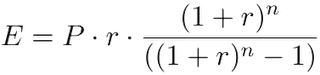
I’m just wondering how the monthly payment got. thanks!

 silver flare
I think whst they did
Was they toom .0519
Multiply it by 27500
Then add what u get to 27500
Then divide by 15
Thats wring
Wrong
Dont listen to me
gleaming tree
ahahaaha thanks for trying tho
gleaming tree
hiii!
 empty ridge
@gleaming tree
The mechanics is that:
Loan(t+1) = Loan(t) * (1+interest_rate/12) - Montly_payment
The idea is that you Loan(15)=0
median dirge
EMI Calculator - Calculate Equated Monthly Installment (EMI) for Home Loan / Housing Loan, Car Loan & Personal Loan in India (with interactive charts)
Scroll down
And you'll find out
How do they do it
empty ridge
It is a goal_seek in excel or if you have a HP-12c,
PV = 27500
n = 15
i = 5.19/12 (edited)
FV = 0
PMT
 empty ridge
This is aproximate, since the timing of the payment matters (number of days in the month, if you pay in the begining of the month or end)...
gleaming tree
median dirge
https://emicalculator.net/
OHH NICEE THANK YOUU!!
median dirge
You're welcome!
gleaming tree
empty ridge
<@!457070504885354509>
The mechanics is that:
Loan(t+1) = Loan(t) * (1+interest...
thank you tooo!! i appreciate you guys help!
thanks!!
ill close this now so others can use it thanks again!
.close
lone heartBOT
Channel closed
Closed by @gleaming tree
Use .reopen if this was a mistake.
lone heartBOT
Available help channel!
Send your question here to claim the channel.
Remember:
• Ask your math question in a clear, concise manner.
• Show your work, and if possible, explain where you are stuck.
• After 15 minutes, feel free to ping <@&286206848099549185>.
• Type the command .close to free the channel when you're done.
• Be polite and have a nice day!
Read #❓how-to-get-help for further information on how to ask a good question, and about conduct in the question channels.
alpine sable
 lone heartBOT
alpine sable
alpine sable
lone heartBOT
alpine sable
alpine sable
I haven't had this solved since yesterday
no help with it
Do I use the second derivative test or first
because when I do the second derivative test its undefined for the critical points
<@&286206848099549185>
empty ridge
Hey @alpine sable, I don't think you need to algebrically solve this... Intuitively, the cube root is "scalling down" what is inside it and you can pretend to know whats going on... First draw what is inside the integral and then reason on what will happen to the integral value as x changes... That would be my aproach to this.
empty ridge
@alpine sable, You know how to solve this for (1-x^2), right? I mean, how to draw the graph of this function and then reason about what would happen to the integral.
alpine sable
not really
im in calc 1
this is the end of derivative calc/start of integral calculus
@empty ridge
alpine sable
Riemann sums
FTC
and how the part being integrated is F'(x)
so
F'(x) = f(x)
thats the approach I took to this problem
empty ridge
And the thing about integrals being the area under a curve, right?
empty ridge
I would use this idea to draw the integral graph.
empty ridge
You know how to plot the graph of the function inside the integral right?
empty ridge
it starts at cubic_root(-3) and ends at cubit_root(-3) and reaches a maximum at x=1,y = cubic_root(0) = 0; right? It will be a distorted parabola like thing
alpine sable
why is it cubic root (-3)
I don't know where it has a maximum
I was taking the second derivative
and I was getting undefined
empty ridge
the function inside the integral is a cubic_root (1 -x^2), right? At x = -2, this function will be valued cubic_root(1 - (-2)^2) = cubit_root(-3)
alpine sable
oh
yeah ok
so yes
maximum I think should be at +1 or -1
because those are the critical points
empty ridge
yes, you are right...
empty ridge
sorry, i said something wrong...
alpine sable
also, Im not sure how to find where its increasing/ decreasing
empty ridge
The critical points are based on the derivative... Let be step back, and explain my plan to solve this
My idea is to use the information about what is inside the integral to reason about the shape of the integral.
alpine sable
Ok
empty ridge
What is inside the integral is a parabola like thing: cubic__root( 1 - x^2). This function on the interval [-2, 2] will go from [-3 --> 1 --> -3].
So, it will cross the x-axix at x = -1 and x = 1.
What all this information say about the integral?
First, from -3 to -1, the thing inside the integral will have a negative value, right?
alpine sable
Yes
empty ridge
That is, we will be accumulating a negative thing.
So the integral will be decreasing in value (acruing to more negative sum)
at x=-1, the function inside turns positive, so the integral will start to become less negative, increasing in value... this will go on until x = 1....
and then, for x> 1, the function inside will become negative again, and the integral starts to decrease.
alpine sable
empty ridge
and then, for x> 1, the function inside will become negative again, and the inte...
How so
Wouldn’t it be positive?
empty ridge
For x > 1, x^2 > 1 --> 1 - x^2 < 0
 alpine sable
Uh
empty ridge
From this, you can infer the shape of the integral. Given an derivative you can infer what would be happening (not exactly) with the function.
empty ridge
From -2 to -1 the integral derivative (what is inside, would be negative, so the integral ....)
empty ridge
You would have to solve the integral or reason about it intuitively.
Building the intuition now may be hard, but it will give you more flexibility to reason about complex situations and infer what to expect from the solutions of problems
alpine sable
I still don’t understand the maximum
empty ridge
Analytically what characterize a maximum?
alpine sable
Local maximum or absolute?
empty ridge
Local (and absolute in a sense)
alpine sable
All of the other values are less than that value
empty ridge
And in terms of derivatives?
empty ridge
Good, both.
empty ridge
 alpine sable
Like I said earlier
empty ridge
I'm speaking of a general case.
The graph I posted is for the thing inside the integral (that is, for the derivative of the F, by the FTC)
So, if I can pinpoint the condition for critical points from the thing inside the integral (the F') I wil be able to infer the maximum of F.
alpine sable
Wdym
empty ridge
The problem gave you a function F(s) that is defined as an integral of another function f(s) = cubicroot ...
By the FTC, the F'(s) = f(s) right?
@alpine sable, does it make sense?
@alpine sable Do you want to start again from the beggining? I am sorry if I'm confusing you.
empty ridge
Ok!

@alpine sable Your objective is to draw a graph and indicate some information about it. To draw this graph, we need to know where it starts. What is F(-2)?
empty ridge
@alpine sable Nope, -3 is the derivative of F at -2. (Why? Since F(s) is an integral, by the FTC, what is inside the integral is the derivative of F)
The integral from -2 to -2 would result in a 0 sum (imagine the riemman sum from -2 to -2)
So, F(-2) = 0, because it would be the result of a integral from -2 to -2 (a zero area region).
alpine sable
ah ok
is there any way you can explain this over voice?
I feel like I'd understand it a lot faster
empty ridge
I'm sorry, my english sucks... I'm better at writting than at speaking...
alpine sable
gotcha thats fine
empty ridge
And my accent would confuse you more lol
alpine sable
its ok
empty ridge
You also know that F'(-2) = -3 right?
alpine sable
yes
empty ridge
This means that the graph should be decreasing
alpine sable
yes
empty ridge
It would keep decresing until F'(x) >= 0, right?
When would that happen?
Remember that what is inside the integral is the derivative of F (using the FTC).
empty ridge
When would F'(x) >= 0?
empty ridge
Great, so the graph of F would be decreasing from -2 until -1, right?
alpine sable
yes
empty ridge
at -1, you have reached one of the critial points. Does it make sense?
alpine sable
yes
empty ridge
From that point until 1, F would increase in value, since F'(x) >= 0 for x in [-1,1]
alpine sable
yeah
empty ridge
Then at 1, what will happen?
empty ridge
At 1 it would reach another critical value, right (it would stop increasing, and will start decresing from 1 to 2)
empty ridge
alpine sable
F'(x) right
Right!
alpine sable
how is it increasing
on
-1,1
its decreasing from the maximum until 2
is it not
empty ridge
Since F'(x) >= 0 for x in [-1,1], F will be increasing in that interval, right?
From [1,2]. F'(x) <= 0, and therefore F will be decreasing.
In a table:
x | F' |F
-2 -> -1 | Negative | Decreasing
-1 -> 1 | Positive | Increasing
1 -> 2 | Negative | Decreasing
@alpine sable does it make sense?
empty ridge
@alpine sable Ok, now we have a problem. I'm thinking how you could infer the value of the integral at the critical points...
@alpine sable Where is the function concave up and down?
empty ridge
@alpine sable This is true for the F', not for F.
alpine sable
Im not sure how to infer it
empty ridge
@alpine sable How you normaly determine the concavity of a function?
alpine sable
second derivative
empty ridge
So, using the information from the first derivative (what is inside the integral) you can determine the changes in concavity of F
alpine sable
yes
empty ridge
Then, that's it. You've done it!
lone heartBOT
Channel closed
Closed by @lyric arch
Use .reopen if this was a mistake.
Available help channel!
Send your question here to claim the channel.
Remember:
• Ask your math question in a clear, concise manner.
• Show your work, and if possible, explain where you are stuck.
• After 15 minutes, feel free to ping <@&286206848099549185>.
• Type the command .close to free the channel when you're done.
• Be polite and have a nice day!
Read #❓how-to-get-help for further information on how to ask a good question, and about conduct in the question channels.
empty ridge
I've just realized that I didn't know what I was doing, I was trying to explain how to solve this problem, but I'm not sure anymore that I know how to solve this. My approach was to use the information on the thing inside the integral to infer the shape of F.
But when I check on wolfram alpha, nothing made sense anymore.
My question: Is this a problem on complex analysis? Or is there a "real analysis" solution? Should I go back and study calc 1 again?
 lone heartBOT
empty ridge
I've just realized that I didn't know what I was doing, I was trying to explain ...
lone heartBOT
empty ridge
I've just realized that I didn't know what I was doing, I was trying to explain ...
@empty ridge Has your question been resolved?
empty ridge
.close
lone heartBOT
Channel closed
Closed by @empty ridge
Use .reopen if this was a mistake.
lone heartBOT
Available help channel!
Send your question here to claim the channel.
Remember:
• Ask your math question in a clear, concise manner.
• Show your work, and if possible, explain where you are stuck.
• After 15 minutes, feel free to ping <@&286206848099549185>.
• Type the command .close to free the channel when you're done.
• Be polite and have a nice day!
Read #❓how-to-get-help for further information on how to ask a good question, and about conduct in the question channels.
 dry echo

 lone heartBOT
@dry echo Has your question been resolved?
lone heartBOT
Channel closed
Closed due to timeout
Use .reopen if this was a mistake.
Available help channel!
Send your question here to claim the channel.
Remember:
• Ask your math question in a clear, concise manner.
• Show your work, and if possible, explain where you are stuck.
• After 15 minutes, feel free to ping <@&286206848099549185>.
• Type the command .close to free the channel when you're done.
• Be polite and have a nice day!
Read #❓how-to-get-help for further information on how to ask a good question, and about conduct in the question channels.
alpine sable
i have the answers but idk how its formed, the answers are on the right side and the actual question is on the left, the dropdown box choices are vertical and horizontal, i just dont understand what the answers are saying, i just need someone to put it in form for me
lone heartBOT
alpine sable
i have the answers but idk how its formed, the answers are on the right side and...


 hallow hinge
alpine sable
hallow hinge
alpine sable
i think i can explain this
so there are two points H is (-5, -3), K is (5, 3)
they make a line segment
 alpine sable
10 apart
hallow hinge
yeah do u know how you would find that though?
alpine sable
uh
hallow hinge
of fuck sorry im being really confusing
alpine sable
lol np
hallow hinge
ok so the answer k is wrong lol
alpine sable
alr
alpine sable
ok
hallow hinge
so basically what you can do when trying to find the length of a diagonal line is you can make an imaginary triangle like this:

you know about pythagorean theorem right?
alpine sable
yes
hallow hinge
so can you solve it knowing that?
hallow hinge
np
yeah the answer key thought that the black line had a distance of 0 which doesn't make sense
alpine sable
yea lol
hallow hinge
do you need help with transformations of HK?
hallow hinge
so that was the only problem?
hallow hinge
cool
.close
type .close when ur done so the channel becomes available again @alpine sable
so how i got sqrt(136) is this:
a^2 + b^2 = c^2
10^2 + 6^2 = c^2
136 = c^2
sqrt(136) = c
so the length is ~11.662
lone heartBOT
@alpine sable Has your question been resolved?
lone heartBOT
Channel closed
Closed due to timeout
Use .reopen if this was a mistake.
lone heartBOT
Available help channel!
Send your question here to claim the channel.
Remember:
• Ask your math question in a clear, concise manner.
• Show your work, and if possible, explain where you are stuck.
• After 15 minutes, feel free to ping <@&286206848099549185>.
• Type the command .close to free the channel when you're done.
• Be polite and have a nice day!
Read #❓how-to-get-help for further information on how to ask a good question, and about conduct in the question channels.
 rare verge
help lol
 lone heartBOT
Channel closed
Closed due to timeout
Use .reopen if this was a mistake.
Available help channel!
Send your question here to claim the channel.
Remember:
• Ask your math question in a clear, concise manner.
• Show your work, and if possible, explain where you are stuck.
• After 15 minutes, feel free to ping <@&286206848099549185>.
• Type the command .close to free the channel when you're done.
• Be polite and have a nice day!
Read #❓how-to-get-help for further information on how to ask a good question, and about conduct in the question channels.
 grizzled badge
 lone heartBOT
grizzled badge
grizzled badge
lone heartBOT
grizzled badge
grizzled badge
Can someone check my work? I’ve been practicing and wanna know if I did this right
 glass lichen
Total area, not signed area for the last question
Hint: They specifically said sum or difference of integrals
grizzled badge
So like f(a1)+f(a2)?
ocean sealBOT
Mosh
 grizzled badge
Negative area right?
ocean sealBOT
Mosh
 grizzled badge
Ahhh
glass lichen
so you add up all the intervals ensuring they individually have pos area
grizzled badge
Gimmie 1 sec and tell me if it’s right?
glass lichen
alternatively and I Ieave this up to you to confirm, $\int_a^e\abs{f(x)}\dd{x}$, however in all practical uses that's very hard to use
ocean sealBOT
Mosh
 grizzled badge
 glass lichen
yes
grizzled badge
Sweet!! I have some more questions if you wanna check those for me
Also did the ones I circle were they right? I just wanna make sure so I don’t get confused
glass lichen
yes

 glass lichen
why is B a left-sum?
grizzled badge
oh i giess i just looked at it as an over estimate and got confused
its a right hand
glass lichen
yep
glass lichen
yes.
grizzled badge
do the others look correct?
glass lichen
double check iii
glass lichen
yes.
grizzled badge
im pretty sure i got this next one right but im not entirely confident

@glass lichen you still there? sorry if I'm bugging you lmao

.close
lone heartBOT
Channel closed
Closed by @grizzled badge
Use .reopen if this was a mistake.
Available help channel!
Send your question here to claim the channel.
Remember:
• Ask your math question in a clear, concise manner.
• Show your work, and if possible, explain where you are stuck.
• After 15 minutes, feel free to ping <@&286206848099549185>.
• Type the command .close to free the channel when you're done.
• Be polite and have a nice day!
Read #❓how-to-get-help for further information on how to ask a good question, and about conduct in the question channels.
 supple tundra
 lone heartBOT
supple tundra
supple tundra
lone heartBOT
supple tundra
supple tundra
Not sure about this last part. From a sketch of the function, it seems that it's possible for there to be 1, 2 or 3 roots depending on the values of $p,q$. But not sure how to utilize $4p^3+27q^2$
ocean sealBOT
azeem321
 lone heartBOT
@supple tundra Has your question been resolved?
lone heartBOT
Channel closed
Closed due to timeout
Use .reopen if this was a mistake.
Available help channel!
Send your question here to claim the channel.
Remember:
• Ask your math question in a clear, concise manner.
• Show your work, and if possible, explain where you are stuck.
• After 15 minutes, feel free to ping <@&286206848099549185>.
• Type the command .close to free the channel when you're done.
• Be polite and have a nice day!
Read #❓how-to-get-help for further information on how to ask a good question, and about conduct in the question channels.
 dark pelican
 lone heartBOT
dark pelican
lone heartBOT
dark pelican
 jagged imp
you deleted your original message
dark pelican
yeah i tried to add a better one
whatever
i just picked between the two that sounded right and i managed to get it right thanks
lone heartBOT
@dark pelican Has your question been resolved?
Channel closed
Closed by @dark pelican
Use .reopen if this was a mistake.
Available help channel!
Send your question here to claim the channel.
Remember:
• Ask your math question in a clear, concise manner.
• Show your work, and if possible, explain where you are stuck.
• After 15 minutes, feel free to ping <@&286206848099549185>.
• Type the command .close to free the channel when you're done.
• Be polite and have a nice day!
Read #❓how-to-get-help for further information on how to ask a good question, and about conduct in the question channels.
 rough salmon
what is the blending function for the 5th control point of a degree 4 bezier curve?
lone heartBOT
rough salmon
what is the blending function for the 5th control point of a degree 4 bezier cur...
 bleak ridge
That's a good question
Based on a little bit of looking around
I'd say it's
,w BernsteinBasis[4,4,x]
ocean sealBOT


 Requested by PapaBread#3820
ocean sealBOT
Requested by PapaBread#3820
ocean sealBOT
 Requested by PapaBread#3820
lone heartBOT
Requested by PapaBread#3820
lone heartBOT
@rough salmon Has your question been resolved?
bleak ridge
Np
rough salmon
ah
i was graphing the curve n when i plug in t^4 it aint working, turns out it's the 4th control point's blending func tat was wrong
breh
.close
lone heartBOT
Channel closed
Closed by @rough salmon
Use .reopen if this was a mistake.
Available help channel!
Send your question here to claim the channel.
Remember:
• Ask your math question in a clear, concise manner.
• Show your work, and if possible, explain where you are stuck.
• After 15 minutes, feel free to ping <@&286206848099549185>.
• Type the command .close to free the channel when you're done.
• Be polite and have a nice day!
Read #❓how-to-get-help for further information on how to ask a good question, and about conduct in the question channels.
Channel closed
Closed due to the original message being deleted
Available help channel!
Send your question here to claim the channel.
Remember:
• Ask your math question in a clear, concise manner.
• Show your work, and if possible, explain where you are stuck.
• After 15 minutes, feel free to ping <@&286206848099549185>.
• Type the command .close to free the channel when you're done.
• Be polite and have a nice day!
Read #❓how-to-get-help for further information on how to ask a good question, and about conduct in the question channels.
 cosmic oak
 lone heartBOT
cosmic oak
cosmic oak
lone heartBOT
cosmic oak
cosmic oak
Hi can anyone help me with this question
 buoyant kayak
cosmic oak
Hi can anyone help me with this question
buoyant kayak
cosmic oak
Hi can anyone help me with this question
what specifically?
lone heartBOT
@cosmic oak Has your question been resolved?
lone heartBOT
Channel closed
Closed due to timeout
Use .reopen if this was a mistake.
lone heartBOT
Available help channel!
Send your question here to claim the channel.
Remember:
• Ask your math question in a clear, concise manner.
• Show your work, and if possible, explain where you are stuck.
• After 15 minutes, feel free to ping <@&286206848099549185>.
• Type the command .close to free the channel when you're done.
• Be polite and have a nice day!
Read #❓how-to-get-help for further information on how to ask a good question, and about conduct in the question channels.
 hallow bluff
Hi! I've had to solve for the x intercept with this and got (-7.22, 0).
Im wondering how can I now use this information to find the y intercept?
 lone heartBOT
hallow bluff
Hi! I've had to solve for the x intercept with this and got (-7.22, 0).
Im won...
lone heartBOT
hallow bluff
Hi! I've had to solve for the x intercept with this and got (-7.22, 0).
Im won...
 wary stream
So you understand that for the x intercept, y is equal to 0. If it is the y intercept, what does that mean for the x value?
hallow bluff
The x value is -7.22
The issue is that if I set y to 0 and solve from there like normal it is only checking it.
Ohh wait you need to make x zero this time dont I
wary stream
hallow bluff
Ohh wait you need to make x zero this time dont I
Yes this
hallow bluff
Ok thank you. And if I am showing my work I should change the f(x) to just y?
wary stream
Yeah, you can
hallow bluff
Thank you so much my friend. I will return in maybe 30ish minutes. Should I close the channel do you think or no?
wary stream
You can close it. There are multiple free channels
lone heartBOT
Channel closed
Closed by @hallow bluff
Use .reopen if this was a mistake.
hallow bluff
.reopen
lone heartBOT
✅
hallow bluff
Hold on, and you know what I should do with the 4 at this point?
wary stream
So you plug in x = 0, correct?
Just find the value of y
And that's the y intercept
hallow bluff
Yes however I am at a dilemma
I will show you

If I were to add 4 on both sides, I would just divide by three like normal?
wary stream
You just simplify the right side
hallow bluff
Adding like terms? I got -3 that way.
lone heartBOT
Channel closed
Closed by @hallow bluff
Use .reopen if this was a mistake.
Available help channel!
Send your question here to claim the channel.
Remember:
• Ask your math question in a clear, concise manner.
• Show your work, and if possible, explain where you are stuck.
• After 15 minutes, feel free to ping <@&286206848099549185>.
• Type the command .close to free the channel when you're done.
• Be polite and have a nice day!
Read #❓how-to-get-help for further information on how to ask a good question, and about conduct in the question channels.
alpine sable
how can i represent this function using heavisides?
 alpine sable
so far i have u(t-3)*2(t-3) for the first part up to t = 5
but idk what to do after that
bleak ridge
You could prob do some fancy like
Layering of functions
So of course the first layer is H(t-3)*2(t-3)
Then you could multiply that by H(5-t)
And add on H(t-5)
Idk itd be nasty
H(t-3) * 2(t-3) * H(5-t) + H(t-5)
Then a final multiplication by H(8-t)
H(8-t) * (H(t-3) * 2(t-3) * H(5-t) + H(t-5))
Lets see
,w Heaviside[8-t] * (Heaviside[t-3] * 2(t-3) * Heaviside[5-t] + Heaviside[t-5])
ocean sealBOT
 Requested by PapaBread#3820
bleak ridge
Requested by PapaBread#3820
bleak ridge
Oh no
alpine sable
lmao
bleak ridge
Thats not right
Hmm
Lemme go through the steps visually
,w Heaviside[t-3] * 2(t-3)
ocean sealBOT
 Requested by PapaBread#3820
bleak ridge
Requested by PapaBread#3820
bleak ridge
So yeah that looks right
alpine sable
yah
bleak ridge
,w plot Heaviside[t-3] * 2(t-3) * Heaviside[5-t]
ocean sealBOT
 Requested by PapaBread#3820
ocean sealBOT
Requested by PapaBread#3820
ocean sealBOT
 Requested by PapaBread#3820
bleak ridge
Requested by PapaBread#3820
bleak ridge
Strange
Oh
Its just not plotting right
Wolfram moment
,w plot (Heaviside[5-t] * Heaviside[t-3] * 2(t-3)) from 0 to 10
ocean sealBOT
 Requested by PapaBread#3820
bleak ridge
Requested by PapaBread#3820
bleak ridge
Ok so yeah
,w plot (Heaviside[t-3] * 2(t-3) * Heaviside[5-t] + Heaviside[t-5]) from 0 to 10
ocean sealBOT
 Requested by PapaBread#3820
bleak ridge
Requested by PapaBread#3820
bleak ridge
Oh
Makes sense
,w plot (Heaviside[t-3] * 2(t-3) * Heaviside[5-t] + 4 * Heaviside[t-5]) from 0 to 10
ocean sealBOT
 Requested by PapaBread#3820
bleak ridge
Requested by PapaBread#3820
bleak ridge
,w plot (Heaviside[8-t] * (Heaviside[t-3] * 2(t-3) * Heaviside[5-t] + 4 * Heaviside[t-5])) from 0 to 10
ocean sealBOT
 Requested by PapaBread#3820
bleak ridge
Requested by PapaBread#3820
bleak ridge
Well there you go
There is one more consideration though
,w (Heaviside[8-8] * (Heaviside[8-3] * 2(8-3) * Heaviside[5-8] + 4 * Heaviside[8-5]))
ocean sealBOT
 Requested by PapaBread#3820
alpine sable
Requested by PapaBread#3820
alpine sable
ahh i see thx alot!
bleak ridge
I dont think that its the exact value you want at t=8
alpine sable
seems to be ok on desmos
 bleak ridge
Desmos supports heaviside?
 bleak ridge
Oh
I mean the technical definition of heaviside is more like
{t<0:0, t=0: 0.5, t>0: 1}
I think
But if you define it like that it should be fine
lone heartBOT
@alpine sable Has your question been resolved?
lone heartBOT
Channel closed
Closed due to timeout
Use .reopen if this was a mistake.
Available help channel!
Send your question here to claim the channel.
Remember:
• Ask your math question in a clear, concise manner.
• Show your work, and if possible, explain where you are stuck.
• After 15 minutes, feel free to ping <@&286206848099549185>.
• Type the command .close to free the channel when you're done.
• Be polite and have a nice day!
Read #❓how-to-get-help for further information on how to ask a good question, and about conduct in the question channels.
 gritty gull
https://gyazo.com/31c4dcab5d839540d4f77b72c7c09c72
parking garage to terminal A is expressed as 60r
and terminal A to terminal B is expressed as (r + 8.1)45
 lone heartBOT
gritty gull
https://gyazo.com/31c4dcab5d839540d4f77b72c7c09c72
parking garage to terminal A ...
gritty gull
lone heartBOT
gritty gull
https://gyazo.com/31c4dcab5d839540d4f77b72c7c09c72
parking garage to terminal A ...
gritty gull
how would i write an equation that relates to both of these equations?
vale wigeon
if you know how far you traveled from garage to term A, and you know how far you traveled from term A to term B, how do you find the total distance traveled?
gritty gull
NVM LOL

= 3,950
which would be my answer
however
i have no clue on how to rewrite this
in order to fit this equation
do you think (60r + 8.1)45 = 3,950 would work
(the reason why 8.1's in there is because the trip from terminal a to terminal b travels 8.1 ft per second faster)
or maybe
lone heartBOT
@gritty gull Has your question been resolved?
vale wigeon
do you think (60r + 8.1)45 = 3,950 would work
no
@gritty gull i was expecting the very simple answer of "you add the distances"
lone heartBOT
Channel closed
Closed due to timeout
Use .reopen if this was a mistake.
Available help channel!
Send your question here to claim the channel.
Remember:
• Ask your math question in a clear, concise manner.
• Show your work, and if possible, explain where you are stuck.
• After 15 minutes, feel free to ping <@&286206848099549185>.
• Type the command .close to free the channel when you're done.
• Be polite and have a nice day!
Read #❓how-to-get-help for further information on how to ask a good question, and about conduct in the question channels.
 warm shoal
Hey im trying to solve a limit with L'hopitals and I understand now that the limit doesn't exist but I would like to see the error in my ways
lone heartBOT
warm shoal
Hey im trying to solve a limit with L'hopitals and I understand now that the lim...
warm shoal
I am sending a picture right now

the original question was the limit as x approaches -3 of sinx/(x-pi)(x+3)
My thought process was to try and force an indeterminate form by multiplying by (x+3)/(x+3)
 velvet pelican
it's already indeterminate tho
warm shoal
and this provides a definite answer at the end which would suggest the graph has a removable discontinuity
velvet pelican
substituting in -3 gives sin(-3)/0
velvet pelican
ok so the limit doesnt exist
warm shoal
no its not that simple
the limit doesnt exist because the two-sided limits dont converge
its not simply because you plug in -3 and it doesnt work
what I dont understand is that mathematically my answer produces a definite number as the answer to the limit
but in reality it doesnt exist
velvet pelican
so when you used lhopital the second time
it wasn't in the form 0/0
since you still had sin(x)
lone heartBOT
Channel closed
Closed by @warm shoal
Use .reopen if this was a mistake.
lone heartBOT
Available help channel!
Send your question here to claim the channel.
Remember:
• Ask your math question in a clear, concise manner.
• Show your work, and if possible, explain where you are stuck.
• After 15 minutes, feel free to ping <@&286206848099549185>.
• Type the command .close to free the channel when you're done.
• Be polite and have a nice day!
Read #❓how-to-get-help for further information on how to ask a good question, and about conduct in the question channels.
gritty gull
vale wigeon
<@530635344060612618> i was expecting the very simple answer of "you add the dis...
OHHHHHHHH
lone heartBOT
gritty gull
OHHHHHHHH
lone heartBOT
@gritty gull Has your question been resolved?
lone heartBOT
Channel closed
Closed due to timeout
Use .reopen if this was a mistake.
Available help channel!
Send your question here to claim the channel.
Remember:
• Ask your math question in a clear, concise manner.
• Show your work, and if possible, explain where you are stuck.
• After 15 minutes, feel free to ping <@&286206848099549185>.
• Type the command .close to free the channel when you're done.
• Be polite and have a nice day!
Read #❓how-to-get-help for further information on how to ask a good question, and about conduct in the question channels.
 rough owl
Compute the regular equal payment needed to discharge both principal and interest of the loan. Suppose money borrowed is worth 7.5% compounded monthly for 25 years.
lone heartBOT
rough owl
Compute the regular equal payment needed to discharge both principal and interes...
rough owl
Total Contract Price (TCP) = 6,890,000
Loan = ?
what is the formula of loan
how do i get the loan?
<@&286206848099549185>
lone heartBOT
@rough owl Has your question been resolved?
lone heartBOT
Channel closed
Closed due to timeout
Use .reopen if this was a mistake.
Available help channel!
Send your question here to claim the channel.
Remember:
• Ask your math question in a clear, concise manner.
• Show your work, and if possible, explain where you are stuck.
• After 15 minutes, feel free to ping <@&286206848099549185>.
• Type the command .close to free the channel when you're done.
• Be polite and have a nice day!
Read #❓how-to-get-help for further information on how to ask a good question, and about conduct in the question channels.
 barren glade
 lone heartBOT
barren glade
lone heartBOT
barren glade
 solar merlin

 agile crest
anyone who can help me?
 solar merlin
agile crest
anyone who can help me?
solar merlin
agile crest
anyone who can help me?
use an available channel. when you post in an occupied channel that someone's already asking for help for, it's like shitting in a bathroom stall someone's already pissing in
try looking up ''algebraic long division''
there's a lot of tutorials on it
agile crest
oh
solar merlin
@barren glade anyway, with the identity i posted above, you should be able to solve it. just plug in the values
lone heartBOT
Channel closed
Closed by @barren glade
Use .reopen if this was a mistake.
lone heartBOT
Available help channel!
Send your question here to claim the channel.
Remember:
• Ask your math question in a clear, concise manner.
• Show your work, and if possible, explain where you are stuck.
• After 15 minutes, feel free to ping <@&286206848099549185>.
• Type the command .close to free the channel when you're done.
• Be polite and have a nice day!
Read #❓how-to-get-help for further information on how to ask a good question, and about conduct in the question channels.
 light crane
Hi! currently doing a wave equation with dirichlet boundary condition exercise, but i dont know how to get the initial displacement from the graph
 lone heartBOT
light crane
Hi! currently doing a wave equation with dirichlet boundary condition exercise, ...
light crane
lone heartBOT
light crane
Hi! currently doing a wave equation with dirichlet boundary condition exercise, ...
light crane
initial displacement is u(x,0) but given the graph is u(x,t) against x im stuck there
lone heartBOT
@light crane Has your question been resolved?
lone heartBOT
Channel closed
Closed due to timeout
Use .reopen if this was a mistake.
Available help channel!
Send your question here to claim the channel.
Remember:
• Ask your math question in a clear, concise manner.
• Show your work, and if possible, explain where you are stuck.
• After 15 minutes, feel free to ping <@&286206848099549185>.
• Type the command .close to free the channel when you're done.
• Be polite and have a nice day!
Read #❓how-to-get-help for further information on how to ask a good question, and about conduct in the question channels.
 odd rover
oh
i am sorry, i am new..i went through the rules and stuff now. will make sure next time 👍
 lone heartBOT
Channel closed
Closed due to the original message being deleted
raw shard

odd rover
.close
lone heartBOT
Available help channel!
Send your question here to claim the channel.
Remember:
• Ask your math question in a clear, concise manner.
• Show your work, and if possible, explain where you are stuck.
• After 15 minutes, feel free to ping <@&286206848099549185>.
• Type the command .close to free the channel when you're done.
• Be polite and have a nice day!
Read #❓how-to-get-help for further information on how to ask a good question, and about conduct in the question channels.
odd rover
Hi!
I wanted a bit of help with this question related to Circles. Can you some please guide me with what can be done to prove whats given?
Thanks!
 lone heartBOT
odd rover
Hi!
I wanted a bit of help with this question related to Circles. Can you some p...
raw shard
lone heartBOT
odd rover
Hi!
I wanted a bit of help with this question related to Circles. Can you some p...
raw shard
no i don’t know how to do stuff like this
 grizzled sundial
Hey guys what's the difference between a stationary point of inflection and a point of inflection?
grizzled sundial
ohh sorry
odd rover
odd rover
Hi!
I wanted a bit of help with this question related to Circles. Can you some p...
@covert agate you seem to know circles mate. can you possibly help with these pls
raw shard
don’t ping random people asking them for help
odd rover
odd rover
Hi!
I wanted a bit of help with this question related to Circles. Can you some p...
<@&286206848099549185> someone pls help
 covert agate
i would just use coordinate geometry lmao
covert agate
odd rover
Hi!
I wanted a bit of help with this question related to Circles. Can you some p...
so notice O is the circumcentre of PQR right
odd rover
covert agate
so notice O is the circumcentre of PQR right
mhmm
covert agate
and you extend the angle bisector of ∠ PQR and perpendicular bisector of QR to S
just prove they intersect the same point
odd rover
covert agate
and you extend the angle bisector of ∠ PQR and perpendicular bisector of QR to S
angle bisector of PQR??
covert agate
QPR sorry
odd rover
covert agate
just prove they intersect the same point
same point as what?
covert agate
angle bisector PQR and perpendicular bisector QR
odd rover
hmm
covert agate
odd rover
same point as what?
prove the intersection lies on circle
idk there should be a better approach? not sure tho
odd rover
i was thinking to do this by proving that os is also the radius
covert agate
odd rover
i was thinking to do this by proving that os is also the radius
it is
odd rover
so OS=OR/OQ
odd rover
it says that i have to prove its on the circumference
covert agate
there are infinitely many O’s satisfying ‘lying on the perpendicular bisector of QR’
one of those O’s is the circumcentre
no other information about O means you can, WLOG, assume O = circumcentre
covert agate
oh
i think i have an approach?
if S wasn’t on circle, OQ not equal to OS and OS not equal to OR
prove this and you should ne good
odd rover
covert agate
if S wasn’t on circle, OQ not equal to OS and OS not equal to OR
i suppose it needs to be proved that OQ=OS and/or OS=OR
covert agate
yea
i think consider a point on the perpendicular bisector of QR and inside/outside the circle?
proof by cases
then show it’s not the angle bisector of QPR
lone heartBOT
Channel closed
Closed by @odd rover
Use .reopen if this was a mistake.
Available help channel!
Send your question here to claim the channel.
Remember:
• Ask your math question in a clear, concise manner.
• Show your work, and if possible, explain where you are stuck.
• After 15 minutes, feel free to ping <@&286206848099549185>.
• Type the command .close to free the channel when you're done.
• Be polite and have a nice day!
Read #❓how-to-get-help for further information on how to ask a good question, and about conduct in the question channels.
 ivory forge
this is the qn and answer my teacher gave
will it not be wrong if we take n=2?
 lone heartBOT
ivory forge
this is the qn and answer my teacher gave
will it not be wrong if we take n=2?
glass lichen
ivory forge
this is the qn and answer my teacher gave
will it not be wrong if we take n=2?
lone heartBOT
ivory forge
this is the qn and answer my teacher gave
will it not be wrong if we take n=2?
glass lichen
ivory forge
this is the qn and answer my teacher gave
will it not be wrong if we take n=2?
wdym?
alpine sable
There's a minus sign missing
ivory forge
?
glass lichen
Oh wait, sorry just woke up
you never plug in x=0.
its a limit
you dont care about what happens at x=0
lone heartBOT
Channel closed
Closed by @ivory forge
Use .reopen if this was a mistake.
alpine sable
@ivory forge ln(x) *x^n=ln(x) *1/(x^-n)
ivory forge
?
alpine sable
First part of the second line
lone heartBOT
Available help channel!
Send your question here to claim the channel.
Remember:
• Ask your math question in a clear, concise manner.
• Show your work, and if possible, explain where you are stuck.
• After 15 minutes, feel free to ping <@&286206848099549185>.
• Type the command .close to free the channel when you're done.
• Be polite and have a nice day!
Read #❓how-to-get-help for further information on how to ask a good question, and about conduct in the question channels.
 chrome dune
 lone heartBOT
chrome dune
chrome dune
lone heartBOT
chrome dune
chrome dune
I keep get 13
Y = z+1
And z = 2
So, y = 2+1, right?
X-2×2+1=10
X-2×2=9
X=13
But there's no 13 in the choices
 tawny pivot
alpine sable
tawny pivot
alpine sable
Yes
lone heartBOT
Channel closed
Closed by @chrome dune
Use .reopen if this was a mistake.
Available help channel!
Send your question here to claim the channel.
Remember:
• Ask your math question in a clear, concise manner.
• Show your work, and if possible, explain where you are stuck.
• After 15 minutes, feel free to ping <@&286206848099549185>.
• Type the command .close to free the channel when you're done.
• Be polite and have a nice day!
Read #❓how-to-get-help for further information on how to ask a good question, and about conduct in the question channels.
 woven otter
How do I convert and approximate a long decimals that has been rounded into fraction?
I once converted 0.2571428571 to 27/105 through trial and error, but I wonder if there's another short way of doing it
What I am now looking for is 0.2608695652 into fraction
lone heartBOT
woven otter
How do I convert and approximate a long decimals that has been rounded into frac...
raw shard
try 26/100 at first
then turn it into like 2600/10000
so then if you add 1 it does very little
,calc 2601/10000
ocean sealBOT
Result:
0.2601
oh darn that’s right
oh i see what you want
you want it with like 2 or 3 digit numbers
woven otter
I could go for that, but I know that'll affect the coming equations badly
maybe exact if I'm lucky
calculators only go up to certain decimal place
so I was thinking that 0.2608695652 can be converted into a nice 2-3 digits fraction xx/xxx, and not 2608695652/10000000000
I was thinking there would be a straightforward method instead of trial and error
 gray isle
i suppose you could consider
1/0.2608695652 and see if that gets you something nicer
,calc 1/0.2608695652
ocean sealBOT
Result:
3.8333333335889
 azure merlin
In the given circle, O is the centre of the circle, DB is diameter and angle AOB = 120°. Find the measure of angle ADB and angle ACB.
 fair crater
woven otter
How do I convert and approximate a long decimals that has been rounded into frac...
fair crater
woven otter
How do I convert and approximate a long decimals that has been rounded into frac...
I think this is a hard problem in approximation
gray isle
which i suppose you could approximate as 3.8333...
and convert that to a fraction and take its reciprocal
the same approach could work for
ocean sealBOT
Result:
3.8333333335889
,calc 1/0.2571428571
ocean sealBOT
Result:
3.888888889537
You could try the approach of
https://en.wikipedia.org/wiki/Continued_fraction#Best_rational_approximations
In mathematics, a continued fraction is an expression obtained through an iterative process of representing a number as the sum of its integer part and the reciprocal of another number, then writing this other number as the sum of its integer part and another reciprocal, and so on. In a finite continued fraction (or terminated continued fraction...
gray isle
which could be approximated as 3.8...
which as a fraction would be 35/9
and its reciprocal 9/35
fair crater
gray isle
which could be approximated as 3.8...
which as a fraction would be 35/9
and its ...
This is fine for back-of-the-envelope but is handwavy. I think approximation theory formalises this nicely
gray isle
yeh, it depends on what you're given and what you're allowed to use
fair crater
Though in the end I suppose - it depends on what you want to do. There's some really interesting stuff like https://math.stackexchange.com/questions/3749872/is-22-7-the-closest-to-pi-among-fractions-of-denominator-at-most-50

Mathematics Stack Exchange
Is $22/7$ the closest to $\pi$, among fractions of denominator at most $50$?
I am currently studying continued fractions, while I know that for all denominators at most $Q_n$, $\frac{P_n}{Q_n}$ is ...
lone heartBOT
Channel closed
Closed by @woven otter
Use .reopen if this was a mistake.
Available help channel!
Send your question here to claim the channel.
Remember:
• Ask your math question in a clear, concise manner.
• Show your work, and if possible, explain where you are stuck.
• After 15 minutes, feel free to ping <@&286206848099549185>.
• Type the command .close to free the channel when you're done.
• Be polite and have a nice day!
Read #❓how-to-get-help for further information on how to ask a good question, and about conduct in the question channels.
 cunning bloom
 lone heartBOT
cunning bloom
cunning bloom
lone heartBOT
cunning bloom
cunning bloom
Could someone help with finding a function f:A-->B where f (the function) is bijective
 crisp grove
didn't someone already answer?
cunning bloom
no
i did get help before but i just gave up and tried another way
but now we are back here sooo
any idea 🙂
lone heartBOT
@cunning bloom Has your question been resolved?
lone heartBOT
Channel closed
Closed due to timeout
Use .reopen if this was a mistake.
Available help channel!
Send your question here to claim the channel.
Remember:
• Ask your math question in a clear, concise manner.
• Show your work, and if possible, explain where you are stuck.
• After 15 minutes, feel free to ping <@&286206848099549185>.
• Type the command .close to free the channel when you're done.
• Be polite and have a nice day!
Read #❓how-to-get-help for further information on how to ask a good question, and about conduct in the question channels.
 tawny fable
Hey there
lone heartBOT
tawny fable
Hey there
tawny fable
I have a question in linear algebra

what does p(-2) = 0 mean?
It means when -2 is the input the equation outputs 0?
when trying to figure out if it is a subspace of V
I should run some examples of equations from R4[x]
and try to see if there is closure for addition and multiplication?
like, it there a easier way? what if it was R10[x]?
anyone ? 
<@&286206848099549185>
 chrome salmon
tawny fable
I should run some examples of equations from R4[x]
chrome salmon
tawny fable
I should run some examples of equations from R4[x]
No need
tawny fable
I don't think I fully understand that.
As we learned, we need to show 3 axioms hold:
- 0v is in the vector space
- closure to addition
- closure to multiplication
If we want to prove it is a subset of a vector space
and If we want to show it is not, we need to give a counter example
tawny fable
chrome salmon
Just use p(x) and q(x) notation
but I don't think I just understand what do you mean by that. and also, what is the connection between that and homogeneous and non-homogeneous linear equations
ocean sealBOT
it's Sam
 chrome salmon
If p(x)=0 then ofc p(-2)=0
tawny fable
but how do you know that p(x) = 0?
chrome salmon
tawny fable
but how do you know that p(x) = 0?
Idk that's one of the element of R4[x]

 tawny fable
tawny fable
tawny fable
here
chrome salmon
tawny fable
.
crisp grove
no I can see it now
tawny fable
 crisp grove
"tap to see attachment" seems to fix it
tawny fable
I just dont understand if that means
that the x's are 0
or the coefficients
I just don't have the image of that in my head
idk why
I guess it is confusing because we say it is a vector now and I am used to see it as an equation
chrome salmon
tawny fable
or the coefficients
The coefficients
How do you write p(x) generally
Using coefficient a,b,c,d
chrome salmon
if all a,b,c,d,e are equal to 0 then does p belong to R_4[x]
tawny fable
well I guess it is
chrome salmon
Yeah so p(x)=0 does make sense
tawny fable
Does it also mean that 0v is inside every polinome?
chrome salmon
Oh yeah
tawny fable
So in the question
what they mean is that I look at the group of all the polynomials s.t. p(-2) = 0
chrome salmon
Yes
tawny fable
does it mean that p(x) in this case is linear depentent?
chrome salmon
To what tho
tawny fable
idk
chrome salmon
{1,x,x²,x³,x⁴}?
tawny fable
i am thinking it can only be multiplications of a certain number
in order to make p(-2) = 0 true
tawny fable
but it should be from degree 4 isnt it?
chrome salmon
Less than
tawny fable
chrome salmon
For an example p(x)=x²-2
isnt that p(-2) = (-2)^2 - 2 = -4?
chrome salmon
tawny fable
it includes all degrees in it then?
Deg(p) =< 4
chrome salmon
tawny fable
isnt that p(-2) = (-2)^2 - 2 = -4?
Edit to -4
chrome salmon

tawny fable
I say 0v C R4[x] for every x in R
-2 is in R
==> 0v C p?
chrome salmon
U_1
chrome salmon
tawny fable
I say 0v C R4[x] for every x in R
-2 is in R
==> 0v C p?
Foe every x?
tawny fable
oh
x is not mentioned...
nvm
the how do I explain that 0v C p?
then
0*(-2)^4 + 0*(-2)^3 + 0*(-2)^2 + 0*(-2)^1 +0 = 0?
= 0v?
chrome salmon
tawny fable
0*(-2)^4 + 0*(-2)^3 + 0*(-2)^2 + 0*(-2)^1 +0 = 0?
Yeah
See p(x) = ax⁴+bx³+cx²+dx+e for a,b,c,d,e in R
That means p(x)=0 is in R_4[x]
Since a,b,c,d,e can be =0
Understand what R_4[x] is
p(x)=e is also a thing
tawny fable
for instance we have all vectors like
v = [1,2,3,4,5]
u = [0,0,0,0,5]
etc..
chrome salmon
Nah don't think that way
chrome salmon
The basis we are working here is {x⁴,x³,x²,x,1}
chrome salmon
We aren't working on R⁴
ocean sealBOT
it's Sam
 tawny fable
ocean seal
**it's Sam**
tawny fable
ocean seal
**it's Sam**
how do you know you can use distributivity here?
ocean sealBOT
it's Sam
 chrome salmon
tawny fable
how do you know you can use distributivity here?
chrome salmon
tawny fable
how do you know you can use distributivity here?
p and q are polynomials
tawny fable
ocean seal
**it's Sam**
1 is when e also equals 1?
chrome salmon
Yes
ocean sealBOT
it's Sam
 tawny fable
and x^2 is when c = 1 and all the rest are 0?
tawny fable
So can you explain to me what is exactly p(2) = 0?
@chrome salmon
Or any of the other exercises
chrome salmon
tawny fable
So can you explain to me what is exactly p(2) = 0?
p is a polynomial whose zero is 2
For example x-2 , x²-4 , 5x-10 ,...
Set of all such polynomials is U_1
U_1 = {x-2 , x²-4 , 5x-10 , x³-4x,....}
This won't contain polynomials like x-3 , x²+1
tawny fable
tawny fable
So can you explain to me what is exactly p(2) = 0?
Oh, I meant -2
Yeah I get it now
So basically all the functions of the type of polynomials that sum up to 0 when inputs -2?