#help-0
1 messages · Page 353 of 1
 meager summit
 lone heartBOT
Channel closed
Closed by @meager summit
Use .reopen if this was a mistake.
 long axle
Good takeaway
lone heartBOT
 Available help channel!
Send your question here to claim the channel.
Remember:
• Ask your math question in a clear, concise manner.
• Show your work, and if possible, explain where you are stuck.
• After 15 minutes, feel free to ping <@&286206848099549185>.
• Type the command .close to free the channel when you're done.
• Be polite and have a nice day!
Read #❓how-to-get-help for further information on how to ask a good question, and about conduct in the question channels.
 left sinew
 lone heartBOT
left sinew
left sinew
lone heartBOT
left sinew
left sinew
hello, would like help on this problem please
not sure how to approach or visualize
thanks
lone heartBOT
@left sinew Has your question been resolved?
 slender marten
left sinew
slender marten
left sinew
The inner integral assumes that x is held fixed, say x = x_0. If x_0 is rational then f(x_0, y) = 1 and if if x_0 is irrational f(x_0, y) = 2y. Essentially you have two cases which collapse two different ordinary Riemann integrals which both have a finite value.
left sinew
slender marten
The inner integral assumes that x is held fixed, say x = x_0. If x_0 is rational...
right but how do you know the final value of the outer integral since it could either be 1 or 2y on the inside
like what proportion of the time is it 1 or 2y
thanks
slender marten
Oh. I see what you mean. Let me think for a second on that.
left sinew
slender marten
Oh. I see what you mean. Let me think for a second on that.
thanks
slender marten
You might have to write f(x, y) = g(x, y) + h(x, y), where
g(x, y) = 0, x is rational,
= 2y, x is irrational; and
h(x, y) = 1, x is rational,
= 0, x is irrational.
lone heartBOT
Channel closed
Closed by @left sinew
Use .reopen if this was a mistake.
lone heartBOT
Available help channel!
Send your question here to claim the channel.
Remember:
• Ask your math question in a clear, concise manner.
• Show your work, and if possible, explain where you are stuck.
• After 15 minutes, feel free to ping <@&286206848099549185>.
• Type the command .close to free the channel when you're done.
• Be polite and have a nice day!
Read #❓how-to-get-help for further information on how to ask a good question, and about conduct in the question channels.
 opaque heart
what the heck is this
 lone heartBOT
opaque heart
what the heck is this
lone heartBOT
opaque heart
what the heck is this
 timid lion
e is a constant, ln is log base e
 alpine sable
,calc e
 ocean sealBOT
Result:
2.718281828459
Euler's constant
 vale wigeon
opaque heart
wtf is e and ln
vale wigeon
opaque heart
wtf is e and ln
have you been introduced to logarithms at all?
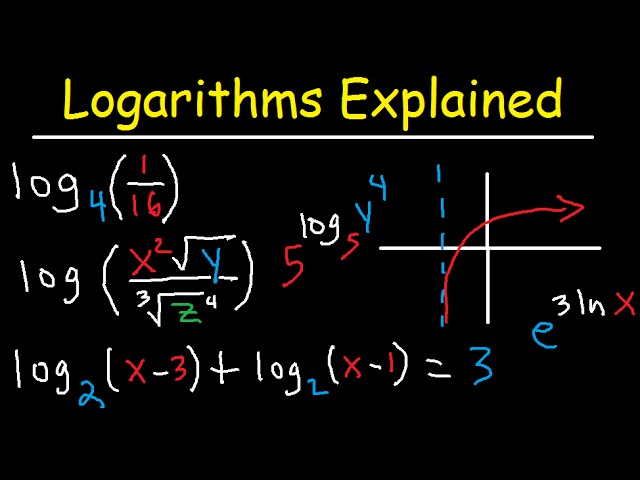
This algebra 2 / precalculus math video tutorial explains the rules and properties of logarithms. It shows you how to condense and expand a logarithmic expression in addition to graphing and solving logarithmic equations.
Algebra For Beginners: https://www.youtube.com/watch?v=MHeirBPOI6w
Algebra 2 - Ba...

This algebra 2 video tutorial provides a basic introduction of logarithms. It explains the process of evaluating logarithmic expressions without a calculator.
Algebra For Beginners: https://www.youtube.com/watch?v=MHeirBPOI6w
Algebra 2 - Basic Introduction: https://www.youtub...
opaque heart
vale wigeon
have you been introduced to logarithms at all?
Yes I have been
I'm mostly confused what ln and e are
vale wigeon
do you mean lg or ln
opaque heart
timid lion
e is a constant, ln is log base e
log can be ln?
vale wigeon
the function e^x comes up quite a bit in calculus
opaque heart
like how pie is area for circles or some ratio i forgot
vale wigeon
pi, not pie.
alpine sable
one of the famous properties of e^x is the fact that the slope of its tangent line is equal to itself everywhere
also, one of the definitiond of euler's number related to compounded interest (that's how it was discovered)
[
\lim_{n \to \infty} \p{1+ \f1n}^n = e
]
ocean sealBOT
 vale wigeon
what grade are you in
opaque heart
literally just figured out what a logarithmic was and how you can use it to use like 3^x = 9 or other stuff
alpine sable
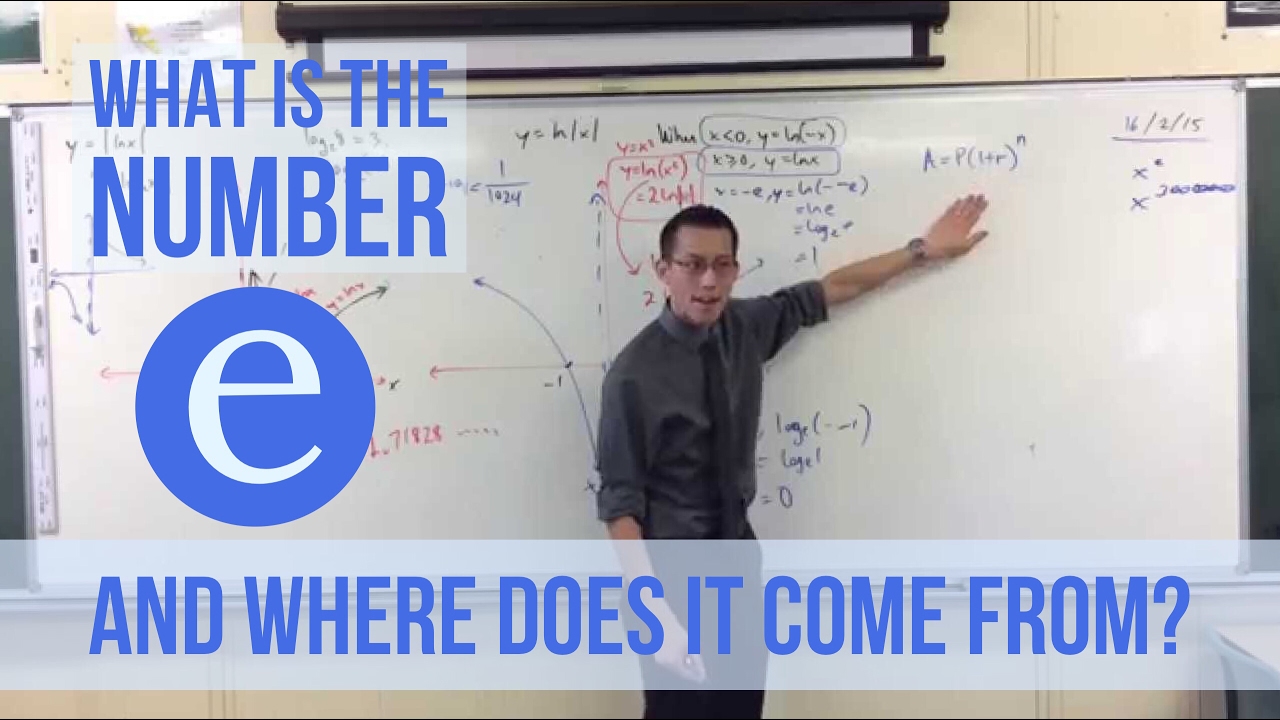
e (2.718281828...), also known as Euler's number, is a critically important number in mathematics. It forms the basis of the exponential function and the natural logarithm, and like π it crops up in innumerable places (even where you wouldn't expect it).
give this a watch
opaque heart
yes sir/ma'am 🫡
alpine sable
sir works
lone heartBOT
@opaque heart Has your question been resolved?
lone heartBOT
Channel closed
Closed due to timeout
Use .reopen if this was a mistake.
lone heartBOT
Available help channel!
Send your question here to claim the channel.
Remember:
• Ask your math question in a clear, concise manner.
• Show your work, and if possible, explain where you are stuck.
• After 15 minutes, feel free to ping <@&286206848099549185>.
• Type the command .close to free the channel when you're done.
• Be polite and have a nice day!
Read #❓how-to-get-help for further information on how to ask a good question, and about conduct in the question channels.
 finite gazelle
I have a really dumb task that for some reason im calculating incorrectly. I have 100 numbers (data) that i need to sort out into 10 groups of equal interval. Smallest num is 22, biggest is 60. Im struggling with making the groups fit the data correctly and evenly
lone heartBOT
finite gazelle
I have a really dumb task that for some reason im calculating incorrectly. I hav...
 rare gale
finite gazelle
I have a really dumb task that for some reason im calculating incorrectly. I hav...
rare gale
finite gazelle
I have a really dumb task that for some reason im calculating incorrectly. I hav...
is this more of a programming question?
 mortal trellis
what exactly do you mean with 10 groups of equal interval
rare gale
not sure I am understanding your question correctly, but if you are just trying to divide [22, 60] into 10 equally sized intervals you could just calculate (60 - 22) / 10 = 3.8 let's call that d:
d = 3.8, now your intervals would just be:
[22, 22 + d), [22 + d, 22 + 2d), [22 + 2d, 22 + 3d) etc if that makes sense
lone heartBOT
@finite gazelle Has your question been resolved?
finite gazelle
rare gale
not sure I am understanding your question correctly, but if you are just trying ...
thats the correct idea but the last group undershoots by a bit
rare gale
finite gazelle
thats the correct idea but the last group undershoots by a bit
just make sure the last group is a closed interval on both sides so it includes the actual 60
10 groups = 11 boundaries where you have to be inclusive, so the last one (depending on how you slice things up needs to have 2), sounds like you arent including the 60 in that one maybe?
last group: [22 + 9d, 22 + 10d]
lone heartBOT
Channel closed
Closed due to timeout
Use .reopen if this was a mistake.
Available help channel!
Send your question here to claim the channel.
Remember:
• Ask your math question in a clear, concise manner.
• Show your work, and if possible, explain where you are stuck.
• After 15 minutes, feel free to ping <@&286206848099549185>.
• Type the command .close to free the channel when you're done.
• Be polite and have a nice day!
Read #❓how-to-get-help for further information on how to ask a good question, and about conduct in the question channels.
 mossy current
 lone heartBOT
mossy current
mossy current
lone heartBOT
mossy current
mossy current
How do I find the equation of this graph?
lone heartBOT
@mossy current Has your question been resolved?


 glad socket
yeah but u cant rlly get that from the graph
mossy current
mossy current
Answer is this
Do you understand how its worked out based off this?\
I have no clue
glad socket
youre probably studying geometric series in ur classes
and the teacher expected you to model it as y = a^(x-b)
mossy current
Yes
 charred jewel
probably the scale isnt accurate enough
mossy current
But thats like a expoential graph with an asymphote and everything
glad socket
yeah
mossy current
Let me show an example
glad socket
if you mode lit sa y=a^(x-b) and plug in 2 different points youi get that solution
but you cant be expected to do that just off the graph (even though it does look exponential)
charred jewel
i mean like when x = 3, the graph is in the middle of 2 and 4 but you cant really tell if its equal to 3
mossy current
Something like that
 charred jewel
so if the graph had better accuracy it'll be easier to tell
glad socket
charred jewel
i mean like when x = 3, the graph is in the middle of 2 and 4 but you cant reall...
irrelevant
its close enough
glad socket
again
charred jewel
glad socket
its close enough
it could be like 2.8 or something
glad socket
onlyif you assume the shape y=a^(x-b)
glad socket
charred jewel
it could be like 2.8 or something
not if its in the middle
mossy current
glad socket
onlyif you assume the shape y=a^(x-b)
How would you solve it with this?
Assuming it's 3
glad socket
mossy current
How would you solve it with this?
plug in 2 points i.e. (2,1) and (3,3)
then solve
1=a^(2-b) 3 = a^(3-b) and figure shit out
1=a^(2-b) --> 2-b = 0
 glad socket
a point on the line is (x,30-2x)
the area would then be x(30-2x)
so you just want to find the maximum value of that for 0<x<10
mossy current
Wait why 0<x<10 sorry
mossy current
I honestly am confused with the question lol
So it's saying to find a rectangle with the largest area
Actually
I dont really understand
Alright so they want to place a billboard on the side of a ski jump. The side of the building is a trapezium with a parallel vertical sides 10m apart.
This lines equation is y = 30 -2x

I don't really understand what to do
 worn fox
The base of the rectangle will be x where x is between 0 and 10 agree?
lone heartBOT
@mossy current Has your question been resolved?
lone heartBOT
Channel closed
Closed due to timeout
Use .reopen if this was a mistake.
Available help channel!
Send your question here to claim the channel.
Remember:
• Ask your math question in a clear, concise manner.
• Show your work, and if possible, explain where you are stuck.
• After 15 minutes, feel free to ping <@&286206848099549185>.
• Type the command .close to free the channel when you're done.
• Be polite and have a nice day!
Read #❓how-to-get-help for further information on how to ask a good question, and about conduct in the question channels.
 near falcon
what is "the solution is all numbers" and "there is no solution" in math
lone heartBOT
near falcon
what is "the solution is all numbers" and "there is no solution" in math
near falcon
pls help
 violet tide
near falcon
what is "the solution is all numbers" and "there is no solution" in math
violet tide
near falcon
what is "the solution is all numbers" and "there is no solution" in math
all numbers means all of the elements of your set very the affirmation(s)
and no solution means no number verifies your affirmation
near falcon
what about for the linear equations
alpine sable
near falcon
what is "the solution is all numbers" and "there is no solution" in math
If there are no solutions, that means that the equation is false. For example 1=8 or 5>6
alpine sable
near falcon
what about for the linear equations
Same for linear equations
near falcon
what are the conditions
alpine sable
For example 3x + 6 has infinitely many solutions
alpine sable
near falcon
what are the conditions
Wdym?
near falcon
what are the conditions that make the solution to a linear equation all numbers
alpine sable
If you solve the linear equation, and what you get is false then it doesn't have any solutions (like i listed above).
alpine sable
near falcon
what are the conditions that make the solution to a linear equation all numbers
It depends on the linear equation, you can't just change it
near falcon
ok thx
alpine sable
For example 2x - 4 = 2x + 6
If you solve it, you'll get 0 = 10, which is never true
near falcon
yea
alpine sable
So for any value of x, this is still untrue
This has an infinite number of solutions
near falcon
so how do i do 2x-(5-x)k = 10 if the solution is all numbers
alpine sable
Do you need to find k?
near falcon
yes
alpine sable
You can start by disturbing k into the parentheses and then getting rid of them
near falcon
how do i write it in the form of ax=b tho
alpine sable
Simplify it
alpine sable
alpine sable
You can start by disturbing k into the parentheses and then getting rid of them
.
Can you do that?
near falcon
i dont think so
alpine sable
Try it
near falcon
how
alpine sable
See the (5 - x)k part? Can you make it so that k goes inside the parentheses?
near falcon
5k-kx?
alpine sable
Yes
near falcon
but theres two variables
alpine sable
So now you have 2x - (5k - kx) = 10
Can you get rid of the parentheses entirely?
The -(5k - kx) part
near falcon
so -5k+kx?
near falcon
how do i do it if theres two variables
alpine sable
Ok move -5k to the other side
alpine sable
near falcon
how do i do it if theres two variables
Think of k as just another number, don't worry about it yet
near falcon
2x+kx = 10-5k
near falcon
(2+k)x?
alpine sable
Yes!
So you get x(2 + k) = 10 - 5k
Now what can you do to make it only x on the left side?
 hasty creek
near falcon
help?
hasty creek
near falcon
help?
You get 2x - 5k + kx = 10
near falcon
fianly
hasty creek
I am not obliged to help you
near falcon
ok
hasty creek
Anyways
hasty creek
hasty creek
You get 2x - 5k + kx = 10
So we know that there are 0 x at the right side
near falcon
why
hasty creek
Can you read?
near falcon
oh
near falcon
hasty creek
Can you read?
u said left side at first, no needa be rude
hasty creek
Nah not tryna be rude
I meant re read my thing
near falcon
ok
hasty creek
Ok so
If the right side has 0 x and the left side has some x, and we know that the right and left side are equal
Then the x on the right side are equal to 0
hasty creek
So 2 + k = 0
hasty creek
near falcon
so k is -2?
Yep
near falcon
how do i write it in an equation tho
hasty creek
Re arrange the equation into
x(2+k)-5k = 10
We know that (2+k) = 0 since there are no x on the right side
So k = -2
 unkempt robin
What
near falcon
tysm
hasty creek

hasty creek
unkempt robin
What
We want the equation 2x - 5k + kx = 10
To be always true
hasty creek
all good
lone heartBOT
@near falcon Has your question been resolved?
Channel closed
Closed by @near falcon
Use .reopen if this was a mistake.
Available help channel!
Send your question here to claim the channel.
Remember:
• Ask your math question in a clear, concise manner.
• Show your work, and if possible, explain where you are stuck.
• After 15 minutes, feel free to ping <@&286206848099549185>.
• Type the command .close to free the channel when you're done.
• Be polite and have a nice day!
Read #❓how-to-get-help for further information on how to ask a good question, and about conduct in the question channels.
 silent ore
I'm learning multivariable calc right now and I got this rather difficult task for me. It seems simple but I get lost in the computation. I need to find the directional derivative of f(x,y) = e^{x-y}(x^2-2y^2) at (1, 1) along the direction given by the vector v = (−1, 2) and the direction of maximum rate of increase at (1, 1), then the stationary points and say whether they are local maximizer minimzers etc. Now I did find the first point of directional derivative and stuff, but then when it comes to stationary points, they are not numbers but rather functions of their own and then it gets really hard to find whether they are maximizers or minimizers. I'll upload my work. I'm not sure how to define those points when there are x_{1,2} = -1 +- sqrt(1+2y^2)
lone heartBOT
silent ore
I'm learning multivariable calc right now and I got this rather difficult task f...
silent ore

 lone heartBOT
@silent ore Has your question been resolved?
silent ore
Maybe I'll write it more concise
The main problem is finding and classifying the stationary points of the function f(x, y) = e^{x-y}(x^2-2y^2) at (1, 1) where the solutions involve expressions like x_{1,2} = -1 +- sqrt(1+2y^2), making it challenging to determine whether they are local maximizers or minimizers.
when gradient of f = 0 vector involves other variables in the solution i get lost
<@&286206848099549185>
lone heartBOT
@silent ore Has your question been resolved?
lone heartBOT
@silent ore Has your question been resolved?
lone heartBOT
@silent ore Has your question been resolved?
lone heartBOT
@silent ore Has your question been resolved?
lone heartBOT
Channel closed
Closed due to timeout
Use .reopen if this was a mistake.
Available help channel!
Send your question here to claim the channel.
Remember:
• Ask your math question in a clear, concise manner.
• Show your work, and if possible, explain where you are stuck.
• After 15 minutes, feel free to ping <@&286206848099549185>.
• Type the command .close to free the channel when you're done.
• Be polite and have a nice day!
Read #❓how-to-get-help for further information on how to ask a good question, and about conduct in the question channels.
 hushed trench
how to find confidence interval?
 lone heartBOT
hushed trench
how to find confidence interval?
lone heartBOT
hushed trench
how to find confidence interval?
@hushed trench Has your question been resolved?
hushed trench
<@&286206848099549185>
lone heartBOT
@hushed trench Has your question been resolved?
Channel closed
Closed by @hushed trench
Use .reopen if this was a mistake.
Available help channel!
Send your question here to claim the channel.
Remember:
• Ask your math question in a clear, concise manner.
• Show your work, and if possible, explain where you are stuck.
• After 15 minutes, feel free to ping <@&286206848099549185>.
• Type the command .close to free the channel when you're done.
• Be polite and have a nice day!
Read #❓how-to-get-help for further information on how to ask a good question, and about conduct in the question channels.
 royal crystal
 lone heartBOT
royal crystal
lone heartBOT
royal crystal
 tacit arch
royal crystal
Specifically the bottom part
tacit arch
royal crystal
Specifically the bottom part
what sentence or equation exactly
royal crystal
tacit arch
what sentence or equation exactly
since a does not equal c or b does not equal d
the last sentence
tacit arch
follows from the assumption

"two different ways" means a is different from c and b is different from d
tacit arch
...
royal crystal
💀
tacit arch
 royal crystal
i forgot what eh question said let me reread
tacit arch
if v and w are not linearly dependent, then they're linearly independent
royal crystal
So we're showing that v and w are linearly dependent
which is scalar multples of each other
ah (a-c)v and (b-d)w are just another scalar multiple of v and w
and therefore they are linearly dependent?
royal crystal
tacit arch
if v and w are not linearly dependent, then they're linearly independent
unless im not understanding
 oak chasm
Well, if you have (a - c)v + (b - d)w, what does that equal?
royal crystal
oak chasm
Well, if you have (a - c)v + (b - d)w, what does that equal?
0?
oak chasm
Right.
royal crystal
oak chasm
Right.
not really following, are u saying like if we put
(a-c)v = -(b-d)w
this shows they're scalar multiples of each other?
and that means that they're linearly dependent?
oak chasm
Well, that's a good thing to try.
If a vector is a linear combination of the other vector(s), then it's not linearly independent of it/them.
royal crystal
oak chasm
Well, that's a good thing to try.
Im super lost so does what I said actually prove linear dependence?
oak chasm
Well, you're almost there.
I mean, yes, they are scalar multiples, but it would be clearer to say that, for example, v is a scalar multiple of w.
You're trying to show that a vector, not a scalar multiple of that vector, is a linear combination of the other vector(s).
So, is v a linear combination of w?
If you're stuck, review what a linear combination is.
royal crystal
oak chasm
So, is v a linear combination of w?
I have no clue
oak chasm
What is a linear combination?
royal crystal
A vector that can be written as scalar multiples of other vectors right?
oak chasm
No, a linear combination is a bunch of vectors, each multiplied by some scalar (the scalars might differ for each vector), then those are summed.
Like ax + by + cz.
royal crystal
Yeah
oak chasm
To determine if a vector is linearly dependent on a set of vectors, you see if you can make a linear combination of the set of those vectors that equals that original vector.
royal crystal
yes
oak chasm
So, if you're trying to determine if v is linearly dependent on w, you see if there's a linear combination of w that produces v.
royal crystal
Ok
oak chasm
A linear combination is the sum of a scalar multiplied by each vector.
royal crystal
Sorry, i still dont really see what ur getting atr
(a-c)v = -(b-d)w
how does this show dependence?
oak chasm
You're trying to show that "v and w are linearly dependent".
It's not quite there.
You show that v is a linear combination of w.
Not that some multiple of v is.
That v is.
royal crystal
Isnt that what this is saying?

I dont understand
How do i know that v is a linear combination fo w
oak chasm
You do v = some scalar w.
royal crystal
so v = -(b-d)/(a-c)w?
oak chasm
Right.
So, v is a linear combination of w.
Which means that it's linearly dependent on w.
royal crystal
Isnt that what I said before?
oak chasm
You never had v = something.
oak chasm
If you want to determine if a vector is dependent on some other vectors, you make a linear combination of those vectors that equals the original vector.
Here, a linear combination is just a scalar times w since you only have one vector in the linear combination.
If you had w and x, you'd have something like v = aw + bx.
oak chasm
No problem.
What they pointed out there is also important.
At least one scalar must be nonzero.
Like if you have v = 0w + 0x, that won't work.
royal crystal
Yeah that makes sense
oak chasm
I think they use a different way of doing linear dependence.
royal crystal
I have a different quesiton if you dont mind
If A is an n×n matrix which is not invertible, then any homogeneous linear system of equations having A
as its matrix of coefficients must have infinitely many solutions.
is this true or false
oak chasm
You can also do it where you put the original vector and the others on one side and do a linear combination of all of them. If at least one coefficient is nonzero, but you get the zero vector from it, then it's linearly dependent.
OK, so what's the rank of such a matrix?
I guess that's one way to figure it out.
royal crystal
It has to not be a full rank right?
oak chasm
Right. If it had a rank of n, you could invert it.
royal crystal
Since it deosnt have a full rank it has a free variable?
Im just kinda lost on the homogenous linear system of equations having A as it's matrix of coefficients
Kinda confused on what that means
oak chasm
Oh, have you done RREF?
royal crystal
Yes
oak chasm
It's sort of like that.
The matrix is the coefficients of each equation, one row per equation.
royal crystal
So if i have a matrix
[1 -1]
[-1 1]
which is not invertible
If i put it as the coefficient matrix does that mean it's saying
x1 - y1 | 0
-x2 y2 | 0
oak chasm
Yes, except the same variable for each column.
royal crystal
oh wait what
royal crystal
Ok
oak chasm
royal crystal
This is where I got stuck
How do i know that this matrix has infinite solutions?
Is it cuz i can take infinite values for each variable that cause it to = 0?
oak chasm
No, it's because when you're solving a system of equations, you need as many linearly independent equations as variables or you won't be able to solve for all variables.
If you do RREF, you get the rank as the number of nonzero rows.
So, you essentially have the rank as the number of independent equations.
And so you can solve for the rank as the number of variables you solve for.
But if the rank is less than n, and you have n variables, then at least one variable won't be solvable, and it can be anything.
royal crystal
royal crystal
So if i have a matrix
[1 -1]
[-1 1]
which is not invertible
So do i actually have to put the coefficient matrix into a system? Can't I just know it from the original matrix
Since it has a rank less than n
oak chasm
The coefficient matrix is a system of equations.
Then you do RREF with it.
Then you have the solutions to some variables or linear combinations of variables.
Like if you get {{1, 0, 0, 5}, {0, 1, 1, 6}, {0, 0, 0, 0}}.
Then x_1 is 5, and x_2 + x_3 is 6.
But then you can't exactly solve for x_2 or x_3.
royal crystal
Sorry I dont follow
royal crystal
oak chasm
Like if you get {{1, 0, 0, 5}, {0, 1, 1, 6}, {0, 0, 0, 0}}.
is this a matrix or?
ocean sealBOT


 Requested by chai.t.rex
royal crystal
Requested by chai.t.rex
royal crystal
A is supposed to be an nxn matrix
oak chasm
Right, but with RREF, it'll have the extra column.
oak chasm
Right.
royal crystal
i see
oak chasm
So, with that example, you can fill in anything you want for x_2.
And that will determine x_3.
royal crystal
oak chasm
So, with that example, you can fill in anything you want for x_2.
I dont get this
oak chasm
Well, let's say you have x_2 + x_3 = 6.
You can't just solve that for x_2 and x_3.
You have to fill in one of the variables to get the other one.
royal crystal
Oh but isnt x_3 the free variable?
oak chasm
Well, I mean in the sense of more basic algebra, a + b = 6 allows you to fill in either a or b to get the other variable.
royal crystal
ok
oak chasm
With a zero row in the augmented matrix, you'll have at least one variable that you can set to whatever you want.
So, there are infinite solutions.
oak chasm
You're welcome.
royal crystal
.close
lone heartBOT
Channel closed
Closed by @royal crystal
Use .reopen if this was a mistake.
Available help channel!
Send your question here to claim the channel.
Remember:
• Ask your math question in a clear, concise manner.
• Show your work, and if possible, explain where you are stuck.
• After 15 minutes, feel free to ping <@&286206848099549185>.
• Type the command .close to free the channel when you're done.
• Be polite and have a nice day!
Read #❓how-to-get-help for further information on how to ask a good question, and about conduct in the question channels.
 thick cipher
 lone heartBOT
thick cipher
thick cipher
lone heartBOT
thick cipher
thick cipher
hi guys, how do u find the summation when the index doesnt start at 1? (no. 18)
finding the first 13 terms is tedious
 foggy current
For the case of question 18, you start adding from k=14 instead of k=1
foggy current
Shifting the index means that instead of k going from 14 to 18, you let i=k-13 so that i goes from 1 to 5
And since k=i+13, you replace every k in the summation term by i+13
thick cipher
does it yield the same result?
thick cipher
so instead of 14-18, it becomes 1-5 essentially
foggy current
Yes
thick cipher
gotcha
thick cipher
foggy current
At least in the case where i=k-some integer
by this it doesnt work in all cases where index is not 1?
foggy current
This always work for any index
thick cipher
alright, gotcha
thick cipher
foggy current
This always work for any index
okay, extra question
i wanna reverse enginneer it
what if my index is 1, and upper limit is at 18
foggy current
Then instead of i=k-some integer, we use i=k+some integer
Assuming you're trying to make the starting index some non-1 integer
foggy current
"Some integer" depends on how much you want to "shift" the indices

 foggy current
Remember to replace the variables in the summation term
I.e. replace all n's on the right with n+13
thick cipher
ohhh
thick cipher
foggy current
Remember to replace the variables in the summation term
so if the index is shifted to 1; the variable on the right will be
n + something
foggy current
Yes
foggy current
thick cipher
so if the index is shifted to 1; the variable on the right will be
You mean on the left?
thick cipher
foggy current
You mean on the left?
ye; where n = 1 and upper is 5
thick cipher
foggy current
You mean on the left?
i mean on the right hand side btw
 thick cipher
foggy current
thick cipher
foggy current
question, in summation, are there theorems wherein n is the exponent?
usually there are three theorems in summation,
n^1; n^2; n^3
but what is the summation therorem of
2^n
 mellow grail
thick cipher
2^n
mellow grail
thick cipher
2^n
Binomial expansion go brrrr
Have u heard of the binomial theorem @thick cipher
And not summation theorem, summation formula
lone heartBOT
@thick cipher Has your question been resolved?
lone heartBOT
Channel closed
Closed due to timeout
Use .reopen if this was a mistake.
Available help channel!
Send your question here to claim the channel.
Remember:
• Ask your math question in a clear, concise manner.
• Show your work, and if possible, explain where you are stuck.
• After 15 minutes, feel free to ping <@&286206848099549185>.
• Type the command .close to free the channel when you're done.
• Be polite and have a nice day!
Read #❓how-to-get-help for further information on how to ask a good question, and about conduct in the question channels.
thick cipher
mellow grail
Binomial expansion go brrrr
pascals triangle and the factorial formula, yeah
thick cipher
.reopen
can someone explain this? this is mathematical induction;

my math teacher made a good method to understand the lesson called the TAPE Method
T. Test if n = 1 is true
A. Assume n = k is true
P. Prove n = k + 1 is true
E. Explain
thick cipher
thick cipher
can someone explain this? this is mathematical induction;
can anyone explain step 3?
mellow grail
I never did induction on this. I always just went ahead and wrote 2^n as (1+1)^n
And expanded
Oh wait that's the formula for the sum of binomial coefficient 
Sorry sorry
mellow grail
thick cipher
can anyone explain step 3?
Yes so what he did was he added one more term I.e. 2^(k+1)
He then replaced all the terms before it with what we assumed in step 2
thick cipher
mellow grail
He then replaced all the terms before it with what we assumed in step 2
right, since the 2^(k + 1) - 2 represents LHS
or left hand side
also can someone check my problem if i am wrong about mathematical induction
thick cipher
mellow grail
And use a^m * a^n = a^(m+n)
product law
mellow grail
thick cipher
also can someone check my problem if i am wrong about mathematical induction
No it's correct
thick cipher
since common base
mellow grail
Yes
mellow grail
Wdym
thick cipher
Prove that 5^(n) - 1 divisible by 4 for every positive int. (TAPE Method)
Test is n = 1 is true
5^(n) - 1 = 4
5^(1) - 1 = 4
5 - 1 = 4
4 = 4 ✅
Assume n = k is true
5^(k) - 1 is true
Prove n = k + 1 is true
5^(k + 1) - 1
5^k (5) - 1
5^k (4 + 1) - 1
4(5^k) + 1(5^k - 1)
Explain
By Mathematical induction, we have proven that indeed, 5^(n) - 1 is divisble by 4 for any positive integer n
can u check pls
lone heartBOT
@thick cipher Has your question been resolved?
charred jewel
thick cipher
Prove that 5^(n) - 1 divisible by 4 for every positive int. (TAPE Method)
Test ...
i dont think 4 - 1 = 5
charred jewel
yeah it looks correct
 charred jewel
thick cipher
charred jewel
thick cipher
brackets are important to use
thick cipher
charred jewel
brackets are important to use
wat should i bracket?
charred jewel
2+4+6+...+2k+2(k+1)
thick cipher
oh shit
it changes everything
2k + 2 + k^2 + k
2(k + 1) + k^2 + k
(1 + 1)(k + 1 ) + k^2 + k
k^2 + k + 1 + 1(k + 1)
(k + 1)(k + 1) + k + 1
(k + 1)^ 2 + k + 1
By math induction, the formula (2n - 1) = n^2 is true for any positive integers n
2 + 4 + 6 + … + 2n = n^2 + n
Test n = 1 is true
2(1) = (1)^2 + 1
2 = 1 + 1
2 = 2
Assume n = k is true
2k = k^2+ k is true
Prove n = k + 1 is true
2 + 4 + 6 + … + 2k + 2(k + 1) = + (k + 1)^2 + k + 1
using step 2:
k^2 + k + 2k + 2
k^2 + k + 2(k + 1)
k^2 + k + (1 + 1)(k + 1)
(k + 1)^2 + k + 1
heres the full thing, is it correct
charred jewel
should be assume 2 + 4 + 6 + ... + 2k = k^2 + k is true
 violet urchin
charred jewel
should be assume 2 + 4 + 6 + ... + 2k = k^2 + k is true
violet urchin
charred jewel
should be assume 2 + 4 + 6 + ... + 2k = k^2 + k is true
isn't that equivalent
he said that the formula is true for n
and then said n=k
it was a little roundabout but its accurate
lone heartBOT
@thick cipher Has your question been resolved?
Channel closed
Closed by @thick cipher
Use .reopen if this was a mistake.
thick cipher
prove by mathematical induction that 1^2 + 2^2 + 3^2 + … + n^2 = (n(n+1)(2n + 1)/6 is true for any pos int n
lone heartBOT
Available help channel!
Send your question here to claim the channel.
Remember:
• Ask your math question in a clear, concise manner.
• Show your work, and if possible, explain where you are stuck.
• After 15 minutes, feel free to ping <@&286206848099549185>.
• Type the command .close to free the channel when you're done.
• Be polite and have a nice day!
Read #❓how-to-get-help for further information on how to ask a good question, and about conduct in the question channels.
 zinc shore
i need help to find the p value
 lone heartBOT
zinc shore
i need help to find the p value
lone heartBOT
lone heartBOT
zinc shore
i need help to find the p value
lone heartBOT
@zinc shore Has your question been resolved?
Channel closed
Closed by @zinc shore
Use .reopen if this was a mistake.
Available help channel!
Send your question here to claim the channel.
Remember:
• Ask your math question in a clear, concise manner.
• Show your work, and if possible, explain where you are stuck.
• After 15 minutes, feel free to ping <@&286206848099549185>.
• Type the command .close to free the channel when you're done.
• Be polite and have a nice day!
Read #❓how-to-get-help for further information on how to ask a good question, and about conduct in the question channels.
alpine sable
stuck on this question
 lone heartBOT
alpine sable
stuck on this question
alpine sable
lone heartBOT
alpine sable
stuck on this question
alpine sable
i have some working but it's very rough
lone heartBOT
@alpine sable Has your question been resolved?
alpine sable
<@&286206848099549185>
 exotic canopy
alpine sable
stuck on this question
exotic canopy
alpine sable
stuck on this question
which one
rare gale
alpine sable
i have some working but it's very rough
it says "show that the sequence is monotone increasing for each x" but wouldn't it be decreasing?
since as n -> inf each term decreases?
and there's some theorem that says that if the sequence of a sum is monotone and decreasing it converges to a limit, that's about it
lone heartBOT
@alpine sable Has your question been resolved?
lone heartBOT
Channel closed
Closed due to timeout
Use .reopen if this was a mistake.
Available help channel!
Send your question here to claim the channel.
Remember:
• Ask your math question in a clear, concise manner.
• Show your work, and if possible, explain where you are stuck.
• After 15 minutes, feel free to ping <@&286206848099549185>.
• Type the command .close to free the channel when you're done.
• Be polite and have a nice day!
Read #❓how-to-get-help for further information on how to ask a good question, and about conduct in the question channels.
 remote ether
I’m homeschooled, so no formal education with maths, just online stuff, and I’m planning on starting a course next year that will help me get into a computer science degree in university. I need to work more on my maths, and I’m wondering what areas of maths I’ll need to study. There are 3 main maths courses in this course: advanced maths 1 (algebra, curve sketching lines, sequences and series etc.), Statistics and advanced maths 2 (trigonometry, differentiation, integration etc. )
lone heartBOT
remote ether
I’m homeschooled, so no formal education with maths, just online stuff, and I’m ...
remote ether
Do I need statistics? And do I need to go as far as advanced 2, or just stick with 1
rare gale
math is heavily used in computer science but kind of depends what you want to be doing, more software engineering (can be very math heavy, ofc there is a large variety) or more artsy design-oriented stuff like designing websites \ user interfaces etc.?
remote ether
What does each field typically require?
I would like to work toward more engineering side of things
rare gale
computer science encompasses a broad spectrum of things, i dont really know how to answer your question if you don't know more specifically what you want to do with it, but in my opinion anyone going into comp sci should have or pursue a strong math foundation since its basically all math when it comes down to it. there are many layers of abstraction in programming these days though and if you are working at a lower level of abstraction you would need to be familiar with stuff like binary, hexadecimal bases etc., there is always a lot of geometry and trig involved in display stuff on the screen, coordinates etc., and getting really close to the hardware level it is handy to be familiar with logic circuits etc., on the other hand people like designers \ user experience people work at a high level of abstraction where all that stuff is abstracted into their high-level programming language and they might not have to dea with it directly much....it kinda depends where in that you want to insert yourself.
basically math wont hurt and it's hard to imagine someone loving computer engineering if you hate math since they are closely related...if you have no motivation to study math then probably it isn't the field for you
remote ether
I enjoy algebra at the moment, but I’m not sure how I would go with calculus
That’s why I was wondering if I could avoid it 😅
rare gale
not having a strong math foundation and going into any sort of programming will invariably lead to hitting walls every which way and having to end up learning things more later anyway
rare gale
remote ether
I enjoy algebra at the moment, but I’m not sure how I would go with calculus
it just gets more and more interesting : )
remote ether
I just don’t want to get stuck and fail it… also I haven’t done much of this form of learning yet…
I really get your point about not having a strong foundation.
rare gale
calculus isn't necessarily too hard, it's actually very intuitive for the most part...i've tutored calculus for many years and i find 95% of the people struggling with it are struggling because of a poor arithmetic \ algebra foundation...people "get by" in lower level courses and don't fully understand stuff like manipulating fractions, exponents etc., just enough to get a passing grade. Then they get to calculus where a problem might involve a lot more steps involving "complex" arithmetic, and making mistakes at any of those steps can compromise the whole problem. the concepts introduced by calculus flow pretty easily and actually appeal a lot to just basic human intuition if you have a strong foundation in arithmetic, geometry, trig
problem is a lot of people in american education system, where i live, don't have that foundation so they end up struggling
but if you don't struggle with just the working out problems part then the concepts are really exciting and fun \ interesting in my opinion
remote ether
That’s interesting to hear! I learned arithmetic more recently at my own time, being home schooled, so that may help ?
remote ether
Honestly I haven’t done much of either. Mostly focusing on algebra 2 at the moment.
rare gale
alright, you'll want to focus on a strong foundation in both those things before approaching calculus since it really builds on it and is completely necessary
remote ether
Ok sure. What level of geometry should I be aiming for?
rare gale
i guess high school geometry
im not too familiar with curriculum of what is taught these days, maybe you can ask around in #book-recommendations for a good book for your situation
remote ether
I’ll have a look at that one, thanks! And high school trig?
rare gale
what age are you right now if i may ask?
remote ether
I’m 16, so starting the course next year. As they have entry from 17
rare gale
the calculus course? or the comp sci degree?
remote ether
The calculus course. It’s to help develop my skills to do the degree in the future.
rare gale
ok, sounds good yeah
remote ether
So you reckon I should definitely go ahead with the calculus. What are your thoughts on statistics in computer science?
In your time teaching, how long does it usually take for people to grasp calculus?
lone heartBOT
@remote ether Has your question been resolved?
remote ether
.close
lone heartBOT
Channel closed
Closed by @remote ether
Use .reopen if this was a mistake.
Available help channel!
Send your question here to claim the channel.
Remember:
• Ask your math question in a clear, concise manner.
• Show your work, and if possible, explain where you are stuck.
• After 15 minutes, feel free to ping <@&286206848099549185>.
• Type the command .close to free the channel when you're done.
• Be polite and have a nice day!
Read #❓how-to-get-help for further information on how to ask a good question, and about conduct in the question channels.
thick cipher
hello
lone heartBOT
thick cipher
hello
thick cipher
how is 0 factorial = 1?
 calm anchor
thick cipher
calm anchor
thick cipher
that makes sense
 near apex
lone heartBOT
near apex
lone heartBOT
@thick cipher Has your question been resolved?
lone heartBOT
Channel closed
Closed due to timeout
Use .reopen if this was a mistake.
Available help channel!
Send your question here to claim the channel.
Remember:
• Ask your math question in a clear, concise manner.
• Show your work, and if possible, explain where you are stuck.
• After 15 minutes, feel free to ping <@&286206848099549185>.
• Type the command .close to free the channel when you're done.
• Be polite and have a nice day!
Read #❓how-to-get-help for further information on how to ask a good question, and about conduct in the question channels.
 gusty brook
 lone heartBOT
gusty brook
lone heartBOT
gusty brook
 gusty brook
gusty brook
gusty brook
i solved the last part in a Z pattern
left right, down left, down right
.close
lone heartBOT
Channel closed
Closed by @gusty brook
Use .reopen if this was a mistake.
Available help channel!
Send your question here to claim the channel.
Remember:
• Ask your math question in a clear, concise manner.
• Show your work, and if possible, explain where you are stuck.
• After 15 minutes, feel free to ping <@&286206848099549185>.
• Type the command .close to free the channel when you're done.
• Be polite and have a nice day!
Read #❓how-to-get-help for further information on how to ask a good question, and about conduct in the question channels.
 hidden moon
Can someone tell me pls how I can simplify sqrt3(sqrt(2)/4) to 1/sqrt(2)?
lone heartBOT
hidden moon
Can someone tell me pls how I can simplify sqrt3(sqrt(2)/4) to 1/sqrt(2)?
 real oak
i really need urgent help with the answers to A and B

 minor needle
hidden moon
Can someone tell me pls how I can simplify sqrt3(sqrt(2)/4) to 1/sqrt(2)?
minor needle
hidden moon
Can someone tell me pls how I can simplify sqrt3(sqrt(2)/4) to 1/sqrt(2)?
use latex or set the brackets properly
hidden moon
minor needle
use latex or set the brackets properly
 hidden moon
i cant get any further than this
 ocean sealBOT
Modus
 minor needle
and hence
ocean sealBOT
Modus

 lone heartBOT
Channel closed
Closed by @hidden moon
Use .reopen if this was a mistake.
Available help channel!
Send your question here to claim the channel.
Remember:
• Ask your math question in a clear, concise manner.
• Show your work, and if possible, explain where you are stuck.
• After 15 minutes, feel free to ping <@&286206848099549185>.
• Type the command .close to free the channel when you're done.
• Be polite and have a nice day!
Read #❓how-to-get-help for further information on how to ask a good question, and about conduct in the question channels.
 forest glacier
There is a wall, 12 meters from the wall is a 4 meter high fence. What's the shortest ladder that can touch the wall?
lone heartBOT
forest glacier
There is a wall, 12 meters from the wall is a 4 meter high fence. What's the sho...
forest glacier
 minor needle
I think one element is missing
forest glacier
what do you mena
minor needle
I doubt there's a unique solution in this scenario
forest glacier
and what do you mean by that? ( like that there is no solution?=
lone heartBOT
@forest glacier Has your question been resolved?
lone heartBOT
Channel closed
Closed due to timeout
Use .reopen if this was a mistake.
Available help channel!
Send your question here to claim the channel.
Remember:
• Ask your math question in a clear, concise manner.
• Show your work, and if possible, explain where you are stuck.
• After 15 minutes, feel free to ping <@&286206848099549185>.
• Type the command .close to free the channel when you're done.
• Be polite and have a nice day!
Read #❓how-to-get-help for further information on how to ask a good question, and about conduct in the question channels.
 sonic sinew
$\lim_{x\to{0}}{\tan\left(\frac{\sin\left(\pi,x\right)}{2,x}\right)}$
ocean sealBOT
Bobba
 sonic sinew
How would you calculate this limit without using the l'Hopital rule?
My first thought is splitting it in to sin(sin(pix)/(2x))/cos(sin(pix)/(2x))
And then multiplying the sine in the numerator by sin(pix)/2x * 2x/sin(pix) so that way you get the formula of sinx/x which if you take the limit going to 0, is equal to 1
rare gale
you know that one special limit theorem that calculus classes generally teach around the end of the section on limit theorems? its proof is often shown as an example of using the squeeze theorem so it would probably be same chapter as that

so probably using that
sonic sinew
Yeah I thought so too that's what I meant with multiplying it by (sin(pix)/2x * 2x/sin(pix))
so then what's left in the numerator is sin(pix)/(2x)
rare gale
ah sorry i was typing it out before you had typed all your part : )
so yes you were on the right track
sonic sinew
but then you still have the cosine in the denominator
rare gale
ah so youre not sure how to deal with the tan?
sonic sinew
should you substitute it for 1 - sin²x?
sonic sinew
rare gale
ah so youre not sure how to deal with the tan?
Well I thought I'd just make it sin/cos
rare gale
the thing to remember with limits is that you can do stuff like
$\lim\tan(f(x)) = \tan(\lim f(x))$
ocean sealBOT
Soosh
 rare gale
IF f(x) value falls within the domain of tan
sonic sinew
oh word
rare gale
because tan function is continuous on its domain...what does continuity mean? it means that the value of the function and the limit match up right?
and both exist
and its something you would have learned about tan function is that its continuous on its domain
sonic sinew
rare gale
because tan function is continuous on its domain...what does continuity mean? it...
what about points like x = pi/2?
rare gale
well what i suggest is to try to now calculate the inner limit
and see where it falls
depending on where the inner value falls then itll either be the value of the tan function or if the inner value falls on one of the asymptotes of tan then it wont exist, because the tan function doesnt have a 2 sided limit there
on the asymptotes its increasing without bound on one side, decreasing without bound on the other, so no limit exists
 royal meadow
what are you guys doing
am i insane or can you just find the inner limit and then take the tan of that
sonic sinew
Thats what I thought the very first time I tried
rare gale
more or less what i just said, but just explaining why you can do that : )
sonic sinew
so you'd do something like this right?
royal meadow
oh isee
sonic sinew
$\lim_{x\to{0}}{\frac{\frac{\sin\left(\pi,x\right)}{\pi,x},\pi,x}{2,x}}$
ocean sealBOT
Bobba
 sonic sinew
well the tan of this limit
sonic sinew
yes but then you get tan(pi/2)
rare gale
$\lim_{x\to0}(\frac{\pi}{2}\frac{\sin(\pix){\pix}}$
ocean sealBOT
Soosh
Compile Error! Click the  reaction for more information.
(You may edit your message to recompile.)
 rare gale
sigh my latex is rusty lol
royal meadow
$\frac{\sin(\pi x)}{2x} = \frac{\pi}{2} \frac{\sin(\pi x)}{\pi x}$
ocean sealBOT
Kaisheng21
 rare gale
yes thats what i was trying
royal meadow
so yeah it goes to like pi/2 from below
rare gale
so yeah tan isn't continuous at pi/2 so you can't just use its "value" and the limit from the left and limit from the right don't match up so the limit doesn't exist, QED
royal meadow
so tan of that should go to like +infinity
like if x > 0 sin(x)/x is < 1 right
so it's like, slightly less than pi/2
so the tan sorta goes to positive infinity
sonic sinew
whaaat
royal meadow
ok
so consider small x
like, x = delta
so you know that sin(x)/x goes to 1 right
as x goes to 0
sonic sinew
yes
royal meadow
you should also know that for x > 0, sin(x) < x
so essentially when x gets closer and closer to 0, sin(x)/x essentially goes to 1 from below
it'll go like 0.9, 0.99, 0.999, something like that
rare gale
limit of tan x as x -> pi/2 from the right is -inf and limit as x -> pi/2 from the left is +inf

its just a vertical asymptote right?
royal meadow
i mean yeah
but essentially
so we have basically pi/2 * sin(pix)/x right
so that'll go to pi/2 from below
because it's like, pi/2 times something that goes to 1 from below
so then we take tan of all of that
so we're just approaching pi/2 from the left
so if you see on the graph, we only need to consider tan(x) from the left side
as it goes to pi/2
which is just positive infinity
sonic sinew
royal meadow
because it's like, pi/2 times something that goes to 1 from below
but sinx/x goes to 1 from both sides doesn't it
royal meadow
sure
i mean it's the same in the negative case, or it should be
wait lemme check
yeah sin(x)/x should still be < 1 for negative x
so it still works out
ocean sealBOT
Soosh
 rare gale
youre approaching 0 for the overall limit but whether you approach from the left or right the negative signs cancel out
sonic sinew
And since one goes to +inf, the other one as well then
rare gale
i didnt catch that at first but Kaishen is right
so yeah the value of that fraction is always positive right?
since either both numerator and denominator are positive or both negative
so i guess always approaching pi/2 from the right for the tan
sonic sinew
Do you mean the left?
rare gale
uh im not even sure lol
if i were doing the problem id plug in some small number like 0.1 to test : )
sonic sinew
I think that's the safest way too
But I kinda sorta understand the logical reasoning too
I think I have my answer though
Thank you guys sm
.close
lone heartBOT
Channel closed
Closed by @sonic sinew
Use .reopen if this was a mistake.
Available help channel!
Send your question here to claim the channel.
Remember:
• Ask your math question in a clear, concise manner.
• Show your work, and if possible, explain where you are stuck.
• After 15 minutes, feel free to ping <@&286206848099549185>.
• Type the command .close to free the channel when you're done.
• Be polite and have a nice day!
Read #❓how-to-get-help for further information on how to ask a good question, and about conduct in the question channels.
 covert cradle
how
 lone heartBOT
covert cradle
how
covert cradle
lone heartBOT
covert cradle
how
covert cradle
.close
lone heartBOT
Channel closed
Closed by @covert cradle
Use .reopen if this was a mistake.

 zealous lichen
this channel is not available
 rancid adder
how
lone heartBOT
Available help channel!
Send your question here to claim the channel.
Remember:
• Ask your math question in a clear, concise manner.
• Show your work, and if possible, explain where you are stuck.
• After 15 minutes, feel free to ping <@&286206848099549185>.
• Type the command .close to free the channel when you're done.
• Be polite and have a nice day!
Read #❓how-to-get-help for further information on how to ask a good question, and about conduct in the question channels.
 rancid narwhal
 lone heartBOT
rancid narwhal
rancid narwhal
lone heartBOT
rancid narwhal
rancid narwhal
 rancid narwhal
rancid narwhal
rancid narwhal
i did number (a), and found A = (0, 2) WHILE B = (4, 2)
rancid narwhal
rancid narwhal
BUT I DIDN'T UNDERSTAND WHAT THE QUESTION MEANT IN PART (B)
AND ALSO HOW TO DO IT?
zealous lichen
volume of revolution is a classic question
it's a bit complicated to explain though
exotic canopy
you need to find the volume of revolution when that shaded area is spun around the x-axis
big hint: volume of shaded area = (volume of revolution of a segment of the circle from x=0 to x=4) - (volume of revolution of the rectangle with vertices O, A, B, and point (4,0) )
lone heartBOT
@rancid narwhal Has your question been resolved?
lone heartBOT
Channel closed
Closed due to timeout
Use .reopen if this was a mistake.
Available help channel!
Send your question here to claim the channel.
Remember:
• Ask your math question in a clear, concise manner.
• Show your work, and if possible, explain where you are stuck.
• After 15 minutes, feel free to ping <@&286206848099549185>.
• Type the command .close to free the channel when you're done.
• Be polite and have a nice day!
Read #❓how-to-get-help for further information on how to ask a good question, and about conduct in the question channels.
 meager dagger
Hi, I'm training on an exercice we did in class. We have to demonstrate a matrix equality. At some point, we have something like $$ABA^{-1}B=B^2$$. I don't see where that's from, is that always true, how do you prove it ?
lone heartBOT
meager dagger
Hi, I'm training on an exercice we did in class. We have to demonstrate a matrix...
ocean sealBOT
weareinthematrix
 alpine sable
it would have been true if matrix multiplication was to be comutative
because $$AA^-1=I$$
ocean sealBOT
HadarS
 alpine sable
so we are left with $$BB=B^2$$
ocean sealBOT
HadarS
 alpine sable
but i dont know how to prove it when the multiplication isnt comutative
 thorn monolith
Well multiply both sides of equations by $$B^{-1}$$ on right side
ocean sealBOT
Cyrenux
 thorn monolith
$$ABA^{-1} BB^{-1} = B^2 B^{-1} = BBB^{-1}$$
ocean sealBOT
Cyrenux
 thorn monolith
Oops forgot to multiply LHS ( left hand side) earlier
Use the fact that $BB^{-1} = I$
\where I is the identity matrix
ocean sealBOT
Cyrenux
 thorn monolith
Then our equation is equivalent to $$ABA^{-1} = B$$
ocean sealBOT
Cyrenux
 thorn monolith
Multiply both sides of equation by A on right side
$$ABA^{-1}A = BA $$
Then
$$ AB = BA$$
ocean sealBOT
Cyrenux
 alpine sable
when multyplying both side of the equation by stuff you assume the equallity is true...
 vale crag
I mean yeah what's even the question @meager dagger
thorn monolith
alpine sable
it would have been true if matrix multiplication was to be comutative
This
vale crag
what are A and B
does it have to hold in general?
is this an equation to solve?
it's just too vague
meager dagger
vale crag
I mean yeah what's even the question <@534746389612331047>
Okk, thanks a lot, it anwsers my problem !
thorn monolith
@alpine sable yes, im showing them how to start off with by going reverse direction
Beginner wont see that commutative property satisfies this
vale crag
I did nothing but ok
thorn monolith
meager dagger
Okk, thanks a lot, it anwsers my problem !
My solution is written assuming that A and B are invertible matrices, otherwise B^(-1) and A^(-1) wont even exist
meager dagger
thorn monolith
Beginner wont see that commutative property satisfies this
Thanks a lot !
.close
lone heartBOT
Channel closed
Closed by @meager dagger
Use .reopen if this was a mistake.
Available help channel!
Send your question here to claim the channel.
Remember:
• Ask your math question in a clear, concise manner.
• Show your work, and if possible, explain where you are stuck.
• After 15 minutes, feel free to ping <@&286206848099549185>.
• Type the command .close to free the channel when you're done.
• Be polite and have a nice day!
Read #❓how-to-get-help for further information on how to ask a good question, and about conduct in the question channels.
 noble wigeon
 lone heartBOT
noble wigeon
noble wigeon
lone heartBOT
noble wigeon
noble wigeon
Need help for (b)
Am I correct in stating that the polynomials $1-x^2$ and $x-x^2$ form a basis for $S$?
ocean sealBOT
Tāhā
 vale crag
seems like it's a basis yea
but just extracting the answer out of your hat without justification is not enough
@noble wigeon
noble wigeon
vale crag
but just extracting the answer out of your hat without justification is not enou...
Thanks, no I had done the working just wanted to verify my answer
.close
lone heartBOT
Channel closed
Closed by @noble wigeon
Use .reopen if this was a mistake.
Available help channel!
Send your question here to claim the channel.
Remember:
• Ask your math question in a clear, concise manner.
• Show your work, and if possible, explain where you are stuck.
• After 15 minutes, feel free to ping <@&286206848099549185>.
• Type the command .close to free the channel when you're done.
• Be polite and have a nice day!
Read #❓how-to-get-help for further information on how to ask a good question, and about conduct in the question channels.
 stark terrace
how do i find the amplitude at 4ms of a 65 hz sine wave??
stark terrace
 lone heartBOT
@stark terrace Has your question been resolved?
ocean sealBOT
! What the hell am I doing here?
 stark terrace
yes
 slender gull
Maximum amplitude.
stark terrace
slender gull
Maximum amplitude.
also what is the difference between angular velocity and angular frequency
i originally tried to get the frequency of the sine wave and then find the amplitude at 4 ms of it
 slender gull
stark terrace
also what is the difference between angular velocity and angular frequency
slender gull
stark terrace
also what is the difference between angular velocity and angular frequency
$2 \pi f = \omega$
ocean sealBOT
! What the hell am I doing here?
 slender gull
f being frequency
lone heartBOT
Channel closed
Closed due to timeout
Use .reopen if this was a mistake.
Available help channel!
Send your question here to claim the channel.
Remember:
• Ask your math question in a clear, concise manner.
• Show your work, and if possible, explain where you are stuck.
• After 15 minutes, feel free to ping <@&286206848099549185>.
• Type the command .close to free the channel when you're done.
• Be polite and have a nice day!
Read #❓how-to-get-help for further information on how to ask a good question, and about conduct in the question channels.
mortal trellis
<@&268886789983436800>
zealous lichen
<@&268886789983436800> adverticement
stark terrace
<@&268886789983436800>
stark terrace
slender gull
f being frequency
so angular velocity = omega and angular frequency = omega
slender gull
Yep.
lone heartBOT
@ionic garden Has your question been resolved?
 real gazelle
.close
lone heartBOT
Channel closed
Closed by @real gazelle
Use .reopen if this was a mistake.
Available help channel!
Send your question here to claim the channel.
Remember:
• Ask your math question in a clear, concise manner.
• Show your work, and if possible, explain where you are stuck.
• After 15 minutes, feel free to ping <@&286206848099549185>.
• Type the command .close to free the channel when you're done.
• Be polite and have a nice day!
Read #❓how-to-get-help for further information on how to ask a good question, and about conduct in the question channels.
 bold silo
How did I get it wrong? The answer is 0.0328 < 0.05


 pseudo ice
Your answer isn’t particularly clear: what did you get as the critical region? Assumedly X>=5?
bold silo
pseudo ice
Your answer isn’t particularly clear: what did you get as the critical region? A...
6.37×10⁻³ < 5
pseudo ice
That isn’t a critical region though?

 bold silo
pseudo ice
That isn’t a critical region though?
bold silo
pseudo ice
That isn’t a critical region though?
Ye my cr is 5 but to prove it is I need to show that the % is less than the significance level
pseudo ice
Also where did you get this from?
bold silo
pseudo ice
Also where did you get this from?
Bc the binomial cd does <= so 1-0.904 would >=
pseudo ice
Well, on that, that would give you strictly greater than, if your calc gives you the probability <= then 1-“that” gets you >
Because you’d be getting the probability of not being less than or equal to that value, which is being greater than it, if you get me(?)
bold silo
pseudo ice
Well, on that, that would give you *strictly* greater than, if your calc gives y...
Arnt I'm trying to prove that p > 0.2?
pseudo ice
P(X<=4) is 0.9672 so then P(X>4) = 1 - P(X <= 4) = …
pseudo ice
bold silo
Arnt I'm trying to prove that p > 0.2?
Wellllll, not really in finding the critical region, you assume that the probability is p=0.2
But you want to find the values for which taking that on or greater is less than your significance level
bold silo
pseudo ice
P(X<=4) is 0.9672 so then P(X>4) = 1 - P(X <= 4) = …
Aren't you supposed to add 1 to 4 if it's >=? Sorry I don't get statistics

That's the ms
pseudo ice
bold silo
Aren't you supposed to add 1 to 4 if it's >=? Sorry I don't get statistics
Well P(X > 4) is P(X >= 5), so in that way, yes
If you’re strictly greater than 4, then you’re at least 5
bold silo
So how did I get it wrong?
pseudo ice
Where did you get the probability 0.904 you mentioned earlier?
pseudo ice
pseudo ice
(The blue from your implication should be the 1 - 0.967[2] really)
bold silo
pseudo ice
Where did you get the probability 0.904 you mentioned earlier?
Did binomial cd and had 5 as my x, n = 10 and p=0.2
bold silo
pseudo ice
(The blue from your implication should be the 1 - 0.967[2] really)
Why are you doing 1 - (X<=4) instead of 1 - (X>=5)?
pseudo ice
bold silo
Why are you doing 1 - (X<=4) instead of 1 - (X>=5)?
Because P(X >= 5) is not 1 - P(X <= 5):
If you’re strictly greater than 4, then you’re at least 5
pseudo ice
bold silo
Did binomial cd and had 5 as my x, n = 10 and p=0.2
- the number doesn't look right to me tbh [tables give 0.9936]
bold silo
pseudo ice
Because P(X >= 5) is *not* 1 - P(X <= 5):
> If you’re strictly greater than 4, t...
How is that different tobthis question where you do do that
 pseudo ice
bold silo
How is that different tobthis question where you do do that
pseudo ice
bold silo
How is that different tobthis question where you do do that

See those
"if you're not at most 30, you're at least 31" and similar for the second one
You seem to be working out P(X<=5) then working out P(X>=5) by doing 1 - P(X<=5)
 distant lotus
excuse me?
lone heartBOT
@bold silo Has your question been resolved?
lone heartBOT
@bold silo Has your question been resolved?
lone heartBOT
Channel closed
Closed due to timeout
Use .reopen if this was a mistake.
Available help channel!
Send your question here to claim the channel.
Remember:
• Ask your math question in a clear, concise manner.
• Show your work, and if possible, explain where you are stuck.
• After 15 minutes, feel free to ping <@&286206848099549185>.
• Type the command .close to free the channel when you're done.
• Be polite and have a nice day!
Read #❓how-to-get-help for further information on how to ask a good question, and about conduct in the question channels.
alpine sable
 lone heartBOT
alpine sable
alpine sable
lone heartBOT
alpine sable
alpine sable
i dont get this
 jagged cobalt
which part?
jagged cobalt
can you divide by 0?
jagged cobalt
yeah, thats the answer to (a)
jagged cobalt
yeah
jagged cobalt
what do a and b imply about tan's graph
jagged cobalt
yeah, but thats just what tan is, you need to be specific
a and b build to c, so use them
jagged cobalt
tan is undefined when cos is 0 - has vertical asymptotes, tan is 0 when sin is 0, thats about it
,w graph y=sin(x), y=cos(x), y=tan(x) from -2pi to 2pi
ocean sealBOT

 Requested by aldrnari_
alpine sable
jagged cobalt
tan is undefined when cos is 0 - has vertical asymptotes, tan is 0 when sin is 0...
Requested by aldrnari_
alpine sable
jagged cobalt
tan is undefined when cos is 0 - has vertical asymptotes, tan is 0 when sin is 0...
ohh okk
thank u so much !! 😊
.close
lone heartBOT
Channel closed
Closed by @junior holly
Use .reopen if this was a mistake.
Available help channel!
Send your question here to claim the channel.
Remember:
• Ask your math question in a clear, concise manner.
• Show your work, and if possible, explain where you are stuck.
• After 15 minutes, feel free to ping <@&286206848099549185>.
• Type the command .close to free the channel when you're done.
• Be polite and have a nice day!
Read #❓how-to-get-help for further information on how to ask a good question, and about conduct in the question channels.
 surreal meteor
 lone heartBOT
surreal meteor
surreal meteor
lone heartBOT
surreal meteor
surreal meteor
When integrating this^^
Is it not possible to let $u=3x^2$ or does it have to be $u=3x^2+1$
ocean sealBOT
SimonWin
 jagged cobalt
3x^2+1 would be better as a choice
surreal meteor
Because I tried $u=3x^2$ but I am getting some weird results
ocean sealBOT
SimonWin


 gritty talon
you can skip the u sub by noticing that the numerator is the derivative of the denominator multiplied by something
surreal meteor
gritty talon
you can skip the u sub by noticing that the numerator is the derivative of the d...
The assignment says to use u sub
gritty talon
ok then
surreal meteor
 surreal meteor
gritty talon
ok then
surreal meteor
gritty talon
ok then
^^
gritty talon
I don't see why you can't do u=x^2
jagged cobalt
surreal meteor
using 3x^2+1 and 3x^2 shouldnt be particularly different in any real way
they have the same derivative after all
surreal meteor
surreal meteor
Yeah, but so why do i get the wrong result?
Do you see the miscalculation
gritty talon
i'll leave you with @jagged cobalt 🙂
surreal meteor
gritty talon
I don't see why you can't do u=x^2
Probably could, I'd love to just find the mistake with mine tho as that was my initial thought even though yours was probably easier and better
But I do see what you mean once i sub the x^2 then I'd get du/2x and then x/2x
so i see what you mean
and that was actually pretty smart too haha
I just don't think I'd think of that myself so why I'd lioke to just find my mistake here so i can correct it
jagged cobalt
its not actually wrong
 ocean sealBOT

 jagged cobalt
pay note to the fact you have 1/6 ln(6(3x^2+1))+C
=1/6 ln(3x^2+1) + 1/6 ln(6) +C
since 1/6 ln(6) is a constant, ill just call 1/6 ln(6) +C the collective constant C
so you have 1/6 ln(3x^2+1) +C still
 jagged cobalt
because theyre not, you have arbitrary constants
 surreal meteor
But that's exactly what my statement says isn't it?
jagged cobalt
surreal meteor
these arent the same as the integral results
surreal meteor
$\frac{1}{6}\ln(6\cdot 3x^2+6)$
ocean sealBOT
SimonWin
 jagged cobalt
pay note to the fact you have 1/6 ln(6(3x^2+1))+C
=1/6 ln(3x^2+1) + 1/6 ln(6) +C...
jagged cobalt
jagged cobalt
pay note to the fact you have 1/6 ln(6(3x^2+1))+C
=1/6 ln(3x^2+1) + 1/6 ln(6) +C...
this is the core of it
ocean sealBOT
SimonWin
 jagged cobalt
i mean, yeah but thats besides the point?
surreal meteor
Okay, but I think you're going very technical talking about constant terms that then tehcnically if i add a constant term they're equal
jagged cobalt
doesnt change that
$$\frac{1}{6} ln(6\cdot 3x^2+6)+C=\frac{1}{6} ln(3x^2+1)+\frac{1}{6}ln(6)+C$$
ocean sealBOT
AℤØ
 jagged cobalt
the point is C is a constant you do not know
surreal meteor
ocean seal
**AℤØ**
Yes, but I have to determine the definite integral
jagged cobalt
i can call $\frac{1}{6} ln(6)+C$ as a constant A
ocean sealBOT
AℤØ
 surreal meteor
So, would I get the same result
jagged cobalt
surreal meteor
Yes, but I have to determine the definite integral
it wont change anything
its like adding a constant then subtracting it again
it disappears
surreal meteor
So what you did was
you factored out the 6
and then placed it in it's own 1/6ln(6)
jagged cobalt
ocean seal
**AℤØ**
think about evaluating this as a definite integral result
you would have somewhere [+1/6 ln(6)+C] - [+1/6 ln(6)+C]
it would just go away, has no effect on the result of the definite integral, no constants do