#elementary-number-theory
1 messages · Page 68 of 1
 vernal widget

 sleek cove
too bad you don't commute with 2d girls
 steady nest
 sterile pumiceBOT
suck2015:
 fervent crest
Looks good to me
But you can simplify your answer
What is the multiplicative inverse of p-1?
 sacred junco
does anyone want to be my guinea pig for a lecture series I'm making on algebraic number theory
you just have to sit back and pretend to be a student free of charge ;) and enjoy
yes
I do not have enough mathematical maturity for algebraic number theory but yes
 swift shard
Sure haha. I don't know much ant so I could use some learn
sacred junco
It's a very gentle intro and I only have the intro lecture so far which is even more gentle so I wouldn't be worried
Kaynex I imagine the first two lectures would be stuff you already know but after that it gets hot 😳
but srs dm me if either of you are interested as to when you're free :)
sleek cove
how much algebra is needed for pre req
sacred junco
none really lol if I get deep enough into the series I'll introduce group theory, literally no algebra prereqs
a little mathematical maturity and some basic knowledge of modular arithmetic and divisibility is all really
sleek cove
hm i mean i'm interested, what would like the first lecture cover?
 jovial hemlock
so
Chinese Remainder Theorem only works for finitely large collections of numbers, right?
I assume I can’t say “Take X to be the number which is 1 modulo every prime, except 3, it’s 2 modulo 3”, for example
because no such number exists?
jovial hemlock
So
If I imagine an infinite-dimensional space
where the “first” dimension can have points on either 0 or 1, the second dimension on 0,1, or 2, the third dimension on 0,1,2,3, or 4, and so on- the n’th dimension has the values from 0 to the n’th prime - 1
and I think of these coordinates as representing modularities
then the coordinates, for example, (0,2,3,1,8,8,8...) where it’s just 8s forever, would represent the number 8
If I had the coordinates (a,b,c...z,n,n,n...) repeating on “n” forever
and I knew that at least one of a - z was 0
oh okay never mind I solved my problem thank you
I tried something recently where I simply had each line represent a prime number and the coordinates represented the products
it turned out not useful, because any number can be found on any given line from the origin, although I’m sure the infinite-dimensional shape traced out by the coordinates representing “6” would be interesting to look at if we could process it
which construction?
haha I took linear algebra last year and now I can’t help but try to convert everything into vector spaces
usually my problem comes from forgetting scalars don’t have to be integers
ik
then I get rid of vector
and just have a space
I don’t know what that is but I’m super excited to learn when I look into abstract algebra
I’ve found that just trying to work around with different random unsolved problems in number theory gives me a lot of insight into what makes it fun and lets me do creative stuff. My goal isn’t to actually solve a problem, just to throw various ideas which I’m sure were tested at the wall and find out exactly why they don’t work
couple months ago I got myself confused because I thought an idea did work, and everyone thought I was a crank trying to share a proof so it took me a long time to be able to find my mistake
to be clear my confusion was that I knew it was too obvious to work and there must be some mistake but I couldn’t find it
honestly the more I learn about number theory, the more fun it seems
The reason I’m doing this is that it’s what makes sense at the moment
I’m going to college soon, planning on math major, and I’d like to focus on branches that interest me
but it’s also easier for me to learn them in the actual class
so for now I’m working on testing what I can of various branches, seeing what I like and what I don’t, and coming in here if I can tell I’ve confused myself into thinking something that’s wrong
and the idea I tried to bring up earlier this conversation- I made a mental mistake and was confusing infinitely many dimensions with infinitely long dimensions, and while I believe my original problem would have been correct with a restricted number of infinitely long dimensions, it was the count that mattered and I didn’t realise that until I went to explain my confusion
That’s what I plan on
I’m mostly focusing on getting a better grasp on basic set theory, proofs, and LaTeX (so I can properly ask questions) right now, and when I feel comfortable there I’ll probably move on to abstract algebra
and also a bit of real analysis I’m trying to work through on the side as well rn
The thing with elementary number theory is, whenever I learn a new concept, my natural response to try and tighten my intuition is to see how it applies to numbers and the natural number system
and this leads me to getting questions about numbers I wouldn’t have had otherwise
like when I learned about vector spaces, I immediately tried representing numbers with their coordinates representing their prime factorisation, and the results of that experiment gave me good insight as to how vector spaces were really helpful and also where they can be limited
that sort of thing has proven excellent for helping me understand what I’m learning, but it keeps coming at the cost of some questions about number theory which I’m not always able to answer myself (I wish I was)
This subject is, I suppose, the perfect storm of interesting questions and applications I can fully imagine with my current knowledge, and absolutely no way to understand or use them or answer my questions about them without years more study
can I ask a silly question?
How do I NOT do number theory
No, like in the sense that thinking about other things always leads to thinking about number theory
more specifically, it leads me to questions in number theory I can’t answer and wind up getting hyper focused on
It winds up being truly interesting often
and maybe not even number theory in particular
Like, the other day I was playing around with patterns in primes and wound up in #topology asking about lines on the surface of a torus
I have exactly enough knowledge to ask interesting questions (to me) and make interesting connections without being able to understand anything about the answers or results, and that winds up being difficult for me to accept and leads to my progress stalling and sometimes leaves me more confused than when I started
Do you have any sort of short term way to avoid the lure?
wax while I row past the sirens?
This might come across as... I dunno, something not good
I genuinely want to know how to avoid getting sidetracked like this
Yeah, even my tiny tiny bit of set notation proved insanely helpful
Would you recommend stopping real analysis for now to learn algebra?
for notation & stuff?
jovial hemlock
I meant as in
do abstract algebra, and then return to analysis
not just stop analysis all together
@sacred junco does that change your opinion?
cause like
remember the question I was asking in #topology?
I couldn’t understand a thing you guys were saying
because I didn’t have algebra
see, if I do algebra, then when I have a question, I can both ask and answer it
ask and understand answers I mean
I can’t do that now
I don’t think it’ll get me to number theory faster
I think it’ll be what I need to understand things when I get confused and look online for guidance and stuff like that
no I could tell
like lifts were tooological
but Z^2 / R^2 I’m pretty sure is algebra right?
that’s what I’m trying to do is my point
but the basic topics are algebra and analysis
well for that question sure
but overall
oh
really?
nice
I like topology- I don’t understand a bit of it, but I like the concepts as I understand them, so I’m looking forwards to that
can I ask
do you have a good source online for where I can learn those things?
books are expensive haha
I will be yeag
I’m trying to do what I can in the meantime though
well I hope I will be anyway :P
neither
I’m on a gap year starting this fall
yeah,
I had decided before Covid hit, and now I have a really good reason lol
I want to keep my math skills fresh over break though
yeah I took a semester last year
started there, ended with eigenvectors and stuff
why?
You mean before analysis & all those?
I have more experience in self study then I’d like
had to learn for like three years on Khan Academy alone
see actually, linear algebra is a great example of why I want algebraic
I could understand the computations, but not conceptualise what I was actually doing
well but
see, I did conceptualise it eventually
by coming up with different ideas for vector spaces in the context of numbers and seeing the results
and that led to a lot of confusion, though it was helpful in the end
but with algebra, I could express my confusion, and it would have been a lot easier
understand what?
abstract algebra sorry
i’m
basic set theory, rings, fields, stuff like that
I thought- is that wrong?
right
and that’s what I need
expressing confusions
well like
jovial hemlock
huh this is neat
really simple, but I just noticed that the reverse distributive property holds for numbers that sum to 1
e.g. if a+b+c = 1, then a+(b*c) = (a+b) * (a+c)
 harsh mirage
hahaha, wow, that's cute
jovial hemlock
with the exception of b or c being 0
edit: I have no idea why I thought it had that exception, it does not
 abstract flax
Lol
jovial hemlock
I love things like this
tiny useless tidbits that could one day be relevant to happen to know years down the line
 unborn egret
too bad most of us don't have a good enough to store them perfectly for that long
 torn escarp
funny I figured this out earlier this year too haha @jovial hemlock
here's a kind of related question you might enjoy, when is the cross product associative for 3 vectors and the result nonzero?
torn escarp
do whatever you have to to get an answer
 wise oyster
Oh well im dumb anyways you cant cross 3 vectors in 2D
Lemme try work it out
Oh wait
You said associative
Ive been toiling with the problem in my head for commutative
torn escarp
haha 😛
wise oyster
Alright sounds easier
Alright i think i got it
If the product is a x b x c, then it is associative and non zero if a = c (and the individual cross products arent 0 ofc)
@torn escarp
I didnt actually prove it though but from looking at the equations it seems to be the case
torn escarp
looks like the right track, I don't think this is the most general answer but I don't have the solution here myself I'll have to work it out again to check
but yeah, I guess give more of your reasoning/argument
wise oyster
Haha it's incredibly weak i should probably prove it
I just worked through the algebra of the two cases, and when comparing the final vectors, a sort of replaced the role c had in the first equation and vice versa
There's probably a much simpler way to do it by thinking about it visually
However it is not too hard visually to see that my case does work
I dont know if it's the only case
Additionally, the result of the cross product will be b when a and b are perfectly perpendicular and of equal norms
torn escarp
here's what I have in mind, put c=ka for a scalar k and then use the property axb =-bxa to flip stuff around a bit if necessary and move the k around
(axb)xc = (axb)xka = (kaxb)xa = (cxb)xa = -ax(cxb) = -ax(-bxc)=ax(bxc)
torn escarp
I moved the scalar k around
wise oyster
Oh yeah ofc
torn escarp
basically to flip flop a and c
torn escarp
but I don't feel satisfied that this is the most general solution
wise oyster
So simple and then there's me with my tedious cross product algebra XD
torn escarp
😛
wise oyster
Yeah there might be a more general solution
torn escarp
I guess here a,b are arbitrary vectors and then c is always a scalar multiple of a, so only slightly more general than your answer but
wise oyster
Well it's a lot more powerful
torn escarp
I guess the answer I'd like would be like a set of vectors that all mutually are associative maybe
wise oyster
Mine was only the special case k = 1
torn escarp
yeah still you made a huge dent in the problem by figuring that out
you would have got the scalar multiple part eventually I think
that's a tinier leap to make
wise oyster
Is there some cross product identity for a x (b +c)
Im trying to prove this must be the general case
torn escarp
oh good idea, yeah it distributes
wise oyster
Thanks
Proved it i think
So if c is not ka
Oh wait haha i already see a flaw
Okay well ive only proved that it 's not true for c = any other vectors spanned by a and b
Because then we have (axb)x(ka + lb) = (axb)xka + (axb)xlb
Additionally we have ax(bx(ka+lb)) = ax(bxka + bxlb) = ax(bxka) + ax(bxlb) we know from your earlier proof that this is (axb)xka + ax(bxlb)
So if we assume associativity then (axb)xka + (axb)xlb = (axb)xka + ax(bxlb) => (axb)xlb = ax(bxlb)
But bxlb is not a vector so this cant be true
Is that a valid proof?
@torn escarp
Also this doesnt really belong in this chat does it?
torn escarp
sec need to focus on it but
oh well, I guess not but too late at this point
it was related to the other problem lol
this channel is usually not that busy anyways
wise oyster
Does the proof look valid?
torn escarp
hmm I'm not sure
torn escarp
well ok since earlier I said it had to be non zero and you showed it ended up giving (axb)xlb = 0
then it doesn't work because of that
I guess I'm not sure which thing it's proving, I'm just distracted right now
torn escarp
I think the idea is good
like representing a vector in terms of other vectors like that
I'm too preoccupied to really check it but seems like it could work
wise oyster
Haha thanks dw about it
jovial hemlock
I found a more general result, I think
a x (b x c) = (a x b) x c iff b x (a x c) = 0
wise oyster
Ooh nice
jovial hemlock
This can happen either if a is a multiple of c, or if b is a multiple of their cross product
wise oyster
So that takes into account all multiples of a for c, plus additionally axc being a multiple of b
jovial hemlock
but I do want to test an example out quickly just to feel more confident
wise oyster
Wait
I have an example where we get a 0 cross product
Let a = (1,0,0), c = (0,1,0) and b = (0,0,1)
Then ax(bxc) is 0 so it doesnt work
jovial hemlock
wdym that doesn’t work
wise oyster
The original question was asking about associativity and non zero cross product
bx(axc) is 0 sure, but so is the actual product we're interested in
jovial hemlock
technically I didn’t make any limitations to check that the result was non-zero, that would be quite difficult
but it does find, for example, the following group that does work
a = (2,3,4), b = (-6,12,-6), c = (5,6,7)
To find only non-zero groups, you’d have to add on the shoe-horned restrictions that a is not a multiple of b x c and b is not a multiple of c, but honestly I think the more general solution here is cooler
@torn escarp is this what you were thinking of?
wise oyster
Yeah it's still a cool solution. Howd you come across it?
jovial hemlock
Simply doing it component-wise
doing a x (b x c) manually based off of their components, doing (a x b) x c based off of their components
wise oyster
Do you have a proof, would be nice to get one though im pretty convinced
jovial hemlock
sure
it’s a little lackluster because I didn’t write down anything in words though
on the first page I expand (a x b) x c, on the second page I expand a x (b x c), then on the second page I set them equal and do some manipulations on the equation for the x-component (y and z are the same manipulations but not written down) and plug my equations back into vector form, and on the third page I show that the result is an expansion of b x (a x c) = 0
wise oyster
Nice
I didnt have the resilience to go through the algebra and go further than just finding the expressions for the two associate cross products
Nicely done
jovial hemlock
this isn’t a formalized proof, I didn’t write it to be one when doing it
I’m glad that I recognized the bottom equations on page 2 as being equal to b x (a x c) = 0 so quickly
wise oyster
Yeah good job
jovial hemlock
this is honestly the only time I’ve ever had fun with cross products lol
wise oyster
Can you do the same with c x (b x a)
Wait nvm i misread
Thought for a moment you might be able to
wise oyster
Plus if c x (b x a) = 0 then (a x -b) x -c = 0 so (axb)xc = 0
jovial hemlock
if you have c x -(a x b) does that equal -(c x (a x b))?
because if so c x (b x a) does equal (a x b) x c
jovial hemlock
haha
wise oyster
Shouldnt be able to cancel out my negatives i dont think
wise oyster
Wait actually
Yes sorry
What you said is true as well
c x -(a x b) = -(c x ( a x b))
jovial hemlock
and therefore (a x b) x c = c x (b x a)
wise oyster
Yes
jovial hemlock
that’s interesting, cross products have a weird 3-vector commutativity
wise oyster
Yeah
jovial hemlock
now here’s a challenge for you. You have 10 seconds.
wise oyster
Oh no
jovial hemlock
If * is for dot product, when does (a*b) * c = a * (b * c)?
jovial hemlock
why
wise oyster
Because any two vectors dotted is a real
jovial hemlock
haha
wise oyster
Cant dot a real and a vector
jovial hemlock
yep
 proven dagger
What if your vector space is R?
jovial hemlock
toldja you could do it :)
wise oyster
Fair @proven dagger
wise oyster
But we're referring to common high school geometry vector spaces
jovial hemlock
6 =/= [6]
wise oyster
@jovial hemlock it is technically
And at that point your metric is just regular multiplication
jovial hemlock
I mean sure you could say it is, but I don’t see why it would be a vector instead of just a scalar
wise oyster
No but if your vector space is R, then scalars are vectors
jovial hemlock
that doesn’t... that doesn’t make sense to me
hmm
I mean I understand why you could say that if you wanted to
wise oyster
It has to do with the actual definition of a vector space
jovial hemlock
but I don’t see why you’d want to
wise oyster
A vector isnt especially an arrow
It doesnt really matter for our purposes they were being pedantic
jovial hemlock
I know, but I thought a scalar doesn’t exist in a vector space
I thought a scalar was an operation you do on a vector
and it seems strange for operations to themselves be vectors like that
wise oyster
Yes but when your vector space is R, the pool of scalars can still be R
jovial hemlock
I’d think that even in R, 6 =/= [6]
wise oyster
So i believe scaling vectors is the same as applying the metric
jovial hemlock
It comes out to the same result yeah
wise oyster
I doubt you ever use that vector space
jovial hemlock
This conversation has truly shocked me
I did not know cross products could be fun
 upbeat wren
Um, is there a "standard" proof for this?
For any even 2k > 2 and any positive integer n, (2k)^n - 1 is never a prime except when n = 1 and 2k - 1 is prime?
I have a proof. Just wondering if there is a "nicer" "accepted" one?
fervent crest
Use the fact that $x^n-y^n=(x-y)(x^{n-1}+x^{n-2}y+\cdots+xy^{n-2}+y^{n-1})$ to factor $(2k)^n-1$ and notice that if $n>1$ then both factors are not $1$, and the case of $n=1$ and $2k-1$ is not prime is easy
@sterile pumice
sterile pumiceBOT
Whoever:
fervent crest
I wouldn't say this is "the standard proof", but it is fairly obvious that you should do something like this
upbeat wren
Wow. Thank you.
 median gorge
if u do the zeta function as the input as each prime
$p\in \mathbb{P} \sum_{n=1}^{\infty} \frac{1}{n^{p_n}} = \alpha $
sterile pumiceBOT
consciousness is quantum:
median gorge
i did a program and it looks like it may converge? or am i jus wasting time
fervent crest
It does converge
You can do an easy comparison test with 1/n^2
Since all primes are greater than or equal to 2
@median gorge
median gorge
epic is this a pointless number then?
@fervent crest is there something i can read about this sum?
fervent crest
I don't know anything about this sum 
sacred junco
LoliShrug
sacred junco
was hoping to get some help with this, solving the pell equation is no problem, but i'm stuck when its like this
 void widget
divide both sides by 4
then you can use the continued fraction of sqrt(21)
[4; 1, 1, 2, 1, 1, 8]
in fact you can even just use 5^2 - 21*1^2
CF gives you 55^2 - 21*12^2 = 1
23^2 - 21*5^2 = 4 came before that
sacred junco
Let $\phi=\frac{1+\sqrt{5}}{2}$, how do I prove that there is no unit $u\in\bZ[\phi]$ such that $1<u<\phi$
sterile pumiceBOT
critter:
 junior sapphire
One way to prove that is by calculating the fundamental unit of $\bZ[\phi]$, which is in fact $\phi$. By Dirichlet's Unit Theorem we know that the $\bZ[\phi]^*$ is generated by $\pm \phi^{k}$, therefore such an $u$ can't exist.
Or more elementary: Assume there exists a unit $1<u<\phi$. Then $u=\frac{x+y\sqrt{5}}{2}$ for some $x,y \in \bZ$ and
$$\pm 1 =N(u)= \frac{x+y\sqrt{5}}{2}\frac{x-y\sqrt{5}}{2}$$
Since $1<u$ you can write
$$-u < -1 \le N(u) \le 1 < u$$
Divide by $u\neq 0$ , then $-1 < \frac{x-y\sqrt{5}}{2} < 1$.
Now add that last inquality to $1 < u <\phi$. So $0 < x < 1+\phi$. Since $x$ is an integer we have $x=1$ or $x=2$.
If $x=1$, then $1^2-5y^2=\pm 4$ has solutions $y=\pm 1$. If $x=2$, then $4-5y^2=\pm 4$ has the solution $y=0$. But all these units don't satsify $1<u<\phi$.
sterile pumiceBOT
Ceana:
junior sapphire
It basically says that the unit group of a ring of integers is isomorphic to the product of a finite group and some free group of rank n=r+s-1 for certain r and s.
sacred junco
I see
sacred junco
this was assigned in the unit about diophantine equations, it seems unrelated so i'm struggling
sacred junco
how to go about it :/
 timber blaze
WLOG, choose $q \leq p$.
There are $p^2q^3$ integers divisible by $p$, and for every $p$ integers there are $[ p/q ]$ integers divisible by $q$.
Hence the number of integers divisible by $p$ and $q$ is
$$p^2 q^3 (1 + [p/q] )$$
So the number of integers not divisible by them is
$$(pq)^3 - p^2q^3 ( 1 + [p/q] )$$
$$= p^2q^3 ( p - 1 - [p/q] )$$
And by symmetry (given that p and q are coprime), the avg. is $\frac{(pq)^3}{2}$.
sterile pumiceBOT
Daniel Cann:
timber blaze
This does not seem right, could someone let me know what they think?
Because I have made a use of [...] in order to obtain the integer part of p/q
But there must be a way to do it without that
Although the formula appears to be giving a correct answer
There is no way that's right...
I think it's because my answer is not symmetric with respect to p and q
abstract flax
There are p^2^3 integers divisible by p? I'm assuming the context is not the whole of Z?
What are you trying to prove?
junior sapphire
 abstract flax
Lol, thanks. Didn't see the question
junior sapphire
Im not sure if q,p are primes or arbitrary integers tho
abstract flax
If they were primes, they wouldn't specify they were co prime
junior sapphire
Assuming p and q coprime the answer should be p^2q^2(p-1)(q-1)
 carmine delta
How do we show that there always exists an integer $k \in \mathbb{Z}/m\mathbb{Z}$ for which $2^k \equiv k \pmod m$?
sterile pumiceBOT
NinthLyfe:
junior sapphire
What’s k for m=3?
carmine delta
Explain why not
carmine delta
How does that make it not well defined
not really
ok i just read it
that doesn't affect the problem does it? I'll just reframe it like this, then:
How do we show that there always exists an integer $0 \leq k < m$ for which $2^k \equiv k \pmod m$?
sterile pumiceBOT
NinthLyfe:
 supple furnace
The case of m=1 is trivial. Suppose m>1 and that the claim holds for all n<m. Then there exist (arbitrarily large) r such that 2^r=r mod totient(m) (as totient(m)<m). Now setting k=2^r, we get that 2^(2^r)=2^r mod m holds for all sufficiently large r satisfying the above condition because 2^r and 2^2^r eventually vanish mod 2^v_2(m) and because 2^(2^r-r)=1 mod p^v_p(m) for any odd prime p dividing m by Euler’s Theorem.
This shows that there always exists such a k
But the bounds it gives are pretty bad
 native cave
can anyone explain why any prime number "p" that satisfies ** p(mod4)=1** can we written as the sum of two perfect squares?
junior sapphire
Do you know about the gaussian integers?
native cave
i know the definition
junior sapphire
 simple hearth
There is an excellent mathologer video with the best proof of this claim I have ever seen
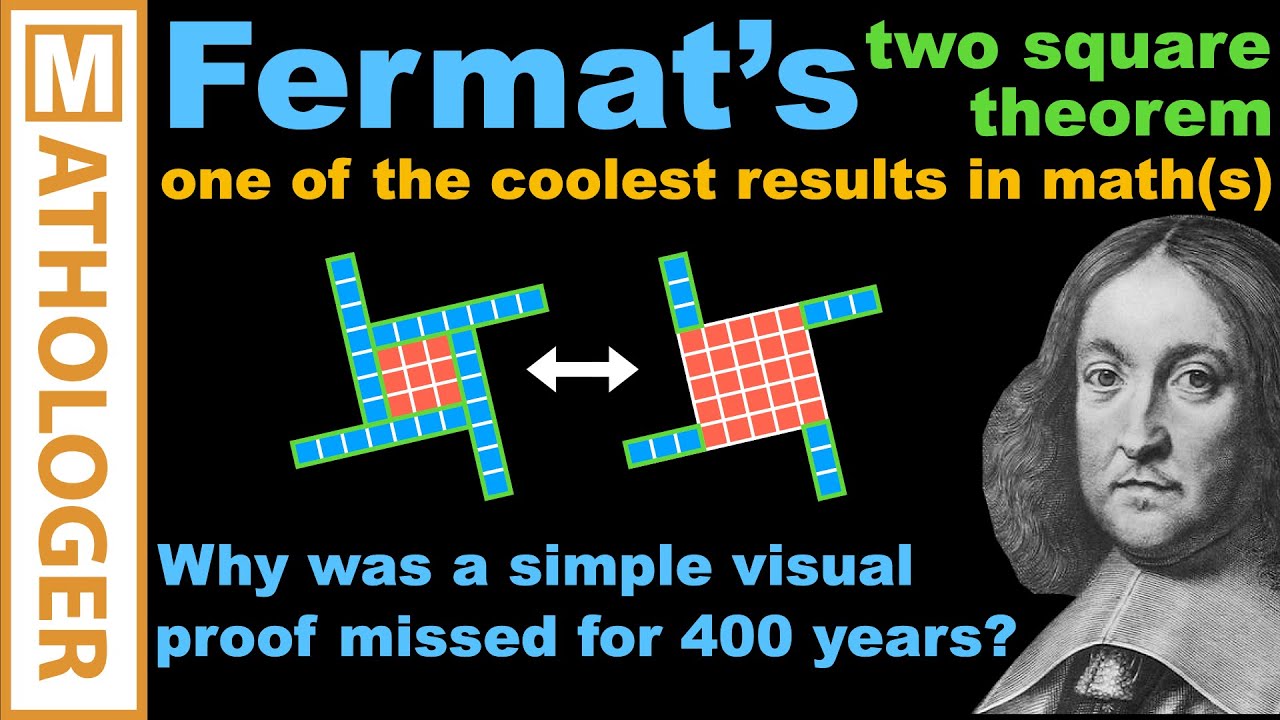
Today's video is about a new really wonderfully simple and visual proof of Fermat's famous two square theorem: An odd prime can be written as the sum of two integer squares iff it is of the form 4k+1. This proof is a visual incarnation of Zagier's (in)famous one-sentence proof...
There you go
 trim bridge
How would you show that Y = {1/x : x ∈ X} is bounded above? If X is bounded below, X ⊂ ℝ and also inf X > 0.
I let inf X = α -> 0 < α
Y is bounded above because Y = 1/α
Then letting sup Y = β,
β = 1/α
vernal widget
is that n theory o.o
trim bridge
Is there a channel for Set Theory?
vernal widget
this looks like it could be in a lot of channels
gotta ask a mod tbh
maybe #proofs-and-logic
trim bridge
Maybe #advanced-analysis ?
vernal widget
could be
trim bridge
@vernal widget ty
vernal widget
np
trim bridge
@vernal widget It says I don't have permission to type in there
trim bridge
Ah, ty very much @vernal widget 🙂
vernal widget
np
jovial hemlock
Given arbitrary natural numbers $a$ and $b$, where $b > a$, how can I find the smallest naturally number $n >1$ such that $a^n \equiv a \mod b$?
sterile pumiceBOT
Notchmath:
torn escarp
look up the carmichael function
that and the euler totient function
those would be some things to look at to get started
fervent crest
Well if gcd(a,b)=1 then such number exists
jovial hemlock
if b is a power of a, for example, it doesn't
jovial hemlock
the carmichael function seems to almost be what I want
no it doesn't never mind
hm
jovial hemlock
see I was looking at- if in base 10 you pick a single digit number, say 7, and look at the last digit as you exponentiate it, you get 7, 9, 3, 1, repeating. And I'm curious as to the length of those cycles for the more general case
torn escarp
yeah
jovial hemlock
I'm not sure if there any cases where the cycle does not include its first member if b is not a power of a- if a is 3 and b is 9, you get 3, 0, 0, 0, 0, all the way 0s
torn escarp
lambda(10)=4
jovial hemlock
well certainly that's the maximum
torn escarp
all others are divisors of 4
have you learned lagrange's theorem?
I say all others but we are in the context of numbers relatively prime to 10, just to be clear
jovial hemlock
no
fervent crest
For now we assume $\gcd(a,b)=1$.
You can rephrase your problem to finding the smallest positive integer $n$ such that $a^n\equiv1\pmod{b}$. This number is called the order of $a$ modulo $b$ and let's denote this as $\operatorname{ord}_b(a)$.
Some elementary observation about the order of a number is that if $a^n\equiv1\pmod{b}$ if and only if $\operatorname{ord}(b)\mid n$. Therefore by Euler's theorem we have $\operatorname{ord}_b(a)\mid\varphi(b)$. Therefore to find the order of a specific $a$, you just need to look at all the divisors of $\varphi(b)$, and one of them is the order of $a$.
Then there is another lemma that can help you: let $a$ be an integer, and if $a^n\equiv1\pmod{b}$ but $a^{n/p}\not\equiv1\pmod{b}$ for any prime divisor $p$ of $n$, then $n=\operatorname{ord}_b(a)$.
Therefore here's what you can do to find the order of $a$ modulo $b$: Start with $n=\varphi(b)$. Find all primes $p$ dividing $n$, and raise $a$ to the power $n/p$ modulo $b$. If this number is $1$ for every prime then you're done. If $a^{n/p}$ is not $1$ for some $p$, then replace $n$ with $n/p$ and repeat your process.
jovial hemlock
yeah no I was clear
torn escarp
otherwise you just have to divide out the gcd
fervent crest
Oops accidentally wrote too much
The assumption gcd(a,b)=1 is to guarantee that the order exists
And it also allows you to cancel a in the equation a^n = a (mod b)
jovial hemlock
you mean if this number is not 1 for every prime?
fervent crest
Yeah
sterile pumiceBOT
Whoever:
jovial hemlock
I THINK the number exists iff a^2 is not a divisor of b, but I'm not sure of that in any way
so is the takeaway that there's no pattern to these, but simply an algorithm? That surprises me, I would've expected there to be something of some kind
fervent crest
I don't think there's a nice pattern to this
I mean you can use Chinese remainder theorem and some other stuff to make the structure of integers modulo n to look much nicer
And then the pattern is pretty nice and calculating the order is fairly easy
That involves some basic group theory
torn escarp
have you heard of the discrete logarithm problem @jovial hemlock
finding exponents is pretty much taking logs
jovial hemlock
"pretty much" you say
torn escarp
log(b^n) = n log(b)
divide out the log(b)
you're trying to do a discrete logarithm, a problem that is known to be hard
how do we know it's hard? cause lots of people have tried over a long time lol
jovial hemlock
huh
jovial hemlock
what do you mean ask a question lol
torn escarp
I'm not psychic
jovial hemlock
I didn't have a question, I was absorbing what you said
like "huh, that's interesting"
torn escarp
idk what huh means, thought you were confused
jovial hemlock
sorry
torn escarp
hah it's fine
jovial hemlock
what do you mean by divide out the log(b)?
torn escarp
you asked "pretty much"
look if I give you a number and you want to know what power it is of something
what do you do?
jovial hemlock
I thought that was the definition of a log sort of
and "definition" is obviously inexact here
torn escarp
I think I was just being too careless
if you want to know what power of 10 some number, say x, is
you look at log_10(x)
that's the exponent on it, that's all
jovial hemlock
Oh, maybe you misunderstood my pretty much
torn escarp
I was just suggesting that if you don't log with the same base you get a constant multiplier
jovial hemlock
it wasn't "In what way is a log used to find exponents", it was "what makes the problem of finding a log different in any way from finding an exponent"
torn escarp
it isn't different
it's just giving what you're doing a name
in terms of how other people already talk about it
you are just kinda coming to it on your own way that's all
just read the first two or three lines of this
In the mathematics of the real numbers, the logarithm logb a is a number x such that bx = a, for given numbers a and b. Analogously, in any group G, powers bk can be defined for all integers k, and the discrete logarithm logb a is an integer k such that bk = a. In number theor...
jovial hemlock
more accurately, it seems like there is no such number if there is a prime p such that p divides a and p^2 divides b
fervent crest
I think this is a sufficient condition for the number to exist: if p divides a and b, then a has more factors of p than b does
If this holds for all prime then there should exist a number n such that a^n = a (mod b)
jovial hemlock
just playing around with data, it seems that if numbers a and b produce n according to the above conditions, then numbers A and b produce n, where A is the modular inverse of a with respect to b
not proven or anything, just something I noticed in a few test examples
torn escarp
I'd look at the rad(n) (the squarefree radical) as a way of describing stuff
if rad(a)=rad(b) for instance, then some power k of a, a^k=0 mod b
 hallow stratus
fervent crest
hallow stratus
fervent crest
@raven flint Since 3|17a and gcd(3,17)=1, by the fundamental lemma 3|a. Therefore 3|2a. Now since 3|2a and 3|(2a - 7b), 3 divides their difference 2a - (2a - 7b) = 7b. Since 3|7b and gcd(3,7)=1, applying the fundamental lemma yet again yields 3|b
 raven flint
Thanks a lot!! 😄
 raven stag
hey
for which irrational numbers is the product of two irrational numbers an irrational number??
how can I know which have that property???
I'm tring to know when is the this product irrational for n in the natural numbers
either
$ \sqrt{n^2 + \frac{2n}{3} + \frac{2}{3}} \in I \lor \sqrt{3n^2 + 2n + 2} \in I $
sterile pumiceBOT
jamperezmondragon:
raven stag
but how do I prove that???
huuuhh I'm so stupid
shouldn't have factoraized that
just assumed it wasn't the case
sacred junco
for which irrational numbers is the product of two irrational numbers an irrational number??
this is unsolved
raven stag
really????
sacred junco
yes
raven stag
but for radical irrational numbers it's simpler isn't it?? there are just two cases
fervent crest
I’m pretty sure we still don’t know whether πe is rational or irrational
raven stag
wooow
sacred junco
lol, that's the example I thought of when thinking it was unsolved
raven stag
I didn't know that
fervent crest
Not even multiplication but similarly for addition: we don’t know whether π+e is rational or irrational
raven stag
could u share a case for which the sum of two irrationals is a rational number??
sacred junco
pi + -pi
fervent crest
Damnit sniped
sacred junco
yea?
raven stag
0/1 how stupid am I
fervent crest
Isn’t that what you wanted?
raven stag
yes
Not even multiplication but similarly for addition: we don’t know whether π+e is rational or irrational
@fervent crest well how could anyone approach that problem??
abstract flax
If you wanted it not to be zero (1+π) - π
fervent crest
Well I'm not sure how to approach it either, otherwise it would be solved already, but I do know that you can easily show that at least one of πe and π+e is transcendental
If you assume π and e are both transcendental
abstract flax
Theorem: Every rational number is the sum of two irrational numbers. The proof is left as an exercise for the reader.
raven stag
jajajajajajajaj
fervent crest
So for a polynomial, if the coefficients are algebraic then the roots are also algebraic
raven stag
@fervent crest a trasendental number is such that it can't be expresed algebraicly
fervent crest
Therefore if the roots are transcendental then at least one of the coefficients is transcendental
A transcendental number is a real number that is not the root of some polynomial with integer coefficients
raven stag
okey
fervent crest
Therefore if the roots are transcendental then at least one of the coefficients is transcendental
Based on this, we have that (x-π)(x-e)=x^2-(π+e)x+πe is a polynomial with transcendental roots, so one of its coefficient must be transcendental
Well actually I'm assuming a lot of nontrivial facts
raven stag
either pi + e or pi times e
fervent crest
Yeah
Well from this you can at least conclude that at least one of them is irrational
Because polynomials with rational coefficients have algebraic roots
raven stag
and u can do the same with any irrational number isn't it ?
fervent crest
Any two transcendental numbers
fervent crest
Because it is perfectly reasonable for a polynomial with integer coefficients to have irrational roots
raven stag
u said that u assumed nontrival facts, are they proven???
Well from this you can at least conclude that at least one of them is irrational
@fervent crest is this a theorem???
fervent crest
What is a theorem
I mean if you say a theorem is a fact that can be proven then it is a theorem
raven stag
yea
a theorem is a fact that can be proven deductivly from the axioms you choosed isn't it?
well thanks anyways
sacred junco
Very interesting discussion @fervent crest @raven stag I’m new to number theory and find it appealing
fervent crest
Glad you find interesting
fervent crest
Yes
raven stag
because all rational numbers can be expresed as the root of a polynomial with integer coeficients
fervent crest
Exactly
raven stag
ax + b
fervent crest
a/b is a root of bx-a
raven stag
yes
ok
but is Q union I = R?
are trasendental numbers defined soley as roots of polynomials with noninteger coeficients??
fervent crest
What
A real number is algebraic if it’s the root of some integer coefficient polynomial
A real number is transcendental of it’s not algebraic
Roots of polynomials not having integer coefficients still might have algebraic roots
Like x-sqrt(2)
Every real number r is the root of some polynomial, specifically x-r
@raven stag
raven stag
ahhhhhh duh
ok
I misunderstood the concept of algebraic numbers
but is Q union I = R?
is this true?
fervent crest
What’s I?
Do you mean irrational numbers?
Well that’s by definition true
Since irrational numbers are just numbers that are not rational, so I = R\Q, so Q union I = R
swift shard
@storm sinew
Start actually multiplying 3s together:
3¹ = 3 (mod 4)
3² = 1 (mod 4)
And look at that, we already got 1. That means:
3² × 3² × 3² × ... = 1 × 1 × 1 × ... (mod 4)
3^122 = 1 (mod 4)
3^123 = 3 (mod 4)
 storm sinew
oh wow, yeah that makes sense, tysm
fervent crest
Think about what is (n+1)! and what is (n+1)*n!
raven stag
what???
fervent crest
(n+1)! is the product of numbers from 1 to n+1. n! is the product of numbers from 1 to n, and when multiplied with (n+1), (n+1)*n! is the product of numbers from 1 to n+1, so (n+1)=(n+1)*n!
 runic vector
a typo
raven stag
no
runic vector
raven stag
I mean the image
fervent crest
? what about the image
swift shard
That's what ! is haha
fervent crest
Ok so $(n+1)!=1\cdot2\cdots n(n+1)$. Then $n!=1\cdot2\cdots n$, so $(n+1)\cdot n!=1\cdot2\cdots n(n+1)=(n+1)!$
sterile pumiceBOT
Whoever:
runic vector
thats not my issue @raven stag 🤨
raven stag
aye but it's easier to work with
swift shard
3! = 3(2)!
(n + 1)! = (n + 1)n!
swift shard
It's the only thing worth saying about the factorial haha
Okay fine you can say other cool things about the factorial
raven stag
@runic vector where did u find that equation??
swift shard
But that's the definition. Everything comes from that
fervent crest
The only cool thing about factorial is stirling's formula
sleek cove
says the uncool person weeb
torn escarp
legendre's formula is a cutie
storm sinew
is it right to say that fermats little theorem is a special case of eulers theorem?
and how do i know if i should use FLT or eulers theorem when trying to find the remainder of a large number?
do i use FLT when dividing with a prime? or am i missing something
sacred junco
is it right to say that fermats little theorem is a special case of eulers theorem?
Yes
You are using Euler's theorem in any case
storm sinew
soo dividing by a prime, finding a remainder would give me the same answer using FLT and eulers theorem?
oh wow nvm, im stupid
the totient of a prime would just be p-1
which is fermats little theorem
got it now :)
sacred junco
the totient of a prime would just be p-1
^
raven stag
which euler's theorem r u guys talking bout? where can I learn more? @sacred junco @storm sinew
fervent crest
@raven stag https://en.m.wikipedia.org/wiki/Euler's_theorem?wprov=sfti1
You can also learn this in any introductory number theory book, the most beginner friendly one I know is “A Friendly Introduction to Number Theory.” It’s pretty easy to read but still has a lot of content
In number theory, Euler's theorem (also known as the Fermat–Euler theorem or Euler's totient theorem) states that if n and a are coprime positive integers, then
      a

        φ
        (
        n
        )
...
 trim gust
the proof is pretty nice too
raven stag
thanks!!!!
storm sinew
could anyone show me how you would solve 5^12 mod 11*13 using eulers totient theorem?
i got to 5^120 congurent 1 mod 11*13, but now im stuck
raven stag
do u guys have any general advice on getting better at mental arithmetic?? besides of identities and factorization
i got to 5^120 congurent 1 mod 1113, but now im stuck
@storm sinew 5^12 is congruent to 5^12n mod k
a is congruent to a^n mod k
sacred junco
Not really
storm sinew
then the remainder would be 1 aswell?
answer should be 14 according to my book
but idk how to get to that answer
storm sinew
oh wow, totally forgot that was a way of doing it
tysm!!!
okay so
i got 25mod11=3, and 5^12mod13=1 when doing it separately
but
i dont see how this is going to get me to the answer, which should be 14
fervent crest
@storm sinew @empty yew that is not true, for example x = 0 (mod 4) and x = 0 (mod 6) does not imply x = 0 (mod 4*6)
The statement that if x = k mod a and x = k mod b, then x = k mod ab is not true
But it is true if you assume gcd(a,b)=1
storm sinew
i mean, in my question, gcd(a, b) is 1
storm sinew
but i dont see what to do next
fervent crest
Chinese remainder theorem states that if $x\equiv x_1\pmod{n_1}$ and $x\equiv x_2\pmod{n_2}$ and $\gcd(n_1,n_2)=1$, then $x$ has a unique solution modulo $n_1n_2$
sterile pumiceBOT
Whoever:
fervent crest
And here's how to find it
So right now we have two congruences: x=3 (mod 11) and x=1 (mod 13)
So by the first congruence, we have x=3+11n for some integer n
Right?
storm sinew
so, basically find an x that fits in both equations
fervent crest
Yes
storm sinew
i've worked with the crt before, so i think i'll be able to find it out now :)
fervent crest
Alright
storm sinew
i just didnt see what to do next
fervent crest
You just let x=5^12, and you observe that x=3 (mod 11) and x=1 (mod 13)
and then chinese remainder theorem gives you a solution modulo 11*13
storm sinew
yeah, totally see it now, thankyou :)
fervent crest
You're welcome
 empty yew
oh hecc, true. sorry about that. i said it in passing without thinking about it too much, sorry
raven stag
@sacred junco how is this not true??
sacred junco
a is congruent to a^n mod k
2!=2^3 mod 5
fervent crest
What is a,n,k
sacred junco
Idk
raven stag
$ a \equiv n \textrm{mod}\b \implies a^k \equiv n^k \textrm{mod}\ b$
sterile pumiceBOT
jamperezmondragon:
Compile Error! Click the  reaction for details. (You may edit your message)
fervent crest
\pmod{b}
Are you trying to say that $a\equiv b\pmod{n}\implies a^k\equiv b^k\pmod{n}$?
sterile pumiceBOT
Whoever:
fervent crest
That is true
fervent crest
Then a = 1 (mod n) too
sacred junco
Well that's different than this
a is congruent to a^n mod k
fervent crest
a is not arbitrary
raven stag
yeah but $ (a^{b})^{c} = a^{b\times c}$
fervent crest
Ok here is what happened: the statement I wrote above actually had an implicit statement in the beginning.
If $a,b$ are integers such that $a\equiv b\pmod{n}$, then $a^k\equiv b^k\pmod{n}$ for all positive integers $k$.
If you substitute in $b=1$ then the statement will become:
If $a$ is an integer such that $a\equiv1\pmod{n}$, then $a^k\equiv1\pmod{n}$
raven stag
no not that
fervent crest
Nonono
sterile pumiceBOT
Whoever:
sterile pumiceBOT
jamperezmondragon:
raven stag
I meant that
raven stag
yes so $5^{120} \equiv 1\ mod{(11\times13)} \newline \newline \implies 5^{12} \equiv 5^{12\times10}\ mod{(11\times13)}$
sterile pumiceBOT
jamperezmondragon:
fervent crest
I'm not sure why that implies
raven stag
do u guys have any general advice on getting better at mental arithmetic?? besides of identities and factorization
@raven stag .
fervent crest
Oh mental arithmetic
Well I always have pencil and paper next to me
My mental arithmetic sucks
So....
raven stag
@fervent crest $\newline (5^{12})^{10} = 5^{12\times10} = 5^{120} \newline$ and then the theorem u stated
sterile pumiceBOT
jamperezmondragon:
sacred junco
\equiv for modulos
raven stag
yes
fervent crest
Ok so (5^12)^10 = 5^120
fervent crest
And you raised both sides to what poower?
raven stag
And you raised both sides to what poower?
@fervent crest Im doing it in reverse, I think that's what I did not say
Send this in #bots
@fervent crest ohh ok
thanks
raven stag
oh how so?
fervent crest
$(-1)^2\equiv 1^2 \pmod{p}$, but is $-1\equiv1\pmod{p}$?
sterile pumiceBOT
Whoever:
fervent crest
It applies to all Z
raven stag
does it applies to Q at least??
fervent crest
The definition $a\equiv b\pmod{n}$ means $n$ divides $a-b$ does not require $a,b$ to be positive
sterile pumiceBOT
Whoever:
fervent crest
Well
raven stag
ohhh wait
fervent crest
Modular arithmetic can be extended to arbitrary rings, which are basically number systems where you can do addition and multiplication
raven stag
but they don't need to be closed
fervent crest
wdym
raven stag
rings don't need to be closed under either addition or multiplication to be rings right?
raven stag
but they can be
raven stag
ahhh ok
fervent crest
The definition is that they have two operations, or functions RxR -> R
raven stag
how do u even define division there??
fervent crest
Why do you need division
raven stag
ohhh shit right
there are just partitions of ur ring isn't it? so ok
wow
that's mind blowing
fervent crest
Well the equivalence classes do partition the ring
You can do it in any ring, but only "nice" rings will have properties that you like
Like for "nice" rings, you sometimes will have that all nonzero elements are invertible, you can extend euler's theorem and etc
raven stag
oh
so
at some point
some sets that have especific characteristics can be subject of number theory
like the integers and stuff
but instead of numbers just the elements of the set
oh wow
that's rather amazing
fervent crest
Well numbers are elements of a set
In particular the set of integers
But yeah that's common in like all fields of math
raven stag
yea of course
fervent crest
Where you try to extend the result
raven stag
oh shit
fervent crest
You notice that some properties of integers only depend on specific features of the integers
raven stag
ok and u search sets with those features?
fervent crest
Yes
raven stag
omg
fervent crest
For example
You can notice that the fact that integers have unique factorization theorem can be proved using only a "division algorithm"
So we name rings that have a division algorithm to be "euclidean domains"
and euclidean domains will also have unique factorization
fervent crest
Well of course
raven stag
so can we apply the ideas that build up criptography to all euclidean domains??
fervent crest
Cryptography?
raven stag
but with infinite sets of infinite prime numbers?
well I mean that based in prime numbers
raven stag
euclidean domains have infinite prime numbers I suppose
fervent crest
Not necessarily
raven stag
why?

 raven stag
but can't the elements of a field be the primes of another set that has that field as a subset?
ok I'm just having a mental fap
I will research this
is it in the artin's algebra book that we where talking bout before? @fervent crest
the euclidean domains and stuff
fervent crest
It probably is? I don't know
I haven't reached that part yet
But it is in
"A Classical Introduction to Modern Number Theory" by Ireland, Rosen
It's in like the first chapter
ok I'm just having a mental fap
lmao ok
Not gonna judge
raven stag
I don't mean literaly
like it's just that I'm thinking of stuff that I cannot yet understand but still I'm wondering
fervent crest
Oh actually I think any euclidean domain with one primes has infinitely many primes
You can just extend euclid's proof
supple furnace
Yeah
supple furnace
1
supple furnace
p-adic integers
storm sinew
how can i solve 3^12 mod 35?
fervent crest
Exactly the same as the last problem
35=5*7, so find 3^12 modulo 5 and 7, and combine them with crt
storm sinew
oh okay, wasnt sure if i had to find the totient of 35 before, and then split it
but that wont get me anywhere
sacred junco
Another way:
3^12=531441 = 15184*35+1
 patent oak
Is there any chance I can reduce the following to something nice
$n!\cdot\sum_{k=1}^m\frac{1}{(n-k)!}$
sterile pumiceBOT
Nikolaj-K:
sacred junco
If you bring in n!, it looks similar to a binomial coefficient
 brave thicket
In mathematics, Stirling numbers arise in a variety of analytic and combinatorial problems. They are named after James Stirling, who introduced them in the 18th century. Two different sets of numbers bear this name: the Stirling numbers of the first kind and the Stirling numb...
These might help
 craggy solstice
@sacred junco nah but theres no k! In the denom
trim gust
well u have sum of k! times nCk
sacred junco
^
sacred junco
sum of nPk
torn escarp
that makes it the coefficient on the exponential generating function you get for coefficient 1 and k! which correspond to e^x and 1/(1-x) respectively so
well, no I'm assuming the upper bound is n not m
if m>=n then it's fine since the higher binomial terms are 0 and cancel out
even then the sum should start at 0 lol
well ok just to finish my original thought since it might be adjustable afterwards, the nth derivative of e^x/(1-x) evaluated at x=0 is the nth term if the sum goes from k=0 to k=m>=n
 slender moth
for $b \geq 2$ and $n$ positive integers, let $F_b(n)$ be the sum of the digits of ($n$ written in base $b$). is there any formula for $\sum \limits_{n=0}^m F_b(n)$ for $m \geq 1$?
sterile pumiceBOT
Auvera:
slender moth
i see there are OEIS entries for F_b for small b
but i thought maybe the sum of the F_b(n) is easy to compute for certain m, like maybe m=b^k-1
like aren't the digits of numbers in [0,b^k) uniformly distributed? for example for b=10 and k=2, all numbers have two digits, and there are 10 numbers with first digit being i for each i in {0,1,...,9}. same with the second digit
so in that example we have $\sum \limits_{n=0}^{99} F_{10}(n) = 10 \sum \limits_{i=0}^{9} i + 10 \sum \limits_{i=0}^{9} i = 20 \cdot 55 = 1100$ i think
sterile pumiceBOT
Auvera:
slender moth
seems like that easily extends to general b and k
probably sounds like a silly problem but this came up while trying to prove average case complexity of an algorithm i'm working on
sacred junco
How to find the maximum value of $\dfrac {n(99)(98)(97) ... (101 - n)}{100^n}$ for integers n
sterile pumiceBOT
Barry:
torn escarp
you can take the log of it to separate it out into a sum, then approximate it with an integral so that you have something differentiable to find the max with calculus
you could also try stirling's approximation
probably the max value of that is near the integer value where it is at its max
slender moth
maybe i'm missing something but seems you can just find the N where the sequence is decreasing for all n larger than N. then check the finitely many n smaller than N for the largest value
fervent crest
Why do you have so many terms in the middle tho 
sleek cove
relatedly, what is the product in the numerator supposed to be
fervent crest
Oh I think I see what he meant
fervent crest
$\frac{n}{100^n}\prod_{i=1}^{n-1}(100-i)$
sterile pumiceBOT
Whoever:
fervent crest
I think
sleek cove
~~what if n negative  ~~
~~
storm sinew
how can i solve this?
trim gust
Well anything above 3! Is just 0.....
storm sinew
oh wow youre right 😅
storm sinew
how should i start on this problem?
 ornate sonnet
find the remainder when 6^n is divided by 98 for a few values until u spot a cycle
same with 8
then add
would be my idea
storm sinew
oh ill try that, i tried a much different approach, by splitting them up and using chinese remainder theorem and eulers theorem
but ill try your approach, sounds much easier
ornate sonnet
yh
my cycle for 6^n looks like
||(6,36,20,22,34,8,48,92,62,78,76,64,90,50,6)||
and for 8^n ||(8,64,22,78,36,92,50,8)||
trim gust
notice 6 =7-1, and 8=7+1
ornate sonnet
hm very smart
trim gust
and also 98 =7^2 times 2
therefore everything cancels excpet 2 times 98C0
so remainder is 2
 stark bone
Hi, does anyone know how to code the Chinese Remainder Theorem out in Python?
fervent crest
The main problem would be finding the multiplicative inverse
Once you have that it's fairly easy to explicitly write out a solution
stark bone
THanks, I'll try to figure it out
storm sinew
so, i basically figured out that n=12, but i dont see how i can find out what the 7th smallest possible value of n is..?
fervent crest
Remember by chinese remainder theorem
This solution is unique modulo 5*9*11
That means that there is only 1 solution in every interval of 5*9*11 numbers
storm sinew
could you please show me an example? :)
storm sinew
no i just didnt understand what you meant by every interval of 5 * 9 * 11 numbers
i mean
fervent crest
Oh
storm sinew
i dont see how i could find the 7th smallest possible value
fervent crest
So you said the solution is n=12, I'll assume that's correct
So the solution set is actually n = 12 (mod 5*9*11), so any number congruent to 12 modulo 5*9*11 is a solution
fervent crest
Yes so the answer is 5*9*11*7+12
Assuming 12 was a solution of that system of congruence
@storm sinew
storm sinew
12 was a solution, but 5 * 9 * 11 * 7 + 12 wasn't correct :|
actually had to multiply by 6 instead of 7
but i see why
fervent crest
Oh yeah oops
storm sinew
why wouldnt eulers theorem work here??
i usually put mod 10, and then use the totient of 10 which is 4
so 54^4=1 mod 10
but that doesnt seem to be the case here?
oh wait 54 aint coprime with 10
my bad
lol