#elementary-number-theory
1 messages · Page 66 of 1
 worldly tree
worldly tree
worldly tree
Can be lots
 winter bear
sure, which ones
 copper hollyBOT
From
Rule 4
If your question has not been answered for a minimum of 15 minutes, you may use the Helpers tag once. Please do not try to bump your question using this ping unnecessarily. Do not abuse this ping. Do not individually ping users with the Helpers tag without their express permission.
winter bear
start of with just which primes
copper hollyBOT
From
Rule 2
Before asking a question, make sure that the channel you are using is not currently in use. An occupied channel would generally have an ongoing discussion or a trailing unanswered question. Likewise, when you are done using a channel, make this clear so that it's open for others to use.
winter bear
what
 sleek cove
lol
winter bear
lmao bot broken??
winter bear
thats only some of them, so as i said first focus on just what primes p_1 can be
worldly tree
p_1 can be 2
winter bear
right what else, because (p_1-1) can also divide
sleek cove
any more or is that it
winter bear
mhm those are the possible primes
 sterile pumiceBOT
JohnDoeSmith:
worldly tree
For 3,5,17 needs be 1
winter bear
mhm, well either 1 or 0 right
winter bear
basically figure out all the possible combos
winter bear
well are they alone enough to have phi=16?
worldly tree
No
17^d - 1 = 16 so d = 1
For 5 , c = 1
I can only have 4 from 2
2^a - 2^(a-1) = 4
2^a - 2^(a-1) = 2^2
a + (a-1) = 2
2a-1 = 2
a = 3/2 ?
When c = 1 a= 3/2 maybe? @winter bear
winter bear
umm a=3/2 doesnt make sense
again theres quite a bit of combinations, just figure out which one gives exactly 16
worldly tree
Can you maybe say what equation I am making equal? This i don't get
2^a * 3^b * 5^c * 17^d = 16 ?
This will not make sense
winter bear
apply phi to that
so basically you want to know when $\phi(2^a)\phi(3^b)\phi(5^c)\phi(17^d)= 2^4$
sterile pumiceBOT
JohnDoeSmith:
winter bear
and you know each of them yields a different power of 2
depending on their exponent
figure out how to combine these powers to get precisely 4 powers of 2
sleek cove
start with p=2
winter bear
i mean tbh its kinda exhaustion
worldly tree
Okay I understanding now
One is 34
17 * 2
phi(17*2) = (17-1)(2-1) = 16
One is 2^5
31 - 16 = 16
copper hollyBOT
From
Rule 4
If your question has not been answered for a minimum of 15 minutes, you may use the Helpers tag once. Please do not try to bump your question using this ping unnecessarily. Do not abuse this ping. Do not individually ping users with the Helpers tag without their express permission.
worldly tree
I can do this, thanking you @winter bear
winter bear
np
worldly tree
How many are there?
winter bear
oh umm i didnt count it myself lol
worldly tree
Is there algorithm way to know how many?
sleek cove
probably like atleast 5 idk
winter bear
i mean its just this but yeah its a bit tedious
worldly tree
So I cannot know when is time to stop
winter bear
i mean do something exhaustive
like start by listing out all the things for a certain value of a
for example
sleek cove
theres 6 for 16
worldly tree
maximum combination = 432*1
sleek cove
so you need 4 more
worldly tree
theres 6 for 16
@sleek cove How to know this?
winter bear
yeah i also get 6
sleek cove
uh i did them out idk if theres s way
you could cheat and look at a table if you want
worldly tree
How to know which combination to skip?
winter bear
i mean you kinda do it in your head, like lets use powers of 2
for 2^5, you cannot multiply with anything else right or else it will go over
for 2^4, you can only have one extra power of 2, so only 3
sleek cove
well if your phi(p^k) is greater than 16, you know it cant be right
winter bear
etc etc
worldly tree
Go over what?
sleek cove
like you have an upper bound on all of the exponents
winter bear
well phi would go over 2^4
worldly tree
Yes, what is upper bound?
sleek cove
like the bound on 17 is lower than the bound on 2's exponent
winter bear
i mean if you want 5 is the upper bound on power of 2 and 1 on the rest of them
worldly tree
You meaning that if I do 2^6 , then phi(2^6) = 2^6 - 2^5 ?
winter bear
and then you can go plug it into a python algorithim or smth to be fully exhaustive
worldly tree
2^5(2-1)
sleek cove
yes, phi of 2^6 is that, but your phi n must equal 16, so the left side of the equation must not be greater than 16
aka p^(k-1) (p-1) must not be greater than 16
worldly tree
Oh
sleek cove
and specifically, it must divide it
worldly tree
So a < 6
sleek cove
yes
worldly tree
but why 3^b must be 1 ?
sleek cove
well try 2
sleek cove
and does 6 | 16
worldly tree
Okay now understanding
sleek cove
what if its 3^3 or higher?
worldly tree
It is going over 2^4
 hollow venture
not sure if this is #advanced-number-theory or #elementary-number-theory but I'll try here:
Looking to make some progress on this question, focusing on part a. (I think I have an answer for part b, and part c is apparently extremely difficult)
 simple hearth
Hint: rewrite the claim a^2 = 1 mod p without the mod notation.
hollow venture
Sorry, I was doing another question. @simple hearth do you mind helping me through your logic with mod? It's my weakest area of this module, I just don't understand it very well
simple hearth
I suggest looking up the definition of a = b mod n.
hollow venture
ah I should say like, I understand working with it when we're talking about actual known numbers but my confidence gets a bit shaky when we're dealing with primes
oh hang on
ok I think I see what you mean
you can rewrite a = b mod n as a-b=kn i.e. a - the remainder when divided by n = some multiple of n
so here a^2-1=kp
hollow venture
difference of 2 squares
simple hearth
perfect
hollow venture
(a+1)(a-1)=kp
a+1=kp therefore in "A-B=KN", A=a, -B=-1, N=p so a= -1 mod p as given
simple hearth
Yup. I'd have phrased it as: a^2 = 1 mod p means p divides a^2-1=(a+1)(a-1)
but the definition of prime is that if p divides a product, it divides one of the terms
so p divides a+1 or p divides a-1
but we are given that p does not divide a-1, so it divides a+1.
(I'm not disagreeing with your argument, I'm just showing you can avoid introducing k if you want)
hollow venture
yeah I see your logic, and my argument doesn't explicitly exclude the use of the (a-1) bracket which could be useful
simple hearth
yeah you jumped over that part a bit
hollow venture
for the next part, a composite number is just not prime right?
so 4, 6, 8, 9, 10, ...
simple hearth
a composite number is neither prime nor 1
correct
but one has to be slightly careful that 1 isn't composite or prime
hollow venture
I don't think I've ever looked but is there a special name for 1's status as neither?
or is it just that it isn't composite or prime
simple hearth
1 is called a unit
but usually you don't get into that unless you want to talk about whether -5 is prime, for instance
hollow venture
well, all negative numbers n have -1 and -n as factors so I don't think they're prime since that's clearly more than just 1 and n
simple hearth
ahh, but then isn't 5 not prime because 5 = -1 * -5 ?
hollow venture
👀
hhm
then I think exclusion of negative numbers would have to come from defining "prime" to consider just natural numbers
simple hearth
so, what's going on is that -1 is also a unit
so in order to say a number is composite it has to be a product of two non-units
and then you get a coherent answer
hollow venture
I suppose you could say -1 * -5 = -1 * -1 * 5 = 1 * 5
simple hearth
This is all completely gratuitous if you're only talking about Z, and indeed Conway even argued that in that context we should just declare that -1 is a prime, but if you want to generalize the idea past just the integers, you don't have a good analogue of the natural numbers
hollow venture
ok fine, primes are cool 😛
I'm finding number theory's quite a breath of fresh air vs all the probability and stats work I've been doing
pure maths best maths heh
in the next part of the question, I think I've seen something similar before where you use the fact that n has a prime factorisation to show it's composite
hollow venture
I've got uhhhhh... Something? But I'm pretty sure it's meaningless and doesn't tie a and n together @simple hearth
All that does is show that those numbers have remainders when you divide them by a prime
simple hearth
if the number was prime, would it be possible for this number to square to 1?
simple hearth
Look at what you proved in part a
hollow venture
right
I mean 3 does divide 2^2-1=(2+1)(2-1)=3
and 2 = 2 mod 3 not 1
oh
nah I think that's fine because -1 = 2 mod 3 so ye the proof would work
what're you getting at?
simple hearth
What did you provei n part a?
hollow venture
that if a^2 = 1 mod p then a = -1 mod p
hollow venture
if we're still talking about the a=2 example then no a=2, but 2=-1 so a=-1 with an extra step?
simple hearth
I mean the example in part b
hollow venture
well 2949^2=8696601=1 mod 67, so by the proof 2949 = -1 mod 67
unless I shouldn't be picking a p but that sounds weird
hollow venture
oh
right
well that makes sense lol
buut 3953 isn't prime and it necessitates p being prime O.o
its factors are 59 and 67 which is why the pairing with 2949 is spicy but
simple hearth
Write down the contrapositive of part a
hollow venture
so if a =/= -1 mod p then a^2 =/= 1 mod p
simple hearth
and you can read that as "modulo a prime"
hollow venture
the first statement?
 hollow venture
moving on from that question then as I really don't see how to finish it
Here, I know I need to use Hensel's lemma and I've tried that but I don't think I've actually used it correctly
This is what I've tried, but all that really is is showing that I can use the lemma then not really doing anything with that fact
hollow venture
err I think I've got the right answer but I don't think I've used the method correctly, I've just kinda gone straight to the answer
hollow venture
nvm, solved it
hollow venture
This is another question I'm having trouble with... I think i know the required definitions, just can't figure how to use them
 last grove
can someone help explain why this is true? C = euler's constant here
and what does C(s) even mean
C * s?
last grove
that's weird
here's how they defined it
wait asec
maybe it doesn't mean anything at all
just another constant
 fervent crest
Ah
 supple furnace
This is standard notation
Euler Maclaurin I’m guessing?
It’s a function of s that does not depend on your x value by the way
That is why it is defined as such
supple furnace
I’ve seen this C function come up as a result of a “weak” version of Euler Maclaurin (first order approximation of it).
last grove
thanks again
also... one last thing
how come it still equals zeta(s) even after they subtract x^(1-s)/(1-s)
OH
NEVERMIND
when 0 < s < 1, both zeta(s) and the limit diverge as x->infinity
sooo they are essentially the same when x->infinity for s:(0,1)
sleek cove
why does he use n^2/2 -t_n, instead of t_n - n^2/2
wait nvm my bad
because we want sigma - n
simple hearth
I think this is their way of admitting that both O notation and << notation are slightly uncomfortable, but at least you can always choose which you like better 😛
sleek cove
hmm I guess
and yeah they are like pretty weird ngl
like the whole concept of scaling functions and "Absorbing" smaller errors, or increasing the error to accomodate other functions, makes sense intuitively, but it just seems kind of arbitrary/odd
also this interlude is bleh, relearning calc with big O notation-hard pass lmao
 steady nest
how would you go about doing this?
i did find an answer but i feel its perhaps too simple?
the question did say use the euclidean algorithm
sterile pumiceBOT
suck2015:
sterile pumiceBOT
suck2015:
steady nest
and then from this point, given that all n! , n being > 1 are all even ? so 2 must be the gcd?
because 10! is divisible by 7 and thus 10! +2 cannot be divisible by 7
fervent crest
Yes I think 2 is the answer
But what do you mean by 10!+2=14?
Remember what euclidean algorithm says:
$$\text{If }a_0=ba_1+a_2,\text{ then }\gcd(a_0,a_1)=\gcd(a_1,a_2).$$
sterile pumiceBOT
Whoever:
steady nest
@fervent crest oh i forgot to reply to this
yeah by the way of the euclidean algorithm, 10!+2 = 14(k) + remainder right?
but then at this point, we can just see that the only divisor possible is 2 because 7 won't work
fervent crest
Yeah
last grove
not a question but I made a meme
(source: Apostol's Analytic Number Theory)
 sacred junco
i like it when women overpower me
 alpine jasper
could've just put it as an exercise
fervent crest
the first thing that came into my mind is dominated convergence theorem
sleek cove
negative exponents are ugly
sleek cove
thats not what your dad said last night
sleek cove

 inner crest

 granite wagon
We have m belonging to N and α belonging to Z, then there exist unique numbers q, r belonging to Z such that α = mq + r with r being 0<= r < m. We know that α is congruent with r for mod m. We say that r is the least remainder of α for m and α belongs to the class of r for m. Thusly there exist m classes of mod m, the r (mod m), r = 0, 1,...., m - 1.
Does that mean that for unique α, r and q r is the least remainder of α congruent to r (mod m) iff α belongs to the class of r (mod m)? Is that a class or a specific case since these three symbols are unique. I am not proposing that they can't be arbitrary but for a specific case they aren't. So if for this α we have a class of r (mod m) does that mean that m is arbitrary and therefore that is the reason that there exist a class of α congruent with r (mod)?
 craggy solstice
Basically an equivalence relation on a set partitions it into classes, modulo is an equivalence relation. Here our set is Z and we can divide it into classes d' such that 0<=d<m such that each class is a set of elements of the form mk+d {see that mk+d (mod) m is just d}
So every element which produces a remainder k modulo m is in the class k',like this we can partition Z into a set of m classes {0', 1' , 2',...(m-1)'} and all of these classes are non empty
f'=n' means that f=n mod m
i.e. they just make the same the equivalence class
granite wagon
I see
I don't know why this is not explicitly stated in my pdf..
That equivalence relations don't partition a set into classes.
Does that have something in common with dedekind cuts?
How to create the set of irrationals out of the rational numbers by creating small sets in between an irrational number or a unique rational through the process of creating two sets (well ordered with a least element) that are adjacent to said number and thus you partition the rationals through that process. I don't know if that makes sense at all.
 neon comet
is there a trick im missing?
or do i have to do the 2^47 calculation?
prime powers -_-
guess i could break it up into 2 factors
lemme try that
neon comet
27/5=5*5+2
sleek cove
no?
neon comet
2^4=5*3+1
sleek cove
yes, so =1 mod 5
neon comet
ye
neon comet
2^4*2^43
sleek cove
but you are still left with the same situation
sleek cove
recognize that (2^4)^k = (1)^k = 1 mod 5
i mean you could, but thats inefficient having to repeatedly subtract 4 until you get a small power
neon comet
thanks for the help i think i can solve this now
sleek cove
why does O(x^2) get absorbed here
 light flicker
because you're looking at x small
sleek cove
jfc this is annoying
why cant they just use a different letter/symbol for non infinite values
 carmine burrow
hey, can someone explain why the gcd(a, b) = gcd(b, r) with euclidean algorithm, I get the rest of how it works, I'm just a bit confused with the proof for this statement (r is the remainder and a and b are both positive integerrs)
 swift shard
Because
gcd(a, b) = gcd(a, b + ma)
For any integer m. This is exploitable, choose an m that makes the second argument as small as possible. This ends up being r. @carmine burrow
 soft kestrel
Because the next term in Laurent series is a constant no ?
sleek cove
um, how do you know that?
sacred junco
https://i.imgur.com/bu7yvip.png I'm confused on how to read this; are these operations the same (both plus, or both minus) or what? Another problem I'm working on it doesn't seem to agree with it but I might be doing something wrong
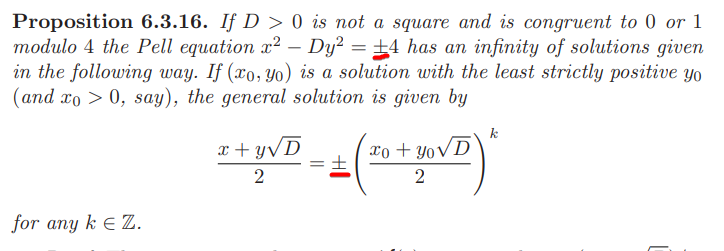
the proof was too hard for me as well so that didn't clear anything up
it seems like one should be plus and one should be minus or something
 void widget
sacred junco
void widget
sacred junco
it means the answers you get are both positive and negative
so for example, x^2 - Dy^2 = 4 and -4
sacred junco
umm not quite what I'm asking
I mean
are the solutions to x^2-Dy^2=-4 given by
fraction thing = - exponent thing
and the solutions to x^2-Dy^2=+4 given by
fraction thing = + exponent thing
light flicker
For the second plus, minus, it shouldn't matter what you take
Since, changing the sign of x,y doesn't matter
sacred junco
is that suggesting the solutions to x^2-Dy^2=4 and to x^2-Dy^2=-4 are the same?
light flicker
uh no?
sacred junco
then what doesn't matter?
light flicker
the second plus or minus doesn't matter
because if (x,y) is a solution to your equation, then so is (-x, -y)
sacred junco
why is it there then?
light flicker
Because you're looking for all solutions?
sacred junco
oh I think I see what you mean now
so you would build the set of solutions the same way for either equation, +4, or -4, with both p/m for the second p/m, but the -4 or +4 determines the fundamental solution
I think I should rewrite that
sacred junco
the set of solutions to x^2-Dy^2=4 and the set of solutions to x^2-Dy^2=-4 are constructed the exact same way, but have different fundamental solutions
and the construction uses both fraction thing = + exponent thing and fraction thing = - exponent thing
light flicker
Yep
sacred junco
ok thank you
light flicker
As a side note, this is strongly connected to something called the fundamental unit theorem in algebraic number theory
and they probably don't give a proof, but that theorem is at least one way you'd prove it
sacred junco
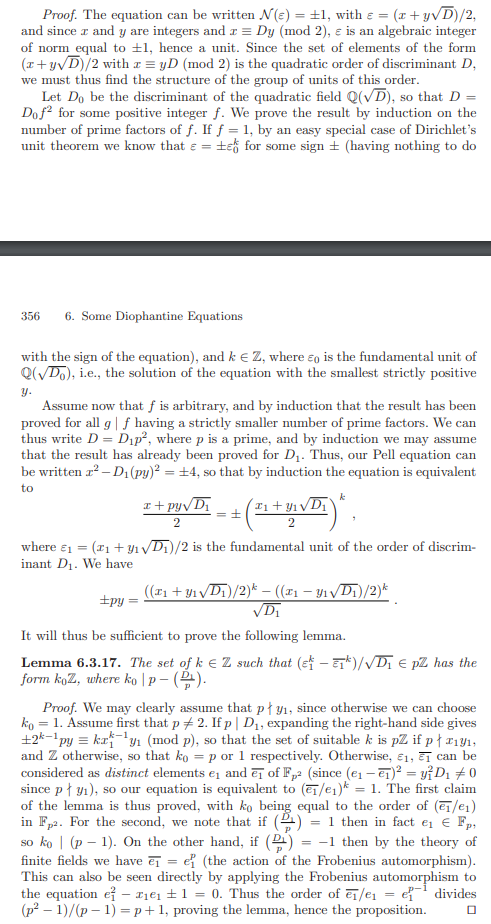
https://i.imgur.com/8eGT1eX.png this is the proof they give
 sleek cove
so for the RHS i treat it as a product of two functions u = zpi and v = inf product of w(z)
so for v' / v, this turns into the inf sum of w'(z) / w(z)?
sleek cove
nvm
sacred junco
number theory is officially sexy
if anyone already has a desmos/programmed plot of this lmk but I will try to do it myself using that or python matplotlib and the like
 slow yew
We are learning about Euclid's division lemma.
And we have to prove a lot of stuff.
I am trying to make a collection of tips to help.
Show that the square of an odd integer is of the form 4q+1 for some integer q.
Show that the square of any positive integer is of the form 3m or 3m+1.
Show that the cube of any positive integer is of the form 9m, 9m+1, 9m+8.
Compare with a=bq+r.
- For questions which ask to prove that the square or cube of something is of some form, follow the following tips and examples:
a. The most important thing is look for the least base form that can prove the asked forms.
b. Look at b of the form(s) to prove. It indicates b of base form. If b of form to prove is high such as 9, the base b is 3.
c. The number of forms asked to prove, generally, indicates what our base form should be.
d. There can be various cases:
i. Asked to prove multiple forms: The constant (remainder) of the various forms would be different. The highest constant indicates the highest remainder of the base form.
Un-square/Un-cube the constant if required. You will get the highest remainder of the base form. Add one to the highest remainder of the base form, you will get b.
ii. Asked to prove single form: Un-square/Un-cube the constant. You will get the highest remainder of the base form. Add one to the highest remainder of the base form, you will get b.
^ This is what I have so far, any improvement would be appreciated.
sleek cove
I think you're overcomplicating it
all you need to do for these problems is just consider the n cases when working mod n
like for n^2 = 0 or 1 mod 3, just do the three cases for n
also, why does it take 6 pages to prove that C is e^-γ smh 
sacred junco
recs on best analytic number theory intro book?
light flicker
apostol
simple hearth
I'm a fan of Koninck and Luca if you want an easier intro and Overholt if you want a slugfest
I bounce back and forth between the two
sleek cove
i prefer my n=1 sample size and reccomend stopple
sacred junco
thanks yall
slow yew
@sleek cove did you reply to me?
sleek cove
yes
slow yew
I am in year 10, lol.
sleek cove
um ok?
slow yew
Meaning, I don't understand that.
sleek cove
all you need to do for these problems is just consider the n cases when working mod n
what dont you understand ab this
mod?0
sleek cove
oh the picture is completely unrelated lol
slow yew
ok lol
sleek cove
uh so basically
lets stick w the n^2 being of the form 3k+1 or 2 examplep
so we know that every single integer is of the form 3k + 0,1, or 2
right?
slow yew
Yep
sleek cove
ok, so we know that every single integer squared, must be those three possibilities squared as well, right
slow yew
Yep
sleek cove
ok, so now all we have to do is, take each possibility and square them
3k+0 is trivial, as it squared is 3(3k^2)
thus in the form 3k+0
slow yew
Yeah, ik the process of proving of it.
The problem is choosing the correct b
in the base form, a=bq + r
slow yew
Umm, do we not need b so we can complete the base form and then square/cube it?
sleek cove
oh
well if the problem asks you to show/prove that something must be of the form nk+r
you set b = n
and only consider r
slow yew
What about 9m+1, 9m+8,9m?
Surely, I wouldn't set b=9.
Well, I could do that.
But it's tooo lengthy.
So, I'd set b=3.
And it'd work
See, I know generally when it is not squared or cubed, b=n
But these special cases.
sleek cove
well you're not wrong, however setting b=3 is probably a bit more work
you have to then worry about factoring
like, with each case when you set b=9, you probably have like 20 seconds of work
slow yew
Yeah, but we have an exam on Monday, and we are supposed to solve 10 of these questions in 20 mins :/
sleek cove
well
it would probably be worthwhile to learn some basic modular stuff
you already know the basics
sacred junco
10 of these?
you can reduce them all to multiplication and subtraction problems once you understand modular arithmetic lol
slow yew
Hmmm
sleek cove
we say a = b mod n, iff a - b = nk. and theres simplifications you can do with these as well, for example
what is 125 = ? mod 7
this is equivalent to 125 = 7k + x
sacred junco
might want to clarify the = is an equivalence, not a literal "=" as to not confuse him
slow yew
oh
sleek cove
it means conguent mod n which means they have the same remainder when divided by n
so like 5 = 12 mod 7
because 5 - 12 = 7 (-1), which is equivalent to 5 = 7(0)+ 5
and that 12 = 7(1)+ 5
hence r is 5 here
so back to 125 = x mod 7
we notice that 125 = 5^3 = 25 x 5
but, we know that 25 = 4 mod 7, since 25 = 7(4) + 4
thus 125 is congruent to 4(5) mod 7
so now instead of solving
125 = x mod 7, we have
20 = x mod 7
and we repeat again getting 20 = 7(2) +6
thus 125=6 mod 7
this was just an example to show that using mod can quickly reduce large numbers into smaller, more manageable ones
so for the 9k problem, it is very fast to check all 8 possibilities
hmm that was a lot, and idk how fast you would be able to learn to use this efficiently
slow yew
I didn't get the
which is equivalent to 5 = 7(0)+ 5
part
sleek cove
well whats 7 times 0
its just showing that the remainder when 5 is divided by 7 is 5
remember, k can be any integer
sacred junco
hmm so many ways to explain modular congruence
slow yew
its just showing that the remainder when 5 is divided by 7 is 5
@sleek cove oh.
sleek cove
yeah i probably didnt explain it very good lol
sacred junco
one common first explanation to counting (not quite arithmetic, but counting) in a modulo is a clock
if it is 5 o'clock
and 12 hours pass, it's 5 o'clock again
adding 12 was negligible
5 and 17 are congruent
slow yew
o.0
sacred junco
same with any multiple of 12
slow yew
I see.
sacred junco
5 hours and 17 hours are the "same"
slow yew
"same", yes.
sacred junco
just as, in modulo 12,
5 and 17 are congruent
they both leave a remainder of 5 when divided by 12
sleek cove
congruence is different from traditional equality, but it allows tou to substitute much larger numbers for smaller ones, because they are "congruent" in the world mod n
slow yew
Oh, so modulo is all concerned with remainders.
sleek cove
yes
slow yew
I see.
sleek cove
hence why it is a very good tool for these kinds of problems
slow yew
it's kinda like why 6/3 = 12/6. They both have quotient 2. And so we can replace 12/6 by 6/3.
sleek cove
sort of, like the bigger number that we replace, will be of the form
xk_1 + r, and when we substitute a smaller number, yk_2 + r, the k_2 must be smaller than k_1, and it gets "absorbed"
also, what would you do if asked to show that say, every "something" must be of the form 6k + r_1, 6k + r_2, etc
you wont be able to use the trick that you did by replacing 9 with 3, as it relied on 9 being a square
or what about larger numbers, like 13k + r
you would have to use modular arithmetic, which you already were doing but you just didnt kno, it was in disguise
slow yew
oh.
sleek cove
i mean, doing them all out staying in the form of a=bq+r is fine 100%, and will work
its just that taking advantage of modular congruence reallllllyyyyyy saves a ton of time
so I do think its probably worth learning/getting used to it by monday, atleast the basics
slow yew
Yeah, it would help in MCQs but for the written section, I would have to use a=bq+r. Anyways, I will still learn mod arithmetic.
sleek cove
i mean technically modular arithmetic is using a=bq+r 
but yeah, it would probably help with your understanding of the problems and like what to consider etc
slow yew
embrassed I guess.
slow yew
@sleek cove I read up on mod arithmetic.
Could you show me how it applies to the questions I posted above?
sleek cove
yes
slow yew
I understood your examples with numbers
sleek cove
which one
slow yew
any
sleek cove
k 1 sec
alright lets do the top one
so we are trying to show that
n^2 = 4q+1, for n odd
which is equivalent to n^2 - 1 =4q
so this is a hint that we should probably be working modulo 4, right?
slow yew
Yeah, it's like the form difference of two number = modulus * k
slow yew
Yep
sleek cove
ok, so can n = 0 mod 4?
sleek cove
yes sorry
slow yew
yeah, you should put in braces
sleek cove
we will be working congruent from here on out
sleek cove
"i guess"? be confident
slow yew
Ok
They ARE not divisible by 4
because if they were, it would imply they are divisble by 2
sleek cove
alright good lol, so what are the possibilities for an odd number to be congruent to, mod 4
sleek cove
alright good
slow yew
I am not purely doing mod arithmetic here, I am kinda using a=bq+r
sleek cove
so we have 2 cases to consider n = 1, 3 mod(n)
slow yew
yeah
sleek cove
and yeah they are equivalent, just easier to work with mod usually
now, all we have to do is square n, right?
sleek cove
mmhm
slow yew
why wouldn't it work out in mod?
I mean, according to mod, why would it not be an odd integer?
sleek cove
well it would imply n = 4k + 2
slow yew
I can see in a=bq+r (let's just call this euclid's lemma or lemma)
Yeah
But is there a pure mod reason?
sleek cove
which is n = 2(k+1)
slow yew
Yeah
sleek cove
but n was odd, remember
sleek cove
yeah, by definition, a = b mod(n) iff a = nk +b
so like, i guess we are using the lemma to check for the remainders here, but we havent actually needed to use it yet
slow yew
so like, i guess we are using the lemma to check for the remainders here, but we havent actually needed to use it yet
@sleek cove ? those two sentences seem contradicting.
sleek cove
like
this is how i would arrive at where we are now in the problem
so we know we are working mod(4), so 0 cant be a possibility because that would mean n is even, and 2 cant work for the same reason
like, in my head, im using the lemma
but you shouldnt have to like write it out
slow yew
Yeah
 leaden compass
sleek cove
and we want to check n^2 so whats the obvious thing to do
slow yew
Umm, square
sleek cove
right, so square both possibilities
slow yew
Yep.
slow yew
1
sleek cove
you can shorten it if you like, cut out a bunch of words, and like some "trivial" stuff too
slow yew
I'll do this proof on a paper, and approach you if i have any problems
fervent crest
Just to format everything nicely:
Suppose $n$ is an odd integer, then $n$ is equivalent to either $0,1,2,3$ modulo $4$. If $n$ is equivalent to $0$ or $2$ then $n$ is in the form of $4k$ or $4k+2$, both of which are even. Therefore $n$ is equivalent to $1$ or $3$. But $1^1\equiv1\equiv3^2\pmod{4}$, so in any case $n^2\equiv1\pmod{4}$.
sleek cove
i mean most people here should know how to solve these problems, but sure
slow yew
🙂
sterile pumiceBOT
Whoever:
fervent crest
Bold of you to assume 4k is even an integer
fervent crest
I think you are a dense, totally disconnected subset
sleek cove
btw using modular arith is probably allowed, since it really is just a=bq+r, you should ask your prof/teacher before if you can use it @slow yew I dont see why you wouldnt be allowed
leaden compass
i think you're dense in PP
 stoic bear
Archsys try math pickup lines irl
leaden compass
would you like to see my P^2 
winter bear
smh interrupting help
sleek cove
we finished lol
sleek cove
shush loser john
winter bear
smh
sleek cove
go back to whatever losers do
leaden compass
yeahhh
leaden compass
smh only losers do CA



 fervent crest
wtf
 rotund zinc
how i get ping
sleek cove
ask @fervent crest
fervent crest
I have a question: How do I prove $$|\ln\text{lcm}(1,2,\dots,n)-n|<\sqrt{n}\ln(n)^2$$
sterile pumiceBOT
Whoever:
fervent crest
For n≥3
winter bear
since you are doing ANT
sleek cove
uh well by me doing ant
sleek cove
its really me taking 2 hours reading a 6 page proof of showing the exact value of C
sleek cove
no
well maybe
i mean I could get the general ideas/concepts in like a 5 minute readthru
but like, actually following allong myself for each step and like confirming the steps is what takes so long
winter bear
smh it wasnt 3 days it was like a wekk
sleek cove
i think hes actually a weak loser
leaden compass
no you
leaden compass
no you're a weak weeb loser
sleek cove
unironically im actually kinda strong
light flicker
r u bigger than me
slow yew
guys, isn't using modulus congruence a short hand for 'remainder = dividend mod divisor'?
sleek cove
probably
slow yew
oh.
slow yew
Ok
fervent crest
I think it is inspired by that idea, but in general you can have 5=3 mod 2
But like, 3 is not the remainder of 5 when divided by 2
sleek cove
like my body is probably bigger than zoph chans, but pp is another story 😔
leaden compass
you mean your pp is not as big as you?
sleek cove
its relative
slow yew
I think it is inspired by that idea, but in general you can have 5=3 mod 2
@fervent crest I thought it like: 5 mod 2 = 1. You see, I simplified the mod expression on one side
light flicker
smh im pretty big
sleek cove
ok lets doxx our bodies
leaden compass
@sleek cove  pp's and relatives should not be in the same sentence
light flicker
I'm 170 lbs
leaden compass
mfw real alabama hours
stoic bear
usually written the other way @slow yew
sleek cove
im 187 this morning 6'
light flicker
yea but I'm only 5'7" get beat
leaden compass
,w 187lbs to kg
winter bear
alright lets move to chill
sleek cove
oh deadas
winter bear
lmfao
sterile pumiceBOT
 Requested by Archsys#2878
leaden compass
Requested by Archsys#2878
leaden compass
,calc 84.82/1.83/1.83
sterile pumiceBOT
Result:
25.327719549703
move to chill
leaden compass

stoic bear
You say a = b mod c, if a can be written as a cn + b for some integer n @slow yew
sleek cove
yeah, most of it is muscle
slow yew
@stoic bear yeah
I thought it like: 5 mod 2 = 1. You see, I simplified the mod expression on one side
= is not equivalence here
it is normal equal
fervent crest
mod can be used like that as an operator
slow yew
Yep
fervent crest
But we usually talk about modulo as in a=b (mod n) means n divides b-a
stoic bear

slow yew
@fervent crest Yep.
fervent crest
I'm a multilinear alternating operator on R^n x R^n x ... x R^n
Don't ask me what that means Idek myself
slow yew
wot
winter bear
you are the zero operator whoever
slow yew
@sleek cove Also, we can't use modulus in our exam :/ We have to use the long process of using the lemma :/
Guys, is there a zero sum property?
fervent crest
No
fervent crest
?
Depends on how you interpret the question
If by ax+b=0 you mean x is some number satisfying this equation, then x=-b/a if a≠0 and x can be anything if a=0 and b=0
But if you mean ax+b as a polynomial is 0 (which means ax+b is 0 for all x), then it is true that a=b=0
slow yew
Yeah, it's from a polynomial question.
Let me send the question
If the polynomial x^4 – 6x^3 + 16x^2 -25x +10 is divided by another polynomial x^2 -2x +k, the remainder comes out to be x+a.
I would subtract the remainder
and then divide
and equate remainder = 0
sleek cove
nvm thought you meant solution
slow yew
@sleek cove , Show that the cube of any positive integer is of the form 9m, 9m+1, 9m+8, we are not permitted calculators, so taking n = [0,8] mod(9) is a bit hard
sleek cove
well, the same ideas will work
you just have to like write them out in lemma form if you were to do it
slow yew
yeah
slow yew
Yeah.
sleek cove
i mean, all youd be doing is showing your work
slow yew
That's the problem lol
slow yew
Yeah
I mean use b=3 would work perfectly for this
but that's thing, you don't know whether you can use, it might not work
while b=9 is a safe option
sleek cove
if your number isnt a square/cube/etc, you probably wont have any shortcuts ye
 hearty wadi
How?
sterile pumiceBOT
Tubular Cat:
 potent dust
write out a couple a terms of that sum and you should be able to see how the middle terms cancel each other
Show that the cube of any positive integer is of the form 9m, 9m+1, 9m+8, we are not permitted calculators, so taking n = [0,8] mod(9) is a bit hard
n={-4, -3, -2, -1, 0, 1, 2, 3, 4}
@slow yew
potent dust
<@&268886789983436800> title and date looks like an exam
 celest plinth
got em
hearty wadi
@potent dust thanks. Authors of that book really had to write it like you did, and probably explain it too (as they usually do)
sleek cove

sleek cove
 dawn warren
Yeah
sleek cove
where does the 2 in C_2 represent? does it come from like the twin primes for N, N + 2?
like what does C_k represent
dawn warren
It presumably represents primes of form like n,n+k
sleek cove
ya i see it ty
 atomic sable
I dont understand what "decimal equivalents" mean in this graph
light flicker
Base 10
simple hearth
The phrase "normal form" scares me, even though its benign here
 timid olive
that the number in normal form
you mean hex?
last grove
hey, I am working through Apostol's ANT right now and I came across a tricky problem:
I am able to show that it is equal to x*ζ,(2) + O(log x), but not x**/**ζ,(2) + O(log x)
here is my work
does anyone know a trick for solving this?
here are two relevant identities that I used
 torn escarp
you probably need to look at how those theorems are proved and make something on your own with abel summation
torn escarp
👍
simple hearth
Factor the direchlet series of the multiplicative function mu(n)
using the EUler product
last grove
ok thanks man
I don't know what dirichlet series are right now, but I'll look into them later
this page really helped though
simple hearth
which book?
last grove
Apostol's Analytic Number Theory
I'm still going to try all the problems first before looking at the answers though
simple hearth
I strangely have not spent much time with Apostol
last grove
how did you learn number theory?? 😃
simple hearth
I learned a lot of analytic number theory in bits and pieces along the way, but I think Overholt is my preferred text
though Konic and Luca has also helped
 silent cairn
Is apostol’s analytic number theory low level enough to be considered elementary?
I mean I don’t really care if ppl are talking about it here, but I thought that book was decently advanced
simple hearth
elementary in the context of number theory literally means "not using analysis"
it doesn't mean easy haha
but I try not to die on that hill
silent cairn
Sure, but by that frame aspostol isn’t elementary right?
I just make that comment because it’s in the #elementary-number-theory channel haha
simple hearth
I mean, I think it is at the easier end of analytic number theory books
 bleak musk
@simple hearth At what point in number theory do you start using analysis? I'm asking you because you seem knowledgable and friendly 😅
simple hearth
Number theory doesn't exactly have a standard order. So you could do it quite early, or only after a long time.
bleak musk
then let me rephrase
what sorts of problems lend themselves well to analysis techniques, and what background do you need to start learning analytic number theory
simple hearth
Generally questions about what happens "on average" lend themselves to analysis
so things like the prime number theorem, that the number of primes less than x is approximately x/log(x)
I have a video intro to analytic number theory if you like
bleak musk
omg really? Yes I would love to see that!
simple hearth

Today we introduce some of the ideas of analytic number theory, and employ them to help us understand the size of n!. We use that understanding to discover a surprisingly accurate picture of the distribution of the prime numbers, and explore how this fits into the broader con...
I'm obviously biased, but I think it's a lot of fun
sleek cove
shameless plug 
simple hearth
haha shame is overrated 😛
sleek cove
this vid has been out
simple hearth
part two soon
 silver zealot
1/a + 1/b = 1/c
solve for natural numbers a,b,c
nvm found out what I wanted

In number theory, the optic equation is an equation that requires the sum of the reciprocals of two positive integers a and b to equal the reciprocal of a third positive integer c:
        1
        a


    +
...
sacred junco
how can i prove the the final sum of digits of any product of 9 will be 9?
if we add the digits of any product of 9 until the result is a single digit number, it becomes 9.
anyway to prove it?
bleak musk
@sacred junco you can write any number $n$ in base 10 as
$n = a + 10b + 100c + ...$
Where $a, b, c, ...$ are integers. You're concerned with the sum $a + b + c + ...$. As a hint, what happens if you let $n$ be divisible by 9, and subtract $a + b + c + ...$ from both sides?
sterile pumiceBOT
Nicholas:
 humble umbra
@sacred junco https://en.wikipedia.org/wiki/Digital_root
The digital root (also repeated digital sum) of a natural number in a given number base is the (single digit) value obtained by an iterative process of summing digits, on each iteration using the result from the previous iteration to compute a digit sum. The process continues ...
light flicker
What have you thought about?
 wispy creek
 silverman
sacred junco
@bleak musk @humble umbra i fell asleep. thank you for those... i just saw those and will come back for any questions
 opaque dome
ah sorry internet went out
In the answer key it says that it is true
but there's a counterexample
$15^2 + 8^2 = 17^2$
sterile pumiceBOT
opaque dome
since b = 8
this implies that
there exists n such that the equation $\frac{n(n+1)}{2} = 8/4$ is satisfied
sterile pumiceBOT
opaque dome
however the n is not of any significance since the answers to that equation aren't part of the natural numbers
or even the integers
so how that's supposed to be true confuses me
sleek cove
is b = 8 = 4(T_n)?
opaque dome
yes
and then T_n = 8/4 = 2
and since it's a triangular number there must exist sum n s.t. n(n+1)/2 gives an answer, right
sleek cove
is 2 a triangular number
opaque dome
no i dont think so
sleek cove
so how is b=8 a counterexample if it doesnt satisfy the requirements
opaque dome
I had wolframalpha solve the equation (n(n+1))/2 = 2
Aren't they saying that every b = 4T_n?
or am i reading this wrong
sleek cove
yes
sleek cove
uhhuh
sleek cove
not for every b in N, but for every n in N for T_n
opaque dome
yess
sleek cove
yea lol
sacred junco
hello
sacred junco
hey guys, can help with some pointers maybe on how to start this question?
sacred junco
gladly
 nimble cedar
Well, 5^12 = 17 mod 64, and -5^5 = 11 mod 64
nimble cedar
So what is (-5^5)^-1 mod 64?
Or perhaps more to the point as I look up some stuff...
What is the multiplicative inverse of 11 mod 64
nimble cedar
That would get you to x^5= 17*35 mod 64, which is at least a start
So x^5 = 19 mod 64
I think
It is, because that is also -5^7 mod 64 like I thought I could do before
But then talked myself out of
nimble cedar
I talked myself out of saying 5^12 mod 64 divided by -5^5 mod 64 would be -5^7 mod 64
But that would have been fine
sacred junco
at this point, would it be fair to do something like this?
and we have x = 36 mod 64
nimble cedar
Hmm? I think 36^5=0mod64
sacred junco
x = 35*mod64
nimble cedar
Yes
Aside from making it faster to get to x^5=19mod64 I don’t know how the table helped
sacred junco
the R table or the table inc with the question?
sacred junco
an answer is an answer so i'm happy with it
nimble cedar
Maybe that’s all it was there for...but I’d like there to be a theorem we didn’t use that would have made it easier
The trick is being able to get answers later
sacred junco
the course offering i'm taking doesn't even have prerecorded lectures, just notes and theorems :/
otherwise i'd be trying to apply theorems, just dk where to start
nimble cedar
Well, this is related, but probably not what you would be expected to deal with in an elementary number theory class... https://math.stackexchange.com/questions/934798/modular-nth-roots-e-g-x5-equiv-6-pmod31

Mathematics Stack Exchange
I want to algorithmically solve the (large integer) modular root equation
$$x^n \equiv a \pmod {p^k},$$
assuming for simplicity that $p$ is prime, $\gcd(a,p)=1;$ and $n$ odd. If $q \equiv n^{-1} ...
sacred junco
I'll ask straight up this time: can i get some help on this?
torn escarp
What's a universal exponent and what's U_n?
last grove
geb1 ok
sleek cove
charmichaels function/theorem i think
and i think U_n is
{ k in Z/nZ such that (k,n) = 1 }
torn escarp
seems like a reasonable guess
sleek cove
yea its just a matter of breaking down 18900 if thats the case
sacred junco
b^-3/b^-6 = 1/b^3
How? Isn't it supposed to be b^3?
-3 - (-6) = 3
yah
where did u get that?
sacred junco
where did u get that?
@sacred junco
@sacred junco wait a minute
what u said is the reciprocal of whats on the screenshot
lmao
Still I don't get it.. why is it inverted?> lmao
@sacred junco
wdym
what you asked and whats in the screen shot are inverses of one another
b^-3 / b^-6 = b^6 / b^3 =** b^3 **
Oh no, now that I notice it, I'm confused af
My bad, I'm sorry
no worries lmao
 digital swan
n = p * q

Get start base
b = floor(n / 2)

Calculate v for our hyperbola
v = b^2 mod n

Find solution x, y?
y^2 - x^2 - 3x - 2 = v

Result:
p = 4x + 2(y - x) + 3
Does anyone know how i can get the x, y integers without n prime factors?
sacred junco
Is it correct?
opaque dome
hey so i was going through this book
and this is kind of confusing
i don't get what this notation means
i get the | notation, it means that b is a divisor of a
but the .
and the ->
i get the feeling that --> means the same thing as =>
last grove
-> means "imply" you're right
opaque dome
damn why didn't they use > that is up
like it's twisted up
is there a symbol for it in latex?
last grove
hmm
opaque dome
let's expand this then
earlier they said this
I was thinking you could "expand" out the b|a as a = bc but nvm
wont do much good
bleak musk
@opaque dome I think they're using it to mean "and"
if b|a and c|b, then c|a
for the imply, you can use $\Rightarrow$
sterile pumiceBOT
Nicholas:
sterile pumiceBOT
Nicholas:
 bronze veldt
@sacred junco No, it is not correct. $12^3$ divided by $4^{-3}$ is not $3^6$. By the way, these kinds of questions don't belong in this channel. Please use #prealg-and-algebra instead, or other people may think you are trolling and will ignore your question completely
sterile pumiceBOT
MDragon:
Compile Error! Click the  reaction for details. (You may edit your message)
sleek cove
thats a 4 and a 12, huh
bronze veldt
I think so :p
sleek cove
hmm yeah i see it now
last grove
hey all, is this identity correct? Mu is the Mobius function
torn escarp
mu and n are multiplicative functions, so is their convolution, so looking at the identity on just a power of a prime is enough to confirm it
look at n=p let's just say, 1+1/p = mu(1)/1 + mu(p)/p = 1 -1/p
not quite right
@last grove
$(\mu \star N)(n) = \sum_{d|n} \frac{n}{d} \mu(d) = n \sum_{d|n} \frac{\mu(d)}{d}$
sterile pumiceBOT
Merosity:
torn escarp
now looking just at a power of a prime,
$\frac{(\mu \star N)(p^k)}{p^k} = \frac{p^k-p^{k-1}}{p^k} = 1-\frac{1}{p}$
sterile pumiceBOT
Merosity:
torn escarp
so that's the actual result