#elementary-number-theory
1 messages · Page 65 of 1
 obtuse mason
 dreamy rain
but isnt the result that (m-1)!==0(mod m) when m is composite true even when m consists of the same primes?
seems silly not to explain the full thing idk
 nimble cedar
If that’s a textbook, it wouldn’t surprise me if that extension of the theorem shows up as an exercise for the student to prove
Particularly since they state “it’s not hard to show...” about it
dreamy rain
ah right
dreamy rain
i really dont understand the point of this ‘additional work’
if n|a that means n is composite anyway
dreamy rain
hm i think im reading this wrong
i dont get how does fermats little theorem implies that n is composite or n|a
ohhhh
the gcd(a,n) must be equal to n? (if n isnt composite)
and if gcd(a,n)=n, then n|a?
when a>n ofc
but in this example it isnt
idk if im making sense
 alpine jasper
fermats little theorem says that
$p$ prime and $p\nmid a\implies a^{p-1}\equiv1(p)$
so taking the contrapositive of that statement gives
$a^{p-1}\not\equiv1(p) \implies p$ is not prime or $p\mid a$
 sterile pumiceBOT
Publius:
dreamy rain
ah i see, thank you
dreamy rain
idk if this a silly question, but could there not also be the situation that b_{i}k== 1(mod m), where k is less than m and not relatively prime to m?
 light flicker
No you can't
if k isn't relatively prime to m, then b_i k isn't relatively prime to m either
but 1 is relatively prime to m
dreamy rain
ahhhh
ok thank you
and if b_i k isnt relatively prime to m, that means, there wont be any solutions for k if we write b_i k==(mod m)?
well yea, p sure thats right lol
dreamy rain
this is for the same question, i dont get how d cant be c_i? d^2 is 1(mod m) and so is (c_i)^2?
light flicker
because c_i d = -1 (mod m)
 last grove
Hello, I am confused to how they received the final result in this proof. Can anyone suggest some pointers?
 craggy solstice
We will go over all the factors of n in the expansion as all the factors of n are some combination of the prime factors of n and since all the factors of n are all written as a product of distinct primes which are all coprime, no (p_i)^2|(the factor of n) so mu(the factor) is never 0 by definition
They just open up the product and expand
last grove
I understand what you mean, and I know how to get to
but I don't know how they used the above result to get to
craggy solstice
Oo how did you get it
I now saw the wiki page and they used some mobius inversion and fourier transform things
last grove
ok so earlier in the book, the book shows you another theorem that you need to prove the current one
with that, you can just multiply both sides by n and the totient function
 silk vine
There's Lagrange's Four-Square Theorem which states that any given natural number n can be written as a sum of 4 squares and similar results for k less than or equal to 4, i.e theorem's that states whether or not a positive integer can be written as a sum of k squares for k less than or equal to 4.
But are there results about whether or not, given a positive integer n and a given positive integer k, can n be written as the sum of k integer squares?
Like, how hard is it to generalize this result?
Of course I mean generalizing this result where n is expressed in a non trivial way for k bigger than 4
since n can always be expressed as a sum of 4 integer squares, then the rest of the terms would be all zero, but that's trivial
light flicker
@silk vine Lagrange's four square theorem allows for 0^2 so already, you wouldn't be able to get all numbers, if you restrict to positive squares
However, its true that every integer > 33 can be written as the sum of 5 positive squares
 sleek cove
anyone have experience with either?
dreamy rain
im kinda lost at the point where ive highlighted
where have s and t come from, is s just a number in the rth row?
could someone may be just explain the bottom bit differently to the text
dreamy rain
hm
 eager tendon
If I divide an integrer by an irrational number the result carry on being irraitonal ?
a/rootsquare(2)
For example
a is an integreer
dreamy rain
could u elaborate andrew
last grove
im not sure about this... I'm learning this as well right now lol
dreamy rain
ah thats fine
yeah im just confused about the whole bottom part
like even past the s and t
eager tendon
How do we know irrational numbers cannot be expressed by a fraction ?
light flicker
that's literally the definition
eager tendon
Yep I saw that
If I multiply integrers with irraitonals
the resuts are always irrationals numbers rights ?
dreamy rain
oke np
eager tendon
Fermat theorem talks about x,z,y pow 3
it also proved that x,z,y pow 4 has no solution ?
Oh the problem talks about n <= 3
Sorry ignore that
last grove
but I think the book is assigning a number from [1,2,...n-1] to each row
light flicker
what exactly are you confused about? It's just stating that being coprime to n, only depends on the residue mod n
dreamy rain
oh lol
ok that explains what s and t are then
so
oooooo
ok all makes sense
thanks
dreamy rain
this is burtons elementary number theory, the main book im using is silvermans one
but they provided a different explanation to why the phi function is multiplicative
which i do not understand whatsoever
tbh
this proof is more common i think and makes more sense to me lol
dreamy rain
ya
btw just to make sure, the ending is just basically saying that
because the numbers in the rth row are congruent to modulo n to 0,1,2,...n-1 (in some order) and due to the fact that being coprime to n only depends on the residue mod n (where we have stated the residues to be 0,1,2...n-1), the rth row contains exactly phi(n) integers coprime to n?
@light flicker
light flicker
rth column, but yes
dreamy rain
whoops yea
dreamy rain
how come p satisfying p==0,2(mod 4) wouldnt also result in phi(m) not being divisible by 4?
light flicker
They cover those cases
dreamy rain
hm i dont quite get what u mean
did the text just forget to mention it?
@light flicker
dreamy rain
ahhhh yeah
alpine jasper
i've been stuck on this for sad amount of time now
if there exists $n$ such that $n-n^2\equiv1(p)$, then $p\equiv1(6)$
sterile pumiceBOT
Publius:
alpine jasper
first i write $n-n^2 = g^l$ for some generator $g$ of the group $(\bZ/p\bZ)^\times$, then it must be that $n-n^2=1\implies n^2-n+1=0$... am i even on the right track
sterile pumiceBOT
Publius:
alpine jasper
@winter bear give me your power dad
alpine jasper
 ok let me try that
yeah i still don't know 
so i get
$\left(n-\frac12\right)^2=-\frac34$
sterile pumiceBOT
Publius:
alpine jasper
but no idea where to go from that
i know there can't exist such n tho
so if it's solvable then $n^2-n+1\neq 0$...?
sterile pumiceBOT
Publius:
alpine jasper
hmm
let me think about that
ok so
$\left(\frac{-3}{p}\right)=\left(\frac{1}{p}\right)\left(\frac{3}{p}\right)$
sterile pumiceBOT
Publius:
 winter bear
np
eager tendon
To know if a positive integrer N is prime. You can check if N is divided for any prime P such that P >) sqrt(n)
I think it was wrong
What I wrote above
obtuse mason
i mean if you can divide N with any prime it aint prime
you don't have to do anything anymore after that
obtuse mason
okay and what do you do with it?
 brittle patrol
What you're saying is "If n is not divisible by any prime smaller or equal to square root of n, then n is prime"
Which is the same as showing that "If $n$ is composite, then it's divisible by some prime $\le \sqrt{n}$"
sterile pumiceBOT
Gonzo17:
brittle patrol
But the latter is easier to show
Take any composite n, recall what it means for an integer to be composite
And from there you should be fine
eager tendon
But why that is true
brittle patrol
why what is true?
The fact that it's enough to prove this
If $n$ is composite, then it's divisible by some prime $\le \sqrt{n}$
sterile pumiceBOT
Gonzo17:
eager tendon
Why that fact is true
last grove
if it is only divisible by primes that are bigger than sqrt(n), then if you multiply together all the primes that divide n, you will get something larger than n
I hope that helps
obtuse mason
i think the best way to go about it, would be just to make a couple examples for yourself
to convince yourself of the fact
 devout bridge
If there are both infinitely many rational and irrational number, on the interval [0,1], if a random number was chosen what would the probability be that it was rational?
obtuse mason
0?
devout bridge
if it was zero then is the probability a random number is irrational 1?
obtuse mason
yes
devout bridge
why?
obtuse mason
because there are just so many irrational numbers
the irrational numbers between 0 and 1 are uncountable
so no bijection between $\mbb{N}$ and $[0, 1] \subset\mbb{R}$
sterile pumiceBOT
deekaan:
devout bridge
doesnt make sense how that means the probability is 0 for it to be rationakl
im looking for a proof not an intuition btw
obtuse mason
oof best bet would be something like stackexchange
I'm not gonna write one up
I dont like those kinds of proofs
sterile pumiceBOT
Malix:
obtuse mason
rofl
sterile pumiceBOT
Shipreck:
devout bridge
is
nimble cedar
The measure of the rational numbers in the closed interval from 0 to 1
devout bridge
I know that I dont know what it evaluates at
nimble cedar
0
devout bridge
fr?
nimble cedar
Yes
nimble cedar

Mathematics Stack Exchange
I have been looking at examples showing that the set of all rationals have Lebesgue measure zero. In examples, they always cover the rationals using an infinite number of open intervals, then compu...
devout bridge
thanks pal
last grove
hey all, I'm having trouble with a part of a proof
somehow, they calculated that g(1)=1
how do they know that?
light flicker
multiplicative functions must always have that g(1) = 1
since 1 is coprime to everything
last grove
how do we know that g is multiplicative? in the proof, they start with the assumption that f is not multiplicative
light flicker
read the theorem
last grove
it says g is multiplcative on the top line.. but in the proof, they only assume that f is not multiplcative
I think I'm not understanding how proofs work
lol
nimble cedar
It’s a proof by contrapositive
light flicker
They're assuming g is multiplicative
last grove
sorry if this seems like a dumb question... but which line implies that?
nimble cedar
If g and f*g are multiplicative...
The Negation of (p and q ) is (not p or not q)
They tell us they will show not q
So p will still be true
In case the symbols I switched to are confusing, the theorem says: if (p and q), then r.
They assume not r, and need to prove not (p and q), which only requires one of p or q to be false
They chose for q to be the part they showed would be false
last grove
so if q is false, then p has to be necessarily true
light flicker
Theorems are implications, you assume things to be true, and see the consequences of those assumptions
This theorem assumes that g and f * g are multiplicative and concludes that f is also multiplicative
nimble cedar
Also, just because f is not multiplicative, doesn’t mean g isn’t multiplicative. So we shouldn’t assume that
last grove
ok Malix I understand that part now...
but what are the initial assumptions of the proof? The proof says that ** "We shall assume that f is not multiplicative and deduce that f * g is also not multiplicative." ** .
Is the top part ** "If both g and f * g are multiplicative, then f is also multiplicative." ** also an assumption?
WAIT
I GET IT NOW
the two assumptions are actually the same and not contradictory
they assume A -> B which is also implicitly assuming !B -> !A
or am I wrong
light flicker
uh no?
If A is that g is multiplicative and B is that f is multiplicative
Then they're assuming A and not B (and that f * g is multiplicative) and coming to a contradiction
last grove
oh, I set A = "g and f * g are multiplicative" and B = "f is multiplicative"
light flicker
okay sure, then they're assuming A and not B
last grove
so that works
eager tendon
$a \equiv b \quad mod(n) \rightarrow |a| \equiv |b| \quad mod(n)$
This is not true right ?
sterile pumiceBOT
AfterJack:
light flicker
No it's not
 sacred junco
Show that the equation $x^2-y^2=n$ has only a finite number of integer solutions for each value of $n>0$.
My attempt:
First note that $x^2-y^2=(x+y)(x-y)=n$, so $x+y=a$ and $x-y=b$ are factors of n, of which there are finitely many. But $x=\frac{a+b}{2}$ and $y=\frac{a-b}{2}$, so there are finitely many corresponding integer solutions $x$ and $y$.
sterile pumiceBOT
zd:
sacred junco
Something feels a bit off here and I don't know what. Any tips would help
I think I need to show all of the solutions are of this form, and that will complete it right?
light flicker
Yes that would complete it
dreamy rain
i dont really understand the significance of gcd(a, m-a)=1? this as a fact is true, but did they mean to say gcd(m, m-a)=1? that seems more important here idk
nimble cedar
They want gcd(a,m-a) =1 to justify the simplification of the fractions they do in that next line
 upbeat wren
Trick: Pick any positive whole number with no zeroes as digits. Rearrange the digits as you like but form a different number. Take the positive difference between the two numbers and add 1. Find the sum of the digits. Find the sum of the digits for this sum. Continue finding sums of digits until you have one digit left. You will get 1. I think! 🙂
nimble cedar
Trick: Pick any positive whole number with no zeroes as digits. Rearrange the digits as you like but form a different number.
@upbeat wren
This requires the number to be greater than 9 and not have all the same digits (ie not 11 or 33 or 222)
Also, 121-112=9
alpine jasper
What's lambda? And mu is the Mobius function?
upbeat wren
@nimble cedar Thank you.
 torn escarp
@last grove completely multiplicative functions distribute over dirichlet convolution
so if you look at $(u \star \mu)(n) = \delta(n)$ (here u(n)=1 and delta(n) = 1 if n=1, 0 otherwise) and multiply both sides by $\lambda(n)$ you get
sterile pumiceBOT
Merosity:
torn escarp
$(\lambda \star \mu \lambda)(n) = \delta(n)$
sterile pumiceBOT
Merosity:
torn escarp
make sure it's clear why u went away on the left side and lambda went away on the right side
also probably you should derive that fact about completely multiplicative functions distributing yourself too, it should be fairly straight forward by looking directly at the convolution, but if you run into any trouble just ping me
light flicker
@eager tendon what do you mean by mcm?
eager tendon
Minimum Commun Multiple
torn escarp
when are $m^2+4$ and $m^4+4$ simultaneously perfect squares mod p?
sterile pumiceBOT
Merosity:
torn escarp
lol when m != 0
torn escarp
irrelevant to me, made a mistake earlier that makes this not matter
 simple hearth
Well, the answer is basically never, if m is an integer, because m^2 is a square so m^2+4 almost never is because squares are far apart.
Oh, mod p, I can't read.
torn escarp
For $n > 1$ is there always a prime $p > 2$ such that $n^2 = - 1 \mod p$?
sterile pumiceBOT
Merosity:
torn escarp
any ideas or rough sketches of attack are helpful, I don't really know what I might look into to begin
simple hearth
Factory n^2+1
err
factor n^2+1
(too much Satisfactory I guess)
(I can say more, but that is likely enough)
torn escarp
I don't think that does it for me, because I can write (n+i)(n-i) = 0 mod p
assuming p = 1 mod 4 let's say
simple hearth
Well n^2 = - 1 mod p is exactly saying p divides n^2+1.
torn escarp
but I don't think this shows that n+i or n-i is 0
simple hearth
so if I want to know which primes have this property for say, n=7, I'd calculate 7^2+1 = 2*5^2
simple hearth
and so 5 is the only prime greater than 2 with this property
I know, but this is sufficient to get you the answer
so n has this property if and only if n^2+1 has an odd prime factor
simple hearth
so now you just have to worry about whether n^2+1 is ever a power of 2
torn escarp
I see and that can't be because n^2 = 1+2+2^2+...+2^k can't be a perfect square when n=1+2m since n^2 = 1 + 4t
simple hearth
perfect
torn escarp
thanks 👍
 past mauve
 torn escarp
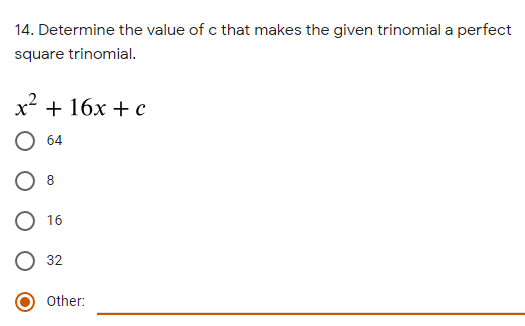
wrong channel, go to one of the questions channels further down. But here's a quick suggestion, work backwards start from (x+a)^2 and expand this to match the terms with your trinomial
sacred junco
@past mauve c has to be a perfect square number
sleek cove
why does stopple have so much stuff about sigma(n) and s(n)? is it like super important for later material?
simple hearth
sigma(n) is a classical object that was of interest as far back as the ancient Greeks, so it is the kind of thing number theorists like to use as examples to show how powerful an idea is
it also winds up being important in the context of modular forms
I'm not sure I know what you mean by s(n)
sleek cove
s(n) is just sigma(n) - n
simple hearth
ahh, yeah, so directly digging at perfect/abundant numbers
sleek cove
like, its definitely interesting, with perfect numbers and amicable pairs and such, but I don't see the need to to pages of problems on these topics
simple hearth
There are only so many multiplicative functions to choose from is I suspect what is going on.
sleek cove
wdym
simple hearth
oh, just that it is a concrete approachable multiplicative function and there are not that many of those.
(I do not have the book in front of me, so I can only guess from the table of contents what the author is doing with them a bunch, but they show up a lot in most analytic number theory books, along with phi(n) and d(n) and friends because those are the nice examples)
simple hearth
admittedly the other day when I was going to make an analytic number theory video one of the first things I put in the script was proving that sigma(n)/n is pi^2/6 on average
sleek cove
so its realated to zeta?
simple hearth
Yes, multiplicative arithemtic functions have a nice relationship with the zeta function, in terms of an Euler Product.
(ahhh, tau(n) is what I called d(n))
simple hearth
(one thing a lot of people do is to write $\sigma_k(n)$ for the sum over the divisors $d$ of $n$ of $d^k$
sterile pumiceBOT
zetamath:
simple hearth
and then $\tau(n)=\sigma_0(n)$
sterile pumiceBOT
zetamath:
sleek cove
hmm
simple hearth
Yeah, Euler's proof using that product formula to show that every even if perfect number comes from a Mersenne prime is very similar to the idea of the product formula for zeta. I don't think I'd noticed taht before!
One thing I wish would show up somewhere is a more holistic treatment of generating functions.
simple hearth
you will want to use your formula for tau(n)
sleek cove
that if n=p^k, T(n)=k+1, and if (m,n) = 1, then Tau is multiplicative?
simple hearth
yes
so, if, e.g., I wanted the smallest number with 101 divisors
what would that number be?
simple hearth
well, 101 is prime
how can I get a prime number of divisors?
(out a multiplicative function)
sleek cove
you can get a prime num of divisors by raising itto itself minus 1?
so 101^100? but thats like massive idk
simple hearth
what about 2^100?
simple hearth
I claim that is minimal
simple hearth
got it?
simple hearth
correct, so when you go on to say, find the smallest number with 8 divisors, you ahve to look at ways you could factor 8
8, 42, and 22*2
err 2 * 2 * 2
sleek cove
yea
simple hearth
so, 2^8, 2^4 * 3^2, and 2* 3 *5 all have 8 divisors
simple hearth
oh yeah, you definitely do not want to compute D(100!)
sleek cove
mmhm
sacred junco
cool problem: show 55, 5050, 500500, 50005000, ... are triangular numbers. (so for all k>=0 numbers with 2k+2 digits such that first one is 5, k zeroes after it then again one 5 and rest are zeros, are triangular)
 deft verge
||
"The formula for calculating the nth triangular number is: T = (n)(n + 1) / 2"
and the formula for getting the nth of your fancy numbers is (10^n)*(10^n + 1) / 2
sorry, I know nothing of how to formalize this
||
sacred junco
that's enough, no need to formalize any more
Try this one then: same thing but for sequence 45, 4950, 499500, 49995000,...
deft verge
||oh, bc T(n) = ((n + 1))((n + 1) - 1) / 2||
wow that's pretty funny
sacred junco
uhhh can you elaborate? How does that say anything?
at least I did it other way I guess
deft verge
yeah that was brief
I mean that your second sequence is much like your first sequence but you have (thing)(thing - 1)/2
sacred junco
it's also true for the sequence 21, 2211, 222111, 22221111,... 222111 is 666th triangular number btw
 wispy moon
How do I find primitive roots of a large prime number such as 197?
 wild zinc
I'm not sure of a good method to find a primitive root
but once you've found one primitive root g, the others are g^k, where k is coprime to 196
wispy moon
Thank you, how would you go about finding one root?
torn escarp
brute force
start with 2, and start raising it to powers and see if it gets to 1 prematurely or not
wispy moon
would that be the only way or would you be potentially able to use discrete logs to solve this?
torn escarp
in doing so you'll get a list of other numbers that are powers of 2 which you would then skip
what algorithm do you have for computing discrete logs?
winter bear
also say the order of 2 is (p-1)/n, you can then restrict to looking for nth roots of 2
hmm on second thought i dont think this will make the algorithim more efficient
wild zinc
hmm
I think we can use multiplicity of legendre symbol
bc euler's criterion says the primitive roots are those with (g / p) = -1
so you check 2
check 3
don't need to check 4
check 5
don't need to check 6
(bc if both 2 and 3 have (g / p) = 1 then so does 4, 6 etc.)
wispy moon
Would you still require brute force to check 2,3,5 etc
wispy moon
The question I got is a diffie-hellman one - Give an example of how Alice and Bob can exchange keys, using the prime p = 193 and a primitive element g (you need to determine a primitive element g yourself)
wild zinc
bc you have (2 / p) = 1 if p = +/-1 mod 8, and (2 / p) = -1 otherwise
I think this is the result at least
p = 193 is 1 mod 8 so 2 is not a primitive root
p = 197 is 5 mod 8 so 2 is a primitive root
actually I'm not sure all this euler criterion logic is correct
winter bear
this isnt right btw
wild zinc
yeah mb
winter bear
not all non-QRs are generators
wild zinc
if (g / p) = 1 you can guarantee it isn't
wild zinc
so if your p is 193 I guess this at least tells you not to check 2 :^)
"brute force" here is checking when the power is some divisor d of p-1 btw
so it may not be too bad to do
winter bear
yeah. my thought is two fold, one is where we do not factor p-1 and then slowly eliminate the subgroup generated by each of 2,3 etc
and then another is where we do and then test all numbers (still eliminating but less so) against the divisors
wispy moon
would this method work?
wild zinc
yeah that works just fine
winter bear
yeah should be fine
factorization is NP iirc
so might not be the most effecient way?
i mean this problem is NP too probably so lol
oh theres some interesting literature on this
so it seems we do need to factor for deterministic algorithims
wispy moon
In the example above why is 2^152 and 2^40 not also tested?
winter bear
you dont need to, you already know 2 is not a generator
wispy moon
ah right i understand now
winter bear
turns out generalized RH implies that if $g$ is a generator mod $p$, then there is some $g\leq O(\log^6 (p))$, so some algorithim test it against that hoping to get lucky
(but yeah ur prolly not looking for this, the factoring trick is prolly whats intended rip NP)
sterile pumiceBOT
JohnDoeSmith:
sleek cove
so I looked this up, and it seems to be 1500 not 300, but how do they pick the exponent?
 humble umbra
sleek cove
humble umbra
sleek cove
well yeah, but like, why not 1499 or 1501?
simple hearth
almost assuredly the proof, if you look at it, looks like "any counterexample must have the following properties..." where the list of properties is so restrictive that you can enumerate all the numbers with those properties less than some huge bound (e.g 10^1500)
and then you just do a computer search of all of those numbers
Like here is a list (from wikipedia) of theorems we know about odd perfect numbers
simple hearth
Do you know any group theory?
simple hearth
So there was this many decade long search to find all the finite simple groups. It doesn't matter what those are. But it proceeded a lot like this, where people kept proving that if there was one that we didn't know about, it had to have this ridiculous list of properties.
and so people became convinced that there wasn't one
and eventually they narrowed it down to that if there was such a thing, it had to be a group with order 808,017,424,794,512,875,886,459,904,961,710,757,005,754,368,000,000,000
and that number is just so absurd, it couldn't possibly exist, right?
and then someone found it.
sleek cove
tf
simple hearth
The Monster Group, as it has become known
sleek cove
by guess? surely a computer cant check that
simple hearth
They found it as the automorphism group of a particular lattice, if I recall correctly
So this whole "cascading list of restrictions" is not an uncommon thing to see in math. Sometimes it leads to eventually getting to "there aren't any" and sometimes it leads to finding that this one thing dodged all the restrictions
simple hearth
yeah, probably every piece of one of these is a paper.
sleek cove
yeah, it just seems kind of weird/arbitrary at a glance from my perspective as a rising soph in undergrad lol
simple hearth
Elementary number theory is incredibly weird/arbitrary. I really recommend reading the paper "The Law of Small Numbers", by Guy. it's short, and readily available online. Basically, I think the right view is that the deep theory dictates the behavior of large integers, but there are a lot of "small" integers where strange accidents happen.
like, for example, n!+1 shouldn't be a square, but it just so happens it is a bunch of times for small n
sleek cove

how do people write out the aterisk for convolution
like is a 5 pointed star acceptable lol
simple hearth
haha well, anything you write by hand is pretty mcuh only for you, so you do you
I draw three intesecting line segments
sleek cove
mu(n) = 0 iff n is not square free, right
simple hearth
right
sleek cove
I'm not following what dq is from
take n=30 = 2 x 3 x 5
d = 1, 2, 3, 5, 6, 10, 15, 30,
let q = 5
how can dq divide 2 or 3 or 6
light flicker
what is u here?
light flicker
dq is a divisor of n, not a divisor of d
simple hearth
so what they're saying is that they are pairing each divisor of 6 with that divisor times 5
so 6 gets paired with 30, 3 gets paired with 15, 2 gets paired with 10, 1 gets paired with 5
That's all of the divisors of 30
but each pair contains an elements whose mu's are opposites
simple hearth
yeah, mu is multiplicative, so mu(xq)=mu(x)mu(q) = -mu(x) as long as (x,q)=1
so mu(x)+mu(qx)=0
sleek cove
 steady nest
multiplicative inverse(redirected from other channel) @light flicker
steady nest
yeah i believe
light flicker
can you define multiplicative inverses for me
sterile pumiceBOT
suck2015:
light flicker
but why does that mean that x = y (mod p)
light flicker
when dividing by p yes
a better way to say it is that if you take the number x - y
then this will be divisible by p
light flicker
yes
steady nest
what does that mean?
p = pk , k being an integer?
oh
then k just equals 1
🤦♂️
thanks Zoph
last grove
hey all, I'm confused to how they turned the derivative into f(n) - f(n-1)
or do the curly brackets {} represent something important?
sacred junco
well, $\int_{a}^{b} f'(x) dx = f(b) -f(a)$
sterile pumiceBOT
Godel:
sacred junco
you can take (n-1) out the integral since it's just a constant
 lucid girder
Please help me to finding Cp(V) and Cs(V)
 fervent crest
Doesn't feel very number theory to me
Probably post it in question channels or in physics server
fervent crest
I'm saying this isn't the place to ask
But look up separable differential equation
lucid girder
oh thank u
 vast dove
Are we still talking about Wilson's theorem?
simple hearth
I love Wilson's Theorem
I put a question on one of my cryptography exams about whether it would be an effective primality test
wild zinc
O(n) primality test, pretty good
simple hearth
haha if you even forget and do the digits thing backwards you could call it O(log(n))
last grove
Wilson's theorem is pretty cool
in fact, anything involving consecutive numbers in number theory is pretty cool
last grove
hey, how did they combine 5) and 6) to prove the theorem?
I am thinking that they did something with this
light flicker
"integration by parts"
alpine jasper
you can first write
$4503x\equiv4(1803)$
and since you said gcd = 3, and $3\nmid4$, the first eq has no solution
sterile pumiceBOT
Publius:
alpine jasper
uh yes, moreover, there are exactly gcd(4503,1803) = 3 solutions
you can use euclidean algo and perform back sub
do uhh,
4503 = 3 * 3606 + 897
3606 = ...
...
once you get to the bottom, you can solve for 3 (aka the gcd you just found)
i don't have time to go in to details but that's the idea, try a small example if you're confused
@sweet jay
you can sort of guess and check when the (mod n) has a small n, but in this case idk if there's an easier way
alpine jasper
not sure why your solution didn't work, maybe a silly mistake?
in any case, you can generate more solutions once you found a solution
do you know how?
if $x_0$ is a solution, then $x_0 + \frac{1803}{(4503,1803)}$ is another, keep adding and you'll get more
sterile pumiceBOT
Publius:
alpine jasper
once you added for a total of $\frac{1803}{(4503,1803)}$ times, you've obtained all incongruent solutions, in this case, 2 times
sterile pumiceBOT
Publius:
alpine jasper
np
alpine jasper
wdym?
technically, finding x only will suffice, but usually you get y for free via back sub
alpine jasper
(a, b) denotes the gcd of a and b
if that's what confuses you
oh shit wops
i said something wrong
 winter crow
okey
 simple hearth
it shows up a lot in analytic number theory
sleek cove
Im confused ab the << notation
couldn't you switch f(x) and h(x) and the relation would still hold?
light flicker
yes
simple hearth
What book is this? I feel like I just saw taht paragraph in some Analytic Number Theory book
sleek cove
so the relation is kind of useless if the functions are of the same degree at least for polynomials
simple hearth
I wouldn't call it useless, it just is much weaker than <
but the functions in analytic number theory have a lot of noise in them
and so if you want to compare, e.g., pi(x) and sqrt(x) or something like that, you're going to need more flexible relationships
sleek cove
gotcha
simple hearth
also, having relationships like this helps you a great deal in proofs by making you not have to carry around inequalities evrywhere
simple hearth
how can it be wrong?
simple hearth
I don't think it's that bad
simple hearth
Hint: 320 = 2^6 * 5
winter crow
i have already know that man
simple hearth
Hint 2: phi is a multiplicative function
simple hearth
so if phi(n)=320, what primes could divide n?
winter crow
1 2 4 5 8 10 16 21 32 40 64 80 160 and 320 divisors of 320
if we add +1 each one
and choose prime
we obtain that 2 3 5 11 17 and 41
right ? @simple hearth
winter crow
what primes could divide n? answer of this question
2 3 5 11 17 and 41 these
or what ?
simple hearth
Yes, so now what powers of those primes could divide n?
winter crow
n=2^a 3^b 5^c 11^d 17^e 41^f ??
simple hearth
yup, so now you just have to find all the a b c d e f that work
it's like a little soduku
winter crow
how can I do that
simple hearth
for example, can f=2?
winter crow
absolutely not
noww if 41In then 41.m=n right ?
so phi(n)= phi(41) phi(m)
and then phi(n)=40 phi(m)
since phi(n)=320 then we have to find phi(m)=8
m values
simple hearth
Exactly, now you've got it
winter crow
then convert n values to product 41
but i have question
are we apply all of this values ?
what about 2 ?
if we apply we concluded same thing
as a question
phi(m)=320
simple hearth
yes, phi(2)=1, and so if m is odd, phi(2m) = phi(m)
winter crow
now when we solve for 3
we obtain phi(m)=160
this is again too hight
am ı use process from the beginning ?
to find
simple hearth
isn't phi(11*17)=160?
winter crow
oww You are right
simple hearth
its' the n=1 term of the series
note the strict inequality in the second formula
wait, now I'm confused and think maybe it should be a -1
oh, no, it's a +1
last grove
I think you have the right idea...
simple hearth
because what they're really doing is aplying the formul for 1/2+1/3+...
and then tacking a +1 on both sides
winter crow
i cant reach 800
this is solution for n
i check that calculator
but i cant reach
sleek cove
are we supposed to use a calculator for this lol
simple hearth
I think very little is lost in using a calculator at the analytic number theory level 😛
last grove
you're gonna need a big calculator 😳
simple hearth
I almost always have a sage window open
simple hearth
oh, H_1000 is just the 1000th partial sum of the harmonic series?
you can do that with Euler Maclauren
sleek cove
uh idk what that is
simple hearth
It is a tool sepcifically for answering this question
but I'm guessing they used it in the proof of the result you gave
so you can just use that result prboably (-:
oh, never mind, they just used the bound on the error in a lefthand Riemann Sum
sleek cove
yes
simple hearth
but if you dig in the proof, instead of saying that the error is O(1/n), the error is literally <1/n
sleek cove
yes
simple hearth
which means you get 3 decimal places for free
simple hearth
yeah, that should do it (-:
but fun fact, when Euler was studying 1+1/4+1/9+1/16+... he calculated the sum to 17 decimal places by hand
last grove
bruh
sleek cove
isnt that like 10^3 terms
simple hearth
(for comparison, if you literally calculated the sum of the first 10 trillion terms, you would only get 10 decimal places)
sleek cove
oh nvm lmao
simple hearth
Will do, I posted the link to part 1 of my intro to analytic number theory here
but it is a good topic to transition because the method Euler used to show that zeta(2)=pi^2/6 is exactly the same method that Riemann used to show the zeroes of the zeta function dictate the distribution of the primes
last grove
Euler's proof is pretty insane
last grove
you mean a proof created in the midst of being high?? xD I guess people are more creative when "high"
simple hearth
when Wile E Coyote runs of the edge of a cliff chasing the roadrunner he doesn't fall until he looks down
deft verge
I still don't understand why his ski + refrigerator solution didn't work
simple hearth
(the proof of the Weil conjectures is, to my eye, the most impressive of these.)
"oh, if we had a cohomology theory for these wholly non-geometric objects then the result would be a trivial consequence of the Lefshetz trace formula. Of course."
last grove
hmmm... how did they get this result?
did they plug it into the Eulers ummation formula
winter crow
can ı ask another question @simple hearth ?
simple hearth
so the area of the rectangles is the sum and the area under the graph is the the integral of 1/x which is log(x)
so the thing in the limit is the sum of all these triangulish regions
and say, the second one is : 1/2 - \int_2^3 1/t dt
and you can do a little bit of trickery to turn that into what is written above
[This is just proving the Abel summation formula in this case, though]
@winter crow You can ask, there are probably plenty of folks around who might answer!
simple hearth
I bet they want you to use the Chinese Remainder Theorem
last grove
dang, @fervent crest , I never knew that existed. Thanks a lot sir
fervent crest
Also read what zetamath said above ^
simple hearth
the number of times I've said to myself "oh crap, I just reproved the abel summation formula in this special case" is high
sacred junco
i can tell you the last digit but not the last 2 digits
simple hearth
FWIW, I find the abel summation formula highly unintuitive, so even when I prove something that would have fallen out of it, it is often insightful
winter crow
@sacred junco why 17^2=289 then the last two digit 89
sacred junco
bc the last two digits are 89
sacred junco
bruh idek what u were asking
winter crow
ı was asking part b
sacred junco
ok
deft verge
the repeating pattern for the second digit is 0,1,6,5,2,9,8,3,4,7,
sacred junco
ye
last grove
what is the high-level idea for proving this
using abel's summation formula?
sorry if I'm asking too much 😫
lol you guys didn't mean the euler summation formula.. did you??
simple hearth
did you see how to derrive it from my picture earlier, andrew?
last grove
it was a helpful point
I was able to visualize it better
I used Euler's summation formula to prove it though... I'll upload a picture of my process later
it would be interesting to know how to use Abel's formula to tackle this though
simple hearth
So what do you get if you apply the Abel summation formula to the sum from 1 to x of 1/n?
last grove
so I will let phi(n) = 1/n
and a\subn = 1 always
(if I do it the other way around, then the derivative of phi will be zero and the integral disappears)
wait no
it doesn't make sense that way
simple hearth
I think the traditional way here is to use the next term in Euler MacLauren
sleek cove
I still dont know what that is lol, I haven't learned that
idk how to deal with the n^C
simple hearth
I think given that you're doing this kind of thing, it is worth learning the formula.
I can link you to a couple of articles I found useful when learning it
or alternatively you can watch the really excellent mathologer video about it
sleek cove
alright then, I'll check out his vid, I like his stuff
if I still dont get it I'll lyk
simple hearth
I'll note, btw, this is a form of Stirling's Formula
but Stirling's Formula gives yo uthe actual constant, which you can't get out of EM
(that's just context, it doesn't mean you shouldn't figure out the exercise, of course)
sleek cove
um not going to lie, this is fairly intimidating lmao, and by fairly I actually mean very
simple hearth
it looks intimidating, but it is not as bad as it looks. Basically, the place your log(n!) approximation is coming from is from approximating \sum log(n) with \int log(x) dx
 static sparrow
I've got some weird stuff but it should work
https://cdn.discordapp.com/attachments/488104216678760469/717792123524481184/94730921676115968.png
 simple hearth
and what this formula gives you is an approximation for what that error is
sleek cove
hmm
yeah I remember the sum being interchangeable with the integral
I'll try that if I can't get grasp the euler maclauren method, thanks Tuong
static sparrow
👍
simple hearth
I think the result you want follows from EM with p=1.
sleek cove
this vid?
simple hearth
Yes
sleek cove
ok
wait, so what is the function that I am replacing with the sum on the left
log(n) or log(n!)
sleek cove
oh duh
simple hearth
I'm sorry, I maybe should have made sure we were on the same page about that earlier!
simple hearth
I think I really want p = 2 in your formal, that is through the first derivative. This is only an approximation, afterall
simple hearth
log(1)=0 so it shouldn't matter much
since you're looking for an asymptotic bound anyway, that only shifts stuff by a constant
sleek cove
so do you think I should evaluate p=1 or 2
sleek cove
p=1, not sure what to do with this exactly
I know that the error, or big O will decrease with larger p values
but I don't see how this will allow me to arrive at the original claim
simple hearth
so rewrite this as log(n!) = ...
and then use log properties to collect stuff
noting, e.g., that n= log(e^n)
actually, I think this is more terms than you need, because n log(n) - n + log(n) is already log(n*(n/e)^n)
sleek cove
no
wait
that doesn't help
wait
yeah i dont get how that helps
I was already at that step before trying this
but you have n^C
simple hearth
So what I get just from the integral is that log(n!) = log(n (n/e)^n) +A(n) +C
where |A(n)| is at most as big as log(n)
and C is a just a constant
so you could write that as
log(n!) = log(n (n/e)^n) + O(log(n)
which certainly implies your result
(the EM makes that error term much more precise)
(I'm sorry, I think I gave you a bigger hammer than was needed for this problem)
sleek cove
yeah that makes sense
however, the proof is supposed to just rely on just the theorem

which I still cant figure out
simple hearth
Well the theorem just gives you log(n!) = log((n/e)^n) + O(log(n)), so that would say there is a constant C such that for large enough n, we have log(n!) \le log((n/e)^n) + C*log(n)= log((n/e)^n) + log(n^C)
so, there is definitely an N such that if n>N then (n/e)^n > n^C
so then for n>N we have log(n!) \le 2 * log((n/e)^n) ... Something went awry here?
simple hearth
$\le$ and $\ge$
sterile pumiceBOT
zetamath:
simple hearth
sorry , I can actually compile the latex
this is easy if yo uuse the fact that you prove, in the proof of the 'Know" that the error isn't just less than C*log(n), it is less than log(n)
I don't think the fact, as stated, with no other context, is sufficient fro the desired result, however
simple hearth
I would want to start exactly with the line written there
and then use e's to get rid of the logs
sleek cove
I did, and arrived at smth similar, you still have n^C
simple hearth
where did you get a C from?
sleek cove
oh wait
hold on
bruh
I feel so dumb
like actually
I spent too much time thinking about C, and the definitionsof << and O
simple hearth
haaha it happens to the best of us
but yeah, to elaborate just slightly, this gives you that it's at most of order n * (n/e)^n
but if you go one more term down the EM thing, you learn that front term can be repalced with an n^(1/2)
sleek cove
simple hearth
Perfect
sleek cove
yeah that makes sense
simple hearth
so the "implied constant C" is the e
sleek cove
yup
simple hearth
well sorry for contributing to confusion there, but hopefully it makes sense now
sleek cove
I was trying to like, make my way backwards through the definitions involving O and << from the original theorem, instead of actually thinking about what was going on
no, thank you lol
plus the euler maclaurin expansion will definitely be helpful in the future
simple hearth
oh yeah, it is in the intro chapter of most analytic number theory books because you use it all the time
though it is suuuuuper finicky and weird
sleek cove
the first time it's mentioned in this book is 219/400, im only at 53 ish lol
simple hearth
just as an example of how finicky it is, you choose this number p of terms you want to use, and even for fairly small p it is often very accurate
but then in most cases, for large p, the sum actually diverges
let me get that in a more human file format
sleek cove
how would that happen though
simple hearth
sleek cove
like wouldnt that require and increasing derivative
simple hearth
so, one of the things Euler used this for was to approximate zeta(2)
and he used 10 terms of the EM approximation, and got 17 digits of accuracy
so what you're looking at is a graph of the number of digits of accuracy you get out of EM for that series based on the number of terms you use
so you very rapidly get 17 digits of accuracy
and then it hangs at exactly 17 digits of acuracy for a bunch of terms
and then the bottom falls out and it explodes
(so negative 20 digits of accuracy means the 20 digits before the decimal place are incorrect, btw)
sleek cove
how does that happen lol
simple hearth
roughly speaking,what's happening is that taking a bunch of derivatives gives you giant factorials
e.g. the hundreth derivative of x^100 is 100!
sleek cove
yes
simple hearth
and so at each new term, you're chopping off the error from the lower order terms
but you're magnifying the error of the higher order terms
and so at first, you're winning
but eventually you lose the battle
(and lose it fairly catastrophically as the illustration shows)
sleek cove
and so at each new term, you're chopping off the error from the lower order terms
@simple hearth what does this mean
simple hearth
I'm off for now, but I can elaborate later
 simple hearth
tau is the number of divisors?
sleek cove
ye
simple hearth
I like d(n) so much better, but it does get ugly when you do mobius inversion ahd have d(d) floating around everywhere
sleek cove
where can I find a proof of this, the one for k=3 was gross, but I can't find one googling that has this form
fervent crest
What's tau(n)?
sleek cove
sorry, divisor function
simple hearth
its on page 101 of Koninck and Luca's Analytic Number Theory book
their form of it is d(n) = n^ O(1/log(log(n)))
(obligatory joke about what sound a drowning analytic number theorist makes)
sleek cove
ok sweet thanks
simple hearth


If you have not seen this, I think this is really awesome. It shows how Riemann's formula for psi(x) in terms of the zeroes of the zeta function fits it near perfectly
last grove
it's really cool
there's a formula that uses the zeros of the zeta function to create this curve that fits the prime counting function really nicely (I think)
@simple hearth I think it's this one
and the more zeroes you include, the more accurate it gets (to a point)
simple hearth
It actually converges to it perfectly even
torn escarp
interesting, I wonder if anyone's thought about this sort of Gibbs phenomena at the discontinuities or derived any kind of information from them
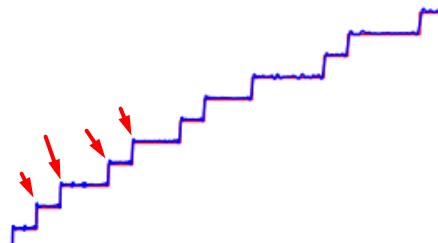
seems like something someone way smarter than me would have already looked into already and found some kind of bound of some sort, just curious if you know anything about that so I don't consider wasting any time on this lol
simple hearth
I don't know anything about it, but I'm very far from an expert on this
sleek cove
the reason he lets n=N!, is so the first inequality holds?
and thus H_n becomes larger than log (N)
simple hearth
yeah, N! is divisible by every integer from 1 to N
that's all that is being used here
sleek cove
yup making sure
simple hearth
I would just have phrased this as $\lim_{n\to \infty} \frac{\sigma(n!)}{n!} = \infty$.
sterile pumiceBOT
zetamath:
simple hearth
well, it can't be 0 because n! is a divisor of n! so the ratio is always at least 1
sleek cove
wait
oh yeah i was thinking n
wait
even then
oh yeah
i was summing divisors of n, not n!
my bad
simple hearth
but $\frac{\sigma(n!)}{n!} \ge 1 + 1/2 + 1/3 + ... + 1/n$ and the latter, in the limit, is the harmonic series, which famously diverges
sterile pumiceBOT
zetamath:
simple hearth
it's not a different argument than the one given in the text you quoted, but I think it puts the emphasis on the right part
sleek cove
$\lim_{n\to \infty} \frac{\sigma(n)}{n!} = \infty$.
sterile pumiceBOT
Sideurk:
simple hearth
haha yes that definitely isn't true
sleek cove
yeah I see that yours is equivalent
so you get s(n) > n(C-1) which implies this, right
simple hearth
what is s?
sleek cove
sigma(n)-n
simple hearth
yeah, sure.
 worldly tree
HI, for euler totient. How do i figure out all numbers n such that phi(n) = 16 ?
I try, maybe just 1?
@winter bear
17
winter bear
well i mean what did you try theortically not computationally
like what ideas do you have
sleek cove
its like a puzzle kinda like sudoku
worldly tree
ph(n) = p-1 ?
winter bear
thats for primes
sleek cove
for n=p
sleek cove
factor n into prime powers then work backwards
worldly tree
(p_1^k -p_1^(k-1)) .... (p_r^k - p_r^(k-1)) = 16
winter bear
bad () but yeah
worldly tree
Oh I edit