#elementary-number-theory
1 messages · Page 47 of 1
 surreal shuttle
 sacred junco
@surreal shuttle
Let's suppose we have a nontrivial relation a^r = 1 (mod n)
Do you understand this?
If not, then rip
surreal shuttle
Yes
surreal shuttle
yes
surreal shuttle
Sure
sacred junco
It is about finding maximal k
You can divide r by 2 again and again right? @surreal shuttle
surreal shuttle
Yes
sacred junco
So, you divide it by 2 until you cannot.
When is it that you should stop dividing by 2?
surreal shuttle
Yes
surreal shuttle
Yeah
sacred junco
r = 2^k * m
So what was the pic
t!pic
Write r = 2^k m, with k >= 1, m odd
So now now
Do you get this
surreal shuttle
Yeah
sacred junco
So you get how to get the k - you should divide by 2 till odd number to find it.
It is a common pattern btw.
So..
https://cdn.discordapp.com/attachments/418981682117345288/552389698572517398/unknown.png

Next part about b_i, you should understand.
Right?
surreal shuttle
Yes
sacred junco
Now the important part
You have b_0, b_1, ...
And you have b_k = 1 (mod n).
So there should be the maximal number
Such that
b_l is not 1 (mod n). Right?
surreal shuttle
Yeah
surreal shuttle
yes
sacred junco
And it should be b_(l+1) = 1 (mod n)
surreal shuttle
yes
sacred junco
So yeah, you get most part of it. right?
All clear, or is there something which is hazy?
surreal shuttle
Yeah I get it now thanks
sacred junco
👍
(Tbh now I don't know where you got trapped)
(Maybe you don't know why you don't get it before now?)
 pulsar yarrow
How would I show that F(x,y) = (2y, 3x) is injective or not?
 quick furnace
by checking whether or not it meets the definition of injectivity, it seems
pulsar yarrow
I get to (2y, 3x) = (2y', 3x') but then I don't know what to do after that
pulsar yarrow
Y and X is equal?
quick furnace
in your case, 2y = 2y' and 3x = 3x'.
pulsar yarrow
oh okay I see
 fast monolith
@jolly comet So yeah the competition ended and now i'm open to every solution you can give me :D
fast monolith
In the decimal representation of 2sqrt = 1.4142... Isabelle finds a sequence of k consecutive zeros, where k is a positive integer. Proof: The first zero of this sequence is at the k-th position after the decimal point at the earliest. Copy past 100
 jolly comet
if there are k zeroes in a row in they cannot occur too early
okay yeah so here's my idea
there's this theorem which basically says that if a number is "freakishly well" approximated by rationals then it's transcendental
and a freakishly good approximation is one which is a lot closer than you have any reason to expect from the size of the denominator
you can look up the details if you care but you don't need it for the proof i have in mind, it's just a good fact about transcendentals to know when it comes to number theory
we only need to think about quadratic irrationals (which sqrt(2) is because it's a root of the quadratic polynomial x^2 - 2) and those happen to be the weakest of the bunch
fast monolith
ok so you don't have the solution.. but this is also interesting
jolly comet
i have all the pieces to write down a solution but i didn't do it because i'm not gonna do your contest lol
a rational p/q is a good approximation to a real x if |x - p/q| is minimal among all rationals with denominator <= q
the theorem about "freaksihly good" approximations to algebraic numbers is due to liouville and it says that if x is algebraic of degree n (i.e. if it's the root of a degree n polynomial) then there eixts a c dependent only on x such that |x - p/q| > c/q^n for all rationals p/q
in the case of quadratic irrationals like sqrt(2) it means you couldn't expect to get any better than quadratically close to it
now it's also, separately, known that the best rational approximations come from truncating the continued fraction expansion of a number
the continued fraction for sqrt(2) is 1 + 1/(2 + 1/(2 + 1/(2 + 1/(2 + 1/(2 + 1/...)))))
$\sqrt2=1+\frac1{2+\frac1{2+\frac1{...}}}$
 sterile pumiceBOT
tubular:
jolly comet
initially 1 but then 2s forever
so, with regards to this problem specifically, you probably don't even need toworry about the liouville result because that requires finding and proving a c which is hella spicy
pulsar yarrow
Is F(x,y) -> F(y,y) surjective? I would assume so from common sense as it is possible to make any y if x = y but how would I go about proving it?
jolly comet
@fast monolith you know that k zeroes showing up at position p means that $\sqrt2=\frac a{10^{p-1}}+\epsilon$ for $\epsilon<\frac1{10^{k+p-1}}$
sterile pumiceBOT
tubular:
jolly comet
where a is some positive integer which is going to be the first digits of sqrt2
fast monolith
sry if i don't answer I had no time rn
tomrrow
maybe
what was that grammer tho
jolly comet
so my first strat would be to set p=k and then find the best approximation (from the continued fraction) whose denominator is less than 10^{2k-1} or maybe 10^{k-1}
and then compare that to a/10^{k-1} and presumably learn a contradiction from the fact that the a/10^{k-1} shouldn't be better than the continued fraction result but is extremely good
sterile pumiceBOT
tet:
sacred junco
<@&286206848099549185>? common modulos don't seem to work very well
oops not a help channel, sorry for the ping i guess
pulsar yarrow
looking for help on how to solve 5x + 9 = 10 mod 77; a lot of the tutorials i've watched dno't have the _+9
 static sparrow
something+9=10 mod 77 is the same as something=1 mod 77
pulsar yarrow
how does that work
static sparrow
$a=b\mod c\iff a-b=0\mod c$
sterile pumiceBOT
Tuong:
static sparrow
if a=b mod c then there exists k in Z such that a=b+kc, so a-b=kc.
k is in Z so a-b=0 mod c
if a-b=0 mod c, then there exists k in Z such that a-b=kc, so a=b+kc.
k is in Z so a=b mod c
static sparrow
Yeah
static sparrow
5x=1 mod 77 means there exists k in Z such that 5x=1+77k
5x-1=0 mod 77 means there exists k in Z such that 5x-1=77k
it's really the same
you can add stuff like you want
pulsar yarrow
but regardless how do I find x
static sparrow
,calc 31*5-1
sterile pumiceBOT
Result:
154
,calc 154/77
sterile pumiceBOT
Result:
2
So, 31 is a solution
pulsar yarrow
how did you find that
static sparrow
I did 77*2, it ends with a 4, so it's a multiple of 5 minus 1
5×31-1=2×77
If you can't find an easy solution, there's an algorithm to compute one, but I don't remember it
static sparrow
77×2 ends with a 4
77×2+1 end with a 5, it's a multiple of 5
then (77×2+1)/5=31
pulsar yarrow
why you multipled the 77 by 2 you didn't have to multiply the side of the 5 as well?
static sparrow
I'm not working with the equation, I'm designing a solution from scratch
when you've got equations like this, there's often an "easy" solution with which you obtain all the solutions
here, 31 is an "easy" solution
and when you can't find one of those "easy" solutions, there's an algorithm to obtain one, but I can't remember it right now so you'll have to look for it in your notes
pulsar yarrow
but the easy solution should still fit in the equation right
so if its 5x = 1mod77
if x = 31
static sparrow
It had something to with Bézout iirc
pulsar yarrow
does 155= 1mod77
pulsar yarrow
ugh mod is hard to wrap my head around
pulsar yarrow
okay
but what happens if i need to solve 2 equations
so like
x = 2mod7 and x = 3 mod11
i assume i cant do it like linear equtaions
static sparrow
To solve tbese, you use theorems you've learned in class
7 and 11 are coprime so iirc there's something special about that situation
I dont' remember it exactly though
I'll go to sleep now, good luck with your exercise!
pulsar yarrow
okay thanks!
 stuck lintel
since 7 and 11 are coprime you can apply the chinese remainder theorem
which states that if 11z = 2 mod 7 and 7y = 3 mod 11, then x = 11z + 7y mod 77
,tex more generally if you have \$x \equiv a_1 \pmod{m_1}$
and
$x\equiv a_2\pmod{m_2}$ and $(m_1, m_2) = 1$\ then solve the equations $z_1m_1 \equiv a_2 \pmod{m_2}$ and $z_2m_2\equiv a_1 \pmod{m_1}$ \ and $x \equiv z_1m_1 + z_2m_2 \pmod{m_1m_2}$
sterile pumiceBOT
Plum:
stuck lintel
it gets more complicated if you have 3 or more relations at once
pulsar yarrow
yup jus tfound it
seems fairly straightforward
unlike when there's 2 variables
im not sure what to do when its x and y
so like x + y = 33 mod 77, and x-y =10 mod77
i tried combining it to get 2x = 43mod77 but then im not sure what else
stuck lintel
ya that works
stuck lintel
2x ≡ 43 mod 77 -> 2x ≡ 120 mod 77 -> x ≡ 60 mod 77
pulsar yarrow
how did you get 120?
stuck lintel
add 77
remember what he said about if a = b mod m and c = d mod m, then a + c = b + d mod m
and since 77 = 0 mod 77, then a + 77 = a mod 77
stuck lintel
yeah you can divide as long as it’s coprime to the modulus
pulsar yarrow
How would I remove the 5 from 5x ≡ 1 mod 77
What values am I alloewd to mulitply both sides by
sacred junco
np
pulsar yarrow
why can you just add 77 to the right again
oh cause modding gives the same remainder?
pulsar yarrow
and I can divide both sides by any number as well as multiply?
sacred junco
multiply yes, divide not so much
you can only divide by some number if that number is coprime to the modulus, 77 in this case
pulsar yarrow
okay and how about adding and subtracting to both sides
sacred junco
allowed
pulsar yarrow
okay and so for congruencies the mod isn't part of the particular varibale, but part of the entire side right so
sacred junco
what do you mean
pulsar yarrow
its not like ( ) = ( (xmodx) ) but rather (LS) = (RS) modx
or is it just a property of the congruency
so if like x = 1mod6, and I wanted to add some number, it'd be x + y = 1 + y mod 6 instead of x + y = 1mod6 + y
cause 1mod6 can just be evaluated?
sacred junco
the first thing you said
in general, if a = b mod n
c = d mod n
then a + c = b+d mod n
and also ac = bd mod n
pulsar yarrow
If I'm just adding a number how do those apply
sacred junco
then you set one of the pairs equal to each other
so c=d
go back to your congruence, 5x = 1 mod 77
since 0 = 154 mod 77, we can add this congruence to our first one
5x + 0 = 1 + 154 mod 77
sacred junco
yeah
sacred junco
np
 sterile nymph
 swift shard
Gotta take it mod 10
stuck lintel
try to find the units digit of each of those terms individually by noticing a pattern in their units digit
how would you find the last three digits of that sum tho hmmmmmm
swift shard
Add the digits, take it mod 10
You've only got to multiply until you see a repeat
2¹ = 2
2² = 4
2³ = 8
2⁴ = 16
2⁵ = 32
And there it is, 2¹ ≡ 2⁵ ≡ 2^(4n + 1)
Namely, 2^(2017) = 2^(4×504 + 1) ≡ 2
 vernal ravine
I think I proved the Collatz Conjecture for all even n but my proof is extremely dodgy
jolly comet
uh
using the word "even" suggests you have no idea what you're talking about
because an answer for all even n would very easily imply an answer for all n
vernal ravine
I mean for all n ≡ 0 mod 2
jolly comet
i know exactly what you mean
every odd n is the result of one collatz step from the even number 2n
vernal ravine
Oh you're right
jolly comet
it's my professional opinion there's no way you can have a legitimate proof of what you claim to know if that escaped you
swift shard
Well there, you've proven the collatz conjecture! Good job
vernal ravine
I never said I had a legitimate proof
But essentially if it can be shown that every n can be written in the form (n*(3^k)+2*m)/2^l such that the result forms an integer, then the Collatz Conjecture is true for all n
Pardon the horrid handwriting
Never mind I'm an idiot I'll just leave
jolly comet
the collatz conjecture is that every integer transforms into 1 after a finite number of collatz steps
vernal ravine
Yeah, I showed in the base case that the integer 4 transforms into 1
And then just used a piss-poor version of induction from there
Obviously it has some holes in it but I think I'm making progress
jolly comet
(1) this is not how you use induction with multiple variables; your setup for incrementing the variables would only imply anything for the cases where k = m = l, and it is very much not the case that an integer can be written in that form for k = m = l
(2) it's not clear what is being proven in your inductive case or how you prove it
(3) i think you are using the letter n in multiple contexts and pretending like they're the same (or accidentally confusing them) when they're not
it sounds like you are searching for a form such that every positive integer can be written in that form, and applying a collatz step reduces that form in a way that you can handle by induction
vernal ravine
Yeah that's what I'm trying to do
jolly comet
this is a plausible strategy, if such a form exists
vernal ravine
I apologize for my incompetence, I'm only in vector calculus right now and have yet to take discrete math
jolly comet
however, there is no heuristic evidence that such a form does exist
i would suggest you learn a little more about induction to see how it applies in the case where there are multiple variables
the one-variable case is a lot simpler than the general case and it requires a lot of care to make sure you're saying what you want to say
 wind falcon
 sturdy dirge
Of course.
stuck lintel
what does r_1, r_2, ... stand for?
sturdy dirge
It's probably a proof for:
$\forall (a, n)\in\mathbb{N}^2, n>1,a\wedge n=1, a^{\phi(n)}\equiv1\pmod{n}$.
sterile pumiceBOT
static sparrow
Yes, it's some infix notation for gcd
sturdy dirge
Yes.
stuck lintel
Right but what are r_n supposed to represent
sterile pumiceBOT
 brittle patrol
They're prolly just the $\varphi(n)$ numbers smaller than $n$ and relatively prime to it
sterile pumiceBOT
Gonzo17:
 noble jay
@static sparrow only for us french people
i've never seen anyone else use it or even recognize it when i use it
 languid fog
Someone PLEASE HELP :((
I've been struggling with 8(b)
Yeah, but how do I get the actual factors
How does this tell me anything about the options tho?
2,2
1 and 4
So I have to find solutions for a^2+5b^2=2 and such?
Yeah, I see that. But how do I show that
Oh shit I get it
Thanks man
 tender copper
question
what is the closest thing to a method of turning sequences of numbers into functions there is?
 silver solar
Linear interpolation I suppose
tender copper
isnt there a simpler way?
sacred junco
That's the simplest form of regression analysis, which is by definition the only way to accomplish such a task.
tender copper
what if the function is know was a polynomial of degree n and you just have to find it
without using roots
 tender copper
well if roots are not given
sacred junco
Lagrange interpolation?
tender copper
like for example a function of degree 2 with 4 points that are consecutive
sacred junco
Example
tender copper
(1,2) (2,9) (3,22) (4,41) (5,66) (6,97)
sacred junco
Yeah just do regression 
sacred junco
If you know exactly that it is polynomial, use Lagrange interpolation
But it is sensitive to small changes in data
so never do this if the data are not exact
tender copper
i think i have a simpler method
9-2 is 7
22-9= 13
13-7=6
which is the last derivative of the function
still working on it
maybe i will have a ready version in a month
sacred junco
yes, this also works
if your points are consecutive
this is called newton interpolation
tender copper
huh
newton has discovered it all
;-;
sad
so what are the limitations of newton interpolation?
sacred junco
No limitation
it allows you to find the unique polynomial which has given values at given points
but this is not always what you want
tender copper
how so?
sacred junco
if your data is from experiment for example
it can contain errors
and in this case the exact interpolating polynomial may be worse than lower degree regression
,wolf interpolating polynomial [(1,1.03) (2,1.96) (3,3.05) (4,3.98) (5,5.01) (6,6.03) (7,6.95)]
tender copper
i see
sacred junco
ok maybe it's not that good of an example
but on the first segment for example it is worse than the straight line
tender copper
does it also do exponential + polynomial functions ;-;
tender copper
eh im just a highschooler i dont think i will be able to understand it fully
sacred junco
oh
it's not that hard, but some background knowledge is of course needed
What do you need this for?
tender copper
idk
i thought i stumbled on something interesting and new
but turns out newton already did it
sacred junco
It's good
tender copper
i was just bored in class
sacred junco
If you rediscover something that is useful enough to attach someone's name to it
it means that you are good
tender copper
well i found a way to use the method with functions that are + exponential
like x^2 + 2^x
and still testing with products but i think i have a clue
well its all relates to pascals triangle
sacred junco
with polynomial + a^n the differences will eventually multiply by (a-1)?
that's nice to play with these things
sacred junco
oh, yeah
tender copper
the polynomial becomes 0 but the exponential part stays the same
sacred junco
ah
yes
maybe try to read the book "Concrete mathematics" when you are done with your tests
the beginning should be accessible
 noble elm
so, im sorta stuck here. If $\frac{3^k+1}{2}$ is prime, how do we know that $k$ must be a power of two?
sterile pumiceBOT
em:
noble elm
I got as far as seeing that since $3^k = 2*p - 1$ for some prime $p$, that $3^k \equiv -1 \mod{p}$
sterile pumiceBOT
em:
noble elm
but idek if that's the right direction i wanna be headed
in the congruence or to the original form?
 hearty timber
noble elm
hearty timber
noble elm
1 is a power of two u noob :V
ily jaco
ohhh I think I see
So if k is not a power of two, $k=2^j * m$ for some odd $m$. Then $3^k+1 = (3^{2^j}))^m + 1 = (3^{2^j}))^m - (-1)^m$ since $m$ odd. This is divisible by $3^{2j}+1$
sterile pumiceBOT
em:
noble elm
so it isnt prime :V
thanks dad
?
oh we div by 2
fuck
hhh k
oh, 3^k+1 is always 0 or 2 mod 4 innit
derp
oof
oh wait lol that doesnt matter at all
adfklasdfkl
bc 3^2^n + 1 divided by 2 is an integer anyway
lmfao
i mean i thought the logic held for a second there lmfao
if we divved 3^k+1 by not 2 it would matter lmao
proof by contradiction is a lie
:V
yeah I somehow never quite realized (or at least internalized) that not a power of two implies a power of two times some odd factor
huh, weird
ive taken a few semesters of combinatorics based classes and maybe just never really considered it
But then again I'm a constructivist
 tribal abyss
Can you take a number in a group, let's say in the rationals, and take it to the power of another number in that same group, and get a number in the group above as a solution.
So: a^b = x
Where: a,b = rational, x = irrational.
Will it just be that you can only get number from that group and nothing above no matter the operation?
What about something like e^π? Will it give another transcendental number?
stuck lintel
wdym?
are you saying if its possible for x to be irrational or for x to be rational
because x can either be rational, i.e. 1^1, or irrational, i.e. 2^(1/2)
also e^pi was proven to be transcendental, however pi^e, e + pi, and e*pi arent proven
swift shard
Doesn't make sense in the context of a group, since gⁿ is short form for gggg...
So n is always an integer
 last zealot
I was trying to prove this
and realised that this isn't true since if m=9, n=2 then 9|2 then it doesn't hold
Am I right?
 exotic raptor
for m=9
9 has one prime divisor (3)
2¹=2
n can be either 0 or 1
as 0*(-1)=1*0=0 ≡ 0 (mod 9)
that's 2 total so it does work for m=9
last zealot
Ohh thanks for that
 trim gull
Can someone tell me how you go from the term 3^(n+1) to 3^n * 3?
 grizzled stump
A rigorous solution, but overkilling it would be to use Lagrange mutlipliers
grizzled stump
Haha certainly yes
grizzled stump
Analysis or calc
stuck lintel
By AM-GM, (p+q)/2 >= sqrt(pq), so the maximum value of pq is taken when (p+q)/2 = sqrt(pq). Plug in p+q=1.
1/2 = sqrt(pq)
pq = 1/4
@drifting inlet
Additionally, you could also use basic algebra. q=1-p
p(1-p) = -p^2 + p.
The vertex of a parabola is at the x value -b/2a.
p = -1/-2 = 1/2
-p^2 + p = -1/4 + 1/2 = 1/4
sacred junco
parabola
stuck lintel
Fuk
sacred junco
lol
exotic raptor

 devout trail
Can someone please explain to me the conclusion in the last sentence of the solution?
 drifting inlet
Thanks @stuck lintel
 low jolt
Then it can be seen EASILY that $ n(n+1) $ is congruent to 0,1,2 modulo 5. Is this based on observation or can we mathematically prove that $ n(n+1) $ is indeed congruent to 0,1,2 modulo 5?
sterile pumiceBOT
Rumoden:
exotic raptor
you can just check from 0 to 4 and the rest follows
not sure if there's a faster way
stuck lintel
Context?
quick furnace
$12 \equiv_{11} 1$
sterile pumiceBOT
Ann:
quick furnace
$20 \equiv_{11} 9$
sterile pumiceBOT
Ann:
low jolt
ah i see lol thanks very much!
 hollow lark
hello, someone showed me this but i don’t know what is happening between the 4th and the 5th line. can someone explain it to me ? thank you !
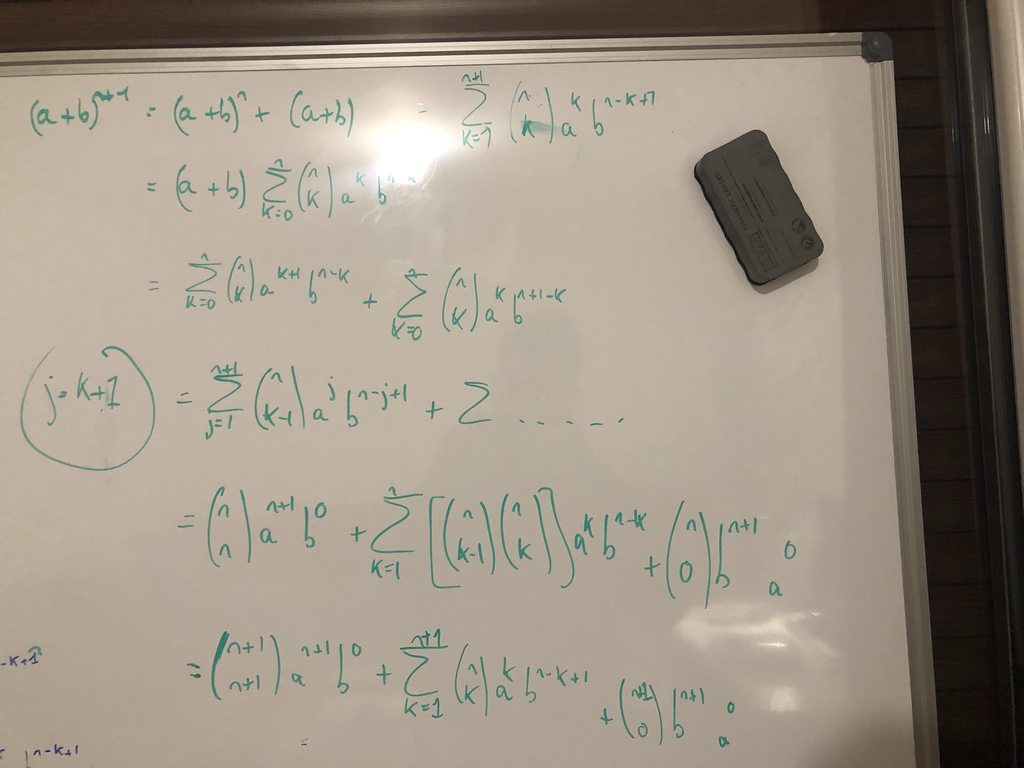 hollow lark
i mean the line under, when it starts by C^n _n
static sparrow
they isolated the first and last terms
static sparrow
You're welcome
 raw cypress
Hey guys! So I’m trying to learn a quick way on how to calculate the politeness of a number and I’ve been looking up some explanations and they’re are very vague and sometimes not true.
For example the wiki explanation
raw cypress
hmm the formula work for an integer like 9?
exotic raptor
Well it'll work for any
raw cypress
90 has 3odd factors however it’s actually 5
But then the formula is true
18 has 2 odd factors which is true.
But the formula is false
exotic raptor
3, 5, 9, 15, 45
 sick ravine
Hi, I need to calculate the gcd of some very large numbers, using the euclidean algorithm isn't an option here. Could someone suggest some techniques I could try to get there? For instance, I know that 2 is factor of the gcd, I also know that 2 is in fact the gcd (I used a calculator). I thought of expressing 2 as a sum of the numbers, but that would require using the euclidean algorithm. Are there any general methods I could try?
 crystal pond
Prime factorization..?
sick ravine
I would go about that but they are expressed as power of prime +/- 1. Even otherwise they are very large, this would take a long time manually
silver solar
How big are the numbers?
sick ravine
approx 50 ^ 500
crystal pond
hmm ok no prime factorization
silver solar
Maybe you could try doing something with the fact that they're almost-prime powers
sick ravine
They aren't intractable, I can write a python program to compute the answer. Just wouldn't work manually
@silver solar, could you elaborate a little bit, I'm not sure how I would do that
sick ravine
@gilded tinsel, sorry for the late reply. If possible only give a hint please. Here is the number I need to compute: gcd(x ^ 671 + 1, x ^ 610 - 1) where x = gcd(61 ^ 610 + 1, 61 ^ 671 - 1)
crystal pond
The GCD is 2 right
So I’m thinking it has something to do with how one of them is +1 and other one is -1 and 61^671 is simply (61^610)(61^61)
sick ravine
x = 2, but I can't prove without using the division algorithm
sick ravine
yes
crystal pond
Hmm okay I need to think about it some more haha but I think we’re quite close to the crux
sick ravine
The results I've already got are that 2 | x and x | 61 ^ 61 + 1
I don't think the second one is useful however
 gilded tinsel
okay i think i proved x is 2
x should divide the sum of two numbers in the gcd
$x|61^{610}(61^{61}-1)$
sterile pumiceBOT
rockpaperscissors:
gilded tinsel
for simplicity ill call 61^610 * (61^61-1)=y
suppose a prime p divided y
p then is either 61 or p|61^61-1
that is $61^{61} \equiv 1 \pmod p$
sterile pumiceBOT
rockpaperscissors:
gilded tinsel
if p=61 this is false so suppose p does not equal 61 (anyway 61 does not divide any of the numebrs in x)
the order of 61 in Z/pZ is then a divisor of 61 i.e either 1 or 61
sick ravine
Shouldn't the sum of the two numbers be 61^610 + 61^671 = 61^610(6 ^ 61 + 1) (not minus 1)
sacred junco
shit
crystal pond
It was looking really good!
sick ravine
The way your proof is proceeding we can try to eliminate 122 as a possibility
We'll also have to eliminate 2
gilded tinsel
$61^{61} \equiv -1 \pmod p$
sterile pumiceBOT
rockpaperscissors:
sterile pumiceBOT
Rumoden:
sick ravine
The author adds 6 * 9 ^ n on both sides of the congruence
RHS was already 9 ^ n
So we get 1 * 9 ^ n + 6 * 9 ^ n = 7 * 9 ^ n
Clearly 7 | 7 * 9 ^ n
Therefore, 2 ^ n + 6 * 9 ^ n = 0 mod 7
low jolt
So it's something like $... ≡ 9^n + 6 \cdot 9^n$ so $9^n (7)$
sterile pumiceBOT
Rumoden:
sick ravine
Yeah
low jolt
got it thanks.
sick ravine
Sure
crystal pond
kj wdfjkhds fjkdhs f
@sick ravine I THINJK I GOT IT
wait
maybe
I dunno just try and follow my reasoning and see if it's flawed
So like, we observed that both 61^610+1 and 61^671-1 has a GCD of 2
Now we will prove this is the highest GCD
So we know by the fundemental theorm of arthimetic or whatever
each no. has a unique prime factorization
So if 2 was not the highest GCD
There would be some number greater than 2 that divides both numbers
And that number must be odd, since primes are well odd
So if that numbers divides them
it must also divide the sum rite
so the sum of 61^610+1 and 61^671-1 is like
61^610+61^671
then we factorise
61^610(61^61+1)
ok so we know 61^610 is odd
and 61^61 is even
odd x even is even rite
and we know the prime we're dividing is odd
so we have a case of even/(prime) which is even/odd
That means our result must be even
But the remaining prime factors must be odd
Because odd x odd x odd is odd
I think
Am I right?..
sick ravine
Couple of things
sacred junco
you still haven't proved that gcd can't be 4,6,8,...
sick ravine
Couldn't the gcd be 4
crystal pond
oh yeah shit
sick ravine
exactly
crystal pond
sad
sacred junco
hahahahaha
sacred junco
i was wishing you said "but odd can't divide even"
crystal pond
I'm bad :<
crystal pond
haha..
sick ravine
Does x^n + 1 have factorization formula?
sacred junco
only if n is odd
sick ravine
okay, make it -1
sick ravine
Sorry, I meant x^n - ( -1 )^n and use the formula you mentioned
sacred junco
o
crystal pond
ok wait I think I kinda got it
So previously my proof was okay right
It's just that I didn't proof like
the 4, 8, 16 cases
Do I just have to prove that if 61^610+1/2 is odd
then like it's good?
sorry (61^610+1)/2
crystal pond
Oh owo
sick ravine
61 ^ 61 = 61 = 1 mod 10
crystal pond
wait so are we done!!!
sick ravine
61 ^ 61 + 1 = 2 mod 10
sacred junco
lol
sick ravine
Yes we now have X, I shall work on computing the final value. Thanks a lot for the help everyone!
crystal pond
Oh yaY!!!
I hoped I contributed something owo haha
And I'll go read up on euler's theorem thanks
sacred junco
you contributed the fact that all primes other than 2 are odd
crystal pond
So I didn't contribute anything
sacred junco
lol
crystal pond
cries in dismay
sick ravine
Yep, a very important part of the proof
sterile pumiceBOT
 Requested by Oxide#6480
sick ravine
Requested by Oxide#6480
sick ravine
No @crystal pond proved that x can't have any odd prime factors
crystal pond
oh yay so I did something :>
Sometime I like to think I'm good at math even if I know I'm not really
I don't know honestly I kinda wanna be a teacher when I grow uppp
sick ravine
I'm pretty sure every mathematician feels that way
crystal pond
Yeah I guess so, I just like teaching though, the feeling of seeing a student enlightened is something
not quite describable by words
sacred junco
become a buddhist
crystal pond
Does that enlighten people
sick ravine
I meant, the part about where you said that you felt you aren't good at math
crystal pond
Ah but yeah I don't think anyone would worship me though
Nevermind none of this is number theory
Bogeyman urr I'm glad I contributed something, have a nice day :>
sacred junco
bogeyman
sick ravine
@crystal pond , could you explain the last part of your proof again? even/odd = even, but what contradiction did we arrive at? why must (61 ^ 61 + 1)/odd = odd, why can't it be even?
crystal pond
okay so the last part of my proof is even/odd = even
and the contridiction is because
when we prime factorize something
the rest of it's factor are all prime numbers greater than 2
which are odd numbers
So we know the result should be odd
Urr how do I say it
Okay lemme try and phrase it better
sick ravine
Our aim is to prove that x can't have an odd prime factor, but I don't see how does this contradict that
crystal pond
Okay lemme explain the later part
then I'll rephrase the earlier part
the 61^61+1/odd
and wait no it's
61^61+1/2
is odd
sacred junco
isn't that assuming what we wanted to prove
crystal pond
because then we have shown that 2 is the greatest prime factor
Isn't that proving that 2 is the gpf
Because if it was even
crystal pond
bzzzz okie
sick ravine
Say, we arrive at the result using the eulers theorem proof since that doesn't depend on Itadaikmasu's proof
we now have 61^61 + 1 / 2 is odd
sick ravine
but now x and 61 ^ 61 + 1 / 2 may have a common factor
crystal pond
But we're proving that 2 is the GCF
The proof right
61^61+1/2 is odd
it needs the earlier proof first
then it makes sense
sick ravine
Nah, theother proof only says that 1 is the highest power of 2 in the prime factorization of 61 ^ 61 + 1
crystal pond
because once we know there are no prime factors greater than 2
sorry
no prime factors
greater than 2^n
for some interger n
then we proof that n is 1
First we prove x is 2^n
then we prove n = 1
sick ravine
The order you prove it in doesn't really matter, but please do explain how we arrived at x = 2^n for some n, I didn't get the last part in your proof
crystal pond
Okay one sec I need to see if my proof is like yeah
oh earlier I made a typo
61^61+1 is even
sigh my own proof confuse me
sick ravine
I don't think we arrived at a contradiction
as in x/2 and 61^61 + 1/ 2 may still have an odd common factor
sacred junco
i think i came up with a proof that an odd prime cannot divide 61^(610) + 1 and 61^(671) -1
say it is p
then $p | 61^{610} + 1$ and $p | 61^{671} - 1$
sterile pumiceBOT
sterile pumiceBOT
sick ravine
we know p!= 61
sacred junco
now since p is prime, either $p | 61^{610}$ or $p | (61^{61} + 1)$
sterile pumiceBOT
sterile pumiceBOT
sacred junco
raise both sides to the 10th power
sterile pumiceBOT
sacred junco
but that would mean:
sick ravine
brilliant! chefs kiss
sterile pumiceBOT
sacred junco
but we assumed that 61^(610) + 1 was divisible by p
so clearly $p \nmid 61^{61} + 1$, what we have left to disprove is that $p | (61^{610})$
sacred junco
then multiply by 61^(61) on both sides
crystal pond
okay this proof makes more sense thanks :">
@sick ravine Hey curious question but like
what year are you..?
and what course is this
or maybe like how old is a more appropriate question
sacred junco
lol
hm, now that's all left to prove is that if $2^k \mid 61^{610} + 1$ and $2^k \mid 61^{671} - 1$, then $k = 1$
sterile pumiceBOT
sacred junco
idk
crystal pond
We know there are no primes greater than 2 right?
sacred junco
hahahahahahaha
crystal pond
HAHAHA OK PLS DONT QUOTE ME ON THAT
Well okay so uhhh I think we should divide both numbers by 2
sacred junco
and if it is odd
sacred junco
how will you divide them
crystal pond
I thought we were using eulers theorem or something
sterile pumiceBOT
sacred junco
and ofc, gcd(61, 2) = 1 so we can divide by 61
and note that 183 = 3 * 61
$\frac{61^{671}}{61} \equiv 3 \equiv 1 \pmod{2}$
sterile pumiceBOT
crystal pond
uh yeah..?
I'm sure how to prove this one because like
even/even gives even or odd
I dunno how to prove it's odd
sick ravine
Sorry, I'd lost connectivity for a moment there. This proof is great! No odd prime and minimum and greatest power of 2 is 1. Therefore x = 2
sacred junco

crystal pond
Well okay
sick ravine
Once again, thanks guys
 copper dome
https://www.youtube.com/watch?v=5TkIe60y2GI this is neat

Matt Parker talks about numbers - as he often does. His book "Humble Pi" is at: http://bit.ly/Humble_Pi More links & stuff in full description below ↓↓↓ The ...
stuck lintel
Not really number theory
copper dome
what channel should i have put it in @stuck lintel?
sacred junco
mathematics
raw cypress
Not sure if this is the right channel but would any of you guys happen to know how to approach this problem?
This type of problem has appeared twice in previous math comp test
crystal pond
I think the trick is that the expression above is rational
Meaning it's going to be recurring
Most likely
recurring decimals such as 0.9999
can be expressed as infinite sums
i.e. $\sum{1}{\infty}{9/10^n}$
sterile pumiceBOT
Itadakimasu!:
exotic raptor
$\sum_{n=1}^{\infty}{9/10^n}$
sterile pumiceBOT
CaptainLightning:
exotic raptor
oh
exotic raptor
the golden ratio satisfies x²-x-1=0
crystal pond
Oh yeah
okay okay I got it
If you do sub 10=x and you do long division
You began to like see the pattern emerging
In case you can't think of fibonacci during the exam
raw cypress
ohhh I see it
 astral pike
So...how about that multiplicative persistence?
 haughty falcon
well, being an idiot, I implemented a program that checks if a new number can be deduced from 277777788888899 and it's currently running
sacred junco
what do you mean by deduced from
haughty falcon
however I did the analysis of the computation time, and it's O(n^15), where n is the number of 1s spliced into the permutations of the number
well, you can rearrange the digits and splice in 1s and then test if all factors are less than 10 (more exactly 2, 3 and 7 are enough. 5 is impossible if working with the given number)
if so, then you can just bunch those factors together and have a number with persistence 12
so, I quickly calculated how many numbers I have to check when I have spliced in n 1s, and it's about ((15+n)^15)/(10^6), using sterling's formula for factorial and a few other simplifications (and assuming I did nothing wrong)
here's the crappy code
feel free to do whatever you want with it
just to be sure. this is how you compile it:
gcc persi.c -o persi.exe -lgmp
I guess trying all numbers of the form (2^a)*(3^b)*(7^c) diagonalized by a+b+c=n for their persistence is probably more efficient and could even benefit from some dynamic programming (though I guess the usual recursive approach won't be much slower)
edit: quickly estimated the operations for the second algorithm and it's something like 5*n^2, with n still being the number of digits more than the 15 we already know
haughty falcon
so were talking sum((3^n)/n!)?
that would be e^3, going by sum((x^n)/n!)=e^x
but is there a base 10 algorithm for single digits of e^x?
raw cypress
yeah that is the approach the paper had. thanks
low jolt
Hello. I'm currently trying to study number theory. I think it's a fascinating field of study. However, whenever I read the articles, such as proving that gcd(x,y) = gcd (x+y,y) or something else like that I can't follow up. I also have trouble trying to answer the questions since I often don't see how to solve it. Has anyone had similar problems? Mind sharing?
sacred junco
@low jolt see: euclid's algorithm
oh your question was more general than i initially thought it to be
low jolt
yeah :^(
i mean i tried doing practice problems
but i rarely finish a problem because i get stuck
noble jay
@low jolt when you get stuck stop working on it and then go back to it the day after
low jolt
ay thanks both of ya.
sacred junco
@low jolt u could check out some YouTube channels
 grim thicket
Would the linear congruence x = 2 mod 3 have infinite answers?
grim thicket
Im kind of confused because I'm asked to find all the answers to the congruence 16x congruence 32 (mod 48) and i simplified it down to x congruence 2 (mod 3), how would I list all the answers?
 abstract sinew
to start, can you list some answers?
swift shard
Easy, the answers are x = 3k + 2, where k is an integer
abstract sinew
is that all of them?
grim thicket
Not all of them, I read that a congruence b (mod m) and if gcd(a,m) = d and d|b then there are d number of answers but if I write x = 3k+2 there would be an infinite amount of answers
abstract sinew
there are d answers mod m
grim thicket
in this case d mod m would be 16 right?
grim thicket
I've written out 16 answers starting from 2 all the way to 47 but 50 seems to also be an answer
grim thicket
Ah
abstract sinew
have you already written down 50 on that list?
the solutions to that congruence aren't integers.
they're integers mod 48
so as soon as you write down 2, you've also written down 50 and 98 and 146 and ...
grim thicket
Ah I understand now. That was the bit of information I was missing.
abstract sinew
(and -46 and ... )
grim thicket
Thank you very much!
abstract sinew
np and gl
stuck lintel
🍌
low jolt
@sacred junco 👍 thanks.
 limber crow
can somebody sanity check me? I'm doing a chinese remainder theorem problem
my equations are x = 3 mod 7, x = 4 mod 5, and x = 1 mod 3
then N = 3*5*7 = 105
the partial products are 15 for 7, 21 for 5, and 35 for 3
multiplicative inverse of 15 mod 7 is 1
multiplicative inverse of 21 mod 5 is 1
multiplicative inverse of 35 mod 3 is -1
Then x = 15*3*1+24*4*1+35*1*-1 = 106
but that is wrong
help?
limber crow
nvm I figured it out I'm just a dumbass
silver solar
🍮
low jolt
I posted a similar proof on stackexchange, but I felt that it couldn't hurt to have more opinions. So here's my proof that there are infinitely many primes in the form 4k-1 that is congruent to 3 mod 4.
If $4k-1 \equiv 3 \mod4$ then the following equation is true : $$4k-4 = 4n$$ where $n \in \mathbb{Z}$,
$$k-1 = n$$
$$k = n+1$$
Since $n \in \mathbb{Z}$, then there must exist infinitely many $k$, thus not only proving that primes in the form $4k-1$ are congruent to 3 modulo 4, but also proves that every integer of the form $4k-1$ is congruent to 3 mod 4.
sterile pumiceBOT
Rumoden:
stuck lintel
Your last paragraph doesn't make sense
It's proved there are an infinite number of numbers of the form 4k-1 but it doesn't prove that an infinite number of those are prime
Also 4k-1 is congruent to 3 mod 4 trivially by the definition of mod
low jolt
How do I do that?
I have to prove that there are infinitely many primes in the form 4k-1?
stuck lintel
4k + 3 is equivalent to 4k - 1
also try a proof by contradiction
assume there exists a finite number of primes of the form 4k + 3 and see what happens
low jolt
Got it, thanks!
 worldly tinsel
I have this question https://gyazo.com/e6a31bb3993c0c4056c13b3d741d1e75 which is supposed to become 4(mod 14) and I have no issues getting (2)^14 mod(14) but I'm unsure how to go from there to 4mod(14)
The only thing I can think of is simplifying it to (2^7)^2 but still not sure how to proceed
 static sparrow
13 = -1 mod 14, and 29 = 1 mod 14 would be a good start i guess
gilded tinsel
umm 2^7 mod 14 is 2
@worldly tinsel
2^7 aint that big so you could easily just calculate it
 forest fractal
 sacred junco
How do I prove that between integers a to (p-1)a all the numbers are congruent to unique integers mod p ?
Assuming gcd of p and a is one
 lament arch
@sacred junco unique integers?
sacred junco
In fermat's little theorem proof it used inequalities. Didn't get it
Oh by a to p-1 a I meant
a, 2a, 3a to (p-1)a
lament arch
$$\alpha a \equiv \beta a \mod p \implies$$
$$ \implies\alpha a - \beta a \equiv 0 \mod p \implies$$
$$ \implies a(\alpha - \beta) \equiv 0 \mod p \implies$$
$$\implies a \equiv 0 \vee \alpha - \beta \equiv 0 \mod p$$
sterile pumiceBOT
izanbf:
sacred junco
is this a contradiction?
lament arch
yes if a is not congruent to 0 and alpha and beta are not congruent
lament arch
i think this is correct and anything more is required
low jolt
having some trouble comprehending the blue part
quick furnace
this says "if some natural number is in S, then so's the one right above it"
low jolt
I see, thanks.
hollow lark
hey.
i need to prove that : gcd((3a+4b),(4a+5b)) = 1, while gcd(a,b) =1
i’ve tried diophantine equation and bezout identity but it doesn’t work.
can someone tell me how should i start ?
thank you !
stuck lintel
use euclidean algorithm
noble jay
@hollow lark let d = gcd(.....,....), d divides both so d divides every linear combination of both
try to get to d divides a and d divides b
stuck lintel
gcd((4a + 5b), (3a + 4b)) = gcd((3a + 4b), (a + b)) = gcd((a+b), b) = gcd(a, b) = 1
hollow lark
that's what i did ! thank you !
 drowsy cobalt
I got a question about the average prime Gap. According to PMT, there are x/ln x primes between 0 and x. Then, if p_m is the last prime less than x, the average prime Gap should be (p_m - 2)/(x/lnx - 1) shouldn't it? If there are n primes then there will be n - 1 prime gaps and since p_m and 2 are the last and the first prime between 1 and x, the numerator should be p_m - 2.
Why is the average Gap accepted as ln x?
sacred junco
prime gap doesn't mean difference between 1st and last prime in that range
it means difference b/w the last and second last
or maybe im not understanding your argument
the standard way is to use PNT+ pigeonhole principle
drowsy cobalt
Yeah prime gap is p_n+1 - p_n right?
sacred junco
ye
drowsy cobalt
then if the last prime number less than x is p_m
then the gaps would be 3-2, 5-3, ...., p_n+1 - p_n,... p_m-1 - p_m-2, p_m - p_m-1 right?
so you add them all up
and divide by the number of prime gaps
on adding them up, you're left with p_m-1 - 2
and the number of gaps is the number of primes minus one
sacred junco
now you are confusing number of gaps and the gaps themselves
drowsy cobalt
Average prime gap = sum of all prime gaps/number of prime gaps
number of prime gaps = number of primes - 1
Wait
sacred junco

drowsy cobalt
Is the average prime gap the average of the gap between consecutive primes or between all primes?
sacred junco
consecutive
drowsy cobalt
yes so the sum of all prime gaps should be p_m - 2 shouldn't it?
sacred junco
sum of all prime gaps upto the mth prime, yes
drowsy cobalt
if p_m is the greatest prime less than x then
p_m - 2 would be the sum of all prime gaps of primes less than x
and the number of primes would be x/lnx
so the number of gaps would be one less than that
which means the average prime gap is (p_m - 2)/(x/lnx - 1)
drowsy cobalt
<@&286206848099549185>
 wild zinc
average prime gap means average (ie expected) gap between two primes of (roughly) that size
so eg the expected prime gap between consecutive 50-digit primes is roughly log(10^49)
 shadow saffron
i was wondering if there is a name for this thing and why does it work
say you want to find the smallest number with n factors
you would take the prime factors of n
subtract one from them and then use them in descening order for the exponents of the prime numbers
and this gives you the lowest number with n factors
quick furnace
it has to do with the number of factors a given number has
bc to find that, you can factor it into primes, take all the exponents, add 1 to each, multiply all that together, and get the desired result
for example the number $2^5 3^{11} 5^8 7^{10}$ has $(5+1)(11+1)(8+1)(10+1)$ factors
sterile pumiceBOT
Ann:
wild zinc
each factor itself has a prime factorisation that is unique up to ordering
shadow saffron
i dont understand
wild zinc
well I haven't finished explaining :^)
shadow saffron
oh sorry
wild zinc
so we just need to find the number of ways of selecting primes from the factorisation, in this case 2^5 * 3^11 * 5^8 * 7^10
so we could select 2^4, 3^7, 5^0 and 7^10
which would give us the factor 2^4 * 3^7 * 7^10
I cba to work out what that works out to as a decimal
but the point about the factor having a unique prime factorisation is that the only way to get that factor is to select those primes
now to count the number of ways to select prime factors from that:
we can pick a power of 2, 3, 5, 7 etc. independently
so it comes down to multiplying the number of possible powers for each of these
if we look at the power of 2
it can be 2^0, 2^1, 2^2, 2^3, 2^4 or 2^5
so 6 possibilities
the adding one comes from the fact that we are counting from 0 to the highest power of 2 that divides it
rather than from 1
now this is maybe a bit rambly so if there's something specific in that you don't get then ask @shadow saffron
shadow saffron
ok i think i understand
ok yeah, so 2^0 * 3^6 * 5^8 *7^0 is another factor?
@wild zinc
wild zinc
yeah
shadow saffron
it seems to be more of combinatorics trick then?
wild zinc
counting them yes
shadow saffron
ok, thanks for all the help
wild zinc
np :)
btw I'm not sure that the prime factorisation always gives you the smallest number with that many factors
you could combine the factors of 20 (or whatever you're doing) in some other way which may give something smaller
in this case it works but I think there are cases where it doesn't
shadow saffron
idk, i think i read somewhere someone used this method to find the smallest 3 (i dont recall how) so that they were able to find the sum of the three smallest numbers with n integers
wild zinc
well it gives a reasonable start
but say for 32 factors or something like that
it'll give you 2 * 3 * 5 * 7 * 11
= 2310
whereas you could do say 2^3 * 3 * 5 * 7 = 840
instead using 32 = 4 * 2 * 2 * 2
shadow saffron
but 4 isnt a prime factor?