#elementary-number-theory
1 messages · Page 42 of 1
 blissful venture
 weak rapids
is it just doing that algo for each congruence?
blissful venture
As in?
 wild zinc
what does the zip function do?
blissful venture
Zip creates an array of tuples to iterate over, like
zip([1, 2, 3], [4, 5, 6]) = [(1, 4), (2, 5), (3, 6)]
But it returns it as a generator the value only when needed, so it uses less memory and is faster
weak rapids
@sacred junco from online calculator they are saying its 251. Really if someone can explain how to get it using extended euclidean algo, it would be much appreciated
 sacred junco
Aaaahh.why am i wrong
Oh i got it
Ok listen.
Heres what i did.
No dont listen i cant explain on this platform..
Ok ive written it down for u
@weak rapids
weak rapids
@sacred junco thanks. Why is there a 1 in front of the mod on each line ?
Tryig to figure out patterns
blissful venture
This is such a painful way of solving
sacred junco
U wont understand any of this rn.
@blissful venture theres always room for improvement.
Share ur solution..im really new to chinese remainder theorem.
blissful venture
You remember all those so's right? 👀
you know that x = 1 (mod 5)
=> x = 1 + 5k
=> 1 + 5i = 6 (mod 7)
=>i = 1
=> x = 6 (mod 35)
=> x = 6 + 35j
=> 6 + 35j = 3 (mod 8)
=> 35j = 5 (mod 8)
=> j = -1 = 7 (mod 8)
sacred junco
What will u do after that?
blissful venture
I've had practice though, used to do this as high school trick for 4-5 equation in my head, so I have lot of practice simplifying fast
It's same for large numbers, it's gcd, so it becomes small fast
sacred junco
@weak rapids well as u can see i got owned.
So ill go wear my hat of shame
@blissful venture thanks for disclosing the method dude.
wild zinc
I don't think I've ever seen the proof so I had to come up with my own method :^)
sacred junco
Im trying to prove it myself.
blissful venture
Man, when I came across the proper proof in undergrad I was like woah
never needed that much rigor before for olympiads
wild zinc
initially it was just a slower version of that but then I realised I was being a dumbass
sacred junco
@blissful venture plz dm me the proper proof if u can.
sacred junco
Nvm ..ill do it myself.
blissful venture

sacred junco
It uses a certian proposition..
Which at some point will ne necessary to prove in a solid way
blissful venture
I wrote some code for multivariable CRT in undergrad
It was good stuff
It's really cool how you can extend the CRT, it comes in handy.
wild zinc
is there a better way to extend CRT to non-coprime moduli than just making the moduli coprime by dividing out some common factors?
blissful venture
But taking gcd of the moduli is fast, so finding common factors is also fast
You can do the usual stuff too, as long as you don't accidentally multiply/divide by a factor of the moduli while getting the inverse, but I found that I was more prone to mistakes there
 sturdy dirge
$$
\left{
\begin{matrix}
x&\equiv1\pmod{5}\
x&\equiv6\pmod{7}\
x&\equiv3\pmod{8}
\end{matrix}
\right.
\iff
\left{
\begin{matrix}
x & \equiv 1\pmod{5}\
x & \equiv 27\pmod{56}
\end{matrix}
\right.
\iff
x\equiv 251\pmod{280}
$$
.
 stoic basinBOT
sacred junco
stoic basinBOT
sacred junco
What the fuck do u guys smoke😂 😂
@sturdy dirge u using the crt in some other alien way?
 vapid tree
How do u
x= 6 (mod 7)
x= 3 (mod 8)
And thus
x= 27 (mod 56)
For me I do
7a + 6 = 8b + 3
Then
7a + 3 = 8b
Through trial and error a = 3 b = 4
Thus 27 (mod 7 x 8)
But idk how to do it for big numbers
Is there a rule
vapid tree
But did it work though?
vapid tree
I think i found a way that might just be pure luck
x = 6 (mod 7)
x = 3 (mod 8)
6/7 - 3/8
27/56
Idk
vapid tree
Yeah I think that actually makes sense
Since if we write
x = 7a + 6
x/7 = a + 6/7
x/8 = b + 3/8 -
x/7 - x/8 = a - b + 6/7 - 3/8
x/56 = a-b +27/56
And a b are integers
Then we can say
x = 27 (mod 56)
However I don’t think it works for all
x/56 = a + 27/56
x/5 = b + 1/5 -
51x/ 280 = a - b + 27/56 - 1/5
51x / 280 = integer +79/280
Uh.....
51x = 79 (mod 280)
51 = 51 (mod 280)
x = 79/51 (mod 280)??????
280(51)/51+ 79/51
vapid tree
(x/280)51 = Integer + 79/280
b = original numerator before x51 and simplify
a = amount of times numerator was subtracted by denominator
79 = 280a - 51b
b < 280
b has to end with 1
Oh wow that’s some big trial and error
b = 251, a = 46
x/280 = integer + 251/280
251 mod(280) = x
Finale
sacred junco
I'm having trouble showing that f is onto implies gcd(m, n) = 1
Can anyone help? <@&286206848099549185>
 vast vessel
Please follow the min 15 min rule: wait a minimum of 15 minutes before pinging @helpers.
#❓how-to-get-help
Thanks.
 silver solar
Chinese remainder theorem?
although nah, Chinese remainder theorem is actually the converse...
maybe you can prove using contradiction
silver solar
like, if m and n are not coprime, there exists a pair that is not reached by f
sacred junco
hmmm ok I'll think about that
 slender berry
@sacred junco
sacred junco
hi
 indigo iris
Imagine the future if Math didn't exist
 elder bobcat
does math exist
philosophy is a scary place
be careful or you might want to die
kek
w h y is math
 glad nacelle
@ionic quarry please don't post in multiple channels
 ionic quarry
apologies
 shell ore
what's the subset thing that doesn't have a - in the middle?
 fathom sierra
yeah $$\subset$$ literally means is a proper subset of @shell ore
stoic basinBOT
stoic basinBOT
shell ore
@fathom sierra hmm alright, any clue by the way how to get not less than sign?
fathom sierra
(\not<)
shell ore
can anyone help me with veninn diagrams?
I need to calculate this: (A△B)∩C
and also thanks @fathom sierra
 spare python
Venn*
 unborn geyser
I was goofing off in maths class looking at the multiplication table in my book thinking of the different ways of multiplying numbers that give the same answer and I came up with:
n*m = ((nx)/y) * ((my)/x)
 unkempt hedge
How do I solve this generating function ∑f(x)x^n = x/(1-x)^3 + f(0) ? where f(0) is a constatn
unborn geyser
I finished my thinking:
I propose that n^2 = ((nx)/y) * ((ny)/x)
Where x, and y are factors of n, then ((nx)/y), and ((ny)/x) are factors of n^2
 ornate wigeon
unborn geyser
ornate wigeon
unborn geyser
3^2 = 9 = ((32)/2) * ((32)/2) = 3 * 3 = 9
I was getting at is the factors of 20 are 1, 2, 4, 5, 10, 20
The factors of 20^2 (400) are 1, 2, 4, 5, 8, 10, 16, 20, 25, 40, 50, 80, 100, 200, 400.
I can make all of the factors of 400 only using the factors of 20 in the ((nx)/y) * ((ny)/x)
N is always 20, x and y are always a factor of 20.
(I can't seem to post all of the sums I want to in this chat :/) there seems to be a word limit, I only want a few more lines for my sums
 fair lynx
For a, i put
Let s be the sup A, and t be the sup B.
then, t >= b, for any element b in B. Since
s < t,
and t is the upperbound of any b in B including b itlse,f then we an say that there is an element b where b = t.
Or,
s < b.
==> sup A < b.
but then what example would not work if sup A was <= sup B?
i'm assuming since it works with Sup A < sup B,
the problem occurs when sup A = sup B
oh wait I can think of an example, nvm
 spiral heath
My brain is so tired
For the past few days I have been obsessively searching for hints towards an exact representation of a=sum(i=0,∞,1/floor(a^(2^i)))
The algorithm for approximating it is easy and seems to get one decimal digit correct for every three steps - just start with any random value for a, I use 2, then take the sum, average that with the previous value of a, repeat - N steps seems to produce N/3 accurate decimal digits
but attempting to find any other patterns is seemingly futile with my knowledge
blissful venture
I saw that before the edit
spiral heath
I've been trying to find patterns in the sequence of a^(2^i)
but I can't
not even a^i
there are some pseudo-patterns but they always start diverging eventually
ugh this place is always so dead except for the question channels

this! this is my number/formula/thingy
(latex is hard ugh)
I have no idea how to define this any other way or construct the sequence of floor(a^(2^n)) without knowing a already
 unique vaultBOT
In analysis, a lacunary function, also known as a lacunary series, is an analytic function that cannot be analytically continued anywhere outside the radius of convergence within which it is defined by a power series. The word lacunary is derived from lacuna (pl. lacunae), me...
vast vessel
If a is an integer, this is just a Lacunary series
No closed form
oh wait
ur asking me to solve an equation
🤢
why is this #elementary-number-theory lol
well in any case I doubt there's a closed form for a unless it happens to be some nice trivial value like a rational numbre
spiral heath
how is it not number theory, I'm studying numbers...
I guess maybe it goes in pure math?
point is, no, I didn't ask you to do anything, my point is I feel like shit because I've been on a wild goose chase for several days like a typical amateur mathematician who knows basically nothing
 craggy plume
"number theory", despite it's name, generally studies only integers.
(And stuff like divisibility and prime numbers.)
spiral heath
yeah.
craggy plume
This looks more like algebra.
spiral heath
when I think of algebra what comes to mind is abstract algebra
I hate the confusing, random terminology for what kinds of math are what
like how the only difference between geometry and algebra is whether you are looking at a picture or not, ultimately
sacred junco
@spiral heath
spiral heath
lovely, I didn't think to plot it in Desmos - I mean, I know what the number IS anyway, I have an algorithm to calculate it to arbitrary precision
I just wanted a faster way of expressing it, a series representation for the number not reliant on its own self
sacred junco
oh nice
spiral heath
also, it's clearly NOT 5/3 😄
spiral heath
I had a continued fraction representation for it up to 15 digits but I deleted it because what's the point 😄
spiral heath
yeah you can get it to arbitrary precision by starting with x=2, taking the sum of 1/floor(x^(2^n)), then making the average of that sum with x be new x, over and over again
three steps of that gives one decimal digit correctly, it seems
sacred junco
well yeah that is one way to do it
spiral heath
and every kind of mean seems to work about equally well so I just use the arithmetic mean
sacred junco
that is just a uhhh approximation algorithm
spiral heath
it's just... not what I want
yeah exactly
I want the exact number
naturally it will still require some form of approximation to actually use, of course, but at least I would know how it's related to other numbers
sacred junco
I am trying to think about a more elegant way to get it
well it would be nice if you could apress it as something simple and elegant
spiral heath
Well if there's a generalized way of solving this problem, I have a bunch of other double exponential constants of similar sorts we could work on as well and make a paper out of it 😛
sacred junco
Sounds interesting
I was going to give it a shot to kind of get a fresh prespective
spiral heath
For several days I was obsessively looking at the sequence of floor(a^(2^n)) - and even just a^n - to see if I could find patterns in the sequence
For several days I was obsessively looking at the sequence of floor(a^(2^n)) - and even just a^n - to see if I could find patterns in the sequence
if there was a pattern in the integer sequence, I would be able to get a out of it
sacred junco
I been sick the past week and stuck in bed working on a paper
spiral heath
but alas, there is nothing I can find that holds up
spiral heath
of course, which is why I'm focussing on specifics for now 😃
I wonder... if we pretend a is a binomial, I wonder if there would be anything in Pascal's Triangle which could help...
sacred junco
thats not a bad idea
spiral heath
but I don't really know how to use it for arbitrary binomials anyway, much less numbers being symbolized by them
still, we would just have to look at rows in the Triangle which are powers of 2, and do... something? with the coefficients there
problem is that floor function, and the reciprocal
I don't have any idea how to put it all together.
sacred junco
I mean if you are dealing with a real number raised to a power inside a floor function
you are making things complicated
sacred junco
That is oh
spiral heath
I was looking at Sylvester's sequence minus one (1,2,6,42,1806...)
and noticed this simple pleasant pattern in it (each number is x(x+1) where x is the previous number)
and discovered Vardi's constant squared in it, the "a" in floor(a^(2^x)) which makes the sequence (without knowing about it beforehand, or even that this was a sequence anyone else had studied - never heard of Sylvester till recently)
then I thought "well is there any such sequence where reciprocals of the numbers in it sum to the same constant 'a' that makes it?"
sacred junco
interesting
spiral heath
and indeed there IS such a sequence, but the problem is that there seems to be no easy pattern in the sequence itself by which you could construct it
so you have to start with the constant that makes it, instead of ending up with that
which is... kind of counterproductive
It goes 1,2,7,57,3347, and on upward - there are some rather complicated patterns in the lower values that completely fail in pretty much the next value - every time
I even tried it with powers that aren't themselves powers of two, just a^n generally and it looked like a sort of nudged fibonacci sequence (because a=1.6606... is close to phi), but again all the patterns I tried to find in it eventually failed
 autumn swift
my class is actually graph theory, i think this channel is closest
need help on induction proofs
please ping me
silver solar
Graph theory comes closest to #combinatorics actually @autumn swift  there
there
autumn swift
ok
blissful venture
How is Graph Theory combinatorics?
Wikipedia lists it under other
Though I think geometry might be closer
sturdy dirge
Taxonomy issues.
silver solar
Graph Theory is kind of all over the place tbh
spiral heath
I actually would place graph theory as a form of topology... :3
craggy plume
Graph theory is of course about algebra. You graph f(x)=y all the time. 😛
glad nacelle
Graph theory is probably combo tbh
Like I'd say it's a combinatorial structure, among others studied in the subject (hypergraphs, projective planes, etc)
sacred junco
Is product of (1-2/(p-1)) to p(n)
O(1/log(n))
Mind you not talking about all primes less than n
The nth prime
spiral heath
what?
@sacred junco what are you referring to there? (sorry to ping you)
whatever it is it sounds interesting
sacred junco
@spiral heath oh hello
So uh
Let me see here
I should take a snap of my white board
spiral heath
that doesn't really help much
I can't figure out exactly what it is meant to be
oh the big pi is the product symbol
stoic basinBOT
spiral heath
measurement of how long an algorithm takes to reach an answer
basically (or rather how quickly it converges)
I'm... really not sure what it's doing there though
or what the whole point of this equation is
also I didn't know you could just put the top number on the product symbol without a bottom one - I presume that means product from i=0 to n, or something, but it's confusingly written
stoic basinBOT
spiral heath
maybe
but what she said still doesn't make a lot of sense and I don't understand the context of the equation
still at least now I have something to evaluate, see what it does
(then there is the question of what is the zeroth prime)
the thing is if this is prime numbers then it will provide a result of 0 if it includes any prime less than 5
and that makes no sense
@sacred junco your equation makes no sense and I have no idea what it's for, that's why I pinged you
spiral heath
and all those people tried to explain it to me and just made me even more confused. god fuck I feel stupid.
but yeah that equation multiplies to zero after like the second term so I seriously have no idea wtf it's all about
sacred junco
@spiral heath
hey
so the context
it is about PNT for arithmetic progressions
this product was showed up in my calculations
and I am trying to find a big O
spiral heath
but... the way you wrote it, it multiplies to zero
unless I just do not understand math suddenly
one minus two over the second prime (3) minus one is 1-2/2=1-1=0
so the product for all n of (1-2/(nth prime minus one)) equals zero
sacred junco
So anyway I have some notes
I will post them when I am done
Trying to be a little clearer
For review
sacred junco
So what I am asserting is this
Given a mapping P -> A
Where 0<a<p
For p>3
We can create a class of Arithmetic progressions
pn +- a
So results on Arithmetic progressions show that for example
pn + a will assymtotically account for 1/(p-1) of the distribution of primes
Thus +-
It would account for 2/(p-1)
And then the product of 1-2/(p-1)
would be account for the numbers not represented by such arithmetic progressions
all of this follows from the Poussin's results on arithmetic progressions and the PNT
featured here
In number theory, the prime number theorem (PNT) describes the asymptotic distribution of the prime numbers among the positive integers. It formalizes the intuitive idea that primes become less common as they become larger by precisely quantifying the rate at which this occur...
So since this product must be O(1/log(n)^C) for some C
for the nth prime
then the number of primes that do not conform to any such arithmetic progression
would be n * O(1/log(n)^C)
which would be
O(n/log(n)^C)
which the limit of this would be infinity for any C
so given any mapping
P -> A
0<a<p
p>3
there are infinite quantity of prime numbers that can not be represented as pn +- a
any thoughts?
sacred junco
<@&286206848099549185>
not so much of a goddess at math are you
😂
Huh
Maybe not
It is more about beauty
💋
@sacred junco
......
alright have that win then
lets focus on the math
Yeah so criticism
Of my argument
Or not
 vast dove
I don't even understand it
shell ore
can anyone help me with this, what do we have to assume when proving that this is true
$$(A \setminus B) \cap C \subset A \setminus (B \cap C)$$
stoic basinBOT
shell ore
is it that $$A \subset B$$ or something?
stoic basinBOT
shell ore
<@&286206848099549185>
 somber rampart
@shell ore let B = {}
then A intersection C is obviously not A \ C in all cases
so it can't be that B is just a subset of A or C
if A is a subset of B doesn't work because then we have {} on the left hand side and A on the right hand side letting C = {}
so we've narrowed down our options
of subset relations
somber rampart
with C = {} then A = {} as well
in fact I think the condition we're looking for is A = C
shell ore
so 1 of them just has to be {}
somber rampart
no it's just that {} is convenient for calculating
since it behaves nicely with intersection
and with set minus
so we can check for the degenerate case of {}
and see what happens
shell ore
what degenerate case?
somber rampart
of something being = to {}
shell ore
ah
somber rampart
A = C works for proving it
not sure if that's too strict a condition though
also didn't see the subset thought it was =
shell ore
how do you go about to figuring out that A has to be C etc? is it just by doing theese a lot
somber rampart
so let me go back a bit
yeah just thinking about the problem and testing out different ideas
shell ore
also quick sidenote, it says that it has to be for all A, B and C
somber rampart
there might not be any assumption then
I thought it was just = not subset
lets see
so let something be in A, not in B, and in C
then it is in A
and not in B, thus not both in B and C
and so we're done
yeah it works for all A, B, C
why were you looking for an assumption?
shell ore
because it says "what assumption do we have to make"
I tried running the question through google translate but that was no good, but it asked for an assumption from the start
I think it's that A not in B but in C
somber rampart
Ohhh, it's just the translation is a little weird
you start with the assumption that there's an element a in A, not in B, and in C
shell ore
yea, I'm always bad at translating theese questions
somber rampart
I thought you meant an assumption about the sets themselves
which would contradict your for all A, B, C
shell ore
is there a difference?
somber rampart
yes
shell ore
oh
somber rampart
here we're proving that if a is in (A \ B) intersect C then it's in A \ (B intersect C)
which begins by assuming a is in (A \ B) intersect C
and showing that given this a is in A \ (B intersect C)
make sense?
shell ore
uh, maybe..
okay no, I'm not actually following...
so because a has to be in both (A\B) intersect C and in A\ (B intersect C), A must be in C
somber rampart
we're not saying A must be in C
that's not what we're doing
you misunderstood the question a bit
we're not looking for a relationship between the sets and an assumption there
we're looking for an assumption to start with to do the proof
shell ore
it says prove that and with all and what we have to assume at the beginning
I don't understand what I missunderstood....
right
somber rampart
Ok lets do the proof first so you can see it works regardless of what you know about A, B , and C
shell ore
okay
somber rampart
We want to prove that (A \ B) intersect C is a subset of A \ (B intersect C)
it suffices to prove
if a is in (A \ B) intersect C then it's in A \ (B intersect C)
shell ore
yes
somber rampart
assume a is in (A \ B) intersect C (this is the assumption they're talking about)
then a is in (A \B) and in C
then a is in A, a is not in B, and a is in C
thus a is in A, a is not in (B intersect C)
thus a is in A \ (B intersect C)
shell ore
why are proofs so confusing...
somber rampart
you'll get used to them
look at each step in particular
do all of them make sense?
shell ore
sidenote, a is just some arbitary set right?
shell ore
okay
ooh now I think I'm understanding it better
because a has to be in A\B it can't be in B because then it wouldn't be in the A\B
somber rampart
mhm
shell ore
but it has to be in C because it has to intersect
riiiiiiight
so it would look like this pretty much written on paper?
stoic basinBOT
Rendering failed. Check your code. You can edit your existing message if needed.
shell ore
assume $$a \in (A \setminus B) \cap C then a \in A, a \not \in B, a \in C$$(edited)
stoic basinBOT
Rendering failed. Check your code. You can edit your existing message if needed.
shell ore
okay I don't know how to fix that..
or can I just write that all that, would that be eligable as proof or does it have to be symbols?
@somber rampart so this would be correct? http://i.imgur.com/ggGxpTh.png
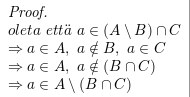
oleta että means assume
somber rampart
Yes ^^
shell ore
alright thank you! I'll see if I can do the other ones myself :p
shell ore
@somber rampart would you have time to help me with one more? or give a hint
I have to prove that if m is an odd number prove that m^2 is also odd
fathom sierra
one way is just letting m=2k+1; k in N
fathom sierra
And calculate m^2 from that
shell ore
hmm alright...
fathom sierra
m^2 = (2k+1)^2
shell ore
yea
I guess
but do I solve the (2k + 1)^2 then break out a 2 or something
and bam it's not even or something
shell ore
right
how do I know if I'm done with the proof
I've gotten to m^2 = 2(2k^2 + 2k + 1/2)
fathom sierra
Ya (well there's a shitton of ways to prove it but that's one of the most basic ones)
shell ore
oh
okay...
should I use the equivalent sign like this
$$m^{2} = (2k + 1)^{2} \equiv 4k^{2} + 4k + 1 \equiv 2(2k^{2} + 2k) + 1$$
stoic basinBOT
fathom sierra
tbh I never used it in my whole life
shell ore
oh..
fathom sierra
But I guess you can here yeah
fathom sierra
i'll just shut my mouth
Well "never used it in my life", used it to denote congruence modulo w/e ofc
somber rampart
Yeah it's not for this, which is just regular equivalence
It's for equivalence relations which are not the regular notion, such as congruence modulo
shell ore
oh
okay I'll take it away then
I don't know should I use lim for this or what, but I need to prove that if a > b then (a + b)/2 < a, I've used words but I don't know if I'm supposed to use mathematical symbols and stuff for it instead
but I've written that if a would be equal to b then a + b would be 2 a which would be equal to a, but because a > b then (a + b) /2 can never come all the way to a which means it will always be less than a
vast vessel
a > b
a+a > a+b
2a > a+b
@shell ore
 mystic elm
anyone able to jumpstart me on an epsilon delta proof?
 sullen rune
sure I love torture
mystic elm
nice
i've been angsting over proving that the limit of the dirichlet function does not exist, i.e. when x is rational, f(x) =1, if x is irrational, f(x) = 0
i've been trying to prove the negation of the limit definition, but i'm hitting a brick wall when it comes to relating the resulting inequalities as epsilon isn't expressed in an inequality with x, as f(x) only takes on the values of {1, 0}
internet tells me to remember the density of rationals and irrationals, which would imply linking the two cases of rationals and irrationals, but i keep falling into proving them seperately, and thus having no common ground between them
sullen rune
is the limit just anywhere or
sullen rune
ok do you think you have the negation of the limit definition
mystic elm
ye
there exists an epsilon > 0 s.t. for all delta > 0, there exists an x s.t. 0<|x-a|<delta and |f(x)-L| >= epsilon
so in the case of a rational, |1-L| >= e, in case of an irrational, |L| >= e
sullen rune
gotcha, so the density of ir/rationals let's you say there's always an x that gives f(x)=0 or 1
mystic elm
ye
part of my issue is that i'm not exactly sure where i'm supposed to end up lol
yes, prove that there's an L that works for the negation, but how exactly do i get there
sullen rune
er I think you wanna show that no L works
mystic elm
then i want to be proving the positive rather than the negation and then reach a contradiction, correct
part of this might be that i'm completely flipped over heads over heels here
i honestly don't know
the past hours have not been kind
sullen rune
gotcha
so let's just pick an e
we're trying to get far away from 0 and 1, and with >= I think anything less than 1/2 will do
so like e=1/4
we can try to prove no limit for a general L
mystic elm
okay
sacred junco
Plumorant
sullen rune
nice
sullen rune
nah
sullen rune
yea I think so
mystic elm
okay
then we have,
x is rational
|1-L| >= e = 0.25
x is irrational
|L| >= e = 0.25
sullen rune
I don't really understand that
like you have x in {a-delta,a+delta}
so you can go for 2 cases for x: rational/irrational
which if we're using e=1/4 gives |1-L|>=1/4, and |L|>=1/4
and no L can satisfy both
er misspoke
L has to satisfy one of those
mystic elm
i feel kinda dumb
when proving two cases for x like that, can you assume that the limit would be the same for both?
ohokay
how do you go ahead and prove that L actually satisfies one of those conditions, or do you just say that an L exists such that one of the conditions are satisfied, and thus the proof is done?
sullen rune
yeah you gotta prove that all L satisfy at least one condition
mystic elm
next question is how
sullen rune
which is either so easy it doesn't need a written proof, or you can be like R\(3/4,5/4) satisfies the first, and R\(-1/4,1/4) satisfies the second
and the union of those is R so you're good
mystic elm
oh
sullen rune
oh and e=1/2 works woops
mystic elm
so just break up the inequality, and then give the range of L. we can choose any e > 0 in place of 1/4, and thus L will take on any value of [-e, e] or [-e+1, e+1]. therefore the negation is proved for all L, and thus the limit does not exist.
or would i be going back into the weeds by saying that
sullen rune
yeah looks like weeds
mystic elm

sullen rune
everything above says that the limit isn't L for all L
mystic elm
okay
apologies that i'm being a backwards human being, but if we walk back a step
why exactly would you take the union of the two cases of L
sullen rune
the line with R\?
mystic elm
ye
just recently covered most of this, so some of my basics are a bit shakey
as evident
apologies
sullen rune
uh, union is like the OR for sets
and we're looking at L that satisfy condition X or Y
so we're saying L is either in this set or that set
where being in the sets mean there's no limit
sullen rune
np~
mystic elm
< 3
sacred junco
A grasshopper moves along a straight line. She knows how to make jumps of 11 cm and jumps of 17 cm, each in both directions (to the right or to the left). After a number of these jumps, she finds herself exactly 9 centimeters from her starting point. How much did she jump, at least? Somebody can tell me the solution
<@&286206848099549185>
sullen rune
you can simplify it a little bit
does it ever make sense to go say, 11 cm to the left and then a bunch of steps later go 11 cm to the right?
sturdy dirge
9=17*(-4)+7*11 thus 4 + 7 = 11.
sturdy dirge
You are welcome.
sacred junco
And for this exercice somebody can tell me the solution (like this i see if my solution is true)
A frog (negligible size) moves by jumping in a grid pattern (infinity) 1 cm × 1 cm. It jumps from point to point, where a point designates an intersection of two lines of the grid. She can do 4 types of jumps:
6 cm jumps to the right,
Jumps 8 cm upwards,
Jumps 9 cm to the left,
10 cm jumps down.
Among all grid points, a square of 10 × 10 points is colored red. How many red dots, among the 100, can the frog reach as it starts at one corner of that square?
<@&286206848099549185>
sturdy dirge
Maybe 15.
 sturdy dirge
Horizontal jumps are multiple of 3 and vertical jumps are multiple of 2.
 swift shard
Doing right, left gives 3cm left, so a 3cm left jump is possible. Then, do right, gives a 3cm right jump.
Up, down gives a 2cm down jump. Do that 3 times, then up, to get a 2cm up jump.
I believe that's the best you can do
sturdy dirge
$$
\left(1 + \left\lfloor\frac{10}{2}\right\rfloor\right)\left(1+\left\lfloor\frac{10}{3}\right\rfloor\right)=4\cdot6=24
$$.
stoic basinBOT
swift shard
Yap, that looks pretty good
swift shard
It didn't take 24?
sacred junco
No i didn't take 24
sturdy dirge
More data is required.
sacred junco
Hello
spiral heath
Hello also 😃
 woeful ravine
100!/10^24=(Is there a way to do it without a calculator)?
I tried looking into factorial congruence... but I didn't understand any of it.
silver solar
The result is 134 digits long...
 last nova
is there a way to prove:
(3^(2^69))-1
is the sum of two perfect squares?
$$
(3^(2^69))-1
$$
stoic basinBOT
last nova
oh gawd
sacred junco
Lol
last nova
be able to help me out?
sacred junco
Hmm it's easy
last nova
this is my first time using lol
last nova
i guess prove it is equal to:
a^2 + b^2
where a and b are integers
sacred junco
Easy.
sacred junco
Just has to prove that it's possible with any number with the form 2^n(4k+1)
last nova
what theorem is that?
sacred junco
Wait a minute
last nova
be careful btw
3 to the 2 to the 69
so its 2 to the power of 69
and 3 to the power of that
altogether minus 1
last nova
hmm sorry not sure what u mean on that part
last nova
so how do i apply that to the question?
last nova
how do u factorise a second power?
sacred junco
So you don't know what is 3^(2^69)?
last nova
its 3 to the 2 to the 69?
last nova
yes
sacred junco
Yupp
last nova
the braghm-fibo theorem?
last nova
sick!!!
sacred junco
Right?
sacred junco
So x-1 left.
sacred junco
x = 3 ^ (2 ^ 68)
last nova
ye
sacred junco
And do what is done again
last nova
ah right
sacred junco
Think :
last nova
ok i get it
sacred junco
Got it? Good!
last nova
so we need to prove the right side is equal to 1?
ahshit what am i saying
forget i said that
why would it
hm how would we bring the braghm theorem here now though
sacred junco
Yup
sacred junco
So.. what happens?
last nova
we can drop that braghm theorem in there
sacred junco
How?
last nova
sum after splitting x-1 and the orignal sum of squares
sacred junco
I mean you need to show that x^2-1 is sum of two squares
last nova
OH
WAIT
that
x^2 - 1
can we prove its odd
and then apply fermat
ah shit no we cant
sacred junco
Brahmagupta-Fibonacci is necessity
U can do it in another way tbh
(3^69)^2-1=a^2+b^2
sacred junco
Latex it please.
last nova
sacred junco
U know that( a)^b^c=(a)^c^b
last nova
wait
sacred junco
Because thats what im doing.
sacred junco
Sarcasm?
sacred junco
$$
(3^(2^(69)))-1
$$
stoic basinBOT
sacred junco
😐
Well what i was saying was.
Factorise the eqn.
And just show that such integers exist.
Yup I was suggesting that
And factorization part is the first hurdle for him I guess
Then its sorted i guess.
Ahh..then explore and enjoy my friend.
Best of luck
last nova
how would u get 69 squared after swapping them around
3^69 whole squared is 3^(69+69) no?
sacred junco
Wdym?
last nova
is his point to make it 3^(69^2) instead?
sacred junco
No
sacred junco
Factorize.
last nova
factorize what?
sacred junco
Factorize 3^(2^69)-1
last nova
thats what u were saying with 3^2^68 right?
sacred junco
Just keep factorizing.
last nova
so now u mean factorise 3^(2^68) - 1 right?
sacred junco
Yep
last nova
and make it into a sum of squares right?
last nova
yes
keep reducing them down
but now we have a bunch of sums of squares
all multiplying each other
last nova
so now we apply brahm?
sacred junco
Well, now or after whole factorisation
last nova
so that's what i mean by 30 times
we keep breaking down the 3rd term of minus one by factorization?
last nova
then we apply brahm to 30 pairs of square sums?
 stuck lintel
Prove that $$\forall m,n \in \mathbb{Z}, S(m,n) = \frac{1}{m} + \frac{1}{m+1} + \frac{1}{m+2} + \frac{1}{m+3} + \dots \frac{1}{m+n} \notin \mathbb{Z}$$
stoic basinBOT
stuck lintel
huh mudkip left
sturdy dirge
No.
vast vessel
Yes @wild zinc
stuck lintel
@sturdy dirge can you help :p
there's a solution for this in a book but it's too advanced for me to understand
and mudkips gone so welp
sturdy dirge
@wild zinc ?
vast vessel
ur obviously just going crazy


 noble jay
@vast vessel wow hold on there m8
vast vessel
wut @noble jay
noble jay
lemme think about it first
vast vessel
k
stuck lintel
oh hey it's dusty :^)
hopefully after im done with this book i can finally solve your problems
sturdy dirge
Interesting https://projecteuclid.org/euclid.ndjfl/1224257540 .
Project Euclid - mathematics and statistics online
sturdy dirge
You are welcome.
spiral heath
What is a "morphic number"? And what is an "automatic number"? I just saw those two terms in a paper and Google doesn't really tell me much.
sturdy dirge
Where is the paper ?
 north orbit
How many integers $$ N$$ less than 1000 can be written as the sum of $$ j$$ consecutive positive odd integers from exactly 5 values of $$ j\ge 1$$?
stoic basinBOT
north orbit
I'm having trouble understanding the solutions to this question.
I've gotten to $$N = j(2k+j)$$
stoic basinBOT
 open rivet
Is there a way to quickly tell what the order of a congruence class is other than plugging in powers one at a time and seeing where it gets you?
like for this, naturally, 10 would work because 11 is prime, and 11-1 is 10
but the true answer is 5, which divides 10
if the subscript (11 in this case) is not prime, is there a fast way about this
like this one
obviously its 2, but i only knew that by checking it
swift shard
No formula for doing these, I'm afraid
open rivet
alright, thanks
stuck lintel
How would you find the last three digits of a_n in the sequence a_1 = 2, a_2 = a_1 + 2^2, a_3 = a_2 + 2^3, etc
 flint canyon
for all positive numbers a,b. If a|b and b|a then a = b
I have that b = an, a = bm,, a = b(k)
can I do that?
nvm
I see that an = bm where (b)=(a)
 cerulean pulsar
Does i^3 = 1 ??
sullen rune
-i
 dry acorn
@stuck lintel a_n=[a_(n-1)+2]^2
stuck lintel
?
dry acorn
what?
dry acorn
you had a problem above
stuck lintel
proving that the sum of reciprocals of consecutive integers can’t be an integer?
dry acorn
no, "How would you find the last three digits of a_n in the sequence a_1 = 2, a_2 = a_1 + 2^2, a_3 = a_2 + 2^3, etc"
dry acorn
hold on, i think i typed the formula wrong
theres suppoesed to be underscores
alright, there it is
where n is the given integer
dry acorn
@stuck lintel hey sorry to ping you, but I typed the formula wrong, this is definitely it.
silver solar
Do you know interval notation?
silver solar
It's a map from a Cartesian product of intervals into another interval
Yeah
And [0, infinity) is just any non-negative number
 steady matrix
Allright, thanks 😃 Is there a way to visualize the product of intervals?
I know what an interval is, but the product of several is new to me
flint canyon
I am trying to figure out the format of the following:
For all integers a,b,c,d,n (n > 0), if ab(modn) and cd(modn) then (a+c)(b+d)(modn)
Is this saying ab(modn) congr cd(modn) then (a+c)(b+d)(modn) ?
silver solar
@steady matrix Rectangles, my friend
And in this case, a rectangle with two opposite sides of length a, and two opposite sides of length infinity
You could also call it a strip
so... an infinite strip of width a
flint canyon
<@&286206848099549185>
sacred junco
Wait 15 mins before that ping my friend.
flint canyon
Whats the rule for the 2nd ping (: /s
sullen rune
3^(n+1) - 1 = 2*3^n + 3^n - 1
flint canyon
Kind of needed the steps, but thanks lol, pretty quick
Like do I do
3^(k)-1 )+ 3^(k+1 )-1?
then try to proof
how'd you get to 2*3^n + 3^n-1 , specifcally the 3^n-1 part
flint canyon
I guess all I get is an answer and no explanation 😦
noble jay
@flint canyon its also known that the power of an odd number (positive integer power) is also an odd number, so odd number -1 = even number
better than induction
sacred junco
@flint canyon still need the steps?coz i can help
 wide shuttle
So... I recently found a way to simplify the sums of integer powers
flint canyon
@sacred junco I got it for now, I might ask another induction problem I’m having trouble with later though, thanks!
wide shuttle
V(x,y) = \sum{n=1}{x}{n^y}
im still new to latex
V(x,y) = x^(y+1) / (y+1) - \sum{n=2}{y+1}{V(x,y+1-n) * ( y+1)Cn }
its derived from the idea of adding the differences of consecutive numbers to the y'th power.
ex: (1^2 - 0^2) + (2^2 - 1^2) + (3^2 - 2^2) + (4^2 - 3^2)= (1) + (3) + (5) + (7) =4^2,
sum(2n-1) = 2sum(n) - 1sum(1) = xx
so... moving terms around a bit
sum(n) = (xx - sum(1)) / 2 = (xx+x)/2
sum(n^y - (n-1)^1) from n = 1 to n = x.
vast vessel
 use MathBot
elder bobcat
latex ez
wide shuttle
I love the support, thanks guys!
elder bobcat
lol
wide shuttle
❤
 crimson ibex
$$\sum_{n=0}^{10} n^{2} $$
stoic basinBOT
crimson ibex
@wide shuttle Discord supports Latex just add $$ at the beginning and end of the math
 silent lantern
Does the last nonzero digit of a factorial eventually become periodic?
If so, find an explicit formula
silent lantern
thats separate to a question right?
 solar gale
u mean intersection
sacred junco
Oh lol yes.
solar gale
was there any theory before the questions?
sacred junco
Basically only the floor functio
Fact thag n consecutive no.s are divisible by n!
Tau function
And most things related to gcd and lcm
Thats all
Tho im 100% sure this involves use of the floor function
Just cant figure how to use it in this case.
silent lantern
Find a way to bound it
solar gale
er
sacred junco
Yes?
solar gale
idk ask a8
sacred junco
@silent lantern help lol
silent lantern
I’m doing french
silent lantern
👍
swift shard
1 ∈ X, so X ∩ N contains 1 at least
I'm fairly sure that's the only thing it contains
sacred junco
Id like a more rigorous formal proof please.
silent lantern
@sacred junco but the answer is empty set
sacred junco
Hahahaha
silent lantern
Except for 1
sacred junco
Answer is {1} btw.
swift shard
Of course, but one has to play with the idea first before getting anywhere
swift shard
Basically, X doesn't contain any other integers. Why?
Idunno atm but we can find it I'm sure
silent lantern
Use an inductive proof
sacred junco
x,y>2
silent lantern
Show that when n is a prime it doesn’t work