#elementary-number-theory
1 messages · Page 30 of 1
 proven cypress
 gaunt marlin
Guys, I'm very noob at Number Theory, I'm trying to integrate Mathematics (especially NT and Combi) and Computational Task together, I wanna research on those topics, especially I'm fascinated to solve problems from https://www.projecteuler.net
But I don’t know how can I approach, I wanna start from project euler. I need complete roadmap since I'm absolute beginner. Besides, I want solid foundation of NT as well as Combi and Its implementation on CS as well as solving problems.
A website dedicated to the fascinating world of mathematics and programming
 mint stone
gaunt marlin
Guys, I'm very noob at Number Theory, I'm trying to integrate Mathematics (espec...
mint stone
gaunt marlin
Guys, I'm very noob at Number Theory, I'm trying to integrate Mathematics (espec...
I don’t see any reason not to start. You can sort the problems by difficulty (which is nice, since Project Euler allows that), pick the ones you find interesting, and try solving them. And if you get really stuck, there are explanations available online for many of them.
gaunt marlin
mint stone
I don’t see any reason not to start. You can sort the problems by difficulty (wh...
My actual problem is, I don't see explanation or editorial, I think my approach is right but ultimately its wrong, in some cases, my logic goes wrong. So you are saying I need to seek editorial when I'll get stuck. And that's how I can do better, right?
mint stone
gaunt marlin
My actual problem is, I don't see explanation or editorial, I think my approach ...
Yep, try searching for an editorial on the problem. Those with low to medium complexity can often be found somewhere on the internet. Alternatively, you can check other platforms like Codeforces (CF), which hosts a lot of number theory problems as well. CF is much more popular, so you're more likely to find explanations there. That said, some of the highest-difficulty problems still have no solutions available online.
If the problem is just too hard and you have no clue where to even begin, it's actually a great opportunity to indulge in slow-paced mathematical reflection — say, early in the morning, when you're not fully awake yet. You can let your mind wander through different approaches, hoping that some mathematical deity will descend and bless you with a solution. In any case, the real joy comes from the process itself, and solving the problem in the end will feel like a well-earned reward. But of course, this is more for the math aesthetes — a rare breed, as always 🙂
 main fractal
the set of remainders you get when taking multiples of x modulo m is the same as the set of multiples of gcd(x, m) modulo m - why?
 rugged locust
main fractal
the set of remainders you get when taking multiples of x modulo m is the same as...
rugged locust
main fractal
the set of remainders you get when taking multiples of x modulo m is the same as...
that does not sound true - for instance if x is coprime to gcd(x,m) then the set of multiples of gcd(x,m) is just 1.
but as long as x itself is not equal to 1 mod m then its set of multiples mod m has to contain more than just 1
main fractal
This probably doesn't apply to all cases then or maybe I said it wrong. I'll try to explain it with more of a visual I guess. I thought that if you have x, 2x, 3x, 4x, 5x, etc. and then take all of those modulo m, that the set becomes multiples of gcd(x, m). This definitely seems to work for coprime numbers because all the numbers start getting listed and loops forever. For example x = 6 and m = 7 would be 6, 5, 4, 3, 2, 1, 0, 6, 5, 4, 3, 2, 1, 0, etc. If you then switch m to 8 where gcd(6, 8) = 2 you end up with 6, 4, 2, 0, 6, 4, 2, 0, etc. I am really new to number theory so I could be completely wrong though
rugged locust
oh, you meant sums of x
rugged locust
main fractal
This probably doesn't apply to all cases then or maybe I said it wrong. I'll try...
it's because coprime numbers mod m are invertible
namely, if x is coprime to m, then there exists another number y such that xy = 1 mod m
main fractal
Thanks
rugged locust
main fractal
This probably doesn't apply to all cases then or maybe I said it wrong. I'll try...
just a quick sketch for the proof of your statement.
For any number x, let x = x'g, where g is the gcd of x and m.
Then x' is coprime to m.
Thus let y be an integer such that x'y = 1 mod m, such that xy = x'gy = g mod m.
So the set of multiples of x contains the set of multiples of g.
On the other hand, x'g = x, so the set of multiples of g contains the set of multiples of x.
 orchid escarp
Hi all!
If d divides a and d divides b, does that mean it divides any integer combination of a and b? Like, can I just go on adding and multiplying a and b forever and d will still divide the result? For example: d divides a * whatever + b * whatever - a * somethingelse + b * anotherthing - b * onemorething. Even if all those "whatever" things are different?
If that's true, what's the general theorem that says this? Because Bézout only talks about ax + by, not stuff like ax + bx - bj + ak + am - br etc. Is there a more general theorem than Bézout for this?
 wooden glen
ax + bx - bj + ak + am - br = a(x+k+m) + b(x-j-r)
 patent acorn
...i don't see how bezout is relevant here at all?
this just follows from the facts that:
- if d divides a and d divides b, then d divides a + b
- if d divides a, then d divides a * b
which are both pretty immediate from the definition of divides:
- if a = kd and b = jd, then a + b = (k+j)d
- if a = kd, then ab = (bk)d
orchid escarp
but... i d|a and d|b, d = ax + bx + br + bj - ak + asomething.
I dont know how to say in english.. "linear interger combination" I think
but bezout say just ax + by, not a lot of sums with others integers, not just x and y
patent acorn
patent acorn
which are both pretty immediate from the definition of divides:
1. if a = kd and...
(where all the variables here are integers)
patent acorn
orchid escarp
but... i d|a and d|b, d = ax + bx + br + bj - ak + asomething.
I dont know how ...
...i'm not clear on what direction you're asking for a result in
or no, not "direction", i'm not clear on the quantifiers
you're talking about two completely unrelated results that have very little to do with each other beyond being about divisibility
or actually it's not quantifiers
you're just being generally really unclear
orchid escarp
Yeah, I get that if d divides a and d divides b, then it divides a + b, a − b, and any multiple like ka or kb.
But what I'm trying to understand is: if I start adding and subtracting a and b with lots of different integer coefficients, like:
d | ax + by − bj + ak + am − br + ...
Isn't that still something that d divides? Like, all of these terms are still just combinations of a and b, right?
So my real question is:
Is there a name for the set of all these combinations? Like, is this the "ideal generated by a and b"?
I was thinking Bézout's identity covers it, but Bézout just gives one equation, like ax + by = d, not the whole set of expressions like that.
So is there a theorem that says:
"all combinations like ax + by + ak + bj − b*r + ..." are still divisible by d if d divides both a and b"?
patent acorn
patent acorn
this just follows from the facts that:
1. if d divides a and d divides b, then d...
yes, this
you just apply these facts multiple times
although also, as tropo pointed out, the numbers of the form ax + by - bj + ak + am - br + ... can in fact all be written as ax + by, by just collecting together all of the terms with a in them and all of the terms with b in them
orchid escarp
is that what people call the ideal generated by a and b?
patent acorn
also bezout's identity is still completely irrelevant
wooden glen
orchid escarp
is that what people call the ideal generated by a and b?
It is indeed the ideal generated by a and b.
But note that you already got that ideal as { ax+by | a in Z, b in Z }.
You don't get any new numbers by your "− bj + ak + am − br" calculation that you couldn't already make just as ax+by for appropriate x and y.
orchid escarp
Thank you! I'm back to work now — I'll digest your answers later.
orchid escarp
cool, I get it now: a(3 + 5 - 2) + b(4 - 1 + 10) = a(6) + b(13). thanks for the answers
 maiden solar
has anyone seen something like this before? i cant find it on the OEIS

 white prairie
Can i get a hint on second case? I tried analyzing the solution from the notes i got but it doesnt make much sense to me and internet didnt help much either 🙃

 stuck shore
maiden solar
has anyone seen something like this before? i cant find it on the OEIS
stuck shore
maiden solar
has anyone seen something like this before? i cant find it on the OEIS
looks interesting. you should submit it to oeis if you can't find it there
 supple quarry
stuck shore
looks interesting. you should submit it to oeis if you can't find it there
supple quarry
stuck shore
looks interesting. you should submit it to oeis if you can't find it there
Can I reasonably assume you're familiar with the Riemann Hypothesis?
 atomic harbor
hes bernhard riemann himself
 cunning goblet
 deep fable
Thanks, one sec
 dreamy wraith
a^x | b^y , det(A) greater or equal to zero => a^w | b^z
A= [x y]
[w z]
Matrix
What’s the proof of this ?
 ocean flame
dreamy wraith
a^x | b^y , det(A) greater or equal to zero => a^w | b^z
A= [x y]
[w z]
...
ocean flame
dreamy wraith
a^x | b^y , det(A) greater or equal to zero => a^w | b^z
A= [x y]
[w z]
...
I suppose that x, y, w, and z are non-negative integers. What about a and b?
 zinc pewter
I'm trying to understan if my proof of the following lemma is correct: "if p is a prime and p|ab, then p|a or p|b". My attempt is as followed, If $p|ab$, then either $ a = pq$ or $b = pq_2 $, or both cases. Case 1: $p|a = p|pq$, valid. Case 2: $p| b$, valid. Case 3: $p \nmid a$, then $a = pq_2+r$ for some nonzero integer r. p|ab = p|(pq+r)b. b has to be a multiple of p, $b = pq_2$, so that $p|ab = p|(pq+r)pq_2 $otherwise we have a contradiction.
dont know the latex keyword for not divisible is : /
∤
 brittle prairie
“if p|ab then either a = pq or b = pq_2” needs justification
 sterile pumiceBOT
Pen
 zinc pewter
brittle prairie
“if p|ab then either a = pq or b = pq_2” needs justification
zinc pewter
brittle prairie
“if p|ab then either a = pq or b = pq_2” needs justification
ah okay
Hmm
brittle prairie
zinc pewter
ah okay
(this is the wrong line of reasoning)
sorry i wasnt clear
do you know Bezout’s Lemma
zinc pewter
It is the case since $p|ab =p|(pq+r) $ where the rest is 0 using the division algorithm
zinc pewter
brittle prairie
do you know Bezout’s Lemma
I do not
Looked it up and yes, I know of it
as a matter of fact, my book uses it without mentioning the name
zinc pewter
brittle prairie
“if p|ab then either a = pq or b = pq_2” needs justification
Could you explain why this thinking is wrong? I tried showing that if p|ab, then either a = pq or b = pq_2 must be true using contradiction
Proofs are hard : (
wooden glen
zinc pewter
I'm trying to understan if my proof of the following lemma is correct: "if p is ...
You seem to start by assuming the thing you're supposed to prove.
(Ah, Ark already pointed that out).
zinc pewter
wooden glen
You seem to start by assuming the thing you're supposed to prove.
I meant that those are the possible cases without contradicting p|ab
wooden glen
But that is what you're supposed to prove!
zinc pewter
wooden glen
But that is what you're supposed to prove!
Yes! The first two cases is when p|a or p|b, because it follows then that p|ab. The third case is when p|a, showing that p|b must be case
Or maybe I need to step back a bit and read what I wrote, I am clearly in the wrong
My own ignorance is my greatest weakness
wooden glen
You start by saying "if p|ab then either p|a or p|b or both p|a and p|b" -- but that doesn't actually differ from the lemma you're supposed to prove because "X or Y" is logically the same as "X or Y or both X and Y".
So once you say that, you're saying "we already know that what I'm supposed to prove is true", and the whole rest of your paragraph is superfluous.
dreamy wraith
ocean flame
I suppose that x, y, w, and z are non-negative integers. What about a and b?
Yep a and b are also non negative integers
a,b,x,y,z,w ∈ W
zinc pewter
wooden glen
You _start_ by saying "if p|ab then either p|a or p|b or both p|a and p|b" -- bu...
One of my weaknesses that I have identified is the begining of a proof and what assumptions are allowed to make. You are correct and I need to work more on this
Thanks for the feedback ❤️
ocean flame
dreamy wraith
Yep a and b are also non negative integers
a,b,x,y,z,w ∈ W
So, without a statement a | b, it seems that it is not always true. Are there any additional statements?
dreamy wraith
ocean flame
So, without a statement a | b, it seems that it is not always true. Are there an...
No there are not additional statements, we use it to check if questions like this are true
a^4 | b^ 5 => a^6 | b^ 8
In true or false questions
From the determinant this should be true
ocean flame
dreamy wraith
No there are not additional statements, we use it to check if questions like thi...
Interesting. I think, the formula of the determinant for 2 by 2 matrix and the Fundamental Theorem of Arithmetic can help
wooden glen
dreamy wraith
a^x | b^y , det(A) greater or equal to zero => a^w | b^z
A= [x y]
[w z]
...
Assuming a, b, x, y, w, z are all nonnegative integers: For each prime p, let f(p,a) be the the exponent of p in the prime factorization of a.
a^x | b^y then says that x·f(p,a) <= y·f(p,b) for all p.
We want to know how w·f(p,a) compares to z·f(p,b). Multiply the known inequality by w/x, and we get
w·f(p,a) <= wy/x·f(p,b)
which gives us the desired w·f(p,a) <= z·f(p,n) if wy/x <= z which is if wy <= xz, which is if 0 <= xz-wy.
dreamy wraith
wooden glen
Assuming a, b, x, y, w, z are all nonnegative integers: For each prime p, let f(...
Thanks! Can we extend this to negative integers as well ?
a, b ∈ Z
wooden glen
Probably not without a lot of sign-fiddling.
Oh, a and b should work, yes -- divisibility doesn't care about signs, after all.
dreamy wraith
Got it thanks! I gotta do more work on fundamental theorem of arithmetic it seems
Another proof i was struggling was done with fundamental theorem of arithmetic
This one particularly
a^n | b^n => a | b
wooden glen
With the same machinery as above, a^n | b^n tells us f(p,a)·n <= f(p,b)·n for all p, which immediately gives us f(p,a) <= f(p,b) for all p, so a | b.
dreamy wraith
wooden glen
With the same machinery as above, a^n | b^n tells us f(p,a)·n <= f(p,b)·n for al...
Appreciate It! What book do you recommend for elementary number theory ?
wooden glen
Unfortunately I don't have any book recommendations.
 regal summit
dreamy wraith
Appreciate It! What book do you recommend for elementary number theory ?
regal summit
dreamy wraith
Appreciate It! What book do you recommend for elementary number theory ?
Friendly intro to number theory by Silverman isnt too bad
Silverman is also a big name in number theory so its a good start
 unkempt void
I liked Ireland and Rosen's book
dreamy wraith
regal summit
Silverman is also a big name in number theory so its a good start
I’ve heard his name from his calculus book
 unique cypress
dreamy wraith
Appreciate It! What book do you recommend for elementary number theory ?
unique cypress
dreamy wraith
Appreciate It! What book do you recommend for elementary number theory ?
Ireland and Rosen
Apostol
 long lion
zinc pewter
I'm trying to understan if my proof of the following lemma is correct: "if p is ...
long lion
zinc pewter
I'm trying to understan if my proof of the following lemma is correct: "if p is ...
here's the proof you've tried to do:
"Suppose for a contradiction otherwise. By the division algorithm, write $a=q_1p+r_1, b=q_2p+r_2$ for some $1 \leq r_i < p$ then we obtain $p \mid r_1r_2$, contradiction
sterile pumiceBOT
LY
 long lion
the problem is the last line: why is that a contradiction
 wraith pebble
Hello mathcord! Is the following statement true? i've been using it in a lot of problems relating divisibility but I haven't seen this stated as a lemma/theorem in any of my books.
sterile pumiceBOT
lord_breadcrumb

 verbal axle
if a | (b + c) then an = b + c for some n
now if a | b then am = b and so an = am + c -> (n - m)a = c
so a | c
and the same proof the other way works to show a | c => a | b
wraith pebble
cool! thx
 junior swallow
Does this proof work for $\implies$ (here $(a, b)$ is the gcd of $a$ and $b$)? Suppose that $(a, b) \nmid c$. Then there are $q, r \in \mathbb{Z}$ with $r < (a, b)$ and $c = (a, b)q + r$. Then $ax + by - (a, b)q = r$, and since $(a, b)$ divides the left hand side, $(a, b)$ divides $r$. This contradicts the fact that $r < (a, b)$.
 sterile pumiceBOT
okeyokay
 rugged locust
junior swallow
Does this proof work for $\implies$ (here $(a, b)$ is the gcd of $a$ and $b$)? S...
rugged locust
junior swallow
Does this proof work for $\implies$ (here $(a, b)$ is the gcd of $a$ and $b$)? S...
you're overthinking it
suppose it has a solution x_0,y_0
 west glade
your proof literally uses that (a,b) divides the lhs of some equation
immediately apply it to ax+by=c
rugged locust
then ax_0 + by_0 = d [ax_0/d + b y_0/d] = c, where d := (x_0,y_0), so d divides c
junior swallow
west glade
immediately apply it to ax+by=c
thanks bud
junior swallow
junior swallow
Does this proof work for $\implies$ (here $(a, b)$ is the gcd of $a$ and $b$)? S...
Could I have a hint for <= please?
 trail sleet
junior swallow
Could I have a hint for <= please?
trail sleet
junior swallow
Could I have a hint for <= please?
what if x = 0
junior swallow
Nvm I got it
junior swallow
trail sleet
what if x = 0
Yeah I considered that but ended up hitting a dead end
trail sleet
oh hm
junior swallow
We have ax' + by' = d for some d in Z, where d = (a, b). Then d | c, so that (ax' + by')k = c for some k in Z. Consequently ax'k + by'k = c, so we may take x = x'k, y = y'k
junior swallow
yeah
verbal axle
trail sleet
(a,b) refers to gcd(a,b)?
I also hated that shit till I realized that its the ideal generated by {a, b}
trail sleet
ah i thought it was saying a|c and b|c lol
yeah idt its true in that case
dreamy wraith
Why we don’t consider Willan’s formula for primes ?
trail sleet
dreamy wraith
Why we don’t consider Willan’s formula for primes ?
Because computing the nth term of that sequence takes more work than just searching through the list of numbers until the next prime
Or something like that
 compact swift
is there an elementary proof of like given a prime p divide the discrimiant of an integer polynomial coefficient f(x) then f(x) == g(x)h(x)^k (mod p) k > 1
 sacred junco
What does a||b mean
 still flare
sacred junco
What does a||b mean
still flare
sacred junco
What does a||b mean
Hard to say without context, but it could mean:
- a is parallel to b
- this is a typo and they meant to write a | b, meaning an = b for some integer n.
sacred junco
But I've seen twice it in number theoretical context
rugged locust
sacred junco
But I've seen twice it in number theoretical context
mind showing the context, then?
 rugged vigil
sacred junco
What does a||b mean
rugged vigil
sacred junco
What does a||b mean
!original
 rotund gustBOT
sacred junco
What does a||b mean
rotund gustBOT
sacred junco
What does a||b mean
Please show the original problem, exactly as it was stated to you, with the entire original context. A picture or screenshot is best. If the original problem is not in English, then post it anyway! The additional context might still be helpful. Do your best to provide a translation.
sacred junco

 shell heath
maybe it denotes proper divisor? just guessing...
oh wait, on googling... it means exact divisibility, so 3^k | n but 3^(k+1) does not.
long lion
sacred junco
What does a||b mean
i think generally in NT, p^k || stuff means v_p(stuff) = k
unique cypress
Yes that's what I'd assume too
junior swallow
Am I stupid? As to the second assertion, (2, 4) = 2, and 2 | 8, 4 | 8, and 2 * 4 = 8 | 8
 rugged locust
junior swallow
Am I stupid? As to the second assertion, (2, 4) = 2, and 2 | 8, 4 | 8, and 2 * 4...
rugged locust
junior swallow
Am I stupid? As to the second assertion, (2, 4) = 2, and 2 | 8, 4 | 8, and 2 * 4...
You’re just asked to give a counter example
Of course there’s going to be cases where (u,v) is not 1 and it still works, as you have demonstrated
junior swallow
Bro my brain does not work when it comes to number theory holy shit
unique cypress
replace noggin
rugged locust
Have you tried turning it off and on again
junior swallow
Can I have a hint on showing that if (u, v) = 1 then (u + v, u - v) = 1 or 2? If it's 1 then we're done, so we can suppose it's not 1 and show that the gcd is 2
So far I know that (u + v)a + (u - v)b = d for some d > 1
we also have ux + vy = 1
thus u(a + b) + v(a - b) = d = uxd + vyd, and I'm stuck
rugged locust
junior swallow
So far I know that (u + v)a + (u - v)b = d for some d > 1
you know more than that actually, d has to divide every possible integer combination of u+v and u-v
junior swallow
Ah
d | 2u = u + v + u - v
uhhhhh
if d =1 then we are done so suppose it's not 1
d | 2u and d | 2v, if d > 2 then d | u and d | v, contradicting (u, v) = 1
?
rugged locust
good enough
junior swallow
hold up i feel like this explicitly uses euclid's lemma
/requires d to be prime
We're basically saying if d | 2u and d does not divide 2 then it divides u right
rugged locust
not really
let p be a prime factor of d, think about what happens next
this is a common trick when you want to prove things about divisibility of numbers
instead of looking at a number itself, which may or may not be prime, try looking at what happens to an arbitrary prime divisor of that number
and if you can prove something about that prime divisor, usually that's as good as proving something about the original number
junior swallow
Hmmm... let 2 \neq p be a prime divisor of d. then p | 2u and p | 2v, so that p | u and p | v (here we really use Euclid's lemma). Since p > 2, this contradicts (u, v) = 1
rugged locust
you don't need to assume p is not 2
since p divides 2u and 2v, and (u,v) = 1, you immediately get that p has to be 2
so either d is 1, or it has a prime divisor, which can only be 2
there's a final step that I haven't mentioned yet
can you see what it is?
junior swallow
I mean I would guess involving showing that the exponent of 2 in d is equal to 1
junior swallow
junior swallow
Hmmm... let 2 \neq p be a prime divisor of d. then p | 2u and p | 2v, so that p ...
I guess this would involve showing that there's only one 2 in the product as well
junior swallow
Well I guess if d = 2^n where n > 1, then 2^{n - 1}k = u and 2^{n - 1}j = v for some k and j in Z. then 2 | u and 2 | v, contradiction
junior swallow
Am I going crazy? By the Proposition, we have $\sigma(n) = (2^{m + 1} - 1) \cdot \left(\frac{(2^{m + 1} - 1)^2 - 1}{(2^{m + 1} - 1) - 1}\right)$. Substituting $x = 2^{m + 1} - 1$ gives $x \cdot \frac{x^2 - 1}{x - 1} = x(x + 1) = (2^{m + 1} - 1)2^m$, aka what we started with
 sterile pumiceBOT
okeyokay
 rugged locust
the first part of your expression doesn't look right
let's label the prime 2^m+1-1 as p
then as a = 1, the term in the expansion is (p^2-1)/(p-1) = p+1
junior swallow
rugged locust
then as a = 1, the term in the expansion is (p^2-1)/(p-1) = p+1
Is this for the second term in the expansion for \sigma(n)?
the first term is 2^{m + 1} - 1 because we take p_1 = 2
rugged locust
oh wait hold on I think I misread your thing
junior swallow
all good
rugged locust
junior swallow
Am I going crazy? By the Proposition, we have $\sigma(n) = (2^{m + 1} - 1) \cdot...
everything is right, but you substitied in x wrong at the end
x(x+1) = (2^{m+1}-1) (2^{m+1}-1 + 1) = (2^{m+1}-1) 2^{m+1}
so there's the missing factor of 2
wooden glen
What are we seeing there?
junior swallow
Could I have a hint for this question please
 rugged locust
junior swallow
Could I have a hint for this question please
rugged locust
junior swallow
Could I have a hint for this question please
do you know v_p notation?
rugged locust
I think so
anyways, just write a out as a prime factorization
then look at each prime dividing a
junior swallow
👍
 slender current
Yeah what it looks cool
junior swallow
I'm probably not understanding this correctly but why is this true? for instance, if a_1 = 3 and a_2 = 1, we have \epsilon_1 = 3 and \epsilon_2 = 1

also it appears as if this is my channel now
I guess my question is how is \mu defined if the integer is not a product of distinct primes - is it a homomorphism or something
wait no for it to be a homomorphism it has to be defined for products containing multiple primes
never mind I'm dumb
not square free
can somebody explain the displayed equality though?
is it like 1 place to choose a 1, 2 places to choose 1, etc.
wooden glen
Yeah, that's the first equals sign. The second equals sign is the binomial theorem in reverse.
junior swallow
got it, thanks
dreamy wraith
Can someone explain the intuition of this
7|14m-21n+143x => 7|3x
 spice plank
dreamy wraith
Can someone explain the intuition of this
7|14m-21n+143x => 7|3x
spice plank
dreamy wraith
Can someone explain the intuition of this
7|14m-21n+143x => 7|3x
assuming that m, n, and x are integers
7 | (14m-21n+143x) means that (14m-21n+143x)/7 is an integer
(14m-21n+143x)/7 = 2m - 3n + 20x + 3x/7
but since 2m, 3n, and 20x are integers, 3x/7 must also be an integer
dreamy wraith
Thanks
unkempt void
14m -21n + 143x = 7(2m - 3n + 20x) + 3x
 uncut arrow
I have this diophantine equation I've been trying to solve, with relatively little luck. Domain for n is non-negative integers.
I'm aware of the small, trivial solutions at n = 0 and n = 5 (I think those were them at least), but my question is whether or not there are others.
To that end, my goal is to either prove that there are no solutions for n > 5, or find one.

I'm not very experienced in number theory, and any diophantine equations beyond linear ones are generally beyond me, so I'm just not sure what to try.
Any related theorems or connections would be really helpful, I tried googling stuff but got nothing besides AI overview straight up lying.
Also, I got this equation through a convoluted series of events involving some parts of math I'm more familiar with (discrete calculus, graph theory, Pascal's triangle, combinatorics), so if this ends up being completely intractable I can always try to backtrack there.
west glade
with induction you can easily show that eg cn^4<=24*2^n for n big enough
wooden glen
As soon as n>=6, 2^n grows by a larger factor than the quartic polynomial for each step of n, since (7/6)^4 < 2.
west glade
at that point its a bit of a question of how much you want to optimize the constant c
wooden glen
Wait, is it 2^n or 2^m on the right hand side?
0 and 5 are not actually solutions if it's 2^n.
west glade
ok the next obvious thing: can you factor that quartic?
junior swallow
Let a, b be two integers. Is lcm(a, b) = d, where (d) = (a) (b), the product of the principal ideals generated by a and b in Z?
unkempt void
junior swallow
Let a, b be two integers. Is lcm(a, b) = d, where (d) = (a) (b), the product of ...
(a)(b) = (ab)
unkempt void
Intersection
junior swallow
alas
I guess that makes sense since elements of (a) n (b) are multiples of a and b lol
oopsies!
junior swallow
I'm quite terrible at number theory.. can I have a hint for 20a please

 rain glacier
look at prime factorization of a and b
unique cypress
junior swallow
I'm quite terrible at number theory.. can I have a hint for 20a please
Tip: when lost, always prime factorize
uncut arrow
uncut arrow
I have this diophantine equation I've been trying to solve, with relatively litt...
Still working on this if anyone has any ideas or suggestions of what to try
 hearty hornet
uncut arrow
Still working on this if anyone has any ideas or suggestions of what to try
hearty hornet
uncut arrow
Still working on this if anyone has any ideas or suggestions of what to try
Are you looking for hints or an answer? I seem to remember a 3b1b video about this problem (Or something related)
uncut arrow
Anything. An outright answer isn't really what I'm looking for, but if there's explanation for where it comes from then totally
I've pretty much given up trying to solve it this way on my own
 surreal crescent
hearty hornet
Are you looking for hints or an answer? I seem to remember a 3b1b video about th...
surreal crescent
hearty hornet
Are you looking for hints or an answer? I seem to remember a 3b1b video about th...
i dont think so
surreal crescent
uncut arrow
Anything. An outright answer isn't really what I'm looking for, but if there's e...
where did u get this problem from
hearty hornet
uncut arrow
Anything. An outright answer isn't really what I'm looking for, but if there's e...
It's a sum of binomial coefficients
surreal crescent
hearty hornet
It's a sum of binomial coefficients
wdym
hearty hornet
edited\
$$ (n - 4)^4 + 14 (n - 4)^3 + 83 (n - 4)^2 + 262 (n - 4) + 384 = \sum_{k=0}^4 \binom{n}{k} $$
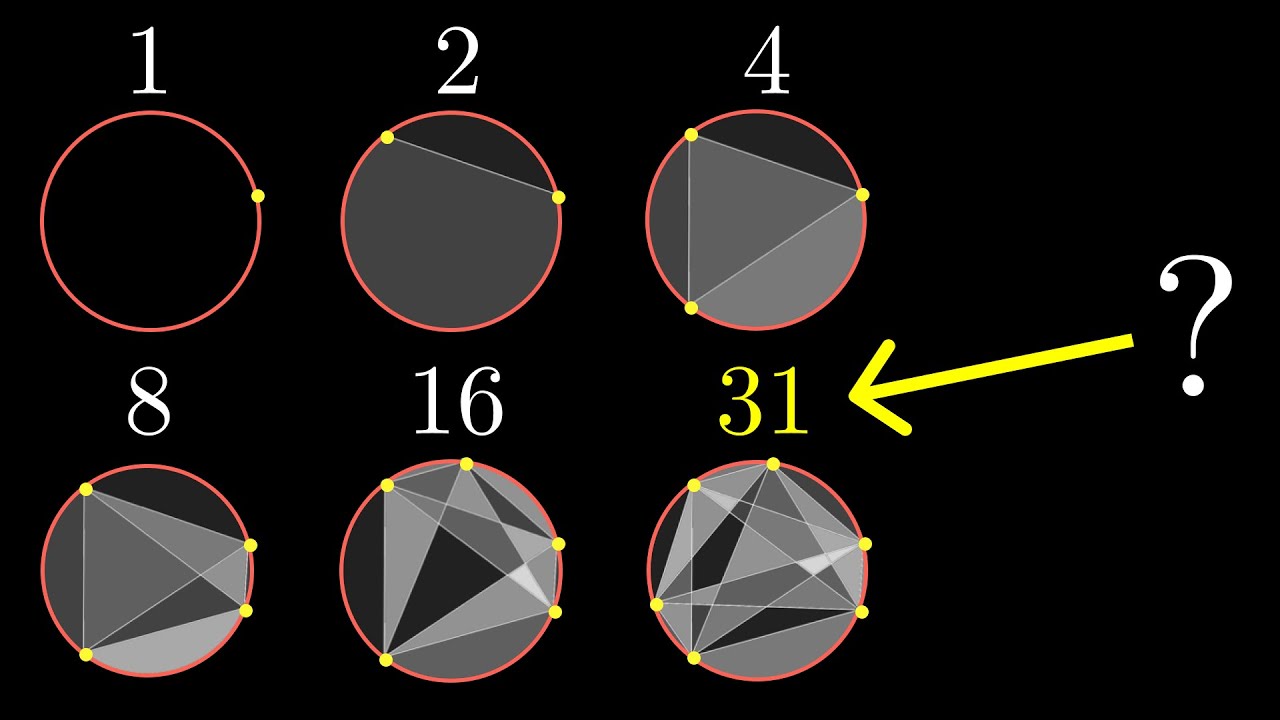
An apparent pattern that breaks, and the reason behind it.
Help fund future projects: https://www.patreon.com/3blue1brown
An equally valuable form of support is to simply share the videos.
This is a remake of one of the earliest videos on the channel. It's such a wonderful problem, and the audio/pacing in earlier videos was really suboptimal, s...
@uncut arrow This seems related, you can confirm the values in the sequence are just shifted. Where did the problem come to you from?
 hearty hornet
yeah it's a rising factorial not falling
I'll edit rq
That should work, it's only nonnegative though
sterile pumiceBOT
Yumdub
 hearty hornet
surreal crescent
?
hearty hornet
surreal crescent
?
Sorry for the haphazard edits, it's correct now.
surreal crescent
hearty hornet
Sorry for the haphazard edits, it's correct now.
oh wow yeah
but does that help?
hearty hornet
It's a helpful hint which seems to be the request. I'm unsure if it's a full solution but it does give a lot of insight into where the problem could have come from
It doesn't look like you can immediately determine if it's a power of two or not from this
but binomial coeffs sum to be powers of two across the rows. Hence the small solutions, the video mentions the Moser Circle Problem
surreal crescent
hearty hornet
but binomial coeffs sum to be powers of two across the rows. Hence the small sol...
but its just a portion of a row
uncut arrow
Yeah, aware of those connections, but didn't find anything super useful there sadly
Is it more worth trying to find some combi or graph theory approach instead do you think? (vs continuing to explore the diophantine equation I originally posted)
uncut arrow
hearty hornet
<@766838709630009385> This seems related, you can confirm the values in the sequ...
I got it from a friend, who probably got it from here if I had to guess.
(He's a 3b1b fan)
hearty hornet
Yeah, I think the video might end with a conjecture for this or something. I'm not sure I remember
uncut arrow
If Grant isn't sure of an answer I'm not sure if I have much hope
hearty hornet
It doesn't seem exceptionally difficult, but it's a number theory problem ofc so it could look that way and be crazy hard lol
uncut arrow
Yeah lol
hearty hornet
This may have a combinatorial answer, I wouldn't turn it into algebra
not sure what else to do though, I was thinking using the coefficients next, as in their divisibility properties
uncut arrow
He poses the "is there another power of 2" question at about 15:00 in that video and says he's not sure of the answer
hearty hornet
Glad I could save you the headache lol, a friend definitely did this to me a couple years back too
Why I knew the problem immediately.
uncut arrow
hearty hornet
It's a sum of binomial coefficients
I wouldn't have noticed this probably, though I could have figured it out probably by thinking about the pascals triangle connection more
Someone in the comments brute forced it to 10,000,000 lol, and they found nothing
hearty hornet
uncut arrow
I have this diophantine equation I've been trying to solve, with relatively litt...
Anyone who writes 24 under a polynomial like that is usually looking at something like n choose 4, since 4! = 24. From there I just checked the values a bit with a physical calculator. I was somewhat convinced when I saw 384 = 2^4 * 4! , so then I tried to do the second coefficient (the sum of the values in the product, by Viete's equations) and make it work out
I also have seen this before, so I had a feeling it was that circle problem from 3b1b lol
hearty hornet
uncut arrow
I wouldn't have noticed this probably, though I could have figured it out probab...
Pascal's triangle wasn't my first thought, although that is a way to define Binomial Coefficients, but the factorial definition is the true definition.
surreal crescent
hearty hornet
It doesn't seem exceptionally difficult, but it's a number theory problem ofc so...
No, this probably pretty likely has a very bashy mod solution at least
hearty hornet
My limited experience is that's kind of like the "turn it into a big algebraic diophantine equation" thing where it's often just as difficult that way
 astral quiver
 wise karma
unique cypress
Memes go to <#342850939306246145>
wise karma
unique cypress
Memes go to <#342850939306246145>
- Sorry, I'm new (deleted and replaced now) 2) some, but it gets greatly exaggerated by some lecturers and in popular science
unkempt void
Number theory is the application
unique cypress
sotrue
hearty hornet
Where is it most appropriate to ask a mathematics question relating to undergraduate number theory? Should I use #help for an answer requiring a reference / proof or ask the question here?
I had a question related to a small generalization of Fermat Factorization (difference of squares method)
hearty hornet
Well first off, the difference of squares method is the following:
If you have N = x^2 - y^2, then N = (x - y)(x+y), so you can factor N. If N is odd, it can always be written this way, and so you can do Fermat Factorization by starting with a rounded value of x = sqrt(N), and then solve that equation backwards to find a perfect square integer y^2
It's known that Fermat Factorization is fast if p = x - y and q = x + y (these both exist if N is odd). That's because it basically increments x for the smallest y value, since you start with
round( sqrt(N) )^2 - N,
and then square root to search for y (or test it's a square I guess).
You can generalize Fermat Factorization to a "ratio hint" for how far apart the factors are. The assumption is that r = 1 in the basic Fermat Factorization. To demonstrate this, r = 4 (q = 4p, or round about there) can be done as follows:
$$ N = (x - y)(x+y) = p*q \approx 4p^2 $$
so now
$$ sqrt(N) / 2 \approx p $$
sterile pumiceBOT
Yumdub
 hearty hornet
My question is firstly, and I may table the rest pending response, how far off can that "ratio hint" truly be from the real ratio? Surely if the factors p and q have r = 4, then using normal Fermat Factorization (r = 1) would take a long time, as the test is slow. But if I chose an r = 3.9? I know the answer of closeness also depends on N, so I'm curious how to get a function f(N, r) that can succeed in a single hit.
 thorn relic
are all sufficiently large integer the sum of 4 positive squares?
wooden glen
thorn relic
are all sufficiently large integer the sum of 4 *positive* squares?
In particular, odd powers of 2 are not.
thorn relic
wooden glen
No. https://oeis.org/A000534
presumably as one require the squares to be larger and larger, the number of squares needed to make sufficiently large integers goes to infinity right?
That is, If $G(n,2)$ denotes the minimum number of square greater than $n$ needed to represent all sufficiently large integer, then $\lim_{n\to \infty} G(n,2)=\infty$?
sterile pumiceBOT
qwertytrewq

 kindred moss

Mathematics Stack Exchange
Lagrange's four-square theorem states that every natural number can be written as the sum of four squares, allowing for zeros in the sum (e.g. $6=2^2+1^2+1^2+0^2$). Is there a similar result in which
every integer >= 34 is a sum of 5 positive squares :0
thorn relic
kindred moss
every integer >= 34 is a sum of 5 positive squares :0
i think circle method shows that such number always exists no matter what bound you have (every sufficiently large integer can be the sum of some fixed number of squares greater than 10 for example)
kindred moss
thats cool :0 but that must only work for specific bounds? since we already see it fails for 4 squares
or is that referring to nonnegative squares
wooden glen
thorn relic
That is, If $G(n,2)$ denotes the minimum number of square greater than $n$ neede...
I don't think so. Without loss of generality, assume n is a square. Then every residue class modulo n is a sum of 4 square residues, so for each residue class we can pick a representative that's the sum of four squares >= n. Now, for a sufficiently large number, you can subtract one of those representatives and have a multiple of n left -- and that is the sum of at most 4 squares each a multiple of n.
So 8 squares will always suffice.
thorn relic
kindred moss
thats cool :0 but that must only work for specific bounds? since we already see ...
the statement is "for every n,there exists some number m for which every sufficiently large integer is the sum of m squares greater than n"
kindred moss
oh so you're letting the number of squares vary on the bound, that makes more sense
thorn relic
wooden glen
I don't think so. Without loss of generality, assume n is a square. Then every r...
right! thanks. thats perfect, this argument should generalize to show that $\lim_{n\to \infty}G(n,k)\leq 2G(k)$
sterile pumiceBOT
qwertytrewq
 thorn relic
actually might be G(n,k)<=2G(1,k) cuz 0 might mess up the argument
wooden glen
In the square case, note that the exceptions in A000534 get farther and farther apart. So if you just have two possible representatives for each residue class modulo n ready that you can make with exactly 4 squares, then eventually it will be certain that you can pick one of the two representatives to subtract and end at something that is not one of the forbidden multiples of n.
(But I don't know how well that generalizes to higher powers).
thorn relic
wooden glen
In the square case, note that the exceptions in A000534 get farther and farther ...
for each n, and kth power, you mod out by n^k, and carry out the same argument. Ofc, this is given that one knows G(1,k) is finite, so you can really pick powers greater than 1. And this is the result mentioned in the first couple paragraph of https://ford126.web.illinois.edu/wwwpapers/warpoly.pdf
I think the bound that your argument provides is really 10 rather than 8 unless i misunderstood
because every large integer is the sum of 5 positive sqaures
which i think you need them to be positive in the end because u want multiples of n in the end (otherwise it might still be 0)
wooden glen
thorn relic
I think the bound that your argument provides is really 10 rather than 8 unless ...
I think I can make it 8.
For every residue r, 0 <= r < n, first write r = a²+b²+c²+d² with a,b,c,d>=0. Then if, say, a² is smaller than n (including if a=0), replace it with (a+n)², which does make the square large enough without changing the residue class. Similarly for b, c, d.
This itself gets us down to 9 squares for sufficiently large targets, you agree?
thorn relic
wooden glen
I think I can make it 8.
For every residue r, 0 <= r < n, first write r = a²+b²+...
right that gives 9
wooden glen
Now you have for each r a selection of a²+b²+c²+d² == r (mod n) with each of a², b², c², d² >= n. But then we also have a²+b²+c²+(d+n)² == r (mod n), so there are at least two different choices of how to reach a multiple of n when we see residue r.
thorn relic
right and ig you argue that counterexamples that is not the sum of 4 squares must be sparse eventually everywhere?
wooden glen
Yes, because we have the entire list of counterexamples in A000534.
In fact scratch all the above modulo business! (no, that is still necessary, sorry)
thorn relic
wooden glen
Yes, because we have the entire list of counterexamples in A000534.
right! i didn't check carefully, much nicer than I expected
that's cool, it makes a interesting question to ask what the sup of G(n,k) over n is.
 waxen pumice
man, I think it's super cool how the square root of perfect squares will always be in the middle if you were to list out all the divisors of the perfect square in ascending order
just blows my mind
wooden glen
thorn relic
right! i didn't check carefully, much nicer than I expected
In fact if we let n=p² where p is a prime of the form 4k+1, then every residue class modulo n can be made as the sum of two squares, rather than four.
thorn relic
wooden glen
In fact if we let n=p² where p is a prime of the form 4k+1, then every residue c...
genius
 lavish estuary
I have no clue if this should belong to pre algebra or this channel but oh well
 rugged locust
lavish estuary
I have no clue if this should belong to pre algebra or this channel but oh well
rugged locust
lavish estuary
I have no clue if this should belong to pre algebra or this channel but oh well
hint: ||ABCABC = 1000ABC + ABC = ABC(1001)||
wooden glen
Also hint: ||1001=7·11·13||
lavish estuary
rugged locust
hint: ||ABCABC = 1000ABC + ABC = ABC(1001)||
how do u all even think about that D:
ok maybe its because i didnt actually learn number theory in its own
This was a question from my uni entrance exam
Thats why i was a lil confused on where to send it-
Thank u so much-
wooden glen
Hmm, recognizing that ABCABC=1001·ABC is fair game for an entrance exam, but memorizing the prime factorization of 1001 is more of a parlor trick that feels more like competition math or recreational math.
rugged locust
by the way, there's a really fast way to figure out what the remaining 2 primes are
wooden glen
Perhaps the problem is given in a context where there's ample time to factor 1001 by trial division?
lavish estuary
rugged locust
by the way, there's a really fast way to figure out what the remaining 2 primes ...
Yee one of them is 2
Thats like the only prime number i could find lol
wooden glen
It's the only way for the sum of two distinct primes to be odd. (Or the sum of five distinct primes to be even).
lavish estuary
then i tried to divide 98 by 4 so that ik it would have numbers closer to 98/4 in order to get the big number
lavish estuary
lavish estuary
then i tried to divide 98 by 4 so that ik it would have numbers closer to 98/4 i...
But yeah uh that didnt go so well-
lavish estuary
wooden glen
Perhaps the problem is given in a context where there's ample time to factor 100...
I think there is like 3 mins given on average for each question
<but like some questions are easier than others so maybe 4 mins-ish for the harder ones?
Tysm!
junior swallow
Here, do we assume that a > 0? Otherwise, -2 = (-1)^3 - 1 is prime
 kindred moss
yeah, i dont really see negative numbers referred to as prime very often
junior swallow
Could I have a hint for showing that n is prime?
I'm assuming that it has a proper divisor and looking at 2^n - 1 = 2^{n - 1} + 2^{n - 2} + 2^{n - 3} + ... + 1
kindred moss
junior swallow
Could I have a hint for showing that n is prime?
i would instead do a substitution tbh, if n = xy for x, y > 1, then 2^(xy) - 1 = (2^x)^y - 1. a similar argument for why a must be 2 will reveal why this must be composite
your argument would work too, you just have to organize the terms a bit to show it
 limpid atlas
presumably n>1 as well I assume, other wise you can set a to be any prime + 1 and n = 1
junior swallow
kindred moss
i would instead do a substitution tbh, if n = xy for x, y > 1, then 2^(xy) - 1 =...
Ah that's smart lol
junior swallow
How can I see that 4k^2 + 4k is a multiple of 8 for k >= 0
kindred moss
Tru factoring it
kindred moss
that gets us a lot of the way already right
junior swallow
Yeah, I mean either k or k + 1 will be even, so we can pull out a 2
kindred moss
yaa that’s it
junior swallow
nice thx
junior swallow
Can somebody please explain where this highlighted equality came from?

Nvm it comes from Taylor Series ig
I don't recall learning this expansion in real analysis or calculus hm
kindred moss
It’s easy to see if you take an derivative and then an integral
unique cypress
If you don't like this you can use Euler summation
 thorny ermine
Hey folks!!!!!!!!!
Fucking got D grade in every maths subject. Someone wants to challenge me in advanced mathematics? Beluga🦆
junior swallow
kindred moss
It’s easy to see if you take an derivative and then an integral
Sorry, would you mind elaborating more please?
kindred moss
ya
$-\log{(1- x)} = \int_0^x \frac{d}{dx’} [-\log{(1- x’)}]dx’$
sterile pumiceBOT
snowflake
 kindred moss
basically just taking a derivative and then undoing it with an integral (the lower bound is there to give us the right constant)
if you compute that derivative, you get a nice rational with a nice power series expansion
And then you can just integrate that power series
And you’ll get the series expansion of log
junior swallow
Hmm okay I see
Lowkey I kind of forgot about power series and am too lazy to review these things lol
kindred moss
valid, the series here is just a geometric series which is nice
And then the integral gives us those m coefs
junior swallow
Yeah the rest of the proof I can remember from ra
Am I dumb or does this only count polynomials of degree one less than f?

Also where do we use that we're summing over positive primes in the proof? I'm assuming it's where they say 1 + 1/2 + 1/3 + \dots + 1/n < \lambda(n)
Which follows from unique factorization
junior swallow
Wdym
I mean why aren't we counting polynomials of the form a_0 x^{m - 1} + a_1 x^{m - 2} + \dots + a_{m - 1} as well
and polynomials of lower degree
kindred moss
like if a0 = 0 then x^m isn’t really there
So you already have an m-1 degree poly at most
You can represent any lower degree poly by zeroing out the top terms
kindred moss
I don’t really understand what the inverse prime elements are here though someone else will probably have to help with that
kindred moss
Right but here the primes are like… irreducible polynomials right
junior swallow
junior swallow
Can somebody please explain where this highlighted equality came from?
Are you referring to this?
kindred moss
like there it’s integers, whereas the generalization is to polynomials
Unless you’re asking about the integer setting
junior swallow
I think they only write p_i^{-1} when they're talking about integers yeah
kindred moss
No yeah like that first one is def using integers
I thought you were asking how the polynomial setting connects to that
Which I don’t really know
 kindred moss
oo
kindred moss
junior swallow
Can somebody please explain where this highlighted equality came from?
I think the primes just gave us that lambda expression, and then the log gave us the prime reciprocal form, if that’s what you’re asking?
 analog crystal
Is there anyone knowledgeable on Primes?
rugged locust
just ask your question and they will come
 kindred fulcrum
analog crystal
Is there anyone knowledgeable on Primes?
kindred fulcrum
analog crystal
Is there anyone knowledgeable on Primes?
!da2a
rotund gustBOT
analog crystal
Is there anyone knowledgeable on Primes?
No need to ask “Can I ask…?” or “Does anyone know about…?”—it’s faster for everyone if you just ask your question! See https://dontasktoask.com/
kindred fulcrum
analog crystal
Is there anyone knowledgeable on Primes?
I can try to help
junior swallow
Why are we allowed to compute this? Don't we have the possibility that a/b - y is not in Z[w], while \lambda is a function only defined on Z[w]?
 rugged locust
junior swallow
Why are we allowed to compute this? Don't we have the possibility that a/b - y ...
rugged locust
junior swallow
Why are we allowed to compute this? Don't we have the possibility that a/b - y ...
what is omega? is this the eisenstein integers
junior swallow
w = (-1 - \sqrt{-3})/2
rugged locust
so it is
rugged locust
junior swallow
Why are we allowed to compute this? Don't we have the possibility that a/b - y ...
first of all is it clear why r,s are rationals
junior swallow
Yeah
analog crystal
kindred fulcrum
I can try to help
What I may ask is more closer to number theory with Primes.
We have 3 numbers, A B C
Each being Primes and Additive Primes. Their Linear concatenation being Prime ( ABC ), Reverse Concatenation being Prime ( CBA ) and a concentric structure ABCBA is a Prime.
How common are these?
rugged locust
junior swallow
Why are we allowed to compute this? Don't we have the possibility that a/b - y ...
in this case, you can actually just treat gamma as the norm function
essentially what the proof is doing is applying the norm function on C, restricting it to Z[w], and showing that the restriction gives a well-defined Euclidean norm
and hence Z[w] is a ED
kindred fulcrum
analog crystal
What I may ask is more closer to number theory with Primes.
We have 3 numbers, ...
probably very rare, other then A,B,C being prime the other properties are pretty random
rugged locust
junior swallow
Why are we allowed to compute this? Don't we have the possibility that a/b - y ...
by the way, although it may be tempting to conclude from this that "most" extensions of Z are euclidean domains using this method, turns out that this actually fails for almost every case you can find, except for a few specific handful of situations.
in particular, a really interesting result is that there is actually only finitely many Eucliean Domains of the form Q(sqrt(d)), where d is some integers
and we fully know what that list looks like, you can find it here
https://en.wikipedia.org/wiki/Euclidean_domain#Norm-Euclidean_fields
In mathematics, more specifically in ring theory, a Euclidean domain (also called a Euclidean ring) is an integral domain that can be endowed with a Euclidean function which allows a suitable generalization of Euclidean division of integers. This generalized Euclidean algorithm can be put to many of the same uses as Euclid's original algorithm ...
 neat rock
junior swallow
Why are we allowed to compute this? Don't we have the possibility that a/b - y ...
neat rock
junior swallow
Why are we allowed to compute this? Don't we have the possibility that a/b - y ...
I think we can also assume the lambda function defined for Q[w] in a similar way. In the proposition 1.4.1 the author has done this only.
 kindred fulcrum
neat rock
I think we can also assume the lambda function defined for Q[w] in a similar way...
kindred fulcrum
neat rock
I think we can also assume the lambda function defined for Q[w] in a similar way...
its the absolute value of the field norm I think
 tidal anchor
can someone help with this question? Find all the integers x, y, z so that 4 ^ x + 4^y + 4 ^ z is a square.
analog crystal
kindred fulcrum
probably very rare, other then A,B,C being prime the other properties are pretty...
But to level it up.
Let's pick a specific base, such as Base-N, N being greater than 10.
So far we have such Symmetric Prime structure, and I decided to consider these numbers A B C to be in Base-N and convert them to Base-10, giving X Y Z. I notice they are not individually Primes, but:
XYZ is a Prime
ZYX is a Prime
XYZYX is a Prime
XYZZYX is a Prime
ZYXXYZ is a Prime
Now how rare would this be to have happened by a random chance?
analog crystal
analog crystal
But to level it up.
Let's pick a specific base, such as Base-N, N being greater...
The A B C feature and Base-N to Base-10 later giving the X Y Z feature.
I am intending to know how I can compute the rarity of this.
kindred fulcrum
analog crystal
But to level it up.
Let's pick a specific base, such as Base-N, N being greater...
I don't think it will be easy to find any relation between the fact that these are primes and these properties.... What we can do is try to "guess" what it should be by choosing $1 \leq X,Y, Z \leq M$ uniformly. Then the property XYZ is a prime means that it shouldn't be divisible by 3 (or other small primes). Maybe we can make a very strong assumption that is $XYZ \bmod 3$ is close to be uniform on ${0, 1, 2}$ and then we get a probability of at least 1/3 that our properties are not satisfied.
sterile pumiceBOT
ExpertSqueeSQUEE
 kindred fulcrum
tidal anchor
can someone help with this question? Find all the integers x, y, z so that 4 ^ x...
kindred fulcrum
tidal anchor
can someone help with this question? Find all the integers x, y, z so that 4 ^ x...
I am thinking about this. If you more people to see this you should post in the math help channel.
tidal anchor
kindred fulcrum
I am thinking about this. If you more people to see this you should post in the ...
thx
the section is occupied tho
kindred fulcrum
tidal anchor
can someone help with this question? Find all the integers x, y, z so that 4 ^ x...
I managed to reduce it to two variables...
If WLOG $x\leq y \leq z$ then
$$4^x + 4^y + 4^z = 4^{x}(1+4^{y-x}+4^{z-x})$$
Since $1+4^{y-x}+4^{z-x}$ is odd, the left side is a square if and only if both $4^{x}$ and $1+4^{y-x}+4^{z-x}$ are squares.
Also $4^{x}$ is a square if and only if x is even.
sterile pumiceBOT
ExpertSqueeSQUEE
 kindred moss
i have no context but isn't that only odd if x < y and x < z, or if they're all equal
oh but that's easy to check as edge cases
kindred moss
kindred fulcrum
I managed to reduce it to two variables...
If WLOG $x\leq y \leq z$ then
$$4^x +...
wait isn't 4^x a square no matter what x is
bc 4^x = 2^(2x)
patent acorn
yes, it's (2^x)^2
kindred moss
z - x + 1 = 2y - 2x, unless there's some other weird way for the sum to be a square
z = 2y - x - 1, that's a pretty easy set of solutions
assuming x < y < z
kindred moss
$1 + 4^a + 4^b = k^2$ where $0 < a < b$, so
$4^a + 4^b = (k+1)(k-1)\$
clearly $k$ is odd, so let $k = 2n + 1$, and then
$4^a + 4^b = 4n(n+1)$
sterile pumiceBOT
snowflake
 kindred moss
does this mean anything
kindred fulcrum
right side is divisable by 4^a
kindred moss
right
kindred fulcrum
and one of n, n+1 must be odd
kindred moss
its a little annoying again bc a could be 1 but ill just separate that out for now
kindred fulcrum
so $4^{a-1} \mid n$ or $4^{a-1} \mid n + 1$
sterile pumiceBOT
ExpertSqueeSQUEE
 kindred moss
oh and if a = 1 then 4^(b-1) + 1 = n(n+1), impossible since odd = even
okay perfect
$4^{(a-1)}(1 + 4^{(b-a)}) = n(n+1)$
sterile pumiceBOT
snowflake
 kindred moss
i feel like n has to be the one that's a multiple of 4
no idk
n just being a power of 4 is an easy solution again
o yeah why was i doing mod 4
😭
kindred fulcrum
mod 3 maybe works
kindred fulcrum
k = 2n+1
n = 3m+1
k = 6m + 3
kindred moss
hmm
oh yeah we're just imposing more and more structure on the square
that's good
kindred fulcrum
I think n = 4^(a-1) is a must
if $4^{a-1} \mid n$ then $n = 4^{a - 1}m$. The equation $4^a + 4^b = 4n(n+1)$ becomes
$$1 + 4^{(b-a)} = m(4^{a-1}m + 1)$$ which modulo $4^{\min(b-a,a-1)}$ yields $m=1$ modulo this power of 4.
sterile pumiceBOT
ExpertSqueeSQUEE
 junior swallow
Can somebody please explain these highlighted sentences?

By unique factorization, isn't s unique?
It makes sense that f_S(x) <= 2^t
Assuming that all subsets of S are in the form y(n)
But the highlighted sentence still doesn't make sense
hearty hornet
junior swallow
By unique factorization, isn't s unique?
It is unique, but n is a variable. So over the range of possible primes, one bounds the subsets as just picking one element in or out (that's a factor of two, which you seem to understand).
I think because there are only \sqrt(x) options for m, m^2 also has only \sqrt(x) options, and the product means that you are simple taking the product of the number of each
Maybe the proof could have said "there are \sqrt(x) choices for m^2 less than or equal to x"
junior swallow
kindred fulcrum
so 2^t options for every subset of S
Thank you
junior swallow
hearty hornet
Maybe the proof could have said "there are \sqrt(x) choices for m^2 less than or...
Thanks this is helpful
junior swallow
What is the purpose of counting these multiples? Is it that they're all the potential divisors of m which don't exceed x?
 kindred fulcrum
junior swallow
What is the purpose of counting these multiples? Is it that they're all the pote...
kindred fulcrum
junior swallow
What is the purpose of counting these multiples? Is it that they're all the pote...
yes
 wanton gorge
Hi. What books or materials do you recommend me in order to start with number theory? Is there any subject that I need to know before starting with number theory?
 quaint gate
if you're comfortable with hs math youre good to go
junior swallow
Where did this 2 come from?
 rugged locust
junior swallow
Where did this 2 come from?
rugged locust
junior swallow
Where did this 2 come from?
2n choose n = (2n)!/(n!)(2n-n)!
junior swallow
junior swallow
Where did this 2 come from?
Also, why is tp = floor(log 2n/ log p)? For instance, we have 3^3 <= 2 x 15, but floor(ln 15/ ln 3) = 2 \neq 3
unique cypress
junior swallow
Also, why is tp = floor(log 2n/ log p)? For instance, we have 3^3 <= 2 x 15, but...
comes from the inequality
junior swallow
Would you mind elaborating please?
I understand that we can isolate t_p via logs but idg why we can just take the floro
unique cypress
are you asking why floor instead of ceil?
you're taking floors because you want an integer
rugged locust
as opposed to taking ceil, which famously returns non integers

 hoary shell
junior swallow
Where did this 2 come from?
hoary shell
junior swallow
Where did this 2 come from?
tp <= log2n/logp. You want the smallest such tp so you take floor
hoary shell
rugged locust
as opposed to taking ceil, which famously returns non integers
Is this a joke? lmao
rugged locust
whats a joke
rugged locust
:3
hoary shell
unique cypress
you're taking floors because you want an integer
This is implying that you take the floor because the ceil gives you a non integer
unique cypress

 forest portal
hello, new here. I'm working on arithmetical/multiplicative functions such as the famous Möbius function and its inversion formula.
I need some clear explanation on indexes exchange on double sums
it appears anywhere
it's not necessarily a number theory question as it's common in other fields too
wooden glen
Can you show an example of a situation that confuses you? As long as it's elementary number theory, all the sums will probably be finite so you can rearrange them freely.
long lion
yeah just type latex and there's a bot which displays it
forest portal
$$\sum_{d\mid n}\mu\left(\frac nd\right)\sum_{d'\mid d}g(d')=\sum_{d'\mid d \mid n}g(d')\mu\left(\frac nd\right)=\sum_{d'\mid n}g(d')\sum_{m\mid \frac n{d'}}\mu(m)$$
sterile pumiceBOT
schrysafis
 forest portal
I want to know how and why this works
I understand that on the first sum we can use that since m,d are independent to the index d' of the outer sum so we can put it in then we get a double sum with two index conditions
rugged locust
fix a d' such that d' divides n.
Then d' divides d divides n <=> d/d' divides n/d'
forest portal
ah
alright
Mathematics Stack Exchange
I need to prove the identity $$\sum_{k = 1}^n \mu(k)\left[ \frac{n}{k} \right] = 1$$ where $n$ is a natural number, and $[n]$ denotes the floor function. The proof also should not use the Möbius
can you explain the first answer to this problem?
it's similar
I get confused when he enters new index i
when we write dk=i it's a different way of saying d|i?
rugged locust
no, not d|i
it's saying that (k,d) where k<=n and d<=n/k is the same as (k,d) where kd <= n
forest portal
<= what does this mean?
neat rock
less than or equal to
forest portal
alright got it
forest portal
rugged locust
it's saying that (k,d) where k<=n and d<=n/k is the same as (k,d) where kd <= n
but how do we evaulate each term of the sum? how do 1 and 0's come up?
rugged locust
the 1's and 0's filter for the double counting
because otherwise the kd<=n will count the first sum twice
because if kd <=n then two things are possible: either k<=n and d < n/k, which is what we want, or d <= n and k <= n/d, which we don't want
the 1's and 0's get rid of the second case by making it go to 0
forest portal
rugged locust
the 1's and 0's filter for the double counting
need to think of it
forest portal
rugged locust
because if kd <=n then two things are possible: either k<=n and d < n/k, which i...
wait why will the latter case not hold?
rugged locust
because 1 only happens when d <= n/k (the first case)
forest portal
oh got it
forest portal
Order Test $\ ,a,$ has order $,n\iff a^n \equiv 1,$ but $,\color{#0a0}{a^{n/q} \not\equiv 1},$ for every prime $,q\mid n$
Proof $,\ (\Leftarrow),\ $ Let $,a,$ have $,\color{#c00}{{\rm order}\ k}.,$ Then $,k\mid n,$ (proof). $ $ If $:k < n,$ then $,k,$ is proper divisor of $,n,$ therefore $,k,$ arises by deleting at least one prime $,q,$ from the prime factorization of $,n,,$ hence $,k\mid n/q,,$ say $, kj = n/q,\ $ so $\ \color{#0a0}{a^{\large n/q}} \equiv (\color{#c00}{a^{\large k}})^{\large j}\equiv \color{#c00}1^{\large j}\equiv\color{#0a0}1,$ contra $\rm\color{#0a0}{hypothesis}$. So $,k=n.$ $\ (\Rightarrow)\ $ Clear.
Mathematics Stack Exchange
How can I show that the order of an element modulo $m$ divides $\phi(m)$?
I know that if $a$ and $m$ are relatively prime, then the least positive integer $x$ such that $a^x\equiv1\pmod m$ is its o...
sterile pumiceBOT
schrysafis
Compile Error! Click the  reaction for more information.
(You may edit your message to recompile.)
 forest portal
can anyone explain in the proof: i) modulo what are we working on, ii) why if k is a proper divisor of n then k|n/q?
the part with the prime factorization is unclear since if n=q then k|n/q implies k=1 which contradicts the hypothesis
then q must be a proper divisor of n
 delicate vortex
forest portal
can anyone explain in the proof: i) modulo what are we working on, ii) why if k ...
delicate vortex
forest portal
can anyone explain in the proof: i) modulo what are we working on, ii) why if k ...
i) modulo any integer. ii) if k is a proper divisor, then n/k is divisible by at least one prime q dividing n, so k divides n/q
forest portal
i see
the rest of it is okay
''if k is a proper divisor, then n/k is divisible by at least one prime q dividing n'' wait can you prove this quick to be sure?
nvm got it
it's just a little divisiblity exercise
and prime number theorem
 drifting mango
is the intro to NT math-115 by UCB a good point to start for getting from 0 to like decent level in NT?
junior swallow
Can somebody help me see how the above implies this highlighted inequality?

Does it follow from the fact that all primes dividing (2n n) must divide 2n?
neat rock
junior swallow
Does it follow from the fact that all primes dividing (2n n) must divide 2n?
not necessarily divide 2n but they should be less than 2n
becuase if p > 2n then by the inequality just above proposition 2.4.4 you see that ord_p (2n,n) = 0
 broken sluice
im gna start number theory this yr is there anything i need to know
kindred fulcrum
broken sluice
im gna start number theory this yr is there anything i need to know
To have fun
broken sluice
oh ok ty
junior swallow
neat rock
becuase if p > 2n then by the inequality just above proposition 2.4.4 you see th...
Ah right, thanks!
junior swallow
Can somebody please help me see why we can bound the blue circled term by the yellow highlighted term?

 primal pewter
junior swallow
Can somebody please help me see why we can bound the blue circled term by the ye...
primal pewter
junior swallow
Can somebody please help me see why we can bound the blue circled term by the ye...
each term is ≤log(2n) ||use [x]<=x|| and there are at most sqrt(2n) terms
junior swallow
Is there any other way to see this other than an annoying proof by cases

Bc if not than I CBA lol
neat rock
junior swallow
Is there any other way to see this other than an annoying proof by cases
which cases are you referring to?
rugged locust
junior swallow
Is there any other way to see this other than an annoying proof by cases
holy shit PRIME LOCALIZATION 🔥 🔥 🗣️ 🗣️ 🗣️
it's just two cases, it's a pretty straightforward check
junior swallow
Not tryna do allat I’m negl
rugged locust
honestly you don't even need to check
just notice that every other prime other than p is a unit
and p itself is not
then the fact just follows from factoriaztion in Z
unique cypress
Prime localization MENTIONED?!
wooden glen
"Z_p", though ...
 warm meadow
I've asked it before (here if not on other channels), but is the following true?
The $n$th digit (from the right i.e. the first or the lowest place value) of a power of two $2^k$ is equal to the $n$th digit of $2$ raised to the following power
\[ \bigl((k-n) \bmod (4\times5^{n-1})\bigr)+n. \]
glass
 wooden glen
That sounds right. Note that 4×5^(n-1) is the totient of 10^n, and subtracting/adding n before/after the modulo makes sure don't choose a power that is smaller than n, which might give the wrong residue modulo 2^n.
... wait, that explanation of the adding/subtracting n sounds crazy. Does it even work?
For n=4, k=3 the claim wants us to find digit 4 of 2^503, but 2^503 ends in ...20715008 with doesn't have 0 as digit 4 from the right as it should.
It should work as long as k >= n, though.
 ember spire
 warm meadow
wooden glen
That sounds right. Note that 4×5^(n-1) is the totient of 10^n, and subtracting/...
warm meadow
wooden glen
That sounds right. Note that 4×5^(n-1) is the totient of 10^n, and subtracting/...
I see. I didn't know what totient is. But now I know
thankyou
warm meadow
btw here's the first time I asked it. Some replies can give insight now that I'm looking back at it.
-# also interesting to see my mistakes
and the original question was to actually calculate a power of 2
using this method
warm meadow
\[
2^k = \sum_{n=1}^\infty\left\lfloor\frac{\exp\!\biggl((\ln 2) \cdot \Bigl(\bigl((k-n) \bmod \phi(10^n)\bigr)+n\Bigr)\biggr) \bmod 10^n}{10^{n-1}}\right\rfloor \cdot 10^{n-1}
\]
glass
 warm meadow
-# wrote 2^x as exp(xln2)
\[
2^k=\sum_{n=1}^\infty\left\lfloor\frac{2^\varphi\bmod10^n}{10^{n-1}}\right\rfloor\times10^{n-1}
\]
where $\varphi=((k-n)\bmod\phi(10^n))+n$
glass
 warm meadow
and as Troposphere said, k >= n
maybe there's a way to set the upper limit to a finite number
oh maybe u can set the upper limit to k
like the number of digits should not exceed the exponent
warm meadow
-# the algorithm works
warm meadow
wooden glen
That sounds right. Note that 4×5^(n-1) is the totient of 10^n, and subtracting/...
4x5^(n-1) as totient of 10^n seems to be false
but it seems to be but divided by 2^(n-1) ?
wooden glen
warm meadow
4x5^(n-1) as totient of 10^n seems to be false
Yeah, oops
But it is the totient of 5^n, which is what we really need here.
By the CRT we just want to find a number that is 2^k modulo both 5^n and 2^n, and the latter is always 0 if we assume k>=n.
 warm latch
guys is this set theory
quaint gate
no?
 coral merlin
-# maybe he saw the word theory and thought it's set theory
 spiral radish
Prove that if p and p^2 + 8 are prime numbers, then p^3+8p+2 is also a prime number
 little wigeon
i think its a bit of a trick question haha
little wigeon
spiral radish
Prove that if p and p^2 + 8 are prime numbers, then p^3+8p+2 is also a prime num...
are you familiar with modular arithmetic ?
 little wigeon
are you familiar with the result that for primes p > 3, p equiv +/- 1 mod 6
spiral radish
Nopee..
west glade
you dont explicitly need that here
one way to go about this could be: check for which small primes p this holds. maybe you can spot a pattern
spiral radish
Ok thxxxxx
little wigeon
west glade
you dont explicitly need that here
whats the alternative?
west glade
||mod 3, not mod 6||
spiral radish
west glade
one way to go about this could be: check for which small primes p this holds. ma...
No pattern spotted
little wigeon
west glade
||mod 3, not mod 6||
oh right ok
little wigeon
thought you were going to pull some rabbit out of a hat
spiral radish
For those unpair
p>=3
But even after hours of trying out i cannot prove it
Thats why I’m asking for help

west glade
the key insight I wanted to get is that curiously the only small prime that you check for which it works is p=3
for all other primes p^2+8 is seemingly never prime
I wonder why
spiral radish
OH
spiral radish
west glade
for all other primes p^2+8 is seemingly never prime
I still don’t know how to prove this
west glade
3 seems to be special. the word modulo has also been mentioned
spiral radish
Ok ill think
hoary shell
spiral radish
Prove that if p and p^2 + 8 are prime numbers, then p^3+8p+2 is also a prime num...
It's a trick problem
Spoiler: ||Prove that it is never prime for p not equal to 3||
unkempt void
little wigeon
whats the alternative?
Woah Acman...
unkempt void
Gooood thanks yeah hru?
little wigeon
im well !!
 fervent night
Hello guys
This is a very beautiful arithmetic problem
I found two proofs of it
Text me if you have solved the problem
i just translated the problem in english

 placid stratus
can someone verify that state of the art probabilistic prediction of nth prime is < 1s and error ~ sqrt(nth) / 25?
placid stratus
also can someone verify (or refer me to a table) for the de bruijin count of 5 smooth numbers less than or equal to 2^49, i'm calculating it as 6164
 lapis dew
fervent night
Hello guys
This is a very beautiful arithmetic problem
I found two proofs of i...
lapis dew
fervent night
Hello guys
This is a very beautiful arithmetic problem
I found two proofs of i...
very nice problem! i assume one of your proofs uses prime factorisation of squares but i dont know what the other could be, care to enlighten me?
 lapis dew
oh coool i am bilingual i speak both french and english
fervent night
Oh nice
lapis dew
hmmm i kind of understand it, no offense but your handwriting isnt the best (but honestly i cant complain mine's worse)
I have a nice number theory problem for you though
lapis dew
fervent night
Hahaha i know
My teachers always noticed it .
don't worry its not too bad
Let a^3 + b^3 = 2^c
Prove that a=b
i managed to solve it myself
it was an australian math olympiad (AMO problem in 2016)
fervent night
A b and c are natural numbers ? Or real numbers ?
fervent night
Okay
lapis dew
but you can include 0
fervent night
Ok
fervent night
A real headache. Hahahaha
I found the solution just for odd numbers
Even numbers not yet

 steady glen
Holà peeps,
I'm looking for online resources/books to start learning number theory :0
Any recommendations?
lapis dew
fervent night
I found the solution just for odd numbers
this is the key
you need to find an extension that links all odd solutions to even ones
fervent night
steady glen
Holà peeps,
I'm looking for online resources/books to start learning number theo...
You want the basics of arithmetics ?
steady glen
fervent night
You want the basics of arithmetics ?
yess
fervent night
I have courses in french
fervent night
lapis dew
you need to find an extension that links all odd solutions to even ones
Mmm okay i will see what i can do
lapis dew
fervent night
Mmm okay i will see what i can do
okay you have done the hard part already
lapis dew
fervent night
Really ?
yes showing that the only odd solution is when they are both one and equal
lapis dew
fervent night
I think even numbers is the hardest part
hmmm its hard to see but once youll see it will look simple
 lapis dew
fervent night
I know i didnt write a good essay
lapis dew
fervent night
I know i didnt write a good essay
that looks good
i did a slight modification to this i think but this works
well done!
fervent night
Nice brother 👌
lapis dew
👌
fervent night
I have a problem if you want
fervent night
Hhhhhhh
lapis dew
fervent night
I have a problem if you want
sure! want a mini math duel?
ill give you a problem you give me one
fervent night
My problem is about an exercise with many questions.
And i have to translate it to english
Oh
lapis dew
fervent night
My problem is about an exercise with many questions.
And i have to translate it...
oh i see
fervent night
You say you understand french
lapis dew
yes
you probably dont have to translate
although i dont know the math language in french
ill see what i can do
i can speak fluently
lapis dew
hey guys so umm... please dont laugh but i have been working on the collatz conjecture
i have found some interesting structure
placid stratus
what is it
lapis dew
placid stratus
what is it
when encoding the structure of reverse accelerated odd steps i have been able to represent multiplication as nested sums
placid stratus
what is an "accelerated" odd step and what is the idea of a nested sum since summation is commutative
junior swallow
Could I have a hint on this problem? This is what I have so far: By induction on $n$. If $n = 0$ or $n = 1$, this is true. Suppose that the formula holds for $n - 1$. Then
\begin{align*}
\text{ord}_p(n!) &= \text{ord}_p (n \cdot (n - 1)!) \
&= \text{ord}_p(n) + \text{ord}_p((n - 1)!) \
&= \text{ord}_p(n) + [(n - 1)/p] + [(n - 1)/p^2] + [(n - 1)/p^3] + \dots
\end{align*}
Now, $\text{ord}_p(n -1 ) = \alpha = \text{ord}_p(n)$, so that $\dots$
 sterile pumiceBOT
okeyokay
 rugged locust
junior swallow
Could I have a hint on this problem? This is what I have so far: By induction on...
rugged locust
junior swallow
Could I have a hint on this problem? This is what I have so far: By induction on...
oh, you don't need induction for this
first question, how many numbers are divisible by p at least once, that are <= n?
 sly sand
anyone hear know basic algebra to plot points and make lines I am kind of Dum
junior swallow
rugged locust
first question, how many numbers are divisible by p at least once, that are <= n...
[n/p] numbers right
rugged locust
junior swallow
[n/p] numbers right
how many numbers are divisible by p^k, that are <= n?
junior swallow
uhh is it just [n/p^k] also?
rugged locust
now here's the big claim: v_p(n!) is just sum of all of them
{# of numbers divisible by p at least once} + {# of numbers divisible by p at least twice} + ... = {total amount of times p shows up in the product of n!}
junior swallow
Hmm okay thanks for the hint, it kind of makes sense but I'm trying to see why it's true (even intuitively)
Try in #prealg-and-algebra
sly sand
k
junior swallow
Can somebody please help me see why this is true? If $x_0 + jm'$, $x_0 + km'$ are two solutions where $0 \leq j < k < d$ and $x_0 + km' \equiv x_0 + jm' ; (m)$, then $m \mid (k - j) m'$. I don't see the contradiction.

Nvm, (k - j) < d, so m'(k -j) < m'd = m, so can't be divisible by m
sterile pumiceBOT
okeyokay
 rugged locust
junior swallow
Hmm okay thanks for the hint, it kind of makes sense but I'm trying to see why i...
rugged locust
junior swallow
Hmm okay thanks for the hint, it kind of makes sense but I'm trying to see why i...
you can think about the block diagram
junior swallow
block diagram?
rugged locust
junior swallow
block diagram?
here I asked gpt to make the tikz code to visualise what I'm thinking
sterile pumiceBOT
HChan

 limber verge
if f(n)= reminder when n^n is divided by 7 ,then find the min value of T (positive integer) where f(n+T)=f(n)
kindred fulcrum
There are two cycles in the base and in the exponent.
I mean the base has a cycle of 7
And due to Fermat there is a cycle of 6 in the exponent
So T=42 is a cycle
The question is if its minimal
limber verge
now i feel even more sad cause i got the right* answer but wrote the wrong one
 modest coral
For all n, or for any n?
kindred fulcrum
All
modest coral
Yeah I believe 42 is minimal
(5+T)^(5+T) = 3 (mod 7), implies T is 0 or 5 mod 7.
(2+T)^(2+T) = 4 (mod 7) implies T is not 5 mod 7.
Then n^n n^T = n^n (mod 7), so 3^T = 1 (mod 7), so T = 0 (mod 6)
hearty hornet
A follow up question:
If f_m(n) = (n^n % m), where we take a % b to mean "remainder of a upon division by b,"
then is it true that for T = λ(n) * m,
f_m(n) = f_m(n + T),
where λ(n) is the Carmichael function?
hearty hornet
Yeah, but this doesn't prove it's the minimal T, right? Just that that T works
for some m
also I guess my letters are wrong too?
like λ(m) * m is right
Is lcm(m, λ(m)) = T for any composite m?
wanton gorge
Hello! I read somewhere in a message that there’s something that helps you write formal proofs or something like that. I’m not sure if it’s an AI or something like that; right now I can’t seem to find the name.
kindred fulcrum
Lean
wanton gorge
kindred fulcrum
Lean
Thanks
Guys, I know it is not april but I think I found a proof about Collatz Conjecture
But I don't know how to right it so I won't do it 🙂
kindred fulcrum
wanton gorge
Guys, I know it is not april but I think I found a proof about Collatz Conjectur...
not to put you down but it probably doesn't prove collatz
wanton gorge
kindred fulcrum
not to put you down but it probably doesn't prove collatz
Don't tell me that 😢
hearty hornet
hearty hornet
Is lcm(m, λ(m)) = T for any composite m?
For all composite m, let f_m(n) be the function that maps n to (n^n % m). Let T > 0 be its period.
Is T = lcm(m, λ(m))? Can someone confirm or deny this result?
here T is dependent on m, so T_m if you will
lapis dew
wanton gorge
Guys, I know it is not april but I think I found a proof about Collatz Conjectur...
would you be down to send it to me? I have been working on the problem and have many ideas and have seen many attempted proofs
 unkempt mason
lapis dew
would you be down to send it to me? I have been working on the problem and have ...
unkempt mason
lapis dew
would you be down to send it to me? I have been working on the problem and have ...
i dont think hes serious
lapis dew
unkempt mason
i dont think hes serious
yeah you're probably right
wanton gorge
Yes, it was a joke. Sorry to disappoint you, although I imagine you’re used to this kind of humor. I know that nobody really finds it funny.
But seriously, I’m genuinely interested in this problem and I have a question about it. I was reading somewhere and saw that several users mentioned a connection between the Collatz Conjecture and prime factorization. Could that be true? In what way are these two topics related?
lapis dew
wanton gorge
But seriously, I’m genuinely interested in this problem and I have a question ab...
if you could prove that the collatz function maniputates numbers in a way such that they can reach any prime factorisation then you would have proven that it hits all positive integers (because from the fundamental theorem of arithmetic, every positive integer has a unique prime factorisation)
west glade
if you knew how the prime factorization changes when you go from one number to the next one, then you could control how it changes when you do the 3n+1 step. and depending on how well you can do that you could maybe show that eventually the prime factorization has the form 2^k in which case you would be done
limber verge
collatz conjecture just seems so simple and elementary and yet it is still baffling mathematicians
sacred junco
skill issue
limber verge
sacred junco
skill issue
prove it
i mean ik u saving it as ur first paper to publish but it wouldnt hurt to leak it a lil
unkempt mason
unique cypress
Why is ENT brainrotted with Collatz
Whats wrong with an entire field focusing on Collatz?
unique cypress
unkempt mason
Whats wrong with an entire field focusing on Collatz?
What field?
unkempt mason
oh wait you meant the channel?
unique cypress
yes
unkempt mason
oh then still i think its fine for a group to be focused on one problem
unique cypress

kindred moss
i will be geeked if they find an odd perfect number or a collatz loop in my lifetime
wanton gorge
lapis dew
if you could prove that the collatz function maniputates numbers in a way such t...
Interesting. I was thinking about something related to the fundamental theorem of arithmetic but I couldn't get any further
wanton gorge
west glade
if you knew how the prime factorization changes when you go from one number to t...
Very interesting
wanton gorge
lapis dew
if you could prove that the collatz function maniputates numbers in a way such t...
Have you ever read the Enis Olgac paper about it?
wanton gorge
About Collatz Conjecture I mean
kindred moss
it seems sketchy that it has no citations
 hoary pollen
wanton gorge
kindred moss
it seems sketchy that it has no citations
hoary pollen
wanton gorge
kindred moss
it seems sketchy that it has no citations
But what do you think about his arguments?
kindred moss
umm i didnt read too closely but i also think its sketchy that the paper is like 3 pages long 😔

oh
thats annoying
okay this looks sketchy as hell now
uhh was this the paper you were referring to 😭
is there a way to embed link hmm
okay yay
kindred moss
this is the important part and this proof doesn't really make sense
 wanton gorge
kindred moss
uhh was this the paper you were referring to 😭
wanton gorge
kindred moss
uhh was this the paper you were referring to 😭
Yeah yeah that's it
wanton gorge
kindred moss
this is the important part and this proof doesn't really make sense
I guess you are referring to the proof by contradiction
That doesn't make any sense to me either
I found it very strange
But I think that inverting the tree is the way to go. I was playing with the Conjecture and I come up with the same idea before reading this paper
Funny thing happen when I was talking with GPT and asking him if someone has taken this approach before. I asked him for historical references y he come up with this

I was like: WTF, someone proof the Conjecture????
I he then he answers: My apologies for the earlier confusion. After a more careful review, I can confirm that the Collatz Conjecture remains unsolved.
Do not scare me like that dude 🤣
 loud maple
wanton gorge
Funny thing happen when I was talking with GPT and asking him if someone has tak...
loud maple
wanton gorge
Funny thing happen when I was talking with GPT and asking him if someone has tak...
GPT hallucinates a lot and is unreliable even when "just" asking it for references.
 half vortex
Anyone here from nz?
lapis dew
west glade
if you knew how the prime factorization changes when you go from one number to t...
yes also true, but the issue with the prime factorisation method is that when you meddle with both the additive and multiplicative construction of integers things get extremely convoluted (+1 messes up all the structure)
 hushed sable
Can anyone help with a guiding hand in my number theory homework? I'm very tired and just need a starting point (the help channels say they're for pre-uni questions)
rugged locust
hushed sable
Can anyone help with a guiding hand in my number theory homework? I'm very tired...
just ask the questions
wanton gorge
loud maple
GPT hallucinates a lot and is unreliable even when "just" asking it for referenc...
Yeah, but at least it's getting better if we compared it with a few years ago.
I'm sure GPT saw something like: "here we are gonna prove de Conjecture" or "we have proven the Conjecture" and assumed that XD
 halcyon spruce
Is the marked area (with blue pen) of the proof even necessary? The theorem just asks to prove the uniqueness of q and r.
 kindred fulcrum
its asks to prove existence and uniqueness
halcyon spruce
kindred fulcrum
its asks to prove existence and uniqueness
😅 True. I missed the existence part, sorry. Thanks for pointing it out.
 slim viper
So for the extended eulcidean algorithm, there is a trick if a and b are coprime:

and it's this algorithm
but I dont understand why Pn=a and Qn=b
how could I go about proving this
I get the idea is kind of like this:
If we have:
a=q1b+r2
b=q2r2+r3
r2=q3r3+r4
...
r_(n-2)=r_(n-1)q_(n-1)+1
r_(n-1)=q_n
Then we can substitue the r_i up the chain to recover a
but it's like backwards from how the algoriothm proceeds
wanton gorge
lapis dew
yes also true, but the issue with the prime factorisation method is that when yo...
Sorry to bother you, could you check this paper out? The thing is that it's in spanish and you have to translate it 😬
Anyway, I'm going to leave it in case you could check it out

Demostración formal de la Conjetura de Collatz usando teoría de grafos La conjetura de Collatz, también conocida como el problema de 3n + 1, es uno de los problemas no resueltos más famosos en matemáticas. Propuesta por Lothar Collatz en 1937, la conjetura plantea una secuencia de operaciones simples aplicadas a cualquier número entero pos...
lapis dew
wanton gorge
Sorry to bother you, could you check this paper out? The thing is that it's in s...
okay I'll have a look
 nocturne vortex
could I have some help proving this? I see that I can apply the division algorithm first, and my thought is that either r is already less than half of b so that works, or r is greater than half of b so you can multiply q by (b+1) then use a negative remainder, but I'm not sure how to show it formally
 modest coral
i would break it into two parts, showing existence and showing uniqueness
it's as you said, we have a=bq+r with 0 <= r < b by the division algorithm
if r <= b/2 we have shown existence. otherwise
a = b(q+1) + (r-b) and b/2 < r < b, which implies -b/2 < r-b <= b/2
this shows existence, using q+1 and r-b
you can multiply q by (b+1) then use a negative remainder
oh this was a bit off, you mixed up the q and b. other than that it makes sense
anyway, what remains is to prove uniqueness
wanton gorge
lapis dew
okay I'll have a look
Oh thank you
If I have a positive integer n and I know the congruence of n modulo 5, is there any way to determine the congruence of (n/5) modulo 5?
nocturne vortex
modest coral
i would break it into two parts, showing existence and showing uniqueness
Thank you!
kindred fulcrum
wanton gorge
If I have a positive integer n and I know the congruence of n modulo 5, is there...
n/5 is not an integer unless n is divisable by 5. Then if you write n=5m, the question of what is
m mod 5
is the same as asking what is
n mod 25
and there are 5 perfectly valid answers (0,5,10,15,20)
wanton gorge
kindred fulcrum
n/5 is not an integer unless n is divisable by 5. Then if you write n=5m, the qu...
But isn’t there any way to narrow down that set of valid answers?
kindred fulcrum
Not unless you know more about n
 broken phoenix
How do I find the last $2$ digits of $2023^{2022^{2021}}$ or any number and any number of digits for that matter?
I figured using mod (number of digits) (in this case $mod 100$ for last 2 digits)
But I don't know how to develop further
sterile pumiceBOT
danilojonic
 sterile pumiceBOT
danilojonic
 broken phoenix
I've heard of Euler's totient function but I can't see why and how it's useful here
kindred fulcrum
Eulers theorem tells us that
for $\gcd(a,n)=1$ we have $a^{\phi(n)} \equiv 1 \bmod n$
sterile pumiceBOT
ExpertSqueeSQUEE
 kindred fulcrum
So to find $23^{2022^{2021}} \bmod 100$ we need to find
$2022^{2021} \mod \phi(100)$
sterile pumiceBOT
ExpertSqueeSQUEE
 kindred fulcrum
broken phoenix
I've heard of Euler's totient function but I can't see why and how it's useful h...
kindred fulcrum
broken phoenix
I've heard of Euler's totient function but I can't see why and how it's useful h...
.
broken phoenix
kindred fulcrum
So to find $23^{2022^{2021}} \bmod 100$ we need to find
$2022^{2021} \mod \phi(...
Okay, but what do I do from here?
What is mod phi(100)
kindred fulcrum
phi(100)=40
broken phoenix
kindred fulcrum
phi(100)=40
I don't understand how you got this
kindred fulcrum
There is a formula
phi(n) is the number of 1<=a<=n co-prime to n
You can use this and the prime factorization of n to get a nice formula
broken phoenix
kindred fulcrum
phi(n) is the number of 1<=a<=n co-prime to n
Yeah I know that
So there are 40 coprimes to 100?
But how do I calculate that efficiently
kindred fulcrum
$\phi(n)=n \cdot \prod_{p \mid n} (1-\frac{1}{p})$
sterile pumiceBOT
ExpertSqueeSQUEE
 broken phoenix
kindred fulcrum
$\phi(n)=n \cdot \prod_{p \mid n} (1-\frac{1}{p})$
broken phoenix
kindred fulcrum
$\phi(n)=n \cdot \prod_{p \mid n} (1-\frac{1}{p})$
Ohh this is kinda familiar yeah
kindred fulcrum
The proof of this is usually using the Chinese Reminder Theorem
It reduces to showing the formula for prime powers
And there its easy
broken phoenix
kindred fulcrum
$\phi(n)=n \cdot \prod_{p \mid n} (1-\frac{1}{p})$
What's p?
Can you show me how you used it in mod 100 example?
kindred fulcrum
100 = 2^2 * 5^2
broken phoenix
kindred fulcrum
The proof of this is usually using the Chinese Reminder Theorem
But crt relies on multiple coprime modulos
kindred fulcrum
kindred fulcrum
100 = 2^2 * 5^2
So we multiply by
(1-1/2) * (1-1/5)
kindred fulcrum
broken phoenix
What's p?
The different primes dividing n
broken phoenix
kindred fulcrum
So we multiply by
(1-1/2) * (1-1/5)
Okay so 25 and 4 couldn't work because they're not primes even though they're coprime
broken phoenix
kindred fulcrum
The different primes dividing n
I don't have any intuition for this, could you explain CRT, little fermat and Wilson's theorem?
I never did any number theory so it's very weird for me to understand these
Like I can learn formulas by heart but I want a logical explanation why they work the way they work
kindred fulcrum
You know some group theory right?
broken phoenix
kindred fulcrum
You know some group theory right?
Yes but give me some topic to see if I know
I know groups, subgroups, homo-iso morphisms, cyclic...
kindred fulcrum
Some theorems from elementary NT are simply group theory results
Z/nZ is the integers modulo n, which is a cyclic group of order n
likewise there is a group (Z/nZ)* (the operation here is multiplication and not addition like in the last example)
Euler's theorem tells the order of (Z/nZ)* is phi(n)
broken phoenix
kindred fulcrum
Z/nZ is the integers modulo n, which is a cyclic group of order n
We write that group as $\mathbb{Z}_n = \left{0, 1, 2, ..., n-1\right}$ I guess it's the same thing just with different notation
sterile pumiceBOT
danilojonic
 kindred fulcrum
Yes
If you learn some ring theory you will understand where my notatiom comes from
broken phoenix
kindred fulcrum
Euler's theorem tells the order of (Z/nZ)* is phi(n)
alright that makes sense
kindred fulcrum
And fermat is the special case where n is prime
broken phoenix
is eulers theorem and function related to order of element in a group? Because I keep mixing them up
kindred fulcrum
Eulers function is the order of (Z/nZ)*
Which depending how you orginally define eulers function, is by definition or by eulers theorem
kindred fulcrum
broken phoenix
I don't have any intuition for this, could you explain CRT, little fermat and Wi...
Wilson is sort of unrelated to group theory but there are some grouo theoretic proofs
broken phoenix
I understand diophantine's equations and euclid's algorithm tho
kindred fulcrum
CRT is the assertion where if $$n=p_{1}^{k_1}p_{2}^{k_2}...p_{m}^{k_m}$$ the prime factorization of n then
$$\bZ / n \bZ \cong \bZ / p_{1}^{k_1} \bZ \times \bZ / p_{2}^{k_2} \bZ \times ... \times \bZ / p_{m}^{k_m} \bZ$$
sterile pumiceBOT
ExpertSqueeSQUEE
 kindred fulcrum
Usually most proof give an explicit isomorphism
kindred fulcrum
broken phoenix
I understand diophantine's equations and euclid's algorithm tho
Good for you
Anyway.. if you want to study all of this, you can google these things and read some about it online
Or you can pick up a number theory book and read it alongside learning Grouo Theory
broken phoenix
kindred fulcrum
Anyway.. if you want to study all of this, you can google these things and read ...
Not really atm I need it for my abstract algebra course, I don't quite understand why they included it in such limited way, it's only done for like 1-2 classes so I couldn't pick up much.
junior swallow
Can I have a hint to show that if gcd(a, b) = 1 and if d | ab then d | a or d | b
I know I can reduce it to Euclid's lemma somehow but I'm having trouble
rugged locust
junior swallow
Can I have a hint to show that if gcd(a, b) = 1 and if d | ab then d | a or d | ...
if you can prove it for every prime divsor of d
then you have proved it for d
junior swallow
But what if some prime divisors divide a and some divide b ig
rugged locust
oh, wait, true
do you know anything else about d?
otherwise the statement just isn't true
junior swallow
No lol
It was just what came to mind when I saw this but wrong ig

I mean I guess it would be nice if every divisor of ab is of the form d_1 d_2 where gcd(d_1, d_2) = 1 and d_1 | a, d_2 | b
kindred moss
junior swallow
It was just what came to mind when I saw this but wrong ig
this kind of reminds me of how you can write the sum of divisors of a number by adding the powers of each prime factor and multiplying the sums together
if it was d instead of f(d) then that would be the exact answer right
and bc f is multiplicative and ur only ever multiplying powers of distinct primes together in the expansion...
all that's left to show is that every factor does appear in that expansion which i think just follows by a bijective argument/FTA
the final step there is to show that for
g(a * b)
if a and b are relatively prime then the "product of sums of prime factor powers" form for ab is just the product of the form for a * the form for b
which is easy to see in this form
 sweet lichen
Anyone know resources to study number theory from basics to advanced? Like any Coursera course would be helpful
kindred fulcrum
sweet lichen
Anyone know resources to study number theory from basics to advanced? Like any ...
It depends on what you consider advanced.... If you are looking for something on coursera there is probably a search functin there. If not there are some books you can read. If I rememeber Art of Problem Solving have a book on number theory. For more options you can go to #book-recommendations
hushed sable
can someone help me with this? I am stuck and I understand I will "factor out" a -1 k times and then the rest is wilsons theorem, but I am literally just confused because the left term has p-k terms and the right term has k-1 terms which are both less than the number I need if that makes sense
 broken phoenix
how do I learn how to think with these tasks?
Examples:
Determine residue when dividing 11^33^55 with 41
Find last 2 digits of number 2023^2022^2021
Determine residue when dividing 13^19^2023 with 29
Determine residue when dividing 13!*7! + 2207^2647 with 2584
They mostly seem like the same type of tasks but I just don't know how to think through them since this is kind of strange and new to me, can anybody help me?
hushed sable
It is probably super easy
hushed sable
broken phoenix
how do I learn how to think with these tasks?
Examples:
Determine residue whe...
Use mod 100 and then Euler's Totient Theorem to reduce each exponent mod phi
broken phoenix
hushed sable
Use mod 100 and then Euler's Totient Theorem to reduce each exponent mod phi
that's for the 2nd example right?
hushed sable
For the last two digits one, sry kinda tired
Yeah the others are just the same but different starting mod
broken phoenix
can you tell me like entire process? Why do the totient function and what after it?
hushed sable
It just makes the number smaller, take phi of phi of 41, then you can reduce 55 by that
not by that, like mod
gimme a sec to see what it is
rugged locust
hushed sable
can someone help me with this? I am stuck and I understand I will "factor out" a...
hint, ||k == -1(p-k) mod p||
hushed sable
Right so phi(41) is 40 obvs because it's prime, then phi(40) is 16
So find 55(mod 16), then that can just be replaced
rugged locust
fastest keyboard in the west
hushed sable
rugged locust
hint, ||k == -1(p-k) mod p||
I'm so tired lol this is obvious after seeing it
@broken phoenix so then you have 11^33^7 and you take 33^7 mod 40 (bc phi of 41 is 40) and you work down the chain
Then use whatever other tricks you have on the remaining big numbers
hushed sable
rugged locust
hint, ||k == -1(p-k) mod p||
Is this a theorem or proposition i'm supposed to know and recall, or are you guys just super smart and have done a million of these
broken phoenix
hushed sable
Right so phi(41) is 40 obvs because it's prime, then phi(40) is 16
how do you find number of coprimes fast way? Like for 40 how did you know it was 16 or I need to count them manually?
hushed sable
There's a formula
rugged locust
hushed sable
Is this a theorem or proposition i'm supposed to know and recall, or are you guy...
it's barely a lemma, lol
I haven't done that many NT questions but there are patterns you pick up on
broken phoenix
hushed sable
There's a formula
n(1-1/p1)(1-1/p2)...?? where p1 and p2 are factors of n?
hushed sable
Yeah that's one of them, there's a few
@rugged locust Yeah I didn't mean that it's that serious but you get what I mean, I've been staring at this thing. Maybe it's the stress of it being homework and being sleep deprived
broken phoenix
okay so for 40, $5\cdot 8 = 5\cdot 2^3$ which then means $40\cdot(1 - \frac{1}{5})\cdot(1-\frac{1}{2})$ right? Do we ignore the powers (of 2 for example)?
hushed sable
@rugged locust So then I can multiply by k keeping in mind the congruence relation and then I can actually factor out the -1^k is the plan?
sterile pumiceBOT
danilojonic
 hushed sable
Yeah basically, but you should be able to run the number and see what happens
You can think of it as subtracting from a running total by fractions of that total
40-8=32-16=16
ignore my abuse of notation guys
broken phoenix
hushed sable
Yeah basically, but you should be able to run the number and see what happens
so no need for CRT or Wilson or whatever?
just euler times and times again until idk
hushed sable
I mean you def don't need wilson, but sometimes you can use CRT on these once you get the numbers as small as they go
kindred fulcrum
hushed sable
<@530674466028650516> So then I can multiply by k keeping in mind the congruence...
you don't multiply by k, .... you just turn (k-1)!(p-k)! into (p-1)! up to (-1)^(k-1). each term in (k-1)! goes to p - itself
hushed sable
No need to get frustrated with me dog I'm multitasking and haven't looked at it yet
kindred fulcrum
I am not mad
hushed sable
The ellipse comes off mad but maybe cultural diff, no worries
kindred fulcrum
"I can be sad or bad or even rad! But never ever mad!" - Esquie
I was waiting for a chance to say this xd
hushed sable
@broken phoenix also keep in mind there are conditions of coprimality for Euler's, so sometimes you CRT to get coprimality
I am failing so hard, how do I turn (k-1)!(p-k)! into (p-1)! anything, are you saying I DON'T multiply anything new into the equation?
@kindred fulcrum
rugged locust
hushed sable
I am failing so hard, how do I turn (k-1)!(p-k)! into (p-1)! anything, are you s...
are you still stuck?