#elementary-number-theory
1 messages · Page 10 of 1
 torn escarp
yeah for sure
let me see if it's done geting to 10k
8 9697
8 6529
8 3643
7 71
7 661
7 6359
7 6043
7 5503
7 4241
7 3541
7 3163
7 2267
6 9437
6 8863
6 5791
6 5051
6 4663
6 4591
6 4259
6 401
 errant otter
imagine some new NT theorem comes out of this 
errant otter
"just do desmos"
 runic token
oh you mean how we'll get this into a graphic software
errant otter
yeah
torn escarp

Desmos
lol I think there's probably a better way to paste it into desmos so it's all in one thing
errant otter


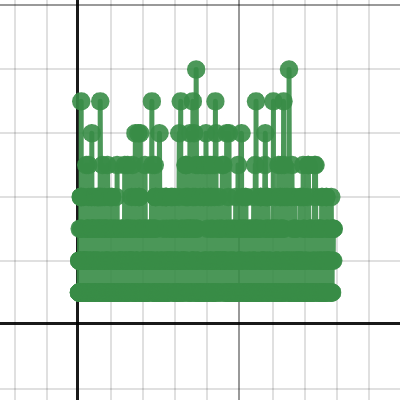 torn escarp
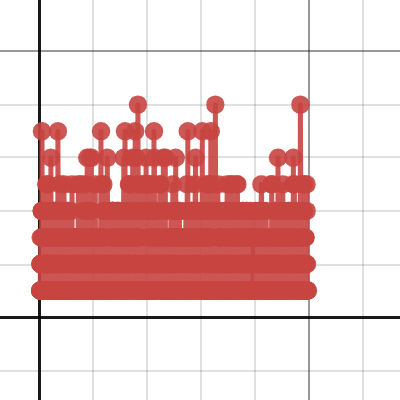
oh desmos cut out higher data in this version for some reason
too many pts for it in a table I think
errant otter
interesting nevertheless
 runic token
wait mero can u get ur program to spit out how many numbers have 7, how many have 5, 4, etc?
torn escarp
sure
well I'll just run some stuff on the data as a separate bit of data wrangling, not the program itself
1 467
2 364
3 208
4 116
5 46
6 16
7 9
8 3
or I guess reversed is nicer imo
8 3
7 9
6 16
5 46
4 116
3 208
2 364
1 467
in case you're curious how I'm getting these:
lotta basic unix tools are good for this sort of stuff
torn escarp
thousands of points + desmos is conspiring to crash my browser
errant otter
XD
torn escarp
it's a shame that we dont' have the computing power to get millions of data points
I feel like we can't really see what's happening
just looks like static to me lol
errant otter

2 2
1 3
1 5
2 7
2 11
1 13
1 17
2 19
3 23
2 29
1 31
1 37
1 41
2 43
2 47
1 53
4 59
4 61
3 67
7 71
1 73
4 79
4 83
1 89
1 97
Funny, I tried on my own and it seems that there's an error in p = 2 
torn escarp
you might be double counting with how you set up your loop
1 and p-1 happen to be equal
 right
torn escarp
runic token
wait mero can u get ur program to spit out how many numbers have 7, how many hav...
right
torn escarp
runic token
wait mero can u get ur program to spit out how many numbers have 7, how many hav...
the frequency graph looks more structured
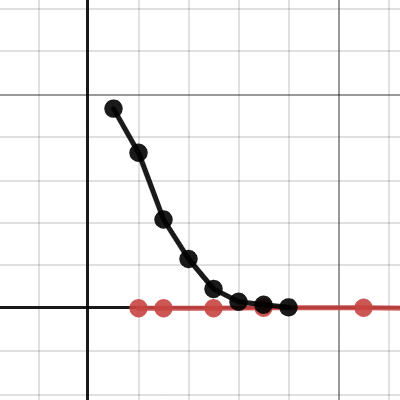
Desmos
runic token
oh that's nicer
errant otter
wow
torn escarp
 errant otter
distribution curves we go agian
torn escarp
interesting
torn escarp

Desmos
desmos does it automatically
you take like a table of data with x_1 and y_1 then y_1~ax_1 + b will give the least squares for those pts for instance
runic token
we should plug some of those numbers into the inverse symbolic calculator
torn escarp
I guess the thing is, we need to normalize this curve somehow
otherwise it'll just keep growing by getting more data points
since the height is the frequency of occurrence
I'm wanting to return to this and thinking from this sort of theoretical starting point we could predict this curve here
but not sure exactly how I'd get started on that lol
runic token
i don't know enough group theory to help w that :( sorryyyyy
torn escarp
that's ok I'm probably just gonna forget about this problem in a few minutes and move on with my life, it was fun though lol thanks for playing with me here haha @runic token and @errant otter 😛
runic token
yes sir 🫡 anytimeeeee
torn escarp
runic token
i don't know enough group theory to help w that :( sorryyyyy
on the other hand, it might be an interesting motivator to learn some specific stuff about cyclic groups
errant otter
indeed
group theory 
lmao idk if my program is doing it right but
when I implemented numpy
I generated 10k in like 3s
lemme check against what u generated

wait it ACTUALLY looks correct
wtf
no way
numpy's that cracked???
runic token
 probably tbh i heard it's mad efficient
 runic token
DAMN
yo do the things mero did
cmon graph it
i wanna see
pleaseeeeeeeeeeeeeeeeeeeeee
errant otter
Idk how to graph tho 
errant otter
I made it do 100k, I wonder what it's at rn
torn escarp
nice I just literally printed it with commas and lines then pasted into desmos
torn escarp
like
1,2
3,4
5,6
errant otter
what I did was to download a file of the first 100k primes
so I just accessed each number
runic token
LMAO
errant otter
and then did the operations
and appended
it's called....
what is it called?
right
torn escarp
I think gp has the primes cached up to like 100k or so too
torn escarp
I think running the program backwards or something could optimize it, there's definitely work that could be done I think to make it better
but I think numpy probably did better idk haha
errant otter

this is the first 23k I did before I cut it off btw
it's taking quite a bit of time to do 100k as expected
factorials do be like that
oh WAIT
DUDE
WE WERE SO DUMG
WE COULD HAVE SAVED THE PREVIOUSLY COMPUTED FACTORIALS TO OPTIMISE
BROOOOOOOOOOOOOOOOOOOOOOOOOOOOO
💀
torn escarp
apparenly by default gp precomputes the first 65,000 primes which is more than I went to, so it's inefficient than what you're doing haha
torn escarp
errant otter
WE COULD HAVE SAVED THE PREVIOUSLY COMPUTED FACTORIALS TO OPTIMISE
yeah, or used how factorials are computed to do them in ad ifferent order
errant otter
mhm
torn escarp
like compute n! and then reduce for p < n
errant otter
mhm...
torn escarp
think that's what you're saying already so I'm late to that party haha
errant otter
man how I love computers, rip to 19 century NTheorists
runic token
they woulda had to figure ts out themselves
torn escarp
you can probably graph with python or something with some library, I'd have to find one or something I guess
errant otter
does desmos accept json
errant otter
wait that works?
torn escarp
yeah that's what I did earlier
torn escarp
torn escarp
like
1,2
3,4
5,6
put your data like this
torn escarp
well it'll break the table
torn escarp
when I did it like (a,b) then it made separate points
torn escarp
just make a new program to go through the file and do it
runic token
^^
torn escarp
well, I'll just do it cause I already did it earlier
errant otter
torn escarp
desmos doesn't like it
runic token
LMAO
torn escarp
ctrl+v and immediately froze
yeah need to get some kind of graphing library or somethin
let's see what we can find
errant otter
runic token
LMAO
literally got overloaded
bruh
I can't find a file with factorials in it
runic token
i think if someone has mathematica pirated here it would be easy
errant otter
istg tho the 1millionth factorial has like
over 550000 digits
💀
no wonder my program is not terminating
I'd bet it's around the 40ks rn
errant otter
runic token
i think if someone has mathematica pirated here it would be easy
shhhhhhhhh
Well I do but idk how to use it + it's laggy
runic token
wait kmm can u check the highest number so far
i feel like if it's in line w what we've seen
and assuming it grows slower the hgiher it gets
it should be at like
15?
runic token
can u check how far in it is?
errant otter
nope I didn't add that feature else it'll impede on computation speeds
wel tbh
I might as well abort
and improve my code
hm....

it hit 566k
impressive
errant otter
highest in that range is 9
torn escarp
weird yeah
errant otter
very sus
torn escarp
grows very slowly
errant otter
 wonder if that'll be broken
if we went higher
time to optimise code
here we go

"no file for factorials? Fine, I'll make it myself"
oh wait
I used wrong command
LMFAO
wholly FUCK
it's 211MB
💀
not stonks at all
errant otter
I tried making a file with factorials
it went balooney
thank god my PC's pretty strong
torn escarp
 torn escarp
generating an american flag I guess
torn escarp
11 1
9 10
8 48
7 149
6 385
5 1085
4 2450
3 4845
2 7547
1 9151
computing frequencies from the data
which is 11 though? heh let's find out
runic token
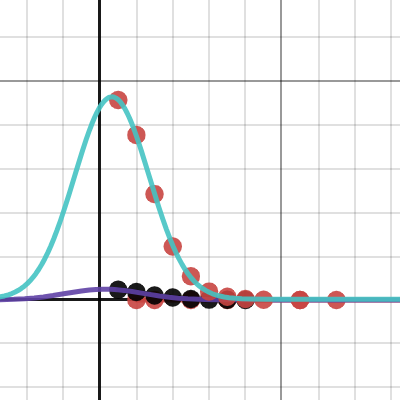
8 3
7 9
6 16
5 46
4 116
3 208
2 364
1 467
this is the original one
hmmmm the frequencies actually look like
relatively similar
right?
like
torn escarp
yeah actually let me graph it too
runic token
similar to a surprising degree
errant otter
well if u wanna compute freqnency
torn escarp
awk '$1==11' random.txt
11 292627
errant otter
just use a dictionary
tho sadly it'll result in us losing the data of which numbers had this corresponding number
torn escarp
I already computed it from the data
just sort by the number of occurrences and throw away the other number and then count them up
that's really all I'm doing here cat random.txt | awk '{print $1}' | sort | uniq -c | sort -n | awk '{ print $2, $1}'
awk '{print $1}' grabs just the first entry, then I sort it, then count up the unique entries and count them with uniq -c then the rest is me just reorganizing it to look cute
(idk if you care about this just figured it might be nice to explain tho)
torn escarp
Desmos
torn escarp
haha that's not entirely necessary it's just to keep the random.txt at the beginning of the pipeline
errant otter
torn escarp
https://www.desmos.com/calculator/wyywxl7xhl
now to work out the std. deviation and all those stats stuff
torn escarp
as it's written, I actually put k where 1/sigma^2 is
so if I just rewrite it in terms of that it'll tell us directly
errant otter
noice
torn escarp

Desmos
m and s are the mean and std
well actually I added a +C to it to raise it up
so maybe I should remove that
runic token
do you think if we scale the bottom graph appropriately we'll get a really good approximation of the top graph
torn escarp
 errant otter
hmm geez, I need to learn my statistics
errant otter
cmon python you can do ittttttttttttttttttttttttt generating the first 100k factorials
 errant otter
oof
torn escarp
I ust divided the y value by the first element
errant otter
maybe this is da wrong approach
torn escarp
lol oh definitely
we just pulled a gaussian out of our butts
could easily be something else
errant otter
hmmmmmmmmmmmmmmmmmm
runic token
tbh im willing to assume it's a gaussian js bc that looks pretty enough
torn escarp
like if we think of the probability of what curve we'd expect of pulling without replacement idk
I'd have to look up stuff and think about it to know what that would be
torn escarp
errant otter
primes berrt
torn escarp
actually just shows the first line but this is the plotting program
errant otter
geez it's taking forEVER to generate the first 100k factorials
torn escarp
I just did the hacky thing, probably there's a way to read the file in python to get it but I just said screw it and threw the data in a list
errant otter
based mero
torn escarp
matplotlib was what I found an example for
torn escarp
torn escarp
referring to this earlier
errant otter
naruhodo
torn escarp
an alternate way to look at the data
cat random.txt | awk '$1>hs {hs=$1; print $1, $2}'
1 2
2 7
3 23
4 59
7 71
8 3643
9 62939
errant otter
runic token
LMAO
errant otter
latex moment
runic token
did it go high enough
torn escarp
oh I just forgot to copy the last line
lol
cat random.txt | awk '$1>hs {hs=$1; print $1, $2}'
1 2
2 7
3 23
4 59
7 71
8 3643
9 62939
11 292627
errant otter
interesting
no 10
runic token
why is ten skipped
errant otter
avoids 10 like the plague
runic token
that's so silly
runic token
ohhhh true
torn escarp
71 occurs so soon
errant otter
sus
runic token
torn escarp
I think 10 happens after 11
out of context this is really funny actually
torn escarp
that it's already beat out 5 and 6 from occurring
haha
well we know it occurs cause we saw the frequencies earlier
and all were nonzero
runic token
right
torn escarp
it is interesting how it skips
torn escarp
torn escarp
`cat random.txt | awk '$1>hs {hs=$1; print $1, $2}'`
1 2
2 7
3 23
4 59
7 71
8 36...
actually I should have written the program simpler, then I'll explain it
runic token
couldnt be me kmm
torn escarp
it looks at the first entry $1 and if it's larger than the current highscore hs (initializes to 0 by default) then it will set the new hs hs=$1 as that entry and then print the line print
awk '$1>hs { hs=$1; print }' random.txt
1 2
2 7
3 23
4 59
7 71
8 3643
9 62939
11 292627
awk has come in surprisingly handy for dealing with this math data, didn't really expect to use it on the weekend here lol
runic token
oooh
errant otter
runic token
(n+1)! = -(n+1) mod p
hmmge
runic token
are these the first numbers that reach the new number
torn escarp
yeah
runic token
that could be interesting!
maybe those show a pattern
none of them are even
(except two)
torn escarp
cat random.txt | awk 'BEGIN{OFS=","}$1>hs { hs=$1; print $1, $2}'
1,2
2,7
3,23
4,59
7,71
8,3643
9,62939
11,292627
paste this into desmos (after I reload it cause it froze again...)
https://www.desmos.com/calculator/wa90okiazc

Desmos
torn escarp
looks like it might be exponential growth
runic token
tell me that doesn't look like ae^x
torn escarp
eh doesn't look so well https://www.desmos.com/calculator/uqpa8fdavk

Desmos
runic token
ah im sure if we zoom out far enough it checks out
torn escarp
if you look at the smaller points they are not too grat either idk, I guess it's debatable
errant otter
mfw it approaches e^x
also geez
it hasn't generated the 100k factorials yet
I'm beginning to question if it's even computationally reasonable
errant otter
ye I did
runic token
oh 💀
torn escarp
ust curious looking at the differences between consecutive terms:

 runic token
torn escarp
ust curious looking at the differences between consecutive terms:
runic token
torn escarp
ust curious looking at the differences between consecutive terms:
huh
ur right
those are weird numbers
torn escarp
71 is honestly the weirdest one
errant otter
it's just x = 1, multiply by 1, store value, mult by 2, store, 3....
errant otter
torn escarp
71 is honestly the weirdest one
fr....
errant otter
let's see if we can find any patterns when we sum teh digits
runic token
maybe it's bc 17 is the largest number which occurs as a prime factor of an order of a sporadic simple group
torn escarp
I could imagine some relation to like n! and having subgroups of S_n etc etc doing idk what
but I don't know what a sporadic simple group is
tbh in a year from now I think the main thing I'll remember is that (p-1)! = -1 mod p doesn't mean p-1 is the minimal number that makes n! = -1 mod p true lol
surely we can prove this is true for infinitely many cases
it seems pretty common to occur
or at the very least we can prove the probability if we assume it's random follows somethin
 runic token
it not only seems random but it seems that more and more numbers do not have p-1 as the minimal number to that being true
as we go up to infinity
torn escarp
like ok if I rephrase it slightly in terms of being random and group theory, think of it this way:
start with {0,1,2,...,2n-1} and then pick a number at random without replacement
call your number x, then keep taking numbers out and adding to your x and reducing mod 2n
how often would you expect to have x=n before you run out of numbers to draw from the pile?
runic token
isnt this more combinatorics
torn escarp
it's whatever you want it to be
do you see the relation to the original question or should I explain a bit
as long as this question makes sense on its own we can try to work on this new probability question on its own merits though
(I'm trying to shield you from the group theory translation I did, that's all)
with a loosening assumption on how it's random
errant otter
literally being like veritasium when trying to explain p-adic numbers
desparately avoiding any mention of AA
torn escarp
😩
I didn't watch that p-adic number thing but I was afraid I'd see people talk about that now haha
runic token
trust ill tell you if i cant handle it
torn escarp
I probably have to watch it just so I can anticipate what people will say about it
runic token
torn escarp
I probably have to watch it just so I can anticipate what people will say about ...
it's a very silly funny video
torn escarp
so the structure of multiplication mod p is not really very predictable in this sense
like if I give you an element of Z/pZ* (the multiplicative group of integers mod p) and ask you to tell me what order it is in the group (how many times you multiply it by itself to make 1) then it's hard to compute
and that problem is called the discrete logarithm problem and some security depends on no one knowing a great way to solve this problem in certain cases
so we might as well just assume if we just start looking at the numbers in order like 1, 2, 3, 4, 5,... then we'll just assume for the sake of argument that their order is random
this is what we're looking at when we look at n for n!, we're just multiplying these on one after the other and seeing if we make -1 mod p
runic token
oh!
torn escarp
this multiplicative group happens to be a cyclic group with p-1 elements
torn escarp
so I turned it around to talking about addition mod 2n, here 2n is really p-1
torn escarp
and n+n=0 mod 2n
just like -1 * -1 = 1 mod p
so that's the isomorphism I'm looking at
basically the logarithm of multiplication mod p
and then assuming those are random when given to us by computing n! (not the same as the n in 2n, bad choice of new variable my bad)
torn escarp
log(n! mod p) = log(1)+log(2)+...+log(n) mod p-1 I suppose might be nice
to sort of think of it like that
log(-1 mod p) = (p-1)/2 mod p-1
runic token
torn escarp
log(n! mod p) = log(1)+log(2)+...+log(n) mod p-1 I suppose might be nice
wait i'm confused
isn't this noninteger
torn escarp
or I would rather throw away the mods and just have it understood what the domain and range types ar
this "log" is a map from Z/pZ* to Z/(p-1)Z
I think they usually use like ind(x) or ord(x) instead of log(x) for this
and I probably should specify a little more like a base of the logarithm, like some generator
so like let's pick p=5
g=2 or g=3 which would you prefer
I'll do g=2 you do g=3 afterwards
runic token
sure!
torn escarp
mod 5 is understood:
2^1 = 2
2^2 = 4
2^3 = 3
2^4 = 1
now we can map them to what order they are err
actually I might be saying that wrong earlier, I think maybe just ind, not ord
order is something else
order is what power you need to make the identity
ind is the index, which I believe is usually used for "log"
runic token
right
torn escarp
I'm kinda making a mistake in doing two separate things on accident cause I didn't think ahead just started writing haha
torn escarp
here I'm saying ind(2)=1, ind(4)=2, ind(3)=3 and ind(1)=4
or really ind(1)=0
although it doesn't matter because remember 2^4=2^0 = 1
ind(x) is well defined mod 4
since the exponents cycle back around
torn escarp
like for instance, $2*3 = 1 \mod 5$ which as exponents looks like $2^1 * 2^3 = 2^{1+3} = 2^4 = 2^0 =1 \mod 5$
 sterile pumiceBOT
Merosity
 sterile pumiceBOT
Merosity
 errant otter
damn
torn escarp
so we're going from multiplication mod p to addition mod p-1
errant otter
wtf it looks so much like FLittleT
torn escarp
it is flt haha
except we're just thinking about it as logs instead of exponentials, same idea
torn escarp
1
runic token
i forget
torn escarp
fermat's little theorem
torn escarp
yeah, so maybe it'd be clearer if I had been writing like log_2(x) and now you're basically doing log_3(x)
torn escarp
at least, I see no good reason not to use logarithm notation like I'm doing cause it feels sane to me
yeah exactly
runic token
no it makes sense
torn escarp
0 is best imo
just keep them to {0,1,2,3} for mod 4
you oculd wrap around further like 2^5 = 32
runic token
right right
torn escarp
so what's ind(32)
torn escarp
yeah, alternatively since 32=2 mod 5
errant otter
naruhodo
torn escarp
so you can do it inside or outside
if that makes sense
ind(32) = ind(2) = 1 is how I did it doing mod 5 inside
or ind(32)=ind(2^5)=5 = 1 mod 4 outside
runic token
it makes senseeee
torn escarp
this is what a group homomorphism allows you to do f(x*y)=f(x)+f(y)
going between multiplication and addition, we could compute it eithe way as the group with multiplication or the group with addition
although we have something stronger, we have a group isomorphism, this is invertible
torn escarp
but just trying to tie it into stuff a bit to help give you examles for learning group theory later
errant otter
me with my self-insert nanis be like
torn escarp
lol
runic token
what does invertible mean here
torn escarp
we can go back and forth
without losing information
so like lt's say I give you the set {1, -1}
and witht he operation multiplication that gives us a group
a group is a set with a binary operation that obeys some rules
so now we can make this homomorphism: f(x)=x^2
and see that it satisfies f(xy)=f(x)f(y) for all x,y in {1, -1}
but we can't invert it cause both 1 and -1 map to 1
errant otter
so would that require bijectivity?
torn escarp
yep
torn escarp
the reason it's nice to have an isomorphism is that basically means we're just relabelling the symbols of the group
we're not "smashing it down" into a smaller group
runic token
-1,1,i,-i
errant otter
isomorhpism theorems be like
torn escarp
another isomorphism we can make is think of multiplication with {1, -1} and addition mod 2 with {0, 1}
these are really just a relabelling of the symbols we use
runic token
hm
errant otter
naruhodo
torn escarp
-1 * -1 = 1 is really arelabelling of 1+1=0 mod 2
replace -1 with 1, replace * with + and replace 1 with 0
 torn escarp
you basically just rewrite it as x mapping to f(x)
it's important to think of the domain and codomain
f: {1, -1} -> {0, 1}
so while 1 lives in the multiplication world on the left, 1 lives in the addition mod 2 world on the right
f(1)=0 and f(-1) = 1
and f(x*y) = f(x)+f(y)
runic token
ohhhhhhh
torn escarp
so that's how the elements and binary operator translate over
runic token
okay okay nice
torn escarp
yup
runic token
is that the proper notation?
errant otter
notation brrt
torn escarp
but in our case G is still that same data of a set with binary operatior
and same for H
G = ({1, -1}, *) and H = ({0,1}, + mod 2) you could write something like this
although there are bunch of other notations for things like this
torn escarp
like when you learn about quotients people often write Z/2Z for addition mod 2 and Z/pZ* for multiplication mod p
runic token
and if you had more elements
hm
wait
you can only have an isomorphism if the cardinalities are equal
right?
torn escarp
yeah
if there's not even a set isomorphism, you can't have a group isomorphism
it starts to get hairier when you get to larger groups which have the same cardinality, now telling groups apart might require looking at other properties of the elements or operator
torn escarp
lol I feel like we kinda diverted from our original goal but that's fine
I think this is probably more important
but I think that should make it much clearer how basically fermat's little theorem sorta tells you multiplication mod p is the same as addition mod p-1
you're just relabelling some symbols in a sense
torn escarp
yeah you're welcome
also our example showed that relabelling to addition wasn't even unique
it depended on which generator we chose, like when I did 2 and you did 3, we ended up with different looking translations that were still consistent
runic token
ohhh that’s true
torn escarp
in fact it might be clearer to see this through another isomorphism you're familiar with
when we use the complex numbers {1, -1, i, -i} we could do the complex conjugate
since adding the roots of x^2+1 has this ambiguity of which is i and -i, it doesn't really matter which we pick
similarly we can map 2 to i or 3 to i
runic token
hmmm
torn escarp
going from multiplication mod 5 to multiplication in the complex numbers
f(2)=i is enough to unravel everything
f(2)^2 = i^2 has to be true
cause f(2*2)=f(2)*f(2) as a homomorphism
runic token
right
errant otter
runic token
oh so it cycles!
runic token
that makes sense
torn escarp
similarly f(3)=f(2^3)=f(2)^3= i^3 = -i
and so on
but we could have done the reverse to begin with and picked f(3)=i
and gotten f(2)=f(3^3)=f(3)^3 = i^3 = -i
yeah so we just sorta went through a bunch of different isomorphisms but the kind of nice thing is group theory lets us zoom out and not really worry about these details
we're really just relabelling the same group here
whether we saw it as addition mod 4, multiplication mod 5 or multiplication in the complex numbers
it's really the same structure, so it's sort of nice to bounce between perspectives like this
runic token
ohhh so we can make thms abt like one group while it might be hard for another group
torn escarp
depending on what's convenient to us
runic token
but bc of isomorphism
torn escarp
yeah exactly
runic token
it still applies
errant otter

errant otter
lmao
runic token
that’s so smart
torn escarp
I dunno haha
torn escarp
I suppose in some sense the first isomorphism we all really kind of get used to seeing is exponentials and logarithms
runic token
i wish i was like that fr
errant otter
fr
torn escarp
yeah, see if you can figure out what the sets and operators are
errant otter
Mmmmmmmmmmmmmmmm
runic token
sets are a^x for exponentials and the operator is multiplication?
torn escarp
errant otter
*set of real numbers-* no shit
haha not exactly
errant otter
naaaaaaaaaaaaaaaani
torn escarp
runic token
sets are a^x for exponentials and the operator is multiplication?
set not quite right, but operator would be multiplication
runic token
hmmmm
errant otter
MmmmMMMmmm
torn escarp
I think once you see it it'll be clearer, but I'll let you struggle together for a bit while I make more tea
it's good for you to figure it outhaha
errant otter
ok fair
errant otter
wait
runic token
i think?
runic token
because ln(a) + ln(b) = ln(ab)
errant otter
hmge
torn escarp
A and B each have a binary operator
remember a group is a set and binary operator
are they both addition then?
runic token
hm
no
wait
i feel like it should be no
i think the exponentials should be multiplication
ohhh the domain for exponentials is all real numbers
and the codomain is positive reals
torn escarp
the exponential or log is not where the binary operator is
that's just the map between the groups
runic token
mf
errant otter

torn escarp
just like log maps a number from positive reals to all reals
log maps ??? operator to ??? operator?
log(x+y)=log(x)*log(y)
log(x+y)=log(x)+log(y)
log(x*y)=log(x)+log(y)
log(x*y)=log(x)*log(y)
runic token
c!
torn escarp
which of those looks right and what's going where
runic token
multiplication to addition!
torn escarp
so is that * to + or + to *
errant otter
multiplicative to additive 
torn escarp
ok cool
torn escarp
so now write exponentials out this way
show how it does the reverse
f(x+y)=f(x)*f(y)
errant otter
we can just use the fact that log is inverse of exp can we?
runic token
that was silly of me
yes it goes additive to multipicative
and it's unique in that property, right?
torn escarp
yeah
I guess it sounds like I'm asking something intense I really just meant
write it in terms of like f(x)=e^x
I want to see the + and * flopping around
runic token
ohhh but the reason group theory is nice is because we can prove something for this and then extend it to different groups
runic token
torn escarp
I want to see the + and * flopping around
e^(a+b) = e^a * e^b
like that!
torn escarp
yeah exactly
that's really all I was looking for, just making sure the basics are clear of what'shappening
just like we relabeled addition mod 4 to multiplication of {1,-1,i,-i} in C
and saw that those are really just the exact same structure
addition of reals is exactly the same structure as multiplication of positive reals
so that's really just all we really have from this particular isomorphism
runic token
hmmm
torn escarp
this was just to show an example, I don't know if that will feel very profound or anything like that
runic token
it's still a nice example though
i think it helped me!
idk abt kmm but it made sense to me
torn escarp
that's good
I think we're sorta used to R since kids that it's easy to take it for granted a bit, but the fact that to show that addition of R and multiplication of positive R are the same requires a funny mapping, like log(2) where you're producing irrational numbers often times
for instance, is addition in rationals isomorphic to multiplication of positive rationals?
errant otter
mmmmmm
torn escarp
if they are or aren't - prove it 😛
also backing up, just like we mapped 2 mod 5 to i or -i
we also didn't have a unique isomorphism here either
f(x)=a^x we had choices for a
anyways just sorta throwing some food for thought at you to play with haha I think that's a good amount for now
we can still keep talking I just won't like keep introducing new stuff haha
runic token
i am working on the problem
hmmm
so my initial thoughts were
"oh of course it has to be possible"
errant otter
Ummmm okay so I have the sussy feeling like we have to introduce the fact that irrational numbers may pop out to disprove this
runic token
so then i thought abt defining some function q to q+
oh
me and kmm are thinking entirely different things 😆
errant otter

runic token
im sure they're correct tho
bc im having much trouble defining such a function that maps addition to multiplication
runic token
we want a function s.t f(x+y)=f(x) * f(y)
oh
but its unique
and clearly it's sometime nonrational
torn escarp
runic token
but its unique
it's not necessarily unique
errant otter
yeah around those lines? But wait why'd u write f(x)+ oh ok u fixed it
okok
so um
let's say
clearly
torn escarp
just like f(x)=2^x and f(x)=3^x are both exponentials (log_2 and log_3 for the inverse)
errant otter
so since such an x must exist
and assuming that the isomorphism is there
then
f(x) = f(x/2 + x/2)
= f(x/2)^2
runic token
hmm
errant otter
so
runic token
OH
errant otter
since f(x) = 2
errant otter
basically it'll become sqrt 2 I think?
and that's irrational
but now to prove that there is indeed such an x
runic token
well
it just needs to have it so that it doesn't map to perfect squares every single time
oh hold up
nono we dont need to do that
okay so hear me out
if we can have f(x/2 + x/2)
errant otter

runic token
then why can't we have f(x/3 + x/3 + x/3)
errant otter
uh huh
 errant otter
lmao that EMOTE
runic token
it's gotta be a cube root
and we can just go on
so it would have to be rational
for every single nth root
which is not possible
for any number
errant otter

 torn escarp
you solved it?
torn escarp
haha it sounded like you had a good idea so I think you did
I didn't read it, just was gonna let you rewrite it more cleanly when you're ready haha
errant otter
I just abused the guy who got stoned by pythagoras's followers
errant otter
torn escarp
I didn't read it, just was gonna let you rewrite it more cleanly when you're rea...
alrighty here I go
Suppose that we have an isomorphism between the addition in rationals and the multiplication of positive rationals, denoted by $f: (\mathbb{Q}+) \mapsto (\mathbb{Q}_{>0} \cross$
Since $f$ is bijective, there exists an $x \in \mathbb{Q}$ such that $f(x) = 2$. Since x is rational, so is $\frac{x}{2}$. (I think? Idk how to prove this part tho)
As such, we have that $f(x) = f(\frac{x}{2} + \frac{x}{2})$, and by our assumption, is equal to
$f(\frac{x}{2}) \cdot f(\frac{x}{2}) = f(\frac{x}{2})^2 = 2$, which implies that
$f(\frac{x}{2}) = \pm \sqrt{2}$. But $\sqrt{2}$ is irrational, leading to a contradiction
sterile pumiceBOT
Kiameimon | Welt Rene (glomed)
 torn escarp
yeah that looks good, I'll help on the parts a bit that need cleaning a little
errant otter
I need to learn how to write formal proofs smh
torn escarp
since f maps from positive rationals, it's defined on x/2, so f(x/2) is fine
yeah that was plenty formal
if you had tried to do something like f(sqrt(x)) then we'd have problems of course
I probably would have not written sqrt(2) because it's not really an element
like f(x/2)^2 = 2 but since we know f(x/2) is rational we could write it as y maybe for clarity
errant otter
ah
torn escarp
y^2 = 2 then just say - "nope" cause of the same reason
errant otter

errant otter

torn escarp
I think working backwards is sorta tricky like knowing there's an x such that 2=f(x) is a good trick
since this is the number theory channel, this is morally good because we have now officially shown that the rational numbers are more interesting than real numbers
errant otter
torn escarp
because its multiplicative group and additive groups isn't really just a simple relabeling of symbols like reals 😛
that makes sense though we already knew that, cause rational numbers have prime factorizations while real numbers, there's no barrier to taking roots
errant otter
yee
torn escarp
if you push your proof a bit more generic and don't fix 2, you could do something like pick an arbitrary rational q, q=f(x) then break it down to q=f(x/n * n) = f(x/n)^n and recognize that f(x/n)=r is some other rational number but in general we can't solve q=r^n for all n
(just to put it more clearly why I said there's no barrier to taking roots)
torn escarp
actually groups like this have a name called divisible groups
errant otter
a bit
torn escarp
matrix multiplication is noncommutative generally speaking
errant otter
mhm
torn escarp
so there's a source for some nonabelian groups that might be important to you eventually
errant otter
uh huh
torn escarp
and try rotating it 90 degrees around the x axis or y axis but in opposite orders
and you end up with different ending configurations
errant otter
mhm mhm
torn escarp
or if you have some dice lying around you can do them both too
anytime in math someone calls something a 'symmetry' they are probably thinking about some specific group moving something around
errant otter
sounds like diagonalisation to me
torn escarp
somewhat related
the eigenvector matrices you're conjugating by are what make up the symmetries
errant otter

torn escarp
specifically if we're talking about symmetric matrices, you can think of the symmetries are how those orthogonal matrices reflect or rotate the quadratic forms
like xy=1 is a hyperbola that opens up at a 45 degree angle but then we can rotate it 45 degrees to make (x^2-y^2)/2 = 1 or whatever it is
well we'd have to talk a little bit more about group actions since I'm introducing an extra set here now tha the group is acting on
I think that's enough for tonight lol
errant otter

 verbal axle
does this look right? here p is prime
 torn escarp
where do you get the upper bound of ceil(sqrt(p))
verbal axle
I proved that
 torn escarp
I'm guessing some kind of tweak on $\sum_{d|p-1}\varphi(d) = p-1$
sterile pumiceBOT
Merosity
 verbal axle
yeah that was the part I was not too sure about, I did some playing around and saw that as p gets large, the bound ceil(cbrt(p)) holds, but for some smaller values of p it doesn't
like p = 31, this doesn't hold
ngl I was kinda bluffing, the gap does grow very fast tho
torn escarp
I don't think you need to do anything so weird
but idk, nothing pops out to me right away
verbal axle
what I could do is use the fact that
my idea is that there is no d that divides p-1 that is greater than sqrt(p)
maybe that plays a role here somewhere
torn escarp
hmm the fact that we have the cube root might mean we have to pull out more than that
but it's a start, let's see how that goes for us
verbal axle
yeah the cbrt is throwing me off a bit lol
torn escarp
already that gets us $\lim_{p \to \infty} \frac{p-1 - \varphi(p-1)}{p-1}$
sterile pumiceBOT
Merosity
 torn escarp
so that's 1 - phi(p-1)/(p-1), I don't think $\lim_{p \to \infty} \frac{\varphi(p-1)}{p-1} = 1$ so we gotta be better
sterile pumiceBOT
Merosity
 verbal axle
since p is prime $\frac{\varphi(p-1)}{p-1} < 1$ cuz $p-1$ is not prime
sterile pumiceBOT
ForJoke
 verbal axle
my idea is that there is no d that divides p-1 that is greater than sqrt(p)
verbal axle
verbal axle
my idea is that there is no d that divides p-1 that is greater than sqrt(p)
what if we looked the sum $\sum_{d|p-1, d < \sqrt{p}}\varphi(d)$
sterile pumiceBOT
ForJoke
 torn escarp
that's what we just looked at
verbal axle
oh wait, wut?
torn escarp
oh p not p-1
my bad
I think it's still the same though
here's another way maybe
d | p-1 and d < cbrt(p) we rewrite this condition as d^3 < p and then subtract 1 from both sides d^3 - 1 < p - 1
now factor and we have (d-1)(1+d+d^2) < p-1
we already know d-1 < p-1 not very exciting, but maybe 1+d+d^2 < p-1 if we look at the divisors between these two roots of the quadratic
verbal axle
I dont quite see how this helps ngl
torn escarp
not sure yet either, but I just finished solving for the roots of it
one is negative, but might as well be 1, the other is positive so
$$\sum_{d|p-1, d<\sqrt[3]{p}} \varphi(d) \le \sum_{d|p-1, d<\frac{-1+\sqrt{4p-7}}{2}} \varphi(d)$$
sterile pumiceBOT
Merosity
 torn escarp
at least we know this is true and we have a quadratic now, and then we can mess with that a bit more to simplify it to something more tractable like you had actually -
$$\sum_{d|p-1, d<\sqrt[3]{p}} \varphi(d) \le \sum_{d|p-1, d<\frac{-1+\sqrt{4p-7}}{2}} \varphi(d) \le \sum_{d|p-1, d<\sqrt{p}} \varphi(d) $$
sterile pumiceBOT
Merosity
 verbal axle
yeah the far inequalities are easily derived since cbrt(p) < sqrt(p)
torn escarp
I guess what I'm saying is, if the sqrt(p) one doesn't work we might be able to tighten it a bit further using this result I just found to make it work if we're nearly close
verbal axle
oh that is true
torn escarp
although idk where to go from here either so that's why I did that dancing around haha
just figured at least I'll take the paths I could see to their dead ends first
hmmmm
verbal axle
sterile pumice
**Merosity**
the far sqrt(p) doesn't help, I checked this using python, sqrt(p) grows too slowly after a point
torn escarp
oh, change it to the lower one I just got too
it probably won't work either if it's too slow growing
so this just needs to be trashed entirely
that's just translating slightly, it's not gonna fix issues in the long term
verbal axle
what makes the cube root so special?
torn escarp
hmm idk
more playing around, what if we write p=1+dn and d^3 < p and plug it in to make d^3 < 1+dn
this is like a depressed cubic
which is how I feel about it too, not sure if I want to go further down this path
verbal axle
yeah no, this gets ugly, fast
I'm sorry but I gotta sleep now, its like 5am where I am💀
I will dream about this question, and hopefully get something fruitful, I will keep you updated
verbal axle
you should proolly sleep too lmao
torn escarp
exactly what I'm doing too
verbal axle
gg
errant otter
 white lion
Im trying to understand this proof for 'there are infinitely many primes of the form 4k-1'
sterile pumiceBOT
jayzsparrow
 white lion
Interlude 1: how do we know that there must be atleast 1 prime divisor of the form 4k -1?
torn escarp
Suppose they're all 4k+1
torn escarp
That's fine
white lion
torn escarp
Suppose they're all 4k+1
wait was that it? 😅
torn escarp
Well just giving a hint, you fill in the rest
white lion
Suppose all the prime divisors of 4k - 1 is 4k+1?
torn escarp
Yeah
white lion
suppose there are only finitely many primes of this for $p_1,p_2,. . . , p_n$ and consider the number $m = 4p_1 . . . p_n$ - 1. since m is of the form 4k-1 and m > $p_i$ for all i it follows that m is composite and must have prime factors of the form 4k + 1 or 4k-1. Since the product of any two numbers of the form 4k+1 is again of that form it follows that m has atleast one prime divisor of the form 4k-1
sterile pumiceBOT
jayzsparrow
 white lion
torn escarp
Yeah
white lion
torn escarp
Yeah
ah ok I see what you're saying, gotcha thanks.
torn escarp
Cool, you're welcome
verbal axle
torn escarp
but only using d < cbrt(p)
how many divisors can p-1 have that are less than p^(1/3)