#precalculus
1 messages · Page 271 of 1
 willow bear
that's horribly one-dimensional
 sleek ruin
Hm weird
 viscid thistle
can someone give me the steps to solving for x? Would greatly appreciate it.
willow bear
what have you tried so far
 astral mantle
take the log of both sides
 peak badge
Are you familiar with logarithms in the first place?
viscid thistle
ln(e) = 1, isn't it ?
sleek ruin
Something like this. Sorry I had to ask again. Still a little confused and all. Appreciate it
peak badge
...definitely review on logarithm properties then......
viscid thistle
oh for ln(2)?
 obsidian monolithBOT
Ann:
viscid thistle
willow bear
when you take the log of e^x you don't suddenly get to just plop the ^x on the outside of the log
peak badge
Any ideas on how do you proceed from here, 403? It's just one step away from the answer IMO
viscid thistle
let me think'
willow bear
no no 403
sleek ruin
my bad
viscid thistle
ok
willow bear
it should never have been there
it is the result of a mistake
as i have UNSUCCESSFULLY been trying to point out
but you never understood, it seems
sleek ruin
That's tuff
willow bear
ok let's back up
let's back up
you had the equation e^x = 2
this is what you came to, everything up until now was ok
the next most sensible step is to take the natural log of both sides
thus, ln(e^x) = ln(2)
viscid thistle
willow bear
yes! there we go.
viscid thistle
ok
willow bear
and it is now that you can simplify ln(e^x) to just x.
why aren't my messages sending
peak badge
Did you get the intuition/reasoning behind the procedure though?
viscid thistle
yeah
because e^x is togehter
so there is a parenthesis?
at least
tahts what I'm thinking
peak badge
Yes. e^x is an entire number that you would have to take it together
peak badge
why aren't my messages sending
Internet issues?
viscid thistle
ln(e^x) = x?
peak badge
Okay. @viscid thistle I would advise revising logarithm properties here on out. Because to get the next step for the answer - you need to apply 1 of them.
Here's a starting material if you don't have any to refer to
http://www.montereyinstitute.org/courses/DevelopmentalMath/TEXTGROUP-1-19_RESOURCE/U18_L2_T2_text_final.html
https://www.mathsisfun.com/algebra/exponents-logarithms.html
The exponent of a number says how many times to use the number in a multiplication
sleek ruin
oof
peak badge
For completeness sake - I will finish up with the problem here -
$$\ln (e^x) = \ln(2)\newline\rightarrow x \ln(e) = \ln(2)\newline\rightarrow x = (\ln(2))/(\ln(e))\newline\rightarrow x = \ln(2)$$
willow bear
do you really need more than 1 step to go from ln(e^x) to x?
i thought familiarity with the definition of log could be assumed
also it's \\ for new lines
peak badge
Err..sorry with that. My LaTeX skills are wack
obsidian monolithBOT
HarshlyDOOM:
viscid thistle
I forgot that I can move the exponent to the front lmfao
now it makes perfect sense
 harsh smelt
but if e^x = e^x which is definitely true, by the definition of ln, x = ln(e^x)
harsh smelt
sure no problems
viscid thistle
hello what is the derivative of sin(x^3)
?
using substitution we can put x cube = t
then sin t derivative is cos t
then substitute t again
that gives answer cos (x^3)
AM I RIGHT ?
CHAIN RULE IS DUMB ?
willow bear
no, you're not actually applying chain rule here
and to be clear, chain rule is the tool to use to differentiate sin(x^3) you're just not using it properly
in your notation, you forgot to multiply by dt/dx
which would give you d/dx sin(x) = 3x^2 cos(x^3)
sleek ruin
Expanding use the Laws Of Logarithms. Not sure what I got wrong on this one. Would appreciate any feedback, thanks.
viscid thistle
no, you're not actually applying chain rule here
@willow bear ik
i am USING SUBSTITUTION
willow bear
parentheses around ( ln(sqrt(5)) + ln(y) ) in the second line @sleek ruin
willow bear
using your method you can prove the derivative of any function is 1
viscid thistle
yess replace that function by t then diffrentiate that gives 1
sleek ruin
Thank you.
willow bear
@viscid thistle do you not see the problem here?
viscid thistle
yes i see
willow bear
clearly the derivative isn't just an operation that takes in a function and always returns 1.
viscid thistle
but why am i wrong
You forgot what's chain rule
i can replace anything by t and derive that its answer is one
WHY DO I ALWAYS HAVE TO USE CHAIN RULE
isnt substitution valid
x^3 = t
d(sint)/dt = cos(t) * dt/dx
ok
willow bear
isnt substitution valid
chain rule is the calculus version of substitution
viscid thistle
diffrentiation is something that is not a function
wot
yes
What does that even mean lol
viscid thistle
so i am supposed to do it in terms of dt not dx
 pastel pecan
Guys this problem is seriously stumping me and my friend
willow bear
this is a matter of incomplete simplification
4 - 4sin^2(θ) = 4(1 - sin^2(θ)) = 4 cos^2(θ)
sleek ruin
thats what i am going to relearn that in the next chapter. i remember the struggle.
pastel pecan
yeah lol
sleek ruin
Question:
My Work:
To be honest, this one was tough for me. A lot going on and the fractions + the exponents threw me off. I guess my question is what would the first step be?
 vale widget
just take the root
pastel pecan
here we go again boys lol
spent another 20 mins on this one
still lost
as hell
 echo wagon
Well, show your work how you got to 2
pastel pecan
ok
I factored the top and bottom
which I got
(sin+4)(sin+4)/sin(sin+4)
to which I crossed out both sins'
to which I was left with 4+4/4
8/4
=2
OMG
I just realized I should of crossedd out (sin+4) and (sin+4)
shoot I got it
thanks
harsh smelt
@pastel pecan write down denumenator explicity
obsidian monolithBOT
Commander Vimes:
pastel pecan
I get csc^2x-cot^2x=-1
so there should be a negative 1 in the denominator
But in the anwser show in the second part it is positive
You see where Im lost?
obsidian monolithBOT


 Requested by Commander Vimes#7532
pastel pecan
Requested by Commander Vimes#7532
pastel pecan
1=csc^2x-cot^2x
harsh smelt
so?
harsh smelt
yw
harsh smelt
np
 toxic coral
Is the vertical asymptote of csc(pi)x just n or (pi)n?
willow bear
did you mean csc(pi x)
also there is not one asymptote there are an infinite number
and they happen precisely at the integer coordinates
i.e. x = n, for n ∈ Z
 blissful ridge
Yeah, all of them look wrong
(Though don't ask for helps on tests, you'll get banned)
 cobalt storm
Oh this is just a homework that we submit my bad
 north island
convert to a common base
viscid thistle
i tried that
its where i mess up
like i tried doing 6log8(y) into 6log2^3(y)
and then where from there you know
cobalt storm
Oh nvm those are uncommon bases
north island
noooo
north island
because it's not neat
okay i highly recommend watching the linked video
but i'll summarise
logs are like multiplicative steps
log2(x) is the number of 'steps' it takes to get to x, from 1, with the step size 2
and 8 is 3 steps of 2
viscid thistle
mhm yes
viscid thistle
so that becomes 18log2(y)?
north island
think so
north island
yes
viscid thistle
and also makes sense because it would need to be y^3 to be multiplied
instead of 2^#
2^3
north island
what
viscid thistle
like if its log8(y) right
north island
yes
north island
yes
north island
no
north island
give me a counterexample
viscid thistle
wym
north island
try one out
viscid thistle
like a different example or number
viscid thistle
sure
north island
...
viscid thistle
but why isnt it true with 18 and 6
north island
it is true
viscid thistle
theyre supposed to be the same scale factor
north island
it's just simpler to consider 3 and 1
north island
yes
viscid thistle
and 6log8(64) is 12
north island
shit what have i done
north island
it's the other way around
viscid thistle
wym
north island
6log2(64) = 18log8(64)
viscid thistle
huh
north island
i am a moron
north island
log2(64) = 3log8(64)
viscid thistle
you're a lifesaver if thats true
north island
because you're taking 1/3 the steps
north island
i'm a buffoon
 calm grove
probs wanna multiply the 2 into (x-14), then synthetically divide the resulting equation
 small forge
@calm grove That doesn't work
 gaunt mason
U is the union. It means the solution is both the interval on the left and the interval on the right of "U"
@heady field
 heady field
wdym?
gaunt mason
What is unclear?
heady field
wait am i supposed to answer it based off of what i see in problems and not the graph?
 patent beacon
A and B are two different sets (or intervals)
A U B means "whatever is in either A or B"
U is called the "Union" of the sets
gaunt mason
a,b,c,d are not the problems, but the solutions.
you are supposed to answer based on the graph
gaunt mason
Yes.
The function rises from -1 to 1, and also from 3 to infinity
So both these two intervals are the solution, and you "unite" them with U
heady field
thank you!
i am studying for test tomorrow
i thought it was (x,y) U (x, y) so that's why i was confused
gaunt mason
cool
 obtuse kite
i am studying for test tomorrow
@heady field good luck on the test. I took a similar one recently
 knotty echo
heady field
knotty echo
heady field
i am guessing it would be the top degree so x^7/x^4 = x^3, so odd
take that with a grain of salt though because i am not done precalc
sadly the practice quiz didn't give me results to see if it was right or wrong, does anyone know the answer to this? i guessed it was a polynomial
 velvet granite
@heady field its a poly cuz the x^3 correct?
heady field
that makes more sense
i was just scared that some technical way it wasn't
and i assume that'd mean \sqrt[4]{x^5-x^2+3} would be one as well
viscid thistle
Hi, can someone help explain why there is an extraneous constraint?
And what an extraneous constraint is ? Thank you
gaunt mason
Can anyone help me?
@knotty echo you need to apply the definitions of even and odd.
 hard hedge
Can someone explain how to do 3 and 4 please?
velvet granite
@hard hedge where your unit circle?
For #1 its asking where sec is positive and tang is negative
sec is just 1/cos right, so we need to find where cos is positive and where tang is negative
cos is positive in quadrants 1 and 4 and tang is negative in quadrants 2 and 4
so your answer would be quadrant 4 because it matches the needs of both identities
 jolly gust
How would I prove that $f(x) = 5*3^x and prove that f(x+2)-f(x) is divisible by 10$
obsidian monolithBOT
Big Chungus:
obsidian monolithBOT
Big Chungus:
jolly gust
I dont know how to prove that this is divisible by 10
obsidian monolithBOT
Ann:
willow bear
also bad tex earlier
$f(x+2) - f(x) = 5 \cdot 3^{x+2} - 5 \cdot 3^x \ = 5 \cdot 9 \cdot 3^{x} - 5 \cdot 3^x \ = 45 \cdot 3^x - 5 \cdot 3^x \ = 40 \cdot 3^x$
obsidian monolithBOT
Ann:
willow bear
which is not divisible by ten for all real values of x, so you'll have to be more specific as to what values x is supposed to range over
unless you want me to maliciously comply with your underspecification
jolly gust
nope
willow bear
then it's false as stated
f(-98) - f(-100) is not even an integer let alone one divisible by 10
jolly gust
ok thamks
 south bear
can someone explain the unit circle to me?
My teacher taught the class it but he didn't really explain in depth wut it actually is
 grand berry
the unit circle is a circle of radius 1, and the various points along the circle have certain angles with respect to the positive x axis
and those points have coordinates that are given on the diagram
south bear
hmm, ok. Is this related to like sin, cosine, and tangent?
south bear
The professor mentioned something about that
grand berry
The y coordinate is the sin of the angle
south bear
why tho? I don't understnad
grand berry
pretty sure it has something to do with sin^2(theta)+cos^(theta) = 1
grand berry
well it’s just the Pythagorean theorem
south bear
thetha is just the degree right?
south bear
oh ok, so another way to write the pythagorean theorem?
grand berry
you know how the Pythagorean theorem is a^2 + b^2 = c^2
south bear
hmmm ok
grand berry
So then you use the Pythagorean theorem and get sin^2(theta) + cos^2(theta) = 1
south bear
ok tysm
That means a whole lot of sense
why is unit circle important in all this tho?
If it's just another way of doing pythagorean theorem?
grand berry
unit circle helps you memorize cos and sin of a bunch of angles
grand berry

 potent imp
unit circle helps define sin(x) and cos(x) for any real number
if u used the right triangle definition sin 240 wouldnt make sense because u cant have a 240 degree angle in a right triangle
 topaz flint
The accerleration of a shuttlecock is given by a(t) = 34.6t-52.1 where t is time in seconds since shuttlecock was hit. initial velocity = 40 ms^-1. Calculate the velocity after 2 seconds.
 jagged glade
Chain rule?
 violet jetty
yeah
obsidian monolithBOT
Result:
5
@topaz flint
I'm not sure, I got 5
topaz flint
oh
violet jetty
struggling with the working backwards
jagged glade
do you know how to apply chain rule in this question?
violet jetty
not particularly sure
obsidian monolithBOT
Result:
5
Lol
topaz flint
thanks for the help
jagged glade
This is chain rule
violet jetty
...
jagged glade
Anyways
(ln(f(x)))'= d(ln(f(x))/df(x) * f'(x)
So what is $\frac{\dd ln (f(x))}{\dd f(x)}$
obsidian monolithBOT
Biscuit:
jagged glade
It's similar to $\frac{\dd ln (x)}{\dd x}$
obsidian monolithBOT
Biscuit:
violet jetty
am i suppoed to answer?
violet jetty
I'm gonna be honest, not sure
jagged glade
Okay... Have you learn the derivative of ln(x)
violet jetty
derivative of ln(x) is 1/x?
jagged glade
Yea
violet jetty
ok formatting is weird apparently
jagged glade
So what is $\frac{\dd ln (f(x))}{\dd f(x)} ?
violet jetty
(1/x)/1?
jagged glade
Since it's with respect to f(x), we don't have to change it. And since bot is dead, let's let f(x)=y
Then we will have ln(f(x))=ln (y)
Derivative of ln(x) w.r.t. x is 1/x
Then what is the derivative of ln(y) w.r.t y ?
violet jetty
y
jagged glade
1/y
Therefore we have ln(f(x)) = 1/y times f'(x)
Hence we plug the f(x) back in and get 1/f(x) times f'(x) equals
f'(x)/f(x)
jagged glade
That's how we get d (ln (f(x)))/dx= f'(x)/f(x)
It's just practice, and practice makes perfect :)
violet jetty
thanks for the help
 stuck lark
@jagged glade @violet jetty (ln o f)'=f'/f 
$(\ln\circ f)'=(\ln'\circ f)\cdot f'=\frac1f\cdot f'=\frac{f'}f$
obsidian monolithBOT
RokettoJanpu:
 dawn depot
Find the gradient of the tangent at each function at the given value of x. How to solve this? i get the derivative then i plug 1 and -3?
 uncut mulch
if the derivative is only in terms of x, you only need to use the x-coordinate of the point i.e. 1
dawn depot
the derivative here is 2+5x^-2?
violet jetty
2x^2+5/x^2
uncut mulch
2+5x^-2?
yes
violet jetty
use quotient rule
uncut mulch
quotient rule is overkill
dawn depot
so now to find the gradient i plug in 1 then what?
dawn depot
ur saying answer is 7?
uncut mulch
yes
dawn depot
book says 13
dawn depot
oh ok
jagged glade
ty for pointing out typo😂 RokettoJanpu
 cedar pawn
What's the position of these oblique asymptotes? y=2x for +inf and y=-2x for - inf. Function is sqrt(4x^2-1)
For +inf= sqrt(4x^2-1)-2x=0
Don't you do this afterwards (sqrt(4x^2-1))^2=(2x)^2
Then your become 4x^2-1=4x^2 and then u will become - 1=0 but that's wrong I think
How do you do it then
viscid thistle
??
cedar pawn
?
viscid thistle
the function is even so you might aswell study it for x > 0
ok I got it
you are trying to get q
$q=\lim_{x\to\infty}f(x)-mx$
obsidian monolithBOT
HoboSas:
viscid thistle
can you explain yourself
cedar pawn
Translated
viscid thistle
I just want to find the position
of what?
cedar pawn
Yeah but slip it. If a function has 2 horizontal asymptotes then it can't have an oblique right?
Skip*
cedar pawn
What
viscid thistle
asymptotes
cedar pawn
A function with 2 horizontal asymptotes doesn't have an oblique asymptote
viscid thistle
yes
cedar pawn
A function with a horizontal asymptote for +inf can have an oblique asymptote for - inf right?
viscid thistle
yes
cedar pawn
Okie
 proper hornet
I was thinking 60y = 1.5x
I got that by setting both equations equal to zero and then setting them equal to each other
 sick steppe
Just find slope of the line then plug it into slope-point formula
 round quest
how do i find the sum of all integers between two numbers
blissful ridge
how do i find the sum of all integers between two numbers
The interval you want to sum will form an AP
viscid thistle
triangular numbers apparently @round quest
proper hornet
@sick steppe to find the intercept do I minus y to get them both equal to zero and thrn set them equal to each other?
Slope*
sick steppe
For a slope m and point (a,b): $y-b=m(x-a)$
obsidian monolithBOT
moshill1:
viscid thistle
(n(n+1))/2 - (m(m+1))/2 = all integers summed from m to n
sick steppe
that's point slope @proper hornet
viscid thistle
@round quest
round quest
its not working
its giving me a different result
i need to find the sum of all integers from -10 to 50
north island
what?
north island
so what you can do is
sick steppe
you're given 2 points, pick one
north island
you can pair them up
proper hornet
Ok
north island
-10 + 50 = -9 + 49 = -8 + 48 etc.
so you get (a-b)/2 terms of (a+b)?
30 * 40 = 1200
proper hornet
@sick steppe if i solve for m I get m= y/x -70
proper hornet
So (a,b) and (x,y)?
proper hornet
I mean eith thebformula
sick steppe
(2.5,175) and (4,235)
im not talking about the formula, im talking about the points you have
cause you said 2 arbitrary points
proper hornet
Oh then (y2-y1)/(x2-x1)?
sick steppe
yes that's slope
proper hornet
Ok
After finding the slope what would i plug in for x and y to find b?
Just the x and y of a point?
north island
yes
viscid thistle
if it hits both points you're probably good
north island
dy/dx = 60/1.5 = 90
proper hornet
Oh my calulatir lied
viscid thistle
(235-175)/(4-2.5) = m
proper hornet
I got 40
proper hornet
How does 60/1.5 = 90 lol
viscid thistle
yeah...
proper hornet
Its not a differential
He was thinking a differential
I was once at calc 2 level then i forgot everything :(
round quest
how do i do this
north island
sum from 1 to 200 of (3n-1) = 3 x sum from 1 to 200 of n + sum from 1 to 200 of -1
round quest
is there a formula for that
echo wagon
$\sum_{n=1}^m n = \frac{m(m+1)}{2}$
north island
let's set 10 as an upper bound
echo wagon
But also, it's an arithmetic series, so you can use the partial sum formula for an arithmetic sequence @round quest
obsidian monolithBOT
Lunasong:
echo wagon
n is an index/variable, it's not a single value
round quest
wait
that formula gave me a different answer
it gave me 20100
the answer is 60100
echo wagon
That would be because you just worked out the sum of n
But you have 3n-1
Not the same thing
Have you done arithmetic series? You can just use the partial sum formula for that, it's probably better
 misty ocean
sin x=3/5, x lies in quadrant 1, and sin y=5/13, y lies in quadrant 2. Find sin(x+y)
echo wagon
Draw the plane to find cos x and cos y too
And then expand sin(x+y) using the compound angle formula
 topaz obsidian
velvet granite
topaz obsidian
velvet granite
@topaz obsidian so something like x(x-3)^2(x+2)
im just not sure if that goes through 5,70
Dont listen to me im dumb
uncut mulch
introduce a scaling factor to be determined
if you perform a vertical shift like that, you no longer have the specified roots
velvet granite
@uncut mulch ah so what you are saying is the the a value must change
sick steppe
yes
cobalt storm
Wouldn’t this be false since x = 4 is not a point in the inverse of f(x)
Since this is f o f^-1 we can’t use an x value that isn’t apart of the inverse function right
north island
it isn't? thought f^-1(4) = 2
cobalt storm
Oh wait bvm
Yeah you’re right I just saw the (2,4)
In the original function
So it’s inverse would be (4,2) making 4 an x value
Yeah thanks
 idle moat
patent beacon
idle moat
patent beacon
There's a π/3 in it, but the expression isn't just π/3
north island
it's sin(pi/3), which is sqrt(3)/2
velvet granite
@idle moat well, csctheta, is the same as 1/sin theta
and sin is positive in quadrants I and II
 remote veldt
Can anyone think of a way to maximize and minimize $f(x) = \frac{3x + 1}{x^2 + 3}$ without calculus
obsidian monolithBOT
Nicholas:
remote veldt
a high schooler I know asked me this question and I'm like 90% sure that the teacher means for them to just use graphing software
 radiant notch
hello can someone help me with composing functions with functions. I don’t understand the order. So like for example if we had f(x) = 2 and g(x) = 4
(f o g)(x)
What would the order be ??
uncut mulch
(fog)(x) = f(g(x))
radiant notch
So would it be, 2(4(x))
 quick mirage
Note that whatever we have as x f(x) always equals 2
So f(g(x)) = 2
But if we had something like f(x) = 2x
Then we would substitute the x values with whatever x ends up being
radiant notch
ohhhhh
quick mirage
For example if g(x) = 2
And we use f(x) from the example above
(f o g)(x) = f(g(x)) = f(2) = 2(2) = 4
quick mirage
sorry I can’t find the right dot
uncut mulch
just use o
radiant notch
@quick mirage ok thank you !! :)
round quest
is this right
 steep plume
Been doing introduction to Combinations and the teacher pulls up wit this, and says research. Asking for help
willow bear
what is your definition of nCr? @steep plume
steep plume
As in the formulae?
willow bear
as in, how did your teacher introduce nCr to you
since it clearly wasn't by means of this formula
steep plume
nCr=n!/(n-r)!r!
willow bear
did your teacher DEFINE nCr to be that?
steep plume
Yes
willow bear
oh
well this is a simple matter of writing out the RHS with your formula & doing some simplification
have you done any work in that regard?
obsidian monolithBOT
Ann:
willow bear
you can use $(n-r)! r!$ as a common denominator; this will require multiplying the first fraction by $\frac{n-r}{n-r}$ and the second by $\frac{r}{r}$
obsidian monolithBOT
Ann:
 trim cave
Use derivatives
If you're talking about whether the function is increasing or decreasing
 limber compass
but how did they go from
How did the go from the first line to the second line?
willow bear
replace sqrt(p^2 - 4q) with something like R for convenience
$-p + R = n(-p-R) \ -p + R = -np - nR \ nR + R = p - np \ (n+1)R = (1-n)p$
obsidian monolithBOT
Ann:
willow bear
$R = \frac{1-n}{1+n}p$
obsidian monolithBOT
Ann:
 harsh rampart
https://i.imgur.com/gLVIbl3.png c is -2r^-2 - (3/2) x^-1/2 right?
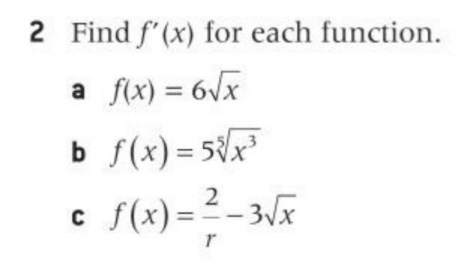
 harsh rampart
what?
viscid thistle
2/r is just a constant
harsh rampart
so ur saying derivative of 2/r is 0?
viscid thistle
yes
harsh rampart
then i have to find derivative of -3 sqrt x?
viscid thistle
yes
harsh rampart
how to know which variable we are solving with respect to?
not to r
because it f(x)?
harsh rampart
oh ok ok
 sour hemlock
poorly worded question
so, if I understand the question, increasing the rent on every tenant by 100 will decrease the total number of tenants by 10?
and we are only allowed to increase rent in increments of 100?
let x be the number of 100 increments made to the rent
(50 - 10x)(850 + 100x)
so I guess you could find the maxima of the above
gaunt mason
At 850$ the building is full with 50 apartment units.
So less than that is not optimal, and not needed to consider.
When increasing the rent from this point the appartment ocupancy decreases. The decrease is likely linearly, at a rate 10 units/$100.
let x be the number of 100 increments made to the rent
(50 - 10x)(850 + 100x)
@sour hemlock I think it is sligtly more clear to let x be the increase in $.
(850 + x)(50 - 10/100 * x)
 mystic umbra
you can increase the rent in any amount. the 100 per 10 is a rate
and yes this is a find the maximum
O = occupied units
U = units
V = vacant units
R = revenue
P = price of rent
R = P(U-V)
or you can say R = PO
we knot that V = (P-850)/10
because 100/10 = 10
so also O = U-(P-850)/10
R = P(U-((P-850)/10))
U = 50
maximize R = P(50-((P-850)/10))
so you find the zeros of the derivative. look at the graph. that's it.
willow bear
did you mean to say "i am asked to write these summations in sigma notation and i am struggling, please help me!"
 serene heath
simple typo
willow bear
@viscid thistle
viscid thistle
lmao
very simple typo
kk
lemme fix dat
i am asked to write these summations in sigma notation, and i'm not struggling im just challenging other people in this math server good luck.
willow bear
lmao
viscid thistle
@willow bear
quick mirage
im just challenging other people
@viscid thistle good one
 sand harbor
LOL
willow bear
sounds like you're trying to get ppl to do your hw for you
these are not challenge problems by any means lol
viscid thistle
smh
quick mirage
Okay, then why don't you tell me what these are in sigma notation
viscid thistle
ok
how do i write math stuff here?
really @willow bear
if their not challenging do them
eeeeeeeeeeeeeeeeeeexxxxxxxxxxxxxxxacccccccccccccctlyyyyyyyyy u have NO IDEA
quick mirage
If you need help man just say so
willow bear
$\sum_{k=-26}^{-18} \frac{k+27}{k+28}$ and $\sum_{j=100}^{119} \frac{1}{2(j-99)}$ respectively lol
obsidian monolithBOT
Ann:
quick mirage
LOL
viscid thistle
ur wrong
serene heath
based
willow bear
i'm not lol
viscid thistle
L
willow bear
these sigma notations are entirely valid for the sums you gave
willow bear
you did huh
quick mirage
Okay, so you want us to help guide you through the practice correct?
willow bear
i mean idk about you but i don't think it's a good move on your part to attack someone who, yknow
knows her shit pretty well in this branch of math
quick mirage
Respect goes both ways indeed
willow bear
i intentionally gave notations which are not the "canonical" or simplest ones, by the way.
be grateful i didn't use $\thonk$ or $\catthink$ as variables, cause i very well could've
obsidian monolithBOT
Ann:
quick mirage
Emojibra
viscid thistle
sry lol
 somber yew
Catthink in preamble 
uncut mulch
are you familiar with function notation?
viscid thistle
Ik its the way a function is written
uncut mulch
where are you stuck exactly?
viscid thistle
Well I have math dyscalculia and I dont remember how to do this specific problem unfortunatly
uncut mulch
if h(x) = x
h(🍌) = ?
viscid thistle

uncut mulch
if h(x) = x
h(1) = ?
h(2) = ?
h(a) = ?
this is supposed to test your basic understanding of the notation
viscid thistle
i dont know this, Im sorry man. I cannot rmbr for the life of me. I dont know what to plug in to what you just stated /:
uncut mulch
well if you start with
h(x) = x
to determine h(1) you could simply sub x=1
hence h(1) = 1
similar idea if you wanted to find h(2) or h evaluated at anyother value
h(🍎) = 🍎
h(🍌 ) = 🍌
as for your problem,
$f(g(x))$ could be obtained by replacing instances of $x$ in your $f(x)$ with $g(x)$ giving you:
$$f(g(x)) = \frac{g(x)-8}{g(x)+7}$$
obsidian monolithBOT
ramonov:
uncut mulch
and then use algebra to show that that simplifies to x
viscid thistle
Okay, I will work that out, then I will send what I have if that is okay
Can I solve for f?
@uncut mulch
uncut mulch
wdym?
uncut mulch
no
viscid thistle
sigh
uncut mulch
that is complete nonsense
g(x) is the function g evaluated at x,
and you are explicitly given the value of that
g(x) is NOT the product of g and x
viscid thistle
Sorry
uncut mulch
f(g(x)) is NOT the product of f g and x
north island
madre de dios
uncut mulch
this is FUNCTION notation
north island
cool it lol
uncut mulch
due to this poor understanding you should look up some youtube videos on it
viscid thistle
alright
 velvet blade
r's degree can be 1/2 also right?
velvet blade
So in polynomials, integer degrees are a must?
viscid thistle
that's how they are defined
north island
not just integer, gotta be natural number degrees i think
velvet blade
Why not rational degrees? Aren't we able to define it?
Or is it just out of the scope of this book?
viscid thistle
that's not a polynomial
north island
not all polynomials would have certain nice properties then
viscid thistle
not just integer, gotta be natural number degrees i think
yes correct my bad
velvet blade
Okay, so are there more general definitions of functions with multiple terms with different degrees?
north island
y'know, i've never really heard about them
i don't know what they're called, if there's a name for them
velvet blade
Okay. Another doubt: Is there a proof for when if you add one term to the other, it's degree doesn't increase?
Or is it trivial?
viscid thistle
one term?
velvet blade
Like, ax³+bx². Adding those two terms won't increase the degree right?
The degree of ax³
viscid thistle
the degree of the polynomial is the highest power in it
velvet blade
3•2³+6•2² = 3•2⁴ right? I was just thinking of some numbers that do this
Because there's this proof remark about how the leading coefficient doesn't change if you factor out one of a common factor in the terms
velvet blade
It holds for very few of the pairs, but the book said it can't happen, so this remark holds about polynomials
gaunt mason
@velvet blade I don't get it. It said what
velvet granite
5%
is the same at 5/100 @quaint mason
so its for 100 feet, the road goes down 5 feet
 quaint mason
how do u know its 100 feet tho
velvet granite
you kinda have to assume because they dont give you any other information
gaunt mason
100 feet is defined precisely.
The first sentence says 5% slope means that elevation_change = 5% * horizontal_distance_change
That is elevation_change = 0.05 * horizontal_distance_change @quaint mason
And in the next sentence the elevation_change (the descent) is said to be 5 feet.
So you put that into the formula from the previous line and you get the horizontal_distance_change
quaint mason
elevation change??
gaunt mason
What is unclear about these words?
elevation change is increase or decrease in elevation (height)
velvet blade
How do I do this?
velvet blade
fuck that was simple
better snap
instead of x-c, would x+c have worked to prove this?
if f(c)=0, won't a_0 =0?
<@&286206848099549185>
velvet blade
f(c)=0?
velvet blade
a_0 doesn't have x as a factor, so there's no way 'c' is multiplied by 'a' in that constant term
 fading token
To be clear that we're on the same page, you do realize that we have $f(c)=0=c^n+a_{n-1}c^{n-1}+\ldots+a_1c+a_0$, right?
is the bot ded

obsidian monolithBOT
Rijinaru:
 fringe stream
a_0 would be 0 only if c = 0
velvet blade
wait
fringe stream
is this the case?
velvet blade
Ok I misunderstood
Ok, so since all the coefficients are integers, and f(c)-a_0 = -a_0, that means LHS is divisible by a_0 and c is one of it's factors?
Or did I get it wrong?
fading token
$c^n+a_{n-1}c^{n-1}+\ldots+a_1c+a_0=0\implies -a_0=c(c^{n-1}+a_{n-1}c^{n-2}+\ldots+a_2c+a_1)$ i.e. $a_0=ck$ with integer $k=-(c^{n-1}+a_{n-1}c^{n-2}+\ldots+a_2c+a_1)$, and hence $c|a_0$
obsidian monolithBOT
Rijinaru:
fading token
Yes, you were trying to divide by $a_0$ whereas you want to prove that $c$ is a divisor
velvet blade
Okayy
obsidian monolithBOT
Rijinaru:
viscid thistle
How do I do this?
What have you tried so far
I tried making them into their own triangles and making a proportion
viscid thistle
Consider one specific trig ratio on the small one @viscid thistle
To get an specific side length so that we can use that length plus x, to use again another specific trig ratio to finally solve for x
@viscid thistle So would it be 93/53.7=93/x?
Why didn't you use the trig ratio
Idk what you did
Since the smaller triangle is a 60 30 one I thought that the smaller leg would be 93 divided by root 3
It is
But i mean
How did you got that eqn
53.7 is indeed the base of the small triangle correct
I didn't know how to do the trig ratio here
Now you can consider solving using
tan(30)=93/(x+53.7)
Do you understand why? The adj side of the big triangle is basically the 53.7 and the x together
I get it
From there it is just a point of algebra, i have to go, if you have any doubts ask away
Good luck.
thank you
I got it correct this time
 autumn marsh
26! ≡ 29 (mod n) I need help finding n
willow bear
presumably, n would have to be a divisor of 26! - 29
limber compass
@willow bear Thank you for helping me out yesterday 🙂
viscid thistle
Bro
im challenging u guys
what is the
good luck my fellows
theres no way any of u guys can solve this
if any of you guys do
u get a free pass to my belly
blissful ridge
How did you get the value of a_n??
blissful ridge
nth term of GP is given by
T_n=ar^{n-1}
viscid thistle
well no shit
willow bear
oh it's you again
viscid thistle
rude!
willow bear
??
obsidian monolithBOT
GTX1080Ti:
 amber linden
Ahhh, I got the right answer now. Thanks bro!
willow bear
please don't bro me