#precalculus
1 messages · Page 257 of 1
 harsh smelt
 glad pasture
i was not sure what RHS and LHS meant
harsh smelt
right hand side
and left hand side
basically LHS is what is to the left from <= (>= or = )and RHS is what from the right
glad pasture
I don't think it would be clear which side those equations would be on
harsh smelt
ok let me rewrite it
 obsidian monolithBOT
Commander Vimes:
harsh smelt
now assume a is nonnegative and b is negative
we have two cases
when a+b is >= 0
then we have a-|b| inside modulus
i mean for example |2+(-1)|=2-|1|=1
clear?
glad pasture
yea
harsh smelt
and on the right it would be still a+|b|
so we have for case a+b >= 0
a-|b|<=a+|b|
is it clear that this inequality will hold always?
glad pasture
yea i think i get it
harsh smelt
can you consider case a+b <0 analogously?
after you did it you have |a+b| <= |a|+|b| proved
and we will be able to proceed to main problem
glad pasture
ok thanks for the help
harsh smelt
but we have not proved that |a|-|b| <= |a-b| yet
glad pasture
i just wrote the explanation that if b is larger than a then |a-b| would be larger since |a|-|b| would be negative and |a-b| would always be positive
harsh smelt
it is wrong
can you write down complete proof for |a+b| <= |a|+|b| first?
like combine all what i ve shown
and then we will be able to prove |a|-|b| <= |a-b|
(i mean yes you can do proof by cases for |a|-|b| <- |a-b| but bruh)
 umbral sky
can someone help me with my hw?
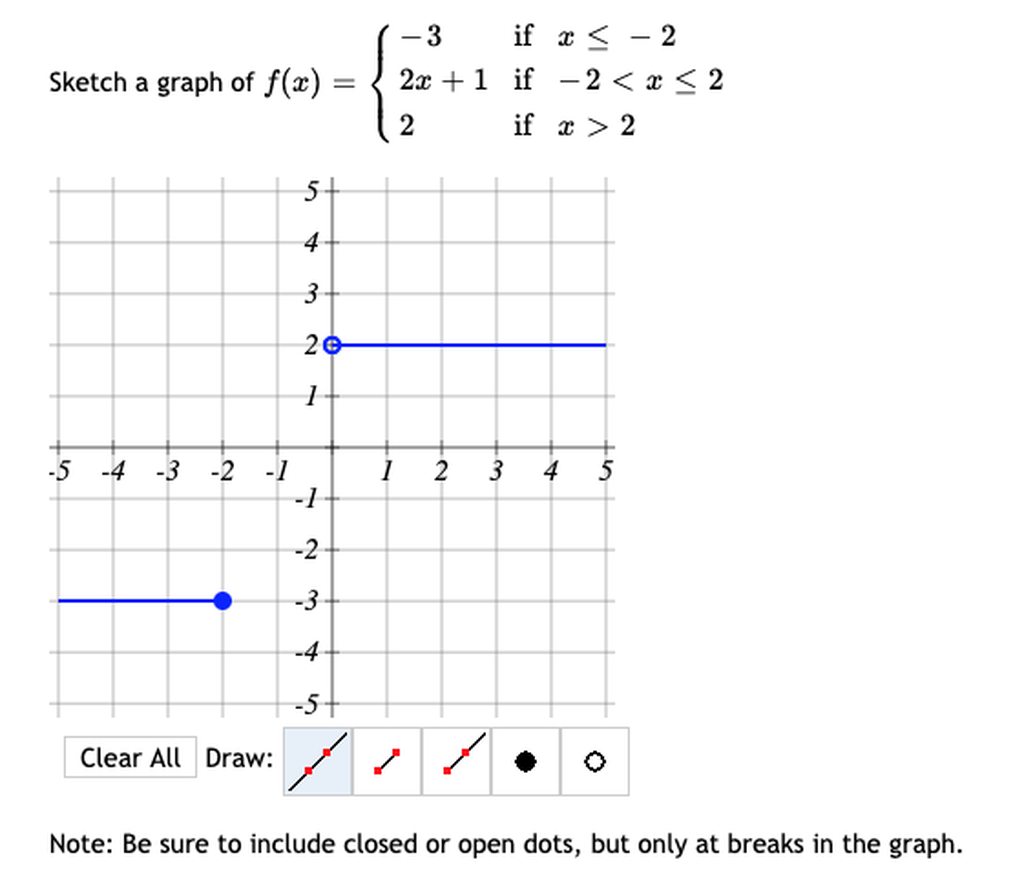
i have this so far but im confused for the second function
 umbral sky
y=2x+1 should go through (0,1) correct?
 uncut mulch
yes
umbral sky
I see, whats wrong with the 3rd function?
uncut mulch
what you have there is f(x) = 2 for x>0 (instead of x>2)
umbral sky
hmm i see, x is supposed to be greater than 2
would this be better
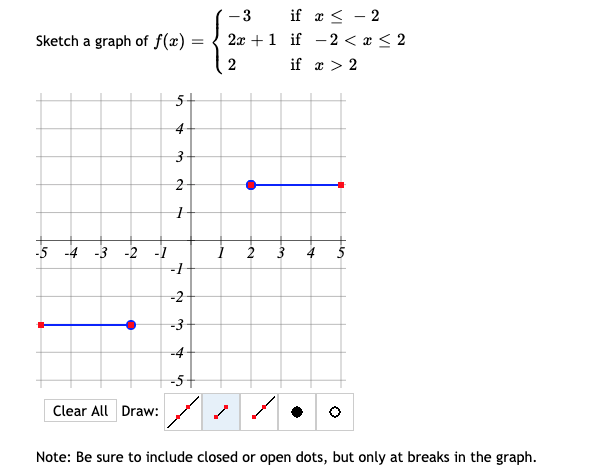
dont mind the red dots. it's an open circle too.
the -2<x<2, is that the same as x > -2 and x < 2
uncut mulch
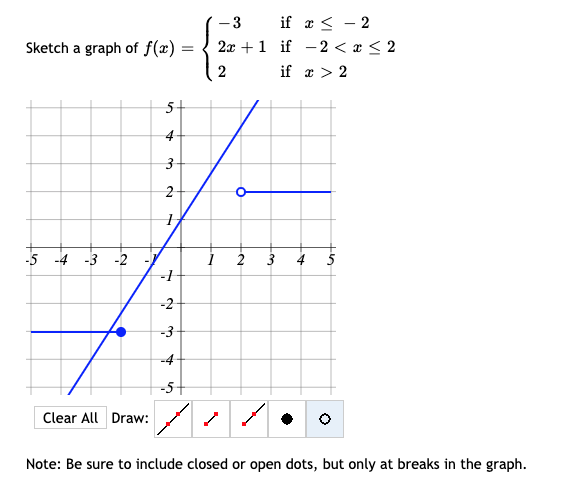
not sure on that system but are you using the 3rd line option when drawing?
 uncut mulch
no its not
you only need two points construct a line,
it is most convenient here to consider the boundaries,
i.e. looking at the value of 2x+1 when x=-2 and when x=2
and use the appropriate open/closed circles
umbral sky
hmm but the line doesnt go through -2 or 2?
uncut mulch
wdym
umbral sky
ohh nvm thanks i got it
could you also help me with a few more questions that im stuck on?
the -1 exponent, what does that do
 uncut mulch
denotes inverse
 hollow stirrup
guys
help?
to find the limit of 2 i have to find the limit from 2- and 2+
but the values when i calculate the y
makes me confused
uncut mulch
why is the limit from the left and right of 1 relevant here?
you can factorise the denominator then cancel and/or apply certain limit laws/properties
uncut mulch
x^2 - 4 is a difference of 2 squares
hollow stirrup
aha
 ornate wolf
what should i do since it say no real solution, i can't use inverse method?
 viscid thistle
think about intersection of lines
viscid thistle
Currently almost 5000 people
viscid thistle
An extraordinarily intelligent ape 
 hexed otter
So like
There is this question
Ellipse equation
The given are, vertices: (5,0) (-5,0)
Pass through (2,4)
Write it in standard form
I got confused on the the pass through part please help thanks!
 tardy ridge
if it passes through that point it'll satisfy the equation
obsidian monolithBOT
Albot1288:
Albot1288:
Compile Error! Click the  reaction for details. (You may edit your message)
viscid thistle
?
 ember crane
I would like to ask a question. May I?
 vital wedge
yeah go ahead?
ember crane
am I do this right? the question asks yo find the limit
vital wedge
@ember crane yeah your answer is good, i normally wouldn't have done it by dividing through by x^3 but that works!
ember crane
great! thnks~ @vital wedge
 novel cargo
you showed us the function of the position
 brisk fiber
sorry
novel cargo
that's definitly in meters
brisk fiber
my bad
brisk fiber
i didnt post the whole question
novel cargo
velocity is in m/s
brisk fiber
well i get that the distance is 97.408
and the time is 7
so wouldnt the answer be 13.91542 m/s
but im getting it wrong
@novel cargo
novel cargo
please show the whole question, where do you get 7 s?
brisk fiber
novel cargo
you must have learned derivatives, r?
 mighty onyx
For each angle below, determine the quadrant in which the terminal side of the angle is found and find the corresponding reference angle $\overline{\theta}$. You can enter $\pi$ as 'pi' in your answers. Do not use any space. You can round your answers to four decimal places.
obsidian monolithBOT
Albot1288:
mighty onyx
$\theta$ = 3 in quadrant I but what does $\overline{\theta}$ mean is this case?
brisk fiber
@novel cargo
obsidian monolithBOT
Albot1288:
novel cargo
what is the derivative you calced?
mighty onyx
oh In thought yall were done sorry
novel cargo
np
novel cargo
hahah
I make so many similar mistakes
dw
that's the reference angle @mighty onyx
mighty onyx
how would I find what the angle is?
novel cargo
gimme a sec
viscid thistle
in radiant?
novel cargo
viscid thistle
$3\approx \pi$
obsidian monolithBOT
HoboSas:
novel cargo
so, if it's 3 rad, it's in the second Q
also, the ref angle is pi - 3
look at the left most pic
@mighty onyx
mighty onyx
it says that it's in 1st quadrant
viscid thistle
3 degrees then
mighty onyx
it says it's wrong
novel cargo
show
mighty onyx
Don't worry about the others I use 6 as a place holder
mighty onyx
I thought of it like a graph and picked first quadrant because it was positive but then when it got to theta = 16 idk why it's in quad 4
and theta = -8 had to be in 2-4 because it had negative
I could be wrong as just got lucky but idk
novel cargo
have you checked other values in the quadrant input boxes?
I mean, do they show incorrect for any input?
or have you guessed all of them correct?
mighty onyx
The first one for quadrant 4 work I haven't checked the others. My teacher could have put it in wrong because he sometimes does that
novel cargo
look, if this is in rads (which I think it is because you are talking about pi in the question), then theta = 3 is in quadrant 2
this means that this question is broken, more or less
mighty onyx
let me try it as if it is in quadrant 2
yep he put it in wrong and pi-3 =0.1416 works
novel cargo
to work out the rest of the ref angles, look at the picture I sent you earlier
also, you can get extra credit by showing off that you found the bug
novel cargo
np
 terse ravine
@novel cargo This question is weird.
novel cargo
do you know about shifting?
terse ravine
I have infosheet on Transformation rules for functions.
That someone posted in here.
(x-5) is right c units and -2 is down d units.
novel cargo
nice
you almost answered the question
take the know point (3, -3) right and down by the specified vals
what do you get?
terse ravine
(8, -5)
novel cargo
yeah, this the only option IMO
I'm not sure if this would be always true tho
I mean provably true for all and any function
because the Q says "which ordered pair must be on the graph"
 dusk phoenix
novel cargo
dusk phoenix
novel cargo
what's the problem @dusk phoenix ?
viscid thistle
Hey I'm having a bit of trouble with this problem
i keep ending up with something that I can't factor
and I don't know if I'm just doing it wrong or what
 echo wagon
Show your work
viscid thistle
huh ok 1 sec ill write it down
like
subtract both sides by 1
take the second term, -8, divide it by 2 and then square it, you end up with 16
add that to both sides
now you have 4x^2-8x+16=15
i tried factoring the left hand i cannot
echo wagon
Your problem is the 4 in front of x^2, before you complete the the square you must factor out 4. Or because you have an equation, divide through by 4
echo wagon
You have to get rid of the 4 before you decide what to + and -
viscid thistle
oh
uh
so i would just divide the initial equation by like
4
and i would have x^2-2x+1/4
right?
viscid thistle
hm i just
yea i dont think this is working
i got x^2-2x+5/4=1
i cant factor the left hand side again
is there some trick that im missing
Okay so
Idk what kinda math this is
But I have a very specific problem
I have this equation
And it is supposed to Sequantially output digits of Pi
But
It outputs them as decimals, and I need outputs as integers
0 -> 3.1333333333333333
1 -> 0.12942612942612944
2 -> 0.04222052457346574
3 -> 0.02075533661740559
4 -> 0.012313749155854425
5 -> 0.008145077498205814
6 -> 0.005784671552865616
7 -> 0.004319630382142555
8 -> 0.0033482289236764964
9 -> 0.0026712052667351854
10 -> 0.002180579380761778
11 -> 0.001813703745553055
12 -> 0.0015322017344245025
13 -> 0.0013114985592049856
14 -> 0.0011352659599557589
15 -> 9.923110450969705E-4
16 -> 8.747532268239622E-4
17 -> 7.769139035694725E-4
18 -> 6.946173203983882E-4
19 -> 6.247373535173935E-4
This is the output
But
novel cargo
is this precalculus?
viscid thistle
I think so
Im not sure tho
This is for a CS project
Anyway
I need a Sequantial function that outputs digits of Pi accurately and as integers
For example
1st iteration = 3
2nd = 1
3rd = 4
Ect
viscid thistle
Not even programming
novel cargo
algorithm
viscid thistle
Im trying to design an ALU that uses an equation to calculate Pi in binarh Sequantially
I need a new equation
Binary*
terse ravine
Hmm
novel cargo
divide by 2
what are the angles in the interval 0 <= theta < 2pi for wich sin = -sqrt(2)/2
@terse ravine
novel cargo
Im trying to design an ALU that uses an equation to calculate Pi in binarh Sequantially
@viscid thistle this probably the wrong channel for this. Ask maybe in #discrete-math or the more advanced channels
viscid thistle
Okay
novel cargo
2 sin (theta) = -sqrt(2)
sin (theta) = -sqrt(2)/2 | divide by 2
which you basically got right
also, 7pi/4
obsidian monolithBOT
JakeHillman12:
viscid thistle
any help would be greatly appreciated 🙂
A hint would do nicely, how would I start solving this equation?
viscid thistle
this is the question
would you multiply the top and bottom by something, I'm confused
 blissful ridge
$\frac{x^{-2}-1}{x+1}=\frac{\frac{1}{x^2}-1}{x+1}$
obsidian monolithBOT
The Godfather:
blissful ridge
$\frac{1-x^2}{x^2(x+1)}$
obsidian monolithBOT
The Godfather:
blissful ridge
Now factorise the numerator and cancel out whatever you can
viscid thistle
Ah! Ok, thanks! 🙂
wait @blissful ridge (sorry for the ping!), how would you factorize the numerator??
blissful ridge
$a^2-b^2=(a-b)(a+b)$
obsidian monolithBOT
The Godfather:
viscid thistle
$$\lim_{x\to 0} 4x \cot(\pi x)$$
obsidian monolithBOT
JakeHillman12:
 hallow thunder
@viscid thistle maybe this will help: $$\cot(x) = \frac{1}{\tan(x)}$$
obsidian monolithBOT
jedben2:
viscid thistle
yeah but what is tan(0)
hallow thunder
0
hallow thunder
no
hallow thunder
what happens if you use this in the actual limit?
hallow thunder
$$\lim\limits_{x\to 0} 4x\cot(\pi x) = \lim\limits_{x\to 0} \frac{4x}{\tan(\pi x)}$$
obsidian monolithBOT
jedben2:
hallow thunder
what next? @viscid thistle
viscid thistle
is tan(pi*x) some sort of identity
viscid thistle
no?
hallow thunder
that would help here
viscid thistle
is there a way to solve this algebraically
hallow thunder
you could use a taylor series
but l'hopital's rule is easier
in my opinion
@viscid thistle this goes over it: https://en.wikipedia.org/wiki/L'Hôpital's_rule
 viscid thistle
Oh ok!
hallow thunder
you can use this here because plugging in 0 gives us a $\frac{0}{0}$ indeterminate form
obsidian monolithBOT
jedben2:
hallow thunder
@viscid thistle are you able to evaluate the limit now?
viscid thistle
Don't use L'Hopitals...
$$\lim_{x\to 0} \frac{4x}{\tan(\pi x)}=\lim_{x\to 0}\frac{\pi x}{\tan(\pi x)} \frac{4}{\pi}$$
obsidian monolithBOT
HoboSas:
viscid thistle
tan(f(x))/f(x) is a well know limit
 misty ocean
If cos(t) = 0.7 for a constant t, explain why cos(t + 6π) must also equal 0.7.
i dont get it
viscid thistle
$\cos(x+2\pi n)=\cos(x) \forall n \in \mathbb{Z} $
viscid thistle
Fuc
obsidian monolithBOT
HoboSas:
viscid thistle
It's late
viscid thistle
Hey, this may not be suitable for pre calculus, but can anyone please help me find a design and equation for this question? It the "wrap up problem" part
terse ravine

 rigid beacon
ember crane
rigid beacon
ember crane
from step 3 to step 4 is confusing, that is mathematically possible?
someone explain step 3 to step 4 please
 simple edge
Split the fraction into two simpler limits. If you multiply the expressions in step 4 you get step 3
 mossy tiger
I'm in precalc right now and I just have a question so I don't mess up in the future. I am trying to find the domain of a rational function.
How do I solve for -x^2-11x-30
there's a -x^2 so do i factor -1 out?
 onyx wharf
you can factor -1 out sure
 bleak lance
 livid turret
hi
trying to find vertex of this parabola and i get (2,8) but calculator says its -1,9
uncut mulch
show work
livid turret
i made mistake bc i did the 2 in 2a as an exponent
 willow bear
as r approaches 0
the value of the limit cannot involve r
@marsh idol can you show your work for this problem
 marsh idol
Im not exactly sure how to do this, need someone to explain
willow bear
i would begin by finding the coords of the intersection point of your two circles
or maybe even before that, you could write down the equations of the circles
to then find the intersection point from those
marsh idol
yes, i can do that
willow bear
once you have the coords of the intersection point you can write down the equation of the line
all in terms of r of course
and then find its x-intercept
also in terms of r
and once you have that, you can then take the limit as r -> 0
viscid thistle
Is the limit 0?
willow bear
no
marsh idol
ok thanks, I'll get back to you once ive done these
willow bear
anyway the problem really isn't that hard, it just requires a little bit of calculation but not much more than that
that doesnt sound right at all
no
viscid thistle
After applying l'hopital
willow bear
...bruh
 boreal geyser
||Uh the limit is 0 though right||@willow bear
willow bear
no it's not
boreal geyser
Lmao I can't do algebra mb
 proven marten
Oh, hello @boreal geyser
boreal geyser
Hey bby
 stiff oracle
Can someone explain to me how log9(cos2x+2) is equal to log3√(cos2x+2)
 lime bolt
log_a^2(b^2)=log(b^2)/log(a^2)=2log(b)/2log(a)=log_a(b)
 strong ermine
what are roots of unity and what are they used for
i have hw but we didnt get that far into notes
so i am a little stuck
lime bolt
the n^th roots of unity are the n solutions to x^n=1
strong ermine
um can you give an example?
its hard for me to understand cuz its a little abstract for me
lime bolt
well they are all exp(2kiπ/n), from k =0,1,..n-1
 pure delta
I am not sure if this belongs here.. but:
"For every x> 0 we consider the quadrilateral Q with vertices A (x, 0), B (0,1), C (-x, 0) and D (0,1). When the centers of the sides of this quadrilateral connect, we obtain a rectangle R. Calculate algebraically the limit of the ratio of the circumference of these two figures as x approaches 0"
I hope someone could help me out!
tardy ridge
D=0,-1
?
ratio of circumference?
well one perimeter is 4sqrt(x^2+1), the other one is 2x+2
 tough shell
viscid thistle
tough shell
viscid thistle
 rigid sun
pythagoerean theorem
viscid thistle
huh
rigid sun
what is csc(x)=?
viscid thistle
1/sin
rigid sun
ok
viscid thistle
so sin theta is 4/7
viscid thistle
x/r
adj/hyp
im so confused
@rigid sun are u trolling?
I doubt he’s trolling
 warm nebula
you can find the value of tan if you know the values of sin cos and tan using pytahgoreous therom
rigid sun
look at your formula sheet
or try to think of one
which one can you use
there's quite a few
how about this one
sin^2+cos^2=1
do you have that one?
viscid thistle
yea
rigid sun
ok
viscid thistle
Now use it
rigid sun
and solve for cos
viscid thistle
^^^
At which point you will have acquired tan(theta)
Make sense @viscid thistle ?
what does the restriction do
0<theta<pi/2
theta is an angle between 0 and 90 degrees (first quadrant)
That’s all it says
i got tan theta = 4/sqrt(33)
is that the final answer?
or do i do soemthing with that
angle
i rougly recall having to find multiple answers to a set
warm nebula
it should only be that 1 step. the restriction makes tan positive if you mean that as a second step
viscid thistle
so tan can be negative here because its +/ when u root both sides
+/-
?
i used to know this stuff
haven't done it in a year
and kinda freaking out
warm nebula
the first quardrent is (+) for all values how could it be negative
you dont need to calculate the root just make sure the value is true to the condition
 limber heath
Can someone explain this to me?
viscid thistle
yes
you multiply the negative by
FOILing
(-) * 4 = -4 and (-) * -r = +r
so you get -4 + r
FOIL = First Outside Inside Last
its the distributive property when multiplying with variables
does that make sense (-) * (-) = (+) and (-) * (+) = (-)
thats the minus-plus rule
brackets mean multiplication
limber heath
I'm getting -4 - r because (-) * (4) = -4 and (-) * (-r) = +r so it's (-4) - (+r) = -4 - r
viscid thistle
its (-) * 4 and (-) * (-r) not (-) * (-) and then -*r)
you don't seperate - and r
-r is one componenet
 blissful kayak
When you just see a floating negative sign, just think of it as -1**r*
limber heath
I'm lost
blissful kayak
And when you see something like the expression you were given at first (-(4-r)), you can just switch the terms inside the parenthesis and that will cancel out with the negative out front
viscid thistle
valk ur over complicating it
blissful kayak
So you can rewrite -(4-r) as (r-4)
viscid thistle
-4 is - * (+4)
blissful kayak
Yes
viscid thistle
so when you multiply another - it cancels out the negative and leaves you with +
I hope that clarifies
blissful kayak
Just like any negative number squared yields a positive number
limber heath
I believe I figured it out now. There is a invisible 1 before the brackets. -1 * (4 - r) = -4 + r
blissful kayak
Exactly!
limber heath
and something like this would be 5 − (4 − r) = 5 - 4 + r right?
blissful kayak
Mhm
limber heath
okay that's confusing because it's acting as both subtraction and multiplication but ill just roll with it
blissful kayak
But that's because that 5 out front isn't being multiplied by anything else
limber heath
thanks
blissful kayak
Ye!
limber heath
what are you taking right now?
viscid thistle
what does it mean to solve by inspection?
am i meant to just magically think of the value?
viscid thistle
i mean 2 is the answer but how do u show steps
for that crap
or what do u write
cos(pi) = -1
blissful kayak
My friend came up with something
I'm not completely sure how he got it, but he says it's also 2
"-1≤19-5x²≤1 and then find the possible set for x
-2≤x≤2 we get
And put in values 2 and -2 so you get the answers.
The answers are x=-2 or 2"
He basically composed the cosine into its set of values for x
tardy ridge
you solve it by inspection because |cosx|<=1
there aren't many integers to guess.
theren't
blissful kayak
theren't
@tardy ridge Good language my freind
*friend
how on earth do you do this?
@viscid thistle Oh these are pretty fun!
So basically when you have composite inverse Trigonometric functions, it's best to construct a right triangle using the value inside the inverse function
And since it's arccosine/inverse cosine, it's the adj/hyp
And that's enough to construct a right triangle with a leg of 9, a hypotenuse of 10, and another leg of √19 (Pythagorean Theorem)
And then what we do from there is we just find the tangent of this triangle we constructed, so opp/adj
And we get that to be √19/9
viscid thistle
what happens with the inverse?
 quick mirage
might as well do this step by step
tan(cos^-1(9/10))
= sin(cos^-1(9/10)) / cos(cos^-1(9/10))
= sqrt(1 - (9/10)^2) / (9/10)
= sqrt(1 - 81/100) / (9/10)
= sqrt(19/100) / (9/10)
= sqrt(19) / 10 * (10 / 9)
= sqrt(19) / 9
blissful kayak
:3
quick mirage
i think this is what it is lol
blissful kayak
That's my result also
 feral monolith
I did (a) but dont know how to do (b)
blissful kayak
No Trig?
feral monolith
no
blissful kayak
Awh...
feral monolith
I only learned how to do A so I dont really know what to do for B
quick mirage
pythagorean theorem seems to be all you need here
 elder junco
Yeah
quick mirage
length = x, height = sqrt(x)
feral monolith
ohh
quick mirage
hypoteneuse = sqrt(length ^2 + height^2) = sqrt(x^2 + sqrt(x)^2) ) = sqrt(x^2 + x)
feral monolith
i thought i would need to use the distance formula to get measures
quick mirage
perimeter = length + height + hypoteneuse (a + b + c)
= x + sqrt(x) + sqrt(x^2 + x)
feral monolith
Thanks!
quick mirage
no problemo
quick mirage
@fiery wren i believe the function is in lowest terms
 fiery wren
dude
i JUST submitted my quiz
and that was the only thing
i got wrong
LOL thanks anyway
viscid thistle
I can't seem to get this question to work using y=ax^2+bx+c
it doesn't return a quadratic
i get a=0
how is it done
c = 5
4 = a +b +c
3 = 4a +2b +c
a+b = -1
4a+2b = -2
2a+2b = -2
4a+2b = -2
-2a = 0
a = 0
b = -1
but that makes no sense cus it needs to be a quadratic
anyone knows?
tardy ridge
then it is not a quadratic.
viscid thistle
but the question says it is
and when i use that equation it doesn't intersect with the first point
viscid thistle
how do i find a quadratic that passes?
its not asking for linear
am i missing something?
tardy ridge
then the question is probably wrong.
 lethal oracle
Alright I’ll help
tardy ridge
linear eq. could be considered quadratic for some people.
tardy ridge
0x^2+bx+c?
viscid thistle
why do some ppl consider linear quadratic
tardy ridge
I don't know
lethal oracle
Ya you’re right about it being linear
tardy ridge
the question probably just messed up.
tardy ridge
I don't blame him for messing up if it is a mess up because imagine having a PHD and writing quadratic questions.
lethal oracle
No
viscid thistle
sheiit
x^2 + y^2 -18y +75 = 0
and then how would u write that in acceptable form if there are 2 variables of y with different powers?
lethal oracle
Wait sorry you’re right
viscid thistle
oh okay
lethal oracle
I misunderstood you
viscid thistle
lethal oracle
correct
viscid thistle
from y = sqrt(6) -x +9
how did u get that?
oh nvm
i see
ur right
can u show steps?
@lethal oracle
im having trouble getting to it
lethal oracle
ya give me a sec
viscid thistle
Is that abs value
 flint spruce
I think they just want you to define absolute value
ornate wolf
Given two planes:
7x+8y+5z= 0,
7x+8y+5z= d,
Suppose the distance in between the two planes is 12 and d> 12, find d
This means two planes are parallel since their normal are parallael
what should i proceed with?
viscid thistle
Do these look right?
willow bear
f(g(x)) is ok, g(f(x)) isn't
terse ravine
I thought it would take 2pi but it doesn't like it
viscid thistle
That's correct but there's an easier angle
 hidden willow
just did math homework and im not very confident, can someone check it and maybe help if i got any wrong, not asking to cheat
viscid thistle
Sure just post
blissful kayak
Yes
 agile owl
,w (x-2)^{4}

 uncut mulch
not quite.
roots
 bitter basin
i got it
 plain root
anyone here good at pre calc and would we willing to do a voice call
to help me w my homework
 brisk ruin
is this correct
@bitter basin Useful hint: complex roots always appear in conjugate pairs. So if 1+i is a root 1-i is also a root
willow bear
complex roots always appear in conjugate pairs.
this only applies to polynomials with real coefficients
which is the case here, but it's worth pointing out
brisk ruin
Ah of course. Thanks for clarifying 👍
 left fable
Yep and also, it the polynomial is of odd degree, there is at least a real root.
 patent junco
Working with Parametric Equations. Question is asking if there is a difference in the equation if b was 1 more than a instead of vice versa. I've ended with both:
2cos(t) and 2cos(-t). How are these different? I am drawing a blank atm
y(t)=2con((2-1)t) and y(t)=2con((1-2)t)
willow bear
cos(-t) happens to be the same as cos(t)
i'm not sure what your question is tho like
can you show the exact wording
willow bear
wait ok so like
so point 5 is to examine the case where b = a+1?
so $x(t) = a\cos((2a+1)t), y(t) = a \cos(-t)$
obsidian monolithBOT
Ann:
patent junco
I have just been assuming it's if we switched around a and b, where we use a=1 and b=2, instead of vice versa
but his wording is always weird
viscid thistle
How do you do this?
viscid thistle
@viscid thistle still need help?
viscid thistle
f(x) = [[x]] is the "greatest integer" function. The range of f(x) = x - [[x]] is:
I believe it is 0, but this is a multiple choice quiz and 0 isn't one of the options.
@viscid thistle have you tried anything?
Also you need a or b?
@viscid thistle quiz?
No its online homework
I believe it is 0, but this is a multiple choice quiz and 0 isn't one of the options.
My bad. It online homework. May of said quiz because I'm not used to hw being multiple choice.
viscid thistle
Have you tried anything?
viscid thistle
@gritty stratus
 gritty stratus
Hi no not yet I’m not sure where to begin
gritty stratus
👍
viscid thistle
Post what you get
viscid thistle
,rccw
obsidian monolithBOT
viscid thistle
We don't want to express cos in terms of sin
So you should have $\frac{\cos²(x)}{\sin²(x)}-\cos²(x)$
obsidian monolithBOT
Al𝟛dium:
gritty stratus
👍
tardy ridge
it should be -1 anyways.
viscid thistle
Now proceed with multiplying on the numerator and denominator by sin²(x) on the -cos²(x) to have the same denominator
Post what you get
gritty stratus
Is this what u mean?
 past meadow
,rccw
obsidian monolithBOT
gritty stratus
Ohh
viscid thistle
It is also known as common denominator
gritty stratus
viscid thistle
You know you can multiply the numerator and denominator by the same thing because it's basically like multiplying by 1, because they cancel
Okay good job
Now basically $\frac{\cos²(x)-\cos²(x)\sin²(x)}{\sin²(x)}$
obsidian monolithBOT
Al𝟛dium:
viscid thistle
Can you try to continue from here?
If not, tag me and we can continue
You are basically 2 steps from getting to cot²(x)cos²(x)
gritty stratus
Yay I solved it tyty
tardy ridge
for f inverse of 5 it's asking when the graph is hitting y=5
for the second one, it's asking when the graph is hitting y=f(11)
viscid thistle
what are the steps
tardy ridge
5=f(x)
tardy ridge
it's asking when the graph is hitting y=f(11)
viscid thistle
its asking for the y value?
tardy ridge
the definition of f inverse, first, f only has an inverse if f(x)=f(k) if and only if x=k
second f(x)=y, then f inverse of y= x
viscid thistle
what is f(k)
tardy ridge
f inverse of some number is asking what x value makes it output that number
f inverse of 5 is asking what value of x makes f(x)=5
k is some other value.
viscid thistle
what do i do from here?
or did i do something wrong
@tardy ridge
I can see that x=4 from just looking at it
but how do u do it though
like steps instead of just examining
 umbral cloud
Hey guys
viscid thistle
hi
viscid thistle
what is E
is this ur question?
x^2 + 1 = 2x
first step is to arrange it into ax^2 +bx +c form
then here I see it's a perfect square
viscid thistle
lol
umbral cloud
Not that the question
viscid thistle
what's e
umbral cloud
Wait XD
I know it in French dude.. Sorry..
But... Here is a hint
If x € [1;2[ then E(x) = 1
😂 I hope that it was simple as you wrote
tardy ridge
x=4 by inspection
viscid thistle
how to do it without inspection?
actually lets go to 2
f^-1(f(11))
you set y =12 + ln(8)
or did i understand wrong?
viscid thistle
wait so its the same as a?
viscid thistle
f^-1(5)
i made f(x) = 5
then solved
wait
right?
so ur saying i want to now find what make f(x) = 11
tardy ridge
yeah sorry I meant f(x)=f(11) instead of that
viscid thistle
oh so i make it 12 + ln(8) = 1 + x + ln(x-3)
tardy ridge
you can get the answer directly from f(x)=f(11)
viscid thistle
ah yes
cus they cancel out
but im still solving by inspection
is there a better way for when the questions get harder?
umbral cloud
No dude not like that...
tardy ridge
I'm saying this will help him understand the material.
viscid thistle
bruh how u gonna do my uni like that
umbral cloud
Look...
Here is an exemple...
let x=0.6
the x^2+1=1.36
And 2x=1.2
Then E(x^2+1)=E(2x)=1
viscid thistle
f^-1(f(x) is a cancellation equation
tardy ridge
uni doesn't teach pre calc.
viscid thistle
bruh i know that
tardy ridge
yes that's right, only if f(x) is 1:1 correspodence.
tardy ridge
yes
viscid thistle
what year
tardy ridge
can't tell you.
viscid thistle
im first year and cus we had corona before midterm i slacked off heavy in math
so i didnt really learn the content
umbral cloud
Well XD...
I'm not French but...
It's like I'm studying the last year in highschool
umbral cloud
Thx bruh
tardy ridge
muka who are you talking to?
viscid thistle
@umbral cloud
I dont understand where I went wrong
I got a 3/6 are my answers right
umbral cloud
1/ E
2/ D
Idk the answer of the last question cause I have not studied the exponential function yet...
Sorry
 unborn mist
dont think you can get a closed form solution so id suggest doing it numerically
 shy salmon
I have a super difficult question
@viscid thistle answer is pi
and its the only answer because the function is inversible
viscid thistle
Don't give away answers. The point of this server is to make them to understand it.
@viscid thistle do you still need help anyways?
gritty stratus
blissful kayak
Graph it...
blissful kayak
That looks right to me
gritty stratus
Ok tyy
blissful kayak
Ye!
uncut mulch
,rotate
obsidian monolithBOT
uncut mulch
$\cos\br{-3\theta + \frac{\pi}{2}} = -0.16 \
-3\theta + \frac{\pi}{2} = 2k\pi \pm \arccos(-0.16)$
obsidian monolithBOT
ramonov:
uncut mulch
where k is an integer
gritty stratus
Ooo
uncut mulch
solve for theta and generate the solutions in the interval using appropriate values of k
gritty stratus
Okok thank
 severe bison
gritty stratus
severe bison
gritty stratus
 obsidian monolithBOT


 Requested by Sneaky#0928
 olive quartz
@gritty stratus if you are still on that here is what u need to do
256 can be expressed as 4^4
x^4 + 4^4
You won’t be able to do this with reals cause you’ll need a sum of squares here
viscid thistle
hey
obsidian monolithBOT
abcdefg:
 agile moat
$\sqrt[4]{-256}=x$
obsidian monolithBOT
abcdefg:
agile moat
$x=(2+2i)\sqrt{2}$
obsidian monolithBOT
abcdefg:
willow bear
congratulations you missed three of the four solutions this equation has in C @agile moat
agile moat
+/-
 opaque olive
quick question. ive got $\frac{dy}{dx}=\frac{-(8x+16y+24)}{16x+2y}$ the numerator lets me find out the stationary points, what does the denominator mean again?
obsidian monolithBOT
Yes:
opaque olive
points where its parallel to the y axis was it?
 shadow plaza
Those would be the points where denominator tends to zero
points where its parallel to the y axis was it?
@opaque olive i hope by "it", you mean tangents, right?
 spring thunder
@umbral cloud déso je dormais à 2h du mat
t'y es presque, le problème c'est quand tu ajoutes les deux inégalités
le raisonnement ne marche que dans un sens
si je te dis qu'il y a deux réels a,b tels que 1<a<2 et 3<b<4 alors oui on aura 4<a+b<6
mais si je te dis que a+b est entre 4 et 6 c'est pas forcément le cas que a est entre 1 et 2 et b entre 3 et 4
c'est ça le truc, oui si x est solution alors x est dans (0,2) mais tous les x dans (0,2) ne sont pas forcément solution
ça te permet de réduire grandement là où tu dois regarder
tu passes de checker tous les réels à checker dans (0,2)
maintenant il suffit de regarder quels nombres dans (0,2) sont effectivement solution
et ça c'est assez facile tu peux raisonner par cas
opaque olive
@opaque olive i hope by "it", you mean tangents, right?
@shadow plaza lol yep xD
lime bolt
so basically u are looking for the term with degree -7, so when multiplied by x^7 is constant term. looking purely at the exponents, you can solve simultaneous equations for a+b=7, and -3a+4b=-7, yielding b=2. now u can just look at the binomial coefficient and solve for k.
(the 4 and -3 here come from the x^4 and x^-3 in the binomial expansion, and u are only interested in the term i mentioned, and obviously a and b are the exponents in the binomial thing)
 scenic slate
im sorry I don't understand why the -3a+4b=-7 instead of 7
lime bolt
because u want the exponent to be -7
scenic slate
so the -3a refers to the x that is a denominator and the 4b refers to the x^4
lime bolt
yea that is where the -3 and 4 came from
the a and b are terms in the binomial expansion
well not terms but exponents from the expansion
lime bolt

scenic slate
I got to this point: 84 x X^8 x K^5 = X^8 x 168
scenic slate
ohhh I tried doing it in multiplication so the it would be K x X^-3
lime bolt
it would still be x^-15 which is the same thing
but yea the whole point is so that the overall effect is 1/x^7 so the x's cancel and leave constant term
scenic slate
why did you do 1/x^7 though?
like wouldn't you have to multiply/divide all "terms"
and why did you divide the "K" by 4?
lime bolt
multiplication is commutative
scenic slate
if you multiplied the X^7 wouldnt you have to do the same with 168?
lime bolt
bruh have u read the question
it is saying the term that is constant equals 168 not some random one, and we are muliplying our whole equation by x^7, so u obvioulsy need the one with x^-7
i have already said this
scenic slate
ohh so when we multiplied the X by their coefficients they got cancelled out and therefore it is K^5/2^2= K^5/4?
scenic slate
when we multiplied -3 by 5 and 4 by 2 so that it would be X^-7 and therefore cancel the X^7 which is outside of that bracket
so the remaining is K^5 x 2^-2
lime bolt
well yea obviuolsly that is the point in the question
lime bolt
yea the exponents in that binomial thing
opaque olive
What does constant term mean
lime bolt
x^0 coefficient
opaque olive
Oh i see
scenic slate
hold on I need help again
(X^4/2)^2 so does that mean the numerator is multiplied so it would be 2X^4/2^2
lime bolt
bruh
scenic slate
yo im just here for help
ohh do the exponents(powers) multiply
so it would be X^8
viscid thistle
does anyone know how to solve this question?
my answer is always bigger than the actual answer
Maybe I just dont get what this means but what is this?
Like what is this question asking
viscid thistle
@viscid thistle are u sure ur supposed to put brackets
I see brackets outside the question
willow bear
@viscid thistle why did you put a second pair of parentheses there lol
viscid thistle
Oh pffft I’m dum
 wicked hearth
Can you cancel the x’s?
gritty stratus
How do I get from the first part to second part
obsidian monolithBOT
A brief description and guide on how to use me was sent to your DMs! Please use ,list to see a list of all my commands, and ,help cmd to get detailed help on a command!
tardy ridge
,rotate
obsidian monolithBOT
gritty stratus
@tardy ridge ok thank u
strong ermine
any help is appreciated