#precalculus
1 messages · Page 249 of 1
 viscid thistle
We never said that
 grim sand
I know
 uncut mulch
you may be misrepresenting them
grim sand
Probably 😔
viscid thistle
Yeah, x is equal to 1 is far different from saying that 1x is the same as x
viscid thistle
If you insist, yes
uncut mulch
()
grim sand
How’d u turn x into 0
uncut mulch
you don't
viscid thistle
Please remember to read all my messages, i will repeat myself.
We use x+3=0 to solve for the values of x that make the denominator 0
viscid thistle
Yes.
grim sand
So for example if it was 100/x+100
viscid thistle
You can see clearly that when x=-3, the function does not exist
grim sand
I can still do
uncut mulch
and that is the value you should exclude from the set of reals
viscid thistle
He doesn't know what reals is, so i refrain from using that word yet lol
uncut mulch
parentheses though
viscid thistle
^
uncut mulch
\verb|100/x+100| reads as $\frac{100}{x} + 100$
 obsidian monolithBOT
ramonov:
grim sand
Oh
viscid thistle
And make it x=-100
@grim sand but this logic was correct tho
grim sand
Oki
viscid thistle
x=-100 is not on the domain
viscid thistle
Good
uncut mulch
using appropriate grouping symbols in plain text trains understanding of order of operations which is why we're so strict on it
viscid thistle
Now one last example before anything: Domain of $y=\sqrt{4x+2}$
grim sand
using appropriate grouping symbols in plain text trains understanding of order of operations which is why we're so strict on it
@uncut mulch what
grim sand
So that would be
viscid thistle
It's different from the fraction
uncut mulch
properties of the square root
viscid thistle
Okay, answer this question: what an sqrt can't take to receive a real solution
grim sand
Negative numbers
grim sand
That equation has no negatives tho
viscid thistle
Remember $\sqrt{0}=0$ has no problems with it
obsidian monolithBOT
Al𝟛dium:
viscid thistle
Ok?
grim sand
Ok
 undone pawn
That equation has no negatives tho
the equation has an x in it though.. and for specific values of x, the thing inside the sqrt may become negative
grim sand
Oh
uncut mulch
$\sqrt{\text{you want this to be greater or equal to 0}}$
obsidian monolithBOT
ramonov:
viscid thistle
Use your logic here, remember what an sqrt CAN take instead
grim sand
It can take 2
undone pawn
weird this is something that shouldve been explained in class
viscid thistle
Generalise a bit more
viscid thistle
Reposting it
obsidian monolithBOT
Al𝟛dium:
uncut mulch
it can take a lot more numbers than 2, and rather than check infinitely many values,
set up an inequality
grim sand
How do I square root 4x
viscid thistle
"ask the function what values can it take" remembering it has an sqrt
viscid thistle
Try to generalise
grim sand
Yes?
uncut mulch
huh?
grim sand
4x+2>0
viscid thistle
But not the x or 2 cuz there is no square root of 2 or 1
@grim sand there is a solution for it, √2 is not a perfect square
4x+2>0
Almost
grim sand
4x+2<0
viscid thistle
Remember that $\sqrt{0}$ has a solution
obsidian monolithBOT
Al𝟛dium:
uncut mulch
getting colder.
undone pawn
yep
obsidian monolithBOT
Al𝟛dium:
uncut mulch
you can shorten that to >= in plain text
grim sand
Ok
viscid thistle
Try to solve for x
viscid thistle
Yes.
So NOW you know that the function $y=\sqrt{4x+2}$ can only take values of x such that x≥-1/2
obsidian monolithBOT
Al𝟛dium:
grim sand
How do u know if it’s > or <
@grim sand I’m still a bit lost on this one
X has to be bigger than -1/2
So
[-1/2, INF)
uncut mulch
*greater or equal to
viscid thistle
You have to use your logic, you are asking what values of can it take, which are positive or 0, so it's only ≥0 and not ≤0 because ≤0 would mean negative numbers or 0
uncut mulch
if you can describe it in words,
replace words with the appropriate mathematical symbol
viscid thistle
You have to use your logic, you are asking what values of can it take, which are positive or 0, so it's only ≥0 and not ≤0 because ≤0 would mean negative numbers or 0
Addressing your question of ≤ or ≥
viscid thistle
Nonono, that has nothing to do with the symbol
uncut mulch
$\sqrt{\blue{\text{this}}}$ \
i want "\blue{this}" to be greater or equal to $0$ \
$\blue{\text{this}} \geq 0$
obsidian monolithBOT
ramonov:
grim sand
How would it look if you wanted it to be less or equal to 0
How would the equation look*
viscid thistle
$\frac{1}{\text{this}}$ i want to check for the values of this that make the denominator 0
obsidian monolithBOT
Al𝟛dium:
viscid thistle
How would it look if you wanted it to be less or equal to 0
Use your logic about which values the thing can take or not
viscid thistle
Usually if its fractions and sqrt, you won't have to deal with <0 or ≤0
grim sand
So most of the time I only have to use > or >=
 echo wagon
The inside of a square root always has to be $\geq 0$, but when you simplify the inequality, you could end up with $\leq$ or even $<$. Example: For $\sqrt{-x} $, we require $-x \geq 0$ which would become $x \leq 0$
obsidian monolithBOT
Lunasong:
echo wagon
Yes
grim sand
Ah ok
So it always starts with >= or >
Unless it’s negative (the x)
Then u flip it
echo wagon
Yeah, you can still start with >= and then simplify inequalities as you always do
echo wagon
$\sqrt{-\frac{1} {x} } $
obsidian monolithBOT
Lunasong:
echo wagon
Almost, but one more thing is needed
grim sand
[0,INF)
viscid thistle
Okay well wait a sec
echo wagon
[0,INF)
@grim sand these are positive numbers, this does not correspond to x<=0.
viscid thistle
I'm gonna clarify it
grim sand
Since it’s -1/x
And ur flipping it
Don’t u multiply
Making it 0
But because it’s negative
It turns into a positive
So it’s still
echo wagon
X<= 0
@grim sand this i almost right, but something is off
Since you are dividing by x, x cannot be 0
echo wagon
Yes
echo wagon
Lol, I'm not that creative, but I'll try
viscid thistle
Okay i'm gonna generalise to clarify it as water: 3 examples $$\frac{1}{x-4}$$ A denominator can't be 0, so we are looking for the value of x that makes it equal to 0: $$x-4\mathbf{=}0\implies x=4$$ so x=4 is not on the domain
$$\sqrt{x-4}$$ We are gonna look at the values of x that make the sqrt to be positive or 0, because we know that an sqrt does not have a real solution for negative numbers. $$x-4≥0\implies x≥4$$ then for values less than 4, it will make the sqrt to be negative, see it yourself, take x=3 $\sqrt{3-4}=\sqrt{-1}$ no real solution.
$$\frac{1}{\sqrt{-2x+3}}$$ be careful of this one, we have a fraction AND a sqrt. Remembering which values a fraction can't take (so 0) and which values the sqrt CAN take (positive numbers and 0), we have to find the intersection of both, so it'd be ≥0 BUT we know that the denominator can't be 0 so it's only $>0$ $$-2x+3>0\implies -2x>-3\implies x<\frac32$$ so the domain will be (-inf, 3/2)
Okay PLEASE read everything
echo wagon
$\sqrt{x^2}$
obsidian monolithBOT
Lunasong:
echo wagon
Read Al's message then try my question
grim sand
The picture is gone
viscid thistle
Now
grim sand
I don’t know how to do that ^2 yet
viscid thistle
Last fix
obsidian monolithBOT
Al𝟛dium:
viscid thistle
Those are the 3 examples
viscid thistle
Glad to hear
grim sand
Can u give me an example for me to solve rn
viscid thistle
Your problem lol
grim sand
Also @echo wagon I don’t know how to do that ^2 yet
viscid thistle
No7
grim sand
I thought we already solved that
echo wagon
How are you doing square roots without knowing what squares are? Hmm
grim sand
Lmao
How are you doing square roots without knowing what squares are? Hmm
@echo wagon I don’t know 😔
viscid thistle
Oh yes we finished it true
echo wagon
@echo wagon I don’t know 😔
@grim sand Bizarre. $x^2 = x \times x$
obsidian monolithBOT
Lunasong:
viscid thistle
A harder one $\frac{\sqrt{x}}{\sqrt{3x-2}}$
Focus on the denominator with sqrt first
And then the sqrt above
viscid thistle
I don't remember lol
grim sand
Square root can take 0 and greater than 0
viscid thistle
It's been 2h
echo wagon
What was your problem?
echo wagon
Yes
grim sand
So the equal to symbol is gone
echo wagon
Good job
viscid thistle
Yes
echo wagon
You little liar though
grim sand
So it’s x>1/2
viscid thistle
You successfully understood my big text
echo wagon
In question 8 I see a square
grim sand
Yes cuz it had examples
viscid thistle
So it’s x>1/2
@grim sand yeah
grim sand
Yes
echo wagon
I mean if you're expected to answer that question next, then you should already know what squares aren't
grim sand
I only learned now how to use > and < correctly
I mean if you're expected to answer that question yet, then you should already know what squares aren't
@echo wagon I’m supposed to from last year
viscid thistle
Using logic
grim sand
But I haven’t had math since beginning of sophomore year
So I really dont know anything
echo wagon
Ah, okay
viscid thistle
The website is wrong if you remember
grim sand
(1/2,INF)
viscid thistle
Glad to hear
obsidian monolithBOT
Al𝟛dium:
viscid thistle
If you get this one, you are gonna feel super-accomplished
grim sand
X>2/3
viscid thistle
Focus on the denominator with sqrt first
And then the sqrt above
viscid thistle
X>2/3
Okay yes
grim sand
I just completely ignored the top
viscid thistle
We have to do the square root on top too?
Yeah
echo wagon
Both square roots have to be defined. You're right, but I think only by accident, haha
viscid thistle
Yeah lol
grim sand
Yeah I think I got it right by accident
How do I do the top square root
I just went straight to the bottom
echo wagon
When is it defined?
grim sand
When it’s greater than 0
echo wagon
Or equal
grim sand
But it’s a fraction?
echo wagon
But the numerator can be 0
viscid thistle
Bc it's not in the deno anymore
echo wagon
0/ 1 is just 0. 1/0 is not defined.
grim sand
So there’s a lot of logic
viscid thistle
You'd have to find the intersection between both
viscid thistle
Intersection between x≥0 and x>2/3 is just x>2/3 lol
@echo wagon ur helping out a lot
...
viscid thistle
Im kidding lol
viscid thistle
Just been here for >2h...
echo wagon
Yeah, wtf, my five minutes here was way more helpful than your two hours. Get outta here, Al
viscid thistle
Honorable mentions: Ramonov
viscid thistle
Finding the "intersection"
grim sand
What’s that
viscid thistle
What i do with those is to imagine a real number line
Like the video did
Know what it is?
echo wagon
Let me try to dumb it down again: You need both $x \geq 0$ and $x > \frac{3} {2} $ to be true. But if $x > \frac{3} {2} $ then it is also true that $x \geq 0$. So you combine those by just saying $x > \frac{3} {2} $
viscid thistle
Let me just link a vid lol
obsidian monolithBOT
Lunasong:
grim sand
It keeps disappearing
echo wagon
Because I am changing my mistakes lol
viscid thistle
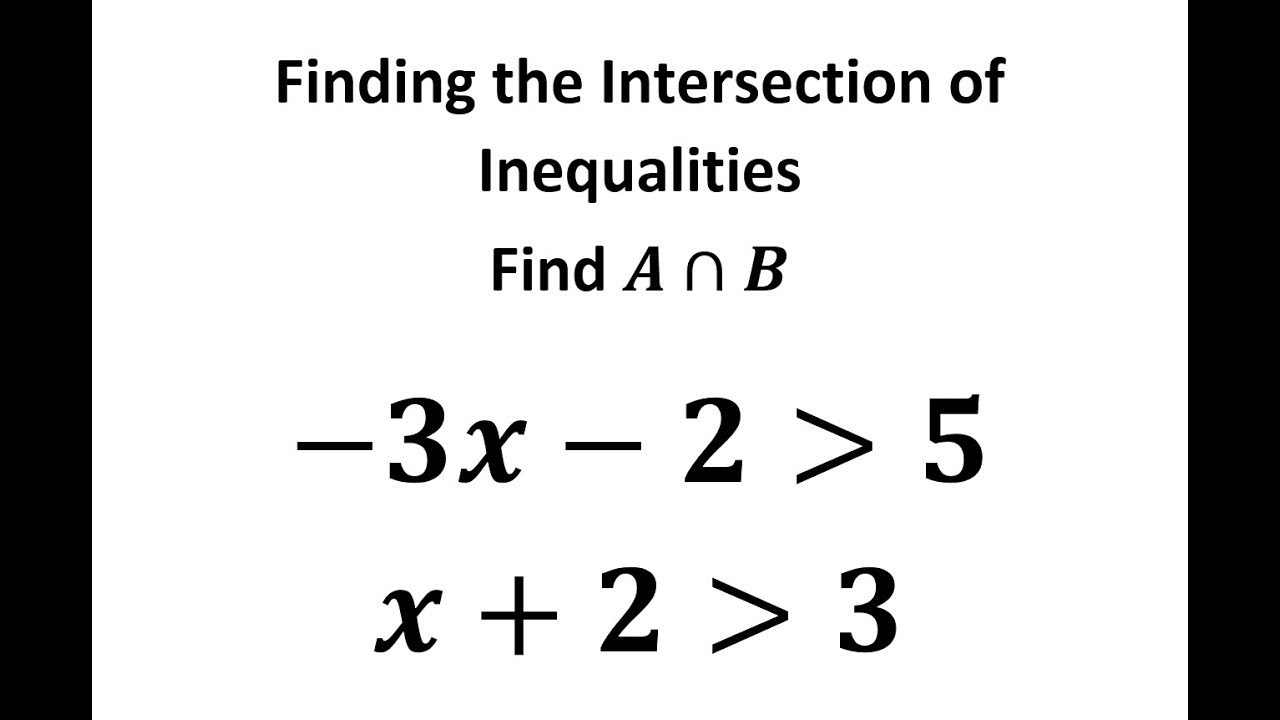
This video covers one example on how to find the intersection when given two sets.
Like, Subscribe & Share!!
If you have a suggestion for a video that I don't have, please let me know in the comments or email me at khernandez.mathvids@gmail.com
What i'm interested in for you are the last seconds of solving the inequalities
Not the process
The real number line thing
obsidian monolithBOT
Al𝟛dium:
grim sand
I’m sorry but
I can’t pay attention to her
She moves too much and my attention drifts
And I forget what she says
viscid thistle
That is the real number line
You can find the intersection pretty easier by drawing it
Okay ig ill find another vid
grim sand
Ok I saw the end part
echo wagon
Combining inequalities can get pretty complicated with more inequalities, and sometimes they can't be combined, so it's difficult to explain the whole process over text. A picture is definitely the way to go.
grim sand
What if it doesn’t have anything in common
viscid thistle

This algebra video tutorial provides a basic introduction into interval notation. It explains how to express the solution of an inequality using a number line and interval notation. Examples include compound inequalities. You should use the parentheses symbol next to an inf...
echo wagon
Like x >= 4 and x <= 2? Then there are no solutions.
grim sand
So it’ll just be called no solution?
viscid thistle
For more grasping on notation
grim sand
And I can’t do the x y thing with it
viscid thistle
So it’ll just be called no solution?
No intersection between them
So yeah no solution
grim sand
Oh but I can still do the domain
But it’ll be 2 domain
Is this right
I’m pretty sure it is right cuz they both end at 5 yes
echo wagon
Yes, good job
viscid thistle
Yep
grim sand
Yus
 novel cargo
yeey
grim sand
I can’t
novel cargo
oh
grim sand
I lose enthusiasm if I take breaks
viscid thistle
So for range, do you know what the inverse of a function is?
grim sand
I haven’t even eaten breakfast lol I’m so intrigued by this
viscid thistle
LOL
viscid thistle
Oh that's great
viscid thistle
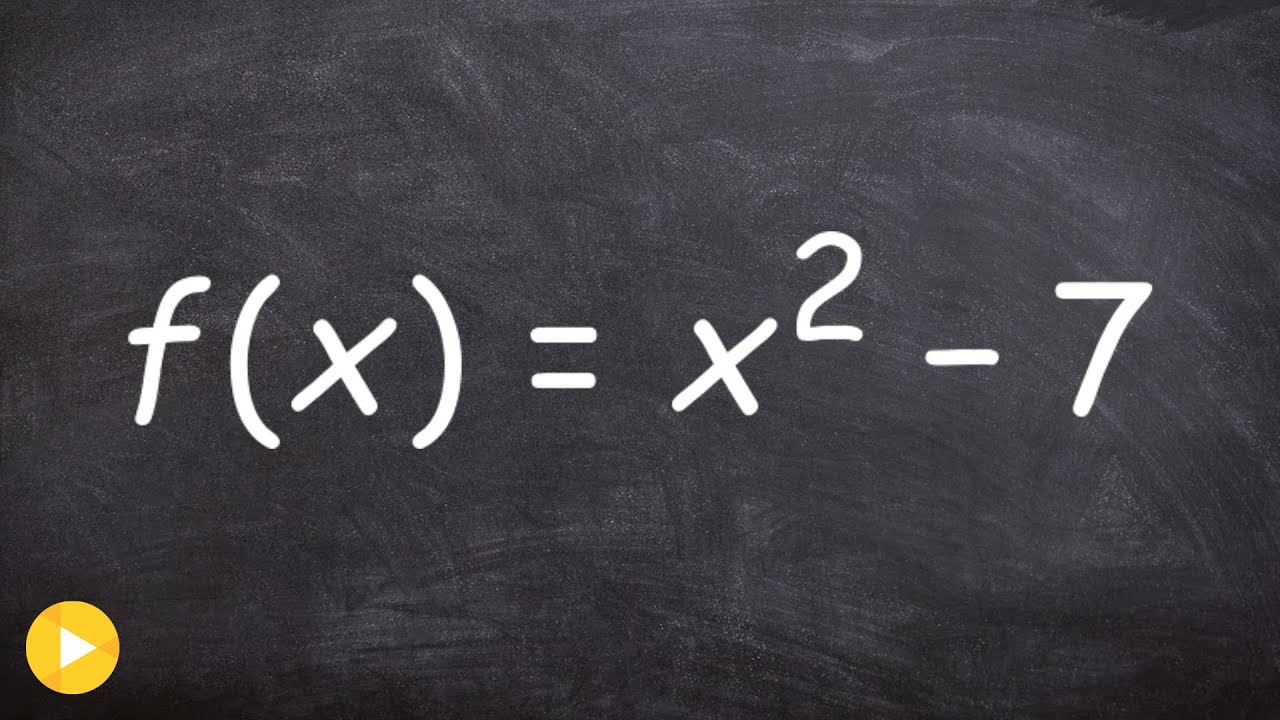
Learn how to find the inverse of a quadratic function. A quadratic function is a function whose highest exponent in the variable(s) of the function is 2. The inverse of a function is a function which reverses the "effect" of the original function. One important property of the...
I'm like too exhausted to write lol
viscid thistle
Indeed
viscid thistle
That's what i call passion
echo wagon
QED means you are smart
viscid thistle

grim sand
My mans talking faster than sonic can run
grim sand
So for domain I only knew how to do it on growth
Graph*
But now I think I understand equations
But range
I know how to do equations how do I do graphs
echo wagon
You just did it on a graph
viscid thistle

This precalculus video tutorial explains how to find the domain and range of a function given its graph in interval notation. The domain represents all of the x values in the function and the range represents all of the y values. You should use parentheses for open circles a...
lmao
At this point, whatever
grim sand
Lmao u just got every vid in a folder or something
viscid thistle
Lol i just look range by looking at the graph literally
grim sand
So u just graph it
@echo wagon
Can u dumb this down
So since it’s fraction
It can’t be equal to 0
viscid thistle
Yeah
echo wagon
Do you know what the U means?
viscid thistle
Nono
grim sand
Union
viscid thistle
Its a fraction
grim sand
Or something like that
viscid thistle
Without sqrt
echo wagon
Do you know what union means?
echo wagon
Union means x can be in the first thing or in the second thing
viscid thistle
Verbally, union means "or"
grim sand
Verbally, union means "or"
@viscid thistle yes this is what I mean by dumbing it down
viscid thistle
Or it is used to glue things lol
echo wagon
So $x \in (1,2) \cup (5,6)$ means $x \in (1,2)$ or $x \in (5,6)$ so $1 < x < 2$ or $5 < x < 6$
viscid thistle
No one said that
echo wagon
Do you understand that example?
viscid thistle
He doesn't know what in means maybe
grim sand
What’s that E
obsidian monolithBOT
Lunasong:
viscid thistle
Nope
grim sand
Oh
echo wagon
The e means x belongs to that set
viscid thistle
You need to dumb it down more luna
grim sand
Yes
viscid thistle
He's not that level yet
echo wagon
Dumbing down is my specialty
grim sand
😂
viscid thistle
echo wagon
Do you know what sets are and that domains are sets?
echo wagon
A collection of numbers (or other things) is a set
The set (3, 5) is the collection of numbers between 3 and 5
grim sand
So 4 works in there
echo wagon
So when you say $x \in (3,5)$ it means x is in that set so it is a number between 3 and 5
obsidian monolithBOT
Lunasong:
grim sand
So what’s the U for
echo wagon
Union means you are putting two sets together, so you are combining all the things that are in either set into one collection
grim sand
Lmao
So for example x E (3,5) can be shown as 3<x>5
And if u put U and a random set
It’ll be the same thing
echo wagon
So (3,5) is the numbers between 3 and 5, and (8,9) is the numbers between 8 and 9 so $(3,5) \cup (8,9)$ is all the numbers that are between 3 and 5 or that are between 8 and 9
viscid thistle
Almost
obsidian monolithBOT
Lunasong:
echo wagon
Or 3.5 or 3.111 or 8.999 etc
echo wagon
But yes, all those numbers belong to the set
grim sand
Oh that’s easy to understand
So now I know what U means
So now back to the fraction
It’s not x>0?
viscid thistle
Remember my big text
echo wagon
So in your question, they want you to write the domain as a union
grim sand
viscid thistle
May i repost?
grim sand
I saved ur big text
viscid thistle
LMAO
grim sand
viscid thistle
Look at the first example then
echo wagon
That is because you can't write it as one interval. So you have to use two intervals and combine them into one with union
viscid thistle
$\frac20$ does this exist?
obsidian monolithBOT
Al𝟛dium:
grim sand
So it’s x>0
viscid thistle
No, why you are going back to inequalities
echo wagon
So it’s x>0
@grim sand why?
grim sand
Oh so it only works for square root
echo wagon
Can x be -1?
viscid thistle
You can see it yourself x=1 exists perfectly
grim sand
Yes but Itd just be a negative
viscid thistle
$\frac21=2$
obsidian monolithBOT
Al𝟛dium:
viscid thistle
You are getting confusing Luna lol
x>0 is greater
Positive numbers not negative
grim sand
So any number but 0 works
viscid thistle
Yes
grim sand
So [INF,0) U (0,Inf]
viscid thistle
Bc it's parens
echo wagon
Yes, but always use round brackets for infinity
viscid thistle
Wait no
grim sand
Oh
viscid thistle
Yeah ^
grim sand
Now I understand U
Cuz I was like
“If it can’t be 0 but It can be positive and negative then how tf do I do everything but 0”
Then that’s where the U came in my mind
I was like
Oh yea
echo wagon
So you can't always combine inequalities, sometimes you have to end up using union because there are two different parts to the domain
echo wagon
Of what I said?
grim sand
Yes
echo wagon
Lol, like what you did here
You couldn't write the domain as one interval
So you have to use two intervals and take their union
echo wagon
Do you know what 3^2 means?
viscid thistle
Yeh
viscid thistle
Do you know the identity (a+b)²?
grim sand
For range don’t I just have to do inverse functions
Have you worked with parabolas?
@echo wagon I probbaly have
Probably*
But I don’t remember the names for them because there’s so many names
echo wagon
It's the graphs that almost look like the union sign lol
grim sand
Yes
grim sand
Yes I work with that
viscid thistle
Or even this
obsidian monolithBOT


 Requested by Al𝟛dium#4084
echo wagon
Requested by Al𝟛dium#4084
echo wagon
And do you know what the turning point of a parabola is?
grim sand
The highest/lowest point of the parabola
echo wagon
Right
viscid thistle
Ding ding ding
echo wagon
Okay, so you know the parabola can go up or down right?
grim sand
Yes
echo wagon
If it goes up, then all the y values above the y coordinate of the vertex is in the range
Does that make sense?
echo wagon
I meant range
echo wagon
And if it goes down, then all the y values below the y coordinate of the vertex are in the range
So to find the range of a parabola, you need the vertex and you need to know if it's going up or down
echo wagon
Graphing it works, but how would you find out what the vertex is to draw it?
grim sand
obsidian monolithBOT
Lunasong:
echo wagon
Do you know that?
grim sand
Yes
echo wagon
Okay
Now, the form they gave it to you in is not the standard form, it's called the vertex form because it automatically gives you the vertex
If $y = a(x-p)^2 + q$ then the vertex is $(p, q) $
obsidian monolithBOT
Lunasong:
echo wagon
Does this ring a bell?
echo wagon
No
viscid thistle
Almost
echo wagon
Remember there is x - p already in the bracket, and just p is the x coordinate
So if it's x - 3, then what is p?
grim sand
3
echo wagon
Yes
viscid thistle
Yesyesyds
grim sand
So they don’t touch the -
echo wagon
The what?
viscid thistle
And if you see a +7 then the p is just -7
echo wagon
Yes
grim sand
Oki
viscid thistle
Because -(-7)=+7
echo wagon
A short explanation: anything squared is always greater than or equal to 0. Do you agree?
echo wagon
So if you have a(x-p)^2 then the smallest it can be is 0
grim sand
Yes
echo wagon
Well the smallest the first term can be is 0, so if you add q the smallest it can be is q
grim sand

 grim sand
Oh
echo wagon
If x > 0 then x + 5 > 5, right ?
grim sand
Yes
echo wagon
It doesn't matter
viscid thistle
getting out of road
grim sand
So I won’t ever see it in an exam or something
echo wagon
Oh, it could happen
I mean it does not affect the fact that the smallest value is q
I'm not saying the smallest value of p and q is q
viscid thistle
No
echo wagon
I should clarify a little. I made a small over simplification
grim sand
Huh
viscid thistle
Okay i think this is getting out of road
grim sand

echo wagon
So if a(x-p)^2 >= 0 then a(x-p)^2 + q >= q
@echo wagon This is true if a is greater than 0
If a is less than 0 then q is the biggest value
viscid thistle
Like, out of what we need you to know to solve the problem
echo wagon
That's true, but I think motivation for why the vertex form gives the vertex is good
viscid thistle
Yeah maybe
echo wagon
Let me give one more attempt, and then you can ignore me if it doesn't make sense
echo wagon
Anything squared is >= 0
viscid thistle
Let me give one more attempt, and then you can ignore me if it doesn't make sense
Okay gl
grim sand
No
echo wagon
Does that make sense or not at all?
echo wagon
We are adding q to both sides of the inequality
In the same way if x > 0 then x + 5 > 5
echo wagon
So if a > 0, then q is the smallest value of a(x-p)^2 + q
grim sand
Yes I understand now
echo wagon
If a < 0, then the sign of the inequality flips and the biggest value is q
Also, when do you get that biggest/smallest value? When the first term is zero. So when x - p = 0 or x = p
So the vertex is (p, q) because p is the value of x that makes the first term 0, and then gives you the biggest/smallest value q
viscid thistle
,w 4x²+x-1 & -4x²+x-1
obsidian monolithBOT
 Requested by Al𝟛dium#4084
viscid thistle
Requested by Al𝟛dium#4084
viscid thistle
Look how a>0 and a<0 changes
grim sand
It flips
echo wagon
Okay, so the vertex is (3,-3)
And the parabola is going downwards
And we said if it goes downwards, then all the y values below -3 is in the range
So what's the range?
viscid thistle
That looked like the meme
grim sand
(INF, -3]
echo wagon
Yes!
obsidian monolithBOT
 Requested by Al𝟛dium#4084
echo wagon
Requested by Al𝟛dium#4084
echo wagon
And if the parabola was going upwards and the vertex was at (7, 6), what would the range be?
viscid thistle
We want to have a visual perspective here
grim sand
6,INF
grim sand
7,INF
echo wagon
No
viscid thistle
No
grim sand
Oh
echo wagon
For what values of x is (x-7)^2 + 6 defined?
grim sand
0
echo wagon
Only for 0?
grim sand
Infinite
echo wagon
What does that mean?
grim sand
Any number
viscid thistle
All real numbers or (-inf, inf)
echo wagon
Yes!
viscid thistle
Better
grim sand
Since it’s a parabola
It doesn’t end
Yes
The graph just keeps going
So both the X values will be infinite?
echo wagon
So the domain of a parabola is always all of R (unless the domain is restricted, and if you don't know what this means, don't worry)
What do you mean both the x values?
viscid thistle
Yeah that's how parabolas are, the vertex acts like the symmetry line
echo wagon
Fight
 proven marten
Isnt that the axis of symmetry though
grim sand
What is a symmetry point
echo wagon
The line through the vertex is the axis of symmetry
grim sand
So the tip is the axis of symmetry
echo wagon
The line through the vertex is the axis of symmetry
@echo wagon the vertical line
grim sand
Smart people arguing and I’m just here like
👁️👄👁️
proven marten
The x coordinate yes is the axis of symmetry
echo wagon
You say a point can't be an axis, but now you want an x coordinate to be an axis. Hmmm
proven marten
What
grim sand
I’m lost here
echo wagon
Smart people arguing and I’m just here like
👁️👄👁️
@grim sand anyway, you understand the range now?
Nevermind, haha
grim sand
I understand range for that
But now I don’t understand domain for it
Just when I thought I understood domain
grim sand
So it’s just always infinite for a parabola?
echo wagon
So what does the set of all real numbers look like as an interval?
proven marten
Could you understand that the vertex x coordinate is either the maximum or minimum point of a parabola
grim sand
Infinite
echo wagon
Write it as an interval
undone pawn
oh woah this is still going on
grim sand
They’re confusing me with their arguing
echo wagon
Not on the same question
proven marten
We're not arguing !
undone pawn
oh nice
grim sand
With their debate
echo wagon
We're not really arguing, and we aren't 'arguing' about the range
So focus on the range
proven marten

echo wagon
How do you write the set of all real numbers as an interval?
echo wagon
(something, something)
undone pawn
ah philosophy
What are real numbers
proven marten
TOK
echo wagon
Real numbers are just numbers as you are familiar with them
proven marten
Lol
echo wagon
So what does the set of all numbers look like?
proven marten
^
grim sand
They always either look like (1,1) or x=0
echo wagon
What do you mean by that?
grim sand
Yes 😃
Umm
Sets of numbers are those groups right
So it would just be (number, number)
proven marten
Its going to be hard for him to determine the interval for real numbers without him knowing the defintion
undone pawn
I dont think they're comfortable with set notations and what "infinity" means in this context
grim sand
What does that even mean
proven marten
Do you know what
undone pawn
cause a while back we were discussing about domains of functions and similar issues cropped up
proven marten
infinity is
grim sand
Yes
echo wagon
@grim sand Okay, you know (1, inf) is all the numbers greater than 1, right?
proven marten
cause a while back we were discussing about domains of functions and similar issues cropped up
@undone pawn harvest
echo wagon
And (-inf, 1) is all the numbers less than 1
proven marten
No, that is not how intervals work?
undone pawn
right see they're getting confused by set notations and cartesian points
grim sand
Oh
uncut mulch
i knew it
undone pawn
which ramonov tried to clear up earlier
uncut mulch
hah
grim sand
Confused here with all the big words..
undone pawn
understandably so
proven marten
Imma head out, too many people explaining
undone pawn
someone needs to explain to you the whole idea of sets
grim sand
Luna explained it
undone pawn
it's unfortunate that they use the same notation as points though
uncut mulch
it depends on context really. with proper context, there shouldn't be a huge issue distinguishing whether parentheses notation is being used to represent a point or interval
echo wagon
@grim sand What they mean is, on the curve y = x^2, (2, 4) is a POINT on the curve. This refers to a specific point with two coordinates. But (2,4) as an interval is the set of all numbers between 2 and 4. These are written in the same way, but are not the same thing. Do you understand that?
undone pawn
ok yep that's right
proven marten
goodu
undone pawn
I thought it was X and Y
not sure why you got confused in the middle then
grim sand
@grim sand What they mean is, on the curve y = x^2, (2, 4) is a POINT on the curve. This refers to a specific point with two coordinates. But (2,4) as an interval is the set of all numbers between 2 and 4. These are written in the same way, but are not the same thing. Do you understand that?
@echo wagon yes
echo wagon
Okay, good
echo wagon
Now, for the domain of a parabola, I'll just tell you what it looks like because maybe you haven't seen it before. The domain is (-inf, inf). Can you see how this would mean x can be any number?
viscid thistle
Good
echo wagon
Yes, so the set containing all numbers is written as (-inf, inf)
So that's the domain
proven marten
(smaller, bigger)
viscid thistle
Only 2 ppl max here please.
proven marten
I count 3 without me anyways
undone pawn
lol
viscid thistle
Everyone wants to help, but we can confuse him
undone pawn
I'll just lurk
viscid thistle
So only me and Luna as always
grim sand
Yes
echo wagon
Remember how (-inf, 1) means everything less than 1 but there is no limit to how small it can be? And (1, inf) means everything bigger than 1 but there is no limit to how big it can be. Now (-inf, inf) means there is no limit to how big or how small it can be. It's just the way we write intervals. If there is no limit to how small it can be, we have a -inf first, and if there is no limit to how big it can be, we have a +inf second
viscid thistle
(0, inf) would only mean x>0
viscid thistle
We want to include negative numbers too
echo wagon
I don't know what line you are talking about
grim sand
And so -INF would be the left and inf would be the right?
The one that’s pointed on by the arrow
echo wagon
That's the parabola
grim sand
So the domain
echo wagon
The domain isn't the parabola, it is the collection of all the x values on the parabola
grim sand
Okay so the range is just from the vertex to the bottom
echo wagon
Yes
echo wagon
Can you remember your previous domain exercise where it was like [-3, 3]?
grim sand
So the domain is all the X on the parabola
echo wagon
Yes
echo wagon
That's just how we write it, really. Because it fits how we write other intervals
grim sand
Can I get an example 😀
viscid thistle
^
grim sand
Like this
echo wagon
All parabolas have the same domain, so can't exactly give a different example
echo wagon
Yes
viscid thistle
y=4(x+3)²+3
grim sand
Oh that’s easy
viscid thistle
No
grim sand
Negative 3
echo wagon
And the domain of every straight line is also (-inf, inf) because x can be any number. Any function where x can be any number, the domain is (-inf, inf).
grim sand
(-inf, inf) also called R or all real numbers
@viscid thistle what’s the exact definition of real numbers
viscid thistle
Also explained by "x² doesn't give any problems in the domain"
grim sand
y=4(x+3)²+3
@viscid thistle
So vertex is (-3,3)
Range is [3,INF)
Domain is (-inf, INF)
Yes
😀
echo wagon
Real numbers are just all the numbers you know at this point. There are things called complex numbers, but you don't need to worry about it yet. Just know the reason people specify real numbers is to make sure people know they are talking about the normal numbers that you know and not the complex numbers.
echo wagon
Complex numbers allow you to take square roots of negative numbers.
grim sand
Oh thats confusing
viscid thistle
don't worry yet about complex numbers
echo wagon
But let's not digress too far now
viscid thistle
Btw the set of real numbers is represented as $\bR$
obsidian monolithBOT
Al𝟛dium:
grim sand
Oki
obsidian monolithBOT
 Requested by Al𝟛dium#4084
echo wagon
Requested by Al𝟛dium#4084
echo wagon
So $\bR = (-inf, inf) $. They are the same thing.
obsidian monolithBOT
Lunasong:
 echo wagon
What?
viscid thistle
Nvm
viscid thistle
You'd graph it getting key points
viscid thistle
Lol i knew it
 willow bear
$\bR = (-\infty, +\infty)$
obsidian monolithBOT
Ann:
undone pawn
lmao
echo wagon
Haha, I know. I use inf, because that's what they have to type in for their solutions
echo wagon
Yes
grim sand
Wether it’s -A or positive A
viscid thistle
Yeah the coefficient of x²
echo wagon
Step 3) If there are x or y intercepts, find them
And then draw just connect the dots in the right shape
Whether a is positive or negative
grim sand
How do I keep it going
echo wagon
You can't keep going forever obviously
Just add arrows at the end to show that it keeps going
viscid thistle
You can draw an arrow at the end of each branch
grim sand
Oki