#precalculus
1 messages · Page 244 of 1
 narrow peak
 willow bear
$\log_{10}(x)$
 obsidian monolithBOT
Ann:
 uncut mulch
underscore{base}
willow bear
this is how you do subscripts longer than one character in general
 stuck lark
,rccw
obsidian monolithBOT
willow bear
$\log_2[(5x+3)^2] - \log_{5x+3}(2) = 1$
obsidian monolithBOT
Ann:
willow bear
discord ate the underscores
narrow peak
shitcord
willow bear
aight hold up now
uncut mulch
i mean the notation sucks, but based on context its reasonable to assume that the exponent apples to the (5x+3) and not the log function
willow bear
i might have missed a two turning itself into a four somewhere.
narrow peak
yes u did
mr ramanov found it
i squared the entire thing cuz my algebra glitched
xd
 viscid thistle
@narrow peak did u got answers
narrow peak
i got it alr
viscid thistle
-1/5 guess
 opaque olive
Quick question $\sqrt{9-x^2} = 3-x?$
obsidian monolithBOT
Yes:
stuck lark
not equivalent
opaque olive
ok thanks
 fleet yew
Lmao!
I'm not trying to make fun of you but that is pretty funny
I think that's called "undergrad's dream" or something
viscid thistle
How is that not Equivalent?
fleet yew
You cant distribute a power over a sum
willow bear
@viscid thistle (a+b)^2 ≠ a^2 + b^2 and sqrt(a+b) ≠ sqrt(a) + sqrt(b).
viscid thistle
 viscid thistle
$(a+b)^2 = a^2 + b^2$ in some rings
obsidian monolithBOT
polynomial:
 harsh smelt
i can define (a+b) be identically zero and get this but what for are you saing this
 proven marten
Vimes, pls fix your english
willow bear
@viscid thistle we get it you know what a ring of characteristic 2 is now get out of this pre-uni channel
viscid thistle

 heady jewel
 gloomy path
 yikes
yikes
 serene heath
cringe
willow bear
@serene heath https://media.discordapp.net/attachments/359052581022203914/733247653651152906/fb52961e754540acce550b281276750a.gif

 long crown

opaque olive
$\sum_{k=1}^{n}(\sqrt{k}-\sqrt{k-1})$
obsidian monolithBOT
Yes:
opaque olive
can i evaluate this with the summation formula?
 lime bolt
bruh it just telescopes
opaque olive
wdym
lime bolt
the middle bits all cancel
lime bolt
what formula do u mean
opaque olive
 lime bolt
this isnt an arithmetic sequence
opaque olive
oh ok
fleet yew
@sage lake try -2
 sage lake
I don't think that's it chief
fleet yew
@sage lake try 2
sage lake
nope
fleet yew
Try 1
sage lake
nope
fleet yew
Try -1
sage lake
Should've gotten an intel chip
fleet yew
Bro its called the rational root test
sage lake
what happens if it's not rational 😭
fleet yew
That is probably the case
sage lake
sooo AMD what do I do
fleet yew
Is there a specific method your teacher wants you to use
Because i mean if you just need the answer you could plug it into wolfram alpha
If you really want to solve this by hand you'd have to do it numerically
 steady kernel
$n$ is a positive integer and $p$ is a polynomial such that $p(x+1)-p(x)=x^{4n}$ for all $x.$ How do we prove $p(1-x) \ge p(x)$ for $0 \le x \le 1/2$? Suggest a better channel if polynomials do not fit here.
obsidian monolithBOT
aadfg:
fleet yew
@steady kernel prove that p(x) is strictly increasing from 0 to 1
Wait actually
p(0)=p(1)
And p(0.5)=p(0.5)
sage lake
@fleet yew so is there a method where I can solve this by hand?
or do I just have to bring wolfram alpha to class
steady kernel
@fleet yew That's false, even for n=1.
 tepid cedar
is there an easy way to do this instead of doing it manually
viscid thistle
manually is probably the fastest way
tepid cedar
this was the first problem, so i thought id just code something out so my prof can see i did the work
thanks
i havent done this in forever, i kinda forgot
viscid thistle
you can separate it into $\sum_{k=1}^5 k+ \sum_{k=1}^5 1$ which maybe makes it a little faster to see
obsidian monolithBOT
Botn:
tepid cedar
smart
viscid thistle
easier to see it is 1+2+3+4+5+5 like that
viscid thistle
well actually 2+3+4+5+6 is just as easy
viscid thistle
the inside sum should be done first
viscid thistle
$\sum_{i=1}^2\left(\sum_{j=1}^3 (i+j)\right)$
obsidian monolithBOT
Botn:
 wide ocean
for 9b) I'm not sure how to answer this
f of g(x) means f(x) times g(x)?
same for 9a)?
wide ocean
oh I see
so the second variable always goes into the first variable? @acoustic harbor
like g(x) is the "X" in f(x)
 acoustic harbor
sure
wide ocean
thanks @acoustic harbor , how can we isolate g(x) in h(x) = f(g(x))
h(x) =x^2 ?
x-4 = f(x)^2
acoustic harbor
x-4=g(x)^2
acoustic harbor
ye
 pseudo cargo
Yess
wide ocean
thanks @acoustic harbor
viscid thistle
@wide ocean 😁 😁
wide ocean
I found x=3
proven marten
yes they want you to solve for x
viscid thistle
,w 2/(x-5) + 1 = 0
obsidian monolithBOT


Requested by polynomial#4757
viscid thistle
yes
proven marten
lol
no worries
Although if you kept that in #prealg-and-algebra it wouldve been better
proven marten
which part?
 chilly apex
a) please and b
proven marten
Well, what have you tried
steady kernel
@fleet yew No, we want to prove $f(1-x) \ge f(x)$ for all $x \in [0,1/2].$
obsidian monolithBOT
aadfg:
fleet yew
look at the first equation. p(x+1)-p(x)=x^(4n). so when x is 0 that means that p(1)-p(0)=0, meaning that p(0)=p(1)
so there are two points in the interval [0, 1/2] where p(x) = p(1-x)
viscid thistle
from graph A to graph B, what would the horizontal stretch be?
is it just pi
1/2 I believe
So in the equation I would write it as 1/2 ?
or 1/2pi
 upper kelp
I believe it should be 0.5 and not 0.5π.
If you're unsure, you can check which points are supposed to be the roots of the function, and choose accordingly.
Let's try f(x) = cos (0.5x).
In that case, we see that the roots are: f(x) = cos (0.5x) = 0 => 0.5x = 0.5π + πk, meaning x = π + 2πk which means ±π, ±3π, ... as the picture shows.
However, if we were to try f(x) = cos (0.5πx), we would get:
cos (0.5πx) = 0 => 0.5πx = 0.5π + πk, meaning x = 1 + 2k, which means ±1, ±3, which isn't the case, as the picture shows.
upper kelp
If I may ask: Did you have troubles with proving that the inequality holds true algebraically, or something else?
opaque olive
well
no
i was thinking that ill need to show first that if a is bigger than or equal to 8/9
and then the derivative
but
the derivatives denominator is positive, (a squared number)
so i just need to prove that the numerator is positive now
which is what im struggling on
upper kelp
I hope I'm not getting rusty:
Did you get $x^4 + (a - 3)x^2 + a$ in the numerator?
obsidian monolithBOT
RoiKadmon:
opaque olive
no
$\frac{(a-1)x^4+(2a-3)x^2+a}{(x^2+1)^2}$
thats what i got for my derivative
i used the product rule
and tidied it up alot
obsidian monolithBOT
Yes:
opaque olive
oops the denom was squared
upper kelp
Okay, I got the same thing now, sorry for the delay.
May I give a few hints?
opaque olive
so
i need to just prove that the numerator is positive when a is bigger than or equal to 8/9 now right?
upper kelp
9/8, but yes, indeed. This will be the values of a for which the inequality holds true for all x values, and not specific ones.
If I may give some hints:
Hint 1:
||Notice that only the powers $1, x^2, x^4$ are present in the inequality. In that case, the substitution $t = x^2$ could help you simplify the inequality to a second-degree equality.||
Hint 2:
||Once you get a second-degree equality, you can check which values have an "intersection".||
obsidian monolithBOT
RoiKadmon:
upper kelp
Oops.
fleet yew
find the determinant of that quadratic in t
fleet yew
glhf
opaque olive
i originally tried to complete the square
upper kelp
In a sense, the discriminant is another way of completing the square, so you were still correct. It's just that the discriminant allows you to find the values of a directly.
opaque olive
ok
i think ive done it
i just want to clarify my thoughts though @upper kelp
So after getting my derivate, i say that the denominator was square thus positive for all values of x
if i say that f(x) = numerator
complete the square to find the minimum y value of that function
and i found that the minimum value was bigger than zero if a was bigger than 9/8
is that fine?
upper kelp
Indeed.
The reason that works is that if you start with the inequality:
Ax^4 + Bx^2 + C ≥ 0
and substitute t = x², then it's sufficient to show that:
At² + Bt + C ≥ 0
holds true. This is precisely what you showed.
By completing the square, you're showing that the function At² + Bt + C is equal to:
(Pt + Q)² + K
where K is dependent on a. You've shown that if a ≥ 9/8, then K ≥ 0, which means that the function is never negative.
 thin sky
Why is it B? Fak I forgot the most basic math of all time
I mean... I wrote D because none of the values between 0 and 2 when squared get to 4
I don't know if that is an error of the crowdsource answer or if I have gone extremely dumb right now
lol
viscid thistle
@thin sky Are u sure about
D to be correct.
thin sky
yeah! I wrote D
but the answer that a lot of people apparently wrote is B
those are "crowdsourcing answers"
answers that a lot of people agree on
but I don't see why it is not D
it should be D
viscid thistle
But, actually answers are all except E
viscid thistle
Show me ur work
thin sky
I don't do work for most of these questions
for example
anything greater than 0 but less than 2
squared
viscid thistle
Have a try once otherwise u may forget
thin sky
will always be less than 4
no matter what
however, for options A, B, C
for A, (-4)^2 is 16
which is greater than 4.
for B, the same but with (-3)^2 = 9, which is more than 4
and it should be all that are less than 4
c more of the same
E is ludicrously wrong
5^2 is 25 which is way more than 4
only (0,2) -- noninclusive meets the requirements
I think I have gone mad
lol
even if options A, B, C, and E had non-inclusive values, they don't meet the requirements
viscid thistle
wait give me sometime i m doing
thin sky
okay
now that I think of it
the answer should be (-2, 2) -- non inclusive, but it does not appear
viscid thistle
yeah
thin sky
ooo maybe
maybe they are so vague that
they want us to "interpret that in (-3,3) all the values I mentioned are included
viscid thistle
sending one beautiful way to tackle such problems in future
thin sky
wow
I can't believe these dudes
like (-3,3) is so ambiguous because it might make you believe that anything between -3 and 3 should be possible.
they should have stated (-2,2)
thin sky
what will it not be?
thin sky
thanks
the wording of the question* was awful
but that is a way of getting used to questions like that
opaque olive
is there any easy way to find all values of x other than considering all "critical values of x"? $|x+1|-|x|+3|x-1|-2|x-2|=x+2$
obsidian monolithBOT
Yes:
steady kernel
@fleet yew Yes, but that doesn't imply $p(1-x) \ge p(x)$ on the whole interval, which is what we want.
obsidian monolithBOT
aadfg:
 patent crow
omg, i can't believe this is stumping me.


i calculate 216 hours, but that's not possible.
i'm doing this wrong.
you have X people doing work in 288 hours,
if you less than X people, doing the same amount of work, it should take longer than 288 hours.
<@&286206848099549185>
please save my sanity.
the answer is 384 hours, right?
viscid thistle
pretend work is in the form of workers*hours
therefore total work is 12*288
and this means that time taken for 9 workers is 9x = 12*288
,w 12*288/9
obsidian monolithBOT

 Requested by Fang#5134
viscid thistle
Requested by Fang#5134
viscid thistle
yes, it is 384 Hours
 opaque olive
Quick question, what would be the best way of finding the derivative of $\sec(x)^2$ shall i just write it as $\sec(x)\times\sec(x)$
obsidian monolithBOT
Yes:
viscid thistle
⛓️ 📏
opaque olive
yep i suspected using the chain rule
but i have 4 different products
so this is taking a while
$g(x) = e^{-ktanx}$ where $k=\sin2\alpha$
obsidian monolithBOT
Yes:
opaque olive
i need to show that its convex between $0<x<\alpha$
obsidian monolithBOT
Yes:
opaque olive
i think ive got it now though
proven marten
⛓️ 📏
@viscid thistle Iron bar scale?
viscid thistle
Ann made that
 upbeat bone
lol Denton
wide ocean
can someone please explain why its "C"
i did f(x) -g(x)
but the equation was -root of(x+2) -x^2 +2x-7
does this combine in some way
viscid thistle
What do you mean combine in some way
What qualms do you have with C?
An equivalent question is, for which $x\in\bR$ is $-\sqrt{x+2}-x^2+2x-7$ also real?
obsidian monolithBOT
Botn:
opaque olive
@viscid thistle how did you make the background white btw?
of what the TeXit bot said
viscid thistle
Hmm let me see
wide ocean
okay nvm I might have graphed it wrong initially
how can I graph this equation without a graphing calc?
$x\in\bR$ is $-\sqrt{x+2}-x^2+2x-7$ also real?
obsidian monolithBOT
Cord:
wide ocean
No but to understand what the domain is yeah
viscid thistle
You don’t need to graph it to recognize for which values of x that expression is real
wide ocean
Oh what defines real parts of the eqn
opaque olive
,tex --colour white
obsidian monolithBOT
Your colour scheme has been changed to white
opaque olive
yay
wide ocean
like only variables?
viscid thistle
Look for variables in square roots and denominators
viscid thistle
These things may give rise to complex values or undefined values
wide ocean
is the only thing that points to the domain not being able to equal -2
ok thanks @viscid thistle
viscid thistle
That function, ima just call it f(x), is a function who’s output is complex for all real numbers in the input less than -2.
For example
G(x) = sqrt (x-2). For all x<2 the output is complex.
For some values like 1 or 0, it is clear:
G(1) = sqrt(1-2) = sqrt(-1) = i
G(0) = sqrt(0-2) = sqrt(-2) = sqrt(2) * i
G(-2) = sqrt (-2-2) = sqrt(-4) = 2i
 gritty lintel
Hey guys, I have a question where I need to solve the equation of sin(2x-0.35) = cos(3x) where x is greater than or equal to 0 and less than or equal to pi
I tried writing the cosine as a cofunction identity but my online course said it's incorrect, and im not sure what to do as they dont say.
lime bolt
just write cosx as sin(x+pi/2) and equate the inputs
 simple edge
theres 3 solutions
fleet yew
cos(x)= sin(90-x) = -sin(x-90)
viscid thistle
any tips to help me solve this problem would help
would the variables be the two points and time
lime bolt
no use the speed of the current and speed of boat
the points are the same so idk why u would use that
viscid thistle
and time would be the last variable @lime bolt
lime bolt
it isnt a variable it just 1 hour and 2.5hours
viscid thistle
anyone know how to do this on desmos
 past meadow
you should just be able to click on the intersection point and it will give you the inteersection
like this
upper kelp
Since you don't know the coefficients of the small powers of x, it would be beneficial to look at properties of the function that relate to the coefficients of the large powers of x. (x³ in this case)
One important aspect of the coefficients of the greatest power of x is that they determine the values of the horizontal asymptotes. Consider the coefficients of x³ in this case, and the horizontal asymptotes in the graph. Which one do you think is more fitting?
viscid thistle
For this i found that theta = 70 but can someone help me with finding the general equation? Not sure how because there is no restriction
pseudo cargo
You could do $cos (2\theta) = 1 - 2sin (\theta)^2$
obsidian monolithBOT
Lobo:
pseudo cargo
And stablish $sin \theta$ as the value you wanna find, saying $sin \theta = x$ for example
obsidian monolithBOT
Lobo:
pseudo cargo
So you end up with the equation $-2x^2-x+1=0$
obsidian monolithBOT
Lobo:
pseudo cargo
You solve x and then you have $sin\theta$. After that, you get $\theta$
obsidian monolithBOT
Lobo:
pseudo cargo
Using the sine inverse
 rapid lance
$$y^{2}=x^{3}+x+2$$ find a way to represent the number of solutions modulo p as and angle $$\theta_{p}$$ then find the frequency of each value of theta as $$\pi \left( x\right)$$ approaches infinity
i got that $$\cos \theta {p}=\dfrac{M{p}-\cdot P-1}{2\sqrt{p}}$$
obsidian monolithBOT
ohNoiAmHere:
rapid lance
what do i do for the frequency of $$\theta_{p}$$?
obsidian monolithBOT
ohNoiAmHere:
lime bolt
you want to work out how long it is travelling in the air for to deduce the invariant horizontal velocity. the vertical velocity is a function of -gt, use the equation for final position=initial position +initial velocity and half acceleration times t^2. plug in the values, and work out t
 lethal oracle
Well I used an equation that someone else gave me and I got 3.83m/s
Is that incorrect?
This is a like a base level problem btw
viscid thistle
Well I used an equation that someone else gave me
...
lime bolt
66.67 ms^-1
lethal oracle
It gets you 3.83m/s
viscid thistle
But it's too easy
lethal oracle
This is an entry level physics high school class I’m helping someone with
Or rather helping both of us I mean
lime bolt
well you at least want to understand why it is true
viscid thistle
^^^^
lethal oracle
Ya that’s true
viscid thistle
I would get the time from the vertical motion
lime bolt
yea that is what i said earlier
lethal oracle
Can you help me on the next part of you don’t mind?
The vertical motion is effected by gravity, right?
lime bolt

viscid thistle
Horizontal motion has constant speed
lime bolt
did u not understand my solution @lethal oracle ?
lethal oracle
No I do
Do you guys know how I would do c?
I understand there’s different ways to do this
But for the sake of a low level high school course
I think what I need to do for c is basically find the cannon balls height at 275m, right?
lime bolt
so we are using the velocity from b)?
lethal oracle
Yes
lime bolt
just work out the time by distance over horizontal velocity
and then use that in the vertical equation
viscid thistle
I think what I need to do for c is basically find the cannon balls height at 275m, right?
Yes
lime bolt
yes g is gravitational constant of earth
lime bolt
use the equation for final position=initial position +initial velocity and half acceleration times t^2.
do u know why this equaiton is true
u just plug 0 into initial velovity and initial position
lime bolt
so do u want me to explain this equation
lethal oracle
I understand the equation I’m just having trouble like using it
It’s vi+initial position
lime bolt
your finial position will be your initial plus your average velocity times how long you are moving at this velocity, note this works only for constant acceleration
lethal oracle
Could you show me how this would look in equation form?
lime bolt
like a picture of the full equation?
lethal oracle
Ya if you can
lime bolt
lime bolt
yes as initally there is 0 vertival velocity
lethal oracle
So we are left with 1/2at^2
lime bolt
also we take the centre of the coordinate system as the starting place
that is why x_0 is 0 not 100
lime bolt
ok, as we have constant acceleration, we can regard the velocity as an average over the journey, i.e inital velocity plus final over 2
your finial position will be your initial plus your average velocity times how long you are moving at this velocity, note this works only for constant acceleration
use this
do u have paper? try and get the formula from what i have said
lethal oracle
Our initial is 3.83m/s right?
Are we sure that’s the right answer?
I’m using paper ya
lime bolt
no i got 66.67 for it
lime bolt
i told you how i got it earlier
lime bolt
yes
lethal oracle
So 275/66.67
lime bolt
no plug into above formula, and you can see how much it has changed over the y
lime bolt
yes
lethal oracle
Now we got -83.17
lime bolt
so it is gonna be a minus, but now we just readapt our coodinate system to the question's one by adding 100 on the vertical
so now you have the answer, i suggest you try deriving the equation from the information i gave
lime bolt
no what is -83 add 100
lethal oracle
17
So the minimum height for it to pass over is 17 meters
Thank you so much for putting up with my confusion btw
lime bolt
although add the decimals to be more precise
lethal oracle
Could too explain though like
What adding 100 means like in terms of the math
We’re adding 100 specifically because it’s the height it was shot from?
lime bolt
yes it would have changed the equaion a bit but same answer
lethal oracle
Thank you so much
viscid thistle
opaque olive
calculus?
i thought this was pre calculus
oh
i dont understand still though
how would i get rid of ln?
well multiplying be e?
oh wait
ill get ln(y+1) = ln(x) + lnC ?
oh
hmm im not too sure
hmm i think so
log_e in natural log
$log_by = x$
obsidian monolithBOT
Yes:
opaque olive
$y=b^x$
obsidian monolithBOT
Yes:
obsidian monolithBOT
slimvesus:
opaque olive
so you mean this right? $e^{ln(y+1)} = e^{{ln(x)}+c}$
obsidian monolithBOT
Yes:
opaque olive
so $y+1 = x + e^c$
obsidian monolithBOT
Yes:
opaque olive
and we can right A as e^c?
oh
wdym absolute values
nah this is part of a much larger differential equation question
ok the absolute values, you mean the "critical values"
magnitude
modulus
yep
no
so y = -1 and x = 0
im not sure what youre asking about the modulus lol
hmm
the modulus was only added cuz you cant have a negative in the log
i dont know
could you just tell me the answer?
yeah i have
A = e^C
?
$|y+1| = |x| e^c$
obsidian monolithBOT
Yes:
opaque olive
yeah thats what i sent earlier
i just forgot the modulus sign
ok
how do we go about dealing with the modulus sign
ok
it would be $|\pm (y+1)|$
?
obsidian monolithBOT
Yes:
opaque olive
oke
hmm
we can just ignore those plus minus now right
ok
yep
yep
it does
question
ok so we dont need the plus minus for 2/3 cases
that could arise
but for the 3rd, we can get away with having the plus minus on one side right
@viscid thistle
but we can contain the plus minus for what ever case in the A constant rigt
yeah
obsidian monolithBOT
slimvesus:
 viscid thistle
hey anyone here
quick and easy question
how do i find the horizontal strech of a sin function
idk if this is precalc or a calc question sorru
simple edge
2pi/b gives the period for a given b in sin(bx)
 dark sky
how to do dis
viscid thistle
Draw a triangle
And then substitute the side lengths
And then || I’m not doing this problem for you||
@dark sky still need help figuring it out
?
lime bolt
this is a primitive pythagorean triple
fleet yew
Primitive pythagorean triples are just scaled down versions of non primitive pythagorean triples
Isnt that cool?
 vale basin
Can somebody help me here
I solved it whit lhopital rule
But our prof said we had to solve it without lhopital
But dont know how to start on this one so far
uncut mulch
consider conjugates
vale basin
I dont know what you mean like conjugates in complex numbers etc
vale basin
I still dont get it to use that in this case :/
uncut mulch
and is a very common idea to solve these limits and prove trig identities
first combine them into a single fraction and the rationalise the numerator
by multiplying the numerator and denominator by the conjugate of the numerator
vale basin
So basicly multiplying with 1
uncut mulch
yes
obsidian monolithBOT
I couldn't find a command named tex Area. Please make sure you have spelled the command correctly.
narrow peak
ok i need help
Without using a calculator, find the integer value of a and of b for which the solution of the
equation $2x\sqrt{5}=x\sqrt{2}+\sqrt{18}$ is $\frac{\sqrt{a}+b}{3}}$.
obsidian monolithBOT
Hmm:
Without using a calculator, find the integer value of a and of b for which the solution of the
equation $2x\sqrt{5}=x\sqrt{2}+\sqrt{18}$ is $\frac{\sqrt{a}+b}{3}}$.
```Compile error! Output:
! Extra }, or forgotten $.
l.55 ...rt{2}+\sqrt{18}$ is $\frac{\sqrt{a}+b}{3}}
$.
I've deleted a group-closing symbol because it seems to be
spurious, as in $x}$'. But perhaps the } is legitimate and you forgot something else, as in \hbox{$x}'. In such cases
the way to recover is to insert both the forgotten and the
deleted material, e.g., by typing `I$}'.
Preview: Tightpage -1310720 -1310720 1310720 1310720
[1{/usr/local/texlive/2018/texmf-var/fonts/map/pdftex/updmap/pdftex.map}]
Try isolating x
narrow peak
,w expand (2xsqrt(5)-xsqrt(2))^2
obsidian monolithBOT

 viscid thistle
I s o l a t i o n
viscid thistle
So?
narrow peak
so i got it thanks
proven marten
Is conic section pre calc
viscid thistle
I think so
rapid lance
$$y^{2}=x^{3}+x+2$$ find a way to represent the number of solutions modulo p as and angle $$\theta{p}$$ then find the frequency of each value of theta as $$\pi \left( x\right)$$ approaches infinity,
i got that $$\cos \theta {p}=\dfrac{M{p}-P-1}{2\sqrt{p}}$$
what would i do for the frequency of values for $$\theta{p}$$?
obsidian monolithBOT
ohNoiAmHere:
opaque olive
quick question, does $\frac{v}{2-2v^2}dv = \frac{v}{-4v}ln(2-2v^2)$
obsidian monolithBOT
Yes:
 hallow thunder
unfortunately, there is a v on top, so it is not as easy as the natural log
integration by parts should help here
or not.
@opaque olive u sub works. dont forget to add C at the end
opaque olive
is the answer $-\frac{1}{4}ln(2-2v^2)$
obsidian monolithBOT
Yes:
past meadow
,w integral x/(2-2x^2) integral
obsidian monolithBOT

 Requested by Sneaky#0928
obsidian monolithBOT
Requested by Sneaky#0928
obsidian monolithBOT
 Requested by Sneaky#0928
opaque olive
Requested by Sneaky#0928
opaque olive
howww
upper kelp
Hint: ||Try to notice a relationship between the numerator and the denominator in terms of differentiation.||
upper kelp
At least from what I've learned, you can show that the numerator is the derivative of the denominator, and that gives you that the function is log (denominator).
Not sure if that answers your question.
opaque olive
yes
upper kelp
I think that's technically still a substitution of variables without explicitly doing it, but it's still correct.
opaque olive
okay so
past meadow
pretty sure your answer is correct and wa just put some of it in the constant
opaque olive
....
upper kelp
Yes, sorry. Keep in mind that:
log (2x² - 2) = log (x² - 1) + log (2)
due to the rules of logarithms.
upper kelp
Oh, and a small technical note:
The integral technically needs to have an absolute value on it inside the argument of the log.
This means that you should have:
log (|x² - 1|) = log (|1 - x²|).
fleet yew
You can simplify it further
opaque olive
differentiating $ln(2-2v^2)$ gives $\frac{-4v}{2-2v^2}$ right?
past meadow
thats not a dollar sign
opaque olive
lol my bad
fleet yew
Remember that (x²-1) is a difference of two squares
obsidian monolithBOT
Yes:
past meadow
yes although that expression can be simplified
opaque olive
so would $\frac{-1}{4}ln|2-2v^2|$ be a correct answer?
past meadow
\\\
obsidian monolithBOT
Yes:
opaque olive
im used to linux
past meadow
yes
although not pulling out that constant may sometimes get you marked down on a test or w/e
opaque olive
i can now simplify yes
past meadow
also $\ln$
obsidian monolithBOT
Sneaky:
past meadow
yes you can now simplify
opaque olive
ok ty
 graceful ledge
1 is not prime because sin(90°) is a factor
 frail patrol
Trying to factor x^3-x^2+8x+60 But I'm not sure what to do I put it in a factoring calculator and tried to work backwards but I'm not sure how they did it. I'll put my work and problem/ solution below
upper kelp
Did they give you any clue in the question as to what may be the root of the function? (if you know that x = -3 is a root, then you can use polynomial division to factor the polynomial.)
Also, perhaps you're meant to guess small numbers and check whether they are roots of the function.
frail patrol
yes they told me a zero was = -3
upper kelp
Oh, I see. Are you familiar with polynomial division?
upper kelp
In that case:
If you know that x = -3 is the root of a polynomial, then you know that it can be written as f(x) = (x + 3)·g(x), where g is a polynomial of a degree 1 lower than that of f's.
You can find g using polynomial division.
Generally speaking, if x = α is a root of a polynomial f, then you can write that polynomial f as:
f(x) = (x - α) · g(x)
where deg (g) = deg (f) - 1
and you can find g through polynomial division.
frail patrol
so did you just solve if x= -3 you just added 3 and made x+3=0 then just used polynomial remainder theorem
k thx
frail patrol
I ran into a problem there was a question similar to that but I dont think you can you polynomial remainder theorem the question gave me a zero of 2+3i and f(x)=x^3-3x^2+9x+13 what do I divide f(x) by to get a solution because I don't think you can use imaginary numbers in poly rem theorem All I really need is the first step
graceful ledge
I ran into a problem there was a question similar to that but I dont think** you can you **polynomial remainder theorem the question gave me a zero of 2+3i and f(x)=x^3-3x^2+9x+13 what do I divide f(x) by to get a solution because I don't think you can use imaginary numbers in poly rem theorem All I really need is the first step
@frail patrol what
uncut mulch
what exactly is the question asking for?
frail patrol
How do I factor f(x)
uncut mulch
apply conjugate root theorem
frail patrol
k
graceful ledge
Genius
frail patrol
thanks I was able to solve it
 burnt osprey
ssdsaw
vale basin
What is the best way to find the angle between 2 tangents
 echo wagon
Although no one will agree with me, I always use the dot product. Find a vector on each line, and use the two forms of the dot product to get the angle between the vectors (which is the same as the angle between the lines)
Since this is precalculus, if you don't know what a dot product is, ignore my answer
vale basin
I know what it is 😄
But i need to find 2 vectors and then say cos(alpha) = |u•v|/|u|•|v|
Or am i wrong 😅
vale basin
Thanks man
dark sky
how to do this
dark sky
oh i got it
is it 3?
in my first attempt i tried completing the square but i did it wrong lol
echo wagon
3 is right
 still meadow
Hmm?
hallow thunder
yeah 3 is right
echo wagon
Expand (x-2)^2 and you get x^2 - 4x + 4, which is three more than what you were given
still meadow
Oh yeah smh my head.
 scarlet juniper
Can someone help me factorize (sp?) 8+ 10x -3x[squared]
obsidian monolithBOT
JC Denton:
scarlet juniper
yes
scarlet juniper
$3x^2 +10x +8$ ?
obsidian monolithBOT
Venx:
obsidian monolithBOT
JC Denton:
scarlet juniper
right
obsidian monolithBOT
JC Denton:
proven marten
What do you think it would be
scarlet juniper
$-1(3x^2 -10x -8$
obsidian monolithBOT
Venx:
scarlet juniper
yep
proven marten
Ok now you think of the divisors of 3, it would only be 3 and 1 so:
$-1(3x ± a)(x ± b)$
obsidian monolithBOT
JC Denton:
obsidian monolithBOT
JC Denton:
proven marten
Which is the first part of the expansion
scarlet juniper
Yes I follow
proven marten
Ok now you think of the divisors of 8
scarlet juniper
8 and 1 or 2 and 4
proven marten
Correct so now you also think of where you would substitute the 8 and 1 or 2 and 4 in $-1(3x ± a)(x ± b)$
obsidian monolithBOT
JC Denton:
scarlet juniper
so theres a bit of trial and error to that process
proven marten
So that when adding 3xb and ax add up it gives -10
proven marten
and when multiplied it gives -8
I think this is quicker when you get used to it tbh
You could also use the 'down under' method
lime bolt
Wait I think this is essentially the same method but less systematic
proven marten
Wait let me show you
lime bolt
It is Looking for a pair which adds to 10 and times to 8, from the factors of 3 and 8
echo wagon
Subtract to 10
proven marten
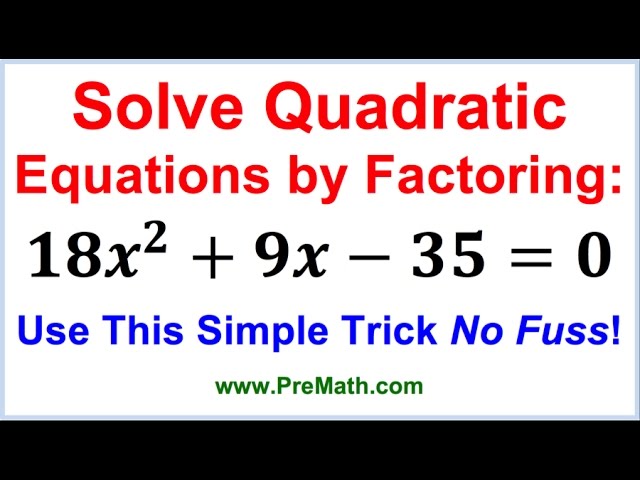
Simple Trick to Solve Quadratic Equations using the No Fuss Factoring Method. By PreMath.com
This is kind of what I meant
except you would keep it all over 18
Just use the grid method
@lime bolt Is the grid method the one with the X?
scarlet juniper
$-1(3x -4)(x -2)$
obsidian monolithBOT
Venx:
lime bolt
Tbh it isn’t really a grid it literally just writing the down factors of 3 and 8 but like in a grid
proven marten
Yes
lime bolt
The grid doesn’t have a purpose
lime bolt
I guess, I don’t know the names of these things
echo wagon
@scarlet juniper No, you need to get -8 not +8
proven marten
@scarlet juniper You seem to be familiar with this
echo wagon
So one bracket has a + the other a -
scarlet juniper
yup
proven marten
kane wdym by grid method
lime bolt
Ehh I don’t really know how to explain it that well
proven marten
$-4*-2=8$
obsidian monolithBOT
JC Denton:
lime bolt
I could send a pic or something
echo wagon
I'm sure he means list the pairs of factors of a and c in a grid and then systematically multiply and add them until you get b somehow.
lime bolt
Yea
proven marten
Ive never heard of that method before though
echo wagon
That is more systematic, but can be excessive when there are obvious factors that can be left out or when intuition can tell you what the right factors are
proven marten
^
scarlet juniper
$-1(3x +2)(x -4)$
obsidian monolithBOT
Venx:
echo wagon
Hooray
scarlet juniper
Thank you
fleet yew
amazing
scarlet juniper
so if y = -1(3x +2)(x -4), y = 0 when...
fleet yew
i personally would have factored out the LC but your way works too ig!!
proven marten
Whats LC
echo wagon
LC??
proven marten
y=0 would mean the roots/solutions/x-intercepts of the graph
scarlet juniper
if the -1 wasnt there, y = 0 when x = 4
echo wagon
The -1 doesn't change anything
echo wagon
It doesn't change the roots I mean
echo wagon
AMD be factorizing with fractions
fleet yew
sorry to interrupt
proven marten
You didnt interrupt
AMD be factorizing with fractions
@echo wagon I dont think my mental capacity can factor fractions


 scarlet juniper
imma guess with the above, y = 0 when x is -4
proven marten
Yes
echo wagon
No
proven marten
Oh no do I have to relearn quadratics
LMAO
I messed up on quadratics
Yeah so
You want the bracket to equal to 0
scarlet juniper
so the -1 doesnt actually change it
obsidian monolithBOT
JC Denton:
echo wagon
Venx: If you have any product that equals 0, it is true only when one of the factors is zero. So if abc = 0 then a = 0 or b = 0 or c = 0
$-1(3x +2)(x -4) = 0$
obsidian monolithBOT
Lunasong:
echo wagon
You have three factors, but obviously you cannot have -1 = 0
So you set the other two factors equal to 0
scarlet juniper
my instinct with that -1 is just to oppositize everything
echo wagon
No
Follow the logic. A product is 0 if one of the factors is zero
So set the different factors equal to 0 and solve for x
Don't just guess what you should do
scarlet juniper
Im learning about inequalities
echo wagon
Where is the inequality lol?
scarlet juniper
Im just linking formulas like that to the correct notation
proven marten
Ah quadratic inequalities
scarlet juniper
oh plot twist it was >0
proven marten
Yes
scarlet juniper
but works the same
proven marten
Yes
echo wagon
Well, finding the roots are the same, but the solution is not the same
proven marten
no problem
proven marten
As mathematician he has to be
scarlet juniper
I think I grok it
echo wagon
Okay
scarlet juniper
im doing exercises from an EDx course
proven marten
grok
scarlet juniper
know the term?
the lecturer glossed over how he factorized a similar problem
I couldnt figure out how he knew what to do
let me try and dig it up
$y = 2x^2 +5x -3$ ?
obsidian monolithBOT
Venx:
obsidian monolithBOT
Venx:
obsidian monolithBOT
Venx:
scarlet juniper
so anyway I don't understand why 5x was turned into 6x - x
I can see how x and 6x works nicely with the bracket multiplication, I guess I can't see how you'd know to do that before you factorized
unless he was just being illustrative
proven marten
Oh that method
I dont understand how people do that method
its so tedious sometimes
scarlet juniper
is it just a case of splitting x's until you find a pair that multiply nicely?
like if -x + 6x didnt work, next you'd try it with -2x + 7x etc?
viscid thistle
denton
you posted examples not the explanation
lmao
@scarlet juniper google factor by grouping
scarlet juniper
the example helped actually, thanks both
viscid thistle
thanks @fleet yew
scarlet juniper
my first time posting here, great community by the looks of things
proven marten
great job guys
@fleet yew tyty
the example helped actually, thanks both
@scarlet juniper I felt like you grasped math easier, so I just decided to give you examples
obsidian monolithBOT
Yes:
harsh smelt
for the first part it is unclear what they want from you
viscid thistle
it wants you to show work
viscid thistle
is there something about question 2. that explains it more zeek?
as it stands that question is just 2 sentences
not sure what work it's asking for
harsh smelt
(would not earthquake they want be 490 richters lol)
 blissful ridge
The first part is just a sentence
harsh smelt
4
fleet yew
Wtf
Sorry guys i was accidentally mashing my keyboard
Just happened to be on the 3 key
 lethal zephyr
3
 zealous slate
3
stuck lark
三
willow bear
III
stuck lark
州
 smoky pagoda
Tres
proven marten
dri
blissful ridge
Teen
 wide lynx
idk where to put this question but idk where to start
blissful ridge
What have you done so far?
blissful ridge
Start by making a diagram
wide lynx
wide lynx
but i thought thats
the point
well i guess the orientation matters
i have no idea how to approach that then lol
blissful ridge
Join the diagonal
lime bolt
Yes draw a right triangle with radius, half width and length
blissful ridge
The diagonal would pass through centre