#precalculus
1 messages · Page 237 of 1
 wide lynx
 fleet yew
@burnt grail just let x^4 equal that number
 pale bison
@wide lynx ??????
pale bison
what were the "three ways" that you were shown to?
how am i suppose to know what technique is required of you to solve it
pale bison
bye
 burnt grail
@fleet yew how do I get 4 values for z doing that though?
fleet yew
@burnt grail those values of z are the values of x
Just let z^4 equal that number
@burnt grail you are familar with roots of unity?
burnt grail
No I’m clueless
fleet yew
there's four of them aren't there?
think about it
let's say that z^4 = 16
here's a little trick: 2 + 2 = 4.
it is usually easier to take the square root twice than it is to take the 4th root
so try letting a=z^2
burnt grail
So it gets confusing when I have square roots and i
burnt grail
A = 4
fleet yew
so then we substitute back in for z
so we have two equations
z^2 = 4, and z^2=-4
does this all make sense so far
burnt grail
Yes it does
fleet yew
solve those two equations
burnt grail
+- 2
burnt grail
Would it just be -2
burnt grail
How would you do the second one and get a negative value
fleet yew
lol i don't think you should be doing this problem no offense
square roots of negatives are imaginary numbers
 viscid thistle
the square root of -4 is 2i, no? or am i imagining things
burnt grail
Oh well I mean I thought you were asking for a literal value
viscid thistle
gotem
fleet yew
don't spoil it
burnt grail
So I was confused
burnt grail
Btw when we do get there, I have to put it in exponential form
fleet yew
yeah ik we're getting there lol
now do you notice anything about those numbers
squid don't spoil it
viscid thistle
did y'all get my corny joke? and so sorry for interrupting it was just irresistible
burnt grail
Z0 z1 z2 z3
 fleet yew
@burnt grail what do you notice in common about these 4 numbers: 2, -2, 2i, -2i
here's a hint: do you know how to take the absolute value of a complex number?
fleet yew
alright gl
 reef jasper
 oblique thicket
@wide ocean construct an equation like this: $\frac{(1+x)(2+x)(4+x)}{1 \cdot 2 \cdot 4} = 9 $ After quick simplifications, we can get $x^3+7x^2+14x+8=72$ which leads us to $x^3+7x^2+14x=64$ Which is already easily solvable.
 obsidian monolithBOT
Dmytr:
 wide ocean
@oblique thicket thank you so much!
oblique thicket
you are welcome
wide ocean
the answerkey says x=2 (increase dimension by 2)
oblique thicket
yep
wide ocean
and i'll see if it's solvable with the equation above, thanks I hope it works
oblique thicket
It is solvable and you'd get exactly 2
wide ocean
thank you! bless
oblique thicket
Thanks
viscid thistle
may I get help with this
these where my answers and im not too sure whats wrong
 alpine basin
How do I use synthetic division on this problem with its dividing by an x^2 +4?
 gilded stirrup
You can’t use synthetic
You have to use long division
Then write coefficients
And put an 0 for the x term of x^2+4
alpine basin
put a zero where?
 willow bear
5x^4 - 3x^3 + 2x^2 + 0x - 1
alpine basin
How would I divide that once I have it set up? Im having a bit of trouble figuring it out
viscid thistle

Learn how to divide polynomials by quadratic divisors using the long division algorithm. Before dividing a polynomial, it is usually important to arrange the divisor in the descending order of powers of the variable(s). To divide a polynomial by a quadratic divisor using the l...
I personally like this one
There are loads of videos tho
@alpine basin
 uncut mulch
similar process to long division with numbers
instead you have powers of x instead of units,tens,hundreds,etc...
alpine basin
@viscid thistle How do I know when I can use synthetic division? Would this problem have to be normal long division as well?
alpine basin
okay thanks
viscid thistle
Just always use long
 velvet garden
I see that as an absolute win
viscid thistle
In the short term
alpine basin
I got 4 for this problem, but the answer is 6, can someone show me how I'd solve this?
uncut mulch
wdym by
the answer is 6
uncut mulch
if a polynomial of x: P(x), is divided by (x-a),
the remainder will be P(a)
but the answer won't be 6
here, if $P(x) = x^4 - 9x^2 + 14$ is divided by $(x-2)$, the remainder will be $P(2)$
obsidian monolithBOT
ramonov:
 fervent girder
Does this solution appear wrong? If -4 is a zero, should it not be listed in the final zeros? I am confused by the chart as well
fervent girder
...i've been stuck on this for 2hrs... okay, so the solution is wrong for that chart?
pale bison
are there more polynomials?
fervent girder
that is the complete solution
pale bison
you should only focus on how -2 is a zero leads to the factorization
can you take a pic of question 21?
fervent girder
 maiden pebble

Does sin^2(x) seem to hump the x-axis because it is squared, so it never passes through an axis
Like double roots (I think thats what they are called)
 hexed ermine
Right because its squared, any negative part gets squared so it's always positive
maiden pebble
OOOH is that why double zeros dont pass axis?
hexed ermine
Yep
maiden pebble
🤯
hexed ermine
If you have (x-a)^2 theres a double root at a, and you can't get a negative number outta it
Because x is in the reals
 pale bison
$\sin\cdot\sin(2x)$...?
obsidian monolithBOT
Publius:
pale bison
the answer is no^
maiden pebble
ok
thx
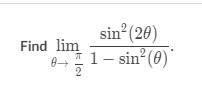
I have simplified the bottom to cos^2(x) but dont know what to do on the top
willow bear
double angle identity sounds like it might help
maiden pebble
how?
I turned it into 1-cos^2(2x)
wait ur a genius
Do you mean (sin^2(2x))/cos^2x --> tan(2x)
obsidian monolithBOT
Ann:
willow bear
this is the identity i meant
and here, $\sin^2(2\theta)$ would become $4\sin^2(\theta)\cos^2(\theta)$ upon applying it
obsidian monolithBOT
Ann:
 lofty prism
f(x) = 1/2 x
prove that f(8) approx equal to 4
i do it like this:
f(4) = 1/2 * 2 = 1
it doesnt give me 4
please any help???
lofty prism
what?? but nevermind i found the answer
f(8) ~ 8*1/2 ~ 4
even if you didnt help me i appreciate you guys wanting to so thanks!
 heady jewel
...
lofty prism
uhhh what
 peak badge
Looks like there's some miscommunication over here.
If you have cleared your doubts well and good. Otherwise, can you please repeat your question?
viscid thistle
if you plug in 8 you get half of 8 which is 4
what?? but nevermind i found the answer
f(8) ~ 8*1/2 ~ 4
even if you didnt help me i appreciate you guys wanting to so thanks!
...
 fossil crownBOT
From
Rule 5
While asking questions, make sure you mention all relevant details, including the context, what you have tried and what you're stuck at. Do not expect others to simply solve your questions for you.
lofty prism
f(x) = x * (1/2)
show that f(8) ~ 4
peak badge
Ah, okay.
viscid thistle
f(8)equals4
uncut mulch
no like seriously, what class is this supposed to be?
why are you asked to show that approximations are equal
and equal stuff are approximations?
peak badge
Basically how to use functions in math, I guess?
uncut mulch
and/or are you grossly misrepresenting the problems
lofty prism
i mean the question was f(8) = 4 but its better if you write it with ~
lofty prism
but it's quite the same but approx is better
No.
@viscid thistle for what?
but i will put an = if you want to
however approx generalizes it more...
willow bear
hold on what
uncut mulch
the use of approximation sort of implies non-equality
viscid thistle
Hell no.
lofty prism
Let f be a function defined in IR such that f(x) = x/2
1- Show that f(8) = 4
thats exactly what it says i cant photograph it
viscid thistle
....
willow bear
why can't you take a screenshot
lofty prism
the use of approximation sort of implies non-equality
@uncut mulch i dont think so
viscid thistle
.....
lofty prism
why can't you take a screenshot
@willow bear it's not on my computer
but its okay i got the answer tyanks for your help
viscid thistle
No it's not okay, you think that using ≈ is "better" or whatever while = is the appropiate use
uncut mulch
and/or are you grossly misrepresenting the problems
seems that's a yes
lofty prism
uh thats an arithmetics fact though
uncut mulch
if the question use an $=$, you should transcribe/represent it as such \
if the question use an $\approx$, you should transcribe/represent it as such
obsidian monolithBOT
ramonov:
lofty prism
guys just to test your knowledge, put the correct sign here :
1+1 # 2
uncut mulch
we're not the ones that need testing
peak badge
That's not the point, sucette
lofty prism
could you answer.plzase
viscid thistle
7
peak badge

uncut mulch
...
lofty prism
7
@viscid thistle huh
willow bear
...
peak badge
Let's not jump the gun bois
lofty prism
guys if theres anything wrong with what i say feel free to correct me but i dont think i told shit here
peak badge
At this rate,we need to VC to understand this
viscid thistle
Can you define what ~ is for you?
 rugged linden
~ implies that this is just about the answer, it's not actually the answer
uncut mulch
$1 + 1 \approx 2$ has implications that $1 + 1$ could be a value that isn't $2$
rugged linden
it's an approximation
obsidian monolithBOT
ramonov:
rugged linden
yeah
it doesn't generalize anything, you're just saying something that is untrue
it's like saying 5 is approximately 5
it's untrue
lofty prism
basically = is used for values that are perfectly equal such as
1=1
3+3=6
2^2=4
etc
~ is used to compare two values which dont need to be the same or perfectly the same
1 ~ 1
4 ~ 4.5
3 ~ 10
3+4 ~ 11
idk if im clear lol
peak badge
Much better
rugged linden
Yeah
lofty prism
edited please check l1stest update
rugged linden
in your earlier example where f(x) := x/2 and f(8) you said was apprximately 4
viscid thistle
Bruh
rugged linden
oh wait you're using it in the inclusive sense? That's the misunderstanding i suppose
peak badge
At this rate I think it's more of a language barrier/definition issue...
rugged linden
The ~ sign doesn't include the = in it's definition, if something is equal it is =, if it's around the value then it's ~, they're used for seperate things
obsidian monolithBOT
whzup:
lofty prism
what sources are you using to state this definition . which arithmetics sources .
rugged linden
I mean there isn't really a standard convention which convenes to determine what ~ and = means
lofty prism
I don't think $\approx$ defines an equivalence relation, does it?
@opal jacinth in a sense it does
obsidian monolithBOT
💣♧ 𝐬𝐔ς乇ţ𝐭𝐄 ✊🍧:
rugged linden
it's just notation, we're just telling you what is normally done
uncut mulch
with no specified accuracy.
anything can be considered approximately equal to anything
lofty prism
yeah so you are basically saying we cant say 1~1
rugged linden
big mind
peak badge
= is used to define when two particular quantities are exactly the same.
~ is used to define when two particular quantities are approximately the same.
that is, there is some chance that it need not exactly be the same but the "measure" of two quantities are close to each other.
@lofty prism
 fluid shore
the real valued function of a real variable f(x) = x^2 has a derivative f'(x) = 2x
lofty prism
it's 2x
just saying
= is used to define when two particular quantities are exactly the same.
~ is used to define when two particular quantities are approximately the same.
that is, there is some chance that it need not exactly be the same but the "measure" of two quantities are close to each other.
@lofty prism
@peak badge thats why i hate high school programs lol, they really mess students minds up
peak badge
it's 2x
@lofty prism
Your statement is true if you consider that we are taking the derivative w.r.t X.
However, if we took the derivative w.r.t say, Y - then the derivative will be 0.
lofty prism
|not| (means absoluetly not lol because || is absolute value sign)
@lofty prism
Your statement is true if you consider that we are taking the derivative w.r.t X.
However, if we took the derivative w.r.t say, Y - then the derivative will be 0.
@peak badge depends if x is dependent on y
uncut mulch
However, if we took the derivative w.r.t say, Y - then the derivative will be 0.
depends if x is dependent on y
peak badge
Yes
peak badge
Just leave it, Abhi
peak badge
@lofty prism so you hate High school and I presume you don't get the math as well?
lofty prism
@lofty prism so you hate High school and I presume you don't get the math as well?
@peak badge ?? i m not in high school though
peak badge
So, what's your educational background as of now? That way, I can better explain things to you
lofty prism
this is personal information i would not like to leak, but you must know i am not a high school student.
peak badge
Sure, your wish.
I am pretty sure you aren't in high school and by your responses till now, I can probably say that English isn't your first language as well.
viscid thistle
What is wrong with that?
lofty prism
duh
peak badge
I think all of us have been pretty clear in your responses to your queries but there still exists to be miscommunication between us, maybe that's one of the reasons.
lofty prism
what is queries
peak badge
What is wrong with that?
Some people understand stuff better in their native language .
Questions
lofty prism
youre hindi?
viscid thistle
That's the opposite for me, I prefer English for maths
peak badge
I am just saying. I have met people who don't grasp English as well and prefer things to be in their native language.
lofty prism
what is grasp
peak badge
Ability to understand
peak badge
That's fine. Usually nobody in most of my circles do
peak badge
...
 odd abyss
does someone know how to write the partial fraction decomposition of a rational expression
I need help understanding
 jagged glade
Hello @odd abyss , which part of the partial fraction do you need help with?
https://www.mathsisfun.com/algebra/partial-fractions.html
There are some basics for partial fractions in the above link, feel free to take look~😁
odd abyss
yes hello
jagged glade
Yes?
odd abyss
let me take a look at this article
jagged glade
Sure! Take your time
jagged glade
Well, since x²+2 has complex roots, we don't have to factor it.
For partial fractions
rugged linden
Isn't what they're going to have to do polynomial long division?
with one of the (x^2 +2)
hm
jagged glade
But for the (x²+2)²,we have to separate into (x²+2) and (x²+2)²
rugged linden
I think u made a typo with the (x^2 + 2)^2
odd abyss
so im not foiling
rugged linden
but from there you can't do partial fractions because the degree of the numerator is larger than the denominator
so they're gonna have to do polynomial long division with one of the x^2 + 2 terms
jagged glade
So. It would sperate into
$\frac{Ax+B}{(x^2+2)}+\frac{Cx+D}{(x^2+2)^2}$
obsidian monolithBOT
Biscuit:
odd abyss
monkas
rugged linden
oh wait sorry yeah you didn't make a typo with the (x^2 + 2)^2 thing
i forgot about that rule
jagged glade
Sorry, I was focusing on the LaTeX, can't really read what you guys were typing just now :P
rugged linden
bahah its okay
jagged glade
Yea?
odd abyss
how are you allowed to make (x^2 + 2)^2 into that
rugged linden
well
you know how when you have normal fractions you mutiply the diagonals and multiply the denominators when you want to brute force normal fraction addition, we're doing the opposite here
jagged glade
We would just let $\frac{x^3+x^2+8}{(x^2+2)^2}=
\frac{Ax+B}{(x^2+2)}+\frac{Cx+D}{(x^2+2)^2}$
odd abyss
regarding @rugged linden I actually dont know when you have to that
uncut mulch
missing ^2 on the lhs
odd abyss
and @jagged glade I will just go along with it
jagged glade
$\frac{x^3+x^2+8}{(x^2+2)^2}=
\frac{(Ax+B)(x^2+2)}{(x^2+2)^2}+\frac{Cx+D}{(x^2+2)^2}$
rugged linden
Yeah kinda
odd abyss
ok biscuit
jagged glade
And we now compare the coefficients of the x terms in the numerator
odd abyss
a and c
rugged linden
Okay wait im just making this more confusing bahahah just listen to biscuit
jagged glade
$x^3+x^2+8=
(Ax+B)(x^2+2)+Cx+D$
obsidian monolithBOT
Biscuit:
jagged glade
And by comparing coefficients we can find A,B,C and D
odd abyss
why do we need c and d
jagged glade
Well, it's a cubic polynomial. We shouldn't miss out the x^1 term and x^0 if this is what you mean :)
And the partial fraction guides us into this equation.
odd abyss
ok
jagged glade
$x^3+x^2+8=
(Ax^3+Bx^2+2Ax+2B)+Cx+D$
obsidian monolithBOT
Biscuit:
jagged glade
$x^3+x^2+8=
Ax^3+Bx^2+(2A+C)x+(2B+D)$
obsidian monolithBOT
Biscuit:
jagged glade
Can you find the values of A , B , C and D?
odd abyss
let me write this
jagged glade
Yes, because I edit my text because of the typo
jagged glade
Yep
obsidian monolithBOT
Biscuit:
odd abyss
so solve that
jagged glade
Comparing coefficients yea
odd abyss
so im not solving
jagged glade
Okay. So do you get the gist of doing partial fractions?
Well, it's solving for A,B,C and D, but not x.
jagged glade
I see.
rugged linden
maybe try a simpler example first?
odd abyss
ill try one and come back
rugged linden
good luck :))
odd abyss
cause I dont know how to solve a b c d
jagged glade
Oh, I can show.
Like for LHS, the coefficient of x³ is 1.
And for RHS, the coefficient of x³ is A
So by comparing coefficient, we have A=1
odd abyss
is this question an improper or proper rational expression
firstly
the denom is bigger right
jagged glade
Should be proper, since the numerator is of degree 3 and the denominator is of degree 4
odd abyss
so in order to solve were making the bottom smaller
jagged glade
But this since example is has a square term, we have to break it into (x²+2) and (x²+2)²
odd abyss
ok
jagged glade
jagged glade
Yep
odd abyss
so we get
[ x^3 + x^2 + 8 / (x^2 + 2)^2 ] = [ (Ax + B)(x^2 + 2) /(x^2 + 2)^2 ] + [ (Cx + D) / (x^2 + 2) ^2 ]
jagged glade
Missing a C, but it's correct.
odd abyss
where does the c go
jagged glade
Cx+D
jagged glade
Yes
odd abyss
ok now what
jagged glade
Now we compare the coefficients of the numerators, since the denominators are the same
obsidian monolithBOT
Biscuit:
jagged glade
So, first, we can compare the coefficient of x³ term.
For LHS, the coefficient of x³ term is 1.
For RHS, the coefficient of x³ term is A.
So, we get A=1
 desert pendant
Guys, if we have a function inside of a summation, can you take the function out
like i have the sum of the imaginary part of something
so can i take the imaginary part out
fluid shore
how about showing the specific question
odd abyss
quick google
fluid shore
i was talking to kiesh
desert pendant
nvm
jagged glade
Right
jagged glade
Yes.
odd abyss
c and d = 8?
odd abyss
why
jagged glade
For LHS, the coefficient of x term is 0.
odd abyss
ohhh
jagged glade
For RHS, the coefficient of x term is 2A+C.
odd abyss
since its not therwe
jagged glade
Yea, therefore it's 0
odd abyss
so I rewrite as x^3 + x^2 + 8 = Ax^3 + Bx^2 + 8
jagged glade
Yea, you can do that, but not necessary.
odd abyss
so further would be x^3 + x^2 + 8 = x^3 + x^2 + 8
odd abyss
On completion of this worksheet you should be able to evaluate
constants given two identical polynomials.
odd abyss
👉 👈
jagged glade

odd abyss
so we already got the values of a b c d
jagged glade
Yes, then we can rewrite our fraction into the partial fraction form.
jagged glade
 odd abyss
these are the partial fractions?
jagged glade
Yea, this is the partial fraction decomposition.
To be honest, if this is your first time doing partial fraction decomposition, this is not a good example since it looks like we didn't do anything much.
And it's actually a hard example.
 jagged glade
Yes?
odd abyss
how do we go from there
to https://cdn.discordapp.com/attachments/488104216678760469/726451856464805888/681190496273432663.png
just the top part
jagged glade
 odd abyss
ok
jagged glade
Substitute the A,B,C and D that we have found into that
odd abyss
so is this https://cdn.discordapp.com/attachments/363224154469826562/726439680148504586/681190496273432663.png
just something you do when you find all the letters
jagged glade
Yep
odd abyss
A1x + B + A2x + B2
obsidian monolithBOT
Biscuit:
jagged glade
Do you mean this?
jagged glade
It works too, it's really up to you. Whichever you are comfortable with
Or this too
$\frac{(A_1x+A_2)}{(x^2+2)}+\frac{B_1x+B_2}{(x^2+2)^2}$
obsidian monolithBOT
Biscuit:
jagged glade
This doesn't seem too hard comparing to the previous one
odd abyss
I mean if all I have to do is multiply the 2 together then it should be easy
thank you for all the hard work
jagged glade
You're welcome!
 urban harness
hi do u guys know what these types of problems mean???
i literally have no idea
like y= max{x, 6-x} what does that mean?
uncut mulch
at a certain x, y will be the max value of x or 6 - x
eg, at x=0, x and 6-x will have the values 0 and 6 respectively
 wide sequoia
uncut mulch
wide sequoia
uncut mulch
6 is the larger of the two and thus y=6 when x = 0
the graph will effectively be piecewise
wide sequoia
is the range for the function (-inf,0] U (3,3)
wide sequoia
Hello?
 stuck lark
you want to denote that 3 is a point in the range. () denotes open intervals and (3,3) doesn't denote a valid interval. just write the single point in a set. (-infty,0]U{3}
wide ocean
I squared and zeroed the equation to use Quadratic formula
But all my answers no real solutions
I'm confused?
Thanks if you know how to answer this..
When -5 is squared, is it +25 or -25?
 sour eagle
You should also look at the condition of 2x + 5 and x + 3 being positive ( since square roots cannot be negative nor take negative values when solving over real numbers). So looking at a), x = -2.75 is not a solution.
 elfin crescent
are all sqrt functions neither even nor odd functions?
fluid shore
Hmmm, the function:
$$\sqrt{|x|}: \bR \to [0,+\infty)$$
is an even function.
obsidian monolithBOT
Abhijeet Vats:
stuck lark
\sqrt{|x|}: \bR \to [0,+\infty)
 elfin crescent
o ok
willow bear
$x \mapsto \sqrt{|x|}: \bR \to [0, +\infty)$
obsidian monolithBOT
Ann:
willow bear
@fluid shore
stuck lark

fluid shore
....................................................
needless, the meaning was clear
i mean, unless you need it clarified
elfin crescent
so that function will be an even function then right?
fluid shore
Yea that's an even function
elfin crescent
k
uncut mulch
,w graph sqrt(x^2)
obsidian monolithBOT
 Requested by ramonov#0921
uncut mulch
Requested by ramonov#0921
uncut mulch
,w graph sqrt(|x|)
obsidian monolithBOT
Requested by ramonov#0921
fluid shore
here, let me clarify what function i was referring to
stuck lark
$\fxn{f}{\bR}{[0,\infty)}{x}{\sqrt{|x|}}$
obsidian monolithBOT
RokettoJanpu:
fluid shore
$f = {(x,y) \in \bR^2: y = \sqrt{|x|} }$
obsidian monolithBOT
Abhijeet Vats:
fluid shore
Or more specifically, for my case:
$f = { (x,y) \in \bR \times [0,+\infty): y = \sqrt{|x|} }$
obsidian monolithBOT
Abhijeet Vats:
viscid thistle
can I get some help with this one? thamks
btw i'm not supposed to know the answer
the question is: solve this
without the tan thing
uncut mulch
did you copy down the question properly?
viscid thistle
yes
i've looked over it several times today and yesterday
it baffles me cause it's the only weird one out of all of them
uncut mulch
it (the series) doesn't converge
uncut mulch
,w lim n to inf of lim k to n of (4n^2)/(4n^2 + (2k-1)^2)
obsidian monolithBOT
Requested by ramonov#0921
uncut mulch
summand doesn't approach 0
viscid thistle
,w lim n to inf of lim k to n of 1/(2n + (2k-1))
obsidian monolithBOT
 Requested by Ichikaru#2677
fluid shore
Requested by Ichikaru#2677
fluid shore
That left-hand side looks like it could be written as a Riemann integral.
viscid thistle
i'm trying to do that
uncut mulch
,w lim of n to inf of (sum from k=1 to n (1/(2n + (2k-1))
obsidian monolithBOT
Requested by ramonov#0921
viscid thistle
makes sense
viscid thistle
,w lim of n to inf of (sum from k=1 to n (4n/(4n^2 + (2k-1)^2))
 visual finch
 sour eagle
Just divide by 16 and you get the standard form
alpine basin
How would i solve this problem? im having issues with it
alpine basin
You mean -3, 2?
viscid thistle
In terms of a, b and c
^
alpine basin
3 and 2?
viscid thistle
How did you get that
alpine basin
i just plugged in h,k and x,y
alpine basin
Im supposed to write a formula for this graph, I got (x+3)(x+2)(x-1)^3, but it's supposed to be multipled by a 1/6 as well, how do I find that answer based on this graph?
viscid thistle
Probably with the point (0,-1)
alpine basin
What would that have to do with 1/6?
viscid thistle
You want y=-1
viscid thistle
You want to find a coefficient
alpine basin
yes
viscid thistle
So it should be - 1=6c
alpine basin
oh i see solve for c
viscid thistle
Np
 kindred whale
Not sure if I’m doing this right anyone help?
 craggy dune
,rotate
obsidian monolithBOT
kindred whale
im inputting the functions in and mulitplying then multiply by -2?
craggy dune
f(2) is the function f evaluated at 2
that means if f(x) = x
then f(2) = 2
if f(x) = x^2 + 2x + 2 then f(2) = 2^2 + 2 * 2 + 2 = 10
kindred whale
am i taking 2x+6 times 1/x
craggy dune
yes
kindred whale
cuz if so then 2x+6/x
kindred whale
im not sure thats why im lost
kindred whale
*-2
craggy dune
no
okay you should have (fg)(x) = 2 + 6/x
that makes sense no?
if you divide 2x + 6 by x
because 2x/x = 2 and 6/x = 6/x
kindred whale
yes
craggy dune
so now you want to know whats (fg)(-2)
so you evaluate the function at x = -2
can you give me the result?
alpine basin
How do I find all complex solutions of this problem?
alpine basin
what you mean
sour eagle
x^4 = (x^2)^2 = y^2
craggy dune
its not really needed but it will make the problem look like something you should have solved many times before
craggy dune
no factorization
you know something like x^2 + 2x + 1 = (x + 1)^2
have you seen something like that before?
alpine basin
yea
craggy dune
thats the problem type you're dealing with right now
alpine basin
arent i supposed to do it without factoring?
craggy dune
no
its basically a more advanced factoring problem
with subbing you get the first step
then you replace the y with x^2 and with that comes the slightly more difficult step
craggy dune
well factor (y^2 - 7y - 144)
that means you need to find a and b so that (y + a)(y - b) = (y^2 - 7y - 144)
with a - b = - 7 and a * - b = 144
once you have that you turn that into (x^2 + a)(x^2 - b)
then (x^2 + a) = (x + ci)(x - ci)
and (x^2 - b ) = (x + d)(x - d)
there are some pretty strong hints in there
especially as you can assume that the factors are nice
alpine basin
what is ci
craggy dune
c * i
alpine basin
I got (x^2-16) = (x+4)(x-4)
craggy dune
good
alpine basin
but im not sure howd Id factor (x^2+7)
craggy dune
x^2 + 7 ?
craggy dune
okay good
(x^2 + 4) = (x +2i)(x-2i)
please don't just believe me
verify
take the right side term apart and see if it equals x^2 + 4
craggy dune
yes
so you have a total of 4 solutions
which works because of polynomial with deg 4
alpine basin
oh thats a good way of checking
Thanks
Can I ask you about another problem on my practice exam?
Im supposed to find an equation for this, I got part of the answer which is (x-3)/(x+3)(x+4) but I couldn't get the -8 thats supposed to be multiplied on the (x-3)


 alpine basin
The scaling factor?
obsidian monolithBOT
ramonov:
alpine basin
Oh right
uncut mulch
scaling factor in this case a
alpine basin
so do i solve for a?
uncut mulch
yes
uncut mulch
you could start with a on the denominator
you'd end up with a different value for the variable
but the end result would be the same
alpine basin
hm
uncut mulch
we usually put it on the numerator in these situations for convenience
alpine basin
so either way just have to solve for a? And then I would plug in, in this case, -2 for y and 3 for the x? Then solve for a?
uncut mulch
no
alpine basin
o
uncut mulch
(3,-2) is not a point that lies on the curve
alpine basin
oh do you just pick any point
so I could do (3, 0)?
I was looking at the intercepts
uncut mulch
(3,0) doesn't really help though
since that's how you got the factor (x-3)
consider using the y-intercept
alpine basin
so (0, -2)?
 marble osprey
would you like to hear it
uncut mulch
yeh. plug (0,-2)
alpine basin
@uncut mulch Would that always be the case where I should use the y intercept for the point to plugin?
uncut mulch
no
alpine basin
hmm then how would I know which one to choose
uncut mulch
use whatever points you can easily identify and/or are given
eg if they explicitly label a point, you could use that
alpine basin
Hmm
I thought technically the x intercept and y intercept both label a point
I guess what im tryna ask is how I can tell which one is more useful to plug in
uncut mulch
well in this case, the x-intercepts and asymptotes determined the linear and reciprocal factors
you'd need to use other info to determine other properties
the curve won't always have a nice y-intercept
alpine basin
@uncut mulch could you help me with this one as well? if you dont mind xD
uncut mulch
perform polynomial long division
uncut mulch
show your work
uncut mulch
$-6 - (-10) \neq -16$
obsidian monolithBOT
ramonov:
uncut mulch
check your signs again
uncut mulch
1- (-10) = 11
alpine basin
yeah
uncut mulch
$\polylongdiv{4x^2-6x+1}{2x-5}$
alpine basin
The answer says its just 2x+2, when finding the equation of the oblique asymptote, does the remainder not matter?
uncut mulch
$f(x) = 2x+2 + \frac{11}{2x-5}$
obsidian monolithBOT
ramonov:
 odd helm
how would i do this problem
viscid thistle
could anyone explain the max thing to me. or how to solve these problems. I'd appreciate any help
 rapid lance
@odd helm do you know how to add vectors?
it would help to graph the vectors to get a sense if you feel confused
viscid thistle
{5a+2b : a,b ∈ Z}
{6a+2b : a,b ∈ Z}
how do I do those
rapid lance
what are they asking for?
rapid lance
i think its the same as any other set
viscid thistle
this is the answer apparently
{5a+2b : a,b ∈ Z} = {...,−2,−1,0,1,2,3,...} = Z
wouldn't it be the same for the second one?
viscid thistle
guess not
viscid thistle
{3,6,11,18,27,38,...}
how do I express it in set notation?
guess x ∈ N, but what else?
I see it's +3,+5,+7,... but not sure how to express it algebraically, since in 3 x would have to be 0, and to acquire the result of 3 you'd have to add 3, which breaks the pattern?
 harsh smelt
6-3=3
11-6=5
18-11=7
27-18=9
viscid thistle
I see it's +3,+5,+7,...
harsh smelt
reasonable assumption may be that it is sequence given by rule $\
a_{k+1} = a_k +2k+1$
obsidian monolithBOT
Commander Vimes:
harsh smelt
and $a_1 = 3$
viscid thistle
how have you come to this assumption
harsh smelt
i just looked at first terms
obsidian monolithBOT
Commander Vimes:
harsh smelt
i mean look at first terms, to be more precise at their differences
it is just odd numbers
solving this recurrence will give u exact form of set elements
viscid thistle
thank you
viscid thistle
{(x, y) : x ∈ [1,2], y ∈ [1,2]}
what am I supposed to do
fluid shore
?
viscid thistle
it says 'sketch the following sets of points in the x-y plane'
fluid shore
What is the question?
viscid thistle
but wouldn't that just be a straight line
pale bison
what have you tried?
fluid shore
You're just sketching $[1,2] \times [1,2]$, where $\times$ is the cartesian product
obsidian monolithBOT
Abhijeet Vats:
fluid shore
So, it'll just be the set of ordered pairs such that $1 \leq x \leq 2$ and $1 \leq y \leq 2$. That's going to be a rectangle.
viscid thistle
ok but wouldn't it just be a line starting at [1,1] and ending at [2,2] ?
obsidian monolithBOT
Abhijeet Vats:
fluid shore
??
ok but wouldn't it just be a line starting at [1,1] and ending at [2,2] ?
What do you mean by "a line starting at [1,1] and ending at [2,2]"?
viscid thistle
oh nevermind
fluid shore
You're confusing interval notation with ordered pair notation
fluid shore
wot
sour eagle

fluid shore
I've never seen that notation for intervals
fluid shore
My dude, I'm not even American lol
[ , ] is typically what's used for closed intervals
it can also be used for other things but it's clear from context what it's supposed to mean
viscid thistle
what about this lol
{(x, y) : x, y ∈ R, y ≥ x^2 - 1}
all I can get from it is that it starts at [0,-1]
viscid thistle
or this one
{(x, y) : x, y ∈ R, x^2 + y^2 ≤ 1}
pale bison
did you solved the previous one?
viscid thistle
no
pale bison
ok
{(x, y) : x, y ∈ R, y ≥ x^2 - 1}
this means, x and y are real numbers, and you're looking at the x y plane
(x, y) : x, y ∈ R^
viscid thistle
yes ik
pale bison
and you're picking points x and y such that y >= x^2 - 1
i.e. points from the curve x^2 - 1 and points above it
 past meadow
n=choose an unoccupied channel
sour eagle
@viscid thistle the solution has already been suggested in #prealg-and-algebra ?
Why would you ask again?
viscid thistle
viscid thistle
yes
willow bear
the boundary is a parabola. yours looks off at the bottom
why are the points (±1, -1) in there
viscid thistle
dunno
willow bear
i mean
your parabola looks weird
like
the boundary of your region should pass through the points (±1, 0)
harsh smelt
why bottom of parabola is "cut off"
pale bison
it's a parabola after an uppercut
viscid thistle
That's a vase
harsh smelt
can u first draw just y = x^2-1?
willow bear
vimes thats what im trying to point out
viscid thistle
oh
I understand now
btw
it passes through (±1,0)
I meant for it to pass through them at least
willow bear
well
correct your sketch
draw the parabola y = x^2 - 1 properly
then shade in the region north of it
viscid thistle
pale bison
still a bit pointy but it's acceptable
viscid thistle
wdym
pale bison
,w graph y = x^2 - 1
obsidian monolithBOT
 Requested by Publius#2314
viscid thistle
Requested by Publius#2314
viscid thistle
diff scale
pale bison
i mean ok the scale is a bit off, but it is not pointy at the bottom
well anyway
{(x, y) : x, y ∈ R, x^2 + y^2 ≤ 1}
now that you've completed the previous problem, can you do this one on your own?
viscid thistle
I'll try
harsh smelt
it is better to first draw a boundary
and then to see the behaviour of remaining parts
viscid thistle
I drew the points
pale bison
i mean, does the equation x^2 + y^2 ≤ 1 remind you of anything
you should not apply the "plot point and connect" technique here
harsh smelt
you should not apply the "plot point and connect" technique here
would better to use technique "see relation and show it"
haha
viscid thistle
viscid thistle
wouldn't it just be a circle then
harsh smelt
yes it would
viscid thistle
what's the difference between it and x²+y² =1
pale bison
none read it wrong
harsh smelt
what u have plotted firstly is closed region 0 <= y <= sqrt(1-x^2)
willow bear
x^2 + y^2 <= 1 is a region, specifically the region enclosed by said curve
a disk in this case
viscid thistle
@viscid thistle the solution has already been suggested in #prealg-and-algebra ?
@sour eagle where
sour eagle
harsh smelt
@viscid thistle u can remember (or recall if u heard this before) that x^2+y^2 = a (a >= 0) always forms a circle
viscid thistle
i know the channel, but where is the solution?@tilde
willow bear
@harsh smelt what if a=-1 lol
harsh smelt
fixed
sour eagle
Dude, HoboSas literally said what you should do. It's not the whole solution, but from there it's easy.
harsh smelt
but if a =-1 it would some region on complex plany i guess
viscid thistle
I still don't understand why it's a disk and not a circle
pale bison
@sour eagle hobosas was wrong, this is not a "prove this identity" question
wops i read it wrong
willow bear
x^2 + y^2 ≤ 1 includes the points inside the circle.
harsh smelt
circle is boundary
viscid thistle
ah
willow bear
the difference between a circle and a disk is the same as between a sphere and a ball
sour eagle
Oop nvm
pale bison
no
pale bison
that can't be more wrong, points in second quadrant have negative values of x
viscid thistle
for
{(x, y) : x, y ∈ R, x > 1}
 smoky pagoda
yeah
viscid thistle
oh
smoky pagoda
because y is free to be anything
viscid thistle
so 1st and 4th except of the [0,1],yes?
smoky pagoda
what's wrong with the [0,1] interval?
x can belong to the (0,1] interval in this case
viscid thistle
cause x > 1
viscid thistle
so x can't be below and including 1
viscid thistle
it's a diff question
smoky pagoda
ah
viscid thistle
no disk here
smoky pagoda
what's the q
viscid thistle
{(x, y) : x, y ∈ R, x > 1}