#precalculus
1 messages · Page 235 of 1
 maiden pebble
 remote veldt
whatever
maiden pebble
Thanks for the enlightening prediction Ann
 willow bear
it's not a prediction, i'm just being passive-aggressive and salty
and you could've been even more explicit in your sarcasm
maiden pebble

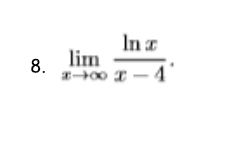
WHen checking this problem, I have been getting 0 on top, but infinite in the denominator
Does this still fit l'hopital's rule?
 viscid thistle
Yes take derivative of top and bottom
maiden pebble
Seperatly or together?
viscid thistle
create a new fraction with the derivative of 3x on top and the derivative of ln(x+1) on the bottom
viscid thistle
what is the derivative of ln(x+1)
remote veldt
@maiden pebble 0/infinity is not l’hopitals, it’s just zero. this case is however not 0/infinity, it’s 0/0
maiden pebble
hohere?
remote veldt
**
maiden pebble
oh ok
remote veldt
Corrected
viscid thistle
So you get 3 / (1 / (x + 1))
viscid thistle
yeah
make sure that
when you create the new fraction
you still write the limit notation
until you plug in a value that makes it determinate
willow bear
@viscid thistle you do realize that 0/infty is just 0 right
viscid thistle
but here it's not infinity on the bottom ?
 craggy dune
yes if you want to
maiden pebble
I solved for the limit of the numberator and got 1/infinte
maiden pebble
When the top and the bottom are either 0 or +-infinity
and in this case I got neither
 patent beacon
You have inf/inf in this case
craggy dune
what's log x for x to inf?
maiden pebble
Kaynex how did you get inf on the top?
oh, I took the derivative of the top
Thanks Kaynex
Deekan I didnt understad what u said last
craggy dune
im curious why you think you don't think there is inf on top
what do you get if you do lim x to inf ln(x)
maiden pebble
I took the derivative then plugged in inf
so i did 1/inf
but I see now that I am not meant to take the derivative when checking the problem
 elfin crescent
ive never done limits, or derivatives in precalc b4
patent beacon
Only the cool kids do calculus in pre-calculus
elfin crescent
l hop in precalc?
maiden pebble
Yea Ive gotten a lot of comments about my class doing a lot of derivatives and stuff in precalc
People tell me to go to #calculus but then when I talk there they expect me to know everything already
viscid thistle
also bridge, you asked why ln(infinity) is infinity
maiden pebble
I might have but I know why
maiden pebble
thx for helpin
elfin crescent
you guys have any tips/resources for self studying precalc?
viscid thistle
prof leonard
maiden pebble
I just got a Calc for DUmmies book
craggy dune
khan academy
elfin crescent
hm okay
maiden pebble
it was like 25$
elfin crescent
precalc is basically alg 2+trig right?
craggy dune
pre calc is a bit of everything really
maiden pebble
Does i have a derivative>?
 languid crane
elfin crescent
languid crane
elfin crescent
@languid crane the imaginary number i right?
@viscid thistle as long as i follow through with prof leonards video i should be able to learn everything for precalc right?
viscid thistle
fo sho
maiden pebble
prof leonard?
elfin crescent
alrighty ty
@maiden pebble he's a great math youtuber, if you don't know him you should check him out. he's really great i used him for calc and stat!
maiden pebble
no way hes better than my boy sal
Oh he does stat too?
That would have been helpful this year since I prob got a 2 on my AP Stat test
viscid thistle
i legit bought this t shirt for my sibling lol
he's lucky tho
he gets to explain what a derivative is for 3 hours
my school is like ok we have 10 minutes to explain what a derivative is
here's the equation now figure it out
 arctic mantle
I tried plugging rcos(t) into x but didn't get anywhere, im assuming i need to get rid of t but not sure how to it
I also have no clue how to do the rest of the question so all help is appreciated 🙂
 rich flint
@arctic mantle it seems they want you to plug-in for x and solve for r and y
So your expected to have variables in your final solutions
Basically don’t get rid of t.
 rigid siren
Have you studied the standard form of the parametric equation for an ellipse?
If you haven't here's a hint: it has something to do with $sin^2(\theta) + cos^2(\theta) = 1$
 obsidian monolithBOT
Mains of the Universe:
 past meadow
if its not clear, i would suggest letting $\sin(x)=u$ so that you have $2u^2+5u-3$
obsidian monolithBOT
Sneaky:
past meadow
the expression in u is a quadratic, which i think you should know how to factor
 reef jasper
oh yeah tnx
past meadow
no worries
 tawny nacelle
#69 nice
 sterile notch
So apparenty: x^4 + 2 x^2 - 4 x + 8 = (x^2 - 2 x + 2) (x^2 + 2 x + 4)
How would have I figured that out?
Given only: x^4 + 2 x^2 - 4 x + 8
 radiant fiber
Um trinomial multiplication? Ig
rigid siren
You know that a quartic is the product of two quadratics (ax^2 + bx + c)(dx^2+ex+f). Expand and compare coefficients to get a linear system of equations.
You could also do it as a product of a linear term and cubic.
You might run into complex coefficients this way though.
rigid siren
Also, this form is known as the depressed quartic, and there are a few general ways to solve it, usually involving some clever rearrangement and auxiliary parameters. They aren't covered in the school curriculum usually, but look up Ferrari's Method for one way to do it.
rigid siren
Whoops, yeah.
rich flint
@reef jasper did you figure it out? If not you can also use the quadratic equation for this
Be mindful of the fact that 2 and 3 are prime numbers so it shouldn’t take that long to figure out the solution
 fervent girder
how to find b?
 frozen needle
use a ii
rigid siren
Find values where $(g \circ f)(x) - f(x) = 0$
obsidian monolithBOT
Mains of the Universe:
willow bear
have you already done (a)(ii)?
 tepid basin
Can anyone help me with this ?
 lethal spoke
f(x)=4, g(x)=1
viscid thistle
that is 200 iq
 broken echo
Wow
 alpine basin
is [-infinity, 6) U (6, infinity) the proper way to write x != 6 in interval notation?
 pale bison
x in (-infinity, 6) U (6, infinity)
viscid thistle
you can also say R - {6}
alpine basin
wait @pale bison why is the left parentheses thicker then the others
pale bison
right
alpine basin
thanks
pale bison
np
reef jasper
no just find the exact value
reef jasper
oh mb #17
viscid thistle
lmaoooooooooooo
reef jasper
lol sorry
reef jasper
pi/12 isn’t on it tho
viscid thistle
pi/12 is half of pi/6
plus, 2sin(theta/12)cos(theta/12) = sin2(pi/12)
which equals sin(pi/6)
which equals 1/2
boom
next
reef jasper
where did cos(theta12)go
reef jasper
ok tnx
viscid thistle
np
obsidian monolithBOT
L'Âne 🍐:
viscid thistle
k
reef jasper
i’m suppose to use an half angle identities in #41
but when i plug it in it gives a weird #
viscid thistle

Socratic.org
Find cos ((7pi)/12) Ans: (sqrt2 - sqrt6)/4 cos ((7pi)/12) = cos ((3pi)/12 + (4pi)/12) = cos (pi/4 + pi/3) Use trig identity: cos (a + b) = cos a.cos b - sin a.sin b cos a = cos (pi/4) = sqrt2/2 ; cos b = cos ((pi)/3) = 1/2 sin a = sin (pi/4) = sqrt2/2 ; sin a = sin (pi/3) = sq...
 harsh cipher
Hi
question
question c
when I find the common ratio of 1/3
when I subtract 1/3 from 7/9 i get 4/9
can someone show me how that is same as 7/3
 uncut mulch
why are you subtracting 1/3 from 7/9?
harsh cipher
to see if the common ration make sense
uncut mulch
why are you subtracting
harsh cipher
ratio*
uncut mulch
and to check you should evaluate t3/t2
harsh cipher
then i need to multiply 1/3 to t2 to get t3?
yes
I need to start practicing trial and error and develop discipline to become good at math. When I start asking for answers immediately, it's unlikely that I will become a problem solver or a "thinker"
sigh

uncut mulch
@reef jasper the method shown, uses compound angle instead of half angles (which is better in this case)
if you must use half angles you could simplify it to -sin(pi/12) = -sin( (pi/6)/2) and continue from there
the final values are equivalent, but the half angle method results in something less simple and takes some effort to simplify it further.
reef jasper
how do i even start with #75
 jade heron
expand out cos(2t)
as a function of sines
so cos(2t) = cos^2 (t)- sin^2(t)
= cos^2(t) + sin^2(t) - 2sin^2(t)
= 1 - 2sin^2(t)
then just let t = sin^-1 (4/5)
@reef jasper
viscid thistle
Wth
jade heron
? @viscid thistle
viscid thistle
lmao
cos(2t)=1-2sin^2(t) doesn't seem right to me
tru
Neither wolfram agrees
So copswing
@reef jasper
uncut mulch
,w cos(2t)=1-2sin^2(t)
obsidian monolithBOT
 Requested by ramonov#0921
viscid thistle
Requested by ramonov#0921
viscid thistle
Wut
lmaoooooooooooooooo
Wait a sec
Actually
Im blind
I read sin instead of cos
Nothing happened
jade heron
👍
elfin crescent
besides textbook problems, do you guys have any practice problems you would recommend for since i am self studying precalc course?
craggy dune
khan mastery
viscid thistle
yes
elfin crescent
alright
viscid thistle
being a function is a necessary condition for a relation to be an inverse function
viscid thistle
What notation would this be called
defining a function by writing out the ordered pairs that it consists of?
don't know if that has a notational name
Me neither
viscid thistle
set of ordered pairs i think
i found it
yes that is a set of ordered pairs
ok thanks
im stupid sorry
but I don't think it has a simpler name than that
yeah
you could probably say "ordered pair notation" and people would know what you mean
but it's not an official name
Would this be correct?
hm well
your commas look like they are separating and statements in some places and or statements in others
which is pretty nitpicky
but otherwise nothing wrong
the domain could read like
x such that -5 < x <= -1 AND 1 < = x < 5 AND x in R
while you want
x such that
-5 < x <= -1 OR 1 < = x < 5
AND
x in R
could you write that out
on paper
if you can
I can't decide if $\vee$ is appropriate for this context or not
viscid thistle
I guess it is, but be careful using it as the word "or" anywhere else
is this for a high school class?
no
just writing notes for next year
so i dont need to remember everything from this year
remote veldt
0 bytes
viscid thistle
ok
you can use the vee symbol here instead of a comma but learn more about logic notation before using it elsewhere as a replacement for the word "or"
since it should really only be used in a few specific situations
if writing as properly as possible, at least
what is the vee symbol?
$\vee$
obsidian monolithBOT
Botn:
viscid thistle
oh
I never used this before
Is the way I wrote it fine?
because I dont know what this is
with commas?
technically not really
it can be inferred what you mean
so instead of commas
there would be a vee symbol
and thats all?
in the one place you wanted an "or" not an "and" yes
because if that comma meant "and" like commas usually do for conditions
what does vee mean?
then your domain would be the empty set
it's shorthand for the word "or" in some logical contexts
by comma I meant and
like set builder notation
the domain is __ and _-
oh, well you don't want and, do you?
there is a break in between
x such that x is inside two disjoint intervals?
that's the empty set
which is not what your domain actually is
x such that -5 < x <= -1 AND 1 < = x < 5 AND x in R
wait why
there are no such x
so v
x would need to be both less than -1 and greater than 1
where there is and
x such that 2 conditions are met:
- -5 < x <= -1 OR 1 < = x < 5
AND - x in R
is what you want
well
actually, I'd probably rewrite a bit
after reading that
${x\in\bR \mid -5<x\leq -1 \vee 1\leq x<5}$
obsidian monolithBOT
Botn:
viscid thistle
ok
${x\in\bR \mid -5<x\leq -1 \wedge 1\leq x<5}$ (where $\wedge$ means "and") is the empty set
and that's what commas would typically read as
"and"
ok thanks
obsidian monolithBOT
Botn:
viscid thistle
oh also, I might add, it's intuitively similar to $\cap$ and $\cup$
obsidian monolithBOT
Botn:
viscid thistle
those mean "and" and "or" (in a sense) when working with sets
same thing in logic, the symbols are very similar looking
but with statements instead of sets
so when you were doing the interval notation you wrote the interval as a union of two intervals
you would need to use the same thinking here
either of the two statements (equivalent to intervals)
-5 < x <= -1
or
1 < = x < 5
need to be met in order for x to qualify for the set, not both of the statements
sterile notch
what does it mean when theres a line on top of a complex number
liek z but upside down
willow bear
$\overline{z}$ denotes the complex conjugate of $z$
obsidian monolithBOT
Ann:
willow bear
if $z = x + yi$ then $\overline{z} = x - yi$
obsidian monolithBOT
Ann:
sterile notch
Oh right, thanks heaps!
 keen sigil
I'm not sure how to finish this. Could someone let me know if I did something wrong. If not I just don't know where to go after this
thanks :)
keen sigil
oh cos^2 is 1 - sin^2
viscid thistle
you got it
keen sigil
so it would be sin^2x(1-sin^2x)
viscid thistle
whats the answer then
viscid thistle
without ^2
keen sigil
wait if it's cos^2 why is it not sin^2?
viscid thistle
so it would be sin^2x(1-sin^2x)
the first is just sinx, look at what you wrote in the picture
viscid thistle
which is answer D
viscid thistle
np
 desert pendant
@wide ocean Multiply everything by the product of the denominators, for Q1, multiply everything by (x^2-x)(x-1), and stuff will cancel with the denominators, and you won't have fractions anymore, for Q2, multiply everything by x(x-5), and same thing
 wide ocean
@desert pendant thanks so much!
viscid thistle
can I get some help with this?
frozen needle
integration by parts gives good things
frozen needle
what's the reasoning behing this ?
frozen needle
clearly the n is annoying you, it would be natural to try to make it go away by making a 1/(n+1) appear
 harsh smelt
,w x^2+4x+5
obsidian monolithBOT
 Requested by Commander Vimes#7532
harsh smelt
Requested by Commander Vimes#7532
harsh smelt
nah does not have roots (real) to use partial fractions
viscid thistle
Hopital doesnt work right
frozen needle
you've got something looking like
$$n\int_0^1x^nf(x)\dd x$$
with $f$ a differentiable function, and you'd like to make a $\frac 1{n+1}$ appear... there's a quite natural integration by parts to do here
obsidian monolithBOT
Tuong:
harsh smelt
integration by parts + completting the square should do
viscid thistle
i did
harsh smelt
,w integral 1/(x^2+4x+5)
obsidian monolithBOT
Requested by Commander Vimes#7532
harsh smelt
why you ve got x^(n+1)
frozen needle
idk what you've done
frozen needle
ah you forgot a write a minus sign
harsh smelt
,w integral arctan(x+2)
harsh smelt
wtf
viscid thistle
how do i rotate mine
frozen needle
stop everything
harsh smelt
,w integral arctan(x+2)x^(n-1)
obsidian monolithBOT
Requested by Commander Vimes#7532
viscid thistle
i said that the derivative of x^n+1/n+1 is x^n
harsh smelt
meh, my way is too complicated lol
frozen needle
 frozen needle
for all $n\in\bbN$ you have $\displaystyle n\int_0^1x^nf(x)\dd x=\frac{n}{n+1}f(1)-\frac n{n+1}\int_0^1x^{n+1}f'(x)\dd x$, and this is the natural integration by parts to do
obsidian monolithBOT
Tuong:
harsh smelt
$\int x^n f(x) dx = f(x) \frac {x^n}{n+1} - \int f(x)x^n dx$
obsidian monolithBOT
frozen needle
your parenthesing is a bit meh
viscid thistle
oh
obsidian monolithBOT
Commander Vimes:
viscid thistle
now f’(x) is arctan(x+2)
frozen needle
err not quite
harsh smelt
now f’(x) is arctan(x+2)
no forget about that i did not profitable sub
frozen needle
more like -(2x+4)/(x²+4x+5)²
harsh smelt
hence
frozen needle
$$n\int_0^1x^nf(x)\dd x=\frac{n}{n+1}f(1)-\frac n{n+1}\int_0^1x^{n+1}f'(x)\dd x$$
obsidian monolithBOT
Tuong:
viscid thistle
yes
harsh smelt
why
frozen needle
and f(x) is 1/(x²+4x+5)
obsidian monolithBOT
frozen needle
so f'(x) is -(2x+4)/(x²+4x+5)²
viscid thistle
in this case is this
harsh smelt
$n\int_{0}^{1} x^n f(x) dx = n(f(1) \frac {1^n}{n+1} - \int_{0}^{1} f(x)x^n dx$)
obsidian monolithBOT
Commander Vimes:
frozen needle
so
viscid thistle
ok now
frozen needle
n/(n+1) tends to 1, no mystery
frozen needle
would you be able to show that $\displaystyle\lim_{n\to+\infty}\int_0^1x^{n+1}f'(x)\dd x=0$ ?
obsidian monolithBOT
Tuong:
frozen needle
Well try
obsidian monolithBOT
viscid thistle
mb this?
frozen needle
that ineq seems hard to show if it's even true
harsh smelt
should be f(1)/2 as limit, no?
frozen needle
you could go for something simpler
viscid thistle
welp the lower bound is 0
harsh smelt
like i've got
$n\int_{0}^{1} x^n f(x)dx = \frac{nf(1)}{2(n+1)}$
obsidian monolithBOT
Commander Vimes:
willow bear

frozen needle
$$0\leq\frac{2x+4}{(x^2+4x+5)^2} \leq\frac 6{25}$$
viscid thistle
i am confusion
obsidian monolithBOT
Tuong:
viscid thistle
😮
frozen needle
when x is in [0,1]
frozen needle
that's just 1 ineq, the whole work isn't done yet
frozen needle
yes
viscid thistle
makes sense then
frozen needle
and with the integral, it all goes nice

 vague aurora
idk what i gained but i proved sec is the reciprocal of cos
viscid thistle
wot
vague aurora
yees
viscid thistle
U can't imo
uncut mulch
hmmm you could try applying
sqrt(x^2) = x for x>=0
which gets you something very nice
pale bison
that's clever
uncut mulch
you could also consider
$$ 7 \pm 4\sqrt{3} = 2^2 \pm 2\cdot2\sqrt{3} + (\sqrt{3})^2$$
obsidian monolithBOT
ramonov:
uncut mulch
7 = 4+3 = 2^2 + sqrt(3)^2
that approach is if can recognise certain patterns and are very comfortable with binomial expansion
applying sqrt(x^2) = x for x>=0
here will be sufficient for simplifying
wdym?
since your expression is positive, you can square it to get something easier to manipulate and then take the square root
$= \sqrt{\br{\sqrt{ 7 - 4\sqrt{3}} + \sqrt{ 7 + 4\sqrt{3}}}^2}$
obsidian monolithBOT
ramonov:
uncut mulch
expand and simplify the stuff inside
remote veldt
,rotate
obsidian monolithBOT
viscid thistle
number 1
willow bear
ok what's giving you trouble here
viscid thistle
how to approach it
i just did difference of cubes but idrk where to go from there
willow bear
hm.
viscid thistle
so how do i do it
alpine basin
can anyone help me find the average rate of change for this problem?
alpine basin
What you mean?
3h^2 + 9h + 9 is the answer but im not sure how to get to that point
uncut mulch
$\frac{\Delta j(x)}{\Delta x}$
obsidian monolithBOT
ramonov:
 muted summit
need big help: Determine the slope of the tangent line 2x^3 +2xy^2 -y^3 =21 at (2, 1)
uncut mulch
any reason why part of the equation is on a separate line?
muted summit
no that's a mistake
uncut mulch
implicit differentiation
sub in coordinates of your point
isolate dy/dx
muted summit
yeah but the issue is the point isnt on the equation
muted summit
so it wouldnt be possible to find the slope if the point isnt on the equation?
muted summit
don't think so copy and pasted straight from the pdf
il inform my teach bout it thanks
uncut mulch
theres another type of question asking for info about tangents passing through points that aren't on the curve
muted summit
oh i see but this question is most likley wrong since it's multiple choice giving slope
viscid thistle
what r the options
muted summit
a) -5/26 b) 26/11 c) -11/26 b) 11/5
ramonov is most likley right the (2,1) should bne (2,-1) i tried it and got 26/11 which is one of the answers in the MC
when one negative wastes hours
viscid thistle
there is a simple form to this but i dont know how to arrive to it
long division leads nowhere
 loud sierra
If two numbers divide to give 0
The top one must be zero
@viscid thistle
Set your top equation to be equal to 0
viscid thistle
yeah i know but i need the form after division
so i can find the other solutions in terms of a
here's the solution but again i dont understand how this jump was made
how one would do this algebraically without messing around with the cubic formula
patent beacon
K hol up lol
loud sierra
I’m sure there’s a better method to do this, but one method would thinking about it like this
If the x^3 coefficient is 2,
Then the only possible combinations of x is (x+coefficient) (x+coefficient) and 2x+ coefficient
And since a3 is the constant a must be the constant in the factorisation
So you have (x+a)(x+a)(2x+a)
And now you can try out the different signs to see which one it is
Obv it’s a bit of trial and error
viscid thistle
oh that is a very interesting way of doing it
loud sierra
I’m sure there’s a more better way to do this
Like an actual mathematical way instead of a logical way
loud sierra
@viscid thistle you could further go to say since the a^3 is positive, then two of the there should be two -a and one +a since only that works to give a^3. Three positive a would lead you to having more terms,
Then it becomes a question of placing the 2 minus and 1 plus
Then the 2 minis must be with the x-a since there is into a -3ax^2 remaining
Sorry for not sending this earlier I was eating dinner lol
viscid thistle
no worries
i guess you could intuitively start off by writing x-a twice, because then its a difference of squares and you're expecting a cancellation
loud sierra
Did u figure out an algebra method
viscid thistle
i dont think there's an analytical expression for it except the cubic formula
but that thing is monstrous so
loud sierra
Ye exactly
Like thats what I was thinking since it’d too complicated to put into a cubic formula
What class is this anyway lol
Like what grade is this for
viscid thistle
im not sure, im just doing this for fun
its a problem from spivak's calculus, chapter 9 problem 2
usually the book doesn't have computationally heavy problems like this
so i was a bit stumped when i first saw it
loud sierra
Ah nice haha
viscid thistle
but if you're asking what grade im in then i think its grade 11? (year 12 in the uk)
thanks for the help
loud sierra
I thought this was part of school curriculum or something
Np
Glad to hear ur doing maths for fun lmao
viscid thistle
at 2am no less haha
loud sierra
The best time 😉
willow bear
the image you posted is called an inequality
tawny nacelle

are you sure you know what bitch means ?
yeah right ofc
you should say thanks queen
nice 
willow bear
uhh yeah i would appreciate not being called a bitch
it's kinda rude
what's your native language @stark vale
ты меня сукой назвал(а), так-то
в смысле??
нахуй пошел
<@&268886789983436800> this person called me a bitch and then said "you are a slut and so's your mom".
viscid thistle
craggy dune
🤔
tawny nacelle
willow bear
thank you whoever banned this idiot
 willow bear
no
first off don't trust gtran and second trust me they basically called me a prostitute
which i do not appreciate, as you can imagine

 willow bear
no clue, apparently in their incel mind the fact that i refuse to be called a bitch means i am to be degraded and denigrated as much as possible
 hearty vector
Can anyone teach me Real zeroes of polynomials?
willow bear
okay what is giving you trouble
hearty vector
on how to solve this
willow bear
look up "polynomial long division"
 tame wedge
Why isn't x*y<=1 the same as x<=1/y
willow bear
because y may be negative
 mint bobcat
@hearty vector use synthetic division?
put the coefficients of the polynomial x2 +11x +31 into a bar
and divide it in a special way with -3
cuz for x +3
x = -3
disclaimer is that synthetic division only works when ure dividing a polynomial with a linear polynomial
i believe the quotient is x + 8
and the remainder is 7
to any expert reading this if im wrong plz correct me, i just started taking maths as a hobby so im still a novice in many parts
 jovial cairn
There’s a generalization of synthetic division to work for arbitrary polynomials!
The Wikipedia page for it details it, it’s really cool @mint bobcat
mint bobcat
wait really?
jovial cairn
Yeah haha, take a look if you get a chance
jovial cairn
Polynomial long division is for suckahs
 viscid thistle
Polynomial long division is for suckahs
@jovial cairn this, soooooooooooo much
viscid thistle
lemme write it again cause it’s very chaotic
willow bear
are you sure you didn't mean $\lim_{n \to \infty} \sum_{k=1}^n \frac{1}{n} \frac{1}{\sqrt{1 + \frac{2k}{n} - \frac{1}{n}}}$
obsidian monolithBOT
Ann:
willow bear
aight
viscid thistle
i forgot about the sqrt
now i should take the 1/n out of the sum
and me it so i have only k/n
i am stuck in a loop lol
@willow bear could u give me a hint?
willow bear
i'm trying to think of sth rn
viscid thistle
oh sorry
wait a minute
the 1/n tends to 0
so that means i can get rid of it, right?
then
im soo bad with limitss
patent beacon
Indeed you are looking at turning this into a reimann sum
 frigid sapphire
f(x) = {x + 3 for x < -1, x^2 for -1 <= x < 2}
@here
how can x be < -1
and also x >= -1 ?
I'm trying to find the domain of the function
 carmine birch
x isnt < -1
x is a variable
that just states how the function behaves when x < -1
viscid thistle
@frigid sapphire so we are talking about this
$f(x)
\begin{cases} x+3 & x<1 \ x² & -1≤x<2 \end{cases}$
obsidian monolithBOT
Al𝟛dium:
frigid sapphire
damn
oh well
I got it wrong on my homework
lol
but that's ok
thanks a lot guys
keen sigil
Could someone help me? I'm not sure where to start in proving this identity
viscid thistle
I think i'd start from left side
Hold on
So $\sin(A-B)=\sin(A)\cos(B)-\sin(B)\cos(A)$
obsidian monolithBOT
Al𝟛dium:
keen sigil
yea
obsidian monolithBOT
nebula:
viscid thistle
Cube root of 8i = cube root of 8 x cube root of i.
patent beacon
Write it like 8(cos(iπ/2 + 2πk) + sin(iπ/2 + 2πk))
patent beacon
Then Demoivre gives all three
viscid thistle
$i=\sqrt{-1}=(-1)^{\frac{1}{2}} \$
$i^{\frac{1}{3} = \sqrt{-1}^{\frac{1}{3}} = ?$
obsidian monolithBOT
leviosa:
Compile Error! Click the  reaction for details. (You may edit your message)
obsidian monolithBOT
nebula:
viscid thistle
Lmaoooooo
 stuck lark
@viscid thistle as kaynex said, rewrite 8i in polar form, though i'm not sure why he included i inside the trig functions
8i=8cis(pi/2+2pi k) where k is an integer. hitting that with de moivre gets you 3 distinct cube roots
https://www.khanacademy.org/math/precalculus/x9e81a4f98389efdf:complex/x9e81a4f98389efdf:complex-polar/v/polar-form-complex-number to start, KA probably has something on de moivre's theorem too
 drowsy karma
How would you find this on a normal whole number graph? Would you just have to estimate?
keen sigil
I'm not sure what it means when it asks me to express the function in terms of cosx
 fluid shore
It means that there is a trigonometric identity that gets you from $\cos(\frac{1}{2}x)$ to $\cos(x)$. In particular, note that:
$$\cos(2\theta) = 2\cos^2(\theta)-1$$
obsidian monolithBOT
Abhijeet Vats:
fluid shore
Indeed.
keen sigil
alright, thanks
fluid shore
you're welcome
 muted marlin
if Tan0=-5/2 and 0 is a quadrant 11 angle, what is cos0?
how will i be able to solve this?
willow bear
do not
use
zero
for
theta
and also there's no such thing as a quadrant 11, there's only four quadrants
willow bear
that's the roman numeral for 2, if anything
 willow bear
cos(theta)
don't use the number zero for theta, or else someone else will come along and tell you cos(0) (i.e. the cosine of zero degrees) is 1, which is the wrong answer to your problem.
willow bear
anyway.
you may first consider using that quadrant information to find out what sign cos(theta) is.
muted marlin
its called theta right?
willow bear
is it positive or is it negative?
i
yes
yes it's called theta
the letter θ is called theta
muted marlin
tan(theta)= -5/2
willow bear
this is not what i am asking you.
willow bear
no.
willow bear
now.
consider the pythagorean identity
cos^2(θ) + sin^2(θ) = 1
or to put it in a form more relevant to your particular problem
1 + tan^2(θ) = 1/cos^2(θ)
willow bear
i divided through by cos^2(θ).
i divided both sides of cos^2(θ) + sin^2(θ) = 1 by cos^2(θ).
willow bear
your angle is not in the first quadrant, so it'd be tricky to construct a relevant right triangle without running up against complications that i'd rather not get into right now
willow bear
not really
i mean
"sohcahtoa" is a mnemonic for the right-triangle definition of trig functions, which at this point is not applicable to most angles
muted marlin
sorry I really am bad with alol this
I been trying to write notes on it so this is really helpful
willow bear
i'm trying my best here
rest assured i've seen students be much less cooperative than you
muted marlin
yeah I am understanding a little bit
willow bear
anyway, once you have 1 + tan^2(θ) = 1/cos^2(θ) (and not forgetting that cos(θ) < 0), it's a matter of algebra to solve for cos(θ)
(remember that the value of tan(θ) is known.)
willow bear
you solve the equation
1 + tan^2(θ) = 1/cos^2(θ)
for cos(θ)
muted marlin
wait my calculator is weird
so I have to put that in my calculator right like what you just said
I get 0.99
willow bear
uh
no
since when did a simple algebra problem like this require the use of a calculator?
muted marlin
im really kind of bad with math so I use a calculator
willow bear
refrain from it as much as possible
muted marlin
oh ok
willow bear
like... you can just rewrite this thing as $\cos^2(\theta) = \frac{1}{1+\tan^2(\theta)}$... and then take the square root to give $\cos(\theta) = -\sqrt{\frac{1}{1 + \tan^2(\theta)}}$...
obsidian monolithBOT
Ann:
willow bear
no calculator required, unless you're unable to simplify $\sqrt{\frac{1}{1 + (-\frac52)^2}}$ by hand i guess
obsidian monolithBOT
Ann:
muted marlin
yeah im pretty bad with simplifying so I try to use a calculator so i dont mess up in the end
willow bear
no
muted marlin
but ill try to solve it without it
willow bear
calculators don't give you exact answers
willow bear
yeah, so your final answer is cos(theta) = -2/sqrt(29)
willow bear
again
oh
no thats even worse
if you do it in your head it's like a surefire way to fuck up
muted marlin
no not like in my head but i wrote it down
willow bear
do it on paper
muted marlin
and did it
and just simplified it
so try to do it all in paper and not on calculator right
willow bear
yes
the only time you should ever use a calculator is when you're asked for the value of something to some number of decimal places, and even then you should only use the calculator at the END once you've gone as far as you can on paper w/o rounding or approximations
muted marlin
ah ok tyy for your help
imma write in my notes
because i have a exam coming up soon so it definetly helped me



 willow bear
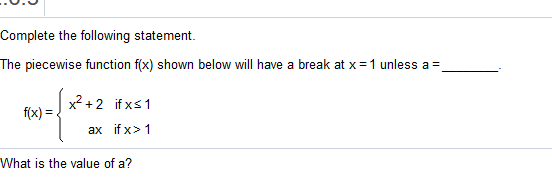
presumably, the initial 4 meter height is not the height of any of its bounces
harsh cipher
okay I kind of got it
it has to be"the height of the bounce"
meaning after first bounce?
meh
viscid thistle
@harsh cipher It's 2.92 because 73% of 4 is 2.92 
And the answer to B) is 4(.73⁸) ≈ 0.322
viscid thistle
3^5=243
viscid thistle
I dont understand what is your question
harsh cipher
how is (root3)^5 = root 243
viscid thistle
that's allowed
viscid thistle
$(\sqrt{3})^5 = 3^{5/2}=\sqrt{3^5}$
carmine birch
yes
obsidian monolithBOT
HoboSas:
keen sigil
if someone could help me figure out this problem that would be greatly appreciated
y = 2cos(2x) and y=sin(x)-1
trying to find x
uncut mulch
have you attempted anything yet?
keen sigil
idk where to start
i know i might need to use the identity for cos2x
which would equal cos^2x - sin^2x
uncut mulch
there are multiple forms for the double angle identity for cosine
keen sigil
oh right
my intuition tells me to use the (1-2sin^2x) one but idk if that's right
i could use the other one and somehow convert cos into 1 and sin^2x
uncut mulch
try it and see what happens
drowsy karma
For Method of Elimination, can I choose either x or y to eliminate? Or do I have to eliminate a specific one
keen sigil
I've gotten here and I'm not sure if it's right or where to go
uncut mulch
incorrect setup
those aren't the equations(s) you should be solving
you should be starting with:
$2\cos(2x) = \sin(x) - 1$
obsidian monolithBOT
ramonov:
uncut mulch
applying the double angle identity: $\cos(2x) = 1 - 2\sin^2(x)$ will lead you to a quadratic in $\sin(x)$
obsidian monolithBOT
ramonov:
willow bear
@drowsy karma it's up to you
keen sigil
oh i was trying to make the left match the right and doing systems of equations i was just overthinking it
this seems right
 dense creek
Hi, I’m stuck at this question. Anyone can help me ?
viscid thistle
Not #precalculus at all.
dense creek
@viscid thistle I suppose to post to which channel ?
viscid thistle
Well
You have plenty of channels of adv maths
If you have no idea still, use #questions section
wide ocean
yeah that's not precal..
 heady jewel
@dense creek thats not proper notation btw you cant make changing variable(k) and the bound the something in terms of k
so use a different changing variable
dense creek
So can I use N ?
viscid thistle
Not #precalculus not #precalculus not #precalculus
dense creek
@heady jewel
heady jewel
Anythi other than k
@dense creek
@viscid thistle relax notation is used everywhere
You dont want something like
$\sum_{k=1}^{k+1} k$
obsidian monolithBOT
Lionel:
viscid thistle
@viscid thistle relax notation is used everywhere
@heady jewel and?
heady jewel
So hes clarifying notational problems
Im not discussing his problem
The one he posted
viscid thistle
Still not the place.
 warm crescent
how is it obvious that difference of students height is less tham 3m?
heights of student *
 sour eagle
Have you ever seen someone taller than 3m
viscid thistle
good argument, how do you prove that?
sour eagle
😔
warm crescent
NO
 serene heath
lmao imagine being under 4m tall
sour eagle
yea the question is kinda dumb imo
warm crescent
thanks vroo
warm crescent
opening my maths notebook after almost 5 months
sour eagle

warm crescent

viscid thistle
...
viscid thistle
yah this is right @robust rover
sour eagle
what
reef jasper
how do i write a cosine function for this
reef jasper
hello?
reef jasper
i got the amp and midline and i’m pretty sure i got the period
3cos(pix+1/2)-1
but i don’t get the same thing in desmos
remote veldt
put brackets around the (x + 1/2). If you want to transform f(ax) by a shift of b, it's f(a(x - b)) not f(ax - b)
 muted granite
Anyone have a link to video or article how to do this on a TI-84? I can not find one. Thanks.
muted granite
yeah, but I am going to need to know the process when it gets more complicated.
viscid thistle
how can matrix addition get more complicated?
craggy dune
well you can use the stuff you learned at school or you can use wolfram
or just wait till someone answers your question
sometimes that works too
viscid thistle
reduce the fractions
viscid thistle
yah
wide ocean
Can someone pls explain why the reference angle has answers in ALL four quadrants?
I thought it would only be in Quadrant 1 and 4 since cos is positive
But since it's Cos squared, it can have negative values?
"CAST" rule?
viscid thistle
But since it's Cos squared, it can have negative values?
indeed
viscid thistle
btw, domain doesnt imply solutions
wide ocean
wym?