#precalculus
1 messages · Page 232 of 1
 pale bison
 full garden
❤️ thank u so much
❤️ if it wasn't for you I would've not been able to solve it thank u so much
pale bison
ah fuck i made a mistake
full garden
oh
full garden
dont say sorry if it wasn't for u i would've not been able to solve that question thank u so much bro ❤️
pale bison
lol np
full garden
hey guys i have a question please
so it it correct if i do this ?
and then factor everything out?
can someone please tell me if thats the correct way of starting
full garden
oh
 sour eagle
so it would be (k^2+1)^2-4*k^2
full garden
so only (k^2+1)^2
sour eagle
Yes
full garden
guys how do I solve for this quadratic
i tried using like quadratic formula
and didn't get that recperical thing
 hasty magnet
are u asking for a or b @full garden
full garden
this
hasty magnet
k is a constant
full garden
like its impossible to get x = -k
yes bro I am jus trying to solve it using the quadratic formula
hasty magnet
ok first can u expand the equation
and tell me what you got
then we can apply the quadratic formula
hasty magnet
nah u have to expand it
hasty magnet
before u apply it
hasty magnet
ok good
full garden
thank u
hasty magnet
can u combine any like terms
full garden
yes
hasty magnet
combine em
hasty magnet
...
that's not combining like terms
do u seem anything u can combine
from the other thing u sent
full garden
i dont think i can combine them bro
I can just factor out the common x
and Ig use it for the b
hasty magnet
not factor
combine
oh wait
ok
i thought u could combine like terms but i was wrong
u actually have to take the quadratic formula of it lol
full garden
okay
hasty magnet
i did?
@full garden
i got it if u need
did u get it?
if u still need help here's how u do it https://mathsolver.microsoft.com/en/solve-problem/k { x }^{ 2 } %2B `left( { k }^{ 2 } %2B1 `right) x%2Bk %3D 0

Microsoft Math Solver
Solve your math problems using our free math solver with step-by-step solutions. Our math solver supports basic math, pre-algebra, algebra, trigonometry, calculus and more.
i kept doing it wrong because i forgot u needed absolute values
😅
full garden
@hasty magnet thank u so much ❤️ thank u ofc u did even if u didn't help me u still tried which means a lot to me thanks buddy
 rapid tangle
@lilac pier I tried that earlier put how do I apply limits to infinity on that
 stuck lark
denom
 lilac pier
numerator approaches +infinity
oh
LOL yeah
actually for the infinity part, write the denominator as 1/x^3 - 6/x^2 + 11/x - 6
so as x approaches infinity, the denominator approaches -6
the numerator approaches infinity since x^3 has the highest power and is positive
so it's something of the form infinity / -6 which is just -infinity
@rapid tangle
rapid tangle
Yes, the answer's correct
Thanks
Just got wound up at the algebra part cuz I'm relatively knew to this stuff
 tender bolt
if i am given g(x) = 2x+1 f(g(x))= 3x+7 , how can i find f(x)?
 harsh smelt
plug g(x) in
tender bolt
where
 past meadow
i think commander means sub 2x+1 for g(x) in f(g(x)) so that you have f(2x+1)=3x+7
 viscid thistle
Zeus wants to know f(x) given g(x) and f(g(x))
What changed between g(x) and f(g(x))? @tender bolt
viscid thistle
$g(x)=2x+1$
$f(g(x))=3x+7$
tender bolt
so f(x)= kx + 6
tender bolt
so there is not really any method
viscid thistle
Wait no
tender bolt
it is just trying to find it
viscid thistle
Hold on
viscid thistle
Cant you do something with inverse
past meadow
you're overthinking it. perform the substitution ramonov mentioned
viscid thistle
Im pretty sure theres a legit method with inverse
tender bolt
i just thought it in my had and i got f(x)= 3/2x + 11/2
past meadow
thats the correct answer zeus
viscid thistle
^
tender bolt
oh so i can do 2x+1= u
viscid thistle
Eeee
 uncut mulch
isolate x to get it in terms of u
 obsidian monolithBOT
AASlavoj:
viscid thistle
Shouldnt that be f(x)
uncut mulch
uh no
tender bolt
f(x)= 2*(x-7)/3 +1
uncut mulch
u=2x+1
isolate x from that equation
tender bolt
i did that
obv
thats how i got (x-7)/3
i any case, i got what i needed, i checked also
thanks mans
man*
uncut mulch
wait
uncut mulch
that notation looks messed up
viscid thistle
How can u be two different things
uncut mulch
^
uncut mulch
extremely hard to follow what's actually being done
harsh smelt
How can u be two different things
viscid thistle
Animal abuse inside that box
uncut mulch
who the fk is Schrodinger?
harsh smelt
it is Schrödinger minimized
sour eagle
ö looks like 😮
tender bolt
wtf
sour eagle

 hexed ermine

 warm siren
lol
rapid tangle
How do i solve this
 serene heath
what have u tried
rapid tangle
I don't know how to expand xⁿ
The formula wasn't given
Like i solved the prev one where it was a^x
rapid tangle
Ok imma try, thanks
Hey..uhh so still not getting it
Sorry, if it's basic stuff but I'm really new to this 😅@serene heath
I could solve it using L'Hopital rule but I wanna solve it algebraically cuz they didn't teach that rule in this book
serene heath
what did you get after subbing
rapid tangle
😶oops sorry i took the wrong limit
Thanks for your help, got it
This is correct right?
viscid thistle
Yup
Big brain
My man
I miss u
@rapid tangle good job
Me too lol
How u been
#chill :)
hasty magnet
the increments are by 7 @silver matrix
so one line is counted as 7 numbers until that line
it's asking what would y be if x is 2
sour eagle
x-intercept = intersection between the graph of the function and x axis
y-intercept = intersection between the graph of the function and y axis
so f(14) = 0
f(0) = 28
You can get the equation of the "line" between points (0,28) and (14,0) by calculating the slope
m = -28/14 = -2
y = -2x+28
So f(2) = -2*2+28 = 24
@silver matrix
hasty magnet
bruh ur not suppose to give them the answer @sour eagle
 silver matrix
Why not?
sour eagle
😔
hasty magnet
we're here to guide you, not do it for you
silver matrix
Now, here the answer is A. right?
Thanks to his explanation I know how to mechanize this exercises
sour eagle
Yes
full garden
hey guys I just have a very silly question
for this one I just plugged 1/x in f
and I got this
but I feel like it's wrong to do that because the question can't be that simple 😅
can someone please just quickly tell me if that's correct please
 smoky pagoda
im not familiar with the notation but if Im assuming correctly, id say it's -2*(1/(-3(x-4)))-5
full garden
oh
smoky pagoda
or when simplifying: 2/(3x-4)-5
cross check with someone else though
it's the way I think the notation is being used
full garden
okay thanks buddy I'll check thank u
smoky pagoda
i havent actually seen this before
full garden
sameee
smoky pagoda
but the way I understand it what's in the square brackets becomes the new input for f
full garden
i thought we just had to sub 1/x into f
oh
yes i think ur answer is correct bro thank u
rapid tangle
Where did I go wrong?
 signal herald
@rapid tangle 5th line
You factor out an x, but take out the negative sign as well
That’s why you end up with -1/2 instead of 1/2
rapid tangle
@signal herald ah yes, a rather silly mistake
Thanks tho
signal herald
@rapid tangle Where do you go to school? It's interesting that you're learning limits in precalculus, especially using series expansions
 drowsy karma
So I'm looking at the answer key of my homework but I don't understand where that 3 came from in the final portion of the question.
The 3 that came into 3y
harsh smelt
he moved everything to right
drowsy karma
wym
uncut mulch
multiplied both sides of the equation by 3 to get rid of the fraction
rapid tangle
@signal herald heyy so m currently in 10th grade moving to 11th
I'm really just trynna teach myself calculus
Rn I'm following this book called Differential Calculus for Beginners by Joseph Edwards
uncut mulch
is that a 9, a or q
uncut mulch
multiplied both sides by 12
harsh smelt
look
$\frac{(-q-3)}{6} \frac{3}{2} = -1$
obsidian monolithBOT
Commander Vimes:
harsh smelt
$\frac{3(-q-3)}{12}= -1$
obsidian monolithBOT
Commander Vimes:
uncut mulch
though it would be more efficient to multiply by the lcm of 2,6 (which was 6)
harsh smelt
$\frac{3(-q-3)}{-1}= 12$
obsidian monolithBOT
Commander Vimes:
harsh smelt
which is the same as $\frac{3(-q-3)}{1}= -12$
obsidian monolithBOT
Commander Vimes:
harsh smelt
do you understand why?
"the cosine of an angle in the unit circle just equals cosine, "
hm
indeed!
well your idea is correct
look
sin is opposite leg divided by hypothenuse
(for right triangle)
and cos is near leg by hypothenuse
so in case of unit circle we have hypothenuse 1
since it is radius
and because of that
x and y components are cos and sin respectively
we define unit circle in terms of circle btw
x^2+y^2=1
viscid thistle
hey guys! How do i find the two fundamental solutions for cos(5x+3x)=0.03?
i found one, but not sure how to find the other
harsh smelt
hey guys! How do i find the two fundamental solutions for cos(5x+3x)=0.03?
@viscid thistle cos(-x)=cosx
viscid thistle
@harsh smelt i appreciate that tip, but im not quite sure how to apply it
i know that my first answer is in QI and my second should be in Q4
harsh smelt
suppose cos(10)=0.3
viscid thistle
is that where thats heading?
harsh smelt
then cos(-10)=0.3
harsh smelt
suppose you found solution which is A
then because cos is even
-A is also solution
viscid thistle
what if i wanted the solution to only by between 0 and 360
viscid thistle
i tried that as well!
obsidian monolithBOT
 Requested by Commander Vimes#7532
harsh smelt
Requested by Commander Vimes#7532
harsh smelt
basically what i said
viscid thistle
how did they come up with 33.965?
Sorry if i'm not understanding by the way! im trying my best!
drowsy karma
@harsh smelt ya i think i get it
lilac pier
@viscid thistle You have cos(8x) = 0.03, that means cos(8x) is positive
For simplicity, let 8x = alpha. So you have cos(alpha) = 0.03, which means cos(alpha) is positive. You should know cos is positive in the first and fourth quadrants.
For the first quadrant, you get alpha = 88.28. For the fourth quadrant, it's 360 - 88.28. So you have alpha = 88.28, 271.72. Now use alpha = 8x.
 fleet yew
@lilac pier dont just give out answers
 willow bear
no, the domain of tan is not $\mathbb{R} - { n \pi/2 \mid n \in \mathbb{N} }$.
obsidian monolithBOT
Ann:
willow bear
$\mathbb{R} - { (2n+1)\pi/2 \mid n \in \mathbb{Z} }$
obsidian monolithBOT
Ann:
silver matrix
Uf.. I do not understand that 2n + 1
Indeed, I do not understand all this mathematical demonstrations or whatever is called when they add that + 1
willow bear
it can be rewritten as $R - \curly{n\pi + \frac\pi2 \mid n \in \bZ}$
silver matrix
it's annoying for me
obsidian monolithBOT
Ann:
silver matrix
Yeah
Thanks
Now I understand why they add that 1
it's a better way the first way but I needed to know where it came from
silver matrix
Is this true? At first I thought it was, but then I said that the domain could be (in interval notation) (-\infty, 2] U [3, \infty)
As the x can have all that values except the ones between 2 and 3
This ones included
But then he says that the domain has to be the intersection between the roots.
What do you guys think?
viscid thistle
Yes
The domain of a function is all the values that can produce a result passing through the formula
sqrt x-3 is only defined in R when x>=3
willow bear
sqrt**(x-3)**
viscid thistle
and sqrt 2-x only when x<=2
willow bear
sqrt**(2-x)**
viscid thistle
so the function as a whole has no real domain
willow bear
if you write \verb|sqrt x - 3| then it is not clear whether you are talking about $\sqrt{x}-3$ or about $\sqrt{x-3}$
obsidian monolithBOT
Ann:
viscid thistle
indeed, sorry
silver matrix
What is hte difference between that example and this one?
I mean the values don't have an intersection either
But here there's a solution
In the other case, it wasn't
Why
This is not solved algebraically, I HATE this explanations
viscid thistle
the square root doesn't exist if what is being squared is negative
willow bear
in either case, you don't want negative numbers under your square roots
silver matrix
Is a circle an even, odd or neither function?
The professor says that techinically a circle is not a function
 tawny nacelle
yes it isnt
 patent beacon
It's not a function R → R, which is usually where we talk about odd/even
silver matrix
Could you tell me, even so, if it's an even odd or neither function? It's symmetrical both on the y-axis and on the origin
Oh ok
so it's anything then right?
If it's not a function
then can be neither, nor odd nor even I guess
serene heath
the question is nonsense
tawny nacelle
its a relation on the set R
serene heath
since its not a function
silver matrix
https://www.youtube.com/watch?v=fKyBOLsqRlo&list=PL0o_zxa4K1BXUHcQIvKx0Y5KdWIw18suz&index=10
Min: 17:34
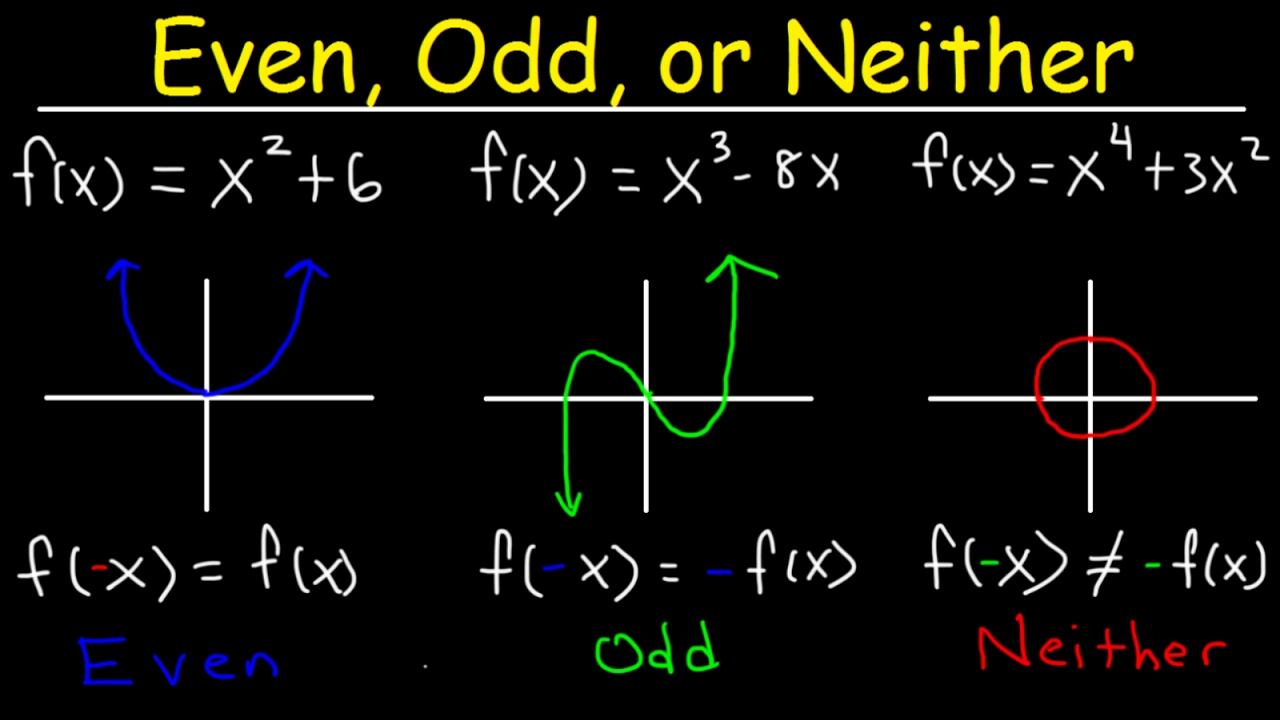
This algebra 2 and precalculus video tutorial explains how to determine whether a function f is even, odd, or neither algebraically and using graphs. This video contains plenty of examples and practice problems using variables and constants. First, plug in -x into the equati...
I don't like how he explain things, but 🤷♂️ this guy makes ace exams
He taughts you how to mechanize things
So
Left as an exercise I guess. The thing is that I've heard about R but I don't even know what that is
They are like planes? Dimensions? Real numbers?
No idea
serene heath
the set of all real numbers
silver matrix
Ok
I've seen sets in a very basic way
so
So R1, R2 and R3 are then differente thins right?
willow bear
yes
R^1, or just R, is the number line
R^2 is the x-y plane
R^3 is three-dimensional space in the everyday sense of the word
silver matrix
Can there be R\infty?
harsh smelt
Hilbert space
silver matrix
or R0?
harsh smelt
or R0?
zero vector?
willow bear
no to both of these
willow bear
R^∞ could be understood as the set of all infinite sequences of real numbers
tho it never really comes up bc there's not much you could do with it
R^0 is just... well, you could say it's just {0} but i don't see a use for that except maybe to plug a hole in some definition
silver matrix
So if there are higher dimensions than 11, why the physicists try to invent a theory that explain all in the world with x dimensions?
silver matrix
yeah
willow bear
what are you even talking about
silver matrix
how can you explain more than 11 dimensions
silver matrix
No, it would be a non-technical discussion about what people are studying today
 pale kettle
You can just work with these things algebraically
harsh smelt
dimension in math != dimension physically
pale kettle
You don't need to be able to visualize them to be able to work with them
harsh smelt
dimension in math is just like roughly standard lenght of an array
willow bear
the space of all possible configurations of a system is a meaningful thing physicists talk about
and the dimension of THAT can go as high as you want with complex enough systems
silver matrix
I'm just saying that I do not understand why physics try to say that the world is x dimensions when in math you see higher dimensions than that
willow bear
why does it matter what you see in math
pale kettle
Because the world isn't that high of a dimension?
willow bear
what you see in math need not have direct relation to anything in the real world
or like
pale kettle
Just because we can think of R^(10000) doesn't mean the world can have that many dimensions?
silver matrix
so math is apart from the world/universe?
willow bear
direct relation in specifically the way you're thinking of
pale kettle
I mean, there are things in the world that have high dimension in some sense
silver matrix
that explodes my mind tbh
pale kettle
Like data sets can have high dimension
silver matrix
and doesn't makes sense in some way
pale kettle
This isn't the standard "physical dimension of space"
silver matrix
then you are not explainging all
willow bear
because again, R^n for high n is the natural setting for modeling complex systems with many components and many degrees of freedom
pale kettle
I can have a dataset that takes values in R^(10000)
patent beacon
There's different ways to interpret a vector space. Literally representing "space" is one of them, for which R⁴ could never work
willow bear
like if you have three bodies interacting gravitationally in three dimensional "physical" space, that's already three position and three velocity vectors - one for each body
and the state of the system as a whole could be expressed as a single point in R^18
up to technicalities as to what that point would ac be
add more components and interactions and the dimension of the state space can be cranked as high as you wish
silver matrix
I have to study more to comprehend these type of things. From a premature perspective I see incoherent listening to a physicist talking about M-theory or whatever theory (obviously in a divulgative way) and then see the group monster with 256 dimensions or whatever that thing is (again, in a divulgative way)
pale kettle
Dimension just can have different meanings?
willow bear
of course you have to study more to comprehend these types of things
pale kettle
Dimension in these situations usually means dimension as a vector space
So like R^(10) has dimension 10
patent beacon
Self-teaching AIs are really just spicy functions R^10 to R^5 or whatever
 slow roost
i did the math but not sure if its right.
 maiden pebble
is tan(5x) = sin(5x)/cos(5x)
past meadow
Yes
maiden pebble
awesome
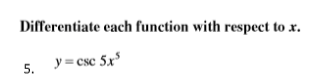
https://i.imgur.com/aCYvzOV.png I got a very long answer, could someone tell me if im close?
 viscid thistle
https://www.symbolab.com/solver/derivative-calculator/\frac{d}{dx}\left(csc\left(5x^{5}\right)\right)
Free derivative calculator - differentiate functions with all the steps. Type in any function derivative to get the solution, steps and graph
maiden pebble
$ csc(5x^5)cot(5x^5)(25x^4)cot(5x^5) + (-csc(5x^5))(-sin(5x^5))(25x^4) $
obsidian monolithBOT
Bridge:
maiden pebble
thanks rent free i see where i went wrong
viscid thistle
np
maiden pebble
Could someone help me solve the derivative of sqrt(2t)
 empty wolf
Do you know how to write square root as an exponent?
maiden pebble
Yes
empty wolf
Okay, so once you've done that, do you have an idea for derivative rules you know that would apply to (2t) raised to some power?
obsidian monolithBOT
Bridge:
empty wolf
Yeah, nice, that's exactly it. There's just one step left. The power rule would be for $t^{1/2}$, but you have 2t inside
maiden pebble
finally...
obsidian monolithBOT
flormulaic:
empty wolf
So is there any other rule you can use that takes care of when you replace e.g. x with 2x or a f(x)?
maiden pebble
what?
empty wolf
Do you remember learning about the chain rule?
empty wolf
Sorry, that's what I was trying to ask about
So, can you try applying the chain rule to the steps you've already worked on?
maiden pebble
is my equation correct?
past meadow
Wait why do you need chain rule here
empty wolf
The equation you put above would be for just the power rule. You also need to handle the "2t" inside somehow (using the chain rule)
past meadow
...
Constant multiple rule
Much easier than chain rule
Original expression simplifies as Sqrt(2)*sqrt(t)
maiden pebble
I dont think ive heard of the Constant Multiple rule before
empty wolf
I did not know that was a thing, but it sounds like giving a name to the chain rule of a linear function
maiden pebble
Wait, flormulaic do you want me to apply to chain rule to my original equation or my most recent one?
empty wolf
I was thinking about just applying it to the most recent one. The only problem is in the most recent equation you sent, you're just skipping the fact that when you apply the power rule to (2t)^{1/2}, there is a 2t (a function) that you need to pull the derivative from afterwards
Sorry if that's unclear
maiden pebble
So you just want me to mutliply $ \frac{1}{2}(2t)^{-1/2}$ by 2
obsidian monolithBOT
Bridge:
empty wolf
Exactly like that, yes
maiden pebble
So the fraction obv cancels
empty wolf
Yes
maiden pebble
Ooh ok, so i get 1/sqrt(2t)
empty wolf
I think so, yes
empty wolf
That's 1/sqrt(2t), it just separated the two
empty wolf
Sneaky, I think the rule you're talking about would not pass through a nonlinear function (like square root)
maiden pebble
, calc 2/3/4
obsidian monolithBOT
Result:
0.16666666666667
, calc 2/1 * 4/3
obsidian monolithBOT
Result:
2.6666666666667
, calc 2/3 * 4/1
obsidian monolithBOT
Result:
2.6666666666667
, calc 2/3 * 1/4
obsidian monolithBOT
Result:
0.16666666666667
thank god
 prime crypt
. Write a polynomial inequality in factored form with integer linear factors who’s solution is:
𝑥 ∈ [−3]∪[−2,0]∪ [1/2,2/3]
willow bear
what's that box meant to be before the 1/2
also do you have a screenshot of the problem just in case
stuck lark
i heartily dislike [] used for both closed intervals & set roster
prime crypt
Yep they force it up your mouth in ib lol
harsh smelt
well
@prime crypt
if this borders are solutions for inequailty
they are roots of underlying equality
(sounds a bit communistly lol)
prime crypt
hahaha
you’re right, just tried that and got something
just used one of those sign charts to see if the solutions fit for either < or >
willow bear
aight well ok like
you're gonna want a nonstrict inequality
because (polynomial) > 0 will only ever give you open intervals
viscid thistle
Tag helper after 15 mins
 stark vale
okey thanks
patent beacon
I'm thinking something has gone wrong
It looks like whatever goes off the top, comes back at the bottom. With that being said, the amplitude would then be 5
Periodic functions should never look like this lol
silver matrix
Thanks for the answer. I guess the period is 10pi, no?
And what about the formula?
patent beacon
,w graph 5cos(1/5 x)
obsidian monolithBOT
 Requested by Kaynex#7520
patent beacon
Requested by Kaynex#7520
patent beacon
That would be it. Note that 1/5 comes from 2π/10π
viscid thistle
bruh
silver matrix
And this is the Mathematical Association of America
arggg
I'm gonna tell my advisor
viscid thistle
very poorly made
silver matrix
My answer?
silver matrix
Yeah, agree
 still meadow
isn't that Webwork as a whole?
viscid thistle
Anyone here ?
pale bison
no
viscid thistle
we're all ghosts
Q.29
I have solved this auestion
But i just need someone to check if my logic is correct or not
pale bison
sure, post your solution
pale bison
sure
viscid thistle
So first i checked for what values of x sqrt(1-|x|) would be valid
As its a square root
It should always be positive for all real values of x
So sqrt(1-|x|) >=0
Solving this inequality we get
x must belong to the interval [-1,1]
pale bison
good, keep going
viscid thistle
And then i just took the intersection of the above 2 sets
And got the answer
Have i considered all the appropriate cases ?
pale bison
yes
you actually don't need to consider the -sqrt 5 case, since |-1 - sqrt 5| > 1
so looking exclusively at [-1, (-1 + sqrt5)/2] will work
oh wops nvm
i missed the 2 at the bottom
yeah, you did everything correctly, discard what i said above
viscid thistle
Thanks 🙂
pale bison
oh wait wops,
|(-1 - sqrt 5)/2| > 1
viscid thistle
so looking exclusively at [-1, (-1 + sqrt5)/2] will work
@pale bison Shouldnt it be a closed like this ) ?
Since the roots arent considered
pale bison
yes, since you have strict equality, i'm just giving a domain for which they're defined on
viscid thistle
Yes 🙂
sour eagle
@viscid thistle but the solution ((-1-sqrt5)/2, (-1+sqrt5)/2) is not an answer in that list. Or maybe im just dumb. Sorry for the ping!
viscid thistle
@sour eagle Its alright 🙂 , actually the solution will be obtained after intersection of 2 sets
Thats just one of the sets
sour eagle
Oh ok! Wasn't sure if that was the final solution or not 😅 Sorry again for the ping
 gloomy mortar
Okay I’m absolutely going nuts with Precalc. I have a few assignments left and I just can’t figure them out. I asked some family too. Can someone please dm me so we can talk about these calculus parts of the class (since this server doesn’t like giving me notifications in here 🙈)? I’m just being driven nuts with it and only have a few more days till the school year is over.
 rich flint
@gloomy mortar go ahead and post your work so someone can see if they can help you
@gloomy mortar we have rules regarding dm make sure you review those but your better off uploading a screenshot on here so people can help you. If I can’t see the work I don’t feel confident that I would be able to assist. Good luck 👍
viscid thistle
That's all eh
Wow great
No one will have time to walk through all
@gloomy mortar you gotta choose
past meadow
the general prolem solving method for geometry problems like those in the second pic onward goes like this: Draw a diagram. list or think of relevant formulas(cosine rule, sine rule, etc are going to be especially important here). See if you have enough values to use any of those. If you don;t, look for values that you can find that you would be able to plug into those formulas. Then, do your best to solve.
 raven brook
 pale bison
,rotate
obsidian monolithBOT
pale bison
what have you tried?
viscid thistle
@raven brook dont multipost.
 sterile notch
So I had this question:
Show: 2 * ln(y) = √(ln(y))
2 * ln(y) - √(ln(y)) = 0
2 * a^2 - a = 0
a( 2a - 1 ) = 0
2 * ln(y) - √(ln(y)) = 0
√(ln(y)) ( 2 * √(ln(y)) - 1) = 0
√(ln(y)) = 0, ln(y) = 0, y = e^0 = 1
or
2 * √(ln(y)) - 1 = 0
2 * √(ln(y)) = 1
√(ln(y)) = 1/2
ln(y) = 1/4
e^(1/4) = y
Though I was wondering, why I don't need to put ± next to ln(y), after squaring 1/2, to 1/4
obsidian monolithBOT
ramonov:
sterile notch
Looks like abs value tbh
uncut mulch
$(\sqrt{x})^2$ is not the same as $\sqrt{x^2}$ for all values of x
obsidian monolithBOT
ramonov:
sterile notch
Hmm, what values?
I guess negative values wont work.
For the first one.
Since it'd be undefined I assume?
uncut mulch
depends if you are considering complex numbers
sterile notch
Ah right
uncut mulch
eg (sqrt(-1))^2 would be -1
but sqrt( (-1)^2) would be |-1| = 1
sterile notch
Yep, that makes sense
gloomy mortar
@viscid thistle I still need this much help because people weren’t really helping before, so this has all built up. I guess now you realize why I can’t do it myself. People are refusing to help me
gloomy mortar
Before I didn’t send many. I sent 13 problems now because it’s built up since people weren’t helping
viscid thistle
Aight
gloomy mortar
I get that it’s a lot but it’s gotten to that much because people haven’t helped. That’s why I really just need someone to help
And I’m coming to here because my teacher doesn’t ever answer her emails
And no one I know irl knows more than the second problem
Or if they have, haven’t replied
viscid thistle
-
Note that angular speed's formula is $$\omega=\frac{\theta}{t}$$ and when we talk about time that it takes to rotate once we talk about this formula $$\omega=\frac{2π}{T}$$ where T is the time it takes to rotate once (which you are given)
-
Is basically asking you for your lineal velocity, V. Whose formula is $$V=\omega \cdot r$$ whose r is given on the previous problem.
Next pic: 1) Note that Sine's law is $$\frac{\sin(A)}{a}=\frac{\sin(B)}{b}=\frac{\sin(C)}{c}$$ where A is an angle and a is the side length located on the opposite of the angle (same for letters b and c), example given on the pic. While cosine's law: $$a²=b²+c²-2bc\cdot \cos(A)$$. So for 1 and 2, two lengths are given and one angle, choose which law is more convinient.
From 3) to 6) you gotta draw these.
3) 2 angles and one length given, calculate another length.
-
2 lengths are given (while 90 being the length side) (use geometry here).
-
2 angles and 1 side, pretty obvious to which law you should use to get the other side.
-
Again pretty obvious, 2 sides and 1 angle, calculate the missing angle.
Next pic:
-
2 angles 1 side, calculate side.
-
2 sides 1 angle, calculate angle.
-
3 sides, calculate angle.
Last pic:
-
Again, 2 angles and 1 side, calculate the other side
-
Motion problem combined with 2 angles given, to calculate 3 sides, 2 or them are calculated by the motion equation (you gotta transform the units first) $$x=v\cdot t$$ where v is velocity which is given and time which is given as well, when both x are calculated, use cosine's law for the other length.
Bonus: 2 side lengths, 1 angle, missing 1 side, calculate it by one of the laws. And to find the area, i would use Heron's formula for the area of any triangle: $$A_{\text{triangle}}=\sqrt{s(s-a)(s-b)(s-c)}$$ where s is the semi-perimeter so $$s=\frac{a+b+c}{2}$$ and a, b and c are all the side lengths of the triangle
@gloomy mortar
obsidian monolithBOT
Al𝟛dium:
gloomy mortar
Oh god let me try to break all that down and do it
Thanks for the info I’m just trying to not have my brain explode rn
Is 3 just 2pi/45 rpm then?
On the first page
Is this right for those two?
@viscid thistle
viscid thistle
The second one is not
And the first one must be expressed in rad/s not in rpm
For the second one look better at the formula
Its $V=\omega\cdot r$ not the other one
obsidian monolithBOT
Al𝟛dium:
gloomy mortar
Wait what did I do wrong then in the second
viscid thistle
Its $V=\omega\cdot r$ not the other one
obsidian monolithBOT
Al𝟛dium:
gloomy mortar
Yeah cause w=2pi/45
gloomy mortar
I multiplied that by 125/1
viscid thistle
Neither the dots
gloomy mortar
No worries
viscid thistle
So yeah its correct
And the first one must be expressed in rad/s not in rpm
@viscid thistle dont forget this one thing tho
gloomy mortar
Wait it says radians per minute though so wouldn’t it be rad/m not rad/s?
(I put rpm and derp, that’s revolutions per minute not radians per minute lol)
viscid thistle
Wait it says radians per minute though so wouldn’t it be rad/m not rad/s?
@gloomy mortar you are given 45s
Not minutes
Therefore it must be seconds
So rad/s
Or whatever notation that its equivalent to that
gloomy mortar
Yeah but it says calculate in radians per minute which I just now realized
Unless that’s a typo
viscid thistle
Where?
gloomy mortar
Right on number 3
gloomy mortar
So just times it by 60?
viscid thistle
Look
gloomy mortar
I mean to get rad/s to rad/min do I times 2pi/45 by 60?
viscid thistle
,ask (2pi rad)/45s to rpm
obsidian monolithBOT
 Requested by Al𝟛dium#4084
viscid thistle
Requested by Al𝟛dium#4084
viscid thistle
^
gloomy mortar
It’s not rpm it’s radians per minute
viscid thistle
BRUH oml i need to eat urgently lol
gloomy mortar
Lol
viscid thistle
I mean to get rad/s to rad/min do I times 2pi/45 by 60?
@gloomy mortar yeah
viscid thistle
Totally correct
gloomy mortar
So I’m taking a look at the last two pages, and I have this so far. I feel like I should use the sines law, but with the info I have I’m confused...
Cause I have sides b and c but angle A...
If I use the Cosines law I get stuck
viscid thistle
Yah for the tree one you gotta use cosine law
It has 3 forms
Use the most convenient one @gloomy mortar
gloomy mortar
Wait so I don’t need that to be angle A then
Does it matter what’s angle A, B, and C?
harsh smelt
it is opposite to side
gloomy mortar
I mean does it matter if that is angle A, B, or C?
viscid thistle
Yeah
gloomy mortar
Because it doesn’t say what side is a, b, or c
viscid thistle
You can just name them
But respect the angle
Like if you put angle A, the side a must be on the opposite
gloomy mortar
Okay I still don’t get what I use though. Because the different versions of the cosine law only have one version for each angle
viscid thistle
Okay
For this one i'll tell you
Just so you get used to it
$$a²=b²+c²-2bc\cdot \cos(A)$$ so $$a²=30²+45²-2(30)(45) \cdot \cos(86)$$
Thats it
obsidian monolithBOT
Al𝟛dium:
gloomy mortar
Oh wait wait yeah I know what to plug in for that but I still don’t get the info I need I mean
I need angle C
obsidian monolithBOT
Al𝟛dium:
viscid thistle
Bc now you know a, b and c
gloomy mortar
😳 I didn’t think of that
gloomy mortar
I’m confusing myself
I feel like I need to take cos^-1 to cancel cosine and find <C but how do I do that here
Cause I can’t find cos^-1(4.07)
@viscid thistle
willow bear
4.07 = cos(C)
gloomy mortar
Yeah
willow bear
the fact that you got cos(something) to be a value above 1 is
kinda suspicious ngl
hoooold up
gloomy mortar
What did I do wrong then I’m confusing myself
willow bear
,calc 2 * 52.31 * 30
obsidian monolithBOT
Result:
3138.6
,calc 52.31^2 + 30^2
obsidian monolithBOT
Result:
3636.3361
so you had 2025 = 3636.3361 - 3138.6cos(C)
that's what you should've had, anyway
and then you... subtracted the 3636.3361 and the 3138.6?
yeah, that's where you went wrong
gloomy mortar
No that’s the same number
497.7361
2025=497.7361cos(C)
That’s what I have
,calc 3636.3361 - 3138.6
obsidian monolithBOT
Result:
497.7361
Result:
4.066265060241
,calc 2025/497.7361
obsidian monolithBOT
Result:
4.0684209965884
4.07, approximately
viscid thistle
,calc 30^2+45^2-[(2(30)(45)*cos(86)]
obsidian monolithBOT
The following error occured while calculating:
Error: Parenthesis ) expected (char 30)
harsh smelt
,w range cos(x)
obsidian monolithBOT
Requested by Commander Vimes#7532
harsh smelt
,calc 30^2+45^2-((2(30)(45)*cos(86))
viscid thistle
,calc 30^2+45^2-(2(30)(45)*cos(86))
obsidian monolithBOT
The following error occured while calculating:
Error: Parenthesis ) expected (char 31)
Result:
3960.9858013643
,calc sqrt(3960.9858)
obsidian monolithBOT
Result:
62.936363097974
Look
willow bear
@gloomy mortar you are making an algebraic fuckup
to demonstrate...
by your logic, the equation 35 = 50 - 2x would have x = 35/48 as a solution
which it does not
3636.3361 - 3138.6 * cos(C) is not (3636.3361 - 3138.6) * cos(C)
gloomy mortar
I used a calculator for that too
viscid thistle
@gloomy mortar redo it
willow bear
mythicalsheep
gloomy mortar
I just did
willow bear
i am not saying you did your arithmetic incorrectly
gloomy mortar
And got the same answer
willow bear
i am saying THAT THIS IS AN INVALID ALGEBRAIC MOVE
gloomy mortar
gloomy mortar
Wdym Ann
willow bear
ok so like
can you show your work again
redone if possible
so that i can pinpoint the mistake more easily
viscid thistle
redone
gloomy mortar
Ik
gloomy mortar
Why’d you subtract 2025 and put everything over 3138.6
obsidian monolithBOT
Requested by Commander Vimes#7532
gloomy mortar
That’s the opposite
willow bear
aight so like
you know what really is not helping
the fact that you're choosing to work with big messy numbers
harsh smelt
Why’d you subtract 2025 and put everything over 3138.6
because
a^2=b^2+c^2-2ab(cosC)
gloomy mortar
I’m using the scientific calculator to make my life easier so I don’t have to work with them
willow bear
algebra
 remote veldt
sometimes it can be easier to make everything a variable, then put numbers in at the end
willow bear
$c^2 = a^2 + b^2 - 2ab \cos(C)$ can be rearranged as-is to $\cos(C) = \frac{a^2 + b^2 - c^2}{2ab}$
obsidian monolithBOT
Ann:
viscid thistle
sometimes it can be easier to make everything a variable, then put numbers in at the end
@remote veldt always lmao
harsh smelt
^
remote veldt
I mean like with coefficients of 1 or whatever it usually doesn't matter lmao
harsh smelt
also avoids round off errors
gloomy mortar
I literally did that I just didn’t put that equation in my work
gloomy mortar
To the equation yes
willow bear
and subtracted things that weren't meant to be subtracted.
harsh smelt
,calc 252.3130
obsidian monolithBOT
Result:
3138.6
$c^2 = a^2 + b^2 - 2ab \cos(C)$ can be rearranged as-is, \textbf{without plugging anything into anything}, to $\cos(C) = \frac{a^2 + b^2 - c^2}{2ab}$
obsidian monolithBOT
Ann:
viscid thistle
To the equation yes
@gloomy mortar that led to algebraic messings
harsh smelt
wtf
gloomy mortar
a²=b²+c²-2bc•cos(A)
That’s the first part
I did exactly that
Commander that was me dividing it on both sides to cancel it out
harsh smelt
where from 497
gloomy mortar
I already explained and calculated
viscid thistle
Better $a=\sqrt{b²+c²-2bc\cdot \cos(A)}$
gloomy mortar
The whole equation before cos(C)
harsh smelt

gloomy mortar
Al3dium I did nothing different
obsidian monolithBOT
Al𝟛dium:
viscid thistle
Look
gloomy mortar
Yeah I know
remote veldt
why have you already plugged numbers in mythical sheep. Why are there numbers in front of the cos(x)? why are there numbers anywhere?
this is the issue that ann was stating
harsh smelt
$a^2=b^2+c^2-2ab\cos A$
gloomy mortar
You guys are ignoring what I said
Those are the values plugged into that equation
The first one
obsidian monolithBOT
Commander Vimes:
gloomy mortar
The one with cos(A)
harsh smelt
yes
remote veldt
do not plug values in directly
harsh smelt
A = C now
remote veldt
wait
gloomy mortar
I know the equation
obsidian monolithBOT
Commander Vimes:
harsh smelt
if you wish so
gloomy mortar
I did that for the second one
Look at the triangle
That’s where the values come from
I found 52.31 in the first equation
harsh smelt
$c^2=a^2+b^2-2ab\cos C$ hence \
$2ab\cos C = a^2+b^2-c^2$
viscid thistle
$\cos(C) = \frac{a^2 + b^2 - c^2}{2ab}$
obsidian monolithBOT
Al𝟛dium:
viscid thistle
Just redo it
gloomy mortar
I already know the equations
obsidian monolithBOT
Commander Vimes:
 inner karma
AlKhashi's
gloomy mortar
I did and you guys won’t believe me
inner karma
theorem
obsidian monolithBOT
Commander Vimes:
gloomy mortar
4.07
gloomy mortar
harsh smelt
you did $\
\cos C = \frac{c^2}{a^2+b^2-2ab}$
obsidian monolithBOT
Commander Vimes:
viscid thistle
,calc arccos((52.31^2+30^2-45^2)/(251.3130))
remote veldt
use arccos
harsh smelt
and wolfram
obsidian monolithBOT
The following error occured while calculating:
Error: (intermediate value)(intermediate value)(intermediate value) is not a function
harsh smelt
,w
obsidian monolithBOT
Please submit a valid query! For example, ,ask differentiate x+y^2 with respect to x.
obsidian monolithBOT
Requested by Al𝟛dium#4084
gloomy mortar
gloomy mortar
That’s not the equation
viscid thistle
^
harsh smelt
gloomy mortar
Stop talking
This is what I did
The equation in red is what I did
Which is what I was told to do
obsidian monolithBOT
The following error occured while calculating:
Error: Syntax error in part "²+30²" (char 6)
viscid thistle
^2
obsidian monolithBOT
Result:
3741.9561
,calc -2(52.31)(30)
obsidian monolithBOT
Result:
-3138.6
52.31 btw
obsidian monolithBOT
Result:
3636.3361
,calc 3636.3361-3138.6
obsidian monolithBOT
Result:
497.7361
Yep
harsh smelt
2025=3636.3361-3138.6cosC
viscid thistle
You didn't respect the order of operations
viscid thistle
What
gloomy mortar
I did them originally but I mistyped it so I had to recalculate
harsh smelt
are 3633 and 3138cosC similar terms of the equation?
can you add bananas to chairs?
meh
remote veldt
@gloomy mortar The point I have been making is that your fundamental error came in in this step (red arrow). Do you understand why I say that you shouldn't have done that
gloomy mortar
Everything is plugged in the exact same as the equation
remote veldt
yes. But you should not be plugging in anything that early
you should isolate for the variable, and THEN plug in
harsh smelt
AND ANYWAY
remote veldt
you made algebraic errors because there were numbers there
harsh smelt
are 3633 and 3138cosC similar terms of the equation?
@harsh smelt
remote veldt
you subtracted non-similar terms, for example
isolate first
before there are ANY numbers
and then plug in
harsh smelt
can i add bananas and chairs?
remote veldt
it will minimize these silly algebraic errors
viscid thistle
yes. But you should not be plugging in anything that early
Exactly, which is what everyone has been telling you @gloomy mortar
gloomy mortar
The equation is c²=a²+b²-2ab•cosC
harsh smelt
advantages of operating with symbols:
easier to read
easier to parse
mimnal round-off-errors
The equation is c²=a²+b²-2ab•cosC
yes
we need cosC
gloomy mortar
I plugged into that because that’s the equation I was given
viscid thistle
...
remote veldt
and we are saying to wait to plug in until AFTER you have isolated for the thing you want
right now, that equation has c^2 isolated
manipulate it until the isolated thing is C (or cos(C) if you prefer)
harsh smelt
or. at least AcosC
gloomy mortar
Okay well I wasn’t told that at the start I went with the equations I was given
gloomy mortar
I literally barely even know how this works how am I supposed to know not to plug it in from the start