#precalculus
1 messages · Page 229 of 1
 hexed ermine
 ember crane
I don't know?
hexed ermine
Do you know the pythagorean identity
ember crane
yes
 drifting bear
So how can you rearrange the Pythagorean identity so you can express cosine in terms of sine?
ember crane
so cos = x and sin = y?
hexed ermine
No
ember crane
I don't get the question though
drifting bear
technically that's true
hexed ermine
well I guess you can look at it like that
drifting bear
But you have to understand why it's true in order to assume that
hexed ermine
tell me the identity
ember crane
sin = op/hyp and cos = adj/ hyp ?
ember crane
Oh.....move sine over
ember crane
square root the whole thing
hexed ermine
yep
drifting bear
Gj 👍
hexed ermine
so what would it look like
hexed ermine
yep
 languid crane
+-?
hexed ermine
well +-
languid crane
oh didnt notice that
hexed ermine
oh did they mean to do that lol
ember crane
hori asympt = 2
hexed ermine
yeah
ember crane
but the end behaviors is the troublesome part
hexed ermine
wyd end behaviors
that is the end behavior
at x tends to -inf or inf, the rational function tends to 2
ember crane
like how to find which directions are the end arrow of the lines go?
hexed ermine
they both go to 2 lol
horizontal asymptote means that as x tends to -inf or inf it converges to some value
ember crane
so how do u know if it goes to inf or -inf ?
hexed ermine
well im just saying, end behavior is the functions tendency as it goes in either direction
as it gets bigger it converges more to 2
and as it gets bigger in the other direction is also converges to 2
so that's what the end behavior means here
 torn oriole
If you have the highest powers on the numerator and denominator being the same, then you can compare those @ember crane
 paper pecan
Make a triangle having an angle x such that sin(x) = 3/5
Then tan (x) will give you what you need
hexed ermine
well you dont wanna calculate it
do what sid said
make a triangle with your known
paper pecan
You make a triangle, for which sin(x) = 3/5 (the opposite would be 3 and the hypotenuse would be 5)
 willow bear
you do not need x itself
all you need is a triangle
perhaps with two of its sides labeled with lengths 3 and 5
in a way that makes one of the angles have a sine of 3/5
ember crane
OHh!!! okay
 still yew
Hello!
I was wondering something.
Say I had the function, $f(x) = 2x^4 + 15x^3 - 58x^2 + 171x + 117$
 obsidian monolithBOT
Jon123276:
still yew
Is there an easier way to find all of the roots of it, as in real and imagionary?
hexed ermine
no nice way to do it unfortunately
 tender bolt
@hexed ermine when we use rational roots test, does equation need to have form of $ax^n+bx^(n-1)+cx^(n-2) ...$
obsidian monolithBOT
ZeusBotko:
tender bolt
tf is this bot
does it need to have like x^4 and then x^3 and then x^2
or it can be like x^5 + x^2 +4
hexed ermine
It can have any real coefficient
It can even be 0
So x^5+x^2+4 is the same as x^5+0x^4+0x^3+x^2+0x+4
tender bolt
so you can use this test on $x^5 + 2x^3 + 4$
obsidian monolithBOT
ZeusBotko:
 past meadow
also curly brackets for your tex
hexed ermine
Yes
 daring yarrow
2 curves touch one another in a certain point if this point ........ and the tangent line in this point to the 2 curves is ............
i think the last one is opposite
idk about the first tho
im tempted to say "if this point exists on both curves"
actually no shouldnt the last one be "equal"
hexed ermine
Yep
daring yarrow
slope of the tangent line btw its a rough translation
hell yeah :D
i have no clue for the first one tho, could you give me a hint?
daring yarrow
its in dutch
Twee krommen raken elkaar in een bepaald punt als dit punt … ligt en de raaklijnen in dit punt aan de twee krommen ….
i have to fill in the dots
hexed ermine
So the tangent lines are necessarily equal at the point
Because the slope of one can be different from the other
What are the options for the first one
hexed ermine
Translate
daring yarrow
k1 and k2 touch in point P(x0;y0) if and only if
and the rest is in math notation
en = and
the y-values at the given x-value are the same...?
hexed ermine
If the two curves touch each other at that point the x and y values are the same yes
daring yarrow
that seems like a pretty obvious thing tho, is that really what i should write down?
hexed ermine
What does raken in mean
daring yarrow
touch
hexed ermine
So its asking if both points touch at the same value means the two functional values are the same AND the derivatives at the point are the same
Well the first is true
Derivatives arent necessarily true
daring yarrow
is it not?
hexed ermine
For what
daring yarrow
for the derivatives
hexed ermine
Nope
daring yarrow
its just touch btw not intersect
cuz we're not supposed to correct or anything, we're just supposed to put it into words
daring yarrow
there's a couple of examples and all the derivatives are the same

so i guess the derivatives should be equal (in that point)
hexed ermine
Oh I see, if they only touch
Not intersect
Like look at x^2 and x
They intersect at (1,1)
But the derivatives at the point are different
daring yarrow
yeah cuz they intersect
hexed ermine
So that implies that they cut across
daring yarrow
yea
hexed ermine
Hmm didnt know that
daring yarrow
so the derivatives should be the same
still dont fully get what they're trying to say with the first one
the function values are equal...?
at the given x-value
hexed ermine
Yep
daring yarrow
that seems like a pretty obvious thing but hey
hexed ermine
I guess that makes sense, if it touches it once that means they act like a tangent at that point
daring yarrow
yep
example in the book is f(x) = x²-6x+8 and g(x) = -(x-3)²-1
the derivative on the point of intersection (at x = 3) is equal (0)
hmm for the first one i dont really know how to word it
hexed ermine
The y values at x_0 are the same for both functions
daring yarrow
"2 curves touch eachother in a given point if this point is ....."
hexed ermine
Oh
daring yarrow
thats what i thought too but the "is" makes that a bad sentence
(even when translated into dutch)
hexed ermine
Idk what answer you're expecting
daring yarrow
the language barrier is rough bruh
it's talking about laying which is just like a point lays on a graph in dutch idk kinda weird to translate
so they're saying "2 curves touch in a given point if this point .... lays"
so i guess it should be "2 curves touch in a give point if this point lays on both graphs"?
hexed ermine
Hmm lol
daring yarrow
fuck it i'll go with that
hexed ermine
Yeah
daring yarrow
thanks alot man 
 leaden stratus
I know that cos B is 1/3 and I need to find cos A. I thought that I can do cos2A = cos (180 - B). Then divide for 2?
 uncut mulch
@leaden stratus wdym by divide for 2?
leaden stratus
@uncut mulch well, I think I had a stupid idea
uncut mulch
starting from cos(2A) = cos(180 - B) is fine
and then apply some double angle, shift identities
leaden stratus
@uncut mulch apply some double angle?
ember crane
first I substitute 2sin(x)cos(x) with sin2(x) and then I'm stuck with the next step
leaden stratus
But cos(2a) is cos^2a - sin^2a
uncut mulch
there are 3 forms of that identity
and they should all be listed in your formula sheet
specifically:
$\cos(2\alpha) = 2\cos^2(\alpha) - 1$
obsidian monolithBOT
ramonov:
uncut mulch
@ember crane factor out cos(theta)
leaden stratus
@uncut mulch I solved it, thanks. But in another way
alpha = (180° - beta)/2
So you have 90° - beta/2
Cos alpha is the same of sin beta/2
 loud vale
 craggy dune
that depends
if x is positive you won't run into problems
but -1 |x + 2| is something different than |-x - 2|
craggy dune
well think about it for a second
what happens with f(x) if you let it run towards positive infinity
 molten forge
it approaches positive infinity?
molten forge
Negative infinity?
craggy dune
okay now put in -5
craggy dune
yes
molten forge
@craggy dune
craggy dune
do you understand why?
craggy dune
where does f(x) go if you let it run towards negative infinity?
craggy dune
very good
molten forge
so how do I express that as an answer?
molten forge
How do I do that?
craggy dune
and then explain if you let that one grow towards infinity or negative infinity it behaves in a certain way
well how did you know x^3 is relevant in f(x)
?
molten forge
cuz thats the degree
craggy dune
yes the largest one
so you can find x for which x^3 is larger than x^2 if you go towards infinity
or x^3 smaller than x^2 if you let it run towards infinity
molten forge
ok wait
sorry thats a bit much
can you break it down?
like im still trying to understand the fundementals here
@craggy dune
craggy dune
if you let something run towards infinity
that means you keep putting in larger values in f(x)
molten forge
ok
craggy dune
so lim to 100 f(x) would be f(100)
assuming f is continuous
so if you let something go towards infinity you try to identify which factor grows the fastest
later it will get trickier but right now you just have to understand, that starting at a certain x
x^3 will be larger than x^2
so the higher the exponent the faster the function grows
molten forge
ok
craggy dune
I want to see if you understood what Im telling you
molten forge
ok so h(x) would approach negative infinity as x approached infinity @craggy dune
correct?
craggy dune
why do you think that?
molten forge
as x -> inf, h(x) -> and as x -> -inf, h(x) -> -inf
molten forge
cuz the left side is going down and the right side is going upo
craggy dune
yes but you can see it just by looking at the term
you're learning limits so you can graph functions without a calculator
molten forge
ok
looking at the term
the degree is 5
meaning it will be in that kind of shape
craggy dune
yes
l(x) = -x^2 + 1000000
what happens if we let that go towards negative infinity?
molten forge
it would approach -inf
even if the y intercept is huge, itll be a parabola facing down cuz of the -x^2
craggy dune
good
molten forge
So the answer to the problem would be +inf, +inf?
molten forge
How do you do this?
https://cdn.discordapp.com/attachments/363224154469826562/710554489815302194/unknown.png
@molten forge
 craggy dune
the starting one
molten forge
the original
craggy dune
yes thats +inf +inf
craggy dune
Try to write a little more
the point of those questions is to show that you understood what is happening
molten forge
ok
 flat hemlock
Daniel knows 40% of the material for his final. When he has taken tests before, if he knows the material for the question, he has a 95% chance of getting the correct answer. If he does not know the material for the question, he has a 25% of getting the question correct. What is the probability of Daniel not knowing the material for a question and getting the answer correct? Leave your answer in decimal form to 4 places.
need a quick hand
 lilac pier
@rain mulch it's correct
lilac pier
ah
 rain mulch
Wtf are those lol
lilac pier
okay nvm that
have you studied some kind of formula for mean
@flat hemlock you can try and make a tree diagram, it's not neccessary but will help you
rain mulch
No
lilac pier
@rain mulch Okay donald, well, what you can do is write down 10 values: x1, x2, .... x10
flat hemlock
i was wrong stll on that
lilac pier
One thing that is given to you is that x1 + x2 + x3 + .... + x10 = 60
To find the mean, what you do is divide this sum by the total no. of values(which is 10)
So divide both sides by 10, you get (x1 + x2 + ... + x10) / 10 = 6
Your mean is 6, you already know that I hope. Let's find the new mean.
Every value in the data was multiplied by 3
That means x1 is now 3x1, x2 is now 3x2
So you have (3x1 + 3x2 + .... + 3x10) / 10
You can factor 3 from numerator, you get 3(x1 + x2 + ... + x10 ) / 10
And you already know what (x1 + x2 + .... + x10) / 10 is, that's 6
So now you have 6 * 3 = 18 your new mean
@rain mulch
 viscid thistle
i dont have time
@flat hemlock EXCUSE ME?
<@&268886789983436800> thats the most clearest evidence of an exam i have seen in my life
 fringe stream
viscid thistle
fringe stream
viscid thistle
Np :)
viscid thistle
Lol
anyone able to lend a hand here? I attempted to isolate u, but that answer was incorrect
 tardy ridge
I'm not sure how to express u as an exact answer without tan^-1 in there.
 kind dust
viscid thistle
kind dust
viscid thistle
hey guys!
how would I evaluate arcsin(sqrt(3)*cos(pi/6))
would it be arcsin(sqrt(3)*(sqrt(3)/2))
willow bear
indeed, and as stated it looks like this reduces to arcsin(3/2), which is undefined.
are you sure you copied the problem down correctly?
viscid thistle
Yea im sure! my professor tends to like questions like this because they truly test understanding
thank you for the confirmation that i was on the right track though! i really appreciate it
 sullen canyon
if i want to simplify 4sin(5x)cos(5x)
is that 2(2 sin 10x) or is that simply 2 sin 10x
sullen canyon
its double angle identity
willow bear
$4\sin(5x)\cos(5x) = 2\sin(10x)$
obsidian monolithBOT
Ann:
willow bear
$4 \sin(5x) \cos(5x) = 2 \times (2 \sin(5x)\cos(5x))$
obsidian monolithBOT
Ann:
sullen canyon
isn't it sin2x = 2cosxsinx
willow bear

sullen canyon
wait what
willow bear
parentheses
you've missed three pairs of 'em
sin(2x) = 2sin(x)cos(x) yes that is correct
sullen canyon
ok i see it
so if it was sin 10x, then it would be (2sin(5x)cos(5x))
but since its 2sin10x, then its multiplied by 2
making it (4sin(5x)cos(5x))
 median quail
this might sound a bit too simple, but I don't understand the definition of limits 😅 . Does a limit mean approaching or equal to? Like lim x -> infinity 1/x , does the limit every equal zero?
median quail
As in, is it alright to say that a limit tends to infinity for a function means that it is equal to zero. Hopefully I will try to make more sense. For f(x) = 1/x, If f(x) → 0 as x → ∞ , then why does limx→∞
f(x) = 0. (Because from how I understand f(x) only tends to zero and never reaches zero.)
 echo knot
U are not making sense
median quail
Sorry I don't really know how to explain my question, but what I mean is the limit of a function as x approaches c means c is infinitesimally small. What does this tell about the function f(x)? Like for example, does it affect the graph in any way, for example?
echo knot
When we say f(x) → l as x →c ...by this we mean...as x is made closer and closer to the number c f(x) goes closer and closer to the number l
@median quail
echo knot
Shift x in the right then multiply by 6 and thereafter apply cos
 vague minnow
hmm ok I got a simpler equation, but I think the cos(15x) is causing problems 🤔
 glacial coyote
don't cancel out cosine because there's a chance that you lose a factor
in this case you do
first factor out cosine to get (cos(theta))(sqrt(2) - 2*sin(theta))
then you can solve for the zeroes of both of those factors
tardy ridge
also cos(insert theta) could be 0 and by canceling you are doing illegal
ember crane
Ohhhh ok..... got it
 latent turtle
i beleive this gives one of the equations. shud be able to find the others
i count a total of 3 answers for that question
 elder plume
can someone help
viscid thistle
Formula of a circle is: $\$
$(x-h)^2+(y-k)^2=r^2\$
Where...$\$
$(h,k)$ is the center. $\$
And when $r$ is the radius.
obsidian monolithBOT
leviosa:
viscid thistle
@elder plume
elder plume
woah
 odd helm
How do I convert my answer into one of the answer options
past meadow
multiply the numerator and the denominator denominator by the 1-sqrt(3)'s conjugate, 1+sqrt(3)
odd helm
Alright thank you I got it now
 remote bison
NOOOOOOOOOOOOOOOOOOOOOOOOOOOOOOOOOOOOOOOOOOOOOOOOOOOOOOOOO I LOST MASTERY POINTS ON KHANACADEMY
IT HAPPENED AGAIN ON THE FIRST QUESTION NOO
WHYYYYYYYYYYYYYYYYYYYYYYYYYYYYYYY DOES THIS HAPPEN
KHANACADEMY SHOULD HAVE A 'FORFEIT' BUTTON ON QUIZZES
 serene heath
ok
remote bison
shut up you don't understand the pain at all
paper pecan
wht
willow bear
bruh
remote bison
have you been on khanacademy? ever?
willow bear
if you still mess up often enough for this to happen you can't rly claim you've mastered the concept
remote bison
you get 1 question wrong even by mistake and sal is like: "YOU KNOW NOTHING"
willow bear
what no
bruh just retake the quiz
also like
be more attentive ig
you're kinda overreacting here
remote bison
you can't "leave" in between
you have to suffer pointlessly through the rest and still have 1 wrong
paper pecan
It's merely 4 questions bruh
remote bison
ye and I've got lazy during quarantine
do you people have no sense of memery out here
you're kinda overreacting here
wait...... ohhhhh
I ranted on the wrong server lol
viscid thistle
also failing questions are good for you to learn not that it is horrible
remote bison
ik lol
viscid thistle
----------(free channel)---------
remote bison
--------(paid channel. Monthly subscription: $π)---------
paper pecan
Bruh, that's irrational
remote bison
Like every tv and radio channel rn
--------(paid channel. Monthly subscription: $π(cos90 + i sin90)---------
ye now you can't even pay
paper pecan
remote bison
--------(paid channel. Daily refreshed subscription: $π(ncos45 + i nsin45), where n = number of days subscribed) ---------
quits it for real now
remote bison
okay, "aNn"
but idc
I shall continue
with an inverter
so that mean I won't continue lol
but if I don't continue, the inverter will do the job
hence I will have to
quit it
k imma leave
paper pecan
It means you're asked to find the difference quotient given by $\frac{f(x+h) - f(h)}h$
obsidian monolithBOT
Sid:
paper pecan
@upbeat moss
remote bison
thanks captain obvious
paper pecan
There's nothing more to tell, unless they have more questions
 upbeat moss
I never was asked a question like this so, I wasn't sure how should I answer
craggy dune
you take the difference quotient of your function and then look for the lim
 pale bison
No
paper pecan
You're just asked to find the value of $f(x+h)$ subtract $f(h)$ from it and then divide what you get by $h$.
obsidian monolithBOT
Sid:
upbeat moss
And I can use any values I want since none are given correct?
obsidian monolithBOT
Sid:
viscid thistle
----------(occupied channel)---------
@paper pecan bruh
willow bear
y'all this stopped being funny 40 mins ago
viscid thistle
@willow bear i dont do it bc of fun, i do it to be clear its a free channel
paper pecan
She didn't refer to the ----(free channel)---- thingy
viscid thistle
Oh lol mb
 patent beacon
Think e definition
(1 + 1/x)^x approaches e
@viscid thistle
tardy ridge
hm
 thorn mountain
Yes, (at least) two different ways to accomplish that
 desert socket
i am utterly confused at whats happening here
when i calculated the inverse tangent of <-2, 2sqrt(3)> i get -60 degrees or 300
but this site and my math book says its supposed to be 120
is my formula wrong?
isnt theta = inversetan of y/x?
in regards to vectors
ping me pls
okay I think i have it figured out
so depending on the points you get a general direction of the vector (quad 1-4) and then you do quadrant angle - the inverse tan. in this case 180 - atan(2sqrt(3)/-2).
hexed ermine
Right obviously here the angle is negative because it's in the 2nd quadrant, the reference angle is given by 60 so you know that it is in the 2nd quadrant with a reference angle of 60
Which is 180-60 degrees
 vernal wasp
could someone please help with this one cause i have the biggest brain fog rn and ive forgotten about injective functions completely
craggy dune
(e,5) 
willow bear
f is not a function from X to Y at all 
vernal wasp
omg
i did not read properly
thank you so much
i could not for the life of me understand why i was getting it wrong
 sweet niche
Why can any complex number or function be split up in two parts: $x(z) = x_R (z) + i x_I (z)$
obsidian monolithBOT
meerio:
serene heath
thats how they're defined?
 acoustic laurel
Complex numbers are defined like that, but I’m not aware if there’s any underlying reason to that. There probably is. I’ll have a look.
I can’t really get beyond this, but someone more qualified might be able to give some context. Maybe read up on the history of complex numbers, but I’m assuming that you need the underlying logic for it: which is, I think just because of complex numbers being defined that way.
 harsh smelt
you can think of complex number as a vector on the plane
with real component and imaginary
 smoky fractal
Can someone tell my why im not given 44.1° even when i plugged in its sine on the inverse?
viscid thistle
radians or degrees?
viscid thistle
oh I didn't even look at the pic
I just really thought it would be a not on right setting issue
smoky fractal
Lol its ok
past meadow
Wait whats the issue? The .79 is 44.1 deg in radians
past meadow
Lmao np
viscid thistle
so it was almost a not on right setting issue
smoky fractal
lol ig
 steel brook
<@&286206848099549185> I am having the hardest time with a rational functions question.
Conditions:
-Exactly two x-intercepts: (5, 0) and (-2, 0).
-Exactly one vertical asymptote: x = 3
-
Write a formula for a rational function in factored form that meets the conditions above and has no horizontal asymptote. Call this function f.
-
Write a formula for a rational function in factored from that meets the two conditions above and has a horizontal asymptote of y = 1. Call this function g.
For problem #1, I did the following, which seems to work out. But I can't figure out how to do #2 at all.
f(x)=
(x-5)(x+2)
/
(x-3)
There doesn't seem to be anything I can fiddle with to get it to hit both x-intercepts while only having a single vertical asymptote AND a horizontal asymptote. I can get it with multiple vertical asymptotes but that doesn't fit the constraint.
willow bear
swap out the (x-3) for a (x-3)^2
steel brook
That doesn't seem to work out when I throw it into a graph.
Crosses the horizontal asymptote
steel brook
That just... doesn't feel right.
Isn't that what a asymptote is all about? Can't cross it?
uncut mulch
that's a misconception
willow bear
x/(x^2+1): am i a joke to you
steel brook
Yeah, googled around and that seems to be right. Egg on my face for being so untrusting.
 maiden pebble
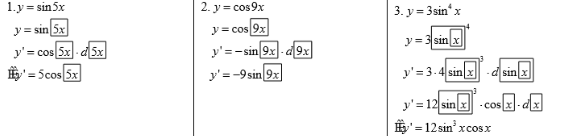
These are some exmaples that my teacher gave to me
In the first one, I was wondering where the 5 comes from (the 5 from 5cos)
willow bear
you thought the derivative of 5x was 1?
maiden pebble
Yea I was doing my math wrong
willow bear

maiden pebble
I took the derivative of 5 and x
obsidian monolithBOT
Ann:
willow bear
also the derivative of 5 isn't 5
maiden pebble
yea its 0
willow bear
0*1 isn't 1
maiden pebble
yes thats why i corrected myself
then deleted that message for some reason
...
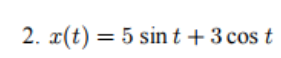
5cos - 3cos
?
$f5cos - 3cos
past meadow
$5 \cos(t)-3 \cos(t)$?
obsidian monolithBOT
Sneaky:
past meadow
for the derivative?
viscid thistle
Check again
past meadow
hm?
maiden pebble
oh i wrote that wrong
viscid thistle
Still check again
maiden pebble
but why would the t still be there
viscid thistle
Hmmm?
maiden pebble
ok....
past meadow
are you talking about how the derivative of 5x is 5?
maiden pebble
you agree that x^2 would become 2x
past meadow
yes, the derivative of x^2 is 2x
maiden pebble
 thorn mountain
it REQUIRES an input variable
maiden pebble
input variable?
craggy dune
something you put into it
thorn mountain
cos(t) cos(x) cos(something)
willow bear

maiden pebble
5t^2 = 10t
willow bear
no
you are not misusing the equals sign like this
5t^2 and 10t are not the same thing
maiden pebble
yea, but I assumed yall were smart enoguh to know what im talking about
viscid thistle

willow bear
the equals sign does NOT mean "next step".
maiden pebble
ppft, proper notation lol
willow bear
if you want to write that the derivative of 5t^2 is 10t
thorn mountain
maiden pebble
ok fine Ann, 5t^2 --> 10t
thorn mountain
still no
maiden pebble
better Ma'am?
willow bear
ok, that's better.
not ideal, but better.
at least now you're no longer claiming 5t^2 and 10t are the same thing.
maiden pebble
better = good enough
willow bear

willow bear
why do ppl find it hard to understand that notation matters
maiden pebble
well if t = 2 then id be correct
thorn mountain
if I want you to know that the sky is blue, does this quote let you know that? "apoidghb-iapoingo[ia"
willow bear

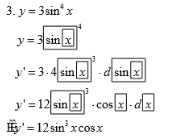 willow bear
'cause they're entirely differnt objects maybe?????
maiden pebble
Cuz in that example sinx^(n-1) occurs
thorn mountain
willow bear
$\sin^4(x)$ is the composition of two functions
obsidian monolithBOT
Ann:
maiden pebble
I appreciate it
thorn mountain
@maiden pebble you're ignoring everyone
willow bear
it's $[\sin(x)]^4$
obsidian monolithBOT
Ann:
maiden pebble
@thorn mountain I take back what I said
willow bear
i.e. it's the composition of (u ↦ u^4) with (x ↦ sin(x)), in that order
and what's being used there is the chain rule
but it sounds like you're not nearly familiar with that
given that mere minutes ago you thought functions were the same thing as numbers and not a completely different object
maiden pebble
So would it be incorrect notation to write sinx^4 instead of sin^4 x
willow bear
sinx^4 is just bad.
sin(x)^4 is ok
as is sin(x^4), but this now refers to a different function obviously
but sinx^4 is bad
in general you should always write parentheses around arguments of trig functions
sin(x), not sin x.
cos(t), not cos t.
maiden pebble
Also I do know the chain rule
willow bear
tan(θ), not tan θ.
maiden pebble
ok, so sin^4(x) is different from sin(x^4)
which would mean that its never the x being squred, cubed, etc, but the sin, cos, etc
thorn mountain
sin^4(x)=(sin(x))^4, which is different than sin(x^4) yes
maiden pebble
Well now my homework makes sense
Thanks for the help
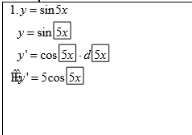
how would you write this with parenthesis?
(the first one)
past meadow
sin(5x) is fine
maiden pebble
why does the 5 go inside the parenthesis with the x, but when its an exponent it doesnt
willow bear
because stupid notational conventions that's why
maiden pebble
this is what originally confused me because what I did with 5x followed the rules I knew but when there was an exponent they didnt work
thorn mountain
it's an unfortunate habit that math software and textbooks have with notation for these types of functions
it should have been written y=sin(5x) from the beginning
maiden pebble
what is the derivative of tan?
thorn mountain
that is not a thing
past meadow
remember just "tan" doesnt mean anything
maiden pebble
no wonder my teach told us to do #4 different;y
thorn mountain
the derivative of tan(x) with respect to x is sec^2(x)
maiden pebble
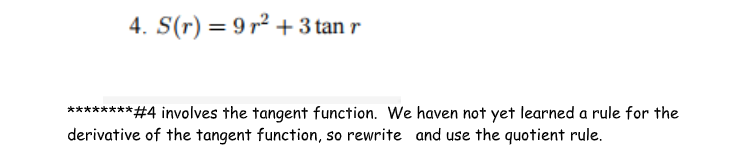 thorn mountain
ok. so do that
maiden pebble
easier said than done
maiden pebble
sin/cos
maiden pebble
your welcome
maiden pebble
hope you dopnt correct peoples grammar online
thorn mountain
had it not been an issue with the functions, it wouldn't have come up here
you good with the quotient rule?
maiden pebble
do I leave out the 3
thorn mountain
also...why are we in the precalculus channel talking about derivatives so much?
maiden pebble
Or do I include that with the sinx
Because im in PreCalc
and this is my homeowkr
thorn mountain
the 3 is a constant multiple on the tangent function
thorn mountain
I'm not a mod since I just joined, but that seems weird unless the calculus channel was occupied at the time
but then, it seems weird that you are doing so many derivatives in precalculus too so /shrug
maiden pebble
They didnt want me using it because then people in that chat would assume that I had already learned everything from preCalc
such as the tangent function
thorn mountain
to be fair, you should have learned what the tangent function is before trying to find its derivative...
but the tangent referred to in calculus ("the slope of the tangent line") and the tangent function from trig are not exactly the same things
maiden pebble
ok i got 3(-sin^2(x) - cos^2 (x))/cos^2 (x)
thorn mountain
where'd the minus signs come from?
maiden pebble
the subtraction or negative?
maiden pebble
well I did sinx times the derivative of cosx
thorn mountain
what is the quotient rule?
thorn mountain
nope
maiden pebble
bruh
thorn mountain
wait, maybe
i hate that notation
what part are you supposed to take the derivative of in "low d high"
maiden pebble
low, deriv of high - high, deriv of low
thorn mountain
so why did you do "high d low" as your first part?
thorn mountain
again, why are there minus signs?
thorn mountain
i'm questioning your derivative taking, not your multiplication (yet)
maiden pebble
lol
thorn mountain
there is no derivative of cos
maiden pebble
WHAT
maiden pebble
umm, x?
maiden pebble
low d high, cos(x) times cos(x)
thorn mountain
uh huh
maiden pebble
3(cos^2(x) + sin^2 (x))/cos^2 (x)
thorn mountain
good. now does the stuff inside the parenthesis in the numerator look familiar?
thorn mountain
yep
maiden pebble
so have I learned the tangent function now?
thorn mountain
not really
you've learned how to find the derivative of the tangent function
assuming you could repeat this process without someone guiding you step by step
maiden pebble
yall ruthless
thorn mountain
Telling someone lies that make them comfortable is a quick way to lead them to destruction
maiden pebble
the man who has no imagination has no wings
thorn mountain
sure
maiden pebble
 maiden pebble
sure sounded liek it
maiden pebble
it just so happens that I have another question
thorn mountain
ask away
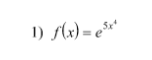 thorn mountain
use the chain rule
there will be a 20x^3 somewhere
there will be an e somewhere
but the derivative will not be e^(20x^3)
thorn mountain
that's not what determines whether you should use the chain rule or not
the chain rule is used to take the derivative of a function which is a composition of functions
$ \frac {dy}{dx} = \frac {dy}{du} \frac{du}{dx} $
obsidian monolithBOT
Malix:
thorn mountain
is probably the prettiest way to write the chain rule, but it isn't the only way
maiden pebble
how does that help me wiht my problem?
thorn mountain
another way to write the chain rule would be: If f(x) = O(I(x)), then f'(x)=O'(I(x))(I'(x))
find the functions which are composed to make the function you want to take a derivative of
maiden pebble
I understand what the chain rule is, i just dont know how to use it with this problem
thorn mountain
find the functions which are composed to make the function you want to take a derivative of
as some more hint...that's an exponential function. what's the most basic exponential function?
@maiden pebble did you give up?
maiden pebble
no
 serene slate
maiden pebble
serene slate
maiden pebble
im just very lost at what ur saying Malix
thorn mountain
channel occupied, try one of the questions channels
maiden pebble
me or thomas?
thorn mountain
thomas
you were here first
what is a basic exponential function?
not descriptively, just give a formula for one
maiden pebble
x^2
thorn mountain
that is not an exponential function
exponential functions have the variable in the exponent
maiden pebble
so x^x?
thorn mountain
that's overly complicated
maiden pebble
1^x
thorn mountain
and that's too simple since no matter what the exponent on 1 is you always get 1
maiden pebble
i mean, you asked for basic
thorn mountain
but 3^x (or e^x) would be what I'm talking about
since 3 and e are both positive constants that are not 1
maiden pebble
ok
thorn mountain
so e^x is an exponential function, can you see another function you could compose with that to get your f(x)?
thorn mountain
well e^x isn't the f(x) in your problem
do you know what function composition is?
maiden pebble
Not by name
thorn mountain
f(g(x))
maiden pebble
yes
thorn mountain
so, can you see a function that could be plugged into e^x to make the function in your problem?
thorn mountain
e^0 = 1
maiden pebble
yes
thorn mountain
that is not f(x) in the problem you posted
thorn mountain
maiden pebble
So you want me to fine something equal to e^x and plug it into f(x)?
maiden pebble
OOOOHHHH
thorn mountain
that is what i want you to do
maiden pebble
5x^4
thorn mountain
ok. that is the "inside function" for the chain rule
the function we plugged it into (e^x) is the "outside function"
maiden pebble
e^20x(5)
maiden pebble
I DID
thorn mountain
you did no such thing
thorn mountain
that is a thing you forgot, but that wouldn't fix the problem of not using the chain rule
also, what you just put is still not correct
maiden pebble
what do you think the chain rule is?
thorn mountain
another way to write the chain rule would be: If f(x) = O(I(x)), then f'(x)=O'(I(x))(I'(x))
or
$ \frac {dy}{dx} = \frac {dy}{du} \frac{du}{dx} $
obsidian monolithBOT
Malix:
maiden pebble
wait whats the inside outside thing
like when you have (2x+1)^2
Whats that claled
thorn mountain
in that example, the inside function would be 2x+1 and the outside function would be x^2
that is function composition
which is what you use the chain rule to find the derivative of
maiden pebble
yea, so arnt we trying to use that to solve this problem?
thorn mountain
i am trying to get you to do so, yes
you have instead decided to use: If f(x)=O(I(x)), then f'(x)=O(I'(x))
which is false
maiden pebble
I dont see how what I did was wrong
I did the derivative of the outside, time the inside
Times the derivative of the inside
thorn mountain
you claimed the derivative would be e^(20x^3)
maiden pebble
 thorn mountain
(5x)^3 = 125x^3 all on its own
maiden pebble
so 3000x^3
thorn mountain
NO
you don't need the chain rule to find the derivative of 5x^4
that derivative IS 20x^3 as you said from the beginning
thorn mountain
what is the derivative of e^x?
thorn mountain
It will not follow the rule for polynomial derivatives
maiden pebble
xe^x-1
thorn mountain
no
that is the rule for the derivative of x^n
which doesn't work for things that aren't x^n
thorn mountain
if your class has gotten to this point, either the teacher has covered the derivative of e^x, or they are not actually teaching the course
are you familiar with the definition of derivative?
and limits?
maiden pebble
d/dx
thorn mountain
that's a symbol
maiden pebble
or dy/dx i believe
thorn mountain
not the definition
maiden pebble
a tiny change in y over a timy change in x
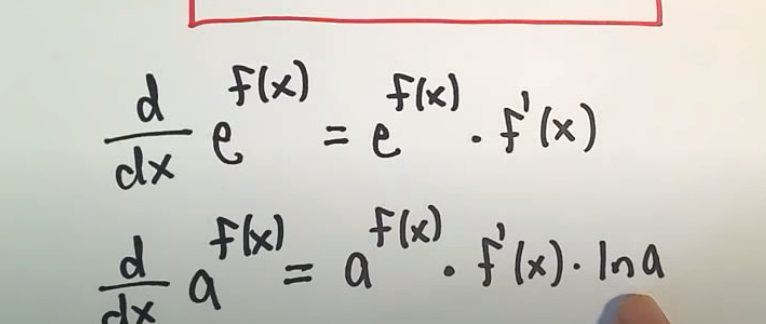
does this picture help https://i.imgur.com/oVMxMMl.png


 thorn mountain
this is one form of the definition
the picture you posted is the "shortcut" for the chain rule with exponential functions
you could use it to answer your original question
but you won't have any idea why it works
thorn mountain
i teach in the US
i know that
but I am here to help you understand
not simply say "here's a formula, it works cause I say so"
that last quote is doing a disservice to students
thorn mountain
haha
maiden pebble
according to my "shortcut" would the next step be e^5x^3 time 20x
maiden pebble
did I change it?
thorn mountain
yes
thorn mountain
what's the derivative of 5x^4?
maiden pebble
20x
thorn mountain
no
maiden pebble
wait what
oh yes, i see
Would that be my final answer?
its like 10x messier than the original
thorn mountain
that would be the final answer
no one said taking derivatives made things "cleaner"
maiden pebble
well i wish they did
thorn mountain
fair enough
maiden pebble
thanks for the help
turns out that when you know how to do something it is...easier
 pseudo lance
hi this isnt really calculus but it is the closest to calculus so: is air resistance maximal at terminal velocity or at minimal (downwards) acceleration
 rare pagoda
Both?
Terminal velocity occurs when air resistance = mg so there will be no downwards acceleration because a = 0
@pseudo lance
pseudo lance
Yeah but in my graph the terminal velocity is different from minimal downwards acceleration
Cos its about a skydiver who suddenly opens his parachute
rare pagoda
You reach terminal velocity when a = 0
desert socket
I have a question regarding the magnitude of a vector. Are there specific situation when |v| = sqrt(a^2 + b^2 +c^2) and others when it’s |v| = ai + bj + ck
I had a question in my textbook that asked to find the volume of a parallelepiped
rare pagoda
That's fun