#precalculus
1 messages · Page 227 of 1
 rare pagoda
 muted steeple
let's see. So i have a problem $h=-16t^2+24t$ and the goal is $h_{max}$
 obsidian monolithBOT
꧁༺Vocal༻꧂:
muted steeple
so to complete the square i just do $h + \left(\frac{24}{2}\right)^2=-16t^2 + 24t + \left(\frac{24}{2}\right)^2$
?
obsidian monolithBOT
꧁༺Vocal༻꧂:
muted steeple
i honestly don't know where this is getting at.
rare pagoda
what you are doing is correct
rare pagoda
you are going to get an equation of the form $h(t) = -a(t-t_0)^2 + h_{max}$
obsidian monolithBOT
magnusChadson:
rare pagoda
where the max height will be h_{max} and the time associated with this height is t_0
muted steeple
i don't see how the above distills to that
rare pagoda
also, I think you forgot to divide through by -16 before starting to complete the square
muted steeple
it's gonna result in fractions, if i do that
rare pagoda
that's okay
if you find this method too tedious, you can do what I told you before of using the formula I gave you or finding the average between the two roots
muted steeple
$\frac{h}{-16}+12^2=t^2+\frac{3t}{-2}+12^2$
is what i get so far, i think it's correct so far right?
it's not tedious, is just, im confused about my goals here.
rare pagoda
I don't think that you divided the by -16 properly
obsidian monolithBOT
꧁༺Vocal༻꧂:
muted steeple
is this correct now?
rare pagoda
also isn't v_0 40?
muted steeple
you are right, i was looking at the wrong initial value, sorry.
let me change taht.
rare pagoda
also I meant to divide through by -16 to get the equation $\frac{-h}{16} = t^2 - \frac{v_0}{16}t$
obsidian monolithBOT
magnusChadson:
rare pagoda
and then complete the square
muted steeple
why shouldn't i plug $v_0$?
obsidian monolithBOT
꧁༺Vocal༻꧂:
muted steeple
it's a given value
rare pagoda
you can
muted steeple
'kay so then i have $\frac{-h}{16} + \left(\frac{\frac{5}{2}}{2}\right)^2 = t^2 - \frac{5t}{2} + \left(\frac{\frac{5}{2}}{2}\right)^2$
obsidian monolithBOT
꧁༺Vocal༻꧂:
muted steeple
$\therefore \frac{-h}{16}+\frac{25}{16} = t^2 - \frac{5t}{2} + \frac{25}{16}$
obsidian monolithBOT
꧁༺Vocal༻꧂:
rare pagoda
the rhs can be simplified to (t- 5/4)^2
muted steeple
ohh
muted steeple
$\therefore \frac{-h}{16}+\frac{25}{16} = \left(t-\frac{5}{4}\right)^2$
obsidian monolithBOT
꧁༺Vocal༻꧂:
muted steeple
how does this gives me t tho?
rare pagoda
isolate for h first
muted steeple
i guess multiply by the LCD 16?
rare pagoda
ye
muted steeple
$-h + 25 = 16\left(t - \frac{5}{4}\right)^2 \ therefore -h = 16\left(t - \frac{5}{4}\right)^2-25 \therefore h = -16\left(t - \frac{5}{4}\right)^2+25$?
obsidian monolithBOT
꧁༺Vocal༻꧂:
rare pagoda
great
rare pagoda
noooo
rare pagoda
so you now have a quadratic in vertex form
muted steeple
what is a vertex form?
muted steeple
yes.
muted steeple
yep.
rare pagoda
so in order to maximize -16(t-5/4)^2 + 25, we want -16(t-5/4)^2 to be as small as possible
muted steeple
sorry, what do you mean when you say maximise?
rare pagoda
to make it as big as possible
so we do that by setting t = 5/4
and then we get h = 25
 leaden stratus
Hello. Today we tried to solve this, but even our teacher was unsure about the steps. How would you solve this? Thanks.
@leaden stratus up
leaden stratus
@acoustic harbor use the search option and find the messages sent by me. You'll find the post...
 acoustic harbor
what do you mean
it’s sin^2(pi)?
the variable is theta
and you plug in pi into theta
 jaunty mason
i think, maybe, he's confused by the notation?
 proud jetty
yes
jaunty mason
sin^2 (x) = sin (x) * sin (x)
proud jetty
like is it gona be 3pie^2-2pie?
jaunty mason
se-senpai?? 👀
proud jetty
sin basically pie when solving right?
proud jetty
so sin is sin?
acoustic harbor
yes
proud jetty
no number variable?
proud jetty
could ya tell me how i would go about putting it in a calculator?
 viscid thistle
May I get help with this please?
 smoky needle
Can someone help me with this problem?
acoustic harbor
is this a calculator problem
smoky needle
If you’re referring to mine, I don’t think it is.😅
 crimson merlin
,help
obsidian monolithBOT
A brief description and guide on how to use me was sent to your DMs! Please use ,list to see a list of all my commands, and ,help cmd to get detailed help on a command!
crimson merlin
,help cmd
obsidian monolithBOT
You really shouldn't take it literally. Please type ,help rolemod for example. Full command list can be found with ,list.
 sweet wyvern
Nothing
sweet wyvern
But there is no cot button allowed?
viscid thistle
here
Find, with proof, a sequence of buttons that will transform $x$ into $\frac{1}{x}$.
obsidian monolithBOT
Disabled_Skooter:
viscid thistle
First we have to get x on our screen, then we press [tan-1] then we press [tan].
@sweet wyvern
no wait
it doesnt
sweet wyvern
that would still yield x
sweet wyvern
oh nvm @viscid thistle your original proof worked
 full garden
hey guys I feel very embarrassed for asking this but how do i solve this...
sweet wyvern
I'm blind
viscid thistle
ok
sweet wyvern
the one with cot
full garden
no bro
 uncut mulch
don't overthink it
full garden
is it just 4?
full garden
me first :(
rare pagoda
@viscid thistle draw a right triangle with sides 1, x and sqrt(1+x^2)
full garden
hey guys can someone please help me with this question
can I just say that a must be an even number ?
rare pagoda
not exactly
for a function, (x,y), each x needs to have a unique y
aka when you have (a, x) and (a, y) then x = y
so basically in your case a cannot equal 2, 4, or 6
full garden
oh
sorry what?
yes bro reading over it now I understand what you were saying
thank you bro makes sense
 hexed cairn
hi, does anyone know how to do this?
 fleet yew
@hexed cairn do you know how to work with vectors
This is pretty much just asking you to draw a triangle when it comes down to it
Same basic trig you've been doing since preschool
hexed cairn
kinda? i’m certainly not the sharpest tool in the shed
fleet yew
Do you know what the complex plane is at least
 formal iris
can i get help on 24
viscid thistle
How did u get the answer for tan(2x)
smoky needle
Can someone help me on 4? I did the work prior to it in #3.
viscid thistle
You can't have a negative number in the sqaure root
smoky needle
Oh did I do #3 wrong?
viscid thistle
So your x has to be a value that, When sqaured, gives you a value less than 36
No u did 3 correct
So u have to have an x value such that x^2 < 36
viscid thistle
You have to plug in a value that, when squared, gets you a number less than 36
smoky needle
So any number as long as it’s less than when squared, got it!
viscid thistle
Yes
smoky needle
To both Xs right?
viscid thistle
Yah
viscid thistle
It's not
I'll give you a hint: there's a number that, when you sqaure it, you get the number you're subtracting it with.
X has to be less than that number
smoky needle
Can it be 6^2?
viscid thistle
No because then the value inside your sqaure root would be 0
It's gotta be less than that
smoky needle
Hmm okay, I’ll redo it again!
So when squaring it, it has to equal what I’m subtracting it with, right?
Sorry I’m kinda slow
viscid thistle
It has to be less than what you're subtracting it with
No worries
You don't need to apologize :)
smoky needle
Thank you for your help! I appreciate it!
viscid thistle
So x^2 has to be less than 36
smoky needle
I used 5^2
viscid thistle
That works
viscid thistle
Can you use numbers wirh decimals in them?
smoky needle
I am actually not sure, our teacher never really said anything about this problem..😕
viscid thistle
Ah. It seems kinda vague
smoky needle
Yeah..my friends and I don’t know how to solve it
viscid thistle
x has to be the closest value to 6 without actually being 6
smoky needle
I now have 5.9 sqrt of 1.19
viscid thistle
Oh wait it says largest possible value
My bad lol
Your number should be furthest away from 6
smoky needle
Haha no worries!
viscid thistle
Uh yah so x has to be 1 I think
smoky needle
Oh wait 1?
viscid thistle
Uh yah I think 1
smoky needle
So it would be 1 sqrt of 35?
viscid thistle
Oh wait but you have to multiply by 1 after...
After doing trial and error I found that 3 is the correct answer
smoky needle
Okay, so is the final answer or the value that I replace x with? 😅
viscid thistle
Yah so x is 3
That gives the maximum area
I realized why this question was tricky
If x = 3, the area is 81
smoky needle
Yeah it’s tough. Lol
And ohh okay, I’ll plug in 3 for x and see what I get
I ended up getting this😅
viscid thistle
Do that but with x = 1 thru 5
smoky needle
So I do 1,2,3,4,5?
smoky needle
Awesome, I will do that
viscid thistle
Ok thx
smoky needle
Hmm I think I am doing it incorrectly
I am getting negatives inside the sqrt and isn’t that wrong?
viscid thistle
Can you show me what u have
This is what I have if x= 1
@smoky needle
This is what I have when x = 2
viscid thistle
No worries
smoky needle
viscid thistle
I got 16.58 for 5 × sqrt(11)
smoky needle
Oh okay, I’ll do that for the rest. I just left it with the sqrt!
viscid thistle
So looks the answer is when x = 5 then After All
smoky needle
Can you explain why x=5 is the answer?
It wouldn’t be 4? Because that’s the largest?
viscid thistle
Actually you're right it's 4
 vernal moon
It’s technically sqrt(18) I reckon
viscid thistle
What's sqrt(18)
vernal moon
It’s about 4.23
viscid thistle
Ok ann
 willow bear
what
viscid thistle
🤣🤣🤣
willow bear
fuck both of you
vernal moon
I’m sorry ann
viscid thistle
Ann stop being mad pls Ann im begging you
smoky needle
Wait I think I got the answer, it is sqrt(18)...I think
vernal moon
it is
smoky needle
I’ve been at this question for a while 💀💀
Do we need to do the derivative for this problem?
viscid thistle
Oh crap I can't believe I didn't think of the derivative
 pulsar spindle
matches the root 18 answer
viscid thistle
@smoky needle u need the deravitive
smoky needle
I’ve done derivatives before lol, but how can I do it with this problem?😅😅
viscid thistle
Search up the product rule
Ight so first rewrite sqrt(36-×^2) as (36- x^2) ^ 1/2
Then u gotta take the derivative of that and multiply it with x
Next you take the deraivitve of x and multiply it with (36 × x ^ 2) ^ 1/2
Then you add your products
And set a =0
Then solve for x
pulsar spindle
its cheating ;-;
@vernal moon Cheating would feel like going on desmos and graphing the function
I hate calculator papers man
vernal moon
i was jokin lmao
personally
without calc
i would just
square it
then notice
its a quadratic
-u^2+36u
where
u=x^2
then use quadratic turning point
then square root
and u get sqrt(-36/(-2))
which is sqrt(18)
smoky needle
Can I show my work? I got this far
My work is sending right now, it just takes a while for it to send
Wait Nevermind, I think I did it wrong
vernal moon
let p(x) be a quadratic polynomial ax^2+bx+c
the turning point of p(x)
is
the x cord of the turning point
will be
-b/2a
smoky needle
Would it be okay if I just do the derivative since I’m more familiar with that?
vernal moon
d/dx(ax^2+bx+c)=2ax+b
-b=2ax
-b/2a =x
the turning point has a derivative of 0
so this works
smoky needle
Okay I will try it!
smoky needle
It can be simplified to 3sqrt (2)?
 native sequoia
you can derive -b/(2a) from noticing that the turning point doesn't change respect to c and then averaging the 2 x-intercepts that we can force to exist by changing c
native sequoia
actually slightly better to just notice ax^2+bx+c=c has solutions x=0 and x=-b/a and taking average
 gray marten
Hey, would it possible if anybody could give me some tips for solving this limits question: lim x->+∞ ln(x^2)/ln(2x) Any help would be amazing!
willow bear
log laws
gray marten
So, if I use log laws, it would become 2 ⋅ lim ln(x)/ln2x
but im not sure what to do after that
willow bear
there is still another log law you can use
gray marten
sorry i'm looking through all my notes and I'm still not sure which log law i can use 😅
pulsar spindle
@gray marten have you tried L'hopital rule?
gray marten
I don't think my teacher has ever mentioned it
so im assuming im not supposed to use it yet in the homework?
pulsar spindle
ah... then ignore that suggestion
gray marten
is it necessary to solve this question???
willow bear
no
pulsar spindle
No, probably should be another way
pulsar spindle
than factor out ln (x)?
willow bear
no
willow bear
3 * 2x is far from 30x
obsidian monolithBOT
Ann:
willow bear
$5f(2x) \neq 5 \cdot (2 \sin({\color{red}5} \cdot 6x) + 4)$
obsidian monolithBOT
Ann:
 sullen canyon
so its 10 sin (6x) +20
willow bear
yes
sullen canyon
thanks
gray marten
Hey, does anyone know how to do this question? Given f(x) = ((e^2x)-1)/((e^x)-1)) Name the x value(s) at which the function isn't continuous. For each discontinuity, determine whether the discontinuity is removable. If removable, indicate the point that would make the function continuous at the particular value of x.
I'm thinking that I have to use the derivative? but im not exactly sure
 serene heath
where is your function defined?
gray marten
my worksheet doesn't specifically say anything
regarding where the function is defined
 patent beacon
A real function is defined everywhere except where "a definition doesn't make sense". Your worksheet will never generally tell you where functions are defined as it's something you can find.
In this case, there's an x-value that causes a division by 0. A function is never defined at such an x-value
@gray marten
 fleet harbor
Can anyone please help with this question?
I just need to figure out where to start
patent beacon
Can you express (2z + 1)/(4z - 4) in rectangular form?
Or actually, split each z into x + yi first
fleet harbor
I did that and afterwards kept only the imaginary parts, but I have no idea where to go from there
Would I need to multiply the denominator by the complex conjugate?
patent beacon
It sounds like you've done something off, after doing this, your simplified expression should be clear
You can always divide a complex number by another by multiplying by the complex conjugate, but we may not need to
Actually nvm I think you do need to perform the division first
fleet harbor
but would I be dividing by 0 if I do the Im?
Soz, I don't fully understand how the Im works
patent beacon
Im(a + bi) = b
So you want a rectangular form in those brackets
,w simplify (2x + 2yi + 1)/(4x + 4yi - 4)
obsidian monolithBOT
 Requested by Kaynex#7520
patent beacon
Requested by Kaynex#7520
patent beacon
Wolfram why
viscid thistle
Lol
fleet harbor
I got (16xyi - 4yi + 8x^2 - 4x - 4)/(16y + 16x^2 - 32x + 16) after multiplying
gray marten
Sorry for the late response, thank you that makes more sense. @patent beacon
fleet harbor
Nvm I multiplied wrong
muted steeple
Hi, guys. How can the determinant be used to find the highest point in a quadratic?
More specifically, i have a question which asks me "How fast would a ball have to be thrown upward to reach a maximum height of 100 ft?" and I'm given the following formula $16t^2-v_0t+h=0$ and the hint suggests using the discriminant.
obsidian monolithBOT
꧁༺Vocal༻꧂:
muted steeple
So based on what i know so far, i need to find $v_0$ and $h = 100$ so the equation can be written as $16t^2+v_0t+100=0$
obsidian monolithBOT
꧁༺Vocal༻꧂:
muted steeple
not sure how a determinant would apply here given that $v_0$ is an unknown coefficient, which is required for a determinant.
obsidian monolithBOT
꧁༺Vocal༻꧂:
viscid thistle
The display initially shows 0. Prove that there is a sequence of buttons that will produce $\frac{3}{\sqrt{5}}$.
obsidian monolithBOT
Disabled_Skooter:
viscid thistle
Can I get help with this really quick?
serene heath
context?
viscid thistle
guys
viscid thistle
@severe verge do you think you could help me?
 severe verge
just check a bunch of things til you get one that does the job 
well, probably a good idea to draw a unit circle diagram on paper and just try to get to 3/rt5 there first
full garden
hey guys I have a very fast question please
so i have to find the inverse and i got to this point
and I was wondering of I can make the last part like the equation in the question
like can I break the donamirator of a + b into a - a
i feel like the question might have a mistake because i don't see a mistake in my steps 😅
can someone please clarify
or can i even do it that way if the equation is not set to y -_-
can someone please help me
viscid thistle
you have to swap all x's for y's in the first step
you didn't do that
@full garden
How would I do this problem?
full garden
by = will equal yy?
viscid thistle
no
full garden
i missed a y?
viscid thistle
one of your y's should be an x
 past meadow
the second term, you didnt swap the y
full garden
ohh i seee
viscid thistle
you should have bx not by
viscid thistle
How did u calculate the hypotenuse
 daring yarrow
does this look right?
i messed up on the left limit from that fraction with the squrae brackets, its supposed to be -4-4-4
aka -12
but apart from that i didnt make any writing errors so question still stands 
 pseudo lance
to calculate the height of centre of mass of this shape, can i do (centre of mass triangle +centre of mass rectangle) /2
 fading token
only if the triangle and rectangle have the same mass 
pseudo lance
ugh sad
if there was a y-axis there, how would u be able to calculate the a of the triangle
the distance to the centre point
is there a formula or something?
 hollow eagle
hmm. I gotta think about this. I believe you take the center of mass of the triangle (which will not be halfway up the triangle), and then use CoM formula Xc = ( x1m1 + x2m2 ) / (m1+m2) alongside the center of mass of the rectangle to get the center of mass of the Y coordinate
note that the com of x coord will always be halfway along because it's symmetrical
pseudo lance
alright thanks
 sharp marsh
viscid thistle
sharp marsh
viscid thistle
@sharp marsh solve for x?
@sharp marsh send the exponential x+6 to right side
It would become 3= e^(3-x)/x+6
No just use log
Yes I'm coming there
acoustic harbor
yeah you can’t send the (x+6) to the right side
acoustic harbor
just ln both sides
viscid thistle
You can
just ln both sides
@acoustic harbor yeah
It would be reciprocal.on the opp side
Even if you use log on both sides you'll still get log3 = 3-x/x+6
acoustic harbor
no
viscid thistle
?
acoustic harbor
idk what you did lol
acoustic harbor
that’s ln
acoustic harbor
you wouldn’t get that answer
viscid thistle
ln3 = 3-x/x+6
acoustic harbor
no you can’t bring the (x+6) to the right
 pale bison

viscid thistle
sigh
Then why did I get same one as application of log on both sides
Like, its wayyyyy easier to do it.
$In(3^{x+6})=In(e^{3-x})$
$(x+6)In3=3-x$
If a^m = b then a = b^1/m
obsidian monolithBOT
Al3dium:
pale bison
It would become 3= e^(3-x)/x+6
That's incorrect @viscid thistle
viscid thistle
You will then take log because of e
e will become in base.for ln3
But thats ¡In!!!!!!
Its what i did before
Denotion wrong
Process right
Ln yes ln
pale bison

 fierce slate
how would one solve this?https://prnt.sc/sc5cd9

 opaque mountain
@fierce slate Where's the initial equation?
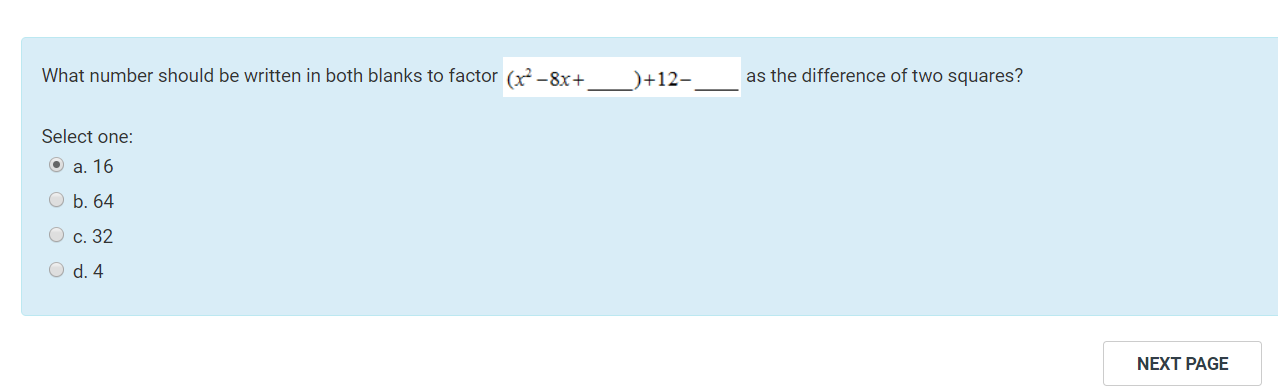 opaque mountain
I'm not sure then..
viscid thistle
none of those answers look correct
you'd end up with 12 if you plug in every answer
serene heath
16 works
viscid thistle
how?
serene heath
wym how
viscid thistle
16 doesn't work
serene heath
why not
viscid thistle
because like i said earlier, you'll just get 12
viscid thistle
you'll end up with (x^2 - 8x + 16) + 12 -16 which simplifies to x^2 + 8x + 12 when u remove the brackets
viscid thistle
yes i know
viscid thistle
hmmm i think i get what you mean now
serene heath
they put those brackets there for a reason
viscid thistle
i thought you had to simplify it after
opaque mountain
Can I at least get an explanation on what's that question is asking?
serene heath
do you know what a difference of 2 squares is?
basically asking you to pick a number so u get something of the form
a^2-b^2
viscid thistle
How would I do 19
serene heath
what have u tried
viscid thistle
I have done log(sinx*cosx) but I’m stuck there
 misty heath
what is the definition of a log?
viscid thistle
Ok then use the def of log
Yeah lol
@viscid thistle if you have $\log_{\frac{1}{2}}{(\sin{x}\cos{x})}=1$
Use the definition for log
$\log_a{b}=c$
$a^c=b$
misty heath
then you can either consider the double angle formula for sine or use the fact that sine is an odd function and solve the equation that way
first line has an extra } I think
cos{x}})}
obsidian monolithBOT
Al3dium:
obsidian monolithBOT
Al3dium:
viscid thistle
@viscid thistle doesn't it seem familiar? Like if we could apply this to your problem ...

Ohhh
Thank you very much
Np 
Another question sorry
How would I do this
Oh my
Wait lol
@viscid thistle do they ask you to simplify
It says solve for x
can i simplify u, big brain ?
@viscid thistle multiply both sides by 100
Okay
So I would have 100x^log(x)=x^3
can i simplify u, big brain ?
@viscid thistle bet
What would I do from there
take the log of the exponent or something
Yeah lol i answered the same on #help-1
@viscid thistle dont post it twice.
Alright
So lets keep the one here @viscid thistle
Take the log of both sides
There is smth weird on line 3
viscid thistle
@tardy ridge he can take out the 3 as it is an exponent of log
But anyways, the 3rd line looks wrong
Just dont take the 100 to the left side
I’m confused
,rccw
obsidian monolithBOT
viscid thistle
Srry for the overloaded ink on the middle, i had to make it clearer that it wasn't the base of the log lol
@viscid thistle
All the logs are base 10 btw, in some, i just didnt put them (on the last lines)
@tardy ridge could you verify this lol im a lil rusty on logs
Okay
Now try to continue
viscid thistle
Oh true yeah
@viscid thistle so yeah try to continue from last line but remember that $log_{10} (10)=1$
So you can simplify that
So I have log(x)^2=3logx-2
obsidian monolithBOT
Al3dium:
 charred latch
How would I complete the square for this problem x = y^2 + 6y + 5
viscid thistle
@viscid thistle
is 3logx-2
as
3log(x) - 2
or
3log(x-2)
theres a difference
 tardy ridge
...
 gilded stirrup

 next kernel
Recursively defined sequences?
next kernel
a1 = -2; an = n + a(n-1)
tardy ridge
yes you can make the denominator into x^2(x-1)
and then put it as a polynomial in terms of x
tardy ridge
you can get rid of the x^2(x-1)
 limber compass
I did.
tardy ridge
why did you replace everything with p and q
limber compass
bceause its easier.
tardy ridge
ok well I have x^2(A+C) + x(B-A)-(B+1)=0
and then I thought wouldn't it be nice if everything equaled 0
tardy ridge
that seems fine too
limber compass
hmm, so what were you talking about.
 native shadow
 willow bear
well you might consider first computing the product while still in rectangular form
and then converting the result to polar
 dire raptor
@viscid thistle I will try, you first expand the brackets.
-6 + 15i - 8i -20
= -26 + 7i
now you convert
willow bear
that's exactly what i said, but they chose to ignore me as it seems
except that i didn't straight up do it for them
viscid thistle
Aight sir
So I figured it out
botth fo you were kinda wrong
I have to coonvert each individually
and then multiply them
@willow bear I wanna learn :pp I need this for calc
dire raptor
Both ways work.
though with your method you gotta know some extra rules.
such as cis(a) * cis(b) = cis(a+b)
etc etc
willow bear
if the actual directions in the problem were not what you posted, then it's kind of on you for misleading us, and not on us for not following directions neither of us knew.
dire raptor
I have to a gree with Ann here.
Since you didn't specify Ann assumed any method is allowed. Which means logically she chose the most efficient one
sullen canyon
if i have log (base 9) (cos 2x+2), how could i make that into log (base 3)
do i use the change of base formula?
willow bear
$\log_9(z) = \frac{\log_3(z)}{\log_3(9)}$
obsidian monolithBOT
Ann:
sullen canyon
@willow bear after that i need to make it into log (base 3) sqrt cos 2x + 2
how do i do that
willow bear
oh god there are so many parentheses you're omitting there
but $\log_a(z^p) = p \log_a(z)$
obsidian monolithBOT
Ann:
pale bison
$\log_9(\cdots)=\frac{\log_3(\cdots)}{\log_3(\cdots)}$
obsidian monolithBOT
Publius:
pale bison
consider something like that
sullen canyon
itd be this right?
i'd have log (cos 2x+2) / log (9)
but how do i go from there
pale bison
what is $\log_3(9)$?
obsidian monolithBOT
Publius:
willow bear
log_3(9) is 2.
willow bear
so you have $\log_9(\cos(2x) + 2) = \frac{1}{2}\log_3(\cos(2x) + 2)$
obsidian monolithBOT
Ann:
sullen canyon
yes
past meadow
log law ::
past meadow
as ann said above, $\log_a(z^p) = p \log_a(z)$
obsidian monolithBOT
Sneaky:
sullen canyon
cheers everyone 👍
ye i just realized
i'm not very good with logarithms as you can see
past meadow
it just takes practice. you'll get better
pale bison
its ok we forgive you
sullen canyon
its just when there are a lot of different topics, and we haven't done logs in months and we get a question on logs, i kinda forget how to do it
 harsh cipher
Hello
question about graphing hyperbola
(x^2)-(y^2) = -36
trying to come up with the restriction under the radical sign after writing y= root x^2-36
 hexed ermine
Is it root x^2-36?
hexed ermine
Are you sure its y=sqrt(x^2-36) ?
harsh cipher
now x^2+36 is greater than or equal to 0
x^2 is greater than or equal to -36
yes
oh maybe I need to isolate x^2
harsh cipher
matter : graph hyperbola x^2-y^2 = -36
show asymptotes
i think im right
need to isolate x^2 this time
since radius is negative
muted steeple
can someone explain the highlighted part?
does it just mean d = x^2+2xc+c?
also not sure what it means when it says "we can also obtain the coefficients from the solutions".
when i say not sure, i mean i don't understand how
hexed ermine
Well you can plug in your solutions into a quadratic with arbitrary coefficients
muted steeple
okay, what does that achieve or tell me?
so far i understand this sentence as; if you obtain d from some quadratic with some coefficients, you can use the d to find the coefficients of the said quadratic.
which sounds useful, but i dunno how.
 pure dagger
is this screenshot skipping a page or something
the sentence just makes no sense lol
muted steeple
sorry, let me provide more context.
so for a i determined solutions x=5 and x=4
and it is indeed that 5*4=20 and 5+4=9 which is middle coeff
pure dagger
i think exercise 137 has nothing to do with what's written on the second page
it rather looks like there's an exercise 140 to the right of it, which continues onto that page
hexed ermine
^
muted steeple
pure dagger
this is the kinda math help i was born to do
yes there we go
then, your highlighted part just refers to what follows in the parts of the exercise a, b, and c
namely, you're supposed to verify that given some numbers, and someone tells you "these are the solutions to a quadratic equation", you can reconstruct the quadratic equation from the solutions
muted steeple
so (a) now tells me that i can reconsturct const and middle coeff
pure dagger
ye
muted steeple
not sure about the case where the leading term has coeff of >1
pure dagger
yeah, you don't get that one; the problem is, that if you have a quadratic equation (e.g. x^2 - 1 = 0), then all multiples of that equation have the same solutions (e.g. 50 x^2 - 50 = 0)
so you can only reconstruct the coefficients from the solutions if you fix the leading coefficient
so the correct statement is: "if you have the two solutions of a quadratic equation, you can uniquely reconstruct the quadratic equation from it, up to a scaling factor"
muted steeple
so it has to explicitly tell me the leading coeff if it's non 1?
pure dagger
yup!
muted steeple
okay, i understand now.
pure dagger
cool! glad to help
muted steeple
so whatever solutions i got now, say i have coeff of 2, then i'd need to scale them both by factor of 2?
pure dagger
mhm i think it's more complicated
you might understand it better if you do the exercise
muted steeple
cuz i know that first and last term scale exponentially
pure dagger
once you've done c), try to see what happens if you use leading coefficient 2 or 3
pure dagger
np!
muted steeple
Hey @pure dagger mind clearing up few more things for me concerning the the (c)?
let me write out what i've done so far for c.
So to prove $r_1 \cdot r_2 = c$ using the quadratic formula, i set
$r_1 = \frac{-b+\sqrt[]{b^2 -4ac}}{2a}$ and
$r_2 = \frac{-b-\sqrt[]{b^2 -4ac}}{2a}$.
Since i need to prove $r_1 \cdot r_2 = c$
i plug these two equations
$\frac{-b+\sqrt[]{b^2 -4ac}}{2a} \cdot \frac{-b+\sqrt[]{b^2 -4ac}}{2a} = c$
Which then using the difference of squares rule means
$\frac{b^2-b^2+4ac}{4a^2}=c \therefore \frac{c}{a} = c$ which seems to be wrong.
obsidian monolithBOT
꧁༺Vocal༻꧂:
muted steeple
it should cancel out to be to c = c right?
 sand skiff
It works if a = 1
muted steeple
so it only works if a = 1?
sand skiff
Seems so
sand skiff
If there is a constant in front of (x-r1)(x-r2), c will not be r1*r2 unless that coefficient is 1
If that makes sense
muted steeple
(1-r1)(1-r2) = 1^2 -r2-r1+r1*r2)?
sand skiff
a(x-r1)(x-r2)
muted steeple
oh, so this form you mean when factoring
muted steeple
yep, makes sense
thanks.
i just realised that also proves the $r_1 + r_2$ part 😄
obsidian monolithBOT
꧁༺Vocal༻꧂:
 orchid pier
hi im stuck on a homework question says compute ((1/2) - ((sqrt3)/2)i)^20 i get two answers -1/2 + (sqrt3/2)i or -1/2-((sqrt3)/2)i)
are either of these right?
express the answer in form a + bi
willow bear
the second one is right
the first one is wrong
idk how you got two answers
but probably worth looking into
orchid pier
thank you very much, i thought so too
patent beacon
Do you know what it means for a graph to be "increasing"? Just means it has a positive slope
hexed ermine
Yeah
 winged ether
can someone help me how to do difference quotients? I am really stuck on this one problem where you find teh difference quotient of f(x) = x^1/2
so difference quotient of square root of x
serene heath
try finding a unit vector in that direction first
full garden
guys can someone please clarify what this question is asking
like am i supposed to derive the x = -b/2a formula ?
I've just never seen anything like this formula before
tardy ridge
the vertex is always the midpoint of the two roots
tardy ridge
I didn't use the axis of symetry, I just foiled that into y=a(x^2 -(r+s)x+rs) then completed the square and get that answer
full garden
so u completed the sqaure from that strange formula ?
can u elaborate on that u just said please
so u completed the square after expanding the factored form ?
so we're supposed to get x = -b/2a as the answer ?
because if that is the answer then u helped me a lot
tardy ridge
what no I proved -a((r-s)/2)^2 is the max or min
full garden
what is the question even asking
tardy ridge
by expanding a(x-r)(x-s)
full garden
is the question asking for that ?
tardy ridge
it's asking you to prove the max or min of a(x-r)(x-s) is -a((r-s)/2)^2
full garden
and how do u complete the square when u get y = a(x^2-rx-sx+rs)
full garden
yes
tardy ridge
now you can complete the square
full garden
okay
so after i complete the square it will give me the formula for min and max?
isn't min and max the same thing as the vertex
and the vertex can get from -b/2a?
tardy ridge
the min and max is the y value at -b/2a
full garden
yes yes
tardy ridge
when you complete the square the a(x-k)^2+ N the n is the max or min
tardy ridge
yes yes
tardy ridge
wait what you just have to find N that's all-
full garden
okay will try thank u so much bro thank u
hey guys I am supposed to complete the square in order to get the answer that I circled on the page but for some reason i didn't get that answer
becasue I still have to add + rs and multiply by -1
can someone just please clarify the solution for me please
guys please..
 reef crest
ok ill see if I get that
full garden
thank u bro
reef crest
this is confusing lol i think im almost there tho
tardy ridge
you should have $(-r^2-s^2-2rs)/4+rs$ inside the brackets
reef crest
math is hard to format smh
obsidian monolithBOT
Fishraider:
tardy ridge
then you can get -(r-s)^2/4
which is -((r-s)/2)^2 and you add the a later and then you're done
viscid thistle
then you can get -(r-s)^2/4
@tardy ridge its -(r+s)^2/4
full garden
thank u @tardy ridge @reef crest @viscid thistle thank u guys a lot
reef crest
i didnt really help LOL sorry
viscid thistle
How would I do 23
isn't the answer given?
No?
log 18 = a?
4
isn't that the answer
I don’t think so
I did that and my teacher said it was wrong
tardy ridge
@tardy ridge its -(r+s)^2/4
@viscid thistle no it isn't, I was talking about the final answer.
viscid thistle
Oh srry lol
reef crest
if 2^a is equal to 3, then that means 2^a^2^2 would give you 18
so then 2^4a
i think
tardy ridge
separate log 18 into log 2's and log 3's
reef crest
idt u need any log 3s right?
reef crest
oh wait am i being dumb
wait no that's not what it is lol unless im thinking wrong
it's not (2^a)^2^2
tardy ridge
18 is not even a power of 3
reef crest
wait i think im wrong
i was thinking
oh wait yeah i am very wrong
i somehow thought
3 squared gives 9 and that squared again is 18
reef crest
im dumb
reef crest
ask fishraider lol i have no idea what's going on rn
viscid thistle
Anyone know that?
reef crest
i think it diverges right?
because the power of the base increases
and each term gets closer to zero
sorry not divergent
convergent
for the sum there's a formula
i cant remember it rn though
tardy ridge
a(r^n-1)/(r-1)
viscid thistle
Got it
full garden
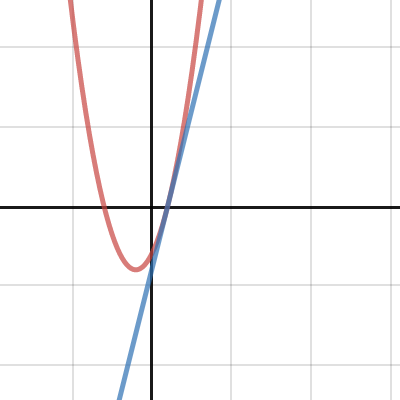
hey guys I have a very quick question
I tried solving for this and I got the slope is either -4 or 0
but when I tried -4 it was a secant when I graphed it
so 0 seems to be the correct answer, but can that be right?
becaue the question says in the form of y=mx+b
viscid thistle
if 0 looks correct then its probably the right answer
full garden
so it can be correct even if the question says the line is in the form of y=mx+b?
viscid thistle
yah
full garden
❤️ thanks bro
tardy ridge
@full garden m = 0 or 4 by setting the discrimminant to 0
full garden
@tardy ridge yES BRO I LOVE u but like when i checked the graph it looked like when it was -4 it touched the graph twice bro
 obsidian monolithBOT
iRazur:
full garden
$m^2+4m+4-4=0$
obsidian monolithBOT
iRazur:
full garden
$m(m+4)=0$
obsidian monolithBOT
iRazur:
tardy ridge
$x^2 + (-(2x-mx)+1=0$
 obsidian monolithBOT
Fishraider:
full garden
because that's the b bro
tardy ridge
No.
full garden
i tried like following this step
because there was a negative on the outside bro
bro can u please who me the steps that u took
 lilac pier
@full garden YEs there is a negative outside but it's being squared
full garden
yes
lilac pier
negative squared means negative times negative which is just positive