#precalculus
1 messages · Page 226 of 1
 solid warren
usually polar coordinates are (r, theta) and spherical is (p, theta, phi)
their r has no relation to r from polar notation
 nova wedge
and r in polar coordinates is the hypotenuse on the xy plane
solid warren
yes
nova wedge
Classes all being online sure is rough 🙂
 maiden igloo
yep
 viscid thistle
Hi!! Sorry for the disturbance but how would I find the sum or difference of log(25w^3/sqrta)
 tardy ridge
$log(25w^3/sqrta)$
 obsidian monolithBOT
Fishraider:
obsidian monolithBOT
Fishraider:
 unique hill
then log(25w³) can be further expanded
 sly ether
don't know if it's the right channel but...how do i solve an equation of the form:
a^x+b^x=c
@sly ether can you guys help me here
trying here
 jagged glade
Hello tacos, do you have the exact question?
sly ether
yeah
a = 0.5417
b = 0.736
c = 0.56
but it's also a general question on how i would solve this
jagged glade
I see... I have no clue right now but to use numerical methods.
sly ether
meaning testing every posibility?
 west shadow
Okay so I dropped my math classes of the semester because I can't do online
I still have the textbook
And I'm going over the questions
I'm hella confused
west shadow
Yeah I cannot do online
And the school allowed it to be cleaned from my records
Because of the pandemic atm
 sour hemlock
Why can't you do it online?
sour hemlock
And what grade level is your math?
west shadow
This is college pre calc
west shadow
Yeah they don't allow me to bring my records from my high school
And I entered the school a week before it began and so I couldn't take the exam
 formal iris
@viscid thistle
 fleet yew
@viscid thistle p=2pi/b
viscid thistle
heyy
formal iris
seems like AMD has answered it
viscid thistle
sorry i dont quite follow
formal iris
Period = how long it takes for the function to do 1 full round
viscid thistle
i dont care aabout the answer
fleet yew
Lmao
viscid thistle
i want to know how to solve it
formal iris
Yes what part u dont get
viscid thistle
finding out how to get the period
formal iris
alright so you are given cos 4x
viscid thistle
yes
viscid thistle
okay
fleet yew
$m+a\sin(b(x-s))$
obsidian monolithBOT
AMD:
viscid thistle
what?
fleet yew
That is what we call the general form of a sinusoidal wave
Because sin and cos are pretty much the same thing, just shifted
viscid thistle
yea
fleet yew
m is the midline, a is the amplitude, s is the shift, and b is the factor that determines the period
viscid thistle
ok
fleet yew
So lets look at your specific example
viscid thistle
that would be helpful
fleet yew
cos(4x) i think
viscid thistle
yes
fleet yew
As you can see, the midline is zero, the amplitude is 1, and there is no shift
Because cos(4x) = 0 + 1cos(4(x-0))
All there is to deal with is "b"
fleet yew
So b is 4
fleet yew
so you can think of this function cos4x as being 4 times "faster" than the parent function cosx
viscid thistle
yes
fleet yew
So its period will only be 1/4 as much
viscid thistle
pi/2?
fleet yew
Yes
formal iris
Amd I have a question is it possible for you to help me as well?
fleet yew
Sure
formal iris
Imma wait till Disabled is done
fleet yew
@viscid thistle you good?
viscid thistle
uhh
i have a question about a cosine problem
but if parths problem is eaiser help him first
easier
fleet yew
K just ask it here
formal iris
go ahead i feel like mine will take a bit
viscid thistle
help with C
formal iris
the aim of the that question is for u to combine the sine & cos then take the peroid
formal iris
Jumping into challange questions is not efficent if you do know material
fleet yew
There is an easier way lol
viscid thistle
this is just my hw
viscid thistle
ok
fleet yew
What is it
fleet yew
You sure about that?
viscid thistle
nope
fleet yew
(2pi, 1)
fleet yew
So heres the thing
viscid thistle
yea
fleet yew
Sinusoidal functions can have the same value twice in a period
So you dont know if that is actually the period or not
fleet yew
If 2 pi is the period, then h(0)=h(2pi), and h(a)=h(2pi+a)
So lets use a test value
To make things simple lets use pi/2
viscid thistle
yea lmao
fleet yew
So let a=pi/2
viscid thistle
right
fleet yew
Does h(0+pi/2)=h(2pi+pi/2)?
fleet yew
You sure about that?
viscid thistle
yea
fleet yew
Check again
viscid thistle
2pi =! 0
fleet yew
Lmao
fleet yew
0 doesnt equal 2pi but sin(0)=sin(2pi)
viscid thistle
😐
fleet yew
lol
Do you know what h(x) means
Or h(something)
It means you plug something in for x into the formula
So if h(x)=2x then h(3)=2(3)=6
viscid thistle
ok
fleet yew
So yeah 2pi is the period
viscid thistle
yes
 loud quartz
Is this the correct way to solve this
viscid thistle
do i have the right answer?
 patent beacon
3sin(2x)
viscid thistle
ok
patent beacon
Wait I derped
patent beacon
Don't trust me you had it haha
patent beacon
Hmm it's a horizontal stretch by 2, no?
viscid thistle
lmao
fleet yew
your equation is right
viscid thistle
im a clown
formal iris
AMD someone helped me out
fleet yew
but read the question again
patent beacon
Oh haha
viscid thistle
wait
fleet yew
this is the kind of shit that fucks you on standardized tests
patent beacon
At least someone here can read
viscid thistle
do i have to add 3 and 1/2?
fleet yew
yes
viscid thistle
u rkidding
fleet yew
lmao
viscid thistle
i cant with math no more
fleet yew
nah man it's cool
that got me too for a solid minute
they're trying to trick you
you just have to read carefully
viscid thistle
it's too hard for me. i think i'll let you solve it
lmao
its too hard
what is this
fleet yew
broo
it's exactly what i posted 30 min ago
something about the general eq of a sinusoidal
viscid thistle
to calculate a, you have to take the max y value and subtract it with the min y value then divide it by 2
 keen sigil
could someone help me out with this?
 willow bear
what is giving you trouble here
keen sigil
im not sure how to compose the (fg^-1)(x)
willow bear
wdym
given that there's no circle there, i'd assume it stands for multiplication, not composition
keen sigil
oh yea sorry thats what i meant
willow bear
so if you have g^-1 written out it should pose an issue to you?
keen sigil
oh is that saying it's just g^-1 times f(x)?
willow bear
g^-1(x) times f(x) yes
 slate oracle
 slim wigeon
Well
You have one side and an angle
(there may be a different way to do this, but I'll explain how I remember)
Are you there @slate oracle
slate oracle
Yes.
slate oracle
Yes.
slim wigeon
And whats the area formula for a triangle?
slate oracle
area=hxb/2
slim wigeon
ok
since the rotation is arbitrary, we'll set b=14
so we want to find h
using soh cah toa we can find one of them that works for what we have and what we want
we have b
we want h
slate oracle
Yes.
slim wigeon
which one of the three works best/most easily?
slate oracle
toa
slim wigeon
ok
slim wigeon
Whats the relationship that TOA describes?
slate oracle
tan=oppo/adj
slate oracle
14?
slim wigeon
yes
and the adj is the one we want to find
what other information do we currently have
slate oracle
That the angle is54
slate oracle
Not sure.
slim wigeon
what do you usually put into sin cos and tan
slate oracle
Uh.. what?
slim wigeon
you have $sin(), cos(), and~tan()$ what goes into the paratheses?
slate oracle
x?
obsidian monolithBOT
Sei:
slim wigeon
and x is usually what type of number? (integer, angle, other?)
slate oracle
Angle I suppose
obsidian monolithBOT
Sei:
slim wigeon
right?
slate oracle
Yes.
slim wigeon
and you want the height, so how do you proceed?
slate oracle
How.. would I proceed? I'm sorry.
slim wigeon
You want to isolate height
slate oracle
So I would multiply each side with 14.
obsidian monolithBOT
Sei:
slate oracle
Oh.\
slim wigeon
if we do something to one side of an equation we have to do it to the other
so what can we do to get rid of height on the right
slate oracle
multiply each side with height?
obsidian monolithBOT
Sei:
slate oracle
Yes./
slim wigeon
and are a step closer to getting height isolated
slate oracle
divide each side with tan(54) now?
slim wigeon
yes
slate oracle
We're left with height=14/tan(54)
slim wigeon
yes
slate oracle
Sorry.
slim wigeon
its fine
slate oracle
So now, we know our height, right?
slate oracle
Thanks for all the help, btw.
slim wigeon
you can put 14/tan(54) in your calc to evaluate
slate oracle
I would get 20.777675732
slim wigeon
Not gonna check, but I believe you
slate oracle
Wait.
slim wigeon
?
slate oracle
I got 10.17159
slim wigeon
ok one sec
slate oracle
Ok.
slim wigeon
i am gonna check
10.17 is correct for degrees
ok so now you have b and h
and your area formula
plug in and solve
slate oracle
Ok.
slim wigeon
Lemme know what you get
slate oracle
So if I plug everything in, I'll get A=10.17(14)/2
Right?
And if I solve that, I'll get 71.19
slim wigeon
Looks good
slate oracle
What's next?
slate oracle
Oh, thank you!
slim wigeon
No problem
 vague minnow
hey, I need to solve this equation system, how do I start? do I use graphs maybe, or some substitution?
vague minnow
nvm, I solved it :v
 gilded stirrup
How do you find the interval for a function f(x) where the average rate of change is 0?
Is this correct?
fleet yew
yeah looks good
viscid thistle
factor out the cosx from each term
 proud jetty
^ could u show me how to do it step by step sir?
viscid thistle
sure
proud jetty
thanks alot
viscid thistle
i'll try
proud jetty
pls do
patent beacon
Step 1:
cos(x)[√2 sin(x) - 1] = 0
And that's the step by step of factoring out the cos(x) from each term
patent beacon
Yes, that's one of the solutions. The other factor gets some solutions too
proud jetty
how would I factory them all probably?
ik all the answers
but I wanna know the setps to get them
@viscid thistle any luck?
viscid thistle
im working on it
viscid thistle
alright so your second step is to set: sqrt2sin(x) - 1 =0
viscid thistle
you have to calculate cos ^-1 (0) = x
proud jetty
😮
viscid thistle
forget what i said about square rooting
this is what u do next:
you set sqrt2sin(x)=1
then u divide both sides by sqrt2
proud jetty
ic
viscid thistle
then u find the sin inverse of 1/sqrt2
last step should look like : x = sin ^ -1 ( 1/sqrt2)
proud jetty
😮 yea i got it thx alot
gilded stirrup
I know it tells me to use guess and check, but is there a way to do this algebraically?
viscid thistle
I dont think so
gilded stirrup
F
viscid thistle
Might be wrong tho, but i have never heard of any other way of doing it
gilded stirrup
This is gonna take so long
viscid thistle
Lol
gilded stirrup
Ah ok
fleet yew
@gilded stirrup which problem specifically?
gilded stirrup
b and d? They took so long to guess and check
fleet yew
If you dont mind going into a bit higher level math
gilded stirrup
sure I might not understand fully tho lol
fleet yew
You dont need exact answers do you?
gilded stirrup
hmm ok gimme a second
fleet yew
Basically all these functions can be represented using an infinite sum of terms in x
gilded stirrup
oooooohh I see
fleet yew
So like adding together a bunch of polynomial terms
gilded stirrup
grade 9 fundamentals
my book oh
my book is grade 12 advanced functions and calculus and vectors
 uncut mulch
depends on the book. some use log for ln
tardy ridge
feng is my father
uncut mulch
yeah if it doesnt have a base
it's 10
depends on context
gilded stirrup
feng is my father
@tardy ridge no
 smoky needle
I know this is a dumb question, but will this have a vertical asymptote? I’m getting confused.
willow bear
yes, this thing has vertical asymptotes at ±1
smoky needle
@willow bear What happens if it was x = -1?
willow bear
what do you mean
tardy ridge
gilded stirrup
@smoky needle divide all by x, then you have 1/x^2-1 solve x^2-1=0 to find VA and take the limit as x approaches infinity to get horizontal asymptote
 lilac pier
@viscid thistle you can find the first factor by guessing
then others come from long division
lilac pier
@viscid thistle yeah so try plugging in the integer values, see what factor u get
 stable pasture
does vectors count as precalculus?
uh for some unknown reason my teacher says my answer to this problem is wrong (problem 4)
this is the figure
this is what I got, but he says it doesnt match with the answer in his solution book
can someone point out what I'm doing wrong or if it is right?
I just took $\vec{n} = \vec{AC} \times \vec{AB}$ and then found $\hat{n}$
obsidian monolithBOT
PhysicsMonster:
viscid thistle
@lilac pier none of the possible rational roots equal zero when I plug them in
this is the question again for reference
gilded stirrup
If you’ve tried all of them they either have no integer roots or there are imaginary roots
 muted steeple
Hi guys, can a quadratic have 3 solutions?
 pure dagger
nuh
muted steeple

Solved: Free step-by-step solutions to exercise 109 on page 57 in Precalculus: Mathematics for Calculus (9781305071759) - Slader
then how this person got it?
I can follow what he's doing at it seems correct.
In my own answer, i simply divide out the last factor.
he uses it to get -1
pure dagger
that ain't a quadratic equation
muted steeple
how is it not?
pure dagger
the (.)^(1/2) factor makes it non-quadratic
if you don't literally have a x^2 + b x + c, then it's not quadratic
muted steeple
with substitution it is.
pure dagger
what are you substituting
also, substitution of an equation can make it so that the new equation has a different amount of solutions
in any case; if you're just dividing out the (x + 1)^(1/2) factor, you're potentially dividing by zero, so you're making a mistake there
muted steeple
if you say $y = (x+1) $ then you have something along the lines of $4y^{1/2}-5y^{3/2}+y^{5/2}=0$ then some factoring and you get $y^{1/2}\left(y^2-5y+4\right)$
obsidian monolithBOT
꧁༺Vocal༻꧂:
muted steeple
oh
pure dagger
and that substituted term you create is still not a quadratic expression
it's a quadratic times a square root
muted steeple
oke, it makes sense now.
pure dagger
cool!
muted steeple
thanks.
 jade iris
You invest an income stream of 𝑓(𝑡) = 𝑃𝑒0.02𝑡 dollars at a rate of 6% compounded continuously for 43 years into a retirement account. Find the value of 𝑃 needed for you to have 4 million dollars at retirement. Please round to the nearest dollar. How would I solve this and if this is in the wrong chat tell me!
willow bear
do you mean $f(t) = Pe^{0.02t}$?
obsidian monolithBOT
Ann:
jade iris
yes with a rate of 6% compounded continuously for 43 years
willow bear
oh an income stream huh.
smoky needle
Hello would this function: f(x)= - | x-4 | +4 have a max or a min? Or neither?
patent beacon
If you know what |x| looks like, which is like a big V with minimum at (0,0)
You can get f(x) by taking |x| and
- Flipping over x axis
- Moving up 4 units
- Moving right 4 units
Should help visualize that there's a max at (4,4)
smoky needle
Ahh I see, so since we flip it over the X, it would be a downward V; therefore there’s a max?
patent beacon
Yaya
jade iris
@willow bear yep its been a while since i have done one
smoky needle
@patent beacon thank you!!
patent beacon
Np, feel free to ask if you have anything else!
smoky needle
@patent beacon I finished my quiz last night, but I went back to my work and see if I made sure I did them right. So far, I got those. But I made small mistakes on my other ones.😓
Thank you once again
jade iris
Can someone explain 8B?
 acoustic harbor
set the equation to equal 0
jade iris
and solve for B? @acoustic harbor
acoustic harbor
wait why do you have Y and B
jade iris
i had y as the rate per month with was 1000 but i didnt know if that was relevent to use
acoustic harbor
im pretty sure everything is in terms of B
not y
just set the differential equation to equal to 0 and find what B values make it 0
jade iris
@acoustic harbor would that make it stable then if it is 16,666.67?
 blazing raven
x^2 + y^2 + z^2 = 27 ... jk
acoustic harbor
?
 civic sierra
Where x=y=z, taadaa
civic sierra
I wasn't being serious :)
gilded stirrup
Is there a good website for practice mhf4u exams
The ones I found online are either just the exam no answers or are really shady
gilded stirrup
ty sm!
tardy ridge
@gilded stirrup is my father.
fleet yew
@tardy ridge prove it
gilded stirrup
@fleet yew hahahaha hes not
viscid thistle
Anyone know which one is the answer
been stuck on solving this for like 20 minutes
patent beacon
2T + 0C + 2F = 6
1T + 5C + 0F = 11
100T + 120C + 60F = 460
viscid thistle
?
patent beacon
First line is to get the correct fiber
Second line is to get the correct fat
Third is for calories
 tribal wharf
process of elimination should also be pretty easy?
only the first and last answers come out to 6 grams of fiber for example
tribal wharf
2 toast, 1 cottage cheese, 2 fruit is how many grams of fiber
2 toast * 2 grams per toast + 1 cheese * 0 grams per cheese + 2 fruit * 2 grams per fruit = 8 grams in total
since there are 6 grams of fiber in the meal, clearly the second answer is not correct
tribal wharf
i mean yes
is it the way the chart's presented thats throwing you off?
seems pretty straightforward to me
viscid thistle
dam it makes sense
how did I not catch that
I was making matrix charts
but the asnwer is like right there
lmao
Thanks @tribal wharf
gilded stirrup
On khan academy they teach you about multiplying polar coordinates in polar form by transforming it into e^phi*i+another but isn’t it just possible to add the angles and multiply r by the other r to get the polar coordinate?
So it would be like z1=r1cis theta z2=r2cis phi and z1 x z2 would be r1*r2(cis(theta+phi)
Actually nvm I found it on YouTube
Khan academy does it the really long way
muted steeple
Hi guys, where am i going wrong solving this
$x^2\sqrt[]{x+3} = (x+3)^{3/2}$
So i rewrite this with fractional exponents
$x^2(x+3)^{1/2} = (x+3)^{3/2}$
I can see that i can get rid of these fractional exponents by squaring the both sides, so i get.
$x^4(x+3) = (x+3)^3$
Now if i divide the (x+3) from both sides i get
$x^4 = (x+3)^2$
If i expand, i get
$x^4 = x^2+6x+9$
Then moving everything to the left
$x^4 - x^2 - 6x - 9 = 0$
Now it seems to be in a standard form, so i group and factor
$x^2(x^2-1)-3(2x+3) = 0$ which doesn't make sense to me.
obsidian monolithBOT
Publius:
muted steeple
thanks, didn't know what happened there
 pale bison
you can divide both sides by (x+3)^(1/2)
that way you don't have to deal with issue of factoring probably
muted steeple
oh, ofc. Though i'm still interested in where i went wrong.
surely, it should have factored either way?
pale bison
i don't see why it should factor
certainly not by grouping it seems
you can try the rational root test
muted steeple
what is that?
obsidian monolithBOT
Publius:
pale bison
,w factor x^4 - x^2 - 6x - 9
obsidian monolithBOT
 Requested by Publius#2314
muted steeple
Requested by Publius#2314
muted steeple
not sure which part you are referring to.
-9/1?
that's what i get from the rational root test.
pale bison
factors of 9
muted steeple
1,9,3,3?
pale bison
$\pm\frac{\text{factors of 9}}{\text{factors of 1}}$
obsidian monolithBOT
Publius:
muted steeple
that it can be factored?
pale bison
so if it factors, it'll be one or more of these:
(x-1)
(x+1)
(x-3)
(x+3)
(x-9)
(x+9)
but like
dividing or rising both sides by something can lead to troubles
pale bison
if you divide by (x+3)^(1/2) as i suggested, you are assuming x != -3, meaning you might lost this root if it happens to be one
squaring both sides will get rid of the signs
muted steeple
oh
pale bison
so you need to break it into cases
pale bison
assume x < 0, and square and see where that gets you
assume x > 0, do the same thing
x = 0, same thing again
but dividing doesn't give you that many cases
it only wants you to assume x != -3
pale bison
plus, dealing with fourth degree polynomials is generally bad unless it factors nicely
muted steeple
well, this is part of my quadratic equation section
pale bison
this is nothing really profound, in all cases you get solutions by running through all cases
and like here:
you generally don't want to multiply by something and then divide
muted steeple
i haven't been told any of this in the book 😄
i thought it's a standard way to manipulate an identity
regardless whether it's quadratic or linear
pale bison
once you get used to dealing with polynomials you'll have some idea on how to find roots
or quadratic rather, anything else is annoying unless it is made purposely good
muted steeple
okay, so let's say i want to redo this again properly.
assuming i can't divide
or whatever
then i need to cover test cases x < 0, x > 0 and x = 0
so i have three equations like this?
for x = 0 $\sqrt[]{3}=\sqrt[]{0^3}$?
obsidian monolithBOT
꧁༺Vocal༻꧂:
pale bison
muted steeple
i'm just curious
pale bison
$x^2(x+3)^{1/2}-(x+3)^{3/2}=0$
obsidian monolithBOT
Publius:
pale bison
$(x+3)^{1/2}(x^2-(x+3))=0$
obsidian monolithBOT
Publius:
muted steeple
okay, this looks like what i've done before.
pale bison
$\sqrt{x+3}(x^2-x-3)=0$
obsidian monolithBOT
Publius:
muted steeple
not sure why i didn't realise this ...
muted steeple
then, i can use the zero product rule to work out the two products right?
wait, that middle term is troublesome
in the parenthesis
pale bison
idk what that rule means
muted steeple
if you have products ab=0 then a=0 or b=0
pale bison
but either $\sqrt{x+3}=0$ or $x^2-x-3=0$
obsidian monolithBOT
Publius:
pale bison
yes precisely
it's a quadratic so nothing bad really
compared to the degree 4 polynomial you managed to cook up
muted steeple
yes 😄
I was hoping that it would factor nicely
okay, but how would i find $x^2-x-3=0?$
obsidian monolithBOT
꧁༺Vocal༻꧂:
muted steeple
that x would get in the way no?
pale bison
the quadratic formula since you can't factor it
muted steeple
oh
jeez
i'm really not on point.
thank you for your time.
really informative.
pale bison
np
gilded stirrup
could someone explain the complex roots of z^3=-512
the khan academy video doesn’t help
like why is there a random variable k*theta
fleet yew
@gilded stirrup what is the real third root of -512
viscid thistle
like why is there a random variable k*theta
@gilded stirrup k usually is the integer
fleet yew
@gilded stirrup -8 times the third roots of unity
gilded stirrup
third roots of unity?
gilded stirrup
OOOOOOOOHHHHHHHHH
IT ALL MAKES SENSE NOW
OK THAT WAS THE LAST THING I NEEDED FOR COMPLEX NUMBERS TY

 sweet wyvern
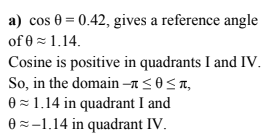
cos^-1(.42) is approximately equal to 1.14
sweet wyvern
yw
sweet wyvern
x = r cos(theta), y = r sin(theta)
sweet wyvern
x = ( 5/(1+cos(theta)) cos(theta) --> 5 cos(theta) /1 + cos(theta)
sweet wyvern
so we know r = 5/(1+cos(theta) right? We use the formula r cos(theta) = x but we plug in 5/(1+cos(theta) into r cos(theta) = x instead of r. We are substituting the value r with 5/(1+cos(theta) instead
hence why I wrote x = ( 5/(1+cos(theta)) cos(theta)
 next kernel
Is that legal? My brain hurts
I have no idea but my assumption is that the answer is 1.
patent beacon
The multiplicative identity, by definition
Which is a fancy way of saying the identity matrix
No?
Note that this is the way we define an inverse matrix. If ' means inverse,
AA' = I
next kernel
@sweet wyvern
That gives us x = 5/costheta
What would we do with that information?
next kernel
That makes no sense because you end up with x=(5costheta)/(costheta+cos²theta)
sweet wyvern
no you only multiply the numerator by cos(theta)
if you multiplied both the numerator and denominator by cos(theta) then you'd effectively be multiplying the radius by one
next kernel
you mean you multiply the fraction by cos(theta)/one
sweet wyvern
yes
next kernel
And then?
sweet wyvern
then you get what I showed you earlier: the x-coordinate of the rectangular coordinates
so now you need to solve for y
and the equation you use for conversion to y is y=r sin(theta)
next kernel
I would get y= 5sin(theta)/(cos(theta) + 1)
sweet wyvern
yes
next kernel
How does that...work out for the answer?
sweet wyvern
((5 cos(θ))/(cos(θ) + 1), (5sin(theta)/(cos(theta) + 1)) should be your rectangular coordinates
next kernel
Except those aren’t coordinates on a point.
Coordinates on a point would be like 2 +/- √5
sweet wyvern
do you have a specific value for theta?
next kernel
No
The answer simply takes the sides of the equation and trades parts to rewrite it using √ (x² + y² ). I think you took the wrong method for procedure.
next kernel
The professor made a mistake when asking for coordinates, because those were not included in the answer.
She meant to say conversion.
This is all a mess.
sweet wyvern
yeah sorry man
fleet yew
@sweet wyvern are you applying for mod
sweet wyvern
no it was just a joke
fleet yew
I think you should lol
viscid thistle
thanks ive mastered it!
fleet yew
Really?
gilded stirrup
lol
viscid thistle
i keep trying to convert cot into sin/cos and squaring the unit circle values
but that doesnt seem to be the way to solve it
so im not to sure what to try now
viscid thistle
1/tan
viscid thistle
sin/cos
fleet yew
So whats 1/(sin/cos)
viscid thistle
cos/sin
viscid thistle
oh i meant i was converting cotangent into terms of sin and cos!
i see the confusion now
viscid thistle
it seems i was on the right path
 violet nest
Hello
I'm having trouble converting a logarithmic equation to exponentials
So this is my graph and equation pulled up from Excel
But this is apparently what my friend is getting
Our values are based on the same table, and I need the equation in the second picture's form to find my K values
Can anyone help me convert my top equation to the second?
 sharp marsh
Find all solutions of the equation in the interval [0, 2π). (Enter your answers as a comma-separated list. If there is no solution, enter NO SOLUTION.)
4 sec^2 x + 2 tan^2 x − 6 = 0
Help?
acoustic harbor
use a trig id
change sec^2x to 1-tan^2x
or change tan^2x
and then factor
@sharp marsh
sharp marsh
Oh it's
The X is seperated from the 2
@acoustic harbor
Also is it not pi/6 and 5pi/6?
acoustic harbor
im not sure what you mean?
sharp marsh
Um it's not sec^2x but sec^2 (x)
 pseudo lance
hello
when looking for a hole, should u do numerator =0 and denominator = 0 OR should u find an x value for which the graph doesnt exist
for example, in y=ln(x^2)/ln(x^2)+2. If u do numerator and denominator = 0 then u end up without a hole, but if you use x=0 then u do have a hole
this equation is confusing me
fleet yew
@pseudo lance holes are common divisors (roots) of the num and denom
pseudo lance
whats a divisor?
oh nvm
how come x=0 is a hole then? since its not a common divisor
acoustic harbor
a hole occurs when the limit is 0/0
acoustic harbor
i forgot everything about ellipses
acoustic harbor
1-1
willow bear
$1 - (1 - 2 \sin^2(x)) \neq 1 + 2 \sin^2(x)$
obsidian monolithBOT
Ann:
acoustic harbor
is 0
viscid thistle
Oh wait its -1 + 2sin^2 x
willow bear
$1 - (1 - 2 \sin^2(x)) \neq -1 + 2 \sin^2(x)$ either
obsidian monolithBOT
Ann:
acoustic harbor
what?
viscid thistle
Welp I’m in danger
viscid thistle
Yes it’s 0 but
acoustic harbor
Make it 0
viscid thistle
Wait it’s not distribution multiplacston oooooo
acoustic harbor
its straight forward from there
willow bear
you say $1 - 1 = 0$ yet simplified $1 - 1 + 2\sin^2(x)$ as something other than $2\sin^2(x)$ two times now
obsidian monolithBOT
Ann:
willow bear
curious indeed
viscid thistle
Ok does that look a lil better
willow bear
$1 - (1-A) = 1 - 1 + A = (1 - 1) + A = 0 + A = A$
obsidian monolithBOT
Ann:
willow bear

acoustic harbor
im a little worried
viscid thistle
My brain has just shut off since the quarantine started
Im so not ready for ap Calc
acoustic harbor
dont really use trig ids in ap calc
acoustic harbor
isnt it straight forward?
you have 2sin^2x/2sinxcosx
start canceling out stuff
viscid thistle
Oh huh so that would leave sinx/cosx
acoustic harbor
yes
viscid thistle
Now how exactly do this one work
viscid thistle
So there’s this
willow bear
**1/**sec^2(x) = cos^2(x)
viscid thistle
Would I cancel out the denominator this way?
No no
Never mind that’s not right
viscid thistle
Forgot to put it in front of sin
Or wait
Does it go between the sin and x while the cos numerator and denominator cancel out
uncut mulch
wdym
viscid thistle
I don’t know anymore
uncut mulch
currently you should have: $\frac{2\sin(x)\cos^2(x)}{\cos(x)}$
obsidian monolithBOT
ramonov:
uncut mulch
cancelling a factor of $\cos(x)$ will leave you with: $2\sin(x)\cos(x)$
obsidian monolithBOT
ramonov:
 jaunty mason
I have a function that transforms a polar coordinate: $f(r, \theta) = (a sin \frac{r}{a}, \theta)$
obsidian monolithBOT
Tāhā:
jaunty mason
What is the function that has the same effect, but in Cartesian coordinates?
smoky needle
Hello, is someone available to help me on a question?
jaunty mason
don't ask to ask!
jaunty mason
,$ f(x, y) = \left(a sin \left(\frac{\sqrt{x^2+y^2}}{a}\right)\cdot\frac{1}{\sqrt{1+{(y/x)}^2}},a sin \left(\frac{\sqrt{x^2+y^2}}{a}\right)\cdot\frac{y/x}{\sqrt{1+{(y/x)}^2}})\right)
obsidian monolithBOT
Tāhā:
jaunty mason
this is what i tried, please tell me there's a simpler version for it
oof, doesn't fit in the image
Well the x-component is
,$ a sin \left(\frac{\sqrt{x^2+y^2}}{a}\right)\cdot\frac{1}{\sqrt{1+{(y/x)}^2}}
obsidian monolithBOT
Tāhā:
jaunty mason
and the y-component is
,$ a sin \left(\frac{\sqrt{x^2+y^2}}{a}\right)\cdot\frac{y/x}{\sqrt{1+{(y/x)}^2}}
obsidian monolithBOT
Tāhā:
smoky needle
I am having trouble with #7. I don’t quite understand what it is asking me.
jaunty mason
aaah can someone help me with my polar conundrum
smoky needle
@willow bear so will I just have to put any real numbers in for x to see if it is a neg or positive?
jaunty mason
nop
you're supposed to know that the term with highest degree will grow the greatest
and recognize that it has a negative coefficient in this case
smoky needle
So if it a positive value for that, would negative be the answer since -x^7 has the highest power?
smoky needle
@jaunty mason thank you, I appreciate it!
jaunty mason
np 😄
 fierce slate
could someone help me with solving this? https://prnt.sc/sarabi

i dont understand how to find the equation without a given directrix
sweet wyvern
instead try finding the distance b/w the vertex of the parabola and its focus
call this distance p
the general formula that we want to use to determine our parabola (when it opens or down and we are given the focus or directrix) is x^2 = 4py
viscid thistle
you could also use process of elimination given estimates of points... say, it can't be the first one, because one of the points is (1,1) and that doesn't appear remotely true on the graph. this isn't reliable in the long term, but it works for tricky questions you don't know the traditional process of.
sweet wyvern
yeah lol, you can also instantly rule out the second option b/c of the y^2 (this applies when the parabola opens to the right or to the left)
viscid thistle
indeed.
the only remaining options are the third and last, and we can rule out one of them with a point estimation.
 leaden stratus
Hello. Today we tried to solve this, but even our teacher was unsure about the steps. How would you solve this? Thanks.
The result is pi/4 + kpi.
willow bear
- how many marbles are there in total?
- how many fit the description "the marble is green or has a number > 3"?
 barren stream
alright there are 10 marbles in total
6 marbles are green, and 4 of them are larger than 3
@willow bear im not really sure what to do next.
or even if im correct so far.
willow bear
you have 10 marbles:
O1, O2, O3, O4, G1, G2, G3, G4, G5, G6
barren stream
yes.
willow bear
O for orange, G for green
how many fit the description "the marble is green or has a number > 3"?
muted steeple
how do i go about solving c?
 rare pagoda
you have a parabola opening up downwards, what do you know about where its absolute maximum will be?
muted steeple
"opening up downwards" ?
muted steeple
i know nothing of that sort at this stage. I'm doing a chapter on quadratic equations.
rare pagoda
okay you know the equation y = x^2 right?
rare pagoda
and -x^2 would make an upside down U
muted steeple
yes.
rare pagoda
that's what I mean by growing up/down
muted steeple
so i assume that negative -16x^2 is the down
rare pagoda
yep
muted steeple
oke
rare pagoda
and when it is growing down, you know there is going to be a global max
aka the vertex
muted steeple
yes, so i need to find the global max
but i have not learnt that, i know how to find roots etc.
wait, can i set the roots somehow to global max?
rare pagoda
if you get the roots, then the t value for the vertex would be the average of those 2 roots
but you can use the formula $t = \frac{-b}{2a}$
obsidian monolithBOT
magnusChadson:
rare pagoda
make sure to plug the t value that you get back into h(t)
muted steeple
oooh i think i can see it.
so the arithmetic average of the two roots would give me the time for the global max right?
wait, but i need to find the height.
ahh...
rare pagoda
kinda weird that problem c is find the height while problem d is find the time
since you need time to find height
muted steeple
https://cdn.discordapp.com/attachments/363224154469826562/706907252249854484/195274489901219849.png this resembles the square completion formula


a and b are the coefficients for the quadratics?