#precalculus
1 messages · Page 225 of 1
 fleet yew
 smoky needle
Okay!👍🏽
Will I have to do anything else?
Now that I have the x intercept if the maximum?
smoky needle
Into the original equation correct?
fleet yew
yes
fleet yew
checks out
smoky needle
That will be the y intercept then? So it’s (2,2)?
fleet yew
yeah
smoky needle
Is it okay if I ask one more question?
It’s pretty much done, I just don’t know what to do after this part.
fleet yew
sure
smoky needle
 unique hill
misclicked
smoky needle
Lol no worries!
fleet yew
checks out
but there's something special about this specific problem you might've missed
this is actually another quadratic
smoky needle
My friend did this, but i dont get how he got 4-8+8
Darn, so I might’ve done it wrong then
fleet yew
the 4-8+8 just comes from plugging the value into h(t)
unique hill
,rotate 270
 obsidian monolithBOT
fleet yew
obsidian monolithBOT
fleet yew
(3rd root of 2)^6 - 4(3rd root of 2)^3 + 8
smoky needle
Ahhhhh I seee
Okay, I got it! Thank you so much! I forgot about all the power rules smh
But I still don’t quite get how that is the min?
Is it because h(0) is greater; hence, the min values are cube root of 2, 4?
unique hill
and the minimum value is the y coordinate of the global min (correct me if im wrong)
fleet yew
Yes
fleet yew
Plot the function
unique hill
for reference
smoky needle
Is the global min the lowest one?
fleet yew
Yes
In fact i am mistaken there is no local min in this function
Thats just a critical point
smoky needle
Sorry, my professor doesn’t use those terms and I’m referring back to all my calculus notes in high school... but can you clarify those terms for me? It’s been a while..
 hardy abyss
I'm kinda concerned by that "global minimum" 
smoky needle
Dang, even when I took calculus in college before dropping the class, they’ve never mentioned global max/min..😟
Wow. Thanks guys!
Appreciate it!
unique hill
Sorry, my professor doesn’t use those terms and I’m referring back to all my calculus notes in high school... but can you clarify those terms for me? It’s been a while..
@smoky needle if you're not familiar with the term inflection, an inflection point is where the concavity of the function changes
fleet yew
That's kind of surprising considering that thats exactly what you're doing
Finding maxes and mins
smoky needle
@unique hill so inflection is where the concavity changes, got it. So what are critical points then? I’m like blanking out with the terms..
@fleet yew yeah, they’ve only used local min/max. Never used global..
unique hill
critical point is a generic term
fleet yew
Critical points are roots of the first derivative, inflection points are roots of the second derivative
unique hill
When dealing with functions of a real variable, a critical point is a point in the domain of the function where the function is either not differentiable or the derivative is equal to zero
smoky needle
Yeah, I’m actually going back to my calc notes, and I take pretty detailed notes, and I’m not seeing any of those terms.
We’ve used critical points though
smoky needle
Thanks for letting me know though. I wouldn’t blame the professor, it’s probably our responsibility to know it. And I actually took calculus fall quarter and failed it, so I stayed for the rest of the class. I decided to retake it but dropped it winter quarter since I knew I wasn’t prepared to take it, hence I went backwards and did precalc to enhance my knowledge.
unique hill
let us know if u need any more help :)
smoky needle
Thank you! You guys did help a lot! (:
fleet yew
Ur welc

 willow bear
what's the question for those who don't speak suomi
 languid crane
uhm
"The half-life of caffeine in the body is about 5 h. After how long a cup of coffee obtained
caffeine has dropped to less than 1%?"
obsidian monolithBOT
Result:
13.152
that the caffeine level dropped to 1% after 33 hours and 13 mins
languid crane
hm ok
 muted steeple
Hi, how does this property make sense?****
unique hill
well anything that's in the absolute value brackets can be negative or positive
muted steeple
Yes.
unique hill
reason is because if u put absolute value brackets around smth, it bcomes positive
unique hill
even tho the inside is negative, putting those brackets around it makes it positive
yes, the inside
u can clearly see X is inside the absolute value brackets in the pic
muted steeple
hmm, now i'm trying to figure out why this is a useful property 😄
unique hill
like what makes those brackets useful?
muted steeple
In the context of solving abs val equations
it's just saying that the expression inside abs gives either positive or negative C
unique hill
^ yes, the expression can be positive or neg
 past meadow
of how it might help you to solve an equation
 tardy ridge
I lose solutions if I b is positive even and I move it down.
log a^b
to b*log a
I lose solutions.
fleet yew
@tardy ridge any specific proble
 full garden
hey guys I have a question
I got the formula n^2+6n-2 and it works
but my teacher said it's unacceptable because it needs to be in recursive form
like this one
how can I convert n^2+6n-2 to a recursive formula
I tried to look up youtube videos and they just leave the equation in the quadratic form
if someone can please guide me through this, it will be greately appreciated
oh
 heady jewel
you can just plug in (n-1) and n
full garden
steven what?
heady jewel
and then subtract t_{n-1} and t_{n}
full garden
what
heady jewel
ok wait
full garden
thank u bro ❤️
heady jewel
you got it?
full garden
im trying to get it to work bro but thank u for helping me
heady jewel
what no wait
full garden
so you just plug (n-1) whereever i see n?
heady jewel
look your trying to obtain a recursive
full garden
yes sir
heady jewel
like a term=something*another term
so tell me what js t(n-1)
you just replace that n with n-1
full garden
tn-t i think
heady jewel
no
tardy ridge
what
heady jewel
no it wouldnt
tardy ridge
that's (n-1)^2
heady jewel
4
tardy ridge

heady jewel
so see you want something like t(n)=5+t(n-1)
and you know t(n)=n^2-6n+2
whats t(n-1)
you just repllace the n with a n-1 and simpplify the exppression you get
t(n-1)=(n-1)^2-6(n-1)+2
full garden
i got n^2+4n-7
full garden
okay
heady jewel
youll get a -8n not a -4n(its -2n-6n)
full garden
bro even tried it in photomath and got the same answer
heady jewel
so t(n-1)=n^2+4n-7 right and you know t(n)=n^2+6n-2
what will be t(n)-t(n-1)
t(n)-t(n-1)=2n+5 right
you agree?
t(n)=2n+5+t(n-1)
theres our recursive definition of our Sequence
full garden
omg
heady jewel
however find a quadratic from this recursive definition is p hard
llike 187 said
you have done the hard part teacher wants the easy thing
full garden
no your method was outstanding thank u so much
full garden
love u thank u
 lyric cliff
Can someone help?
willow bear
what's giving you trouble
lyric cliff
starting. lol
willow bear
i mean
 sour hemlock
What is tan equal to?
lyric cliff
sin/cos
sour hemlock
There you go
sour hemlock
Anything divided by 0 is not 0
willow bear
you're dividing by zero
willow bear
there
 gilded stirrup
^
sour hemlock
There you go
lyric cliff
thanks to all of you
gilded stirrup
hmm transformations are so annoying, for a(f(b(x-h)))+c, a is for x axis and as factor of |a| and b is y axis and has a factor of 1/|b| right?
I want to get this out of the way before I start a worksheet lol
sour hemlock
a, f and b are all functions?
gilded stirrup
no like, uhh f(x)=x^3 and then the transformations applied to f(x)
 patent beacon
a is a vertical stretch
b is a horizontal compression
 safe lodge
its that easy?
Or you can try by the θ ,,cos (what ) = 0 ? π/2 ,3π/2 ..etc ,,, try putting the θ in the tan ,, tan (π/2 )= und @lyric cliff
gilded stirrup
ooh okay, thanks for clearing it up
gilded stirrup
yea, h and c are translations from right to left and up/down respectively I think
sour hemlock
f and a are functions or numbers being multiplied?
patent beacon
af[b(x - h)] + c
If that clears it up
sour hemlock
Right, if the absolute value of the product of f and a is less than 1, you have a compression along y axis otherwise a stretch
patent beacon
f is a function, everything else is a real number multiplication
willow bear
"graph r = 2cos(θ) + 2sin(θ)" does not mean "graph r = 2cos(θ) and then graph r = 2sin(θ) on the same coordinate grid
 viscid thistle
Then how would I actually add them instead of putting them on the same graph
willow bear
i mean first off like
if you were asked to graph something in rectangular coords, say y = x^2 + 4x, you wouldn't graph y = x^2 and then y = 4x and attempt to pass it off as an answer, right?
anyway, here you might consider writing cos(θ) + sin(θ) as sqrt(2) sin(θ + π/4) to make this easier for yourself
 unique flint
how do i get the fundamental interval of y=1/4csc(2pix-pi)?
lyric cliff
vete a copiarte a otro lado
full garden
,help
obsidian monolithBOT
A brief description and guide on how to use me was sent to your DMs! Please use ,list to see a list of all my commands, and ,help cmd to get detailed help on a command!
gilded stirrup
nvm I got it
 severe flare
What was it? genuinely confused what the factor theorem is
severe flare
Ohh sweet thanks lol I was like wait a minute
 harsh cipher
question
This question. When I rationalize +- root(1/2)
how is the reference angle pi/4

willow bear
cos(π/4) = sqrt(2)/2 = 1/sqrt(2) = sqrt(1/2) = any of the other forms you might insist on putting this number in
but also, why not rewrite this equation as cos(2θ) = 0 and make your own life so much easier?
harsh cipher
how do you change it to cos(2θ)= 0
life isn't suppose to be easy
😛
anyways how have you been doing?
willow bear
uh cos(2θ) = 2cos^2(θ) - 1???
but also like.
life isn't suppose to be easy
what
is that meant to be a justification for wading through a forest of algebra that could very easily be avoided with a detour i explicitly pointed out to you
harsh cipher
no lol
 upper kelp
Just in case, those trigonometric properties could be helpful in the future:
sin (α ± ß) = sin (α) cos (ß) ± cos (α) sin (ß)
cos (α ± ß) = cos (α) cos (ß) ∓ sin (α) cos (α)
sin (2α) = 2 sin (α) cos (α)
cos (2α) = 2 cos² (α) - 1 = cos² (α) - sin² (α) = 1 - 2 sin² (α)
Comes right after α in the alt codes. 
willow bear
does it? 
upper kelp
Yes! 
Or is it a fake alpha, too? 
 radiant spruce
 worthy pelican
This baby is nasty :c
willow bear
hrgh
hang on doesn't the numerator approach 0 and the denominator approach infinity
thus making the entire thing obviously 0
worthy pelican
it says the answer is 4 😦
worthy pelican
i think it makes 0
willow bear
as written? yeah, it does
upper kelp
Did they make a mistake with the 2 in cos and intend to write it as (3πn - 2) / (6n + 3), perhaps?
upper kelp
Please don't cry!
Remember the little panda is always here for emotional support: 
upper kelp
Sounds to me like you don't need L'Hopital's rule in this case.
If you have the numerator converging to 0 and the denominator to ∞, then the quotient must converge to 0.
worthy pelican
i mean yes, but i dont really understand that the answer is 4
do u think is a mistake?
upper kelp
As the question is written, it seems that the limit is indeed 0.
As to why they wrote 4: Could either be a mistake in the answers, or a mistake in the question.
worthy pelican
thanks
really thanks
i think its a mistake
and i was gonna cry
❤️ love both of u
 silk briar
quick question, is the general solution to a trig function written with the periodicity and "n"?
upper kelp
I would say so.
If that answers your question, for example, if I had an equation like cos (x) = 0.3, and some Θ was an angle that solved it, as in cos (Θ) = 0.3, then I would write the general solution with x = ±Θ + 2πk.
Now, one small note: This is often not the end of the problem, because the problem requires you to only have values of x from some range given in the question, so you must only pick the finite angles that satisfy this condition.
viscid thistle
Oh ok
 cosmic escarp
patent beacon
cosmic escarp
patent beacon
Who said it was?
patent beacon
Lol no it's no problem. It is weird to write it as a chain of inequalities
patent beacon
You're going straight for vertex form, but it will be difficult to incorporate the roots
I'd suggest y = ax(x + 16) instead
 carmine elbow
Soo, use (-16,0)?
carmine elbow
But the values of h and k are supposed to go there
 leaden stratus
Hey I need help. How do I do this? Of course I have to use the "t" method and it becomes a second grade equation.
upper kelp
You're right about the 't' method.
Now, consider this problem: You have cos² x in there, which isn't a power of sin x.
In that case, how can you correct that such that the cos² x becomes some expression that strictly involves sin x?
Hint: ||Think about trigonometric identities.||
viscid thistle
Would the answer to c be 410i+410j
Show your work. @viscid thistle
Oh my work is kinda messy
Lemme rewrite it
leaden stratus
You're right about the 't' method.
Now, consider this problem: You havecos² xin there, which isn't a power ofsin x.
In that case, how can you correct that such that thecos² xbecomes some expression that strictly involvessin x?
Hint: ||Think about trigonometric identities.||
@upper kelp 1 - sin^2x?
upper kelp
Indeed!
Now, you only need to correct the minus in sin (-x), and you're all set to use the quadratic equation.
leaden stratus
Indeed!
Now, you only need to correct the minus insin (-x), and you're all set to use the quadratic equation.
@upper kelp - (-sinx)
So +sinx
@upper kelp excuse me, so I'd have - 2sin^2x + sinx = 0
So sinx (-2sin^2x + 1) = 0
But the solutions are sin x = 0 (2kpi) and sin^2x = 1/2
upper kelp
Sounds okay to me.
Just a few things:
- Remember that the general solution to
sin (x) = 0isx = πk, notx = 2πk. - Now that you have
sin² (x) = 0.5, how can you derive from that the possible values ofsin (x), and from there the possible values forx?
leaden stratus
On the book are kpi and pi/6 and 5/6pi
Sounds okay to me.
Just a few things:
- Remember that the general solution to
sin (x) = 0isx = πk, notx = 2πk.- Now that you have
sin² (x) = 0.5, how can you derive from that the possible values ofsin (x), and from there the possible values forx?
@upper kelp oh right
The solution is kpi
upper kelp
Do the solutions have to be between 0 ≤ x ≤ π, or general solutions?
upper kelp
Yes.
I would begin solving this question by noticing that in the denominator, the "important factor" as you tend to infinity is the x^6.
If you take x^6 to the square root, you get |x³|.
Do you know how to go on from there?
viscid thistle
Yes. But am I allowed to assume this? I know that when looking at limits at infinity, you must only regard the term of highest degree. Would that work under the radical?
upper kelp
Are you familiar with the method of dividing the numerator and the denominator by 1/ x^(something)?
viscid thistle
Yeah
upper kelp
May I show you how it's applied here with the square root?
viscid thistle
Sure
upper kelp
There you go.
Notice that when I put 1 / x³ inside the root, I had to square it.
This is true for positive numbers. If x < 0, then I have to put a minus in front of the root.
full garden
hey guys I have a question right here it says that the person started at $750 but like whenever I use this formula i get the term that's before the one on this table as it I'm doing this n-1 exponent
but the formula perfectly suits the table when I start with $783 but it just doesn't sound right because the question says that the person started with $750
so which formula should I start with
full garden
can someone please help me?
full garden
hey guys can someone please just clarify whether I should use the first formula or the second formula please
 rich flint
@full garden hello are you still there?
full garden
yes sir
rich flint
Hey bro so your trying to find an equation where you plug in for the year and your wondering whether you should start with $750? You should work with $750 and in the interest rate that they gave you.
obsidian monolithBOT
TopCat:
rich flint
No clue why that did that
full garden
yes bro should i start with 750 or 783
rich flint
750 because that is what the problem starts with
full garden
like when I use the equation it works with 783 it outputs the same value from the table. But the question says started with 750 so I am not sure if i should
oh
bro but here's the thing
Im supposed to use this formula tn = a (r^n-1) so when I subtract a one with the equation that starts out with the 750 I get the previous value than the one that's in the table
but when I use the 783 for intial value it works
rich flint
Ok so I didn’t know you were suppose to use that formula they said simple interest so I assumed I=PRT
So what does tn represent and a?
Tn is total after years and a is the principal on I see
full garden
the teacher wants me to use this like geometric sequence formula for this bro
this one bro
rich flint
Ok I see how this is a problem
full garden
yeah bro
rich flint
Ok well think about this did you try it with the information you were given
rich flint
Well if the teacher requires you to use that geometric sequence I don’t think you have a choice
full garden
she didn't really restrict it bro. The reason I assumed that I have to use the gemotric sequence formula is because that's what we covered in class today
rich flint
I was saying if you plug in the value that you have in relation to the table you can see that you can compare it with what you know
Ohhh ok then no
Simple internet formula is I=PRT that calculates your interest then you add that with the principal
Try it for the first year and then try it when 4 years past then you will see what I’m saying.
full garden
okay bro
rich flint
Also explains why my interest rate is different from yours
rich flint
No problem I’m still here just ping me to make sure
rich flint
No
rich flint
I got 4.5% your not that far off actually
full garden
i probably rounded it wrong
full garden
why bro
full garden
no worries bro you're helping me without asking for a favor
that's already pretty nice of u to do
rich flint
Follow under where I crossed out something
I factored the $750 out of it and I used the same data for the first year of course time stands for 1 so you would end up with 1+r
full garden
yes bro this formula works best
for four years i got 885
which is the correct number
rich flint
Sequence is not used for this
full garden
what is it used for bro
bro like this question right here i think we are forced to use sequence
rich flint
No
The keyword is simple interest did he/she use these finance questions with sequence in class?
full garden
he didn't really mention the word simple interst in class bro
that's why i made that assumption
rich flint
Simple interest is associated with one formula which is the P+PRT
full garden
and like when it talks about 15th year and 10th year i think the only way to solve is it to use sequence
rich flint
So did the professor discuss finance questions at all with PRT
full garden
no bro
rich flint
There is your answer
full garden
okay
rich flint
You use PRT+P when it says simple interest cause that is the equation they are referencing
They are mentioning years cause they want to know how much your investment yielded after that amount of time.
So for part b for the first homework solve for t which represents time and then for part c since you got the correct interest rate estimate how much after 15 years
full garden
will do bro
rich flint
Just plug in n for t since they said nth year
full garden
bro can you use the exponential equation for simple interest ?
rich flint
Technically it is true but it would be for compound interest problems or e which is an irrational number
full garden
Okay thank you so much bro
rich flint
So if you put simple interest rate in google that one equation will always come up
No problem man take care
fleet yew
Eyy its topcat
 keen sigil
i dont understand what i'm supposed to be doing here, could someone help?
i understand how i'd do 2 but idk about 1 or 3
patent beacon
What's h(0)?
keen sigil
oh my bad
h(0) is 4
would i then do g(4)
and then solve that?
and get (4,2) as the point
patent beacon
g(4) = 2, correct
patent beacon
g(h(0))
= g(4)
= 2
And that's the third answer
Np! Good luck with the rest, feel free to ask if you need anything else
 honest patio
hi i need help with question 2
ive found what is k=2.77
and im stuck idk what to do for the next step
 willow bear
$C_0e^{-kt} = 0.75C_0$, solve for $t$
obsidian monolithBOT
Ann:
honest patio
i thought 0.75 is already decades and c is the current that is remaining?
willow bear
oh, my bad. i misread
replace that with 0.25 then
since 75% decayed, 25% must remain
willow bear
actually
i might not have said this the best way
you don't even need any equations to solve this problem, just common sense
75% of the substance has decayed
this means that a quarter of the original is remaining
honest patio
thats what i thought
honest patio
but they gave me this equation and a whole story
willow bear
since the original amount would be cut in half after one half-life
and the half that remains would be cut in half after another
hence, 2 half-lives must have passed
1 million years, in your pic
willow bear
dunno
viscid thistle
hey guys! am I right in thinking that csc^2t is equal to 1/sin^2t
willow bear
yes but you should use parentheses with trig functions
viscid thistle
so csc^2(t)?
 stuck lark
csc^2(t) is equivalent to 1/sin^2(t)
viscid thistle
thanks a lot!
 plush violet
Since its money you could just have 3115.93, but thats alot of significant fiqures, id round up to 3116 personally, but i dont know how your teachers feel about significant fiqures
viscid thistle
Id do same ^
plush violet
I generally aim for 3 significant fiqures unless im told otherwise
fleet yew
Nearest cent
plush violet
i dont think it asks for it to the nearest cent does it?
that sounds kinda bitchy and sarcastic but its not lol
fleet yew
Its money lol
carmine elbow
can someone help me with this problem?
This is an ellipse and I am trying to put it in standard form
tardy ridge
why do you have a random (b/2)^2
why did you flip the signs for the last step
it's not like the 9 is disappearing
also 9*9 =81 not 9 for the 4th step.
@carmine elbow hi.
carmine elbow
Hi
Sorry, my computer wasn’t showing any notifications
And thank you for catching that
smoky needle
Hi can someone check if I did this correctly?
viscid thistle
how write disctrete data in interval notation
smoky needle
@viscid thistle thank you! 😊
viscid thistle
what is the symbol for irrational numbers?
 brittle fable
irrational numbers is I
viscid thistle
i thought intergers was I now
brittle fable
integers are Z
 maiden furnace
how do we graph r=2sin3theta
viscid thistle
what is the symbol of imaginary numbers
fleet yew
@viscid thistle 0 is sometimes considered to be part of the naturals
also don't use I for the set of integers
it's Z
smoky needle
I am not sure if I got this correct, can someone explain what I may have done wrong?
viscid thistle
I have a question basically asking if f(x) = x is equivalent to f(u) = u
I cant really decide
Based on that information yeah, but we dont know if u has a limit of any kind
fleet yew
@viscid thistle what's the question
 proud gate
I just found a trig idenity :D
Sin theta = Cos(theta + 270deg)
 acoustic harbor
why you use degrees
proud gate
@acoustic harbor for the actuall equation i did use radians, 3pi/2 but here i didnt want to write that cause its awakward to write as text like that and didnt want to make a whole textit thing
Plus degrees in a way are more inutitive for me
fleet yew
@viscid thistle only iff x=u
willow bear
"only iff"
harsh cipher
Hi
Question
How can I simplify this expression
sin(x-2) cos(2-4x)-sin(2-4x)cos(x-2) ?
willow bear
$\sin(a) \cos(b) - \cos(a) \sin(b) = , ?$
obsidian monolithBOT
Ann:
harsh cipher
that's what it simplifies to?
harsh cipher
that's sin(a-b)?
 lilac pier
, rotate
obsidian monolithBOT
 plucky vapor
lilac pier
plucky vapor
lilac pier
it's the time taken for the cycle to return to where it started from and repeat the whole process again
 sturdy haven
So what would that mean in the context
lilac pier
the time it takes for the bp to increase/decrease then come back it's original value
sturdy haven
okay
Also
For a phase shift
You know how it is usually
sin(x-a)
What if it is sin(a-x)
lilac pier
@sturdy haven It's almost the same thing, sin(a-x) = -sin(x-a)
so you draw the graph of sin(x-a) but invert it
lilac pier
yeah
sturdy haven
Thancc
 lilac pier
@maiden furnace Try multiplying/dividing with the conjugate secx - tanx
maiden furnace
ok i got that down but i dont see where to go from there
lilac pier
what do you have in the denominator
lilac pier
yes sec^2x = tan^2x + 1, so sec^2x - tan^2x = 1
maiden furnace
sweet solved it ty for the help
lilac pier
n
np
@maiden furnace there is another method, change the sec to 1/cos, tan to sin/cos, simplify, you get cosx/(1+sinx)
now you can take conjugate 1-sinx and do the same thing
maiden furnace
ohh i think the first method way easier for me
I also need help with this and idk how to solve it
 lilac pier
@maiden furnace try using sin(a-b) = sin(a)cos(b) - cos(a)sin(b)
maiden furnace
os i would have something like sin ( arctanx) cos(arctany)-cos(arctanx)sin(arctany)
lilac pier
Yeah so let's say arctanx = theta, this gives us x = tan(theta).
Now tan(theta ) = x, we can also say tan(theta) = x/1
now make a right angled triangle with the side opposite to theta being x and adjacent to it being 1
you can use pythagorus theorem to find the remaining side which is the hypotenuse
once you do that, all we need is sin(arctanx) or sin(theta) and cos(arctanx) or cos(theta)
so find sin(theta) and cos(theta) from that triangle of yours
@maiden furnace
Once this is done, we have to do the same with arctany
@maiden furnace ?
maiden furnace
hmm i think i get it lets see
viscid thistle
could someone check my answers? I wanna check if im doing it correctly
maiden furnace
so would hypotenuse be x + 1?
lilac pier
$\sqrt{x^{2} + 1}$
obsidian monolithBOT
Sup?:
maiden furnace
so then sin would be xsqrtx^2+1 / x^2 + 1 right?
obsidian monolithBOT
Sup?:
maiden furnace
yeah but u cant leave the bottom like that
obsidian monolithBOT
Sup?:
maiden furnace
wont that be the same thing?
lilac pier
No
viscid thistle
obsidian monolithBOT
Sup?:
maiden furnace
oh wait that right there gonna be a y instead of the x
viscid thistle
I just want it corrected
 proven dove
bruh
viscid thistle
@sup
proven dove
nvm i got it
maiden furnace
so would my final answer be x/sqrtx^2 +1 x 1 / sqrt y^2 +1 - 1/sqrt x^2+1 x y/sqrt y^2 +1
lilac pier
Let's see, we need sin(theta)cos(alpha) - cos(theta)sin(alpha)
Yep
$\frac{x}{\sqrt{x^{2} + 1}} \cdot \frac{1}{\sqrt{y^{2} + 1}} - \frac{1}{\sqrt{x^{2} + 1}} \cdot \frac{y}{\sqrt{y^{2} + 1}}$
obsidian monolithBOT
Sup?:
lilac pier
@maiden furnace this should be it
proven dove
how do i find the xpoints of y = 2sin(x-pi/4) - 1 algebraically to graph?
lilac pier
wdym?
proven dove
how do i find the points to graph the function
lilac pier
You can take the graph of y = sinx, apply some transformations
proven dove
nvm lol
 flint viper
 serene heath
what have u tried
full garden
hey guys can someone please help me with question
she said it has to do with arithmetic sequence
upper kelp
Indeed, simple interest means that there is a constant amount of dollars that are inserted into the savings account each year, and therefore the series of terms that represent the amount of dollars that were in the savings account are an arithmetic sequence.
Do you know how to use these pieces of data to find out the general rule of the arithmetic sequence?
End of 10th year: $300
End of 15th year: $325
 silver bloom
upper kelp
silver bloom
upper kelp
Have you learned a technique in which you consider the sum of terms whose differences between the angles of which are the same as a geometric sequence?
For example, if you have the numbers z1 = cos (α) + i · sin (α), z2 = cos (α + ß) + i · sin (α + ß), z3 = cos (α + 2ß) + i · sin (α + 2ß), and so on..., then those terms are the terms of a geometric sequence whose quotient is q = cos (ß) + i · sin (ß).
full garden
@upper kelp thank you bro i was able to find a solution after you clarified apprecaite it man
 haughty cave
How would I go about finding a higher order polynomial that goes through the same 3 points as the lower polynomial?
I have the polynomial y=1/2(x^2+2x-8) where the x-intercepts are -4 and -2 and the y-intercept is (0,-4)
I'm not quite sure how to make it a higher order while still having it go through those points
upper kelp
Interesting question.
This is an interpolation problem that one of the methods for solving is with Newton's method.
Suppose that you had a polynomial P that went through the points (x1, y1), (x2, y2), (x3, y3), and now you want to construct a polynomial Q that goes through all these points with the addition of (x4, y4).
In this case, you'd construct the polynomial:
Q(x) = P(x) + A· (x - x1)(x - x2)(x - x3)
for some coefficient A which you can find using substitution.
Note that since A is multiplied by (x - x1)(x - x2)(x - x3), then the addition of the term still guarantees that Q(x) passes through the initial 3 points.
upper kelp
One thing that I would personally check to verify is to see what the degrees of the polynomials are in the numerator and the denominator.
In this specific case, we get that the numerator is of degree 2 and the denominator is of degree 3.
Do you know what that means in terms of the "behavior" of the function towards infinity?
viscid thistle
is it horizontal asymptote?
upper kelp
Indeed.
More accurately, do you know how to find its value?
upper kelp
Personally, the way I learned, there is no need to divide the polynomials.
The method I know involves dividing both the numerator and the denominator by the greatest power.
May I show how it applies here?
upper kelp
It is. 👍
I'll try to rewrite the function and then I hope it'll be a little clearer why.
upper kelp
I apologize if this is a little hard to see.
Here, I divided both the numerator and the denominator by x³, and I got this equivalent function.
(Those functions aren't equivalent at x = 0, but still.)
viscid thistle
@upper kelp
upper kelp
Sorry for responding late.
I could be mistaken, but I think so.
I think the idea of the zeros is to get all fractions p / q, in a plus or a minus sign, such that the "free term" is divisible by p and the coefficient of the greatest power is divisible by q.
viscid thistle
Thanks for your help, got 10/10
viscid thistle
oof
upper kelp
Seems to me that they're looking for this equation:
[The matrix equality is AB = I, where the element in the second row, second column is equal to the product of the 2nd row in A with the 2nd row in B.]
fleet yew
@upper kelp nice
 fluid shore
Take the limit as x -> +infty
rich flint
This is pre calculus they don’t discuss limits
fluid shore
Oh really?
rich flint
Yes
 uncut mulch
yes they are
fluid shore
Ok okay don't take the limit as x-> +infty
Just think about what happens when x becomes very big
@alpine portal
 alpine portal
Well actually this is calc hw so I shouldve put it in calc
@fluid shore Is that really all I have to do to get an HA?
In this type of question
fluid shore
Indeed
In this case, the domain of the function is just $\bR^+$ so you only need to determine the limit that the function approaches as $x \to +\infty$
obsidian monolithBOT
Abhijeet Vats:
rich flint
@smoky prawn it matters which classes but the pre calculus classes that I was TA for they usually don’t teach limits
Each school has state requirements of what curriculum they need to cover so I assumed limits wasn’t covered in pre calculus everywhere because that is what I was use to
So no limits are not taught in pre calculus all the time
Kind of like matrices is not usually covered in college algebra when it kind of is when you discuss system of equations
 reef rune
@upper kelp I still can't see why it equals 1 lol
upper kelp
Do you feel comfortable with matrix multiplication?
upper kelp
Remember that the unit matrix has 1-s on its diagonal and a zero everywhere else:
1 0 0
0 1 0
0 0 1
yeah yeah
willow bear
you can say whatever you want
if you're asking whether you can say "this is a geometric series with first term 1 and ratio 4/3" and be right,
then the answer is yes
worthy pelican
thanks
past meadow
,rotate
obsidian monolithBOT
harsh cipher
Hi
 pale bison
hi
viscid thistle
Hi
harsh cipher
how can I write (1-cosx)/(sinx) as tan(x/2)
I don't get how it became tan(x/2)
I mean how I could write it as such
pale bison

Visit http://ilectureonline.com for more math and science lectures!
In this video I will introduce the half-angle formula tan(x/2)=?
this video is probably helpful, if you don't understand a step in particular you can ask
pale bison
i suppose they want to derive or prove it
harsh cipher
this is very frustrating
Im taking precalculus
and nowhere in throughout this unit we learned half angle formula
anyways ill watch the video
thanks!
pale bison
it's not worth the time to go over those formulas in detail if your teacher aren't gonna prove it imo
harsh cipher
ok
can you explain if I can use the conjucate method?
multiplying (1+cosx)/(1+cosx) to the original equation?
viscid thistle
The conjugate method is used with the purpose of doing away with roots in the denominator
Idk if that'll work
viscid thistle
Wait you mean to multiply to the LHS?
harsh cipher
yes
viscid thistle
Show your try
Anyway if anything doesn't seem to work, you have to try with the most simplified or complicated side of the equation
harsh cipher
well the question is
viscid thistle
Starting with the LHS its like going backwards
harsh cipher
(1-cosx)/(sinx) can be written as
multiple choice answer
so if i use the conjucate method and expand numerator I get (1-cos^2x)/(sinx(1+cosx))
languid crane
yeah and you can simplify that
viscid thistle
@harsh cipher ^
uncut mulch
common denominator, combine terms
uncut mulch
expressing sec and csc in terms of cos and sin may help
 rigid beacon
Yea
That's my #1 tip with trig identities
Express in terms of sin and cos
Because it may look messier at first but it leads to easier simplification because you only have 2 functions to keep track of, not 6
 maiden pebble
wait isnt that what he did though
I mean he didnt show his work ig
but he got the answer
maiden pebble
cos^2/sin^2 doesnt equal tan^2?
rigid beacon
Ye ye
I'm just saying like actually writing all that out at some point when solving trig identities is a good idea
 uncut mulch
consider rationalising the numerator
willow bear
 this does not approach 0 as h -> 0.
uncut mulch
that expression does not approach 0 as h→0
willow bear
not for any value of x
maiden pebble
oh reallly
rigid beacon
You will get a function in terms of x in the end
Your end result can be a constant or a function in terms of x
It doesn't have to be a constant.
maiden pebble
so would i square everything
rigid beacon
sqrt[x+h] + sqrt [x]
willow bear
what do you mean "squared everything"
rigid beacon
You can't square it
willow bear
you can't go from a/b to a^2/b^2; this changes the value of the expression
maiden pebble
wdym cant
willow bear
which is the last thing you want
i mean can you go from 2/3 to 4/9
no because those aren't the same
but "squaring everything" gets you exactly that
rigid beacon
To keep the function the same, you need to multiply the numerator and denominator by the same thing
maiden pebble
yea, thats what I did...which was squaring it
rigid beacon
No you didn't
maiden pebble
2x+h/h
willow bear
rigid beacon
No and no
willow bear
rigid beacon
As someone with shitty handwriting
Start writing slower and more deliberate
You'll think more while writing
maiden pebble
idrc
rigid beacon
And you'll be able to read your work when checking it
Both of which will help you catch silly mistakes
Which you should care about
maiden pebble
how does that make you think more?
I thought less cuz I was focusing on writing neat
maiden pebble
ALL
Students
Take
Calculus
@viscid thistle https://i.imgur.com/BwNrutT.png
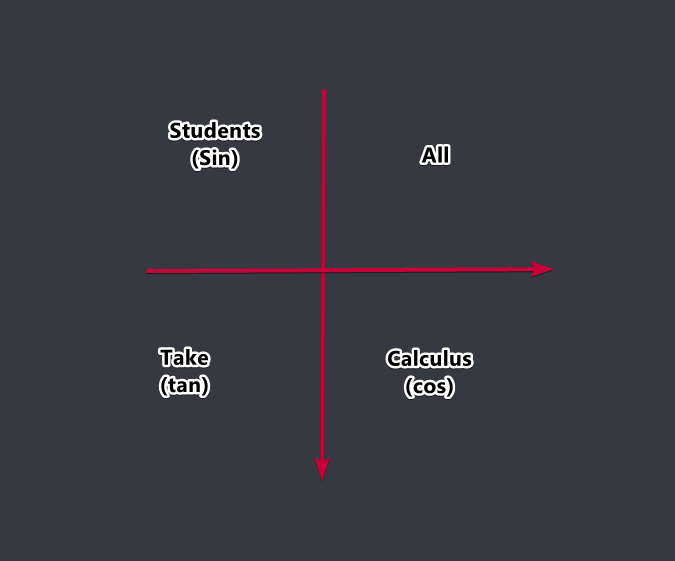
So if sin and tan are both positive then ur answer is in Q1
willow bear
no, i'm talking to vearax and correcting their misplacement of the parentheses
maiden pebble
oh good, dont want to be spreading fake news
willow bear
astc is a shit tier mnemonic tho
 maiden pebble
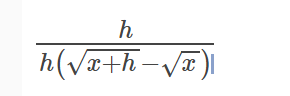
umm, I did what I thought was normal math
and no im not sure I didnt fuck up the signs
@willow bear yea ur right, that last - sign is meant to be a +
 maiden pebble
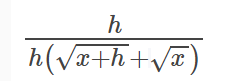
so all I need to do is move the parenthesis to the top
u know what i mena
wait do I just multiply by the conjugate again?
maiden pebble
because i need to remove the sqrt on the bottom
willow bear
no you do not
maiden pebble
😕
willow bear
first off why not cancel out the h's on the top and bottom
so that yknow
you no longer have a 0/0 situation
obsidian monolithBOT
Ann:
maiden pebble
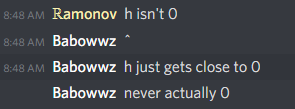
wait so we do want to plug in 0 for h
I thought we never didthat
cuz everyone is like https://i.imgur.com/AZACgVr.png
 willow bear
one possible line of attack for finding a limit is to get the function in a form where it's obviously continuous at the limiting point
and then plug it in
maiden pebble
so root(x)/2x
willow bear
$\frac{1}{2\sqrt{x}}$ is fine as-is
obsidian monolithBOT
Ann:
maiden pebble
my teacher dont like that
rigid beacon
Then you can rationalize it
maiden pebble
yea i was checking if my rationilzation was correct
would be very embarrasing if it wasnt
willow bear
what's incorrect is your spelling of rationalization
maiden pebble
yea well this is a math discord
willow bear
and?
maiden pebble
And as long as you understand the word I wrote, which you did, then does it really matter if I spell it perfectly
muted steeple
Hi, I'm struggling to understand what he's trying to achieve in the highlighted part
He then applies the A^2-2A+1=0 factor rule, but i don't see a how (1-x) is a square.
This method for solving is so bizarre.
Oh nvm $A = \sqrt[]{1-x}$
obsidian monolithBOT
꧁༺Vocal༻꧂:
muted steeple
surely this is not the easiest way of solving this?
willow bear
it is
carmine elbow
Can someone help me with this problem?
This is a conic section word problem that is supposed to be a parabola.
muted steeple
Well that's extremely annoying.
 vague aurora
What would be the best way to do precalc over the summer? In your opinion
 maiden igloo

I realize it with be x2 - x1 , y2- y1
i end up with 2 , -2
but the form it wants be to write it in shows a + sign
did i do something wrong
or would my answer be
s = 2i -2j
viscid thistle
it can be a negative
https://gyazo.com/cc3b5004b2fc801942a331f02c7261c2
Hi! I've been working on this for about 30 or so minutes and am still very confused. I didn't really understand the concept to begin with, so that's most likely why I'm confused. Thank you for any help you can give!


 heady jewel
what have you tried
willow bear
your handwriting could use some improvement.
maiden igloo
😂
maiden igloo
one second
willow bear
no equals signs anywhere, no mention of u or v
maiden igloo
willow bear
"board" is not a term in common use on discord
this isn't a forum
but it would fit in this channel
@maiden igloo
v = (-9i, -3j)
i definitely remember telling you about this notational mishap
willow bear
if you wanna use coordinate notation for vectors (like (3,4)) that's fine. if you wanna use i+j notation (like 3i+4j) that's fine too.
buit for the love of god don't mix the two.
maiden igloo
@willow bear I see what you're saying my apologies
@willow bear Is my answer on the right track though ?
 nova wedge
I feel like the last one is saying the hypotenuse over the side, and thats not how i recall using tangent
willow bear
@maiden igloo you seem to have made several sign errors, and your notation is making it hard to follow them through
 solid warren
@nova wedge they used arctangent
nova wedge
@solid warren Correct. I guess I don't recall the rules for arctan then
when using arctan
I can use either "adjacent" side?
solid warren
arctangent(opposite / adjacent) gives you the angle that they form
the third value, phi, is the angle from the z axis
solid warren
yes
nova wedge
but isn't r the hypotenuse?
solid warren
no
p is the hypotenuse
r is the projection of the 3d vector onto the xy plane
oh i see
their notation is different
@nova wedge normally spherical coordinates are written (p, theta, phi)
for some reason the wrote in r for p in that diagram
nova wedge
so is r really the top dotted line?
solid warren
so normally, r = sqrt(x^2 + y^2) but here it does in fact equal the hypotenuse
usually yes
nova wedge
then it would make sense there
solid warren
yeah
nova wedge
to make sure i understand correctly
they are using the arctan of the dotted line
over z
solid warren
yes