#precalculus
1 messages · Page 219 of 1
 novel dirge
she will start tallking how I copied my homework from the internet
like she did once before, but luckily, I did it on my own
but she did catch like half my class
and was all smug
sorry for the rant
can you please explain how my notation doesn't work and how the one you wrote is different?
 stable pasture
Is limits a part of precalculus or calculus?
 steel venture
@novel dirge reviewing it it looks like mine doesn't actually work
the best way to approach it is to say
$P(A'\cap B'\cap C')'$
 obsidian monolithBOT
Buncho Maximos:
steel venture
precalc
stable pasture
sorry
steel venture
np
@novel dirge to explain why your notation fails we can look at two variations of it
$(P(A)\cup P(B))\cup P(C)$
obsidian monolithBOT
Buncho Maximos:
steel venture
and $P(A)\cup (P(B)\cup P(C))$
obsidian monolithBOT
Buncho Maximos:
obsidian monolithBOT
Buncho Maximos:
novel dirge
the problem is that Idk what + and - do
steel venture
its just adding and subtracting
whoops
$P(A)$ will be a number between 0 and 1
@steel venture
obsidian monolithBOT
Buncho Maximos:
novel dirge
not sure what that means either...
steel venture
just that $P(A)$
obsidian monolithBOT
Buncho Maximos:
novel dirge
I feel like an idiot now for not understanding this
steel venture
will be a number between 0 and 1
don't, it can be confusing
but P(A) is just the probability something happens
novel dirge
so P(A) can be 0,6?
novel dirge
ok
I understand that now
but not how it is connected to the other parts
or how I use that
obsidian monolithBOT
Buncho Maximos:
novel dirge
...
I never did any operations with groups
what can I google to see how this works?
the + and -
steel venture
its the same thing as saying 1 + 1
or .5 + .7
or x + y
and 6 - z
its just adding
and subtracting
novel dirge
ok, but how do I do the adding and subtracting?
How do I get this $P(A)\cup P(B) = P(A) + P(B) - P(A\cap B)$
?
obsidian monolithBOT
Mr.Pancake:
steel venture
before we go forwards
i made a mistake
its not $P(A)\cup P(B) = P(A) + P(B) - P(A\cap B)$
obsidian monolithBOT
Buncho Maximos:
steel venture
its $P(A\cup B) = P(A) + P(B) - P(A\cap B)$
obsidian monolithBOT
Buncho Maximos:
novel dirge
ok
steel venture
but
it really means what it says
say we have two probabilities
A and B
the probability of A or B is = the probability of A + the probability of B - the probability of both
novel dirge
I kinda understand it when you write it and explain it like that
but I couldn't do it myself
that is the biggest problem
steel venture
well just remember
P(A) means the probability of A happening
P(AnB) is the probability of both A and B happening
P(AuB) is the probability of A or B happening, not both
novel dirge
so if I have A and B and just one of them turns out to be true I can write AuB?
steel venture
um no
usually when you work with these variables
A and B will be events
and you won't really get "results"
it mostly about the probabilities of the events
novel dirge
Serbian
novel dirge
yep
a. Ostvarila su se sva tri događaja A,B i C
b. Ostvario se bar jedan od događaja A,B,C
c. Ostvarila su se bar dva od događaja A,B,C
d. Od događaja A,B,C, ostvarili su se samo A i B
e. Ostvario se samo jedan od događaja A i B
f. Ostvarila su se dva od događaja A,B,C
g. Nije se ostvario nijedan od događaja A,B,C
h. Ostvarilo se najviše dva od događaja A,B,C.```this is the problem
steel venture
which one specifically
novel dirge
Write it like the group expressions( I think that is the closest translation I can think of)
steel venture
i put it on google translate no worries
novel dirge
and then a to h are the different casses
steel venture
but whhich one are you talking about
novel dirge
well, all of them
steel venture
so if I have A and B and just one of them turns out to be true I can write AuB?
@novel dirge
novel dirge
but I would like to be able to figure them out myself
steel venture
when you said this
novel dirge
yes
steel venture
ah
i see
yes you were correct
I thought we were talking about probabilities but i think AuB is what your teacher is looking for
novel dirge
yes
I mean, it isn't her that made this, she just found this on the internet
but yes
that is the format I am supposed to write this in
so for e I can write AUB?
steel venture
yep
novel dirge
Can you help me with the rest?
I will try doing them first though
and you correct me if I am wrong
is that ok with you?
steel venture
sure
novel dirge
great, thanks
 carmine elbow
When you're done helping him/her, can you help me with a problem?
novel dirge
For b, I am not sure if it can be AUBUC?
if one of 2 is AuB then shouldn't AuBuC be if it is 1 of 3?
novel dirge
and what does mine say?
steel venture
just 1
novel dirge
just one of the 3?
steel venture
yes
steel venture
yes
steel venture
yeah
steel venture
yeah sure
so think of it this way
if we want at least 1
then there can't be a scenario where none happen right?
steel venture
yep
novel dirge
right?
novel dirge
A'nB'nC'?
steel venture
good
novel dirge
so (A'nB'nC')' ?
 novel dirge
😆
for d, where out of A,B and C, only A and B happened, it would be (AnBnC')?
since it doesn't include C
steel venture
👍
novel dirge
it is?
steel venture
yep
steel venture
which letter is that
steel venture
you could say something along the lines of
(AnBnC')u(AnB'nC)u(A'nBnC)u(AnBnC)
novel dirge
so that is either any 2 are true or all are true?
steel venture
yep
steel venture
yep
novel dirge
and for the last
were max 2 of 3 are true
that means that 1 is always false?
so can that be A'nB'nC' ?
steel venture
that is just the probability that all 3 don't happen
but you have the right idea
max of 2
means that
you can never have how many
novel dirge
(AnBnC)' ?
steel venture
👍
novel dirge
sorry, but is it possible for you to just quickly check this?
just to make sure I didn't mess up somewhere
and thank you for the help and patience
steel venture
looks good
 hushed sorrel
im not US
but is precalc including complex numbers?
bc i have a complex number q idk where to post
 uncut mulch
semi-advanced algebra. use one of the free general questions channels denoted by greek letters
hushed sorrel
ok thx xx
 silk sail
Can someone help me with writing this function?
Suppose the value of Tech Advanced stock (in dollars) is given by g(t)where t represents the number of days after January 1, 2014. Express the values of the following stocks in terms of the function
g
The value of VirtualTech's stock, p(t), is always the same as the value of TechAdvanced's stock two weeks later.
 sour hemlock
I think your question is incomplete
sour hemlock
p(t) = g(t+14)
silk sail
Ok thank you that makes sense, idk why that one was seeming so confusing to me
novel dirge
@steel venture sorry for bothering you again
but I just checked again and am a bit confused with the second answer
where at least 1 needs to be positive
(A'nB'nC')'
isn't that the same as just (AnBnC)?
obsidian monolithBOT
Ann:
novel dirge
(A'nB'nC')'
is equal to that or that is the correct solution to my problem?
because at least one has to be true
out of 3
 willow bear
i'm saying $(A' \cap B' \cap C')' = A \cup B \cup C$
obsidian monolithBOT
Ann:
novel dirge
you don't have to scroll up
I have to write a formula using set operations
to express that out of 3 events -A,B and C, at least 1 happened
and the formula is what I got with the help of Buncho
but now when I tried to check it again, by myself I got confused
same for the one where no events are true, where we wrote - A'nB'nC'
can you please also check them, if it isn't a problem?
novel dirge
anyone?
 viscid thistle
I don't understand why don't you use OR ?
novel dirge
how should I use it?
viscid thistle
You have 3 events right?
novel dirge
yes
viscid thistle
And you want that one or two or three events happened?
novel dirge
in one problem, at least 1 of the 3 happened
but can be more
and in the second problem, 0 happened
novel dirge
I need to write a formula that does this, but with set operations
viscid thistle
The U is a sort of "OR" for the sets
In French we call it "union" I am searching the English word
novel dirge
I think it is also Union
viscid thistle
What do you call a set operations, U isn't one of them?
novel dirge
in my language we call it something similar
it is
in one problem, either A or B is true
so the solution is to write AUB
Idk if I am overthinking about the 2 problems I asked here about, but the more I think about them, the less I understand them
viscid thistle
Repost it I didn't see it
novel dirge
and if at least 2 are true (AnBnC)' ?
viscid thistle
Ok ok wait
novel dirge
ok, sorry
viscid thistle
To make the think easier
Try to think like if U was "or", n was "and"
' was "not"
Now try to retrieve the solution you find with this method
novel dirge
The thing is, I don't have much problems solving if the entire formula is true or not
I have problems writing it
which doesn't really make sense
novel dirge
yes
viscid thistle
I have a formula but it is quite long
Try to find a formula with the method I told you
novel dirge
is the one I wrote here wrong?
viscid thistle
Repost it 
novel dirge
no
wait
I did that one
I asked about the one with max 2
so out of 3 events max is 2 correct
novel dirge
and the formula for that is (AnBnC)'?
novel dirge
the one I sent?
viscid thistle
They are the same
viscid thistle
Np
 slim finch

 patent beacon
What's the question?
 rich light
Are you able to help w/ this? @patent beacon
I can’t factor any more from there correct? So I head right to sign analysis + interval notation?
patent beacon
@rich light
Okay, so you want to know when
(2x + 1)(x - 3) is positive
That happens when they're both positive, or when they're both negative
rich light
why do I want to know why it's positive in that case vs negative in the last example we talked about?
like when you helped me with my other question
 twilit shadow
Can someone please tell me what I did wrong?
patent beacon
If ab > 0
Then a and b have the same sign.
If ab < 0
Then a and b have opposite signs
@twilit shadow
Check your multiplication on (x + 4y)(x + 4y)
 tardy ridge
use pascals triangle
patent beacon
If 2x + 1 ≤ 0 and x - 3 ≤ 0,
Then x ≤ -1/2 and x ≤ 3
Which is satisfied by x ≤ -1/2
But the logic is correct, x ≥ 3 and x ≤ -1/2 are the solutions to this problem
obsidian monolithBOT
 Requested by Kaynex#7520
patent beacon
Requested by Kaynex#7520
patent beacon
You can see the solution where the parabola goes above the x-axis
rich light
okay yeah, I see what I did wrong
thanks
in terms of interval notation, would it be (3, ♾️ ) (-1/2, ♾️ ) @patent beacon ?
patent beacon
(-inf, -1/2] U [3, inf)
The U means "union", which is just a way to combine the sets into one.
rich light
okay, why did you get -inf for the first?
 toxic nova
@slim finch yes
 vapid torrent
A vase has 10 black balls in it and 10 red balls, a second vase has 10 red and 20 black. If a coin is tossed, and its heads, 2 balls are taken out of the first vase, if its tails, 2 balls are taken out of the second vase
How can I create a probability space for this?
 karmic wave
@rich light the negative infinity comes from the less than part
rich light
gotcha
 harsh cipher
Hello
 uneven dawn
Could anyone hop in voice chat for a few minutes and walk me through a radical function problem?
Like this one ^
harsh cipher
lose root and solve
uneven dawn
just square both sides?
would the right then just be 5x + 10?
Its also asking for the sum of solutions so how could it just be one answer?
I think i got it actually, I need to do sqrt(5x-3) * sqrt(5x-3) * -1^2
?
I struggle to even find a video solving a problem like this one
 daring yarrow
(a+b)² = a²+2ab+b²
@uneven dawn
also
https://www.youtube.com/watch?v=d24-xDTuVX4 @uneven dawn
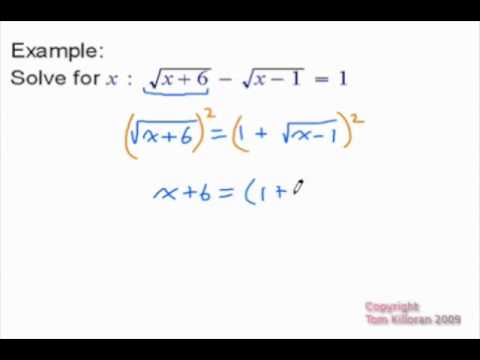
very similar problem
viscid thistle
https://cdn.discordapp.com/attachments/446817824338608139/697265386252402718/unknown.png How are you supposed to do ii of this question? Just had this on a test I completed around an hour ago but ii was the only question I couldn't answer 😦
 daring yarrow
is M the middlepoint of the circle
viscid thistle
It's a parabola and yes, M is the midpoint
Meaning M should be where I've plotted the red dot
uncut mulch
consider: (p+q)^2
viscid thistle
Is it something to do with the p^2 + q^2 / 2 bit
uncut mulch
(p+q)^2 expands to p^2 + q^2 + 2pq which is related to that and the given relatationship p + q = pq
viscid thistle
p^2 + q^2 + 2(p+q) ?
uncut mulch
yes
viscid thistle
Is that supposed to be on the y coordinate tho
Oh wait never mind
I think I got it
y = x^2 / 2 ?
uncut mulch
you're missing something
uncut mulch
(p+q)^2 = p^2 + q^2 + 2(p+q)
x^2 = p^2 + q^2 + 2x
what is p^2 + q^2 in terms of y?
you ignored the part involving 2(p+q)
viscid thistle
In terms of y, wouldn't 2y = p^2 + q^2
uncut mulch
yes
viscid thistle
or the other way around
Hmm alright I'll try this out now, and I'll see if I can get the answer
I think I got it
y = (x^2 + 2x)/2
uncut mulch
are you sure its +?
uncut mulch
if its a minus, and not a plus. yeh
viscid thistle
Fuck how did I not get that thanks for the help
uncut mulch
if your comfortable with the relation between (p+q)2, p^2 + q^2 and pq, its easier to work from y.
$y = \frac{p^2+q^2}{2} = \frac{ (p+q)^2 - 2pq}{2}$
obsidian monolithBOT
ramonov:
viscid thistle
I recognised the fact that there was a p + q and a p^2 + q^2 and I did it halfway through but then I stopped because I thought i was overthinking it
Grrr
There goes 3 marks
uncut mulch
if you did some sort of squaring of (p+q) you'd likely still get 1
 vernal spindle
How can I find sin(195) without just typing it in a calculator
 past meadow
sin is taken based on the angle from the x axis, and its pi/6 from the x axis
but its negative in that quadrant
so -sin(pi/6)
pi/6 being 15 degrees obviously
wait im wrong
pi/12
not pi/6
but same concept
past meadow
like in terms of the unit circle centreed on the origin
vernal spindle
isn't sin the y axis since its (cos,sin) ?
past meadow
the angle is measured from the x-axis
is what i meant
the actual value is the y coordinate
idk im sorry if that was poorly explained
 lilac pier
@vernal spindle What sneaky means is that sin is negative in the third and fourth quadrants. We have the angle 195 degrees atm so it's in the third quarant and it's negative. Now we always go for the shortest possible angle from the x-axis.
past meadow
Thanks for clarifying, it was probably a bad explanation
vernal spindle
Ok I get that now, so we know sin is negative
 fleet yew
P(no spades) = 1 - P(Spades)
vernal spindle
1-Sin(-195)?
lilac pier
No no
fleet yew
What
vernal spindle
I don't know
fleet yew
Seems simple
Just trying to find sin(-195°)
Right?
Or is there something im missing
uncut mulch
no minus
lilac pier
you can try writing it as sin(180 + 15)
vernal spindle
can i then break it to sin(180)+sin(15)
lilac pier
this will get you -sin15
vernal spindle
how'd you get that
lilac pier
use the formula
vernal spindle
This is a basic question but whats the easiest way to calculate sin15
fleet yew
Exactly?
vernal spindle
yeah
fleet yew
Use half angle identities
vernal spindle
Why a half angle identity?
 jagged inlet
wrong chat
fleet yew
Yep
 vernal spindle
cos(180)
willow bear
okay my bad
you were going for sin(195°) originally
i didn't scroll up
okay alright but
you don't have x, you have 30
presumably
since sin(15°) is what you want
so yknow
$\sin(15\dg) = \sqrt{\frac{1 - \cos(30\dg)}{2}}$
obsidian monolithBOT
Ann:
willow bear
this is what you would have at this point
if you chose to use the half angle identity for sine that is
which is not the only way to go for 15° in particular mind you
there's one that may be a little bit easier in the sense of not requiring as much fucking around with roots within roots
and to reiterate kaynex's suggestion, it'd be rewriting sin(15°) as sin(45° - 30°)
and then using the angle difference identity
vernal spindle
i think thats easier i lost myself within all the roots
I got sqrt(6)-sqrt(2) over 4
vernal spindle
negative^^
willow bear
that is correct
and now to get back to the original problem of sin(195°) you'll multiply that by -1
vernal spindle
wow i actually understand this that all helped a lot
fleet yew
@vernal spindle what do you think you're supposed to find
vernal spindle
3(1-sinx=2(1-sin^2(x))
fleet yew
Use the distributive property
uncut mulch
theres something more efficient
vernal spindle
Divide?
uncut mulch
no
consider rearranging the equation to the form:
stuff = 0
and factorising (1-sin^2(x))
vernal spindle
oh subtracting?
uncut mulch
is part of it
vernal spindle
3(1-sinx)-2(1-sin^2(x))=0
 tight ravine
uncut mulch
tight ravine
uncut mulch
in use
vernal spindle
How could I factor 1-sin^2(x)?
uncut mulch
1-sin^2(x) = 1**^2** - sin**^2**(x)
vernal spindle
(1-sinx)^2 ?
vernal spindle
(1+sinx)(1-sinx)
obsidian monolithBOT
ramonov:
uncut mulch
can you factorise that further?
vernal spindle
would the 1-sin(x)'s be combined to (1-sin(x))^2
uncut mulch
wdym?
uncut mulch
do both terms have a common factor?
vernal spindle
sinx?
uncut mulch
no
vernal spindle
I don't think they do then
uncut mulch
(1- sin(x)) perhaps?
uncut mulch
= 0
uncut mulch
no the signs were fine
 lethal warren
@tight ravine the points where the tangents intersect the graph are just the points where the gradient of the graph is -2/25
you just need to find dy/dx and make it equal to -2/25
uncut mulch
$3(1-\sin(x)) - 2(1-\sin(x))(1+\sin(x)) = 0 \
(1-\sin(x))( 3 - 2(1+\sin(x)) = 0$
obsidian monolithBOT
ramonov:
uncut mulch
can you continue from there?
vernal spindle
i dont see where i can go next
uncut mulch
zero product property
something i'm pretty sure you've applied countless times already
uncut mulch
what interval are you supposed to solve for?
uncut mulch
those would only be 2 of the solutions
vernal spindle
I'd have to keep adding?
uncut mulch
there is also more than 1 solution to
sin(x) = 1/2 in [0,2pi)
look up general solutions for trig and how to write them
vernal spindle
I I think she only wants the solutions between 0 - 2pi because we solved 2sin^2(x)-3sinx-1=0 and she said the solutions were pi/2 and 3pi/2
pi/2, pi/6, 5pi/6
uncut mulch
2sin^2(x)-3sinx-1=0 are you sure that was the correct equation
vernal spindle
+1
uncut mulch
x = 3pi/2 isn't a solution to 2sin^2(x) - 3 sin(x) + 1 = 0
vernal spindle
I don't know then, she had us rewrite it as 2t^2-3t+1=0 to make it look easier too
uncut mulch
depends on your preference
if you have no issue viewing it as a quadratic in sin(x) then sub isn't needed
vernal spindle
Let's see if i understand this, for 1+sinx=2cos^2(x) I got 3pi/2, 7pi/6, and 11pi/6
uncut mulch
,w solve 1+sinx=2cos^2(x) for 0<=x<=2pi
obsidian monolithBOT
 Requested by ramonov#0921
vernal spindle
Requested by ramonov#0921
vernal spindle
😦
vernal spindle
I put 1+sin(x) instead 1-sinx when i factored it out
uncut mulch
either way, there's some issue with signs,
show your work
vernal spindle
I got it now pi/6 and 5pi/6
I had (1+sinx)(1-2(1+sinx)) after i factored it out instead of (1+sinx)(1-2(1-sinx)
uncut mulch
missing a ) at the very end but ok
vernal spindle
I'm working on my formula sheet but I can't figure out how you get the vertex for intercept form
uncut mulch
axis of symmetry/ x-coord of the vertex will be the average of the zeros
lethal warren
harsh cipher
where did I do it wrong?
obsidian monolithBOT
Ann:
harsh cipher
second
willow bear
these are sqrt(f(x) + 2) and sqrt(f(x)) + 2 respectively
harsh cipher
I will take a note, write the closing sign after x
then +2
Thank you!
y=sqrt(f(x))+ 2
anyways
the reason why y>=2 is we sub in 0 for f(x) ?
so 2<=y<=4
willow bear
0 ≤ f(x) ≤ 4 implies 0 ≤ sqrt(f(x)) ≤ 2 implies 2 ≤ sqrt(f(x))+2 ≤ 4
 rare zephyr
No. 3
Ive expanded the expression and substitute tan with sin/cos then substitute them back into my equation but uhhhhhh now Im stuck
I look back at the question just to have myself more confused on what to do
uncut mulch
draw some triangles
uncut mulch
apply the given information
uncut mulch
note: make sure to watch the signs and quadrants
 brittle fable
when taking the composition ( f ∘ g ) ( x ) and we call the new function h(x)
is h(x) effectively the same as f(x) if we change the domain of f to be the same as the domain of g?
obsidian monolithBOT
khaled014z:
viscid thistle
what
- your question doesn’t make sense
- this isn’t the right channel
- don’t double post
 cedar cosmos
Becuz the dg cancels out
vernal spindle
I'm solving cos(2t)=sin(t) I turned it to 1-2sin^2(t)=sin(t) then subtracted sin(t) getting 1-2sin^2(t)-sin(t)=0 but now im stuck
 tawny nacelle
its a quadratic in sin(t)
 pale bison
obsidian monolithBOT
pale bison
obsidian monolithBOT
Publius:
 vernal spindle
I was seeing if I could get a, b, c but i dont think i can because the 1- infront
willow bear
huh?
willow bear
oh that. sorry, didn't see your message earlier
what if i were to tell you that this is the same as (-2)sin^2(t) + (-1)sin(t) + 1 = 0
and that this is indeed a quadratic in sin(t)
vernal spindle
-2sin^2(t)-2sin(t)+sin(t)+1=0
I think i made it worst, i have -2(sin^2(t)+sin(t))+(sin(t)+1)
novel dirge
yesterday I got help here with writing set operation expressions for probability
but when I sent it to my teacher, she said that 2 are wrong
and that I should use + instead of U and that I shouldn't use n at all
e. Of the events A and B, only one happened
f. Of the events A,B and C, 2 happened
for e I wrote (AUB)
and for f
(AnBnC')U(AnB'nC)U(A'nBnC)
but it looks like they were somehow wrong
she didn't want to tell me what was wrong but told a friend of mine who copied everything from me
vernal spindle
I solved the -2sin^2(t)-2sin(t)+sin(t)+1=0 using the quadratic equation and got -1 and 1/2
willow bear
you got sin(t) = -1 and sin(t) = 1/2.
vernal spindle
How do I know it's sin(t)= thats where i got lost
willow bear
what else could it be? what were you solving for?
you can make a substitution, u := sin(t)
then your equation will become -2u^2 - 2u + u + 1 = 0
and you'll get two sols: u = -1, u = 1/2
does that make sense to you
willow bear
👏
vernal spindle
What can i do next in cos(2x)cos(x)+sin(2x)sin(x)-1=0
vernal spindle
cosxcosy-sinxsiny
 heady jewel
whats cos(2x+(-x)) now
vernal spindle
Why not cos(x-y)?
vernal spindle
cos(2x-x)-1=0
heady jewel
👍
vernal spindle
What do I do with that
heady jewel
can you solve cos(x)=1?
vernal spindle
How did you get that
heady jewel
whats x+x
vernal spindle
2x?
heady jewel
whats x+x-x
vernal spindle
x
heady jewel
=2x-x
heady jewel
do you know that cosine of any multiple of 2pi=1
better get a general form
so like x=2pi*k where k \in the integers
would be the general form
 cosmic cargo
Hello! This is my first time in this server is anybody able to help me with a trigonometry problem 😌
heady jewel

cosmic cargo
How do I find the intersection points of polar equations r = 2 and r = 4sin2theta?
vernal spindle
I can’t find my mistake
tardy ridge
I thought he was using a trig identity
that's just the question
whoops
yeah fourth line you have to subtract
you can't multiply
lilac pier
@vernal spindle The mistake is that after the 3rd line, you should've added sinx - 1 on both sides, then on the RHS you have 0.
after that you can factorize
vernal spindle
ohh
I need to get rid of the subtraction and get multiplication so i can find the zeros right?
lilac pier
If you mean factorize, then yeah factorizing is better
After adding sinx - 1 on both sides, you get
$[1 + \sin(x)][1 - \sin(x)] + \sin(x) - 1 = 0$
obsidian monolithBOT
Sup?:
vernal spindle
then, 1sin(x)((1+sin(x))-1)
lilac pier
What can you do now
lilac pier
From where?
No need to factor out sin x
Just use this
sinx - 1 = -(1 - sinx)
Now you have -(1-sinx) in both the terms, so factor this out
$[1 + \sin(x)][1 - \sin(x)] - [1 - \sin(x)] = 0$
obsidian monolithBOT
Sup?:
vernal spindle
factor out (1-sin(x))?
lilac pier
Yes
vernal spindle
Would it be (1-sinx)((1+sinx)-1)
vernal spindle
for 1-sinx=0 i got pi/2
vernal spindle
0, pi, 2pi
lilac pier
Or you can write npi, where n is any integer.
For the first one, you can write pi/2 + 2npi, where n is any integer.
vernal spindle
I keep understanding the problem but when i see the next problem i don't get it again :/
like now for cos(x)sin(x)=cos(x), i took -cos(x) and got cos(x)sin(x)-cos(x)=0 and im stuck
 patent spruce
whats a pi?
patent spruce
can yo please hepl explen
 hollow oar
is this for only colege kids i need help my teacher called my mom
patent spruce
i got a lunch detenction at hom
hollow oar
that stink
patent spruce
and now i hove bruses on my behynd
hollow oar
what category is 7tyh grade math in
vernal spindle
cosx(sinx-1)=0?
hollow oar
im 7th grade
lilac pier
Yes
vernal spindle
pi/2 and 3pi/2
lilac pier
both should be pi/2
Now for sinx = 1, you can write x = pi/2 + 2npi, where n is any integer.
Try to think of what you can write for cosx=0
vernal spindle
I think i just need to find the values between 0-2pi
lilac pier
Oh okay
vernal spindle
For cosx-5sin(2x)=0, first i applied cosx-5(2sinxcosx)=0
vernal spindle
I'm kind of stuck here
lilac pier
Factor out cosx
lilac pier
$\cos(x)[1 - 10\sin(x)] = 0$
obsidian monolithBOT
Sup?:
vernal spindle
I got cosx=0 and sinx=1/10
lilac pier
yeah
lilac pier
@vernal spindle Sorry was gone
 acoustic harbor
the arcsin of (1/10)
lilac pier
Well it's just arcsin(1/10) like nelson said and if you look at the graph of the sin function, that's the only solution in the range 0-2pi
acoustic harbor
doesn't -arcsin(1/10) work
vernal spindle
Is that the same as sin^-1(1/10
acoustic harbor
yes
vernal spindle
So the answer is pi/2, 3pi/2, and sin^-1(1/10)
 dusk elm
How can you isolate x?
vernal spindle
take sin^-1
dusk elm
applying the inverse operation seems like a good idea
dusk elm
I think you may have done the problem wrong because sin will always take a value between -1 and 1
vernal spindle
vernal spindle
To solve this
tardy ridge
well then it means it's not a solution
dusk elm
Took me a second but solving you get sin(x)=-2 so there is not solution for that one
so you only solution is pi/2 for [0,2pi]
vernal spindle
ah makes sense
vernal spindle
I'm struggling with this problem now
viscid thistle
if it has that shape
that means we can achieve our goal through simple translations
so the vertex is currently at (0,0) for 2x^2
vernal spindle
yea
past meadow
yeah i realised what you meant lmao
viscid thistle
we want it to contain (1,1)
(1,2) is 1 unit above (1,1)
so what do we need to do?
oh wait
scratch that
the final equation will come in the form 2(x-h)^2 + k
where (h,k) is the vertex
if (h,k) is the vertex, what is h?
@vernal spindle
viscid thistle
h is 0
so the final equation will be in the form 2x^2 + k
the point (1,1) is on this equation
this means that 1 = 2(1)^2 + k
what is k?
vernal spindle
Do I plug in the other values and solve for k
vernal spindle
how did you get the 1 for y
viscid thistle
it says that (1,1) is on the equation
viscid thistle
yes
viscid thistle
yeah
 full garden
hey guys very silly question but can someone please explain how i can get that 165 point? like I was able to get the rest of them but for some reason couldn't figure out the 165
full garden
omg i actually love u wth i was watching this tutorial and the guy was like we have to add 90 to the period and stuff omg thank u so much that helps alot
patent beacon
120 → 165 is a quarter period. So +45
full garden
omg yes i think that's what he was mentioning ❤️ thank you so much love u bro thank you so much really
vernal spindle
I'm trying to solve this problem again for practice but i cant figure out how to get sin and cos for the first one, so far i turned sin(2x) to 2sin(x)cos(x)
lilac pier
you have tan theta, you can make a right angled triangle with the given sides, find the unknown side
find sin and cos theta
vernal spindle
3^2+4^2=x^2 ?
lilac pier
Yeah
 analog relic
$\tan{\theta}=-\frac{3}{4} \implies \frac{opp}{adj}=\frac{3}{4} \implies $ By Pythagoras' Theorem, $hyp=\sqrt{opp^{2}+adj^{2}}=\sqrt{3^2+4^2}=5 \implies \frac{opp}{hyp}=\frac{3}{5}$ and $\frac{adj}{hyp}=-\frac{4}{5}$ (because it is in the second quadrant) $\sin{2\theta}=2\sin{\theta}\cos{\theta}=2(\frac{3}{5})(-\frac{4}{5})=-\frac{24}{25}$
obsidian monolithBOT
Lσνιηg✧Sσνєяєιgη:
viscid thistle
Why tan is negative but opp and adj are both positives
steel venture
its unit circle
uncut mulch
dodgy explanation
willow bear
i was about to say just that
i could repeat my suggestion of doing it purely algebraically
using tan^2(x) + 1 = sec^2(x) to get sec^2(x), then from that get cos^2(x), then cos(x), then sin(x), then everything else
fleet yew
@viscid thistle he's just talking about the sides of the triangle
lengths are positive numbers
viscid thistle
Ah yes I'm stupid 
viscid thistle
But if tan is the quotient of two lengths how can it be negative
fleet yew
by convention. we assign negative values to tangent in the second and fourth quadrant


 fleet yew
i mean i was thinking more along the lines of that up and right being positive is a convention in the cartesian coordinate system
willow bear
nothing to do with tan
viscid thistle
When we use tan with radians I'm ok that it can be negative
But when we work with triangles
If tan is a quotient between two lengths how can it be negative? Or how can cos or sin be negatives?
willow bear
if you're working with triangles then your angles are constrained to (0, pi/2) and your trig functions are all positive
viscid thistle
Oh ok
 proper pulsar
This is hard lol
 onyx pagoda
I have a question if someone can dn me that would be great
lilac pier
willow bear
i dm'd them about it.
 south forum
how do i solve #1?
 lost mesa
do you know what a composition of functions is
lost mesa
ok so
willow bear
lost mesa
$$(f \circ g)(x) = f(g(x))$$
obsidian monolithBOT
andrwxlin:
lost mesa
no
theres a difference between the closed circle and opened circle
the closed circle means multiply (i can't remember the latex code for it)
the open circle means composition
willow bear
no, you don't multiply anything
lost mesa
you take the result of g(x) as your input for the function f(x)
willow bear
to calculate g(f(4)), the first step is to calculate f(4).
south forum
omg thats not a multiplication sign im so dumb
south forum
ohh ok
 tropic hare
Mhm.
willow bear
did i not say exactly what to do?
lost mesa
$$(g \circ f)(x) = g(f(x))$$
obsidian monolithBOT
andrwxlin:
lost mesa
you're given f(x) and g(x) and x=4
south forum
yes
lost mesa
to calculate g(f(4)), the first step is to calculate f(4).
willow bear
on the other hand, some people choose not to listen to me. or they choose not to tell me when something i've said confuses them, instead opting to remain silent.
bit of a shame, really.
south forum
ohh ok that makes more sense thx, and srry @willow bear didnt see but
thanks both of you for the help
tardy ridge
here is a nice challenge question related to your question @south forum
south forum
thx @tardy ridge
carmine elbow
I need help with a half-life problem
 vague minnow
Hey, I have a question on how to solve this equation. I think I've made some progress, I got a simpler looking equation, but can't figure out what to do next
tardy ridge
@vague minnow I think i got it, do you have the answer so I can verify
tardy ridge
well I haven't checked it over
one of them is 1 and -3
then I have a quadratic formula thing
which I haven't simplified yet
vague minnow
hm, -3 and 1 shouldn't fit because the log_x thing on the left has x as base, so x should be positive and not equal to 1 🤔
vague minnow
sure
tardy ridge
tardy ridge
well no x=1 means log 1 = 0
so it's undefined
but it looks like I can't get the 1/2 solution
vague minnow
oh I think I got it
tardy ridge
what did you do
vague minnow
thanks for your help dude, very much appreciated 🙂
tardy ridge
Glad it worked
carmine elbow
Can you help me with my problem?@tardy ridge
tardy ridge
what is your problem
carmine elbow
I’ll show you
tardy ridge
I have not learned this
vague minnow
oh half-life
I'm not familiar with English terms but.
is it nuclear physics?
it seems like it
tardy ridge
I've only seen half life 3 memes
carmine elbow
🤷🏾♀️
vague minnow
hm
when I plug in the half-life
I need to convert it into seconds, right?
cause that's like the standard thing
cause if that's the case
then it would be this
 hardy abyss
try factoring out sec^2(x)tan^2(x)
 pale pond
thank you
lost mesa
try multiplying $\frac{\tan x}{1 + \sec x}by\frac{\sec x-1}{\sec x-1}$
obsidian monolithBOT
andrwxlin: