#precalculus
1 messages · Page 216 of 1
 unique hill
unique hill
unique hill
so you repeat the same process you did for finding the height of just the building
what would be the appropriate trig ratio to use here?
 slate oracle
Since we know the adjacent and oppo, we would use we would use tangent again
unique hill
yes, tangent, you are given the 47 degree angle and the adjacent, which is 59
slate oracle
Then we repeat the process
unique hill
yup
unique hill
tower + building to be exact
slate oracle
Or.. yeah
unique hill
that's incorrect, you have one unknown side
ok first, tan 47 = opp/adj
and you know that adj is 59
slate oracle
wE DON'T KNOW OPPO
unique hill
yes we dont
slate oracle
so tan47= x/59
unique hill
correct
slate oracle
tan47(59)
unique hill
mhm
unique hill
63.27 (rounded to 2dp)
slate oracle
ohok
unique hill
ok so now you've found out the height of the building and the height of building + radio tower
slate oracle
So we would subtract the previous answer with the current answer we got
unique hill
what do u need to do to find just the height of radio tower
unique hill
you might want to round the numbers after the calculation
slate oracle
oh
 unique hill
other way round
unique hill
59tan47 - 59tan35
unique hill
the height of the building plus the radio tower is 59tan47
just the height of the building is 59tan35
unique hill
the 59 matters alot...
unique hill
whut
unique hill
yep you're correct
and that's the height of the radio tower excluding the height of building
 gaunt bay
may i get some help now?
gaunt bay
gimme a sec
 gaunt bay
yes
unique hill
you're trying to find the height of the airplane, but you're missing one side to do that
so you're trying to find that missing side
gaunt bay
im confused cause i try to use tan but i forget how to properly use it and when i tried searching couldnt finjd something good
gaunt bay
i keep getting a negative number
gaunt bay
i got x=150-tan(8.9)
unique hill
???
no you dont do that
you're trying to find x
in tan(8.9)=150/x
$tan(8.9)=\frac{150}{x}$
gaunt bay
do i not need to single out x?
unique hill
yes u have to single out the x
you're trying to find x here
$tan(8.9)=\frac{150}{x}$
why is texit not working
gaunt bay
so i multiply the x to both side making it Xtan(8.9)=150 is this right?
gaunt bay
whats the easier step?
unique hill
just go straight to x=150/tan(8.9)
gaunt bay
ohhhhhhhhhhhh. wow i didnt think about deviding. thats where my mistake it. ughh
unique hill
it's like saying 6/2 = 3 and rearrange it so that it's 6/3 = 2
gaunt bay
yea you right. i think that was it. i can do the rest on my own. help out gabe if you can. that was literally the one thing i missed xD
unique hill
aight good job

 viscid thistle
yea
unique hill
and to your answer, yes there is a quick way
look at the question and see what's common
slate oracle
Are.. you.. finished?
unique hill
one eighty u need help?
unique hill
not sure when gabe will come back
slate oracle
I got 50 for the first part
unique hill
@viscid thistle @ me when u come back
unique hill
ok wait lemme read the question
viscid thistle
hey
unique hill
@slate oracle i'll deal with gabe first if u dont mind
slate oracle
Yeah
unique hill
yep, since x-1 is common, you can substitute sth (like a pronumeral) as x-1
@slate oracle im doing yours atm
slate oracle
Thank you
slate oracle
All good
unique hill
i got the same step as you but somehow i got the wrong answer...
well my answer seems wrong
slate oracle
That's all the questions I had trouble with
Wahh
Welp, it's fine.
@unique hill Thank you so much for helping me with the 3 questions I was struggling with!
slate oracle
mkmk
unique hill
@slate oracle
unique hill
apparently i got the ambiguous case for sine rule...that's my mistake
unique hill
anyways the distance is 49, which u got right?
slate oracle
Yeah
unique hill
now try drawing a triangle with the known distance and angles
slate oracle
So 49 isn't the final answer..?
slate oracle
omg

 uncut mulch
what's x?
slate oracle
sorry
I always confuse myself like this
lol
So then what's after?
There's no way b=0.33
slate oracle
erhiuer
unique hill
that's why
uncut mulch
sin(b) approx 0.3345
unique hill
^
slate oracle
So we divide by sin?
unique hill
nono
uncut mulch
that would be a big fat NO
uncut mulch
sin isn't a magical object being multiplied to b
slate oracle
LOL
unique hill
$sinx=\frac{79sin(12)}{distance}$
 obsidian monolithBOT
Nightingale:
slate oracle
rIGHT
unique hill
u need the exact value cuz when i did it, the rounding bit gets rly rly close between rounding up or rounding down
unique hill
no worries
unique hill
ok we're trying to find the exact value of the distance
unique hill
distance
slate oracle
We don't know the x though
unique hill
'sin' ?
slate oracle
Uh what?
unique hill
the 'sin' by itself...
slate oracle
Ok ok.
unique hill
and also, we need to draw a triangle to find exact value of the distance
unique hill
ok this is the part that's crucial:
if it's rounded normally without the exact value, the answer ends up differently than u did if it's in exact values
cuz rounding in tenth place
so dont round the distance to 49
uncut mulch
when evaluating the distance you should've had something like:
,w sqrt(79^2+31^2-23179*cos(12 deg))
fkn wolfram
unique hill
this is why u need the triangle
slate oracle
Ok..
uncut mulch
triangle helps visualise things
slate oracle
lol
obsidian monolithBOT
Nightingale:
uncut mulch
$d = \sqrt{79^2+31^2-2\cdot31\cdot79\cdot\cos(12\deg)}$
unique hill
cos
obsidian monolithBOT
ramonov:
unique hill
@slate oracle that's ur exact distance
slate oracle
ok yeah
unique hill
do u how to get that exact form?
slate oracle
SO then the equation is sinx=79sin(12)/distance(which is approx. 49)
uncut mulch
and the value evaluated from that could be stored into your calculator
unique hill
^ important
uncut mulch
or be a parentheses god and enter it all in the calc at once
unique hill
i did it once without storing and when rounded to tenth place it's a different answer
slate oracle
oh
unique hill
so are u aware that we used the cosine rule to find the exact area?
slate oracle
Yes
unique hill
ok now u know the distance
unique hill
$sinx=\frac{79sin{12}}{\sqrt{79^2+31^2-27931*cos{12}}}$
looks horrendous without the sqrt command
uncut mulch
you can let
d = sqrt(stuff)
in an earlier line to save space
unique hill
...
 stuck lark
night you may want to follow ramonov's latex to improve
uncut mulch
\sqrt
obsidian monolithBOT
Nightingale:
slate oracle
So...
uncut mulch
close enough
slate oracle
can't we write it as that
 fleet yew
simplify that
slate oracle
ok
stuck lark
$\sin(x)=\tfrac{79\sin(12^\circ)}{\sqrt{79^2+31^2-2(79)(31)\cos(12^\circ)}}$
uncut mulch
what's tfrac
obsidian monolithBOT
RokettoJanpu:
$\sin(x)=\tfrac{79\sin(12^\circ)}{\sqrt{79^2+31^2-2(79)(31)\cos(12^\circ)}}$
$\tfrac12\frac12$
obsidian monolithBOT
RokettoJanpu:
uncut mulch
mmk
unique hill
@slate oracle u with us
unique hill
yep, inverse sine the whole thing
uncut mulch
apply arcsin to both sides to find x
stuck lark
i use tfrac a lot more often after learning how useful it is to nicely cram all those identities on my trig sheet
unique hill
@uncut mulch i dont think he knows what arcsin is
slate oracle
so then it's csc(0.33)
unique hill
uhhhh
slate oracle
or..
unique hill
exact form
slate oracle
3.04
uncut mulch
no
unique hill
so did u store the values into the calculator?
uncut mulch
that's why we use arcsin
uncut mulch
instead of sin^(-1) which is bad notation
unique hill
nope
slate oracle
bjklgyjghhknl
stuck lark
as long as you clearly understand that $\sin\inv$ refers to $\arcsin$ instead of $\tfrac1\sin$ then you're fine
obsidian monolithBOT
RokettoJanpu:
unique hill
arcsin doesnt not equal to csc
uncut mulch
$\sin^{-1}(x) \not\equiv \frac{1}{\sin(x)}$
slate oracle
yeye
obsidian monolithBOT
ramonov:
unique hill
lmfao that equivalent sign
stuck lark
it's needed
slate oracle
=+-
uncut mulch
oh btw how do you get texit to display emotes
slate oracle
SO then 19.54 is my answer?
unique hill
180-that
cuz u found the ambiguous angle by using sine rule
it has two different sol
stuck lark
texit devs only handpicked a select few emotes that you can actually render
off the top of my head there's $\thonk\catthink$
obsidian monolithBOT
RokettoJanpu:
unique hill
$\thonk$
stuck lark
$\mniip$
obsidian monolithBOT
RokettoJanpu:
Compile Error! Click the  reaction for details. (You may edit your message)
stuck lark
nope
obsidian monolithBOT
Nightingale:
unique hill
@slate oracle uh u with us?
slate oracle
yeah
unique hill
180- the answer u got
slate oracle
im deceased
unique hill
180-(stored answer in calculator)
uncut mulch
its better to have applied the cosine rule again
uncut mulch
so you don't have to bother checking for ambiguity
unique hill
okay what is it
@uncut mulch true
rounded to tenth decimal place bc question asks for it
slate oracle
160.45?
unique hill
tenth
slate oracle
46*
unique hill
160.5 should be ur answer
unique hill
im in 11th grade
unique hill
nice good job
slate oracle
all u lmfao
unique hill
np
fleet yew
!cough @harsh cipher
fleet yew
!cough @harsh cipher
unique hill
!sneeze @harsh cipher
unique hill
what makes u think im not 
 harsh cipher
it was just an assumption
unique hill
alrighty
harsh cipher
yep 🙂

 willow bear
yes
 lilac pier
, rotate
obsidian monolithBOT
 unkempt stirrup
,rotate 180
obsidian monolithBOT
lilac pier
@carmine elbow What's up with the numerator after plugigng x=0 in (gof)(x)
 carmine elbow
That’s f(x) inside of g(x)
lilac pier
Yes but what did you do after that
carmine elbow
They asked me to plug in zero @lilac pier
Oooh, I see what you mean. The numerator is supposed to be zero
 tardy ridge
@viscid thistle limits
x^4 is the largest power so it'll impact it almost 100% when x-> infinity
 sharp marsh
How do I do this?
fleet yew
How do you do what?
lilac pier
@sharp marsh part (b) is straight forward, you just have to plug in the values
sharp marsh
uhh
lilac pier
part c is basically what happens as t approaches +infinity
lilac pier
have you studied derivatives?
@sharp marsh If you have studied derivatives, you could find the derivative of the function and see if it is > 0 or < 0
sharp marsh
uhh
no
I'll just do another problem for now
f(x) = 2(x + 5)/x^2 + x − 20
Is the horizontal asymptote y=0
and is the vertical asymptote x =-5,4?
And when does the vertical asympote not exist*
willow bear
you're missing some parentheses here
around the denom, to be more specific.
ASSUMING for a moment that you meant $f(x) = \frac{2(x+5)}{x^2 + x - 20}$, factoring the denominator gives you $(x+5)(x-4)$, and the $(x+5)$ factors in the num and denom cancel out. so here you have a hole, rather than an asymptote, at $x=-5$.
obsidian monolithBOT
Ann:
willow bear
the only vertical asymptote here occurs at x=4, because of the factor of (x-4) that did not cancel out with anything else
sharp marsh
ok
sharp marsh
So when does the vertical asymtote not have one?
willow bear
i think you aren't wording your question properly

 slate echo
Does anyone know how to express tan(-315°) as a trigonometric function of an angle in quadrant 1? I'm pretty sure the answer is but idk what the steps are
uncut mulch
consider the periodicity of the tangent function
tardy ridge
whenever you add 2pi the value doesn't change
obsidian monolithBOT
AMD:
fleet yew
which is the same thing as $f(g(x))$
obsidian monolithBOT
AMD:
fleet yew
yep
you know g(3) is 0
and you must find f(g(3))
so plug in 0 for g(3)
and find f(0)
carmine elbow
is that 4?
fleet yew
yeah you got it
carmine elbow
are there any videos on this? I want to make sure I don't forget how to find values on a graph
fleet yew
here's a good one

Khan Academy
Sal evaluates (h⚬g)(-6) for g(x)=x²+5x-3 and h(y)=3(y-1)²-5.
carmine elbow
Thank you for the help!
sharp marsh
log8 x + log8(x + 3) = log8(x + 15)
How do I do this
I am at the part where it is log8(x^2+3x) = log8(x+15)
unique hill
is that base 8 or no?
unique hill
btw u might want to type sth like log_8 x or use texit
fleet yew
yes
fleet yew
then move all the terms to one side
unique hill
that was quick
sharp marsh
yeah
So like for this problem
log_6 x + log_6(x + 6) = log_6(x + 24)
Is the answer 8?
Or is it both 8 and -3?
Or did I just do it wrong?
or 3
nvm it's 3
thx
sharp marsh
o h
 daring yarrow
AMD has covid 
 unique hill
u already posted this somewhere
 hollow prawn
ik but people don't answer it
unique hill
during 1:28
hollow prawn
ok thx
unique hill
not getting the solution for u
hollow prawn
whyy 
unique hill
we help u get to the solution
hollow prawn
ok
unique hill
what's the point of learning if u just have the solution but not the steps
hollow prawn
because I can just figure out how u got da solution
unique hill
so you're good now?
obsidian monolithBOT
Nightingale:
unique hill
how would u approach that
unique hill
and what do u do if you have the LCD?
hollow prawn
add the top
hollow prawn
ok
unique hill
$\frac{1}{3}+\frac{1}{2}$
obsidian monolithBOT
Nightingale:
unique hill
can u provide me the answer? guide me through each step pls
unique hill
can u type it out in a proper format
hollow prawn
what do you mean
unique hill
is that what your working out looks like when doing fractions?
hollow prawn
yea
unique hill
ok are you sure the final answer is 1/3
so are u saying that 1/3 + 1/2 = 1/3
your working out is crucial here
obsidian monolithBOT
Nightingale:
hollow prawn
yea
unique hill
guide me through the steps for this one
unique hill
steps
unique hill
your first step should make them the same denominator
 timid lagoon
this is precalc
unique hill
yes ik what u did but the working out...
hollow prawn
ok so 5vw/20 - 4v^4/20
timid lagoon
um
unique hill
second term
hollow prawn
subtract numerator
unique hill
yes
hollow prawn
(5vw-4v^4)/(20)
obsidian monolithBOT
Nightingale:
hollow prawn
that the answer?
unique hill
no your parenthesis is still wrong
the numerator is inside the parenthesis
ok there we go
unique hill
np
obsidian monolithBOT
daring yarrow
nvm 
unique hill
which question
unique hill
aighty
unique hill
wait so do u need help or not?
daring yarrow
nono
unique hill
okie
 lilac pier
@vestal birch You can start from RHS, you should know tan = sin/cos
tan^2 will give you sin^2 / cos^2
simplify then
 vestal birch
Oh ok thanks 🙂
 novel dirge
Hello, does the binomial formula belong here?
I need some help with understanding how it works
Because I don't know what to do with the coefficient in the parantheses
willow bear
$\binom{n}{k}$ is just another notation for $n$ choose $k$, or in other words $\frac{n!}{k!(n-k)!}$
obsidian monolithBOT
Ann:
willow bear
sometimes it's denoted $C_n^k$ iirc
obsidian monolithBOT
Ann:
novel dirge
so what am I supposed to do with it?
do I just leave it there or what?
I understand the other part of the formula
but not how to connect it with the parantheses and get the result
willow bear
can you show the problem you're doing
novel dirge
It is the upper left corner
Just started doing it
these were sent by my prof.
and she didn't even explain how to do this, just sent us the formula and practice problems
novel dirge
yes, starting from that
willow bear
can you transcribe or translate that? i'm having a bit of trouble reading the directions
novel dirge
define the fifth member in the expanded form of the binomial
obsidian monolithBOT
Ann:
novel dirge
$(x^{1/2} + x^{2/3})^{12}$
obsidian monolithBOT
Mr.Pancake:
willow bear
oh 12
okay
well
expanding this out via the binomial theorem you get $$\sum_{k=0}^{12} \binom{12}{k} (x^{1/2})^{12-k} (x^{2/3})^k$$
obsidian monolithBOT
Ann:
willow bear
for the fifth term, take the term corresponding to k=4 - since k starts at zero
$\binom{12}{4} (x^{1/2})^8 (x^{2/3})^4$
obsidian monolithBOT
Ann:
obsidian monolithBOT
 Requested by Ann#0413
novel dirge
Requested by Ann#0413
novel dirge
I get that part
how to get it to that
but what I am confused about is what to do with the thing in the parantheses
how do I actually simplify that
novel dirge
hello
obsidian monolithBOT
Ann:
willow bear
this is just the defn
novel dirge
so do I also have to calculate that and multiplay it with the second part?
that seems like a ton of work to do
willow bear
$\frac{12}{4} = \frac{12 \times 11 \times 10 \times 9}{4!}$
obsidian monolithBOT
Ann:
novel dirge
so it is just that?
calculating it and multiplaying with everything?
that is much more simple than I thought
thank you
willow bear
multiplying* but yes
novel dirge
is there a way to find which term doesn't contain x, without expanding the entire problem?
willow bear
take the general term, calculate the exponent on x in terms of k, and set that to zero
novel dirge
can you explain that a bit more?
willow bear
so your thing now is (x + x^-2)^12 yes?
novel dirge
yes
willow bear
$\sum_{k=0}^{12} \binom{12}{k} x^{12-k} x^{-2k}$ is what you get upon expanding it with the binomial theorem
obsidian monolithBOT
Ann:
willow bear
$x^{12-k}{-2k} = x^{12-3k}$
novel dirge
yes
obsidian monolithBOT
Ann:
obsidian monolithBOT
Ann:
willow bear
no
lmao
the point is that we made it so that there wouldn't be an x
as the problem asks
novel dirge
just found out that quotin teXit doesn't work
willow bear
x^0, if you insist
novel dirge
but how do we keep one X, but not the other?
willow bear
what do you mean
novel dirge
$x^{12-k}{-2k} = x^{12-3k}$
obsidian monolithBOT
Mr.Pancake:
novel dirge
that one is correct?
willow bear
our terms are $\binom{12}{k} x^{12-3k}$ for $k = 0, 1, ..., 12$. we want the one that doesn't contain an $x$. for it to not contain an $x$, the exponent on the $x$ has to be zero. so it's the one with $k=4$.
obsidian monolithBOT
Ann:
obsidian monolithBOT
Mr.Pancake:
novel dirge
where did the second X go?
willow bear
IT'S NOT $x^{12-k} - 2k$ !!!!!!!!!!!!
obsidian monolithBOT
Ann:
novel dirge
...
willow bear
this is what it was meant to be
novel dirge
That is what I was asking all along
Now I do understand how to do it, or at least I think
I will try it
unique hill
IT'S NOT $x^{12-k} - 2k$ !!!!!!!!!!!!
lmao
obsidian monolithBOT
Nightingale:
obsidian monolithBOT
Mr.Pancake:
willow bear
$x^{12-k} \times x^{-2k} = x^{(12-k) + (-2k)}$
obsidian monolithBOT
Ann:
novel dirge
ohh
I messed up the problem
I thought it was - instead of x
so couldn't figure out how to the it with subtraction
do know how to do it with multiplication though
thank you
 unique basin
Is this allowed in math, to use diffrent unit scales on diffrent axis?
There should be a minus, for 4 and 8. Forgot that
willow bear
sure
unique basin
Would this be allowed aswell?
willow bear
if you want
daring yarrow
could someone solve this please
i solved it and got -2
so did my friend
but the online correction key it should be something completely different
LL = +oo and LL = -oo
willow bear
LL?
@daring yarrow can you show how you got -2? i'm curious to see where you fucked up
willow bear
$x^3 + x^2 - x - 1 \neq (x-1)(x+1)$
obsidian monolithBOT
Ann:
daring yarrow
but i had that

wait
no i didnt
bruuuh thanks
one day i wont make small brain mistakes anymore 
@willow bear the (0/0) part is correct tho right?
the book says that the top part is equal to -2
so its -2/0
daring yarrow
oh right
cant solve rn cuz there's a live class rn
will do after tho
thanks alot
willow bear
it's a two-sided limit
viscid thistle
Yes
 viscid thistle
Yes
For exemple
3/-0 = -infinity
And 3/+0 = +infinity
Sorry I don't know if the notation is correct
If you search the limit of 1/x you will find that
x -> 0
daring yarrow
oh
idk i just make a grid-like thingy to see what the value of the bottom part is when it comes from the left and whe it comes from the right
doing that i guess
feels weird writing -0 tho 
viscid thistle
Ah ok
daring yarrow
how does one stop making dumb mistakes in math tho?
viscid thistle
Ok
 harsh condor
-0 and +0 exists in programming, idk about maths
viscid thistle
Find two way to prove that
4^n-1 can be divided by 3
n is a natural integer
daring yarrow
proof by idk allowed?
if so :
idk
Q.E.D
i'd probs go for an induction proof or something but im too lazy
viscid thistle
Sorry I'm a little French guy I don't understand your post
daring yarrow
idk = i dont know
Q.E.D = what u put at the end of a proof
its an attempt at being funny
viscid thistle
Induction is when you prove the hereditary?
harsh condor
By induction, you assume the base case is true.
viscid thistle
Ok so yes induction works
harsh condor
Assuming 4^(0)-1 is supposed to be divisible by 3
harsh condor
Although I think induction is unnecessary


 harsh condor
I think the key is to know the definition of Odd and Even numbers:
Even: 2x (2 times any number is even)
Odd: 2x - 1 (even numbers - 1 are all odd)
daring yarrow
would induction work?
harsh condor
Yes induction should work
daring yarrow
this isnt true tho is it cuz if u take n = 2
viscid thistle
Solution :
||
4 = 1 mod 3
4^n = 1^n mod 3 = 1 mod 3
4^n - 1 = 0 mod 3
||
daring yarrow
4 is divisble by 3?
viscid thistle
No
harsh condor
which is divisible by 3
viscid thistle
No 1 is after
daring yarrow
my bad
viscid thistle
You should do that with congruence
harsh condor
(1^n mod 3) feels slightly illegal
harsh condor
So given X^n
if X is congruent to mod(a, b)
then mod(a^n, b) is congruent to X^n
viscid thistle
What is mod(a, b)
harsh condor
a mod b
viscid thistle
X = a mod b
X^n = a^n mod b
harsh condor
since a^n mod b, I wasnt sure if u mean (a mod b)^n, or (a^n) mod b
So given X^n
if X is congruent to "a mod b"
then "(a^n) mod b" is congruent to X^n
e.g
4 is congruent to "1 mod 3"
then "(4^n) mod 3" is congruent to 4^n
viscid thistle
Sorry I don't understand duh
(4^n) mod 3 is congruent to 4^n
You mean
4^n = 4^n mod 3?
harsh condor
So you said:
4 = 1 mod 3
4^n = 1^n mod 3 = 1 mod 3
harsh condor
Right so only with A = 1 mod B
So if you have A = 1 mod B,
then A^n = 1^n mod B = 1 mod B.
harsh condor
Yep that makes sense
harsh condor
post avant swarm sounds like some band name or genre
viscid thistle
No it's French
harsh condor
I noticed
 earnest flint
4^n -1 = 0 mod 3
4^n = 1 mod 3
Since 4 = 1 mod 3
4^n = 1^n mod 3 = 1 mod 3
earnest flint
^^
viscid thistle
:nose:
harsh condor
For all real x's where x != 2, there is a unique y where y=-x/(x-2) (which i assume means 1-1)
Any idea how I'd do this?
willow bear
For all real x's where x != 2, there is a unique y where y=-x/(x-2) (which i assume means 1-1)
uh,,, no? as stated, this is not the same as saying "the function f(x) = -x/(x-2) is injective"
would you mind showing the exact statement of the problem you're doing
harsh condor
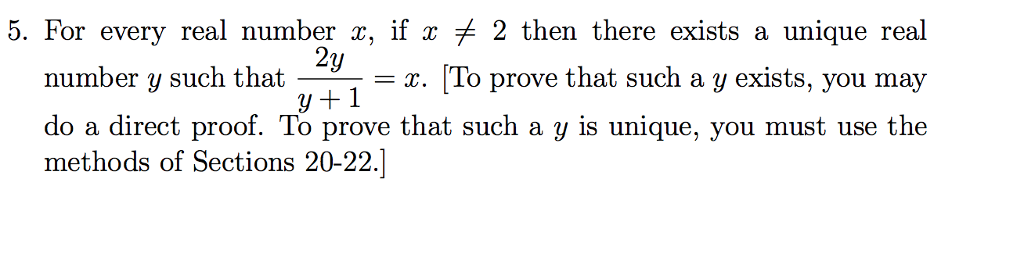

Random question from google actually. Just googled for proving math question examples
I assumed "for all real x's ..., there is a unique y", to mean one-to-one.
harsh condor
I believe that 1-1, means the domain maps to codomain
or something along those lines.
willow bear
yeah no
harsh condor
What does it mean?
that maps distinct elements of its domain to distinct elements of its codomain
So basically any function which has a unique output for every unique input?
Or am i wrong here?
willow bear
you're using the word "unique" sloppily
we say that a function is one-to-one if it never maps two different inputs to the same output. that's one way of putting it which doesn't go into imprecision.
harsh condor
Sure, I guess that works.
What would be a case where "a unique outptu for every unique input" would be incorrect?
willow bear
there's a difference between incorrect and sloppy
harsh condor
I see:
For all real x's where x != 2, there is a unique y where y=-x/(x-2)
The assumption that it is 1-1 is incorrect in this case.
"As two different inputs" could "map to the same output?"
willow bear
no it's not that
the statement just does not say anything about any function being one to one or not
viscid thistle
Where you have to prove that
You must prove y exists then y is unique right?
I think you should take y and y' and find that there are equals
harsh condor
For all real x's where x != 2, there is a unique y where y=-x/(x-2)
I think I have to prove that there is a unique y, for all real x's
willow bear
Right, so I cannot assume it means it is 1-1
not only are you being sloppy again, you seem not to understand my point at all
harsh condor
Sorry, I seem to have missed it, I interpreted that you were saying if "the statement does not say anything about the function being one to one" it cannot be assumed to be one to one.
viscid thistle
Now let's search if y is unique
harsh condor
Sure, how would I search?
viscid thistle
To prove that y is unique cannot you just write that "x/(2-x) have only one image when x=/=2"?
harsh condor
Not entirely sure tbh, it was a random question from the internet:
https://images-ext-1.discordapp.net/external/HziZOpVHsh52_q_WMjlQQf1N0NIpSnkavpW-BGX46LQ/https/d2vlcm61l7u1fs.cloudfront.net/media%252F6a4%252F6a47a432-dd2b-4110-86a4-8426e083c5f8%252FphpE6LmFa.png?width=400&height=102

 viscid thistle
I try a method
harsh condor
And I got up to: y=-x/(x-2)
viscid thistle
-x
Crap I don't find the same value I retry my calcul
I find the same expression
Hmmm
I'm right
I will verify with your expression
harsh condor
I was thinking, if I add a 'a' and 'b', I could try prove for equality.
y = -a/(a - 2) = -b/(b - 2)
implies a = b
harsh condor
probably
 eternal thunder
To prove that y is unique cannot you just write that "x/(2-x) have only one image when x=/=2"?
@viscid thistle you'll have To justify this
eternal thunder
In english please
viscid thistle
Et y1 = x1/(2-x1)
harsh condor
x = 2y/(y+1)
(y+1)x = 2y [multiply both (y+1)]
yx + x = 2y [open brackets on (y+1)]
yx = 2y - x [minus -x on both sides]
yx - 2y = -x [minus 2y on both sides]
y(x-2) = -x [factor out the y]
y = -x/(x-2) [divide (x-2)]
harsh condor
Bonjour!
harsh condor
Noice
So does that mean proving
y = -a/(a - 2)
z = -b/(b - 2)
y = z implies a = b
Should count as proving it?