#precalculus
1 messages · Page 212 of 1
 hard hornet
 vernal spindle
(19pi)/6 and (23pi)/6?
 obsidian monolithBOT
Cytis:
vernal spindle
Do I have to use sin^2x+cos^2x=1 then 2sinxcosx for each one?
hard hornet
NO
YOu already solved for alpha
your solutions are alpha
now just divide them by 2 to get theta
vernal spindle
ohh
hard hornet
you did all the work already
now just take every solution you have, the 4 solutions, and divide them by 2
vernal spindle
would it be 7pi/6 * 2/1
hard hornet
???
literally
take the solutions you gave me
and divide them by 2
since we made the substitution alpha = 2 theta
and to solve for tehta
just divide both sides by 2
so take alph and divide it by 2
vernal spindle
alpha is 7pi/6 right?
hard hornet
alpha are the 4 solutions you gave me
vernal spindle
so thats one of them
hard hornet
ye
 warped dagger
isnt this already simplified enough? sin^2x+cos^2x=1
says to simplify it but it seems simplified enough to me
 oblique thicket
Write 1 = 1 or even 0=0, lol. There's no way to simplify it even further.
 narrow peak
$sin^2x+cos^2x=1$
obsidian monolithBOT
Hmm:
 grizzled totem
If I enter this into my calculator, I get the final answer.
However, I can also do this
and then do
I'll still get the same answer
My question is, will I lose marks for not including the step of converting/simplifying eventhough I get the same answer?
 stuck lark
ask your teacher if they want stuff simplified
grizzled totem
The question doesn't say to do so but the mark scheme does it anyway
I'll ask
Why is there a subtract symbol there?
stuck lark
they've done the laplace expansion of that determinant over the first row
grizzled totem
I found this during research of laplace expansions
I still don't understand why there is a minus and then a plus
 viscid thistle
if i square sin^(1/2x) do the contents of the function sine also get squared?
to 1/4?
 willow bear
sin^(1/2x) doesn't make any sense as stated
obsidian monolithBOT
Ann:
willow bear
it's literally just shorthand for $(\sin(x))^2$
obsidian monolithBOT
Ann:
viscid thistle
oh okay tyvm
stuck lark
say you have a matrix A. we denote $A$'s entry in the $i$th row and the $j$th column as $A_{ij} $
grizzled totem
Furthermore, I'm watching a tutorial video on how to cross product 2 vectors. He includes add and subtraction symbols but the question I have been given just simply states numbers without add or subtraction
obsidian monolithBOT
RokettoJanpu:
stuck lark
if $A$ is a square matrix, we define the $(i,j)$ cofactor of $A$, $C_{ij}$, as
$$C_{ij}=(-1)^{i+j}M_{ij}$$
where $M_{ij}$ is the $(i,j)$ minor of $A$, which is the determinant of the matrix created by deleting the entries in the same row and column as the $(i,j)$ entry of $A$
obsidian monolithBOT
RokettoJanpu:
stuck lark
doing the laplace expansion of $\det(A)$ over the first row of a 3 by 3 matrix $A$, we get
$$\det(A)=C_{11}+C_{12}+C_{13}=M_{11}-M_{12}+M_{13}$$
that's where the negative sign in front of $M_{12}$ is from
obsidian monolithBOT
RokettoJanpu:
grizzled totem
Is this my final answer?
grizzled totem
this?
grizzled totem
willow bear
yes that's better
willow bear
look up "vector algebra" maybe? i'm sure there's plenty of videos out there
grizzled totem
I think it's this
except I don't know what to do with "2w" in the question I'm given, the scenario says "w" is "(-1,1,5)"
so if I have 2w, what is that? 2(-1,1,5) I'm then lost as to how to then proceed with the calculation whilst following that particulor video.
willow bear
if $\mathbf{a} = (x, y, z)$ then $c\mathbf{a} = (cx, cy, cz)$. nothing all that complicated.
obsidian monolithBOT
Ann:
grizzled totem
Is this my final answer?
willow bear
your notation is off
willow bear
yeah
you seem to be mixing the i,j,k notation and the ordered list notation and you're also missing out on some minus signs
which just makes everything go wack
grizzled totem
How would you have done it
willow bear
i mean i would've done what the markscheme did
like
that's how i would've written it more or less
grizzled totem
Is me writing the letters i,j and k irrelevent?
willow bear
...there is no good answer to that
grizzled totem
I'm watching a tutorial on how to solve this type of question
Where did he get that minus symbol from
Is it the laplace expansion thing
grizzled totem
OB is 2,1,-3 in that example
OA is -1.5.2
In this case, he's done AB = - AO + OB
Or we can just say AB = + OB - AO right?
What is that

 grizzled totem
I thought it was an upside down y
grizzled totem
I just watched this video and it didn't even give me a final answer in an equation
My final answer is this
Mark scheme shows this
grizzled totem
I was confused on how the equation was shown, but I get how it was done
 tawny nacelle
those are just different ways of writing the same thing
warped dagger
hi folks, im in need of dire help ```
1+sin(x)/cos(x) / 1+cos(x)/sin(x) = tanx
What do i do there
not sure what to do, multiply or divide sides
willow bear
uh
warped dagger
do you have an idea
tawny nacelle

willow bear
is that meant to be this
warped dagger
indeed
willow bear
the left-hand side is a nested fraction.
do you know how to deal with nested fractions?
warped dagger
i multiplied numerator and denominator by sin(x)/cos(x)
willow bear
not a good idea. you'll still have a nested fraction after doing that.
the thing you'll want to multiply by in order to minimize the work to be done is cos(x)sin(x), so that the inner denominators are cleared
warped dagger
what should i do after that? do i just multiply both sides by 1 and then the 1 in the denominator cancels out or is that just wrong?
willow bear
do what i said first. make the fraction not a nested fraction anymore.
 sleek mirage
ohh
this is what im looking for
Complete the following sentence; make sure to cite the unit circle and what you know about sin.
The function sin is increasing in the open interval from x1 = 0 to x2 = π/2 because
what does this mean i have 3 minutes to answer it
@willow bear can you help please
willow bear
why are you pinging me unprompted :|
sleek mirage
oh my bad am i not supposed to in this server
you are the only person in this chat
who looks like they can help
**Sin is equal to Y, and on a unit circle Y is over 1. On quadrants 1 and 2, the value of Y is positive. The relationship between Sin and the unit circle is that Sin is Y, and so it is positive in quadrants 1 and 2 and negative in 3 and 4. **
sleek mirage
this is what i said
 rigid beacon
i have 3 minutes to answer
sleek mirage
yes
rigid beacon
is this a test?
sleek mirage
ok maybe
rigid beacon
yea sorry no
grizzled totem
Hurry the fuck up, the exam is nearly over 🤣
sleek mirage
😭
grizzled totem
Oh sorry
sleek mirage
1:30 left
willow bear
uh yeah you attempted to cheat in an exam
rigid beacon
👋 no thanks
willow bear
<@&268886789983436800>
rigid beacon
big issue
sleek mirage
is that against the rules too lol
grizzled totem
Say you was joking or you'll be in trouble
sleek mirage
i was joking haha
grizzled totem
You're a funny guy
sleek mirage
its ok ill leave the server
rigid beacon
- Requesting help during an exam a bannable offense.
viscid thistle
no joking with such things
viscid thistle
its ok ill leave the server
@sleek mirage ok let me help you with that
grizzled totem
😦
rigid beacon
you realize that there are institutions that can shut down servers for this kind of thing right?
grizzled totem
He's gone.
rigid beacon
I moderate the AP server and Collegeboard has FULL power to demand that server be shut down for people using it to cheat on the AP test
viscid thistle
nope, I helped him quit the server by giving him a small kick
willow bear
yes
grizzled totem
?
rigid beacon
Ok so I've never seen that notation in a class formally but that R -> R just means it takes a real number and outputs a real number right? and that it's a 1 to 1 thing?
viscid thistle
yep
willow bear
maybe go to khanacademy
grizzled totem
Yes
viscid thistle
but doesn't mean it's a 1 to 1 function
rigid beacon
gotcha
viscid thistle
for example you can write
rigid beacon
but the fact that it says function means 1 to 1 right?
viscid thistle
f: IR -> IR
x -> x²
no we call a function 1 to 1 if for every x and y in its domain, if f(x)=f(y) then x=y
in other words, no two elements from the domain share the same image
rigid beacon
gotcha
but @grizzled totem as an example. Let's say h(x) = x^2 and I told you to find h(2) what would you do?
grizzled totem
I'd replace the x's with 2?
rigid beacon
perfect
warped dagger
1 / sin(x)/sin(x) + cos(x)/sin(x) * cos(x)/sin(x) = tan(x)
I have no clue how to get rid off these fractions
willow bear
have you done what i told you to do or have you gone off in your own direction
willow bear
i told you exactly what to do in clear language
i can repeat it
bolded, italicized and all-capsed
in case you didn't catch it the first time round
warped dagger
ok sure
willow bear
i want you to multiply the numerator and the denominator of the big fraction by cos(x)sin(x), and then to simplify the numerator and the denominator of the big fraction separately so that it is no longer a nested fraction.
warped dagger
i already multiplied it
willow bear
what you should end up with on the LHS after doing this is $\frac{\cos(x)\sin(x) + \sin^2(x)}{\cos(x)\sin(x) + \cos^2(x)}$
obsidian monolithBOT
Ann:
grizzled totem
Is this right
willow bear
no
this is a jumble of symbols that is attempting to say something but failing to do so
grizzled totem
I think I know what you're saying
willow bear
But it is saying that f is -2
and that already doesn't make much sense
like what are you even doing
you have the function f(x) = 4x + 2, and you're trying to calculate f(-2)?
rigid beacon
so 2 things I see wrong:
1: you're not finding f(x) = -2, you're finding f(-2). So that thing in the top right is wrong
2: when you sub in -2
it's 4 times x + 2
4(-2) =/= 4-2
rigid beacon
there you go
rigid beacon
ye
warped dagger
Ann:
@obsidian monolith i have a question, what happened to 1?
was that the pythogorean identity?
thats the only thing confusing me right now
still dont understand how that got there lol
i understand now, wtf
dont wanna tag you, do these just cancel out?
 odd helm
Idk if I’m plugging my graph in wrong or I’m doing my division wrong
But could someone point out where I’m wrong
 modest flare
The graph can be misleading. It crosses the x-axis VERY close to x=-5, but not exactly.
@odd helm
odd helm
Oh ok
So am I supposed to solve this problem with a calculator?
Because Idk how else to do it
 remote veldt
@odd helm it's an application of intermediate value theorem. Check the interval boundaries. if f(x) is continuous, and f(a) and f(b) have opposite signs, f(x) has a zero in [a, b]
 thick stirrup
Hey, I have four questions. I've spent 2 hours trying to figure out the answers to these questions but the resources provided only addresses one step of the overall equation. I really just want the Answers so I can call it a night. Could I get some help?
I need to find the missing cave angle. I know that missing portion of the big rock angle is 122 degrees.
<@&286206848099549185>
warped dagger
trying to solve this, havent been able to figure out how to
 serene heath
solve in what way? @warped dagger
grizzled totem
Does this mean composite functions?
 wind igloo
Yes
 magic abyss
Unless they want you to operate that
magic abyss
If that's the case then 18+2x/x+5
grizzled totem
 patent beacon
Looks like they did simplify it
magic abyss
Wait what
grizzled totem
Ok so I do know how they got to 8+2 (x+5)/x+5 but I have no idea how they then get 2x+18 and the one after that
Literally no idea
patent beacon
What's 2(x + 5)?
grizzled totem
2x + 10?
patent beacon
Go the other way. See how:
2(x + 9) = 2x + 18?
grizzled totem
so it's saying that both of those answers are accepted?
because they mean the same thing
or is 2(x+9) the final answer
patent beacon
I would personally accept the one you posted originally
grizzled totem
Damn, I'd lose so many marks if I just did that according to this mark scheme.
 late pewter
$$
x = 4y + 2
$$
$$
\frac{x + 2}{2} = \frac{4y}{2}
$$
obsidian monolithBOT
Frank:
late pewter
do you see the error
late pewter
yea thats right
you can always check by taking your answer and plugging it into the original equation
grizzled totem
My method is different to the mark scheme though
late pewter
i mean the methods are basically the same, you just switch the variables around at the beginning and they switch the around at the end
grizzled totem
How do I check my answer by taking it and plugging it into the original equation?
late pewter
so if you didnt switch your variables around, your answer would be
x = (y - 2)/4
right
grizzled totem
yes
late pewter
your original equation is y = 4x + 2
grizzled totem
correct
late pewter
take your answer: x = (y - 2)/4
plug it into your original equation: y = 4(y-2)/4 + 2
if you cancel everything out you get y = y
which is correct
but you always have to make sure you use your answer without the variables switched
like how they did it in the answer shown
sure but you cant do that on a test lol
ok then you do you
grizzled totem
I'll learn this method of checking the answer.
What would I search up on youtube to do this type of question?
viscid thistle
revise?
grizzled totem
To do this type of question
stuck lark
"mapping diagram"
odd helm
To get a polynomial with zeroes 2 and 1 I would do (x-2)^2 (x-1) but I’m not sure about the -i
 uncut mulch
conjugate root theorem
 maiden furnace
I just need quick help with this small problem

how do i find the period of this
maiden furnace
and then does anyone have a trick to getting the 5 key points
 vocal cave
How do I solve q1&2?
vocal cave
 fluid shore
Okay, so what have you tried? @vocal cave
vocal cave
willow bear
uh
wow. that is
some real messy handwriting
but also, $a^b \times c^d \neq (ac)^{b+d}$
obsidian monolithBOT
Ann:
fluid shore
@vocal cave Okay the idea here is that you want to try and get $15^x$. Notice that that's just $3^x \cdot 5^x$. So, try to get something like that on one side and bring everything else over to the other side.
obsidian monolithBOT
Abhijeet Vats:
fluid shore
As for the second question, the first thing you should do is to draw a picture. Once you've done that, try to get to the answer on your own and come back here if you have any problems
 harsh cipher
Hello
Question
If the point (5,16) is on the curve y= f(x)
What point is on y= sqrt f(x-2) + 3
fluid shore

willow bear
is that $\sqrt{f(x-2) + 3}$ or $\sqrt{f(x-2)} + 3$
obsidian monolithBOT
Ann:
harsh cipher
Hi
fluid shore
Lmao I feel like we ask them that sort of thing every single time
willow bear
use some goddamn parentheses aight
obsidian monolithBOT
אewb64:
fluid shore
Okay, so what do you actually want to find?
harsh cipher
I need to find what point would be $\sqrt{f(x-2)}+3$
obsidian monolithBOT
אewb64:
willow bear
so $(5, 16)$ is a point on the graph of $y = f(x)$.
this means that $f(\underline{\phantom{33}}) = \underline{\phantom{52}}$.
fill in the blanks here
obsidian monolithBOT
Ann:
willow bear
@harsh cipher
harsh cipher
yea
willow bear
no
willow bear
no
harsh cipher
what am I not understanding?
willow bear
you're not understanding what the graph of a function actually represents
the fact that (5,16) is a point on the graph of f means that when the input to f is 5, the output is 16
harsh cipher
Okay
willow bear
now
obsidian monolithBOT
Ann:
willow bear
fill in the blanks here
harsh cipher
5 , 16?
willow bear
write out the actual equation with the blanks filled in
harsh cipher
f(5) = 16
willow bear
ok great
harsh cipher
thank you
willow bear
so
we have this other graph
y = sqrt(f(x-2)) + 3
and we wanna use the information we're given to find a point on this graph
notice that we're only really given the value of f(5)
harsh cipher
I understand that
willow bear
we don't know the value of f at any point other than 5
so
in $\sqrt{f(x-2)} + 3$, what value is being used as the input to $f$?
obsidian monolithBOT
Ann:
harsh cipher
5
willow bear
no.
we want it to be equal to 5
but in that expression, there is no 5 anywhere to be seen
don't overthink this.
what's being plugged into f here?
harsh cipher
haha okay
willow bear
you see the part of that expression that looks like f(something) right
harsh cipher
f(x)
willow bear
no
harsh cipher
(x-2)
willow bear
f(x-2)
the thing being plugged into f is, shockingly, x-2.
x-2 is being used as the input to f here.
does that make sense to you
don't overthink it
harsh cipher
yes
willow bear
ok
so
since x-2 is the input to f, and 5 is the only input for which we know the output of f
we want x-2 to equal 5
what value of x makes this happen
harsh cipher
x= 7
obsidian monolithBOT
Ann:
harsh cipher
(sqrt 5) + 3
willow bear
no.
what's f(5)?
it's not 5.
f(5) isn't 5.
you know what it is, but it is not 5.
you even said at some point what f(5) is
if you scroll up a bit
willow bear
f(5) is 16
harsh cipher
okay~
harsh cipher
no
willow bear
so... what is the value of $\sqrt{f(x-2)} + 3$ when $x = 7$?
obsidian monolithBOT
Ann:
harsh cipher
I need time wait please.
willow bear
ping me when you're back.
willow bear
bravo
willow bear
are you well-rested, well-fed and well-hydrated
harsh cipher
possibly not well hydrated, but I try to eat healthy
I have sleep apnea so I don't get enough oxgen to my brain as much as I would like to have
@willow bear thank you for the explanation you are awesome!
 whole hearth
$\lim_{x\to3}\frac{\sqrt{x^2-5}-2}{x-3}$
obsidian monolithBOT
mrmola:
whole hearth
how do I solve this?
I think once i get started i can figure out what to do but i don't know how to start
hard hornet
mmmm do you know the definition of a derivative?
wait first of all, do you know what a derivative is?
willow bear
you don't need that here
whole hearth
the extra fun slope thing
hard hornet
oh rly?
hard hornet
aight
willow bear
yes you can just multiply and divide by the conjugate of the num
it's a common trick
hard hornet
conjugate of the numerator
willow bear
multiply and divide by sqrt(x^2-5) + 2
hard hornet
multiplying by the conjugate is a way to get rid of nasty square roots
it's a technique used for solving limits
hard hornet
well, plugging in x = 3 at the moment just yields 0/0, indeterminate form, which means that we have to use some technique to get an actual answer
whole hearth
ooooh
i see
so this isn't a general way to solve it
its just that the problem was made in a way so that multiplying by the conjugates makes the top and bottom cancel
hard hornet
there are a couple ways to solve it, but Ann gave you the easiest one
whole hearth
but like the fact that that worked is because this is a problem designed to be possible to solve that way
what if it is a 6 instead of a 5?
willow bear
like under the root?
hard hornet
problems like these give you a chance to practice your techniques, and being able to see something, and trying it out, so when you're given a problem like the one you mentioned, you stand a chance
willow bear
then you'll get a nonzero number divided by 0 so the limit doesn't exist
hard hornet
wdym
hard hornet
if it works, it works, if not, try something else
whole hearth
if there is no cancelling then it will be undefined?
hard hornet
first of all, you have to check that it's indeterminate form, then try the conjugate
if it's still indeterminate form, rip
try something else
hard hornet
this is a lot of "if" you're talking about, come back when you find a problem like this
whole hearth
i almost certainly won't
vocal cave
I don't know how to do 4aii
whole hearth
ty
hard hornet
how'd you do part ai first
vocal cave
hard hornet
part ii is almost the same, except ittells you that the two roots are numerically equal, but opposite in sign
what does that tell you the relationship between alpha and beta
vocal cave
What does it mean?
hard hornet
idk, what does it mean? you tell me
vocal cave
I don't know
hard hornet
two roots numerically equal, but opposite in sign
vocal cave
Does it mean the root is "3" but isn't -
hard hornet
it means that if one root, was, for example, 3, then the other one is -3
numerically equal, opposite in sign
if it was 6, then the other root is -6
vocal cave
So the root is 3 for 4aii?
hard hornet
if ur root was 100, then the other root is -100
no
i'm telling you what "numerically equal, but opposite in sign" means
set up the relationship between the two roots
vocal cave
I know that, but I don't know how to apply that logic to the question
hard hornet
okay, give me an equation between alpha and beta
vocal cave
a+b= -b/a
hard hornet
there's another one
vocal cave
ab= c/a
vocal cave
o.O
hard hornet
let p and q be roots
p + q = -b/a
pq = c/a
vocal cave
Yes
vocal cave
What is it?
hard hornet
you gotta find it
vocal cave
I don't know
hard hornet
"numerically equal, but opposite in sign"
you can find the equation between p and q with that line
vocal cave
-pq=-c/a?
hard hornet
no
you're overthinking it
if i tell you that two numbers are numerically equal, but opposite in sign, what equation can you construct that gives a relationship between these two numbers?
vocal cave
I don't know
hard hornet
if i tell you two numbers, p and q, are numerically equal, but opposite in sign
what equation can you write about these two variables
it doesn't involve a, b, c
vocal cave
I told you what I know
hard hornet
keep trying, ping me back when you have something
$p + q = \frac{k-3}{4} \
pq = \frac{k+5}{4}$
obsidian monolithBOT
Cytis:
hard hornet
there's one more equation between p and q
@vocal cave figured it out yet?
did he rage quit F
hard hornet
it's an equation
at least you're trying, i'll give it to you
p = -q
that's all
now you should be able to solve for everything
@vocal cave
vocal cave
I only know alpha+beta=-b/a and alpha•beta=c/a. How am I going to get alpha=-beta?
hard hornet
its an equation, its always true for part 2
vocal cave
Uh
hard hornet
you use that to solve for p, q and k
vocal cave
I still don't understand what to do
hard hornet

remember we let p and q be roots
part ii
says
the two roots are numerically equal but opposite in sign
literally means that p = -q
you NEED THIS equation to solve
part ii
vocal cave
Uh
hard hornet
you learned how to solve system of equations before?
vocal cave
Simultaneous equation?
hard hornet
yes
harsh cipher
okay question again
determine the equation of the radical function that has a starting point (1,3) and passes through (-3,5)
Y = ${a}sqrt{x-h}+k$
obsidian monolithBOT
אewb64:
Compile Error! Click the  reaction for details. (You may edit your message)
harsh cipher
oh no
willow bear
$y = a \sqrt{x-h} + k$?
obsidian monolithBOT
Ann:
harsh cipher
naisu
yes
I need to read the manual properly 🙂
If i put in the values for (h,k) and (x,y) I get a negative number inside the sqrt.
vocal cave
yes
@hard hornet
Why do I get so complex roots and the answer is simply k=3?
After I get this what do I do?
 last loom
"Decide the primitive function F(x) to f(x) = 3x+e^x, where x=0 is 8"
I really need help with this one if a kind soul could help
 fleet yew
@last loom a primitive function is an antiderivative
fleet yew
Lol its not a term ive heard before
But you just need to integrate it
And then choose the constant of integration such that F(0)=8
last loom
I don't know, cant make it work. Could you perhaps help me?
Swedish is weird btw, we use some weird words 😉
Especially for math
uncut mulch
$\int 3x + e^x \dd{x} = \ ?$
fleet yew
Its e^x
obsidian monolithBOT
ramonov:
uncut mulch
e=3
fleet yew
Lmao
last loom
Alright, makes sense
fleet yew
$\int 3x + e^x \dd{x} = \int 3x \dd{x} + \int e^x \dd{x}$
obsidian monolithBOT
AMD:
fleet yew
Just practicing my latex
fleet yew
Eh its relevant
fleet yew
K
fleet yew
What is the eq of f(x)
last loom
Isnt it this one?
fleet yew
No from the graph
uncut mulch
don't really need to find the equation of f(x).
what does the integral represent?
last loom
The integral represent the graphs area
fleet yew
Ye
uncut mulch
signed area between curve and x-axis (between x==-2 and 1)
last loom
So the answer should be the area in the graph that the integral says
Yeah, do you know how to calculate it?
signed area between curve and x-axis (between x==-2 and 1)
@uncut mulch
last loom
Whats the basic formula?
uncut mulch
area of triagnle = 1/2 bh
last loom
Oh
Another one like this "Decide the antiderative to f(x) =3⋅ln(2)⋅2^3x, where F(0) =1"
It should be easy but I just cant figure it out
willow bear
consider that your function is $8^x \ln(8)$
obsidian monolithBOT
Ann:
willow bear
...basic exponent and log laws...
3 ln(2) = ln(2^3) = ln(8)
2^(3x) = (2^3)^x = 8^x
willow bear
yes
grizzled totem
Is that how I'd write it in an exam?
willow bear
dunno. ask your teacher if this is acceptable on your exam to make sure
warped dagger
how do i get rid off these
willow bear
well first off sin^2(x)+cos^2(x) should ring some bells
warped dagger
yeah
willow bear
and second, nested fractions. didn't we talk about these before
willow bear
multiply the outer num and denom
warped dagger
alright
willow bear
also consider doing something on the right hand side
obsidian monolithBOT
ιχιση_тαкαgι:
narrow peak
$\frac{tanx-1}{tanx+1}$
willow bear
$\frac{\tan(x) - 1}{\tan(x) + 1}$
narrow peak
meme
i put / wrong way round
$\frac{(\frac{sinx}{cosx}) -(1)}+1}\frac{sinx}{cosx}+1$
obsidian monolithBOT
Hmm:
Compile Error! Click the reaction for details. (You may edit your message)
 analog relic
Ya i know right
narrow peak
fuck this shit
analog relic
$\frac{\frac{sinx}{cosx}-1}{\frac{sinx}{cosx}+1}$
obsidian monolithBOT
ιχιση_тαкαgι:
analog relic
Like this?
Oh but got the ^2
So $\frac{{\frac{sinx}{cosx}-1}^{2}}{{\frac{sinx}{cosx}+1}^{2}}$
obsidian monolithBOT
ιχιση_тαкαgι:
obsidian monolithBOT
ιχιση_тαкαgι:
analog relic
Yay
But i rather expand with the tanx first
Then from the expansion, convert to sinx and cosx
But since we're here, let's expand
So $\frac{\frac{sin^{2}x}{cos^{2}x}-\frac{2sinx}{cosx}+1}{\frac{sin^{2}x}{cos^{2}x}+\frac{2sinx}{cosx}+1}$
obsidian monolithBOT
ιχιση_тαкαgι:
analog relic
Then $\frac{2sinx}{cosx}=\frac{2sinxcosx}{cos^{2}x}$
obsidian monolithBOT
ιχιση_тαкαgι:
analog relic
And $1=\frac{cos^{2}x}{cos^{2}x}$
obsidian monolithBOT
ιχιση_тαкαgι:
analog relic
Can combine the fractions
So $=> \frac{\frac{sin^{2}x-2sinxcosx+cos^{2}x}{cos^{2}}}{\frac{sin^{2}x+2sinxcosx+cos^{2}x}{cos^{2}}}$
obsidian monolithBOT
ιχιση_тαкαgι:
 pale bison
analog relic
pale bison
analog relic
Since denominator is the same, just like $\frac{\frac{a}{x}}{\frac{b}{x}}=\frac{a}{b}$
obsidian monolithBOT
ιχιση_тαкαgι:
analog relic
And $sin^{2}x+cos^{2}x=1$
obsidian monolithBOT
ιχιση_тαкαgι:
analog relic
So => $\frac{1-2sinxcosx}{1+2sinxcosx}$
obsidian monolithBOT
ιχιση_тαкαgι:
analog relic
Then just look at the left hand side
By multiplying $cosxsinx$ to both numbers and denominator on the left hand side, you get
$\frac{1-2sinxcosx}{1+2sinxcosx}$
obsidian monolithBOT
ιχιση_тαкαgι:
grizzled totem
I don't understand the truth table for this
The symbols mean "if mark is NOT good at maths, this means he is NOT good at computing"
Why is the third column true for this? He is good at maths, yet he is bad at computing, therefore the statement "¬r->¬s" should be false
 blazing parrot
he is NOT good at math means he is NOT good at computing
the statement doesnt say anything about if mark is good at math
so the statement holds true
not a -> not b != a -> b
grizzled totem
Why is the one above it false then?
viscid thistle
Draw triangle labeling angles A B and C angles and a b c sides
a=3 b=4 c is unknown
Find c
can anybody help me work this problem?
grizzled totem
and the one right at the bottom
blazing parrot
2nd since r is F then by the statement s is F, but S is T so statement false
last r is T so statement doesnt apply
@grizzled totem
@viscid thistle nope
you dont know that the angle opposite side c is 90 degrees
viscid thistle
but do we assume it?
blazing parrot
not unless they tell you to
viscid thistle
if A is 25 degrees and b = 8
how do i get the third side to find the other variables?
do you know the law of sines and law of cosines?
what is it?
law of sines
now i rememeber
law of cosines
ty
actually
looking at the problem again
yeah it doesnt have another angle
I think you just need to set up a cosine or sine equation
ok
probably cosine using angle A
ok that did not format oof
so would it be cosine of 25' = 8/x
yes
ok that helps me a lot
thankiessssssssss
np
willow bear
are those the only options 
 sturdy haven
Yes my frenj
sturdy haven
you just add or subtract 360 rigjt
viscid thistle
to find sine i would need the hypotenuse
do i use a^2 +b^2 = c^2 or A^2 - B^2 = C^2?
blazing parrot
just remember in the first one c always refers to the side opposite the right angle
blazing parrot
for?
viscid thistle
your answer seems right
sturdy haven
my teacher is so fricken stupid bro wtf
8
She already fucked up two questions on the fucking trig review sheet
sturdy haven
Yes thanks but I mean eight
analog relic
Oh sorry sorry
Wait ah
$sin(theta)=3/4$ so $hypothenuse=sqrt{4^{2}-3^{2}}=sqrt{7}$
obsidian monolithBOT
ιχιση_тαкαgι:
narrow peak
pythagoras
narrow peak
then use that value and divide by 7
narrow peak
,w calculate √(7²+8²)
obsidian monolithBOT
 Requested by Hmm#2554
analog relic
Requested by Hmm#2554
analog relic
$hypotenuse=\sqrt{7^{2}+8^{2}}$
obsidian monolithBOT
ιχιση_тαкαgι:
analog relic
So $cos{theta}=\frac{\sqrt{113}}{7}$
obsidian monolithBOT
ιχιση_тαкαgι:
viscid thistle
$\theta$
obsidian monolithBOT
Silver Hunter:
viscid thistle
for this we put sqr root of 13 as hypo and then put 13 over 2 and flip correct? (for cosecant)
meaning its A right?
cosecant is hypotenuse over opposite
so it should be D
oh
OOHhhhhh
ty
ur a big help
no problem!
glad to help :)
analog relic
Thank you @viscid thistle
grizzled totem
This is contradiction?
If P is not true, P is only true if q is true then it means q is true
 stray ibex
convert -sin(wt+phi) to cosine , can i just put the negative inside?
so: -sin(wt+phi) = sin(wt-phi)?
 elfin birch
ye ty ❤️

so this is just asking me to use the unit circle and write expressions that fit into that range ?
oblique thicket
They're probably asking you to simplify the expression.
elfin birch
how do i know which quadrant this is in ?
would it be Q1 ?
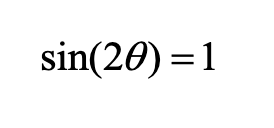
how would i remove 2 from the theta ?
elfin birch
<@&286206848099549185>
oblique thicket
You can use double angle formula and make it $\sin(\theta)\cos(\theta) = 0.5$
obsidian monolithBOT
Dmytr:
viscid thistle
sin(2A)=2sinAcosA
elfin birch
ahh ok
so whats its asking is i need to find angles on the unit circle that correspond to that angle
so i dont need to simplify
i have to get it in terms of sinx = x
so i can look on the unit circle to find angles that correspond
like pi/4 or 5pi/6
 deft fox
 tawny nacelle
well if the product of two things is 0 what can u say about those things
vernal spindle
one is a 0?
tawny nacelle
both actually cuz u dont know which one is 0
vernal spindle
oh so find where cosx=0
tawny nacelle
u have to say either cos(x) = 0 or sin(x) - 1 = 0
tawny nacelle
hmm but if u dont have any restrictions on x, you will get infinitely many solutions
vernal spindle
I think we only do 0 to 2pi
tawny nacelle
yeah so find the x's which lie between 0 and 2pi and also satisfy one of those equations
wait maybe i should rephrase that 
find the solutions for those 2 equations and make sure to only take the x's that lie between 0 to 2pi
and then those r your solutions
 gaunt bay
hello guys, wanted to know if anyone would be able to set a time and get on a call and help me with some of my work (its a hefty amount and it would be easier than posting 50+ question every minute) all the homework is online and i also have a hard time with that too. PM would be fine and i am not expecting someone to do all the work for me. i just need a guide and someone to tell me if i got the answer right or what i did wrong. its early precalc stuff like algebra then going into trig (the class is precalc with trig) PM me if anyone would like to help.
harsh cipher
go through it and post questions you don't understand
Question
Equation of radical function that has starting point (1,3) and passes through the point (-3,5)
Determine the equation*
y= $a sqrt{x-h} + k$
obsidian monolithBOT
אewb64:
Compile Error! Click the reaction for details. (You may edit your message)
harsh cipher
$y = a \sqrt{x-h} + k$?
obsidian monolithBOT
אewb64:
harsh cipher
$y = a \sqrt{x-h} + k$
obsidian monolithBOT
אewb64:
fleet yew
@harsh cipher your starting point always has the coordinates (h,k)
and you only have one other point
so plug the known values in and solve for a
harsh cipher
I got -4 inside the sqrt
I'm guessing but when the starting point passes through (-3,5) it's reflected in the y axis?
I could not solve for the value a
🤣
uncut mulch
was it -3 or 3,
it looked like you posted 3 yesterday
uncut mulch
i guess in that case you'd use:
harsh cipher
I looked at my past notes to see if I did anything incorrect, but the questions ended up being perfect sqrt.
uncut mulch
$y = a \sqrt{h-x} + k$
obsidian monolithBOT
ramonov:
obsidian monolithBOT
אewb64:
obsidian monolithBOT
אewb64:
Compile Error! Click the reaction for details. (You may edit your message)
obsidian monolithBOT
אewb64:
Compile Error! Click the reaction for details. (You may edit your message)
fleet yew
@harsh cipher
Dude its latex
It needs backslashes
Also please change ur name the right alignment is annoying
harsh cipher
okay
analog relic
$\sqrt{x-1}$
obsidian monolithBOT
ιχιση_тαкαgι:
blazing parrot
then ask
harsh cipher
Determine the equations of the asymptote of the fucntion y= (3)/ (2x^2-5x-3)
harsh cipher
in the denominator
blazing parrot
the function would have restrictions when the denominator
blazing parrot
the function would not be defined when the denominator is 0
so when $2x^2 - 5x -3 = 0$ stuff happens
obsidian monolithBOT
Not Chezstick:
harsh cipher
I don't understand
 undone pawn
do you know what an asymptote is?
harsh cipher
no
undone pawn
dont you think you should look it up before trying to solve this question..?
harsh cipher
yes this from the past unit I forgot how to do it. let me look it up
viscid thistle
An asymptote in this instance would be where the denominator is = 0.
(When you divide, it can’t equal x/0 right? So whatever values make the denominator = 0, is where your asymptotes are. Asymptotes are basically lines that aren’t strictly part of the function, but they help you graph it, and I believe that you’re trying to find vertical asymptotes right now.)