#precalculus
1 messages · Page 211 of 1
 vernal spindle
 fleet yew
Which is ?
 proud gate
I have this word problem with two ducks walking away from a spot.
I found how much more one has moved than the other but i cant figure out how to solve how far apart they are from eachother
fleet yew
@proud gate what Is it
 opal shell
if you want the exact displacement you can use pythagoras theorem
proud gate
But i dont know the two sides
opal shell
13-12
=1
8-5=3
and then you get the hypotenuse, which is the displacement from duck 1 to duck 2
 neon garden
Can someone explain how to solve e^(2 + ln3)? I don’t really understand what to do
 remote veldt
@neon garden just so you know, "solve" refers to equations not expressions, ie determining the identity of an unknown. in this case, you're looking to simplify. I'm not letting you know to be a dick, it's just important to use words in a way that people understand.
To simplify e^(2 + ln3), first use the rule that e^(a + b) = e^a * e^b, so you can turn this into
e^2 * e^(ln 3)
You can then use the property that e^(ln (x)) = x
e^2 * e^(ln(3)) = e^2 * 3
So your final answer is 3e^2
 uncut mulch
what are you being asked to do?
 deft fox
 pale bison
what have you tried?
it's useful to start naming stuff first...
let x be the population of bacteria
let h be the hours required
and so on..
@deft fox
 willow bear
let h be the hours required
uh oh stinky
pale bison
well what's wrong with that
willow bear
nvm

 frigid sapphire
hello
can someone help me with a math proof
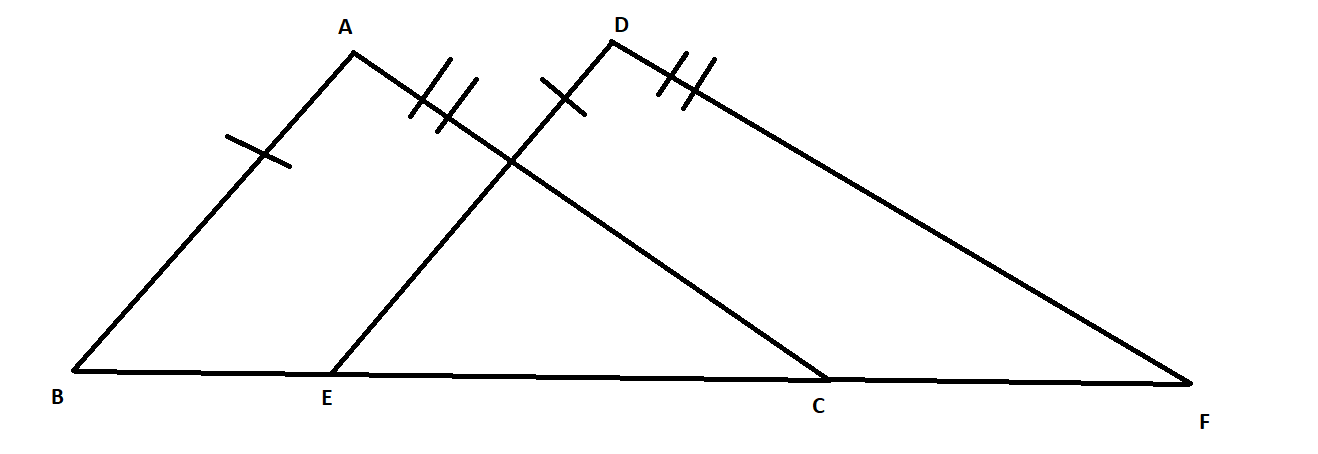
line segment BA is congruent to ED
line segment AC is congruent to DF
line segment BE is congruent to CF
BE = CF (SAP? Reflexive?)
EC = EC (Reflexive?)
BE + EC = EC + CF
is this correct?
 undone pawn
yeah, seems right
 midnight sand
Uh idk if this is considered precalc in US terms because im in canada but for quadratic inequalities, is the y the answer area or is the a(x-p)^2+q (like y > a(x-p)^2+q)
because i'm having trouble on figuring out which way the inequality sign goes when looking at a shaded parabola
 rigid beacon
can you send an actual problem/example cause I can't tell what you mean from your original wording @midnight sand
midnight sand
So you know when graphing a quadratic inequality the answer isn’t a point but a shaded area?
Would the shaded area (the answer) be y when written y > a(x-p)^2+q? Aka vertex form?
rigid beacon
an equality is typically an area
so like
y > x^2 would be an area
it would be the shaded area of all y-values greater than the function x^2
it doesn't have to be vertex form
@midnight sand
 fresh sparrow
((t-7)^2)^2 = (t-7)^4?
fresh sparrow
Thanks. I'm working on a bigger problem. Just making sure. hahaha
fleet yew
👍
fresh sparrow
I had a subtraction mistake lol. It was causing me to subtract instead of having addition.
 sour hemlock
Is this a multiple choice question?
 slate oracle
So my answer was correct, right?
 solar valley
if you picked C yeah
slate oracle
How so?
sour hemlock
sorry wait
well taking the inverse cos of a negative number should also add in a 180
if I remember
so the answer seems to be none of these
slate oracle
uhh what
sour hemlock
y = -3cos(7x)
-y/3 = cos(7x)
acos(-y/3) = 7x
pi - acos(y/3) = 7x
willow bear
the function they're giving doesn't have a true inverse unless you pretend that cos does
sour hemlock
that is true
I assumed it does
in this case
because no assumptions on limits of x and f(x) were given here
slate oracle
What crack is my teacher on.
willow bear
dunno but it checks out, even if you forget about cos not having a true inverse there is no right answer here so mb you should ask your teacher directly what crack they're on
willow bear
none of the answers are correct
sour hemlock
no
willow bear
no
slate oracle
Can you guys show your work. I'm so confused.
sour hemlock
y = -3cos(7x)
-y/3 = cos(7x)
acos(-y/3) = 7x
pi - acos(y/3) = 7x
x = 1/7 (pi - acos(y/3))
willow bear
"find for y" 
willow bear
do you know how to find the inverse of a function
sour hemlock
I just did it with y to make it easier to type here
willow bear
in general
sour hemlock
you can replace y with f(x) and do it again, wouldn't make a difference
sour hemlock
right
everyone has their own personal favorite method
I switch x and y in the end
doesn't make a difference
slate oracle
So, @willow bear , is zimmer's answer correct?
sour hemlock
well I hope so lol
willow bear
yes zimmer's answer seems correct
slate oracle
Thank you so much
I'll be discussing my two supposed "incorrect" answers with my teacher.
 blazing parrot
draw a right angle triangle, remember pythagoras
then set hypo to r i guess'
you can draw a right triangle inside the circle
based on quadrant
i not sure how else
unless you mess around with all the sin^2 + cos^2 identies
wat
 narrow peak
y u delete
blazing parrot
sin theta < 0 what does that tell you about the quadrant of theta
 sturdy haven
It bools me that that means dat it be in da THIRD QUADRANT HOOD
Ir fourth quadrant
But WE KNOW TAN IS NGETIBE
so the at tells me that the cos boi boutta be positive
So we be bein in da fourth quadrant
blazing parrot
yes not how i expected but yes
sturdy haven
Now wat
blazing parrot
you can use this to do the Question
sturdy haven
The fricken frick is the q
blazing parrot
by same methods as the others
sturdy haven
-15/8=sin/cos
IM SOLVIN FOR TWO VARIABLES MAN
Im freakin out
Oh shet
HWO DO I DO
rigid beacon
The trig ratios are ratios
they're ratios of sides of a triangle
so draw out the triangle
sturdy haven
Aight aight aigjt
I drew it dawg
HELP
I HAVE NO IDEA WHAT DO PUT ON IT
I JUST DRAW A TRIANGLE
aaaaa
blazing parrot
what is tan theta
sturdy haven
-15/8
blazing parrot
in terms of the variables
sturdy haven
Y/X
blazing parrot
so we can set Y to -15 and X to 8
blazing parrot
its one of the possible values
sturdy haven
ooo
sturdy haven
17
blazing parrot
whats sin theta
sturdy haven
-15
blazing parrot
um sin theta != Y
sturdy haven
BUT BOY YOU INLY SAID IT IS POSSIBLE VALUE THERE ARE SOOOOLOOO MANY POSSIBEL GALUES
blazing parrot
you seee
all the other possible values are having Y = -c15 and X= c8 for some constant c
so that Y/X = -15/8
than the last side is sqrt((-c15)^2 + (c8)^2) = sqrt(c^2)(17)
= 17c
so -15c/17c = -15/17
the result would be the same
sturdy haven
Wait so I did the other problems with the unit circle
Like when it said give sin i just use puthagoraan identifiy
For other bromblemss
undone pawn
if you are, you're one of the nicer ones i gotta say
blazing parrot
well yes you can
sturdy haven
Okayz thank for help
 grizzled totem
Why is this correct?
BUC means in B or C so I'd shade everything in B or C and \ A means not A and A` means not A
So I'd just do
grizzled totem
Thank you so much
willow bear
not in A' is the same thing as in A
because double negation
$X \setminus A' = X \cap A$
 obsidian monolithBOT
Ann:
grizzled totem
Double negation!
I needed this
Ok so if you double negate it
How do I then go from
to
willow bear
i already said it. $(B \cup C) \setminus A' = (B \cup C) \cap A$
obsidian monolithBOT
Ann:
grizzled totem
ohhhh
(BUC)nA
I still don't understand
Why is (BUC)nA (B or C and A) not this
 fluid shore
The bottom three portions you shaded are in A'
willow bear
the bit at the top isn't in B u C
fluid shore
This is why venn diagrams are a disgusting way of teaching set theory 😩
willow bear
meh they're an okay visual aid imo
grizzled totem
ok so that's A'
i don't even know why I shaded the A
I shade the A because apparently BUC\A' is the same as BUCnA
willow bear
parentheses!!!
 stuck lark
how you can check if the parametrization is ok is to plug x(t) & y(t) into the ellipse eqn and see if what you get is true for all t
 odd helm
How do I determine if the graph is linear or quadratic
odd helm
Alright thanks
stuck lark
two matrices are row equivalent if one can be changed into the other via a series of row operations @winter isle
 winter isle
my answer was 2 for the missing number, is that correct?
stuck lark
sure
stuck lark
yw
 viscid thistle
What is the difference between PCalc and Calc
 lost mesa
pcalc teaches fundamental knowledge that will be used in calc
viscid thistle
Delightful
 carmine elbow
Hi everyone! I am new to this server and need some assistance
I’m using the distance formula for the problem. I got this far, but I’m not sure what to do next.
 late pewter
The question is to just find the distance between the two points?
lost mesa
your distance formula isn't right, unless im seeing smth wrong
late pewter
distance formula seems correct, just parentheses are kind of whack
lost mesa
yea ok
personally, i feel like this isn't a needed step
$2-\frac{3}{2} = \frac{1}{2}$
obsidian monolithBOT
analyst:
lost mesa
we can prove this two ways
fraction subtraction: 4/2 - 3/2 = 1/2
decimals: 2 - 1.5 = .5, or 1/2
uncut mulch
2 * 2/2 = 4/2
carmine elbow
why are you multiplying and not substracting 2 - 3/2?
uncut mulch
that intermediate step was done to get a common denominator
carmine elbow
can you show me that step?
uncut mulch
$2 - \frac32 = 2\cdot\frac22 - \frac32 = \frac42 - \frac32 = \frac{4-3}{2}$
obsidian monolithBOT
ramonov:
carmine elbow
I'm still confused.
late pewter
which step are you confused on
carmine elbow
the multiplication
uncut mulch
to get a common denominator for adding/subtracting fractions
uncut mulch
uh which 2?
late pewter
2 = 2 * 1 = 2 * 2/2
carmine elbow
yes
late pewter
this 2? ^
carmine elbow
yes
uncut mulch
there are 5 2s there...
lost mesa
ah yeah okay, thanks for pointing it out ramonov
carmine elbow
sorry about that
uncut mulch
there are 3 2s now
but wdym why is it there?
late pewter
the left one?
the left one is just there from the distance formula
you wrote it yourself in your work
carmine elbow
the 2 that is multiplied by 2/2
uncut mulch
2- 3/2 was what you originally had. if 1/2 isn't immediately obvious,
you would multiply 2 by 2/2 (i.e. 1) to get a common denominator of 2
do you agree that $2 \times \frac22 = 2 \times 1 = 2$?
obsidian monolithBOT
ramonov:
carmine elbow
yes
uncut mulch
and that $2 \times \frac22 = \frac42$
obsidian monolithBOT
ramonov:
carmine elbow
yes
uncut mulch
and that $2 - \frac32 = 2 \times \frac22 - \frac32 = \frac42 - \frac32$
obsidian monolithBOT
ramonov:
carmine elbow
no
late pewter
$2 - \frac32 = 2 \times 1 - \frac32 = 2 \times \frac22 - \frac32 = \frac42 - \frac32$
obsidian monolithBOT
Frank:
late pewter
does that make sense ^?
lost mesa
yes
uncut mulch
pretty much
late pewter
um that works too
lost mesa
then you subtract the numerators
carmine elbow
Wow, I can't believe it took me that long 🙄
Thank you for being patient! Sorry it took me soo long to figure it out
odd helm
How do I approach this
late pewter
you can find what the boundary of x^2-y^2 < 1 is equal to
then you can pick a point to determine the direction to shade
 dense crater
YES
odd helm
I’m still confused on my question what do you mean by boundary
 spiral beacon
@odd helm i think boundary means the shape
ie. circle, hyperbola, parabola etc
and the "boundary" would be the line of the graph
odd helm
It’s a circle isn’t it? And it has a radius of 1 and the values are less than 1
So idk why my answer was incorrect
lost mesa
lmao np
spiral beacon
ye its minus not addition
viscid thistle
hey!
i have a quick question -- what are the extremas of r^2=64 sin 2theta
These are my answers in (R,theta)
but my teacher isnt approving it
remote veldt
@viscid thistle This is in polar coordinates right? that polar equation isn't a function. It's a relation - it outputs the cricle x^2 + (y + 4)^2 = 4^2
and
x^2 + (y - 4)^2 = 4^2
wait oops is that sin^2(theta) or sin(2theta)
remote veldt
in that case
the r^2 means you have the positive and negative
ie your thing will be symmetric about the x-axis
viscid thistle
Interesting
remote veldt
fuck*
fleet yew
that is a sideways 8
willow bear
express the periods of sin(x/k) and of cot(3kx) in terms of k
spiral beacon
2pik and pi/3k
and 2(pi)k<pi/3k right
my interval of k is (-1/√6, 1/√6)
suggesting that the answer is A
but k cant be 0 so is the answer B?
winter isle
what is the difference between row eschelon form and reduce row echelon form
ping if you answer please
 limber compass
https://cdn.discordapp.com/attachments/238956921581862913/690740098777743401/unknown.png
I got A = 1000000, C = -750, E = 250 (all in mg)
can someone check to see if I am right or wrong?
Because I feel like I am wrong.
 stuck lark
@winter isle
a matrix is in ref if:
all nonzero rows are above all zero rows
each leading entry is to the right of the above row's leading entry
a matrix is in rref if:
it is in ref
each leading entry is a 1
each leading entry is the only nonzero entry in its own column
limber compass
@stuck lark mind helping me later : ) ?
stuck lark
not always
fleet yew
@limber compass what was the question lol
limber compass
https://cdn.discordapp.com/attachments/238956921581862913/690740098777743401/unknown.png
I got A = 1000000, C = -750, E = 250 (all in mg)
can someone check to see if I am right or wrong?
Because I feel like I am wrong.
fleet yew
What was the question
fleet yew
I mean there is nothing to solve for here
limber compass
Ok give me a sec.
Here @fleet yew
thats page 1.
and then the thing I sent above is page 2.
limber compass
@fleet yew Did you end up forming the equations atleast?
I just want to check now if my equations are right or not.
limber compass
damn how are people struggling with this lol. I thought this is like very low level.
lost mesa
i dont think amd can't solve it
i think he just got annoyed
fyi im not gonna do it either im busy
fleet yew
Nah im just done with discord for rn
lost mesa
ah ok my b
limber compass
The real questoin is @lost mesa can you solve it? 🤔
(or help me atleast with forming the equations lol)
I am very desperate sorry.
I am sure I did it wrong because how can I get negative 750 for vitamin C
lost mesa
im hella burnt out rn, going to bed here soon
so na not at the moment
sorry
i found the solution online
or, what i think is the solution
@limber compass
fleet yew
Lmao
grizzled totem
I'm doing sets and my question is regarding power sets
Here is an example question: X = {3,4,5,6} and Y = {2,3,5,7}. Question 1: P(X n Y)
So I need to find out the power set of X n Y
My question is, do I need a "Ø" symbol when doing this?
e.g the answer is {Ø},{3},{5},{3,5}
Or will it be ok to do {},{3},{5},{3,5}
without the symbol
Or is it in this format? {Ø,{3},{5},{3,5}}
willow bear
Here is an example question: X = 3,4,5,6 and Y = 2,3,5,7. Question 1: P(X n Y)
X = {3,4,5,6}
you cannot and should never omit the braces when writing a set like this
grizzled totem
Fixed it
grizzled totem
I'm even seeing answers displayed like this P(XnY) = P ({3,5}) = {{3},{5}, {3,5},Ø}
willow bear
i mean these are sets
the order in which you list the elements of a set doesn't matter
what matters is that you get the elements right
ie include everything that should be included and nothing else
grizzled totem
If my answer doesn't include the "Ø" symbol, will I lose marks?
because that isn't a set
 copper wedge
Yeah
grizzled totem
Like this {},{3},{5},{3,5}
copper wedge
It a set
willow bear
if you're asked "write out the powerset of [blah]" and your answer doesn't contain the empty set as an element
copper wedge
Phi={}
willow bear
then yes you will lose marks bc you're guaranteed to have the wrong answer
grizzled totem
Ah, ok cheers mate
copper wedge
'Yeah it denotes phi
grizzled totem
Will this get me full marks? P(XnY) = P({3,5}) = {{3},{5}, {3,5},Ø}
Or shall I do it your way?
willow bear
you're trying to insist that the empty set symbol and the greek letter phi are the same symbol
which they AREN'T
copper wedge
And u are suggesting the letter x=2
Common
They are used as notations
Dont make a fuss
We all know
They mean something else
grizzled totem
I have a cardinality question, e.g |F n H|
The put the answer for F n H as Ø because it has no values that fit in there
so would the cardinality also be Ø
furthermore, I'm looking at the mark scheme, the answer that was put on there wasn't Ø, it is simply 0
copper wedge
If u are asking about number of element in that set
And if phi is there
Then its also a member
And should be taken into aaccounr
grizzled totem
This is what I mean
So as we can see, it is established that the answer for that is "Ø"
The next question is
Which is the cardinality
grizzled totem
copper wedge
It has no elements
copper wedge
No u cant
0 denotes the number zero
Phi is used to denote a set having no elements
grizzled totem
Ah, I thought it can be used as 0
copper wedge
U cant equate a number with a set.
grizzled totem
btw
Do you know what specific type of vectors this is? So I can research it
Because when I just search for vectors on youtube, I see Graphs
grizzled totem
I don't do physics
copper wedge
Okay then its there in maths as well
copper wedge
This is the geometrical representation of a vector
Join the origin with that point....
 oblique thicket
What do you mean by the type of a vector?
copper wedge
We have vector spaces in maths
grizzled totem
I'm going to revise then attempt and come back
copper wedge
So even 3 may serves as a vector
oblique thicket
Also look up arithmetic vectors, those are what you were given in those tasks.
copper wedge
At the context of the problem
So its necesssary to know the area of study before..u know waht i mean
@oblique thicketyou call them arithmetic vectors
oblique thicket
I don't really know the correct term in english, so I directly translated it.
copper wedge
For us its the very first type of vectors we encounter..with a magnitude and a direction
oblique thicket
Arithmetic vector is an ordered set of numbers for which operations of summation and multiplication on a scalar are defined.
copper wedge
In case you are not from the same country as i am
@oblique thicket yeah..
Similar then
Just a different notation
Thats all
grizzled totem
Is it right?
When you write absolutely it sounds like sarcasm
and yes I'm just using the notepad application
Ok I just used a website that calculates it for me to check my answer was correct
This is what I'm stuck on now
I have the answer 13
and it says "find the angle between the two vectors to two
decimal places; "
But I don't have 2 decimal places
oblique thicket
I think that means you need 2 correct digits after the coma. Like 2,148552... ~= 2,15.
 blissful remnant
would this be no because the 0s are -1 and -3?
oblique thicket
13 is not the angle, it's a dot product. The angle between two vectors is arccos((v,w)/(|v|*|w|).
grizzled totem
Apparently it has something to do with this
oblique thicket
Yep, that's it
grizzled totem
I'll revise it and attempt it
Find V.W and find the angle between the two vectors to two
decimal places;
 = 2(-1) + 0(1) + 3(5)
-------------------------
√2² + 0² + 3² √-1² + 1² + 5²


-2 + 0 + 15                            13
-----------------------    =      ------------
√4+0+9 √-1+1+25                     3.61√25
There still should be square roots in the denominator at the end. And instead of being added, they should be multiplied.
grizzled totem
damn it I don't have a scientific calculator
oblique thicket
Now there's 25 instead of 27. but you've got the idea.
grizzled totem
I have to do cos-1 13 3.61√25
copper wedge
@blissful remnant from gralh 1 annd 3 satisfies...so the faxroes are x-1 amd x-3...
@grizzled totemi dont know that..i said becaise i thkugh u had a calculator
grizzled totem
Yes I found a calculator
I wrote Cos-1( on the calculator
I don't know how to make the (___) appear
copper wedge
Wait wait
grizzled totem
yes I've done cos-1 with the button
I did Shift Cos
to make the cos-1 appear
I'm using casio scientific calculator
copper wedge
Alright
grizzled totem
I didn't manually write cos-1 if that's what you're saying
I don't know how to make the ____ appear
copper wedge
😇
grizzled totem
my answer is 43.927 rounded to 2 is 43.93
I'm going to try to find a calculator online to work this out for me and see if it will give the same answer
copper wedge
Wait wait
copper wedge
Does the ans matches
Oh..may be thats why...because the max value cos inv can spit out is pie (in radian)
U probably converted in degrress
oblique thicket
You've forgot to square -1
oblique thicket
But (-1)^2 = 1 because minus should also be squared.
grizzled totem
oh the brackets
oblique thicket
Yep
oblique thicket
It should've been inside of the second square root in the denominator.
oblique thicket
No, 25 is ok. The -1 here should be (-1)^2, that is 1
And the whole thing then is a square root of 27, not 25
grizzled totem
I don't think I've written (-1)^2 anywhere
I've written it there but not in brackets, the tutorial i watched didn't bracket that
oblique thicket
It should've. You should square the coordinates of the vector and add them, and you just squared the numbers and kept the sign, which is wrong.
grizzled totem
So all of these should've been bracketed ?
oblique thicket
Brackets are necessary only with -1.
oblique thicket
Generally, if you have a power of negative number, put it in brackets.
grizzled totem
and you just squared the numbers and kept the sign, which is wrong.
Shall I square root the 27?
I'm at
oblique thicket
Yep, now take acos of it and you'll get your angle.
grizzled totem
I got 5.20 for square root of 27, now I don't know what to do with the 3.61 and the 5.20
grizzled totem
so if i just put a space between them on the calculator, it multiplies?
I did multiply symbol
I didn't put a space
oblique thicket
It will be multiplied if you put a multiplication sign between them.
oblique thicket
How did you got it?
oblique thicket
Hmm. That's weird.
grizzled totem
I found a calculator online that does it for you
This is what it shows
I don't know where I went wrong
the 13 is correct at the top
Here is the website https://onlinemschool.com/math/assistance/vector/angl/
Angle between vectors calculator. This step-by-step online calculator will help you understand how to find angle between two vectors.
oblique thicket
They've just calculated the cosine of an angle between vectors and got it right, but the task you were given asked for the angle.
grizzled totem
So mine is correct
I think
You're right
Ok I'm going to check the mark scheme now
I don't know why I didn't think of that
I got it wrong
oblique thicket
Weird
oblique thicket
sqrt(27) = sqrt(3 * 3 * 3) = 3*sqrt(3)
Oh, maybe they want the result in radians?
grizzled totem
This is all it says
Here is another calculator I found
Same answer as on mark scheme
oblique thicket
Yep, that's that same angle in radians.
oblique thicket
No, you weren't wrong, you just got your answer in degrees instead of radians, if I understood the situation correctly. Am I missing something?
grizzled totem
I wasn't supposed to square root the 13
I googled that
On calculator it just shows as √13
Even if I try calculate what √13 is on calculator, it just shows as √13 for the answer
oblique thicket
You could've calculated it, but for precision it's much better to leave it to the very end and then calculate it with a few more digits then you need.
grizzled totem
This is what I don't understand
How do you get that from the square root of 27?
This is 27, but the calculator has it as 3√3
oblique thicket
27 = 3 * 3^2 therefor sqrt(27) = sqrt(3 * 3^2) = sqrt(3) * sqrt(3^2) = sqrt(3)*3
grizzled totem
How was I supposed to know that
Ok so we have that solved
Finally
How do I go from
oblique thicket
You were supposed to learn about powers and roots in school.
oblique thicket
Divide 13 by sqrt(13), then multiply numerator and denominator by sqrt(3)
Calculator for sure can calculate the whole thing easily
grizzled totem
Oh wow
my calculator did it
That's why it says calculator is allowed
I finally worked it out
I'm going to move onto the next question
 royal citrus
can someone help me?
neon garden
Can anyone help me with 53?
 upbeat moss
I wanted to ask for assistance with a problem, but here are already 2 waiting.
Dont want to just stack that further.
neon garden
I’m not really sure how to start @serene heath
viscid thistle
Is (-Inf, 0) U (6, Inf) the same domain as
(-Inf, -1] U [7, Inf) ? Wondering if there's more than one way to state a domain
 serene heath
write 1.05 in terms of e @neon garden
oblique thicket
@viscid thistle If your domains are defined over integers - yes.
viscid thistle
ah neat
Thank you!
oblique thicket
Also you can write the same domain as either Z \ [0,6] or Z \ (-1,7). Though in case of integers it's generally better to use closed intervals.
neon garden
@serene heath So now I have f(x) = 1000(0.39e)^x
upbeat moss

I am lost.
I understand how to do synthetic division, but I do not know how to approach this problem
viscid thistle
Find a 0 first
Then you have 1 factor and can divide by this factor
There is a super long formula for 3rd degree, though I'd suggest to try out some obvious choices
upbeat moss
when you say find a 0 first, you mean make x=0? which would basically remove the solo x next to the +10
viscid thistle
$2x^3-7x^2+x+10=0$
obsidian monolithBOT
N/𝔄:
viscid thistle
Solve that
Just try some integers around 0
Most of those exercises don't require you to use the cubic formula
@upbeat moss still there?
viscid thistle
You should try the number after that
oblique thicket
or just -1.
viscid thistle
Works too
uncut mulch
no


 uncut mulch
rational root theorem
viscid thistle
Has he done that?
upbeat moss
never heard of that till now
uncut mulch
sometimes they don't teach you the name
oblique thicket
To be fair, all of the possible rational roots are close to 0 here.
uncut mulch
but not all are necessarily integers
and you shouldn't be testing stuff like +-3 for this question
if you try to apply the "integers close to 0" approach to something like: 12x^3 + 32x^2 + x - 10
then you'd be stuffed
oblique thicket
yeah, I just assumed that it's unlikely someone in precalculus should use rational roots theorem.
upbeat moss
is it below standard?
uncut mulch
i'm pretty sure you should've been taught it if you were given that question
its a relatively simple method instead of "blindly" testing stuff
as for those algebaric mistakes: $2 \cdot 1^3 \neq (2 \cdot 1)^3$
obsidian monolithBOT
ramonov:
upbeat moss
no actually. My professor basically told us just to test numbers.
im looking at this rational root theorem video now, it is simple, but i am 99.9% sure I never seen it in my life
uncut mulch
mmmk. i mean a lot of the time it will involve +-1 (which are possible rational roots in all cases)
upbeat moss
I think I did this Rational Root Theorem right.
got the factors of the constant 10 and the factors of 2 from the 2x^3.
1 did not leave me off with 0, so going to check the remaining numbers (-1, 2,5, 10, 1/2 and 2.5)
ok -1 gave me 0
upbeat moss
sorry for my sloppy handwriting.
I type more than I actually write
I hope I did this correctly
vernal spindle
I'm confused where to start for this type of problem
uncut mulch
determine values of sin x, tan x for x in quad 2
apply double angle identities
vernal spindle
I'm still struggling with it, the part I don't get is what -1/3 equals since it isn't on my trig circle chart
uncut mulch
without solving for x
-1/3 is just -1/3
draw your own triangle to determine the other trig ratios
using something like pythagoras
vernal spindle
a^2+b^2=c^2?
fleet yew
If you double an angle in the second quadrant, what quadrant does it go to
vernal spindle
4th?
uncut mulch
a^2+b^2=c^2
sure
and applying that, if cos(x) = -1/3 and x is in Q2,
determine sin(x) and tan(x)
uncut mulch
no. that isn't even a thing
 pure juniper
It’s sin^2x + cos^2x =1
vernal spindle
would it be, cos^2x-1=sin^2x, then?
pure juniper
-sin^2x
fleet yew
Cosx-1=-versinx
uncut mulch
explain what operations you were attempting to apply (to get what you got)
vernal spindle
I was doing sin^2x+cos^2x=1 then -cos^2x from both sides which was giving me sin^2x=1-cos^2x
pure juniper
Can’t you use sum formulas for this
uncut mulch
need to identify sin(x) and tan(x) first
pure juniper
treat sin(2x) as sin(x+x)
uncut mulch
to make things easier
vernal spindle
would plugging -1/3 make it sin^2x=1-(-1/3)^2 ?
uncut mulch
yes
vernal spindle
so sin^2x=8/9?
uncut mulch
yes
vernal spindle
🥳
uncut mulch
just a small note, you should put parentheses around the (x)
 primal yarrow
Will you reply yes to this question too?
uncut mulch
banana
primal yarrow
Why you gotta do me like that
vernal spindle
is the cos^2x = sin^2x-1
uncut mulch
no
where are you getting that? also going on a detour
from: sin^2(x)=8/9, and x is in Q2
what is the value of sin(x)?
primal yarrow
Dont use "tangent" metaphorically in a math discussion
uncut mulch
lol ok
primal yarrow
Cool
vernal spindle
uncut mulch
well yes, it will be positive, but that's only part of it
vernal spindle
what do you mean?
uncut mulch
what is the value of sin(x)?
vernal spindle
+8/9 ?
uncut mulch
no
vernal spindle
sqrt(8/9)
uncut mulch
yes. can you simplify that a bit
vernal spindle
sqrt(8)/3
uncut mulch
simplify the sqrt(8) further
vernal spindle
2sqrt(2)/3
primal yarrow
Yay
uncut mulch
ok good
primal yarrow
Got nervous lol
uncut mulch
now that you have both sin(x) and cos(x), you can apply the double angle identity to determine
sin(2x)
uncut mulch
$\cos(x) = -\frac13 ; \ \sin(x) = \frac{2\sqrt{2}}{3}$
obsidian monolithBOT
ramonov:
uncut mulch
which can be simplified, i mentioned tan(x) earlier but you don't really need it
sin(x) and cos(x) is used to help determine sin(2x)
cos(x) alone is sufficient to determine cos(2x)
tan(2x) can be determined from your first 2 answers
vernal spindle
2sincosx?
uncut mulch
uh...not quite
vernal spindle
2sinxcosx?
vernal spindle
(-(4sqrt(2))/9)
uncut mulch
parentheses overkill there but that works
fleet yew
((( )))
vernal spindle
also parentheses to make stuff less ambiguous
@uncut mulch
uncut mulch
-4sqrt(2)/9
is sufficient/clear/unambiguous
uncut mulch
if it follows order of operations correctly its fine
vernal spindle
for cos2x would it be 1-2sin^2x
uncut mulch
compared to: 2sinxcosx
99.9999+% of the time it is intended and will be interpreted as 2sin(x)cos(x)
however there is an off chance that someone may have intended something like 2sin(x*cos(x))
cos**(2x)** = 1- 2sin^2**(x)**
will work
uncut mulch
$\sin^2(x) \equiv (\sin(x))^2$
obsidian monolithBOT
ramonov:
vernal spindle
oh so just (2sqrt(2)/3)^2
uncut mulch
for the sin^2(x) part yes
vernal spindle
-17/9
uncut mulch
yes
vernal spindle
now tan2(x)
uncut mulch
tan(2x) NOT tan2(x)
uncut mulch
you could apply that,
however
you already know the values of sin(2x) and cos(2x)
which makes things a lot simpler
vernal spindle
oh so sin(2x)/cos(2x) ?
uncut mulch
yes
uncut mulch
nope
vernal spindle
12sqrt(2)/21 ?
vernal spindle
what do you mean unsimplified?
vernal spindle
ohh 4sqrt(2)/7
uncut mulch
yeh. but i'm still not sure how you didn't reach that directly
viscid thistle
Hey everyone
I've got a question
If the population of X let's say was 2,500,000 in the year 2025, how large will the population be in 2040 if it's at a growth rate at 4%
 patent beacon
I'll do this in millions to keep the numbers small
viscid thistle
The original question was: Researchers found out that the growth rate for the population of the animal is 4% and the population in 2025 was 2,500,000. How large will the population be in 2040?
If that helps.
patent beacon
2.5(1.04)^15
patent beacon
Or, just multiply by 1.04 for every year
viscid thistle
Oh
You just did 40-25
lol
Got it!
So its 2,500,000 times (1.04)^15
right?
@patent beacon
patent beacon
Ya
copper wedge
I think u need to construct a differential equation
viscid thistle
No
 karmic sparrow
vernal spindle
karmic sparrow
vernal spindle
when using A/sina = B=sinb I keep getting stuck when I get to something like 20 = 12/sinx, what do i do next to isolate the x
uncut mulch
A/sina = B=sinb
is that a typo
vernal spindle
Isn't that the formula for getting triangle lengths
uncut mulch
if ur applying the sine rule/law
that second = should've been a /
anyway from 20 = 12/sinx
rearrange it to get
sin(x) = 12/20 = 3/5
then apply inverse trig and be careful of the ambiguous case
vernal spindle
wait i think i did it upside down, sinA/a = sinB/b = sinC/c
uncut mulch
doesn't really matter. its fine either way
odd helm
I followed the steps they gave but I didn’t even come close to the right answer
This is what I plugged into the calculator
odd helm
<@&286206848099549185>
vernal spindle
I'm confused where to start for this problem
uncut mulch
$\sin(\theta) = \frac{\sqrt{2}}{2}$
obsidian monolithBOT
ramonov:
uncut mulch
which is a special ratio
 tawny nacelle

vernal spindle
Is it +-sqrt(2)/2
uncut mulch
no where's the - coming from?
vernal spindle
I was thinking for the sqrt
uncut mulch
sqrt(2) only returns one value
vernal spindle
hmm
uncut mulch
$\sqrt{2}$ is not the same as $\pm\sqrt{2}$
obsidian monolithBOT
ramonov:
vernal spindle
what could I do then?
uncut mulch
$\sin(\theta) = \frac{\sqrt{2}}{2}$
obsidian monolithBOT
ramonov:
uncut mulch
what would be the solution in Q1?
vernal spindle
45 degrees?
uncut mulch
use radians because the question is using radians
vernal spindle
pi/4
uncut mulch
where else is sin positive?
vernal spindle
3pi/4
uncut mulch
not answering my question directly but ok
and that's it
those are your 2 solutions in the interval [0, 2pi)
undone pawn
yes
odd helm
I’m not gonna lie it makes sense why I haven’t gotten help yet but
Idk what I’m doing wrong
I’m following the steps
It says do a+b/2 and I did
But my answer isn’t close to correct
vernal spindle
but the question is that
willow bear
and why are you writing theta as 0 then
nobody will know that you meant theta when you wrote that 0
anyway what is giving you trouble with this equation
vernal spindle
Ohh wait could it be at pi/4 since (sqrt(2)/2)/(sqrt(2)/2) is 1
willow bear
π/4 is a solution indeed.
vernal spindle
I kept looking at 90,180,270,360 trying to figure out how to get the 0 and 1 to become 1
I see it now
willow bear
in the future, please do NOT substitute the symbol 0 for the letter θ
vernal spindle
I'm stuck on this one now, since its 2x i can't simply look at a pi circle
willow bear
have you ever solved trigonometric equations on the entire number line yet
vernal spindle
I don't think so
vernal spindle
How can I do it though?
 hard hornet
let $\alpha = 2\theta$
obsidian monolithBOT
Cytis:
obsidian monolithBOT
Cytis:
vernal spindle
like sinx=-1/2 ?
hard hornet
yes
exactly, solve that
there are going to be an infinite number of solutions, but you can just give me the first four solutions starting at 0
vernal spindle
(7pi)/6, (11pi)/6 ?