#precalculus
1 messages · Page 206 of 1
 fleet yew
fleet yew
fleet yew
You good now?
fleet yew
Lol your teacher dumb
She calls "standard form" what everyone else calls vertex form
So you didnt even need to do all that expanding
 uncut mulch
depends on where you are
 sharp marsh
my brain hurty
fleet yew
What country you in
fleet yew
No
sharp marsh
oh
fleet yew
Im american
I do not call that standard form
I thought you were from some uncivilized country like britain that called things different from us
sharp marsh
oh
I mean US uses feet and lb cause we special like that
So I just assumed we pulled something weird again
sharp marsh
LOL
fleet yew
Just curious lol
sharp marsh
ho
damn
just ask me for my social security already
and my credit card number why don't you
also last 3 digits
sharp marsh
Not even wanting to know things about me :(((
I see how it is
Just take my money like those giRls lAst nIght
fleet yew
What sort of girls are you hanging out with that just take your money
You're getting played son
sharp marsh
Noted
I have a story not about these imaginary girls but something else
I'll tell in general
 gilded mirage
Does everything look ok
 willow bear
what's that last line
gilded mirage
Top or bottom
gilded mirage
Oh no it’s just log base a of b
willow bear
no on the rhs
willow bear
...so you wrote "1 + log_a(b) = 1 + log_a(b)"
gilded mirage
Yea
willow bear
anyway are you sure you copied the thing to be proved correctly bc as written $\frac{\log_a(x)}{\log_{ab}(x)} = 1 + \log_a(b)$ does not appear to be true
 obsidian monolithBOT
Ann:
gilded mirage
Yea that was the problem
willow bear
let me just real quick make sure i'm not screwing up
fleet yew
Untrue statement
gilded mirage
Really
fleet yew
Yeah
gilded mirage
If the a and b on the rhs was switched would it be true
willow bear
gimme a sec.
 stuck lark
seems true for values of a,b,x that make sense to plug in
gilded mirage
I just had to do the reverse of change of base right
 stuck lark
my ONLY nitpick is that your work lacks 
gilded mirage
oh yea I just fixed that
fleet yew
You're missing a few steps on your page that tripped me up
stuck lark
you kinda glossed over applying change of base but it's whatever
gilded mirage
do you guys have any tips on like doing problems like these
most of the time I don't know what to manipulate first
willow bear
a general rule of thumb is start with the side that looks more complicated
not a hard and fast rule by any means but it's easier to simplify than to complexify
fleet yew
Try random bullshit till something works
gilded mirage
i mean my teacher gave us strategies but thats all she really told us
like log properties, manipulating fractions with 1
fleet yew
Just be smart and see patterns
stuck lark
easier said than done
gilded mirage
wish I could be smart
fleet yew
Its not something that can really be taught
Thats why IQ tests are all patterns and shit
fleet yew
Sure
fleet yew
Except with integration
stuck lark
integration needs practice too 
fleet yew
i mean sure it does but it doesn't help much
stuck lark
you seem like you're speaking from your own experience which doesn't say anything about others
stuck lark
gotcha you're just meming
fleet yew
only a little bit
 pale bison
Just be smart and see patterns
thanks man i'm going to solve RH
stuck lark
glhf
 valid violet
I'll never be able to do integrals like the arccot(sqrt(golden ratio)) one so why try at all

Mathematics Stack Exchange
I need help with this integral:
$$I=\int_{-1}^1\frac1x\sqrt{\frac{1+x}{1-x}}\ln\left(\frac{2,x^2+2,x+1}{2,x^2-2,x+1}\right)\ \mathrm dx.$$
The integrand graph looks like this:
$\hspace{1in}$
...
 formal dome
I get the english definition of slope of tangent that if we want to find slope at point P and PQ is a secant line then slope of tangent is slope of PQ as Q tends to P where P remains fixed and Q is variable
But i don't get the mathematical definition. How is the slope of tangent equal to that equation on the right in above picture? If lim ∆x -> 0 happens then according to me, PQ should become a vertical line, because its not travelling in x at all
@serene heath? @viscid thistle? @mystic coyote ?
pale bison
nice pings
 viscid thistle
No because even if it is a curve the limit is saying that when the height and width of that curve approach an infintesimally small value close to 0 the curve will become a straight line and u can use the definition of the gradient
formal dome
@pale bison they're my friends.. it's okay, they don't mind my pings
 formal dome
@viscid thistle does ∆x approaching 0 imply that ∆f is approaching 0 too?
Ok that seems to point to that English definition. If ∆f and ∆x become zero that Q becomes P. But then it'll just become a point. How does a point have gradient? 
 serene heath
I have no idea who this person is
 warped ether
good god
formal dome
Ayyy explain please @warped ether
Or let me back into the server. I really need it for this online course😩
And will need it for when uni restarts too
Orrr someone else may help me too, I won't mind :harold:
pale bison
this does become 0/0
but you need to look at it geometrically
now, consider a smaller delta X
now, if you use the power of imagination, imagine as delta x approach 0
remember that, at no point are you setting delta x = 0!
then, you'll obtain the slope of this purple tangent line
@formal dome i hope this helps
formal dome
Why is it that when the circled term is expanded, only first two terms are written and then O(∆x)^2 is written instead of more terms?
And O(∆x)^2 means that its a sequence with powers of ∆x from two onwards and some constant, like a0∆x^2, a1∆x^3, a2∆x^4,..... right?
(ping me if you answer)
pale bison
you don't have to worry about that big O notation, what is important is the expansion of (x + delta x)^n
look up binomial theorem
@formal dome
 fluid shore
Lmao he even says in the video that it's precisely because those are the terms that go to 0 when you actually evaluate the limit.
formal dome
you don't have to worry about that big O notation, what is important is the expansion of (x + delta x)^n
look up binomial theorem
@formal dome
Oh ik about binomial expansion. I was just wondering that why he didn't write more terms. And Abhijeet's answer was good enough, that they become 0 when limit is evaluated
And
O(∆x)^2means that its a sequence with powers of ∆x from two onwards and some constant, likea0∆x^2, a1∆x^3, a2∆x^4,.....right?
Ps, is my understanding of O((∆x)^2) correct? It's the first time ive heard this term
 remote veldt
@formal dome Saying $f(x) \in O(g(x))$ or $f(x)$ is $O(g(x))$ means that (informally)
$$\lim f(x) \leq \lim Mg(x)$$ for some fixed constant M. Usually, the limit is to infinity, but sometimes we consider the limit to some other number (like 0). $f(x)$ and $g(x)$ don't need to be polynomials - they can be arbitrary function
obsidian monolithBOT
Nicholas:

 remote veldt
@formal dome basically, in this case, x^2 + x^4 + x^6... as x approaches zero is affected mostly by x^2. Like, x^4, x^6 etc. go to 0 way more quickly
formal dome
Ohh yeah kind of makes sense
Ok i get that limit of O((∆x)^2) would be zero but in example of binomial theorem, O((∆x)^2) represents term with (∆x)^2 onwards, right?
remote veldt
the formal definition of towards infinity would be "you can select an x_0 such that f(x) <= Mg(x) for every x > x_0" - like, once you go beyond a point, f(x) is smaller than Mg(x). In this case, you're exactly right about what it represents
since we're going towards zero
you can basically say "oh ok so x^2 + x^4 + x^6 is dominated by x^2 so we'll gorup all these terms"
formal dome
Ok i get that limit of O((∆x)^2) would be zero but in example of binomial theorem, O((∆x)^2) represents term with (∆x)^2 onwards, right?
Then the powers increase, like (∆x)^3, (∆x)^4 and so on
you can basically say "oh ok so x^2 + x^4 + x^6 is dominated by x^2 so we'll gorup all these terms"
Ahhh this was good
Thanks a lot :'))
stuck lark
$\trig$
obsidian monolithBOT
RokettoJanpu:
 warped jungle
i have those but i feel like i did something wrong in my steps
stuck lark
Post
serene heath
malone
stuck lark
Show steps
warped jungle
 lucid plume
cosine is an even function
obsidian monolithBOT
RokettoJanpu:
stuck lark
ye
https://i.gyazo.com/aed804cd8fa1a853488bcb5c0f2f4669.png this isn't true either but w/e
 stuck lark
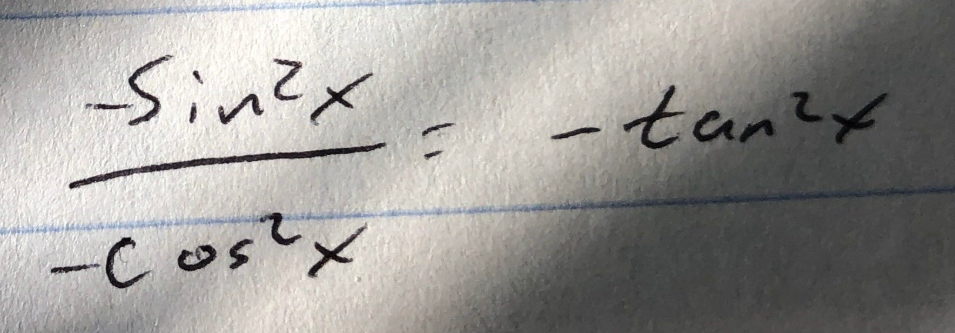
if you look at my sheet we have $\sin^2(x)+\cos^2(x)\equiv1$ so whaddya think?
obsidian monolithBOT
RokettoJanpu:
uncut mulch
it probably didn't like the unnecessary characters
wait
why do you have a y= in there
sharp marsh
wait
idk
i'm dumb
fasdfssdf
Speaking of which
If y = k and x = 11
Then like what is y and x when it's in the other form
sharp marsh
Is this right?
 forest kiln
omg it's ok i figured it out
could u double check my function for the graph though?
i got y=3sin1/2pi(x+pi)
idk it doesnt seem right tho
fleet yew
I would use cosine
forest kiln
can i ask why
fleet yew
It simplifies the equation quitea bit
The cosine function starts at its maximum
And so does this
So you dont have to worry about horizontal shifts
sharp marsh
um
When it's touching X axis
and Y = 0
@fleet yew
So like for 0= (x+6)^2- 81
What do I do?
To get 2 x intercepts
valid violet
If you want to make it harder that's a good strategy
sharp marsh
What's the easier way 
 clever inlet
Why?
sharp marsh
I'm lost
obsidian monolithBOT
gfauxpas:
valid violet
How would you solve for z
valid violet
$z^4 -32z^2+16^2=0$
obsidian monolithBOT
gfauxpas:
valid violet
Now what
valid violet
Show me what you mean
sharp marsh
Wait can I square root -16 or no?
valid violet

sharp marsh
wait my brain
valid violet
$z^2-16=0$ you need to know how to solve this before doing a more complicated case
obsidian monolithBOT
gfauxpas:
obsidian monolithBOT
gfauxpas:
sharp marsh
uh
i think
but like
Just the z^2
wait
o
Do you just move 16 over
and square root it?
If you square root it
Why do you have to square root the z^2 and the -16
Cause when you move the number over you just add that specific number
the opposite of it
or like
uh
ik but I'm saying
why when you square root something
you do it to the whole problem
And not the one thing
valid violet
@broken light no factoring, we're preparing him to do the case (x+3/2)^2-2=0
valid violet
I dunno, I'm just here for free snacks
sharp marsh
lmao
wait
my brain just expanded
cause square rooty 81
u can do -9
Wait so for f(x) = -1 (x+2)^2 + 5
Did I get the X intercept wrong?
clever inlet
It looks reasonable
sharp marsh
Apparently one of the X intercepts
Is
(square root of 5) - 2
Isn't that the same as -2 + ( square root of 5 though) .-.
clever inlet
Yes
 livid umbra
Square root of 5 minus 2 is not the same thing as -2 times the square root of 5
livid umbra
yeah thats right
 ebon raptor
sharp marsh
ebon raptor
sharp marsh
Thanks
 vernal spindle
If sin(t)=3/8 and t is in the 2nd quadrant how can i find cos(t)
 merry sphinx
You can draw a triangle to figure it out
Also, cause t is in the 2nd quadrant, what do you know about cos
vernal spindle
It's negative?
vernal spindle
I would use sinx+cosx=1 right
merry sphinx
No
You are overthinking this
Also, incorrect identity
sin^2(x) +cos^2(x) = 1
(which is not needed here btw)
Sin(x) is the ratio of what 2 sides
vernal spindle
opp/hyp
merry sphinx
Cos(x) is what ratio
vernal spindle
ajd/hyp
merry sphinx
I encourage you to draw an arbitrary right triangle and label the sides you know
vernal spindle
dumb question, how do i know which is the adj, hyp, and opp, i keep mixing them all up
merry sphinx
Ignore the bad drawing but this is basic diagram
So the hypotenuse is always the longest side of a right triangle
fluid shore
Just eat triangular pizzas and you’ll be able to memorize it
merry sphinx
The opposite side is the side opposite of the angle (in this case x)
Adj is always the side "next" to the angle that is not the hypotenuse
vernal spindle
which one is "the angle", it's which ever one im currently finding?
merry sphinx
Doesn't matter as long as you label sides correctly
You should learn about the unit circle if you have not already
fluid shore
Dude you might as well eat a pizza if you’re gonna learn about the unit circle
fleet yew
It has to have a radius of 1 meter tho
vernal spindle
I'm learning the circle right now, just struggling to understand it for some reason
vernal spindle
I don't mean the circle itself just all the angles and sides and formulas
merry sphinx
Yo STFU amd
fleet yew
Dude its just trig
merry sphinx
People struggle with this and this degrading does not help
fleet yew
No im actually genuinely asking what he finds so difficult
Usually when people say that it means that theres something important they're missing about the concept
fluid shore
@vernal spindle The first thing you do
is to forget about memorizing any formulas
Don’t even think about memory work here
fleet yew
^
fluid shore
Get a good book that will bring you through the derivations of each of the most prominent results
Then, do some hard problems to get yourself accustomed to using those results.
vernal spindle
I got this so far
fluid shore
Draw a picture of the situation
willow bear
,rccw
obsidian monolithBOT
fluid shore
Eyy haii ann
vernal spindle
I drew it wrong?
fluid shore
No. You didn’t draw a diagram of the situation.
vernal spindle
so just a mirror of the triangle to the left?
vernal spindle
What do you mean the context
fluid shore
Well, what is the term ‘2nd quadrant’ referring to?
vernal spindle
the -cos,+sin section of the circle?
fleet yew
It doesn't make sense for it to be on unit circle because the radius isn't 1. It probably means cartesian coordinates
vernal spindle
Not second quadrant like this?
vernal spindle
That's what I'm trying to figure out how to calculate right now
vernal spindle
3/8+cos^2(t)=1 ?
fleet yew
sin^2(t) means sin(t)*sin(t)
Its probably easier to do from the triangle lol
Because integers
Just do normal pythag
willow bear
sin**^2**(t) + cos^2(t) = 1
(3/8)^2 is not the same as 3/8
@fleet yew the triangle does not show the quadrant that the angle is in
fleet yew
Doesnt really matter because t itself doesnt matter. Just make sure the signs are right
vernal spindle
I need to square 3/8 ?
willow bear
if sin(t) = 3/8 then what do you think sin^2(t) could possibly be if not (3/8)^2?
 harsh cipher
Hi, Ann
willow bear
either you or kingbluesapphire will have to move
willow bear
harsh cipher
exact location
harsh cipher
okay
vernal spindle
Ok so sin^2(t)+cos^2(t)=1
willow bear
yes
you know the value of sin(t), so you can isolate cos^2(t) and then find cos(t) by taking into account the quadrant that t is in
vernal spindle
I don't square 3/8 when replacing it for sin^2(t) right
I did 3/8-cos^2(t)=1
-3/8 from both sides
cos^2(t)=.625
sqrt(cos^2(t))=sqrt(.625)
= .791
but i dont think thats right
vernal spindle
So .927?
vernal spindle
How do I choose which is a, b, c, from opp, adj, and hyd?
fleet yew
no those were just arbitrary numbers
what i just said there had nothing specifically to do with triangles, it's just an algebraic rule
basically (some number/some other number)^2=(some number^2)/(some other number^2)
in math we often use letters of the alphabet to represent "some number"
vernal spindle
Oh so just leave it as a faction without actually dividing it?
fleet yew
no lol
read what i just said
how do you simplify (3/8)^2 if you know that (a/b)^2=(a^2/b^2)
where a and b are just some numbers
any numbers
vernal spindle
You mean like (3/8)^2 to 9/64
fleet yew
yes
vernal spindle
then 1-9/64 which is 55/64?
uncut mulch
you don't need arccos
fleet yew
yeah mb said the wrong thing
uncut mulch
cos^2(t) = 55/64
vernal spindle
then cos(t)=sqrt(55)/8 ?
uncut mulch
well when applying the sqrt it would be cos(t) = ±sqrt(55)/8
then take the one with the correct sign based on the quadrant
uncut mulch
yep
vernal spindle
I'm done
 copper vigil
k thx
how do i use the limit definiton of the derivative to find the derivative of x
i mean ik it's 1 but i'm kinda stuck
uncut mulch
do you know the limit definition?
copper vigil
uh
lim as h approches 0 of (f(x+h)-f(x)/h)
right?
what is h though
that part kind of confuses me
copper vigil
but i thought x was the variable
 plush heron
they're both variables. When you're finding the limit as h approaches 0 you're finding an infinitely small difference between f(x+h) and f(x), the derivative
willow bear
besides maybe an arbitrary number that is close to zero but is not zero
copper vigil
i remember my teacher saying it had something to do with slope formula or something
but what does this have to do with deltay/deltax
willow bear
this is Δy/Δx that you're talking the limit of.
copper vigil
?
copper vigil
ok i think i sort of get it. so you have to find the slope of the tangent over a really small distance
h
so it's asking what happens as h get's small
but a straight line like y=x doesn't really have a tangent?
plush heron
What other possibility could it be?
copper vigil
but tangent only touches at one point right?
like the tangent of a circle
a line touches itself like a lot
plush heron
The derivative is about the slope of the tangent line, not the actual line
copper vigil
ok but what is the tangent line
plush heron
Just an arbitrary line tangent to the curve
copper vigil
but x can't be tangent to x
plush heron
you're overthinking this tangent thing
plush heron
The derivative is not the same thing as a tangent line. Instead, the derivative is a tool for measuring the slope of the tangent line at any particular point
copper vigil
ok
ooh
just realized something
the tangent line can actually pass through the curve multiple times right?
but its behavior only matters close to that specific point
like a cubic
that does the curvy thing
not all cubics do that but
@plush heron
right?
<@&286206848099549185>
im still kinda stuck
guess the americans are sleeping
 jolly silo
Yes
 runic tapir
Yes
 sour plinth
well i guess im not american so i can't answer this question so i shall leave it to the americans
 left lance
what's this definition of a derivative? can someone explain?
i've learnt this
ive understood the bottom one
is it same as the above one?
fleet yew
Yeah
left lance
what is that first onee 😩
fleet yew
The same thing
left lance
ik but...
fleet yew
But what
left lance
is it derived the same way? deltaf/deltax?
fleet yew
Yea
left lance
o i think i see it now
fleet yew
Uh huh
 rigid beacon
They are not the same thing what
@left lance the black picture you sent will give you the derivative at x = a only
The pink picture will give you a generalized function that you can use to find the derivative at every point on the function
 odd helm
How would I find HA for this?
odd helm
Oh that might have been it I guess
How would I figure out oblique when I’m only given the graph?
fleet yew
@odd helm oblique asymptote is the slanted line
That the function never touches as it approaches +-infinity
 prime yoke
how do u do this thing
how do u find K
and how is finding the equation of cosine diff from sine
vernal spindle
Which formula do I use to calculate a side if i have 1 side and all 3 angles in a triangle
 empty fulcrum
Law of Sines
But think about why that is for a sec
vernal spindle
Is it since cos^2+sin^2=1
empty fulcrum
Nope, the idea is you only want to have to solve for one variable
Notice how the law of cosines requires two "legs" and an angle, whereas law of sines needs only two angles and a leg
vernal spindle
this?
vernal spindle
I don't think so
empty fulcrum
Oh nvm then
It's a similar formula that can be used to solve for different sides/angles depending on whatcha want
For now just stick to the law of sines
empty fulcrum
Yeye
You can get angle B pretty easily, so just do some algebra and solve for b
Then plug and chug
vernal spindle
9/90=b/79 ?
empty fulcrum
Not quite
sine of those angles
The sine of 90 degrees isn't 90, it's 1
You'll have to use your calculator for 79
vernal spindle
Why when I put sin(90 in a calc i got .893
empty fulcrum
Are you in radians mode
empty fulcrum
Yes
Take a step back and think about it when stuff like that happens
For instance, you should have sin(90) memorized, so if you get something like that out it should tip you off that something's wrong
vernal spindle
Should I leave it in degrees or will I need radians for anything with triangles
empty fulcrum
Depends on the question
In this case angles are in terms of degrees
Mostly you'll need rads though
empty fulcrum
Good job!
Yeah it's a fun one
You'll learn some more about it soonish, I assume you juuuust started with it
vernal spindle
My problem is remembering all these formulas for tests
odd helm
Wouldn’t you take the sqrt of 1/4 on the last step but instead he said that -1/4 < x < 1/4 what happens to the x^2 why does it just become x?
 rigid dune
What the madness is that
What the madness is that
What the madness is that
Discord be glitching me out
 small kayak
does anyone know how to add vectors that arent on a plane
 lethal oracle
 dim jungle
harsh cipher
dim jungle
harsh cipher
I feel so dumb because I finished the lesson and didn't have problems but when I get to the assignment
 harsh cipher
Hi Ann!
empty fulcrum
Multiply the whoooole mess by cosine
 fiery wave
1/cosx x cosx = 1
willow bear

 jovial horizon
@willow bear what do we use instead of x for multiplication
willow bear
jovial horizon
epic
 runic blade
Limits is precalculus right?
Can someone check pls. I'm getting k to be infinity
Are you getting it as infinity as well?
 fading token
Did you just delete the messages just to type them again
fading token

runic blade

fading token
Anyhow you can literally plug in x = pi/2 in that expression
fluid shore
No
runic blade
What
fluid shore
It just means that, apparently, $k \cdot 0 = 3$, which is false for all $k \in \bR$.
obsidian monolithBOT
Abhijeet Vats:
fluid shore
There's no further information given about k
fading token
I don't think that's the entire question
fluid shore
Well, then there seems to be a problem there
runic blade
Maybe the denominator was supposed to be 90-x?
fluid shore
Like i said, k.0 = 3 is just false for all k belonging to R.
Why would it be 90 radians - x?
fading token
I think they meant 90 degrees
runic blade
90 degrees 
fluid shore
I know lol, i'm just messing around
Stick to the units being used for angle measure in the question
 fading token
I think the FULL question is determine the value of k such that f is continuous everywhere?
I wouldn't be able to make sense out of it otherwise
runic blade
@fading token f is continuous everywhere if it is continuous at that point anyways
fluid shore
Riji was just clarifying that that's what the question was
willow bear
f is guaranteed to be discontinuous at pi/2 no matter what
fluid shore
Well, okay, they're sorta kinda implying it
fading token

runic blade
They say it inside the brace thing
Whatever it is called
I mean after the definition of f(x) not inside the brace
By the way. Why do we only put one brace? Why not two braces?
willow bear
the fact that it's said inside the brace thing like like bad typesetting
but the brace thing and the fact that it's a single brace is just... that's how the notation is defined?
 full garden
hey guys I have a small question
h(x)=mx2+2 , evaluate h(−3a+1)
am i doing this properly
because I never saw this a^2m before
 modern kettle
$-6am+m\neq -5am$
obsidian monolithBOT
ChrisIntegral:
modern kettle
in general
modern kettle
👌
viscid thistle
I'm so confused but, I'll put this here in hopes someone can explain.
Given an inequality like:
(2x+1)/(x-3)<4
Why is it necessary to consider both cases for when x-3>0 and x-3<0?
Why is it when I consider the case when x<3, (when the denominator is negative), that I get a result like x<13/2. I try to use 4, which is less than 13/2, but it doesn't work. Why?
It seems to only work when x>13/2 or x<3. But Shouldn't 4 work if it is less than 13/2? But then it clearly doesn't, which is the source of my confusion.
vernal spindle
I'm confused on how to start this problem
vernal spindle
wait do I just plugin 5pi/6 for x?
 vernal moon
vernal spindle
vernal moon
vernal spindle
I got sin(5pi/3)
stuck lark
evaluate that
vernal spindle
sin(300)
vernal spindle
I am trying to calculate a missing angle in a triangle with 12.53/1 = 6/sinb but I'm stuck what to do next to isolate b
vernal spindle
1/12.53 = sinb/6 ?
vernal spindle
Didn't know you could do that
clever inlet
You're just taking the reciprocal of both sides
vernal spindle
I got sinb=.47885
vernal spindle
I used a program to get the answers and none show .47885 so i did something wrong
vernal spindle
Ohh sin^-1
willow bear
do not confuse an angle with its sine
vernal spindle
in 5=b/(sqrt(3)/2) do i just multiply both sides by sqrt(3)/2 or do i flip it to 2/sqrt(3)
willow bear
you can do whatever you want so long as you do not mess up in doing it
you can multiply both sides by sqrt(3)/2, or you can multiply both sides by 2/sqrt(3), or by 4647/3222245, or by 7π+1
 proud jetty
need sum help with composite function

what happens after f(2)? why is final answer 3?
proud jetty
what happens to g(3)=2. Its inside the bracket.
 long tartan
you're taking f(g(3))
imagine g(3)=x
so it's like f(x)
but since g(3)=2 x=2
so it's f(2)
makes sense
proud jetty
yea but why is second one zero?
long tartan
np
full garden
guys can someone please tell me what like finding the reference is going to make us accomplish or like what other information would it help us obtain ?
remote veldt
@full garden do you mean finding the reference angle, like in a trig context?
full garden
sorry bro yes
like finding it was kinda easy but I don't really understand why we find it
like for coterminal makes sense
but refrence angle I kinda don't know why we use it
remote veldt
ok. The reference angle gives you the magnitude of whatever trig function. So, the reference angle tells you the angle with the x-axis. Remember, sin is opposite/hypotenuse, cos is adjacent/hypotenuse, tan is opposite/adjacent. The angle your triangle makes with the x-axis determines the ratios of the side lengths
like here, the red triangle and the blue triangle are in different quadrants, but would have the same reference angle
(excuse the shitty paint)
full garden
bruh what do you mean love you for this amazing explanation bro
bro but does that mean the like the cos and the sin will be the same
no? right
remote veldt
no, but they'll be same magnitude
full garden
I think only tan is + in third
remote veldt
yes! only tan is + in the third
that's exactly what you use the CAST rule for
the reference angle tells you how big cos/sin/tan are
the quadrant tells you the sign
full garden
thank you


 patent beacon
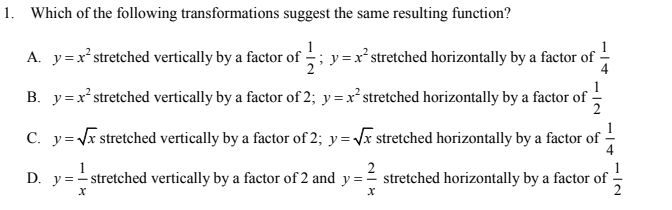
If I take x² and stretch it vertically by 1/2, the new function would be 1/2 x²
If I take x² and stretch it horizontally by 1/4, the new function would be (4x)²
Note that 1/2 x² ≠ (4x)² so A isn't the answer
@proud jetty
proud jetty
Yes I see that but
patent beacon
You want to know why C is the right answer?
patent beacon
Simply because
√[4x] = √[4]√[x] = 2√[x]
patent beacon
Np. Knowing that √ and ² can split over multiplication is cool knowledge
proud jetty
I coulda had also checked using graphing as well?
indeed. Who knows when it could come handy
patent beacon
Yeah, just need to show that √[4x] and 2√[x] are the same function
patent beacon
Or take the √x function and stretch it vertically, it should seem reasonable that this also looks like a horizontal compression
Good luck!
proud jetty
thx
left lance
@left lance the black picture you sent will give you the derivative at x = a only
@rigid beacon ohhk ty(sorry for the late reply lol)
 sturdy haven
How to simplify complex fractions???!??!!????!?????
 neon garden
Can anyone explain how holes work in question 3? I know that it’s (6, -22/3) but I don’t get how that works. Wouldn’t f(6) just be 0?
 raw night
Nope, because it is 0/0 which is undefined
neon garden
Yeah undefined, but how is it a point then?
viscid thistle
How would you attempt this question? I've tried a couple of different ways but I haven't seemed to have got it
viscid thistle
Firstly, I have tried plugging in ath(2x/1+x^2) into ath(x)
clever inlet
Ok
viscid thistle
Didn't work
viscid thistle
Next, I tried plugging ath(x) into 2ath(x), don't think I did it right
clever inlet
What did you get when calculating ath(2x/(1 + x^2) exactly?
In fact
Just ignore the log for now
Just look at the fraction
What did you get for that?
viscid thistle
Gotta do the working out for that again hol' up
At this point I feel as if I’m doing something horribly wrong
viscid thistle
Yeah
clever inlet
(x - 1)^2 = (-(1 - x))^2 = (-1)^2(1 - x)^2 = (1 - x)^2
so we have
(1 + x)^2 / (1 - x)^2 = ((1 + x) / (1 - x))^2 right?
viscid thistle
yeah
viscid thistle
Oh wait that's the final step yooo thanks so much
clever inlet
np
fading token
Chitoge from Nisekoi
viscid thistle
Misaka Mikoto
 novel dirge
I have to find the parameter m for which P wont be empty
I got 2 but the solution says 7
willow bear
you are correct
novel dirge
So the solution is wrong?
willow bear
i don't know, are you sure you're looking in the right place in the answer key
novel dirge
Yes
willow bear
are you sure that m and not x is what you are asked for
novel dirge
It even says that P is empty for every x not 2
willow bear
can you show where it says that
novel dirge
M*
willow bear
i know it's in another language but i can tell it's a Slavic language
novel dirge
Yes
willow bear
so i can probably figure it out
novel dirge
I just realized that it is indeed looking for x
But yeah, my mistake. I know what to do now
 lucid hearth
,rotate
obsidian monolithBOT
fluid shore
Oooh is that your worksheet from school or uni?
novel dirge
Thats first year of hs
fluid shore
That's actually pretty amazing
novel dirge
But the sad thing is that our teacher did a shitty job and almost nobody learned it
fluid shore
I remember helping you out once with Flynn on integration problems
fluid shore
Oh
That's pretty sad. There are resources you can use to learn this stuff properly, though
fluid shore
Ahh
novel dirge
fluid shore
Wow i'm actually pretty impressed though. Logic & Set Theory aren't covered well, if at all, in the IB. I learnt them almost entirely on my own.
fluid shore
,rotate
obsidian monolithBOT
novel dirge
I have to get the total number
fluid shore
I would suggest drawing out a venn diagram, actually
Then, work through the problem by finding each bounded region in the venn diagram.
novel dirge
Hmm
Ill try
Having a bit of a hard time vizualising this in ny head
What exactly I want to do
neon garden
Can anyone help me graph 15? I understand 7-13 when it’s linear, but I’m not sure what to do when the degree > 1
fluid shore
Don't visualize it in your head. The whole point is to draw the diagram so you don't have to visualize it in your head
neon garden
I tried, I have a graph with the vertical asymptotes and intercepts
fluid shore
Pandastrafes, $\frac{x-2}{x^2-x-6} = \frac{x-2}{(x-3)(x+2)}$
obsidian monolithBOT
Abhijeet Vats:
neon garden
I understand that
fluid shore
Uh i was talking to mr pancake with the previous remark i made
novel dirge
Cant he also solve it as a quadratic equation and get x1 and x2?
neon garden
Oh lol
novel dirge
But that would probably be useless
fluid shore
But anyways, you can see that there are two vertical asymptotes at x = 3 and x = -2
lucid hearth
- Find x-intercepts (y=0)
- Find y-intercepts (x=0)
- Find horizontal asymptote (by limit as x->∞ and -∞)
- Find y-asymptote (by limit as y->∞ and -∞)
- Find maximum/minimum point by f’(x)
- Using the coords u found in the previous steps, find out if the graph curves up or down on every portion in between them by using f’’(x) [positive -> U, negative -> n]
- Find any graph holes that makes graph not continuous
neon garden
This is what I have so far
fluid shore
Alright, now consider the roots of f(x)
Clearly, f(2) = 0
So you have one point down
Now, you need to find the behaviour of f(x) near x = -2 and x = 3
neon garden
So I do f(2.9) and stuff like that?
fluid shore
That would be a good start, yes.
Like, okay, just trying some points out to get a feel for what it's like is fine
But in general, let x -> 3 and x<3. Then, clearly, x-2>0 and x +2 > 0. However, x-3<0. So, you're dividing a positive number by a negative number. That means that f(x) goes to negative infinity as x ->3 from the left.
willow bear
x -> 3 and x<3
that's called x -> 3-
fluid shore
I wasn't sure that they were familiar with that notation
neon garden
Ok so f(2.9) = -1.8 roughly
lucid hearth
lim(x→3⁻)
fluid shore
Alright so it's negative right?
neon garden
Yeah
fluid shore
Did you understand what i was saying above?
neon garden
Kind of
fluid shore
The idea is that it becomes more and more negative. It goes to negative infinity.
You can try it with another number that's close to 3
novel dirge
When you finish with him can you help me a bit?
fluid shore
Sure
novel dirge
Im nkt making any progress
fluid shore
But pandastrafes, can you see why it goes to negative infinity?
neon garden
Because the y values keep getting smaller but never hit the asymptotes?
fluid shore
Now, suppose that x -> 3 and x>3. Then, x-2>0 and x+2>0. In this case, x-3>0 as well. So, you're dividing a positive number by the product of positive numbers. The result is going to be a positive number and it's going to get extremely large the closer you go to x=3 from the right.
Well, they keep blowing up as negative numbers but they do not hit the asymptotes because f(x) is undefined at the asymptote
neon garden
do I just keep plugging in values into f(x) until a get a general shape of the graph?
For the middle part I know how to do the ends
fluid shore
No. I've given you a way to reason out how to get the general shape of the graph
Similarly, Kelfran has given you a way to work it out as well.
Attempt to use the reasoning i've used above to determine the general shape of the curve near the asymptotes
lucid hearth
(also I hope you put a hole at x=2 on question 13)
neon garden
I did
lucid hearth
ok nice
fluid shore
Work through it again and look through the approaches that Kelfran and I have presented. Really, really put in some effort into it. Don't just give up after a few minutes. Then, come here if you have additional questions.
neon garden
So as x approaches -2, f(x) -> positive infinity. And as x approaches 3, f(x) -> -infinity
is that kinda what you are looking for?
fluid shore
Not quite. See, the direction of your approach does matter.
But you're getting somewhat close to the general idea
lucid hearth
Well, you can just find the positions of the asymptotes, then later see if it’s increasing or decreasing using f’(x)
To see which goes down to -∞ and which goes up to ∞
neon garden
No
lucid hearth
Okay..
fluid shore
Anyways, pandastrafes, look through both paragraphs that i wrote for you
And try to replicate the reasoning used for x = -2
neon garden
ok
fluid shore
Then, come back here when you're really stuck
novel dirge
@fluid shore my turn now?
lucid hearth
,rotate
obsidian monolithBOT
novel dirge
Ina school 330 students learn french, 470 english, 420 russian
140 f and e
180 f and r
250 e and r
And 120 all 3
fluid shore
Aight so what's the question?
novel dirge
How many students in total
fluid shore
Well, there's a rather interesting formula in question 46 that might just apply here
But rather than relying on formulas, the first thing you should do is to draw a venn diagram to visualize what's happening
novel dirge
Did it and didnt help
fluid shore
So there will be 3 circles you need to draw. Each represents the set of students that learn french, english and russian
Show me the diagram you drew
novel dirge
fluid shore
Ah that's where you've goofed
See there are 330 students who learn french in TOTAL
That includes those who learn french only, those who learn french & (whatever) as well as those who learn all three languages
Also, labelling your diagrams is a very good thing to do
Your diagram should also be about half a page before it will do you any good. It's for your own sake, it helps to make things more clear
fluid shore
Anyways, did you understand the point i made above?
novel dirge
Yes
fluid shore
Similarly, 180 students learn french and russian. This also includes those who learn french, russian & english
novel dirge
But now idk how to draw that
fluid shore
So, as long as they learn both french and russian, they're included in the set of those who learn both languages.
It's the same diagram
However, begin from the inside and move outwards
I'll work you through it, okay?
fluid shore
We are told that 120 students learn all 3 languages. Furthermore, we're told that 250 learn english & russian. So, how many just learn english & russian (without french)
Put what in a circle or an intersection?
120 is exactly where you intially placed it
fluid shore
Anyways, answer my question
novel dirge
130?