#precalculus
1 messages · Page 200 of 1
 clever inlet
what did you get
 harsh cipher
There aren't any reflections and amplitude and vertical displacement seem correct.
I got a very weird graph that starts at the middle and does not show the full cycle. (period)
This is what I put in the calculator
4.5 Sin (pi/180(x-4)+4.9. Then window dimension exactly the same.
 pulsar imp
Hey, I noticed you're missing the closing bracket in the last post
 unkempt burrow
Hi. Can I ask for help here?
 stuck lark
if it's precalc
unkempt burrow
Yes
It’s very easy for other people but I’m having trouble understanding factoring
I’m taking it online and the instructions are even more confusing
 patent beacon
Have an example?
patent beacon
If that were the answer, then the constant term would have to be (-1)(21)
But it's -7
unkempt burrow
Ya the right answer is (3y-1) (y+7)
patent beacon
So do you understand that they're looking for two numbers that multiply to (3)(-7) and add to 20?
unkempt burrow
Yes
patent beacon
Only possibility is 21 and -1
patent beacon
They actually write 20 = 21 - 1 into the equation
That is, they take:
3y² + 20y - 7
And write it like
3y² + (21 - 1)y - 7
unkempt burrow
I see
patent beacon
Finally:
3y² + 21y - y - 7
Can be factored by grouping
unkempt burrow
Ok
patent beacon
Does it make sense? Feel free to ask if there's something missing
unkempt burrow
How can you factor by grouping? Sorry
patent beacon
So let's say we have something like:
3y² + 21y - y - 7
I can arrange it like so:
3y(y + 7) - (y + 7)
Now, note that the term in the brackets is the same both times, that's important. Let me do a substitution, let y + 7 = u:
3yu - u
Common factor:
u(3y - 1)
But u = y + 7:
(y + 7)(3y - 1)
unkempt burrow
Ohhh okay. I think I understand now. Thank you :)))
 leaden stratus
Knowing that the angle is 0 < alpha < pi/2, find sin and cos of the angle (we also know the equation in the photo).
How would I do this?
 uncut mulch
start by expressing it in terms of sin and cos
leaden stratus
You mean that I have to replace sec with 1/cos and csc with 1/sin?
leaden stratus
Ok, did that
uncut mulch
what do you have now?
leaden stratus
uncut mulch
simplify
leaden stratus
I get 3tana - 4 = 0
uncut mulch
continue
leaden stratus
So tana is 4/3?
uncut mulch
yes
leaden stratus
Thanks, I solved it doing a system with
sina = 4/3cosa
sin^2a+cos^2a=1
uncut mulch
drawing a triangle would be more efficient
leaden stratus
I don't know this method
uncut mulch
draw a right triangle where tan(a) = 4/3
uncut mulch
whats the original question?
prove the identity?
you shouldn't write those equations like that since you haven't demonstrated that they're actually equal
instead do
RHS =
= ...
and try to manipulate that 1/( 1 + cos^(x)) while its in the fraction
and eventually reach RHS = LHS
 kind dust
is college algebra precal? or is trig college alg
 civic plaza
College algebra and trig is a part of precal
Trig is usually taught in it's own course separately from a college algebra course
 restive mauve
do your homework
 serene heath
dont fail
 fleet yew
@sturdy haven think about it in terms of turns
that is, fractions of 2 pi
like 270 degrees is 3/4 of a circle
so it is 3/4 * 2 pi
6pi/4
=3pi/2
also one of the reasons tau is superior to pi
 sturdy haven
What is a transcendal number
clever inlet
transcendental?
sturdy haven
Yes
clever inlet
not an algebraic number
so not a root of a polynomial equation with integer coefficients
sturdy haven
Like e?
clever inlet
yes
clever inlet
integer coefficients
sturdy haven
One is an integer
 soft night
😩
sturdy haven
How hard is precalculus half year?
sturdy haven
You were not part of this conversation
sturdy haven
I did really well in geometry and above 90s in agelbra 2
soft night
Most students do
sturdy haven
Aight bet
soft night
it makes life easy
Nobody likes doing that work in their head
If you can just say it without thinking then it’s easy
 viscid thistle
😩is any1 here😩
clever inlet

viscid thistle
gr8 okay so
how do i find the full range of a function? pretty sure i need to find the inverse then the domain and that'll be the range, but i tried doing it on f(x)=(x^2)/(1-x^2) and i just keep going wrong somewhere
algebraically not graphically
clever inlet
why not just reason about it with limits and testing some stuff
viscid thistle
i'm very new to pre calc like the semester just started the other week
it's so simple to find the domain, but i only need help finding the range,,,
viscid thistle
1 sec
i did x=(y^2)/(1-y^2) then multiplied both sides by (1-y^2) to get rid of frac and got
x-y^2x=y^2
idk what do now or if i even did that right
clever inlet
that looks fine
now try move all y terms to one side
and all non y terms to the other
 trim cargo
viscid thistle
trim cargo
viscid thistle
ik i need to do that but idk how
like what do i do with -y^2x
i moved it to right and got
x=y^2+y^2x
clever inlet
factor out y^2
viscid thistle
like x=(x)y^2
clever inlet
almost
viscid thistle
😔that's what i get when i factor it😔
clever inlet
missing a 1
viscid thistle
x=(1x)y^2
clever inlet
x = y^2(1 + x)
viscid thistle
so x/(1+x)=y^2 then sqrt(x/(1+x))=y then 1+x=0 and 1+x>0
clever inlet
x/(1 + x) >= 0
viscid thistle
x>=-1 and x>=0 ?
clever inlet
= -1?
viscid thistle
1+x>=0 sub 1 both sides because frac can't be divided by 0
clever inlet
this inequality is satisfied when both the numerators and denominators are positive
or both are negative
viscid thistle
😔
 warm crescent

 heady jewel
seaech sigma notation
 nova dew
$\lim_{x\to 0} \frac{3x^3-4x^2}{11x^2-5x^3}$
 obsidian monolithBOT
CoolShot:
nova dew
can i factor out an x² and cancel it out here
or would that be wrong
if I do I get the answer as -4/11 which id apparently wrong
not sure where I'm going wrong here
i think i can cancel it because x≠0 here but only approaches 0?
 plain lake
you can factor it out because this just means you'll have a hole at 0
it won't effect your limit evaluation
nova dew
ic so the answer -4/11 is right?
plain lake
yes
nova dew
aight thanks
 astral mountain
How do I see if f'' is 0 or not on this function as example
On a given x value
Without calculating f''
hmm
but there are points of inflection where its not 0 i thought
or is there not?
For this function
Is the inflection at x=3 0
?
or does it not have a f'' value there?
cuz the solution says its not in the domain
of f''
 slow roost
How do you graph the function 2x-4/x^2-4
Like when I used photomath it said the y intercept was at 1
So how do you find that out
And what is the purpose of the zeros/roots from the graph like I got that the zero was 2
stuck lark
graphing the function $x\mapsto\frac{2x-4}{x^2-4}$, do some algebra first
obsidian monolithBOT
RokettoJanpu:
stuck lark
$\frac{2x-4}{x^2-4}=\frac{2(x-2)}{(x+2)(x-2)}$, note $(x-2)$ on top and bottom
obsidian monolithBOT
RokettoJanpu:
stuck lark
this means you can really just graph $x\mapsto\frac{2}{x+2}$, except there's a hole at $x=2$
obsidian monolithBOT
RokettoJanpu:
slow roost
Ohhhh
But how would i approach the graphing
I found the asymptotes
HA: 0
VA: +-2
But it can’t be +2?
stuck lark
read my last msg
slow roost
Ah I see
 rigid beacon
 @broken minnow
 broken minnow
Idk what that is LOL
obsidian monolithBOT
Spamakin🎷:
Compile Error! Click the  reaction for details. (You may edit your message)
broken minnow
Yes
rigid beacon
uh huh
broken minnow
A line
broken minnow
broken minnow
Yet
broken minnow
K but like
If I transform it to
The exponential form
Shouldn’t it be the same graph ?
rigid beacon
No
broken minnow
Why
broken minnow
How do I even graph that tho
broken minnow
Like is it even a function
broken minnow
Rite
obsidian monolithBOT
Spamakin🎷:
Compile Error! Click the reaction for details. (You may edit your message)
broken minnow
Right
broken minnow
I guess
rigid beacon
is that not clear to you?
broken minnow
Imean yes I see it
rigid beacon
ok
broken minnow
I’m just confused how I’d graph it tbh
broken minnow
K but I jus need the logic behind it tbh
For example
If t=1
And let’s say the slope is also 1
It’s essentially
rigid beacon
The axis don't increase linearly
rigid beacon
what?
broken minnow
If I plug in
T= 1
It would essentially be
Ln(pvap)= 1/1
(Assuming those extra letters are zero)
rigid beacon
if they're zero
broken minnow
Therefore pvap is 0 ?
rigid beacon
then ln[p_vap] = 0
well not even
because R can't be zero
can't divide by zero
you're missing the point forget this
your axis aren't increasing straight
broken minnow
But it’s apparently a line
rigid beacon
the X axis is changing by a factor of 1/T as you move from left to right
not changing by a factor of T
broken minnow
Then how is it a line
rigid beacon
Y = ln[p] and x = 1/T
if we make these subs
we get a linear function
so instead of an X-axis
we have a 1/T axis
and instead of a Y-axis
we have a ln[P_vap] axis
broken minnow
Oh so it’s only a line when you make those substitutions
rigid beacon
yes
broken minnow
But when you don’t make the substitutions
 analog minnow

Can anyone help with this? When I do positive infinity I get:
f(inf) = 3-[(-1)/(inf-4)]
and I don't know what that means for my limit..
I have a TI-84 and tried to get a value for x=E99 but it says invalid.. at x=E-99 I get y=2.875
 runic tapir
The first issue is there's no such value of $f(\infty)$ and an additional one is when you do "plug in" infinity I don't see how you get negative 1 in your numerator and $\infty-4$ in your denominator
obsidian monolithBOT
Intel Core i7-8700:
runic tapir
Are you familiar with asymptotes?
analog minnow
Mildly yes
runic tapir
So you know what happens when you divide a constant by a really large number?
analog minnow
yes
 valid violet
Do you know what a limit is?
analog minnow
valid violet
that's illegal in 39 states
uncut mulch
^
runic tapir
Using that intuition is how you can solve that problem. Is there something different about this problem?
valid violet
f is implicitly defined only for numbers. infinity is not a number
runic tapir
What's tragically funny is that you can get the right answer with the wrong process as written
valid violet
it's like evaluating f at x = honeybee
runic tapir
$f(\diamondsuit)=?$
obsidian monolithBOT
Intel Core i7-8700:
stuck lark
plugging in infty into a function is illegal in 1 more state than saying 3(x+2) is equivalent to 3x+2? which state is that?
valid violet
well 3(x+2)=3x+2 for x = infinity
stuck lark
hhhhhhhhhhhh
analog minnow
So I have a horizontal asymptote at x=infinity?
analog minnow
assuming x is a very large value like 9999999
runic tapir
x can approach infinity
valid violet
is that number equal infinity now
that makes calculus easier
do you know what a limit is?
 pliant tree
you have an asymptote at x=2 and 2=-2 i believe
valid violet
limiting behavior?
analog minnow
I am not a pro in calculus by any means
Not even close to being good thats why I came here
valid violet
why are you avoiding my question. "No" is a perfectly good answer to "do you know ____". I'm not asking to shame you\
analog minnow
 valid violet
I'm asking because how much you know already changes how I will state my answere
valid violet
I don't think you do, otherwise you wouldn't be trying to evaluate f "at infinity"
runic tapir
It's really easy to punch down to precalc students, no need to get anal retentive. If you're going to be a jerk then let other people willing to help do so and you can be on your way.
valid violet
I just want to know how to phrase my explanation 
pliant tree
ok is your question for b) @analog minnow
valid violet
there's nothing wrong with not knowing
runic tapir
You can gauge that without being patronizing.
analog minnow
My feelings aren't hurt, I just don't know how to explain how much pre calculus I know.. I am studying a job position as an engineer technologist and we take a 60hour course on pre calculus online
I know a lot of the other stuff but this one stumped me
valid violet
okay
so
to say that a function has a horizontal asymptote
is to say that there's a vertical line y = c such that f(x)-y becomes arbitrarily small as x becomes arbitrarily large
analog minnow
If it had a horizontal asymptote at x=0 it would mean it would approach infinity before it reached x=0.. correct?
pliant tree
yes jetter correct
analog minnow
Okay I understand that much about horizontal and vertical asymptotes
pliant tree
or -infinity
runic tapir
All an asymptote is is a straight line that is a close approximation to a particular curve as the curve goes off to infinity in one direction. The curve becomes very, very close to the asymptote line, but never touches it.
pliant tree
anytime there is a fraction, any x value that makes the denominator=0 is an asymptote
so if it was (1/x) the asymptote would be 0
your best bet is to graph the equations
runic tapir
@stuck lark you good buddy?
stuck lark
not at all
analog minnow
I have it graphed
runic tapir
Wanna talk about it?
analog minnow
And I understand what it means graphed I just can't get it down on paper
stuck lark
$x\mapsto\frac{\sin(x)}{x}$ crosses the horizontal asymptote $y=0$ infinitely many times
obsidian monolithBOT
RokettoJanpu:
pliant tree
so you should see the line approach infinity or -infinity at 2 and -2
stuck lark
that's my first point
stuck lark
second point, i hate it when people dogpile in here
let fauxpas speak only, everyone else please sit down
stuck lark
sigh
runic tapir
I think I was doing pretty well on my own until other people decided to chime in
stuck lark
i don't think so, your definition of an asymptote isn't up to par
analog minnow
Your definition makes sense with what I have learned so far
stuck lark
my example shatters your definition, you never countered that
anyway that's enough shade for now, good luck helping jetter
runic tapir
First off my definition comes from Barron's dictionary of mathematical terms, secondly you're being needlessly picky for the purposes of a precalculus problem.
Anyway back to the problem.
rigid beacon
Functions crossing asymptotes is well within the grasp of a precalc class (it was covered in mine) but sure
runic tapir
Jetter you want to talk about the original or the one just posted? let's hop over to #help-6
Take it up with Douglas Downing then, Jesus.
valid violet
Back. I see Jetter fell to the dark side
stuck lark
watch zeta closely just in case an opportunity to save him from palpatine's clutches presents itself
runic tapir
How sad of a life do you have to have to talk down to precalc students to feel better about yourselves?
fleet yew
How sad of a life do you have to talk down to people who talk down to precalc students to feel better about yourself?
restive mauve
how sad of a life do you have to talk down to people who talk down to people who talk down to precalc students to feel better about yourself?
viscid thistle
Let A ⊆ R be an interval and c : A → R^2 continuous such that c(A) is unbounded in the sense of the usual metric d on R^2 . We can certainly find a sequence a_n in A such that for each r>0, there exists an N in N, n > N, such that for n > N we have c(a_n) ∉ B_r(0 , 0) . Now let L \subset R^2 be a line, we say L is an asymptote to c if
$\lim\limits_{n\rightarrow\infty} \mathrm{inf}{d(c(a_n),l)\mid l\in L}=0$
obsidian monolithBOT
rudy:
clever inlet

viscid thistle
for a sequence a_n as defined
fleet yew
this is the precalc room buddy
 runic cradle
anyone have any idea on this? I think I understand it except for the "what is the steepest roof Calvin can sit on without sliding?" Thank you in advance! (please ping me if you respond)
patent beacon
@runic cradle
This is a well known result from physics, the steepest roof is given by tanθ = μ
runic cradle
Why is that?
 rigid sun
in the 1800s people used to sit on their roofs
but nobody likes sititng on flat roofs
so they wanted to know what was the steepest angle they could sit on
and still not fall off
of course now adays we have shingles
so that isn't really a problem
patent beacon
You may have found that the parallel component is 160cosθ, and the normal component is 160sinθ
Therefore friction vector is 160μsinθ
runic cradle
ohh right
runic cradle
so we want 160μsinθ=160cosθ
 native sequoia
I spam 那个 when talking in Chinese irl
 dim ruin
helps
I get everything that leads up to the red marking (the work on the left), but I cant seem to figure out how I went from what is circled in red to the expression below the red circle..
rigid sun
youre telling me you forgot what you did?
viscid thistle
Mate are you an 84 year old granny with dementia
 steel veldt
isn't that orange xd
 verbal leaf
My teacher wrote on my test that “this is a rest, not a VA” and I’m not sure what rest means?
(The question at hand was to discover every asymptote possible of a rational function)
clever inlet
🤔
the only thing i can think of is a removable discontinuities
cause those get confused with VAs sometimes
but i dn't know what a rest is
do you have the full context?
 median sandal
A rest possible a stationary point? Not sure lol
rigid beacon
Just send your question
median sandal
Ask your question, I am sure someone will be able to help 🙂
 mossy kestrel
og
oh
sorry hold on
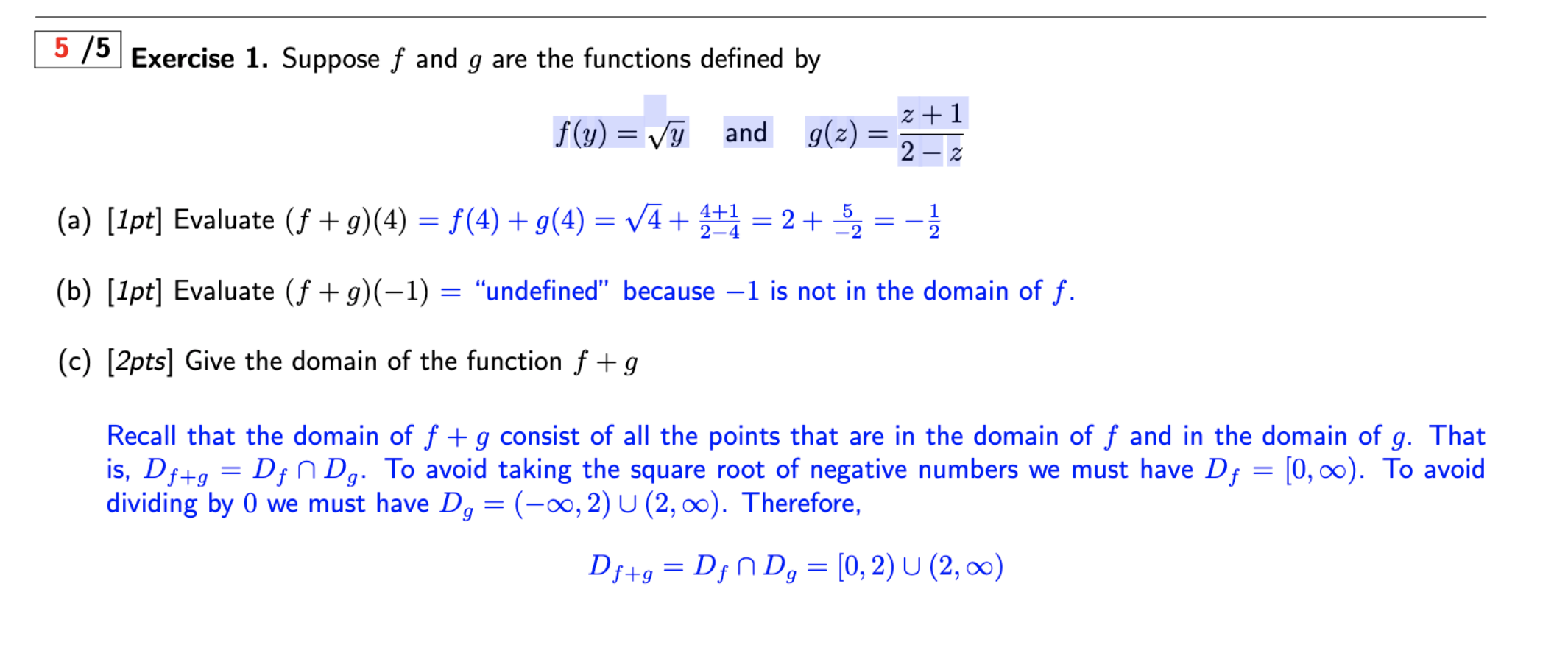
suppose f and g are the functions defined by f(y)= √y and g(z)= z+1/2-z
a) evaluate (f+g)(4)
rigid beacon
Use parentheses but yes
mossy kestrel
oh wow
okay that was easier than i thought
i was really sick last week so i missed a ton of my classes so now im super behind
and my midterm is on thursday lol
so the answer is -.5?
rigid beacon
Yes
stuck lark
identify the domains of f & g in order to identify the domain of f+g
doesn’t seem specified so ig assume the largest set of real numbers that “works” with the definitions of f & g
 patent whale
I've got this function, how do I know if it's continuous? How to calculate it? I don't understand tbh. I think it is continuous but I need to write it formally
 fading token

uncut mulch
limits / definitions of continuity
 wet steeple
patent whale
wet steeple
patent whale
well yep but 0 is out of the domain
fading token
What is the definition of continuous you have to work with?
The formal epsilon-delta definition?
patent whale

they didnt tell us what definition of continuous we have to work with
something like this id guess
yep
fading token
That's the formal epsilon-delta definition
This particular function is usually done as follows (the lazy way):
when x is not 0, the function is continuous (because it's a product/composition of continuous functions)
when x approaches 0, you can show (with e.g. the squeeze theorem) that the function approaches 0 to any arbitrary amount
So the function is continuous everywhere (because the value of the function at 0 is defined to be 0)
this does require some preliminary knowledge, so I find it strange that you have to go through the extra hoops by proving this from the bare basics of the definition of continuity
fading token
So, to rephrase, you do have to employ the definition of continuity, but only in the case of x = 0 (I think, or otherwise use the squeeze theorem)
When x is non-zero, you can rely on the well-behavedness of x*sin(pi/x)
obsidian monolithBOT
WhipStreak23:
fading token

stuck lark
$x\mapsto x\sin\br{\frac\pi x}$
obsidian monolithBOT
RokettoJanpu:
fading token

obsidian monolithBOT
WhipStreak23:
stuck lark
nani
harsh cipher
Question
From the unit circle in trigonometric functions
How do I know at pi/4 the coordinates are root 2/2 , root2/2?
valid violet
What's the standard form of a circle @sharp marsh?
Your conclusion that r=5 is correct
But the rhs of the standard form of a circle isn't r
runic tapir
did you lose your ℌonorable role @valid violet ?
serene heath
you're honourable in my eyes 😽
 reef rune
use desmos
graph all the equations and see which ones intercept the x axis 3 times
which means its not a quadratic
runic tapir
Yes
 sleek pawn
hi
really simple thing but how would I solve this?
$\lim_{x\to3}\frac{x^2-4}{x^2-5x+6}$
obsidian monolithBOT
A regular kugelblitz:
fleet yew
Factor top and bottom
fleet yew
Cancel the x-2
fleet yew
Long division
sleek pawn
lol what?
fleet yew
Polynomial division
sleek pawn
what do I divide by?
fleet yew
Do you know how division works lol
fleet yew
Like straight up do (x+2)÷(x-3)
fleet yew
How are you learning limits and not know polynomial division lol
fleet yew
Anyway you should just know that if you have a function in the form A/0
Where A is not 0
And is a constant when you plug in x
You can just say the limit is at +-inf
No two sided limit exists for a hyperbola
sleek pawn
is that always the case or does it only apply to hyperbolas?
sleek pawn
and how would I solve it with long division?
fleet yew
Look up polynomial divison on khan or something
clever inlet
What have you tried
valid violet
What's "your formula"
 scarlet beacon
x=-6
valid violet
In the question it says to use "your formula "
scarlet beacon
I know. I am confused. I don't see a formula.
uncut mulch
probably the formula to get the equation of the appropriate line
scarlet beacon
Really not trying to play dumb but super lost.
uncut mulch
can you determine the equation of the line given 2 points (on the line)?
or given the slope and a point
scarlet beacon
I can find slope. Rise/run
 sharp marsh
?
rigid sun
wouldn't it be cool if a function gave you a y value with a given x value
it would be cool because then you could see what y value goes with each x value
sharp marsh
Don't you have to get the origin?
rigid sun
it would also be cool if there was a coordinate system
where coordinates are represented in the form
(x,y)
sharp marsh
.
rigid sun
where x gives the x value location of the point you want, and the y value is how high or low it is
that would be insane though because then everyone would be able to test if points passed thorugh the origin
they could put 0 in for x and see if y=0
they could put 0 in for x and see if y=0$$
obsidian monolithBOT
maleb1964:
Compile Error! Click the reaction for details. (You may edit your message)
rigid sun

sharp marsh
rigid sun
they could put 0 in for x and see if y=0$$
obsidian monolithBOT
maleb1964:
Compile Error! Click the reaction for details. (You may edit your message)
rigid sun
 clever inlet
You don't need the extra parentheses
viscid thistle
How do you find the cotangent of an angle without a calculator
fleet yew
@lilac relic my bad lol i guess that is correct
I just had learned in school that if it was implicit then it wasnt really a function
No wait wikipedia itself says I'm right
If tou look under the definition of function
viscid thistle
"Wikipedia"
fleet yew
"In mathematics, a function is a relation between sets that associates to every element of a first set exactly one element of the second set. "
See you cant have multiple y values for one x value
so x^2+y^2 =1 is not a function because there are multiple y values for the same x
viscid thistle
My only lead is that cotangent theta is equal to cos theta divided by sine theta this barely helps me as how do I find cosine and sine without a calculator as well
clever inlet
That kind of just pushes the issue along though doesn't it
fleet yew
What i was saying before is that cot is defined at points where tan is not
Like points where cosx=0
 elfin birch
https://gyazo.com/5460f3621c9e176355269f1d7f085db9
how tf did i get this wrong

csc600 is -2root3/3
clever inlet
Lul
elfin birch
bruh
clever inlet

clever inlet
It is
viscid thistle
@clever inlet for this specific problem I want to find the cotangent of 30 degrees
viscid thistle
So how do I do it
slow roost
How would I figure 12c our from my graphing calculator
I tried doing the label but it wouldn’t work
Value only works for x
elfin birch
if the sin = 7 does that mean that sin = 7/1 ?
so r = 1 ?

or no
<@&286206848099549185>
viscid thistle
@lilac relic why root 3
Okay I understand
That
It's that due to reciprocal functions right
I have no idea what tan 39 is
I get to 1 / tan 30
Then pass that I don't know how to get to the route 3
Root*
What principle says that
Is there a conversion
Yes true
elfin birch
yo phil
viscid thistle
I know that 10 x equals sinx / cos x but how does that make tan 30 root 3
Tan*
Not 10
But how
Still confused by how
Yes
Yeah
Now hold on how do we know any of the lengths of the triangle
Wait what all I know is that I have all the angles but no lengths how do you figure out any of the lengths with just all the angles
Sorry if u just explained it dont understand
And I know it's a right triangle
Oh so we free assign as a ratio type thing
would the answer always be the same as the answer you would put in a calculator
And how
Hmm I guess that makes sense so let me work it out
Thank you so much man
How do I rationalize the numerator √2x + √2y/y
just need a quick refresher
I do conjugate first?
viscid thistle
<@&286206848099549185>
i have been summoned
i shall help you good S I R
so basically you want to make different of squares on the numerator right @viscid thistle
uncut mulch
is that sqrt(2)*x or sqrt(2x)
viscid thistle
also i assume you mean $\frac{\sqrt{2x} + \sqrt{2y}}{y}}$
obsidian monolithBOT
chobë:
Compile Error! Click the reaction for details. (You may edit your message)
uncut mulch
extra} on the end
viscid thistle
Yes
exactly this question
what have you tried so far btw
conjugate so it would be multiplying the conjugate of 2x+2y with 2x-2y on both numerator and denominator
not sure what you mean by "conjugate"
but basically
 vernal moon
...
uncut mulch
did you mean conjugate of
sqrt(2x) + sqrt(2y)
uncut mulch
^
viscid thistle
well I'm not sure what the next step would be after that
2x-2y/y(sqrt(2x) - sqrt(2y)?
uncut mulch
parentheses
assuming they've been correctly placed
you've achieved your goal of rationalising the numerator
viscid thistle
parentheses on bottom right
sorry I'm just making sure I literally forgot stuff after not studying math for a month 
mossy kestrel
when showing a rational number how do you know how much to multiply it by when subtracting x from it?
is by how many numbers its repeated by?
so if the number is 1.2345 and 345 is repeating
would i multiply it by 100
oh wait no 10000
uncut mulch
let $x = 1.2\overline{345} \
10x = 12. \overline{345} \
10000x = 12345.\overline{345}$
obsidian monolithBOT
ramonov:
mossy kestrel
how do i know when to multiply by 10, 100, 1000, 10000
vernal moon
do the position of the start of the repeating sequence
uncut mulch
multiplying by 10 and 10000 here
gets you the 345 repeating after the dp
vernal moon
plus the length of the sequence
slow roost
Lol whenever someone talks over me they don’t get scolded at 🤷🏻♀️
rigid sun
you know what
@weak storm
does this make sense to you
vectors don't have to move tip to tail
i could easily just
move all the vectors apart like 5 feet and they would not be tip to tail
vectors are just a magnitude and a direction
look at vector A+ (-B)
your start at the bottom of A
and then go all the way to the end of B
remember A+ -B= A-B
its actually a nice tool to use parallelo gram method
no
those are two separate vectors
one shows vector A and the other shows vector B
one meta strat to subtract vectors is to use tip to tip
you see, in the diagram you have A-B
so think of it as
the tip of B to tip of A, where the end of A is the tip of the resultant vector
so yeah
you can think of vectors as like
reading
like everyone reads english left to right
ye
 mossy kestrel
halp
 hallow flicker
Ok so I could try like tan of positive x
But like it won’t have the gap in between
hallow flicker
Cosec
rigid sun
ok
hallow flicker
But how do I get the gap on the middle
rigid sun
what do you think
hallow flicker
Just tell me
rigid sun
do you know a way to make a function always negative?
hallow flicker
So -|x|
rigid sun
ok
rigid sun
you can change the period
hallow flicker
What does that mean
hallow flicker
Yea
hallow flicker
Can you explain
hallow flicker
Ok
rigid sun
that was a huge pain in the ass
@hallow flicker
let me ask you this question first
can you name functions that are undefined when the input is negative?
@hallow flicker
bruh
this dude
anime
rigid sun
no tf
rigid sun
that would be like
hallow flicker
And no I can’t
hallow flicker
What about squat root of x
rigid sun
those are two functions that make numbers undefined
rigid sun
but what we also need to consider
is that those function
- make negative numbers into undefined outputs
- are not periodic
aka, they make the entire -x axis negative and the rest is defined
hmm...
if only there was a way we could make certain imputs PERIODICALLY negative
hallow flicker
Ok I couldn’t do it
hallow flicker
Ok
rigid sun
so we already went over the abs value and the negative
hallow flicker
Why is it so complex looking
hallow flicker
Why do you need sin of arcsin?
hallow flicker
N
hallow flicker
X
rigid sun
yes
now all of that on the inside of the sin simplifies down to x
which is
sin(x)
the reason i have the arcsin in there is to make sure that the function retains its original shape
ok
so lets look at your picture
hallow flicker
Wait let me try this
rigid sun
from this picture, it appears that only values from pi to 2pi are undefined
hmmm, so we want to use negative values to make the gaps undefined
if only there was a function that made values from pi to 2pi, periodically negative
hallow flicker
I thanks dude
rigid sun
hmmmmm
hallow flicker
But you don’t need the other parts
rigid sun
tf you mean
rigid sun
yes
fading token
@hallow flicker nice nickname
 lilac tide
kill me now
we’re doing vectors in precalc
but it’s just scalar multiplication and addition
fading token
not unimportant
lilac tide
but so boring and easy
fading token
I'm sure you'll get to do some challenging stuff soon
 languid crane
soft night
languid crane
soft night
Isn’t like
Almost all of math multiplication and addition

Besides number theory
That can suck my pp
 pale kettle
viscid thistle
pale kettle
viscid thistle
Need help on this
Can't visualize this for some reason
<@&286206848099549185> not sure if I am supposed to @ u guys. Sorry if your not supposed to
 narrow hawk
not really the place for precalc is it
uncut mulch
not sure yet you did it anyway 😦
viscid thistle
So I am not supposed to?
uncut mulch
viscid thistle
I am sorry
uncut mulch
15 minute rule
viscid thistle
What does that mean
viscid thistle
But seriously can someone help me with my problem
valid violet
At first glance, I'm not seeing how the width of the pool is relevant
Is this from a book that sometimes puts extraneous info in problems
viscid thistle
It's just a page I got from my teacher. All I did was pull up the online version of it to screenshot for you guys
valid violet
You want to look at it from the side
Like underground next to the pool looking at it sideways
Not from above
 valid violet
it's asking for the solution to -3=7x-5
valid violet
yes. when you evaluate f(x), you put in x = whatever
mossy kestrel
fuck
valid violet
whne you evaluate f inverse, you put in f(x) = whatevere
valid violet
in general finding the inverse is more difficult than the regular function, and there might be no solution or multiple solutions


 mossy kestrel
oh
valid violet
functions of the form y = mx+b always have inverses and it will always be possible to solve for the inverses
in general a function might have no inverse
or the inverse might not be a function
mossy kestrel
how do i know if it doesnt
valid violet
actually I need to correct myself
constant functions like y = 5 are not invertible
so I mean non-constant functions
uh that's actually a really difficult question in general
mossy kestrel
i havent learned it so should i just assume these all have inverses
valid violet
no
you should put in f(x) = whatever
and see if it's possible to solve for x
later on you'll learn more about when to tell if a function has an inverse
without actually finding the inverse
well
if they use the notation
$f^{-1}$
obsidian monolithBOT
gfauxpas: