#precalculus
1 messages · Page 197 of 1
 uncut mulch
 undone pawn
you have written $\int \frac{1}{3x} dx = \ln(3x) + c$
 obsidian monolithBOT
FlynnXD:
obsidian monolithBOT
FlynnXD:
undone pawn
if not, you're wrong
 viscid thistle
Don't mean to disrupt the discussion, I'm just wondering about something. Is this being taught in a precalc class somewhere in the world? The schools I'm familiar only cover this in calc classes.
viscid thistle
Ah ok. I wasn't sure if the school system had moved on. Because I have seen way too much calculus in this text channel
 languid crane
^ same
 sharp quest
if i have $log_5 6$
obsidian monolithBOT
Voyager:
viscid thistle
No
sharp quest
how does
 willow bear
how does what
sharp quest
$\frac{1}{\frac{log_5 5}{log_5 6}}$
obsidian monolithBOT
Voyager:
viscid thistle
$log_5 6$= $log 6$ / $log 5$ which doesn't equal $log 5$ / $log 6$
obsidian monolithBOT
Malinky:
willow bear
OH MY GOD THAT IS SUCH HORRENDOUS LATEX MY EYES ARE LITERALLY BURNING
viscid thistle
:) sry am on phone
obsidian monolithBOT
Voyager:
obsidian monolithBOT
Voyager:
willow bear
$\frac{1}{\frac{x}{y}} = \frac{y}{x}$ that's how
obsidian monolithBOT
Ann:
willow bear
and $\log_5(5) = 1$
obsidian monolithBOT
Ann:
sharp quest
$\frac{log_5 5}{log_5 6}$
obsidian monolithBOT
Voyager:
sharp quest
wait what happens here
willow bear
$\frac{1}{\frac{x}{y}} = \frac{y}{x}$
obsidian monolithBOT
Ann:
willow bear
$\frac{1}{\frac{\log_5(5)}{\log_5(6)}} = \frac{\log_5(6)}{\log_5(5)}$
sharp quest
dude did you type that only after i messaged
obsidian monolithBOT
Ann:
sharp quest
wtf
viscid thistle
and $\log_5(5) = 1$
obsidian monolithBOT
Malinky:
willow bear
you're so very welcome.
sharp quest
$\frac{1}{\frac{log_c a}{log_c b}}$
obsidian monolithBOT
Voyager:
obsidian monolithBOT
Voyager:
willow bear
no
$\frac{1}{\frac{\log_c(a)}{\log_c(b)}} = \frac{\log_c(b)}{\log_c(a)} = \log_a(b)$
obsidian monolithBOT
Ann:
sharp quest
oh alright thanks
sharp quest

how do i start with this
Free Pre-Algebra, Algebra, Trigonometry, Calculus, Geometry, Statistics and Chemistry calculators step-by-step
is this the only way
 pale bison
is it log(x+1) or log(x) + 1?
 serene heath
probably the latter
pale bison
well that makes stuff a lot easier...
 night wigeon
wdym
 patent beacon
In this section we solve separable first order differential equations, i.e. differential equations in the form N(y) y' = M(x). We will give a derivation of the solution process to this type of differential equation. We’ll also start looking at finding the interval of val...
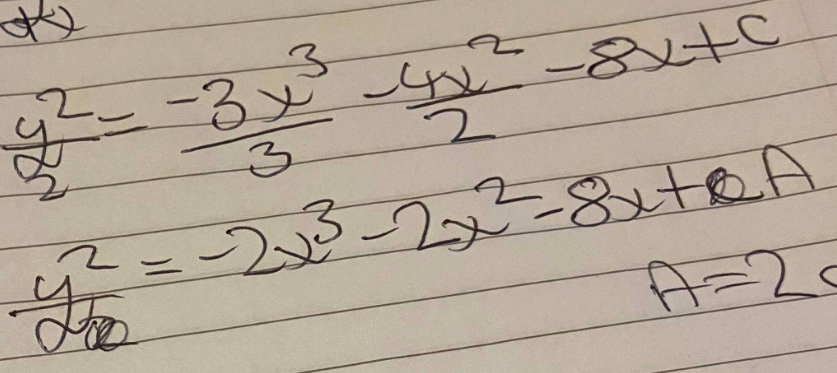
You rearrange to write
y dy/dx = -3x² - 4x - 8
Then integrate both sides:
1/2 y² = -x³ - 2x² - 8x
night wigeon
yea thats what i did
 patent beacon
Oh yeah don't be like me and forget the +C
night wigeon
ya i did
 stuck lark
then the coeffs of x^2 and x are off
patent beacon
Mb I didn't see your work above
stuck lark
y^2=... is really an implicitly defined curve, y isn't a function of x. but if we take sqrt of both sides and "cut" the curve at a specific point, we can make y an explicitly defined function of x
algebra wise yea, just sqrt and pick the "cut" that satisfies y(0)=2
stuck lark
show me your work after y^2/2=...+C
night wigeon
stuck lark
,rotate 45
obsidian monolithBOT
night wigeon
just to be sure, this means x =0 and y =2 right
stuck lark
yes
stuck lark
sqrt(x) is not x^(-1)
night wigeon
oh its 1/2
stuck lark
that doesn't refute "sqrt(a+b) != sqrt(a)+sqrt(b)"
night wigeon
how does that come into this question, isnt it only sqrt(y)
patent beacon
You're taking the square root of each term individually. That's a no-no
night wigeon
ohh
stuck lark
freshman's dream strikes again, with n=1/2
night wigeon
ty that was the right answer
stuck lark
np
obsidian monolithBOT
RokettoJanpu:
Compile Error! Click the  reaction for details. (You may edit your message)
 earnest nymph
Continue from here
stuck lark
,rccw
obsidian monolithBOT
stuck lark
similar to the last one, this is a separable equation, meaning the x and t stuff can be moved to separate sides and integrated
night wigeon
ive found the value for the constant c
altho im confused because i dont know what x(T) = wants me to enter as my answer
stuck lark
isolate x(t)
night wigeon
i dont have a x(t)
stuck lark
isolate x
obsidian monolithBOT
RokettoJanpu:
stuck lark
we have the initial condition x(0)=0 so yes plug that in
 lofty geyser
Does anyone do personal math tutoring
 quasi meadow
@solemn sluice you probably want to simplify the left side of the equation you are trying to prove so solve for c in terms of a with law of sines
 solemn sluice
Mmm ok tyvm
 steep yarrow
Hello I’m from Canada and need help with this log question
 sturdy haven
How do you multiply exponents with the same base and same power
steep yarrow
You just add the powers?
sturdy haven
But 6x^2 x 6x^2 = (6x^2)^2 correct?
steep yarrow
Yea aka 6^4
steep yarrow
Idk what you mean bruh
To answer your original question you just add the powers if they have the same base when multiplying
ie. 5^2 * 5^3 = 3125
2+3 =5
5^5= 3125
willow bear
$6x^2 \cdot 6x^2 \neq 6^4$
obsidian monolithBOT
Ann:
willow bear
@sturdy haven do not use x for multiplication especially when you have a variable called x
 fluid shore
@trim fable you good with that question?
 still yew
So, I dont know why but I am having trouble grasping law of cosines...first off, can when solving a triangle, result to 2 solutions if using the law?
willow bear
depends on what you're finding
willow bear
if you're finding an angle from three sides, or a side from the other two and the angle between them, then no, there is never any ambiguity
still yew
Nvm, SSA
willow bear
no, you were right the first time. this is SAS. angle C is opposite side c.
still yew
Ah
fluid shore
Sure
 trim fable
yay
fluid shore
So have you added both of them
willow bear
what is the question again
 fluid shore
You’re just adding two quadratic expressions together
willow bear
you have FOUR equations???
trim fable
f(x), g(x)
fluid shore
:/
still yew
Why 4?
still yew
You need 1
fluid shore
Ann wait
trim fable
i broke it down
fluid shore
Tell us first what you have done first
still yew
Oh
trim fable
ok
trim fable
h(1)= 1^1 - n(1) +5 h(1) = m(1)^2 + 1 -3 h(-2) = -2^2 -n (-2) +5 h(-2)= m(-2)^2 + -2 +3
= 1 - n +5 = m-2 = 2n+9 = 4m +1
= -n + 6
then I did
willow bear
this is impossible to read on mobile.
trim fable
2n+9 = -n +6 4m+1=m-2
n=-1 m=-1
fluid shore
Star, write things down on a piece of paper
trim fable
LOL idk what i did
willow bear
what is h(x)?
fluid shore
It’ll be clearer that way
trim fable
i cant take a pic of it tho
willow bear
also if you don't know what you did then chances are you did it wrong
trim fable
thats the problem LOL
fluid shore
Exactly
trim fable
ik what i did but
fluid shore
Okay let’s start from the beginning
trim fable
ok
willow bear
no, write it out explicitly. an explicit formula.
willow bear
write out what h(x) is explicitly.
trim fable
let me try brb
fluid shore
Mmh
trim fable
ok
fluid shore
So what have ya come up with?
fluid shore

willow bear
have you written out h(x) explicitly?
willow bear
have you or have you not written out h(x) explicitly?
trim fable
:C
fluid shore
Star, write it out explicitly
There’s nothing wrong with following the direction we’ve given
trim fable
ik
i wanted to see if i could do it but ok
ill try
i just didn't
wanna erase lol
fluid shore
Lmao
willow bear
if you didn't do what you were told to do, say so outright rather than stalling as you just did.
willow bear
NO!
trim fable
-n+m+4=0
willow bear
write out
h(x)
explicitly!
trim fable
what do u mean
willow bear
h(x) = (x^2 - nx + 5) + (mx^2 + x - 3) = ???
willow bear
(m+1)x^2 + (-n+1)x + 2 no bueno????????
trim fable
bueno?
willow bear
trim fable
oh
willow bear
why couldn't you write this out. why did it take me and abhi so many times.
willow bear
how did you get that
fluid shore
Try it when you’re more awake
viscid thistle
can anyone help with proof by mathematical induction? i got stuck on inductive step... it looks like this: 1 + 2(1/2) + 3(1/2)^2 + 4(1/2)^3 + ... + n(1/2)^n-1 = 4 - ((n+2) / (2^n-1))
first you assume that n=k
and then i got stuck on n=k+1
<@&286206848099549185>
willow bear
generally $\int_a^b |f(x)| \dd{x} \neq \absv{\int_a^b f(x) \dd{x}}$
obsidian monolithBOT
Ann:
 blissful wadi
oh
so how can i use abs(x^2-x) ?
i mean integrate it*
is there any methode for the absolute value ?
willow bear
i mean you tried splitting the integral up based on the sign of x^2 - x
which is good
you just didn't do it properly
x^2 - x is less than zero iff x ∈ ]0,1[
willow bear
so you'd be splitting this up as $\int_{-1}^0 + \int_0^1 + \int_1^2$
obsidian monolithBOT
Ann:
 noble sundial
@harsh cipher yup
 harsh cipher
ok thanks
trim fable
@fluid shore hi 😛
trim fable
oh no
i wanted to ask u that before
I realized what i was doing wrong
but i dont understand what im supposed to do
i have a test tom im stressed :c
so what i was doing was
h(x)= f(x) + g(x) and i subbed in 1 into the equation and solved but then
instead u add them like uh.. in a way idk how to
@fluid shore
like how would u add ( x^2 -nx + 5 ) + (mx^2 + x -3 )
coz what i was doing before was just subbing in 1 for x and solving that^^
but u add them first? its kinda confusing coz
idk how she got that yesterday and i was too tired too finish
fluid shore
Well, can you see that x^2 and mx^2 have a common factor of x^2?
obsidian monolithBOT
Abhijeet Vats:
trim fable
hmm
why +1?
uh
oh..
nvm
u factored the x^2
hmm ok makes sense
waitttt
😦
why is it
m-n=-1???
im getting m-n
@fluid shore 😦
fluid shore
:///
Uh wait can you post the question again?
Sorry btw, i’m in camp so i’ll have to come and go as things get busy
@trim fable
Like, post the entire question
 clever inlet
It's just a letter after all
A variable
I think it's safe to assume that's a function d in terms of t
fluid shore
Okay so
trim fable
😛
fluid shore
$f(x) + g(x) = h(x) = (x^2-nx+5) + (mx^2 + x -3) = (m+1)x^2 + (1-n)x +2$
obsidian monolithBOT
Abhijeet Vats:
fluid shore
^Do you understand what i've written above?
trim fable
yeah
fluid shore
Okay so
fluid shore
5-3 is what?
fluid shore
$h(x) = (m+1)x^2 + (1-n)x + 2$
obsidian monolithBOT
Abhijeet Vats:
fluid shore
No forget about what you've gotten before
trim fable
oh
fluid shore
What you have now is what matters
fluid shore
^Good life lesson tbh
fluid shore
So, you have been told that (1,3) and (-2,18) satisfy h(x)
fluid shore
What does it mean for those points to satisfy h(x)?
fluid shore
Nope, it is significant
fluid shore
What does it mean for those points to satisfy h(x)
trim fable
U MAKE THE EQUATION EQUAL TO ITTTTTTTTTTTTTT
fluid shore
Indeed
fluid shore
So h(1) = 3 and h(-2) = 18
trim fable
oh just to clarify coz i think i forgot
fluid shore
Then, you'll get two equations in two unknown variables m & n
trim fable
yeah
ok ikwhat to do now 😄
tho like question about it
u know how i was adding before
whats the difference between adding it the way u showed me or just
subbing things right away and then solving
fluid shore
Like, you don't know if they satisfy f(x) and g(x) individually. You can't say that f(1) = 3. You can say that f(1) + g(1) = 3
trim fable
OHH
fluid shore
Yeap, you substitute x = 1 into it
trim fable
ok
so u always say that
like for the next one
18= f(-2) + g(-2)
right
so i should start off a question by stating something like that
3= ( 1)^2 -n(1) + 5) + (m(1)^2 +1-3)
3= 1 -n +5 +m -2
3=-n+m+4
-1=n+m
fluid shore
Uh no
trim fable
oh so what i did before was right I was just not making it equal to y
yeah ik i wanted to see
fluid shore
You should start off the question by finding h(x) explicitly
trim fable
if i got the answer thhat way
and it worked out
whys that?
is that process considered wrong
idk for me i feel like it really simplifies things a lot, i do get ur way buut its kinda complicated
fluid shore
Well, there is a common consensus that working in variables does allow you to generalize things easily
trim fable
yeah
fluid shore
That is, suppose I give you two other pairs of numbers that, supposedly, satisfy h(x) = f(x)+g(x)
fluid shore
If you didn't have h(x) written down explicitly, you'd have to do the entire calculation again
trim fable
oh
fluid shore
But if you did have it written down explicitly, it'd be way easier for you to get to the end
trim fable
what do u mean by explicitly
fluid shore
For this specific problem, it's not a big issue. For other problems, it can be an issue
Like, a formula for h(x)
Like the one that I showed you a while ago
trim fable
oh
fluid shore
Also, question's
trim fable
?
trim fable
yeah
LOL
hey also
determining the domain and range for
composite functions confuse me a bit and
like can we do this together
so for fog u compare inner to outer right
so the range of g(x) and make that the domain of f(x)
but like its really confusing 😦
i do get it at times but then i just blank out
like we use graphs to do it
fluid shore
I have two functions that are defined as follows:
$f:\bR \rightarrow \bR$ and $g: \bR \rightarrow \bR$
obsidian monolithBOT
Abhijeet Vats:
trim fable
yeah
fluid shore
That's what your functions are
fluid shore
Yes
trim fable
ok
fluid shore
You can use any real number. The functions are defined for all reals
trim fable
ok so for fog
see the pink line is the range of g(x) and I made it the domain of f(x)
but why is the domain for the composite gonna be XER ?
also how would u find the range
fluid shore
Uh have you done the necessary reading on range and domain?
trim fable
what do u mean
for each ye so
for the first one Second one
Domain: x is an element of the reals x is an element of the reals
Range: Y>=0, y is an element of the reals y is an element of the reals
OH BTW YAY I GOT THE ANSWERR!! n=3, m=2 🙂
thanks for that help lol
fluid shore
Well, all you need to do is to see that f(g(x)) = x^2-8
So, that's defined for every real number x
fluid shore
So that would be your domain
fluid shore
Well, it would though? I mean, I haven't encountered cases where that doesn't really work out
fluid shore
To determine what the domain is, you just need to determine when that function is defined and when it isn't
trim fable
oh
and what do u mean by that
like if its valid? the points
thats what my teacher says
fluid shore
So, for example, y = 1/x is defined for all real numbers aside from when x = 0
fluid shore
So its domain is given by $\bR-{0}$
obsidian monolithBOT
Abhijeet Vats:
trim fable
let me show u one from my notes and try to do it algebraically
fluid shore
Sure
fluid shore
Uh $f(x) = \frac{1}{x}$ and $g(x) = \frac{1}{x^2-1}$
obsidian monolithBOT
Abhijeet Vats:
trim fable
ok
fluid shore
Okay so f(x) is clearly undefined at x = 0. g(x) is undefined at x = 1 and x = -1
trim fable
yes
wow..
so u can just do that
😮
my teacher drew it out
ill try to draw it to show u?
or do u get what i mean
fluid shore
Indeed, that's correct
fluid shore
However, keep in mind that the domain of f(g(x)) does not include x = 1 and x = -1.
fluid shore
Because computing f(g(x)) at x = 1 or x = -1 involves computing g(1) and g(-1), both of which are clearly undefined
fluid shore
No
fluid shore
Yea division by 0 is undefined
fluid shore
Well, it does though
trim fable
oh
fluid shore
We did it without drawing any graphs
fluid shore
We determined the domain without using graphs. The domain is the set of real numbers that don't include 1 and -1
Wel, try it
I can't be doing everything for you, right?
trim fable
yeah
ik but this is really helping
oh and these qre questions from the notes tho
that our teacher did with us soooo
i already have the answers for that 😛
i just wanted to see if i could do it an easier way than graphs..
OHH
one more thing
@fluid shore So I have a question about these
Ok so like i get the dividing one coz the first one has a lot of asymptotes so it would be
log2x/sinx
and the third one has multiple zeros so it means it would be
sinx/log2x
then the 4th graph (second row first one) has horizontal asymptotes and zeros
so would it be multiplication so (log2x)*(sinx)
@fluid shore
sorry for the ping if it annoys u
also addition would be the same either way so
(log2x) + (sinx)
1+0 =1 so end behaviour is positive
Subtraction
(log2x)-(sinx)
1-0=1 end behaviour is positive
(sinx)-(log2x)
0-1 end behaviour is negative
so then the last graph would be (sinx)-(log2x) ?
fluid shore
I mean, I'm sort of not sitting down with a pen and paper
So i can't just verify what your answers are
I mean, just graph them out on desmos and see if you're correct lol
trim fable
ohhhhhhhhhhhhhhhhhhhhhhhhhhhh
true true
but my question LOL
was how to determine the last two
these ones
(log2x) + (sinx)
1+0 =1 so end behaviour is positive
Subtraction
(log2x)-(sinx)
1-0=1 end behaviour is positive
unless someone else can help since ur busy and thats fine 😛
thanks soo much thoooooo 😄
willow bear
what is the domain of $\sqrt{x+1} - 2\log(-(x+1))$?
obsidian monolithBOT
Ann:
willow bear
what?
harsh cipher
hi Ann
willow bear
i don't understand your question
harsh cipher
at pi why do we move down 1 square which is equal to 0.25
I think we have to move down 4 squares
willow bear
why
harsh cipher
cos pi = (-1,0)
willow bear
can we cut the pointless filler convo that i'm absolutely not up for sustaining right now and you tell me whether or not what i said made it clearer how to proceed on your problem
trim fable
why oof..
willow bear
yes i was
willow bear
do you know how to find the domain of a function defined by a formula
willow bear
go look this shit up or something
trim fable
oh um
ok
also
i had a question about this
first one would be log2x / sinx right?
willow bear
there's nothing else it could be
trim fable
then third one would be sinx/log2x
and then the fourth would be (sinx)(log2x)
then the last one is sinx-log2x right?
but then idk how to determine the last two
but im left with sinx+log2x and log2x-sinx
so then how would i determine those
willow bear
gee i don't fucking know
willow bear
the fifth and sixth graphs look like mirror images of one another so maybe they are log - sin and sin - log
trim fable
oh i got it
middle top is
log2x+sin
tho is it coz the start of it goes up
see that part of it
and second is sinx-log2x
@willow bear
 safe kettle
x(t) = 2cos^2t - 2sin^2t
y(t) = 4 - [cos(2t)]^2
how do i solve this
using tri identities
stuck lark
wdym solve
 native sequoia
double angle formula for cos
safe kettle
that gets me 4 - (cos^2t - sin^2t)^2 and idk what to do from there
native sequoia
look at what you have in brackets and then look at x(t)
safe kettle
er
OH
hm
but x(t) is multiplied by 2 thougfh
the cos2t
ohh
i think i can see
x(t)/2 = cos^2t - sin^2t
then i can plug in for x(t)/2
k thx
native sequoia
np
safe kettle
i feel dumb now lol
aha
its a parabola
except @native sequoia how do you know where it's restricted
the domain and range
and t also
native sequoia
I'd say assume t is over the reals, and we know x(t)=2cos(2t), so...
safe kettle
errrr what?
native sequoia
what values does x(t) go over?
native sequoia
nah, think about the range of cos
safe kettle
why is it graphed sideways on desmos?
im confused
i thought cos was horizontal
remember when math used to be easy....
native sequoia
can you screenshot what you see on desmos
safe kettle
native sequoia
looks like desmos is letting the vertical axis be the t-axis for some godforsaken reason
safe kettle
oh
it's because of the x probably
there we go
wait so shouldn't x be infinite
goddamn alg 2 & below was so much easier
native sequoia
for t over the reals, 2cos(2t) has range -2 to 2
i.e. x(t) goes over the values between -2 to 2
safe kettle
huh
what
i thought the domain is infinite for sin and cos
and range is limited to whatever
or are we talking about the unit circle
i think i should just get some sleep
safe kettle
eh whatever i'll figure it out in class tmrw
it's getting late
well at least comp sci is easy lmao
 zealous sail
How can I solve
obsidian monolithBOT
Jason_Bjorn:
zealous sail
symbolab says to use Newton Raphson, which has not been taught in my class, so I don't think we use that
and WA doesn't show any actual steps
clever inlet
What have you tried?
viscid thistle
f o g(x) = f(g(x))
For 1, we’d have: f(g(x))= x^2 - 8
Are there any restrictions on the domain?
No. We can input any real number
Now, for the range, we’re looking for values of x which output.
Looking at the function, we notice that x^2 is positive for all x
So, the minimum output of x^2 is 0.
Thus, the range, at the smallest, is -8.
And all numbers greater than -8 can be given.
So the range is all numbers >= -8
willow bear
So the range is all numbers >= -8
are you insistent on avoiding interval notation or sth
what stopped you from saying [-8, +∞)
viscid thistle
Didn’t think he’d understand that
 stark trench
On my test there was this question... "There are 2 letters that dis include x and y, then 3 numbers from 0-9, the first of which cannot be be 0, and then any two letters but they can not be repeated."
So I did
24×24×9×10×10×26×25
Not sure if that is right
<@&286206848099549185>
Also not sure if I should use this ^
viscid thistle
Ping helpers after 15minutes, not before.
viscid thistle
Yes
stark trench
Hmmm... interesting.
patent beacon
What?
viscid thistle
@patent beacon I’m wondering the same thing
 tiny verge
what does 'dis' include mean?
patent beacon
Like is the answer a number?
tiny verge
oh, exclude right
I'm guessing they're looking for letter letter number number number letter letter ?
perms for that
viscid thistle
Oh
patent beacon
So questions pretty much have to include "What is..."
willow bear
disinclude 
viscid thistle
That makes sense i think
patent beacon
Where's your "what is..."?
tiny verge
I would guess number of perms for a 7 blank long code with the given rules
Are you here @stark trench ?
stark trench
@tiny verge yep
Also the question is based off my memory
Not the exact thing
But the numbers are the same
Also I meant disinclude
But autocorrect gives it a space...
Essentially, it wanted us to use fundamental counting theory
With 7 spots
patent beacon
Are you asking "how many ways to make this string"?
stark trench
The first 2 were any letters that disincluded X and Y
tiny verge
hm, so 7 spots with allowing repeated numbers, not allowing repeated letters on the last 2 spots, and allowing repeated letters on the 1st two spots where you can't have x and y, yes?
stark trench
At the end it says
patent beacon
I think you've got it right, then
stark trench
"The last 2 spots can be used for any letter, but these letters cannot be repeated"
I'm not sure if that refers to all previous letters
Or just from that point
So I was like...
tiny verge
hm, my thought exactly
stark trench
Do I use 22x21
Or 26x25
Idk tho
Anyways, fuck that test.
I looked back at my answers in my head.
And I got like 7-8 mc /26
Rip
 winged cloak
Can someone explain this?
willow bear
what's confusing you about this
winged cloak
I don't understand the calculation where does it come from
willow bear
it's not a calculation
winged cloak
So how do you get it?
willow bear
...you don't
well i mean
ok
you CAN sort of do some pseudo-algebraic manipulation here
like you can start from $\frac{f(x+h) - f(x)}{h} \approx f'(x)$
obsidian monolithBOT
Ann:
willow bear
multiply through by h and add f(x) to both sides and you'll get what your paper says
winged cloak
Oh OK I understand I read it like
f '(x+h) ~ f(x) + f '(x) h
willow bear
so you inserted an extra apostrophe in there is what you're saying
willow bear
...sometimes this form can be useful?
winged cloak
With the basic formula you try to reach f(x+h)?
Thats the question
I think I get it now thanks for the help
 sterile halo
coefficient of x^4 in the expansion (2x+1)(x-3)^6. how do you solve this again?
 vapid elk
How to solve x=5arctan(x)?
patent beacon
Cannot
 wide niche
I mean, you can, but it's not exactly straightforward precalc
patent beacon
Cannot algebraically
You can approximate solutions with many methods, up to you if you're for that
wide niche
I got something like this:
x = 5*arctan(x)
x/5 = arctan(x)
x = tan(x/5)     => what values of x make this true?
keeping in mind of course that tan(x)=sin(x)/cos(x)
@patent beacon tangent is periodic though
hrm... the 5 throws a wrench into it
I see your point
vapid elk
Ok. thanks @patent beacon
 hallow flicker
if i have this function with like 2 turning points but only one point cross the x axis how do i figure out the function
hallow flicker
sure
hallow flicker
yea
hallow flicker
what
the function isnt given
it is a polynomial
here are the points where it crosses
the turning point
hallow flicker
you are given like a point
 severe prawn
can you show
hallow flicker
the stuff in the picture is all your given



 hallow flicker
yea
severe prawn
i dont think thats the problem
but okay
can you show the problem
you are given?
from the textbook or whatever
hallow flicker
idk what a degree is
severe prawn
highest power
hallow flicker
yea
hallow flicker
yea
hallow flicker
ok
severe prawn
from the graph
hallow flicker
that 27
hallow flicker
ok
severe prawn
can you keep going?
keep plugging in points
and doing system of equations?
and also by knowing that at turning points
f' is 0?
hallow flicker
no
severe prawn
okay
f(x) = ax^3+bx^2+cx+27
f'(x) = 3ax^2+2bx+c
f'(3.523) = 0
f'(-0.189) = 0
f(2.097) = 0
hallow flicker
ok
severe prawn
those are your 3 equations
for your 3 constants ig
can you solve them?
do you know how i got those equations
hallow flicker
i know how you got 2
severe prawn
what 2
hallow flicker
but the one with the 2. 097 wouln't be zero
cuz its not like a turning point, the top two are
severe prawn
write out the equations
and solve for your constants
unfold your definition
you know f(x)
hallow flicker
i can try
hallow flicker
ok i cant do it
severe prawn
what did yo utry
hallow flicker
oh wait
i think i got it
i assum i set them all qual to each other then solve for a b and c right?
severe prawn
you can do that ig
f'(3.523)=f'(-0.189)=f(2.097)=0
its just a system of equations
severe prawn
sure
 prisma prairie
is b^x = 1/b^-x?
hallow flicker
yes
 runic cradle
I can't seem to figure out part A of this problem. Can anyone help? (please ping me if you do so I can make sure I see it)
I got an answer (about 38.838 mi) very close to the real answer (about 38.65 mi) by assuming that KROK was broadcasting at a 50 degree angle to the east as well but I don't know if I could assume that or, if I could, why that makes sense.
hallow flicker
yea ok ill explain how to get the angle
i assum from there you can do the work
There is another angle so now you should be able to calculate all the angles
@runic cradle
 lethal oracle
(y-2)^2=4(x+3)
Why is the focus of this parabola (-2,2)
I thought the focus is (h+p,k)
And p is equal to 1
languid crane
With what
harsh cipher
question
at pi/2 or 2pi/4 why is the y-coordinate 0.75?
equation given for the above answer was y= cos(x- pi/4)
I just couldn't get that point when trying to graph
willow bear
it's not supposed to be 0.75, the graph is honestly a bit poor
it looks like they approximated the sinusoid by stitching together pieces of a parabola
harsh cipher
well its 0.707 or something to be exact...
willow bear
no
it's 1/sqrt(2)
anyway yeah this isn't a good graph. i can see the seams. it's not clean at all.
harsh cipher
okay. why the y coord is at where it is when x = 0?
willow bear
same reason. it's supposed to be 1/sqrt(2) too.