#precalculus
1 messages · Page 191 of 1
 slow roost
 fluid shore
Good
 odd helm
Mind if I ask now?
fluid shore
Lel good luck for it
Don't memorize things, just think logically and you'll be fine.
 wise kelp
Why do you think it should be 180+4.57
odd helm
Because the reference angle is 4.57 and it was supposed to go in the southwest direction.
I can show you the beginning of the problem if you need it
wise kelp
If you're measuring the angle as shown in that image then it's 270-4.57
wise kelp
Yeah
odd helm
Idk why she did that
Here I'll post the rest of the question
Hm actually maybe since it is going west that we go in the negative direction on the unit circle
Since if you go positive you are heading east
wise kelp
To my understanding, bearing is usually calculated clockwise from north
As in the first image you posted
wise kelp
Np
 trim fable
anyone here
 stable pendant
Removed
 viscid thistle
in what universe is this precalculus
 coarse wadi
idk too much drama in calc
odd helm
uh
 willow bear
you were the one to start it fam
odd helm
Could I post a question
odd helm
Sorry
 languid crane
willow bear
languid crane
willow bear
people see calculus and forget about the pre
 harsh cipher
For this question...
I use doubling time formula.
first step is to find how many times bigger it would be compared to 25 days doubling time by substituing 60.
willow bear
I use doubling time formula.
don't
harsh cipher
then divide by doubling time which is P= 2PO
willow bear
you can immediately write down the formula for the population at t days knowing that the doubling time is 25 days.
$P(t) = P_0 \cdot 2^{\frac{t}{25}}$
 obsidian monolithBOT
Ann:
harsh cipher
Ann, you are next level thinker. 😛
willow bear
i suppose you could call it next-level if you mean it to be above the level of "blindly applying formulae with little to no intuitive understanding of what's going on"
harsh cipher
I need through explanation.
willow bear
P(t) is the population after t days
and i claim it's given by that formula
i invite you to calculate P(25) using it
and see that it works out to 2P_0
exactly as it should
report back when you do so, and tell me whether or not it makes sense to you.
harsh cipher
Nope I didn't get it.
harsh cipher
4.723
willow bear
what
harsh cipher
that's what I got
obsidian monolithBOT
Ann:
harsh cipher
I'm laughing too hard right now, I feel terrible
willow bear
answer my question, please
harsh cipher
p(25)= P_O x 5.27
obsidian monolithBOT
Ann:
harsh cipher
no
willow bear
then how are you getting that 5.27 figure
harsh cipher
i subbed 60 and lolol
harsh cipher
P(25) = P_O x 2
obsidian monolithBOT
Ann:
harsh cipher
okay
willow bear
which is exactly what you would expect given that 25 days is the doubling time
does this make sense to you
i am not going to continue until i get an indication from you that it makes absolute perfect 100% sense
harsh cipher
so after we divide that by
willow bear
i am not going to continue until i get an indication from you that it makes absolute perfect 100% sense(edited)
willow bear
ok, great.
so do you understand why the population can be modelled by $P(t) = P_0 \cdot 2^{\frac{t}{25}}$?
obsidian monolithBOT
Ann:
willow bear
i.e. that that equation does indeed describe exponential growth as i claim it does?
willow bear
no you don't
harsh cipher
why?
willow bear
you don't NEED to do anything
i instructed you to calculate P(25) as a means of illustrating it to you
harsh cipher
that's what I'm saying
willow bear
ok
so
well at this point
the answer to your original problem is $\frac{P(60)}{P(25)}$
obsidian monolithBOT
Ann:
harsh cipher
Yea
willow bear
and i hope it makes absolute 100% perfect intuitive sense to you WHY that expression gives you the answer
whatever its value may be
harsh cipher
So what I do is after finding the population after 60 days.
Then divide by we divide by what you first taught me.
Then divide by what you first taught me

that
🙂
willow bear
i already did
the answer to your original problem is P(60)/P(25)
you said "so what i do is after finding P(60) i divide it by P(25)"
harsh cipher
yea
willow bear
which i guess is just a rephrasing of what i said, but in words
and way less compact
fluid shore
They factored out 1/(x-a) and put everything inside over a common denominator
Work through it on a piece of paper lmao
willow bear
$\frac{1}{x^2(x-a)} - \frac{1}{a^2(x-a)} = \frac{1}{x-a} \paren{\frac{1}{x^2} - \frac{1}{a^2}}$
obsidian monolithBOT
Ann:
willow bear
do you understand this @zealous sail
fluid shore
It might be more fruitful to allow him to work through it on paper first before giving him that step.
But sure
 zealous sail
I've never factored out a whole fraction before
so this is new
I am going through it on paper now
fluid shore
Well you certainly made it more complicated
Okay, come write your problem out first on a piece of paper and send it here
zealous sail
Well, I tired having the same denom. for both first
fluid shore
Well, that’s certainly fine but it’s certainly more complicated
fluid shore
Okay, now, do you see the fact that 1/(x-a) is a common factor for both fractions?
zealous sail
Yeah, what Ann said, is now obvious to me
zealous sail
I got it now
fluid shore
Ann made it rather obvious but you have to be able to see these kinds of things on your own, yea?
zealous sail
My problem was not factoring part of the fraction out of itself, I only looked to factor stuff in the num and denom separately.
Like I said, never have I ever had to do that
fluid shore
It’s okay
zealous sail
thanks @willow bear @fluid shore
willow bear
the very first step
 ripe dust
R.I.P.
willow bear
you can't go from a = b/c to a/c = b
 rich ocean
@ripe dust what you probably intended to do was:
a = b/c => 1/a = c/b => b/a = c
(where a = 1.3, b = 5, c = 2 + 8e^(-0.75t))
 nova dew
ok so I'm trying to derive $\frac{d(x^n)}{dx}=nx^{n-1}$ for the first time without looking it up
obsidian monolithBOT
CoolShot:
nova dew
I did some stuff but didn't exactly get it
can someone tell me where I went wrong
here's what I did
nova dew
f(x)=x^n, I took a point (x+h, f(x+h)), then I did $\lim_{h\to0} \frac{(x+h)^n -x^n}{x+h - x}$ then I used binomial expansion and $\lim_{h\to0} \frac{x^n + ^{n}C_1 x^{n-1}h + ^{n}C_2 x^{n-2} h^2 + \cdots + h^n - x^n}{h}$ and then one h cancels out in each to give $\lim_{h\to0} x^{n-1} + ^{n}C_2 x^{n-2}h^2 + \cdots$ and then all the terms with h will be set to zero so I end up with $x^{n-1}$
where am I missing an n
did latex bot break where did it go
wise kelp
@viscid thistle Can you like, not do that
Just because something's simple for you doesn't mean it's simple for everyone else
 pale kettle
Check that you applied the binomial formula correctly
nova dew
oh
well that was a stupid error but oh well
thanks
Next I'm going to try d(sin(x))/dx=cos(x) which is probably a few miles harder but oh well I'll try it out
nova dew
nice I give up now
no wait I have a good idea I'll try it this time
oh wow I actually did it
am I mathematician yet
$\lim_{h\to0}sec(x+h) = sec(x)$ is this correct
obsidian monolithBOT
CoolShot:
viscid thistle
i think this makes no sense in multiple ways
its like all 50s and 60s were erased and a random choice of 50 or 60 was put in place of it
what is this problem and solution from @odd helm
 hearty spire
Hello, how to write this complex number in algebraic form?
willow bear
$i = e^{i\pi/2}$, so your thing would be $e^{-3\pi/2}$ i suppose
obsidian monolithBOT
Ann:
hearty spire
thanks
odd helm
I’m lost why did they raise it to the 1000 power? Isn’t this sequence going forever since the triangles will keep being divided by 4
viscid thistle
have you learned about converging and diverging series yet
raising it to the 1000th power is uh... not doing anything but trying to make an intuitive/inductive reasoning point on why it converges
the question is kind of poorly phrased
you cant quantify “all” the black triangles
well actually i guess thats fine to say
but without concepts of limits it may not make total mathematical sense why the answer to a sum of infinite black triangles is exactly 1/3
obsidian monolithBOT
Jiramide:
ripe dust
baby mode algeb
 native timber
$4S = 1 + S \rightarrow 3S = 1$
obsidian monolithBOT
Jiramide:
viscid thistle
well yes you can do it by throwing it into the geometric series formula but thats not really going to help in understanding
native timber
fair enough
viscid thistle
https://i.imgur.com/3itVHpk.png this kind of demonstrates how you can add infinitely many things and it be equal to a finite number
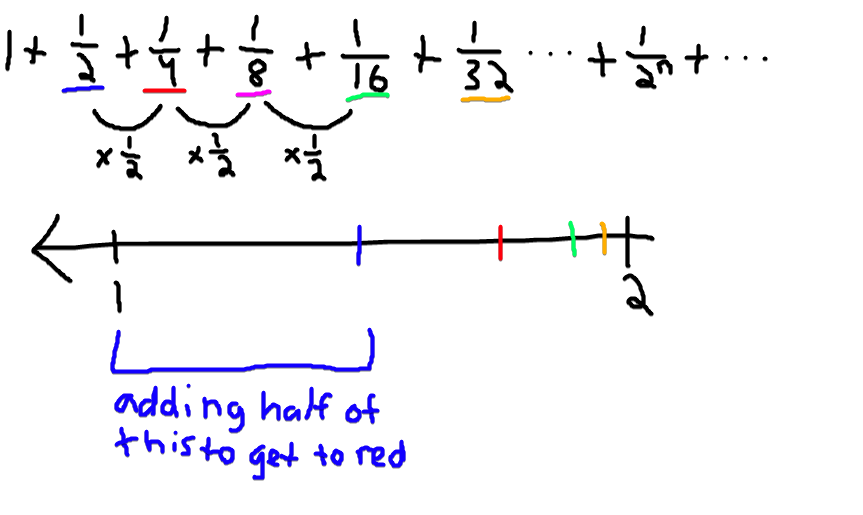
no matter how many finitely many terms you add you never reach 2
probably easier to see than trying to imagine the triangle example
native timber
wait, is he asking why they used S_1000 as the "final element" (using sum of geometric sequence formula) when S is an infinite sequence?
viscid thistle
yea that was part of it at least
 serene heath
,rotate
obsidian monolithBOT
slow roost
So I plugged those in a calculator as
Tan^-1(-1/.658)
And then went on to get mu two angles which are
Radian*
7.272 and 2.152
How do I check if that is equivalent to the original values
Using a calculator
slow roost
Let me see
serene heath
and if they give you -0.658 ur good to go
slow roost
Hold up
viscid thistle
i dont think your answers are gonna work out
slow roost
My answer key says those are the answers tho
@serene heath that’s what I did but it doesn’t match
viscid thistle
- your -1/ is inside the function
serene heath
,w solve cotx=-0.658
obsidian monolithBOT
 Requested by the one n only#3070
slow roost
Requested by the one n only#3070
slow roost
Mhm
slow roost
But how would I check it on a calculator
Shouldn’t it have bee
5.727
I initially got
5.294
viscid thistle
2.152 and 5.294 work
slow roost
Ok
How would I check in my calculator
Lol cause I’m doing something wrong
Oops
Cause that’s what I get back
odd helm
I have a question does it always diverge if it is arithmetic
I mean since we are constantly subtracting it is heading for -infinity right?
So there can’t be a sum
 warped willow
then write diverges?
 dim jungle

Read this too: http://www.bradyharanblog.com/blog/2015/1/11/this-blog-probably-wont-help
More links & stuff in full description below ↓↓↓
EXTRA ARTICLE BY TONY: http://bit.ly/TonyResponse
The sum of all natural numbers (from 1 to infinity) produces an "astounding" resu...
viscid thistle
bruh
wise kelp
It's true, I calculated it
 frozen needle

 valid violet
what's true
wise kelp
That 1+2+3+4+5...=-1/12
It turns out that if you add up all the numbers, you do in fact get -1/12
You just gotta be persistent
zealous sail
shouldn't zero be included on the bottom one?
or really there should be another line 0 x = 0
 native sequoia
we like to keep the sub-domains disjoint
zealous sail
what is that in simple english?
native sequoia
idk
by subdomains I'm referring to x>0 etc..
and the pic is correct
pale kettle
It doesn't matter
The function is defined at x = 0
Since it is part of the first part
There's no reason to define it again in the second part
viscid thistle
For question 8, why do I need to mutually by ( x - 3)squared
I mean if I just mutually by (x -3 ) I only get one answer?
Multiply *
 uncut mulch
there are multiple ways to approach it
it is multiplied by (x-3)^2 here since it is known to be positive
viscid thistle
?
uncut mulch
and won't affect the direction of the inequality
viscid thistle
Why can’t I just multiply by (x-3) then?
viscid thistle
Bruh
uncut mulch
because x-3 isn't positive for all x (x != 3)
viscid thistle
Yeah?
 patent beacon
So if you multiply or divide by a negative quantity, you have to switch the inequality
viscid thistle
Oh is is because x - 3 will be always be positive when squared? That’s why we multiply by that?
Ok
patent beacon
You can multiply by x - 3, but you have to do two cases for the different possibilities


 uncut mulch
turning it into a quadratic inequality allows you to solve it graphically
viscid thistle
Oh but if I multiply by (x-3) how do I do the two cases?
patent beacon
Do one where x - 3 is positive
And another where x - 3 is negative
uncut mulch
yeh. but try getting there yourself, i'm guiding you through this method
step1: multiply both sides by (x-3)^2
viscid thistle
uncut mulch
no, that isn't multiplying both sides by (x-3)^2
(that is multiplying both sides by x-3, assuming x-3 is positive)
viscid thistle
uncut mulch
be careful with the direction of the inquality
viscid thistle
Yeah
uncut mulch
after subtracting both sides by 5(x-3), you'll get **stuff > 0 **
viscid thistle
Oh
uncut mulch
also it was unecessary to expand like that
viscid thistle
uncut mulch
it is easily factoriseable in the form
2**(x-3)^2 - 5(x-3)** > 0
uncut mulch
alternatively if you want to go down the route for just multiplying by x-3, then
FOR x-3 > 0 → x > 3
5 < 2x - 6 → x > 11/2
x > 3 AND x > 11/2 → x > 11/2
FOR x-3 < 0 → x < 3
5 > 2x - 6
x < 11/2
x < 3 AND x < 11/2 → x < 3
uncut mulch
another method is to combine them into a single fraction and analyse signs
$\frac {2x - 11}{x-3} > 0$
obsidian monolithBOT
ramonov:
viscid thistle
I actually learnt in equality last year and I was doing practice question and stumbled Upon this one
The textbooks are not in depth enough tho
uncut mulch
just be careful when multiplying inequalities with unknowns
slow roost
can someone help me with this
That’s all I have right now
And no, I don’t know what the addition formula for sine is
valid violet
so go learn it
slow roost
...
lol
my test is tomorrow and my class is the only class that was given this lesson which did not go over much
odd helm

This trigonometry video tutorial explains how to use the sum and difference identities / formulas to evaluate sine, cosine, and tangent functions that have angles that are not commonly found in the unit circle. Examples include angles both in degrees and radians.
You can use this to learn it ig
slow roost
i learned that
odd helm
Oh
odd helm
Oh well the tan is in that vid so if you need to learn that you can use this vid
 little owl
I never used/learned the tangent one
odd helm
I did
But I forgot it since I learned it a while ago
Sin and cos are easy to remember
slow roost
yeah
Cos is just opposite of what u would think
but idk how to apply it to 15
would i convert everything to angles
and then ask what combinations make up sin pi/2 aka 90º?
odd helm
I mean the sin of pi/2 = 1 and the cos= 0
slow roost
uhuh
slow roost
but its sin pi/2 + sintheta= cos theta
sin pi/2 is 1
so isnt that 1+sintheta=cos theta
odd helm
I thought the formula was sinxcosy +sinycosx
odd helm
So if it is sin(90+ theta) it would be sin(90)cos(theta)+cos(90)sin(theta)
slow roost
oh ok
odd helm
So 1 times cos(theta) just leaves cos(theta)
odd helm
You’re welcome
 untold cliff
Let cos(theta) = u and solve for u. As u = cos(theta) it will equal the solutions to u, should be 2 of them, find theta
slow roost
there 4 of them
slow roost
so would it be
cosroot2/2
so i got
pi/4 and 7pi/4
but then u have to realize isnt it cos= root2/2 and cos -root2/2
so u get 4 answers
untold cliff
oh i thought u were talking about before that, ya
untold cliff
seems fine
viscid thistle
Find cos<E
Is there enough info to solve this?
@viscid thistle what letter is that in the bottom left
D
@viscid thistle
Ahaha, either way, no, I do not believe that is solveable without more information
are you sure you copied it down correctly?
Yup I drew the exact same thing as on my paper, the question literally only says "Find cos<E"
what does cos<E mean?
There's nothing even in the previous problem that relates to this one
Cos of the angle E
warped willow
yea no
viscid thistle
How to do this question? I set delta greater than 0 and didn’t know how to continue.
viscid thistle

willow bear
what did you get for delta
viscid thistle
yes
willow bear
for the exact same reason that's true for any other quadratic
viscid thistle
doesn't this mean there is no maximum number?
ann
@willow bear
if the discriminant is negative, that means there are no real roots?
willow bear
the discriminant being negative means that a^2 + 4a - 8b - 12 = 0 never happens
which is exactly what you want
viscid thistle
oooohhh
dang
if I got this question right
my concepts are that great yet I guess ...
 summer monolith
Is this true?
willow bear
$a(bc) = bac$ yes
obsidian monolithBOT
Ann:
willow bear
because multiplication is associative and commutative
summer monolith
Why lna remains unmultiplied by a^x^2 ?
willow bear
yes you did.
 green zenith
What do they mean by eliminating x from the 2nd equation by adding -2 times the first equation to the second?
wise kelp
,rotate
obsidian monolithBOT
obsidian monolithBOT
GrandPiano:
wise kelp
You can multiply both sides by -2 to get $-2x+2y=-2$
obsidian monolithBOT
GrandPiano:
wise kelp
And then adding this to the second equation gets you $2x+y+(-2x+2y)=6+(-2)$
obsidian monolithBOT
GrandPiano:
wise kelp
Which simplifies to $3y=4$
obsidian monolithBOT
GrandPiano:
wise kelp
@green zenith
The goal is to get an equation with just one variable, so if you make it so one equation has -2x and the other has 2x, you can add them together and the x's will cancel out, leaving you with just y
Though I don't know why they didn't just add the equations together as they are and eliminate y
green zenith
Ahhh now i get it
I wasnt familiar with adding equations
So i literally just add lh to lh and rh to rh when adding equations?
Anyway, thanks for the answer @wise kelp
wise kelp
Yeah, since the left hand side and the right hand side are equal you're still adding the same amount to both sides
Np
 blissful wadi
any help with this limit please
i prooved this before but idk how to use it to get the limit
serene heath
what if f(x)=arctanx-x
blissful wadi
obsidian monolithBOT
dvaix:
blissful wadi
x goes to 0
frozen needle
You can rewrite it as $\displaystyle\frac{\arctan!\prn{\frac x{x+1}}-\frac x{x+1}-\frac{x^2}{x+1}}{x^2}$
obsidian monolithBOT
Tuong:
frozen needle
$\displaystyle\lim_{x\to 0}\frac{-\frac{x^2}{x+1}}{x^2}$ is easy to deal with, the difficulty lies in the calculation of
$$\lim_{x\to 0}\frac{\arctan!\prn{\frac x{x+1}}-\frac x{x+1}}{x^2}$$
obsidian monolithBOT
Tuong:
frozen needle
$$\lim_{x\to 0}\frac{\arctan!\prn{\frac x{x+1}}-\frac x{x+1}}{x^2}=\lim_{x\to 0}\frac{\arctan!\prn{\frac x{x+1}}-\frac x{x+1}}{\frac{x^2}{(x+1)^2}}$$
obsidian monolithBOT
Tuong:
frozen needle
I multiplied by something that tends to 1, it doesn't change anything
but then this limit can be seen as
$$\lim_{t\to 0}\frac{\arctan(t)-t}{t^2}$$
obsidian monolithBOT
Tuong:
frozen needle
and that looks a lot cleaner
obsidian monolithBOT
Whoever:
frozen needle
would you be able to calculate that limit, @blissful wadi ?
viscid thistle
what
viscid thistle
isnt that what he started with
blissful wadi
yeah
isnt that what i started with ?
it will give me 0 times +inf
just like the first expression
doesnt it ?
frozen needle
no
blissful wadi
hm
frozen needle
what do you know about arctan?
blissful wadi
reverse function of a restriction of tan
arctan (t) = -arctan (-t)
lim x goes to 0 arctan(x)/ x = 1
lim in 0 is 0
frozen needle
most of this stuff isn't very useful
blissful wadi
well thats all we know atm about arctan
i dont see the idea tbh
in your expression
for me its similiar to the original one
frozen needle
what do you know about arctan's regularity?
valid violet
If it helps, (arctan(t)-t-(arctan 0 -0))/(t-0) as t goes to 0 is the derivative of arctan -t at 0
blissful wadi
"arctan's regularity" dont know what thats is
frozen needle
continuity, differentiability, etc.
frozen needle
So you can write $\arctan t$ as $\int_0^t\frac 1{1+u^2}\dd u$ for all $t\in\bbR$
obsidian monolithBOT
Tuong:
valid violet
I like my idea ✋
frozen needle
do you know Rolle's theorem?
blissful wadi
yes
valid violet
Yeah i fixed it as you were correcting me
blissful wadi
yeah that's a better ideaa i see it working
valid violet
But
If you're not allowed to use lhr
I'm not sure this is allowed
It's similar to lhr
valid violet
Lhopitals
blissful wadi
if thats what u mean i've see it being used once or twice by my prof even tho he said there always a way arround but i guess its acceptable
@frozen needle what about rolle ?
frozen needle
you can prove a very cool theorem using Rolle
you can show that for all $t\in\bbR$, there exists $c_t$ strictly between $0$ and $t$ such that
$$\arctan(t)-t=\arctan'''(c_t)\frac{t^3}6$$
obsidian monolithBOT
Tuong:
blissful wadi
whats Ct ?
valid violet
some constant
frozen needle
some number that exists
frozen needle
it depends on t so that's why I put a t in the index
blissful wadi
oh yeah
frozen needle
to prove that,
fix $t$, and have a look at the functions $\delta:\bbR\to\bbR$ and $\Delta:\bbR\to\bbR$ defined by
$$\forall u\in\bbR,\quad\delta(u)=\arctan(t)-\arctan(u) - \frac 1{1+u^2}(t-u)-\frac{2u}{(1+u^2)^2}\frac{(t-u)^2}2$$
and
$$\forall u\in\bbR, \quad\Delta(u)=\delta(u)t^3-\delta(0)(t-u)^3$$
obsidian monolithBOT
Tuong:
frozen needle
Rolle's theorem applies to Δ
blissful wadi
oh so you used the theoreme of " acroissements finis " ( idk the name of it in english ) and made a new fuction of it
frozen needle
ah tu es français !
blissful wadi
marocain plutot mais on etudie en langue francaise
frozen needle
vous avez fait l'inégalité de Taylor-Lagrange ?
blissful wadi
non pas encore
frozen needle
Bon, grossomodo, le théorème de Rolle peut s'appliquer à Δ, car Δ(0)=Δ(t)=0 et Δ est dérivable partout
donc il existe c quelque part entre 0 et t tel que Δ'(c)=0
et quand tu calcules Δ'(c), ça te donne l' égalité annoncée avant
blissful wadi
mais ca cest coté theorique plutot pour deduire que la limite existe
nest ce pas ?
ma question est de calculer la limite
frozen needle
quand on a fait beaucoup de limites, on prédit que (arctan(t)-t)/t² ça tend vers 0 quand t tend vers 0
ou quand on connaît un peu plus sur arctan et les dérivées
blissful wadi
plus evidente puisque h(x) = 0
lorsque x = 0
plus une simple application de hopitale ocnfirme que cest 0
mais comment lacalculer cest ca le prob
frozen needle
T'as réussi à suivre tout depuis le début ou il faut recommencer ?
blissful wadi
franchement j'ai pas bien compris mais la ya la methode de montrer que c'est le derive de (arctan (t) - t ) en 0 et j'ai encore 4 question a faire
sinon ta pas a video qui explique cette methode que tu viens de faire ?
frozen needle
Le truc de la dérivée ça aurait marcher s'il n'y avait que t au dénominateur, mais là ya t²
Le théorème c'est "égalité de Taylor-Lagrange"
Tu peut aller voir la démo sur wikiversity
c'est juste le théorème de Rolle appliqué à une bonne fonction
blissful wadi
ah cest un theoreme j'ai cru que cest une petit conclusion de rolle de ta part xD
frozen needle
mais le théorème le plus pertinent ici serait quand même la formule de Taylor-Young
avec les développements limités tout ça tout ça
avec les développements limités, tu fais direct arctan(t)=t+O(t³) quand t tend vers 0 et pis voilà
blissful wadi
les developpements limités nous donne une fonction egale ou presque egale ?
je peux substituer arctan (t) par t+o(t^3) pour calculer la limite
frozen needle
Le développement limité donne une description du comportement asymptotique
c'est pas une égalité, il faut faire attention
et pour le o(t³), il faudrait écrire un terme -t³/3 en plus
terme qui est mangé si tu écris le développement avec O(t³)
blissful wadi
franchement ca me fait du mal a la tete , evidemment ton niveau est plus haut que le mien alors ces methode la sont normal pour calculer une limite pour toi
pourtant la pour nous c'est hort programme tous ca
et si je me rappelle bien on utilise ce developpement limité pour encadré la fonction orignal nest ce pas ?
frozen needle
on utilise un développement limité pour obtenir une description d'un comportement asymptotique
blissful wadi
oui je sais , le cas pour une asymptote oblique par exemple
mais la on l'utilise que pour tracer des courbes
blissful wadi
bah a mon niveau cest que pour les Cf
ptdr meme la methode de derive ne marche pas a cause de t^2 j'ai pas fait attention au debut
j'ai fait 2h sur une limite 😂
blissful wadi
oh
managed to get it
@frozen needle Je me suis souvenu que le prof nous a donner cette inegualité pour nour aider dans un exercice similaire
frozen needle
ah oui c'est pas mal ça
blissful wadi
c'est ca pk j'ai dit avant que les developpelemnts limités nous donne un encadrement
frozen needle
$|\cos(t)-1|\leq\frac{t^2}2$ et $|\sin(t) -t|\leq\frac{|t|^3}6$ sont plutôt pas mal aussi
obsidian monolithBOT
Tuong:
blissful wadi
noté meeerci
frozen needle
Le résultat balèze derrière tout ça c'est vraiment l'inégalité de Taylor-Lagrange
blissful wadi
c'est au sup ca
frozen needle
Oui
blissful wadi
chui enecore en bac SM
je sais pas c'est quoi lequivalacne de bac marocain au france
2eme annee bac plutot
frozen needle
moi non plus, ils ont changé beaucoup de chose depuis l'année où j'ai eu mon bac
(en 2017)
blissful wadi
votre bac c'est la derniere annee du lycee ?
frozen needle
oui
blissful wadi
a quelle age ?
frozen needle
les plupart des gens ont leur bac l'année de leur 18 ans
blissful wadi
ah
meme chose pour nous
17 / 18

Examen National Mathématiques Sciences Maths 2019 Normale - Sujet, Examens Nationaux, Mathématiques 2ème BAC Sciences Mathématiques A BIOF, AlloSchool
exam national pour le bac marocain
odd helm
Why is the answer negative?
y is being raised to the 12 so
Wouldn't that make it a positive?
wise kelp
It’s not $\left(\left(-y\right)^4\right)^3$, it’s $\left(-y^4\right)^3$
obsidian monolithBOT
GrandPiano:
wise kelp
$-y^4=-(y^4)$
obsidian monolithBOT
GrandPiano:
wise kelp
@odd helm
ripe dust
Huh does someone know where the proof for the identity is
I don't know how I could have solve without knowing that
also tried to search on google
Can't find anything abot it
or if you got another way to solve it just lmk
fluid shore
Search for the proof of the addition identities for trigonometric functions
You should get something for that
ripe dust
👍 ty
got it
geez so many stuff to remember for calc 
does anyone know if there's another way to solve what I posted without using that proof?
fluid shore
Don’t forcefully memorize it. Just focus on learning it properly and it’ll automatically come to you
ripe dust
Ah god I tried to replace sinx by sqrt(1-cos^2x) but it ended up in some horrible newton raphson shit 😂
this identity is fairly easy to remember I just have to set y to x
fluid shore
Well you can derive it and you’ll end up remembering it
 undone pawn
yes
harsh cipher
I wans't sure if I had to use properties of logs extended power rule
undone pawn
bring it to the form $2^{\log_{2} x^a} $
obsidian monolithBOT
FlynnXD:
obsidian monolithBOT
FlynnXD:
undone pawn
you're misusing this
you can't just bring the 3 along with it
get rid of the 3 somehow
harsh cipher
well.
when we make log base 8 into base 2
we get 2^3....
2^log base 2 get cancelled...
We're left with 3 x 27 ^ x?
I get confused where the 3 goes after we make the bases the same.
 stuck lark
i see two ways to do this. rewrite the log in the exponent into base 2 or rewrite the base of the exponent to base 8
harsh cipher
thats power rule in reverse
obsidian monolithBOT
FlynnXD:
harsh cipher
thats the same thing
undone pawn
use this to get rid of the 3 you have
right now you have $2^{\frac{1}{3}\log_{2} x^{27}}$
undone pawn
whoops
obsidian monolithBOT
FlynnXD:
harsh cipher
see that's where I'm getting confused
harsh cipher
okay..I still don't get or forgot how to bring the 1/3 infront of log
undone pawn
$\log_{b^n} a = \frac{1}{n}\log_{b} a$
obsidian monolithBOT
FlynnXD:
harsh cipher
im looking at this
and im going crazy haha
Free factor calculator - Factor quadratic equations step-by-step
ok I need to figure out what above formulae was...
what is the name of that formula
undone pawn
let $\log_{b^n} a =c$
harsh cipher
log base b n a = 1/n log base b a
obsidian monolithBOT
FlynnXD:
undone pawn
then by definition, $(b^n)^c = a$
obsidian monolithBOT
FlynnXD:
undone pawn
so $b^{nc} = a$
obsidian monolithBOT
FlynnXD:
obsidian monolithBOT
FlynnXD:
undone pawn
so $nc = \log_b a$
harsh cipher
Im very very confused to tell the truth
obsidian monolithBOT
FlynnXD:
undone pawn
so $c=\frac{1}{n}\log_b a$
obsidian monolithBOT
FlynnXD:
undone pawn
hence proved the rule i just told you
harsh cipher
If this question is not on the test i will not be happy that's for sure.
either way I want to learn how to solve it
undone pawn
alright
harsh cipher
damn it it's taking up a lot of my time...sigh 😛
undone pawn
just clear your mind and focus
harsh cipher
k
undone pawn
see the rule i wrote above, and see the next few lines for a proof
use that rule, the 3 comes out
and then use what you call the "power rule" to simplify
odd helm
I used combinatorics for part 1 and permutation for part 2
Could someone explain why it’s in the opposite order?
 heady jewel
What do you think is the difference between combinations and permutations
willow bear
"combinatorics" is the name for the entire field of math
nCr is called "combinations"
harsh cipher
hi
what log rule is this
\log _{a^b}\left(x\right)=\frac{1}{b}\log _a\left(x\right)
@obsidian monolith \log _{a^b}\left(x\right)=\frac{1}{b}\log _a\left(x\right)
valid violet
dollar signs
harsh cipher
$\log _{a^b}\left(x\right)=\frac{1}{b}\log _a\left(x\right)
$ \log _{a^b}\left(x\right)=\frac{1}{b}\log _a\left(x\right)
valid violet
both sides
harsh cipher
$\log _{a^b}\left(x\right)=\frac{1}{b}\log _a\left(x\right)$
obsidian monolithBOT
אewb64:
valid violet
write $\log_{a^b}(x) = \frac {\ln(x)}{\ln(a^b)}$
obsidian monolithBOT
gfauxpas:
harsh cipher
natural logarithm?
obsidian monolithBOT
gfauxpas:
valid violet
doesn't matter
harsh cipher
im trying to solve this problem
and I don't understand the section where it has the light bulb icon
Free factor calculator - Factor quadratic equations step-by-step
valid violet
I'm telling you where the rule comes from
pic a logarithm and do a change of base of logarithm
$\log_x(y) = \frac{\log_{10}(y)}{\log_{10}(x)} = \frac{\log_{e}(y)}{\log_{e}(x)} = \frac{\log_{2}(y)}{\log_{2}(x)}$
obsidian monolithBOT
gfauxpas:
harsh cipher
okay...
valid violet
$\log_{a^b}(x) = ?$
obsidian monolithBOT
gfauxpas:
harsh cipher
$\log_{b/a}=a$
obsidian monolithBOT
אewb64:
valid violet

valid violet
use the rule I told you to use
harsh cipher
change of base
harsh cipher
listening
valid violet
$\log_y(x) = \frac{\log_{2}(x)}{\log_{2}(y)}$
obsidian monolithBOT
gfauxpas:
valid violet
agree?
harsh cipher
totally yes
valid violet
now try this with y = a^b
harsh cipher
log y / log a?
valid violet
where'd the b go
just take the equation I typed and everywhere you see "y" put in "a^b"
harsh cipher
I need to redo my lesson from changing to exponential equation to log form
valid violet
we're not using the exponential equation at all
harsh cipher
y= a^b is in exponential form?
harsh cipher
yeah
obsidian monolithBOT
gfauxpas:
valid violet
every time you see the symbol "y" in this equation
take your mental eraser and scrub out the "y"
and instead write in "a^b"
$\log_{\phantom{y}}(x) = \frac{\log_{2}(x)}{\log_{2}(\phantom{y})}$
obsidian monolithBOT
gfauxpas:
obsidian monolithBOT
אewb64:
Compile Error! Click the  reaction for details. (You may edit your message)
harsh cipher
shoot
valid violet
$\log_{b}|(x)= \frac{\log{2}(x)}{\log{2}(b)}$
obsidian monolithBOT
gfauxpas:
valid violet
uhh
whateve ryou were trying to write
look
$\log_{a^b}(x) = \frac{\log_{2}(x)}{\log_{2}(a^b)}$
obsidian monolithBOT
gfauxpas:
valid violet
do you see why this is true
harsh cipher
it's the change of base rule
harsh cipher
its like trying to solve 14 = 2^x
valid violet
no
I'm not trying to solve anything
I am just trying to rewrite the logs as logs with a different base
$\log_{r}(s) = \frac{\log_{2}(s)}{\log_2(r)}$
agree or disagree?
err its backwards again
obsidian monolithBOT
gfauxpas:
valid violet
okay
harsh cipher
how does that relate to my question
valid violet
is this equality still true if I rename "s" to "x"?
harsh cipher
yea
valid violet
is it true if I rename "r" to "a^b"?
harsh cipher
yea
obsidian monolithBOT
gfauxpas:
obsidian monolithBOT
gfauxpas:
valid violet
?
harsh cipher
kind of...
valid violet
until now you agreed that you can rename the variables anything I'd like
s to x, and r to a^b
harsh cipher
yea
valid violet
so why "kind of"?
obsidian monolithBOT
אewb64:
valid violet
what about it
harsh cipher
its multiplying 1/b?
valid violet
I didn't get there yet
because you are having trouble first with the change of base formula
and I need to get that worked out first
harsh cipher
uh
would you call this reciprocal law for logarithm?
cuz that's what I learned in my online lessons
valid violet
$\log_{a^b}(x)=\frac{\log_2(x)}{\log_2(a^b)}$
obsidian monolithBOT
gfauxpas:
harsh cipher
-_-
valid violet
I cannot help you until you are 100% convinced of this equality
harsh cipher
I got it
harsh cipher
yea
obsidian monolithBOT
gfauxpas:
harsh cipher
if you change the letters or symbols I can explain to you now
harsh cipher
=1?
valid violet
$\log_{a^b}(x)=\frac{\log_2(x)}{\log_2(a^b)}\text{ and }\log_2(a^b) = b \log_2(a)$
obsidian monolithBOT
gfauxpas:
valid violet
$y=\frac xz \text{ and } z = t , \text { then } y=\frac xt$
harsh cipher
I get that
obsidian monolithBOT
gfauxpas:
harsh cipher
Ok
valid violet
I cannot give you any more hints without telling you the answer
$\log_{a^b}(x)=\frac{\log_2(x)}{\log_2(a^b)}\text{ and }\log_2(a^b) = b \log_2(a)$
obsidian monolithBOT
gfauxpas:
valid violet

harsh cipher
what do you want me to write?
top part is supposed to be
log base (x) should be log a^b
(x)
not log base (x)
valid violet
I'm sorry i don't know how to explain it any more than what i did.
Try taking a 10 minute break then reading it again
 agile steppe
For number 3, shouldn’t it be 1-2A^2 ?
It says 1-A^2 (I don’t know if I did something wrong, but I still think it is 1-2A^2
I mean, I remember the identity was 1-2sin^2theta
Please tell me if I am wrong
valid violet
Yes im asking him
harsh cipher
Ann
willow bear
anyway... he's right
harsh cipher
were you here the whole time?
willow bear
no
harsh cipher
hahah okay
valid violet
Ann maybe you can help me help newb
willow bear
@agile steppe yes it should be 1 - 2A^2
@valid violet i'd rather not. i'm having a bit of a pain spike and i'm also kinda tired
harsh cipher
hahahaha
harsh cipher
yea
valid violet
Let y = log_a^b(x)
r=log_2(x)
s=log_2(a^b)
t=b log_2(a)
Do you agree that y = r/s
harsh cipher
No
valid violet
@agile steppe sorry coldstein i took the question at face value, their identity is false