#precalculus
1 messages · Page 190 of 1
 viscid thistle
for 2 reasons
at least
one is that it should be going through the origin just from looking at the volume equation
viscid thistle
and another is we have a domain of (0,5)
 void quiver
viscid thistle
void quiver
void quiver
viscid thistle
oh
void quiver
yeah
but i think she won't take off to many points for graphing
just the max volume
viscid thistle
honestly id only graph it for the domain
void quiver
cause you do
2nd trace
then find max
you guess max and you go off
the y vavule it gives you
then for d you go off the x vauvle
to see how much you need to cut
which then is 2.15 x 2.15
units are in^3
viscid thistle
ok didnt realize this was a graphing calculator activity
viscid thistle
yea it looks right
viscid thistle
what is that doing?
void quiver
findin where it intersects
and shows you ho wmuch you shoud cut
i think i got that down
viscid thistle
oh did you put another equation in
void quiver
yeah
viscid thistle
ok i see
viscid thistle
yea i see
viscid thistle
sure
void quiver
viscid thistle
ok for the first one
start with a side length of x
ok jeez i dont know how to explain without just giving the answer
void quiver
void quiver
wait so it would be the other way
viscid thistle
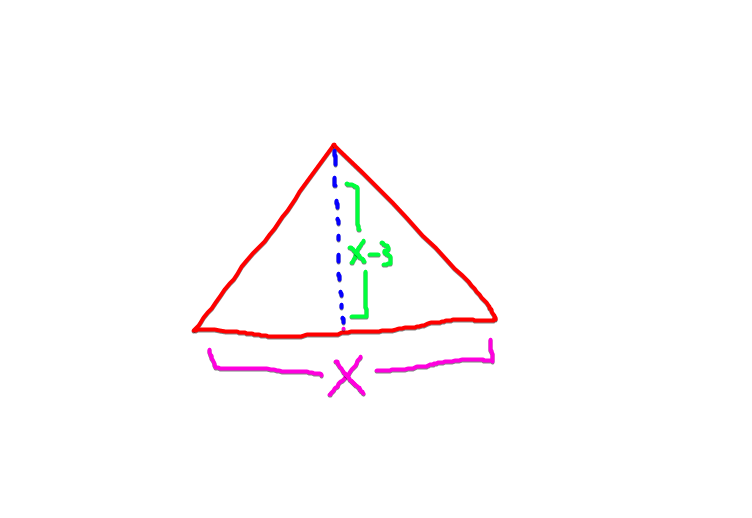
you can find the height of a triangle like that right?
void quiver
wouldn't it?
viscid thistle
not sure what you mean by other way
viscid thistle
that wouldnt help
void quiver
and the x-3 would be the height
viscid thistle
you probably know what i mean if you have any geometry experience at all
void quiver
see
i had a perverted geo teacher
that didn't teach
are you supposed to use hypothiense thingy
viscid thistle
its a line that is perpendicular to a side of a triangle and crosses through a vertex of the triangle
a side and vertex that are opposite of each other
viscid thistle
ok well we want something kind of like the middle one
lets call the bottom side of the triangle x
viscid thistle
the base is supposed to be x
or...
it could b x+3 i suppose but i think that will make computations slightly more annoying
void quiver
so what do i do next?
viscid thistle
or the base could be x-3 and height x-6
well one other thing is that side length on the right isnt x
that side length wont matter actually
we just need to fix the base and height
void quiver
could you draw a diagram?
viscid thistle
 viscid thistle
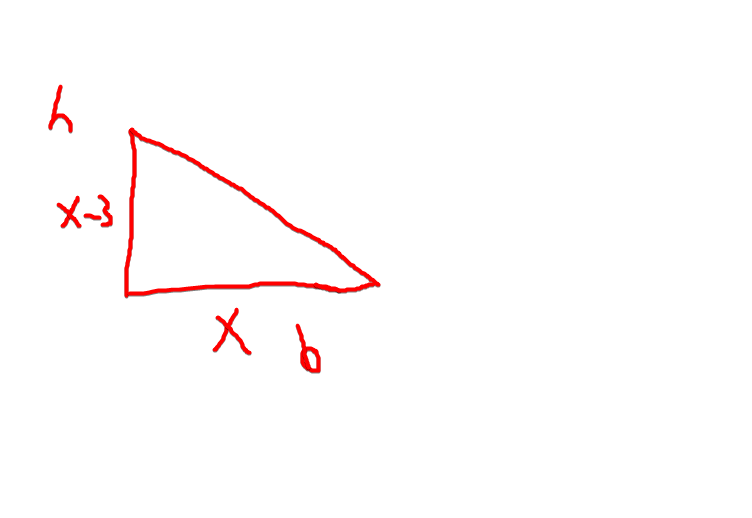
actually this can maybe be simplified
viscid thistle
https://i.imgur.com/PvCJSCA.png i think we can just do this instead lol
 viscid thistle
but the altitude approach would work as well if we assumed the triangle to be isosceles
its just a triangle area calculation
$\frac{bh}{2}$
 obsidian monolithBOT
Botnuke:
viscid thistle
over 2
void quiver
and thats the equation?
viscid thistle
yes
viscid thistle
that diagram doesnt lead to that equation in one step
because it would be 2 separate triangle areas added together
each with a base of x/2 and h of x-3
viscid thistle
and also probably better to replace x with b in the final equation
viscid thistle
since b=x and it kind of asks the question in terms of b
viscid thistle
replace x with b
void quiver
now to b LMFAO
its fine
I NEED TO LEARN
FOR THIS TEST
ITS WORTH 40%
I THANK YOU SO MUCH
so
A triagnle whose height is the square root of its base
what now
viscid thistle
we can just construct this in our head really
no need to draw anything
lets call the base b
what do we want h to equal?
void quiver
the sqaure root of the base
obsidian monolithBOT
Botnuke:
viscid thistle
so you can just substitute that in for h
viscid thistle
yes
viscid thistle
alright lemme google cone volumes first
void quiver
uh
viscid thistle
dont need?
viscid thistle
what would be?
void quiver
the volume
wait i think i got it
its fine
but i need help on this
Write an equation for your new salary after receiving a 2.5% raise.
viscid thistle
if x is your salary, 1.025x is your new salary?
viscid thistle
if thats the whole question then id think so yea
viscid thistle
ya i think thats all it wants
void quiver
so like
viscid thistle
let x be your salary, 1.025x is your new salary
void quiver
OH
viscid thistle
1x+0.025x = 1.025x
void quiver
ic
okok
i think
im done
besides the grain problem
if you can do it and tell me the asnwer and compare
then sure
viscid thistle
if my fortitude lasts long enough
viscid thistle
you first
viscid thistle
not sure i dont remember seeing one but it could be
void quiver
viscid thistle
the initial volume should use 4 as h yea
viscid thistle
keep in mind there are 2 h's in the equation not just 1
void quiver
9.424.
viscid thistle
that seems way too low
viscid thistle
i think you missed putting in a 4 somewhere
void quiver
viscid thistle
what does the radius equal?
viscid thistle
yes, r=1.5h and h=4
viscid thistle
i think that is what i got yea
viscid thistle
where did you get that?
viscid thistle
how are you getting 60 from that?
viscid thistle
so, 160?
viscid thistle
yep
viscid thistle
we want to find the height when the volume is 310.796
void quiver
r=6/4
viscid thistle
r gets squared for cone formula doesnt it?
viscid thistle
im not sure actually i didnt throw the final form into calculator lol
viscid thistle
(not ft^3 btw)
viscid thistle
thats so funny to think about
viscid thistle
i mean thinking about how it could be possible i helped in all the wrong ways leading you to all the wrong answers
viscid thistle
given i think i have helped you arrive at correct answers
its funny to think about how its possible they could be all wrong
viscid thistle
this is one that can be easily checked by yourself
just multiply out your final answers
and see if they add to 150
or 149.999 for rounding
viscid thistle
ok im off to do math for 5 hours cya and ty for the ti84 help
 sick lava
How do i find solution set for sin x = .31
 gilded prawn
 uncut mulch
draw a triangle
 fluid shore
Lmao ‘draw a triangle’ is probably the most commonly given advice and it’s possibly the most commonly ignored advice for such problems
 trim fable
hii
@uncut mulch remember mee
i have a question how would u do this
coz u cant change 48 to a common base of 2
im confused
uncut mulch
didnt we do something similar or this exact question last time?
start with manipulating the left side
are you able to factorise it?
uncut mulch
iirc the hint I provided was
a^(m+n) = a^m * a^n
uncut mulch
nothing yet, try factorisingbthe left side
after splitting the exponent like that, the next step should be clear
trim fable
factor the 2?
trim fable
2^x
uncut mulch
yes
uncut mulch
the thing it's being multiplied to does
trim fable
oh true
so then why didn't
we just leave it like the
original question
and just factor in
the first place?
uncut mulch
you could, but if you were struggling to see stuff, you need this step
trim fable
oh
yeah
true
thank uuuu
so the thing with
these types of questions
is that u have to try to work with one side
then
isolate?
ok
so can i do this one with u
so u can
see if
uncut mulch
sure
uncut mulch
yep
trim fable
yayyyy
uncut mulch
what have you thought about?
trim fable
what i did so far is
3^3x(3^4x-2)=3^x+4
then u know how its 3x so isn't that just
(3^3)^x
uncut mulch
put parentheses in appropriate places
trim fable
uh
uncut mulch
$3^{3x} \cdot 3^{4x -2} = 3^{x+4}$
trim fable
oof
obsidian monolithBOT
ramonov:
uncut mulch
yeh that works
trim fable
ok yay
 upbeat prairie
what does it mean here
"root of a expression"
why did it specifically choose 2/1
trim fable
question
for this
would this be right to isolate for x
16^x+2y =256
2^4x+8y=2^8x-8y
16y=4x
4y=x
viscid thistle
@upbeat prairie you pretty much just have to guess, but of the possibilities that the rational root theorem gives, if there are rational roots, they will be of that form
and there are usually not very many to check
so you can try 1/1 or 13/1, you just might find that they arent roots
or -13/1 or -26/1
etc
 fleet yew
@trim fable wrong
fleet yew
how did you get 256
fleet yew
$32*8^{x-y}\neq256^{x-y}$
viscid thistle
needs {}
obsidian monolithBOT
AMD:
trim fable
oh ok
fleet yew
there is a natural order to things that mustn't be violated
trim fable
how would we do this
ye i figured that one out i complicate things when u can easily simplify lol
i make my life harder
fleet yew
you still have to isolate x
trim fable
ye but
cant u break apart 3x
coz powers get
multiplied
so do that?
but then u would multiply 10 too? coz its in the brackets so nvm?
fleet yew
just use the log lol
trim fable
oh..
question tho
how do u know
when to use log
i dont really get the concept of logs
fleet yew
no you're right mb you can do 1000^x=415
you can
but it's not the most convenient way to do it
trim fable
oh
fleet yew
just take the logarithm of both sides
trim fable
divide by 3
to isolate for x
so x =5
ik that\logs are
the inverse of
exponentials
which kinda gets confusing coz like
why do u have to write the word log
what does log itself mean
like ik its an exponent
technically
but why cant u use a variable? lol
fleet yew
you can't use a variable because it's an operation
trim fable
hmm
so like
but with exponential u just
raise the base to a power but
like we dont write
exponential of something
so like the log itself makes it confusing
fleet yew
it's just mathematical convention
fleet yew
it's not based on any divine law or anything
fleet yew
it's short for logarithm
fleet yew
i think it's from arabic or smth idk
trim fable
wow
fleet yew
no wait it's greek
fleet yew
so 10^3x=415
3x=log(415)
 wise kelp
What's the problem?
wise kelp
What does log mean?
wise kelp
Do you know what a logarithm is
 languid crane
@trim fable inverse of exponential
just like multiplication and division
or
in calc, differentiation and integration
trim fable
oh
languid crane
etc
 red tree
For any invertible function $f$,[f(3x)=415\implies 3x=f^{-1}(415)]
obsidian monolithBOT
Icy001:
languid crane
yea
red tree
(and vice versa)
 stark willow
so $log_b(xy)=log_bx+log_by$
is there any identity for
$log_b(x+y)$
i couldn't find any on rapidtables.
much appreciated.
obsidian monolithBOT
tryingtolearn:
 willow bear
no there isn't
stark willow
thank you
 pseudo sonnet
 torn swift
would still need a trig table to tell you what arccos(-3/5) is
viscid thistle
look at the title of the exercises
but yea you would need a calculator to get a very accurate answer
viscid thistle
https://gyazo.com/b507ab88e791d2fc8da3d3029b451144 how would i reduce this?

its not possible right?
i leave it as that right?
i don't think i can simplify that any more lolz
 undone pawn
yeah you're good
uncut mulch
depends how they want it. you can rationalise the denom using sum of 2 cubes if required
 meager hemlock
im not sure if this is calc or precalc but calc is being used anyway so
i'm totally lost on this question https://cdn.discordapp.com/attachments/559769393995841543/654593094603243532/20191212_015852.jpg
where should i start with it
willow bear
for each point, write out the sign of f at that point
then do the same to f'
then do the same to f''
meager hemlock
what..?
undone pawn
@meager hemlock
what Ann said^^
pretty easily you can see that f(x) is negative everywhere
and you know that f'(x) can be deduced from the slope of the line, which is tan(angle made with x axis) so using that you can see if f'(x) is negative or positive at each point
and I think you can find f''(x) sign by observing the concavity at the point
so use all that to answer the Q
meager hemlock
i can't really see that super easily? it raises up and accelerates up in a few places
willow bear
what part of what i said is unclear?
meager hemlock
because i'm really bad at math and don't understand anything lmao
idk the sign of f
willow bear
do you know how to tell the value of a function at a point from its graph
meager hemlock
I... don't think so?
undone pawn
hm
willow bear

wait what
aight let's forget this questoin for a moment
here's the graph of a function, g
meager hemlock
its 1
willow bear
how do you know
meager hemlock
there are no numbers on the picture i gave you
meager hemlock
casue that's what the y value is at the same point
ohh like positive or negative sign?
undone pawn
yeah.. what else would they be asking
undone pawn
well now you do
meager hemlock
cool
i still dont know what to do with that though
okay.. so if its negative its not negative anymore?
now what
meager hemlock
when you say remove the sign i assume you mean if its a negative y value you just make it positive
all of the points are below the x axis
meager hemlock
what else does "write out" mean
meager hemlock
if the value of the function is increasing from that point, it's positive right
willow bear
what's "it"
meager hemlock
the selected points
languid crane
is this precalculus wth
 eternal flume
if I need to find all x, for which this is valid: log0.5 x is more or equal to log0.5 2
can I say that x can be in this interval (0; 2>
willow bear
$\log_{1/2}(x) \geq \log_{1/2}(2)$?
obsidian monolithBOT
Ann:
willow bear
is this your ineq?
eternal flume
yes, exactly, thanks 😄
so to make this valid, the x must be in an interval (0; 2>, right?
willow bear
are you including 2 itself or not
eternal flume
I'm including 2
willow bear
why are you not writing (0, 2] then
willow bear
...
where are you even from
this is legit the first time i've seen that notation used like that
eternal flume
Middle Europe
Really, first time? 😂
Very common in my country 😂
Anyways, back to the question
is then (0,2] a correct answer?
willow bear
seems so
eternal flume
thanks 😄
upbeat prairie
How are the numbers between -8 and -7 going to be positive for the zeroes?
-7 for example in x - 7 would just equal -14
 valid violet
What does "positive for the zeroes" mean @upbeat prairie
 nova dew
$\lim_{x\to\infty} \frac{n^2 + n}{n^2 + n + 1}$
obsidian monolithBOT
CoolShot:
 rigid beacon
You mean $\lim_{n\to\infty} \frac{n^2 + n}{n^2 + n + 1}$ ?
obsidian monolithBOT
Spamakin🎷:
nova dew
yes sorry
rigid beacon
Ok
Try partial fractions
Oh wait
No no nvm
Look at the terms of largest power in the top and bottom of fraction
rigid beacon
Ok so LaTeX failed but
I was thinking integrals for some reason @willow bear
But yea @nova dew do you remember any properties of limits to infinity
willow bear

rigid beacon
Of rational functions
 nova dew
¹
 heady jewel
no 1
nova dew
y no ¹
 whole fox
How do I do part c I think I've done it wrong
And I dont understand what I've done
<@&286206848099549185>
 whole flint
you done it right
whole fox
oh
but i dont know why haha
whats the difference between what i calculated


and the difference between the point and the green circle
 pure flame
$Tan(a+b) = (Tan(a) + Tan(b))/(1+Tan(a)Tan(b))$
Hi guys! Could you demonstrate me this?
 lost pawn
Write tan(a+b)=sin(a+b)/cos(a+b) then expand and simplify
obsidian monolithBOT
FNDN:
pure flame
I've done that but I didn't get the right.
I'll try it again.
Now, I've realized that I can separete the fraction.

 vestal marlin
What is the lim as x approaches 4 from the positive
valid violet
so the answer is to explain to the reader why the question doesn't make sense
vestal marlin
Or dne?
valid violet
explain why the question doesn't have an answer
 normal sundial
@trim fable let y = 3^x and see if you can solve for y
 cerulean cape
Heyo
I need to know how many coin flips it would take to be 50% and 90% likely to hit 7 total heads
ah, 13 for 50%
and 18-19 for 90% I think
wise kelp
I think you can prove it using the change of base rule
trim fable
ye
ik
i was able to do the first two
but idk how to do c
@uncut mulch hiii can u help me 😛
wise kelp
@trim fable Use the change of the base rule and the rule that log(a^b) = b log(a)
trim fable
yes
wise kelp
Can I see how you got to that
wise kelp
Yeah, see if you can get anywhere with that
viscid thistle
Sin Ø = (root 3)/2, Ø = pi/3 and 2pi/3 right?
 stuck lark
Yes if phi is restricted to between 0 & 2pi (btw don’t use empty set for phi)
viscid thistle
Thx
 slow roost
how is sec29pi/4 equal to -root2
and not root 2
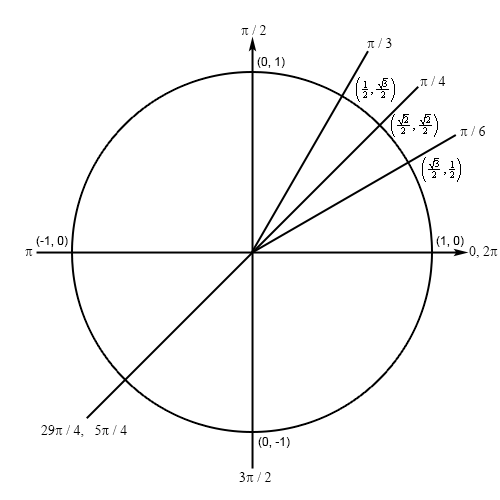
this is the thing i got
so like
for the "bigger" trigs
if its 29pi/4
i would break it down to
28pi/4 + pi/4
so then pi/4 is where i look
and i have to look diagonal from that?
to find the right quadrant
bc i was under the impression that if it was pi/4 then the answer would be positive cause (+x,+y)
but in the pic, it shows you using pi/4 as a director to the quadrant of 29pi/4
 weak pagoda
have u tried simplifying to stay in the quadrant?
instead of just breaking it straight down
weak pagoda
ye it is.
slow roost
ye ok
so then do i take the sign of whatever the coordinate pi/4 is
or do i look across
like diagonal
cause that seems to be working on every problem i try now
cause normally, if i got pi/4
i would be like ok so then is its cos, then it would be positive root2/2
but in this case, theyre showing to look across the pi/4 quadrant
so thats quadrant 3
weak pagoda
u want to stay in quad 3
weak pagoda
with sec
weak pagoda
sure
weak pagoda
well shit now u got me trying to find it
because i see quad 2 but everything is split up for reasoning
quad 2
fluid shore
$\frac{121\pi}{4} = 30\pi + \frac{\pi}{4}$
obsidian monolithBOT
Abhijeet Vats:
fluid shore
Lmao
fluid shore
Yea, just account for that
slow roost
yeah its quad 2 right
fluid shore
You have -pi/4 below the x-axis and you're rotating it clockwise 15 times in a full circle.
slow roost
quad 2
and u get like -1
cause its (-root2/2,root2/2)
and since its tan
you divide it
and it cancels and left w -1
y/x
but if u think of it in terms of quad 4
it results in the same answer
however
the first question i asked
is not
sec29pi/4
it would be quad 3
oops
yes
quad 3?
so then x is -
so its 1/root2/2
which is -root2
whereas if u said it was in quad 1, the answer would be root2
fluid shore
$\frac{29\pi}{4} = 6\pi + \frac{5\pi}{4}$
obsidian monolithBOT
Abhijeet Vats:
slow roost
uhuh
fluid shore
Notice that 6pi is a multiple of 2pi?
weak pagoda
you want to simplify to keep it in the same spot
slow roost
so multiply by common denominator?
like the 6pi
cause 5pi/4 is in quad 3 if im not wrong
fluid shore
So, if you imagine a line joining the origin to a given point, then the 5pi/4 is the angle that the line should make with the x-axis. Then, any multiple of 2pi added to that will just be equivalent to a given number of rotations
Lmao, just calculate it
What's pi/4 in degrees?
slow roost
45
fluid shore
What's 5*45?
fluid shore
So which quadrant is that in?
fluid shore
Yea
slow roost
interesting
but how do u come up with the
5pi/4 tho
like
what im thinking is
you asked yourself what 29/4 was
closest is 6
so thats 6pi right
fluid shore
Ye
slow roost
leaving u with a remainder of 5/4
fluid shore
I was actively looking for a multiple of 2*pi
slow roost
ah wow! thats actually a nice way of thinking of it
but is my way incorrect?
thats what im trying to figure out
would it work in any situation
fluid shore
Uh i'm not sure. Describe it to me again?
slow roost
shit its hard to like
put in words


ok
so that problem was sec29pi/4
the way i do it is
28pi/4 +pi/4
pi/4 would be in quad 1
willow bear
careful
slow roost
i would look-
willow bear
7π isn't a whole number of full turns
fluid shore
Yes
willow bear
so 29pi/4 won't be in the first quad
fluid shore
The idea is to look for a multiple of 2*pi
slow roost
yeah i get that
fluid shore
But it's a good start.
fluid shore
Sure
willow bear
it'd make more sense to write it as -4pi + pi/6
fluid shore
Is 3pi a multiple of 2pi?
willow bear
but tan is pi-periodic
weak pagoda
you want full rotations to be taken out
willow bear
so you don't need to look for EVEN multiples of pi for tan or cot
for tan half-rotations are fine
weak pagoda
dont throw multiples and words out there. big angles = full rotations + leftovers
fluid shore
I mean, it's better to understand the general principles rather than learning specific things
But whatever lel
What do you think?
fluid shore
Are you sure?
fluid shore
Idk, you tell me
fluid shore
You believe it is or are you sure it is?
slow roost
ok
er can i try one more
o
cos 19pi/4
4pi + 3pi/4
3pi/4 is quad 2
cos will be negative
-root2/2
fluid shore
Are you sure?