#precalculus
1 messages · Page 189 of 1
 trim fable
 uncut mulch
could've been simplified more easily without multiplying it out
uncut mulch
can you continue from
log_3( 9sqrt(3))
uncut mulch
try writing it as a power of 3
trim fable
3^ 1/2
trim fable
2
uncut mulch
sqrt(3) = 3^ what?
uncut mulch
yeh,
9sqrt(3) = 3^(5/2)
uncut mulch
yep !
uncut mulch
getting better.
uncut mulch
needs more practice
trim fable
yeah
uncut mulch
6sqrt(2) = 3 * 2 sqrt (2)
 viscid thistle
how would I prove the existence of an inverse implies a function is injective
and the other way
$\forall b \in B: \exists ! a\in A: fa=b \Leftrightarrow \exists f^{-1}: B \to A$.
 obsidian monolithBOT
mop:
viscid thistle
sorry mental blank
$\exists g : B \to A: g \circ f = i_A \wedge f \circ g = i_B \implies \forall b \in B: \exists! a\in A: fa=b$ is ez
obsidian monolithBOT
mop:
viscid thistle
because if the composition of f and g is injective, f and g are injections
could anyone give me a hint about the other way
<@&286206848099549185> has been > 15 mins since q was posted
 uneven pagoda
Hi guys, I'm having a lot of trouble verifying this problem. I'm trying to get one side to match the other. I've tried turning tangents on the left side into sin/cos and finding the GCF but keep getting stuck. Not sure what to do.
 patent beacon
cot(x) = 1/tan(x)
Should be immediate after multiplying top and bottom by tan(x)tan(y)
Converting right to left I mean
patent beacon
Ya
uneven pagoda
What do I do with the -1 on the cotangent side? Does that turn into -(tanxtany)? The rest is good though
patent beacon
Yeah it does
Seeing as that's what you have on the left, that's exactly what you want

 candid onyx
Is this right ?
 willow bear
that -1 there went flying
candid onyx
Lol I forgot to add it in at first
willow bear
anyway ok first off
tan(2x) is 90°-periodic
and second
solutions (in degrees) to one decimal
candid onyx
What do you mean 90 degrees periodic?
willow bear
tan(2(x+90°)) = tan(2x)
solutions repeat every 90° rather than every 180° as with tan(1x)
candid onyx
So add 90 and 180 instead of 180 and 360?
candid onyx
Ok I see now
 topaz fox
is log(n^3 + 6n^2) => log(n^3) + log(6n^2)
?
 stuck lark
no, but log(n^3*6n^2) = log(n^3) + log(6n^2)
viscid thistle
maybe they meant greater-than-or-equal-to?
 fluid shore
Eh, maybe?
fluid shore
Maybe they don't know the convention?
 valid violet
"Equal to or greater than" isn't wrong but peopke dont say it
fluid shore
To be fair, I didn't even know that != means 'not equal' lel
valid violet
I think it's more likely they were misusing implication
Well that's borrowed from computer languages, not math
viscid thistle
Anyone online?
#precalculus for number five, how do I write this mapping it rule?
 gentle vigil
@viscid thistle which sub-question are you finding difficult?
gentle vigil
Firstly, you did correct to notice that it is a decay function. Still you have drawn growth
valid violet
Don't they say the formula in the first line
gentle vigil
@valid violet precisely.
valid violet
Horizontal and vertical something?
viscid thistle
Horisontal stretch and vertical stretch
gentle vigil
Oh okay
viscid thistle
Then there are also horisontal/vertical translations
gentle vigil
Yes
I don't think you can precisely show stretch in a graph paper unless you put many points and sketch it
So you should be able to take care of translations mainly.
For that, you have to find intercepts, asymptotes
viscid thistle
No he wants the final graph of this though. I added my own graph for my own reference for help
But they're stretches I just don't know what the exact values are
gentle vigil
Inverse of coefficient of x tells how much the graph is stretched
1/2 in this example
viscid thistle
Oh I see
viscid thistle
So since there is a 2 that is made to 1/2?
gentle vigil
For example, graph of e^x reaches value e at x=1. But graph of e^{2x} reaches value e at x=1/2. So it is compressed in a way.
Or stretched by 1/2
Like this
Or, compare e^{x/2}
valid violet
Ask yourself
The point (x,y) on the unstretched curve
Corresponds to (?,?) On the stretched curve?
That's how i think of it
If that confuses you ignore it
gentle vigil
If your original graph is exp(-x), yes.
But if you are drawing exp(x). There is a negative stretch as well
Which means, graph is flipped
viscid thistle
Ok I will apply the neg but what about a value of 2?
I'm sorry I'm taking your time, I've been working on this for a while now
valid violet
We can leave whenever we want, you're not keeping osc here :)
gentle vigil
Hahah
gentle vigil
So from 3^{-x} to 3^{-(x-1)}, how would you proceed?
gentle vigil
Sure
gentle vigil
Yes
viscid thistle

gentle vigil
Hpw would you go from 3^{-(x-1)} to 3^{-2(x-1)}
valid violet
What's ry?
gentle vigil
So can you draw it?
@viscid thistle I edited the original text. So there won't be any ry
viscid thistle
Ok
gentle vigil
Please send the plots if possible so I can understand that you are following it
viscid thistle
Ok I need to get graphing paper one second
gentle vigil
Rough sketches will work
Also, now that I know your terminology, I understand what you have written with pencil on your paper and it looks correct.
You can draw final graph with that information.
viscid thistle
Also I put it into a graphing calculator and got a y-intercept of 4 but I'm getting a y-incept of 3
@gentle vigil
Btw thanks for all of your help!
gentle vigil
How are you getting 3?
What procedure are you following?
@viscid thistle you are welcome!
viscid thistle
@gentle vigil
viscid thistle
Isnt it 2^3?
gentle vigil
You have 3 as the base, not 2
viscid thistle
Yup. I thought everything was to the power of 3
I can guarantee that I won't forget that mistake on a test
gentle vigil
I hope you do well!
viscid thistle
Tysm! @gentle vigil
gentle vigil
You're welcome!
 jaunty hornet
hello, can someone help me ? i have to show that this function is odd
jaunty hornet
yup
 spark lance
or maybe not
trim fable
question
jaunty hornet
i showed that it was not even, but playing with power gives me nothing
spark lance
yeah
spark lance
4x + 2
trim fable
oh
jaunty hornet
@trim fable it like 2^(2x) = 8
 spring thunder
i mean that's how multiplication works
trim fable
ok i got the answer yay
LOL
😛
yeah
so its like
2(2x+1)
u know how sometimes u
only multiply the first
spark lance
in what case?
spark lance
you always distribute it
jaunty hornet
bonsoir haha. when i try -f(x) = f(-x), it's just not the same expression
spring thunder
i'm talking about the exponential function
8^x > 0 for any real x that's what i mean
ofc the exponent could be negative here
jaunty hornet
spring thunder
att tu peux pas sortir la puissance comme ça là
spring thunder
tu fais comme si $$-x+\sqrt{1+x^2} = \sqrt{-x+1+x^2}$$
obsidian monolithBOT
emeric75:
spring thunder
ya le petit trick avec les conjugués qui marche bien ici
spring thunder
yes
jaunty hornet
j'vais test, merci !
spark lance
@trim fable first you simplify the 9 and 27 to 3 to the power of whatever
I guess you would get 2x/5 = 3
spark lance
9 = 3^2
27 = 3*3
and when you multiply the 2 by x/5, you actually only multiply the x and do not multiply the 5 by 2
for example if you multiplied 4 by 1/2, you would get 4/2 and not 4/8
spark lance
yeah it's when you're multiplying by a fraction
trim fable
yeah
spark lance
if it's x(y+z) then you distribute
jaunty hornet
le trick du conjugué me mène nulle part je crois, une autre idée ? @spring thunder
trim fable
so then u get
spring thunder
j'en ai pas d'autre tbh
jaunty hornet
yikes
trim fable
2x/5=3
spring thunder
mais je sais que le conjugué marche
trim fable
2x=15?
spring thunder
je l'ai fait avec ptdr
spark lance
yes
trim fable
x=15/2?
spark lance
yup
jaunty hornet
arf bah j'ai pas réussi à l'utiliser pour montrer l'imparité alors
spring thunder
$$\frac{(-x+\sqrt{1+x^2})(x+\sqrt{1+x^2})}{x+\sqrt{1+x^2}}$$
obsidian monolithBOT
emeric75:
trim fable
for 1/27
spark lance
yes, that is correct
jaunty hornet
jusque la j'suis d'accord
spark lance
yeah it's 2
spark lance
what was the original problem?
jaunty hornet
du coup j'suis débile c'est bon, merci ! @spring thunder
spring thunder
👌
spark lance
Is this correct? finding the inverse
uncut mulch
follow their recommendation/instructions
 remote citrus
i dont think that is right
trim fable
really?
uncut mulch
show your work
uncut mulch
stop right there
uncut mulch
you can't multiply into exponents like that
by same base, they want you to convert that 4 to a base of 2
THEN you can multiply them together
uncut mulch
parentheses
that works
uncut mulch
factorise 2^(x+2)
uncut mulch
well to be more specific,
factorise 2^(x+2) - 2^x
trim fable
ye and u get
uncut mulch
how are you getting that?
uncut mulch
do those terms have a common factor?
uncut mulch
just like the last question, you can multiply/divide into/out of expenents like that
trim fable
oh
uncut mulch
essentially you just implied that a^anything = a
trim fable
oh
uncut mulch
a^m * a^n = a^(m+n)
trim fable
oh
 fleet yew
can someone name a function with zeros at every integer
valid violet
$f(x)\equiv 0$
obsidian monolithBOT
gfauxpas:
fleet yew
preferably something that can be expressed in y= form
 atomic zodiac
valid violet
atomic zodiac
valid violet
$y \equiv 0$
obsidian monolithBOT
gfauxpas:
viscid thistle
https://math.stackexchange.com/questions/3468897/finding-log-ef-in-terms-of-log-ab-and-log-cd
Can someone help me with this?

Mathematics Stack Exchange
So I have found a method to find $\log c$ in terms of $\log a$ and $\log b$.
Let $x = \log a \rightarrow a = 10^x$, $y = \log b \rightarrow b = 10^y$, and $z = \log a \rightarrow a = 10^z$.
Now you
fleet yew
this is a pointless venture
viscid thistle
@viscid thistle I'm trying to figure out what you're doing, but just can't see it
either way
replace 10 with the base?
basically what you did was just set x = z, then say x = z
which is true
 icy spruce
When finding the modulus you do √x^2+y^2 what about when the y is just -i would't that just be -1?
valid violet
modulus of 0+1i is sqrt(0^2 + 1^2)
fleet yew
modulus is scalar
no direction
it's taking the absolute value of the distance from the origin on the complex plane
 valid violet

 proud jetty
can ya all help mEH! :C
 crisp mesa
Well
valid violet
Bc millenials cant afford to have kids?
proud jetty
just started log and i got quiz tom
crisp mesa
Log1?
crisp mesa
Well the population is growing
proud jetty
100+1.5/100?
crisp mesa
And when it grows you have your orginal population 1, Plus the extra population .015
Why are you dividing?
proud jetty
to get the decimal value? :idk:
crisp mesa
Oh
Well 1.5% is equal to 0.015
Adding it too 1 gets you 1.015
And then you just graph the function
crisp mesa
idk if i really helped tbh
 hoary valley
Explain to me how this simplification happen..
 red tree
$\sqrt{\frac{21}{25}}=\frac{\sqrt{21}}5$
obsidian monolithBOT
Icy001:
hoary valley
?
viscid thistle
thats how math work
hoary valley
I'll help you answer my question, is that what happened?
viscid thistle
yep
hoary valley
Great
obsidian monolithBOT
Descartes:
hoary valley
cool!
uncut mulch
uh... 1/|a|
viscid thistle
Yes but I will assume that they will give nice roots and I dont want to be overly confusing to someone who probably isnt comfortable with absolute value
uncut mulch
much better to state the conditions otherwise it may cause problems down the line
if you were to avoid abs vals, state that for a>0
viscid thistle
Well I agree in principle but I do feel that someone who is not comfortable with how a square root works may be confused by too much info
I may be wrong on that but I am just a guy on discord, not a teacher
fleet yew
Plus/minus is important
viscid thistle
I guess teaching early math isnt my calling
In any case from the question they had I would be surprised if they deal with roots of anything but natural numbers at this time
 torn swift
Teaching at their level is also a big deal, so I see no fault in not giving full details right now. They will learn it later down the line, but for now we want to show the concept without getting bogged down in the details.
 hybrid charm
±
 stark willow
so i'm wondering how do know if the derivative of a function is positive or negative or sometimes both?
does anyone have a link or table that explains this?
like x^4 is bigger than x^2.
x^2 is bigger than -(x^6)
but if you start having more complicated functions like x^5-e^x-sin(x)........
how would you know the derivative of the function is negative or positive?
fluid shore
Well
If f(x) is your function
Then calculate f'(x) and set f'(x) < 0 or f'(x) > 0, depending on what you're trying to calculate.
Then, solve the inequality.
Sometimes, it's hard to solve the inequality, though. So, you can draw a diagram or a graph and just look at its behaviour to find out where it is negative and where it is positive.
stark willow
thank you.
 glad shadow
Need urgent help guys
 cursive river
ok whats the question
 fading token

 heady jewel
wow wulfgar is a mathematician
cursive river
Umm ok?
fluid shore
Lel, @glad shadow you needed urgent help but it’s been about 3 hours.
valid violet
@heady jewel he didn't really come across as a mathematician in the books @cursive river
cursive river
I dont understand the reference 
valid violet
Oh, he's a character in the Legend of Drizzt series by R A Salvatore
Wulfgar, son of Beornegar, of the tribe of the elk
cursive river
Oh right lol, I get told my name is in multiple things but I actually just made the name up when I was a kid
valid violet
Skyrim npc is probably named after Salvatore, i took it as a little easter egg
valid violet
Yes
fluid shore
Oof noice noice
 gloomy crow
real quick, how do slant asymptotes work?
 vivid cedar
by dividing numerator by denominator
vivid cedar
isnt it just 17 + 10(417 - 1)?
viscid thistle
So 417 = A_20
fluid shore
?? I mean, i just noticed that the terms generally consist of multiples of 10 + 17
So actually, we can write it as:
417 = 17 + 10*40
fluid shore
Ye
viscid thistle
Thanks
fluid shore
You can simplify it however you like lol. It’s trivial anyways
viscid thistle
The formula should generate the entire series
fluid shore
Mmmh yea
 prisma prairie
im having trouble finding the inverse of this
$x-\frac{1}{2}=\frac{1}{y^2}$ I got to this step dont know what to do from here
obsidian monolithBOT
The-Elite:
valid violet
Combine the LHS into one fraction
prisma prairie
$\frac{2x-1}{2}=\frac{1}{y^2}$ okay
obsidian monolithBOT
The-Elite:
spring thunder
that's very invertible
prisma prairie
square root
valid violet
Well, i wouldn't do that quite yet
prisma prairie
hmm
prisma prairie
a flip
valid violet
Ooh
prisma prairie
idk
valid violet
Flip both sides
prisma prairie
wait why
valid violet
Try it and you'll see why
prisma prairie
ok
what property is this
i didn't know you just switch fractions like that
oh nvm
ok thx
i got it
valid violet
But more generally
If two things are equal
You can treat them.the same
That's not worded very well
viscid thistle
Hey guys, So when I find the angle between two vectors,
if the angle is 90 degrees it is orthogonal
and if the angle is 0 degrees it is parallel?
 restive bridge
Nub question.
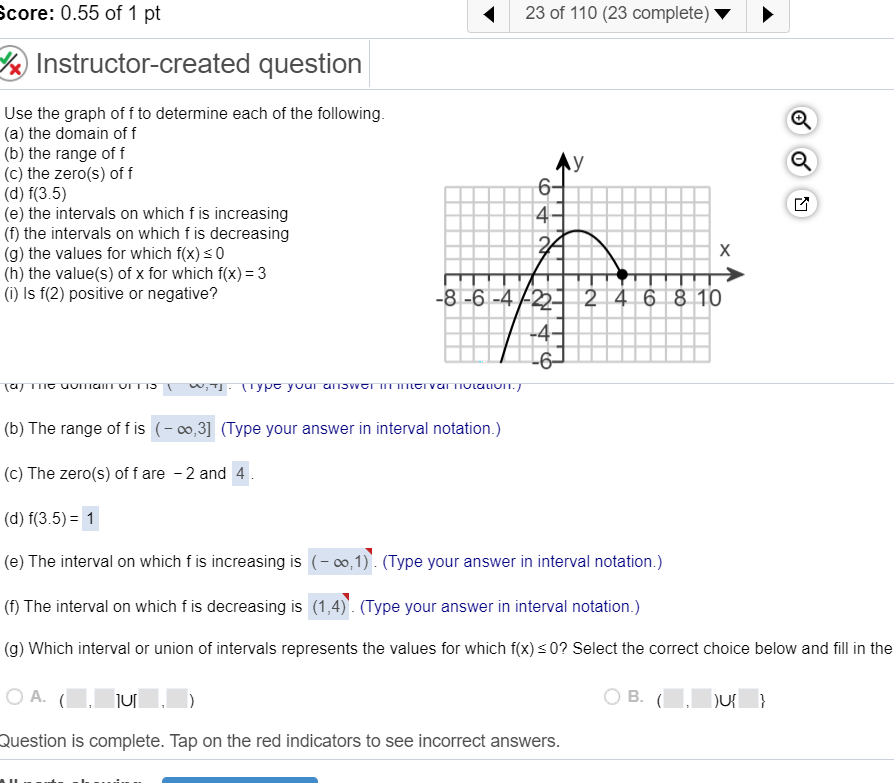
but why usn;t the interval for increase surrounded by brackets?
(obv not on inf, but for actual values we know will happen)
Oh. I get it.
Cause at that exact point that's where it stops increasing/decreasing, right?
viscid thistle
ok ty
viscid thistle
If two vectors are multiplied to each other they then become scalars?
patent beacon
You can't multiply vectors
If you dot product two vectors, you get a scalar though
viscid thistle
@patent beacon so what is |v|^2
Is it considered a scalar product because, the result of getting a magnitude from a vector is a scalar?
viscid thistle
And now that I remember that would make sense because, the definition of a scalar is that it has magnitude only and not direction
patent beacon
You can think of a scalar as a real number.
Then vectors as arrows
There's a lot of ways to relate these two things
viscid thistle
Alright thanks
viscid thistle
So the result from a projection is a vector?
patent beacon
Yes
viscid thistle
Ok cool
 harsh cipher
Hi
do I use properties of logarithm here?
a^log base a ^ x = x
cant get my head around what's going on with question b 😦
uncut mulch
$a^{\log_a x} = x$
obsidian monolithBOT
ramonov:
uncut mulch
yes
 spice surge
I’m doing practice problems for my class and I am stuck in this question. I can calculate it up myself, but I am trying to figure out how to get it without counting all the way up
willow bear
until further information is given, i'm going to assume that all you are given is the first 4 terms \textbf{and nothing else}, which means $a_{14} = 19$
obsidian monolithBOT
Ann:
spice surge
Well by the way it seems, it looks like it divides by two since it goes from 10 to 5, 5 to 5/2 and so on, so I don’t think it can equal 19
uncut mulch
@harsh cipher the question is already in the form of that log property
work isn't needed and you simply just write ||9||
assume it's geometric.
what's the expression for the nth term of a geometric sequence!
(in terms of initial a and ratio r)
 summer monolith
How does the left part transform into the right one?
Why not do this like I originally did (I know there are some Xs left to reduce)?
uncut mulch
might be a bit less efficient depending on the goal.
also you need to check your signs
viscid thistle
its just splitting up the fraction
in the original example
and also cancelling an X out in the second half
$\frac{x^2}{x^4}$ is one result
obsidian monolithBOT
Botnuke:
uncut mulch
-(1+x)(2x) \neq -2x + 2x^3
summer monolith
 prime prawn
What relationship must be met so that log_45 [40sqrt(3)] = log_3n [4n]
uncut mulch
x(1-2) -2 to -3? how?
uncut mulch
x(1-2) to -1 how?
 uncut mulch
don't divide fractions s like that
summer monolith
Doesn't this x get eliminated by reduction?
prime prawn
what reduction?
summer monolith
prime prawn
look (1-2)x = -x right
summer monolith
with the denominator x^3
prime prawn
yes
so numerator is -x-2 still
cause x is not distributed to the other 2 outside of the parenthesis
so you cannot eliminate x from top and bottom
summer monolith
I see
Then I get (-x-2)/x^3
The initial question remains though. How did they split the fraction resulting in two different denominators?
willow bear
$\frac{x^2-(1+x)(2x)}{x^4} = \frac{x^2}{x^4} - \frac{2x(1+x)}{x^4}$
obsidian monolithBOT
Ann:
summer monolith
Makes it clear now. Thks.
But why did the author choose to leave the final result as a split fraction?
prime prawn
preference
summer monolith
I thought simplification is the goal
And (-x-2)/x^3 looks much simplier
willow bear
But why did the author choose to leave the final result as a split fraction?
w/o context it's impossible to tell
summer monolith
There isn't much of a context to be found. Just another practice problem from the book
Forget it. Doesn't really matter
summer monolith
How did they get rid of this (1+x)?
stuck lark
distribute
summer monolith
Thks
 fluid shore
?
fluid shore
What have you tried?
 steel creek
$(a+b)^3 - 3ab(a+b)$
obsidian monolithBOT
Ekansh:
fluid shore
Is that the best way to approach this?
obsidian monolithBOT
Abhijeet Vats:
fluid shore
$(a+b)^2 = a^2 + b^2 + 2ab$
obsidian monolithBOT
Abhijeet Vats:
fluid shore
Can you use the two equations above? Lmao
obsidian monolithBOT
Ekansh:
steel creek
Radicals ewww
fluid shore
Radicals are fun, buddy 🙂
steel creek
Are you Indian? Lol
fluid shore
Maybe, maybe not.
steel creek
lol
 clear glade
Guys why does $2x^2 + 8x + 6/x^2 - 1$ only have one verical asymptote
obsidian monolithBOT
Waterblade:
clear glade
I thought the bottom can be factored as (x + 1) (x - 1 ) thus a VA at x=1 and x = -1
 undone pawn
denominator*
fluid shore
Fk man, i'm so tired I can't even do English properly. That's how much of a dumbass i am.
fluid shore
Okay, Waterblade, let's get down to business. What bottom you talking about?
clear glade
Don't worry, flynn will help me @fluid shore
fluid shore
Hold on, is the $\frac{6}{x^2}$ the fraction or the entire polynomial over $x^2$?
obsidian monolithBOT
Abhijeet Vats:
obsidian monolithBOT
FlynnXD:
fluid shore
Oh wtf
clear glade
2(x^2 + 4x + 3) ->2(x+1)(x+3) @undone pawn
undone pawn
mm hm
undone pawn
and denominator is (x-1)(x+1)
undone pawn
so as a result, there's no discrepancy at x=-1
since limit exists there
and is finite
undone pawn
np
 signal mountain
how do i solve (lnx)^2 + 3lnx = 1 ? not sure how i deal with the (lnx)^2 term :/
 serene heath
Set t=lnx and go from there
signal mountain
thanks!
 sick lava
how am i supposed to get the angle between i + j and i + j -k
stuck lark
dot product definition is one way
sick lava
what do i do with the extra K
stuck lark
these guys are in 3d space. think of the first guy as having 0k component
stuck lark
@sick lava idk how you got 0.86 but dot product uses cos, and make sure your calculator’s in deg mode
stuck lark
Naisu
sick lava
how do i convert (-srq3 + i)^6 into exponential form
stuck lark
Know how to convert -sqrt(3)+i to exp form?
 vale basin
stuck lark
vale basin
stuck lark
^6 is easier to do in exp form so I advise you convert the inner to exp form
sick lava
how
uncut mulch
find r and theta
stuck lark
yes arctan
 trail smelt
Vectors are parallel if they have the same direction. Both components of one vector must be in the same ratio to the corresponding components of the parallel vector.
 pseudo sonnet
thanks got my final in 20 mins
trail smelt
good luck
fluid shore
Calculate
Find the value of the sum
They have a number associated with each sum that you can get. So, get that number.
 odd dagger
nice sigma
viscid thistle
Thanks guys! :'D
What am I supposed to do with this?
Ooh I think I know~~ but please help :'l
fluid shore
Eh there’s a formula for finding the sum using the first and last term of the series
viscid thistle
I know!
fluid shore
I suggest you derive it first lmao
viscid thistle
;_; how do I do that?
fluid shore
Write out a general arithmetic series with initial term a1 and common difference d
viscid thistle
I'd don't think I got this right...
Is not the right diference
52 would be the right diference
But it doesn't make sense because A_14 ≠ 146
A_3 = 146
 Hello?
Ooooh wait
I made an oopsie
This is 10 times worse
Okay, I have this
odd dagger
viscid thistle
odd dagger
@viscid thistle when you divided by 13 why didnt you minus 42 first
you didnt divide 13 to the 42
viscid thistle
I didn't know if I had to do the right PEMDAS or the inversed PEMDAS :'(
sick lava
so cos > 0?
odd dagger
no
viscid thistle
So every time I want to solve the left side of a function I need to use inversed PEMDAS
odd dagger
that is inverse sine
sick lava
oop
odd dagger
@viscid thistle or
sick lava
whats the difference between 1 / sin and sin
viscid thistle
Uhmm okay okay
odd dagger
if a=b then a/13 = b/13
the error you made was like
a = b + 13c
a/13 = b + c
this is not the same
you would do a/13 = b/13 + c
viscid thistle
I didn't knew because, I thought you only cancel 13 to 13 and not the whole thing because 13 is just affecting the d
odd dagger
nah when you manipulate equations you wanna take operators to the entirety of both sides
not just choosing some terms of both sides and assuming that's equivalent
7 = 7
7 = 3+4
7/4 = 3 + 4/4 (error: not dividing the 3 by 4 too)
7/4 = 3 + 1
7/4 = 4
7 = 16
@viscid thistle see how the error of not dividing the entirety of both sides of the equation by 4 doesn't keep it equivalent?
7 = 7
7 = 3 + 4
(7)/4 = (3+4)/4
7/4 = 3/4 + 4/4
7/4 = 3/4 + 1
1.75 = 0.75 + 1
1.75 = 1.75
Here we divide the entirety of both sides by 4 and it remains equivalent
odd dagger
@sick lava can you post the question
odd dagger
ah ok
obsidian monolithBOT
tadders:
odd dagger
oh ok
odd dagger
set up system of equations for n and d with a_n and s_n formula @viscid thistle
viscid thistle
 oh wao
odd dagger
@sick lava so do you know $\sin{\frac{x}{2}} = \pm \sqrt{\frac{1-\cos{x}}{2}}$
obsidian monolithBOT
tadders:
odd dagger
right
odd dagger
whats your reason for that
sick lava
csc > 0?
odd dagger
if 1/f(x) is positive, f(x) is positive too right?
sick lava
yea?
odd dagger
@sick lava post the question
odd dagger
well i mean
sin(x/2) = \pm sqrt(3/8)
sin(x) > 0
2sin(x/2)cos(x/2) > 0
but cos(x/2) will be \pm too
so both \pm sin(x/2) work for some interval in sin(x)>0
sick lava
so it would be +-
fluid shore
Eh what’s the question?
 dim jungle
^
viscid thistle
Am trying this
Am here and 1° I don't know if what am doing is okay 2° I don't know how to continue
Okay, ^^ that complicated
I want the difference
No n, can't do it
trail smelt
@viscid thistle do you know the right answer?
viscid thistle
Yeah, there should be 12 n terms adding up to 690
trail smelt
arithmetic series aren't sharp on my memory anymore but i picked the following formula online $Sn = n*(\frac{a1+an}{2})$
obsidian monolithBOT
🆄🆂🅴🆁🅽🅰🅼🅴:
viscid thistle
What n then?
trail smelt
i got n = 12
viscid thistle
And how do I get it by myself
trail smelt
you pick that formula
substitute Sn, a1 and an with the values you have
then you solve for n
viscid thistle
But am not familiarize with it :'( I can't change that type of thing when I have a midterm on Monday :(
viscid thistle
The formula I do for Sn is the following
trail smelt
show me
viscid thistle
trail smelt
are you sure that's the only formula you have relating to this topic?
trail smelt
i havent touched on this in a loooong time but i am almost certain that we had a formula like this to determine Sn
let me think
viscid thistle
I could use it, but my teacher requires me to understand they reason for every variables to be in it, and I can only explain the one I showed you
trail smelt
I can send you a video explaining the deduction of that formula
viscid thistle
You can send it, but I'm not promising anything. Is a midterm...
trail smelt
 viscid thistle
I did this, but I don't think is possible
trail smelt
I don't see why that formula wouldn't be used in that situation since that it is so straight forward
I'll have a look
viscid thistle
I could use it, but I don't feel confident enough to use it in my midterm
trail smelt
Yup, better play it safe
viscid thistle
:) am glad you understand
So that n I got seems too much
Yeah, never in a million years
Shouldn't it give me 12 as well?
trail smelt
what do you mean?
odd dagger

viscid thistle
I figure it out
 sturdy haven
Are absolute extrema also relative extrema?
sick lava
tan x = -8/9; x in quadrant II; find cos x
Im getting 9 / srq145
supposedly thats wrong
 wise kelp
viscid thistle
wise kelp
viscid thistle
Anyone here that can help me with a simplification question
 proud raven
post it
 native sequoia
,rotate
obsidian monolithBOT
 vestal marlin
viscid thistle
vestal marlin
viscid thistle
I'm guessing every multiple of 4 months the number of rabbits multiples by 3
What you guys think
 lethal oracle
Yes
viscid thistle
so this one is a bit confusing


So it says laber force = L(x)
right
then population is P(x)
nvm
its A
idk why i even asked
willow bear
well you can recognize that 1 = 3^0
 eternal flume
And how can I solve this?
9^(v+2)+5*9^(v+1)=14
willow bear
isolate 9^v first and hope the rhs is a nice power of 3 i guess
eternal flume
Okay, this is what I've done:
9^v = y
y^2+5y-14=0
D=25+4*14=81
D^(1/2) = 9
y1 = (-5+9)/2 = 2
9^v = 2```
How should I continue?how did you get the quadratic??
obsidian monolithBOT
Ann:
undone pawn
$9^{v+2} = 9^v \cdot 9^2$
obsidian monolithBOT
FlynnXD:
eternal flume
I see, thanks
 nova dew
$\lim_{x\to\infty} \frac{5^x}{e^x} = \infty$ right
obsidian monolithBOT
CoolShot:
serene heath
Yus
viscid thistle
B is not so much computation as it is thinking about what the problem means
 void quiver
i just need help
viscid thistle
it wants to know what values of x (amounts you can cut off) are practical for this situation
for example
can you cut off 100 inches from the box?
viscid thistle
my last 3 lines are food for thought for B
viscid thistle
so when does the amount cut off become impractical
viscid thistle
yep
void quiver
so then D: (0,5)?
viscid thistle
yep