#precalculus
1 messages · Page 185 of 1
 rigid sun
 lethal oracle
<@&286206848099549185> is there anyone available that can help me with this?
 native timber
if you have $z \in \mathbb{C}$ with $r = \mid z \mid$ and $\theta = \arg(z)$, $z^n = r^n\left(\cos\left({n\theta}\right) + \text{i}\sin\left({n\theta}\right)\right)$
lethal oracle
Am I correct that my r is 2 and theta 0?
native timber
i don't know what your question is
lethal oracle
Find the nth roots of the complex numbers for the specified value of n
 obsidian monolithBOT
Jiramide:
lethal oracle
-2i, n=6
native timber
we can't determine what r and theta is without the actual complex number
in that case, r = 2 and theta = 3pi/2 rads (or 270 deg)
lethal oracle
Oh alright that’s where I went wrong
native timber
oops being dumb again
lethal oracle
Do I only have a theta of 0 when the coefficient of i is 0?
lethal oracle
Does the fact that it’s -2i change anything
native timber
yes
if you draw a graph where the x-axis is the real number line and the y-axis is the imaginary number line, where would -2i lie?
it's 2 units below origin right
lethal oracle
Ya
native timber
therefore theta would be 270 deg
lethal oracle
Doesn’t that give my the same solutions as theta being pi/2
native timber
while cosine does give out the same outputs for the input pi/2, sin does not
lethal oracle
I think that’s why I’m not getting the correct outputs
What should my arguments be?
Is it not pi/12+(4pi/12)k
native timber
i dont know where you managed to get those numbers
native timber
3pi/2
pi/2 points upwards, 3pi/2 points downwards
hold on lemme do this for myself
native timber
yep i just did it for myself and i don't seem to be getting your numbers
lethal oracle
What argument did you get
native timber
$m = 2, theta = \frac{3\pi}{2} \implies \sqrt[6]{2}\cdot\left(\cos\left(\frac{3\pi}{12}\right) + i\sin\left(\frac{3\pi}{12}\right)\right)$
lethal oracle
Shouldn’t it be 3pi/12+(2pi/6)k
obsidian monolithBOT
Jiramide:
lethal oracle
For each argument
native timber
by argument are you talking about the angle
lethal oracle
Yes
native timber
why would it be (2pi/6)
the period of sine and cosine is 2pi
it's 3pi/12 + 2pi*k
lethal oracle
I thought I divide the 2pi by 6
Along with the original angle
That’s what I’ve been doing and I was getting the correct roots
native timber
 uncut mulch
just an issue with your base angle
lethal oracle
This isn’t for that problem I’m just giving an example
So the base angle is 3pi/2
?
uncut mulch
yes
native timber
i don't recall having to divide 2pi*k by n as well
wouldn't that just divide the unit circle into nths
uncut mulch
yes
native timber
hmm i wonder where i got confused
lethal oracle
Ya I got the correct roots now
And would the boxed portion be the right way to present the roots?
 signal mountain
Hi, I'm trying to solve part two of this problem. I tried solving for m=9/20(m_0) but i end up with the wrong answer, can anyone help?
uncut mulch
what did you get for k?
also you are solving the wrong thing
the original mass is m_0 (NOT 9/10 m_0 which was the mass at t=10)
what is half of m_0?
signal mountain
i got k=0.0105
uncut mulch
would've preferred an exact value but ok
signal mountain
i'm confused about half the mass
uncut mulch
what's the original mass?
signal mountain
m
uncut mulch
and 2nd part of the question is asking you to solve for t when
m = ?
signal mountain
i realise i don't understand this question at all
uncut mulch
what is half of the original mass?
signal mountain
m_0/2 ?
obsidian monolithBOT
ramonov:
uncut mulch
solve that for t
signal mountain
ah, that works. i think i understand now, thanks
 odd helm
For #39 why does the key do ln7 / ln2
odd helm
Alright thank you
 green zenith
I need help with triangles
Is it possible to have 2 triangles when you have the given area and 2 sides?
uncut mulch
what are your thoughts on it?
green zenith
Thats not possible, right?
In the case of both sas and ssa, its not possible because there is a fixed area. One of the triangles is smaller visually than the other one.
uncut mulch
triangles that look different can also have the same area
think about the area of a triangle
Area = 1/2 ab sin(theta)
can there be more than one solution for theta in (0,pi)
green zenith
So for example, if we have the given ssa that have two triangle, the triangles within it have the same area?
 gentle vigil
Do you mean 2 sides are equal and an angle (not made by those two sides) are equal for 2 triangles?
They do not mean triangles are congruent
green zenith
No. What i meant is in a SSA triangle where one of the sides is opposite the angle, and the altitude<opposite<adjacent. This creates two triangles and would those be equal in area?
green zenith
Okay that is what i thought
But another thing confuses me is if we had the given area and 2 sides
gentle vigil
So question you have to ask is, 2 sides and area fixes the other side?
Or fixes the angle made by them?
If yes, there is just one such triangle
If no, there can be multiple
green zenith
Oh
Okay
So earlier we had this one for example, we have area of 20 and 10 and 8 as sides
So do you mean that if we look for the angle, we can have multiple triangle but if we look for the other side, then we can only have one, is that correct?
gentle vigil
No
I'm saying that
You know that two sides of triangle is equal
If you knew the angle between those side us also equal
Then you would have said that they both are equal
Or
If you knew that the 3rd side is equal
Then also you would havr said that both triangles are equal
So you have to look for either of them in terms of area
Do you know how do you express area in terms of other sides/angles?
green zenith
Oh this is deeper than i thought
We only just started and its just the standard formula k=1/2bh, k=1/2absinC and k=(1/2)((a^2sinBsinC)/sinA)
gentle vigil
Yes!
So you know a and b for both triangles
And areas
Does that give you a unique value of C?
sinC =2k/ab
What does it say about C?
gentle vigil
Only 30°?
green zenith
30 and 150
green zenith
Not necessarily?
green zenith
With area 20?
gentle vigil
Yes
green zenith
So if those sides were a and b, we jave C=90°
gentle vigil
So what's your conclusion about that?
green zenith
Okay wow
But back on the case of the other one
Something is still bothering me
So does thag mean if you have 2 triangles, we have two different values of c? And still the same b value?
green zenith
Yes c is what i meant
gentle vigil
a,b are same. But C is different. So c will also be different
green zenith
Ohhh
So i think this is my last question, the final piece of the puzzle, how do you solve for 2 different c's when you have the same a and b and and the value of both sinC is the same?
gentle vigil
There will be two solution to this. x and 180-x
You need to find one solution x
Do you know inverse sine function?
green zenith
Yes. Im familiar with basic inverse sine.
gentle vigil
So your angle is $\sin ^{-1}(\frac{2k}{ab})$
obsidian monolithBOT
oscillatingEquilibrium:
obsidian monolithBOT
oscillatingEquilibrium:
green zenith
So those are my angle C's?
gentle vigil
Yup
green zenith
How about my side c's?
If i were to use the law of cosine, i would find one, but what about the other c?
uncut mulch
c would depend on which angle you are using
 sullen sorrel
can someone help me with c
 queen grail
Wdym @proud jetty
 proud jetty
Could you explain me that problem?
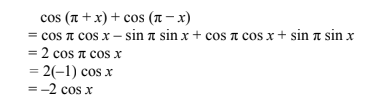
Like where does cos(pie)cos(x)-sin(pie)sin(x) comes from?
queen grail
You're just applying the sum of angles identity
As in
sin(x+y) = sinxcosy + sinycosx
And
cos(x+y)= cosxcosy - sinxsiny
Where x and y are two angles
queen grail
Do you mean what's cos (pi) ?
proud jetty
yea
queen grail
cos (pi) is the same as cos (180 degrees) and with an angle greater than 90 degrees we need to use the reference angle, and in this case it's zero. So we'd say cos (180 degrees) = cos (0 degrees). But you have to remember that cosine is negative in the second quadrant (where our angle is) so it becomes cos (180 degrees) = - cos (0 degrees).
Cos of 0 is just 1 so that's negative 1.
 willow bear
pi, not pie.
 obtuse kiln
pee pee poo poo
proud jetty
@willow bear toss me sum pie
obtuse kiln
oops wrong discord
willow bear
?????
obtuse kiln
hey cutie
obtuse kiln
digits
willow bear
what
obtuse kiln
like in math
willow bear
are you just screwing around rn or what
obtuse kiln
feet pics?
 normal sundial

obtuse kiln
you dont gotta be ashamed
willow bear
what the fuck are you on about
obtuse kiln
yeah kinda
willow bear
what the fuck are you on about
obtuse kiln
idk ive been in here for like 2 years and i never use it
you guys think julitet is a good cat name?
 grizzled orchid
 lost mesa
obtuse kiln
lost mesa
obtuse kiln
Enjoy the videos and music you love, upload original content, and share it all with friends, family, and the world on YouTube.
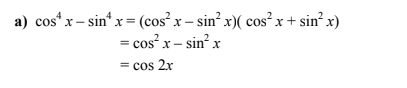
 wise kelp
cos^2(x) + sin^2(x) = 1
proud jetty
oh I forgot about that thx
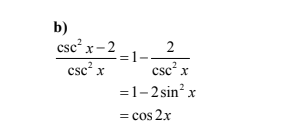
why can you just put 1. for csc^2(x)? If you manipulate it don't you need cot^2(x) there?
1=sec^2(x)-cot^2(x)
wise kelp
They're simplifying csc^2(x)/csc^2(x) to 1
proud jetty
and could you tell me how you end up with 1-2sin^2x?
proud jetty
and could you tell me why 1-2sin^2(x) becomes cos(2x)?
wise kelp
That's just an identity
willow bear
cos(2x) = cos^2(x) - sin^2(x) = 1 - sin^2(x) - sin^2(x)
proud jetty
ah thx alot guys.
 pseudo sonnet
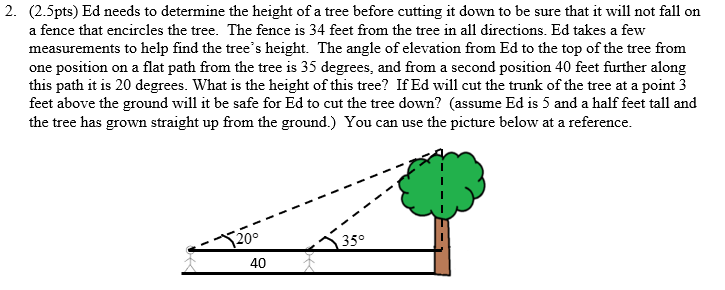
here is what i have so far
am i able to draw that right angle in my drawing
i assumed because his vision is straight at the tree
in relation to the height
<@&286206848099549185>
alright this is what I got so far
can someone verify this
my setup
 pale bison
looks fine, but you have to taken the height of Ed into account btw
pale bison
probably, i guess the question assumes that Ed has eyes on top of his head, not very scientific but 14.6 + 5.5 should be the height of the tree
pseudo sonnet
and for the second part, since the fence is 34 from the tree in all directions
and if the tree were to be cut 3 ft and above from the bottom
the tree would collapse a maximum distance of 20.1 - 3 = 17.1 ft
and since the fences are 34 ft away
it would be safe to cut the tree since they are at a greater distance further away
am I correct?
pale bison
sounds good to me
willow bear
wdym "redefine"
 warm crescent
For example refining f(x) =|x| =(x^2)^{1/2} we get
f(x)=x , x>0
=-x , x <0
=0 ,x=0
@willow bear
willow bear
uh
so you're asked to write |x-2| + |x+2| as a piecewise function?
$f(x) = \begin{cases} 2x & x \in (2,3] \ 4 & x \in [-2, 2] \ -2x & x \in [-3, 2) \end{cases}$
obsidian monolithBOT
Ann:
willow bear
the boundaries of your pieces are 2 and -2
where the expressions inside the absolute values are equal to 0
signal mountain
hi, how do i find the minimum of y=x^2+e^x ? i took the derivative but it seemed tricky to isolate x
willow bear
,w 2x + e^x = 0
obsidian monolithBOT
 Requested by Ann#0413
willow bear
Requested by Ann#0413
willow bear
hmmmmmmmm
well
do you only need the minimum itself or the x value at which it occurs
signal mountain
the answer gives an x and y value
signal mountain
-0.35, 0.83
the first part was to graph it, so maybe they only approx as you say
signal mountain
ok, thanks
 viscid thistle
W H A T
apparently this is right
that definitely to me does not look like reduced row echelon form
 abstract dome
reduced = all digits above and below the leading 1s are 0s
 hazy hull
https://documentcloud.adobe.com/link/track?uri=urn%3Aaaid%3Ascds%3AUS%3A620abfb2-c85e-49fb-a7f9-90c790b015e3 for #4 is x^2/(3x+1) a composition of those 3 functions
 tardy crescent
That is not the composition of those 3 functions. Remember to substitute h(x) for x in g(x), and then sub that in for x in f(x)
hazy hull
so it would become something like 1/(3x^2+1)
tardy crescent
Sorry I was afk, that's closer
You need to substitute the whole expression. So since h(x) = x^2, and g(x) = 1 / (3x + 1), g(h(x)) = 1/(3x^2 + 1). Since f(x) = 1/x, then f(g(h(x)) = 1 / (1 / (3x^2 + 1)) = 3x^2 + 1
abstract dome
wait
uncut mulch
uh... those aren't equal...
abstract dome
yeah
abstract dome
tan(x) * cot(x) = 1
uncut mulch
which would be imposible if they arne't equal
abstract dome
but sec(x) * csc (x) = 1 / (cos(x) * sin(x))
 trim fable
the first was +
tardy crescent
Yeah, those aren't equal, 1/ cos (x) * sin (x) is not equal to 1
abstract dome
oh
tardy crescent
oh ok
abstract dome
yeah that makes more sense then
uncut mulch
zzz
uncut mulch
write stuff in terms of sin and cos
abstract dome
^
uncut mulch
parentheses
trim fable
?
abstract dome
(sin(x))^2
trim fable
ye
abstract dome
not sin(x^2)
abstract dome
ye
uncut mulch
and around the whole numerator
trim fable
sin^2x
abstract dome
parentheses just makes it clearer
uncut mulch
put parentheses around the angle
sin^2(x)
and put parentheses around the whole numerator when typing in plain text
can you expression be simplified?
uncut mulch
no
uncut mulch
how did your sin and cos change into sec and csc like that?
uncut mulch
yes
trim fable
oops
abstract dome
and there's the proof
trim fable
question
u know how
cos was
in the denominator
how it was
sin^2x+cos^2x/cosxsinx
and then
uncut mulch
parentheses
trim fable
1/cosxsinx
and then
sec=1/cos
so then
u would just
multiply it by the reciprocal?
to bring it to the top?
abstract dome
?
uncut mulch
1/(cosx sinx)
abstract dome
^
trim fable
yees
uncut mulch
don't ignore the parentheses
uncut mulch
by definition
sec(x) = 1/cos(x)
uncut mulch
and csc(x) = 1/sin(x)
and you can go directly from 1/(sin(x)cos(x)) to csc(x)sec(x) without doing anything extra
trim fable
ok
 brisk frigate
How does one get the value of "X" in a trig function with another number inside?
The one I'm doing is cos(4x)=0
Usually if they ask for "x" from just cos(x)=0 I use my calculator and what i would do is arccos(0) to get the answer
uncut mulch
find the general solution for 4x
then divide by 4 to get x
brisk frigate
I didnt know about a general solution, I looked it up and it shows this: cos x = 0 is x= (2n+1)(pi)/2
But I'm wondering what value to use for "n"
I suppose since it was 4x then I just do this: x=((2n+1)(pi)/2)/4
native timber
if we let y = 4x, how do we solve cos(y) = 0
brisk frigate
i think i should learn how to do that first then, i usually just do arccos(0)=y on my calculator
shift cos of 0, and use that as the answer for y
 torn swift
you want to find when cos(4x)=0?
torn swift
oh wait, someone is already helping you
brisk frigate
i normally just look at the unitary circle after making cos(x)=0
torn swift
but you know when the cosine function is equal to zero?
brisk frigate
so idk what to do with the 4
native timber
ok maybe replacing it with y might be confusing
torn swift
are we restricted to some interval or do we have to have find all solutions?
native timber
if we let a = 4x, how do you get a from cos(a) = 0
brisk frigate
[0,pi)
torn swift
so when does cosine have a value of zero in this interval?
brisk frigate
I would just look for when 0 shows on the unitary circle and say that "a" is there
torn swift
were on the unit circle does cosine equal zero then?
torn swift
for our interval, we are only concerned about pi/4
so we know that cos(4x)=0
and we want x
so apply arccos to both sides
arccos(cos(4x)) = 4x
arccos(0) = pi/2 as you said
so now 4x=pi/2
now solve for x
brisk frigate
oh
thats amazing
would that work with anything inside the cos()?
like adding/roots/etc
torn swift
sure, arccos(cos(x))=x by the definition of an inverse function
brisk frigate
thats so smart
native timber
assuming its within the range of arccos yes
brisk frigate
i see
torn swift
yes, there is that small detail
native timber
generally arccos(cos(x)) = q where x = q + 2pi*k for some k
 odd badge
i.e. arccos(2) is undefined
torn swift
but the bigger picture is to see the effect of an inverse function
odd badge
if you look at the cos curve it's a good way to see what vals are defined for arccos and what aren't
brisk frigate
@native timber is that the general solution the other guy was talking about?
where n is an integer or something like that
native timber
yeah if its asking for all solutions then that's the proper way to write it
torn swift
general solution is the solution on any interval
brisk frigate
ah i get it, so i wouldnt substitute the n for anything right?
since it would just mean any number
to cover all solutions, etc
brisk frigate
Yeah im getting it a lot more now
tysm for the help, trig is prob the hardest thing i've come across in school tbh
 harsh cipher
Hi guys
may I interrupt?
why do I not move 5 infront of "z" but move (z3) to the numerator?
native timber
exponents before multiplication
the ^-5 is applied to z and only z
while in (3x)^-2, it's applied to both since it's grouped by a parenthesis
native timber
5z^-5 is 5(z^-5) due to exponentiation binding tighter than multiplication
brisk frigate
Aparently there are 4 answers but I could only get 2 and I think one of them is outside the range the question is asking for, is there something I did wrong that I am not noticing?
I just used the addition formula to turn the equation into "cos(4x)" and then solved it
arccos(0)= 1pi/2, ---> (1pi/2)/4 = 1pi/8 <--- First answer, then I added pi to it and got 3pi/8 as my second answer
trim fable
I need help im stuck on a question
so far I did
csc^2(1+cosx)
=1+cot^x (Idk what to replace 1+cosx with)
I have to prove that using trig identities
 rigid beacon
My hint would be using conjugates @trim fable
rigid beacon
look on the left and right sides of the equation
my hint relates to what you said "Idk what to replace 1+cosx with"
trim fable
ye
ok
so like
csc^2(1+cosx) 1+cosx)
=---------------- * -------------
1 1+cosx)
csc^2(1+2cosx+cos^2x)
= -------------------------
1+cosx)
= csc^2(cosx+cos^2x)
ye im kinda stuck there
lol
is it even right so far
uncut mulch
its the wrong approach
trim fable
aww
uncut mulch
the idea is the simplify the denominator on the left
uncut mulch
usually you start with the more complicated side
uncut mulch
fractions are more complicated if the denominator consists of a sum
trim fable
ye
uncut mulch
the idea of using the conjugate is to turn
the denominator into 1-cos^2(x) which can be represented as a single term
uncut mulch
no
trim fable
oh
uncut mulch
as mentioned by spamakin, it would involve conjugates
uncut mulch
what would you multiply to
(1 - cos(x)) to get (1- cos^2(x))?
you multiplied the conjugate of the lhs to the rhs which doesn't really help you
trim fable
1-cosx?
uncut mulch
no
uncut mulch
what is the conjugate of
(1- cos(x))
trim fable
(1-cos(x))
uncut mulch
no
trim fable
(1+cos(x))
uncut mulch
yes
and you should multiply both the numerator and denominator of the lhs by that
you should not have multiplied that on the rhs
 plush matrix
guys quick question about the application problem
trim fable
oh
uncut mulch
$\frac{1}{1-\cos(x)} \cdot \frac{1+\cos(x)}{1+\cos(x)}$
obsidian monolithBOT
ramonov:
uncut mulch
no
trim fable
rs?
uncut mulch
1/(1-cos(x)) is your left side
uncut mulch
by multiplying by
(1 + cos(x))/(1 + cos(x))
you are essentially multiplying by 1
uncut mulch
and after some more manipulation/ simplification
you will reach the rhs
uncut mulch
yes
uncut mulch
you could work from the right, but the steps would be different and its harder to see what you're supposed to do
plush matrix
nvm I got it
uncut mulch
no
trim fable
huh what
uncut mulch
what is
(a - b)(a + b)?
uncut mulch
do you mean replace 1/(sin^2(x)) with csc^2(x)?
trim fable
thank u
ye
i got it
🙂
will u help me with another
i attempted but
got stuck
uncut mulch
sure
trim fable
so what i did was
worked with the ls
=csc^2x+1
1+cscx
then can i cancel?
to cscx
then
1/sinx
i just need the -sinx at the top
so did i mess up somewhere
uncut mulch
yes
uncut mulch
from the start
also inappropriate cancellation
what's the identity relating
cot and csc
uncut mulch
not what i'm looking for.
uncut mulch
missing the ^2
uncut mulch
no excuse
uncut mulch
1+cotx=csc would be false
uncut mulch
no
uncut mulch
you can't just make the equal sign dissapear
uncut mulch
so what would cot^2(x) be equal to?
uncut mulch
yes
proud jetty
lol nice
trim fable
lol
proud jetty
I got unit test and idk jack shit
trim fable
oof
uncut mulch
are you able to continue from
(csc^2(x)-1)/(csc(x) + 1)?
uncut mulch
factorise the numerator. same idea as before (difference of 2 squares)
proud jetty
if ya people tryna help @me
trim fable
oh ok
proud jetty
star u got unit test tomorrow?
proud jetty
Lmao fk me than wait can ya help me with my shit?
trim fable
uh i just learned it
uncut mulch
what's the original question asking for?
uncut mulch
also cos^2(x) - 1 isn't sin^2(x)
proud jetty
So I’m right?
uncut mulch
also cos^2(x) - 1 isn't sin^2(x)
trim fable
question
proud jetty
Isn’t it if u manipulate the identity
trim fable
ye
uncut mulch
you don't really need to multiply by the conjugate for that
trim fable
well advanced functions
uncut mulch
csc^2(x) - 1
is a difference of 2 squares which you can factorise
uncut mulch
(also if you were to do that, parentheses)
uncut mulch
wdym,
factorise "csc^2(x) - 1"
uncut mulch
difference of 2 squares
trim fable
left side?
uncut mulch
you'd would've been 2-3 steps away from finishing it
trim fable
oh well
uncut mulch
i mean multiplying by the conjugate takes the long way
trim fable
im doing this first lol
uncut mulch
but it would also work
uncut mulch
@proud jetty manipulate the identity again,
s^2 + c^2 = 1
c^2 - 1 = ?
uncut mulch
yes
proud jetty
yea im slow but i'm getting there
uncut mulch
what do you get after fixing your signs?
trim fable
?
uncut mulch
at mlg
trim fable
oh ok
uncut mulch
you would obtain the other form from factorising the denominator as a difference of two squares
though the one you got is simpler than the solution obtained from that method
proud jetty
its sx/cx+1
obsidian monolithBOT
 Requested by ramonov#0921
uncut mulch
Requested by ramonov#0921
uncut mulch
that was mlg's
uncut mulch
explain how you got the first line
trim fable
who
uncut mulch
you
trim fable
oh
ok so
sec(x)=1/cos(x)
so i brought cos(x)
to the bottom then
tan=sin/cos
so then wrote that
giving me sin(x)/cos(x)cos(x)
sin(x)/cos^2(x)
uncut mulch
no
proud jetty
ram if their is tanx-3-4
can I add them?
trim fable
oh
uncut mulch
its +
proud jetty
like the -3-4
uncut mulch
not multiply
proud jetty
yea
proud jetty
lol whens ur unit test
uncut mulch
what's tan being applied to? only the x?
tan(x) - 3 -4?
uncut mulch
can you post the original problem
trim fable
next week
uncut mulch
yeh so its
sec(x) + tan(x)
uncut mulch
you shouldn't factor like that
trim fable
who
uncut mulch
mlg
proud jetty
me i guess
trim fable
lol
uncut mulch
the numerator is a quadratic in tan(x)
trim fable
brb
proud jetty
ramonvo could u highlight the problems
like using paint brush or sumthing
and just type wut i can't do cuz i aren't getting this at all
uncut mulch
proud jetty
bet lemma try to make it legal
uncut mulch
if you only factor two of the terms, there's still addition involved and you can't really divide
you would need to factor the whole thing
similarly, factor the denominator too
(cancelling tan like that was illegal, anything after that is irrelevant)
proud jetty
shit
I did it
that would work on exam right?
I am not doing anything just changing how it looks
@uncut mulch do u think if i work like this it will cause me problems with identities?
uncut mulch
you back substituted the wrong things
lethal oracle
ya its sin x in the denominator
proud jetty
yea lol i see dat but will cause me problems with identities?
if i continue to work like dat?
uncut mulch
as long as you're clearly stating your substitution it should be fine
proud jetty
bet thx
uncut mulch
but do try and get to a point where you can do it without sub
lethal oracle
r=6cosx+6sinx
proud jetty
yea i'll try
lethal oracle
how would i change this to rectangular form
i had this on an exam on wednesday and i basically left it blank cause i couldn't remember how
viscid thistle
Is arccot the same as tan?
willow bear
no
 shadow glacier
could anyone help me with this problem https://gyazo.com/08593826e4900e6e4a9024d75d2f1759


 willow bear
15-minute rule.
shadow glacier
sorry i didn't read the rules, just read them and edited msg
willow bear
i didn't read the rules

ok whatever
what have you tried so far
and where are you stuck
obsidian monolithBOT
Digicat195:
 serene heath
,w graph y=(2(x+1)(x-3))/((x-1)(x+3))
obsidian monolithBOT
 Requested by the one n only#3070
 trail badge
Yeah thats it
Thanks
What?
Why?
@Jeff#6412 I wrote this equation above, i don't have sure if it is right, but i think so
Ohh he was gone ;-;
 restive bridge
how does dividing by -36 cause a hyperbola? it should be a parabola
no?
when you divide by -36, the -9 because a positive 4.
OOOOHH
the first one becomes negative, second one because positive
rearrange it fixes the issue
 quick pond
Yo question, for this, can someone explain the proof behind say...
10^log(x)=x
This rule
quick pond
Uhh, the simplest one to understand, I know the other rules but this one is still eluding me
Most likely algebraic then
 merry sphinx
Okay, so think about what a log is asking for
quick pond
It wants us to simplify into K
merry sphinx
For example, $\log_2 64$
obsidian monolithBOT
pocofrosty12:
merry sphinx
What does it simplify to
merry sphinx
So it is asking "for what power does 2 need to be raised to equal 6"
Does that make sense?
quick pond
Yeah it does
merry sphinx
So for $\log_a b$, it is asking for what power of a to equal b
obsidian monolithBOT
pocofrosty12:
quick pond
Yes
merry sphinx
a^ "what power of a to equal b" = b
quick pond
Mhmm that I get
 stuck lark
$a^{\log_a(b)}=b$
obsidian monolithBOT
RokettoJanpu:
quick pond
So log_a(b) means x
And a^x=b
Because x is essentially the power that raises a up to b
I get it now
merry sphinx
Algebra proof is easy too, but I think the intuitive explanation develops a better understanding

 rich ocean
thats the first time i fully understood that intuitively
 hollow bluff
Would this be correct?
my first step was making them all (x+2)(x+2-i)(x+2+i)
then i multiplied
uncut mulch
factor theorem wasn't applied properly
hollow bluff
how do i apply it correctly
Oh wait
Its supposed to be the opposite sign
(x-2)(x-2-i)(x-2+i)
is that better
willow bear
each parenthesis is supposed to be (x - root)
as long as you recognize x-2-i doesn't correspond to the root 2-i you're good
hollow bluff
What do you mean
I feel like in know what your talking about but im not quite grasping it
uncut mulch
even those are the factors, it is unclear whether you are applying the factor theorem properly for the complex roots
hollow bluff
alright
so even if i get the right factors I still might get it wrong
So have a made a mistake?
uncut mulch
depends a bit on how you arrived at those factors
hollow bluff
ah
Well im going to revise my work right now
ill let you know if i need help
thank you!
uncut mulch
it would be better represented as
(x-2)( x - (2 + i))(x - (2- i))
odd helm
Why is there a shift to the right 172
This is what I drew idk why we need to shift wouldn’t this work ok?
viscid thistle
Because you have to start at day 0, time starts at day 0 goes to day 365.
I can't see the full question but its likley because of that. We use phase shifts so that the sinusodal shape will match up
 fading token
3 is a real zero, so R can't have 8 non-real zeros
hollow bluff
darn
 pale kettle
to do what
 hallow flicker
To simplify it
pale kettle
how do know that 0 isnt the right answer
hallow flicker
To solve it
Because of the derivative rule
That’s suppose to be the answer
But it uses the derivative rule
uncut mulch
are you familiar with conjugates?
hallow flicker
No
uncut mulch
read up what you can on conjugates
the idea is to rationalise the numerator
then divide by n,
then take the limit
try and do that yourself and come back if you're still stuck
lethal oracle
ramonov is indeed the best
abstract dome
f'' is the concavity - essentially, the graph being shaped like a U
f'' is the slope of the slope
so if it's an upward facing U, f'' is positive
and if it's a downward facing U, f'' is negative
 stuck ivy
I'm just wondering how concavity affects a
like
f''(x) makes it 0
then the derivative of that would make it positive or negative
abstract dome
for that point (at a vertex), look just before and just after the point
just before, the slope is positive, but decreasingly so (the slope is becoming a smaller negative number)
and just after, the slope is negative and increasingly so (it's becoming a steeper/larger negative number)
stuck ivy
so it would be positive?
abstract dome
if it's an upward facing U, f'' is positive
and if it's a downward facing U, f'' is negative
viscid thistle

hallow flicker
what is this guy asking?
 hoary valley
My teacher says they are the same.
hallow flicker
how
hoary valley
Idk, I'm asking what's the difference.
hallow flicker
you have two different variables at the bottom
the bottom is a derivative
the top has two different variables
abstract dome
yes @stuck ivy
stuck ivy
sweet
hallow flicker
i am assuming that because you saw the lim of h aproch zero i think your mistaking it for zero
thats not really the case
until you simplify the expression always think of h as a value
because in reality it almost never really is 0
its only when you simplify it that the h is so insignificant that it pretty much becomes zero
the top alway sums up to zero while the bottom doesn't
assuming that x and a are the same i guess
 patent beacon
@hoary valley
They are the same. Let x = a + h to go from the first to the second
Note the first should have a limit as x → a
hoary valley
@patent beacon Right. so why we have two formulas ?
patent beacon
I tend to stick with the second as "the definition" but they're the same formula