#precalculus
1 messages · Page 184 of 1
 stuck lark
 odd helm
Ok
 viscid thistle
I have a triangle
that ends up as sin55/a = sinb/7 = sin65/c
how do i create an equation thats solvable if they all have a missing element
 patent beacon
Neither give enough information to determine anything
Well, you can say things about b maybe
 jade oar
yea if f,g, were differentiable u could use lhopital's rule and say something about it using the derivative for (a)
 hoary valley
1s
patent beacon
What's the difference? You put your opinion on them?
hoary valley
That's the question written like that in the book. no one can asnwer it,.
patent beacon
There's no one answer. Take (x² - 25)/(x - 5). The limit is 10. Instead, take 0/(x - 5), the limit is 0
jade oar
you don't have enough infomration to say a) doesn't exist, and you are wrong for b)
hoary valley
Told you, it's a really hard question. even my teacher doesn't know the answer.. but It's literally written like that in my book,
It's either true or false.
patent beacon
Okay, then we go with false
jade oar
Teachers and bookwriters are not infallible
hoary valley
James Stewart - Calculus_ Early Transcendentals-2015
@patent beacon on both (a) and (b) ?
jade oar
For a) it exists if the functions are both differentiable, which is something that is unknown (L'Hopital's rule). b) it goes to infinity
for example, consider 1/10^(-1) = 10. and 1/10^(-99999) = 10^99999
patent beacon
Can't promise infinity. Might be negative infinity from one direction
jade oar
true it could be +- infinity, it may not exist too for that reason. bleh
patent beacon
In either case, the function might not be defined to the left or right of 5, so you still get no promises
jade oar
i don't think it's important to be defined on both sides, the main problem is since we dont know anything about the function going to 0, it could be going to both 0 from negative and 0 from positive, like some stepwise function that changes sign and decreases in abs value
when taking x to the limit point
viscid thistle
how do you solve sinθ = 24/25, 0 < θ < pi/2 find cos (2θ)
im doing the double angle form
still not making sense
 rich flint
@viscid thistle can you post what you have
viscid thistle
1 - 2 (24/25)^2
rich flint
Take a pic of your work and post it
rich flint
if that is what you got as your answer I don’t see the issue
rich flint
Ok so they told you 24/25 is for sin theta?
viscid thistle
sin θ = 24/25, 0 < θ < pi/2, cos (2θ)
rich flint
Yep I got the same answer as the solutions
So since I can’t see your work I have no clue what needs to be corrected
Only thing I can think of is maybe when you simplify your fractions or when you square the sin theta
So for sin(x) your suppose to square both sides
viscid thistle
so 1 - 2sin(24/25)^2 == 527/625?
rich flint
Well they gave you sin(x) and the formula asks you to plug in (sin(x))^2
viscid thistle
isnt it 1 - 2(527/625)
rich flint
Yes that is correct so maybe you went wrong when simplifying the answer
You multiply the 2 by the fraction then you get the LCD which is 625
rich flint
No clue what your saying
viscid thistle
alright
rich flint
2 times 576 is what?
rich flint
1054 is wrong try again
rich flint
Correct now what do you do to the 1 in front?
viscid thistle
625/ 625
rich flint
Correct
viscid thistle
thanks, what formula do i use for sin θ/2 *
rich flint
It matters what the question is asking and what information is given
I’ve never seen what you just typed there is usually an angle with sin
Sin and cos can’t just equal that
rich flint
So what are they asking you to do?
rich flint
You mean when dealing with signs?
viscid thistle
oh nvm
you know how cos 2x can be translated into multiple things
how do you decide which one to use
its just situational
ig
rich flint
It is what information is given you can find the solutions with different methods so yes it is situational
Each formula gives you the same answer
viscid thistle
alright thanks
 slender siren
@flint stirrup
slender siren
Both
 flint stirrup
like a homework problem
slender siren
So in level 2 of factoring trinomials right and yes
flint stirrup
wdym level 2
flint stirrup
its ko
flint stirrup
yes
slender siren
You divide the first number by all the numbers right?
flint stirrup
yes
you factor out a number, which is 3 in this case
so take 3 out of each of the terms
what would you get?
slender siren
x to the second power + x to the second power -42?
flint stirrup
yes
slender siren
I meant minus
 obsidian monolithBOT
Meir:
flint stirrup
since we factored out the 3
slender siren
Oh we got to put the the 3 out of the parenthesis?
flint stirrup
yes
slender siren
Alright hold on I’m going to come back to you in less than 3 minutes
flint stirrup
ok
slender siren
@flint stirrup like this?
slender siren
@flint stirrup
 brisk frigate
Does anyone know how to solve this? I tried using arcsin(3/5) on my calculator to get the value of "t" and then substituted that into my calculator to find the rest
As far as I know arcsin turns the fraction into a degree and sin turns the degree into a fraction, so if in this case t is the degree that you have to input onto sin(t) to get 3/5 then shouldnt using arcsin(3/5) give me the value of t?
patent beacon
Your calculator will give you the Q1 angle
You don't need a calc here either way. Use
sin²θ + cos²θ = 1
To get cos. All of the rest follow
brisk frigate
oh i see, btw is there a way to turn the Q1 angle the calc gives me into the next quadrant?
wasnt it like 180-the calc
patent beacon
Perfect, that's it
patent beacon
Imagining the unit circle is key
patent beacon
Np, good luck with it
 harsh cipher
hi
the part where it says -3 fits this condition but not x>0
what does that mean?
x>0 still fits the condition x>-4 ?
lol
 uncut mulch
-3 is greater than -4
but it isn't greater than 0
x needs to be both:
greater than 0 and greater than 4
the intersections of those is x > 0
harsh cipher
......thinking......
uncut mulch
(and then the additional restriction of x != 1 is also applied)
viscid thistle
how do i solve sqr2 ^20
uncut mulch
no,
the -3 was just an example of what doesn't work
at x=-3,
the argument, x + 4 = 1
however the base will be -3 which is negative which will make it undefined
 rigid sun
arc functions, are the closest you’ll ever get to an inverse
you’ll have to do the math from there
x=3sin(y)-2
x+2=3sin(y)
(x+2)/3=sin(y)
arcsin((x+2)/3)=y
,w plot arcsin((x+2)/3)=y
obsidian monolithBOT
 Requested by maleb1964#6739
viscid thistle
Requested by maleb1964#6739
viscid thistle
you ok
brisk frigate
I'm having a lot of trouble understanding this one, and YouTube isn't helping much, was hoping someone could explain
I was thinking about doing "2Pi-5" and using that as the answer but shouldnt it be represented with a fraction containing Pi like the rest?
 proud jetty
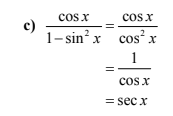
can ya all explain how you get that other half of cos
i was only given the left half.
stuck lark
identity $\sin^2(x)+\cos^2(x)=1$
obsidian monolithBOT
RokettoJanpu:
proud jetty
so could you explain it
stuck lark
the identity can be rearranged to suit your problem
proud jetty
roketto i get it wut u mean but I still don't understand how the other half is same as the left half. ik im dumb
phd how would u slove dat
rigid sun
identity $\sin^2(x)+\cos^2(x)=1$
obsidian monolithBOT
maleb1964:
obsidian monolithBOT
maleb1964:
rigid sun
Now substitute
brisk frigate
lol
rigid sun
you had 1-sin^2(x) on the bottom right?
replace that with cos^2 since we just proved that
proud jetty
yes
brisk frigate
I havent gotten to trig identities yet, do you think i should start memorizing them? Or is that not needed
A friend showed me his formula paper and it was filled with them
rigid sun
Yes
brisk frigate
rip, feels like there were so many
rigid sun
There are many
proud jetty
wait so why do you put a cosx / cosx^2
rigid sun
But just memorize the fundamental ones
proud jetty
like ik we just proved the bottom half but
brisk frigate
Sounds good man, good thing I asked so i have more time for that
rigid sun
? MLG god what?
proud jetty
lol i got quiz tomorrow and i got no clue wuts happening
brisk frigate
yeah we can tell xD
you substitute the bottom half
and then you realise both sides are the same
and say "wow, im done, im so good"
thats it
rigid sun
make sure you say “wow, I’m done, I’m so good” out loud During tests
rigid sun
Dude
brisk frigate
$cos^2(x)=1-sin^2(x)$
obsidian monolithBOT
Mekbot:
rigid sun
cos/(cos*cos)=1/cos
brisk frigate
just substitute "1-sin^2(x)" to "cos^2(x)" and thats it
and then you realise both sides are the same
and say "wow, im done, im so good"
proud jetty
WOW, IM DONE, IM SO GOOD
proud jetty
^if only dat was true imma go do 3 days worth homework and than review everything
thx alot for help ya all
love ya no homo
brisk frigate
How do I go about doing this? I've never seen anything but f(x) so idk what to do when they add something next to the x
Does P(t+pi) mean I have to replace cos(t) with cos(t+pi) ?
Or maybe into cos(t)+pi?
stuck lark
P(t+pi) replaces each t in P(t) with t+pi
brisk frigate
oh thnx
obsidian monolithBOT
MLG GOD:
proud jetty
Like how does cos(x) =0 at bottom make the denominator = 0
uncut mulch
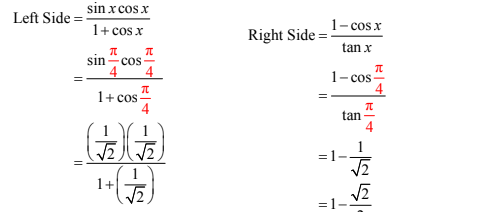
$\frac{\sin(x)\cos(x)}{1+\cos(x)}$?
obsidian monolithBOT
ramonov:
proud jetty
yea like you know how denominator can't equal to 0?
if cos(x) was -1. it would make the bottom equal to zero which isn't permitted.
But if cos(x) is equal to 0 does it still affect the bottom half.
uncut mulch
who's saying cos(x) can't be 0?
 uncut mulch
when 1 + cos x = 0
uncut mulch
yes
 uncut mulch
1/sqrt(2) = sqrt(2)/2
uncut mulch
certain calculations could be simpler
proud jetty
oh ic thx alot
 opal swallow
anone can help me
 willow bear
with what
hoary valley
Why the limit does not exist? isn't +infty??
willow bear
it sounds like your book only considers a limit to exist when it is finite
this needs some context though
viscid thistle
@willow bear is there such a thing as an infinite limit?
can you please give me an example?
and non example?
 rigid beacon
I think some books say limits that go to ±infinity are non-existent and some books will say that ±infinity are good answers for limits
viscid thistle
that does make sense
willow bear
what do you mean by "is there such a thing as an infinite limit"
viscid thistle
disregard, you stated "it sounds like your book only considers a limit to exist when it is finite" and i thought you implied that there is such a thing as an infinite limit, i have no idea what an infinite limit is supposed to mean. i was just confused please forgive
willow bear
$\lim_{x \to 0^+} \frac1x = +\infty$
obsidian monolithBOT
Ann:
willow bear
that's an example of an infinite limit
viscid thistle
yo......
 frank nexus
yo
 blissful wadi
Any help with this please
Mq = show that
Convergente is convergent i guess in english
frank nexus
that looks like japanese to me... cant wait for the later years in school..
willow bear
it's not japanese, it's poorly written french
willow bear
yes
frank nexus
okay, i didnt know why i couldn't read it
blissful wadi
Any helo tho i tried calculating U(n+1) - U(n)
To get an idea where it would be both increasing and majored
Or decreseasing and minored ( ?)
But didnt help
willow bear
$u_{n+1} = \sqrt{2 - u_n}$?
obsidian monolithBOT
Ann:
blissful wadi
yes
blissful wadi
Any help ?
willow bear
let $f \colon ]-\infty, 2] \to \bbR$ be given by $\forall x \in ]-\infty, 2], f(x) = \sqrt{2-x}$
obsidian monolithBOT
Ann:
blissful wadi
= ( french is col
willow bear
then $f([0,2]) = [0, \sqrt{2}]$
obsidian monolithBOT
Ann:
willow bear
$f([0, \sqrt{2}]) = [\sqrt{2 - \sqrt{2}}, \sqrt{2}]$ ... i think?
obsidian monolithBOT
Ann:
willow bear
maybe it'll come in handy that $f$ is differentiable on $[0, \sqrt{2}]$ and that $|f'| < 1$ on $[0, \sqrt{2}]$
obsidian monolithBOT
Ann:
willow bear
even though i don't have the energy rn to notate that in a way that would please Tuong
blissful wadi
hmm wait let me try this
obsidian monolithBOT
Ann:
willow bear
i hope it's obvious that your sequence is obtained by iterating f starting with 0
blissful wadi
whats next ?
i tried doing something but it didnt turns out
i tried to prove that $f(U_{n} = U_{n+1} ; f is continous , U_{0} \in [0,2] ; f([0,2]) \subset [0;2] and find that \lim U_{n} = x whichverifies the equations f(x)=x $
$f(U{n}) = U{n+1} ; f is continous , U{0} \in [0,2] ; f([0,2]) \subset [0;2] and find that \lim U{n} = x whichverifies the equations f(x)=x $
obsidian monolithBOT
dvaix:
willow bear
hhhhf bad tex
blissful wadi
uhetuehuyehteuht
anyway
i wanted to show all that
and then conclude that Un must converge
but i cant get $\lim U_{n}$
obsidian monolithBOT
dvaix:
willow bear
lim u_n is the unique fixed point of f
blissful wadi
huh
willow bear
In mathematics, the Banach–Caccioppoli fixed-point theorem (also known as the contraction mapping theorem or contractive mapping theorem) is an important tool in the theory of metric spaces; it guarantees the existence and uniqueness of fixed points of certain self-maps of ...
i guess you could apply this
odd helm
Why is there a (x+2) in the numerator
-2 is a VA so (x+2) on denominator but
It’s not a zero so idk why it’s on the numerator
hoary valley
Is arctan continuous on R ?
hoary valley
It is not discontinuous on -pi/2,pi/2 ... ?
willow bear
arctan is not tan
hoary valley
Oh It's a RESTRICTION of tan !
willow bear
no, arctan isn't a restriction of tan either
it's the inverse of a restriction of tan
hoary valley
Oh Gotcha
willow bear
what do you mean by (b)
hoary valley
b , in the theorem
willow bear
it's a point
 long pond
I don't remember doing limits in precalc 
 blissful laurel

hoary valley
Does this graph have any vertical asymptotes or horizontal asymptotes?
I see that it has Vertical asymptotes at x=-1 and x=2
Does it have any horizontal asymptotes?
willow bear
the way the graph looks suggests that it has two of those
one at y=2, the other at y=4
 serene heath
Divide top n bottom by x
willow bear
multiply it by $\frac{x^{-1}}{x^{-1}}$
obsidian monolithBOT
Ann:
hoary valley
Do I divide each part inside the sqrt by x like 16x^2/x and +3x/x ?
obsidian monolithBOT
Ann:
hoary valley
And how do you solve this?
stuck lark
$\sqrt{ab}=\sqrt{a}\sqrt{b}$
obsidian monolithBOT
RokettoJanpu:
stuck lark
ig in some people's vocabularies, solve is synonymous with algebraically manipulate
willow bear
uh
you made two mistakes there
$x^{-1}(4x + \sqrt{16x^2 + 3x}) = 4 + \sqrt{16 + 3x^{-2}}$, not $4\sqrt{16x + \frac{1}{3x}}$
obsidian monolithBOT
Ann:
hoary valley
willow bear
you forgot something
hoary valley
I meant this
willow bear
how is anyone supposed to know
how is anyone supposed to know when you meant to write a radical symbol but chose not to do so
 manic hemlock
hoary valley
manic hemlock
hoary valley
This is arctan it has 2 horizontal asymptotes as you can see its graph doesn't touch the horizontal asymptotes..
How come in this function the graph of the function touched the horizontal asymptotes... yet we say it has 2 horizontal asymptotes at y=4 and y=2 ?
stuck lark
horiz asymptotes just tell you the function's end behavior, ie what it does for big positive x and big negative x, not what's happening in between
hoary valley
@stuck lark So in this example above, the function will never intersect with the horizontal asymptotes y=4 and y=2 ?
In big positive x and big negative x ?
stuck lark
rather, think of 4 as the y value the function will converge to as x approaches +inf
obsidian monolithBOT
Waterblade:
stuck lark
if that's the graph of a function f, lim x to infty f(x)=4
hoary valley
@stuck lark Thanks man, I think you definitely deserve the HONORABLE role.
stuck lark
no prob dude  thanks for the kind words
hoary valley
I'm stuck here..
 hollow pollen
viscid thistle
hollow pollen
viscid thistle
,rotate 270
obsidian monolithBOT
hollow pollen
monkaS
rigid sun
,rotate 1
obsidian monolithBOT
 proud sparrow
consider multiplying numerator and denominator by $q_1^{0.6}q_2^{0.4}$
obsidian monolithBOT
Element118:
proud sparrow
@viscid thistle
viscid thistle
I divided the numerator and denominator
Oh nvm
I get it now
I messed up and switched up where the numerator and denominator should be

Ty
 clear glade
I have a problem I want to make sure I did right
this is my sketch
my answer was tan(theta) = 53/38 so theta was equal to tan inverse (53/38), is that right
 undone drift
yes it's correct
clear glade
ok thank you
 mighty pine
 upbeat prairie
I understood everything up till the length of the Latus Rectum
How is it 4p?
and how would I find it?
 hazy hull
https://documentcloud.adobe.com/link/track?uri=urn%3Aaaid%3Ascds%3AUS%3A3d9745da-ff64-4792-a3a7-a06de39af6eb so 6 is that the solution to f(0) gets passed to the division problem?
 plucky storm
Can I have some insight on where to go from here?
I was thinking of bringing the cos over and factoring, but I don't think that's actually the next step?
plucky storm
I'm guessing in doing something wrong here too
Second one of right, there's no real solutions
 tardy plinth
So I got this equilateral triangle with sides of 7m, in which an ant from point C goes towards point A, while another ant goes from A to B. I need to find a function distance between them in terms of y (d(y) in the picture). I tried similarities of triangles, but didn't worked, didn't get the function as showed and not sure from were to start developing this function.
 blazing parrot
At any point in time, CD=AE (assuming both ants move at the same speed)
Then AD would be AC-CD
You know the angle at one of the corners of triangle DAE, you can use that to find the side DE, the result of the function d(y)
tardy plinth
I used cosine law to find d(y), still getting sqrt(49-21y+3y^2)
I'm retarded or burned out 
Could the answer given be wrong?
 native timber
,w simplify \sqrt{(7 - y)^2 + y^2 - y(7 - y)}
obsidian monolithBOT
 Requested by Jiramide#7358
tardy plinth
Requested by Jiramide#7358
tardy plinth
So the answer in the book wrong then
native timber
seems like it
i mean its already suspicious that they managed to get 7y^2 considering that there's only 3 terms
tardy plinth
Didn't even want to consider it to be wrong, as it is taken from one of my countries exams 
native timber
literature is written by humans, mistakes are always possible
tardy plinth
Agree 100% now
willow bear
y=0
y=e would be a horizontal tangent line
without the "never touches" requirement
a graph can cross its own asymptote as many times as you wish
even infinitely many times
eg sin(x)/x
 languid crane
which function
 formal dome
Sorry wrong picture
The limit of this function exists, and it is +infinity right?
Then isn't theorum 1.2.4 b wrong?
Bec in the case of the 1st picture, p(a) ≠ 0 and q(a) == 0 but limit does exist
willow bear
your book may consider an infinite limit as not existing
depending on the multiplicity of a as a zero of q, the limit might be ±∞ (even) or genuinely fail to exist (odd)
formal dome
@willow bear o idk what you mean by limit may be even or odd but i think you mean(what my book explained) that the limit may be
A) +infinity from right and -infinity from left(or vice versa) hence limit does exist
B) plus or minus from both left and right so limit exists
formal dome
And infact it shows a few examples behind with curves similar to this and says limit exists
Oh
willow bear
let me rephrase
depending on the multiplicity of a as a root of q, the limit might be ±∞ (if the multiplicity is even, and depending on the signs of p(x) and q(x) for points close to a) or genuinely fail to exist (if the multiplicity is odd)
formal dome
I gtg somewhere. Will check your answee when i come back I.A. idk tthe meaning of multiplicacy and zero of something lol
willow bear
root
odd helm
For this one why do you divide by 12?
I thought you only divide when it's compounded monthly but the question says annually
 candid onyx
Is this ok ?
rigid sun
,rotate
obsidian monolithBOT
 scenic musk
if a function has an oblique asymptote then it can't have a vertical asymptote correct?
 spring thunder
scenic musk
spring thunder
scenic musk
o ok tyvm
viscid thistle
Okay guys, I can feel am not doing this correctly
 dim jungle
Not inverse's
viscid thistle
So why can I clear the x on the first one?
dim jungle
Not inverse's
viscid thistle
<@&286206848099549185>
 limber bone
yes
viscid thistle
I think I'm not doing this correctly
 barren hedge
formal dome
barren hedge
formal dome
@willow bear (sorry for the late reply, im refering to the question i asked you earlier with two pics about limits)
Ok so i understood you partially that limit may be ±infinity or even fail to exist depending on situations but according to this picture, the limit does exist right? Because limit from left = limit from right = +infinity. And if the 2 one sided limits are equal, it means the actual limit exists and is equal to the one sided limits
willow bear
@formal dome again your book seems to only consider a limit to exist when it is finite
viscid thistle
@willow bear Hey
viscid thistle
How do you rationalize or conjugate a fraction with a radical in the denominator
of which the index is not 2
willow bear
like $\frac{1}{\sqrt[3]{2} - 1}$?
obsidian monolithBOT
Ann:
viscid thistle
yes
willow bear
hh
well in this particular case the "conjugate"\ is $(\sqrt[3]{2})^2 + \sqrt[3]{2} + 1$
obsidian monolithBOT
Ann:
willow bear
i guess
obsidian monolithBOT
Ann:
willow bear
or perhaps more generally $(x-a)(x^2 + ax + a^2) = x^3 - a^3$
obsidian monolithBOT
Ann:
viscid thistle
difference of cubes?
willow bear
yes
viscid thistle
thank you
viscid thistle
$\frac{1}{2 - \sqrt[3]{x}}$
obsidian monolithBOT
Successful:
viscid thistle
@willow bear I am a little confused on how you would get the "conjugate"
I know it is (2x-1)(4x^2 + 2x +1)
but I don't understand how you come up with it
obsidian monolithBOT
Ann:
willow bear
so that the new denominator is $8-x$
obsidian monolithBOT
Ann:
viscid thistle
so my teacher was wrong? Lol
viscid thistle
I only have the notes from his lesson
odd helm
I didn't get that as my answer when I typed it into my calculator
I got 0.0001212
Also idk why the key says divided by 1575
odd helm
<@&286206848099549185>
 fading token
obsidian monolithBOT
fading token
obsidian monolithBOT
Result:
-4.4009344797457e-4
 odd helm
Alright thank you
willow bear
^
 hollow bluff
oh ok
 dense oar
x-1 = 2/y
dense oar
Are you trying to find the equation in terms of x
 smoky vigil
ye
dense oar
$x=\frac{2}{y}+1$
obsidian monolithBOT
AutisticAri:
smoky vigil
thanks, more simple than I expected 😄
Ok I need more help xd
$y=\frac{x}{x-1}
$y=\frac{x}{x-1}$
obsidian monolithBOT
NotLigmaMaster69:
smoky vigil
need to find what x is again
uncut mulch
what's your first step?
smoky vigil
I just got to x=(x+y)/y
don't know what else to do cus otherwise I get that 1=y/y
which is true
,but not what I need
uncut mulch
how are you getting the right side?
smoky vigil
x-1=x/y
uncut mulch
oh. you should leave the y on the left
smoky vigil
hmm
smoky vigil
x=-y+1?
uncut mulch
can you show your work?
smoky vigil
sec, gotta rewrite it then
kinda wrote it in a weird way
oh btw the 2nd line it's x=y(x-1)
uncut mulch
what's the line below that?
smoky vigil
1+(-x)=y
uncut mulch
dunno where you're getting that
what do you get after distributing the y?
uncut mulch
I'm still not following what ur doing.
what are you doing to both sides to reach that?
you are starting with
x = y*(x-1)
and the next step would be to distribute the y
smoky vigil
elaborate please
uncut mulch
a(b+c) = ab + ac
uncut mulch
move all your x terms to one side
smoky vigil
x-yx=-y
uncut mulch
then factorise
uncut mulch
go back a step and rewrite it more clearly first
uncut mulch
simplify the negative to make it look nicer
smoky vigil
x=y/-(1-y)
uncut mulch
which is:
smoky vigil
x=y/(-1+y)
smoky vigil
Many thanks
uncut mulch
np
uncut mulch
unless you know tex, do:
sqrt( stuff )
viscid thistle
Ah okay ty
So I had a question about this
When I solve this equation in the interval [0,2pi)
3secx+sqrt(3)=3sqrt(3)
Would I square it first?
viscid thistle
Ok so
uncut mulch
write sec in terms of cos
viscid thistle
Ok
uncut mulch
you should get 2 nice solutions
uncut mulch
what happened to your equal sign?
you want to reach something resembling
trig function = constant
uncut mulch
but then you'll have the trig function and constant on the same side,
so you should've moved the constants to the other side
uncut mulch
usually for these types of questions, yes
viscid thistle
And then I end up with
3/cosx = 2sqrt(3)
Couldnt I just have it in 3secx and divide by 3 on both sides?
uncut mulch
you can,
but its usually easier to work in sin/cos/tan instead of their recipricals
uncut mulch
you didn't manipulate that properly
what operations were you performing to isolate cos(x)?
viscid thistle
I kept secx and divided 3 on both sides
And then I just did the reciprocal and got 1/cosx
uncut mulch
if you were working in sec, then it would be
sec(x)=2sqrt(3)/3
uncut mulch
that's the equation you need to solve,
there will be 2 solutions for x in [0,2pi)
unless you are very familiar with the sec
take the reciprical of both sides
viscid thistle
Oh I get it
The cosx of that is
sqrt(3)/2
And the solutions would be
pi/6, 11pi/6
uncut mulch
cosx of that is?
viscid thistle
When you turn the secx into the cosx
uncut mulch
yeh
viscid thistle
Ok ty for helping
brisk frigate
I need help with this, I looked up a guide and it still says the answer is wrong pls help
This is the method I used, but maybe there is a simpler way?
uncut mulch
did you draw a diagram?
do you know what quadrant your point is in?
what is your "y"?
uncut mulch
r = ?
brisk frigate
to get the radius, then used that to get angle
sqrt(41) = r
but since it was decimal i left it as sqrt
uncut mulch
sin(theta) = ?
brisk frigate
(5)(sqrt(41))/41
uncut mulch
the ratio of which 2 sides?
brisk frigate
wym by that?
uncut mulch
sin(theta) = opp/hyp = y/r right?
brisk frigate
so i did, sin= y/r, so if y=5 and r=sqrt(41) then sin(5/sqrt(41)
uncut mulch
y = -5
brisk frigate
ye
uncut mulch
-
uncut mulch
also note that its Q4,
so sin(theta) should be negative
brisk frigate
damn
you right
such a simple mistake, yeah i got the answer now thnx bro
feel kinda dumb for that one, been at it for a while and keep going back to check it
brisk frigate
Does anyone know why this is wrong? I feel like I'm missing something
After factoting the equation I got: cos(t)=1 and cos(t)= -1/2
serene heath
Ur missing a solution
brisk frigate
Ok, I have 3 attempts left, the first 3 solutions i got them through a video I watched bc teacher hasnt explained this yet, does anyone know how to solve it?
All I know how to do from the video is, get the values of: cos(t)=1 and cos(t)= -1/2
Then I know that cos = x
so (1, 0) and (-1/2, 0) are the answers in the unitary circle
since (1,0) is on the same axis as "2pi" in the unitary circle, thats my first answer, and since (-1/2, 0) has "2pi/3" and "4pi/3" on the same value of "x" then those two are also answers
But thats as far as youtube video knowladge gets me on this one
serene heath
t=0 is also a solution
odd helm
Could someone check the thing I posted above
brisk frigate
where does t=0 come from? in case i get it on my test
Oh bc you know cos(0)=1
Will I need to memorize the unit circle?
stuck lark
it will be useful for you later on if you do
brisk frigate
Alright
Im still curious as to how he got that t=0, apart from him just knowing cos(0)=1, like did he just know or can that be "found" using the unit circle like I did with the rest of my answers?
stuck lark
unit circle helps
for real values of t, cos(t)=1 only when t is an integer multiple of 2pi
brisk frigate
oh, and I suppose that goes for all of them not just cos
Then if I get that problem in a test I would have to use the unit circle for those, and then how would I find the ones not in it?
stuck lark
wdym not in it
brisk frigate
Oh I thought u meant that "0" as the answer couldnt be found by looking at the unit circle
So I thought in other cases there might be more values of "t" that I wont be able to find by looking at the unit circle
stuck lark
t=0 is ONE solution but there are infinitely many
brisk frigate
huh I see
thats why they limited it to [0,2pi]
and the unit circle only goes from 0 to 2pi for a total of 360 degrees
I think I understand now
stuck lark
the circle goes on and on. but after 2pi you start repeating stuff
brisk frigate
Yeah, now it makes sense why they limited the question from [0,2pi]
What im getting from this is that from now on I'll use the circle to get all values from (0,2pi] then substitute t=0 and check if that is also an answer
and if they ask for values after 2pi, then I keep going with the circle repeating stuff like you mentioned
stuck lark
@brisk frigate certainly if they want a few more solutions beyond t=2pi then do that, but i don't recommend blindly plugging in t=0, i only used that because i know cos(0+2pi*n)=1 where n is an integer
brisk frigate
okok Im not sure i understand the cos(0+2pi*n)=1 but prob bc im just starting, ill keep that in mind
stuck lark
$\cos(0)=\cos(2\pi)+\cos(4\pi)=...=\cos(2\pi n)=1$ where n is some integer
obsidian monolithBOT
RokettoJanpu:
scenic musk
how do i know that cos(pi - 2x) is in the second quadrant
stuck lark
feel like you left out some details
 finite nimbus
My teacher assigning this as extra credit
I have to find out the amount of space my turkey hand occupies
What I’m thinking right now is box the entire thing and calculate the area and then calculate the areas that have gaps
Like between the fingers
Would that be the best way to do it?
scenic musk
turn ur hand into a square
easy A+
or
divide ur hand into triangles
@finite nimbus
finite nimbus
Wouldn't the triangle method not work for the rounded edges of my finger?@scenic musk
scenic musk
i mean theres going to be approximations no matter which method u use
for ur fingers make rectangles
and if u really want
u can make a circle
for ur finger tips
ull need triangles in between to fill in gaps
its a lot of drawing and see what works
finite nimbus
okay thanks
 raw gorge
I gotta question ab finances
You borrow $33,850 to buy a car. You take a 6 year loan at 5.75% annual interest. For the first 2 years, you make the
minimum payment of $557.01. After two years, your financial institutions offer you the option to refinance for free (roll
the existing loan into a new loan with no added cost). Your new loan requires you to make monthly payments of
$425.62 for 5 years. What is the annual interest rate on your new loan? How much did you pay in interest of the 7
years?
I tried using future value to calculate how much is left for the final loan and got $36225.42
but then i used present value and gotta negative interest rate
rigid beacon
@finite nimbus cut the hand out and weigh the paper
You can find the density of paper
And solve from there
 rich ocean
engineer spotted
 green zenith
how do you find the point where two graphs or equations intercept?
i was figuring out how on the equations of both celsius and fahrenheit
for example, i have f=(9/5)C+32 for fahrenheit and the inverse of it for celsius.
viscid thistle
@green zenith set those two equations equal to each other
green zenith
and then?
viscid thistle
then you have the intercept at (x, y)
@green zenith do you have the two equations?
viscid thistle
paste them in here
green zenith
 vague zephyr
 tardy crescent
Hello @vague zephyr, what have you tried so far?
vague zephyr
I have not tried it at all due to my confusion as to where I should start
tardy crescent
So since it's a polynomial of degree 3, it can have at most 3 roots. In this problem they list all the roots, by saying that there's a root with multiplicity 2 at x = 2 and a root of multiplicity 1 at x = -2
So your factors are (x - 2)(x - 2)(x + 2)
vague zephyr
so from this i am supposed to create a polynomial equation
tardy crescent
Yes, you can multiply the factors together and you'll get a polynomial. Although this polynomial will have a y-intercept of 0, so we'd have to shift it by -5.6 after all the factors are multiplied together
(x - 2) * (x - 2) = x^2 - 4x + 4
And then multiplying that by (x + 2), we get: (x^3 - 2x^2 - 4x + 8)
vague zephyr
and then shift it by -5.6
vague zephyr
so x^3 - 2x^2 - 4x + 2.4
tardy crescent
Yes, nice
vague zephyr
alright cool, thank you
tardy crescent
yeah np
vague zephyr
it says its wrong
tardy crescent
Oh crap, sorry
The shift was wrong, that's all
It's supposed to be x^3 - 2x^2 -4x - 5.6
So the constant term has to be -5.6
x = 0 has to give you y = -5.6.
tardy crescent
I'm kind of tired and must be making some mistakes, really sorry for messing that up. Let me see what went wrong
vague zephyr
its all good
tardy crescent
Oh okay
No constant shift, what we needed was a constant factor
so A*(x - 2)(x - 2)(x + 2) = y, we need to find A when x = 0 and y = -5.6
-5.6 = (-2)(-2)(2) * A
-5.6 = 8A
vague zephyr
-5.6/8
tardy crescent
Yup
vague zephyr
so -.7
tardy crescent
That's your function: (-5.6/8)(x - 2)(x - 2)(x + 2)
Yes
So you can also multiply them into that polynomial and then apply the * -0.7, or you might even be able to keep it all in factored form like this: -0.7 (x - 2)(x - 2)(x + 2)
tardy crescent
Yep, that's it
vague zephyr
thanks for the help
tardy crescent
Sorry about that. So what I did earlier, adding a constant after finding the roots, actually changes your roots, so never do that haha
tardy crescent
So whatever the polynomial f(x) is, it can be written as ((x - 6) * Q(x)) - 1
Where Q(x) is the quotient that you get by dividing f(x) by (x -6)
vague zephyr
so then in this instance x-6 is being divided by f(6)
with a remainder of -1
so ((x-6)/6)-1?
or 6-6/6
-1
so would the answer just be -1
tardy crescent
f(6) means you substitute 6 for all the x's, and since f(x) can be written as ((x - 6)*(Q(x)) - 1, you can plug in 6 for the x's and you get (0 * Q(6))) - 1, which is just -1
 tardy crescent
(1 - sin^2 A) - sin^2 A = 1 - sin^2 A - sin^2 A = 1 - 2 sin^2 A
proud jetty
there 2 comes from the remaining sin?
tardy crescent
Yes
proud jetty
why aren't they subtracted tho? like (1-1=0)
tardy crescent
They are subtracted, cos^2 A = (1 - sin^2 A), so both sin^2 A's have a negative sign
It's kind of the same thing as -(sin^2 A + sin^2 A)
proud jetty
ah ic thx.
tardy crescent
yw
tardy crescent
You're welcome 🙂
vague zephyr
We appreciate what you do m8
vague zephyr
Indeed there are however, I only have you to thank at the moment, they will get their turn too lol
tardy crescent
haha thanks. That's it for me tonight, have a good night 🙂
vague zephyr
Good night pal
 tidal rain
 native sequoia
$\tan^2\alpha$ can be arbitrarily large
obsidian monolithBOT
EpicGuy4227:
 stuck lark
identity $2\cos^2(x)-1=\cos(2x)$
obsidian monolithBOT
RokettoJanpu:
proud jetty
thx
stuck lark
np
 spark lance
 lethal oracle
Hey is there anyone around that can help me with a few things?
 abstract dome
whatcha need
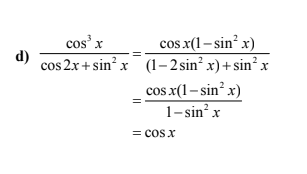



 lethal oracle
The sin^2?
proud jetty
(1-2sin^2x)+sin^2x
lethal oracle
Also I’m having trouble with complex numbers raised to the given power
uncut mulch
combine like terms
abstract dome
which problem do you have, alpaka
proud jetty
oh shit. I forgot the -2 in front means the whole term is a negative right?
abstract dome
yes
lethal oracle
abstract dome
-2 * (sin^2(x))
proud jetty
00f. thx boys and girls and other genders
abstract dome
-8 for the first or second problem
abstract dome
o
lethal oracle
I changed it to polar
abstract dome
Oh, I'm unfamiliar with that
lethal oracle
Oh
uncut mulch
you you would also need to apply the power to the CiS
uncut mulch
multiply their argument by 3
uncut mulch
only the right side of the theorem but ok.
uncut mulch
what do you end up getting?
lethal oracle
I’m getting -8
uncut mulch
that looks good.
uncut mulch
although it still works, (due to odd an evenness of cos and sin)
the sign in between should be +
lethal oracle
Oh
My book says it’s -
And for the problem below that it says the answer is just pi
Not 3pi
uncut mulch
which #?
uncut mulch
what was the original question asking for?
lethal oracle
Polar form of the quotient
Oh do my radians need to be in between 0 and 2pi?
So I need to change 3pi to pi
uncut mulch
did they specify a domain?
lethal oracle
No
uncut mulch
2CiS( pi + 2kpi) would have the same value
from just dividing (and nothing else), your expression is fine
lethal oracle
I might have done this completely wrong
Would this be correct though, the book gives it in a different form but my instructor said I could do it this way but idk if I’m writing it correctly
uncut mulch
is that meant to be the power of 3 or 1/3?
lethal oracle
The question is asking to find the cube roots
willow bear
what are you asked to do
lethal oracle
Find the nth roots of the complex numbers for the specified value of n
rigid sun
I can’t be bothered to do nth roots