#precalculus
1 messages · Page 179 of 1
 viscid thistle
Big number begone
viscid thistle
It was dividing only the x and not the whole equation...
It was a vertical compression???
 acoustic laurel
horizontal compression
because from f to g the /something was cancelled out by multiplying
and this was done on the variable
so it is horizontal
viscid thistle
Okay, but I have this, and the teacher didn't say it was wrong, how can I apply this?
Am going to copy what you wrote
acoustic laurel
lol rip copying is technically against the rules
we're trying to encourage conceptual understanding
but this time, it is what it is
so I think it'll pass
viscid thistle
It's not going to copy copy
acoustic laurel
🙂
acoustic laurel
vertically stretching is multiplying the whole function
lol i think im so burned out lol
viscid thistle
So, only x being affected + a multiplication being involved = horizontal stretch/compression
acoustic laurel
if it is a fraction less than one that is being multiplied with, then it is a compression
but if only x, always horizontal
viscid thistle
So many combinations >~<
Another question, when horizontal, how does stretch/ compress look?
acoustic laurel
however, keep in mind that the multiplication with a fraction less than one is technically dividing
and that only applies for vertical
acoustic laurel
omg im getting disorganized with my thoughts
 fringe wadi
I have a question about function multiplicity:
I don't understand why in order to determine the end behavior we have to add the exponents of the factors
viscid thistle
Okay let's get this chairman
We got this
Dimple question, how is the graph affected when horizontal stretch and horizontal compression
acoustic laurel
it becomes horizontally stretch and compressed lmao
acoustic laurel
just think of the graph shrinking (when being compressed) or growing (when being stretched) horizontally
viscid thistle
But I can't see that in a horizontal way
acoustic laurel
@fringe wadi I can address you
viscid thistle
My brain cannot make an image of it
 obsidian monolithBOT
Cameron:
acoustic laurel
I think adding them up and checking whether they are odd or even leads back to the graph of x^2 vs x^3
fringe wadi
for this function, the sum of the exponents would be 6
but like i dont get how you can just add them together when the bases of the exponents are not the same
acoustic laurel
you don't add them up to work with them in a manner where you would have to fondle with x(x-3)^(2)(x-1)^3
it adds to six
so what do we know about even functions
obsidian monolithBOT
Cameron:
fringe wadi
that would be the expression expanded
acoustic laurel
their end behavior has both lines going off the same direction
they point upwards
both upwards
like
,w graph of x^2
obsidian monolithBOT
 Requested by Chairman Rovic#4063
acoustic laurel
Requested by Chairman Rovic#4063
acoustic laurel
because 6 is an even number
fringe wadi
i get the end behavior portion of it
acoustic laurel
@viscid thistle also, don't stress on making a mental picture
just think of the values of the function for every x
fringe wadi
but the actual multiplicity of the function is determined by the sum of the exponents
at least thats what i've been told
acoustic laurel
@viscid thistle think about how they get affected with horizontal or vertical stretches or compressions
mhmm
acoustic laurel
you can get the multiplicity of some repeating binomial
but I don't think you can for a function
you just determine odd and even multiplicity for a repeating binomial to check whether it crosses or bounces off the x axis
fringe wadi
yes
but you also have to initially find out what side of the x axis the function starts on
and as it was explained to me that's why you have to sum the exponents to find the highest multiplicity
acoustic laurel
mhmm lol idk
I think it has more to do with whether the leading coefficient is negative or positive
but with that rule, i'll look for it
it would be more intuitive since you wouldn't need to expand haha
@fringe wadi again, im sorry for not being informed enough. but thank you for bringing this to my attention
i'll post here once i've come across something pertaining to that method
fringe wadi
no worries! i just found it strange
in all cases we've practiced in class it worked fine
and even expanding the expression completely reveals that the highest present degree is indeed 6
so my thought was that in all cases the sum of every factors exponent will be the highest degree in the expanded expression?
i havent found an example where that isnt the case, but i wasnt sure if it was some widely proved thing
 desert socket
Hello so I’m working on finding the zero and the example I’m following has me stumped in regards to what happens to the remainder 12.
We start with the polynomial at the top and know that x=2 is a zero so I started doing the synth division.
The example immediately factors the (x-2)(x^2 +4x+3) but doesn’t explain what happens to the remainder.
Well distributing and adding the +12 at the end of the distribution gives me the original polynomial but they removed it to factor for some reason.
 proud raven
why do you think that 2 is a zero
are you sure you havent accidentally a sign somewhere
desert socket
That was part of the example.
proud raven
2 is not a zero of that polynomial
desert socket
It specified that 2 was a zero...
proud raven
its possible im stupid
1s
im pretty sure
ill double check with a different tool
but
thats calculator and synth division lol
if you divide a poly by a zero, there is no remainder
desert socket
Let me capture my screen on my laptop 1 sec.
proud raven
desert socket
proud raven

proud raven
desert socket
and then the guy got this..
proud raven
theres 2 imaginary and 1 real root
desert socket
I’m sorry can you explain
proud raven
sure, but you can just graph it too
hmm
if you make the 2 a negative instead of positive you have all real roots
2 isnt one of them though
proud raven
lol one second
desert socket
this was the 'end result'
desert socket
christ
proud raven
youll see theres no remainder
desert socket
Yup I see that
You’d think they would review the maths before uploading this stuff on the official textbook video guides lol
Thanks dude
proud raven

 desert escarp
gamer log equation?
desert escarp
=?
 uncut mulch
you posted an expression with little to no context. did you need help finding its value or something?
 wind cedar
I think I have this set up right, but I'm not really sure what to do next. I thought you set x to be a value that would make A or B = 0 so you can solve for the other one? But how to do that isn't jumping out at me
wind cedar
I did factor it right
 dim jungle
So x=1/5 to solve for B or x=3/2 to solve for A
 hybrid charm
also you need to find B you can't just say make them 0
instead make their coefficients 0
wind cedar
Yes
So how I was shown to set it up is to multiply both sides by the factored denominator. Which is how I got 8-3t = A(5t-1)+B(2t-3)
But I dont know what value to use, the leading coefficients are throwing me off
Nvm, I think I got it
dim jungle
I said above
hybrid charm
,w factor 10t^2+13t-3
obsidian monolithBOT
 Requested by Nick ( 11111010011 )#3263
hybrid charm
Requested by Nick ( 11111010011 )#3263
hybrid charm
😸
uncut mulch
what have you tried?
 somber echo
is anyone good at rational equations ?
 lethal oracle
@uncut mulch
uncut mulch
good start.
do you have any ideas on what to do next?
lethal oracle
Factor it
uncut mulch
yep
lethal oracle
Ya I got it now thanks
uncut mulch
I didn't really do anything 😀
lethal oracle
How do I know to leave it unexpaneded
 willow bear
sin(4x) could have been expanded to 2sin(2x)cos(2x)
third, your handwriting is a bit wack
lethal oracle
Sorry let me rewrite it
willow bear
and you are missing the =0
anyway the thing is the lhs is essentially a function of 2x rather than of x alone
lethal oracle
What would be the next step
willow bear
after you get to $\sin(2x) + 2\sin(2x)\cos(2x)=0$?
obsidian monolithBOT
Ann:
willow bear
why don't you give it some thought yourself
lethal oracle
Should I factor out sin2x?
willow bear
should you?
lethal oracle
I think so, cause then I can start figuring out my solutions
willow bear
then do it
lethal oracle
Would x=pi/2k be the right equation to figure out my solutions for sin2x=0
willow bear
do you mean $x = \frac\pi2k$ or $x = \frac{\pi}{2k}$?
obsidian monolithBOT
Ann:
lethal oracle
The first one
willow bear
then yes those are indeed the sols of sin(2x)=0
willow bear
$\cos(2x) = -\frac12$ gives two families of solutions: $x = \frac23\pi + k\pi$ and $x = -\frac23\pi + k\pi$
obsidian monolithBOT
Ann:
 hoary valley
These are the answers..
I chose (d) , cuz 2 multiplied by the highest value cosθ can get will equal 2.. and e > 2 , is that a valid solution ?
willow bear
yes, e > 2 ≥ 2cos(θ) for all real θ
hoary valley
Awesome
hoary valley
How to shift this function to the right and left ?
 rigid beacon
Why does it say f(y) what
Anyways, for a given f(x)
f(x+a) shifts it left a, and f(x-a) shifts it right a
@hoary valley
hoary valley
@rigid beacon I miss typed that, Are you saying that f(x)=1/(x^2-a) shifts it to the right ?
 proud sparrow
@hoary valley
by replacing x with x+a (a positive)
now 0 behaves like a
so the curve moves to the left by a
hoary valley
@rigid beacon Uh Thanks
rigid beacon
Does that make sense?
hoary valley
Yes, I have to use parentheses and square the whole thing
hoary valley
I'm asked to find the domain of this function... Help
I know I should make the base on both sides similar, but I don't know how to do that with e
willow bear
solve e^2x = 1
hoary valley
I'm trying different things
willow bear
ever heard of this thing called log
willow bear
you can't not have heard of logarithms
the natural logarithm
have you ever used the natural logarithm in any capacity
at all
hoary valley
ln x = e^ln or something
hoary valley
Ok
hoary valley
Thanks Ann, I solved it.
 green zenith
i have a question about composite functions
is the domains of f(g(x)) the domain of g(x) AND the not simplified form of f(g(x))?
 patent beacon
f(g(x)) is itself a single function, and as such it has a single domain
You can't put in anything that g can't accept.
And you also can't put in anything that, after being mapped by g, f can't accept
green zenith
so by that, f(x) is also considered the in the domain of f(g(x))
?\
ah i understand
so f(x) isnt considered
but the value of g(x) onto f(x)
 jaunty mason
hi, ineed help with this question
Prove by mathematical induction that, for all positive integers n, 10^n + 3 * 4^(n+2) + 5 is divisible by 9
,$ 10^n + 3 * 4^{n+2} + 5 is divisible by 9
willow bear
$10^n + 3 \cdot 4^{n+2} + 5$ is divisible by 9
willow bear
ok so what is giving you trouble
jaunty mason
well, i can put k + 1 into it but not sure what i need to do next
willow bear
do you know in general how induction proofs go
jaunty mason
uh-huh
but i'm really only comfortable with proving sums by induction
not really good with divisibility
dim jungle
3*4^(n+2) will always be a certain number
🙂
Mod 9 that is
For pos n
That's ur hint
willow bear
is it tho
willow bear
is 4^n constant mod 9 tho
dim jungle
3*4^(n+2) is

 stuck lark
12 in the exponent or not?
green zenith
no
so what i did was isolate 9^x and 3^x
so its 9^x-3^x=12
and log both sides?
is this correct?
willow bear
well you CAN log both sides but it's not gonna be very useful
green zenith
so i cant log 9^x and 3^x?
oh it must be the quadratics
it is the quadratics
i already forgot
sorry for bothering you guys
stuck lark
it is the quadratics
elaborate
jaunty mason
I'm still not sure what we established when we found that mod 9 was eqaul to a certain number @dim jungle
dim jungle
If it's equal to a certain number mod 9, substitute it in
jaunty mason
1
dim jungle
The middle part always equals 3
jaunty mason
wouldn't we need to prove that as well?
dim jungle
$3\cdot 4^{n+2}$ is 3 mod 9
stuck lark
rip texit
dim jungle
You can prove that through binomial theorem easily
obsidian monolithBOT
Jbao:
dim jungle
Then add other stuff
jaunty mason
what
idk full context
what am i adding together?
why am I adding them together?
@dim jungle Sry for the ping spam but I kind of still need help
also i'm fairly certain we're not supposed to do it this way anyways
something similar to this probably
patent beacon
How far have you gotten?
 trim fable
oh
i was starting with a stretch
so I have the asymptotes drawn out
but like idk how i would
include the 3 points on the right with these specific asymptotes
@patent beacon
like i just drew a stretch of what i did on paper
 ruby frigate
if given a function do you know how to find the VA and the HA?
trim fable
ye
but the question is above this
@ruby frigate
i have to write an equation but i was drawing a sketch to help
ruby frigate
yeah I see that
trim fable
oh ok
so ix if i were to just make a basic equation that
f(x)= 6x/3x-12
that would give me a ha of 3
and va at 4
ruby frigate
no it wouldnt
play around on desmos and see for yourself
VA is when the denominator =0
HA has some rules but a tip would be just to make the highest power of top and bottom the same
and then just divide by their coefficients
trim fable
oh right
i meant
x^2-16
@ruby frigate
how would i make an equation with the properties where f(x) has to be greater than or less than 1/2
green zenith
hello i need help forming equations of circles
in the equation Ax^2+By^2+ax+by+c=0, what do i do with A and B when A and B > 1?
 urban vigil
for the remainder thereom
let’s say that you’re looking for the remainder of a polynomial equation divided by TWO (x+/-n)
would you add together the remainders of each
green zenith
hello!
i need help solving this equation (log(x^2)+log(x^3))/log(60x)=7
what i use the product rule. Then the change of base. Then I change it in exponential form. Is that correct?
dim jungle
just use log properties
you dont need to change base at all
combine all the log to one single log
green zenith
can you make it into one single log without using change of base?
green zenith
😧
dim jungle
it is
 harsh cipher
Hi guys
and girls
I've previously asked this question but wanted to ask again
video explanation said it can foil out the line above the equation with arrows.
(x^2-1)(x-3)(x-3)(x-3)
using pascals triangle. I'm not sure what that is.
dim jungle
J google online 🙂
When u get numbers forming a triangle u know it's right
There r a lot of cool concepts surrounding it so u can look into that if interested
Rly not necessary for a problem like this tho
 noble halo
a little lost on this
i know i could just search it up but I’d like to know an explanation
acoustic laurel
No, it’s not just f(x) = x. I think the domain of the square root function prevents you from using x-values that are negative to avoid a non-real answer. However, it is just f(x) = x for x-values of zero towards positive infinity.
Unless what you meant by “when is x pos” would mean that you cannot have negative position, which you can. It would be much more proper terminology to say “distance” since that would be the appropriate scalar term for some magnitude you travel in space.
uncut mulch
csc(x), cot(x) ig
acoustic laurel
Yeah, but I don’t see how you would have to change your answer. I cannot think of any other trigonometric function that would be undefined for x = 0 other than csc(x) and cot(x) which both would be undefined due to the sin(0) in the denominator that would yield a zero which would result in an undefined answer due to forcing the whole function to divide by zero.
hoary valley
1^x can I call this an exponential function or is it called constant ?
willow bear
depends on context but usually 1^x is not considered an exponential function
 haughty fern
ive totally forgotten how this actually works
Without the two oldest children being chosen, where does 6c2 come from?
hoary valley
What's the range of this function? I tried graphing it, but it shows a blank graph..
willow bear
did you just put it into desmos as is
hoary valley
I used Mathway
willow bear
did mathway not say anything about k
willow bear
mathway is garbage then
bc if it assumes k=0 it should at least say so outright instead of just doing it silently...
hoary valley
Ok, I used Desmos apparently its range never hits 0, so it has a HA at 0 , So the range is (0,+infty), right?
willow bear
... no? its domain is (-k, k)
it can't have any horizontal asymptotes
by your logic, y = x^2 has a horizontal asymptote at -1
 heady jewel
i thought log(a)/log(b) is not equal to log(a-b)?\
@dim jungle stop saying wrong things
hoary valley
I still can't find its range, Help.. I know its domain is
(-k,k) , but I'm unable to find its range.
@blazing monolith I'm not allowed to replace K with a negative number right?
@blazing monolith this with it being as is, the range will be [0,k]
but if it's on the denominator, I have no idea.
uncut mulch
|| sqrt(k^2) != k||
uncut mulch
$8x^2e^{-5x}-5x^3e^{-5x} = 0$
obsidian monolithBOT
ramonov:
uncut mulch
?
green zenith
yes
i did try to solve it by moving 5x^3e^-5x to the other side and ln both sides but im not sure if thats the correct solution
uncut mulch
notice that e^(-5x) cannot be zero
uncut mulch
does that give you any ideas on what to do?
uncut mulch
generally if it was another term, you would factor it out
but since you know e^(-5x) can't be 0, you can divide everything by it when solving for x.
and you'll be left with solving
8x^2 - 5x^3 = 0
uncut mulch
if you want to go through the intermediate step
e^(-5x) (8x^2 - 5x^3) = 0
there are no real solutions to e^(-5x) = 0
uncut mulch
(excluding 0^x which isn't really considered an exponential anyway)
green zenith
that is interesting
good to know
thank you
i think i can take it from here
thanks
 rigid sun
No problem
 serene heath
What is 1-sin^2
viscid thistle
i dont know
serene heath
$\sin^2+\cos^2=1$
obsidian monolithBOT
the one n only:
serene heath
Yes?
viscid thistle
isnt that a pythogrean identity?
willow bear
if a+b=1 then what is 1-a
viscid thistle
1 - a = b?
willow bear
now look at lemon's question again
viscid thistle
1 - sin^2 = cos?
willow bear
no
 trail badge
 gaunt spoke
hey @vague zephyr you still there/need help
 vague zephyr
i finished the first 2, just need help on the last one
vague zephyr
what i have so far is 6 sin ((4pi/5)x)+6
vague zephyr
oh
gaunt spoke
2/2/5
vague zephyr
my period is incorrect then
gaunt spoke
do you see why the period is 2/5?
vague zephyr
yes because the first interval begins at 0 and ends at 2/5
vague zephyr
ooohh
vague zephyr
2pi/2/5x,
gaunt spoke
which is 5pi
vague zephyr
yep, forgot to multiply by the recip
gaunt spoke
yeah
think about it like this to not forget that
2/5 is less than one
so it is going to get bigger
the numerator will be larger/if it is negative, smaller
and if you are dividing by .4
well that is the same as multiplying by 2.5
because 1/.4=2.5
 pulsar viper
How would u solve ax^2 + 10x + c = 0 without using the quadratic formula
My answer has to be in terms of a and c
 tepid cedar
what is the correct formula for figuring out compounded monthly interest?
is this one it?
so 1/12 would be a month for n right?
ok i get it
pulsar viper
How do u do 1 and 2??
 sleek wolf
Is anyone online able to help with chapter 5.3 tangent function graphing
viscid thistle
What would be the reciprocal identity of (sin^2x + cos^2x)/sinxcosx
lethal oracle
uncut mulch
what have you tried?
lethal oracle
Well I’m not sure where to start is the thing
I know I gotta get i wanna get it to sin2x
uncut mulch
4sin(x)cos(x) = 2 * 2sin(x)cos(x)
lethal oracle
Okay so I got (2)(2sinxcosx)-1=0
uncut mulch
^
rigid sun
Do you know what 2sin(x)cos(x) is?
lethal oracle
Sin2x
lethal oracle
So (2)(sin2x)-1=0
uncut mulch
leave the one on the rhs
rigid sun
put the one back on the other side
lethal oracle
Okay
rigid sun
Now solve
lethal oracle
Even though the 1 is on the rhs?
rigid sun
Yes
lethal oracle
So I’m solving 2sin2x?
rigid sun
Yes
uncut mulch
solve: $2\sin(2x) = 1$
lethal oracle
Oh alright
obsidian monolithBOT
ramonov:
rigid sun

lethal oracle
Is the equation I use to solve 2x=4pi/6+pi/2k
lethal oracle
My instructor has us do it that way
rigid sun
That’s aids
lethal oracle
He requires it me for this take home quiz
lethal oracle
Would that be the right equation?
rigid sun
Idk I don’t do that
I just use brain
Sin(2x) has a period of pi
Which fits twice into 2pi
Sin(x) passes 1/2 twice per period
So 2*2
Four solutions
You can find these four solutions by doubling your period
2pi*2= 4pi
Find all values of x under the 4pi where sin(x)=1/2
then half all those values
uncut mulch
ambiguous fractions
uncut mulch
if you wanted to do it like that
2x = pi/6 + 2kpi → x = pi/12 + kpi
2x = 5pi/6 + 2kpi → x = 5pi/12 + kpi
lethal oracle
Why is it 2pi
uncut mulch
add the period while its still in the form 2x =
lethal oracle
So I got sin2x=1/2
Sin is 1/2 at pi/6 and 5pi/6
So I get my period by looking at these two values, right?
uncut mulch
you get your period from the function
lethal oracle
Oh
uncut mulch
which is sin which has a period of 2pi
uncut mulch
the parent function has a period of 2pi
uncut mulch
yes
lethal oracle
Is the period for cosx, pi?
uncut mulch
period of cos(x) is also 2pi
lethal oracle
So when would I have pi/2 as my period?
uncut mulch
depends on the question / transitional shifts
uncut mulch
wdym?
lethal oracle
Is it pi/2 because it’s a function of cos4x?
uncut mulch
period is pi/2 because 2pi/(coeff of x) = 2pi/4 = pi/2
did you understand how to get
2x = pi/6 + 2kpi → x = pi/12 + kpi
2x = 5pi/6 + 2kpi → x = 5pi/12 + kpi
lethal oracle
You divided both sides by 2
uncut mulch
did you understand the first part?
lethal oracle
You got pi/6 or 5pi/6 by looking at where sin is equal to 1/2
uncut mulch
specifically the + 2kpi
lethal oracle
Cause the period is 2pi?
lethal oracle
pi/12, pi/6, 5pi/6, 13pi/12
uncut mulch
some of those arent right
lethal oracle
The last one?
uncut mulch
pi/12 and 13pi/12 are fine
lethal oracle
I’m not sure what I did wrong
uncut mulch
x = 5pi/12 + kpi
uncut mulch
where are you getting 5pi/6?
and where did your pi/12 go?
reminder that
x = pi/12 + kpi
x = 5pi/12 + kpi
lethal oracle
Okay I sent them wrong it’s: pi/12, 13pi/12, 5pi/12, 17pi/12
uncut mulch
yeh thats better
lethal oracle
I have this other one, it’s cosx+cos3x=0
Would my solutions be pi/4, pi/2, 5pi/4, 3pi/2, 7pi/4, 3pi/4
uncut mulch
yeh.
lethal oracle
How do i determine how many triangles a set of measurements make
For example the measurements in 17
viscid thistle
Is homework not allowed to be answered by others here?
ruby frigate
people wont solve it for you, if thats what you're asking
green zenith
What happens when i have 2 log exponents in one number?
For example 10^((log1)+(log2))
Will i just simply add the value of the logs?
I think in this case, i would you use the product rule, right?
But what if it log1 and log2 is multiplied instead of added?
serene heath
Cant do much
proud sparrow
@green zenith What base is the log? If base 10, you can change it to 50^log(9), but that's somewhat ugly
green zenith
Yes it is base 10
Can i also do it 9^log(50)?
And so it cant be simplified to a number?
green zenith
I didnt know that last part
willow bear
50=10*5
viscid thistle
Hello, why is sin(-Ax) * cos (-Bx) equal to -sin(Ax)*cos(Bx)?
green zenith
Yeah but how did 1+log5 happen?
willow bear
@viscid thistle sin(-t) = -sin(t), cos(-t) = cos(t)
green zenith
Thanks guys
viscid thistle
Thank you, I completely forgot about that
green zenith
Is it possible that a graph have 2 horizonntal asymptotes?
uncut mulch
yes
green zenith
I only saw the three rules of finding a horizontal asymptote. Are there other rules?
proud sparrow
what 3 rules?
green zenith
The 3 rules based on the degree of the polynomial in the rational function
green zenith
But based on the rules, i can only find 1 horizontal asymptote
So in e^x, there are multiple asymptotes?
Oh yeah e approaches a certain amount of number
So in a rational function, there is always only one horizontal asymptote?
willow bear
Oh yeah e approaches a certain amount of number
what the fuck is that supposed to mean
green zenith
I think im confused with something else
proud sparrow
So in a rational function, there is always only one horizontal asymptote?
At most one
green zenith
Ahhh
viscid thistle
In a rational function if there is a zero at a certain point but there is also a horizontal asymtope on the x-axis can the function go through the x-axis to reach the zero
uncut mulch
wdym by reach the zero?
viscid thistle
Like
If there's a zero there it means the function needs to pass that point that is on the x-axis right, but there's a horizontal asymtope on the x-axis, so it would cross through the x-axis?
uncut mulch
ah. the horizontal, oblique asymptotes describe the end behaviour
it is possible for the function to pass through it multiple times
viscid thistle
Ok
Thanks cuz I realized it would be impossible for there to be a zero there if it couldn't pass through the asymtope
 nocturne tangle
hi i need help
I already have mu and Vmax
i just need to solve for theta and radius with this information and this formula
<@&286206848099549185>
 uneven tendon
@nocturne tangle square both sides, divide the the numerator and the denominator of that fraction by $\cos\theta$ and solve for $\tan\theta$
obsidian monolithBOT
Nuke:
uneven tendon
Also,
 merry sphinx
Bot is broken
uneven tendon
Again? rip
green zenith
if sin = negative number, shouldn't csc also be = negative number?
ruby frigate
Yes
green zenith
and that works with cos and sec, and tan and cot?
rigid beacon
yup
green zenith
okay thanks. i just want to make sure. the book is making me doubt myself.
stuck lark
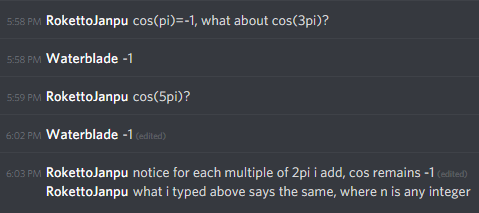
$\cos(\pi +2\pi n)=-1, n \in \bZ$
obsidian monolithBOT
RokettoJanpu:
$\cos(\pi +2\pi n)=-1, n \in \bZ$
 clear glade
i dont get it
stuck lark
cos(pi)=-1, what about cos(3pi)?
clear glade
-1
stuck lark
cos(5pi)?
clear glade
-1
stuck lark
notice for each multiple of 2pi i add, cos remains -1
what i typed above says the same, where n is any integer
stuck lark
solve the problem again, but remember that there are infinitely many values of theta that satisfy the equation
infinitely many until you apply the usual restriction that theta lies between 0 and 2pi (which you yourself never specified but i'm assuming it here)
clear glade
ok I will give it a shot
so yea it just keeps going
oh wait I mightve messed up
gonna try again
yea i dont get it
stuck lark
cos(WHAT) = -1?
clear glade
lol what?
stuck lark
cosine of WHAT equals -1?
clear glade
pi
 clear glade
ok I get that
I don't get where we get 5pi/3 from
like I know pi is where cos is -1
and when we solved the equation we got pi/3
stuck lark
is there a way to neatly state all solutions of x to cos(x) = -1?
stuck lark
i let n = 0, so that's pi/3+0. cos(pi/3) is not -1
clear glade
so you got 1/2 for the cosine
then you looked where else cos is 1/2
and that was the answers along with what we solved basically
?
stuck lark
x = pi/3 + 2pi*n is not the solution to cos(x) = -1
stuck lark
didn't ask you to solve cos(x) = 1/2
stuck lark
x = pi is ONE solution to cos(x) = -1 but it's not the ONLY solution
stuck lark
so state the other solutions using n for an arbitrary integer
clear glade
thanks for the help but I give up lol
clear glade
ahh
I finally get it @stuck lark
Arigatou Roketto-senpai!
I was doing the equations wrong basically
sorry to bother u for u so long lol
stuck lark
@clear glade very naisu! 
clear glade

rigid sun
K
trim fable
yay
this
x^2+3x+3 cant be factored tho :C
so my question was can i move the top and bottom to the other side and simplify then factor?
@rigid sun
trim fable
oof
im so confused with this
coz i got x^2-3x-3/-2x+3
by doing that
u know what nvm
ill ask my teacher tom
 hexed bolt
How would I do the last one?
 limber bone
tan(theta) = sin(theta)sec(theta)
 brisk frigate
Can I ask for math help here as long as its related to Pre-calc? or does it have to be on one of the questions chats
I feel like if its precalc this would be the place for it right?
 grizzled orchid
yes
brisk frigate
k thnx
 summer sierra
nvm i solved it
but i have a new problem
The population of a small town is modeled by the equation
P = 1650e0.5t
where t is measured in years. In approximately how many years will the town's population reach 20,000? (Round your answer to two decimal places.)
uncut mulch
exponential growth function?
dim jungle
Should it be e^ stuff
uncut mulch
$P(t) = 1650e^{\frac{t}{2}}$
obsidian monolithBOT
ramonov:
summer sierra
Yes exponential growth I suppose
uncut mulch
how did you get from the 3rd line to the 4th line?
your right side of the equation just changed
summer sierra
thats what 20,000/1650 is
oh i mean
the power rule lets u do that
like bring the exponent to make it the coefficient
uncut mulch
$e^{0.5t} \neq 0.5 t e$
obsidian monolithBOT
ramonov:
summer sierra
??
summer sierra
what should i do instead?
uncut mulch
which parts are you dividing by 0.5? just the left or both the right and the left?
uncut mulch
then write division on both
summer sierra
thanks i managed to solve it
 opal swallow
stuck lark
opal swallow
stuck lark
$y=\tan(2x-\frac{\pi}{2})$ not $y=\tan(x)$
obsidian monolithBOT
RokettoJanpu:
 pseudo sonnet
gotcha
i got 0 thanks
so is there a quicker way to finding these Y output values
stuck lark
desmos
stuck lark

Desmos Graphing Calculator
pseudo sonnet
what about it?
stuck lark
https://www.desmos.com/calculator/op1velke2f as an example
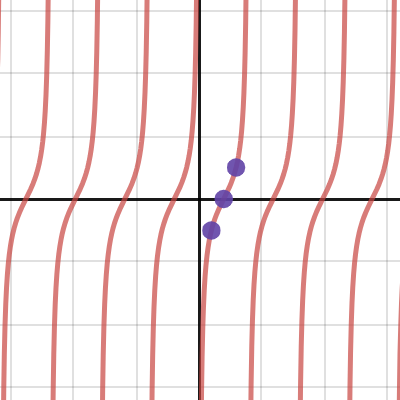
Desmos Graphing Calculator
pseudo sonnet
what the hell
i got positive one for pj/8
ik it should be negative
i plugged in pi/8
then i evaluated pi/4
stuck lark
you forgot how the function's defined
pseudo sonnet
stuck lark
you forgot how the function's defined
pseudo sonnet
?
stuck lark
read the problem again and tell me how y is defined
stuck lark
plug in x=pi/8
 young goblet
When doing transformations, you have inverse, reflection, expansion/compression, and shifts right
what's the order you do them in?
young goblet
no lol
we're not there yet
like i"m just talking about transforming a function in general
like say y = -3f(2(x-5))+4
there's vertical stretch, horizontal compression, reflection across X axis shift right by 5 units and up by 4 units right
but then in waht order do I do it?
cuz I know that some orders matter like stretch before shift
and then what if I throw in an inverse
 radiant night
I keep messing up on factoring that f(x) equation and I cant move forward without simplifying it
 fading token
,w 2x^2-12x+16

 fading token
There you go, under "Alternate forms"
radiant night
Thank you
young goblet
So does inverse come before everything else or after again?
 edgy sun
part c
serene heath
x=x-1+1
uncut mulch
oh that would've been a hint to part a)
for part c)
integrate using the recommended substitution
double angles. draw triangle to find cos(theta),
back substitute and you should reach the answer
brisk frigate
Anyone know how to solve this? My school is bilingual so we just started math in english this month, i dont really understand what is asking me to do
At first i thought it was synthetic division but idk what they mean by "with multiplicity 2"
serene heath
Mutltiplicty refers to how many times the root occurs
So (x-1) 1 has mult of 1
(X-1)^2 is 2
brisk frigate
oh i see
but since there is a comma after the "x = -3" idk if the multiplicity refers to that one or another one that i have to find?
serene heath
Think they mean -3
brisk frigate
okok thnx
I havent really done any "hard" math like this in a while, I think I had to check for factors of "C" and then plugged those values into "X" to check which ones made the equation be "0"
But 81 prob has a lot of factors so, is there a way to just get the answers without that trial and error on my calculator?
I was also thinking about synthetic division but i dont really remember much about it and i think in order to do that i need another set of numbers to divide by or something like that?
serene heath
81?
brisk frigate
well i was thinking 81 bc thats the value of "C" in the first one
- f(x) =x^4 + 6x^3 + 18x^2 +54x + 81
brisk frigate
oh okok, i'll get the values for x on that one
i factored it to: (x^2-9) (x^2-9)
(I always get confused with algebra and functions n stuff like that so im writing what i did, in case the answer is wrong)
so i sqrt both sides
serene heath
Yea that's fine
brisk frigate
and got: sqrt(-3)
serene heath
Erm
brisk frigate
as the answer on both
serene heath
Yes
serene heath
No
serene heath
Yes
serene heath
Lol
brisk frigate
k now ill just look up how to get the values of polinomial equations bc i forgot about it and i should be good to go
tysm for the help
 paper temple

I'm in college precalc, but here's my notecard for the test tomorrow

 thorny island
the fuck
viscid thistle
lool
 remote maple
Can anyone explain how I do this
viscid thistle
ok lets expand that first expression
uncut mulch
double angle identities
uncut mulch
(in reverse)
viscid thistle
yeah
actually why not plug some values in
cos(0) = (1+cos(0))/2
what ?
oh yeah
never mind
anyway
cos^2(pi/2) = (1+cos(k*pi/4))/2
bruh
uncut mulch
do you know your double angle identities for cos? @remote maple
remote maple
@uncut mulch i think so
uncut mulch
it has 3 forms. what are they?
remote maple
Cos^2A - Sin^2A, 2Cos^2A-1, 1-2Sin^2A
uncut mulch
parentheses would be a bit better but ok
since you have cos^2(2x) in you question, which one should you apply here?
remote maple
2nd one
uncut mulch
whoops, left out a 2
yeh. what equation would you start with?
remote maple
2Cos^2A-1
uncut mulch
equation, not expression
remote maple
So, "2Cos^2A-1 = 1+cos(kx)/2" ?
remote maple
oh
viscid thistle
Need halp. How to do dis?
viscid thistle
@viscid thistle you need to zoom dude
remote maple
Think I got it, thanks you guys
uncut mulch
fow much do you know about functions
(Inputs/outputs)
have you done compositions before?
do you understand fog notation