#precalculus
1 messages · Page 173 of 1
 patent beacon
What's f(6)?
 willow bear
inb4 "i dont know how do u find it"
willow bear
ok, so $f(6) = \frac12$
 obsidian monolithBOT
Ann:
willow bear
what about $f(9)$?
obsidian monolithBOT
Ann:
willow bear
and $f(12)$?
obsidian monolithBOT
Ann:
 viscid thistle
-1/2
willow bear
you sure about that
willow bear
and f(15)?
viscid thistle
3
patent beacon
Lol
viscid thistle
I don't mind h
willow bear
you may notice that $f(n+12) = f(n)$
obsidian monolithBOT
Ann:
patent beacon
Ahh clever
viscid thistle
Oh yeah.
viscid thistle
Hello
I'm having the feeling this is a weird result
Why would the number be so small?
For S_3 the result is 192500, what makes sense, the number is increasing
But for S_30 the number is really small
Why?
It's because the numbers decrease to the point they start subtracting?
Is it only 1 that is to the power of 30?
No, It's one half to the power of 30
:)

Lonely, and miss lonely...
I'm still figuring it out, I've never done series before.
Oh!
 glacial island
inverse cos / sin /tan (arccos/arcsin,arctan) is used to find the angle degree right?
viscid thistle
@glacial island make your question in a question channel available! :)

I'm guessing it's cause once the 110000 on the left is being subtracted by a smaller power fraction, the number gets smaller each time. And then the number gets subtracted by 110000. But like for example if it's 110000× (1/2)^3, then the number wouldn't get that small, so once it's subtracted by 110000 it will be a small negative number, then that negative number is just doubled and it becomes positive. But if it's 110000×(1/2)^30 the number is way smaller, and a "smaller number" subtracted by the same "big number 11000" then it will make a "big negative" which is doubled and turned into a positive. Idk if I totally just answered a different question or not h-
Hold up
Oh yeah I didn't explain it 100%
You mean it's increasing by a little right?
No, your are saying exactly what I thought
When S_3 all the number from 1-3 are positive, but there's a moment in the sequence when we start having negative values, that why S_30 is just a small number
Negative values, How?
I think it just increases more slowly when the series has a bigger number, but it doesn't get negative
viscid thistle
There's a moment it gets negative
See?
Oh
You are right...
There's a lot of positive decimals
Right now I'm struggling to make a decision based o.n all the data I have
I need to answer this questions
Choices:
$240,000 a month
$19,912,500 a month
$220 a month
The $220 option is the one I have trouble understanding
viscid thistle
How did I get it?
 proud sparrow
what's the original question?
viscid thistle
The original question is to calculate every choice
I already did that, now I need to make decisions with this results
proud sparrow
I see a 220 about here https://discordapp.com/channels/268882317391429632/363224154469826562/630124886941106176
but honestly, I have no idea what the question is
viscid thistle
The one in the middle is my set of numbers
This is already done Element
What I need help with is understanding choice 3(?
Like, the sum of this sequence, $220, is really the monthly payment?
Cus my head can't understand the logic behind it
viscid thistle
I guess...
I don't understand how ( for choice #3) you could be gaining $192,000 on day 3 but on day 30 your total amount is $220
proud sparrow
ah
viscid thistle

proud sparrow
It's the total area for the 30 days
viscid thistle
Yeah
proud sparrow
So for 30 days, the total area is adding up the square for day 1, 2, 3 to 30
you need to add up the areas
viscid thistle
But why suck as small number like 220 would be de answer
What about the $192000 from up to day 3?
proud sparrow
it can't be less than the area until day 3
viscid thistle
 spring thunder
i'm p sure your calc is saying 220k not 220
proud sparrow
,w (110000*(1/2)^30-110000)*(-2)
viscid thistle
Well that's pretty confusing
obsidian monolithBOT
 Requested by Element118#2437
spring thunder
Requested by Element118#2437
spring thunder
i mean do you really need a calc to see this is almost 220k tho
viscid thistle
I need to be sure
viscid thistle
Well thank you guys, it seems like I'm considerably blind
 pseudo sonnet
does (k+1)! simplify to $(k!) + (1)!$
obsidian monolithBOT
Vici:
obsidian monolithBOT
Vici:
 stuck lark
@pseudo sonnet if it helps, expand the factorial (k+1)! a tiny bit
pseudo sonnet
how do i expand that
stuck lark
how do you expand 5!
stuck lark
what about k! for any natural number k
pseudo sonnet
i dont know :#
stuck lark
notice the pattern for writing 5!
you start with 5 then multiply it with 5-1, which is 4
pseudo sonnet
i see what you mean by the pattern
pseudo sonnet
k! * (k-1)!
pseudo sonnet
20
stuck lark
i just want the expansion
obsidian monolithBOT
Vici:
stuck lark
the first number is 5, the second is 4, what's the third?
pseudo sonnet
$k * (k-1) * (k-2)$
obsidian monolithBOT
Vici:
stuck lark
but remember there could be more numbers that come after k-2
pseudo sonnet
i know
stuck lark
change what you wrote so it's equivalent to k!
pseudo sonnet
$k! = k * (k-1) * (k-2) ... (k - n)$
obsidian monolithBOT
Vici:
pseudo sonnet
like that
stuck lark
there you go
actually not quite, eventually you'll reach k-(k-2) and k-(k-1) which are just 2 and 1
$k! = k(k-1)! = k(k-1)(k-2)!$
obsidian monolithBOT
RokettoJanpu:
stuck lark
this is probably as far as you want to go
obsidian monolithBOT
Vici:
 rare zephyr
ain't it just (k+1)(k)(k-1)(k-2).....?
pseudo sonnet
ye
 obsidian monolithBOT
Vici:
stuck lark
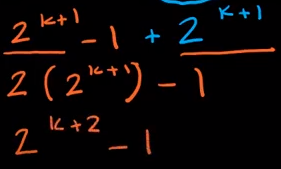
$2 = 2^1 \\ 2 \cdot 2^{k+1}=?$
obsidian monolithBOT
RokettoJanpu:
obsidian monolithBOT
Vici:
pseudo sonnet
smh its so easy
but this notation
makes everything confusing
its like math induction is a new math
pseudo sonnet
ye but induction step so hard
its manipulating powers, fractions, etc to get the same equation
on both sides
nah im op now i get it all
proud sparrow
you think you are op
use that as motivation to learn more
and show us that you would be really op
Hypothesis: @pseudo sonnet is OP
Proof: Let's wait and see
pseudo sonnet
$8^{2k+3}$
obsidian monolithBOT
Vici:
pseudo sonnet
$ = 8^{2k} * 8^{3}$
obsidian monolithBOT
Vici:
pseudo sonnet
can the 8^2k
be simplified any further
can someone tell me where i went wrong
i did..
at the bottom
448 isnt a factor of 57
so that didnt work out
i got a decimal
which line?
all of them are wrong?
how is it wrong
pseudo sonnet
LOL.
 rigid sun
hacker
 simple flume
Please help. I get 2 answers and none seem to work.
stuck lark
show your work
simple flume
calculator
rigid sun
its asking for a function
simple flume
x=0, x=12
willow bear
do you understand what the problem asks you to do
 stoic ember
Hello, I got my first problem to prove it by induction: $\forall n \in \mathbb N*: S_n = 2 + 4 + 6 + ... + 2n = n(n+1)$
obsidian monolithBOT
Alaanor:
stoic ember
So, to solve it, I start by the initialisation, $S_0 = 0$ and $S_1 = 2$ so it's true and it work
obsidian monolithBOT
Alaanor:
stoic ember
then the induction: $P(n) \implies P(n+1)$, hence $S_{n+1} = S_n + 2(n+1)$
obsidian monolithBOT
Alaanor:
stoic ember
and then I end it by $(n+2)(n+1)$
obsidian monolithBOT
Alaanor:
stoic ember
And in the book, it's the answer, but I'm like ? what
that's the answer ?
how does it prove anything
stoic ember
the next occurence
willow bear
(n+1)((n+1)+1)
 shrewd urchin

 stoic ember

 viral imp
,, y=\frac{1}{4^x-3\cdot2^x+2}
obsidian monolithBOT
Umma.Gumma:
viral imp
I'm interested in finding the domain of this function
I'm not sure how to proceed in this case though
that 3 complicates things somehow
 tall granite
it's defined everywhere except where denominator is zero
so solve the equation denominator=0
do find where it's not defined
that's just a quadratic equation
viral imp
edit: I don't understand how to get a canonic exponential equation, starting from that denominator
,, a^{f(x)}=a^{g(x)}
obsidian monolithBOT
Umma.Gumma:
 blazing parrot
why do you need that?
viral imp
how would I do otherwise?
blazing parrot
$$ 4^x = (2^x)^2 $$
obsidian monolithBOT
Not Chezstick:
viral imp
I don't get how this should help
obsidian monolithBOT
Not Chezstick:
viral imp
indeed
blazing parrot
set u = 2^x
viral imp
not following
blazing parrot
now can you rewrite the equation in terms of u?
 reef rune
if a power function can be written as $x^\frac{-1}{4}$ would $\frac{1}{\sqrt{4}{x}$ also be considered a power function
blazing parrot
do you mean the square root sign to go over the x as well?
and it to be a 4th root not a square root?
willow bear
$\sqrt[4]{x}$
obsidian monolithBOT
Ann:
willow bear
did you want this
reef rune
yeah
willow bear
to answer your question: yes it would
reef rune
mhm
weird
I wrote it the other way around on my test and lost a point
guess I'll have to justify
obsidian monolithBOT
Umma.Gumma:
viral imp
I'm trying to assess the domain, which I understand it has to be obtained solving the equation in the denominator
problem is, I know how to solve exponential equations only when they're in a canonical form
 uncut mulch
a hint was already given
let u = 2^x
and rewrite the denominator in terms of u
viral imp
the hint did not help at all
viral imp
that I know, but I would appreciate a general way of approaching this problem
rather that a shortcut to solve this function in particular
blazing parrot
there is not a way to put this in canonical form immediately because of the +2 at the end
blazing parrot
let u be 2^x , rewrite in terms of u
viral imp
,, u^{2x}-3*u+2
viral imp
wait my bad
obsidian monolithBOT
Umma.Gumma:
obsidian monolithBOT
Not Chezstick:
viral imp
,, u^2-3*u+2
obsidian monolithBOT
Umma.Gumma:
blazing parrot
now do you recognise this type of equation
viral imp
I do my question is what is the justification to proceed this way
blazing parrot
you are trying to get 2^x = something
in this case by solving this quadratic, you can solve the 2 exponential equations that you get from it
viral imp
right
therefore, given that the two root are 2 and 1
,, 2^x=2 ==> x=1 and 2^x=1 ==> x=0
obsidian monolithBOT
Umma.Gumma:
obsidian monolithBOT
Umma.Gumma:
blazing parrot
so you now know the denominator is 0 when x = 0 or x =1
so you can write the domain of the function ie when denominator not equal to 0
viral imp
well thanks a lot
I'm not quite confident with this procedure, guess I'll do more of this
blazing parrot
good luck!
 trim fable
How would u do this
blazing parrot
do what
trim fable
one sec
that
what i did was
v=lxwxh
1008=(30-2x)(20-2x)(x)
1008=(4x^3-50x^2=600x)
0=4x^3-50x^2=600x-1008
blazing parrot
dont expand it
blazing parrot
just use the factorised form to find 0s
blazing parrot
you knoe the thing where if a*b = 0 then a=0 or b=0
trim fable
uh what?
blazing parrot
if a*b = 0, it follows that either a=0 or b=0
trim fable
question this is precalc right? coz the course is called advanced functions and i have heard its the equivalent to precalc
oh ye
coz its =0 so one of them has to be 0
trim fable
oh
trim fable
oh
spring thunder
hoping the dimensions have to be integers
blazing parrot
oops i think i did a dumb
 undone pawn
yes
trim fable
yesss!!!
undone pawn
that's a good step to begin with
patent beacon
No 50 isn't divisible by 4
undone pawn
uh 50?
blazing parrot
what 50
undone pawn
what
trim fable
tho the answers 3,4.92 either 3cm by 3cm or 4.92 by 4.92
patent beacon
Going with this
v=lxwxh
1008=(30-2x)(20-2x)(x)
1008=(4x^3-50x^2=600x)
0=4x^3-50x^2=600x-1008
trim fable
^answer at the back
patent beacon
But there's a random = in there so idunno
undone pawn
just divide out the common factors oof
trim fable
ye typo^^
undone pawn
why're you carrying the extra four around
trim fable
it was supposed to be a + sign not =
undone pawn
it's simplified as 252=(15-x)(10-x)(x)
patent beacon
Hacks
patent beacon
Prime factorization is unique
undone pawn
prime factorization
undone pawn
you dont know how to break down a number to its prime factors?
patent beacon
Not the way you're supposed to do it, but a very cool way to do it
undone pawn
^
trim fable
oh
undone pawn
the rigorous way would be to solve the cubic
patent beacon
Know how we got to
252 = (15-x)(10-x)(x)
undone pawn
yes we did
trim fable
oh
undone pawn
like what else could we have done
trim fable
30.-2x-> 15-x is /2 tho
patent beacon
Yes, we divided two of the factors by 2, which is the same as dividing both sides by 4
patent beacon
You don't have to do this, you can expand first
undone pawn
but you'll have to solve the cubic
which sucks
but I guess if it's for school, do that
trim fable
but like would and expand and then try to guess and check till the remainders 1008?
or should i move it to the other side and use 1008
till i get 0?
patent beacon
After you expand, 4 should be a common factor
trim fable
ok
undone pawn
but if you're guessing anyways, factorizing 252 method is as good as any
trim fable
so i was doing ir tight before..?
undone pawn
I guess
trim fable
right*
patent beacon
,w expand (30 - 2x)(20 - 2x)(x) - 1008
undone pawn
wtf
obsidian monolithBOT
 Requested by Kaynex#7520
patent beacon
Requested by Kaynex#7520
patent beacon
Noice
trim fable
wow cool
OH
OMG I MADE A DUMB MISTAKE
the 50 was messing me up
with this question lol
😛
patent beacon
Naturally, 4 is a common factor
4x³ - 100x² + 600x - 1008 = 0
x³ - 25x² + 150x - 252 = 0
undone pawn
anyways for closure, continuing my method, options for x are 2,3,4,6,7,9
and second trial shows, x=3 is a winner
patent beacon
For solving the cubic, any rational root has to be a ± factor of 252
trim fable
it was supposed to be 100 heheh
patent beacon
Which is a lot of options ew
trim fable
i think i forgot to multiply one of them
coz i was doing it in my head lol
ye ik
which is why i hate guessing and checking
lol
undone pawn
i still like my way 😂
patent beacon
Thankfully you know the solution should be positive, and 3 is a smol number
undone pawn
^
patent beacon
Yes Flynn yours is much faster and cleaner.
trim fable
yes
undone pawn
specifically since this setup ended up with neat numbers
in general, cubic is the more robust sol
but eh
undone pawn
gg
trim fable
my question was
do u have to always guess and check
or is there an easier way
coz its annoying lol
lol
i have another question
@undone pawn will u help me:P
 serene heath
Post question
trim fable
i did all of that my question was
patent beacon
Why delet?
patent beacon
The solution can't be 2/3
trim fable
ik it was a story
patent beacon
Via rational root theorem
trim fable
hehe
about a test 😛
ok i guess ill tell u noww
so the unit before this
had guess and check for cubics
and then on my test
there was a question p/q
question
and i had to skip it coz
i couldn't guess it
so then i did the rest of my test then
came back to it
and i still wasn't able to guess it
so then i randomly guessed 2/3 and i was like plzzzzz workkkkk
undone pawn
pls stop spam
trim fable
and i had 5 min left
and got 0! so then i was like yay! @patent beacon there now u know
patent beacon
Hai
trim fable
uh @undone pawn sorry but i wasn't spamming i was telling a story! and i think i just type too fast
lol
patent beacon
Glad you could find it, always keep the rational root theorem in mind, it's useful
undone pawn
type single message then
 river kindle
Guess and check is not reliable. In regsrd to your question, learn to factor and use a better method likr quadratic formula, complete the sqaure or ac method
patent beacon
Did you want to factor that other one? @trim fable
trim fable
im on part d but like how would
I find the max height?
I did this in physics last year but forgot
patent beacon
Where's the zeroes?
patent beacon
Okay, so we also have a zero at t = 0, as we'd expect
patent beacon
You can't find the max without calculus
patent beacon
So they must not want that much accuracy
trim fable
oh ok
patent beacon
You can always put a few points in to find a general shape?
river kindle
Could you factor out one t then get the vertex from there since itll be a quadratic with a fsctor t removed?
trim fable
so then for e, how would I find the time it goes down at
patent beacon
Nop, the max of the cubic is not necessarily the max of that quadratic
river kindle
Yeah, that is fair when I think of it.
trim fable
coz it starts going down after the max height right?
which is why i wanted to find the max height so i could do part e
it does say estimate so do i just guess?
patent beacon
Hmm, I'm not quite sure how they expect you to estimate that
trim fable
like -2+3/2 ?
patent beacon
Sure?
patent beacon
,w maximum of -3t^3 + 3t^2 + 18t
obsidian monolithBOT
Requested by Kaynex#7520
patent beacon
,w decimal expansion of 1/3 + sqrt(19)/3
obsidian monolithBOT
Requested by Kaynex#7520
patent beacon
Wow wolfram not useful lel
patent beacon
That is the exact x value of the maximum
trim fable
ye but i think
my teacher said local max and mins are part of
calc
right?
so i cant do this yet?
patent beacon
,w graph -3t^3 + 3t^2 + 18t between x = 0 and x = 3
obsidian monolithBOT
Requested by Kaynex#7520
patent beacon
That looks like what you'd expect
trim fable
ye
patent beacon
You really could guess 1.5 and be close
trim fable
but how would ik to sketch it likethat 😛
oh ok
0+3/2 and then sub it in
to find the max
right?
patent beacon
Ask your teacher, I'm not sure what's expected
patent beacon
And yeah, finding maximums and minimums is easy once you know some calculus
patent beacon
By plugging in 1.8 into the function?
patent beacon
Fair
trim fable
ok
😛
i just have 1 more question
i feel like i cant do these the way i want coz i dont know calc yet
lol
patent beacon
That's not a question
trim fable
we had to use a graphing calc for this one
patent beacon
Oh I see
trim fable
how would i do part c?
is 0.25 V(t) so like 0.25= (equation) or like plug it into t?
patent beacon
Since these numbers are ugly, you would not likely be able to do it that way
trim fable
ye
patent beacon
Once the -0.25 is there
trim fable
0.25=t(0.027t^2-0.27t+0.675)
patent beacon
Quadratic formula only finds the zeroes of a quadratic
That isn't helpful when the left is 0.25
trim fable
so then 0.27+- square root of -o.27^2-4(0.0027)(0.675) over 2(0.027
which is why i made it into a quadratic by factoring the t
oh so i cant do it?
patent beacon
Nope. Your first priority when solving any of these should be making one side 0
patent beacon
Graphing calculator lol
patent beacon
Yeah, it's a good program
patent beacon
And you want when that's 0.25
trim fable
ok
patent beacon
You can subtract 0.25 off, and look for the zeroes
trim fable
oh ok
3.33
0r 0.447
ohhh thats the answerr
makes sensee
thanks
lol i was just trying to solve this LOL
rip 😛
@patent beacon Thank you 🙂
 pseudo sonnet
wdym
trim fable
use pascals triangle for this
pseudo sonnet
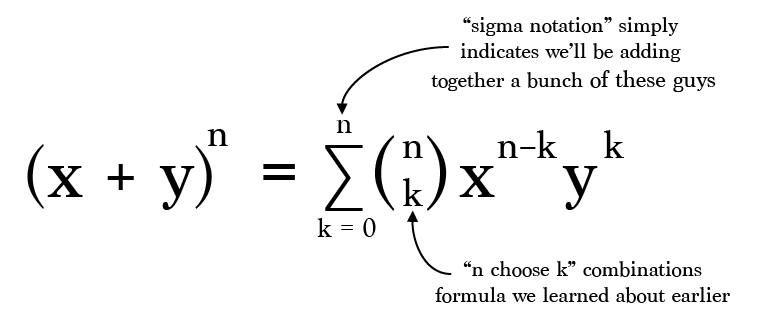
like the combinations/binomial theorem
trim fable
uh whats that?
pseudo sonnet
summation
pseudo sonnet
 pseudo sonnet
how do i apply it to (2-3x)^10
trim fable
what grade are u in?
pseudo sonnet
im taking precalc
trim fable
oh so thats advanced functions?
right
coz im canadian
but i think its the same course just called different things
wait so are u in grade 12?
or 11?
pseudo sonnet
no im freshmen in college
trim fable
(2-3x)^10
1(2)^10(-3x)^0 + 10(2)^9(-3x)^1)+45(2)^8(-3x)^7 etc...
do u get what im doing?
@pseudo sonnet
ur in college?
im in grade 12 rn
so like that would work too^ i learned it last year but idk what way ur supposed to use since ur in college 😛
how old are u? @pseudo sonnet 20? or something
coz im prob younger than u lol
i have never done the thing u said but
would it be like this
i just plugged everything in does that help u? tho idk what that is but like i put it into the thing u sent
Tho idk the value of k soo
patent beacon
That's the 0th term, you want the third one
trim fable
oh
@patent beacon I was trying to help vici so ye i have no idea what that is
lololol
i just plugged the question into the format they sent lol
patent beacon
The third term is
10C3 × 2^(10-3) × (-3x)^3
@pseudo sonnet @trim fable
trim fable
lol i think they are older than me and i still tried to help lol
i was telling them to use pascals triangle 😛
patent beacon
You were close, just needed k = 3
patent beacon
And the Σ goes away, since we're talking about a single term, and not the sum of multiple terms
patent beacon
Yours! Just terms you may not be used to
trim fable
oh
ohhh
cooool
maybe im gonna learn it sooooon
😛
well this year
in this course lol
question just coz im curious
how did u know that
k was 3?
and what is that equation
anyways?
just coz idk 😛
it yet lol
patent beacon
For example,
(x + 1)³ = Σ nCk (x)^k (1)^(3 - k)
trim fable
whats nck?
patent beacon
But that Σ just means to increase k, and sum term
patent beacon
nCk is the number on pascal's triangle down n rows, and over k
trim fable
coz i did that last year
ohhhh
okkk
so instead of doing the thing i was telling them to
with pascals triangle
until u reach the term they wanted to find
u use that to make things
simpler?
patent beacon
You were perfectly right, just needed to set k = 3, not k = 0
trim fable
coz they wanted to find x3
so that would be the third value in pascals triangle
wow i get this
this is cool 😛
so k is just the position in pascals triangle
from left to right
😮
woww
did i just do college level work 😮
cooooooooool 😮
lol
@patent beacon do u know computer science?
patent beacon
Kinda!
trim fable
oh wow
really
will u help me with comp sci 😛
also i looked through my textbook and didn't see any of that stuff. Maybe I missed it but is it part of advanced functions?
or calc?
@patent beacon 😛
obsidian monolithBOT
Vici:
trim fable
whats that
trim fable
ohhhh
 formal iris
does the base of a Expo function have to greater then 1
where are neg bases not allowed
willow bear
negative bases are not allowed if you want to allow the exponent to not be an integer but bases between 0 and 1 are fine
willow bear
no to both of those things
formal iris
why then arnt neg bases allowed
willow bear
no
pseudo sonnet
so it becomes a rational funct
willow bear
no.
the problem with negative bases is
you can't even define (-1)^(1/2) in the reals
bc you'd LIKE that to square to -1
but no real number does that
and this exact same issue arises for most fractions
so you can't even begin to extend this to irrational exponents, bc there's nothing to extend
pseudo sonnet
so you cant have the base number be a fraction
just like u cant have a base number be a negative number
for exponential functions
willow bear
you CAN have fractional bases just fine
were you under the impression that (7/3)^x isn't a well behaved exponential function
pseudo sonnet
no i was trying to make sense of what you said
willow bear
did i at any point even talk about the BASE being a fraction or not
pseudo sonnet
"and this exact same issue arises for most fractions
so you can't even begin to extend this to irrational exponents, bc there's nothing to extend"
willow bear
given that the 1/2 in (-1)^(1/2) is the exponent, and not the base...
willow bear
did i at any point even talk about the BASE being a fraction or not
pseudo sonnet
no
willow bear
can you post the entire problem exactly as stated
...
wow.
ok
so that really WAS the entire problem
....................no fucking clue what they want then
 heady jewel
Simplify?
 scenic musk
how can we check if a number is divisble by 6 without division or modulus
 native timber
divisible by 2 and 3
native timber
are you allowed to use bitwise operators?
if so, divisibility by 2 is trivial; divisibility by 3 reduces to the divisibility of its digital root (in which you only have 4 cases you need to check: 0, 3, 6, 9)
even if you're not allowed to use bitwise operators, you can look at the last digit and see its parity without using bitwise operators
heady jewel
@scenic musk subtract 6 from the given number unless you reach a number <6
and check if it is 0
definition of division
scenic musk
i dont understand @heady jewel
if i have the number 24
which is divisble by 6
24 - 6 = 18
i dont understand what i do from here
oh
i see what u mean
 small cedar


 dark fable
tan(a)=1/2, cos(b) = -3/5
What's (cos(a)-2sin(b))/cot(a)
blazing parrot
you need cos(a) and sin(b) and cot(a) to sub into the equation
what is the definition of cot(a) @dark fable
dark fable
It wasn't provided
I think it wants it in terms of a and b (sum and difference formulas)
dark fable
2
blazing parrot
yay
okay so imagine a right triangle of which one of the angles is a
then tan a is O/A of this triangle right?
dark fable
what
blazing parrot
okay
dark fable
oh yes
blazing parrot
so you know O/A = 1/2
blazing parrot
that makes things more interesting
dark fable
so I think it is supposed to be sum and difference formulas
blazing parrot
hmm
blazing parrot
hmm it is explicitly titled sum and diff formulas
dark fable
yup
blazing parrot
okay let me think about it for a bit
okay
so you have
$$ \frac{\cos a - 2\sin b }{\cot a}$$
dark fable
yep
blazing parrot
so what is 1/cot a
obsidian monolithBOT
Not Chezstick:
blazing parrot
oh i must go
patent beacon
Ya
trim fable
so the
question is
and someone tried to help me but complicated my code and im super confused and i wanna simplify it
there
patent beacon
Welp, can't say I know much about programming and programming style sry
trim fable
how can i do that simply.. like the parsing is confusing and i wanted to use asci
patent beacon
My bad for telling you to put this in the server, didn't think it would be so programming oriented
viscid thistle
What is 1/ba^2
 proud wraith
How do I insert a fraction in Aleks?
I tried "/" and " \ "
the manual says to use "/"
nvm. I'm just braindead
 velvet elm
How do I enter this into a calc to get a result?
 lethal oracle
Anyone there that can help?
velvet elm
I mean like a traditional calc with a log function
uncut mulch
what have you tried?
lethal oracle
Factoring
uncut mulch
what did you get?
lethal oracle
Well I can’t come to an answer
uncut mulch
show your working out
lethal oracle
uncut mulch
what are the solutions to tan(x)=0?
lethal oracle
0, and pi
uncut mulch
what are the solutions to sin^2(x) - 1 =0? ||but can you use those||
lethal oracle
Wouldn’t it be 0 and pi also?
 grim current
Place the 1 to the right side of the equation.
lethal oracle
Ya so it’s sin(x)=plus or minus sqrt of 1
grim current
Right. So what are the solutions to it?
lethal oracle
0 and pi
uncut mulch
what is sin(0)?
lethal oracle
Wait the solutions are pi/2 and 3pi/2
grim current
Yes.
uncut mulch
yes. but can you use those solutions in this question?
uncut mulch
so what would be your only solutions?
lethal oracle
The solutions to tan in this equation which are 0 and pi
uncut mulch
what was your justification for not being able to use x=pi/2 or 3pi/2?
lethal oracle
I’m going to be honest I can’t really remember the reason my teacher told me
Can you explain whyv
?
uncut mulch
tan(x) is undefined at pi/2 +k*pi (where k is an integer)
lethal oracle
Oh because my solutions need to satisfy both?
grim current
Let's say you have tan(x) = sin(x)/cos(x). If you were to substitute x for π/2 or 3π/2, for example, you'd get undefined values, like ramonov said.
lethal oracle
Oh I see
 analog tinsel
grim current
analog tinsel
grim current
Your solution needs to satisfy the conditions imposed by the tan(x), which can be applied to the other functions as well.
viscid thistle
@lethal oracle (cos^2x+sin^2x)(cos^2x-sin^2x)
That is the LHS.
And what does cos^2x+sin^2x equal to?
lethal oracle
1
lethal oracle
Ya I see thanks
viscid thistle
Stephen this is not the time.
 winter isle
we don't start basic trig for another month
viscid thistle
Good for you.
viscid thistle
$\frac{x+y}{x-y} \cdot \frac{x+y}{x+y}=\frac{(x+y)^2}{x^2-y^2}$
obsidian monolithBOT
leviosa:
viscid thistle
Conjugates are usually to take out radicals from the denominator and whatnot.
But it can be used in many other ways as well.
Take the conjugate though.
That's gonna lead you to your answer.
lethal oracle
So just foil them out?
viscid thistle
Honestly I would multiply by sinx+cosx to both the numerator and denominator.