#precalculus
1 messages · Page 169 of 1
 clear glade
 rigid sun
let me see your graph
clear glade
rigid sun
change your base to 4
clear glade
ok
can you explain why we changed (1/4) to 4 (or -4, forgot what it was turned in to )
which exponent ruiling is that
clear glade
right
 obsidian monolithBOT
maleb1964:
clear glade
yea
rigid sun
ok, so what if we wanted to go backwards?
then, we divide by x
this means
x^2/x=x^1
and then
clear glade
x^2/x=x^1$
rigid sun
x^1/x=x^0
clear glade
$x^2/x=x^1$
obsidian monolithBOT
Waterblade:
clear glade
yep
rigid sun
$x^1/x=x^0$
clear glade
$x^1/x=x^0$
rigid sun
then
obsidian monolithBOT
maleb1964:
rigid sun
ok well you get it
clear glade
yea
clear glade
yep
rigid sun
so we can replace x^0 with 1
and we get 1/x=x^-1
this proves that negative exponents are simply fractions but instead of multiplying we divide
clear glade
right
rigid sun
so b^-2= 1/(b^2)
clear glade
yep
clear glade
I see now
clear glade
 indigo sandal
 flint vale
Bc it’s coefficient
rigid sun
idk if i said that wrong or something
flint vale
No I think you fine
I think you confirmed a mistake when you said show
But I mean that’s fine
clear glade
indigo sandal
Looking good partner
rigid sun
that's right
flint vale
Hohyah
rigid sun

flint vale
Just do it and move on
clear glade
👌
rigid sun
ok
 rigid sun
lets goooo
clear glade
thanks so much
rigid sun
ok
clear glade
lol
rigid sun
things to pull away from this
- the outside coefficient (2 in this case) will be the vertical stretch
flint vale
1
rigid sun
- fraction exponents (1/b)^x are equal to b^-x, which is simply b^x graphed across the y axis
flint vale
WRT?
rigid sun
@clear glade I can give you a complete runthrough of how to graph these
instead of individual examples
clear glade
that would be nice
rigid sun
ok
rigid sun
so
clear glade
do u wanna take it to pm?
rigid sun
here is ok
clear glade
ok
rigid sun
- reset your origin
this means to use vertical or horizontal shifts, if the equation has +2 at the end of it, then move the origin up 2, this will be your new origin
clear glade
I get it, and I'm guessing -2 at the end of it would be down 2, right?
rigid sun
yes
ill graph an example real quick
the grey one is x^2 +1
the blue is x^2
ok
imagine moving the origin up one
if you're graphing by hand, you can draw an imaginary line to simulate the x axis moved up 1
clear glade
Ok, undertandable. Since the +1 is at the end of the equation you moved it up by 1
rigid sun
yes
clear glade
Oh I see
rigid sun
step 2. make your horizontal stretches
this could mean flipping across the y axis, compressing, stretching
2x = twice as tight
1/2x= twice as loose
-x= flip across the axis
clear glade
alright, those operations make sense
rigid sun
it is the coefficient on the x part
rigid sun
yes
clear glade
oh ok
rigid sun
the stretch would be a 1/2, which means twice as long
step 3. vertical stretch
just multiply the height of each point by the coefficient
this is relative to the new origin
this will be the k in kb^x
it will be multiplying b
ill do a very fast example, then give you the steps one last time
clear glade
Alright
rigid sun
rigid sun
@clear glade
 harsh cipher
the very left equation
rigid sun
- move your origin
clear glade
I see @rigid sun
rigid sun
- adjust for horizontal stretch
harsh cipher
how is sqrt -9(x-5) -7 equal to the left two equations
rigid sun
- adjust for vertical stretch
harsh cipher
sorry to interrupt
clear glade
Althought what do you mean by move it upside down
rigid sun
it means flipped over the x axis
clear glade
Lol nice
rigid sun
keep practicing more and you'll get the hang of it!
clear glade
Ok
So horizontal stretch is associated with side? The exponent or the leading coefficient
rigid sun
the exponent
clear glade
Alright
clear glade
I see
clear glade
I think I do
rigid sun

Khan Academy
Graph exponential functions and find the appropriate graph given the function.
rigid sun
if you finish that, you can always just make up examples, try to graph them, and check them with a graph on the computer
clear glade
Yeah
rigid sun

 👌
👌 

clear glade
Well, thanks again. Appreciate you talking your time to help
clear glade
Gg good night
 clear glade
@harsh cipher sorry to bury ur question, u could post it now so it can be more noticiable to others

 rigid sun
lol
harsh cipher
lol
harsh cipher
rigid sun
lets see if we can simplify ur problems
harsh cipher
yes
rigid sun
they took -9, separated it into 9*-1
then they took the sqrt of 9=3, moved that to the outside, and left -1 on the inside
that's why on the top right green one, there's a negative on the outside of the parenthesis
thats the -1
you get that?
harsh cipher
so when I simplify bottom left. I should get the equation on the top right
rigid sun
other way around
rigid sun
$\sqrt{-9(x-5)}$
obsidian monolithBOT
maleb1964:
rigid sun
$\sqrt{-1*9(x-5)}$
obsidian monolithBOT
maleb1964:
rigid sun
$3*\sqrt{-(x-5)}$
obsidian monolithBOT
maleb1964:
harsh cipher
I get it.
If we simplify Sqrt -9(x-5)
we get 3 sqrt -(x-5)
I don't get it when you say other way around though.
 velvet kelp
Can i get help with this word problem
 uncut mulch
how would you find the remainder when p(x) is divided by (x-2)?
velvet kelp
just put in x = 2 for the x value in p(x)
uncut mulch
yep
the same applies to dividing by (x+1)
you are told the remainders are equal and you should be able to figure the rest out
velvet kelp
but Im left with 2 undefined variables
uncut mulch
what do you mean 2?
velvet kelp
i mean idk the value of the remainder and C
uncut mulch
you are told the remainders are equal so what will you be able to do?
or how would it relate
p(2) and p(-1)
 willow bear
god forbid you write a statement saying that two things are equal when you are told explicitly that they are equal
velvet kelp
ok but it doesn't make sense to me i don't know the remainder or c i know they're equal but how do I do the equation
uncut mulch
what does p(2) represent?
velvet kelp
the remainder
uncut mulch
what does p(-1) represent?
velvet kelp
the remainder
uncut mulch
you're told the remainders are equal, what would be your equation
willow bear
ok but it doesn't make sense to me i don't know the remainder or c i know they're equal but how do I do the equation
do you know what an equation actually IS
 shrewd urchin
😂
willow bear
@frozen needle
 frozen needle
lmao wut xd
willow bear
someone called me "discount tuong"
oh it was @viscid thistle
i might not have translated it correctly into french 
 last linden
that says reduced priced tuong?
 willow bear
so evidently, i'm discount^2 SA
 royal gull
No it was me 
last linden
haha
last linden
thats the magnitude of the component of F in the direction of V
@shrewd urchin
do you know this formula
a dot b = |a||b|cos(theta)
they just rearranged it
@shrewd urchin helloo
 viscid thistle
Who summoned... Oh XD
 ripe wave
I'm a bit lost on how to show the work/solve
willow bear
do you know what function composition is?
ripe wave
Sort of
willow bear
there is no "sort of". either you know that $f \circ f \circ f \circ f(-2)$ refers to $f(f(f(f(-2))))$ or you do not.
obsidian monolithBOT
Ann:
ripe wave
ok then I don't what function of composition is
willow bear
it's not "function of composition", it's "function composition", aka "composition of functions", and you should really go look that up.
 serene heath
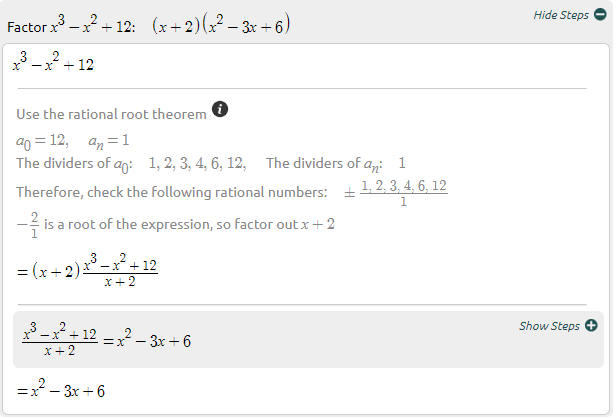
t!wiki rational root theorem
rip bot 😔
its a theorem that helps you find rational roots of a polynomial
 patent beacon
Natural question, do you know what the rational root theorem is?
Have you tried googling it, and are having difficulty with a part of it?
 pseudo sonnet
yeah its basically P / Q then you do synthetic division till u get remainder 0
i watched some vid on it
if my teacher puts a factored form like this on the test to waste my time im gonna lit her ass up
😂
patent beacon
No, that's not the rational root theorem
 proud sparrow
so, what have you tried @solid reef
Do you understand what rationalising the numerator means?
 solid reef
ive tried to simplify the denominator
but im not sure if i have to complete the square for it
and do the same to the top
i should know this but its been so long
kinda need a refresher
:PPP
 short sorrel
@solid reef "rationalizing the numerator" means "get rid of the radical"
what's the way we usually get rid of a radical? well, we square it
but you might notice a problem if we just try and square the numerator
$(4 - \sqrt{x})^2 = (4 - \sqrt{x})(4-\sqrt{x}) = 16 - 8\sqrt{x} + x$
obsidian monolithBOT
Namington:
short sorrel
we're still left with a sqrt(x) term
fortunately, we have a strategy to get rid of it:
rather than just squaring the numerator, multiply it by the conjugate
$(4 - \sqrt{x})(4+\sqrt{x}) = 16 - 4\sqrt{x} + 4\sqrt{x} + x = 16 + x$
obsidian monolithBOT
Namington:
short sorrel
because one is positive, and the other's negative, the middle terms cancel out
leaving us only with the squared terms!
ok, thats great, but we can't just randomly multiply the numerator by (4 + sqrt(x))
what we can do is multiply a fraction by 1
this won't change the value
so it's fine
and note $1 = \frac{4+\sqrt{x}}{4+\sqrt{x}}$
obsidian monolithBOT
Namington:
short sorrel
so
$\frac{4 - \sqrt{x}}{16x - x^2} \ \ = \frac{4 - \sqrt{x}}{16x - x^2} \cdot 1 \ \ = \frac{4 - \sqrt{x}}{16x - x^2} \cdot \frac{4 + \sqrt{x}}{4 + \sqrt{x}}$
obsidian monolithBOT
Namington:
short sorrel
now multiply.
(and then simplify afterward, if applicable)
in general, "rationalizing" a binomial with a square root usually means "multiply by the conjugate"
 half gyro
Hello! Could anyone answer a graph question for me? I'm still poor at understanding graphs, and now I'm getting to one with no numerical points.
I don't really understand question c.
I figure with a and b I'm looking at the line and matching the x and y, but z isn't on the graph
patent beacon
Suppose f(b) = z
That's enough info to get a numerical value for z. What is it?
half gyro
b?
patent beacon
f(a)
Means to find a on the x-axis, go up until you hit the function, then find how high you are on the y-axis
So when I talk about f(b), I mean to find b on the x-axis, then go up/down to the function.
However, f(b) is a special case
No need to get too technical. The graph is doing something interesting around b. What is it?
half gyro
Ah... going through it?
patent beacon
Yep, precisely. Now, if we go to b and go up/down until we meet the function, you've recognized we don't need to go up/down at all
That is, the graph has zero height at x = b
Saying the same thing, f(b) = 0
That part make sense?
half gyro
Because b is at zero on the x axis?
patent beacon
Nope, because the function has zero height above/below b
This notation is important:
f(location on the x-axis) = height above/below x-axis
half gyro
Oh... so you're saying that because it's crossing through, it has zero height?
patent beacon
Yup
f(b) = 0
But we supposed that f(b) = z
So z = 0
Now, the question wants f(z), which is really just f(0) in disguise
half gyro
OH I see... so r, because it also has zero height, but on the y axis?
patent beacon
Remember, when I say f(0), I want you to find 0 on the x-axis and go up/down to the function. Then, use marks on the y-axis to see how high you went
You're right, it's r
half gyro
That makes so much sense now that you've explained it. So I just go up/down how many marks the x axis did, and find the corresponding y?
patent beacon
Yeah, your graph is essentially a line that matches x values to y values. If you've ever played battleship then you know how this works
half gyro
Thank you so much!! I appreciate your time and help.
viscid thistle
 lone prairie
Hey guys I really could use some help on this question. More specially first on finding the function formula for g(x) and h(x)
proud sparrow
you don't need a formula for them
also, you are not told to find a formula
@lone prairie
lone prairie
Where would I start on question g. Do I just plug in 3 for x and then ..?
proud sparrow
yeah, then..?
 stuck lark
,rotate 270
obsidian monolithBOT
stuck lark
,rotate 180
obsidian monolithBOT
lone prairie
No good? @stuck lark
stuck lark
@lone prairie well done 👍🏽
lone prairie
Thanks!
My last question is how would I go about finding g(2) in this situation ?(trying to solve question h)
stuck lark
@lone prairie what did you try?
proud sparrow
@lone prairie read off the graph
shrewd urchin
Use magnifying glass 
lone prairie
I think I would first need to find the slope which I did here. Slope = 3/1 ( if I did that properly?)
stuck lark
no need to find slope at all, just find g(2) and h(2)
lone prairie
Well I know h(2) = 7 according to the table
I'm struggle with g(2) since it's on the graph but I don't know the equation of the line
stuck lark
you don't need the equation of g(x) if you already have the graph of g(x)
lone prairie
I see but g(x) is only shown on the left side of the graph so it never visually crosses to g(2)
stuck lark
for g(2), what x value are you looking at?
lone prairie
Oohh maybe LOl I think I got it. I was looking at the wrong line. G(2) = 4 ?
stuck lark
g(2) = 4 👍🏽
lone prairie
God I'm an idiot thanks. So (g + h)(2) = 7 + 4 = 11?
stuck lark
there you go
lone prairie
Thanks a lot for the support 🙂🙃
stuck lark
no prob 
harsh cipher
hey guys
nm. the answer doesn't use spacing so it confused me.
I answered my own question. 🙂
 stuck ivy
I'm having trouble simplifying this fraction it goes through many steps
I relearnt all the laws and stuff and I got a final answer of - a - 4a/ 4b+a
I made sure to use difference of cubes and factored out a negative to make (4b - a ) into (a - 4b)
stuck ivy
We had a good run
 formal siren
Can someone please explain how to simplify cos(2tan^-1(x))?
 rocky bison
@formal siren You still there?
 proud raven
formal siren
proud raven
formal siren
Nah I haven’t yet
 heady jewel
@formal siren what have you tried
pseudo sonnet
 stuck lark
what'd you try
proud sparrow
so what does that give you?
pseudo sonnet
(3x+1)(x-1)/(x-1)
 pseudo sonnet
😂
willow bear
it could be said to be its own asymptote, but then again that would be dumb
try adding 1/x to it
willow bear
yes
 restive knoll
Guys, how to find x?
willow bear
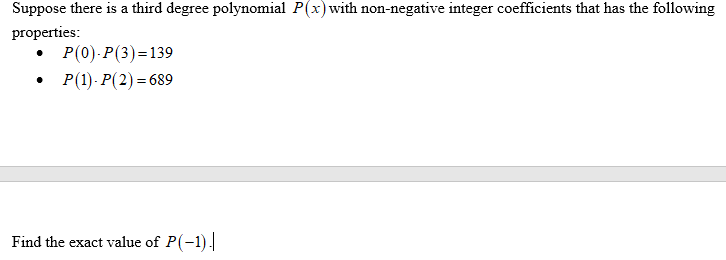
@pseudo sonnet P(x) = ax^3 + bx^2 + cx + d
 proper kindle
if you have positive reals x,y,z satisfying xy+yz+xz = 1
is it true that the maximum value of x+y+z is sqrt(3) ?
willow bear
idk, is it?
proper kindle
I'm not sure, that's why I'm asking @willow bear
Do you want me to rephrase my question?
willow bear
how did you get sqrt(3)
proper kindle
Through computer
If you want, here is what I've tried:
you can substitute tan A/2, tan B/2 and tan C/2 to make use of the identity
proper kindle
Then it remains to maximise tan A/2 + tan B/2 + tan C/2
But using CS I seem to get the inequality flipped

Wolfram|Alpha brings expert-level knowledge and capabilities to the broadest possible range of people—spanning all professions and education levels.
willow bear
@languid dust no.
in all your time here, you've failed to demonstrate sufficient reading comprehension to properly react to people's attempts to help you, choosing instead to ghost them without even letting them know whether you're still stuck or are able to continue the problem.
not once have you responded to a message longer than a dozen words.
proper kindle
(I hope that's not me?)
willow bear
it's not you.
proper kindle
For some reason, I seem to have proven that x+y+z >= sqrt(3)
Even though Wolfram says that's the maximum
pseudo sonnet
@willow bear im still confused, how does the ax^3 + bx^2 + cx + d , help me in figuring out what coefficients are of the equation in order to solve P(-1)
 oblique meteor
@pseudo sonnet you plug in the values in the equations
willow bear
i've attempted to help you at least twice before and have not received any feedback at all
pseudo sonnet
willow bear
if there's something you don't understand then just ASK ffs
willow bear
but don't leave us all in the dark
pseudo sonnet
@oblique meteor i just tried that
 languid dust
sorry
pseudo sonnet
not sure what to do from here
languid dust
i dont get the notification
pseudo sonnet
ohhh
languid dust
if someone does respond bc im working on the question
oblique meteor
P(x) = ax^3 + bx^2 + cx + d
P(0) = d
P(3) = 27a+9b+3c+d
There is a useful hint that all coefficients are integers
proper kindle
Ok, I'm going to ask my question and ping helpers in another channel
oblique meteor
Which means a, b, c, d are all integers
So P(0) AND P(3) are both integers and factors of 139
oblique meteor
Now I believe 139 is a prime number
willow bear
,w factor 139
obsidian monolithBOT
 Requested by Ann#0413
pseudo sonnet
Requested by Ann#0413
pseudo sonnet
yeah i looked it up 139 has no factors
oblique meteor
it indeed is, so you can only write it as 139 × 1
So either P(0) = 1 and P(3) = 139 or its the other way round
Now since a, b, c, d are non negative, so which one do you think is larger? P(0) or P(3)? @pseudo sonnet
pseudo sonnet
p(3)
oblique meteor
That's good
oblique meteor
That's nice. That's your first equation.
Now similarly, you can factorise 689 and get two more equations in terms of a b c
oblique meteor
d=1
pseudo sonnet
yeah i was thinking about it and made no sense
oblique meteor
It is some factor of 689.
And so is (a+b+c+1)
Both factors are greater than 1 because a b c are all greater than 0
So 1 and 689 aren't the factors at play here.
So factorise 689
oblique meteor
Method of elimination
Try doing some operations and eliminate c to get two equations in terms of a and b
pseudo sonnet
the professor's brain to make the solution of P(-1) = -1
ultimate troll
thanks @oblique meteor , @willow bear ♥
oblique meteor
Welcome :)
serene heath
why is ur screen so reflective lol
 rare zephyr
I thought it was an edit
 analog owl
😂
serene heath
anyway thatd just be x<=-2 union x>=4
willow bear
$(-\infty, -2] \cup [4, +\infty)$
obsidian monolithBOT
Ann:
rare zephyr
I think it's x<=-2 and x>=4
willow bear
you are specifically asked for interval notation
are you able to write the blue and the green sets individually as intervals? @analog owl
analog owl
I think it can
willow bear
what's it
analog owl
Yes
analog owl
(-inf,2)U(4,inf)
willow bear
ok first off
the problem
asks you
to write
your answer
in
interval notation
and yet
AND MOTHERFUCKING YET
you kept making attempts to answer this problem NOT in interval notation
going RIGHT FUCKING AGAINST ONE OF THE PROBLEM'S REQUIREMENTS
come ON
and second, no, that's wrong too
 fiery wave
Calm down Ann
analog owl
I tried to translate my book
willow bear
no fuck you @fiery wave i'm not calming down
serene heath
that was uncalled for
viscid thistle
ok
oblique meteor
Try finding x2, x3 and you should see a pattern.
 slender prawn
I got x2= 1/(a-1) and x3= 1/(a-2)
So x23 should be 1/(a-22)
Which is equal to 1, so a would be 23, but that isn't a possible answer
slender prawn
Ow, I took x23 from f(x23)... Thankd
oblique meteor
:+1:
 autumn marsh
 wind igloo
How do you get 2?
flint vale
yeah how
we just plugged x=0 into g then the result into the x of f
and did not get 2
obsidian monolithBOT
Digicat195:
 trail badge
Answer 2 is interesting, but how? 🤔
 bleak lance
x-9/x+67 determine domain of x
I made x+67=0
And I got (-infinity,-67)U(-67,infinity)
I got that wrong tho
 remote citrus
Why does this have no reference triangle?
wind igloo
What sort of triangle would you draw?
I mean, all of the other reference triangles are right triangles.
With the reference angle as one of the acute angles.
3pi/2 is like pi/2
It'd be 90 degrees.
And you can't draw a triangle with two 90 degree angles.
harsh cipher
hi guys
viscid thistle
hey
harsh cipher
and girls
The square root function, on the right side
the range is y greater than or equal to zero
is that correct?
I think the range should be y is less than or equal to root 2?
 compact raft
Heyhaving some problems with my math he can someone walk me through the step of solving the quadratic word problem
compact raft
same
 glossy jetty
Can someone help me understand interval notation
glossy jetty
I’m confused about the ( and [ and the orders
willow bear
"the orders"?
( and [ mean "exclude the endpoint" and "include the endpoint" respectively.
@glossy jetty?
 neon drum
so you get g(C) then whatever you get there you plug into f() @last linden
last linden
g(C) = C/(2π)
f(g(C)) = f(C/(2π))
neon drum
last linden
yes
neon drum
thanks
 crude hemlock
What would be the definition of a “general term” in terms of sequences?
 tame wedge
Can someone quickly explain how to simplify exp(ln(y)/2)
willow bear
y^(1/2)
 smoky fog
Could someone point me in the right direction to get the basics of calculus down? I think it's something I want to learn next, so where do I start?
Like, the most basic, foundation level stuff, thanks
flint vale
,rotate 270
obsidian monolithBOT
serene heath
rearrange then factor out
obsidian monolithBOT
patent beacon
@smoky fog
Paul's online notes are awesome and cover pretty much everything
Download a pdf. Stewart's calc is good for the learner
And, calc is probably the most covered subject on YouTube. I've heard professor Leonard is good
flint vale
solve for y
you know how to do that
well y here is f inverse of x but you get the idea
 small cedar
how do i do this question:
Which of the following has the greatest value: log 2 (3), log 3 (5) or log 5 (11)
i need help, thanks
flint vale
well theres two things, directly seeing how many times base goes into result or rearranging
so 2 to the power of what is 3, 3 to the power of what is 5 etc, ur just comparing the what
 ripe dust
I don't understand why the denominator is x-4 instead of 4-x
what is that kind of sorcery
 rose locust
how do I get angle C? 43° isn’t correct
ripe dust
43... have you seen the angle...
it's more than 90... why would it be 43
wait that's easy lmfao
rose locust
Okay yeah I know I’m dumb whatever you don’t need to rub it in.
ripe dust
find the angle D first there is a big triangle bro
you have two sides with one known angle you can use law of sine
after finding d since it's an isosele triangle (idk the word in english but the two are the same lengths) you can find the angle A
and after you do 180 degrees - A
43.16 is the angle D @rose locust
the angle DA(CoastGuard) is also 43.16
so 180-43.16 = 136 degrees
rose locust
so I just put the angle in the wrong place i should have put 43 in angle D instead of A
flint vale
@ripe dust they just factored out a -1
ripe dust
thanks im retard
flint vale
Peep the numerator
It’s fine dw
Idk the rest of the question but it’s kinda weird why they’d do that
ripe dust
it's an iscosceles triangle so it's the same angle depending on if it's the angle a from the right or the left @rose locust
@flint vale it's some limit stuff
because the limit is 4
so x-4
 pine temple
 pseudo sonnet
can someone explain why my x intercepts arent on the graph
after i solved them and set them equal to 0
i graphed it on my calculator and there arent any x-ints
 tight geyser
what calculator u using
if ur math is correct then it should be calculator settings
use wolfram to see if its there, if yes, then that means ur calc settings wrong
pseudo sonnet
nah dude my settings are right
how come the x ints arent plotted
nvm my factoring was wrong
there arent any x-ints
 river kindle
Your graph looks upset.
 idle dust
hahhaa
harsh cipher
hi guys
smoky fog
@patent beacon thanks
 hoary valley
Guys how to know if both lines are Identical or not? I know how to get the slopes and then what ?
stuck lark
@hoary valley what else makes up the equation for a line besides slope?
hoary valley
Depends on the equation form ?
stuck lark
that's true. let's go with this one: y = mx + b... what do m and b represent?
hoary valley
m = slope , b is y-intercept
stuck lark
yep, so how can you tell if the two lines are identical?
hoary valley
If they have the same y intercept and slopes ? 😅
stuck lark
there you go
hoary valley
@stuck lark In the answer sheet it says that problem is "True" they're identical,, but when I solved it I got the same slope but the y-intercept had different signs but the same number
stuck lark
@hoary valley show us your work
stuck lark
no problem man
hoary valley
@stuck lark If I got the same slope but different y-intercept that means the lines are Parallel, right ?
stuck lark
yep 👍🏽
hoary valley
@stuck lark What about Perpendicular ? I know their slopes should be like reversed with different signs but what about the y-intercept?
stuck lark
y-int doesn't matter. what makes them perpendicular is that one line's slope is the negative reciprocal of the other
hoary valley
Oh Gotcha..!! ❤ ❤ @stuck lark
hoary valley
Can someone explain to me what is this question ? I know how to calculate the distance between 2 points, but I don't understand what is (a,b) nor (b,a)
river kindle
I imagine those are the same points, but going from a to b, then b to a in the distance formula.
Well, maybe the distance formula isn't relevant in this
 quick dagger
can tangent exceed the value 1?
serene heath
what
uncut mulch
are you referring to the function?
clear glade
How do I do $2(4/x+2) + 4$
obsidian monolithBOT
Waterblade:
uncut mulch
is that meant to be 4/(x+2) or 4/x + 2
obsidian monolithBOT
Waterblade:
uncut mulch
$2 \left(\frac{4}{x + 2}\right) +4$
clear glade
+2 is down there with that x
uncut mulch
thats literally what i was asking
clear glade
sorry
obsidian monolithBOT
ramonov:
clear glade
yep
uncut mulch
and what are you supposed to do?
clear glade
it's part of a function composition problem but I forgot how to deal with the fractions so I'm unsure to how to just simplify that expression
uncut mulch
can you post the original problem
uncut mulch
for this question i would recommend splitting f(x) into 2 fractions before doing the composition
uncut mulch
yeh
clear glade
ok ill give it ashot
I think I got it, thanks.
domain would be x is not equal to -4 if the answer is x + 4, right?
wait nvm
$3^3x = 1/9$
obsidian monolithBOT
Waterblade:
clear glade
how would I solve x for this one?
oops, that x should be up there with the 3 exponent
uncut mulch
$3^{3x}=\frac19$
obsidian monolithBOT
ramonov:
clear glade
yep
uncut mulch
can you rewrite 1/9 as an exponent?
uncut mulch
can you continue from here?
 trim flame
yea
 latent goblet
i don't get these problems
short sorrel
do you know how to set up the equations?
short sorrel
well, let's start by looking at our unknowns:
we don't know the volume of B, and we don't know the volume after they mix together (A+B)
but the volume after mixing them together will be 1500 mL + B
so really, the only unknown we have is the volume of B
I'll use the letter B to represent that
let's try and find something we can compare between the three solutions: how about amount of alcohol? (not concentration, amount)
do you know how to calculate the amount of alcohol in solution A?
latent goblet
i don't think so
short sorrel
solution A is 6% alcohol by volume
latent goblet
yes
obsidian monolithBOT
Namington:
latent goblet
o
short sorrel
6% of 1500 mL
we can do the same thing with solution B
except we don't know solution B's volume
it's known
so I'll just write $0.2 \cdot B$
obsidian monolithBOT
Namington:
short sorrel
with B representing solution B's volume
now, the reason i calculate like this is that:
when we mix these solutions together
the new solution should surely have all the alcohol of the two solutions combined
i.e., if we add up the alcohol of solution A and solution B
we get the amount of alcohol in the mixture
so $0.06 \cdot 1500 + 0.2 \cdot B = $ amount of alcohol in mixture
obsidian monolithBOT
Namington:
short sorrel
so next we want to represent "amount of alcohol in mixture"
this'll be similar to what we did in solution A
latent goblet
wait where did u get 0.2?
short sorrel
latent goblet
ok
short sorrel
anyway, the desired concentration of the mixture is 10%
and the volume of the mixture
latent goblet
i aint reading the problem correctly lol
short sorrel
is gonna be the volume of A + the volume of B, right?
thankfully, we know the volume of A
so we can write that as just
$0.1 \cdot (1500 + B)$
obsidian monolithBOT
Namington:
short sorrel
and thus, we have $0.06 \cdot 1500 + 0.2 \cdot B = 0.1 \cdot (1500 + B)$
obsidian monolithBOT
Namington:
short sorrel
solve this equation for B.
latent goblet
ok thanks
tame wedge
Hey I’m learning Parametric equations and I’m not sure on this: (x(t),y(t))=(tan(t),cos^2(t)), the questions asks to eliminate the parameter to obtain y=1/(1+x^2). I’ve tried manipulating the equations for x and y and can’t seem to come up with anything. Any help? Thanks.
uncut mulch
do you know your trig identities?
tame wedge
Yeah, but I’m not sure where to use it though?
Nvm just figured it out, thanks for the hints
Didn’t need that one but it got my brain going I guess
 lyric cliff
Can anyone help me out? I have a problem that says:
John has $99 in different bills ranging from $1 to $10. Theres 26 of them in total and the amount of $1 is double of the amount of $5. How many does each bill class have?
I seem to have made an equation: 1x+5y+10z=26 // 1x+5y+10z=99
but dont know where to go from there
rigid sun
you have the same equation for both
willow bear
how can 1x+5y+10z be equal to both 26 and 99 at the same time?
willow bear
what are your x, y and z?
lyric cliff
its the same
short sorrel
no it isnt
willow bear
what are your x, y and z?
lyric cliff
thats what the 1, 5 and 10 are for..
short sorrel
so the amount of bills should be different from the amount of dollars.
lyric cliff
x,y and z are random variables i created
short sorrel
what do they represent?
short sorrel
if they're the amount of bills
then why are you multiplying the amount of bills by 5 and 10
when adding up to 26?
after all, 26 should just be the total amount of bills
where does the multiplication come in?
short sorrel
there's nothing to explain
willow bear
so x is the amount of ones
y is the amount of fives
z is the amount of tens
what is the total number of bills?
short sorrel
you have that 26 = 99
short sorrel
so how are their equations the same
willow bear
no
short sorrel
if they represent different things?
lyric cliff
split into 26 bills
willow bear
the total AMOUNT OF BILLS is not x + 5y + 10z, that's for sure.
lyric cliff
yeah i see. x+5y+10z is for total amount of dollars.
lyric cliff
x+y+z=26
🙂
So now I have
x + y + z = 26 (amount of bills)
x + 5y + 10z = 99 (total $ amount)
short sorrel
you should be able to make one more equation
"the amount of $1 is double of the amount of $5"
lyric cliff
still cant figure out how to get an answer to the original question
willow bear
"the amount of $1 is double of the amount of $5"
you should be able to turn this into an equation too
short sorrel
you don't have enough equations right now
willow bear
to get 3 equations in 3 variables
short sorrel
oh wait
willow bear
it's not y = 2x
short sorrel
ugh this is why we use descriptive variables
@lyric cliff you've got it a bit backwards
the amount of $1 is double the amount of $5
amount of $1 = 2 times the amount of $5
so x = 2y
(thanks for correcting my idiocy, ann)
 azure hamlet
Can you help me on polynomials?
How do I find a solution set of an equation using given roots?
I have an example
<@&286206848099549185>
 knotty spear
i mean if you know that sqrt(5)/2 is a root you can factor it out
so your polynomial = (x-root)* some other polynomial
knotty spear
it should be possible to factor out an (x- sqrt(5)/2)
and then you are left with a quadratic polynomial
that you can solve
knotty spear

 slate scroll
How would one solve x^4 + 2x^2 = 3
willow bear
substitute u := x^2, get a quadratic equation in u
 willow bear
what rule
 ionic beacon
arithmetic
idk never done this before
ok i found it
just dont know how to prove it
 next willow
$a_n=a+dn$
obsidian monolithBOT
Mat:
next willow
$54=\sum_{n=0}^8 a+dn = a\sum_{n=0}^8 1+ d\sum_{n=0}^8 n$
obsidian monolithBOT
Mat:
next willow
Maybe like this you can proceed @ionic beacon?
stuck lark
\sqrt{}
rigid sun
k
obsidian monolithBOT
maleb1964:
obsidian monolithBOT
maleb1964:
 kindred mica
No.
rigid sun
yeah i was like tf
kindred mica
First of all $\sqrt{x^2} = |x|$, not $x$. Second of all, $\sqrt{ab} = \sqrt a \sqrt b$ only works for $a,b \ge 0$.
obsidian monolithBOT
kindred mica
nice
rigid sun
if it was a domain error or me being sped
kindred mica
inb4 mathematicians are wrong
viscid thistle
inb4 -1=1
kindred mica
Yeah I get it. I was just making fun of the cranks who think they've found a killing mistake in some foundational concept in mathematics.
rigid sun
well
kindred mica
Lol.
viscid thistle
@ionic beacon I can already tell the paper is by edexcel
 forest canopy
just ask
 night spear


 lament garden
pre calculus