#precalculus
1 messages · Page 164 of 1
 harsh cipher
 plush trench
I got 4√3 not 2√3, unlike henry @pliant pecan
 barren hedge
12/6 is 2 tho
plush trench
Yikes!
 willow bear
@harsh cipher
Domain: t > 0
barren hedge
understandable
 twilit shadow
The answer is supposed to end up as 4/3, -2/3, and 1/2
I got the -2/3 so far, but I messed up on the 1/2
And I can’t figure out what I did wrong
I’ve tried coming back to it
I still got the same thing
willow bear
@barren hedge is that your handwriting in your pic
twilit shadow
That’s my handwriting
barren hedge
that'd be a compliment, trust me
willow bear
it's a bit hard to read with your angular and 4-like your eights are @twilit shadow
willow bear
i bet you're one of those people who doesn't put a stroke on their sevens either
willow bear
oh that's ok at least
twilit shadow
I hope that’s better
barren hedge
oh really?? I've never done this problem in my life and I got it, I'm happy
literally never learned this, I'll send a pic
twilit shadow
Nice
twilit shadow
On the one you put an X on, I got the same as you there, but where did you get the one with -8 -16 -20/3 | 4/3 from?
Well, I didn’t get the top row, I have no idea where that is from
barren hedge
the x is crossed out, for that one what I did was just multiply the lowest row by 4/3 (so I get an 8 in the 1st column)
twilit shadow
Okay
 pliant pecan
@barren hedge @plush trench sorry I got picked up to get food since I hadn’t eaten today
barren hedge
oh that's not good
 stuck lark
can't do math(s) on an empty stomach
twilit shadow
Wait, did you multiply by 4/3 or -4/3?
barren hedge
negative
twilit shadow
Okay
barren hedge
just noticed I didn't write it out, I didn't think i'd get this far sorry lol.
twilit shadow
It’s fine
I was trying to avoid fractions, but if this is how it’s solved then okay
barren hedge
well the answer is literally fractions
barren hedge
so that's how I got the idea to multiply by -(4/3)
twilit shadow
Yeah, but I was trying to get it as late as possible
barren hedge
6ix, no I don't believe that is, always do common denominator
pliant pecan
@barren hedge I did? I added 5 to top and bottom of the second fraction to make x plus two into x plus 7
barren hedge
gotta do it by multiplication, so a/b + c/d → ad/bd + cb/bd
pliant pecan
Ohh... yeah, that’s seems familiar
barren hedge
so you'll have to distribute
pliant pecan
Let me try it now
plush trench
6ix seems to be going through quite a wide range of topics
barren hedge
ye lol
plush trench
I’ll admit that all his problems seem fairly straight-forward, though, and that’s nice
I really dislike word problems
barren hedge
@twilit shadow Idk if you still want it, but here's a somewhat cleaner version.
pliant pecan
Sorry, like I said, I’m barely coming back to math and this class is starting off by reviewing previous math courses I’ve apparently taken? Anyways, here’s what I worked out
Good, right?
twilit shadow
I have a new problem. I have no idea where to start.
willow bear
find how many units of red she uses. that must be less than or equal to 32.
plush trench
What did you do at the end @pliant pecan
willow bear
then find how many units of blue she uses. that must be less than or equal to 54.
both in terms of a and b, of course. @twilit shadow
twilit shadow
Thanks
barren hedge
yeah I followed you to the second to last 6ix.
twilit shadow
I think that makes a lot more sense now
plush trench
@pliant pecan Did you just subtract 1x² from top and bottom? Because you can’t do that
pliant pecan
Refresher?
barren hedge
pliant pecan
@plush trench I can’t ? I took out the x^2 because it was divided by x^2
plush trench
No
barren hedge
no, you gotta divide the numerator by the whole denominator
plush trench
Rather, try checking if the numerator is factorable in the second to last step
pliant pecan
Uh.. factorable meaning..? When you take out (x^2) from the equation?
barren hedge
like a coefficient
plush trench
For example
pliant pecan
I’ll come back to it for sure as I found the answer , since it was the second to last step that I had, but with (x+7)(x+2) as the denominator
plush trench
x²-1 -> (x+1)(x-1)
pliant pecan
I remember that..
twilit shadow
@willow bear like this?. Sorry I got the R and B mixed up
pliant pecan
I’ll test it out after I’m done with this practice test, as I think I got it solved correctly here, minus the last step
barren hedge
I don't believe the numerator is factorable, Mr. P.
plush trench
That’s factoring, when a quadratic can be written as (x-a)(x-b) where a and b are integers
It’s not?
barren hedge
You can remove a coefficient
plush trench
7,24,35?
barren hedge
an integer, but not as (x+a)(x+b)
willow bear
@twilit shadow no
twilit shadow
Oof
twilit shadow
I got my R and B mixed up (I’m using those to represent the dyes)
pliant pecan
Uhh... so k = slope, h= amount of turns, and a is..?
plush trench
In vertex form?
willow bear
R = 4a + b, B = a + 6b
twilit shadow
I don’t think that’s right
pliant pecan
I faintly remember this, but I think I’m remembering from wavelengths in calculus... not sure
I’m supposed to convert
plush trench
@pliant pecan are you talking about vertex form
pliant pecan
Standard form...
plush trench
(h, k) are the (x, y) coordinates of the vertex
twilit shadow
For one, they need to be inequalities, and R is the red dye, B is the blue dye, a is the gallons of color a, and b is the gallons of color b
barren hedge
Ax²+Bx+C is standard form.
plush trench
What henry said
pliant pecan
Oh...
barren hedge
A·(x-h)²+k is Vertex Form.
pliant pecan
This practice test says that’s standard form. Ouch. Ok, so h and k are the coordinates of the highest point, correct?
plush trench
Not necessarily the highest point
pliant pecan
Well highest or lowest, depending on the graph, this is negative so it’d be the lowest
plush trench
The extreme point of a quadratic
twilit shadow
Whatever. It’s getting really late, I have like 3 tests tomorrow, and I just can’t think correctly. I’ll just ask my teacher to help
pliant pecan
With the equation, how would I draw the graph? I could do it by plotting it out 1 by 1 but for a general idea...
barren hedge
h and k are* where the function is centered when x = 0
barren hedge
well the k would be different, my bad.
plush trench
The x coordinate of the vertex is -b/2a where y = ax² + bx + c @pliant pecan
pliant pecan
Yeah, I don’t think what I did was right
plush trench
To get the y coordinate, you plug in the x coordinate into y(x)
barren hedge
so h = -b/2a, and k = f(h)
plush trench
Yes
pliant pecan
barren hedge
didn't you say you took calculus, do you remember the power rule?
if you do, the reasoning for the -b/2a is pretty simple to explain, relatively speaking
plush trench
He’d also have to know about maximization/minimization
pliant pecan
I took honors calculus in high school but that was what feels like a long time ago.
plush trench
What class are all these questions for
pliant pecan
Now I can’t even understand college algebra correctly. I mean, give me a formula and it’s as simple as plugging it in, but I haven’t done math in a while and forgot most formulas and rules
barren hedge
Pre-Calc does a lot of review.
pliant pecan
It’s college pre cal
barren hedge
Well, idk if you could follow this, but worth a shot
anything to spare you from memorizing something that seems random
plush trench
(Set dy/dx to 0 because you’re looking for an extreme point in y(x))
barren hedge
and the x would be the specific x value that y' would be set to 0 to. We'd then call that specific x value 'h' (for the Vertex equation).
plush trench
There’s also a formula for the y value of the vertex, but it’s kinda lame
plush trench
Did you get the process?
barren hedge
nice :)
pliant pecan
I understood when @barren hedge broke down getting H, and for K you’re saying I need a derivative. I haven’t done those in a while. I thought I figured out K already by plugging h into the function
barren hedge
That's what you'd do in Calculus, finding the value for K once you have H is nothing special in Calc. Just gotta plug it back into the original equation.
pliant pecan
The answer I had gotten shows up as an answer on here so I’m assuming I had done it correctly?
pliant pecan
Isn’t the derivative like a slope or something ? Can’t remember it too well
It’s not a key, it’s a choice. It’s a multiple choice practice test lol
barren hedge
you got (h, k)→(-1, 22)?
plush trench
It’s the slope of the line tangent to the graph at a particular point
pliant pecan
plush trench
Ah
pliant pecan
@barren hedge those were the values I had gotten
barren hedge
not that, remember the h is negated when it's inside the argument
plush trench
Didn’t he negate it
barren hedge
oh
plush trench
Bruh moment
pliant pecan
So then h = -1 would be addition
barren hedge
true
pliant pecan
That’s what I did lol
barren hedge
i told you you were right
pliant pecan
Oh
barren hedge
totally
plush trench
Henry b like 
barren hedge
good work
barren hedge
i need a bucket, all this sweat and I'd drown a desert
pliant pecan
I feel like this is easy af and I’m over thinking it
pliant pecan
barren hedge
To a person who hasn't taken math for a while, this would be challenging.
pliant pecan
I meant this problem but to a PhD I’m sure you understand it all lol
plush trench
Bruh do you think they’d remember some of these formulae
pliant pecan
That is the correct triangle area formula right?
stuck lark
yes
pliant pecan
Good lol
plush trench
For the area yea
barren hedge
6ix, I'd plug in h = 3×L, solve for L, and plug it back in to get h
stuck lark
if h is height, L is base...?
barren hedge
Yep.
barren hedge
The question says the height is 3 times the base
pliant pecan
I knew it.
plush trench
6ix b like 
barren hedge
lol
barren hedge
A PhD would probably be too busy creating new theories for Differential Vector Topology or something.
barren hedge
derp
plush trench
Wdym nvm
pliant pecan
plush trench
I already drew the sunglasses
plush trench
Start again and substitute this time
plush trench
You usually only want one unknown in an equation
barren hedge
plush trench
You already know what b is
pliant pecan
Holy fuck I’m dumb as a brick
plush trench
Did you figure it out
pliant pecan
Then I was doing it right, right? When I divided by 4 to get b, and then was going to multiply by 3?
pliant pecan
Put the shades back on, I did know it
barren hedge
hm
plush trench
pliant pecan
Is it 1089? It should be, right? Let me prove it, hang on
barren hedge
should be 66 derp
pliant pecan
Holy fuck I’m so dumb. I tried to prove it and the area came out as over 190k
barren hedge
I think the problem is that you said the base was 363
pliant pecan
Yeah, that can’t be right
barren hedge
why'd you divide 1452 by 4
pliant pecan
Because I’m dumb. I plugged in 3b as h and did 3b times b
barren hedge
o
barren hedge
I think this is a bit easier
Isolate L, plug it into the area formula, isolate for h and done
pliant pecan
I figured I’d get b and multiply by 3 but that didn’t work out fine
plush trench
I’m going to hit the sack guys, or at least try to
I gotta cash in my 3 hours of sleep B)
barren hedge
derp, enjoy
pliant pecan
Oh yeah, I got it
barren hedge
let the boogie man eat your feet
plush trench
He She can suck my toes
pliant pecan
Night, @plush trench. Thanks for the help
barren hedge
oh, he she will
pliant pecan
Gn
 lethal oracle
Anyone there that can help?
willow bear

barren hedge
snez
pliant pecan
Yeah, so I failed my practice test due to time. Go into spam random answers into my assignment I have rn to get something better than a 0
Do you guys have some sort of tutoring system?
lethal oracle
Radius = 10 inches, velocity= 24ft/sec, RPM=?
barren hedge
if you have a question, then people try their best to answer
kinda like a ffa
6ix, didn't you have that exact problem? lol..
lethal oracle
I believe I’m doing this right but I keep getting the wrong answer according to my textbook
willow bear
uh
pliant pecan
Wdym? @barren hedge
willow bear
post the question exactly as stated @lethal oracle
barren hedge
the radians per second
barren hedge
But in this case, RPM probably means Revolutions per Minute.
lethal oracle
It’s 45
I take 24ft/sec and then change it to inches per minute
Then I divide by radius
And 2 pi
Maybe I’m making an arithmetic error
Idk
lethal oracle
I got 288in/sec
lethal oracle
17280in/min
barren hedge
hm agreed
barren hedge
so 275 revolutions per minute was wrong?
lethal oracle
Yes
pliant pecan
Surely there’s a better way to solve this
lethal oracle
The book says the answer is
barren hedge
22=½hb is not 11=hb
pliant pecan
It’s not? We did it this way for my last problem though?
lethal oracle
For the whole hour I’ve here trying to do this
barren hedge
gotta multiply both sides by 2, 6ix
barren hedge
ye
lethal oracle
I got my first exam tomorrow
pliant pecan
barren hedge
looks like a quadratic equation to me
pliant pecan
Is this literally what I’m expected to solve?
lethal oracle
Ya that’s a quadratic
pliant pecan
Mine?
barren hedge
yep
pliant pecan
So in a quadratic I’d want to get 44 on the other side, right?
lethal oracle
I mean factorable
barren hedge
$$\frac{-b±\sqrt{b^{2}-4ac}}{2a}$$
 obsidian monolithBOT
HenryCastle:
barren hedge
yep
lethal oracle
Why not just factor it
lethal oracle
Yes
barren hedge
how'd you factor that, Alpaka?
pliant pecan
barren hedge
44 = h·(h+7) isn't too nice to solve.
pliant pecan
I don’t think I can do this without a calculator lol
lethal oracle
I got h=-11 h=4
barren hedge
So remember 6ix, you want to find height. A negative value for height wouldn't make sense.
barren hedge
lol
barren hedge
same
barren hedge
oh
pliant pecan
I don’t see how I’d solve this without a square root and there’s no answer with one lol
barren hedge
how'd you manage to factor it, Alpaca?
pliant pecan
What’s factoring again? Not what is it, but how do you do it? (X-1)(x+1) but what am I putting in for one? A/b/c
barren hedge
oh I see
pliant pecan
What is that? Looks like an interesting process
barren hedge
It's basically an educated guess? Like x²-1 = (x-1)(x+1)
lethal oracle
So to factor you set up the diamond
barren hedge
diamond? fancy stuff going on
lethal oracle
Multiply a and c
pliant pecan
Lol
barren hedge
don't mind us if we rob it from you.
lethal oracle
It’s okay
pliant pecan
Lol
lethal oracle
So the coefficient of h in this case
pliant pecan
So -44
pliant pecan
Yup
lethal oracle
That goes in the top
pliant pecan
I see that
lethal oracle
Now you put b(7)
In the bottom
You see that?
B in this case is 7
You see that @pliant pecan
barren hedge
as in B = 7, not B(x) : x = 7 lol
lethal oracle
Ya sorry I made it a bit confusing
barren hedge
i notion that we change the function notation from f(x) to f((x))
lethal oracle
Nah lol
barren hedge
-dies-
barren hedge
||wat ;-;?||
lethal oracle
Wait
So did you set up the diamond
You got -44 on the top and 7 on the bottom
Right?
barren hedge
The diamond being the X diagram
pliant pecan
Just took my first test btw. Spammed my practice test and started answering what Ik on the actual test. Went pretty bad. Had to sub by 00:00 though. It’ll get replaced by my final exam grade though
@lethal oracle yes, I’m there
lethal oracle
Now you need to find two numbers that multiply to be -44 but add to be 7
lethal oracle
What two numbers do you get?
pliant pecan
But they don’t equal zero 
lethal oracle
Not yet
pliant pecan
Wait, so why’s h coming in?
lethal oracle
Yes
barren hedge
h is a specific value of X that we're trying to find,
lethal oracle
It’s coming in cause we are basically breaking up the orijgnal quadratic into two binomials that are equal to the quadratic that we originally had
lethal oracle
Yes
pliant pecan
And 4 would be the answer
lethal oracle
Those are your answers
pliant pecan
Got it
lethal oracle
No both are
barren hedge
(btw these are different h's, not a systems of equations. So something like h₁+ 11 = 0, and h₂ - 4 = 0)
pliant pecan
Well it’s impossible for -11 in this case so I’d have to take 4, logically
lethal oracle
Well it depends if it’s like a question asking about time
Then yes
Negative time is impossible
pliant pecan
barren hedge
oh but this one is finding height ("length")
pliant pecan
This will work wonders in the future 
barren hedge
(the only problem with this technique is that you won't always be able to find factors, in which case you'd have to restart and use the quadratic equation to get the answer)
pliant pecan
Lol, it’s nothing but anime emojis in this server
barren hedge
ye
barren hedge
you bullying our emojis?? 
pliant pecan
Lol, of course not 
barren hedge
and easy to check once you get comfortable
pliant pecan
Yeah, I’d rather try to factor then use the quad than just go straight to quad
barren hedge
we all do
pliant pecan
Is there a good practice book for algebra you know of, @barren hedge ?
barren hedge
but physics courses will teach you that it's not aboutbwhat you'd rather d-
pliant pecan
Lol
barren hedge
I don't know any books lol
pliant pecan
You said you had one 
barren hedge
like Classical Mechanics an-
no I was commenting when you were saying it is "easy" but you found it hard
pliant pecan
“To a mathematician with a PhD, this is easy”
barren hedge
and saying that to a Math PhD they'd find algebra ez
barren hedge
but to someone who took a break, they'd find it a challenge
oh lol
I'd like a Math and Physics PhD
but I am in college though (like most of us)
barren hedge
no im actually in elementary school, fully qualified to tutor calc 3 and differential equations
ok internet is hard to say things in a joking way, I almost believed myself
lethal oracle
Im a high school junior
barren hedge
What math are you in?
pliant pecan
I wasn’t always this dumb btw. I took honors calculus in high school. I was able to skip algebra and geometry through an exam in high school (geometry one bit me back later as I’d need to apply it in calculus and didn’t actually take the class), and yeah..
lethal oracle
Precalc
barren hedge
really weird. Honors Calc was a thing but I think they stopped it and went for only AP Calc
pliant pecan
What hurt me(fucked me up) was that I left and joined the military, where you don’t use this level of math 
And so it left me
barren hedge
yeah.. the muscle you don't exercize, atrophies. In your case, math.
At least you got a life (whereas I'm still living with my parents >.>)
pliant pecan
Lol, if you call that getting a life
lethal oracle
Do you guys play video games
barren hedge
Used to, but I play a online kid's game (to DEV games, I'm not a creep, sheesh)
pliant pecan
Lol
lethal oracle
Ah lol
pliant pecan
Why?
lethal oracle
Idk I always like finding new people to play with
 pliant pecan
USUM was great, I hate that people frowned upon it
They finally had an event to get them shiny??
 pliant pecan
Nice, did you legitimately get yours ?
 torn swift
At GameStop and you need a freaking app or something to get the codes
Still have to pick up shiny zygarde from the mailman lol
pliant pecan
I’ve played literally every single game (to the main series- so not including every mystery dungeon)
The zygarde codes still work?
torn swift
No
torn swift
I just haven’t picked it up in game yet
torn swift
Not competitive at all. Haven’t got the slightest clue. I just play for fun and gather Pokémon for the looks lol.
Shiny Ho-oh was nice to finally get after all the SRs
pliant pecan
Which is why you’re a flaaffy / ampharos fan .. lol I’m kidding. I used it in gen 2 as well.
Yeah, I loved the fact that we could get all the legendary Pokémon with usum
Tbh, I wish they’d go back to the way they did it in gen 4 where you got a little extra bit of story line for when mythical Pokémon were released. Unlike how they just give them to you now.
torn swift
You want e to the x^2?
 viscid thistle
yessssss
torn swift
$e^{x^2}$
obsidian monolithBOT
⚡Amphy⚡:
obsidian monolithBOT
RokettoJanpu:
$\frac{a}{b}$
\frac{numerator}{denominator}
viscid thistle
thank you both
so
So how do i solve the following inequality: $e^{x^2}-e^{x+2} > \ln(\frac{x+3}{x^2+1})$
obsidian monolithBOT
tomatoes:
torn swift
Looking good now
 proud raven
👋
proud raven
he did 

 proud raven
big oof
willow bear
i don't think this has a nice solution at all
obsidian monolithBOT
jan Niku:
proud raven
then uhh
viscid thistle
well wolfram can do it and it seems like a simple solution
viscid thistle
cool cool
proud raven
you dont need to do it
im not sure that method even works
i just dont like exponents in exponents
so e^x(e^x-e^2) feels better
proud raven
😦
willow bear
e^(x^2) is not (e^x)^2
willow bear
no
it is not
e^x * e^x is e^(2x)
you really really should review your exponent laws
proud raven
i dont have time im trying to keep up in class
viscid thistle
so um does anyone have any ideas
Here is the inequality once more
$e^{x^2}-e^{x+2} > \ln(\frac{x+3}{x^2+1})$
obsidian monolithBOT
tomatoes:
willow bear
,w exp(x^2) - exp(x+2) > log((x+3)/(x^2+1))
obsidian monolithBOT
 Requested by Ann#0413
willow bear
Requested by Ann#0413
willow bear
viscid thistle
wow ok this must be much more difficult than i first thought
which doesn't necessarily mean that it is not simple
although it should be somewhat simple
like high school level
viscid thistle
Does anyone have any more ideas? Absolutely anything else
 cyan zodiac
@viscid thistle I think I got it. The left side stuff is completely irrelevant maybe; take the right side only for now;
rewrite the log of a fraction out as a difference -> log(a) - log(b)
Your only real solutions are when the inside of the log are greater than zero; solve for those inequalities
viscid thistle
@viscid thistle yes i have
@cyan zodiac ok i'll do that
well that leaves us with x>-2
Tomatoes
Can you break this into an inequality of functions?
I mean it already is
But more obvious ones
 next willow
Noticing that $e^t + \ln(t+1) $ is an increasing function is a possible path
obsidian monolithBOT
Mat:
viscid thistle
^
Actually
oh that was actually asked previously in the exercise
F(x)=e^2+ln(x+1)+1
it asked us to prove that it is an increasing function
then to solve the inequality
e^x^2+ln(x^2+1)>1
Move everything to >0
And use that
oh wait yeah
next willow
Mm was it e^2 or e^x ?
viscid thistle
$e^{x^2}$
obsidian monolithBOT
tomatoes:
next willow
In F(x) I mean
viscid thistle
oh um e^2
next willow
Umm, in that case you would need to prove the function for the inequality is increasing I suppose
But the approach is the same
cyan zodiac
Dunno if this is proper enough, but here's what I tried: https://i.imgur.com/VqIC9nX.jpg
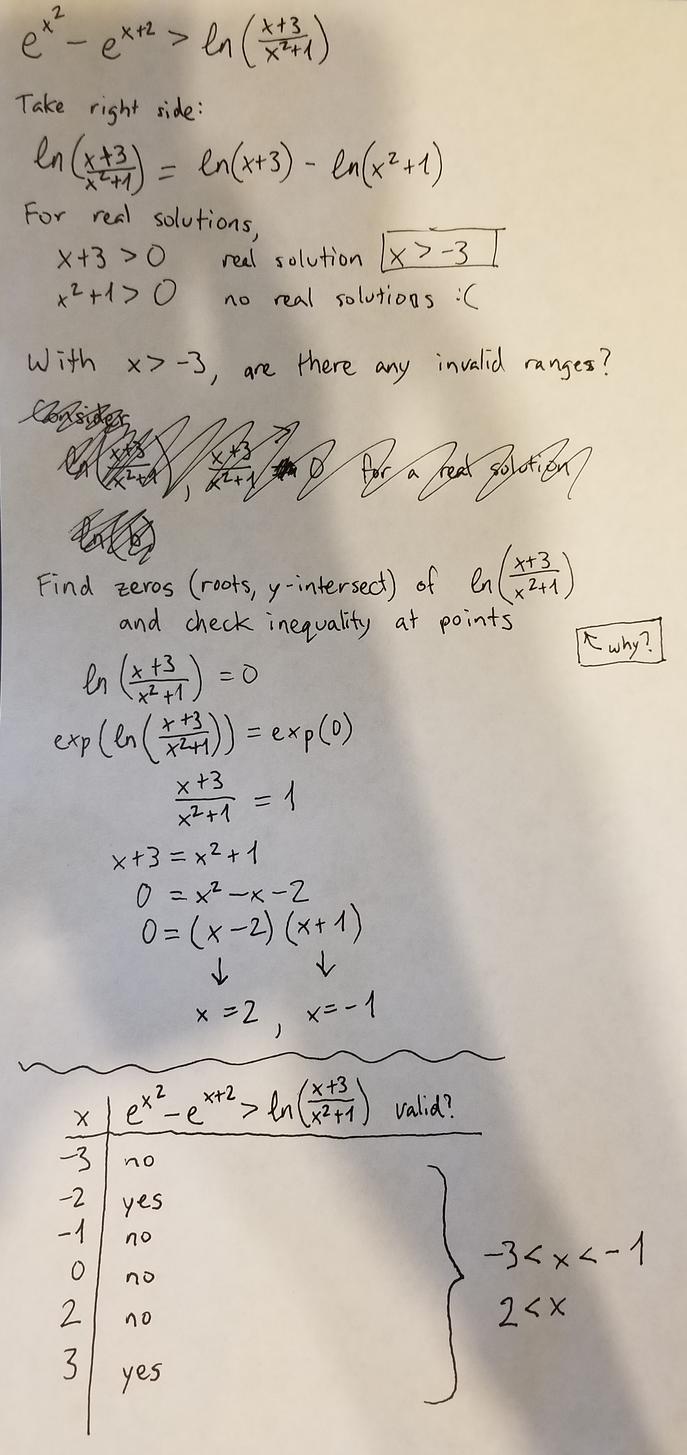 cyan zodiac
US letter full height, cropped width
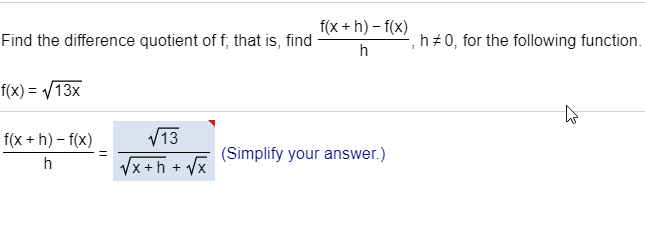 willow bear
what exactly is giving you trouble here
 restive bridge
I really just can't comprehend the steps needed to be taken. I've looked at videos of similar problems, and they've given me insight. But even so, I'm not quite clear on how to go about the problem.
The furthest I've gotten is rationalizing the fraction. (and that was only because I realized they did so in one of the videos)
That's the right answer. @blazing monolith
That's why I was confused. I didn't know how to solve it myself.
obsidian monolithBOT
JY1853:
 pale kettle
Feel like giving full solutions isn't great
restive bridge
It helps me a lot. One thing I need to ask.
@blazing monolith
Why is the rationalization a positive root(x), when the original numerator is minus?
a^2+b^2
a^2-ab+ab+b^2
(I really need to learn how produce the fancy text
pale kettle
Check your work on this expansion
restive bridge
I see the issue I made already. The way JY formats it makes it much less confusing. He has the numbers separated via parenthesis, whereas I factored it automatically. (plus I factored it wrong, my rationalization used a minus square root)
pale kettle
And that's why you do your work step by step
restive bridge
TY guys.
 slate scroll
I'm doing an investigation on Bezier curves with a maximum of 4 control points. Does anyone have a suggestion for a problem/topic that I can model using geogebra?
 wary maple
oops wrong channel
 tidal rain
Hey if for (x-2)(x+2), the roots are x=2 and x=-2, what are the roots if there was a negative sign in front: -(x-2)(x+2)
 uncut mulch
when will the value of the expression be 0?
tidal rain
oh shit i'm dumb lol i see roots would still be the same
 short sorrel
right, since the - never creates or changes a 0
in fact, if you prefer, you can actually distribute the - in to one of the factors:
$-(x-2)(x+2) = (-x+2)(x+2) = 0 \ \ -x + 2 = 0 \implies x = 2 \ x + 2 = 0 \implies x = -2$
obsidian monolithBOT
Namington:
short sorrel
this isnt necessarily to solve it or anything, but it can give one "interpretation" for why it doesnt affect the answer
 rotund spoke
At my school, I taught myself all of Algebra 2 and all of Pre-cal so I didn't get all of the tips and tricks, loopholes, etc. I never could figure out a way to memorize/remember the unit circle without a note sheet. Can someone hook me up with a good method?
 proud sparrow
what do you mean by remember the unit circle?
rotund spoke
yeah like pi/3 pi/6 pi /4
proud sparrow
Well, you can do that by remembering a couple of special triangles
the isosceles right triangle and the equilateral triangle
rotund spoke
how would this translate to setting up the coordinates on my unit circle. for example the coords of pi / 3 are (1/2, sqrt of 3/2). Its been a little bit since ive worked with the unit circle so yeah. Sorry if i have the big dumb rn.
proud sparrow
well, your coordinates are $(\cos \theta, \sin \theta)$
obsidian monolithBOT
Element118:
proud sparrow
so, all that needs is calculating/remembering sin and cos for special angles
 sullen sorrel
Can someone explain the reasoning behind why the first 3 are even, my brain just isn’t working
short sorrel
you know the definition of "even function", yes?
sullen sorrel
yeah
short sorrel
and you know how multiplication by -1 affects how a function "looks"?
sullen sorrel
yes
short sorrel
it's a vertical reflection, yes
does being vertically reflected change whether it's symmetrical about the y-axis?
sullen sorrel
no
short sorrel
hence, (a) is even.
similar logic applies to (b) and (c); the transformation applied doesn't affect whether a function is even
sullen sorrel
Yeah I see now
short sorrel
we can also do this more algebraically:
sullen sorrel
Idk why I couldn’t see that
short sorrel
the definition of an even function is f(x) = f(-x)
so if g(x) = -f(x)
g(x) = -f(x) = -f(-x) = g(-x)
i.e. g(x) = g(-x), so g is even
again, a similar thing can be done in parts b and c
if g(x) = f(-x), we have:
g(x) = f(-x) = f(--x) = f(x) = g(-x)
so g(x) = g(-x), again showing g is even
and if g(x) = f(x) - 2:
g(x) = f(x) - 2 = f(-x) - 2 = g(-x)
so, again, g(x) = g(-x)
this algebraic approach should also show why it fails for (d)
willow bear
actually, for b, you can just say g = f lmao
sullen sorrel
Yeah okay
willow bear
since like
sullen sorrel
Thank you
short sorrel
yeah, true
willow bear
f is even so f(-x) = f(x) by defn
short sorrel
thats much more direct
harsh cipher
Hi
simplifying question. In the last part X= 3/(sqrt 5)
Why can't you leave it as it is. Why multiply sqrt 5/ sqrt 5 to make it X=3 sqrt 5/ 5?
proud sparrow
because we really like integers in our denominators
willow bear
you CAN leave it as is
it's just that some people insist on rationalizing denominators
at all times
obsidian monolithBOT
EvilRobotOverlord:
viscid thistle
Does a function being 1 to 1 mean that it is strictly increasing?
willow bear
no
willow bear
not even that
viscid thistle
oh
willow bear
take f: [0,2] -> R given by f(x) = x for x in [0,1) and 10-x for x in [1,2]
one to one? yes
monotone? no
viscid thistle
wait do you mean these lines

Desmos Graphing Calculator
cause i think thosr are monotone
ohh
it's like
one function composed of those two
but like there are 2 values of x that give the same value for y
does that count as 1 to 1
?
willow bear
i gave you a PIECEWISE function.
proud sparrow
You need to choose which function to use depending on which piece of the domain you are in
 neat terrace
I have no idea if this is the right place to ask, but...
https://i.imgur.com/DbL38ME.png
Is it possible to make an equation for this?
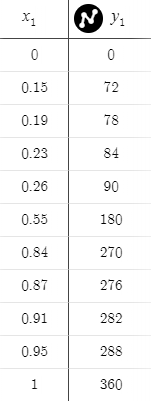
I want to be able to get the value of y when x is anywhere between 0 and 1
proud sparrow
looks like statistics
where you want to fit some sort of best fit line
how do your points look like?
what model are you fitting?
@neat terrace
neat terrace
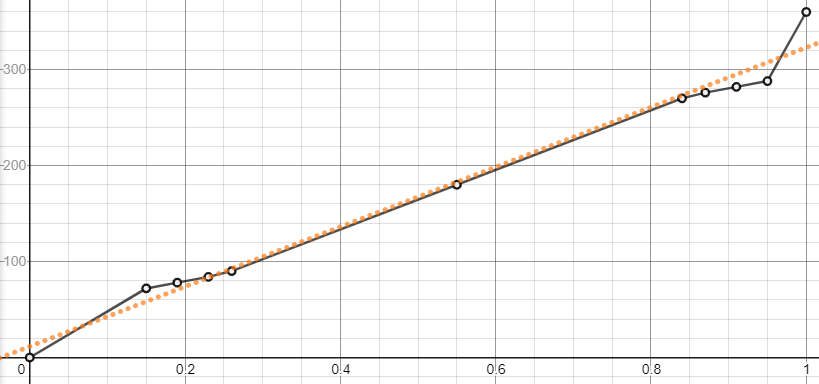 proud sparrow
yeah, just get the equation of that best fit line, and then substitute in the values for x
that's one way about it
neat terrace
I need an exact result though
proud sparrow
yeah, you can substitute in the value for x and get an exact result
or are you going to linearly interpolate between two points?
that's another way to get values
 vernal rapids
fourier series
You can approximate by sin functions or polinomials
But the simplest way is just to make it a piecewise function
proud sparrow
haha we only have it at a couple of points though
vernal rapids
$f\left(x\right)=\left{0\le x\le.15:\frac{72}{0.15}x,.15\le x\le.19:\frac{6}{0.04}\left(x-.15\right)+72,0.19\le x\le0.23:\frac{6}{0.04}\left(x-0.19\right)+78,0.23\le x\le0.26:\frac{6}{0.03}\left(x-0.23\right)+84,0.26\le x\le0.84:\frac{90}{0.55-0.26}\left(x-0.26\right)+90,0.84\le x\le.87:\frac{6}{0.03}\left(x-.84\right)+270,.87\le x\le.91:\frac{6}{0.04}\left(x-.87\right)+276,.91\le x\le.95:\frac{6}{0.04}\left(x-.91\right)+282,0.95\le x\le1:\frac{72}{0.05}\left(x-.95\right)+288\right}$
desmos format
obsidian monolithBOT
DarK:
 lunar mountain
can anyone explain why theres a difference in counting combinations in these 2 situations:
when deciding the probability of throwing a dice roll with a SUM IS 9 OR HIGHER: 6-3 and 3-6 are counted as two different combinations
when deciding the probability of WALK AT LEAST ONCE in terms of transportation with two trips: WALK - WALK are not counted as two combinations
It doesn't make sense to me why it'd be counted in one situation or not the other. For the total sum, it doesn't matter if the first or the second throw is a specific number. Neither should it matter when we try to determine if a person has walked at least once
willow bear
WALK-WALK is the same as WALK-WALK
lunar mountain
Is DICE A: 3 and DICE B: 6 not the same as DICE A: 6 and DICE B: 3 with that logic?
Because the outcome is the same
lunar mountain
I don't understand the logic behind why 6+3 = 9 is not the same as 3+6=9
And if those are counted as two different combinations, then WALK morning and WALK evening is not the same as WALK evening and WALK morning
willow bear
...
lunar mountain
2 times
short sorrel
How so?
There's only one possibility:
The first roll is a 6
And the second roll is a 6
lunar mountain
hm
short sorrel
But if we want to count the probability of rolling a 6 and a 3, in no particular order
There's two possibilities:
First roll 6, second 3
Or first roll 3, second 6
willow bear
do you know what $f \circ g$ is?
obsidian monolithBOT
Ann:
 tawny comet
No, I don't... That's what made it even more confusing
willow bear
Function Composition
tawny comet
Oh, is that what it means?
tawny comet
Right...
willow bear
i mean idk
tawny comet
Any idea on how I would go about doing this?
willow bear
For all those people who find it more convenient to bother you with their question rather than search it for themselves.
 zinc citrus
Function composition is basically where you plug in a function to another function
f o g = f(g(x)) if that form seems more familiar to you, it’s just a different way of writing the same thing
obsidian monolithBOT
 Requested by Krishna#4971
obsidian monolithBOT
Requested by Ann#0413
Requested by Krishna#4971
obsidian monolithBOT
Requested by Ann#0413
 shrewd urchin
How can i do that problem @willow bear
willow bear
compute the angle between your vector and i
 pliant gorge
how do i factor when a is not 1
shrewd urchin
,w tan^-1{3/1}
obsidian monolithBOT
Requested by Krishna#4971
pliant gorge
like for 2x^3-5x-3
shrewd urchin
,w 1.249rad.to degrees
obsidian monolithBOT
Requested by Krishna#4971
tawny comet
Quick questioon y'all
So like, I understand what they mean by (f^-1og^-1)(x)
But what happens when they say
(f^-1og^-1)(2)
Instead of the x at the end
They replaced it with the number 2.
What do I do with that?
pale kettle
What's the difference between f(x) and f(2)?
pale kettle
Yes
 wraith idol
Bruh
viscid thistle

 river coral
@viscid thistle hey friend 🤡
viscid thistle
@river coral hi friend
short sorrel
3^15 = 3^10 * 3^5, and 27 = 3^3
2^10 * 3^10 = 6^10
6^10 / 6^12 = 6^-2, and 3^5 / 3^3 = 3^2
then simplify from there
alternatively, break down 6^12 into (2*3)^12
which becomes 2^12 * 3^12
and then you can, again, simplify from there
tidal rain
im confused about where the 3^25/81^12 came from
short sorrel
i think thats there as a "here's some common mistakes which you shouldnt do"
since theres no justification for that
tidal rain
so is the only part that really matters
i'm just really confused because it seems like my professor's work is so messy
viscid thistle
for 6^12 use the formula: (a * b)^n = a^n * b^n
barren hedge
yeah, the circled is the only part that matters, the rest is random and unnecessary (probably to show another case).
viscid thistle
anyone know how to solve this problem?
short sorrel
your answer for volume doesn't seem simplified
seems correct after simplification, though
short sorrel
you should get a simple trinomial
$(8x^3 + 16x^2 + 6x) - (6x^2 + 24x) \ \ 8x^3 + 16x^2 + 6x - 6x^2 - 24x$
obsidian monolithBOT
Namington:
viscid thistle
hmm
 hushed ember
A square hut with side lengths of 5 m is to be surrounded by a veranda of width x metres.
Find the width of the veranda if its area is to be 24 m2.
can anyone help me on this one?
willow bear
what have you tried and where are you stuck
 native timber
$\sqrt[n]{a}\cdot\sqrt[n]{b} = \sqrt[n]{ab}$
obsidian monolithBOT
Jiramide:
native timber
Multiply the both sides of the fraction by the denominator's conjugate
tidal rain
a^1/3-b^1/3 wouldn't work right
native timber
Ah it's cube root mb
tidal rain
oh conjugate is only for square roots?
native timber
Yeah since only difference of squares factor into term * conjugate form
Have you learned about the sum or difference of cubes?
 glossy grail
native timber
glossy grail
native timber
Hmm I'm not really sure how you'd do this (you could probably arrive at sum of cubes if you really stare at the notes) but I'm on phone and it's rlly hard to type
 upper flint
I need help with sequences
pale kettle
upper flint
 grave furnace
Iirc you just have to find how much the sequence changes each term to get from 22 to 64 in 6 terms, and if you know how to write a recursive and explicit formula you should be good
obsidian monolithBOT
Mechanist FD:
proud sparrow
@upper flint First term is (2*1-1), second (2*2-1) and so on
upper flint
@proud sparrow Ik
proud sparrow
so you start at 1 and end at n
uncut mulch
$\sum_{k=1}^{n} (2k-1)$
obsidian monolithBOT
ramonov:
 lucid crow
o sorry
short sorrel
^
lucid crow
n
uncut mulch
the answer is quite nice
short sorrel
yeah, this is a fairly well-known sum, it turns out.
in fact, you might be able to guess the pattern just by testing
1 + 3
1 + 3 + 5
1 + 3 + 5 + 7
viscid thistle
Hello, someone can help me?
stuck lark


 uncut mulch
why did you write
x^2 for k=0
those caluculations would be for the first term
what is the question asking you to do?
viscid thistle
o_o just replace k by 0 Everytime I saw a K
Oh I see
I did a mistake
What about that? Is that correct?
 patent beacon
Σ means "sum"
uncut mulch
=2
and then you'd have to write out the next few terms
patent beacon
k = 0 below, and n above, means to sum the terms from 0 to n
So you've got the first term, but there's more
uncut mulch
followed by ... and the final one or two terms
viscid thistle
I did this for the third one 
viscid thistle
Really? Why?
uncut mulch
these sums and sequences are better left as fractions so see their patterns
viscid thistle
Oooh okay
patent beacon
You generally don't want to use decimals in a math class. They imply you're approximating the answer
uncut mulch
how many terms did you write for the second one?
viscid thistle
5
uncut mulch
that sum doesn't end at i=6
you'd need indicate that it keeps going until i=n
i meant for your SUM of (2i -1)
uncut mulch
followed by the term where it ends
the last 2 terms is usually better but one is enough
viscid thistle
But it says n, there isn't an actual end
uncut mulch
yeh
viscid thistle
Cool
uncut mulch
for the first one, you could leave them in the form ^4
and for the current question, leave them as powers of 2
viscid thistle
I don't want to risk it, this teacher I have it's kinda scary to me
Is this okay :/
uncut mulch
the denominator is
2k + 1
not 2^k + 1
viscid thistle
Right...
I didn't changed much though, still send prove that I listen to you :)
Thank you very much
uncut mulch
don't write -1x or 1x^2
just -x and x^2
remember the ... and nth term and you should be good
viscid thistle
Thanks again Ramonov, have a great night
 candid onyx
Not sure what I replace here.
stuck lark
what've you tried so far?
 tired zephyr
G-father, you’re missing the -f(x) part
tired zephyr
(((x^2 +1) + h) - (x^2 +1))/ h
 pine galleon
result is 1
tired zephyr
Yes
tired zephyr
X-x. Cxl each other out leaving you with h/h which is 1
candid onyx
thank you!
 proud wraith
When do you know to use "{}" or "()" for answers
Ex) Why does this one use "{}" for it's answers which are {-4,-4/3}
when this one uses "()" for it's answers which are (7,11)
Sorry if I cut anyone.
short sorrel
curly brackets {} denote a set
round/square brackets (), [], (], or [) denote an interval
the first question uses {} because there's a finite set of solutions
 silk cedar
I’m about to start an astrophysics corse it’s I’ll@probably be taking calc and physics
short sorrel
which can be listed individually
the second one uses () because you can't list the solutions
its an inequality, so the solutions will be an interval
{-4,-4/3} indicates that the solutions are -4 and -4/3, and ONLY those
(7,11) indicates that the solutions are all numbers BETWEEN 7 and 11
(excluding 7 and 11 themselves)
for more, look up "set notation" and "interval notation"