#precalculus
1 messages · Page 163 of 1
 wraith idol
wraith idol
wraith idol
But I can use it for that 


 echo plaza
$\fun{f}{X}{Y}{x}{f(x)}$
 obsidian monolithBOT
CaptainLightning:

 long pond
imagine using Y instead of f(X)
 native sequoia
echo plaza
native sequoia
echo plaza
trash book
 willow bear
🗑 📘
native sequoia
it's the textbook written by my philosophy professors
echo plaza
I rest my case
willow bear
trash the philosophy professors
wraith idol
$f:A\mapsto B$ then $f\subseteq A\times B:\forall a\in A,|{b\mid (a,b)\in f}|=1$
obsidian monolithBOT
Whoever:
native sequoia
... with mapsto?
obsidian monolithBOT
CaptainLightning:
echo plaza
what is $f(\emp)$
obsidian monolithBOT
CaptainLightning:
native sequoia
ooo
echo plaza
also the word image is a bit overloaded tbh
wraith idol
Um
True I guess
But you’ll know if it’s a subset of the domain or an element of the domain
 shrewd urchin
#chill
shrewd urchin
Set theory so boring
wraith idol
no u
 torn swift
Yes u
 willow bear
do you know what "varying directly" means
if not, then go look it up
Google it or sth
willow bear
okay
 brisk forge
well on the second part
 languid dust
webassign
willow bear
there must have been SOMETHING you did that led you to that conclusion
languid dust
D:
willow bear
Google Intern, i'm gonna ask you to move to a questions channel if you still need help.
brb
brisk forge
f(5)-f(5) cancels out. and then just divide the hs
brisk forge
i watched this video on how to do difference quotients and followed the steps presented
brisk forge
it wsnt an exact replica of the problem though
willow bear
show. your. work.
brisk forge
nvm ann lmao
brisk forge
no lmao. dw about it
 viscid thistle
Can anyone explain why the cycle repeats only when it is applied twice
Doesn't it repeat after 3pie
this is the question


viscid thistle
help xd
 patent beacon
How many times does sin(2/3 θ) = 1, not considering 2π multiples of θ
Or -1, I suppose that counts too
 blazing parrot
'not considering 2π multiples of θ' meaning just one period
viscid thistle
oh
2 times then
yeah
I dont understand why it needs to be applied twice?
like the graph repeats after 3 pie right?
viscid thistle
/??
 stuck lark
@viscid thistle start with the 3 in front of f. if the height of the graph is given by f(x), then what do you know about the height if you take 3f(x)?
stuck lark
we're not talking about horizontal shifts yet
viscid thistle
Ah
stuck lark
just talking about any ol' function f, what happens to the height of f if you take 3f?
viscid thistle
Multiply by 3
stuck lark
ya
stuck lark
you don't need to go as high as 12...
what's the maximum value of f(x) in the question?
viscid thistle
6
stuck lark
...no
stuck lark
no
viscid thistle
(Facepalms) im so confused
 stuck lark
do you clearly see the graph of the function?
stuck lark
yes the maximum height of the graph is 1
stuck lark
f(x) gives that graph. now take 3f(x), what's the maximum height now?
viscid thistle
3
viscid thistle
Yeah... but where to put thae dot??
stuck lark
(but don't draw it yet)
viscid thistle
Ok
stuck lark
now let's focus on the f(x-4) part
viscid thistle
Ok
stuck lark
if we have f(x) as the graph, what does f(x-4) mean in terms of what you see on the graph?
viscid thistle
Horizontally go right by 4
stuck lark
ya, horizontal shift of +4
now focus on the +2 part
if you have f(x) as the graph, what does f(x) + 2 mean?
viscid thistle
Move up by 2
stuck lark
ya, vertical shift of +2
so we have 3 transformations to think about when redrawing the graph
what are they?
viscid thistle
Max height 3, vertical shift +2, horizontal shift +4
stuck lark
you described the vert/horiz shifts fine
as for putting 3 in front of f(x), it's gonna take every point on the graph and multiply its height by 3
typically we call it a vertical stretch or a dilation by a factor of 3
viscid thistle
Ah.
So basically, if it goes to 0 to 1, when i do it by the stretch it's now 0 to 3?
stuck lark
sure
stuck lark
👍🏽
viscid thistle
Thanks for the help!
stuck lark
no prob
 gaunt mural
Can someone explain limits and they types of continuities like removable jump and discontinuity
It would be very appreciated
 mellow gyro
sure
limits are when x is apporaching something and you are looking for the y value which you are appoaching
mellow gyro
ok
gaunt mural
Lim x approaches the number
mellow gyro
yeah
so continuity is whether or not you pick up your pencil while graphing the line
if you dont pick it up, its continuous
gaunt mural
Yep
mellow gyro
theres 3 kinds of discontinuity
gaunt mural
Yeah removable jump
mellow gyro
jump, infinite, and removable
gaunt mural
Ok
mellow gyro
do you understand those 3?
mellow gyro
so removable is where you have a hole and another point is used to patch the hole
so if you had a hole at x=2 but it states that when x=2 y=5 then thats removable
gaunt mural
Ok
Oh so like if there is a hole like open circle on the graph if there is a close circle on the same x value it's removable?
mellow gyro
yeah
gaunt mural
What about infinite
mellow gyro
infinite is when you have an asymptote and it goes to infnity
on both sides
so like if there is a vertical asymptote at x=0 and both sides go to infinity then there is a discontinuity at x=0
gaunt mural
Ok
mellow gyro
yeah
gaunt mural
Oh ok
So how would you find the limits and continuities without a graph just an equation that is what I struggle with
mellow gyro

Khan Academy
Sal finds the limit of (x²+x-6)/(x-2) at x=2 by factoring and simplifying the expression.
khan does a good job at explaining
gaunt mural
Ok thanks
mellow gyro
yep
wraith idol
I just learned the formula for that segment
In 1 sentence: "I suck at anything circle related."
...............
obsidian monolithBOT
RokettoJanpu:
$s = r \theta?$
 fallow oxide
Hey, so I'm having a little trouble understanding how to find exact trig values w/o using a calculator. So for example find sin(7π/12), I don't understand how to find that within the unit circle and how to find the value of it.
stuck lark
draw or imagine the unit circle (radius 1) drawn with its center at (0, 0)
EDIT: so 7pi/12 is not one of the common angles that we should know the trig functions of, so ignore what i said about the circle
fallow oxide
ok
stuck lark
can you express 7pi/12 as a sum or difference of multiples of common angles (0, pi/6, pi/4, pi/3, pi/2)?
fallow oxide
yeah
stuck lark
what's that sum/difference?
fallow oxide
π/4 + π/3, right?
stuck lark
ya
so now you have sin(pi/4 + pi/3)...
this is where you apply some trig identity to help you calculate this
fallow oxide
that's where i think i'm having trouble with
stuck lark
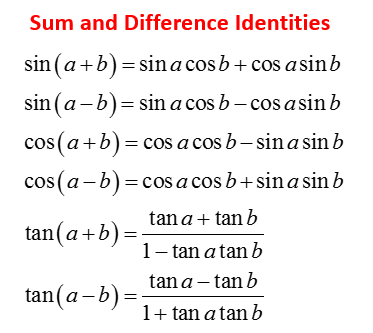
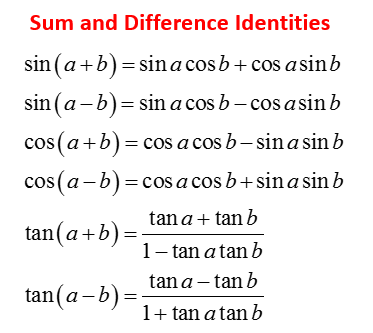
ok, do you know your trig sum and difference identities?
fallow oxide
no
stuck lark
 fallow oxide
so sin(pi/4)*cos(pi/3) + cos(pi/4)*sin(pi/3)
stuck lark
@fallow oxide ya
fallow oxide
then now, i am confused what to do
stuck lark
these are common angles, so you can use special triangles to compute
stuck lark
ya sin(pi/4) = sqrt(2)/2
fallow oxide
sorry about that, so then cos would be 1/2 / sqrt(3)/2?
stuck lark
@fallow oxide 1/2 and sqrt(3)/2 for which angles?
fallow oxide
for the 30-60-90 triangle
stuck lark
@fallow oxide so what is sin(pi/4) x cos(pi/3) + cos(pi/4) x sin(pi/3)?
fallow oxide
sqrt(2)/2 * 1/2 + sqrt(2)/2* sqrt(3)/2 = sqrt(2)/4
obsidian monolithBOT
 Requested by RokettoJanpu#6002
stuck lark
Requested by RokettoJanpu#6002
stuck lark
,w sqrt(2)/4
obsidian monolithBOT
Requested by RokettoJanpu#6002
stuck lark
something's gone wrong in your calculations
obsidian monolithBOT
 Requested by General Authors#6093
fallow oxide
Requested by General Authors#6093
fallow oxide
,w (sqrt(2)+sqrt(6))/4
obsidian monolithBOT
Requested by General Authors#6093
stuck lark
👍🏽
fallow oxide
thanks, you've really helped me
stuck lark
no prob man
 tidal rain
stuck lark
tidal rain
stuck lark
$4y^2-4xy+x^2$ is the square of the binomial $2y-x$
obsidian monolithBOT
RokettoJanpu:
 vestal thunder
hey guys new to the server can someone help walk me through some precalc homework? willing to paypal for a call. no im not asking you to do my homework. im just lost lol
 fast canyon
Could someone guide me through these problems, maybe I’m over complicating, I’m having trouble
stuck lark
@fast canyon what've you tried for the first one?
fast canyon
Splitting the big triangle into two separate ones creating three triangles
torn swift

No guarantee I’ll take your question, but you have to ask it first before anyone can help
 bleak lance
Ok. Factor out the GCF: 7z(z-4)+3(z-4)
willow bear
ok what's giving you trouble here
 willow bear
it's a bit trickier than plane angle
but if you understand that plane angle is ultimately the ratio of subtended arc length to radius
it isn't that much of a stretch that solid angle is the ratio of the area of a shape on the sphere to the square of the radius
shrewd urchin
Ok
The error in measurement of side of a rectangle is 1% how much error there will.be in area
willow bear
as too-good-to-be-true as that sounds... 2%.
bleak lance
I need to factor this x^2-3x-28
willow bear
okay, what is giving you trouble here?
willow bear
let's see
write out the differences between the standard clock (always 12:00:00) and your clocks
for clock 1, this will be as follows:
+5, +75, -52, +110, -45, +90, +79
willow bear
for clock 2:
+906, +899, +918, +907, +897, +924, +911
tldr you can just manually set clock 2 back fifteen minutes
 hard hornet
pixels?
shrewd urchin
willow bear
oh
shrewd urchin
i read a lot about resolution on internet but stilll cant figure out what is it
willow bear
resolution = smallest value you can distinguish from zero basically
so a resolution of 0.01 s means your device can only measure to two decimal places in seconds
shrewd urchin
Ok thank u

they told similarly you can see that it is true for divison i cant see how i tried a lot but still cant see how
@digital valeng me
woops sorry pi
ping me if anyone is replying thaks in adv
shrewd urchin
<@&286206848099549185>
 fringe stream
shrewd urchin
fringe stream
shrewd urchin
I tried
And found
$ Z=\frac{A}{B} \implies \frac{\Delta Z}{Z}=\frac{\Delta A}{A} -\frac{\Delta B}{B}$
obsidian monolithBOT
Krishna(stop listening rap):
shrewd urchin
But this is not true
bleak lance
The mainmast of the ship is 230
feet high. Suppose that a sailor climbs the mainmast to a height of 192
feet in order to look for enemy vessels. How far could the sailor see? Assume the radius of the Earth is 3960 miles.
 fallow marlin
 proud raven
probably easier to just try it
proud raven
@fallow marlin the idea is your just adding whats missing to the exponent of the radicand to make the exponent be some number to the n/n power
which is just the 1 power
@tidal rain try common denominator -> combine factors
patent beacon
@tidal rain
Take out a (2x - 1)^(-1/2) first
 river kindle
Yeah, always take out the lowest power.
 grave furnace
This seems like it should be pretty simple but I'm really confused
I have to do 30 & 32
grave furnace
Nevermind I got it 
 toxic jasper
 harsh cipher
Hi everyone
On the right image. Why do I have to add +8 and subtract -8? How do you get +8 -8?
It's the numerator part on second to last part of the equation.
willow bear
How do you get +8 -8?
do you mean "how do you know to add & subtract 8 as opposed to some other number?"
if so, look at the next step, and notice what happens to the highlighted -4x+8
harsh cipher
it's factored to seperate the equation to write in the form y= a/(x-h)+k
I still don't get it though. Why use +8,-8
obsidian monolithBOT
Ann:
harsh cipher
yes
willow bear
can you expand it back out?
 harsh cipher
okay...
willow bear
all i'm asking you to do is to expand $-4(x-2)$.
obsidian monolithBOT
Ann:
willow bear
what do you get when expanding $-4(x-2)$?
harsh cipher
-4x+8
willow bear
well there you have it, there's your eight.
and the -4x, which is already present in the numerator.
harsh cipher
just became -4x+8-8+15?.....
willow bear
to remind you of the order of operations
harsh cipher
divide multiply add subtract?
willow bear
and specifically that \texttt{-4x+15/x-2} is NEVER going to be read as anything besides $-4x + \frac{15}{x} - 2$.
obsidian monolithBOT
Ann:
willow bear
if you want $\frac{-4x+15}{x-2}$, then you HAVE to write \texttt{(-4x+15)/(x-2)}.
obsidian monolithBOT
Ann:
willow bear
anyway, back on topic
instead of adding and subtracting 8, you can break the 15 into a sum like this: $\frac{-4x + 8 + 7}{x-2}$
obsidian monolithBOT
Ann:
harsh cipher
k
willow bear
the point is to get $-4x+8$
obsidian monolithBOT
Ann:
willow bear
so that you can factor out $(x-2)$
obsidian monolithBOT
Ann:
willow bear
but you can't just add 8 because that messes up the value of the expression
the only number you can add is 0
but you can add a cleverly written 0
in this case, as +8 - 8
willow bear
there's no such thing as "having to" do anything
harsh cipher
lol
willow bear
but if that makes it easier for you to understand, then yes
harsh cipher
okay
Thank you Ann
you're the best I'm kind of looking back to the first answer you gave me.
It makes sense a bit more
harsh cipher
I wrote the domain to be 1<t<10, where t is number of years
the answer key says Model A: 800<C<6800 Model B: 600<C<8100
😦
willow bear
uh
that's weird
are you sure the answer key doesn't state anything of the form (number) < t < (number)
@harsh cipher
willow bear
antilog
more like
10^x
or e^x if you use log for natural log
but yes, $10^{\log(a) - \log(b)} = \frac{a}{b}$
obsidian monolithBOT
Ann:
shrewd urchin
In mu lecture im basic math log and tables he taught a loy of wrong thingd
And ignoring me
Whem i recognize his mistake
 heady jewel

 shrewd urchin
my*
viscid thistle
how can i derive the formula for the nth square triangular number?
I'm cool with the pell's equation thing
but idk what else to do after that
wikipedia says euler did it
viscid thistle
<@&286206848099549185>
willow bear
"square triangular number"?
viscid thistle

In mathematics, a square triangular number (or triangular square number) is a number which is both a triangular number and a perfect square. There are infinitely many square triangular numbers; the first few are:
0, 1, 36, 1225, 41616, 1413721, 48024900, 1631432881, 55420693...
willow bear
ah.
 pale kettle
What exactly are you confused about @viscid thistle ?
If you understand Pell's method, then you should know how to get the solutions
viscid thistle
well i get how to get the solutions just not how to derive the formula that euler gave
it's on the wiki page
viscid thistle
yeah but one is in latin
and i can't find a pdf for the other one
.
also is there a way to derive that recurrence relation or is it just by observation?
the n(k)=34*n(k-1)-n(k-2)+2
with n(0)=0 and n(1)=1
maybe there's a method to get to it by the pell equation
 frozen needle
ignoring the initial conditions first and assuming the existence of a solution, you can show the set of solutions can be given a structure of affine space
find a solution, add the general solution to the homogenous eq, and adjust constants that can be adjusted to fit the initial conditions
frozen needle
an affine space is the image of a vector space by a translation
the homogenous equation would be
$$n(k)-34n(k-1)+n(k-2)=0$$
obsidian monolithBOT
Tuong:
viscid thistle
i have to learn more math to understand that the affine space thing but oh ok i get the other one
wdym by add the general solytion to the homo equation
hmmm ok
frozen needle
if you have a sequence $m$ that satisfies
$$m(k)-34m(k-1)+m(k-2)=2$$
and another sequence $n$ that satisfies
$$n(k)-34n(k-1)+n(k-2)=0$$
you can notice $m+n$ satisfies
$$(n+m)(k)-34(n+m)(k-1)+(n+m)(k-2)=2$$
obsidian monolithBOT
Tuong:
frozen needle
a solution of the original equation + a solution of the homogenous equation makes a solution of the original equation
viscid thistle
ok i think i get it but i still don't get how that helps with the derivation of the recurrence thing
frozen needle
You already know how to solve the homogenous equation, the solutions will look like something something s(k) = Ap^k + Bq^k
The you just have to find some dumb solution m to the original equation, and then n(k) = s(k)+m(k) will give new solutions
You'll just have to find good A and B so that n(0) and n(1) fit the given values
viscid thistle
oooooooooooooooh
that makes more sense thank you
so um this helps with finding the nth solution?
right
?
this gets us from the recurrence to the explicit formula right?
so have i understood this or not
frozen needle
I think you understood
viscid thistle
so um is there a way to get to the recurrence relation or is it just by observation?
frozen needle
observation is fine I suppose
patent beacon
Right there, there's four of them
viscid thistle
,w 3^x+4^x+5^x = 6^x
obsidian monolithBOT
 Requested by Blitzkrieg#7821
frozen needle
Requested by Blitzkrieg#7821
frozen needle

frozen needle
such a troll question
willow bear
this is a guess & verify uniqueness sort of question ig
shrewd urchin
ok
frozen needle
has "decreasing" become the new "strictly decreasing" or is the vocabulary not unanimous ?
willow bear
it's supposed to be strictly decreasing that's for sure
frozen needle
I've seen "non decreasing" being used for "increasing" once, and I was like 
shrewd urchin
they are same
frozen needle
I mean, it's weird how "non decreasing" isn't the same as "not decreasing" whereas "non negative" is indeed the the same as "not negative"
shrewd urchin

viscid thistle
is this where i post math questions i need help with?
stuck lark
depends if it's a precalc question
viscid thistle
it is
at least my pre calc teacher assigned it but it goes off of what weve been learning
. A projectile is fired upward from ground level with an initial velocity of 96ft/sec
Recall the height of a projectile is modeled by h = -16t2 +vot + k
a) To the nearest tenth of a second, how long until the object first reaches a height of 100ft?
b) How long until the object is again at 100ft?
c) How many seconds until it returns to the ground?
i dont remeber how to do these
am i supposed to just plug in the numbers cause when i did i got my answer as 0
stuck lark
$h = -16t^2 + v_{0}t + k$
obsidian monolithBOT
RokettoJanpu:
viscid thistle
should i just take a picture of the question?
stuck lark
i think we have enough information from what you copied and pasted
viscid thistle
ok
stuck lark
what've you tried so far?
viscid thistle
well i tried plugging in the numbers and then doing completing the square
but i got my answer as 0
 next willow
Why 16 though?
stuck lark
we're using imperial units
gravitational acceleration near surface of earth is about 32 ft/s^2
next willow
Ahh it's clear now, thank you
viscid thistle
would i set h as 100 k and k as 0?
stuck lark
@viscid thistle so based on the info i got from the question, v0 is 96ft/s and the projectile starts from the ground... so k should be 0ft
yes set h = 100ft for part A
viscid thistle
oh i wrote that on my paper but forgot on discord
so could i move everything to one side then do the square method?
wait i can leave it and do the square method
stuck lark
uh sure
viscid thistle
ok and im guessing i cant divide by 16 because of that 0?
obsidian monolithBOT
Requested by RokettoJanpu#6002
viscid thistle
ok
kind of makes sense but hes also asking for it in decimal form it seems like
would there be any way to convert it?
stuck lark
@viscid thistle tbh no way except to plug into a calculator
viscid thistle
ok
viscid thistle
How do I find an acute angle of a right triangle given only the trig function?
Like tanx = 3/(square root of 3)
 normal stream
Could someone help me with some stuff about polynomials?
My teacher doesnt teach so I gotta self study but theres some confusing concepts
For example, "Write an equation of the cubic polynomial p(x) if p(0) and p(3) = -5 and p(x) is positive only when x > 9"
the part that confuses me is how i can use the x > 9 part to help solve this problem
 pliant pecan
Lol, for example... I know the process but I’m supposed to not use calculators bc they won’t be there during the test. How would I solve this to get a square root answer?
patent beacon
@pliant pecan
What's wrong with tanθ = 2√3 / 5?
pliant pecan
Nothing. That’s what I’m given. I have to find the sine and cosine so really I just needed to figure out the hypotenuse. But obviously it’s not supposed to be in decimals
I finished this problem got it wrong lol
patent beacon
Ah I see. By pythag:
h = √[(2√3)² + 5²]
patent beacon
= √[12 + 25]
= √37
pliant pecan
So I’d apply the exponent to what’s in front of and inside the root separately... ok
Sorry for the mess, umm...
These have all been solved already. I got a 70 on this quiz. Just trying to get more comfortable so I can be ready for my test later
Or, actually, forget that. How would I turn this into this
 plush trench
Factor 45
And square root any squares that are present
Does that help? @pliant pecan
pliant pecan
Yes. @plush trench
plush trench
Oh cool
pliant pecan
And I have these notes... I just want to know why it’s solved like this, if someone could break it down
plush trench
It looks cooler
pliant pecan
The top of the page, @plush trench , above the Mary go round section
plush trench
The “find perimeter” of triangle?
pliant pecan
Yes
plush trench
Idk what I’m looking at in that work but
pliant pecan
Lol
plush trench
π/3 is a special angle
pliant pecan
I’ll re write it
plush trench
So if you break it up into two right triangles
With 3 as the hypotenuse
That’ll probably do something
plush trench
So what are we solving for, if not the perimeter
normal stream
what books do u guys reccomend for pre calculus for self studying
plush trench
Idk, barron’s math SAT subject test guide? That’s the only thing that comes to mind, but that’s for... the SAT II Math
pliant pecan
I just want to know the thought process, or steps
P is the perimeter of the complete circle
pliant pecan
plush trench
Oh okay
pliant pecan
Yes, essentially a slice
plush trench
Is it a slice from the center of the circle
pliant pecan
Yes
plush trench
Because I can’t help if it’s not
Ok
The area for a circle’s sector slice thing should be
Uhh
πr² (θ/2π)
Which is the area of a circle multiplied by the fraction of the circle that is taken up
Does that make sense?
pliant pecan
Alright, thanks for the formula
plush trench
Do you understand the formula
pliant pecan
This is over perimeter though. I want to figure out why these steps were taken
plush trench
Oh crap lmao
pliant pecan
I think I do for the most part (area formula)
plush trench
Is 5 given
pliant pecan
Yes
plush trench
Btw the sector formula simplifies to 0.5θr²
A circle has 2π radians
and that slice has uhh π/3
pliant pecan
That’s the angle, I believe
pliant pecan
And by “sector formula”, you mean..?
plush trench
Anyway
The arc length, or partial perimeter
Should then be 1/6 of the overall perimeter
Wait is 6+π rad supposed to be the right answer
pliant pecan
Yes
plush trench
Bruh
pliant pecan
What?
plush trench
I thought it was 30
pliant pecan
I mean, according to my professor it’s the 6+pi radians
plush trench
The circumference?
pliant pecan
Yes, circumference/perimeter
plush trench
Hol up let me check something and use the area formula and convert it to the circumference
pliant pecan
Lol
I’m dying out here. Math is like a mine field
One wrong step and you’re turned to 💩
pliant pecan
It’s supposedly 6 plus pi radians
hard hornet
wat
torn swift
Lol we don’t know everything
plush trench
A central sector
torn swift
Though they should have examined the problems beforehand and called for help instead of doing it in front of you lol
plush trench

pliant pecan
I had the notes to this solved problem, I just wanted to know why it was solved this way. Steps needed, any important formulas, etc.. My professor solved it and idk why it was solved this way. I have test full of this stuff soon and want some sort of comprehension
plush trench
I’m getting a strong feeling that that 5 is an S
plush trench
Well that would make it not 30, for starters
pliant pecan
If it’s an S, then S = pi over 3
plush trench
S is arc length
plush trench
Yeah
pliant pecan
I’m looking at the notes... that’s how I got that
plush trench
I am REALLY starting to think the answer is 6π
pliant pecan
For sure, the answer is 6+pi radians according to my professor
Unless she made a small mistake
pliant pecan
Would the perimeter equal 2r + S (arc length)?
plush trench
Not of the circle
pliant pecan
Oh...
pliant pecan
So then...
pliant pecan
Oh crap. Actually, I think I understand it now
plush trench
That should just be a length
pliant pecan
So the perimeter formula is 2r plus S obv... and S is equal to r times the angle... right?
plush trench
Yea the central arc length is S=θr
pliant pecan
Ok, ok... Thanks, I think I can solve these types of problems now!
plush trench

pliant pecan
Sorry, we weren’t given any formulas or anything. She said we’re supposed to know it already. And she just solved the problems fast af and doesn’t take questions...
plush trench
Does the answer say radians
 twilit shadow
Can I ask a question?
twilit shadow
I am having trouble with 38
pliant pecan
Oh lol.
twilit shadow
I know I have to substitute in a point that works and then use variations of that point that are symmetric
pliant pecan
Thought you meant about my problem..
plush trench
Yea
pliant pecan
I would assume so
twilit shadow
Okay thanks. I didn’t want to do that without knowing for sure
plush trench
pliant pecan
I wrote as quickly as possible, this should be everything needed
My notes were gibberish because how fast she goes. Lmk if you want it re written
pliant pecan
Rewritten. Not sure what W is supposed to be, assuming V is velocity. So I assume the problem was to find the velocity or distance traveled in 4 rotations?
If that makes sense
plush trench
Do you know what information was given
pliant pecan
Hang on, let me see. Usually she’ll post the problem online that she solved during lecture
 barren hedge
if the angular velocity is 4 revolutions per second, then 8π rad/sec is good, so what's the question? lol
plush trench
Makes sense
twilit shadow
Another quick question, how do you find if a function is symmetrical in relation to the origin?
pliant pecan
I know the answers are right, my professor solves them in front of us. The thing is, she expects us to know why she solved them that way but idk because I just got back to school lol
barren hedge
Levi, if f(x) = f(-x)
twilit shadow
Oh yeah thanks
barren hedge
you just gotta memorize that 1 revolution is equal to 2π radii.
plush trench
Not - f(x) = f(-x)? @barren hedge
pliant pecan
@barren hedge ok, and what is W? Angular speed?
plush trench
A revolution is 2π radians 6ix
plush trench
Oh henry already said that lol
barren hedge
Interchangable.
plush trench
x² is an even function, though @barren hedge even functions aren’t symmetric about the origin
pliant pecan
Yes, that’s what I said lol
This is my problem... with what you guys told me I’ll try to work it out and I’ll post it. Help me if I’m wrong?
Wait, what is the angular speed formula?
plush trench
Do you know how to do conversions
barren hedge
physics is meant to teach you how to think conceptually, not memorize formulas, lol..
pliant pecan
What would I need to convert?
plush trench
Convert to radians/sec
pliant pecan
Convert to rad/sec from..?
@barren hedge this is supposed to be pre cal, this is physics? I guess it makes sense for it to be involved
barren hedge
oh yeah, it's a physics question. Angular Kinematics.
plush trench
Physics is applied math
pliant pecan
Oh lol
barren hedge
physics is like, philosophy using math idk lol
stuck lark
physics is where you're free to treat derivatives like fractions 
plush trench
Look into even and odd functions @twilit shadow
pliant pecan
Can I get an angular speed formula?
twilit shadow
Oh, I’m done with that problem now, but thanks
stuck lark
$v = r \cdot \omega$
obsidian monolithBOT
RokettoJanpu:
plush trench
I say that because I’m pretty sure henry gave you the wrong answer
God bless you, henry
barren hedge
let's be clear, it depends on what they mean with "about the origin" derp
pliant pecan
@stuck lark that’s not velocity?
barren hedge
it could mean horizontally, vertically, diagonally, they didn't really elaborate lol
twilit shadow
Yeah I’m not completely sure, but I graphed it and it’s definitely no where near symmetric about the origin in any way
pliant pecan
Or linear speed @stuck lark
plush trench
Should be -f(x) = f(-x)
twilit shadow
I do have another quick question if anyone could help me
Is this a trick? It seems way too easy
I would think it would be 75^10
plush trench
Lol
barren hedge
you'd be right
plush trench
I don’t think so?
stuck lark
@pliant pecan in this case, v is linear speed
plush trench
Wait I don’t feel like our answers were very clear
pliant pecan
I’m fucked I guess. Is the answer W?
pliant pecan
plush trench
To answer your question from a while back, convert rad/sec from revolutions/sec @pliant pecan
barren hedge
okay so tell us what's the radius
barren hedge
and from there, tell us the circumference of the circle
(the radius is given in the question, you got this, I believe in you)
pliant pecan
@barren hedge radius is 10. Obviously. I have the formula for the perimeter of a sector...
barren hedge
Perimeter of the entire wheel
pliant pecan
Circumference of the circle is 2pi r squared, right?
barren hedge
not squared
pliant pecan
I get it lol@plush trench
pliant pecan
@barren hedge then it’s 20pi? Lol
stuck lark
do you just have the pi symbol on your keyboard or what?
barren hedge
so what'd be the circumference for this 10 in-radius wheel
plush trench
are you saying circumference is the derivative of area of a circle
barren hedge
yes
stuck lark
that's awesome
plush trench
I just switch to greek bruh moment
barren hedge
now, what's the velocity of the wheel
plush trench
Are you on a computer, henry
pliant pecan
Velocity is... 40pi inch per second?
plush trench
I was about to say holy crap if you have that on a computer keyboard
stuck lark
excitement deflates
barren hedge
yea
plush trench
Nice
plush trench
That’s what I got
plush trench
Have henry check it though
barren hedge
other way
pliant pecan
What do you mean?
plush trench
Bruh moment
barren hedge
Since the inches cancel, the radian units are implied, and the seconds stay in the bottom
pliant pecan
Wait, so to find angular speed I can just divide the velocity by the circumference?
barren hedge
The tangential velocity divided by circumference, yes.
pliant pecan
Tangential velocity meaning..?
plush trench
Isn’t 40π/20π in rev/sec?
barren hedge
no i don't believe it's revolutions/second, we already converted it to radians when we did 10 inches multiplied by 2π
barren hedge
answering Dr. P's question.
plush trench
Shouldn’t that be the circumference in Inches
barren hedge
oh
plush trench
1 revolution = 1 circumference
plush trench
barren hedge
right
pliant pecan
But @barren hedge said I could solve the problem this way even though my answer was right... but it gave me one revolution
plush trench
times 2π rad/revolution
pliant pecan
I’m not as confident anymore lol
plush trench
4π rad/sec
barren hedge
hold up lemme see where i said that
pliant pecan
Why would I multiply by 2pi rad rev? @plush trench It gives the right answer but can you explain?
plush trench
Yes
barren hedge
1 rev = 2π rads
plush trench
pliant pecan
From here, why would I multiply by 2 pi rad/rev?
plush trench
Notice how the “revolution” units cancel out like fractions
pliant pecan
Want to learn the shortcut but want it explained so I know why I’m doing it
plush trench
That’s the basis for conversions
barren hedge
Because, when you divide 40π by 20π you're saying that you complete 2 spins every second
we want to convert spins (revolutions) into radians (how many "radii")
pliant pecan
Hmm
I’m going to screenshot this and come back to it later
Anything to the power of zero is one, right?
plush trench
Yes
barren hedge
Except nilpotent matrices.
stuck lark
0^0 aint
barren hedge
but let's not get into that.
pliant pecan
What do you do if something is to the power of negative one?
plush trench
Bruh moment
barren hedge
anything to the power of negative one is turned into a fraction
Squareroot is something raised to the one half power
barren hedge
Yeah
barren hedge
remember that x²·x⁵=x²⁺⁵=x⁷, so applying that, x⁻¹·x¹ = x⁻¹⁺¹ = x⁰ = 1, and we know that 1/x times x is 1
seems right to me
 kindred grove
Yo
pliant pecan
@barren hedge why would you mention that? It threw me off. This is addition lol.
It’s coming in handy for the second problem though, I think
patent beacon
It can be more simple
barren hedge
si
kindred grove
Henry check my question
pliant pecan
How would I go about that?
kindred grove
Please
barren hedge
hmm
kindred grove
Porfa*****
pliant pecan
kindred grove
Lmaooo
pliant pecan
Oh fuck, square roots, what I originally came for
barren hedge
What's throwing me off is the 2 coeffecient.
pliant pecan
twilit shadow
@pliant pecan this is the simplest way I can think to explain it, if you understand
kindred grove
I know I literally learned all of this last semester and now I forgot everything
twilit shadow
It’s not exactly how math works, but it’s why runs through my brain when doing that
barren hedge
he's got it Levi, lol. Levi, you know how to do Java's question by any chance?
twilit shadow
Not at all
barren hedge
I'm going to have to review factoring.
twilit shadow
Sorry
barren hedge
derp lol
kindred grove
It’s okay, I’ll hit the books in a sec
twilit shadow
I do have my own question though
pliant pecan
@twilit shadow that wasn’t an answer on this test...
twilit shadow
I know, but that’s how you solve it. And then after that you would move the y^(-5) down to the bottom and change the exponent to a positive
barren hedge
remember 6ix, y⁻⁵ is the same as 1/y⁵
pliant pecan
This is obvious, right?
barren hedge
It takes practice
twilit shadow
And then you get 1/(x^3)(y^5), just like you got
pliant pecan
barren hedge
no no no
pliant pecan
This is what I was referring to. This is obvious
barren hedge
not at all
barren hedge
gotta get common denominators
pliant pecan
Well then
Should I multiply everything by square root of 2? It gets rid of the square root of two but then it adds it to the others lol
Help with this one part?
twilit shadow
So, I have to solve the system of equations (at the top) by using matrices. I show my steps to the side to show what I multiply by what and which lines I multiply together. If you need me to explain any steps, I can. Basically, I have done this over and over again and the answer I get is never the right one (I looked in the back of the book), and I know I messed up somewhere in these steps, but I can’t find where
barren hedge
@kindred grove I found this on the internet
twilit shadow
Specifically, line three is the one I got wrong
pliant pecan
Common denominator?
twilit shadow
@pliant pecan I think that to get the common denominator, you should multiply everything by 3 and also by the square root of two
Technically, you would also multiply by one, but that doesn’t do anything so you can just skip it
pliant pecan
I did this instead. It checks out, right?
twilit shadow
Just like if you had 7/5 + 2/3, you would multiply 7/5 by 3 and 2/3 by 5
twilit shadow
Did you multiply the first and second numbers by the square root of two?
pliant pecan
No. I did the first frac times 2, the second by 6, and the third by square root of two, and then by 3. To get a 6 as the denominator for it all
pliant pecan
@plush trench , you’re reliable lol. Am I doing this logically?
@barren hedge hang on, I’m going to read this rn, have to run to the restroom. I pinged peanut before you posted this, my internet is just crap
pliant pecan
Thank god, hang on. I’ll read rn
twilit shadow
I only just learned matrices and I love them (even though they take forever to do), but I mess up small, simple calculations a lot
And matrices have like a hundred small simple calculations
harsh cipher
@willow bear Yes positive. I can take a screenshot of the answer as well.
willow bear
uh
i forgot what the problem was, sorry
can you repost the problem and your screenshot of the answer key
plush trench
Yeah, what’s the prob
stuck lark
https://cdn.discordapp.com/attachments/363224154469826562/616540053040136203/Screenshot_12.png think this was it

 plush trench
((√128)/3) + √(48) + (1/√2)? @pliant pecan
barren hedge
levi, I see you have a row that is 0 -21 0 | 14, whereas I got mine as 0 -21 -8 | -2, did I do something wrong?
twilit shadow
I multiplied the second row by -2 and added it to the first one
barren hedge
yeah same
twilit shadow
-2 times -2 is 4, plus -4 is 0
willow bear
quickmaffs
barren hedge
agreed
barren hedge
one moment
harsh cipher
Hold on finding answer key