#precalculus
1 messages · Page 161 of 1
 shrewd urchin
 spring thunder
it's like if 90% of 2nd year students in france went on taking x-ens
even the non prepa lads
shrewd urchin
The last 3 line are so good
This is elevated thinking how i educated the youth tell a N**ga read book instead of sitting in school.

 acoustic laurel
Big think

 rocky bison
I found the derivative as
,$ -5\left(2-\sin x\right)\sin x-\cos x\left(\cos\left(5x\right)+3\right)
 obsidian monolithBOT
Pseudo:
rocky bison
Which doesn't look like much fun to find roots from
shrewd urchin
I know person who got nothing while preparing for jee. But lost his mental.health and 15kg. @viscid thistle
 brave topaz
Not sure if that helps though
 viscid thistle
@shrewd urchin lol
brave topaz
The answer is E
If x = 3pi/2 you get the max product, as both the sine and cosine terms will be 1
whoops sorry
No sine will be -1 and cosine will be 1, so you'll get 4 * 3
So it will be (2 - (-1) * (3 + 1)
 chilly matrix
ah yes thank you so much
brave topaz
np
 uncut mulch
@chilly matrix the answer is not E
the cos5x will be 0 at x=3pi/2
11.8 should be correct.
brave topaz
ah sorry guys, messed up. I just plugged in some numbers and thought they worked
Yeah you're right Ramonov, I just graphed the product on desmos and the max is 11.8
lol I don't know where I got 12 from
Alan you are totally right on this one, trust ramonov not me haha
chilly matrix
thanks guys! whoops
brave topaz
Hey @uncut mulch, how would someone go about finding this answer? I saw the derivative posted up above. Would you just have to find the zeros of the derivative from 0 to 2pi, and then see which one was the highest for the original function and know that's the max? Or is there some better way to do it?
viscid thistle
hey guys i got a really broad question but
what is a vertical and horizontal asymptote?
how would you define it in terms of a graph
 willow bear
an asymptote, roughly speaking, is a straight line which the graph gets arbitrarily close to as you go further and further along said line
viscid thistle
but it ends prior to going to infinity ♾ right
like would you be able to tell if your graph has an asymptote b/c it ends
willow bear
uh
no?
okay so like
the prime example of a graph that has asymptotes is y = 1/x
it has the x-axis and the y-axis as asymptotes
yet obviously at no point does it "end"
 echo plaza
it takes every pair of elements of the first n primes
multiplies each pair together
and adds these products
for example, for n=3 we have 2*3+2*5+3*5=31
 short sorrel
start with 0
take the first two primes, 2 and 3
multiply them, 2*3 = 6
6
take the first three primes, 2*3*5
find each pair and multiply:
2 * 3 = 6
2 * 5 = 10
3 * 5 = 15
add them
31
viscid thistle
ooooooooo ok thanks
echo plaza
np
short sorrel
take the first four primes, 2*3*5*7
find each pair and multiply:
2 * 3 = 6
2 * 5 = 10
3 * 5 = 15
2 * 7 = 14
3 * 7 = 21
5 * 7 = 45
add them
101
etc
viscid thistle
i get it now ty
viscid thistle
How to calculate the limit of a sum and the sum of the limits?
 royal gull
correctly
viscid thistle
@royal gull should I use the mean value theorem?
royal gull
can you give an example? I dont know what you mean
viscid thistle
I don't know either
shrewd urchin
Legend
 grizzled orchid
@viscid thistle do you mean something like $\lim_{x \to 3} (12x + 3x^2)$
obsidian monolithBOT
hegel:
viscid thistle
63?
grizzled orchid
uh yeah
 vale pewter
x subscript i
 steady plaza
if you can just give me a name ill reserch myse;f
steady plaza
yeah thannks
vale pewter
......
steady plaza
litarly forgot so much this summer
vale pewter
also that's ok feel free to ask more questions whenever you need 😃
 wraith idol
without the knowing the terms this is already simplified
steady plaza
@wraith idol oh shoot ok thanks cus that had me confused for a while
i just noticed the terms but i can do it myself thats not too hard
wraith idol
lol ok
i like how it asks you to show your work when literally you're just adding numbers squared
 zenith sable
It means dont plug it in the calculator and only write the result down.
zenith sable
well u should write down the addition
like people would normally do
and not do it in your head
or a calculator
wraith idol
i never do that
zenith sable
i didnt see the problem itself xd
 zenith sable
i like how it asks you to show your work when literally you're just adding numbers squared
wraith idol
is that ecks dee
zenith sable
im basing off of this
steady plaza
@wraith idol looks up whats peano axioms
wraith idol
you don't know that then you're going to fail your class
jk
go back to work do what you're already donig
steady plaza
this is for AP stat
wraith idol
ok
steady plaza
hopefully i dont fail cus that would suc
wraith idol
probably need peano axioms or i don't feel safe using calculators
succ
good job now you know peano axioms

steady plaza
ill let you know when i figure out what you said means (if ever)
wraith idol
lol ok
steady plaza
@wraith idol ok i looked it up and im more confused ill just do waht i was doing cus this is due in two days and i still have abunch left
short sorrel
@wraith idol could you stop making forced references to higher math in an attempt to look smart?
its obviously confusing people, as exemplified above.
 pale kettle
with that dumb integral too
steady plaza
lol
 patent beacon
You need the piano axioms to get some good music going
wraith idol
Ok I’ll stop
 limber bone
HAHAHAA
grizzled orchid
are you okay
shrewd urchin
🤔
short sorrel
no
grizzled orchid
wow
 ionic beacon
can i ask questions here or do i have to go to the sections below
grizzled orchid
you can ask here
ionic beacon
wait are all maximum/minimum points stationary points?
but not all stationary points are maximum / minimum points
ionic beacon
first derivative = 0 is to find the point of the local min/max point
and the second derivative = 0 is to find whether its local min or max right
 rough hatch
if the second derivative is positive at the x value of the stationary point then its a minimum, if its negative its a maximum
 wind igloo
Something something intervals extrema at endpoints something
 hybrid charm
Just add something here and there and subtract something here and there
 analog owl
How do I answer this, it must be very easy but I don't get it
 bronze canyon
I think they want you to express it without an absolute value
If you can tell with certainty whether the expression between the bar lines is positive or negative, then you can do away with the absolute value
willow bear
no
viscid thistle
x>1
analog owl
@viscid thistle ¿How do I get there?
analog owl
Its excercise A.
 tame wedge
Can anyone help me factor the following by completing the square?
y^2-2y-4+x=0 , solving for ‘y’
patent beacon
So you aren't factoring this, but solving for y
Take the y term, half it, square it.
y² - 2y + 1 - 1 - 4 + x = 0
That's now a perfect square trinomial:
(y - 1)² - 1 - 4 + x = 0
hybrid charm
😺
shrewd urchin
💯
steady plaza
Is this good?
royal gull
no its not
steady plaza
any hint?
royal gull
$\log_3 \left(2x^4\right) \neq 4 \log_3 \left(2x\right)$
check your log properties carefully
steady plaza
@royal gull the z is 2 lol sorry for bad handwriting lol
royal gull
ok then, still wrong
obsidian monolithBOT
dog:
steady plaza
@obsidian monolith do i slit 2 from x?
royal gull
lol you @'d texit
royal gull
I dont know what you have to do, I'm just saying it's wrong
$\log_a \left(b^c\right) = c \cdot \log_a \left(b\right)$
obsidian monolithBOT
dog:
royal gull
yes
steady plaza
ok thanks!!
royal gull
your problem was $\log_3\left(\left(2x\right)^4\right) \neq \log_3\left(2x^4\right)$
obsidian monolithBOT
dog:
royal gull
@steady plaza
 heady jewel
your stuff was right i guess it was just a silly mistake
steady plaza
yeah but the silly ones add up
brave topaz
Looks good to me
steady plaza
ok thnaks
hybrid charm
😸
steady plaza
never done thise before idk why he thinks i would know this
wind igloo
You haven't learned summation notation?
hybrid charm
it was not for you
steady plaza
@wind igloo nah i had to use youtube to learn the basics but that question gets me confused
I don’t even know if I’m doing them right lol
wind igloo
It looks like there are some misconceptions
wind igloo
Yeah. Give me a sec to get to a desktop so I can help explain.
steady plaza
ok thanks
wind igloo
So the first step in your work looks good.
But after that, you make a mistake. The variable listed under the summation sign is the only one that gets substituted on expansion.
So in the case of #127, you have i=1 under the summation sign.
But you replace n in the expression, in the second line.
These expressions do not evaluate to a number.
steady plaza
oh
wait
@wind igloo i replace them with these
this is the one im having issues with
steady plaza
can you help me with r-6?
wind igloo
Yes.
So, the first thing to do is figure out the form of the repeated term.
In this case, the incrementing value is a subscript.
So you replace the subscript with i
And sum from i = (whatever the lowest subscript is) to (whatever the highest subscript is)
Does that make sense?
wind igloo
Exactly
steady plaza
ok thank you so much
@wind igloo waht dose that part even mean lol im so confused
wind igloo
At the very top of the page it gives you a series of x and y values.
I figure it's asking you to use those.
Was there something specific you were having trouble understanding?
steady plaza
umm ok
wind igloo
I mean, I can walk you through the first one, if you'd like.
steady plaza
that would be great
wind igloo
So the first one asks you to evaluate x-bar.
The formula for x-bar is given in the middle of the page.
n, in this case, will be the number of elements of x_i
You are given x_1, x_2, x_3, and x_4
steady plaza
what is n?
wind igloo
Yes
wind igloo
You arrive at the correct answer.
But x-bar is 1/4 * the sum to start with, so you'll want to include that in the first line.
steady plaza
what about x?
wind igloo
That's the term being summed over.
wind igloo
No, there's no solving.
You use the x_i from the top of the page.
Let me write it more explicitly.
steady plaza
ok thank you
wind igloo
$\sum_{i=1}^{4}{(x_i - \bar{x})^2} $
obsidian monolithBOT
samanthaCS:
wind igloo
Does that make more sense?
willow bear
wind igloo
This text seems to assume you're familiar with summation notation already.
It's dropping terms assuming you'll just understand where they should be. Which is fine if you know summation notation.
steady plaza
@wind igloo well thanks to you i think i fully understand how it works now!!
wind igloo
Congrats! Glad I could help
 thin night
anyone have spare time to show me the way? can't find any relevant examples on google
short sorrel
recall that the formula for slope is $m = \frac{y_2 - y_1}{x_2 - x_1}$
obsidian monolithBOT
Namington:
short sorrel
for part (2), we already have the coordinate (3,4) and the other x value of 5
so find the y value associated with the other x value
and use the above formula to calculate slope
thin night
but i only see one set of points not 2
short sorrel
you have (3,4) and (5,something)
thin night
oh
short sorrel
and you can use the equation of the curve to find the "something"
thin night
so (3,4) and (5,x)
thin night
i was thinking the x=5 is seperate
short sorrel
and you know $y = \frac{x+1}{x-2}$
obsidian monolithBOT
Namington:
thin night
(y-4)/2
thin night
how do i simplify that more
short sorrel
$y = \frac{x+1}{x-2} = \frac{5+1}{5-2} = 2$
thin night
wouldn't it just be y/2-2
obsidian monolithBOT
Namington:
short sorrel
so we know the point (5,2)
thin night
you just plugged 5 in ....
short sorrel
...yes, because that's how we solve for the y value of that point
and then we can use that y value
and calculate the slope
$m = \frac{y_2 - y_1}{x_2 - x_1} = \frac{2 - 4}{5 - 3}$
obsidian monolithBOT
Namington:
thin night
so what i did earlier meant nothing
short sorrel
no, you can just substitute in the y value where you have the unknown
$m = \frac{y_2 - 4}{2} = \frac{2 - 4}{2} = -1$
obsidian monolithBOT
Namington:
short sorrel
a bit less "direct" though
thin night
and for #3 what do i do
it feeels the same but i feel like there aren't enough numbers to use :/
short sorrel
you'll have to take a limit.
are you familiar with the terms "difference quotient" or "derivative"?
thin night
yes
short sorrel
do you know how to use that to find the slope of the tangent line?
thin night
i dont know
short sorrel
does this look familiar: $$\lim_{h \to 0} \frac{f(x+h) - f(x)}{h}$$
obsidian monolithBOT
Namington:
short sorrel
(maybe using different letters instead of h)
thin night
i usually work best when someone does an identical problem and i use it as a reference to solve the current problem
so i dont really know how to answer when you ask me if i understand a concept
short sorrel
ok, sure
disclaimer: writing this out in latex is gonna be a bit slow
we have $y = \frac{x+1}{x-2}$
obsidian monolithBOT
Namington:
short sorrel
so we can use that formula to calculate our y values
$\frac{y_2 - y_1}{x_2 - x_1} = \frac{\frac{x_2 + 1}{x_2 - 2} - \frac{x_1 + 1}{x_1 - 2}}{x_2 - x_1}$
obsidian monolithBOT
Namington:
short sorrel
now let's say we let $x_1 = 3$, as the question asks for the slope at the point (3,4)
obsidian monolithBOT
Namington:
short sorrel
then $y_1 = 4$
obsidian monolithBOT
Namington:
short sorrel
so we have $\frac{\frac{x_2 + 1}{x_2 - 2} - 4}{x_2 - 3}$
obsidian monolithBOT
Namington:
short sorrel
now, let's say that x_2 is some "distance" from 3
we dont know what this "distance" is
in fact, in a bit, we're gonna let this "distance" go to 0
but for now, let's call the distance "h"
so $x_2$ is $h$ away from $3$
obsidian monolithBOT
Namington:
short sorrel
ie, $x_2 = 3 + h$
obsidian monolithBOT
Namington:
short sorrel
so we have $\frac{\frac{3 + h + 1}{3 + h - 2} - 4}{3 + h - 3}$
obsidian monolithBOT
Namington:
short sorrel
this is a bit ugly; can you simplify it?
thin night
man its a bit tough trying to follow this type of format
why is the top part so clustered
i dont really know how to simpfly it using the format but it should be h+4/h+1 -4 all over h
short sorrel
$\frac{\frac{h+4}{h+1} - 4}{h}$
obsidian monolithBOT
Namington:
thin night
i dont know what to do after that
short sorrel
when find a "tangent line"
what we want is a line that hits the curve
at exactly 1 point
now, what we did was take 2 points, and say there's a distance of "h" between them
but the tangent line is 1 point
so the 2 points should be the same
the distance between a point and itself... is 0
ie, h = 0
so we replace the h with 0, right?
$\frac{\frac{h+4}{h+1} - 4}{h} = \frac{\frac{4}{1} - 4}{0}$
obsidian monolithBOT
Namington:
short sorrel
except wait, we run into a bit of a problem here
we're dividing by 0
we cant do that!
so instead, we think in terms of a limit
we let h approach 0
get as close to 0 as we want, as close as we need to be totally accurate
but it never quite reaches 0, as otherwise we'd be dividing by 0
so we take:
$\lim_{h \to 0} \frac{\frac{h+4}{h+1} - 4}{h}$
obsidian monolithBOT
Namington:
thin night
wouldn't h b 1
short sorrel
h is the distance between x_2 and x_1
because we're talking a tangent line, there's only 1 point that we care about
so x_2 = x_1
that is, the distance between the two points is 0
so h = 0
short sorrel
right
so we need to manipulate this limit
"rewrite" it
so that h isnt in the denominator
let me show you what I'd do:
we have $\lim_{h \to 0} \frac{\frac{h+4}{h+1} - 4}{h}$
obsidian monolithBOT
Namington:
short sorrel
this is a "nested fraction" - we have a fraction in a fraction
this might be easier to work with if we get rid of that
to get rid of a denominator of (h+1), we multiply by (h+1)
thin night
wouldn't it be faster if you did it all on paper and send a screen shot of it? i feel like its rough having to do this format
short sorrel
not convenient for me right now, i'm afraid
but i'll write it up in nice latex
gimme a sec
thin night
take your time
short sorrel
$\lim_{h \to 0} \frac{\frac{h+4}{h+1} - 4}{h} \ \ = \lim_{h \to 0} \left(\frac{\frac{h+4}{h+1} - 4}{h} \cdot \frac{h+1}{h+1}\right) \ \ = \lim_{h \to 0} \frac{h+4 - 4(h+1)}{h(h+1)} \ \ = \lim_{h \to 0} \frac{h+4-4h-4}{h(h+1)} \ \ = \lim_{h \to 0} \frac{-3h}{h(h+1)} \ \ = \lim_{h \to 0} \frac{-3}{h+1}$
obsidian monolithBOT
Namington:
 long pond
precalculus
short sorrel
and this gets rid of all our denominator $h$s, allowing us to apply the limit: $$\lim_{h \to 0} \frac{-3}{h+1} = \frac{-3}{0+1} = -3$$
obsidian monolithBOT
Namington:
short sorrel
@long pond some precalc classes touch on limits
and the difference quotient is a common example thereof
but yeah, this verges more into calculus territory - its fine though
thin night
This is my calc class
short sorrel
oh, in that case
thin night
I just thought it looked too simple for it
short sorrel
you can just differentiate $\frac{x+1}{x-2}$ directly
obsidian monolithBOT
Namington:
short sorrel
using the quotient rule
at x = 3
you should get $\dv{y}{x} | _{x=3} = -3$
this is much faster than doing the limit definition.
obsidian monolithBOT
Namington:
short sorrel
yeah, i assumed this was a precalc class
i.e. you didnt know how to differentiate
if you can take the derivative of $\frac{x+1}{x-2}$, that's a much better approach
obsidian monolithBOT
Namington:
short sorrel
(although it's actually equivalent to taking the limit I did above)
(still much faster/easier though)
thin night
And that’s it
short sorrel
and thats the slope of your tangent line.
 crude hemlock
I was looking ahead in my PreCalc class (as in tomorrow) and I was wondering how one would go about graphing this:
$f(x) = \begin{cases}
x, & x \in \bQ \
0, & x \nin \bQ
\end{cases}
$
obsidian monolithBOT
Kiako:
bronze canyon
@crude hemlock it’ll be like a spattering of points along the x=y diagonal with a solid line along y=0
crude hemlock
Oh ok
 finite iris
A friend of mine is taking something called the CLEP precalculus exams?
I'm trying to fish a syllabus out of him, and have been somewhat successful, but now I'm wondering if there're any past tests publicly available?
 I doubt honourable makes me an exception to the 15 minute helper ping rule
wind igloo
CLEP
The CLEP Precalculus exam assesses the mastery of skills and concepts required for success in a first-semester calculus course.
 finite iris
Anything for umm, free? xD or not like, 5 problem tests
I found these sites, but didn't really give me a feel for the scope they're assessing
wind igloo
I dunno. That was just me googling
wraith idol
Ecks dee
crude hemlock
What does f:R→R signify
limber bone
a function from R to R
domain R codomain R
a function that takes elements from R and outputs elements to R
limber bone
np sure
 cedar blaze
uh
 paper wolf
I'm trying to learn calculus. I've been watching this video https://youtu.be/S0_qX4VJhMQ?list=PLZHQObOWTQDMsr9K-rj53DwVRMYO3t5Yr. This is hard to explain but I'm having trouble visualizing a squared function and how it relates to an actual square. Does anyone have any resources for that?
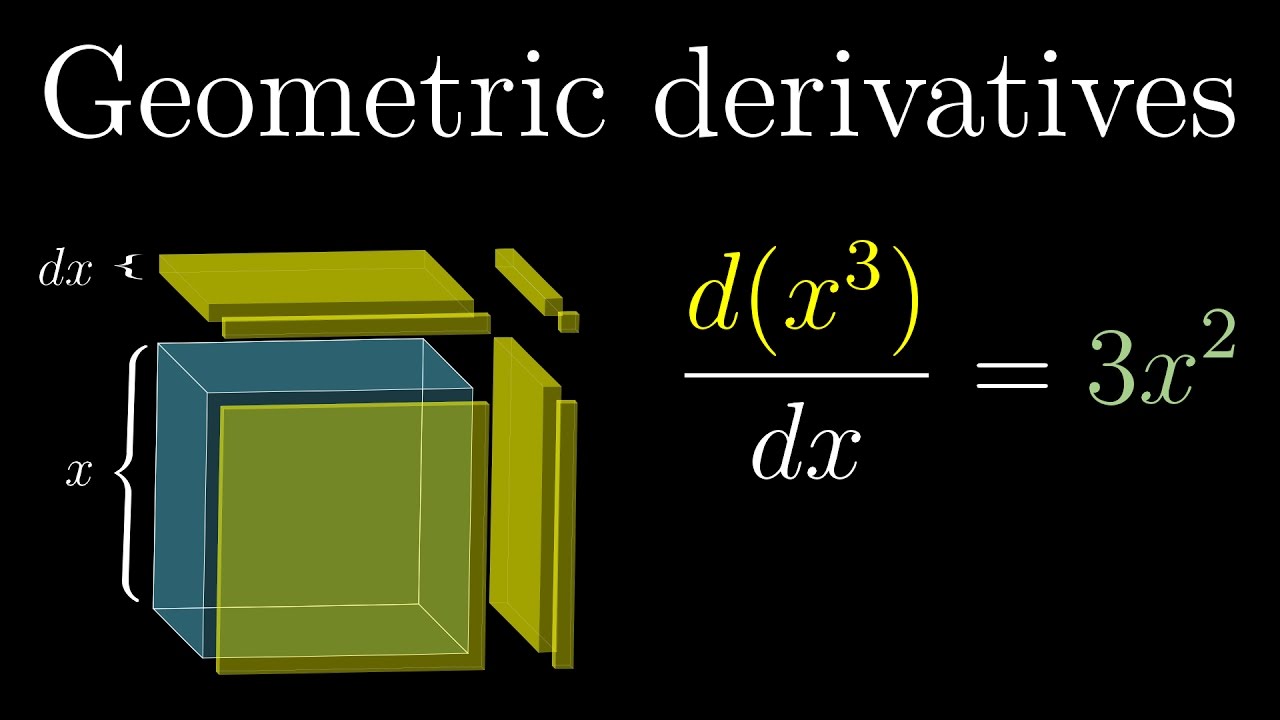
A few derivative formulas, such as the power rule and the derivative of sine, demonstrated with geometric intuition. Brought to you by you: http://3b1b.co/eo...
short sorrel
the area of a square is given by $A = \ell ^2$
obsidian monolithBOT
Namington:
short sorrel
if we let $x$ represent the length, this creates a natural relationship between area and $x^2$
obsidian monolithBOT
Namington:
short sorrel
do you have any more specific questions? as it's hard to tell quite what you're asking
paper wolf
I guess what I'm asking is, could x be visualized as two sides of the square? What can x be visualized as?
patent beacon
@paper wolf
x is x. Geometrically, you can think of it as a line with a length. x is the length of that line
x² is then the square with side length x
The video is getting at the idea that if you increase x by a small amount, then x² increases by 2x as much
paper wolf
I get everything it says in the video, but I feel like there is one thing that's not clicking.
and I don't know what.
patent beacon
Perhaps skip the video.
I feel 3b1b made the series for people already experienced with calc
So do everything else and go back if you need
 karmic topaz
uhh, dont visualize the derivative of x^2 with a square
just use the graph
patent beacon
I kinda agree lol.
I don't like to go against the great 3b1b but this isn't the best way to understand a rate of change lol
 native sequoia
3b1b made me visualise vectors in 3d but it made me kinda skip the proofs of vectors in any finite dimension idk
patent beacon
There's a place for formality and for intuition. I'm glad 3b1b shoots for intuition when many don't - but it skips formality completely and it causes some issues
native sequoia
ye, intuition should aid in constructing the formality
spring thunder
cuz there's a c in your name
 charred hull
oh tru
if x = sin(t) and y = cos(t)
just think of the graph of the unit circle
@cedar blaze
also don't ping me directly
charred hull
read #❓how-to-get-help
if you aren't willing to read rules and adhere to some basic etiquette i'm unwilling to help
 noble halo
hey so i started precalc last week and for one of the problems it says “use a special product to compute the product”
what does it mean by use special product ?
pale kettle
Post the whole question
willow bear

noble halo
willow bear
,rotate -90
obsidian monolithBOT
willow bear
ok it looks like "special product" refers to one of a class of basic algebraic identities such as difference of two squares
wraith idol
btw I really don't like the fact that they used f as a variable...
willow bear
yes
noble halo
t h a n k
 slender river
i found this derivation of the inverse function for hyperbolic trig stuff
and they're using the quadratic formula but omitting the other solution that works ????????
wat
why
pale kettle
think
you have e^y on the left
what happens if you try to consider the negative solution
patent beacon
Important to realize, 2x - sqrt(4x² + 4) is always a negative number
slender river
right
yes
e^y is always positive
and the right hand side should as well
meaning no negative solution
this crossed my mind but
patent beacon
There has to be a functional inverse, since sinh is one-to-one
slender river
i think i screwed up on the algebra when i tested the negative solution
somewhere
hmm then for cosh's inverse it shouldnt matter for x geq 1
theeeeeunk
if i use the plus or minus in the solution
shrewd urchin
@cedar blaze sin^2x+cos^2x=1
 vague oxide
Hey guys! This is my first comment here but I had a question. I self studied Algebra 2 during the summer because i am doubling up on math next year and taking algebra 2 + precalc, but i self studied all of algebra 2 seeing as I needed the skills for precalc. I feel pretty comfortable on all the units and I am doing regents practice problem ( I live in NY). the only thing i have left is statistics. I dont know how other states work but there is a bit of statistics and probability taught at the end of algebra 2 here. Seeing as i will take algebra 2 anyway this year, will I need to know the statistics part for precalc or is my time better spent doing more review and doing work for other classes?
wraith idol
precalc doesn't require you to know stats
however
it's always good to know some things about statistics
like the very basics
 light jewel
Hey can someone help me work this out
vague oxide
Thanks for the response! Do you think I should just learn maybe basic probability or something else?
light jewel
 torn swift
sure would be nice to get rid of those fractions, what should we multiply all terms by to make that happen?
light jewel
X
torn swift
if you multiply by x you still have 5/x
torn swift
that will do the job for us then
torn swift
try to solve it then for a solution set
light jewel
Ok
torn swift
quick check is: is the discriminant positive or nagative?
light jewel
Negative
light jewel
It was negative
obsidian monolithBOT
 Requested by Sigma#3822
 harsh cipher
If you want to become good at problems such as
I have 14000 points today and it increased by 75% since last week. How many points did I have?
What topics or course should I take to improve at these sort of problems?
obsidian monolithBOT
Namington:
short sorrel
your current point amount (14000) is 75% more (1.75 times) the point amount of last week (x)
solve for x
harsh cipher
thanks i got it now
shrewd urchin
Show that the following four conditions are equivalent :
(i) A ⊂ B(ii) A – B = φ (iii) A ∪ B = B (iv) A ∩ B = A
How do i prove iii and i are equivalent
pale kettle
Well first of all
shrewd urchin
I mean what is there to proof
pale kettle
when you're doing these types of problems, you can often make them shorter
Show that (i) implies (ii), then (ii) implies (iii), then (iii) implies (iv), then (iv) implies (i)
Doing all four of these shows that anyone of them implies any other
So all the statements are equivalent
pale kettle
Well depends what you've done already
shrewd urchin
By definition of subset , $A \subset B$ means that if$ x \in A$ then $x \in B$
obsidian monolithBOT
Krishna:
shrewd urchin
By definition of subtraction of sets ,$A-B={x|x\in A$ and $ x\not\in B}$ is equivalent of saying that there doesn't exist x such that $x\in A$ then $x \not\in B$. This is same as saying that if $x \in A$ then $x \in B $
obsidian monolithBOT
Krishna:
shrewd urchin
By definition of Union $ A \cup B ={x|x \in A$ or $x \in B}$ and we know that $A \cup B=B$ this clearly implies that all elemnts of A are contained in B or $A \subset B $
obsidian monolithBOT
Krishna:
shrewd urchin
By definition of Intersection, $ A \cap B={x|x \in A$ and $x \in B}$ this clearly implies that all elemts of A are contained in B or $ A \subset B $
obsidian monolithBOT
Krishna:
shrewd urchin
<@&286206848099549185> is this correct
willow bear
what exactly are you proving rn
short sorrel
quote: \ \ \$A-B={x|x\in A$ and $ x\not\in B}$ is equivalent of saying that there doesn't exist x such that $x\in A$ then $x \not\in B$. This is same as saying that if $x \in A$ then $x \in B $ \ \ \ none of these statements are true
obsidian monolithBOT
Namington:
shrewd urchin

short sorrel
first off:
there doesn't exist x in A - B
and I dont understand how the second sentence follows at all
your reasoning seems to be correct, but your "path" is totally off
I'd rephrase this as:
$A - B = \varnothing$ means that there is no element $x$ such that $x \in A$ and $x \not \in B$. Therefore, $x \in A \implies x \in B$.
obsidian monolithBOT
Namington:
short sorrel
your "proof" never explicitly mentions the fact that A - B = emptyset
which is sort of, like, the whole reason it holds
(also, wait 15 minutes before pinging helpers please)
wraith idol
$A-B=\varnothing\implies A=B$
obsidian monolithBOT
Whoever:
wraith idol
that would be interesting
short sorrel
?
wraith idol
i'm just saying if this is true then it's pretty interesting
short sorrel
no, but $A - B = \varnothing \implies A \subseteq B$
obsidian monolithBOT
Namington:
short sorrel
yes
shrewd urchin
if $A-B=\varnothing$ then this clearly implies that there is no x for which $x \in A$ and $x \not\in B $ this means that if $x \in A $ then $x \in B$ or $A \subset B $
obsidian monolithBOT
Krishna:
shrewd urchin
@wraith idol is this correct
wraith idol
clearly implies
i don't think that's enough
you can't just say clearly implies in this case
you can derive a contradiction if x is in A but not in B
shrewd urchin
😩
So i should write that if lets assume that x in A and x in not in B and then say we reached a contradiction and write..
wraith idol
you need to specify what contradicts
like what can you deduce that's contradicting with our assumption
shrewd urchin
Ok
$x \in A$ so, $x\in A \cup B \therefore x \in B$ as $(A \cup B=B)$ this implies that if $x \in A $ then $x \in B$ or $A \subset B$
newtons testicle is this correct ?
pale kettle
Lmao
charred hull
lmao
wraith idol

obsidian monolithBOT
Krishna:
shrewd urchin
I am showing $A \cup B=B \implies A \subset B $
obsidian monolithBOT
Krishna:
shrewd urchin
enough of this
wraith idol
um
shrewd urchin
I am going to check
wraith idol
is this hw for you
shrewd urchin
solution mnaul
wraith idol
lol haha
wraith idol
Assume $x\in A$. If $x\notin B$ then $x\in A-B$, a contradiction. Therefore $x\in B$ and $A\subseteq B$.
obsidian monolithBOT
Whoever:
wraith idol
lol
shrewd urchin
I will learn proof in 6 chapter and this is chp 1
Anyways thanks newtons testicale

wraith idol

shrewd urchin

shrewd urchin


 grizzled orchid
lmao
heady jewel
im gonna assume its iSSac newtons right testicle
shrewd urchin
🤔
viscid thistle
Can anyone explain this to me?
I don't quite understand the second one
The pattern 2, 4, 8, 16, ... is not only increasing, but increasing where the rate of increase keeps getting faster (that is, it is constantly accelerating). So the general shape between two points is a curve that "dips" to the lower right:
like what is going on??
the straight line??
short sorrel
the straight line is just a direct straight line between two known values: log_2(8) = 3 and log_2(16) = 4
12 is right in the middle of 8 and 16, right?
so it's asking, based on the behaviour of logarithm
will log_2(12) be in the exact middle between 3 and 4 (3.5)
less than that
or more than that?
when we draw a exponential curve, and compare it to just a straight line
we see that the exponential curve is "below" the straight line
so in order to reach the halfway point, 12
we actually have to be past 3.5
honestly, though, i'm suspicious how much the visual aid helps for this one; feels like its just adding some confusion to talk about logs and plot the related exponential
I'd just draw the shape of a logarithmic graph and interpolate from there
viscid thistle
oh
shrewd urchin
sets proofs are so confusing
native sequoia
||hm t is pretty far away from x, muscle memory?||
shrewd urchin
Autocorrect sucks
shrewd urchin
Sometimes you people make me feel like i should turn off my autocorrect tool and sometimes you people make me feel like i should turn on autocorrect tool.
tame wedge
Can I simplify e^(ln(a)*b) to a^b?
Since e^lna=a but the exponent b just floats there still?
 stuck lark
b is the coefficient of ln(a), you can turn that into ln(a^b)
willow bear
$e^{\ln(a) \cdot b} = (e^{\ln(a)})^b$
obsidian monolithBOT
Ann:
tame wedge
Thanks guys makes perfect sense 😃
noble halo
ok so i’ve been trying to simplify this and i did something wrong along the way i color coded everything to make it easier for u guys to understand
stuck lark
,rotate -90
noble halo
blue is the problem that I’m doing
obsidian monolithBOT
noble halo
green are the answers provided
heady jewel
surely precalculus
noble halo
i don’t really know what i did wrong i feel like i made it hard to read
my answer was x^5/2 y^4
or is there any other easier way to do it like faster?
willow bear
there doesn't seem to be anything wrong here to me
are you sure you copied the problem correctly @noble halo
noble halo
yes i’m positive
willow bear
here, i'll even throw the problem into WA for you
,w simplify cbrt(x^2 y^4) * cbrt(xy^2) * sqrt(x^3 y^4)
...what the fuck
noble halo
bruh moment
 obsidian monolithBOT
Ann:
noble halo
yeah i see it thanks
is my teacher o k
alright so this next problem i have no idea how to start i’ve always had trouble w sqr roots
how would i start this ?
also the letters are h’s not n
short sorrel
Do you know what it means by "rationalize"?
noble halo
i never payed attention to any of the mathematical terms so sadly no
short sorrel
Well, answering a question without even knowing what it's asking is pretty difficult
To "rationalize" means to get rid of the irrational numbers
noble halo
yeap
short sorrel
In this case, those are the radicals
noble halo
oh the radicals yeah
short sorrel
So you need to get the radicals out of the numerator
noble halo
can’t you do that thing where you put the 1 on the numerator
short sorrel
Now, you probably know that when you square a square root, it "cancels out"
noble halo
don’t worry lol just keep going
short sorrel
$\sqrt{5+h}-\sqrt{5}$
obsidian monolithBOT
Namington:
short sorrel
Now, knowing what I said about
SquAring a square root gets rid of it
Let's try to square the numerator
noble halo
when you square the first one would it be just 5+h or 5+h^2
short sorrel
$(\sqrt{5+h}-\sqrt{5})^2 = (5+h) - 2\sqrt{5(5+h)} + 10$
obsidian monolithBOT
Namington:
short sorrel
"FOIL it" so to speak
noble halo
ok
short sorrel
Now, this didn't quite work
As we can see
The first andthe last term have no radicals anymore
So that's nice
But the middle term is now a radical
noble halo
so square that
short sorrel
Do you know how we can get rid of this middle term?
We can't just square individual pieces
Because whatever we multiply the numerator by
We have to do the same to the denominator
noble halo
ok ok
short sorrel
So we can't just multiply ONE PART of the numerator
It's all or nothing
Instead, we can look back at our original numerator
$\sqrt{5+h}-\sqrt{5}$
obsidian monolithBOT
Namington:
short sorrel
The problem with squaring it is that, when we "FOILed/distributed" it
We got middle terms
Are you familiar with how to factor, say
noble halo
yes i am
short sorrel
$a^2 - b^2$
obsidian monolithBOT
Namington:
short sorrel
You'll note that this is the form we want:
a and b were squared
But we have no middle terms
And this factors into (a+b)(a-b)
So let's try to apply that to $\sqrt{5+h}-\sqrt{5}$
obsidian monolithBOT
Namington:
short sorrel
If this is our a-b
Let's multiply it by a+b
IE "flip the sign"
Or "multiply by the conjugate"
short sorrel
$(\sqrt{5 + h} - \sqrt{5})(\sqrt{5+h}+\sqrt{5})$
obsidian monolithBOT
Namington:
short sorrel
If we expand this out and simplify
short sorrel
We get $5 + h - 5$
obsidian monolithBOT
Namington:
short sorrel
For the numerator
And yeah, whatever we multiply the numerator by
We have to multiply the denominator by
So we have
noble halo
ok ok
short sorrel
$\frac{\sqrt{5+h}-\sqrt{5}}{h} \cdot \frac{\sqrt{5 + h}+\sqrt{5}}{\sqrt{5+h}+\sqrt{5}}$
obsidian monolithBOT
Namington:
short sorrel
There we go
Now multiply and simplify
This works in general, btw
That long explanation was to explain "where it comes from"
But the "technique" for ANY binomial you want to rationalize
With square roots
Is to multiply by the conjugate
shrewd urchin
nmngtn*
viscid thistle
@noble halo isn’t that funny
Same with some Instructors on YT. So much better than any teacher I’ve ever had
shrewd urchin
Lol
 twilit shadow
Hey, I need a bit of help. I've been stuck on this one problem for probably almost half an hour. I'm doing stuff with matrices in school. I have to solve for the intersection of 3x+5y=7 and 2x-5y=-8 using matrices. I got some crazy fractions and when I checked my work it wasn't right. I just need some halp.
nevermind I'm good
sorry
shrewd urchin
Just use cramers rule

 shrewd urchin
He told he has to use matrices
torn swift
You can use elimination with a matrix setup as well
 full goblet
How does one solve this?
viscid thistle
So the point (0,3) is below (2,4) so we know the parabola opens which way?
@languid dust
The vertex form of a parabola is written
y= a(x-h)^2+k
we know h,k = (2,4) lets fill that in
y=a(x-2)^2+4
viscid thistle
with the point (0,3)
yes fren 
x=0 when y=3
3=a(0-2)^2+4
what is a?
gimme da number
 languid dust
1/4?
obsidian monolithBOT
 Requested by Babowwz#1394
viscid thistle
Requested by Babowwz#1394
viscid thistle
check for the point (0,3)
and vertex (2,4)
can confirm both by visual inspection and math proof
 gj fren
 spark cliff
I’m gonna put this in precalculus, because it’s honestly all calculator
Does this look correct?
All of the practices problems are basically this, and I wanna make sure i’m doing it right
stuck lark
looks good
spark cliff
so then how would i do 3 lmao
stuck lark
,rotate
obsidian monolithBOT
stuck lark
yes
stuck lark
,w (4.9(2.5)^2-4.9(2)^2)/.5
obsidian monolithBOT
 Requested by RokettoJanpu#6002
spark cliff
Requested by RokettoJanpu#6002
spark cliff
understandable
stuck lark
$v = 20\sqrt{T}$
obsidian monolithBOT
RokettoJanpu:
stuck lark
they're asking for dv/dT then plug in T = 300
stuck lark
I used leibniz derivative notation
spark cliff
oh
idk what that is
they’re legit just telling us plug and chug into the calculator
stuck lark
did you take the derivative of v with respect to T?
spark cliff
no?
stuck lark
oh... unless you're using a finite difference method for approximating dv/dT
spark cliff
yeah
like 80% sure that’s just what they’re teaching us
does .577 look right to you? lmao
stuck lark
i mean, i don't want to confirm that without knowing you did the right math to get it
spark cliff
can you not just look at the graph lol
stuck lark
i'm not going to use finite difference to approximate it, i'll just differentiate
,w differentiate 20sqrt(t) with respect to t
obsidian monolithBOT
Requested by RokettoJanpu#6002
stuck lark
,w 10/sqrt(300)
obsidian monolithBOT
Failed to get a response from Wolfram Alpha. If the problem persists, please contact support.
stuck lark
,w 10/sqrt(300)
obsidian monolithBOT
Requested by RokettoJanpu#6002
spark cliff
yay
Is the instantaneous rate of change the same at every point if it’s a linear equation?
karmic topaz
instantaneous rate of change
worst terminology
but yes
tangent slope is a better way to say it
spark cliff
that’s the way the textbook says it smh not my fault
full goblet
What would be the limit?
willow bear
well
if x approaches 3 from the left
then where will the corresponding point on the graph be?
i.e. which piece of the graph is the one you care about?
full goblet
the diagonal graph? maybe
I don't understand limits at all
This was my original answer but my teacher marked it wrong
willow bear
did the teacher just say "no, wrong" or did they have something else to say on the matter?
full goblet
She said that the question is asking for the limit as x approaches 3 from the right
willow bear
from the RIGHT? but the question says to find $\lim_{x \to 3^-} f(x)$.
obsidian monolithBOT
Ann:
willow bear
not $\lim_{x \to 3^+} f(x)$.
obsidian monolithBOT
Ann:
full goblet
yeah that threw me off an im stuck
full goblet
hmm
uncut mulch
was there more stuff below?
the question is worth 4 pts
full goblet
No there is a box to type the answer below it
 next willow
What do your classmates say on the matter?
full goblet
I havent gotten a chance to talk with them yet
willow bear
your answer is 1 and it is correct, idk why your teacher insists x -> 3^- means x approaches 3 from the right and not the left
full goblet
thats why I did not understand why my answer was marked wrong
next willow
When you'll get a chance, discuss this. If they experienced the same correction, the prof may adopt an incoherent notation, otherwise it's just an occasional mistake in the correction
full goblet
See the thing is I took this quiz twice and both times ive gotten the same problem marked wrong
full goblet
I guess i'll email my teacher about it
hahaha I need to pass the class so
gotta redo the tests I failed
I don't have a choice unfortunately
grizzled orchid
how is this even possible
how can a teacher be this brainlet
imagine teaching precalc and not knowing limits
next willow
Was it the only unexpected correction?
full goblet
yeah there are 10 points and she took away 4 from that question
next willow
What
grizzled orchid
@full goblet email your teacher and call them a brainlet
full goblet
I can't not until she posts my final grade
uncut mulch
srsly how is that a 4pt question...
grizzled orchid
because the teacher is a brainlet as we have established
full goblet
I don't want her to fuck up my grade
uncut mulch
its pretty much enough to just say that its 1 w/o explanation
full goblet
I did on the first quiz it was marked wrong
I tried again with an explanation still wrong
shrewd urchin
 clever swallow
this set is equal to = {-20, -15, -10, -5, 0, 5, 10, 15, 20}
viscid thistle
yes
uncut mulch
what was your method when doing a)?