#precalculus
1 messages · Page 156 of 1
 prisma prairie
thats why what @earnest nymph
 earnest nymph
That's why I the a^(3/6) term is so weird
earnest nymph
Yeah
prisma prairie
kk thanks
i wasted 3 hours
trying to solve this and compare it from the books answers
also @heady jewel is super high ego guy
made fun of me
earnest nymph
He's is still fine
earnest nymph
Actually to us indices is like high school level so it's weird to heard it from a guy who doing degree
earnest nymph
Btw,what degree you taking anyway?
earnest nymph
Ah
prisma prairie
dude im on summer break right now but practicing math everyday
earnest nymph
So have u take discrete math yet?
prisma prairie
so i wanna be better at math
 willow bear
discrete != discreet
earnest nymph
Oh sorry sorry
prisma prairie
yeah i finished discrete math it was really easy for me compared to calculus
my fav math course is discrete
earnest nymph
Nice
earnest nymph
Well good luck and hope you get better
earnest nymph
Erm... depends on the person
 torn swift
All depends on aptitude, dedication, and resources you use.
prisma prairie
true
earnest nymph
But don't pressure yourself if you took a longer time than others to master it
prisma prairie
yeah
true
i got all these books from the library that ive been using
idk this work book that im using right now has 2 mistakes so far
it sucks
earnest nymph
😂
prisma prairie
and i waste time trying to do em
and it never works out lol
so yeah
what grade are you in big good
or college
uni
and amphy too
torn swift
Khan academy is great to use as well
torn swift
3rd year Mech E
prisma prairie
nice
earnest nymph
I finish A level, waiting to enter uni to start my degree
prisma prairie
oh nice
good luck everyone
@earnest nymph why did you say not to make the negative exponents positvie btw?
in that question we were trying to do
earnest nymph
You gonna have fractions within fractions
It's better to use the indices law (a^m)(a^n) = a^(m+n) and (a^m)/(a^n) = a^(m-n) to solve this
prisma prairie
=tex \frac{\sqrt{a}\cdot \frac{1}{a^{\frac{2}{3}}}}{a^{\frac{3}{6}}}
 granite stirrupBOT
prisma prairie
granite stirrupBOT
prisma prairie
=tex \frac{\frac{\sqrt{a}}{a^{\frac{2}{3}}}}{a^{\frac{3}{6}}}
granite stirrupBOT
earnest nymph
Yes
prisma prairie
ok
 clever swallow
Odd functions multiplying with each other always turns into a even function right?
earnest nymph
Yes
clever swallow
If I write formal proof on it.
Would It be reasonable to say the exponents are always even therefore the functions are even?
earnest nymph
What the actual question?
willow bear
@clever swallow no
you should use the definitions of an odd function and an even function
 shrewd urchin
@willow bear I don't understand this
earnest nymph
Ah
shrewd urchin
I have to know this in order to suck less
earnest nymph
I think I can help
earnest nymph
Since v (given) and g is constant, the only way to change R is to change theta
And R will be max if sin(theta) is max
shrewd urchin
I just can't understand why sin sin20<=1
 grizzled orchid
,w plot sin x
 obsidian monolithBOT
 Requested by hegel#5301
grizzled orchid
Requested by hegel#5301
grizzled orchid
look at the peak of the sin wave
earnest nymph
^
shrewd urchin
It's 1 bruh
earnest nymph
sin(x) is always between -1 and 1
grizzled orchid

grizzled orchid
$\sin 2\theta$ is less than or equal to $1$ because that's a property of the sin function lol
obsidian monolithBOT
hegel:
shrewd urchin
Can a point be global and local max ?
grizzled orchid
yes
earnest nymph
Yeap
shrewd urchin
Ok
grizzled orchid
in fact that's a characteristic of all extrema of sin functions
unless you are working over an interval but
w/ever not important
shrewd urchin
Yeah I asked because it's local max over some intervals asswell
 primal karma
it's a hyperbola as well
willow bear
not quite
primal karma
what is happening to ann
primal karma
i am referring to her 1/2 1/4 and now 1/8 .__.
earnest nymph
Zeno Paradox?
primal karma
but where are the other 3/4s of ann , are they gone already and if not where do we store them, we're gonna need to store them for quite some time
shrewd urchin
IN the above they say {(x-1)(x+4)}/{x-3} is equivalent to (x-1)(x+4)(x-3)<0
How is this valid ?
shrewd urchin
Wot ?
I don't got u ?
I think it's a rypo
@willow bear can you read the solution and tell if it's correct
willow bear
the one you posted from your book?
shrewd urchin
Yes
willow bear
yes it is correct
shrewd urchin
How 🤔
willow bear
how what
i mean, starting from (x-1)(x-4)/(x-3) < 0, you can multiply both sides by (x-3)^2, a quantity which is positive for all x besides 3
the inequality is not defined for x=3 anyway
 willow bear
,rotate -90
obsidian monolithBOT
willow bear
ok, what is giving you trouble here @opaque shard
willow bear
what are a and b
 opaque shard
Coefficient of sin and cos
willow bear
...
what
what are you even talking about
$-\sqrt{a^2 + b^2} + \sqrt{a^2 + b^2}$ is just 0
obsidian monolithBOT
Ann:
willow bear
but this is not in the form $a \cos(\theta) + b \sin(\theta)$.
opaque shard
How to apply this in case of mod
obsidian monolithBOT
Ann:
willow bear
so what you sent does not apply.
willow bear
of this FUNCTION.
opaque shard
Yes
opaque shard
What's that
willow bear
Desmos.com
 torn swift
just use | | on your keyboard
primal karma
if you ever have a calculator without absolute values just use sqrt(x^2)
torn swift
you really need a calc for abs values? 
primal karma
no, if you have them inside a calulation and are too lazy to think
shrewd urchin
Lmao
primal karma
thinking is difficult it takes effort
shrewd urchin

 viscid thistle

 hard hornet
Recall your trig identities
 rough blaze
shouldn't shifting the point (-4,2) to (0,0) be the same as shifting the point (2,2) to (0,0)?
 limpid moss
yep, since it's a periodical function with a period of 6
rough blaze
I wrote a formula of shifting f(x) from (2,2) to (0,0) and it was marked wrong. What did I do wrong with the formula?
grizzled orchid
you may not have simplified
limpid moss
it's likely it resulted in something like cos(x+2pi)
where you can just cut the 2pi out
grizzled orchid
i see up there you wrote $\frac{\pi}{3} - \frac{2\pi}{3}$ rather than $-\frac{\pi}{3}$
wot
obsidian monolithBOT
hegel:
willow bear
you forgot the x, for one thing
limpid moss
oh yeah lol
torn swift
there is a minus sign I see that we can bring back into the log which will simplify the 1/2
$\log_{a}(b^{n})=n\log_{a}(b)$
obsidian monolithBOT
⚡Amphy⚡:
viscid thistle
so 1/2 would have the -1 as the exponent?
torn swift
yes
viscid thistle
okay
torn swift
and (1/2)^{-1} is?
viscid thistle
2
torn swift
good
viscid thistle
thanks
torn swift

viscid thistle
what does it mean by base e?
 limber bone
e^
viscid thistle
so e^7=16?
 obsidian monolithBOT
Tuong:
 native sequoia
tyson can u send a pic of more of the question?
torn swift
you need to use change of base formula
 frozen needle
that's something kinda important you should know about already
viscid thistle
i tried using natural log but answer turned out wrong
earnest nymph
Can you show your working?
earnest nymph
I don't know? Type it out?
torn swift
MS Paint
 wraith idol
Take a picture
willow bear
@viscid thistle do you have your working on a piece of paper or what
 rare galleon
If you understand the ln and e properties you can isolate t
 stoic quarry
i have no idea what to do v.v i plugged it into a calculator but all i got was this
stoic quarry
hi
 wind igloo
"To draw the graph plot all points corresponding to x-intercepts, minima and maxima within one cycle"...
shrewd urchin
I know that
So the time at which bib is 50% ahead of alice
Is
5t=1.5*3(t+20)
So t=180sexond
Seconds
Assume that the arthimetics is correct
shrewd urchin
frozen needle
$f(2x)=\frac 2{2+\frac 12\times(2x)}$ for all $x>0$
obsidian monolithBOT
Tuong:
frozen needle
I mean what I exactly wrote
viscid thistle
lol
shrewd urchin
2f(x)=4/2+x
viscid thistle
krishna, you're given f(2x), not f(x)
viscid thistle
so if $g(x) = 2x$ then $(f \circ g)(x) = \frac{2}{2 + \frac12 g(x)}$
obsidian monolithBOT
viscid thistle
because that's what we were given
shrewd urchin

 short sorrel
we know f(2x), he let 2x = g(x) and thus we know f(g(x))
this isnt really necessary intuition though
we can see
$f(2x) = \frac{2}{2 + x}$
obsidian monolithBOT
Namington:
short sorrel
and we're trying to figure out what f(x) was
the (2x) meant that, whenever we had an x in the original f(x)
we replaced it with 2x
so let's look for everywhere there's a 2x
$\frac{2}{2 + x}$ can be rewritten as $\frac{2}{2 + \frac{1}{2}\cdot 2x}$
obsidian monolithBOT
Namington:
short sorrel
so, $f(2x) = \frac{2}{2 + \frac12 \cdot 2x}$
obsidian monolithBOT
Namington:
short sorrel
as i said above, f(2x) is f(x) with all the x replaced with 2x
so let's go backwards
replacing the 2x with x
$f(x) = \frac{2}{2 + \frac{x}{2}}$
obsidian monolithBOT
Namington:
short sorrel
we can check our work by plugging in 2x and seeing that we get our original f(2x)
now, find 2f(x)
and we're done.
 rugged ice
I just need a quick refresher, when finding the coordinates of a negative angle, they are the same as the angle's positive, but flipped to the diagonal quadrant?
 vernal rapids
They are the same as the positive angle, but the y value if multiplied by -1
You are going down instead of going up
shrewd urchin
willow bear
$N := 10a + b; ; a, b \in { 0, 1, ..., 9} \
P(N) = ab \
S(N) = a + b$
obsidian monolithBOT
Ann-iversaire:
viscid thistle
fuck simon and fuck his favorite factoring trick
shrewd urchin

You can't disrespect that guy
Is the number 09
$ab+a+b=10a+b \implies -9a+ab=0 \implies a(-9+b)=0 \implies a=0 ,b=9$
obsidian monolithBOT
My homies are good at math:
willow bear
you meant a = 0 OR b = 9, ok
and a can't be 0 since that'd make the number single-digit
shrewd urchin
N IS 9
willow bear
no
viscid thistle
they asked for the unit digit of N, not N itself
willow bear
N can be 19, 29, 39, etc up to 99
but its units digit, which is what you were asked for, is 9
rugged ice
I know this is quite easy, but I've been working at it for some time and can't come up with an answer choice that's provided. Someone mind walking me through it?
rugged ice
I did
shrewd urchin
Show
rugged ice
shrewd urchin
tan=opposite side /adjacent side
rugged ice
I know how to solve it, I'm just not getting an answer that's provided
shrewd urchin
,w tan27°
obsidian monolithBOT
 Requested by My homies are good at math#4971
obsidian monolithBOT
Requested by My homies are good at math#4971
viscid thistle
Requested by My homies are good at math#4971
obsidian monolithBOT
Requested by My homies are good at math#4971
viscid thistle
lol
shrewd urchin
You are not overrated lol
viscid thistle
why does it say 191
viscid thistle
hm wait actually
shrewd urchin
That's the hint nunber
obsidian monolithBOT
viscid thistle
there
 spring thunder
oxide the lad
viscid thistle
lad
shrewd urchin
@rugged ice $24.8\approx24.5$
obsidian monolithBOT
My homies are good at math:
viscid thistle
shrewd urchin
How 🤔 😭
rugged ice
¯_(ツ)_/¯
obsidian monolithBOT
 Requested by Oxide#5973
viscid thistle
Requested by Oxide#5973
viscid thistle
@rugged ice 
rugged ice
im too exhausted to redo the assignment
sitting down and doing online work every day is killing me
viscid thistle
lol
spring thunder

rugged ice
hilarious
spring thunder
all these molecules being synthesised to make you move
shrewd urchin
Lmao
 problem is hard
It's hard it's very hard 😭
@viscid thistle cat how did you become so good at problem solving
viscid thistle
i did not
 karmic topaz
ok nerd
viscid thistle
@karmic topaz nerd
spring thunder
ok
 prisma marten

 rough hatch
$\csc^{2}(x) = \frac{1}{\sin^{2}(x)}$ and $\sin^{2}(x) + \cos^2(x) = 1$, so how come $\csc^{2}(x) \neq \frac{\sin^{2}(x) + \cos^{2}(x)}{\sin^{2}(x)}$
obsidian monolithBOT
Cirno:
rough hatch
am i having a retard moment?
oh yeah i am
thats just 1 + cot^2(x)
many such cases
shrewd urchin
The position of particle moving along the x-axis varies with time t according as $x=a\sin(\omega*t+\theta_0)$
Where $a,$ $\omega$ and $\theta_0$ are constant.($\omega$ is non zero )
Let $x_1$ and $x_2$ be the position of the particle at different time instants $t_1$ and $t_2$ respectively. Find $t_1-t_2$ if\
a)$x_1=x_2$ \
b)$x_1-x_2=2a$ \
The answer of a) and b) are $\frac{2k\pi}{\omega}$, k is an integer) and $\frac{(2t-1)\pi}{\omega}$ , t is an integer
obsidian monolithBOT
My homies are good at math:
shrewd urchin
You can only use unit circle to answer this question
viscid thistle
@shrewd urchin
f(5,2) = 19
i know, i solved it in front of you
viscid thistle
amazing
 spice cloud
Wassap
So my teacher just asked us to construct a graph for x^4-36y^2=0 and wolframalpha just pooped out a 3d graph
Halp
 pale kettle
probably because you left out the = 0 part
 heady jewel
lmao rip onion
heady jewel
youre in class?
spring thunder
yea rip onion
shrewd urchin
,w range of f(x)=3\sqrt{2x-7} -8
obsidian monolithBOT
Requested by My homies are good at math#4971
shrewd urchin
,w domain of f(x)=3\sqrt{2x-7} -8
obsidian monolithBOT
Requested by My homies are good at math#4971
 shrewd otter
Could anyone help me solve for x?
frozen needle
what's giving you trouble here ?
shrewd otter
im not very good with logs so im just getting confused
 royal gull
do you know properties of logarythms?
Like, what happens when you add or subtract them when they have the same base?
shrewd otter
ye sorry thats what i meant
royal gull
but you are dealing with a subtraction here
royal gull
$\log_a x + \log_a y = \log_a xy$
obsidian monolithBOT
dog:
royal gull
$\log_a x - \log_a y = \log_a \frac{x}{y}$
obsidian monolithBOT
dog:
royal gull
try to use this
 vernal anchor
well, why do you think that
shrewd urchin
Coz they have told that ♧ and ♡ is commutative and if they are commutative then ◇ has to be commutative @vernal anchor
y◇x=(y♧x)♡{x♧y} which is totally equivalent to x◇y
vernal anchor
exactly
 next willow
What if only heart was commutative?
It was a question to krishna ugh..
That's a pity
next willow
How a beautiful day
vernal anchor
im wondering why this question has a star next to it
spring thunder
cause it's * hard *
vernal anchor
in (a) star is a binary operation though
but ok
im currently taking some CS class and the prof is rating hw with chilis
spring thunder
(d) star Suppose...... = ?
vernal anchor
from 0-3 chilis
next willow
Mmh that's enigmatic
vernal anchor
(d) seems just as hard as the other questions though
spring thunder
rate the problems with mniip's heads
vernal anchor
it's just mind tricks on the students
it confused Krishna so much, he had to ask for confirmation
vernal anchor
does the star mean it's hard?
shrewd urchin
Yes @vernal anchor
But it wasn't hard at all
I was just confused why they gave * for such an easy problem
 eternal crown
I have an exercise and it's simply
x^2 -4xy +8y^2 +4x -4y +6 = 0
what kind of conic is this?
 wicked swan
@eternal crown wait i might take back what i said. im not sure whats going on with the -4xy term
eternal crown
yeeeees that's what's giving me trouble, I only know the kinda "simply" way
I saw some matrix were involved but I have no clue of how to use t hem
that's why I asked in linear algebra
wicked swan
do you have a screenshot or picture of this question?
eternal crown
it's in portuguese but it's what I said
the conics and degenerations are the alternatives
wicked swan
according to desmos it would be a unique point. hmm its not that obvious to me tho. You said the solution used matrices?
wicked swan
weird no idea how they came up with that. I think you could ask #linear-algebra if you want. You should probably add the given answer for context tho.
eternal crown
if only I had it
wicked swan
had what?
eternal crown
the answer
wicked swan
this is how they present it tho: https://cdn.discordapp.com/attachments/363224154469826562/598371510935224320/21857f15e486a1fc900c583afe2689b5e729a60d.png
post that
 rugged ice
I don't understand how I'm supposed to get a second answer here, can someone explain?
rugged ice
In the first and second quadrants
prisma marten
check again
rugged ice
Positive in what regard?
torn swift
Where the output of tan(x) is positive
There are two quadrants where that will happen
rugged ice
It's positive in the first and second quadrants on my graphing calculator
torn swift
What signs do cosine and sine have in quadrant 2?
rugged ice
I don’t know
torn swift
You know of the unit circle though? That is why I ask you to refer to that.
rugged ice
A bit I guess, but I still don't understand what I'm supposed to do.
torn swift
Do you know how x and y are related to cosine and sine on the unit circle?
torn swift
Yes
And now consider quadrant 2
What sign will x values have?
What sign will y values have?
rugged ice
X will be negative, Y will be positive
torn swift
Then tan will be positive or negative?
rugged ice
Negative?
torn swift
Remember that tan(x)=sin(x)/cos(x)
So the tan(x) will be negative in quadrant 2
So let’s look for when both x and y are negative, that will give a positive value for tangent
rugged ice
So quadrant 3
rugged ice
1 and 3
torn swift
Correct, very good
To get from an angle in quadrant 1 to quadrant 3 you add how many radians?
 patent beacon
I like to think of tanθ as the slope of the line between the origin and (x,y)
That is all
rugged ice
pi/2?
torn swift
not pi/2
rugged ice
or 2pi
torn swift
it will take more than pi/2
well try this
draw an angle in quadrant 1
and now extend the ray so that it is in quadrant three
rugged ice
I don't have graphing paper on me right now
torn swift
we can use wolfram to illustrate this then
let's take a 45 degree angle then
,w graph y=x from 0 to 1
obsidian monolithBOT
 Requested by ⚡Amphy⚡#0697
torn swift
Requested by ⚡Amphy⚡#0697
torn swift
that forms a 45 degree angle
and now to form that same angle in quadrant, I just mirror this line about the origin
,w graph y=x from -1 to 1
obsidian monolithBOT
Requested by ⚡Amphy⚡#0697
torn swift
so that is a 45 degree angle in quadrant 1 and quadrant 3
and how far apart are the angles from each other?
this line forms a ? angle
rugged ice
180 degrees
torn swift
which is how many radians?
rugged ice
pi
torn swift
very good
so you solve tan(x)=2.75 for x in radians I am assuming, and then to get a second answer you will do what?
rugged ice
Add pi
torn swift
yes, and can you tell me why you do that?
rugged ice
To find the value on the other end? I don't know.
torn swift
Can you explain to me again why there are two values for tan(x)=2.75 in the first place, and how to find the second value once you solve for the first value, which will be in quadrant 1 when you use a calculator to solve it
rugged ice
There are two values because of the unit circle, we find the second by adding pi, finding its other positive equivalent
torn swift
can you be more specific about the unit circle part
rugged ice
I don't think I can
torn swift
I mean we talked about just 10 or so minutes ago
you should review our convo to see why it was quadrant 1 and 3
rugged ice
It's on the equivalent place on the opposite half of the circle?
torn swift
I was looking for you to explain why tangent is positive in those two quadrants
rugged ice
Because both X and Y are positive in quadrant one, and they're both negative in quadrant three; resulting in positive answers
torn swift
very good
don't forget to say that on the unit circle, cos(x) is represented as the x coordinate, and sin(x) is the y coordinate
 quick dagger
i think this is a precalc q but how would i solve sin x = 1/2
i know the answer is 60 degrees bc i guess and checked but can someone teach me the official way
limpid moss
it depends on what you'd call the 'official way'
quick dagger
wait is it 60 degrees?
limpid moss
and yeah it's 30
quick dagger
can you teach me how to solve it
limpid moss
if you're not using calculus or anything like that to solve it, you'd use trigonometry
quick dagger
how so
limpid moss
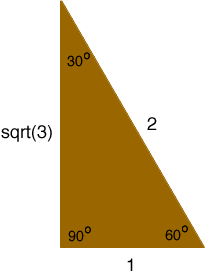
you'd draw a right triangle and make it such that according to the definition of a sine
the length of the hypotenuse and the non-adjacent side to the angle would have a ratio of 2:1
 limpid moss
yeah pretty much like that
quick dagger
what does the left side say?
limpid moss
anyways that's a special triangle, and you can duplicate the triangle and flip it over
that would make an equilateral, and since the angle we're looking for is the half of an angle of an equilateral, the angle is 30 degrees
you can use this geometric method only for special cases where the angle would be 30, 45, or 60
which is why you only memorise the sine for the three angles
quick dagger
is it 30 degrees bc the opposites of the shorter sides of the triangle is the smaller degrees?
 spark cliff
how do I do this word problem 😦
limpid moss
sorry, i don't know what you mean by tha
spark cliff
it is
quick dagger
@spark cliff so that should be enough evidence to solve it wouldnt it
quick dagger
hm
idt thats a precalc q tho
i think its geometry
i did that last year i forgot lol
 long pond
yes, it is a 45-45-90 triangle, so the legs are equal in magnitude
@quick dagger one thing to note is that that equation has more than one solution
limpid moss
yeah but that's only for people who think adding 2pi is a solution that isn't nominal
limpid moss
no, within the scope of a triangle's angles, or 0 to 180 degrees
limpid moss
there's only one solution for all trig functions
quick dagger
@limpid moss so its not 60? for sin x = 1.33
limpid moss
if you meant sin x = 1/1.33, then yeah there would be a different answer for that
long pond
you might think of it in words: what is the angle such that if you take it's sine, you obtain 1/2 @quick dagger
if you memorized your trig values, this should be easy
limpid moss
there's only like 3 of them anyways
limpid moss
who memorises angles other than 30 45 and 60
quick dagger
what trig values?
long pond
yeah
limpid moss
mostly until you start using calculators for trig functions
trigonometry will mostly be just another way to force you to do calculations you don't want to do
quick dagger
?
long pond
cos(60) = 1/2
quick dagger
ok
long pond
er
limpid moss
do you know the identity sin^2 + cos^2 = 1
long pond
sin(30) = 1/2
long pond
i learned this in alg 2
quick dagger
i didnt
long pond
oh
limpid moss
yeah i don't know what precalc
quick dagger
only graphing sine and cosine
spark cliff
same^
long pond
if i asked you what tan(45) is could you tell me?
quick dagger
no
quick dagger
why would u expect me to know i said i dont know nothing about this
its just in my ap physics packet for some reaosin
and i havent learned it yet
long pond
uh
yeah you will need more of an introduction to trig before you tackle problems like sin(x) = 1/2
try using khan academy or another website on your own time
quick dagger
kk
long pond
sorry computer is s l o w

Khan Academy
Learn for free about math, art, computer programming, economics, physics, chemistry, biology, medicine, finance, history, and more. Khan Academy is a nonprofit with the mission of providing a free, world-class education for anyone, anywhere.
tbh i'd start here
if you only have experience drawing sin and cosine waves
just click the first article
you can skip over smething if you already know it
quick dagger
@long pond and this will teach me how to solve sin x = 1/1.33?
long pond
well, eventually
long pond
if you can't tell me what basic trig values are, you will have to def. learn that
this is a streamlined and organised method
quick dagger
@long pond what is sin x = 1/1.33 question name ?
like what category does that q fall under
long pond
hold on, I may have to give you something else as well
Khan Academy
Learn for free about math, art, computer programming, economics, physics, chemistry, biology, medicine, finance, history, and more. Khan Academy is a nonprofit with the mission of providing a free, world-class education for anyone, anywhere.
this goes into how to solve trig equations
native sequoia
the category is using arcsin on calculator
long pond
but before you do this, you should be familiar with the basic trig function and what you can do with them
quick dagger
when i go into ap physics, would i have to learn trig?
@long pond bc if i am then ill spend a lot of time learning it now
if i dont have to learn then ill prob just not fully learn it
long pond
I can't imagine you wouldn't need to know trig in an upper level physics class
maybe not super in depth, but probably more than you know nw
now*
quick dagger
why would the teacher give us this q when we havent even taken precalc
i mean it is ap physics but like we didnt get a textbook
long pond
idk
quick dagger
@long pond she did give us a warning on the front page saying to watch videos and reearch unknown concepts
and that ill be tested on it when i go back to school
so i might as well learn trig then
long pond
yeah i would do that
 zealous sail
Should I remember all these circles? or should I be able to get these answers on my own
my trig knowledge is very minimal
this is a pre-calc class
What is expected of the student here?
patent beacon
@zealous sail
Memorize sin, cos, and tan of the special angles
For example, sin(5π/6) = 1/2, using that diagram
 quasi niche
The second part of the piece wise isn’t even right?
Because it’s negative if u replace x with a negative?
 blazing solar
Any idea how to solve this?
pale kettle
Well then keep thinking
blazing solar
ok
 serene heath

rare galleon
If a person is thinking for more than 30 minutes and he doesn’t have a solution yet help him.
pale kettle
@rare galleon hey I've been stuck on this research problem for two weeks, can you help me
prisma marten
been working on a solution to RH, any help?
rare galleon
@pale kettle way different mate, but good try.
viscid thistle
@pale kettle are you actually doing reu
shrewd urchin
I am doing
viscid thistle
you're not even an undergraduate
reu stands for research experience for undergraduates
now cease your trolling
 lyric burrow
oi boys

 tawny nacelle
oi not man ??
shrewd urchin
Soap you doing physik
tawny nacelle
yea
tawny nacelle

shrewd urchin
People who ask to ask must be banned
tawny nacelle
no ?
tawny nacelle
was that it ??
tawny nacelle
ok lets get to the real question then
shrewd urchin
Soap is physik hard ? For u
tawny nacelle
yea man
shrewd urchin
Ok let me imagine how hard it would be for me 
lyric burrow
brother
tawny nacelle
Khan Academy
Learn for free about math, art, computer programming, economics, physics, chemistry, biology, medicine, finance, history, and more. Khan Academy is a nonprofit with the mission of providing a free, world-class education for anyone, anywhere.
lyric burrow
yeh
shrewd urchin
Soap is it really hard or u joking
tawny nacelle
i learnt precalc from khan academy and look at me i can multiply two number like it nothing
😤
lyric burrow
😔
earnest nymph
Professor Leonard is always a good choice
 quasi forum
Hi
Can i have help with part (ii) please?
also i think this should be pre calc(?)
quasi forum
yep
but how does that explain if L is rational, therefore roots are rational?
is it since if L isn't rational, you can't form a perfect square?
shrewd urchin
 let me think
Yeah
If L is not rational then the roots are not rational true
$x=\frac{-b\pm \sqrt{b^2-4ac}}{2a}$
obsidian monolithBOT
Krishna:
shrewd urchin
If b is not rational then how will the roots be rational @quasi forum
I think the quadratic formula itself answers your question
spring thunder
well it's not hard to show L rational => rational roots
shrewd urchin
$x=\frac{-b}{2a} \pm \frac{\sqrt{b^2-4ac}}{2a}$
obsidian monolithBOT
Krishna:
spring thunder
the discriminant would just be $$L^2-4M = L^2-\frac 89 L^2 = \left(\frac 13 L\right)^2$$
obsidian monolithBOT
emeric75:
spring thunder
(using part one for the first equality)
ie discriminant is rational
so indeed roots are rational
quasi forum
so by proving L is rational, therefore roots are rational?
but isn't the question worded slightly differently?
spring thunder
i'm not sure if they want the equivalence or just the way i did
quasi forum
Like i get your reasoning
shrewd urchin
In which grade are you in
quasi forum
yea
obsidian monolithBOT
Krishna:
shrewd urchin
D is rational but roots aren't
Or that rules works only if a,b,c are rational number
quasi forum
D?
shrewd urchin
Discriminant
spring thunder
well we also know that L is rational in the q
quasi forum
oh wait
since we know L is rational
we can use discriminant
hence, roots are rational
^plus everything else i skipped on 😃
shrewd urchin
$x=\frac{-L\pm\sqrt{L^2-4M}}{2}$
obsidian monolithBOT
Krishna:
quasi forum
hm?
pale kettle
@viscid thistle I am actually doing reu?
heady jewel
@quasi forum did you learn vietas formulas yet?
 torn swift
Can you say anything about the two right triangles?
 sterile portal
they're similar triangles
torn swift
So you can use proportions to set up an expression that includes x then solve for x
sterile portal
would it just be x=(rt/h)-t?
torn swift
I didn’t work it out, no idea lol
sterile portal
oh but u start with r/x+t=h+t and then just solve for x
sterile portal
yea lol
torn swift
Ok you have the correct starting proportion
sterile portal
like one triangle equals the other cause theyre similar
torn swift
Will assume you did the algebra correct
sterile portal
ok thanks
torn swift
Then x is equal to what you got
sterile portal
yep
heady jewel
this is surely precalculus
serene heath
the point with the smaller x coordinate
wind igloo
The leftmost intersection will be the one with less positive x coordinate.
sterile portal
but how do I find that number?
I have the equation of the line and circle, i just don't know how to find the smallest x-coordinate without guess and check


 sterile portal
OH LMAO i was making them equal each other facepalm
i really went brain dead after exams
shrewd urchin
Guys
I got a real quick question
Mm
Can I skip ellipse and hyberbola and goto limits
It's for physics
shrewd urchin
Ok
heady jewel
conic help you at a better understanding and pure understanding of calc tho
i mean if you want to do it for the sake of problem solving
skip conics
shrewd urchin
I want to understand only for physics
I am doing first course on physics
It's a basic one but needs a little bit of calculus
If I need ellipse and hyper bola I will learn it later
heady jewel
like kinematics and other shi?
shrewd urchin
Yes
heady jewel
like newtons laws
shrewd urchin
Yup
heady jewel
ok then just study basic calc
its all you need
standard integration,derivatives and easy limits
shrewd urchin
Khan acamdey has a basic course in that
Like math for physics
Also I want to know basics of calculus
Because I will do some math after 2 months that need a little calculus .
heady jewel
while you learn the true meaning of derivative
you will have a lot of fun
its satisfaction know how shit goes on in very small places
shrewd urchin
Differential coefficient
heady jewel
whats that
heady jewel
oh ok
serene heath
I never bothered to learn comic sections
shrewd urchin
Hmm
serene heath
shrewd urchin
Even I am skipping it
shrewd urchin
Boi @heady jewel ? Are you there ?
https://www.khanacademy.org/science/in-in-class11th-physics/in-in-11th-physics-differentiation
Here is the course of basic calculus can you tell if this is enough for physics
Khan Academy
Learn for free about math, art, computer programming, economics, physics, chemistry, biology, medicine, finance, history, and more. Khan Academy is a nonprofit with the mission of providing a free, world-class education for anyone, anywhere.
This is the link .
 silk sequoia
how do you do this one?? i feel like theres something about angles here i dont know about that im missing 
torn swift
I have my vote on what the answer is
think carefully about those restrictions on the angles and the two relations you have
silk sequoia
ohhh wait
its like that thing where sin60 and sin 120 are equal
but cos60 and cos120 are not because one is negative
so it has to be C
right? 
torn swift
thinking it's that as well
 fringe stream
since theta is between 0 and pi/2, its sine and cosine are gonna be positive
so you can safely say phi is in the second quadrant
but how are you sure its pi - theta and not pi/2 + theta? theyre both in the second quadrant
torn swift
frick, I was stuck between the two as well
fringe stream
remember, one of those returns the same trig function
silk sequoia
??? but if you add 90 degrees to 60 degrees thats not 120
torn swift
He’s more or less asking you to justify which one it is
The above is one such justification, albeit numerical, though still valid.
Well it’s partly a justification, to complete the reasoning you have to show that sin(φ)=sin(θ) and
cos(φ)=-cos(θ) is correct when φ=π-θ, and incorrect if you choose π/2 + θ
torn swift
That’s fine
silk sequoia
ok im not exactly sure what im doing but ill give it a shot
since the first restriction says theta must be between 0 and 90 degrees, sin and cos both must be positive
but the second restriction says Φ is between 0 and 180 degrees, so while sin is positive, cos must be either positive or negative
looking at the top half of the unit circle, the coordinates are nearly the same on both sides if you look at similar angles like 30 vs 150
silk sequoia
ohhhh fuck
whoops
but they still need to be similar angles like 30 and 150 for the condition to be true
idk whats the real term for it
you cant get that "matching" degree by adding 90
is that how to explain it or am i missing something
 little lagoon
ool
shrewd otter
"Use the fundamental identities to write the first
expression in terms of the second." What do I do with the Quadrant VI part?
Quadrant IV* woops
viscid thistle
use the fact that sin and tan are negative for angles from that quadrant
and cos isn't
shrewd otter
sorry im still kinda confused on what to do with that information. Tan t would turn into sin t/cos t, and cos t would turn into the square root of 1=sin^2 right?
so it being in quadrant IV just means its positive?
patent beacon
cos(t) = √[1 - sin²(t)]
If in Q4
 autumn marsh
woo woo im teaching myself precalc this summer for the upcoming class
I have a question about constrictions of the unit circle. Is it just memorizing or is there logic behind why arctan, arccos, arcsin are constricted to lilke
tan quadrants I and IV
cosine I and II etc
idk if im asking this correctly either
royal gull
wut
if ure talkinga bout the sign or value then its clear from the graphs of the function
,w plot cosx
obsidian monolithBOT
 Requested by dog#3227
 river kindle
@autumn marsh there is logic to it. You can actually construct it by hand if you wanted to
autumn marsh
ill send a pic of my notes
and thats what i thought
I was trying to connect it with ASTC but it didnt make sense to me
river kindle
However this is math. Most of everything can be done via logic but memorization is faster
autumn marsh
the highlighted stuff
yeah very true XD
i feel like its simple and im overthinking it cuz i tend to do that and make it harder than it rlly is
river kindle
Study trig
autumn marsh
this is the very beginning of the stuff in the precalc thing im doing, do you think once i practice problems and go further into it ill understand better?
I was pretty solid with trig in alg II
river kindle
You dont have a good grasp of trig from what I seen already
willow bear
quadrant 6
 rigid beacon
Mainly the restrictions are because of when you graph the inverse it has to fit the vertical line test
autumn marsh
^ that actually registers in the brain
rigid beacon
There ya go then
autumn marsh
we didnt learn everything in trig @river kindle plus my teacher sucked so i went through hell tryna understand. We missed a lot of stuff for alg II in general but i got high 90s on all the tests for it
a lot of the stuff in precalc regarding trig is a lil different than what im used to seeing
rigid beacon
Khan Academy is the best self teaching source until you get to calculus imo
autumn marsh
thats what i be usin to take notes and what i used to fill in gaps by my teacher
rigid beacon
Use Khan to fill in the gaps
autumn marsh
he somehow is allowed to teach precalc honors and im glad im not taking it
hes horrible
autumn marsh
i have 5 missing test grades and i asked him to put them in and he said no
literally said nah
rigid beacon
We had a bio teacher so bad he got banned from teaching honors and AP
rigid beacon
And we had a physics teacher so bad he got banned from AP Physics
Yea he's allowed to teach, just only regular level classes
autumn marsh
thats icky
my alg teacher made people cry too, he aint the best but idk i feel bad for him too sometimes
we had a sub for like a month and she taught the class for 15 years before he had
loved her, very enthusiastic and loved what she was teaching, also rlly strict and on topic
my style of teacher precisely
river kindle
@autumn marsh my algebra teacher threw a desk across the room into a wall once. In either case, my comment was judt me saying get a trig textbook or cheaper or free alternative to brush up on it
Algrebra only scratches the surface
That is what i am doing at least for college precalc
autumn marsh
mmk i was just saying im good at alg II trig XD and ill look for some textbooks
patent beacon
Gotta bring that exponent down first; know how to go about that?
 thick star
how do i do that?
patent beacon
Log both sides