#precalculus
1 messages · Page 154 of 1
 deft crow
 viscid thistle
@civic plaza Being taught things before knowing what they mean is bad, that kills learning.
It's pedagogically harmful
It's teaching students to rely on formulae instead of reasoning and intuition
 civic plaza
You're suggesting teaching the cross product by formula though
Why not just teach them how to compute it and in later class when they learn it correctly they'll see it not for the first time
 proud raven
ill look up determinants
i think i can memorize how to do it at least
well sort of
does that mean vectors of different sizes dont have cross products
like if you have 2 4d vectors
civic plaza
Bring taught before knowing in some instances is gonna be necessary because like I said, I was taught in mechanics because you use the cross product in that class fairly frequently
proud raven
or you just do something to split them into smaller vectors
 willow bear
cross product is specific to R^3 yes
proud raven
🤔
willow bear
spaces of other dimensions just don't have it
proud raven
my first homework set is doing cross product of 2 dimensional vectors
maybe its just intuitive
the first one is like cross product ihat jhat
oh but 2d vector cross product exists
just not in 2 dimensions
 echo plaza
I mean if you "try" it in 2d you'd just get a scalar
proud raven
oh its literally just sin 90
echo plaza
and I don't know of any use for the 2 dimensional one
echo plaza
you can't get a vector because you're stuck in R² and the vector would need to be perpendicular to both of them
proud raven
so theres no actual answer to this question but just an intuitive one
i can live with that 😄
viscid thistle
Knowing how to compute something that you don't understand is useless information that will confuse
@civic plaza
If you're mentioning the word "determinant" to students who have taken linear algebra in relation to the cross product, then they'll know how to use relevant theorems to determinants to help them solve problems
If you're working with students who haven't, then the word "determinant" is absolutely meaningless to them, just as meaningless as a simpler formula would be
civic plaza
Meaningless is an exaggeration.
Plenty of people do fine learning to compute the determinant in other classes before being formally introduced in a linear algebra class.
I used the cross product in three classes before taking linear algebra and I turned out okay.
I don't quite understand what the argument is really
 bright oak
Actually, I strongly disagree with the idea that you can compute something without understanding it, and that is a bad thing... not in all cases
In fact, it can be a great learning tool, to use some magic formula to get the right answer, and then figure out why the magic formula works. Has happened to me plenty of times, I learned a lot after I got the answer, and then backtracked, figured out what's going on. Far more useful than just having an empty paper.
proud raven
20 minutes into another lecture i realized the point of the exercise was to show that a cross b doesnt equal b cross a
this is gonna sound misguided
is the cross product just something that happens to give useful results or is it a meaningful/intuitive operation on its own
 timber plinth
it's useful and is meaningful
 autumn sonnet
Is the correct way to solve log_(1/2)(log_(2)((1+2x)/(1+x))) > 0 to make both sides the exponent of 1/2? That way I got a solution but I'm not sure if it's correct
 lyric girder
Pardon me if this doesn't belong here, but does anyone have any recommendations besides Khan Academy for an adult trying to re-learn Algebra and then learn pre-calc + Calc 1? I think I'm in the minority here, but I can't stand Khan Academy's UX and content organization.
If anyone has any book or other resource information I'll gratefully check it out. I'm considering signing up for the ThinkWell course at some point.
 limber bone
dms
proud raven
@lyric girder you're not alone, i hate it too
if the question asks first whats the cross product
which i found, and then asks to confirm they are orthogonal
is there something special about the resultant vector that lets just the dot product work
or is that just the fact that the dot product can confirm if any two vectors or orthogonal
actually scratch all that i just realized how stupid that question is 😄
@lyric girder I told someone else that theres a book in #books-old that is listed as suggested for someone teaching themselves calculus
Calculus for the Practical Man (James Edgar Thompson)
Requires basic algebra, trigonometry
“A great book to learn calculus on your own.”
proud raven
 torn swift
multivar channel would work better
 turbid bear
I have 3 questions regarding polynomials.
What is the actual point or goal of polynomials?
This question was sparked by my more detail-specific questions:
1. Allow division by a variable/indeterminate
2. Allow negative exponents/degrees of variables/indeterminates
These 2 rules seem arbitrary, but I suppose everything seems arbitrary if you don't understand the point of what you're doing.
willow bear
if you allowed negative exponents or division by the indeterminate you'd lose the guarantee that the polynomial can be evaluated at any point
and well... polynomials are basically abstractions of expressions that you can form with addition, subtraction and multiplication only
turbid bear
That definitely makes more sense now thank you
viscid thistle
hi I'm looking for precalculus textbook reccommendations.. one with less applications and more deep intuituve understanding and rigor
 limber onyx
coolmath.com has a lot of precalc
Precalculus review and Calculus preview - Shows Precalculus math in the exact way you'll use it for Calculus - Also gives a preview to many Calculus concepts.
 hearty ether
lmao ive known about cool math games for like 10 years and never once considered there was an actual maths component on the site
limber onyx
Yep
viscid thistle
That's an interesting site gotta admit. It can be supplmentary with a good textbook besides it
And I actually never thought it did too @hearty ether
hearty ether
lmao
limber onyx
Probably you want a real answer
Why do you guys know coolmath games though
I know it’s popular for its games
hearty ether
idk
limber onyx
But I didn’t know it’s that popular across the nation
viscid thistle
I've seen my friends play on there once in a while when they're bored
limber onyx
The website also has real math games as well
Although the owner Coolmath Karen considers all games good for critical thinking iirc
I think I read literally everything on the website, including its financial advice
No joke
No joke that’s where half of the self taught in my username comes from
limber onyx
Yeah
btw, this is coolmathgames description from the owner: This is our brain-training site, for everyone, where logic & thinking meet fun & games. These games have no violence, no empty action, just a lot of challenges that will make you forget you're getting a mental workout!
You may not be doing math
But the games are often puzzles over action
They really are “math” games
In a loose sense
viscid thistle
These really excercise your brain for more mathematical thinking. I'm thinking of using a lot more now from that description
limber onyx
Maybe I should write a joke paper on the mathematics of puzzle flash games
I over analyze the mechanics, etc
But yeah, they have straight prealgebra too, although less known
I suspect the website is so popular because its unblocked on several school firewalls
And therefore people think the math is a facade
But it actually isn’t
viscid thistle
I would gladly enjoy that paper. Yeah schools usually allow puzzle games to make it more a fun way to learn for younger students. I have the same opinion on that as well.. math has a more beautiful aspect if you look deeper into it. The way they teach math now in schools isn't enjoyable which makes students forget the true beauty of math
limber onyx
Unfortunately puzzle skills don’t really translate over to traditional math
So it is a bit silly to call them math games
At least usually
You won’t learn factorization from 2048
viscid thistle
I'll call them puzzle skills for now
 kind pier
I have no idea where to begin for these two questions
timber plinth
You want it to be that H(x) = f(g(x))
So, your answer was wrong because you did f(x) = sqrt(9), which is the constant function
instead, you might what something that isn't constant @kind pier
kind pier
root of x is not a constant
timber plinth
but sqrt(9) is
and f(g(x)) is constant if either f(x) or g(x) is
which i leave to you to figure out why
kind pier
so algebraically I want to functions to multiply together to get H(x)?
timber plinth
no
f(x) is a function, so you want f(g(x)) = H(x)
it's not multiplication, it's composition
$(f \circ g)(x) = f(g(x))$
kind pier
9+x?
 obsidian monolithBOT
Darkrifts:
kind pier
under the square root
kind pier
its not actual homework
its infinite attempts practice
that didnt work though. I was thinking the parent function was square root of 9 + x and the other function was just the root of x
oh wait it did work nvm
timber plinth
nice
timber plinth
Also emil, f and g aren't unique
there's more than 1 way to get it (even if you throw out the identity)
kind pier
I was thinking like graph transformations from what you said
the parent is always x by itself with the constants
and then whatever is on the x directly is the other function
timber plinth
I'm not sure that's the best interpretation, but i'm no teacher
You could also directly replace the occurrences of x with the function g(x) too
kind pier
this is work from like something we skipped and if you wanna learn it on your own you can hahaa so I got no notes
timber plinth
nice
So, that's "composition of functions"
It's rather nice, especially the decomposition, but they're obviously not exactly uniquely able to be decomposed, so that's a thing
it's basically take f after you take g
kind pier
so would |6-x^3| , x^2 have been right also?
timber plinth
@kind pier no that would be x^6 in the middle
viscid thistle
becuase the other's change the conic, since they only have A or C so it would be a parabola
torn swift
Pablo from the Backyardagains 
 royal aspen
just post the question
 wary plover
this problem is simple but I cant for the life of me remember quite what the idea is
is it E?
 short sorrel
helps to draw a diagram first
this is how i'd interpret the question
the ramp being 210 ft long probably means the length you walk on
is 210 feet
so now, recall SOH CAH TOA
here, the angle with the ground is in the bottom-left
so the two sides we know are
the opposite
and the hypotenuse
follow so far?
as a result, we use the trig ratio with O and H
that happens to be SOH, for sine
so we have:
$\sin \theta = \frac{\text{opposite}}{\text{hypotenuse}}$
wary plover
that's what I figured
short sorrel
er
obsidian monolithBOT
Namington:
short sorrel
typo sorry
wary plover
im fine at trig idk why I couldnt remember how to do that
short sorrel
anyway, now we need to solve for theta
currently
theta has this nasty sine acting on it
to get rid of sine
we take the inverse sine
$\sin (\sin^{-1} (x)) = x$, after all
obsidian monolithBOT
Namington:
short sorrel
so it "cancels" so to speak
(This is technically domain-dependent but dont worry about it)
but of course, what we do to one side
we have to do to the ohter
so take the inverse sine of both sides
and we get
$\sin \theta = \frac{31}{210} \
\implies \sin^{-1} (\sin\theta) = \sin^{-1} \left(\frac{31}{210}\right) \
\implies \theta = \sin^{-1} \left(\frac{31}{210}\right)$
obsidian monolithBOT
Namington:
wary plover
cool, thanks
kind pier
if they are asking me to just interpret functions and sketch graphs without plugging in random numbers
is it easier to just see what a polynomial looks like when its (x+2)^2 - 3
or should I foil it out to see whats happening easier?
I also don't understand the impact of what the 4x does do the graph..
short sorrel
Vertex form is generally the easiest quadratic to graph
For a quadratic in the form
a(b(x-c))^2 + d
The vertex is at (c,d)
And the rest can be graphed according to a horizontal stretch (1/b) and vertical stretch (a)
Expanding a polynomial into ux^2 + vx + w tends to make it trickier to graph, as it's hard to get an intuition for what the first couple terms mean
Factored form: a(x-p)(x-q) also tends to be fairly easy to graph [at least for polynomials with real roots], as the roots are at (p,0) and (q,0), and the vertex is just in the middle of those roots and stretched by the a value
In your case, (x+2)^2 - 3 indicates that the polynomial's vertex is at
(-2, -3)
Note that the sign of the term inside the bracket is flipped, but the one outside is preserved
And, because the a and b values are just 1, the graph is shaped like your standard y=x^2
Just moved over to the new vertex (-2, -3)
So this one is quite easy to graph in vertex form, but potentially much more difficult as an expanded polynomial
@kind pier
kind pier
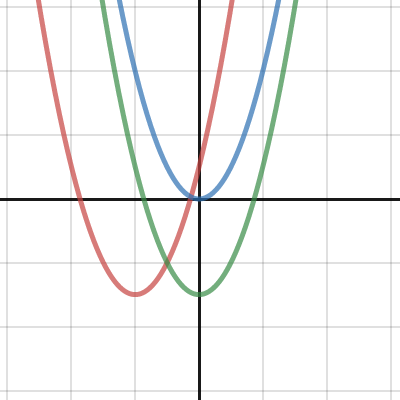
Desmos Graphing Calculator
is that still x^2? it looks like it is, but down 3 and shifted to the left 3
maybe it's wider though
short sorrel
Its still x^2, just translated.
 delicate sequoia
hey what it would be the arithmetic sequence of 1,0,-1,0
torn swift
correct
you plugged in g(x) where ever you saw an x in f(x)
now just have to expand and simplify
 native sequoia
you can write $3^{-7x+5}$ as $3^5\cdot(3^x)^{-7}$
obsidian monolithBOT
EpicGuy4227:
 warm prawn
Answer 'e', maybe?
wary plover
how does that help me
torn swift
you can substitute in what 3^x is
warm prawn
I wrote X as log3(2) 🤷
torn swift
that's one way, but it was easier to manipulate the expression
 modest cobalt
I just don't get it, the software wasn't very helpful
viscid thistle
I’m taking precal H next year, any suggestions on what to review/learn?
timber plinth
precal
viscid thistle
I heard the first topic is limits and continuity but that’s it
 glacial island
quadratics, forumlas, polynomials
timber plinth
Uh, in that case
learn what a limit means, and a bit of the stuff about them
Make sure you know the stuff from prerequisite courses ofc
viscid thistle
Will I be doing integrals this year?
timber plinth
idk
viscid thistle
Doesn’t derivative come first
timber plinth
typically, since it's a more "fundamental" concept maybe?
viscid thistle
Oh
timber plinth
idk, it's certainly simpler for more people to get at least
Definitely typically taught first
viscid thistle
1 more thing, will I need to know trig stuff(unit circle, identities, etc)
timber plinth
You know, idk about the fundamental part really, but it's more simply interpreted with prior knowledge
and yes ofc
viscid thistle
Do you expand on the stuff from precal
viscid thistle
True
timber plinth
But uh
$\lim_{x\to x_0} f(x)$ means stuff as you approach x_0 (or go to infinity)
obsidian monolithBOT
Darkrifts:
Compile Error! Click the  reaction for details. (You may edit your message)
timber plinth
and the derivative has like 5 different ways to notate and idk what your teacher will use
proud raven
find a set of parametric equations through the point parallel to the given vector
point is 0,0,0 and vector is 3,1,5
how do you begin with something like this
isnt that vector already going through that point
i mean isnt a vector already going through every point
is the question asking to turn the vector into parameters and then find an equivalent set of parameters?
<@&286206848099549185>
 hard hornet
I would probably build the equation for the line first, but there are multiple approaches
proud raven
is the line the direction vector
hard hornet
no a line with function r(t)
Like a line line
$r(t) = r_0 + t<x,y,z>$ where $r_0=<x_0,y_0,z_0>$
Lemme dix
Fix
obsidian monolithBOT
MemesPlease:
proud raven
so this is the same as asking to find a line thats parallel to a line
then you just express it as a vector
hard hornet
Line parallel to a given vector
Parallel to your directional derivative
Once you built the line
Everything comes together
Your x components belong with x, y components belong with y, z components belong to z
proud raven
so the question is asking you to find the t part of your equation
with r0 being the 3,1,5
hard hornet
Yes
proud raven
😮
proud raven
the line is just any line parallel to the vector?
hard hornet
Not any line, its a line parallel to the given vector, AND given an initial point
That is, <0,0,0>
proud raven
are you able to walk me through the problem i think i might be retarded
or ill try to find more youtube vids
hard hornet
Ok lets go through some basics
Given a directional vector and an initial point, how do you build a line with respect to t, time
Lets say
I wanted to build the equation of a line parallel to some vector, and passes thru a particular point
proud raven
just place the vector there
hard hornet
I want a line that is parallel to <5,8,1> for example, and passes through the point <2,1,2>
proud raven
just put the beginning of the vector on that point
hard hornet
give me the equation
proud raven
sorry im trying to figure it out
hard hornet
Give it ri me in the form i posted above
Ah ok take ur time
$r(t) = r_0 + t<x,y,z>$ where $r_0=<x_0,y_0,z_0>$
obsidian monolithBOT
MemesPlease:
proud raven
im confused because you only have one point
proud raven
do you have to go through all that angle nonsense then
proud raven
wait you only have one vector
proud raven
am i using this
hard hornet
Noooo dont use any formula
Think about it
In order to build a line
You need some sort of initial point
And how it moves parallel to the direction derivative
proud raven
do i have to take a derivative?
hard hornet
Initial point
proud raven
x1,y1
hard hornet
Yup
That is right
Or
y=mx+b right?
How does that work intuitively though,
Explain to me how that equation works
proud raven
i mean
i guess multiplying x by your slope just gives you y
that doesnt sound right
sorry i know what each individual part is
i dont really know what you want me to say 😅
hard hornet
In slope intercept, you have some constant value, this is where the line is "nailed at"
and then you have the slop
that dictates how slanted the line looks
Makes sense, you only need two components for a line
where it is "nailed at", and how slanted it looks
if you have these two components, you can model infinitely, and all possibilities of lines
makes sense right?
proud raven
yes
hard hornet
now lets up it one dimension, and introduce vectors!
This picture might help
Now, lets say we wanted to construct a line L, that goes through a particular point P, and is parallel to the vector v
in the same way we did it in two dimensions
in three dimensions
there is an initial point, and a "slope", actually not really called slope, but the directional derivative that dictates which direction the line goes
so again I ask you
what is the equation of the line, if it is parallel to <5,8,1> and passes through the point <2,1,2>
$r(t) = r_0 + t<x,y,z>$ where $r_0=<x_0,y_0,z_0>$
obsidian monolithBOT
MemesPlease:
proud raven
<5,8,1> + t<2,1,2>?
hard hornet
you got the order a bit off
the parallel or directional derivative goes with t, because any t value would make it parallel to that vector
and your initial point is <2,1,2>
hard hornet
initial point
proud raven
so r0 is a vector which goes from the origin to the initial point
hard hornet
that is correct, but i wouldnt want you to think of it that way
proud raven
im trying to parse the image
 proud raven
that was in the lecture i watched too and i was struggling with it
hard hornet
notice how
proud raven
what is v
hard hornet
we only get the line L, when we add the vectors r_0, and a, in which a is your directional derivative multiplied by t
v is your directional derivative
thats what your line is parallel to
proud raven
so our v is the <5,8,1>
hard hornet
I know this is very hard to picture
proud raven
so were trying to find r
hard hornet
but imagine vector r, in the picture, is like moving back and forth on the line
proud raven
so when we add them we get L
hard hornet
where the end is at the origin, and the tip is moving back and forth on the line L
we are trying to find the equation of a line in three dimensions, parameterized with t
Read what I wrote about r
r is not stationary
it moves back and forth depending on what t value you give it
thus it traces out a line
I don't know how to animate, so I can't really show you
hard hornet
we essentially graphed an equation of the line
r(t) = <2,1,2> + t<5,7,1>
if t was 0
we get the vector <2,1,2>
if t was 1, we get <7, 8, 3>
if t was 2, we get <12, 15, 4>
etc etc
notice
that depending on your t value
we trace out infinitely many vectors
and those infinitely many vectors arrows, trace out a line
thus thats why the equation of the line in three dimensions
is an initial point + t multiplied by the vector it is parallel with
it takes time to process, don't worry if you don't get it at first
it took me a while too
proud raven
im upset we have homework on something we didnt even cover lol
im trying to find a graphing app to visualize this
hard hornet
o wait what did you guys cover so far
proud raven
its hard to say
i think he actually assumed we already knew this
but i cant be sure
proud raven
calc iii
proud raven
weve been reviewing vectors for the past 2 weeks
and reviewing calc i stuff
but the homework has been mostly on parameter stuff like this and planes
hard hornet
oh
proud raven
today we reviewed the chain rule and the product review
product rule
so the answer is an equation in that form
two vectors added together and a scalar
proud raven
through point 0,0,0 parallel to 3,1,5
hard hornet
your line is essentially infinitely many vectors, in which the line is traced out by connecting all these vectors
proud raven
but its just scalar*the vector
hard hornet
IM SO FUCKIN MAD I CANT SHOW YO
proud raven
t<3,1,5>
hard hornet
aaaaAHAH yup
proud raven
lol im mad i cant figure out how to graph any of this
proud raven
id really like to play with this
hard hornet
knowing that r(t) = t<3,1,5>
proud raven
but its impossible in 3d
proud raven
desmos is great for 3d stuff
hard hornet
x corresponds to x, y corresponds to y, z corresponds to z
so
x = 3t
y = t
z = 5t
t<3,1,5>
3 = x, 1 = y, 5 = z
thats your parametric equation
for symmetric equation, just solve for t
proud raven
if its asking
symmetric equations of the line through the point parallel to the given vector
is that just the same thing
hard hornet
I would build my line first
figure out parametri
then do symmetric
alright
I gotta go soon, ping me back later and I can show you more examples
modest cobalt
I don't really know how to do this at all, I don't know how to start or anything
 fast oriole
idk what text channel to put this. b ut its just a simple equation which im confusing myself on
z^1/3 OVER 2
im trying to flip this
ive got 1 OVER 2 x cuberoot(z)
Is this wrong?
proud raven
flip?
timber plinth
@fast oriole yes
willow bear
this person posted in 3 channels and i happened to respond to them in #prealg-and-algebra
timber plinth
acceptable
fast oriole
cant hit if you dont miss a few times
timber plinth
but uh the reciprocal of $\frac{z^{1/3}}{2}$ is just $\frac{2}{z^{1/3}}$
obsidian monolithBOT
Darkrifts:
timber plinth
which is what I assume you mean by flip
fast oriole
so the initial question is
integral z^1/3 OVER 2
z^-1/3
so i flipped it to 1/2 * cuberoot(z)
1 OVER***
But i want to try pull a constant out of the integral
timber plinth
you can pull the 1/2 out yes
fast oriole
why is it a half
timber plinth
because a/2 = a*1/2
timber plinth
i dont know
fast oriole
(flip upside down)?
timber plinth
i don't know what the problem even is
the necessity of the flip at all is lost on me
fast oriole
Im just trying to flip it so i can isolate the variable
timber plinth
you don't need to flip anything
fast oriole
I dont know how to use your fancy picture thing
timber plinth
just take a/b = a * 1/b
fast oriole
and if b is negative xponent, flip it to positive
timber plinth
yes
fast oriole
$\frac{z^{-1/3}}{2}$
obsidian monolithBOT
FTJ:
fast oriole
that is the thing im triyng to integrate
obsidian monolithBOT
proud raven
on number 25, is there a faster way to do it than turning it into vector point form
or would you just use a fast way to get it into that form
willow bear
is it really that time-consuming to write it in vector form
willow bear
$L_1 : (x,y,z) = (6,-2,5) + t(-3,2,4)$
obsidian monolithBOT
Ann:
willow bear
what did you think it was
proud raven
i thought there was additional steps
willow bear
what steps
proud raven
idk im still trying to sort out the steps for these problems
looking at i thought i had to do some weirdness combining lines
to figure out points
but the vector tells you if theyre parallel anyways
idk how to figure out if theyre identical and not just parallel but ill figure out tomorrow
thanks for answering my stupid question 😄
 gloomy shard
hey, how come
4 log 4(x)
becomes 2 log 2(x)
willow bear
$ 4 \log_4(x) = 2 \log_2(x)$? is that what you meant?
obsidian monolithBOT
Ann:
gloomy shard
yes
it doesn't make sense to me
it should increase to 8 i think
in my head that's what should happen if x is 4 lets say
kind pier
did they make it 2^2?
willow bear
$4^{4 \log_4(x)} = x^4 \ 4^{2 \log_2(x)} = (2^2)^{2 \log_2(x)} = 2^{4 \log_2(x)} = x^4$
obsidian monolithBOT
Ann:
 viscid thistle
what contradicts what
kind pier
I'm having trouble drawing the max and mins using the number line
Im pretty sure the first one is right, but then I don't know
 viscid thistle
find the derivatve, find its roots, those are your extrema
the sign of the derivative determine increase/decrease
@kind pier
viscid thistle
i thought 4x^3-21x^2-26x is the function
kind pier
for the intervals I also made a mistake for decreasing its (-infin,-1.03) U ( 0,6.2)
but i dont know when to use brackets
who gets to claim the cv's?
kind pier
our max and min x values
viscid thistle
you mean f(x) when x is an extremum?
0,0 is a local maximum
the minima are horrendous looking
kind pier
so im suppose to use interval notation to write out the intervals of increasing and decreasing areas of the graph
do the increasing or decreasing intervals get to claim the cv's
so like (-infin,-1.03] or (-infin,-1.03)
viscid thistle
i think it doesnt make a difference whether you include the extremum in the interval
you can see it as decreasing on (-inf,-1.03) and reaching a minimum at -1.03 then starting to increase
you just need to make sure the union of all intervals is R since your function is continuous
 vernal rapids
$$(x^{2^{2^{2^2}}})' ?$$
obsidian monolithBOT
DarK:
 pale kettle
chain rule
vernal rapids
$$2(x^{2^{2^{2}}})\times 2(x^{2^2})\times 2x^2\times 2x$$ Is this true? lol
Lol. I messed up the formatting
echo plaza
wha
obsidian monolithBOT
DarK:
echo plaza
$2^{2^{2^2}}x^{2^{2^{2^2}}-1}$
obsidian monolithBOT
CaptainLightning:
pale kettle
Yeah it's weird, because
echo plaza
power rule
vernal rapids
$2^4(x^{2^{2^{2}}})(x^{2^2})(x^2)(x)$
obsidian monolithBOT
DarK:
pale kettle
$x^{2^{2}}$ is defined as $x^{(2^2)}$ rather than $(x^2)^2$
obsidian monolithBOT
Zopherus:
vernal rapids
$2^4(x^{2^{2^2}+2^2+2+1})$
 ancient stirrup
I have been summoned
obsidian monolithBOT
DarK:
ancient stirrup
I think you need to chen lu the chen lu for the tetration term
vernal rapids
$2^4(x^{2^{2^2}+2^2+2+1})=16x^{15}$
obsidian monolithBOT
DarK:
ancient stirrup
Still nani tf but that's better
obsidian monolithBOT
DarK:
vernal rapids
We could have just calculated the exponent and use $(x^n)'=nx^{n-1}$..
obsidian monolithBOT
DarK:
vernal rapids
$$(x^{2^{2^{2^2}}})' $$ original
obsidian monolithBOT
DarK:
vernal rapids
it is not tetration
I'm just lazy to write a lot of ()
vernal rapids
$((((x^2)^2)^2)^2) '=2^4(x^{2^{2^2}+2^2+2+1})=16x^{15}$
obsidian monolithBOT
DarK:
echo plaza
(((x^2)^2)^2)^2= x^16
ancient stirrup

vernal rapids
It feels good when the correct solution comes out even when you try to oversimplify it
short sorrel
$\pi^{\pi^{\pi^{\pi}}} \in \bZ$?
obsidian monolithBOT
Namington:
viscid thistle
No
viscid thistle
No
short sorrel
Because it's an open problem
viscid thistle
Number theory is boring
viscid thistle
You can use the term almost surely to sound cool
vernal rapids
I dont see why proving this would help society
short sorrel
Welcome to mathematics.
timber plinth
i mean, proving it wouldn't help society directly, but 1) it'd be nifty because math 2) it'd provide useful information which may incidentally help society outside of math on accident
and lets be real, if you're doing math you're probably going for 1) more than 2)
modest cobalt
I really need help with this one, I don't even know where to begin
modest cobalt
<@&286206848099549185>
Is there a better place for this question? No one's answering, this is my third try
modest cobalt
ah thank you
proud raven
is this statistics 😦
proud raven
im just guessing, and i dont know
but im honestly just trying to find a formula that has all of the key words in your question and then solving the inequality
so i might steer you wrong lol
modest cobalt
ah it's alright, at this point anything will help
proud raven
if i can parse it
modest cobalt
maybe it'll give me an idea of what to do
modest cobalt
nah the software wasn't very helpful
It's alright though
Thank you for trying anyway
 cursive estuary
I haven't done statistics for a while so I'm not entirely comfortable doing it without research and I don't have time atm
 midnight fulcrum
Can anyone help on this? if i have 2 sets A and B and A*B = ∅
A and B must be both ∅?
echo plaza
A=∅ or B=∅
 stark inlet
If I had y=2(5(x-2))+3 would my horizontal stretch factor be 1/5?
 steel granite
would you say the same if you wrote it at y=10(x-2)+3
ancient stirrup
beats my infinite integrals i did a few nights ago
for real tho you could eZ prove it
torn swift
Zeta is a professor?
short sorrel
(probabilistic proofs dont count, its trivial to show it's false with probability 1)
ancient stirrup
Step 1:
REEEEEEEE
short sorrel
nah @torn swift its just that this is a fairly well-known open problem
ancient stirrup
Okay now that we have our axioms of choice, REEEEEEE, let's begin
short sorrel
i mean i say "open problem"
its not really
its obviously not an integer
but no one's proved nor calculated it
short sorrel
?
ancient stirrup
obviously it's an integer /s
ancient stirrup
pi^(pi^pi)
short sorrel
and exponents grow, well, exponentially, so pi raised to that power would be absolutely massive
ancient stirrup
I'm talking about (pi^pi)^pi
short sorrel
no one writes $\pi^{\pi^\pi}$ meaning $\left(\pi^\pi\right)^\pi$
obsidian monolithBOT
Namington:
ancient stirrup
the latter is too thicc to analyze
short sorrel
the convention is to treat exponents as though they have implied brackets
ancient stirrup
ye
 rocky bison
Those two things are NOT equivalent
short sorrel
yes
ancient stirrup
^
ancient stirrup
exactly, so when you talk about pi^pi^pi^pi you have to specify
short sorrel
or does $\int_{-\infty}^{\infty} e^{-x^2} \dd{x}$ wake you up at night?
obsidian monolithBOT
Namington:
ancient stirrup
that infty tho
What's that, that doesn't look like anything I learned in precalc 
short sorrel
you right, this is prealg 101
ancient stirrup
but yes that does keep me up at night
short sorrel
petition to rename real analysis "prealgebra"
short sorrel
because havent learned that yet
ancient stirrup
they legit won't know the difference
if you call it geometry
area of a shape = area of a shape
gloomy shard
how to find lg5
if lg2 = a
obsidian monolithBOT
Ann:
willow bear
@gloomy shard
gloomy shard
lg is log base 10
gloomy shard
alright, thanks, will try to figure this one out :D
how it even works
wait how do you just multiply them
it's still not the answer of lg5
expressed as a
willow bear
well yes duh i didn't just give you the answer ofc
gloomy shard
ah i see :P
right, common log functions with the same base, addition 🤦
thanks so much!
 full palm
Can x^3 + x^2 + x be factored completely? I applied the quadratic formula and got 0 and (-1 +/- 3i)/2 as zeros. When I try to factor completely and then expand to check my work, I get a different polynomial. Does anyone know where I went wrong?
full palm
Factor into linear factors with complex numbers. Fundamental theory of algebra. @wind igloo
full palm
 wind igloo
Looks like you did something wrong when expanding to check your work.
Everything works out for me.
full palm
Doesn't quite work out
wind igloo
Hmmm.
How very odd.
Oh. Duh.
It's sqrt3 i
not 3 i
$$ \sqrt{-3} = \sqrt{3} i \neq 3i $$
obsidian monolithBOT
samanthaCS:
wind igloo
@full palm
full palm
Substituting that gives me something even more hairy. Can you show me how you arrived at your solution? (btw, I'm practicing this cause I like it, not for a test).
wind igloo
Hm?
It's the quadratic formula.
b^2-4ac = 1^2 - 4(1)(1)
So the radical is -3
So the root is $$ \frac{-1 \pm \sqrt{-3}}{2} $$
obsidian monolithBOT
samanthaCS:
wind igloo
And when you do the expansion, the numerator is $$ (-1 + \sqrt{3} i )(-1 - \sqrt{3} i ) = 1^2 - \sqrt{3} i + \sqrt{3} i - 3i^2 = 4 $$
obsidian monolithBOT
samanthaCS:
full palm
That seems an odd way of doing it. In all other problems in the exercises, I just factor into conjugate pairs when there's a square in a factor. This still doesn't make sense since I cannot expand back into x^3 + x^2 + x. I'm not sure if something just isn't clicking or I misstated my problem.
wind igloo
How is it an odd way of doing it?
And how does it not expand back into the original polynomial?
I mean, yes, I'm being more explicit than necessary.
But this is exactly the method you used, isn't it?
full palm
I didn't learn to use the numerator like that.
The problem was to find all zeros and then factor completely.
wind igloo
That's just shorthand.
Sorry, I didn't want to type the whole term.
So I just did the 'tricky' bit.
Here, let me do it properly. One sec
$$ x^3 + x^2 + x = x(x^2 + x + 1) = 0 $$
$$x^2 + x + 1 = 0 \implies x = \frac{-1 \pm \sqrt{1^2 - 4(1)(1)}}{2(1)} = \frac{-1 \pm \sqrt{-3}}{2} = \frac{-1 \pm i*\sqrt{3}}{2} $$
obsidian monolithBOT
samanthaCS:
wind igloo
$$ x (x-\frac{-1 + i\sqrt3}{2})(x-\frac{-1-i\sqrt3}{2}) = x(x^2 -x(\frac{-1 + i\sqrt3}{2} -x(\frac{-1-i\sqrt3}{2}) + (\frac{-1 + i\sqrt3}{2})(\frac{-1-i\sqrt3}{2}) $$
obsidian monolithBOT
samanthaCS:
full palm
yes
wind igloo
Bleh.
full palm
Goddamn bot
wind igloo
$$ =x(x^2 -x(\frac{-1 + i\sqrt3}{2} -x(\frac{-1-i\sqrt3}{2}) + (\frac{-1 + i\sqrt3}{2})(\frac{-1-i\sqrt3}{2}) $$
obsidian monolithBOT
samanthaCS:
wind igloo
Better.
$$ =x(x^2 + \frac{x}{2} -\frac{xi\sqrt3}{2} + \frac{x}{2} + \frac{xi\sqrt3}{2} + \frac{(-1+i\sqrt3)(-1-i\sqrt3)}{4} $$
obsidian monolithBOT
samanthaCS:
wind igloo
$$ = x(x^2 + x + \frac{(-1)^2 + i\sqrt3-i\sqrt3 - (\sqrt3)^2 i^2}{4})$$
obsidian monolithBOT
samanthaCS:
wind igloo
$$ =x(x^2 + x + \frac{1 - 3i^2}{4} = x(x^2 + x + 1) $$
obsidian monolithBOT
samanthaCS:
wind igloo
Does that all make sense now?
 ruby otter
samantha familiar name
wind igloo
I haven't been around in a while.
ruby otter
you ain't familiar the name is!!
wind igloo
Shoulda just linked it
 wind igloo
🤷
ruby otter
btw is that name common coz i never thought so
wind igloo
It's pretty common in the US
ruby otter
It's origins??
wind igloo
No real idea beyond what I can quickly google
ruby otter
Are you a native american??
wind igloo
I was born in the US, but I am ethnically Chinese.
ruby otter
Any connection with India??
wind igloo
Nope
ruby otter
So that name must be common as you said
wind igloo
According to Wikipedia it was in the top 10 girls' names between 1988 and 2006
In the US
ruby otter
Maybe in India that samantha came from some other country
wind igloo
Maybe
wind igloo
I have heard of him.
ruby otter
-_- you have heard of him??
wind igloo
Well, I have heard of a famous Indian mathematician of that name.
ruby otter

Srinivasa Ramanujan FRS (; listen ; 22 December 1887 – 26 April 1920) was an Indian mathematician who lived during the British Rule in India. Though he had almost no formal training in pure mathematics, he made substantial contributions to mathematical analysis, number theo...
almost everyone here know him if I'm correct
echo plaza

ruby otter

viscid thistle
lmao look at him
 full palm
Ramanujan was incredible, he just didn't like proving his work.
Why does one use a natural logarithm to get the inverse of 2^2x?
It seems counterintuitive since my first instinct is to use log base 2.
torn swift
Log base 2 isn’t programmed into your calc typically, but log10 and ln are
ln occurs frequently so its values are known
short sorrel
yep
you can absolutely use log_2
but thats usually more awkward
ln is very well-behaved, and log_10 is commonly used, so those two are more common
(you'll see what i mean by "ln is very well-behaved" if you ever take a calc course)
they try and drill the habit into you of using ln
because it's generally easy to work with
full palm
I'm training to be a computer engineer so I will be taking Calc and Discrete Math.
kind pier
r(x) =
x3 − 1x2 − 2x
x − 2
how do i find the range of that ?
I think im suppose to build the inverse of it, but when I do I simplify it down to y(y+1)=x and then can't do anything else
kind pier
<@&286206848099549185>
kind pier
its a fraction
limber bone
x^3-x^2-2x?
oh
x^3-x^2-2x/(x-2)
well
just graph it lol
not easy to find its inverse here
willow bear
$r(x) = \frac{x^3 - x^2 - 2x}{x - 2}$
obsidian monolithBOT
Ann:
willow bear
is this the thing
limber bone
u can factor stuff
kind pier
ya, I don't understand where they are getting these fractions
willow bear
if not, do you have a picture of the thing
kind pier
they are simple like -1/4
willow bear
@kind pier do you have a picture of the problem
before we can start doing the thing or helping you with the thing we need to know what the thing is
kind pier
the second picture is the first part and the one with the red x is what I can't solve. I got the inverse down to y(y+1)=x with y cannot equal 4, but I don't think even that is right.
kind pier
isn't there a way to get an exact value though? the other answers are exact values
limber bone
wdym exact
kind pier
if i graph it on my calc im going to get a decimal string right?
kind pier
ok well i figured it out
how they were getting those fractions
that is a stupid amount of work
 vital siren
@kind pier remainder and factor theorems?
vital siren
aouf
kind pier
so I think i had to just use calculus
vital siren
what's the question
kind pier
I didn't know how to do that when I asked I just watched youtube, but the guy above me had a question
vital siren
oh
 formal wave
 void coral
hey can i get some help
with this function
apparently its horizontal asymptote is y=0
but i dont understand how it crosses y=0
pale kettle
Review what an asymptote is
 sour quiver
 willow bear
@void coral do you mean you don't understand how y=0 manages to be an asymptote yet be crossed by the graph or how the crossing happens in the first place regardless of y=0 being an asymptote?
obsidian monolithBOT
Krishna:
obsidian monolithBOT
Ann:
willow bear
$ marks the beginning or end of math mode in latex
your message is like
"Start math mode. Type 20 - 4x^2 < 0. End math mode. Start math mode again. Type \implies. End math mode. Start math mode again..."
 shrewd urchin
$20 - 4x^2 < 0 \implies 20 < 4x^2 \implies 5 < x^2 \implies x>\sqrt{5}$ or $x<-\sqrt{5}$
obsidian monolithBOT
Krishna:
shrewd urchin
,w factor x^2-11/12x+1/6
obsidian monolithBOT
 Requested by Krishna#4971
 midnight summit
if 1+i is a zero for Q then i-1 is also a zero for Q
you should know this
and also if (1+i) is a zero for Q then $ x-(1+i)$ is a factor for Q
@kind pier
obsidian monolithBOT
mohad12211:
vernal rapids
Are we having complex numbers?
midnight summit
yeah?
kind pier
I mostly dont understand how to distribute imaginary numbers
when we have three terms inside
(x-(1+i))(x+4)^2 right?
i need the polynomial
obsidian monolithBOT
mohad12211:
midnight summit
if 1+i is a zero then 1-i is also a zero
kind pier
i thought the point of making the numbers imaginary was to force a difference of squares
how come you have both imaginary terms -
kind pier
but I was looking at that as lets say the entire b in a^2-b^2 = (a+b)(a-b)
midnight summit
yeah
kind pier
but we have double (a-b)'s
obsidian monolithBOT
mohad12211: