#precalculus
1 messages · Page 153 of 1
 wary plover
 echo plaza
no
 rocky bison

wary plover
I don't know what "we" define this stuff as all I know is what i was taught
rocky bison
I'm literally showing you it
wary plover
I've never seen that graph before in my life, I have no context to judge
I'm thinking of this problems in the terms I was taught, nothing more or less. Clearly I need a more dynamic perspective
rocky bison
It's just the graph of arccos
cos(x)
goes on forever
of to infinity in both directions
arccos(x) does not however
wary plover
so what is the functional interval of that on the circle? I assume the top half?
and then itll just repeat the same graph?
for any other bit
because it doesnt matter which way it's being looked at, it returns the same answers
rocky bison
,$ -1\leq x\leq1\0\leq y\leq\pi
 obsidian monolithBOT
Pseudo:
obsidian monolithBOT
 Requested by Pseudo#2703
wary plover
Requested by Pseudo#2703
wary plover
so I interpret that on the left-hand interval?
like arcsin?
or
wait
hm
would that be the left or right of the circle?
I guess right
echo plaza
yeah
 kind pier
$ \frac{2x+1}{x-5} < 3 $
obsidian monolithBOT
Emil:
kind pier
if you have an equation that says to solve that would you just list the domain?
(-infin,5)U(16,infin) or am i suppose to just put one answer
 hard hornet
solve for all possible x values, so list the domain
 fading token
Write y = x/(x + 1) and express x in terms of y
 rigid beacon
Switch y and x, solve for y, die because algebra is hard
 fiery spruce
So is it y = xy+x
fading token
No, x in terms of y lol
fading token
x = g(y) where then g = f^(-1)
kind pier
$ x^5 - 3x^.25 - 4 = 0 $
obsidian monolithBOT
Emil:
 willow bear
$x^5 - 3x^{1/4} - 4 = 0$
obsidian monolithBOT
Ann:
willow bear
did you mean this
kind pier
x to the 1/2
willow bear
1/2 isn't 0.25 
willow bear
see this is why you should never, EVER write 1/2 as .5
kind pier
Now I know how fractions work with the bot
willow bear
0.5 is ok if you want a decimal so badly
kind pier
ya 1/2 is fine I didnt know the command for fracations
willow bear
$x^{ \frac{1}{2} } - 3x^{ \frac{1}{4} } - 4 = 0$
obsidian monolithBOT
Ann:
kind pier
can I use u sub there? x^1/2 = u^2 and x^1/4 = u?
willow bear
you can ALWAYS make a substitution as long as you clearly define it
whether it turns out to be useful is another question
kind pier
I thought there was a rule about the powers having to have something specific in common
willow bear
in this case, the substitution you suggest does turn out useful
 patent beacon
Take the derivative, check where its signs are positive and negative
Also find the zeroes of the derivative
fiery spruce
What do you mean by where its signs are positive and negative
patent beacon
f'(x) > 0 implies the function is increasing
f'(x) < 0 implies the function is decreasing
fiery spruce
So how would you get the relative extrema?
Its something like plugging x into the second derivative of the function, just dont know what x is
willow bear
no, the relative extrema are where the first derivative is zero and the second isn't
fiery spruce
Ohh ok
 viscid thistle
how do i show
 timber plinth
smh
hard hornet
$(\frac{\sqrt{3}}{2} + \frac{i}{2})^6 + 1 = 0$
obsidian monolithBOT
MemesPlease:
hard hornet
is my latex gud enugh
ah yes
Though, you will have an easier time if you use the format $rcis(\theta)$ instead of what I posted up there
obsidian monolithBOT
MemesPlease:
 wise kelp
@viscid thistle I think you can do it using a^2-b^2=(a+b)(a-b)
Although that requires calculating the cube root of i
Which does seem to be sqrt(3)/2 + (1/2)i but I’m not sure how you find it without knowing what it is it beforehand
Lol why the reactions
wise kelp
Lol that’s just the first method that came to mind
Only because it says the solution they’re looking for is a complex number
How do you calculate the cube root of i btw? If anyone knows
 daring gale
echo plaza
daring gale
echo plaza
just oil it
hard hornet
if thats the case, dont you also have to show that (a+bi)^3 = -i too?
wise kelp
What do you mean? @hard hornet
hard hornet
There are 6 solutions, and you only got 3
But it doesnt rly matter
Cuz it only asks you to show that root3/2 + i/2 is a solution
As easy as just plugging it in and showing its 0
 hard hornet
Write equation, foil
wary plover
@hard hornet so reverse it? make the equation myself?
hard hornet
There is a super fast way, but i forgot what it was called, dont think youll need that
wise kelp
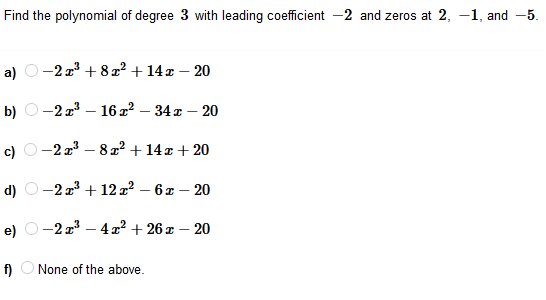
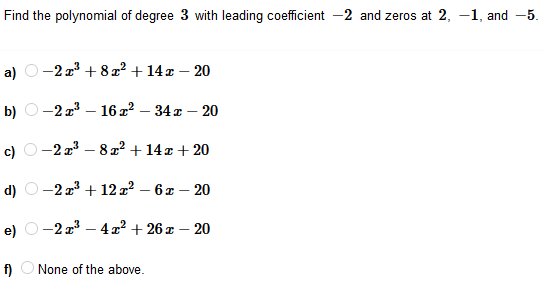
You know the zeroes
wary plover
I can definitely solve this problem easily, but the problem is I have only a minute per and this is more time confusing than most of the other ones
wise kelp
So you can write the equation as k(x-2)(x+1)(x+5)
Where k is some constant
Since the x’s are just going to multiply to x^3, k is also the leading coefficient
wary plover
so there's no faster than than foiling it out?
wise kelp
Can you use a calculator?
wary plover
no
wise kelp
You could just figure out what the x^2 term would be
Since that’s different for all the answers
wary plover
-8x^2
I believe
alright that should be fast enough with the time I save from the ones like graph identification
thanks
wise kelp
Np
hard hornet
(x-2)(x+1)(x+5)
equals 0
And then foil/distribute
Because each of those roots, 2,-1,-5 make that equation true
wise kelp
I just said this lol
viscid thistle
$x^3+4x^2-7x-10$ foiling
obsidian monolithBOT
GABOS:
hard hornet
a+b+c, ab+bc+ac, abc
I forgot what the name of theorem was
But thats all you gotta do
wise kelp
What’s the wolfram alpha command
hard hornet
x^3 - (a+b+c)x^2 + (ab + bc + ac)x - abc
viscid thistle
i mean
wise kelp
Oh right
viscid thistle
hm
hard hornet
But dont need to worry about it
wise kelp
,w cube roots of i
hard hornet
Just write it out, n foul
obsidian monolithBOT
 Requested by GrandPiano#1855
hard hornet
Requested by GrandPiano#1855
hard hornet
Foil*
viscid thistle
x^3+4x^2-7x-10 this is the foiled version
hard hornet
Grand, check the original original question
 spring thunder
@hard hornet viete's formulas
hard hornet
I knew it as vieta's formula
wise kelp
Oh yeah
hard hornet
Powerful formula
 hard hornet
But its probably a bit too advanced for this problem
wise kelp
I’m just talking about cbrt(i) though
hard hornet
Overkill imo
spring thunder
yea it's just that he's french, and his french name is viete
so watever
i say it like that
viscid thistle
I do remember our high school teacher teaching us this
hard hornet
Icic
viscid thistle
but i never really got it
wise kelp
Because using a^2-b^2=(a+b)(a-b) for that problem requires taking the cube root of i
timber plinth
just plug in to see if x makes it 0 smh
hard hornet
Madlad
wise kelp
Yeah you could lol
wise kelp
I don’t think that’s what they want you to do though?
viscid thistle
anyone else here ever mark whole server as read just to see what channels are active
timber plinth
@wise kelp it is
hard hornet
You scared me when you were trying to solve for all of em lololol
wise kelp
Well anyway I was trying to find a way to solve it without doing that
hard hornet
Damn you make things hard for yourself
timber plinth
just pull out the bring radical smh
hard hornet
Guess n check
timber plinth
kek
wise kelp
Or rather I saw that it could be rewritten as an a^2-b^2 and wanted to see if it could be solved that way
On the bright side, I figured out a way to find the cube roots of an imaginary number using algebra
@timber plinth Bring radical?
hard hornet
Uhhh
Yea?
You somehow
Chose the hardest possible way
To solve for x
LOLOLOLOL
wise kelp
Oh yeah I guess so
timber plinth
,w (-1)^1/6
hard hornet
That too
timber plinth
since there's actually 6 solutions, not 3
hard hornet
Yuppis


 short sorrel
theres a few different approaches
my first instinct would be to just expand both sides
and see what you can do from there
wary plover
multiple them out?
short sorrel
yes
wary plover
wont that make it all jumbled? I need to be able to solve this within 2 minutes
wary plover
I guess I could factor them out after that
obsidian monolithBOT
Namington:
short sorrel
note that theres an xy on both sides
so we can clean that up
moving everything to right side, we get
$0 = 11y - 8x + 15$
obsidian monolithBOT
Namington:
obsidian monolithBOT
Namington:
short sorrel
er oops, we're solving for x
wary plover
hehe
short sorrel
$8x = 11y + 15$
obsidian monolithBOT
Namington:
short sorrel
and divide by 8
wary plover
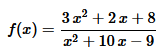
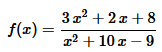
knowing that the hor asymptote is 3, how do I tell whether it crosses that asymptote?
timber plinth
Well, a trivial way is to graph it
Another way is to examine the behavior near the more vertical asymptotes @wary plover
wary plover
so there's no quick fix?
short sorrel
you can check if theres any value of x such that $3 = \frac{3x^2 + 2 + 8}{x^2 + 10x - 9}$
obsidian monolithBOT
Namington:
short sorrel
which gives a solution of x = 37/30
so it crosses (or at least touches) the asymptote there
to verify that it actually crosses, we can, like, test 37/30 + 0.0001 and 37/30 - 0.0001 or smthn
if one is >3 and the other <3, it indeed crosses
this isnt super rigorous but its good enough for elementary mostly-continuous functions
wary plover
and for that algebra I just have to multiply it out?
short sorrel
multiply both sides by the denominator, yeah
just graphing it is far more convenient, but like
the algebraic approach works
wary plover
I dont have the time to graph it
viscid thistle
I believe you have to do sign analysis using 5 points
 echo hornet
hello
viscid thistle
Hey
 proud flax
Boys could i get some help solving simultaneous equations with complex numbers?
@ me if you can please
 heady jewel
@proud flaxdo i just solve and send you solutions
proud flax
That would be helpful thanks
proud flax
Ahaah
heady jewel
atleast
proud flax
Yeah i tried expanding and equating complex and real parts but it didnt work
willow bear
that actually isn't the best route to go here
like, you can turn this into a system of four equations in four real variables
but it's too much of a hassle imo
bc this can be considered as a system of two linear equations just with complex coefficients
willow bear
can you show your work? i'm sure it's all down to an arithmetic fuckup
as is often the case with these
proud flax
proud flax
Ohhhh
willow bear
which you shouldn't be
proud flax
So how should I set it out?
willow bear
well i can show you how i would do it, if you want
proud flax
Yes please
willow bear
ok so let me just copy down the equations for ease of reference: $\begin{cases} (1+i)z + (2-i)w = 3 + 4i \ iz + (3+i)w = -1+5i \end{cases}$
proud flax
Typo in first equation but thats cool
willow bear
from the second equation, subtract $(3+i)w$ from both sides to get $$iz = (-3-i)w + (-1+5i)$$ and then multiply both sides by $-i$ to get $$z = (-1+3i)w + (5 + i)$$
oh yse sorry
willow bear
ofc, feel free to stop me at any point if there's something that isn't clear to you
proud flax
Why do i multiply by -i?
obsidian monolithBOT
Ann:
proud flax
Oh right
willow bear
ok
so then plug that into the first equation to get $$(1+i)[(-1+3i)w + (5+i)] + (2-i)w = 3+4i$$
obsidian monolithBOT
Ann:
willow bear
expand that out to $$(1+i)(-1+3i)w + (1+i)(5+i) + (2-i)w = 3+4i$$
obsidian monolithBOT
Ann:
willow bear
not before asking for work
proud flax
Mmk i think i should be able to get it from here, thanks!
willow bear
alright cool
proud flax
@willow bear i managed to get the right answer from there, thanks heaps 😃
heady jewel
nice
 pallid burrow
need help,
A function f is a rule that assigns to each element x in a set A exactly one element f(x) in a set B.
What is A called? And B? What is the range?
A real function is a function defined on a subset of the real numbers and taking real values.
Which of the following statements is NOT correct?
the answer is B The range of f is B
I dont understand why
 frozen needle
for example with $\fun f\bbR{[-4,2]}x{\sin x}$, the range of $f$ isn't $[-4,2]$
obsidian monolithBOT
Tuong:
frozen needle
you won't be able to find $x$ in $\bbR$ such that $f(x)=-3$ for example
obsidian monolithBOT
Tuong:
pallid burrow
Because even though the elements may be assigned a value in the set B, it does not necessarily take up every value in B?
frozen needle
Yep
pallid burrow
Also in the parabola x+(y-1)sqr=0, is it parabola inrespect to y? because if you solve for y its radical
how do you express the bottom half of that prabola equation with graphing?
with equations
how do i do this question
how do you even get this answer in b) for this question
 limber bone
y = mx +b thats any linear function
for slope 2
y =2x+b thats a linear function with slope 2
thats a
b says find the equation such that f(2) = 1
so y = 2x+b
f(2) = 1
1=2(2)+b
4+b=1
b=-3
so y=2x-3
thats c
b or whatever
got it?
sketch several families is just ig choose some values for b
and sketch them
pallid burrow
what does y=mx+1-2m mean in geometric sense
okayso its just the expansion of slope form with m
generally how does m affect the position of the graph? like those reflection and 180 degree along some axis
limber bone
m is the slope
pallid burrow
by changing m
i remember something like multiplying by -2/3. how do i visualise the mapping of values
is it possible for this sort of rotation transformation of graph to be measured by change in m?
 gloomy shard
Hey, a question about possibilities.
How do you solve the following:
Safe code consists of 3 different digits in ascending order. How many codes are possible?
short sorrel
Note that there's 3 different digits, so we're going to be selecting digits without replacement
So, we want to select 3 digits
But for each 3-digit combo
There's only 1 possible order
So we need to get rid of other orderings
Another way we can think of this: the unique orders don't matter
That makes this a combinations question
short sorrel
How many different digits are there? From 0 to 9
short sorrel
Right
Which means you have
10 options
And you're choosing 3
And need to get rid of duplicate orders
Can you take it from there?
gloomy shard
hopefully :D
heady jewel
gloomy shard
1 possible order out of 3 digits opened my eyes quite a bit, thanks @short sorrel
gloomy shard
which means 120 :>
short sorrel
Right
gloomy shard
need to revise possibilities and combinations a lot :D
short sorrel
Another way to think of it:
10 options for the first digit × 9 for the second × 8 for the third
Then divide by 3! Different arrangements
You'll note this is the same as the formula for nCr
gloomy shard
that's what i thought at first but forgot about division
isn't it a permutation then? The order seems to matter in this case
Okay, that's a combination...
short sorrel
Permutations count each possible ordering
Combinations don't
@gloomy shard
We don't care about every possible ordering
We only care about 1: ascending order
gloomy shard
i see
 edgy forge
in trigonometry, when people are given an angle in degrees, how are they so quick to point out what the coordinates of P are? for example, in this exercise, it seems they just expect you to know that the coordinates of P1 are (sqrt2)/2, (sqrt2)/2
hard hornet
$(rcos(\theta), rsin(\theta))$
obsidian monolithBOT
MemesPlease:
hard hornet
If your radius is 1, and your angle is 45
in this case
your coordinate would become
$(\frac{\sqrt{2}}{2},\frac{\sqrt{2}}{2})$
obsidian monolithBOT
MemesPlease:
edgy forge
could you please explain how you came up with that answer
hard hornet
If you're given a radius of the unit circle
and the angle of the unit circle
then you can easily solve for any coordinate on the circle
given radius and angle
In your case, the radius of the circle is 1 (unit circle), and the angle is 45
using the formula i put above
you get the coordinates
$x = rcos(\theta), y = rsin(\theta)$
obsidian monolithBOT
MemesPlease:
edgy forge
what i think i'm failing to understand is how to get cos and sin of theta
from radius and angle
hard hornet
do you know your trig functions?
edgy forge
i understand that x is cos, y is sin, tan is y/x, etc
hard hornet
oh so you're wondering how I got those two formulas above
edgy forge
i think so
edgy forge
then used the pythagorean theorem?
hard hornet
$cos(\theta) = \frac{x}{r}$
obsidian monolithBOT
MemesPlease:
obsidian monolithBOT
MemesPlease:
edgy forge
agree
hard hornet
multiply both sides by r
and then you get the formula i posted above
the formula comes from drawing a triangle on the unit circle
and using trig ratio + algebra
to find your x + y coordinates
edgy forge
what i think i'm not understanding is how did you know cos(theta) was (sqrt2)/2
hard hornet
cos(theta) is NOT sqrt(2)/2
cos(45) IS sqrt(2)/2
You punch in the angle, and then evaluate the trig ratio
Oh how i knew cos(45) is sqrt(2)/2?
edgy forge
right
hard hornet
Lots and lots of practice
before that, lots of triangle drawing
and lots of ratio figuring out work
edgy forge
thanks for your help
kind pier
How do you do greater than or equal to on the bot commands?
spring thunder
$\leq$
obsidian monolithBOT
emeric75:
spring thunder
well $\geq$ wahtever
obsidian monolithBOT
emeric75:
kind pier
ty
 hard hornet
tbh I would probably distribute everything, combine all the terms, and see if you can factor something
Oh
I see something
Yes
distribute everything, and utilize pythag trig identity
Let me know how far you get
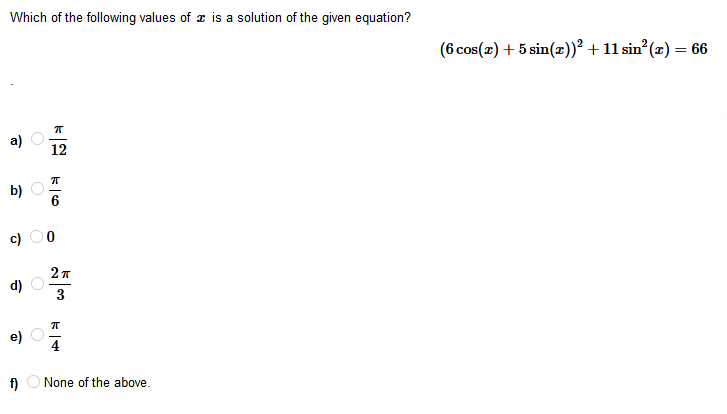
rocky bison
No spoilers @royal gull 
 royal gull
wut? How was that a spoiler? I guess the hardest part is to determine which ones are the correct solutions
after what I wrote before
rocky bison
Yes
royal gull
And what memesplease wrote won't really help without knowing that trick to use a substitution
royal gull
how?
royal gull
I mean, you cant just find delta with cos(x) as coefficient
and roots etc
but I guess you have a different method
hard hornet
Yup
 rocky bison
Yep
hard hornet
perfect
rocky bison
Now move the two square terms next to eachother 👀
wary plover
oh...
obsidian monolithBOT
Pseudo:
wary plover
yes yes I know
rocky bison
So what do you get from there?
hard hornet
what does your resulting equation look like
royal gull
oh wtf I read the parens wrongly lmfao
wary plover
60cos(x)sin(x) + 6
rocky bison
no 🤔
hard hornet
careful, check your math again
wary plover
6cos(x)sin(x) -30
wary plover
mistype
hard hornet
now
wary plover
but yeah
obsidian monolithBOT
MemesPlease:
hard hornet
Hint: Use double angle formula
obsidian monolithBOT
Pseudo:
wary plover
Do you have to use variations of thonking face with every single message? It's really obnoxious and demeaning
rocky bison
That's your double angle formula
hard hornet
Yup
rocky bison

rocky bison
I thought he was trying to us a reduction
obsidian monolithBOT
MemesPlease:
wary plover
well obviously the 30 is irrelevant
rocky bison
tru
wary plover
sin2x = 1
hard hornet
yup
rocky bison
Oh okei
 forest canopy
same
hard hornet
sin(2x) = 1
rocky bison
i've not checked them lmao
hard hornet
funky
wary plover
pi over 4?
wary plover
that one was tough... idk if I can do that kind of problem in 2 minutes
hard hornet
practice makes perfect my friend
the hardest part is usually just "seeing it"
once i saw that there was a trig idnetity that cancels out nicely, it was easy rowing from there
25+11 = 36 if you know what i mean
 frank nebula
Hey, knowing me I would've subbed and checked. At least you did better than me.
wary plover
what's cos2x again?
hard hornet
aka being presented the problem with no multiple choice
cos(2x) gives you three different identities
obsidian monolithBOT
MemesPlease:
hard hornet
and you get the other two by subbing in cos^2(x) or sin^2(x) with the pythagorean identity
Yup that's right
frank nebula
It's a pain in the anus region.
wary plover
I hope I dont get a problem like that
forest canopy
if you remember cos(2x) = cos²x - sin²x you can find the others from this one
hard hornet
learning how to derive it is good
frank nebula
Yeah. It's just manipulating the sin² + cos² = 1
hard hornet
thats fine
forest canopy
my bad
frank nebula
$cos^2x - sin^2(x) = cos^2(x) - (1 - cos^2(x))?$
obsidian monolithBOT
Azuralytix:
forest canopy
you're right I posted directly after thinking something stupid sorry
obsidian monolithBOT
Azuralytix:
frank nebula
Idk how.
frank nebula
Lost me 5 marks during my physics paper.
Because it was the first step of a 3-step qn.
forest canopy
ah, not lucky
frank nebula
Oops latex.
hard hornet
why do you need to simplify it, out of curiosity
wary plover
that's the problem
just simplify it
can I simplify it any further than 2x+2 over the radical?
hard hornet
lemme see
wary plover
hard hornet
i got d
hard hornet
s a m e
 hard hornet
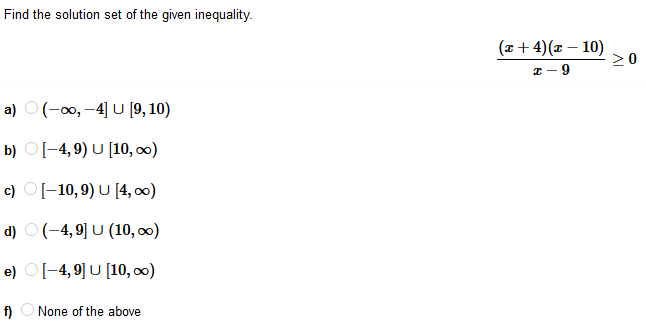
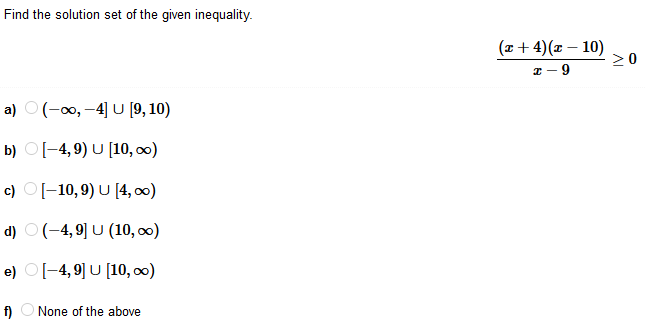
Are you familiar with sign chart?
wary plover
uuuuuh
hard hornet
sign chart is super omg wtf powerful for this problem
wary plover
show plse
hard hornet
search it up a bit, and lmk if its confusing
wary plover
we used them for second derivatives
to map the difference from the first
ok so how do I use these with this problem
wary plover
I just use the numerator for critical points right?
timber plinth
The denominator has a critical point at 9
since the not-so-definedness is rather critical to the behavior
wary plover
or am I thinking of derivatives...
timber plinth
numerator gives you zeroes
critical points i'd call everywhere where either the thing is undefined or 0
wary plover
and if it's -4 or 10 it will just multiply out to 0
ms paint get out here
do I just need to plug things in
wary plover
how do I find the signs then
timber plinth
find the signs of (x+4)(x-10)(x-9)
since putting it in the denominator (applying ^-1 to it) preserves the sign
wary plover
I dont follow
How do I find the signs for my chart without putting in numbers between those critical points
so I think I can do this kind of problem without help, but the answer I got isnt there
is it seriously none of the above?
oh wait
now I remember, you can factor out the signs
got it
fading token
🍮
short sorrel
believe it or not, some people take classes.
i know, shocking
you dont have to be elitist
(Or if youre gonna be elitist, calculus isnt the hill to die on lmao)
hard hornet
wait til he sees advanced mathematics channel
heady jewel
^^
imagine this boi seeing those putnam integrals for the first time and their answers
@hard hornet
short sorrel
imagine thinking putnam integrals are mathematically anything more than a parlour trick
a parlour trick that can get you scholarships, mind, but thats about it
hard hornet
Eh im not interested in competitive math
I do it for fun n out or curiosity
If you think putnam makes a great mathematician, ive got bad news for ya
heady jewel
no
hard hornet
Its the other way around
A great mathematician means more than just being able to do putnam problems
heady jewel
putnam dosent make you a great one
problem solving is a mere part of math
but seriously are you planning to becone a mathematician? @hard hornet
hard hornet
I think what makes a great mathematician is one whose able to solve new problems using whats given, think differently, creatively
Eh dunno
If all you know how to do is replicate tricks
Then ive got bad news for ya
short sorrel
nah a great mathematician can multiply 4-digit numbers in their head
hard hornet
Lmao fudge odd
short sorrel
according to some of my family
hard hornet
Some chinese kids can do 9 digit multiplication in seconds
heady jewel
thats not mathematics
hard hornet
It looks impressive
heady jewel
that dosent even shoe high iq
hard hornet
But it really isnt
heady jewel
what grade are you in @short sorrel
hard hornet
Utilizes some algorithms n tricks
hard hornet
And memorizing abacus
short sorrel
i guess grade 20
short sorrel
yes
heady jewel
woahhhhh
short sorrel
algebraic geometry
heady jewel
good luck
hard hornet
Fancy
hard hornet
How many more years do u have?
heady jewel
wbu memes please
hard hornet
Gonna start my sophomore yr in college
 devout raft
hard hornet
Lul
devout raft
My students
heady jewel
,w differentiate 0
obsidian monolithBOT
 Requested by Lionel#5497
 hard hornet
Its 0
Taking the derivative of a horizontal line yields 0
Or you can treat 0 as a constant
And its still 0
devout raft
,w differentiate Lionel into 100^8990 pieces
obsidian monolithBOT
Wolfram Alpha doesn't understand your query!
Perhaps try rephrasing your question?
Display results online and refine query
 Requested by Krishna#2893
devout raft
Requested by Krishna#2893
devout raft
Lul
obsidian monolithBOT
Requested by Lionel#5497
heady jewel
lmao
devout raft
,w thug life
obsidian monolithBOT
Requested by Krishna#2893
 formal wave
 torn swift
the integral of 1/x is defined as ln|x| so yes, do that
 charred hull
willow bear
charred hull
willow bear
@torn swift not "defined"
 spring palm
can anyone help me find the integral of : sqrt( a^2-x^2)
short sorrel
dx? Is a a constant?
spring palm
ye
spring palm
is it possible without trig sub?
echo plaza
hyperbolic sub 
hard hornet
Or noticing that it's the formula of a half circle
Dunno how that is going to help though
rocky bison
There's probably a bunch of pretty neat but complicated ways to do it tbh
spring palm
im trying to learn the proof for the area of a circle
short sorrel
Fair warning that this ends up being miserable
short sorrel
,w integral of sqrt(a^2 - x^2) dx
hard hornet
If you want the area of a circle, you could just do polar
obsidian monolithBOT
Failed to get a response from Wolfram Alpha. If the problem persists, please contact support.
short sorrel
..n
rocky bison
how are you proving the area of a circle tho
echo plaza
proven impossible
short sorrel
,w antiderivative of sqrt(a^2 - x^2) dx
obsidian monolithBOT
 Requested by Namington#1983
spring palm
Requested by Namington#1983
spring palm
splitting it into quarters
short sorrel
It sucks.
echo plaza

spring palm
wao wtf
rocky bison
Because you could also use a polar integral
spring palm
alright thanks, teacher just made it seem like it was a viable option
echo plaza
that might just be wolfram using its bizarre list of favourite functions btw
if it can use arctan it normally will
even if it makes it uglier
spring palm
hmm i see
hard hornet
Would you still like to know how to solve it using trig substitution?
echo plaza
you can probably write that nicer with arcsin
spring palm
no im fine thanks i have the notes for that
hard hornet
alright
spring palm
thanks for the help frens
echo plaza
np
 molten flume
Don't know how to start this question,.
echo plaza
$e^{qx}\equiv (e^{q})^x$
obsidian monolithBOT
CaptainLightning:
molten flume
Thanks for the help! Easy problem but i over complicated it.
echo plaza
np
 narrow willow
@spring palm you should factor the $a^2$ out of the square root then you'll see how that resembles $\cos{u}=\sqrt{1-\sin^2{u}}$
obsidian monolithBOT
Sherwyn:
timber plinth
WA: exists
Everything but arctan: Am i a joke to you?
echo plaza
wolfram's goal is to use only arctan and artanh I swear
 proud raven
it looks like its just the vector being projected onto rotated 90 degrees
they are uhh
timber plinth
Looks like the perpendicular component
proud raven
vector components of a vector orthogonal to another
echo plaza
timber plinth
Where w1 is the projection and w2 is the "rejection"
proud raven
lol i saw that @echo plaza
proud raven
i dont really see what w2 has to do with a projection is what i mean
timber plinth
w1 is the parallel part, therefore w2 is what's left, creating a perpendicular part since none of it must be parallel @proud raven
proud raven
how do you mean 'whats left'
timber plinth
you know how projections work, yes?
proud raven
i know how to calculate one
timber plinth
smh
w2 is the vector rejection
where w1 is the projection, it's a sort of measure of how parallel it is to a vector I suppose
proud raven
oh
proud raven
i think i just got what you mean
timber plinth
@willow bear sometimes it's actually called the vector rejection
proud raven
bizarre that it always ends up being orthogonal to v
willow bear
timber plinth
$v_{\perp u}$ or some shit
obsidian monolithBOT
Darkrifts:
timber plinth
@proud raven it's obvious that w1 must be parallel by construction, so in order to reconstruct the original piece, you need a piece perpendicular
proud raven
does the original vector always have some specific angle to those two resultant ones
or it just lies between them
last question 😄
spring palm
oooh thank you @narrow willow
 static vapor
need help with delta
how does one recognise the need to use the "inclusion-exclusion principle"
or how do i not need to use it alltogether
 edgy flicker
count how many cases there are in which the same letters do appear next to each other and subtract that
willow bear
"the determinant test"?
also, no, this isn't y = -x; the graph actually consists of two lines, the second line being the y-axis.
viscid thistle
oh
so would it be pair of intersecting lines
the test where B^2-4AC > 0 hyperbola, <0 ellipse and =0 parabola
willow bear
what are A, B and C
willow bear
yeah i mean ok the two lines is kinda like a degenerate case of a hyperbola
fading token
,rotate
obsidian monolithBOT
proud raven
this is gonna sound really stupid i think but
is there a less painful way of finding a unit tangent vector than finding the slope then the tangent line at a point and then a vector along that line and then the unit vector of that vector
echo plaza
you don't need to find the tangent line
proud raven
i found some ways to do it with parametric equations but cant suss it out in my head if were just talking about like x^2=y
echo plaza
otherwise no
proud raven
alright
 stiff rune
@patent beacon
were the points
1,1
and -1,1
that passed through a tangent line with points 0,-1
patent beacon
Yes I believe they are the points
stiff rune
niceee
patent beacon
Did you search for them, or did you find them algebraically? You may be asked to do the latter on a test
stiff rune
i used the gradient of 2x
or of 2 rather
and just found them by going across 1
up 2
both ways
patent beacon
Here's a way that will always find them for you, let's say y = x²:
Take the tangent line at a general point x = a
This tangent line is y = 2a(x - a) + a²
The line should pass through (0, -1), plug that into the tangent line:
-1 = 2a(0 - a) + a²
-1 = -a²
a = ±1
patent beacon
It's kind of like solving the problem backwards, idunno
Use an unknown as the point, and solve for it
stiff rune
well im getting my answers right on the textbook now 😃
and i know how to do every other thing for the test so should be good
rocky bison
@patent beacon That's actually a pretty neat problem tbh
I don't think I've seen things like that before
echo plaza
you get ones with cubics and stuff
rocky bison
Yeah I imagine
I've just never actually seen a problem presented in that way
They're always the other way around
i.e. find the equation for the tangent/norm at x=...
echo plaza
I remember doing a lot of them



 proud raven
can i ask for help on a problem
a) find all points of intersection of the two equations
b) find the unit tangent vectors to each curve at intersections
equations are y=x^2 and y=x^(1/3)
I can get the points of intersection, and i can kind of intuit what the unit tangent vectors are
but im having a hard time showing part b on paper
nvm i think i figured it out
i lied
part c is find the angles between the curves at the point of intersection
is that just equal to the angle between the tangents? or a different value
rocky bison
@patent beacon https://www.desmos.com/calculator/uf41mszecp
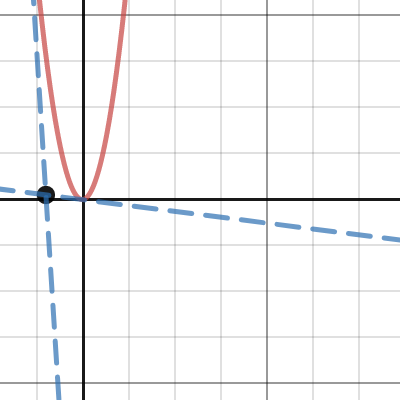
Desmos Graphing Calculator
echo plaza
if you want one with cubics, find the equations of the lines that pass through the origin and are tangent to the curve y=x³-3x²-1
rocky bison
,time
obsidian monolithBOT
The current time for Pseudo is 7:05 AM (BST(+0100)) on Sun, 09/06/2019
echo plaza
,time
obsidian monolithBOT
The current time for Foodness is 6:05 AM (GMT(+0000)) on Sun, 09/06/2019
rocky bison
I'll try to figure how to do that later
echo plaza
how to set it to BST
echo plaza
,ti --set London
obsidian monolithBOT
Your timezone has been set to Europe/London
proud raven
okay, thanks!
echo plaza
also this one
You are given the curve y=ax²+bx+c, (2,4) is on this curve and the tangent to the curve at x=-1 has the equation y-7x=-1. Find a,b and c
someone asked that one about a month ago although it came with a lot of padding lol
proud raven
man
cross products are bizarre holy cow
thats sort of the last thing i have to cover to catch up with vectors in my class
fading token
Cross products are really just 3x3 determinants
 autumn sonnet
if I have log_(1/5)(x^2-3) >= log_(1/5)(x-1) can I cancel the logarithms?
fading token
Depends on which base the logarithm has
autumn sonnet
Oh sorry the base is 1/5, I missed the _
fading token
Oh, then yeah, bc logarithm functions are monotonous increasing
Just be careful that the argument of the log must be greater than 0
autumn sonnet
When could I not cancel the logarithms?
willow bear
ah careful
if you want to undo the log_(1/5) you gotta flip the sign
bc log_(1/5)(t) is monotone decreasing
fading token
ahh yep
viscid thistle
stop saying that cross products are just 3x3 determinants to people who haven’t taken linear algebra
it’s confusing to them and will keep them from understanding it just as much as giving them a simpler formula would be
if someone isn’t at the level where they can understand the derivation for a formula they need, make it simple and clear that it’s just a formula and there’s nothing super fun going on here, it’s simply a tool, not part of the puzzle itself
 civic plaza
Learning how to do the 3x3 determinant is simpler than learning a long af formula  but that's just me
A lot of people , including me, were taught the cross product in a class like newtonian mechanics before being formally taught in linear algebra
It's not bad especially if you consider the "diagonals shortcut" to computing it
 deft crow
why is (ln9)/ 2 the same as ln3
willow bear
$\frac{1}{2} \ln(9) = \ln(9^{\frac12})$
obsidian monolithBOT
Ann: