#precalculus
1 messages · Page 152 of 1
 hollow horizon
 viscid thistle
Nope
viscid thistle
Can you write a, just a in terms of e^(?)
viscid thistle
Give me a ? so that e^?=a
viscid thistle
If you have that ? then you could write your big expression in terms of e^(...) yeah?
Give me a ? so that e^?=a
Have you seen this equation before?
viscid thistle
Give me a ? so that e^?=a
What is this the intuitive definition of? Could it be... a certain function that you've been studying a lot recently? That this very question is testing your knowledge of?
 ruby delta
hey guys, I'm planning to take a calc placement test so just brushing on some things I forgotten or need a review. For this question, the idea I believe is to isolate X, but I'm not sure what direction to approach it. Should I divide by 4? just stuck in general and maybe need a hint http://prntscr.com/nv73fi
 hollow horizon
well im assuming its obviously a log function
viscid thistle
What's the definition of $\log_b a$?
 obsidian monolithBOT
Deconstructed:
hollow horizon
the exponent you need to raise b to to get a
viscid thistle
Yeah, and isn't that asking the same question as Give me a ? so that e^?=a
 unborn plume
hi
viscid thistle
^ This is simply the definition of $\log_e a$, isn't it?
unborn plume
I got a question
obsidian monolithBOT
Deconstructed:
Compile Error! Click the  reaction for details. (You may edit your message)
unborn plume
If v·w = 0, then...
I said the angle between the vectors is right angle
is that true
unborn plume
no this is a pre calc question
 tawny nacelle
if v and w are non zero, yeah
unborn plume
I did not know this was a question channel
I thought it was just for pre calc like the chill for pre calc
 serene heath
na it's a q channel
hollow horizon
OH deconstructed
viscid thistle
Well, if you're learning this in a pre-calc class, congrats :) It is basic linear algebra
unborn plume
Bannan already answered my question anyway
viscid thistle
Head to #linear-algebra
hollow horizon
we never learned much about eulers number
which is wwhy i was so confused
but
we never really worked with it
unborn plume
@tawny nacelle thx
hollow horizon
thats hy i was so confsued when u said e^something
viscid thistle
Oh, you could try putting the expression in terms of 10^(stuff)-10^(other stuff) and that method would work just as well
e is just very very nice and produces incredibly clean solutions when it comes to problems like this and many more, in many different fields of math
hollow horizon
hmmmm
im still stuck
im not sure how to get there
ive been working with a bunch of other people we all cant solve it 😢
viscid thistle
Did you try what I mentioned?
hollow horizon
i just dont know how to get to the
10^(stuff)-10^(other stuff)
this part
im not sure how to get here
viscid thistle
Just look at $a^{\sqrt{ \log_a b }}$ for now
obsidian monolithBOT
Deconstructed:
viscid thistle
What does $a$ equal in terms of $e$?
We talked about the answer to the question Give me a ? so that e^?=a, right?
That's the definition of $\log_e a$. $\log_e$ is also called $\ln$, for 'logarithmus naturalis', or 'natural logarithm'. Latin was used for mathematical texts before today's English, German, French, and Russian.
Cool tidbit for ya
so now we have that $e^{\ln(a)}=a$
obsidian monolithBOT
Deconstructed:
hollow horizon
OH thats what u meant
viscid thistle
Hint 2-
$a^{\sqrt{ \log_a b }}=(e^{\ln(a)})^{\sqrt{ \log_a b }}$
obsidian monolithBOT
Deconstructed:
viscid thistle
Because a equals that
Play around with the expressions even more, see if there are identities you can use to help you get your answer after you've converted the expression into this form
hollow horizon
i used this right
which is basically what u said
i believe
then i subbed in both those values
viscid thistle
if by 'log' you mean 'log_10' yes
 earnest wedge
hello, i dont really understand like the inequality rules
im confused how to tell when the sign switches when i find the factors from a quadratic or polynomial
 pale kettle
Can you give an example problem?
earnest wedge
x^2 -2x -3 >= 0
(x-1)(x+3) >= 0
3x^3 - 4x^2 + 9x - 12 >= 0
x^2(3x - 4) + 3(3x - 4) >= 0
(x^2 + 3)(3x-4) >= 0
 willow bear
in all of these, there's more or less an algorithm you can follow:
- bring everything to one side, so the inequality becomes comparing a polynomial to zero
- factor the left-hand side
- make a sign table
- read off answer from sign table
earnest wedge
i know how to make a sign table, the part that is troubling me is the sign switch when i solve for the factors
earnest wedge
because i have read website that says that only division/multiplication affects sign change between terms or if you move the whole right term to the left term or move the whole left term to the right term so they interswitch
i know
willow bear
if it's a polynomial inequality you shouldn't be multiplying or dividing by anything
only adding and subtracting
which never carries with it a sign switch, unless you flip the inequality itself (ie go from a ≥ b to b ≤ a)
that said, multiplication and division necessitates a sign switch when the thing you're multiplying by is negative
earnest wedge
that's what i thought but like for #7 someone wrote to me that the inequalities were like x <= 1 and x >= -3
willow bear
what, the answer?
earnest wedge
for #7 part a
willow bear
then that's something you'll read off your sign table.
earnest wedge
i dont get how the sign table relates to that portion tho
i understand how to do the sign table but i dont really get the inequality switch rule
for that problem, or do i just go through sign analysis
to determine the intervals
earnest wedge
willow bear
BUT THAT'S EXACTLY WHAT I TOLD YOU
 timber plinth
anngry
willow bear
and no, this has nothing to do per se with the sign table or what you read off from it once you're done making it!
earnest wedge
ik
willow bear
once you factor your polynomial, the sign change points - and thus the endpoints of the intervals in your sign table - are its roots
earnest wedge
yes, im aware of that..
im just lost on this part
x^2 - 3 >= 2x
x^2 -2x -3 >= 0
(x+1)(x-3) >= 0
(x+1) >= 0
how does this end up as: x <= -1?
(x-3) >= 0
x >= 3
this part makes sense to me though
viscid thistle
@earnest wedge Are you confused why "multiplying or dividing by -1" in an inequality switches the inequality?
I can help clarify if so
earnest wedge
no, the adding/subtracting for that part
like, is there something im missing out on?
 short sorrel
x + 1 = 0
solve for x
by subtracting 1 from both sides
x = -1
hold on
i think i see the problem
what we're doing when we find roots is
looking for points where the sign might change
thats all we're doing
then we have to individually chek each interval
between the roots
to figure out whether it should be >= or <=
in that interval
we cant say whether its a <= or >=
JUST through the solving for roots
we also have to make the sign comparison
to figure that out
 ionic beacon
Hey
if the binomial questions ask for first 3 terms descending power of x
can it be like 2x^8 2x^6 2x^4
as long as the difference is the same
the answers is 256x and then 64 x
oh wait
mb
forgot the pascal triangle
forgot the pascal triangle
actually how do you do this
 lethal skiff
How do I learn calc
I’m done with gcse curriculum and tests are easy rn, I’ve got another year before I do calc classes, what are some good resources?
+I have way too much free time
ionic beacon
I tried khan academy
but the questions there is way too easy
for starting calculus
lethal skiff
Yeah I’ve seen that
ionic beacon
so maybe watch the videos do few questions and start doing past papers
lethal skiff
Like Eddie woo?
lethal skiff
I like black pen red pen but his stuff is very advanced I think
Like kinda uni stuff
What yr u in?
ionic beacon
11
lethal skiff
Okey
ionic beacon
i have 16 hours before i have my a maths exam
and i havent started until now xde
so i might not reply
ionic beacon
if i had C+(2x-5)^1/2 = 6
c can be both 4 or 32 right?
x is 9/2
nvm i forgot chain rule existed
 rigid beacon
@lethal skiff I recommend the YouTube channel "Professor Leonard"
Since he uploads a ton of lectures of his calc classes
So you get really really good explanations and he goes through some example problems
I also like Paul's Online Math Notes
Khan Academy is lacking imo
lethal skiff
I’ve never done calc before
rigid beacon
Yea he starts from calc 1
lethal skiff
This won’t be too adv right?
rigid beacon
Basics AF
rigid beacon
Like your limits and the limit definition of the derivative all the way to multivariable calc if you go through all of his videos (which there are a ton)
Np
lethal skiff
1 question tho:
What’s with d/dr pie r^2 being equal to 2 pie r
Or is that just not significant
lethal skiff
This guy just mentioned it quickly and said he’ll go back to it and never does
lethal skiff
And it’s applications
rigid beacon
So I still say start with limit definitions
lethal skiff
I meant in school I’m yr ten
rigid beacon
Oh I thought you were watching the videos rn
lethal skiff
No I’ve been tryna figure it out for the past 2 days
rigid beacon
Well really I think you need a solid foundation of what continuity and limits are first and then you can go for the calculus
lethal skiff
I’m on Eddie woo’s now
lethal skiff
He’s going on a bit abt the power rule and his playlists are all backwards
They start at the end
rigid beacon

YouTube
Topics: Review of Algebra/Trigonometric Concepts, Finding Limits, Derivatives and Derivative Techniques, Integrals and Integral Techniques, and Applications.
Here's the calc 1 playlist in order
He starts with review which if you want you can skip
lethal skiff
Do I start at the start or can I skip to like the third
rigid beacon
But then starting with lecture 1.1 is calc stuff
lethal skiff
Aight these are long as hell
rigid beacon
They full lectures lol
It's not a Sprint
It's gonna take time because it's a whole curriculum in a sense
lethal skiff
Just new to me
rigid beacon
Ye
lethal skiff
The entire gcse curriculum(I start further maths next year) can be covered in two hours
rigid beacon
Calc is nice because unlike precalc the units build on one another most of the time
Well alot of it is example problems (which you should do because they helpful)
rigid beacon
Precalc you may cover the limit definition of the derivative
I did in my precalc class
lethal skiff
Why do ppl write 30* as pie over six
tawny nacelle
its called cultural appropriation
lethal skiff
Fr
tawny nacelle
degree is for filthy peasants
 tawny nacelle
1 radian = $\frac{180}{\pi}$ degree
obsidian monolithBOT
soap:
 willow bear
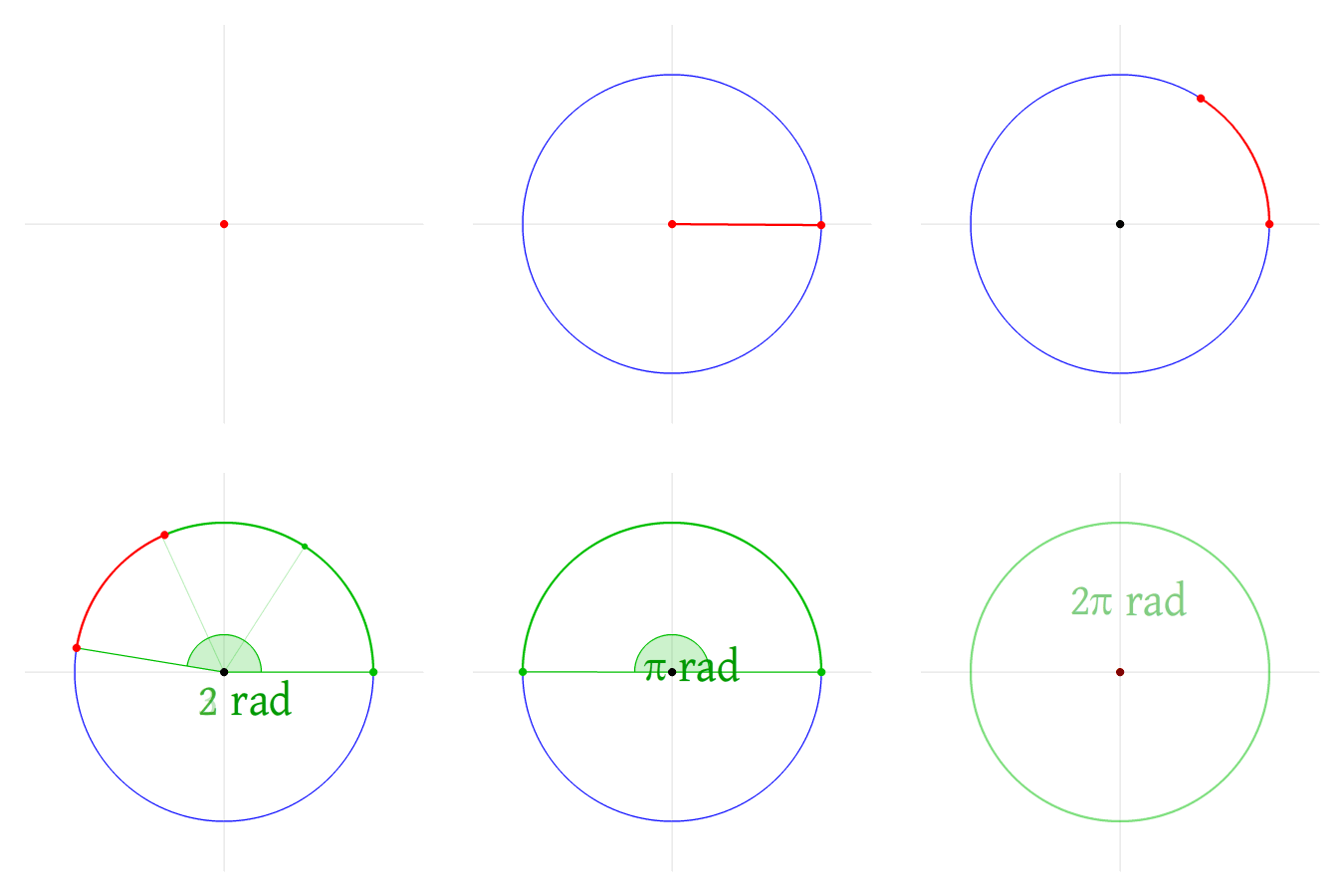
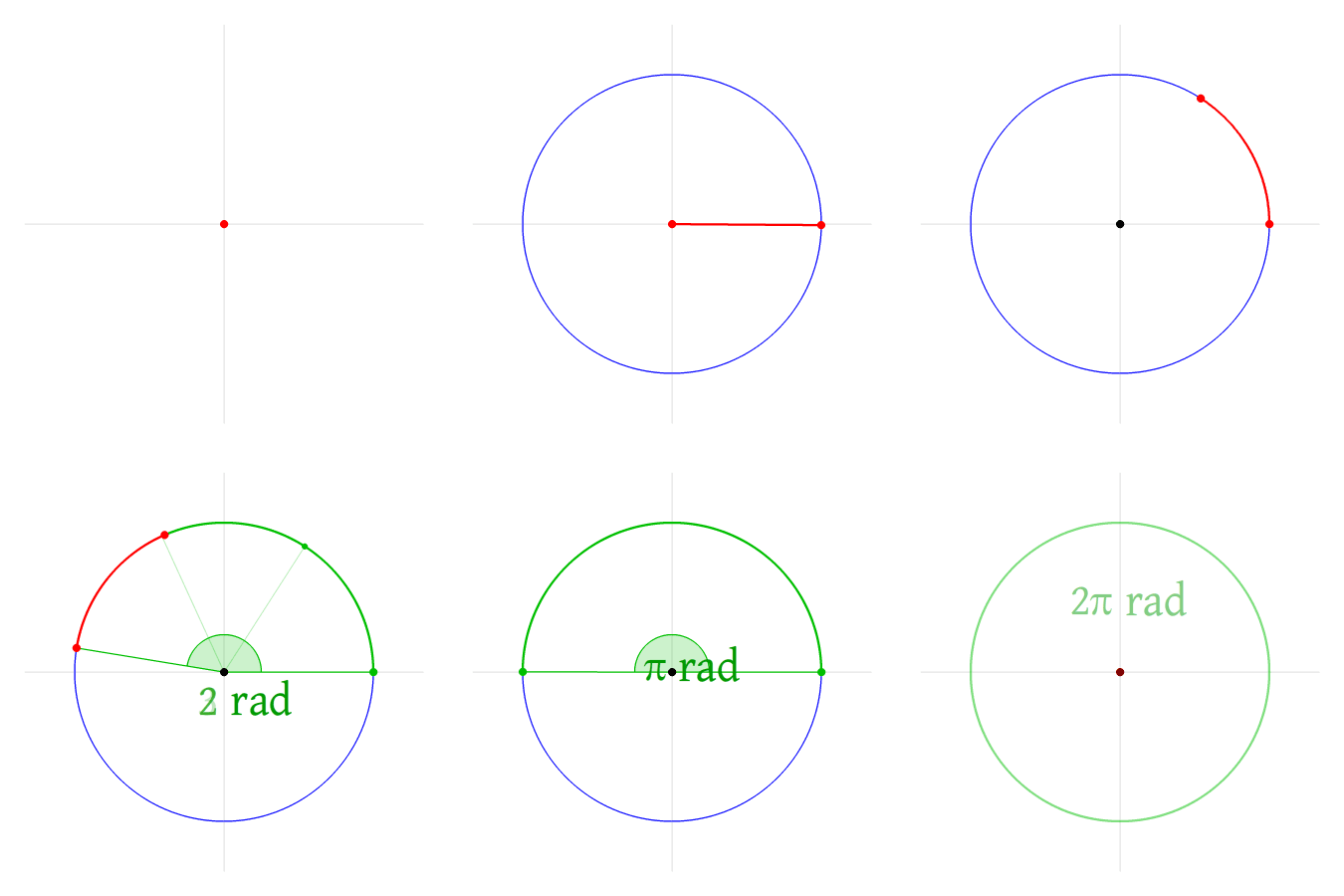
a radian is defined (informally) as follows:
take a circle, and a string as long as the circle's radius. wrap the string around the circle so that it becomes an arc. that arc makes an angle.
that angle is called 1 radian
tawny nacelle

lethal skiff
The arc makes an angle with the circles tangent?
willow bear
no
lethal skiff
Or the radius?
lethal skiff
Nice
 light magnet
Hello smort peoples
 silk sequoia
why can't I turn this function into (x+3)(x-2) over (x-2) and cancel out (x-2), then plug in 2 to get the answer?
timber plinth
Well, that's because f isn't defined at 2
even with the algebraic cancellations, it's got a little "hole" at 2
timber plinth
Do you know what the limit is there?
timber plinth
Go through and calculate it
timber plinth
The function you have there will be basically equivalent to (x+3) because of how the algebraic cancellation works, but it has a hole at 2
you can't just plug in 2, but it behaves almost identically to (x+3)
When you can cancel, the limit should be equal to what the function would be without that hole, but don't think just plugging it in works since you usually take the limit when there's some sort of hole which prevents it
willow bear
why can't I turn this function into (x+3)(x-2) over (x-2) and cancel out (x-2), then plug in 2 to get the answer?
i mean that's exactly how you'd calculate the limit lol
silk sequoia
yeah
 hard hornet
This functio is the exact same as the line x+3, but instrad, you will have a hole at 2
 tropic crown
can someone help me understand the significance of the square bracket and the circle bracket
of where i red underlined?
tropic crown
ty
 rare zephyr
Im actually envious on the depth and complexity of precalculus in the American academy 😕
Might sound brat-y but
Maths here is so boring
 torn swift
~~when you didn’t even study it in high school  ~~
~~
rigid beacon
Uhh
I mean not really if you haven't hit that level
you have to take it to do calculus usually
but it's not like a "graduation requirement" or anything
ionic beacon
calculus is better if you learnt other stuffs as well first
even though im not sure it contributes to calculus
 hidden elm
First off, you need to find out the time of collision.
For the two boats to collide, they need to be at the same position.
if position can be denoted as xi+yj, then we can gather a system of equations
looking at each boat as two separate equations (x and y components), you will get 4 equations total.
if you set "t" as a common time variable, then you can predict exactly where each boat will be at time t.
Here's one equation and reasoning to help you out a bit: Boat A's x position can be written as x(t)=12+9t since it starts off at position 12i and moves "right" to the right 9 units per hour.
@ionic hazel hopefully you can figure the rest out from what I have written above. If not, please ask.
 ionic hazel
Thanks for laying out the steps!
@hidden elm I’ll try and complete the question using t
t = 4/3 hours
as we get
12 + 9t = 40 - 12t
21t = 28
=> t = 28/21 = 4/3
They collide at 7:20 a.m
Now what? @hidden elm
hidden elm
The problem states that the boat A changes direction at 7 am, or t=1
use the position of boat A at t=1 as the new initial position and make a new equation for the new velocity of the boat
using the same method
and when you do that, find the position of the two boats at t=4/3
then, simply use the distance formula (or pythagoras, same thing) to find how far the two boats are from each other at 7:20
keep in mind that the time variable for the new boat will be with respect to 7AM, not 6AM.
(I have not calculated any of this out, so you should double check your steps and calculations).
@ionic hazel ^^
ionic hazel
That’s unusual. I’m not sure if the boat A changed direction to get into a collision. It says “realises a collision is imminent” is the boat is probably trying to avoid the boat B
Nevertheless thanks for the help! @hidden elm
I’ll try both approaches to the question and see what happens
hidden elm
Yes, it changes course to avoid collision.
They would have collided at 7:20 if boat A didn't change course.
@ionic hazel What I said earlier was a singular solution, two parts. 1. Find when they will collide on initial trajectory. 2. Find where boat A will be after changing course at 7AM and use that information to calculate distance.
Hope I cleared up some confusion
 long pond
@lethal skiff fite me
 runic quest
can i just skip precalc and go straight to calc or does it really help that much?
short sorrel
@fervent wagon recall that the period of a "default" sinusoidal wave is 2pi; that is, there's a length of 2pi from one crest to the next crest
compare that to the period on the transformed wave
similarly, consider where cosine "usually" starts when it's not phase shifted, and how you'd have to translate it horizontally to get it to this point
@runic quest precalc is often useful as concepts like reciprocal trig functions (sec/csc/cot) and many important trig identities (pythagorean, half angle, etc) are introduced there
as well as generally aiding your maturity in working with those sorts of functions
 calm cloud
short sorrel
calm cloud
short sorrel
moreover, stuff like the unit circle, logarithms, and limits may or may not be first introduced in a precalc class
depending on curriculum
thats all stuff that can be self-taught
short sorrel
but it'd be difficult to learn it at the same time as calc
runic quest
i have done a lot of topics in calc already like differentiation limits and continuity chain rule etc
short sorrel
trying to scramble to learn how to use trig identities while in the middle of also learning how to integrate them would be fairly awkward
timber plinth
(Depending on curriculum of course) precalc isn't too hard, but i'd not skip it unless you are adequately "mathematically mature" so to speak (and know the logarithm and unit circle stuff too)
short sorrel
again, this is all stuff that you can familiarize yourself with, but it's easiest to do so when not trying to juggle it with a full calc course
runic quest
understood
short sorrel
thats sort of the thing with precalc
timber plinth
I only condone skipping a course when you're either 1) good at math and mature enough to pick it up in 10 seconds or 2) already know everything in the course (give or take like 1 thing)
short sorrel
its a hodgepodge of topics introduced
cause they'll come up in calc
stuff like reciprocal trig functions and polynomial long division
none of the individual concepts are impossible to learn on your own or anything
but itll relieve a lot of pressure when taking calc proper
it'd be like, trying to learn algebra at the same time as learning how to multiply
certainly possible, but you'll likely feel it obfuscates things
that said, theres no "one best way" to learn math, and every curriculum has a host of problems
so dont take the standard alg -> precalc -> calc progression as gospel
but it's definitely very nice to have
runic quest
thanks for the insight
 echo plaza
try multiplying everything by secθ
viscid thistle
k thx
echo plaza
np
viscid thistle
how does it follow that s^n = r?
nvm
im dumb
because the stuff inside the parentheses are unit vector
 swift quail
Can someone help me figure out
- best place to put the hotdog stand along paths
- best places to put two hot dog stands along paths
- best place to put a stand ANYWHERE(even in water)
torn swift
what constitutes "best"?
swift quail
as in most convenient for the students
Number 4 gives amount of people in each dorm
if u cant read the picture b/c my writing lmk but im not sure how to start
i could also measure the distance between anywhere on the picture with a ruler
i would also guess you take into account the number of people in the dorms so youd place the stand a little closer to the larger dorms in order to make more money
swift quail
viscid thistle
Is there a way I can put the Unit Circle on my TI-84?
torn swift
graphing x^2 + y^2 = 1 will work
 daring gale
change coordinate systems to polar
viscid thistle
kk
 slate tiger
Hey, I was wondering if someone could check my answers on this homework then explain five because I’m lost on it
 wraith idol
For 5, you need to use the binomial theorem
wraith idol
Yes
wraith idol
I think the exponent of m should be 8 and the exponent for 3n should be 6
wraith idol
1 to 5 looks good to me, but the rest I already forgot how to do
 scarlet nimbus
Hey, does anyone know the steps into solving this?
tan (theta) problem
or how can i use the unit circle for this?
slate tiger
Look for where sin/cos = radical theee
scarlet nimbus
ok thx
 sullen crescent
hey all, with how much studying i'd need to cover in such a short amount of time, i was wondering if it was okay for me to post an ad for a tutor to help me through a study guide for a few hours?

 wind mulch
Start with g(x), substitute x with 2, ending with 2/3 ln(10). Then for that answer replace the x in f(x) with it
torn swift
alternate notation is f(g(2))
torn swift
what is your first thought?
wind mulch
cosecant is the inverse of sin. It’s like csc(x) = 1/sin(x)
 frozen needle
What have you tried?
torn swift
what else have you done then?
torn swift
do that
torn swift
divide by six on both sides and simplify 4sqrt(3)/6
4/6 can be reduced if you are confused on what I am saying
torn swift
4/6 =/= 2/6
scarlet nimbus
sorry
torn swift
4/6 is 2/3 as you correct yourself
now the final thing I want to do is flip the fractions on both sides, that is allowed, so now I have sin(t)=3/2sqrt(3)
the final step is rationalize the denominator as now we have a sqrt(3) on the bottom
once you do that you'll see the answer right away
scarlet nimbus
ok
torn swift
you get sin(t)=? tell me what you get from rationalizing the denominator
 jagged sun
i recognize ur pfp
 wary plover
not just the substituted form
jagged sun
what pokemon?
scarlet nimbus
ok i think i got it
wary plover
I dont remember how to work out 10e^3(2/3ln10)
hard hornet
is it 2/(3ln10) or 2/3 * (ln10)
torn swift
first thing I want to do is 3 * (2/3)
torn swift
6/12 is what?
wary plover
10 times e to the power of 3 times ln of 10 with exponent 2/3
I suppose maybe I could move the 3 to the exponent too but im not sure what that would solve
torn swift
can you write it out on paper so we can see the equation?
scarlet nimbus
ok
torn swift
what did you get after that simplification?
scarlet nimbus
torn swift
sqrt(3)/2 is a special angle if I ever saw one
scarlet nimbus
yeah it’s part of unit circle
when i look at the unit circle
t equals pi/3 or 2pi/3
torn swift
$e^{\ln(a)}=a$
obsidian monolithBOT
⚡Amphy⚡:
wary plover
knew I was forgetting something
scarlet nimbus
thanks amphy for the help
torn swift

wary plover
so the answer is in fact 1000
thank god, that problem was burning a hole in my skull
torn swift
the big thing was to get it into ln(a) so then you could do that simplification
wary plover
I knew there was something about e to the power of LN but I couldnt remember it
Ill probably be in here a lot over the next week, I have to take a very difficult precalculus test and I havent learned precalculus in over a year
my brain is wired on calculus
scarlet nimbus
precal is way diff from cal huh?
torn swift
I assume you are lost on the final two problems, Val?
wary plover
it's like that spongebob episode where he learns fine dining but forgets his name along the way
wary plover
Ive finally learned calculus but forgot half of these stupid simplification rules
scarlet nimbus
and my A2-PreCal final is tomorrow
torn swift
how much calc though? all the way to multivar?
torn swift
I had to redo calc as well, and it wasn't that bad
retaking it was a bit boring really lol
the new stuff was when it got exciting 
 obsidian monolithBOT
⚡Amphy⚡:
torn swift
that should be enough to help you get to the right answer
wary plover
hmph, didnt think of splitting the 4x^2-1 that way
the real problem is that I have to do all of these in less than 2 minutes each, and I have 40 total problems
torn swift
$4x^{2}-1=(2x)^{2}-1^{2}$, which is the form, $(a^{2}-b^{2})$
obsidian monolithBOT
⚡Amphy⚡:
wary plover
I need to get good at blasting through basic simplification without thinking about it
scarlet nimbus
thx
is it possible to use the pythagorean theorem method even when there's no squared?
example
can cos (t) = 1-sin (t) ?
just like cos 2 (t) would equal 1-sin^2 (t)
cuz im trying to solve sin t cos t = sin t
scarlet nimbus
found the answer i tihnk
serene heath
is it possible to use the pythagorean theorem method even when there's no squared?
nope
not the same thing
scarlet nimbus
Ah ok
well heres my steps to the problem itself:
sin t cos t = sin t
cos t = 0
now i know the answer but i can i figure it oout without using a unit circle?
serene heath
how u getting cost=0
scarlet nimbus
dont you subtract sin from both sides?
serene heath
factor out a sint from both terms
hard hornet
I'm going to assume domain as $[0,2\pi]$
obsidian monolithBOT
MemesPlease:
scarlet nimbus
it’s actually one equation
hard hornet
yes it is one equation
scarlet nimbus
it’s cos(x) multiplied by the factor (2sin x + sqrt(2))
hard hornet
but in order to make that equation true
either cos(x) is 0, OR, (2in(x) + sqrt(2)) is 0
so you really have 2 equations to solve for
scarlet nimbus
ah ok
well the second one is hard
for me
and yeah, the domain is basically the unit circle
hard hornet
ok
2sin(x) + sqrt(2)) = 0
and you want to solve for x
here's my hint to you, solve for sin(x) for now
let me know what you get
scarlet nimbus
ok
do you mean like solve that whole thing but for the sin(x) value?
and not just x value alone
hard hornet
awesome
now
time to solve for x
which x values
satisfies
sin(X) = -sqrt(2) / 2
hard hornet
yup that shud be right
scarlet nimbus
how about the cos x part?
hard hornet
what values of x makes cos(x) = 0?
hard hornet
correct
scarlet nimbus
so do i put all 4 values in as my answers for entire problem?
hard hornet
yup
because all 4 values
makes that equation true
2 from the cos part, 2 from the sin part
scarlet nimbus
ok thank you so much
willow bear
$\sum_{i=1}^{14} X \cdot 1.8^{i-1} = X \cdot \sum_{i=1}^{14} 1.8^{i-1}$
obsidian monolithBOT
Ann:
willow bear
this is the summation version of the distributive law, pretty much
@fervent wagon
wdym "what's it for"
it's still the right hand side of the equation you are to solve
what @serene heath and i have essentially done for you is reduce the problem to one where the summation doesn't directly involve the unknown.
why subtract, though?
if the question were X * 7 = 41, would you subtract 7 from both sides to get the value of X?
it won't do you any good to keep asserting that math your weak spot
hard hornet
The summation that Ann did for you, the one with X pulled out, gives you an actual, physical value
willow bear
seriously what are you even trying to accomplish by saying that
hard hornet
I would try to compute that actual value of that summation, then solve for X by dividing
willow bear
then why are you saying it
hard hornet
Try your best, we are here to help
Then just let us know, we can explain it til you understand
An easier way to compute it might be finite geometric sequence formula if you learned that
If not, probably gotta compute it by hand
willow bear
$X \cdot \underbrace{\sum_{i=1}^{14} 1.8^{i-1}}_{\text{just a number}} = 11709.8$
obsidian monolithBOT
Ann:
willow bear
there's two "things to be done" here and personally i wish to separate them
one is evaluating the sum
the other is solving the equation afterwards
hard hornet
Check the definition of Sigma, or summation
willow bear
that does seem correct
swift quail
I’m trying to figure out how I could mathematically prove where to place the most convenient hotdog stand
someone plz help me iv been trying for hours
swift quail
minimal walking distance for the students
willow bear
and what do all of those numbers mean
and how are the students distributed across campus
swift quail
the ones along the path are the distance and the ones on the house-looking shapes are the amount of people in the dorms
so itd be best to place the, nearest the bigger dorms and farther from the smaller
i just dont know how to show that with math
its for a project and i dont have a partner.... so all i have is pretty much reason, not any mathematical proof
i could measure any distance with a ruler on the paper to add
i have to prove 1) best place to put the hotdog stand along paths
2) best places to put two hot dog stands along paths
3) best place to put a stand ANYWHERE(even in water)
i just dont see how math comes into play
willow bear
the problem is that you're trying to do optimization without having any objective function written out
swift quail
how would i start
willow bear
the problem is that you're trying to do [process] without [thing essential to said process]
swift quail
but how would i make a function from the information given
willow bear
see now you're at least asking a sensible question
swift quail
lol im sorry
swift quail
also what about population density
hard hornet
Is that question math related? At this point, common sese probably tells me to put it in the middle, visible by everyone
willow bear
"bUt HoW dO i ShOw It WiTh MaTh"
hard hornet
Make your own imaginary numbers, OR MAYBE GET DATA FROM SOME STATISTICS? even that would help
Lmao idk
Ann u ok
swift quail
lmfao i dont know
its for a MATH project
so I'd figure it needs MATH lmao
my other friend told me the best place to put it is up the teachers ass
 rapid fulcrum
He's not wrong.
willow bear
@hard hornet NO CLEARLY I'M NOT OK
swift quail
HELP ME ANN
willow bear
CLEARLY I'M GOING THROUGH A MOTHERFUCKING ANXIETY ATTACK
 rapid fulcrum
How about make the entire campus a hotdog stand. Problem solved.
willow bear
WHAT THE FUCK DO YOU WANT FROM ME
willow bear
DO YOU WANT ME TO CONJURE UP A FUCKING OBJECTIVE FUNCTION OUT OF NOWHERE
swift quail
MATH
willow bear
DO YOU WANT ME TO CONJURE UP A FUCKING OBJECTIVE FUNCTION OUT OF NOWHERE
DO YOU WANT ME TO CONJURE UP A FUCKING OBJECTIVE FUNCTION OUT OF NOWHERE
DO YOU WANT ME TO CONJURE UP A FUCKING OBJECTIVE FUNCTION OUT OF NOWHERE
swift quail
YES
willow bear
DO YOU WANT ME TO CONJURE UP A FUCKING OBJECTIVE FUNCTION OUT OF NOWHERE
DO YOU WANT ME TO CONJURE UP A FUCKING OBJECTIVE FUNCTION OUT OF NOWHERE
DO YOU WANT ME TO CONJURE UP A FUCKING OBJECTIVE FUNCTION OUT OF NOWHERE
DO YOU WANT ME TO CONJURE UP A FUCKING OBJECTIVE FUNCTION OUT OF NOWHERE
DO YOU WANT ME TO CONJURE UP A FUCKING OBJECTIVE FUNCTION OUT OF NOWHERE
DO YOU WANT ME TO CONJURE UP A FUCKING OBJECTIVE FUNCTION OUT OF NOWHERE
DO YOU WANT ME TO CONJURE UP A FUCKING OBJECTIVE FUNCTION OUT OF NOWHERE
DO YOU WANT ME TO CONJURE UP A FUCKING OBJECTIVE FUNCTION OUT OF NOWHERE
swift quail
ok
willow bear
DO YOU WANT ME TO CONJURE UP A FUCKING OBJECTIVE FUNCTION OUT OF NOWHERE
DO YOU WANT ME TO CONJURE UP A FUCKING OBJECTIVE FUNCTION OUT OF NOWHERE
DO YOU WANT ME TO CONJURE UP A FUCKING OBJECTIVE FUNCTION OUT OF NOWHERE
swift quail
howcould i make one
willow bear
I HAVE NO FUCKING CLUE
swift quail
LMFAO
i tried doing population density
number of people / land area
but think im doing it wrong
rapid fulcrum
Did they specify how large the hotdog stand needs to be? If not, making the entire campus into one giant hotdog stand will make it equally convenient for everyone on campus.
hard hornet
be less okay
i mean more okay
oh god please dont be less okay
just do some bullshit analysis
swift quail
i guess
hard hornet
"as you can see here, every motherfucker chillin on campus can see the hotdog stand from here, thushot dog stand here ez"
swift quail
im praying that i dont get picked tomorrow to present
so i could see what other people did
hard hornet
if people cant even see it in the first place, what are the chances of them having a hotdog?
swift quail
u didnt see that
hard hornet
or what are the chances of them buying one?
so clearly
put it in a location where everyone can see the hot dog
e z lklap
swift quail
its supposed to be minimal walking distance
hard hornet
if u want another approach
think business approach
how would u maximize profit
ez
well if u want minimal walking distance
put a fkin hotdog stand every 2 meters
done
swift quail
lmfao it can only be one
swift quail
the ohther question allows two
hard hornet
dude its not like u have competition either
you have the monopoly on hot dogs
so you can put it whereever the fk u want
and if ppl want hotdogs, THEY GOTTA GET TO U
PUT IT IN THE FREAKIN SKY
hard hornet
SHIT I WANT A HOT DOG
serene heath
why cant those lazy ass students just walk a little
hard hornet
BETTER MAKE A FUCKING PLANE TO FLY UP THERE
swift quail
cant wait to present that to the smart people in my class
hard hornet
YOU HAVE THE MONOPOLY
swift quail
XD
hard hornet
TELL THE OTHER CUSTOMERS TO GO FUCK THEMSELVES
hard hornet
lmao ann be stressful and playing minecraft, isnt minecraft stressful too
if u really want to be super business efficient, set up a costco
that sells only hotdog buns and hotdogs, and grills
so its going to be a
make your own, buy your own hotdog stand
 violet tartan
@willow bear damn bro relax
willow bear
DON'T CALL ME A FUCKING BRO
hard hornet
in a nutshell u gotta give us more information than a freakin picture
for all we could know, that could be a portion of the american government, and the FBIs are probably on ur arse atm
@swift quail
violet tartan
@willow bear ok sista I appologize sheesh
willow bear
6 and 6 
rigid beacon
I mean
When in doubt quadratic formula
As soon as I see a coefficient that's not 1 in front of the x² term I just do quadratic formula
 kind pier
ya same, but they force you to do these things
there was one question i didnt read that said factor by grouping
and I just plugged in 1 and used remainder theorem and got it wrong
kind pier
Is my #12 right?
 frank nebula
I believe you need to reject x = -5. By substituting x = -5 into the original equation, you'd need to find the square root of -5, which is not a real number.
kind pier
oh ok that makes sense I still dont see stuff like that
frank nebula
I'd recommend doing a quick check of all of your solutions by substituting their values of x into the original equation to make sure you don't get anything that can't be defined (usually either square roots of negative numbers or division by 0).
 wise kelp
I actually don’t know about -5 not being a solution
frank nebula
Ah. I forgot to check for 0.
wise kelp
Even if the square root of -5 is an imaginary number, -5 itself is real
frank nebula
Seems like I'm wrong then. My apologies.
wise kelp
I don’t know though, maybe in that class they don’t want you to accept it as a solution
kind pier
I'll ask my prof, got class in half an hour
these are question like a precalc bootcamp preclass worksheet
thing
swift quail
Would anyone know how to apply center of mass here
hard hornet
you need a function
that models the mass at every point
wait this is the same freakin equestion that pissed off a lot of people
ESPECIALYL ME
 civic plaza
You don't need a function to find center of mass here
Just plop down a coordinate system by the center of the picture
Treat each of those numbers as a weight with position (x,y)
hard hornet
i dont think the numbers represent weight...
he asked the question a ton of times already
we gave him a lot of approaches, but ultimately, this question just straight up sucks
no given information whatsoever
civic plaza
Center of mass in the x axis is the summation of all the masses*(x coordinate)/ masses
Center of mass in y direction is solved similarly
Yeah I've seen this picture several times before now
Never really payed attention to what he was asking since the picture is messy
hard hornet
also, center mass of what? even if you were to find it, it doesn't necessary imply its the best hot dog stand
 charred hull
i really can't tell what is going on based off of the diagram
charred hull
what are the numbers scribbled everywhere? I can't tell what's going on in the diagram. what does everything mean? are there lakes in the middle of the campus?
 lyric gorge
@swift quail maybe do some clustering
viscid thistle
dude i lits thought u drew a penis 😂
 kind pier
 rocky bison
What on earth have you done
rocky bison
Well
1
it's not rational
and it's asking for rationalization
And does it really accepet it being written in exponent notation
kind pier
did you get the same answer?
this is like practice stuff so I can try it. infinit attempts
rocky bison
Urm lemme do it myself
I think the issue is actually in your brackets
Lemme tex it up
,$ \begin{aligned}\frac{\sqrt{x}-\sqrt{x+h}}{h\sqrt{x}\sqrt{x+h}}&=\frac{\sqrt{x}-\sqrt{x+h}}{h\sqrt{x}\sqrt{x+h}}\&=\frac{\sqrt{x}-\sqrt{x+h}}{h\sqrt{x}\sqrt{x+h}}\cdot\frac{\sqrt{x}+\sqrt{x+h}}{\sqrt{x}+\sqrt{x+h}}\&=\frac{x-x-h}{h\sqrt{x}\sqrt{x+h}\left(\sqrt{x}+\sqrt{x+h}\right)}\&=\frac{-1}{\sqrt{x}\sqrt{x+h}\left(\sqrt{x}+\sqrt{x+h}\right)}\&=\frac{-1}{x\sqrt{x+h}+\sqrt{x}\left(x+h\right)}\end{aligned}
obsidian monolithBOT
Pseudo:
kind pier
wait i dont agree with that line
rocky bison
Why not
I'm just distributing it over the bracket
,$ \begin{aligned}\frac{\sqrt{x}-\sqrt{x+h}}{h\sqrt{x}\sqrt{x+h}}&=\frac{\sqrt{x}-\sqrt{x+h}}{h\sqrt{x}\sqrt{x+h}}\&=\frac{\sqrt{x}-\sqrt{x+h}}{h\sqrt{x}\sqrt{x+h}}\cdot\frac{\sqrt{x}+\sqrt{x+h}}{\sqrt{x}+\sqrt{x+h}}\&=\frac{x-x-h}{h\sqrt{x}\sqrt{x+h}\left(\sqrt{x}+\sqrt{x+h}\right)}\&=\frac{-1}{\sqrt{x}\sqrt{x+h}\left(\sqrt{x}+\sqrt{x+h}\right)}\&=\frac{-1}{x\sqrt{x+h}+\sqrt{x}\left(x+h\right)}\&=\frac{-1}{x+\sqrt{x+h}+\sqrt{x^3}+h\sqrt{x}}\end{aligned}
obsidian monolithBOT
Pseudo:
kind pier
rocky bison
I'm not sure what you're doing here 
But you just ditch the + half way
,$ a\left(b+c\right)=ab+ac
obsidian monolithBOT
Pseudo:
rocky bison
You're doing some random order of things there
Like you expanded it correctly with arrows on line 1
Line 2 is..
idk where you got that from
and line 3 is based on line 2?
,rotate 180
fucc
obsidian monolithBOT
kind pier
This is my end product
rocky bison
Yeah that looks fine
Just different forms
I think atleast
The mix of powers of 1/2 and roots confuses me a bit ngl
idk why but it throws me off a bit
kind pier
thats not the same as what you wrote though
i tried both our answers and they didnt work also
rocky bison
,w evaluate \frac{\sqrt{x}-\sqrt{x+h}}{h\sqrt{x}\sqrt{x+h}}-\frac{-1}{x+\sqrt{x+h}+\sqrt{x^3}+h\sqrt{x}}
obsidian monolithBOT
 Requested by Pseudo#2703
rocky bison
Requested by Pseudo#2703
rocky bison
Oof was hoping that'd work
They are the same
I'm pretty sure
They're just written differently
Does it say anything
about how to express it?
kind pier
no, that picture is it in it's entirety.
obsidian monolithBOT
Pseudo:
rocky bison
I had an accidental plus
,w evaluate \frac{\sqrt{x}-\sqrt{x+h}}{h\sqrt{x}\sqrt{x+h}}-\frac{-1}{x\sqrt{x+h}+\sqrt{x^3}+h\sqrt{x}}
obsidian monolithBOT
Requested by Pseudo#2703
rocky bison

kind pier
that didnt work either, but what you have written in the numerator
can also get factered
you can pull out x^1/2
in the denominator**
obsidian monolithBOT
Pseudo:
rocky bison
But that's just more of the same
willow bear
2 is extraneous
kind pier
how come
oh wait nvm
the left domain
thanks that was actually driving me insane I did the proble like 5 times
sullen crescent
Could someone explain to me what ds over dt is supposed to stand for? completely lost on this one
is it just another way of asking for the derivative?
wise kelp
It’s the same notation as dy/dx
Just different variables
Derivative of s with respect to t
 tall sundial
its like, s is the function we are trying to derivate
sullen crescent
gotcha, thanks all
short sorrel
"its like, s is the function we are trying to derivate"
Nitpick: differentiate
Not "derivate"
Doesn't really matter, but figure it's best to be precise as possible with terminology when learning this stuff
 wary plover
They're only giving me single answer choices so I'm a bit confused
torn swift
Infinity many in fact
wary plover
Maybe they want me to put none of the above?
I hate problems where I cant tell if it's purposely vague or leaving out information
kind pier
is that the whole problem?
wary plover
Yep
obsidian monolithBOT
Requested by Pseudo#2703
rocky bison
Ye
You're most likely safe to assume this
However cos(x)=1 does have infinitely many solutions
wary plover
I have no way of getting that information here though
rocky bison
What?
rocky bison
yea
wary plover
in a pre-cal quiz
obsidian monolithBOT
Pseudo:
rocky bison
I mean no
Hence that plot I showed you
Generally we only have arccos for one cycle if you like
wary plover
You lost me
wary plover
that is the question
rocky bison
Full question?
wary plover
literally just that and the word "evaluate"
rocky bison
You said it only have single answer options
rocky bison
Show the options


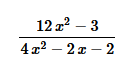
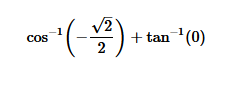
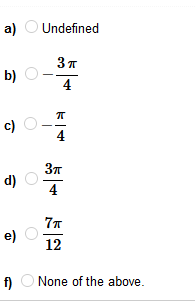 rocky bison
There we go
It's b
We generally only define arccos for one bit of the cos wave
We normally only care about the acute solutions anyway
wary plover
I wish they would make their mind up then, half the time they include an interval
Either always include it or dont at all
rocky bison
That's not for this context thouh is it
echo plaza
uh
wary plover
I have no clue
echo plaza
pretty sure it's d
wary plover
I don't know what "this context" is
rocky bison
You'll be given an interval to solve something like sin(x)=0
Yes?
But not when evaluating arccos(x)
I don't see how this is confusing you so much
There's only one valid solution there
wary plover
All I have to work off is the unit circle, and on that those have multiple meanings. I have no other context
rocky bison
,w plot \arccos\left(x\right)
obsidian monolithBOT
Requested by Pseudo#2703
rocky bison
I'll show this again
Notice how it doesn't go on continuously
It's just between y=0 and y=pi
wary plover
with asymptotes yeah
rocky bison
What?