#precalculus
1 messages · Page 136 of 1
 tawny nacelle
 queen lion
Ohh thanks
tawny nacelle

 viscid thistle
lol soap
 serene heath
apply the chain rule here
 hybrid pewter
o no
serene heath
you differentiated wrong
hybrid pewter
i fucked up didn’t i
serene heath

hybrid pewter
ok i’ll try again sec
 obsidian monolithBOT
lemon catto:
serene heath
k is constant
 swift glacier
Cardioids look like butts
tawny nacelle
looks like x^3
viscid thistle
x^3 doesn't go that quickly to -infinity
 viscid thistle
take out the 1/2 constant
divide by x
,$ \frac12 \lim_{x\to0} \frac{x²-x+\sin x}{x} \ \frac12 \lim_{x\to0} x-1+\frac{\sin x}{x}
obsidian monolithBOT
yami:

 earnest cloak
^
tawny nacelle
hospital rule
earnest cloak
L'Hopital
 tawny nacelle
cause u have a 0/0 situation
viscid thistle
lmao
 desert lantern
do you guys have any good places to look up LH?
desert lantern
thank you very much guys : )
tawny nacelle

Best of Wisin & Yandel https://goo.gl/DRWu3S Subscribe for more https://goo.gl/KKFwMi Music video by Wisin & Yandel performing Pam Pam. (C) 2006 Machete Musi...
this comes up
earnest cloak
lmaooo
hybrid pewter
set what equal to 0?
serene heath
do you know what a log represents
serene heath
it's essentially because you can raise a number to any other number and never get 0
yea
 zinc prairie
ahhh kk
serene heath
it just gets closer and closer to 0
zinc prairie
and u cant have a negative number in the log bc?
serene heath
similar reason
you can raise a number to any other number youd never get a negative
 quick stone
 patent beacon
You can have negative logs if you include complex numbers
But you cannot have log(0) even in the complex numbers
 obtuse ember
a bit stuck on how to find b and c, appreciate the help
has a vertex at (0,2) and passes through the point (1,4)
 royal gull
@obtuse ember I mean, just look at what stays before x^2 - thats a, same with x and the integer by x^0
obtuse ember
@royal gull I got it solved under #help-6 already, mb for leaving the question here xD
royal gull
k
 thick raptor
royal gull
 stark inlet
Did I do this correctly? Question letter J
 earnest nymph
Yeap
 lethal cypress
You're flying from Joint Base Lewis-McChord (JBLM) to an undisclosed location 294 km south and 240 km east. Mt. Rainier is located approximately 56 km east and 40 km south of JBLM. If you are flying at a constant speed of 800 km/hr, how long after you depart JBLM will you be the closest to Mt. Rainier?
I don't understand how to do it at all. Please help.
viscid thistle
no this is simpler; it's just calculus
draw a picture
model your plane's path
write an expression for your plane's position at time t
write an expression for the distance from your plane to Mt. Rainier at time t
differentiate and set = 0 to get the minimum
 atomic urchin
Help please
 naive hawk
try drawing the parabola
viscid thistle
@atomic urchin
naive hawk
^
viscid thistle
what a god
anyone can help explain what the rref button does on the ti series
like ik how to apply it
i just dont know what it does
like it changes the matrix to 10 01 and answers on the end
just didnt attend class for the matrix lesson
 open dust
viscid thistle
open dust
viscid thistle
So for the function of $f(x)=x^2-1$ we need to find what makes it continuous at x=2
obsidian monolithBOT
Simply Me:
 deep trail
if x=2 its c
viscid thistle
For a function to be continuous, ideally, most teachers say "start from end and go to the other end without lifting your pencil"
Although another way to put it is
obsidian monolithBOT
Simply Me:
viscid thistle
Both left and right bound limits must equal each other for the limit to exist, and if all the limits exist and they all equal what the function value equals, than the function is continuous
So.... ask yourself, what point would c be for the function $f(x)=x^2-1$ be continuous?
obsidian monolithBOT
Simply Me:
deep trail
umm
2 right?
4
3
f(2)=3
so need f(2)=lim x--->2 f(2)

can someone help me? im lost
patent beacon
@deep trail
What's the limit of f(x), as x → 2?
deep trail
3
patent beacon
Yup lol
patent beacon
The definition of continuity gives you the answer. The hint is just restating the definition of continuity
Any time the word continuous is used, have that definition in your head
viscid thistle
@simple hemlock use row operations
The standard elimination order is scaling the first row to have a 1 in the first column, eliminating the 2 in the second row, and then eliminating the 2 and -1 in the third row
 gaunt sail
I could really use some help guys. I have 8 questions. Willing to PayPal for help.
It’s on inverse functions.
 buoyant swift
What are the problems? I can try to see if I can give you some help, no money though.
 hollow plover
viscid thistle
hollow plover
viscid thistle
@hollow plover looks right
 green anvil
How do you find the Y intercept of 14x − 6y = 54
viscid thistle
Set x=0 and solve for y
green anvil
Sooo It would be 9 ?
viscid thistle
-6y=54
y=54/-6
y=-9
viscid thistle
It's not too bad
 kind pier
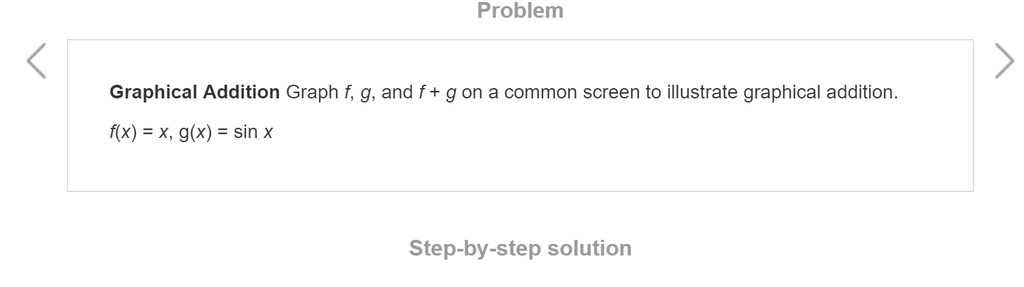
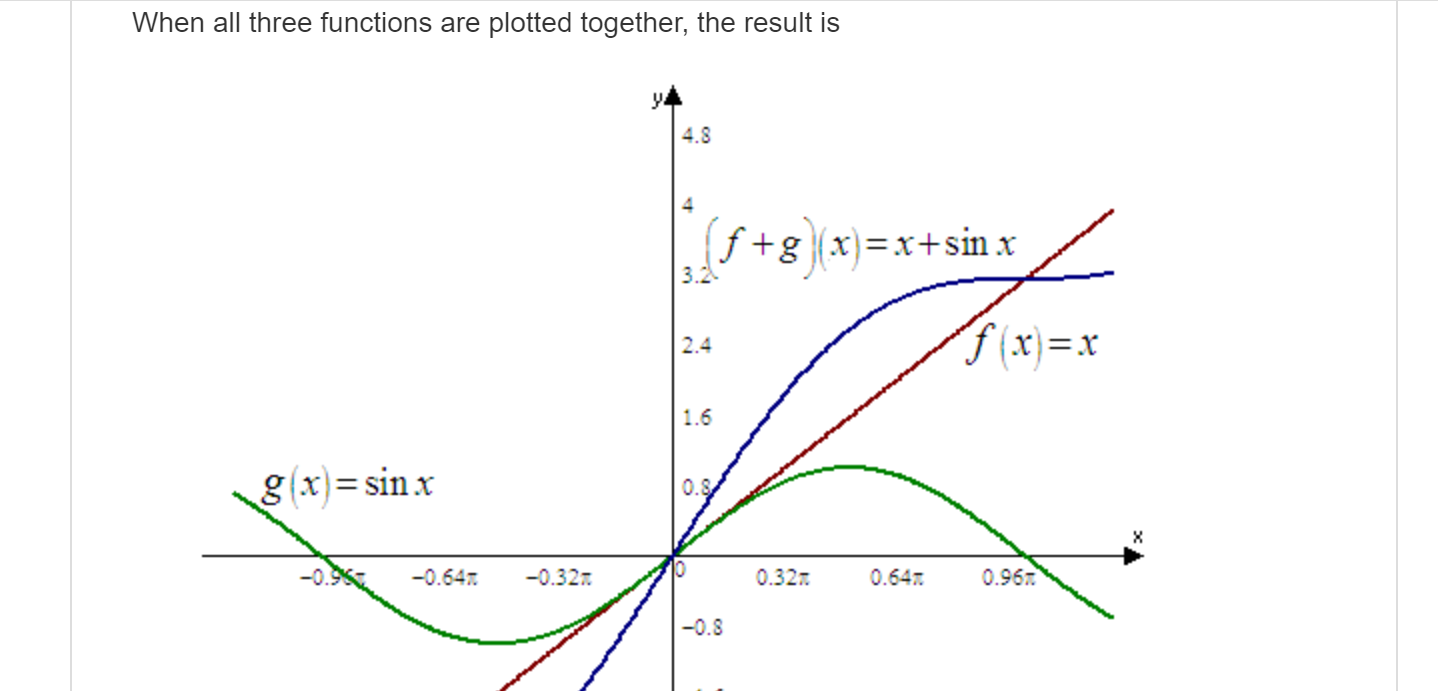
I can see that sin is just getting shift up, but i don't know how explain it numerically
 tall herald
You guys into vectors?
 frozen needle
vectors is a vague word
tall herald
I guess it is, pure math approach, I started working on it last week so have not got much experience yet
 silk crow
What's the method to factor like this?
 limber bone
by grouping
 slow wharf
Finding null points
Any trick to find the imaginary and complex part of $\sqrt{1+i\sqrt{3}}$?
obsidian monolithBOT
Autistic Hoodie:
slow wharf
$x^3+x^2-4x-4=0 \ x^2(x+1) -4 (x+1) = 0 \ (x+1)(x^2-4) = 0 \ (x+1)(x-2)(x+2) = 0$
obsidian monolithBOT
Autistic Hoodie:
slow wharf
@silk crow
silk crow
Do you only keep one of the (x+1)'s from line 2 to 3? @slow wharf
obsidian monolithBOT
Autistic Hoodie:
slow wharf
Like that
silk crow
Ohhh. Thanks!
slow wharf
Np
serene heath
@slow wharf set it equal to a+bi
square both sides
compare real and imaginary parts
slow wharf
Oh wow, haven't thought of that
$\sqrt{1+i\sqrt{3}} = x+iy \ 1+i\sqrt{3} = x^2 + 2xyi -y^2 \ 1+i\sqrt{3} = x^2-y^2 + i(2xy)$
obsidian monolithBOT
Autistic Hoodie:
obsidian monolithBOT
Autistic Hoodie:
slow wharf
How would I go about solving this system of equations?
It will have two answers, won't it?
green anvil
Can you simplify -x^2-1x-1+x+1+1
viscid thistle
I just need E
green anvil
Anyone ?
 stray obsidian
 elfin night
 viscid thistle
education in the USA is not standardized; it varies from state to state and often locality to locality
 distant flume
"Find all maximum and minimum of f(x)=x^3-9x^2+24x using the First Derivative Test"
 south rivet
viscid thistle
south rivet
viscid thistle
@distant flume what did you try?
people here are glad to help others, but not do their work
distant flume
@viscid thistle Get the derivative and draw the single funcions of x^3,-9x^2 and 24x. Then see the right and left of the derivative in relation to the other functions i mentioned. This in two points when x=2 and x=4
I don't know from there onward
viscid thistle
not sure what you said
but indeed x=2 and x=4 are involved
so guess you right
I think you should right things more properly
f'(x)=...
and as you said f'(x)=0 <=> x=2 or x=4
so you can factorize f'(x)
so you can study the variations of f'(x)
so you can see where it is increasing and where it is decreasing
the places where it changes variation (2 and 4) are local minimas and maximas.
to know which, refer to the variations
distant flume
That's what I meant, yes
The problem is that I see no minimas nor maximas although there should be a minima
viscid thistle
@distant flume did you draw the table of variations of f?
using the sign of f'(x)
also, as rockpaperscissors said, f has no global minimas or maximas (f goes to + infinity in + infinitiy and to -infinity in -infinity)
but it has local maximas and minimas
which you can spot looking at the table of variations of f
distant flume
Yeah that's what I thought but I wasn't sure
I did do the table though
Thanks for the response @viscid thistle
viscid thistle
cool! you welcome!
obsidian monolithBOT
Autistic Hoodie:
obsidian monolithBOT
Autistic Hoodie:
serene heath
15=13+2
 spring thunder

serene heath
hang on
slow wharf
Can I do it like
$15 \cdot 3^k \cdot 5^{k+1} + 2 \cdot 2^{k+3} \ 14 \cdot 3^k \cdot 5^{k+1} + 3^k \cdot 5^{k+1} + 2^{k+3} + 2^{k+3}$
obsidian monolithBOT
Autistic Hoodie:
slow wharf
I basically just want to get the $3^k \cdot 5^{k+1} \cdot 2^{k+3}$ part
obsidian monolithBOT
Autistic Hoodie:
 earnest finch
 idle dust
 fossil sedge
Please need help with Q5
I don’t get what they mean by passes fiftyth floor
Is it that we need initial velocity or acceleration before hand?
Or are they suggesting that the lift has a maximum height at the fiftieth floor and that after tht point the velocity is negative because the lift is going down?
Oh and is there a reason why they would give acceleration with variable time as a non given value
 dense charm
Could it be that the lift is falling down but accelerated upwards ?
The explanation is vague indeed
fossil sedge
Yeah I’ve been staring at it for a while now
dense charm
After 5 seconds the acceleration is positive
fossil sedge
And when acceleration is positive then velocity is also positive
fossil sedge
Like in a curve with two stationary points?
dense charm
Think of a vertical toss, acceleration is negative but velocity positive
The question is when does the acceleration stop the negative velocity
fossil sedge
So I have no where tht I know of to start this problem. I don’t even have a vague description of an equation...I just have points
dense charm
Lets call t=0 the moment it passes the 50th floor
fossil sedge
Should I just trial and error some stuff cause I have a wierd feeling tht they give acceleration with unknown time value suggesting tht tht initself is the equation of the acceleration.
dense charm
Can you intgrate the acceletation to get the velocity?
fossil sedge
Yeah yeah ofcourse
dense charm
Okay, so whats the function for velocity
fossil sedge
Anti dif the acc equation
Cause for some reason they put the acceleration equation as one single point on the y axis it’s freaking wierd
dense charm
How do u mean that
dense charm
Do you have the velocity vector now?
fossil sedge
Um...about vectors yeah. I have not even touched vectors one bit
fossil sedge
I will try learn after finishing integrals and then vectors and I’ll have the basics in precalc. Then I will attempt to learn other things on calculus
Kinda exciting tbh idk I think it’s just me
dense charm
Haha math is exciting for sure
fossil sedge
Mhmm
dense charm
You know how to integrate?
fossil sedge
Yeah haven’t touched it either. Sorry haha
I think it’s in the next chapter I will see
dense charm
Are you sure you can solve this without calculus
fossil sedge
Yeah anti diferentiation, and first derivative should be enough
fossil sedge
O isn’t integral the area under the curve?
dense charm
Well thats one of its applications
fossil sedge
Talk in #math-discussion
dense charm
But its calculated by taking the anti derivative
Give me 3 mins
im there
still here
fossil sedge
Ughh I think imma continue try and trial error this problem tomorrow
It’s one am now and I have procrastinated math hw for other math hw
Anyways thnx for helping I have to sleep
dense charm
the solution should be somewhere between the 26th and 27th floor
have fun
sleep well
fossil sedge
Wait woah u know estimations
Ok anyways I’ll try again tomorrow
Hey is u solve the problem please post a picture here
dense charm
its not an estimation i calculated it
im happy to explain it but im not just posting the soltuions
spring thunder
i found exactly 29th floor 
+the way the problem is written makes you think that the ans should be exact
 marsh plover
Hi! I'm learning about conics right now, and I have a problem with ellipses.
$x^2/a^2+y^2/b^2$
obsidian monolithBOT
perrot:
marsh plover
=1
Whoops
If a gets bigger than why does the ellipse get wider?
Shouldn't a denominator getting bigger make it smaller?
Like 1/2 going to 1/4
viscid thistle
Let's see where the ellipse intersects with the x axis
it means y = 0
So $x^2/a^2 = 1$
obsidian monolithBOT
Xaositect:
viscid thistle
$x = \pm a$
obsidian monolithBOT
Xaositect:
marsh plover
Yeah
Yeah
I got there on my own terms
And I was satisfied with it
But my precalc teacher told me that I should have used Pythagorean theorem
To find out the relationship between x and a
Thanks though!
viscid thistle
I'm not sure what the teacher meant there
marsh plover
Yeah me either
viscid thistle
In general, If you have something given by an equation f(x,y) = 0
and you want to scale it k times along the x axis
You get f(x/k, y) = 0
Because k units on the x axis in the new equation correspond to 1 unit in the old one
fossil sedge
@spring thunder can u show me how u solved the problem?
Cause itll be nice if I could see where I did it wrongly
spring thunder
whatchu got?
spring thunder
interesting seeing your attempt tho
fossil sedge
Attempt?
spring thunder
your work for the problem i mean
fossil sedge
Oh um.....i don’t wanna humiliate myself cause I just wrote all over the page like an idiot
spring thunder
oke w/e
fossil sedge
Kinda went back and forth and then did a lot of mistakes but couldn’t trace back
In the end somehow I got answer of 51 floors
Please don’t laugh
spring thunder
answer : the people are dead
fossil sedge
Yeah lift rocketed out of the building
And apparently so did my rational thinking of problems at one am
So please please can u show me the right steps?
spring thunder
so $a=\frac19 (t-5)$ (assuming initial time is when the elevator passes the 50th floor)
obsidian monolithBOT
emeric75:
spring thunder
so you haven't done integration yet right?
fossil sedge
If integration is anti derivatives then yeah I have basic
spring thunder
yeah polynomials aren't too hard
fossil sedge
So antiderivative acc, we get velocity function with a constant missing
Then what do we input to find it?
spring thunder
& you know the initial velocity
thick raptor
constants should come from known values given in the problem
fossil sedge
Wait woah wats the initial velocity? -8?
spring thunder
yes
fossil sedge
Ooh ok and the maximum height or position would be 300 metres in other words the fiftieth floor right?
spring thunder
or you can just say the origin for the position is the 50th floor (ie the initial position of the elevator)
or 50th floor : 300 w/e it also works
fossil sedge
When the time is 0 the floor is 300 cause we start there ooooo ok
So if we do a graph fifty should be a y intercept
Ok I see
And then we use that point and find the height equation and we r done I guess
Wow thanks
spring thunder
well yeah try out the calculations at least 😄
in my calcs i assumed 50th floor = 0m, as long as you stay consistent you can choose whatever origin you want
fossil sedge
Oh one more thing when they say when the lift stops on which floor...I’m confused
spring thunder
(just not something too wacky like 17th floor because why not)
"when the lift stops" when the velocity of the elevator = 0 is what they meant
fossil sedge
What happens when lift stops....does it become another intercept of the height equation. Or is it when velocity equals zero?
Oh ok
spring thunder
but yeah the problem isn't well written indeed
fossil sedge
Ok thank you so much again 
Ooo and guess what when velocity equals zero then it’s also a stationary point lol how have I been so blind
spring thunder
 lost talon
Can someone explain how the formula works?
It basically just says area = measurement/360 times the area so I'm confused how the area doesn't equal the area
 barren hedge
Well the measure is by degrees, so m=180° means half the circle, which if you plug into the equation you get ½πr², which makes sense.
 flint lichen
Would anyone be willing to help me with this? "AN airplane flies on a compass heading 90 degrees at 340 mph. The wind affecting the plane is blowing from 292 degrees at 31 mph. What is the true course and ground speed of the airplane?"
flint lichen
Looks good but how would you convert x,y to degrees @barren hedge
barren hedge
Hmm.
flint lichen
Inverse tan?
barren hedge
Sounds right.
flint lichen
Ill plug in the numbers and @ you for confirmation if thats alright
barren hedge
tan⁻¹(y⃗/x⃗)
flint lichen
wait whered you get the 22 from?
flint lichen
why not 292-90?
barren hedge
Why 360-292 and not 292-90? Because we're preserving that a circle is 360°
And we want the angle to be less than 90°, whereas whether it's +sin, +cos, or -sin, -cos, is depending on which quadrant the wind is blowing.
In this example, it's quadrant IV, so sin(292°) is (-), and cos(292°) is (+)
 ionic hazel
fossil sedge
ionic hazel
fossil sedge
@spring thunder in regards to my question yesterday. I would like to know if velocity is possible when there is 0 time
I don’t understand the concept because when the question said the velocity is -8 I assume it is initial velocity and initial meant when X axis value or time in this case is 0
Cause I kinda did mistakes again
I don’t know why this problem is not making sense to me at all
It makes some sense but my answer is somehow far off
Here it is again so u don’t have to search for it
a=1/9(t-5)
§ 1/9(t)-5/9
V=t^2/18-5t/9+c
Now I will input velocity -8 when time 0
-8=c
Antidiverentiate V and we get the Height. Then we input the 300 metres (50th floor) and time 0 and we get the missing variable of the antiderivative.
Then I just equalise the V equation to 0 use quadratics and I get two points
Input one of them into the Height equation and we should get the answer no?
And despite doing these steps my answer still wrong
barren hedge
It's not the 4th floor?
 cedar chasm
slow wharf
cedar chasm
slow wharf
Is $det(\frac{A}{3}) = \frac{det(A)}{3^2}$
obsidian monolithBOT
Autistic Hoodie:
 viral flicker
It depends: what is A?
frozen needle
I guess it works for 2×2 matrices
slow wharf
I've tested with other matrices too and it seems to work too
I couldn't find any theorem stating that it's valid though
viral flicker
other than 2x2 matrices?
slow wharf
Tested with 3x3 and it worked...
viral flicker
try it with the 3x3 identity matrix
the left side is the determinant of the matrix with 1/3 on the diagonals
which is 1/27
the right side is det(I)/9 which is 1/9
viral flicker
yes
slow wharf
I may have tested it on 2x2 actually
viral flicker
then yes it's always going to work in that case
viral flicker
one of the "rules" for determinants is that if you multiply a column by a number, then the determinant gets multiplied by that number
so when you multiply a column by 1/3, the det gets multiplied by 1/3
so if you multiply the whole matrix by 1/3, then that's multiplying each column by 1/3
and so in an nxn matrix there are n columns so that changes the determinant by 1/3^n
spring thunder
@fossil sedge just show your thing yes I was in class
 stuck palm
How would I find the tangent line? I don’t know the formula for it, I think it’s y-y1=m(x-x1) but not sure on how to find m
 pulsar onyx
This is precalc, but you know derivatives?
If you know derivatives, take the derivative of the function and plug in the given x value (1).
stuck palm
Sorry it just seemed like the people helping in precal were more helpful than calculus. I plugged in 1 and got 4
pulsar onyx
okay, so f'(1) is the slope at x=1
stuck palm
So would I use that formula y-y1=m(x-x1) and plug 1 into x1?
pulsar onyx
ya, plug f'(1) in for m, plug 1 into x1, and f(1) into y1
because derivative is slope, 1 is your xposition, and f(1) is the y value at that xposition
stuck palm
Damn man thank you so much! I appreciate that a lot!
pulsar onyx
np
fossil sedge
@spring thunder um....I kinda did 9 times 2 =81
Oops
I got the answer nw
300-126=174 174/6. =29th floor
viscid thistle
I know vectors (a,6) and (2,a), and now I need to find what a must be so the two vectors point to the same direction. The answer I must get is +/- 2 sqrt 3.
What is the right method to figure out what a must be?
serene heath
did you read what i typed in #prealg-and-algebra ?
viscid thistle
I did
serene heath
thats the method for it ig
viscid thistle
Do you mean I should rewrite them?
viscid thistle
oh yes
serene heath
well there u go
viscid thistle
that I did not come up with tha
slow wharf
How do I solve a limit such as $lim_{x\to2} e^{\frac{1}{x^2-5x+6}}$
obsidian monolithBOT
Autistic Hoodie:
slow wharf
Without the use of a calculator
Like
Why is the derivative from the right 0??
I understand that the derivative of the right will have
$e^{-\infty}$
obsidian monolithBOT
Autistic Hoodie:
obsidian monolithBOT
Autistic Hoodie:
slow wharf
But shouldn't that be equal to one?
frozen needle
What are you even trying to do? Calculating the limit from the original post or a derivative that you didn't mention in the original post?
slow wharf
Solving the limit
frozen needle
Does it even exist though?
frozen needle
Prove it
slow wharf
xd
frozen needle
$\lim_{x\rightarrow 2}\qquad\lim_{x\rightarrow 2^-}\qquad\lim_{x\rightarrow 2^+}$
obsidian monolithBOT
Tuong:
frozen needle
sometimes, these do not exist simultaneously
slow wharf
That's correct
If the function is not continious at the point the left and right limit may be different which means that the limit and that point does not exist
$\lim_{x\to2^+}e^{\frac{1}{x^2-5x+6}} \ e^{\frac{1}{0^-}} \ e^{-\infty} \ e^{\frac{1}{\infty}} \ e^{0} \ 1$
obsidian monolithBOT
Autistic Hoodie:
slow wharf
Is it not?
obsidian monolithBOT
Tuong:
slow wharf
Well yeah...
frozen needle
you wrote that yourself
slow wharf
Yeah but that meant I wanted to find both derivatives
Limits from the left and from the right
Limits**
Sorry
I understand that the limit from the left is +infinity but I don't understand why the right limit is 0 and not 1
frozen needle
"exp(-∞)" isn't the same as "exp(1/∞)"
frozen needle
Well first, there's no such thing as "to the power of minus infinity"
Then
$\lim_{x\rightarrow - \infty}e^x=0$
obsidian monolithBOT
Tuong:
 indigo granite
Hi there folks! I've got a quick question regarding standard form eq for circles. If I had a center at (2, -1) and the line passes through (4, 3) and I wanted to get an equation in standard form I could use the distance formula on those two points to find the radius correct? And after I have the radius I can fill out standard form.
In other words I need to fill out (x-h)^2+(y-k)^2 = r^2. I have the two points I mentioned earlier. So to find r I can just use the distance formula. Correct?
 viscid patrol
Given log100 = 2 and log3 = 0.4771, what is log300?
patent beacon
Log(300) = log(100×3) = log(100) + log(3)
indigo granite
Wouldn't that be 2.4771?
patent beacon
^^
indigo granite
Kaynex actually helped out by explaining why though 
fossil sedge
Can someone find derivative of f(x)=(x+2)^2 * (x-b) for b is a rational number
And do we use the quotient rule for this or is there a way to find derivative of it using just the chain rule?
 meager topaz
Hint : assume (x+2)^2 a new function g(x) and apply quotient rule and to differentiate g(x) , apply chain rule.
 hexed ermine
Just use quotient rule where g(x) = 1/(x-b) tbh
serene heath
quotient rule
 pastel quest
Hi which is the best way to start learning precalculus?
I am going to start it
By myself
So any advice?
slow wharf
$y+cos(\frac{x}{y})^2=\frac{9}{2}$
obsidian monolithBOT
Autistic Hoodie:
slow wharf
The derivative would be like
$y' + 2cos\frac{x}{y}(-sin\frac{x}{y}) \frac{-xy'}{y^2} = 0$
obsidian monolithBOT
Autistic Hoodie:
slow wharf
$(\frac{x}{y})' = \frac{x'y-xy'}{y^2}$
obsidian monolithBOT
Autistic Hoodie:
 remote musk
hah
that's interesting
the quotient rule doesn't work here
woops
sorry
i made a mistake

 heavy root
The three stooges (Larry, Curly and Moe) are trying to move a piano. Larry applies a force of
700 N [S 60° W], Moe applies a force of 900 N [N 30° E], and Curly
applies a force of 1000 N [S 45° E].
a) Draw a position diagram for the piano.
b) Draw a vector diagram for the piano.
c) Calculate the resultant force, and express it as a magnitude and direction.
d) Calculate the equilibrant force.
meager topaz
Just resolute the force vectors ?
viscid thistle
draw the diagrams and add the vectors
you should know how to do both; if you don't, then you shouldn't even be starting on the problem
these are basic skills in physics that they should have taught you before assigning this problem; there's nothing particular to the problem that's tricky at all or that you should need help figuring out
Have you tried anything with regards to the problem?
 eternal lotus
Is it appropriate to call the asymptotes of a hyperbola, oblique asymptotes?
fossil sedge
I forgot what oblique means
 rocky bison
t!wiki oblique
 brisk micaBOT
📖 | ** https://en.wikipedia.org/wiki/Oblique **
Oblique may refer to:
an alternative name for the character usually called a slash (punctuation) ( / )
Oblique angle, in geometry
Oblique triangle, in geometry
Oblique leaf base, a characteristic shape of the base of a leaf
Oblique angle, a synonym for Dutch angle, a cinema...
viscid thistle
because that is the function on which it lies
 small basin
So I got this worksheet with formulas on it, but it doesn't tell me what the numbers stand for. It says it's the "time value of money" formulas, and it has M, r, n, and t. I assume M = monthly payment, r = rate, n = number of times compounded, and t = time passed, but I'm not sure. Is that right?
patent beacon
@small basin
Still need it?
small basin
yeah
when i plug it in, it gives me an overflow error if i use 12
but when I use 1 it makes more sense and is reasonable
small basin
isnt it annual so the n is always 1
patent beacon
Oh. t = number of periods
n = number of compounds per period
small basin
oh
patent beacon
r = rate per period
small basin
thank u
 limber onyx
I may not be reading into this correctly
but for #10
I believe taking exp of both sides gives you y = exp(2 + 4 * ln(x))
@viscid thistle
actually never mind, there's something even better
4 * ln(x) = ln(x ^ 4)
and ln(x ^ 4) + 2 = ln(x ^ 4 * exp(2))
so y = e ^ 2 * x ^ 4
or even better
exp(2 + 4 * ln(x)) using laws of exponents
is y = e ^ 2 + x ^ 4
so yeah multiple attacks
I have to go now, but I will be back soon if you have questions, or maybe someone else will attend
viscid thistle
What is exp? @limber onyx
limber onyx
@viscid thistle abbreviation for e ^ x
 fallen cloud
Exp is longer tho... 10/10 abbreviation
serene heath
lol
viscid thistle
I need help with these two inequality questions
Whoops wrong chat sorry
Hey @viscid thistle are you still there?
I don't mind helping
Yeah still here
Cool so you need help with 41)?
And the question above it
Okay well we'll start with 41 then. Does that say +18 or -118?
+18
okay
So do you know how to factorise?
Yeah
So you need to factorise the left hand side
(x-6)(x+3)<0 I'll have to use < as I have no clue how to do less than or equal to.
Wait no that's wrong
Ohh I thought I would have to use (b/2)^2
Sorry man I gotta be drunk or something
You need to use the formula
Not that’s right
Oh wait
Nvm
-6*+3 is definitely not +18. That's why I originally asked about your hand writing. Then I just got side tracked and I wrote down - on my piece of paper anyways
Do you know the quadratic formula?
like the -b +/- sqrt(b^2 -4ac) and so on
Yeah but i don’t think that will help tho
Oh no it will
The b^2 -4ac part is negative
Which you can't do.
serene heath
why not just factorise it then sketch?
viscid thistle
So you say it has no real solutions.
Like at no point is that quadratic below or equal to 0
-6 and 3 doesn’t equal to 18 @serene heath
serene heath
oh its +18 nvm
viscid thistle
Yeh @serene heath I made the exact same mistake AFTER asking him to clarify the handwriting.
Sorry @viscid thistle I gotta go. But for the other one x>0 and x>-7/2 sketch it and make sure you have the inequality the correct way!
Tyty
 final rover
Wait... What if x<0 and x<-7/2 ? That is a solution for 40), right ?
final rover
Yes, it's for 39, not 40, my bad.
viscid thistle
It’s good
Anyways I’m so stuck on 41. I might just check my notes about it. If I don’t find the solution I’ll hit you guys up
viscid thistle
@viscid thistle I told you the answer to 41. It doesn't have any real solutions as the discriminant is below 0
viscid thistle
Alright
viscid thistle
If x^2 is transformed and translated by a vector (2 3)
then does it become (x-2)^2 +3 ?
 slender river
yeah
green anvil
Find the zeros of the function algebraically.
f(x) = 2x2 − 7x − 72
Anyone able to help ? ik to change F(x) to 0 and thats it...
the 2x2 is soupose to be a exponet of 2..
patent beacon
Can you factor that?
green anvil
I dont think so now that IM looking at it, its soupose to be 2x^2-7x-72=0
patent beacon
Yes, that gives the zeroes. But, one way to find them is by factoring
green anvil
Yea.. Im confused.
patent beacon
Hmm. I'm having trouble factoring it. Maybe it can't be? Know the quadratic formula?
No, it is factorable
 wide frost
every polynomial can be factored
 rare zephyr
Sun is down
Freezing cold
Thats how we already know winter's here
My dog prolly do it for a Louis belt
Thats just all he know
He dont know nothin else
I try to show em
 haughty kraken
uch
So i can simplify
by (x+2)(x²-3)
and next? 😄
so x1 = -2 and x2 is +- root of 3 ?
spring thunder
those are all the sols ye
spring thunder
wym?
haughty kraken
what is wym?
spring thunder
you can factor an x out
haughty kraken
x(x²+10x16)=0
spring thunder
now you can try factoring that quadratic inside
haughty kraken
ur right xD
 cinder ocean
Hey guys, could anybody explain to me how the simplification works between these two steps?
spring thunder
$$\frac{1}{2\sqrt{x}}\sin(x) - \sqrt{x}\cos(x) = \frac{1}{2\sqrt{x}}\sin(x) - \frac{1}{2\sqrt{x}}\sqrt{x}\times 2\sqrt{x} \times\cos(x) $$
obsidian monolithBOT
emeric75:
cinder ocean
@spring thunder Wow! ok, thanks I got it
But I would never had figured that out on my own
How does one get that intuitive feel in mathematics?
serene heath
steroids
spring thunder
but yeah seeing that 2sqrt(x) going to the den makes you think that there was some factoring in the numerator going on
and apart from drugs, the boring answer is just practice (a lot) and git gud
and if your head is a tad slow, just ask your mates (or the discord) or try on your own until your brain melts
@cinder ocean
cinder ocean
@spring thunder hahah okay, thanks. Yeah, I'll be asking here a lot 😃
swift glacier
Would f^2(x) be the same as f(x)^2?
 vernal anchor
depends on the author i guess
sometimes f^2(x) is used to denote function composition, i.e. f(f(x))
swift glacier
Oh thanks
 pure dagger
Ye, the only exception seems to be with trigonometric functions where people write sin²(x) all the time when they mean (sin(x))²
(and only spawns of the devil ever encounter problems where something like sin(sin(x)) is relevant)
barren hedge
f²(x) is an odd notation.. I know that f⁽¹⁾(x) means the first derivitive of f(x), A.K.A. f'(x).
slender river
ehhh it's a meh notation ive only ever seen it used in like weird taylor series thingys
final rover
I've asked my analysis professor about that...
$$f^2(x)=f(f(x))$$ $$f^{(2)}(x)=f''(x)$$ $$f(x)^2=(f(x))^2$$
obsidian monolithBOT
TSM64CM:
final rover
Except in one case... $cos^2(x)=(cos(x))^2$
obsidian monolithBOT
TSM64CM:
slender river
ewwwwwww
this is all so 🤢
like this is all fine if u have like a sentence before it saying
that this is how the notation will be used in the next few pages or watever
but
echhhh
swift glacier
What if it just askes how to transform f(x) into f^2(x)
final rover
Just apply the function a second time, I guess ?
vernal anchor
what would transform in this case even mean
swift glacier
ok a mood
final rover
The first and third one are the most confusing ones.
swift glacier
I'll just write something on the graph, it's just completion grade + I'll also ask my teacher
 chrome temple
n1*sin(i) = n2*sin(r)
(n1/n2)*sin(i) = sin(r)
I don't understand how the top
became the bottom
for snells law
wouldnt everything on the left side be divided by n2?
barren hedge
From what I understand,
$n_1 sin(i)=n_2 sin(r)$ divide both sides by n_2 $\frac{n_1}{n_2}sin(i)=sin(r)$
chrome temple
uh
that did not really answer my question though
why is sin not being divided by n2
sin(i) is not being divided by n2
barren hedge
$\frac{n_1sin(i)}{n_2}=\frac{n_1}{n_2}sin(i)$
obsidian monolithBOT
MathLyfe:
barren hedge
There we go.
barren hedge
Oh you mean some sort of proof? Usually it's just how it is, lol.
chrome temple
sin(i) in snells law is not being divided by 2
remote musk
it's the associative property of numbers
if you want proof you're gonna have to prove the associative property of numbers
barren hedge
Okay thank you for giving a name for it, lol.
barren hedge
Commutative is like AB=BA
remote musk
yeah i guess associative and commutative?
the fraction on the left is (n1 * sini) ÷ n2 the fraction on the right is (n1 ÷ n2) * sini
barren hedge
(technically that's just associative lol)
chrome temple
yeah thats what I assume is suppose to happen
but like
what happens to the sin(i)/n2
why does it just disappear
barren hedge
You factor it out, for lack of better words.
barren hedge
Nope.
remote musk
(n1 * sini) ÷ n2 = (n1 ÷ n2) * sini = n1 * (sini ÷ n2)
barren hedge
But he's asking why, hmm.
Recall that when multiplying fractions, you multiply the top with the top, and the bottom with the bottom,
chrome temple
yeah
barren hedge
$\frac{n_1sin(i)}{n_2}≠\frac{n_1}{n_2}\frac{sin(i)}{n_2}=\frac{n_1sin(i)}{n_2^{2}}$
obsidian monolithBOT
MathLyfe:
barren hedge
Hopefully that makes sense.
obsidian monolithBOT
MathLyfe:
barren hedge
That is what it means to factor out something, in this case since the 1/B is infront, you can say I factored out a 1/B from A/B
chrome temple
but the top for n1 isnt 1?
barren hedge
Even though the A is no longer in the "fraction" it's still there because of the associative property.
It's a general case example.
$\frac{n_1sin(i)}{n_2}=\frac{1}{n_2}n_1sin(i)$
obsidian monolithBOT
MathLyfe:
barren hedge
^ Would be your case.
But to get n1/n2, you would multiply the two fractions (1/n2 & n1/1).
barren hedge
Well there's not mathematical proof for that lol. It's just based on mathematician preference.
barren hedge
Computer Science?
chrome temple
yep
doing things different ways
come out as different answers
could be off by the 15th decimal point
swift glacier
Would I just find the vertical component for this problem? A projectile is fired with an initial velocity of 550 feet per second at an angle of 70 degree with the horizontal. In how
many seconds will the projectile strike the ground?
 dim ruin
 vestal plaza
I understand how to do it by giving us (x,y) I dont understand how to do it by them just giving us x intercept
vestal plaza
so would I do y-0=4(x-8)?
serene heath
yup
vestal plaza
what about the second one
serene heath
horizontal lines have equations y=a
where a is a constant
and vertical lines have equations x=a
vestal plaza
so it will be y=3/11 and y=-5/7?
serene heath
no those are both horizontal lines
vestal plaza
I dont understand
vestal plaza
so it will be x=-5/7?
vestal plaza
it would be the y=3/11
vestal plaza
@serene heath can you help with Modeling with Liner Functions word problems?
vestal plaza
ok
 shell salmon
For slope, first one is growth per year, second one is cost per bike
For y int, first one is initially population, second one is overhead costs
 cerulean fable
<@&286206848099549185> Hello. Does the sign always change for the x-interval with this formula on the graphs?
 shell salmon
Yes
cerulean fable
And if it was a negative, would it change to postive?
shell salmon
Yes
viscid thistle
can i simplify this
4/(2-t)^2 = 2/(2-t)
patent beacon
Multiply both sides by (2 - t)²
viscid thistle
so i can’t square root the top and bottom??
patent beacon
Wat
viscid thistle
it’s the f’(t) of f(t)
can i simply a rational function by square rooting the top and bottom tho
patent beacon
No, since taking the square root of something will change its value
Much like x doesn't simplify to x + 2
viscid thistle
oh so it’s not allowed?? i thought i saw it done sometimes tho
patent beacon
It is true that the square root of 4/(2 - t)² is 2/(2 - t)
But it is not true that 4/(2 - t)² = 2/(2 - t)
viscid thistle
ohh
patent beacon
Oh, also note the potential ±
patent beacon
Yes that doesn't simplify any nicer
viscid thistle
thankss
 open apex
@patent beacon
Would you happen to know how to do it, nobody's really said anything for the past 20 minutes
 fringe hollow
Does anyone have a method for finding zero's of a polynomial that is faster than the rational zeros theorem?
patent beacon
@open apex
Hey, still looking?
open apex
I don't really know how to approach it, that's the main issue
open apex
Identity matrix is the way I approached it
patent beacon
Hmm?
open apex
Uhhh
If I had a pencil and
Give me a minute
Then you'd do
1/3! and the matrix
Infinitely
patent beacon
Yes, that's the definition of e^M
patent beacon
And that, exactly, is the problem. How do we find an easy way to express it?
open apex
If you're trying to ask me, I have no clue
I looked at the problem for a fat 30 minutes and tried to do a bunch of things with it
patent beacon
We need an easy way to find the entries of Mⁿ
Cayley-Hamilton comes to mind if you know that one
open apex
As I said
Most of the math I do is intuitive
But uhhh
There's a pattern, I'm just being retarded to what it is
I'm pretty sure you're just supposed to find the pattern that's taking place and then you go off from there, but I'm kinda clueless
patent beacon
There you go, now you're thinking.
Indeed, knowing that pattern would help
Top left is pretty clear, that's just 2ⁿ
patent beacon
Top right isn't so clear though
open apex
patent beacon
Actually, 2ⁿ - 1 makes sense yeah
patent beacon
That's Mⁿ you found