#precalculus
1 messages · Page 134 of 1
 viscid thistle
viscid thistle
viscid thistle
no I can;t
 clever inlet
?
viscid thistle
what
 serene heath
=pup factorise (3x^4-4x^3+1)
serene heath
never say never
clever inlet
you get the remaining factor generally by long division
viscid thistle
I understand now
clever inlet
or any division method
sometimes, there are nice shortcuts
but i don't see any here
serene heath
.
viscid thistle
what shd I do next
the answer is a o with a slash
@serene heath @clever inlet
ø
clever inlet
limit does not exist
viscid thistle
?
viscid thistle
Can you explain a bit
viscid thistle
yep
clever inlet
meaning you can do more work to possibly reach some answer
viscid thistle
yes
viscid thistle
oh
viscid thistle
so once I have found out theres nothing I can do, so the limit doesn't exist
right?
clever inlet
kind of i guess
serene heath
yea it doesnt
clever inlet
you start to learn cases where limit dne
viscid thistle
my teacher just gave us this ws
serene heath
=pup plot (x+2)/(x-1)
viscid thistle
and he just showed us how to do the factorization wihtout even telling us about the indeterminate form lol
serene heath
yea
viscid thistle
but
serene heath
top and bottom have a factor of -1
viscid thistle
oh
serene heath
so you can factor out (x+1)
viscid thistle
k lemme try
oh it's somehow related to the use of remainder theorem right? @serene heath
serene heath
t!yt polynomial long division
 brisk micaBOT

This math video tutorial provides a basic introduction into polynomial long division. it explains how to find the quotient with the remainder given the divid...
serene heath
this should help
 little hazel
im fixin it
viscid thistle
Bot does it 4 u
little hazel
oh
viscid thistle
Ye, ye
little hazel

 obsidian monolithBOT
Couldn't find an attached image in the last 10 messages
viscid thistle
Alright
little hazel
well i need help figuring out part B
idk what the H is there for
guess ill move it to one of the channels down below
 eternal lotus
I guess once you've simplified the arc between x=2 and x=2+h
You can sub h=1
To get the ARC between x=2 and x=3
little hazel
but how do i simplify the arc between those two if i dont know what h is
viscid thistle
=pup graph 2x^2-x
eternal lotus
The way you simplified the ARC between x=-1 and x=0
Once you get an expression that gives the ARC between x=h and x=h+1 in terms of h of course u sub h=1
x=2 and x=2+h * sorry
little hazel
so h is just 1
eternal lotus
Yeah becaue of h=1 we get the ARC between x=2 and x=2+1
Which is the arc between x=2 and x=3
Which is what we want
 ocean mauve
serene heath
ocean mauve
serene heath
theyre just practicing their camera angles dont mind them
ocean mauve
^^^^
 fair solar
what are the key differences between a hyperbola and ellipse
 hexed ermine
Both are very similar ellipse has a +, hyperbola has a -
 kind pier
is there a way to find the equation of a half of a curve like in a supply and demand graph so you can estimate the future if the trend continues?
viscid thistle
id assume that he means something like arc length
say you have a curve in the domain 0 < x < 2
take half of that
.. or something like that XD
 slender river

 fallen cloud
Sounds like differentiability and Taylor series
 deft flume
how do i solve sin(B)=10(4)/sin(36deg.) ?
The given were A=36deg., a=10, and b=4
Law of Sine, to solve the triangle
any help would be nice
oh nvvm, i knew i had to do the inverse sine to both sides
for some reason, i cant do thr inverse sin in the calculator
its in degree mode
 atomic zodiac
why not
atomic zodiac
that would be because the domain of sin^-1(x) is -1≤x≤1
deft flume
nvm, i got it
 cosmic furnace
Very small question regarding transformation of quadratics
Would a horizontal shrink by a factor of 2/3rds be (1 ⅔X)^2?
 spice mountain
For number 6) a) and b) my teacher graphed them like this. I don’t know how she did it. Can someone pls help explain?
And also I don’t know how to solve a quadratic inequality from looking at a graph. Can someone help explain?
clever inlet
do you have trouble with graphing quadratics in general
or just the regions for inequalities?
 clever inlet
well it's either inside or outside
 limber bone
vegangod
what a terrible name
anyways
its too easy
if y is more
like y >3x+4
then u shade up
if y is less
y <3x+4
u shade down
=pup grpah y > 3x +4
 granite stirrupBOT
limber bone
granite stirrupBOT
limber bone
= pup graph y < 3x +4
granite stirrupBOT
The bot is already processing a Wolfram|Alpha query for this server.
Try again in a moment.
Query made by
@limber bone
limber bone
more
above the line
u shade above the line
same with anything
imagine quadratics like two lines
if y > more
then shade above them
smae with absolute functions
and so on
got it?
spice mountain
For quadratics though I know how to do linear just not quadratic
clever inlet
^
clever inlet
when in doubt though, just test a point
limber bone
ye
but thats like
when ur really worried
like htink of it
if i want the values more than y
and i have y grpahed
then i shade higher thany XD
than y*
right?
=pup graph y > x^2
granite stirrupBOT
limber bone
=pup grpah y < x^2
granite stirrupBOT
The bot is already processing a Wolfram|Alpha query for this server.
Try again in a moment.
Query made by
@limber bone
 limber bone
https://media.discordapp.net/attachments/363224154469826562/537936803554918410/result.png this is the graph of y > x^2

see how he shades above the lines
of the quadratics * assume they are lienes *
lines*
got it?
spice mountain
No sorry
limber bone
its ok
y > x^2 for example
to graph inequalities
all they differ from than normal equations
is that just the shading
and there are only two places where u can shade
above or below
how do u know? from the sign ofd the inequality
if y > then shade up
if y < then shade down
thats it
and note something small
if y > then do dotted lines at the end
if y>= then graph it normally and just do the shades
got it ?
spice mountain
y>x^2, why isn’t it at (0,0) for the origin of the parabola ??
Oooooo okay I understand the shading now
Also for this question: how do you find the inequality equation
??
The check mark is my teachers answer, I don’t know how she got it
clever inlet
well once you got the equation for the quadratic itself
you apply the same idea from above with the above or below
and the curve is dotted
which is used to represent strictly less than, or strictly greater than
strictly less than in this case
spice mountain
I don’t understand what’s your talking about 
limber bone
he means
its the same thing as like wrinting an equation of a normal parabola
just differ the inequality sign
and if its weak or strong
here its dotted
and below the parabola
so y less
y <
go tit?
got it*
clever inlet
was there working before this?
spice mountain
I understand that
clever inlet
cause she seemed to jump a bit ahead
you would generally need to find the leading coefficient
using a third point
usually the vertex
spice mountain
No she’s a bad teacher she just writes the answers and sits in for the rest of the time
clever inlet
here
spice mountain
If u ask her question she gets mad
limber bone
tell her u love her
 earnest nymph
The y intercept maybe help?
earnest nymph
-12
clever inlet
ah yeah
spice mountain

clever inlet
that point would be useful in finding the leading coefficient
your teacher wrote 2 for it
which i assume is correct
but with like no working out
y = a(x-3)(x+2)
plug in (0, -12)
solve for a
that's generally how you would do it
spice mountain
The drawing isn’t on zero so I got confused idk my friend said just say it’s zero cuz she drew the graphs up
clever inlet
what do you mean?
spice mountain
Why y=a(x-3)(x+2) where’s does this equation come from
clever inlet
It's the more general roots forn
limber bone
so u have problems with graphing tghe function as itself
not the inequalities
right vegan
?
clever inlet
Your two roots aren't enough to determine a unique equation for a quadratic
spice mountain
The vertex isn’t exactly on 0,-12 so I was confused with that 
limber bone
^ ye but in most cases they are
but like
sometimes the parabola
is ab it stretched
from this a factort
so u need another poiunt
which kangaroux said
the y intercept
clever inlet
You can use any third point
clever inlet
That's kind of specific to linear functions
spice mountain

clever inlet
That's the general roots form for a quadratic
spice mountain
Is a the slope?
clever inlet
Ehh
In a sense, it affects steepness
This is the type of situation where playing on Desmos helps
spice mountain
Sorry I don’t understand what this equation means the y=a(x-3)(x+2)
And why did the signs become opposite for 3 and -2 when you put it in
I just don’t understand what the equation means
clever inlet
Well, what happens when you plug in x = 3
y becomes 0 right?
This is what we want
clever inlet
essentially now narrow or wide it is
the cool thing is, no matter what a is in that form
it will always pass through the given roots
spice mountain
Ok thanks guys I understand now
 coral mulch
hello
i have a question its very simple
but my brain isnt working atm so i need help
make (A/t )the subject of A=-A_0 *e^ -(lamda *t) where lamda = ln2/t_(1/2)
so this
make A/t the subject ^
 fickle moat
ocean mauve
viscid thistle
fickle moat
ocean mauve
viscid thistle
When finding the domain and range of an inverse function we swap the domain and range of the parent function right? So the domain of tan is (-pi/2, pi/2) and the range is +/- infinity. This would mean the domain of arctan is +/- infinity and the range is (-pi/2, pi/2). Is that correct?
viscid thistle
<@&286206848099549185>
viscid thistle
The domain of tan is restricted to (-pi/2, pi/2) or the domain of arctan is restricted?
@serene heath
Cause my understanding is that the domain of of arctan doesn't need to be restricted since it isn't periodic right? Wait is arctan a periodic function or no since we only map it from the restricted version of tan?
serene heath
sorry the range is restricted so that the function isnt many to one
not the domain, domain is all real
viscid thistle
Ahh that makes more sense. So can arctan be periodic? Is arctan able to be defined for other domains of tan? Like would we ever graph arctan from the tan of (-pi/2 + 2pi, pi/2 + 2pi)
What would it look like if we graphed arctan without the range restricted?
serene heath
no arctan is the inverse function of tan defined so its not many to one
if you change the defined range then its not arctan anymore
if you graphed the inverse of tan it'll just look like the tan graph but reflected across the line y=x
@viscid thistle
viscid thistle
"sorry the range is restricted so that the function isnt many to one" Thinking about this is a little confusing to me. I mean, I've never heard of range being restricted, except indicentally by restrictions to the domain. Does that make sense? Are you saying that the range of arctan is restricted by the restriction to the domain of tan?
@serene heath
serene heath
sorry im explaining this horribly
here this site explains it well
and sorry for the delays im watchin a footbal game lol
@viscid thistle
kind pier
anyone have the ebook of this pre cal book? Author: Stewart
Edition: 7th
ISBN: 9781305701618
Copyright Year: 2016
Publisher: Cengage Learning
viscid thistle
I have actual books not books that you read online
 fresh crow
@fickle moat should be all real numbers (-infinity, infinity) i believe
bc the domain goes from everything below zero to everythinf above and including zero
range should be same thing
bc it's a linear function
(were it a quadratic or something you'd have a min/max value or vertex for the range, even with a domain of all real numbers)
 spring thunder
what about everything between 2 and 8 for the range ? 
and that thing is 3 days old w/e
viscid thistle
@kind pier I highly recommend by AoPS' Precalculus book. A link to this is here: https://artofproblemsolving.com/store/item/precalculus
A comprehensive textbook covering precalculus topics. Specific topics covered include trigonometry, complex numbers, vectors, and matrices. Includes many problems from the AIME and USAMO competitions.
It is very comprehensive and even if you took the class, you will still benefit
 scarlet basalt
Alright, so on the unit circle, can someone tell me the pattern for radians? I identified the pattern for the degrees (like for example, the 1st and 4th quadrant, if you imagine the triangle that's 30 degrees upside down, it hits 330 degrees, and 330 + 30 = 360. This applies for quadrant 1 and 4, and quadrant 2 and 3.) and I know it with the coordinates (like Q1 would have (1/2, √3/2), and Q2 would have (-1/2, √3/2)), but what is the pattern for radians?
 rose pollen
I'm not sure what you're asking here, but the pattern doesn't really change
It's just that the circle is expressed in terms of radians instead of degrees, so if we'd take your original 330 + 30 = 360 that'd be 11/6pi + 1/6pi = 2pi instead
scarlet basalt
Oh wait
I was trying to identify the pattern
of guessing what the radiant would be
but that helped me recognize it
thank you uwu
rose pollen
no problem uwu
 earnest finch
My class just started polar graphing
How the fuck do you actually do that
I'm so confused
 odd yarrow
graph the poles
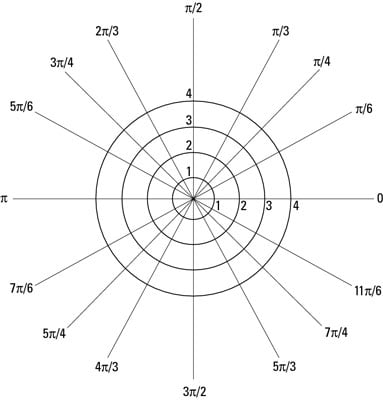
Polar coordinates are an extremely useful addition to your mathematics toolkit because they allow you to solve problems that would be extremely ugly if you were to rely on standard x- and y-coordinates. In order to fully grasp how to plot polar coordinates, you need to see wh...
dw you're not a dummy dad
 hollow plover
How do find out if the graph is symmetrical to x axis y axis and or origin?
i know how to do it with equations but not graphs
 patent beacon
If you flip the graph over the x-axis and it's the same, then it's symmetric about the x-axis
Similar idea with y
,ask graph cos(x)
obsidian monolithBOT
 Requested by Kaynex#7520
patent beacon
Requested by Kaynex#7520
patent beacon
You can see from the higher graph that cos is even
The left is a mirror of the right
hollow plover
ok so basically if you want to find out if lets say a point on the graph is symmetrical to the y-axis, you have to take the x coordinate in (x,Y) and negate it?
sorry i just started my precalc class and we didnt really go into cos and stuff yet
although we learned that in geometry but i forgot most of that
this is from our first class
pls i beg
😦
patent beacon
Actually I derped. No function is symmetric about y because then it's not a function
hollow plover
so the graph is not symmetric to the x axis y axis or the origin?
patent beacon
Well, there is ONE.
hollow plover
my teacher says its symmetric to the y axis
 rocky bison
No function is symmetric about y? 
hollow plover
np
patent beacon
A function is even if the y-axis acts as a mirror for the function
We say it's symmetric about the y-axis
You can see cos(x) is even.
I'm not sure if your graph may be poorly drawn, but it doesn't look even. Almost though
 stuck palm
Does anyone have any understanding on how to do this please? I need help, it’s confusing me :/
patent beacon
Polynomials are continuous everywhere, so no need to check anywhere but x = 1
A function is continuous at a point if:
-The limit exists there
-The function is equal to the limit at that point
stuck palm
So how would I check x=1 to see if it's continuous?
stuck palm
Thats the issue, I don't even know to test the limit... I am so bad at bath
math*
I mean I would assume if the left = the right, then the limit exists, right?
stuck palm
I would say no? Because 1^3+6= 7 and 7 ≤ 1 does not make sense.
spring thunder
why 7 =< 1?
i mean, what does it have to do with our thing?
but yeah 7 is the left limit at x=1
and the lim to the right is ... ?
rip
 drifting imp
can someone help with this question? its a logarithmic question based on exponential growth and decay
Dry cleaners use a cleaning fluid that is purified by evaporation and condensation after each cleaning cycle. Every time the fluid is purified, 2.1% of it is lost. The fluid has to be topped up when half of the original fluid remains. After how many cycles will the fluid need to be topped up?
Im not great with expo growth and decay in terms of finding an equation from it
viscid thistle
ok so you know you need to reach 50% of the original value
drifting imp
yea
viscid thistle
and you also know that your decay is 2.1% / purification
drifting imp
yea
obsidian monolithBOT
yami:
viscid thistle
x_t is your 50%
x_0 is the original amount of fluid you had
t is your time
what is r?
drifting imp
wouldnt it be 2.1% or 0.21?
serene heath
theres no time dependencay tho
drifting imp
yea i know that
viscid thistle
then because its a decay you have to subtract that value
so you end up with
,$ 0.5 = x_0(1-0.021)^t
obsidian monolithBOT
yami:
drifting imp
so x_0 would be 1? because of how much I initially started with
serene heath

viscid thistle
i guess yeah 
 silk oriole
wat is haeppning
serene heath
if 2.1% is lost each time then youre left with 97.9% yes?
if A is how much you had initially
then after i use youd have A*0.979
after 2 uses A*0.979^2
so on...
so in general after n uses
drifting imp
im lost tbh
silk oriole
this is complicated...
drifting imp
yes
serene heath
after you use it once yoy lose 2.1% of it
which means youre left with 97.9%
agree
?
drifting imp
so 1-2.1%?
serene heath
or 97.9%
drifting imp
nvm i got that
serene heath
yea
silk oriole
then
serene heath
so after one use youre left with 97.9% of what u had originally
if originally you had A amount of fluid
then after one use youre left with 97.9% of A
or A*0.979
drifting imp
when you say "A" you mean A=100 right?
silk oriole
serene heath
yea
drifting imp
kk
drifting imp
so would the formula be y= A(2.1)^t ?
viscid thistle
t usually stands for time but it can be anything really
serene heath
in this case the formula is A*(0.979)^n
where n is the number of uses
that formula tells you much fluid you have left after n uses
drifting imp
yea I can solve it from here
serene heath
nice
drifting imp
all i needed was to understand how to find the formula for it
 slow wharf
I am having problems with this problem
It is simple but I keep getting it incorrect
The sum of two natural numbers is 20
Find the numbers so that the product of the square first and cube second is maximum
And I am stupid
I keep writing product as + goddamnit
 uneven tendon
Okay, so
Let's just say x+y = k for simplicity
x, y and k being natural numbers
Note that x = y-k
Thus $ x^2 + y^3 = (y-k)^2 + y^3 $
obsidian monolithBOT
Nuke:
obsidian monolithBOT
Autistic Hoodie:
uneven tendon
OH
slow wharf
$y=a^2b^3 \ y'=?$
obsidian monolithBOT
Autistic Hoodie:
obsidian monolithBOT
Autistic Hoodie:
slow wharf
The result of that is 20 and 12
uneven tendon
Wait, no
slow wharf
But when I use the $x_{12} = \frac{-b=-\sqrt{b^2-4ac}}{2a}$
obsidian monolithBOT
Autistic Hoodie:
slow wharf
I get it incorrectly
uneven tendon
You get $ a^2(20-a)^3 $
obsidian monolithBOT
Nuke:
uneven tendon
Differentiate w.r.t a
obsidian monolithBOT
Autistic Hoodie:
slow wharf
Or should work too
slow wharf
$(400-40b+b^2)b^3$
obsidian monolithBOT
Autistic Hoodie:
obsidian monolithBOT
Autistic Hoodie:
uneven tendon
I mean, you're not supposed to use wolfram
slow wharf
But when I use the formula
uneven tendon
Hold on a sec tho
slow wharf
$x_{12} = \frac{32+-\sqrt{(-32)^2-41240}}{2}$
obsidian monolithBOT
Autistic Hoodie:
slow wharf
It gives incorrect answers
uneven tendon
Let $ f(b) = b^3(20-b)^2 $, thus $ f'(b) = 3b^2(20-b)^2 - b^3(20-b) $
obsidian monolithBOT
Nuke:
uneven tendon
I mean
The answer are the roots of f'(b)
In fact there can only be
Yeah I'm not sure how many roots it has, tbh
But if you are allowed to use wolfram then you just need to get those roots
uneven tendon
Because honestly I have no idea where that polynomial of yours came from
uneven tendon
Ah
It's not wrong tho
The determinant is equal to 64
Thus x = 16 +- 4
Which is 20 and 12
slow wharf
Damnit
uneven tendon

slow wharf
I calculated 4*240 as 980
I think I need to go to slepe
I am too much deconcentrated
:/
uneven tendon
Yeah sure
slow wharf
$y=(20-b)^2b^3 \ y = (400-40b+b^2)b^3 \ y = 400b^3-40b^4+b^5 \ y' = 1200b^2 - 160b^3 + 5b^4 \ y' = 5b^2(240-32b+b^2)$
obsidian monolithBOT
Autistic Hoodie:
uneven tendon
Oh, that's true
slow wharf
Dunno if there was a simpler way
uneven tendon
I'd have needed to put this on paper to realize it
No no yours is perfectly fine
Well done!
uneven tendon
Oh man I'm so sorry to hear that :(
But hey you seem to be doing pretty fine now
If math was what pulled you down then if you keep practicing it'll stop being a bother in no time
 limber compass
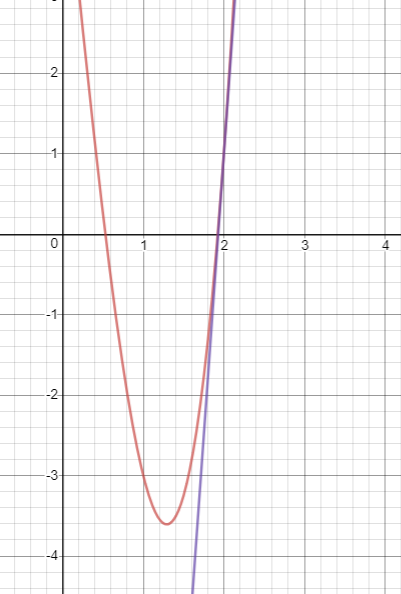
Can someone visually explain what we are getting when we are finding the gradient at a point ?
For example : http://bit.ly/2DFKkwM

I want someone to show me a visual presentation.
bcos i dont really understand. i am verry new
eternal lotus
Essentially we are finding the gradient of the tangent to the graph at x=2

Desmos Graphing Calculator
slender river
get them the limit definition of the derivative
limber compass
Hmm. Sooo what is that blue line ?
Is it that tangent shiz i've been hearing about ?
@slender river
slender river
yes
limber compass
Can u explain a tangent to me 😃
 limber compass
Ok...
slender river
tell me the slope formula
limber compass
for what ?
slender river
slope of a line between two points
limber compass
to get m ?
limber compass
Ohk. You get the derivative by differentiating
slender river
wat
limber compass
and then you plug in the number where x = __
limber compass
Ok I can give an example
slender river
uh okay
limber compass
Ok so find the slope of f(x) = x^3+4x-5 at x = 1
So first I have to differentiate that
which is f'(x) = 3x^2+4
and then i plug in X into that derivative
Is that it ...
hexed ermine
mhm
limber compass
Is that a yes? Or thinking like " Hmmmm "
hexed ermine
@∮c F ⃑(x(t),y(t)) ∙ dr ⃑(t) = 0 You there bud 😃 ?
limber compass
@hexed ermine Could ya explain it to me... Since he is afk
limber compass
Scroll up and read it...
hexed ermine
You want to know what a tangent is?
limber compass
Its fine.. So i did it ^ the slope formula
slender river
yeah that's the derivative
and then at the point x it has the slope of what u evalueate the derivative at that x point
limber compass
😕 ( confused ) ^
limber compass
That blue line you showed me
slender river
3x^2 +4
hexed ermine
The derivative of a function calculates the slope of the tangent line at that given point
hexed ermine
When you differentiate that function, it creates a function of the tangent line slopes to that original function
slender river
so u need the x and y value of the point on the curve u want
hexed ermine
so you can plug 1 into x for the derivative to get the slope of the tangent
limber compass
Ohk I think i get you guys.
So basically the tangent is the slope of the function at a give point.... rrriggght ?
http://bit.ly/2DFjpl2
So that blue line is called a tangent
 hexed ermine
mhm
limber compass
Ohk.
limber compass
isnt that f'(n)
where N is the number at where you want the slope for?
 fallen kite
how much harder is calc 1 vs precalc2/trig
hexed ermine
but with a tangent its essentially the slope of the line but only 1 point is needed
Not very @fallen kite
limber compass
Ohk.
fallen kite
ok thats good to know, because im having enough trouble with this shit
u guys recommend any websites? ive just been looking up random youtube vids
limber compass
@fallen kite I am on the same page here

Yea. If u guys recommend any worksheet websites as well would be great.
slender river
good indeed
like
i love his work
it's a bit lengthy but it's fanstastic
like ur actually in the lecture hall and junk
super gud
limber compass
Hey @hexed ermine So i just showed you what level i am on in calculus. Should I be learning limits rn ?
fallen kite
hmm ill check that out how many hours a week were u going at it
hexed ermine
if you havent learnt them, yes
ehh, about 4
for about 2 weeks
@fallen kite
and now im here helping ppl with calc :v
fallen kite
2 weeks as in what, 80 hours?
fallen kite
u learned calc in 8 hours starting fresh? i dont believe that lol
hexed ermine
His calc 1 series yes
I've did alot of practice on my own but ive spent 8 hrs of watching
slender river
yeh it's def possible
hexed ermine
his vid series
slender river
i am of the same boat sort of but i dont have enough practice bc i cannot find problem sets to save my life
fallen kite
its not possible to learn all in 8 hours.. sure maybe u can watch all the vids, but to understand and retain all of it you'd need to be a god
hexed ermine
Ive had a steady understanding
Helping others and doing problems on my own definitely helped
hexed ermine
Yes
fallen kite
thats a good idea to get ahead
limber compass
Did i do this right ?
f(x) = 3x^2+5 find the equation of the tangent line when x = 2
my answer was : y = 12x-17 ?
viscid thistle
derivative
6x
Slope at x=2, 12
y=mx +b
y=12x
Or
y-y1=m(x-x1)
X1=2 so y1 = 17
y-17=12(x-2)
@limber compass
limber compass
Oh yea How do i check That is what i needed help on
limber compass
Can u teach me a way to check if the equation of the tangent line is correct?
viscid thistle
limber compass
I want to check without a calc
viscid thistle
Then type in the line and the original graph
Graphing is only visual way to confirm
viscid thistle
Oh you mean 7 turn
limber compass
sorry. I have it on paper.
C = -7
viscid thistle
Yup
limber compass
Ohk let me try it
viscid thistle
Its a clear tangent
limber compass
 viscid thistle
Yee
limber compass
One more _quick_question.
viscid thistle
Ok
limber compass
Do u know any websites that have worksheets realted to these type of questions ?
viscid thistle
Only one I could guess is Khan Academy
limber compass
what is this again? lol
equation of the tangent line at a point ?
limber compass
right as in right or write ?
viscid thistle
You called it by the correct name
limber compass
Oh. : )
 coral cairn
I've spent half an hour staring rock hard at this thing, browsed khan academy, etc; and I want to believe that the y-int is 1, what am I doing wrong?
viscid thistle
y-intercept?
coral cairn
f(0)
viscid thistle
well it is 1
viscid thistle
most definitely a typo
coral cairn
if anyone finds anything please tell, my prof sent an email correcting some typos but did not address this question
limber compass
@viscid thistle Hi bro 😃
Desmos Graphing Calculator
I am having problems finding the equation of the tangent.
viscid thistle
what point do you want the tangent at?
limber compass
x = 5
viscid thistle
what's the derivative of f at x=5?
limber compass
459
limber compass
Woah. how did u get it that fast
viscid thistle
$f'(x) = 18x^2 + 9$
obsidian monolithBOT
TendentiousTorturousTopics:
viscid thistle
$f(5) = 800$
obsidian monolithBOT
TendentiousTorturousTopics:
viscid thistle
soo y=459x-1495; you got it right
limber compass
Hmm. then why can't i see the line?
viscid thistle
because you need to zoom in
limber compass
tangent i mean
viscid thistle
the curve is very steep
limber compass
I did.
viscid thistle
derivative of 459 means the slope is 459 lol
the red thing is the curve, and the blue the line I think
atomic zodiac
atomic zodiac
you can adjust the axis with the gear icon on the right
limber compass
How ?
atomic zodiac
change the values
atomic zodiac
idk i'm on phone
limber compass
ohh
limber compass
Thank you 😃 @viscid thistle and @atomic zodiac
atomic zodiac
-10,000 ≤ y ≤ 10,000 or so
limber compass
thnx
atomic zodiac
np
 desert lantern
How can I go about solving this inequality? Really confused about how to get x by itself when it's in the denominator

 tawny nacelle
add 5 and take the reciprocal
btw talking the reciprocal flips the direction of inequality
atomic zodiac
you could also consider each inequality separately to prove it to yourself
ie -1 < 120/x - 5
and 120/x - 5 < 1
desert lantern
@atomic zodiac Can you take each part and put it back together? I've never thought about doing that
@tawny nacelle That makes sense, thank you!
atomic zodiac
just do min < x < max
tawny nacelle

desert lantern
@atomic zodiac gotchya, thanks!
 queen lion
Hey guys!!I want to ask if this answer is correct or not?
limber compass
Hmm. So what can u only get the derivative of ?
I know u can get it for a quadrative equation
but can it be ^4 ? ik that 3 is cubic
queen lion
Logic is also fine,right?
atomic zodiac
why not keep it in?
limber compass
@atomic zodiac So..I tried this function
4x^4+3x^3 + 8
and seems like 4 as an exponential doesnt work
limber compass
No i am trying to get the equation of the slope
atomic zodiac
yes the derivative
limber compass
I mean the equation of the tangent
limber compass
wait I will give u the actual equation
7x^4+8x^3+9x p(0,4)
find the equation of the tangent when the coordinate is (0,4)
atomic zodiac
right
so find the derivative of the equation first
28x^3+24x^2+9 yes?
then plug in the x coordinate
28(0)^3+24(0)^2+9=9
which means your slope is 9
use the equation of a straight line with the given points to get the equation of the tangent
y=mx+c
4=9(0)+c so c=4
so the tangent line at p is y=9x+4
atomic zodiac
well
your point p isn't on the curve
unless your equation was supposed to be 7x^4+8x^3+9x+4
limber compass
Ok so what should i be learning now ...
I have learned finding the equation of the tangent line .. now what ? @atomic zodiac 😃
atomic zodiac
o/
 valid vector
So my professor gave us this function to graph: f(x) = -2 (x - 4)^2 + 3. According to this site, it should end up looking like this: https://www.desmos.com/calculator/iettzueevt
However, if I wanted to do the table of values, she told us that we couldn't use any random numbers for the domain, instead we need to use specific values like -3, -4, 5 and 6, but why specifically those and not something like -1 through 2?

Desmos Graphing Calculator
serene heath
you can use any numbers
just make sure you have a wide enough range
so you get the shape right
valid vector
OK, thank you!
limber compass
So my sister was telling me to learn something like maximum and minimum
any idea on what ? she was talking about
and any yt tutorials would be great if u could link me
viscid thistle
like extrema of a function?
atomic zodiac
probably
viscid thistle

Khan Academy
Once you find a critical point, how can you tell if it is a minimum, maximum or neither?
limber compass
Uh Ok 😃
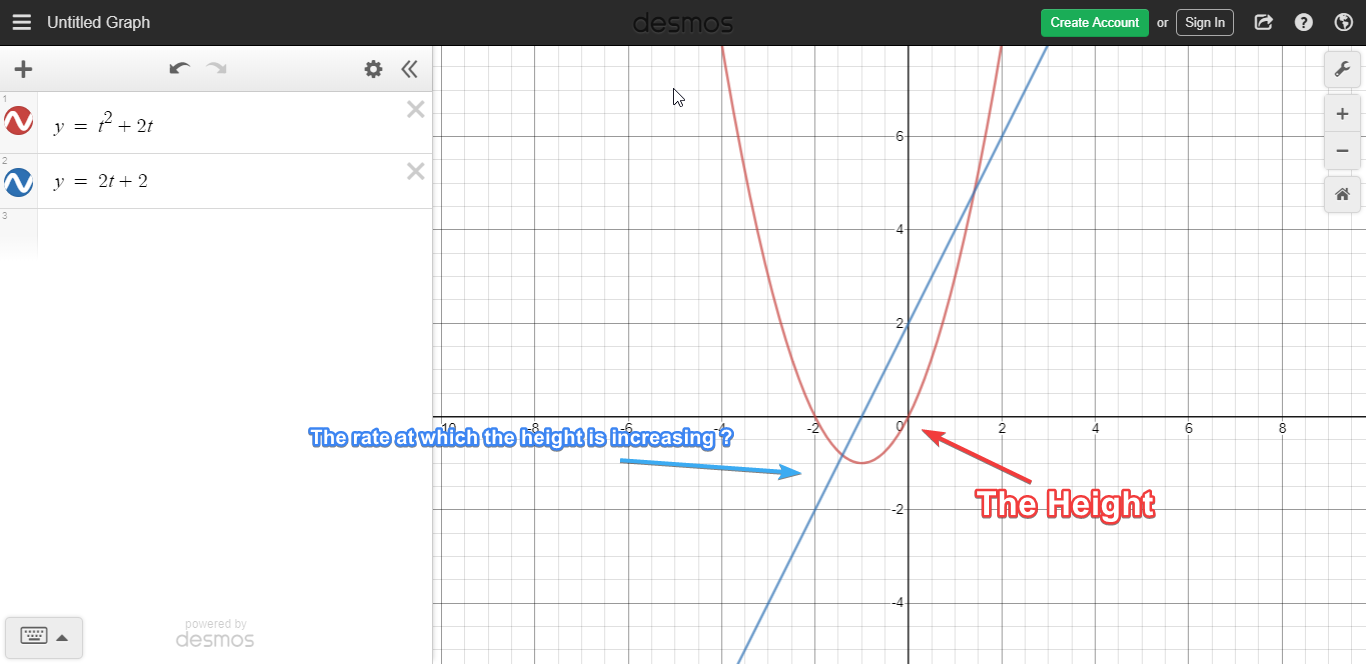
Can someone explain me why we differentiate to find the rate of change ?
 atomic zodiac
because slope is rate of change?
limber compass
Doesn't differentiating something just give us the gradient function of the original graph.
viscid thistle
wow they've really dumbed things down
made a cookbook to solve problems
excellent teaching; might as well just teach the computer to do that for you
wow there let's not talk about gradients
We don't need to get into the definition of gradient, which coincides with derivative for functions of 1 variable
differentiating something gives you the instantaneous rate of change
 atomic zodiac
2logx
 steady cove
is there a reason?
atomic zodiac
one is simpler than the other
steady cove
mk
atomic zodiac
same reason you don't write 10 as 100000/10000 every time
atomic zodiac
np


 limber compass
?
clever inlet
Stationary points on the derivative are points of inflexions
Or possible points of inflexions
limber compass
ohk.?
clever inlet
It's where concavity changes
limber compass
Ohk. I don't understand these big words
clever inlet
Are you studying calculus?
I guess alternatively
You could think of x = 0 as where f(x) is most steep positively
With a slope of 2
Actually I can't read
Y coordinates are difficult
For derivatives
atomic zodiac
think about what the 2 means
it's the highest point on the parabola
meaning the highest slope will be at the same x coordinate
atomic zodiac
greatest positive slope rather
clever inlet
Like, it's hard to tell the slope is 2 exactly
But what's important is that's the greatest value of the derivative and it's positive
slow wharf
I've realized that I have big problems combining fractions with minuses
For example
$\frac{-3x^2-5x-2}{2\sqrt{1-x}} + -x\sqrt{1-x}$
obsidian monolithBOT
Autistic Hoodie:
slow wharf
How would I interpret this?
$\frac{-3x^2-5x-2+2\sqrt{1-x}(-x\sqrt{1-x})}{2\sqrt{1-x}}$
obsidian monolithBOT
Autistic Hoodie:
slow wharf
Apparently it's incorrect?
serene heath
no thats correct
earnest nymph
Probably need to expand the bracket and continue to do?
viscid thistle
What are you trying to do? Simplify?
tawny nacelle
let the r + 1 th term be the what u want
tawny nacelle
and r + 1 th term is ${100 \choose r}(\frac{2}{x^2})^{100}(3x)^{100-r}$
obsidian monolithBOT
soap:
tawny nacelle
lemme finish bruh
spring thunder
(2/x^2)^r 
viscid thistle
ok 😃