#precalculus
1 messages · Page 128 of 1
 mellow matrix
 viscid thistle
mellow matrix
viscid thistle
mellow matrix

A million views? Really? Before you ask, he says it 4,733 times. (including the one in "Alright now fellas...") ALRIGHT ALRIGHT ALRIGHT ALRIGHT ALRIGHT ALRIG...
viscid thistle
viscid thistle
I double checked but i cant find an error
 prime depot
write it out on a piece of paper the steps that you did
cuz then i can see where you went wrong
 spring thunder
this is fking right tho
prime depot
is it???
spring thunder
yas
spring thunder
mk
prime depot
ahhhh
lmao
k i got it
i switched numerator and denominator somehow
 im gonna dissapear into the shadows now
spring thunder
👋
 radiant blaze
@viscid thistle I get cot(theta) to be sqrt(99)
 granite stirrupBOT
An internal error occurred.
A report has been automatically sent to the developer. If you wish to follow up, or seek additional assistance, you may do so at the mathbot server: https://discord.gg/JbJbRZS
radiant blaze
=tex $$\sin ^{2}(\theta)+\cos ^{2}(\theta) = 1(edited)
granite stirrupBOT
Rendering failed. Check your code. You can edit your existing message if needed.
radiant blaze
sin^2(theta)+cos^2(theta)=1
so cos(theta) = sqrt(1-sin^2(theta))
and if sin(theta) = 1/10
then you can solve for cot(theta), and it's sqrt(99)
 shell salmon
seems right
 jagged gorge
I cant find what I did wrong
viscid thistle
looks about right
the method is correct, you just need to be more meticulous in your work, work it again from the start
jagged gorge
Ok
mellow matrix
wait... how did you factorise -2n^2 + 3n + 1?
you should prolly just do integration from that polynomial instead
jagged gorge
Oh ok
jagged gorge
@viscid thistle I tried it again from the start. I need to sub out 2 also?
@mellow matrix wont I need to know what a and b is tho?
viscid thistle
don't factor it when you integrate
that's a waste of time, integration is linear
I use the quadratic formula to get the roots,
=tex \frac{3 \pm \sqrt{33}}{4}
granite stirrupBOT
viscid thistle
scratch that I did that wrong
still, don't factor it before integrating
=tex \int_a^b -2x^2 +3x+1 dx = -\frac{2}{3}x^3 +\frac{3}{2}x^2 +x |_a^b
granite stirrupBOT
jagged gorge
So either way its still right?
jagged gorge
Ok thx
 vocal mountain
Ok can someone confirm the difference between something like -2^5 and (-2)^5
The former is always negative (ignore - sign and put in front after solving exponent)
and the latter can be either (odd expo. = negative, even expo. = positive) right
 distant flume
@vocal mountain The first would have to be -(2^5) not -2^5
 digital rock
-2^5 and -(2^5) are the same because exponentiation takes priority over multiplication (in this case by -1)
 limpid plover
=pup simplify \frac{\frac{16-x^2}{3x^4}}{\frac{20-5x}{4x}}
limpid plover
Yes.
 rocky bison
If you submit your answer it'll tell you
 hexed ermine
Yes @viscid thistle
viscid thistle
Can someone help me match the equation to one of the curves?
I don’t get how to do any of the questions
 winter spoke
hexed ermine
winter spoke
hexed ermine
@viscid thistle 37. -2/3x^4, it's a 4th degree polynomial
Meaning both ends will point in the same direction
Since the coefficient is negative, both ends will point down
That limits it to e f g h
 vale pewter
System of equations
 crystal current
how would each equation be set up?
rocky bison
@crystal current sub each value of xi into your given function
You'll only need 3 of them to solve your equation(s)
Solving for a,b and c simultaneously
 dense zealot
@rocky bison slep
 dense fable
hello! is this where i post a question? (:
im a little lost lol
okay, i cant screenshot my assignment right now but i'll give the word problem
the point of (-1,1) is on the graph of y=x^2. Determine the coordinates of the corresponding point on the graph of g(x)=(x+3)^2-1.
i think this is pre-calc
can someone explain this to me lol im so lost when it comes to grade 12 math.
i know since its y=x^2 its going to be a parabola, right?
so its a translation?
im thonk 2
so the ^2 is just there to show that this is a parabola, right?
yeah
so the new coordinates would be (-4,0)?
o
i got the parabola touching -4 on the x-axis???
dense fable
so since it started on (-1,1), it shifts 3 units to the left so its (-4,1) then it moves 1 unit down so its (-4,0)?
idk if im doing it right lol
hexed ermine
Yes @dense fable
dense fable
i also need some help finding the domain and range of this problem. this is what my mentor sent back to me after i sent in my assignment. if that makes sense, english isn't my primary language lol
thank you! @hexed ermine
hexed ermine
Look at the x values
dense fable
and if someone can explain to me how he got y=1x1+2 from y=f(x+0)+2
dense fable
the answer is (-inf,inf)?
hexed ermine
The range is just all values greater than or equal to 2
Yes in interval notation
But in set builder you write it as {x€R}
dense fable
ooh okay, would the range be {0,4}? or is that completely off?
dense fable
yes
hexed ermine
So the answer is {y|y>=2}
dense fable
ooh okay
makes sense
i do not know how i got 4 lol
also, i need help with this
Describe what happens to the graph of a function if you make these changes to its equation.
A) Replace x with x+3
B) Replace y with y-3
C) Replace x with x-2 and replace y with y+1
viscid thistle
A) shifts 3 to left
B) moves 3 up
C) moves 2 right and 1 down
hexed ermine
Oh yep, my fault, I didnt see it being replaced with y
hexed ermine
Yeah I gotcha
 prime prawn
Ok
 sharp pagoda
only thing i cant get my head wrapped around
prime prawn
Whats the problem?
prime prawn
Alright 2 mins, I'm helping out in #prealg-and-algebra
sharp pagoda
alright sounds good
sharp pagoda
Hey @prime prawn
okay wait so i believe i managed to answer the question
but theres another one that was bothering me more
one second
prime prawn
ok
sharp pagoda
prime prawn
Which one?
sharp pagoda
b
prime prawn
It is too blurry can you type it out please?
sharp pagoda
yeah for sure
prime prawn
14 b?
sharp pagoda
Describe the transformation that must be applied to the graph of f(x) to obtain the graph g(x). then, determine an equation for g(x)
so just from looking at this i can tell its a stretch and a horizontal reflection
i just need to figure out how to write this as an equation
sharp pagoda
yes
sharp pagoda
well its a horizontal reflextion
prime prawn
mhm
prime prawn
no no no
the negative x doesnt go inside
it goes outside
so $$g(x) = - a f(x) + ...$$
sharp pagoda
oh yeah
prime prawn
so $$g(x) = - a f(x) + ...$$
sharp pagoda
-f
granite stirrupBOT
prime prawn
what else do you notice
the graph gives you a few points
For instance g(x) passes through (-7, 0) and (8, 0)
prime prawn
yes, horizontally stretched
sharp pagoda
okay so b is affected
prime prawn
b meaning?
sharp pagoda
-f(b(x))
sharp pagoda
yeah
prime prawn
Also notice that f(x) passes through points like (-1, 0) and (0,4)
these two points correspond to (-7, 0) and (3, -4) on g(x)
sharp pagoda
counted
prime prawn
k thats one way to do it
granite stirrupBOT
prime prawn
Since (0,4) corresponds to (3, -4)
you know that g(x) is shifted 3 units to the right of f(x)
if you shift units like (-7,0) 3 spaces to the left
you get (-10, 0)
with (8, 0), it becomes (5, 0)
etc.
sharp pagoda
left ?
prime prawn
Yes
sharp pagoda
oh nvm
prime prawn
Because you are shifting (3, -4) 3 spaces to the left
to get to (0, -4)
what relationship does (-2, 0) have with (-10, 0)
5 (-2) = -10
that applies to other points
like (3,-4)
sharp pagoda
alright
prime prawn
(3, -4) becomes (0,-4)
5 (0) = 0
same with the other points
do you need help with the format of g(x)
sharp pagoda
it will be -f(1/5(x))?
prime prawn
not quite
sharp pagoda
-f(1/5(x+3))?
prime prawn
My plan would be just to "match the points"
there are 4 points given to you in both f(x) and g(x)
you need to find the relationship between them
sharp pagoda
the hardest thing is seeing if it shifts left or right, thats what im most confused about
being it stretched the points move
but figuring out the shifts is another thing
prime prawn
ok let me see how to word this
The answer is $$g(x) = - f\left[\frac {1}{5}\left(x-3\right)\right]$$
granite stirrupBOT
prime prawn
Basically this means
that if you wanted to shift f(x) to the RIGHT
then you apply -3
prime prawn
if you wanted to shift f(x) to the left 3 units
then you do +3
for horizontal shifts
its the opposite of what it seems
sharp pagoda
i m just confused of the whole algebriac aspect
granite stirrupBOT
prime prawn
what would a be
prime prawn
a is the dilation
k is the units moved UP
so if k is negative, you are moving down
prime prawn
h is the units moved to the right
sharp pagoda
but what do i do with this function, involving the points
prime prawn
ok
granite stirrupBOT
prime prawn
b is 1/5 because there is horizontal stretch of 5
k is 0 because there is no movement up or down
granite stirrupBOT
prime prawn
mkay so in your format
sharp pagoda
okay i see
sharp pagoda
as you said before you took 0,4 and 3,-4 to see the shift
prime prawn
i was matching the dots there
prime prawn
take (8,0)
sharp pagoda
like i understand you the difference of 3
but for 8,0 and 1,0 how do i figure it out
?
sharp pagoda
-3
prime prawn
then?
prime prawn
you add 3 from the x-coordinate of f(x)
sharp pagoda
yeah sorry we're looking at the f(x) to g(x)
prime prawn
you multiply the x coordinate of f(x) by 5
then you add 3
then you multiply the y coordinate of f(x) by -1
now do that to other coordinates in f(x)
like (-2,0)
multiply 5 add 3
then multiply y coordinate by -1
sharp pagoda
okay i sort of understand it
 mortal rain
y'all doing rational functions atm?
sharp pagoda
hey
can anyone help me quickly
transformations wise
Q: what are the coordinates of the invariant points when the function u= |x| -1
 earnest finch
I have a logs and exponentials test tomorrow easy stuff
But then next unit is trig
disguisting
viscid thistle
use this one trick discovered by leonard euler to make all your trig problems into exponentials problems:
=tex \sin x = \frac{e^{ix}-e^{-ix}}{2i} \ \cos x = \frac{e^{ix}+e^{-ix}}{2}
granite stirrupBOT
viscid thistle
ezpz

 prisma scroll
You are given an arithmetic sequence. Suppose the common difference between two consecutive terms is r
Then, a_14 + r = a_15, a_15 + r = a_16
Now can you find r? @viscid thistle
viscid thistle
Yes I can
sharp pagoda
can someone explain to me how to find out if this inverse is a function or not?
equation is :
f(x) = 5/2x +3
 indigo spindle
graph it and reflect over y=x
if it can pass the vertical line test still it is a function
 fringe stream
an easier way would be to swap x and y, then solve for y
 crude dagger
Why is the range of (C)(-x)(x-sqrt(2))(x+sqrt (2)) equal to (sqrt(2), 5/2) when C>0?
 blazing raven
are you sure you copied the problem correctly?
blazing raven
oh. It's a quadratic.
(or a piece of one)
So if C > 0, does the parabola open upwards or downwards?
blazing raven
um, btw, I think the problem has a x^2 and the solution shown has x^3 ... that might be important 😃
crude dagger
The x^2 on the top is another problem
blazing raven
fair enough.
So how many roots does the function have?
I'm guessing we can't use calculus to solve this one?
crude dagger
We can
crude dagger
Well no
They really don’t do anything on the solution they just say that it is as if it was trivial
blazing raven
er do you know derivatives?
blazing raven
okay um, do the first two lines make sense?
btw, that is a terrible usage of the word Range
They mean interval
If C > 0, then f(x) < 0 on the interval x in [sqrt(2), 5/2]
oops not square brackets
They mean interval
If C > 0, then f(x) < 0 on the interval x in (sqrt(2), 5/2)
crude dagger
Well the first line doesn’t hence the question lol oh okay thank you I think the rephrasing helped. I will try to work it out now. Thank you
blazing raven
Anyway, here's the run down. You have part of a cubic times a positive constant. The whole cubic happens to have 3 distinct roots. The restricted cubic has x between sqrt(2) and 5/2. f(sqrt(2)) = 0 for sure. (it's a root and roots are not affected by the vertical stretch C).
fair enough. You are welcome.
 limber bone
transformations 😵
 scarlet vine
uhh i had this question
usually math is pretty easy for me and the other questions were easy
scarlet vine
I dont even know if its possible; theres not even a diagram
scarlet vine
yeah but the diagram doesnt really work out @viscid thistle
I dont think theres enough info
viscid thistle
i just tried it out and i agree  my answer is still in terms of a variable, assuming that the electrician isn’t being forced to walk through a hallway that is only a foot wide
this is my attempt of working it out
scarlet vine
Apparently the answer is A
 remote musk
@viscid thistle why'd you flip the angles in triangle 1?
shouldn't the lower angle be 30?
viscid thistle
the angles aren’t flipped
remote musk
point was shouldn't the lower angle be 30?
viscid thistle
of triangle 1? no.
remote musk
granite stirrupBOT
 remote musk
so assuming we can set x = anything, answer A is one of the possible lengths of the ladder, the others aren't, hence the answer is A
nah, that's a neat solution, i didn't see that
 daring pebble
how do i find the general form for 3b?
i know it's
=tex a * \sqrt{\frac{72}{a}}^x
granite stirrupBOT
rocky bison
What is the form of an exponential function
daring pebble
a* b^x
rocky bison
ok
So now you've got a point that must lie on there
I'm assuming you know b from some other question pieces
Seeming as this seems to lead off from somewhere
daring pebble
??
ah yes i guess so
for f(x) = 18*2^x
b = 2
for f(x) = 8*3^x
b = 3
but how does that help find the general form?
rocky bison
well a and b have a relationship with one another
So if I told you that
=tex a=\frac{2}{b^2}
granite stirrupBOT
rocky bison
You want to write b in terms of a
Oof that's not correct
ok
So we have the point at x=0
=tex y=ab^{x}\x=0, y=a
granite stirrupBOT
rocky bison
Now given this we can and plug in our other point
2,72 from memory
Wait I'm still retarded
fuck my life I'm so tired
@spring thunder help
granite stirrupBOT
daring pebble
ohh
daring pebble
thanks @rocky bison @spring thunder !
spring thunder

rocky bison
I choke so hard 😦
scarlet vine
oh
remote musk
anyway
scarlet vine
but howd you get that?
remote musk
i used ririna's nice looking diagram
solved it exactly how ririna did
except, in triangle 1, you switch the 30 and 60, the lower angle is supposed to be 30
scarlet vine
oh, ive been trying to use 30,60,90 special triangle rules
remote musk
wait
nevermind, i edited my answers
hey did you realise I made a mistake in here?

lol
remote musk
it's supposed to be:
granite stirrupBOT
scarlet vine
yeah
remote musk
so when I substitute x = 3, i get answer A
scarlet vine
because that wouldve been 12 + 2sqrt3
remote musk
yeah, sorry about that, i was looking at the part where multiplied 2 by 3 to get 6, that's how 6 appeared lol
scarlet vine
but wait, a = x/cos30 = (2sqrt(3)/3) * x
cos30 = sqrt(3/2)
which makes it x/(sqrt(3)/2)
turning it into 2x/sqrt(3)
scarlet vine
oh yeah because you rationalize then factor out x
remote musk
you multiply the numerator and the denominator by sqrt(3)
scarlet vine
thanks!
 thick raptor
yw
 gentle flicker
Hey guys. If i have a sine, which goes from 1 to 8 or something. How would i find the % of it that is under 4? Would i put y=4 and find the two times it crosses 4, then take whatever lengh that is call it z. then period/100 = z/%
 dim charm
Patrick and Chris have the following conversation about their favorite numbers:
Patrick: My favorite number is an integer P > 1. It has the interesting property that 6th root(P) is an integer.
Chris: My favorite number, C, isn’t a real number! It has an interesting property, though: C^2015 = 1.
Patrick: Well, that doesn’t help me much! I can think of more than P numbers that could be the value of C.
Chris: In that case, I now know the value of C^P.
Assuming Patrick and Chris make true/perfectly rational statements, which of the following values is equal to 1
roots of unity + logic = 😦
 patent beacon
@dim charm
What are the answers?
patent beacon
P could be 64, 729, 4096...
But there are more than P numbers C such that C is complex and C^2015 = 1. There are exactly 2014 such numbers. So either P = 64 or 729
Chris knows what C^P is from these two possibilities. As such
C^64 = C^729
Dividing by C^64 (recognizing that C ≠ 0)
1 = C^665
So, C is also a 665th root of unity.
The only factors between 665 and 2015 is 1 and 5.
But we know C itself isn't real, so C⁵ is real.
dim charm
thx!!
patent beacon
Np. Feel free to ask if you have anything else!
viscid thistle
I don’t get how we get the transformed points
 scarlet lance
f(x+1) means you move the graph 1 space to left
and f(x) cross (4,0), so you put 0 at f(x+1), i guess
 gleaming bobcat
If you are putting two intervals into a set, and they are both share a closed endpoint, are their ranges simply added, then?
I mean like a piecewise function... If two subsets, each reaching to opposite infinity, and touching at the middle (with >= and <= meeting up perfectly), are simplified, do they merge? Or do they have to share a function as well as a domain? Very confusing
to me
gleaming bobcat
Okay, so imagine if in this Piece-wise Function, the second (middle) function were to intersect directly with the endpoint of either function 1 or 2...
Would I use an upside down Union, an Intersection? Or is this not allowed with a real piecewise function because of vertical line test?
limber bone
union i think
ye union
like for example if it intersected with the end point of the first function the parabola
the parabola stops at x = 1
so for example
domain is from - infinity to 1 U from 1 to wherever the middle function ends
got it?
forgetting about the third functoin
function*
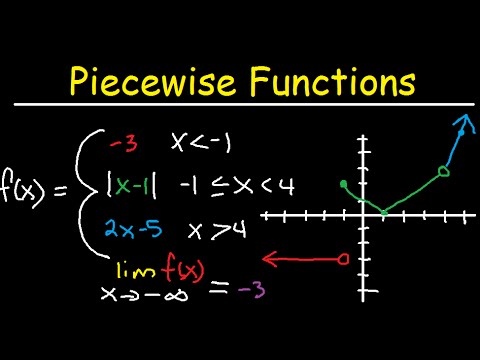
This math video tutorial focuses on graphing piecewise functions as well determining points of discontinuity, limits, domain and range. This video is for stu...
here u go
gleaming bobcat
Ahh, Union + brackets (not parentheses), definitely cleared up my question and makes more sense, thanks!
I will watch the video later, but I just have to say Organic Chemistry Tutor saved my ass last semester in Chemistry, enough people like this guy could easily replace the Pearson-owned "education" system. Just my 2 cents.
 trim coyote
Hey, can someone explain by b^2 = a^2 + c^2 -2accosB becomes cos(B) = (a^2 + c^2 - b^2)/(2a*c)
When I reorder, I get cosB = b^2/(a^2 + c^2 - 2ac)
 fallen cloud
because
you subtract the a^2 and c^2 first
to bet (bb-aa-cc) = 2ac * cos(B)
then divide
trim coyote
ahhh....
I see. I was dividing by cosB on both sides, inversing, then moving b^2 over to the right side as the numerator
What rule did I break here?
 fading token
viscid thistle
fading token
viscid thistle
How would I solve this via factoring?
viscid thistle
Imaginary roots? Does that mean it’s prime?
 serene heath
no imaginary roots mean theyre in the form $$a+bi$$ where i =$$\sqrt{-1}$$
granite stirrupBOT
serene heath
if you sketch that graph
you will see that it never intersects the x axis
and hence does not have real solutions
viscid thistle
Ahh
serene heath
=pup x^2+2x+5
serene heath
see? doesnt cut the x axis
viscid thistle
Ye ty
serene heath
are u sure its given correct?
viscid thistle
Yep
prime prawn
Can someone explain linearization on a graphing calculator to me?
I'd like to know why in a power function y = ax^b, you graph (lnx, lny)
and other examples
 lost cipher
lny = ln(a) + bln(x)
prime prawn
yea
lost cipher
so you have y = ax+b graph
prime prawn
so ln (a) is a constant
ln y = lnx + ln a
hows that a supposed to be close to a line though?
lost cipher
you forgot b, which becomes the slope of that graph
prime prawn
yea mb
lost cipher
it is a line
lost cipher
you treat ln(x) like x
lost cipher
np
lost cipher
you have an extra x thou so it doesn't become linear
lost cipher
if it was like y = ax^2 it would work
prime prawn
"To linearize data modeled by: a quadratic function y = ax^2+bx+c, graph (x, sqrt y)"
prime prawn
I'm not doing this stuff; the calculator is when you give a set of data.
lost cipher
(-3,3),(-2,0),(-1,-1),(0,0),(1,3),(2,8),(3,15)
lost cipher
yeah the text is def wrong
lost cipher
(0,0),(1,3),(2,8)--> (0,0),(1,sqrt3),(2,sqrt8)
the slopes between the first two points and the last two points are not the same
lost cipher
yeah it'll be close at the point you linearize
because you can assume bx is irrelevant compared to ax^2
prime prawn
yep
lost cipher
i thought you meant the whole thing cuz the first one you mentioned applied for the entire graph
lost cipher
yeah pretty much
lost cipher
sqrt y = (sqrt a)x
lost cipher
that's because the equation has to hold
prime prawn
sqrt y = (constant)x
lost cipher
sqrt both sides pretty much
prime prawn
(sqrt y, x)
ok
and for y = ab^x
it says grah (x, ln y)
so you ln both sides
nvm
lost cipher
yeah you're on the right track
prime prawn
ln y = (constant) + x (ln b)
ln b is another constant
ohh
so thats why its represented like that
thank you
lost cipher
np
 vestal widget
 red prawn

Wolfram|Alpha brings expert-level knowledge and capabilities to the broadest possible range of people—spanning all professions and education levels.
this is neat
probably should have expected it to be honest though
earnest finch
@rare zephyr I got it but it's hard to explain
There are alternate interior congruent angles
Which make a pair of triangles similar
Then you can find the distances
And then find the slope of PQ and find the coordinate by making an equation for the point SR
Yeah too long for me to explain lol
dim charm
make equation for rs using slope for pq because they are parallel, and using the point (5,0). once you have that line, find the equation of the line that intersects qs perpendicular, since you are given the point and can find slope since -1/slope of qs. once you have that find where they intersect
 rare zephyr
Thanks
rare zephyr
So R is the point of intersection of, let's pick QR and SR. Which means at R the value of y for both of the straight line equations are the same. So I can substitue Y for the other straight line equation. I get it now
 tawdry current
+12 and -14 right?
tawdry current
Huh thats weird...
I did it on paper and got +12, -14 and also my calculator says +12, -14
definitely not both positive/negative...
viscid thistle
Yea you’re right because after my foil meyhodnyou have to inverse to show roots....
serene heath
=wolf solve x^2+2x-168
serene heath
wait just lookin at the equation
they cant both be positive
cuz last term is negative
serene heath
yup
viscid thistle
@serene heath @tawdry current ty.... guess my txtbook’s a bit autistic
tawdry current
Most of my books have also had those kinds of goofs around them
from my current ones I have not yet found any surprisingly
But yeah np
earnest finch
What does the Greek letter Sugma mean again?
 slender river
lel
 unreal plaza
bruh what does a turning point mean
is that dy/dw = 0
 floral tide
yeah
no thats peak point
turning point of wahat?
of the derivative from neg to pos?
 worn prairie
@rare zephyr remember that, for angles in radians, arc length = angle * radius
so you can set up an equation with unknown radius and known arc AB + CD
jagged gorge
I'm stuck how do you figure out the gradient of the line
fringe stream
slope of the tangent of any curve is given by its derivative
 midnight spindle
yes
jagged gorge
does derivative mean differentiate
midnight spindle
yes
jagged gorge
k thx
midnight spindle
no problem
jagged gorge
how do i find the gradient for the line?
 dull imp
@jagged gorge y=x^3-x^2-2x
dy/dx=3x^2 - 2x - 2
dy/dx | (x=1)= 3 - 2 -2
= 3 - 4
= - 1
jagged gorge
wait what did u do do for the second step
jagged gorge
the one that u edited
dull imp
@jagged gorge oh no for there i just plugged in x=1
jagged gorge
y 1 ?
dull imp
so 3 (1)^2 - 2(1) -2(1)
= f prime (1)
or the derivative at the point x=1
so your new function is 3x^2 - 2x -2, right? and u wanna find the slope at x=1. so you just plug in 1
jagged gorge
so it only works for slope and not other points?
dull imp
@jagged gorge im not sure what you mean by that?
jagged gorge
@dull imp like y did u specifically sub in x=1 and not other points
dull imp
@jagged gorge well doesnt the question ask to find the slope at the point x=1?
judging by the image, there's a dotted line at x=1
dull imp
@jagged gorge i thought u said the answer was -1?
jagged gorge
yes
dull imp
its asking for the slope at a particular point, correct?
jagged gorge
the question was to find the area
dull imp
oh ok
jagged gorge
but i was stuck on finding the gradient for the line
dull imp
well if the line passes through (0,-1) and is tangent to that equation, then it doesnt necessarily have to be like that...
dull imp
uh cool lol.
 kindred violet
 serene heath
@kindred violet thats just x
serene heath
try the substitution $$\tan(u)=\sqrt{2}x$$
granite stirrupBOT
viscid thistle
But then you would have the derivative of tan^-1 (u) as the denominator
Wouldn't that over complicate things
viscid thistle
Hmm
serene heath
you defo will get arctan in your integral
viscid thistle
I c
remote musk
easier to substitute $$ x = \frac{1}{\sqrt2}tanu $$ isn't it?
granite stirrupBOT
viscid thistle
@remote musk I just realised you can sub root 2 x =U
It gives you tan inverse function then
remote musk
ah, i dont have derivative of the inverse of tan memorised
viscid thistle
nvm got it u just plug a slightly bigger number than 1 and then its obvious it reaches infinity
 wild mica
solve for (x-4) ^3/4
viscid thistle
how do you strech the bionomal out
viscid thistle
wait so i do 8^4?
wild mica
then you take the 3th root of that
remote musk
basically, raise everything to the power 4/3
granite stirrupBOT
spring thunder
(ie put the output from g as the input in f)
spring thunder
👌 and delete your thing from calculus
viscid thistle
is this correct?
Well, sin(3x) isn't the same thing as 3sinx, although the limite you take is ultimately correct
viscid thistle
damn
thick raptor
no
viscid thistle
could u show me how? im new to limits and im kinda confused how am i supposed to calculate them
SA is correct. sin(3x)/(3x) goes to 1 because sin(anything)/anything goes to one as anything goes to zero
Well 5x = 3 * 5/3 * x -- perhaps that will be helpful?
i know sinx/x equals 1 but thats it i have no idea how to get 3/5 if i cant do the thing i did on the pic
sin3x if x approaches 0 is 0
i dont know what u mean by sin(3x)/(3x)
that means sin of 3x divided by 3x itself
isnt that sin 1?
wait maybe i get it
just tell me if this is correct if not forget it
I'm doing drive-by helping, hoping someone else will also come to your aid :)
this is the original
correct or nah? 🤔
spring thunder
multiplying by 3x/3x is a bit too much
3/3 is already enough
$$\frac{\sin(3x)}{5x} = \frac{\sin(3x)}{5x}\cdot\frac33 = \frac{\sin(3x)}{3x}\cdot\frac35$$
granite stirrupBOT
viscid thistle
thank you
thick raptor
no
spring thunder
nome
viscid thistle
what is te inverse of y = (x+5)^2
shell salmon
to find the inverse, you are replacing the domain (x) and range (y) with each other
so in the function, you would replace x with y, y with x
after that, you would isolate y, as functions are written y=
viscid thistle
but why is it plus or minus sq rt
tawdry current
is the inverse like the original function solved for x and then x and y changing place pretty much? All the operations done but in a reverse order right?
I haven't had that yet but pretty interesting.
thick raptor
pretty much yeah
 native timber
it's just the name of the sequence
 royal gust
its not a?
native timber
the first element of the sequence S is 1, the second element of the sequence S is 2 etc
royal gust
and also for the formula (n-1) its not squared like $$2*S^(n-1)?$$ ?
granite stirrupBOT
native timber
no, it's subscript meaning that the nth element of the sequence is equivalent to the previous element of the sequence but doubled
you could use exponents to get the nth element in this sequence using 2^(n - 1)
royal gust
oh ok
so what different between 2^(n-1) and what you had earily? will I get the same results?
native timber
yes you'll get the same results, what i had earlier just makes the sequence more "explicit" by defining elements in terms of other elements
royal gust
wow thats interesting its like science getting the same results in different odd ways
native timber
they aren't that different, exponentiation is repeated multiplication and a geometric sequence is a sequence in where an element is the previous element but multiplied by some constant
you could define the nth element of any sequence using S_n = S_1 * r^(n - 1) where S_1 is the beginning of the sequence and r is the constant that the sequence "grows" by
hold on im gonna learn how to use mathbot real quick
royal gust
ok
native timber
$$S_n = S_1 * r^{n - 1}$$
granite stirrupBOT
royal gust
wow you got it quick
native timber
or $$S_n = S_{n - 1} * r$$
granite stirrupBOT
royal gust
so the n was underneath
native timber
that's typically the notation for sequences
$$S_n$$ is the nth element of the sequence S
native timber
_ to denote subscripts
royal gust
$$S_{1} = 1$$
granite stirrupBOT
royal gust
what would be r in this case?
native timber
r is the common ratio and it's the constant which you multiply by to get the next element
in the sequence {1, 2, 4, 8, ...}, that r is 2 because it's doubled each time
in the sequence {10, 30, 90, 270, ...}, that r is 3 because it's tripled
royal gust
$$r = 2/1 = 2$$
granite stirrupBOT
granite stirrupBOT
native timber
$$r^1 = \frac {S_n} {S_(n - 1)}$$
granite stirrupBOT
granite stirrupBOT
native timber
much better
royal gust
$$r^{1} = \frac{S_2}{S(n-2)}$$
granite stirrupBOT
native timber
well no, that's not true
if we use your sequence {1, 2, 4, ...} we can assume that S_0 is equal to 0.5
$$2/0.5 /= 2$$
granite stirrupBOT
native timber
that's awful lol
royal gust
$$r^x = \frac {S_2} {S{2- 1}}$$
granite stirrupBOT
royal gust
how about this?
native timber
i guess that's true iff x is equal to 1
royal gust
we had 1 there earlier just trying figure out what n can be replace by
so we can solve this formula
$$s_n = 1 * 2 ^{(n - 1)}$$
granite stirrupBOT
royal gust
$$S_n = 2^{(n -2)}$$
granite stirrupBOT
royal gust
$$S_8 = = 1 * 2^{(8 - 1)}$$
granite stirrupBOT
native timber
your question had the sequence 1, 2, 4, 8, ...
royal gust
right
native timber
... means keeps on going
royal gust
ohh ok
native timber
there is no "highest" element, it's an infinite sequence
viscid thistle
Well I guess there KINDA is.. infinity lul
granite stirrupBOT
royal gust
Im not sure what you mean by infinty, but we do have to find the 8th element for this one
what do we do next to solve this part? how do we solve S_8?
native timber
$$S_n = S_1 * r^{n - 1}$$ therefore $$S_8 = 1 * 2^7 = 128$$
granite stirrupBOT
royal gust
thats great so that was it
native timber
yeah
you just needed to use the equation and substitute all required values (which were S_1, r and n in this case)
royal gust
thats what im thinking too
I am having problems plugging which numbers in
I dont think we are done yet. So how do we solve 128_8?
granite stirrupBOT
native timber
S itself isn't the 8th element, it's the sequence
royal gust
the final answer is not 188?
native timber
S_8 is the 8th element (which is 128)
native timber
well it shouldn't be 188; it isn't even a power of 2
royal gust
I thought you said something about 2 eariler
fringe stream
simplify f(f(x))
 alpine portal
x/6x+25
fringe stream
what will the domain of that be then?
alpine portal
x is still undefined at -4 1/6
fringe stream
and you should probably try -25/6
alpine portal
I don't get it... if f(x) has the constraint that it cant equal -5
fringe stream
not a mixed fraction
alpine portal
ill try
 solemn tiger
Out of practice on composites, made a mistake.
The domain of the composite is still dependent on the original.
fringe stream
yeah the thing probably just didnt recognize 4 1/6
alpine portal
-25/6 worked
alpine portal
yeah ahha fuck computer language
solemn tiger
I find that online hw systems tend to dislike mixed fractions
Although I think improper fractions are easier to do calculations with
alpine portal
But yeah the first constraint does carry over then
I thought this was a trick question
fringe stream
mhm
f(f(-5)) wont be defined bc f(-5) isnt defined itself
we learn something new everyday
solemn tiger
But only if the resultant function is a composite. If it's just a regular function you find on a problem, f(-5) is defined.
solemn tiger
If we see f(f(x)) in some problem somewhere, f(-5) is defined
alpine portal
At the top it says composed
solemn tiger
If f(f(x)) weren't a composite*
alpine portal
thanks for the help guys anyways
viscid thistle
How does one factor nested trinomials with nested binomials as terms