#precalculus
1 messages · Page 117 of 1
 hexed ermine
 void patio
@upper smelt it sounds like to me you don't know the unit circle very well
hexed ermine
Yes
 charred jasper
<@&286206848099549185> Can i get some help on parametric equations?
charred jasper
please
 gritty blaze
Show it !!!
 true vigil
yeah just ask!
 thick raptor
rip
 prisma tapir
not sure of this would be in calc or precalc but does anyone know how to help me with this
i know that the sum from k=0 to n of k^2 = (n(n+1)(2n+1))/6
but how would you do it for any power like 5 or 1/2
 gleaming wing
Math steps unclear. Now stuck in the 5th dimension. What do?
 zenith juniper
Hi. Where can I find hard questions that are tricky and so regarding a certain subject?
 granite stirrupBOT
 viscid thistle
what ^
viscid thistle
Can someone help me with this? I am not sure how to follow
I got -1 for Horizontal asymptote, and -2 & 2 for vertical asymptote but it
'is incorrect
viscid thistle
where the top part intercepts athe the infinite curve
viscid thistle
I thought that was the y-intercept asymptote
 clever inlet
?
clever inlet
Don't all horizontal asymptotes have some form of y intercept?
hexed ermine
Indeed so
true vigil

 odd lichen
@clever inlet you still need help?
viscid thistle
7?
 queen ibex
yep
hexed ermine
Okay
So you started off a bit correct
You want to determine the amplitude and and the vertical shift
which so far would be 4cos(x)-1
now what we need is the b and c value
@queen ibex
queen ibex
ok how do i find that? thats where im lost on
hexed ermine
Alright
so first find the period
What you want to do is subtract the x coordinates
$$\frac{\pi}{6}-\frac{-\pi}{3}$$
granite stirrupBOT
queen ibex
yea
hexed ermine
Okay so that's the distance from the minimum to the maximum
that means its a half a period
so multiply that by 2 to get the full period
Which is just pi
so pi is the period
Now you know that 2pi/b is the period right?
queen ibex
yep
hexed ermine
Okay so we do 2pi/b=pi
since pi is the period
and we can say that b is 2
2pi/2 = pu
pi*
queen ibex
Wait dont u do 2pi/b=7pi/6?
queen ibex
ok
hexed ermine
Okay so we have so far
4cos(2x)-1
now lastly we need to find the phase shift
Which is defined as c/b
Now I prefer to use cosine first bc it's easier for this problem imo
I notice that the maximum is pi/6 to the right
So what I can do is c/b=pi/6
and we said that b is 2 already
$$\frac{c}{2}=\frac{\pi}{6}$$
granite stirrupBOT
hexed ermine
Cross multiply 2pi=6c
c=pi/3
There you have it
and since it's pi/6 to the right you do -pi/6
So we have as a final answer..
$$4\cos(2x-\frac{\pi}{3})-1$$
granite stirrupBOT
hexed ermine
got it?
queen ibex
yep
hexed ermine
Alright and finding the sin is answer
queen ibex
i didnt know u can find the shift like that
queen ibex
is it the same thing but different shift value??
queen ibex
ok thank you so much
hexed ermine
No problem
queen ibex
@hexed ermine can C/B to find phase shift can be used for sine equations as well???
hexed ermine
Indeed
the only thing you need to do is add pi/2
since cosine and sine waves are 90 degrees out of sync
queen ibex
ok thank you
 viscid thistle
Draw a force body diagram first @upper smelt
So just draw a diagram first showing the respective forces
Yes
Weird that forces are in kg not N
Oh I see
Anyways, you could decompose each vector into their x and y components then add them up for resultant force
Assume one of the forces is parallel to the x axis for convenience
How does your pic look like, I'm on android so can't draw sorry
If you draw a diagram, the x component is just cos theta multiplied by the magnitude of the vector
Y is sin theta nultiplied by mag
Add together the components, use pythag to find magnitude: sqrt (x^2 + y^2)
Angle is just arctan y/x
Nice, there's an answer on homework help server too for your q @upper smelt
Same method
Llama's method is probably best way
That's what I would've done
 severe snow
can anyone help me with parametric equations
viscid thistle
Ok
severe snow
@viscid thistle How do I graph this stuff
viscid thistle
What are the eqns
viscid thistle
Add them
x+y=4cos3 (t)+2sin3 (t)
Try get rid of the t
Then you are left with only x and y then you can graph
granite stirrupBOT
 cosmic nacelle
yeah
 fringe stream
What have you tried?
granite stirrupBOT
fringe stream
Try solving this
cosmic nacelle
umm
fringe stream
=pup sinx from 0 to 2pi
granite stirrupBOT
Query made by @fringe stream
Data sourced from Wolfram|Alpha: http://www.wolframalpha.com/input/?i=sinx+from+0+to+2pi
Do more with Wolfram|Alpha Pro: http://www.wolframalpha.com/pro/
fringe stream
All values of x greater than that for which sin(x) is -1/sqrt2, and all values of x less than that for which sin(x) is 1/sqrt2
Between 0 to 2pi
cosmic nacelle
???
fringe stream
=pup solve -1/sqrt(2) <= sin(x) <= 1/sqrt(2)
granite stirrupBOT
Query made by @fringe stream
Data sourced from Wolfram|Alpha: http://www.wolframalpha.com/input/?i=solve+-1%2Fsqrt(2)+<%3D+sin(x)+<%3D+1%2Fsqrt(2)
Do more with Wolfram|Alpha Pro: http://www.wolframalpha.com/pro/
fringe stream
=pup solve -1/sqrt(2) <= sin(x) <= 1/sqrt(2), x between 0 and 2pi
granite stirrupBOT
Query made by @fringe stream
Data sourced from Wolfram|Alpha: http://www.wolframalpha.com/input/?i=solve+-1%2Fsqrt(2)+<%3D+sin(x)+<%3D+1%2Fsqrt(2)%2C+x+between+0+and+2pi
Do more with Wolfram|Alpha Pro: http://www.wolframalpha.com/pro/
fringe stream
=pup solve -1/sqrt(2) <= sin(x) <= 1/sqrt(2), 0 <= x < 2pi
granite stirrupBOT
Query made by @fringe stream
Data sourced from Wolfram|Alpha: http://www.wolframalpha.com/input/?i=solve+-1%2Fsqrt(2)+<%3D+sin(x)+<%3D+1%2Fsqrt(2)%2C+0+<%3D+x+<+2pi
Do more with Wolfram|Alpha Pro: http://www.wolframalpha.com/pro/
 dense zealot
Lol
hexed ermine
Make time stamps and plot it on a graph
If it makes 1.5revolutions per minute/ that means it makes 1 revolution every 1/1.5minutes
so 1 revolution = 40sec
hexed ermine
You know i've been working through this problem and im not sure if you can do it
This is the closest thing I have to it
you need a function where it goes up and down in a linear fashion and im not sure if there is a way
<@&286206848099549185>
Maybe they might know
 grizzled hull
Gut says $$150\sin\left(1.5x\right)+156$$
granite stirrupBOT
granite stirrupBOT
 simple vault
I dont understand how you got that @grizzled hull
grizzled hull
I'm still editing it.
simple vault
ok
granite stirrupBOT
hexed ermine
Final answer lol
simple vault
it doesnt say its right on the website
hexed ermine
huh okay I guess ill wait for Shenzao
simple vault
I hate webassign lol
wouldnt the amplitude be 156?
since its 150 feet + the wheel(6)
hexed ermine
but mine is in seconds
grizzled hull
We translate it up by radius + height above ground
So we have at least $$-75\cos(_)+81$$
granite stirrupBOT
grizzled hull
I just need to figure out how to make periodicity of -cos(x) 1.
grizzled hull
Mm. Didn't see"minute" there.
hexed ermine
oops
grizzled hull
still, 1.5 per minute is 3 per two minutes.
simple vault
I get the period from the revs/min?
hexed ermine
It makes one revolution in 40seconds
or 2/3 minutes
so put 3pi as b????
2pi/b=2/3
grizzled hull
$$-75\cos\left(3\pi x\right)+81$$
granite stirrupBOT
hexed ermine
Yes
hexed ermine
Looks correct to me
grizzled hull
@simple vault $$-75\cos\left(3\pi x\right)+81$$
granite stirrupBOT
grizzled hull
I dunno, I like $$-r\cos(2\pi\omega x)+r+h$$
granite stirrupBOT
grizzled hull
Let omega be the number of revolutions in a minute.
r is the radius of the ferris wheel.
h is the distance off the ground from the lowest point.
the negative starts it at the bottom.
Let it be positive if it starts at the top.
Use sin if it starts in the middle.
This make sense @simple vault ?
hexed ermine
I was on the right track :v
hexed ermine
Lol savage
grizzled hull
Did we miss a small detail?
fringe stream
It doesn't say if t is in minutes or seconds
grizzled hull
wrote it in terms of h and t, yes?
fringe stream
Try seconds maybe
grizzled hull
Something friendlier to the website may be $$h=-75\cos(3\pi t)+81$$
granite stirrupBOT
grizzled hull
Since it specified that it needed to be an equation in terms of h and t.
If you already did that, we'd just need to turn 3 into 180 to get it into seconds, I think.
granite stirrupBOT
hexed ermine
Try that @simple vault
grizzled hull
Graphed that.
It looks way off.
No
It looks perfect.
Kill me.
I did that right, then edited it 6 times.
It seems I'm no longer confident.
fringe stream
Where's the h?
Do you need it written out for you?
Which, btw, has already been done, multiple times
fringe stream
If that doesn't work, replace pi/20 with 3pi
simple vault
3pi worked
hexed ermine
:+1:
simple vault
so I have these set of problems here but I don't know how to go about approaching them. The textbook doesn't have good examples of it either
clever inlet
Yes
clever inlet
It's the number
Yes
The arcsin function does something to the number
And then the sine function undoes that
Giving back your original number
simple vault
okay now what is the inverse is outside of the parenthesis?
if*
if the inverse is outside and the sine/cosine/tan is inside
simple vault
so theyd still cancel eachother out?
clever inlet
Yeah
 stark trench
true vigil
stark trench
true vigil
mostly try to find the equation of the parabola
put the coordinate system with (0,0) at the vertex
 pure hazel
hexed ermine
pure hazel
hexed ermine
Where is the law of tangents 🤔
 mortal basin
what is the symmetry of sin and cos
 ornate notch
Could you elaborate a bit more on that?
mortal basin
Sorry
Im reviewing my test
And the question is what type of symmetry does f(x)=sin(x) have?
I said neither
But that because i compeltely forgot
ornate notch
Oh, well, cos has reflective symmetry over the y axis then
mortal basin
But its asking for odd or even
hexed ermine
For sin(x) at 0; it's odd
dense zealot
Yes x(x-2)(x-4)
viscid thistle
For f(x)>0
I presumed that the area in between is (2,0)∩(4,0)
but I got that wrong
viscid thistle
I think it's actually negative
but you can't go below two 0's in one place
so I am not sure how to write this
clever inlet
That does not look right
Go from left to right
It's positive from negative infinity to 0
And again from 2 to 4
 wraith shell
Hello, is anyone available to help me understand how future and present values work? I was trying to answer the following question : "How does the interest rate affect the present and future values of an annuity?" This is my answer but after thinking about it more I don't think it is correct : "Assuming the time it takes to pay off a loan stays the same, the present value of an annuity with higher interests rates will have to pay larger annuities while the present value of an annuity with lower interest rates will have to play smaller annuities. Assuming the time given to future value annuity and the outcome is the same, higher interest rates correlate to lower annuities and lower interest rates correlate to higher annuities." It seems the more I think about this I start to get it and then I confuse myself.
wraith shell
Could you answer the question "how does the interest rate affect the present and future values of an annuity?" by saying...
Higher interest rates increase the future value, and lower interest rates increase the present value?
 rotund musk
can someone help me simplify a trig expression?
 haughty thicket
If you send the trig identity sheet
rotund musk
well I can't find a good trig identity for sin(sq)x-1
there are a bunch for 1-sin(sq)x
 wintry moat

Free trigonometric simplification calculator - Simplify trigonometric expressions to their simplest form step-by-step
here is the right one then
naturally it should work
got something
@rotund musk
just found : -1+sin(s*q)*x
rotund musk
that doesn't work. I just checked.
wintry moat
yeah checked too
wintry moat
website is shitty
rotund musk
SHIT
wintry moat
oh
lol
Simplify a Trigonometric Expression - powered by WebMath
had also this one in mind
hope i couldve help you a bit
😃
first it was like ( dosent support multiple functions ) and then you just had to adjust it a bit
I believe that the internet/ computing all these huge ressources made possible a lot of complex / boring tasks such as these calculations and made our lives just simpler and eaiser. If you were to go on math , go on computational / symbolic algebra
machines do the hard work for you
Like imagine a huge repertoire where hunders and thousands of devolopers contribute their efforts in calculating stuff like a huge dictionnary and compile all of that
main intrest left is just to learn new concepts on and on
back then it was just as boring as it might seem
viscid thistle
Calculatorsbare best
viscid thistle
👌
dense zealot
@candid vine did u simplify it
It's the imaginary part of (cosx + isinx)^17 divided by i
 candid vine
I can complexify it
dense zealot
U can use binomial theorem
 static zinc
Regarding my question yesterday, this is what I needed:
static zinc
And from then I look up the value in radians and solve for x. Sorry for the mess
 naive surge
do you guys have any tips on remembering reduction, half-angle, etc. formulas other than just writing it a ton.
true vigil
half angle formulas are dumb
you can get all of them from sin though
by noting cos(x) = sin(x+pi/2)
naive surge
lright thank you
 eternal solstice
Ok this problem is driving me crazy.
I know that the Amp = 2 , Midline = 0 and the Period is 6 which is 2pi/6 so pi/3
It is a cosine function shifted to the right one unit so that would be -1
Therefore the answer should be -2cos(pi/3x - 1 )
It looks almost identical on desmos but I cant get it to line up perfectly.
granite stirrupBOT
Query made by @rocky bison
Data sourced from Wolfram|Alpha: http://www.wolframalpha.com/input/?i=plot+cos(x)
Do more with Wolfram|Alpha Pro: http://www.wolframalpha.com/pro/
eternal solstice
Ok
 rocky bison
You want 2 and -2
So you're going to just multiply by 2
So currently we have 2cos(x)
eternal solstice
Amplitude should = 2
rocky bison
Which lines up in y
eternal solstice
yeah
rocky bison
=pup graph 2cos(x)
granite stirrupBOT
Query made by @rocky bison
Data sourced from Wolfram|Alpha: http://www.wolframalpha.com/input/?i=graph+2cos(x)
Do more with Wolfram|Alpha Pro: http://www.wolframalpha.com/pro/
rocky bison
Looks good
eternal solstice
Yep.
eternal solstice
divide 2pi by 6 and simplify
eternal solstice
Sure thanks
granite stirrupBOT
granite stirrupBOT
rocky bison
nice
eternal solstice
Oooh
rocky bison
btw this is using radians hopefully that's no issue
eternal solstice
I think that might be where I messed up?
rocky bison
Hold up
We want the inverse of that function
Because we'll be making a transformation
Of type
f(ax)
Which is a "squeeze" of a
Wait no that's good, 6 is less than pi
nvm
Let's graph it and see if period is correct though
=pup plot 2\cos(\frac{3x}{\pi})
granite stirrupBOT
Query made by @rocky bison
Data sourced from Wolfram|Alpha: http://www.wolframalpha.com/input/?i=plot+2\cos(\frac{3x}{\pi})
Do more with Wolfram|Alpha Pro: http://www.wolframalpha.com/pro/
eternal solstice
I think pi/3 might be the correct period
rocky bison
Yep
It is
It is the reciprocal
1/a
stupid mistake
whatever though
=pup graph 2cos(\frac{\pi x}{3})
granite stirrupBOT
Query made by @rocky bison
Data sourced from Wolfram|Alpha: http://www.wolframalpha.com/input/?i=graph+2cos(\frac{\pi+x}{3})
Do more with Wolfram|Alpha Pro: http://www.wolframalpha.com/pro/
rocky bison
ok
perfect
now last
we want the first peak
at -2
you can choose any point on the graph
eternal solstice
so -A
rocky bison
just make it consistent
not -a
+a
It's of type
f(x+a)
which shifts everything left
by a
So from 0 to 2
2
=pup graph 2\cos(\frac{x\pi}{3}+2)
granite stirrupBOT
Query made by @rocky bison
Data sourced from Wolfram|Alpha: http://www.wolframalpha.com/input/?i=graph+2\cos(\frac{x\pi}{3}%2B2)
Do more with Wolfram|Alpha Pro: http://www.wolframalpha.com/pro/
granite stirrupBOT
rocky bison
Hopefully that was useful to you
eternal solstice
It was
But the software doesn't like that answer either.
But it does look very similar to it on desmos
eternal solstice
myopenmath
eternal solstice
Ok. So the amplitude and the period and the midline will be the same
rocky bison
Not sure what midline is
eternal solstice
So i just need to find the horizontal shift
rocky bison
Ye
eternal solstice
splits*
rocky bison
=tex \sin(x)=\cos\left(x-\frac{\pi}{2}\right)
granite stirrupBOT
rocky bison
Although might not like that
Might be easier starting agian
Also tests your understanding
eternal solstice
like a new problem completely?
rocky bison
yeah
eternal solstice
I can reset it. Ok
rocky bison
I'm heading to sleep though, so goodluck 😃
 jolly turret
Where am i going wrong? Z is supposed to equal .8 but i got 8/11 which is 0.73
dense zealot
Hi
jolly turret
hi
dense zealot
have you tried row reductions
jolly turret
not sure what that is
dense zealot
inverses?
jolly turret
do you mean like get zeros in the other rows?
dense zealot
No
 unborn mist
dense zealot
unborn mist
dense zealot
If u wanna solve a 3x3
U find the inverse
Then transpose
Well I guess there r faster ways
unborn mist
gaussian elim to get 4/5 for z
your last step is wrong
if you do r1+r3 you get 1 in the first column third row
but you set it to 0
jolly turret
oh ok yeah that last step really messed me up
candid vine
I don't understand what you are doing, what is that 4th columnsupposed to represent?
jolly turret
its a system of equations and the 4th column is the = to part like 4x +5y + 6z = 7 ... the 7 would be on the 4th column
candid vine
Oh you write your systems like that, that's weird :o
jolly turret
its just something in math i guess
candid vine
jolly turret
theyre called matrices
unborn mist
its a linear algebra concept
of gaussian elimination in matrices
look up augmented matrices
jolly turret
i shall be back when i fail this next practice example lol
candid vine
jolly turret
got the next one right 
jolly turret
Im trying to do 37 but no matter what series of changes i keep getting y as 1.5 but the answers says 3.5 for y
jolly turret
im trying to use the matrices though
jolly turret
it does
 wind igloo
Why don't you show us what you've done?
candid vine
It's just that you wrote 2 instead of -2 in the first matrice (last line, last column)
wind igloo
You made a mistake copying down the right hand column.
One of those values should be -2
candid vine
Those sorts of mistakes are the worst, you never see them when you make them
wind igloo
Sign errors are some of the hardest errors to catch.
jolly turret
on which set?
wind igloo
If you look at problem 37, you have ... = 5, ... = 2 and ... = -2
But your right hand columns in the top line do not contain -2.
jolly turret
oh my god
i made the same mistake on my first attempt when i wrote the second set smh
true vigil
double check when you copy stuff
jolly turret
its funny because i usually get more errors on that kind of stuff than anything else
by the way gator would you if you add line 1 to line 3 get 2x + 2y = 7?
wind igloo
2x+2y = 3
jolly turret
oh wait nvm i see now
wind igloo
Err. 2x + 2z = 3
jolly turret
its the negative of the 3rd line
wind igloo
Yes
jolly turret
do you guys know if there are solutions when a row in a matrix is 0 = SomeNumber? Normally if its all zeros id say z=z but with this is it just no solution?
unborn mist
inconsistent system
wind igloo
Agreed. There are no solutions.
 haughty portal
dense zealot

jolly turret
sounds good. i was making sure there wasnt something like for dependent systems
 sacred eagle
 clever inlet
do you know the identity?
clever inlet
hmm, does this actually require the identity?
sacred eagle
not sure
clever inlet
i'm pretty sure it does
sacred eagle
i dont
 dire crypt
cos(a+b) = cos(a)cos(b) - sin(a)sin(b)
sacred eagle
do i need to make the triangle and find the missing side for each one
dire crypt
yea, given hypotenuse = 1, sin(a) = 15/17, you can find cos(a)
etc
but you have to be careful about the signs of the cosine values
for example
if sin(a) = 15/17, and a is in quadrant I
will cos(a) be positive or negative?
dire crypt
so if the missing side is 8, what is cos(a)?
sacred eagle
all are positive in 1st quadrant
dire crypt
yea
sacred eagle
8/17
dire crypt
well, to find cos(a+b)
you use the formula
that
cos(a+b) = cos(a)cos(b) - sin(a)sin(b)
so you can substitute the values you have for cos(a), sin(a), cos(b), and sin(b)
remember
cos(a+b) does not equal cos(a) + cos(b)
sacred eagle
8/17 x 7/25 - 15/17 x 24/25
dire crypt
yep
sacred eagle
200/425 119/425 -
is that
right so far ?
i havent solved something like this before so
dire crypt
I think you multiplied the numerators incorrectly
&& \frac{8}{17} \cdot \frac{7}{25} = \frac{56}{425} and -\frac{15}{17} \cdot \frac{24}{25} = -\frac{360}{425} $$
sacred eagle
is it just 8 x 7 ?
dire crypt
[(8 x 7) - (15*24)]/425
sacred eagle
$$ \frac{8}{17} \cdot \frac{7}{25} = \frac{56}{425} and -\frac{15}{17} \cdot \frac{24}{25} = -\frac{360}{425} $$
granite stirrupBOT
dire crypt
-304
so some important identities to know are sin(a+b)=sin(a)cos(b) + sin(b)cos(a)
and the one for cosine
dire crypt
for cos(a+b)?
sacred eagle
yeah
dire crypt
you typed only 304, right? not -304 (since it puts the negative there for you)
sacred eagle
i tested both
sacred eagle
what does that do
dire crypt
so the cos(b) should be negative
sacred eagle
so its 416/425 ?
dire crypt
alright sweet
sacred eagle
what is the identity for sin now ?
sin ( a + b)
sin(a+b)=sin(a)cos(b) + sin(b)cos(a)
ok
thx
i saw it up there
dire crypt
if you ever wanted to find them online, you can search angle addition formulas
also
since you already know cos(a+b), you could also try to complete the triangle
but if you did it by completing the triangle, you would have to figure out which quadrant a+b is in
dire crypt
you could always just use the sin(a+b) formula
so that you don't have to figure out the quadrant
the only reason finding the quadrant is necessary
sacred eagle
yeah im gonna use that
dire crypt
oh alright
sacred eagle
but i draw the triangles so i can figure out the sin and cosine
dire crypt
didn't you already figure them out?
sacred eagle
yeah but i did it all in my head
dire crypt
oh, do you need to show work?
dire crypt
yea that's fine
sacred eagle
better if i can just look at it than try to remember it
lol
is that the quickest way to solve these
with the indentity ?
and what is the identity for tan(a + b )
dire crypt
The identity is going to be the fastest
for tan(a+b)
well
I never remember the identity for this one XD
because usually
sacred eagle
oh it gave it to me
dire crypt
oh
just multiply by one
:D
for gnarly fractions like that
you can use the property that anything times one equals itself
like
2 x 1 = 2
fancy
but
you also know that, for example
2/2 = 1
$$ \frac{\frac{-416}{425}}{\frac{87}{425}} $$
granite stirrupBOT
sacred eagle
so -416 / 87 ?
dire crypt
yea
just multiplying numerator and denominator by 425 (aka multiplying the entire thing by 1)
sacred eagle
it says its wrong
sacred eagle
what do u mean
sacred eagle
i did the identity for each one
sacred eagle
yes i got those correct
dire crypt
tan(a+b) = sin(a+b) / cos(a+b)
so it should be
$$ \frac{\frac{87}{425}}{\frac{-416}{425}} $$
granite stirrupBOT
sacred eagle
is that 87/-416
dire crypt
yea
remember
you can take the negative sign up to the numerator
by multiplying numerator and denominator by -1
just a by the way sorta thing
sacred eagle
so it should really be -87/416 ?
dire crypt
yea, they're the same thing, but it's more common to put the negative sign in the numerator
dire crypt
did everything make sense?
dire crypt
alright
dire crypt
aw
well
I mean one problem at a time
you got dis
I'm going to go now though, sorry :/
good luck though
sacred eagle
alright
 finite crescent
I'm not sure what I'm doing wrong for this problem. My understanding of the definition of the secant line is that it is just the line between two points of a function.(edited)
My understanding to find the solution to this problem is y = 42 * ((heartbeats at t - 2936)/t - 42)
but the website doesn't like my answers
granite stirrupBOT
haughty thicket
That is the slope of the tangent line
Which is the same as the slope of the secant line
finite crescent
Huh, that's what I have and it doesn't accept it. 1
wind igloo
The numbers shown in the image are not what @haughty thicket has calculated.
The calculation above gives, approximately, 66 beats/min
 opaque parrot
can anyone suggest me good website for learning function sketching?
 meager nymph
I’m on 4. The answer is going to be in fractions like is for the example problem at the top of the pic. I can also show an example problem if that helps. I am confused when sliding everything to one side and then the factoring.
eternal solstice
Hey guys. I've been grinding out some homework all day and got stuck on this problem. Can anyone point me in right direction?
 storm stirrup
ayyyy general solutions
eternal solstice
I know that I can use the double- angle formula to turn it into 16sin(x)cos(x)+15sin(x)=0
Do i combine like terms?
eternal solstice
Thanks
storm stirrup
Oh cool it's asking for non exact answers
Phew

So yeah getting to 16sin(x)cos(x) + 15sin(x) = 0 is correct
You just have to factor out sin(x)
So you get sinx(16cosx + 15) = 0
This is true when either sin(x) = 0
eternal solstice
Ok
storm stirrup
or 16cos(x) + 15 = 0
Go from there, if you get stuck just shoot. List your solutions here before you input them
eternal solstice
So i need to solve for x for the last solution?
storm stirrup
In both
eternal solstice
Ok. Thanks for pointing me in the right direction. Let me try and figure the rest out.
storm stirrup
Make sure you find ALL solutions between 0 and 2pi, you should have 4
eternal solstice
@storm stirrup Ok so I know that sin is 0 at 0, and pi
eternal solstice
but I'm blanking on how to find the other two values. cos(x)=-15/16
storm stirrup
So for the other two values
The first one you can find by simply putting in your calculator arccos(-15/16)
Make sure you're in radians
storm stirrup
yeah
Just a different way of writing it
Do you have or know a formula for general solutions?
eternal solstice
+2pi n ?
storm stirrup
Because you're dealing with cos(x)
You have cos(x) = cos(2.786)
And because trigonometric functions are cyclic, you can use the general solutions formula for cosine
so x = 2n(pi) +- 2.786
You just have to find the integer(s) "n" that make x between 0 and 2pi
eternal solstice
So i could subtract?
storm stirrup
yeah
storm stirrup
yeah
storm stirrup
Well the only two values of n that allow for an x between 0 and 2pi are n=1 and n=0
eternal solstice
I thought i could do 360- the value
storm stirrup
Yeah stay in radians
eternal solstice
but i had to do 2pi-2.786
storm stirrup
yep
eternal solstice
Great. Thanks for the help.
storm stirrup
So what are your 4 solutions?
eternal solstice
Very helpful. Thank you.


 earnest sable
initial speed of a function?
 bold isle
Mmmmmm are you talking about integrals and that such?
bold isle
@dense trellis show us the complete problem
 dense trellis
its literally that function and it was in a test involving rate of change and instataneous and stuff
and it asked for the initial speed
bold isle
i agree with PJS in any case 😅
earnest sable
@lucid spindle thats only the vertical speed
 lucid spindle
Isnt that what they asked for?
earnest sable
they asked for the initial speed
they equation they gave is y=f(x)
you would initially have to find the 2 equations x = f(t) and y = f(t) and then sub one into the other to get y = f(x)
rocky bison
How is that just vertical speed?
He took a differential of the graph which I assumed was based on the idea it's a displacement function
@earnest sable
wind igloo
Meh. It's a poorly-framed question.
The form of the equation, f(x) = -4.9x^2 + 13.4x + 7 -suggests- that it ought to be displacement as a function of time.
Because -4.9 is -9.8/2, which happens to be the acceleration due to gravity in m/s^2
That said, Dusty isn't wrong in that it only accounts for vertical displacement.
There is, however, no information given on what, if any, horizontal displacement/velocity/acceleration there is.
 jolly olive
A particle is moving along the curve y^2 − 6x^4 = y. At the moment when x = −1 the x-coordinate is increasing at the rate of 5 cm/sec. If the y-coordiante is negative at this moment, is y increasing or decreasing?How ast?
anyone know how to solve this
all i know is i need to take the derivative implicitly
nvm found a khan academy vid on how to do it
 calm thicket
What is a "Trace" of a matrix? When and why would we need it?
I can google pretty easily to find it's the sum of the diagonals, but that doesn't tell me what it represents geometrically or answer the second question.
eternal solstice
Hi guys. Anyone available for some quick trig help?
I know how to replace the sin^2 with cos^2, and I know how to factor the equation. I get cos=-3/4 and cos = 1/2
I also know the values of cos = 1/2 between 0 and 2pi. But i struggle understanding how to figure out the values of cos=-3/4 over two pi.
earnest sable
can't you just do arccos(-3/4) forthat?
eternal solstice
Yeah I can gives me the correct value in the QII
Now I need to find the value in QIII
earnest sable
QIII?
eternal solstice
quadrant 3
Nvm. I think I figured it out. I was over thinking it.
take the value and subtract it from 2pi
hexed ermine
Yep
eternal solstice
or add pi/2
viscid thistle
For anyone interested, I spent some time on Desmos making an interactive Unit Circle
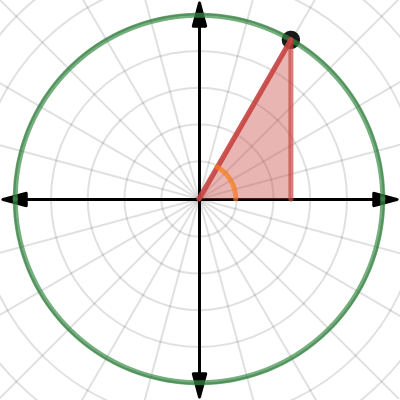
Desmos Graphing Calculator
You can play around with it if you want
eternal solstice
Damn. That is pretty cool.
viscid thistle
Ty
hexed ermine
👍🏼
eternal solstice
Okay basic question. I need to distribute 3(2sinxcosx)
would it be 6sinxcosx or 6sinx3cosx
viscid thistle
Treat sin x and cos x as if they were just variables
It would be 6 sin (x) cos (x)
eternal solstice
okay thanks
viscid thistle
np
eternal solstice
Okay. Why can't I get this right? Dont i just do arcsin(-.45) and add pi/2?
arcsin(-.45) = -.4668
wind igloo
=tex sin\bigg(\frac{\pi}{2} + x\bigg) \neq sin(x)
granite stirrupBOT
wind igloo
Eh.
viscid thistle
Oh I see
It has to do with the Unit Circle
The graph I sent up in chat has some explanation
Do you have it open?
eternal solstice
yeah
granite stirrupBOT
viscid thistle
Ok so do you know how sine and cosine correspond with the Unit Circle?
eternal solstice
yes, cos in the x value, sin is the y value
eternal solstice
yes
viscid thistle
Try and visualize that
eternal solstice
ok sin is negative in the 3rd and 4th quadrant
viscid thistle
Yep
So since it's a circle, what's significant about these two values?
Hint: I'm talking about the x-coords
eternal solstice
I'm not sure
viscid thistle
They're opposites of each other
eternal solstice
oh yeah
viscid thistle
For example in another problem one would be x = 1/2 and the other would be at x = -1/2
eternal solstice
ok yes
viscid thistle
Hold on, no it's asking for the angle in radians not the x coordinate.
Damnit
Ok so you want to find arcsine (-0.45)
And that's one of your answers
You still here?
eternal solstice
Yeah I am
viscid thistle
Ok good, but since we want our answer as a positive, what can we add to it?
eternal solstice
pi
viscid thistle
gg
eternal solstice
That answer is correct
viscid thistle
yes
eternal solstice
now i just need to find the other value
eternal solstice
so 5.8164 is in the QIV right?
eternal solstice
can't i just subtract pi/2 from our original answer
viscid thistle
Anything greater than 3π/2 is in quadrant IV
eternal solstice
because i need QIII
viscid thistle
No, you could only subtract π/2 if theta was halfway through Quadrant IV
(315 degrees)
eternal solstice
hmm
viscid thistle
I'll make a visual
The shaded areas are the same area, just mirrored across the y-axis
eternal solstice
ok
viscid thistle
So what we want to do to find the question mark is subtract 5.8164 from 360 degrees or 2π to get the shaded angle
And then add that value to π
Can you visualize why that works?
eternal solstice
Yeah that helps
viscid thistle
Ok so
viscid thistle
np
eternal solstice
I really need to get into the habit of drawing
I'm realizing im much more of a visual learner haha
so soon as I saw that picture it clicked.
viscid thistle
Visual representations always help, especially when you get into physics
Yeah me too
I need a video or a whiteboard in front of me lol
viscid thistle
No problem man
 gilded marten
I could use some tips if anyone has any
hexed ermine
Some tips would be to determine the amplitude
and the period of the function
and if there is any vertical shift or phase shift
hexed ermine
Well so far you have 3cos(x)
gilded marten
maybe cos -1