#precalculus
1 messages · Page 107 of 1
 viscid thistle
ooh. 2nd year?
 calm whale
yes
viscid thistle
do u think the ib is harder than a level
calm whale
yes definetely
hm lets put it this way
if you're smart academically + orginized it doesn't matter
if you're really organized (as in doing your best) but are not so bright then IB will be easier (more rewarding)
viscid thistle
blackout bruh
calm whale
if you're a dumb and lazy shit then you'll die either way
viscid thistle
talks about organized while playing chess
calm whale
🤔
viscid thistle
hmm did u take/are taking further maths hl?
calm whale
I'm thinking alisher alright I'm just taking my time
I am taking HL maths/physics/econ
wanted to do HL chem
viscid thistle
how is maths hl compared to further maths alevel
viscid thistle
which one is harder though
calm whale
🤔
they are about the same
mmm in a-levels you have more time to prepare
on 3 subjects
calm whale
IB is more about preparing adequately in a short amount of time
uuuh 4hls in ib
I wouldn't advise
I had this mate did 4 hls and got a 45
but generally a nono
@viscid thistle can you spot the mate in 1
no in a-levels you start with 4 and then you can drop 1
viscid thistle
damn my school requires me to do English lit and History of the Americas both at HL, so ill have to do 4 HLs to get maths and physics
calm whale
honestly if I could restart I would 100% do a-levels
viscid thistle
...
viscid thistle
ye
viscid thistle
I made a mistake putting that horse there
viscid thistle
that too
calm whale
that was what lost the game basically
pushing g6 or maintaining the tension was the way to go
@viscid thistle every school requires english lit and a langl; you dont need HL physics to get into an engineering degree
viscid thistle
yes but mine makes it HL
viscid thistle
wtf is HL physics
like "BLOODY HELL MATE, BLIMEY, FUUCKOFFF" right? is that how u do it in england?
calm whale
mmmm
viscid thistle
you broke the maths brady
calm whale
you'd just give em the 2 fingers
mmmm if you're going for cambridge does that means you have 150+ iq right?
calm whale
that's a joke d:
for engineering probs ye 🤔
unfortunate
you;ll get fucked by your IA's lol
calm whale
both maths and physics IA are cancer
calm whale
they aren't hard, they are just cancer
viscid thistle
of course not mr caucasian
i was sarcastic
im an asian yeh
why did you delete ur chat alisher?
calm whale
what do you do in pre ib
viscid thistle
I understood you meant irl so why ask
calm whale
I'm 100% sure that this is a waste of time
I legit don't see how you're going to cambridge and taking that
viscid thistle
no no no no
im just like year 10 dude
im not a year 12 kid mate
does cambridge have scholarships
calm whale
they do
viscid thistle
@calm whale So we use the same textbook for IBs, just go in less depths, so when we reach 16-17 doing the IB, we can test for SLs only in 1 year. @viscid thistle Very few for foreigners
did ramanujan have one 🤔
calm whale
modular algebra?
calm whale
number theory?
viscid thistle
we dont do number theory at all, even at maths hl, my teacher doesnt choose that as an option
viscid thistle
oh man I am 14 and all I learned so far is a bit of calculus and set theory
how do I die
viscid thistle
yeh but not until the end of the year, implicit explicit yes
derivatives and limits
yeh me too @viscid thistle
oh
calm whale
eq-n of vector lines?
viscid thistle
you guys know wat? im playing dota and enjoying my life for the last day of thanksgiving
see yah
calm whale
matrices?
calm whale
🛑 dota
 clever inlet
🤔
calm whale
yes
clever inlet
My friend picked up dota
calm whale
League is superior 🤔
clever inlet
He comes to school like twice a week now
If even that
We had a low attendance meeting at school
And he missed that too
calm whale
wait what grade is that
clever inlet
11/12
calm whale
hmm that's unnaceptable really
clever inlet
I don't think he can pass the year
Cause you need 85% attendance
And he's at like 20
viscid thistle
WHAT THE HECK GUYS
HOW IS LEAGUE SUPERIOR
it's fun
dota is boring and slow
"outplays" are through micro decision making
not mechanics
.....
league is flashy af
no
@viscid thistle r u an american maths student
no
not american, not a math student
lel what r u
calm whale
what
you just said MICRO DECISION MAKING, NOT MECHANICS in the same sentence
🤔
micro = mechanics
macro = map movement
viscid thistle
microdecision making involves positioning in lane, positioning in teamfights,
macro is rotations, vision
micro also involves lane management early game
but this is a calc chat, mb.
Did you take like maths 31 in high school, if you are Alberta-rian?
Ontario
and I didn't focus on math and shit in hs
i went a super standard path
😮
viscid thistle
@inland forum I can help u in 2 weeks lol
 inland forum
now preferably
 fast tinsel
This is the method we use to solve a sin(x) + b cos (x) = c
I just can't wrap my mind around the fact that someone came up with this, how do you even get the idea 😮
 willow bear
tbh this is a slightly roundabout way of going about this
fast tinsel
Is there a better one?
willow bear
hmm
well
okay so let's take the expression a sin(x) + b cos(x)
and let r = sqrt(a^2 + b^2)
then we can rewrite it as
=tex r \left(\frac{a}{r}\sin(x) + \frac{b}{r}\cos(x)\right)
 granite stirrupBOT
willow bear
granite stirrupBOT
willow bear
and now the cool thing about a/r and b/r is that
(a/r)^2 + (b/r)^2 = 1
so they are the cosine and sine of some angle
we can call that angle phi
and get
=tex r(\cos(\varphi) \sin(x) + \sin(\varphi) \cos(x)) = r \sin(x + \varphi)
granite stirrupBOT
willow bear
it's more transparent imo
 rugged marsh
hey
willow bear
👀
rugged marsh
i was asked to find the asymptotes of cot(x)
willow bear
uh huh
rugged marsh
i wanted to ask, if tan(x) was undefined, will cot(x) also be undefined?
willow bear
nope
willow bear
no because cot is defined as cos/sin, not 1/tan
willow bear
no
rugged marsh
why?
can you give an example of "undefined" execept division by 0?
also, does this net neutrality thing happen in only the U.S.?
@willow bear
willow bear
it seems to be US only, yes
viscid thistle
Dunno if Logarithms are supposed to be "pre-calculus", but this is a fun challenge...
viscid thistle
@SpriteFan274#1529 yes, it is pre-cal
viscid thistle
@SpriteFan274#1529 lel can u give us the solution, i combiened it, put the first term into log base 5, stick it together but i dont know how from there
 hoary lantern
thas jsut unnecessary
 brisk root
I have pondered this question for sometime, our teacher is a stickler for details yet provides few for the question. Aside from assumption for the altitude of the antenna, is there another possible way to solve this? If so, please solve.
"A radio antenna is 80 feet tall. The angle of elevation from the top of the antenna to a landing airplane at an altitude of 640 feet is 3° 40'. Find the line-of-sight distance from the top of the antenna to the airplane."
 patent beacon
What's the assumption?
Well, the question defines a right angled triangle, and you can use trig to solve it
brisk root
My assumption is the radio antenna base is at an altitude of 0. I may have over looked something. Did you account for this altitude or have I missed something simple (again)?
Sorry for the delay, I was expecting a notification.
willow bear
brisk root
That is based on the assumption that the altitude is 0 for the base of the antenna. However, since you have arrived at the same diagram as me(though a little less to scale haha) I will use that. I appreciate it, truly.
brisk root
"A boat is sailing due east parallel to the shoreline at a speed of 10 miles per hour. At a given time, the bearing to the lighthouse is S70 E, and 15 minutes later the bearing is S63 E. The lighthouse is located at the shoreline. What is the distance from the boat to the shoreline?"
I have a solution, however many of my classmates and I share different answers. Does this look correct?
 nimble oxide
Can someone explain to be how-to find the domain of composites.
willow bear
of what? compositions of functions?
nimble oxide
Yes, composite functions.
willow bear
mh
do you have an example we could work through or do you just want a set of general guidelines?
nimble oxide
willow bear
aight so
in general, when finding the domain of a composition like $$f \circ g$$, you'll want to do the following
granite stirrupBOT
willow bear
start with the set of real numbers (R)
then find the domain of g
what might be easier to find, and what i recommend you find, is what isn't in the domain of g
in other words, what values of the input to g will "break" g
(i'm not yet talking about your specific example)
once you've done that and gotten your new, restricted set (which isn't the domain yet!) you'll need to find what values of the input to f will break f
and then solve the equation(s) or inequality(ies) g(x) = <whatever you found will break f>
that might sound confusing
nimble oxide
No, I believe I understand.
willow bear
so here's a diagram if you need
the "g" and "f" boxes represent their respective functions, and D(f) and D(g) stand for the domains
nimble oxide
Ah, so the domain of g and f are irrelevant to the domain of f comp g?
willow bear
no? they are anything but irrelevant lol
you need to know 'em so that you know when your composition fails
nimble oxide
Oh....but f(5) would make it invalid,....
nimble oxide
So why would 5 still be included?
willow bear
f(g(5)) = f(1/5) = (1/5 + 4)/(5 - 1/5)
and that does not end up with dividing anything by zero
nimble oxide
O.....
willow bear
it might be helpful to rewrite the definition of f as f(u) = (u + 4)/(5 - u) to distinguish the inputs to f and g
nimble oxide
and if you solve that it'll be (1+4x)/(5x-1)
nimble oxide
simplifying the composition would be a better wa for explaining it
willow bear
also, the simplification of $$\frac{\frac{1}{x} + 4}{5 - \frac{1}{x}}$$ to $$\frac{1 + 4x}{5x - 1}$$ ignores the fact that $$x$$ could not be $$0$$ before the simplification
granite stirrupBOT
nimble oxide
This is giving me a headache. 😅 ugh
OHH nevermind I get it, the domain of f comp g can't equal (1/5) becasue you have to set the denom. equal to 0. with the answer being
nimble oxide
(-infin,0) U(0, (1/5)) U ((1/5), infin)
willow bear
yup looks correct
nimble oxide
ugh, finally.. domain gets me everytime.
 tired dagger
could anyone help with this problem please?
kinda confused as to how I'm supposed to set this up
willow bear
looks like law of sines could be useful here
try obtaining all the angles in the triangle
tired dagger
literally just tried that and got the wrong answer
willow bear
care to show what you tried?
tired dagger
it was on an older problem and the computer seems to change the numbers every time you get it wrong
willow bear
i mean you might have screwed up on the arithmetic
tired dagger
I subtracted 43 from 180
to get the second angle
is it from 180 or subtract from 90?
willow bear
well what do 43° and the angle you're finding have to add up to?
tired dagger
honestly don't remember. I assumed 180 because I recall my professor mentioning something regarding subtracting from 180 on the coordinate plane
willow bear
do you know what a 180° angle looks like
tired dagger
yeah and I just realized the mistake I made
sorry. Should have paid attention and noticed it earlier
 languid wind
how would i approach the following question:
solve for x in the domain 2pi:
3sin2xcosx + 3sinxcos2x = 1
languid wind
is 2cosx and cos2x the same thing?
languid wind
3sinx2cosx +3sinx(cos^2x - sin^2x) = 1
willow bear
@languid wind this is literally sin(2x+x) but expanded
@calm whale nope
this literally screams for an ANGLE SUM IDENTITY
 timid plank
hmm
what is the domain of f(x) = tan(2x+3)-1 (the restricted one to where it can be one to one)
i got (-pi-6)/4< x < (pi-6)/4
i am confused because when I found the inverse things didn't add up
because the domain of f(x) should be the range of f-1(x) but it is not
willow bear
what did you get as f^-1(x)?
timid plank
(arctan(x+1)-3)/2
timid plank
hmm
ok
but then the range of the inverse would be -pi/2 < (y-3)/2 < pi/2
and solving that doesn't result in the domain of f(x)
that is where I was confused
 hidden linden
Could someone help me with solving an equation? It's basically just x^2/3 - 4x^1/3 - 5 = 0
I got to the point of x^2 - 4x = 125
I assumed I'd want to get all terms on the left to factor, but I can't factor that, can I?\
viscid thistle
@hidden linden Actually yes, I think its technically called super imposing where a*b=0, either a or b is zero
We find the roots this way
so, we set it equal to zero
so we factor/quadformula/newton-rasphone/(my discovered on my way to get coffee way to solve for polynomials), etc
(x-n)(x-m)=0
so, we can take it over and we get x^2 -4x -125 = 0
hidden linden
wut
viscid thistle
In short, you can take it to the other side.
 river crow
@hidden linden use quadratic formula after
clever inlet
I think you made an error converting to a quadratic?
If you are trying to cube everything
It wouldn't work like that
viscid thistle
let me check actually
river crow
anyone know how to solve for x here? (1/8)^(2x+1) = 32^(x-3)
viscid thistle
@clever inlet I mean, he should have got x^2 -4x -15 = 0
@river crow I can _walk you through it _
river crow
@viscid thistle ok that would be great
clever inlet
I don't think that works either
viscid thistle
@river crow well, someone who is good with the mathbotshould actually do it ~~ because Im very bad at it...because I never use it ~~
@clever inlet yeah, by the property of a/b-c/b = (a-c)/b
okay, so first off, you know what an exponent of 1/8 turns into, right?
viscid thistle
but, you multiple both sides by 3 though
clever inlet
oo
i assumed the 1/3 was the exponent
cause he got 125
so i assumed he cubed everything
in an attempt to eliminate the fractional exponents
river crow
=calc (1/8)^(2x+1) = 32^(x-3)
granite stirrupBOT
Failed to parse equation: Invalid syntax at position 8
(1/8)^(2x+1) = 32^(x-3)
        ^
wth
viscid thistle
** go to bot testing to experiment, would you kindly? **
@clever inlet yeah, I'm guessing he just put it as x^1

river crow
yeah sure sorry
viscid thistle
no problem, sorry if you thought it was being harsh
My monster of an equation
made with extremes in mind
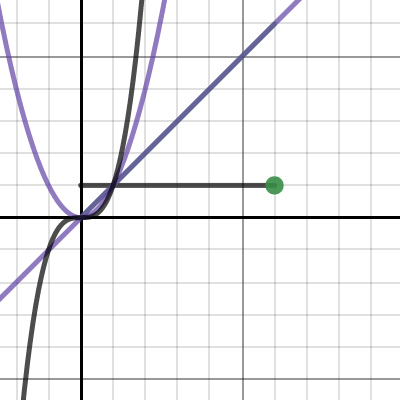
Desmos Graphing Calculator
hidden linden
=tex 2^{-3}^{(2x+1)} = 2^{5}^{(x-3)}
granite stirrupBOT
Rendering failed. Check your code. You can edit your existing message if needed.
hidden linden
Fuck
Isn't that what you do for your problem though @river crow
So it ends up being -6x-3 = 5x-15 ?
clever inlet
yeah, seems like it
hidden linden
And just solve for x at that point
I did that all in my head so correct me if I messed something up
clever inlet
yeah
hidden linden
Yes I did
 heavy sonnet
o ya
hidden linden
Substitute in u² and u, giving you u² - 4u - 5 = 0
clever inlet
yeah
hidden linden
Then u ressubed in valves for u as x^1/3, cube to get rid of cube roots
Gives you -1 and 125
clever inlet
👍
hidden linden
Sweet shit bois
I think this is how you do it @river crow
But double check with someone smarter
Should be 12/11 :/
clever inlet
looks right to me
hidden linden
Yeah those problems are basically all laws of exponents I believe, so if it doesn't make sense Google that shit
viscid thistle
Alright I need some help with pre-calculus problems
So I'm still trying to figure out using summation notation for finding the area under the rectangle.

This is supposed to equal 24.8
However, I put it in for my calculator as 4^∑vx=1 (2(2x-1))
And I get 32
Why is that?
 twilit zodiac
depends what f is
4^∑n=1, (2(2n-1)) <=> 2 * (2 * 1 -1) + 2 * (2 * 2-1) + 2 * (2 * 3 -1) + 2 * (2 * 4-1)
 primal crater
if h(x) is g(f(x)) would the restrictions of g(x) (domain and range wise) carry over to h(x) as well as f(x)?
 late haven
ping <@&286206848099549185>
 severe verge
yes the restrictions carry over @primal crater
viscid thistle
@severe verge are you good at algerbra
severe verge
why whats up
viscid thistle
lol
 calm thicket
I don't know how to do e-h
viscid thistle
e) does that refer to end behavior ?
as in is it increasing as x goes to positive infinity and so on
calm thicket
Basically, solve as x goes to infinity
viscid thistle
oh, so without the odd/even and degree of leading coefficient info?
since u posted in precalculus i figured that's what you'd be expected to do it
lol
calm thicket
If you have another, I can translate it 😛
calm thicket
Generally yea
viscid thistle
so you want $$\lim_{x \to \infty} f(x)$$
granite stirrupBOT
calm thicket
Yea
viscid thistle
are you comfortable with limits to infinity ?
calm thicket
Not overly
viscid thistle
well, and keep in mind that its 11pm here so i may not be at my best, let me try to figure this out on paper really quick
so i dont waste ur time
calm thicket
But I get some concepts, for instance, I'm 95% sure this is 1
because the highest degree is the same
viscid thistle
its better if we go thru the evaluating limits at infinity
it will come at more use with integrals and shit, at least im using it in calc now
gimme a sec
ok got it
it is 1 as far as i got
i can walk you through the limit process if you want
I got 1 too
actually, lets do it
calm thicket
Yea because not all of 'em have the same degree in num and den
viscid thistle
=tex \lim_{x \to 0} \frac{x^2-9}{x^2-x-6}
granite stirrupBOT
viscid thistle
the way i went about solving this
and the way my book did it too (calc book tho)
is, i divided all terms by the term largest exponent of the denominator (in this case x^2)
late haven
\infty ?
viscid thistle
shit right lmao
calm thicket
:p
late haven
lol
calm thicket
that'll help with my x-ints but I think just plugging in 0 would be plenty 😛
viscid thistle
is dividing each term by x^2
calm thicket
Okay
viscid thistle
You'll cover it in calculus
tell me what your fraction looks like
once you divide all terms by x^2
calm thicket
=tex \frac{1 - \frac{9}{x^2}}{1 - \frac{1}{x} - \frac{6}{x^2}}
granite stirrupBOT
calm thicket
The stuff on the right would get to 0 as x gets larger it seems
granite stirrupBOT
viscid thistle
=tex \lim_{x \to \infty} \frac{1 - \frac{9}{x^2}}{1-\frac{1}{x} - \frac{6}{x^2}}
granite stirrupBOT
calm thicket
Does the same method work on this one? Dividing all by x^3?
viscid thistle
=tex \lim_{x \to \infty} = \frac{c}{x^n}
granite stirrupBOT
viscid thistle
but anyways
on the problem we were now
you should also remember that $$\lim_{x \to \infty} c = c$$
granite stirrupBOT
calm thicket
Yea
calm thicket
A'ight
viscid thistle
this is from where the rule you were talking about comes from, from the evaluation (butchered english?) of the limit to infinity
also
if ur evaluating horizontal asymptotes with these
you should remember that some functions may have different horizontal asymptotes on one end of the x axis vs the other
u can verify that its the same on both by checking the limits as x approaches positive as well as negative infinity
calm thicket
A'ight
viscid thistle
are u seeing this in precalc tho ?
we did limits at infinity like a month or so ago in calc xd
calm thicket
I asked my teacher if instead of the usual method, I can use limits to infinity as practice for precalc
*calc
and she said it's fine
viscid thistle
good call
calm thicket
so I'm learning limits while everyone else is doing weird stuff like $$x\to\infty, f(x)\to1$$
granite stirrupBOT
viscid thistle
well
what they'd be saying is something like
as x -> infinity, f(x) -> infinity or so on
but ye
calm thicket
and correct me if I'm wrong, limits are a more formal (and accurate) way of doing it
viscid thistle
i dont qualify myself to say whats accurate/formal, but i am able to tell you that it is used in calc
calm thicket
k
viscid thistle
and it starts to be more and more used in integration too, so you can bet its going to be used on calc 2 and so on
calm thicket
But how do I evaluate the limit of this one?
viscid thistle
aight so
remember what i told u about
u want to divide every term by the term with the largest exponent of the denominator
calm thicket
Dividing by x^2, we get x + 1 - 2/x / 1 - 1/x^2
patent beacon
Limit going to infinity?
calm thicket
mhm
viscid thistle
=tex lim_{x \to \infty} \frac{x + 1 - \frac{2}{x}}{1-\frac{1}{x^2}}
granite stirrupBOT
viscid thistle
right ?
calm thicket
teacher said something about oblique asymptotes if the numerator's degree is larger than denom
And yea
patent beacon
Mineswell not bother. The numerator has a larger degree, so it will always overtake the denominator
viscid thistle
lim x-> infinity of x = infinity
patent beacon
Goes to infinity
calm thicket
So it's infinity
viscid thistle
therefore
calm thicket
Yea
calm thicket
=tex \lim_{x\to\infty}\frac{x^{n+a}}{x^n} = \infty \text{ for positive numbers } a
granite stirrupBOT
calm thicket
If I'm not wrong
viscid thistle
it would appear so
patent beacon
The only interesting rational function is the one where top and bottom are both the same degree
calm thicket
I concluded that if it's the same degree, you get leading coef/leading coef
viscid thistle
like you did with the previous one
calm thicket
Yea
viscid thistle
yep
calm thicket
And if it's a lower degree in numerator, it's 0
calm thicket
But higher, is there no asymptote because it goes to infinity?
patent beacon
There is a slant asymptote
calm thicket
Whoa
viscid thistle
only if the difference between the exponents is one
calm thicket
How to find?
patent beacon
You can get it with polynomial division
But it will go to infinity
viscid thistle
unless i remember it wrong
but the degree of the denom has to be at least 1
and the difference of degrees has to be 1 exactly
calm thicket
Mkay
viscid thistle
i plugged some values into desmos and it appears to be correct
but feel free to correct me xd
patent beacon
(x² + x + 1) / (x + 1) = x + 1 / (x + 1)
As x goes to infinity, 1 / (x + 1) starts to disappear, leaving x alone. So, (x² + x + 1) / (x + 1) will act like x for large values of x
calm thicket
So the asymptote is y=x?
patent beacon
= pup graph (x² + x + 1) / (x + 1)
granite stirrupBOT
Query made by @patent beacon
Data sourced from Wolfram|Alpha: http://www.wolframalpha.com/input/?i=graph+(x²+%2B+x+%2B+1)+%2F+(x+%2B+1)
Do more with Wolfram|Alpha Pro: http://www.wolframalpha.com/pro/
This command is in development. Suggest improvements on the MathBot server (type =about for the link).
calm thicket
How does one divide polynomials?
patent beacon
The graph is far from good looking, but that's what you get, lol
viscid thistle
long division
viscid thistle
or synthetic (if degree of term in the denom is 1)
calm thicket
(assuming it's quick, I still have 4 more questions that'll be on the test)
viscid thistle
synthetic is faster, but there's the condition of the denominator's leading term exponent being of degree 1
viscid thistle
in other words
 opaque bay
welp
viscid thistle
if u got sth like x^2 + whatever in denom = synth doesnt work
opaque bay
gn ya'll
viscid thistle
so then long division
patent beacon
I avoid division processes wherever possible. It's typically possible:
(x² + x + 1) / (x + 1)
= x(x² + x + 1) / (x² + x)
= x(x² + x) / (x² + x) + x / (x² + x)
= x + 1 / (x + 1)
calm thicket
Nice.
opaque bay
op
calm thicket
So how do I find vertical asymptotes?
patent beacon
When the denominator is zero, and the numerator is NOT zero
calm thicket
Okay
patent beacon
My function has a vertical asymptote at x = -1
calm thicket
Referring to this, it factors to (x+3)(x-3)/(x+2)(x-3) so the asymptote is at x=-2, but NOT x=3?
patent beacon
Indeed, no asymptote at x = 3. You get a "hole" there instead
viscid thistle
removable discontinuity if ur profs will take points off for saying hole
hides in B-
calm thicket
They won't
In fact, i is determine the coords of any holes, I assume limits are necessary there
patent beacon
And you can use a limit to find where this hole is
viscid thistle
i fail to see why you would in a case like this though
you see that RD's are factors that cancel out
calm thicket
Yea
patent beacon
To keep the function the same, you'd need to consider the restriction that x ≠ 3. But you can be like EEHH
calm thicket
Oh, can you just remove the x-3 from both sides and plug in x and ignore the x!=3 to get coordinates?
patent beacon
You can use a limit to turn "I don't really care" into "I don't really care but I'm rigorous about it"
calm thicket
I like this quote.
viscid thistle
well by saying that function cant be = 3
arent u saying that "for any value other than 3, this function is defined"
calm thicket
(other than 3 and -2)
viscid thistle
but x = -2 is a VA
patent beacon
Yeah. We can then go on to say that the function can be defined at x = 3 and remain continuous.
But x = -2 is a no-go
viscid thistle
ye
i didnt say x = -2 since we came to the conclusion that it was a VA based on the zeroes of denom that don't have the numerator as 0
also keep in mind that you should say x = -2 since its a line, dont want u to lose points for it
hides in B- again
patent beacon
= wolf graph (x^2 - 9) / (x^2 - x - 6)
granite stirrupBOT
Query made by @patent beacon
Data sourced from Wolfram|Alpha: http://www.wolframalpha.com/input/?i=graph+(x^2+-+9)+%2F+(x^2+-+x+-+6)
Do more with Wolfram|Alpha Pro: http://www.wolframalpha.com/pro/
🐺 Try out the new =pup command! It's much more concise.
viscid thistle
there xd
patent beacon
Again, not a great graph to show those features off :/
But you can kinda tell there's an asymptote there
viscid thistle
the zoomed in version up top lets us see the VA
patent beacon
Ahh good point
viscid thistle
sadly no point out of the RD at x = 3 : (
its even removed from the graph itself
unwanted : (
viscid thistle
fucking hell 11:30 and im not sleeping
patent beacon
Same^
calm thicket
Same tbh
This place makes me want to be a math major
and I end up staying up until like 1 discussing with the smart people about this concept where they're *probably like "Goddamnit i it's obvious"
patent beacon
I love math, but I'm glad I didn't go to be a math major. Just not for me.
viscid thistle
i actually slapped a math major on top of my game programming one
i was fine with it since i am getting rid of all petty shit like composition 2 and stuff this semester lol
calm thicket
I plan on dual majoring compsci and math.
viscid thistle
no offence to english majors but damn lol
patent beacon
That's a pretty good idea, you'll be bounds ahead of other compsci majors, who don't typically know enough math
viscid thistle
hahaha
good point
guess that's why i'm not one of them 😛
and ye
since i'm into game programming specifically
i'm expected to be strong at 3d math
agony intensifies
calm thicket
Game programming isn't my tea tbh, I would rather write software to solve problems 😛
viscid thistle
have u looked at reverse engineering?
patent beacon
I see too many people:
"I'm trying to program this game in 3D space, can someone help me with this right angled-triangle"?
calm thicket
noice
viscid thistle
you should look up reversing in games
calm thicket
sohcahtoa intensifies
viscid thistle
thats why i had the 2 weeks of not touching this discord server
i was legit obsessed with it
like a new toy i was into it 24/7
then i was like "i cant leave math now halfway lol"
calm thicket
Mk I get f-j until problem 3 D:
viscid thistle
so big return
patent beacon
Freakin' rotation matrix intensifies. You need some pretty intense math to be able to do what they want to do and they haven't left grade 10 smh
calm thicket
mhm
viscid thistle
it was the difference in the degrees and stuff
viscid thistle
which one are u doing 3 or 4
viscid thistle
what do u get as ur lim -> positive infinity
calm thicket
infinity
calm thicket
-infinity
calm thicket
No asymptote?
viscid thistle
that the function is unobstructedly (rip english majors x2) making its way to positive/negative infinity
calm thicket
Mk
viscid thistle
i'd check with kayne just to be sure
calm thicket
x(x+2)(x-1)/(x+1)(x-1)
calm thicket
Yea, factored
viscid thistle
its not rightly factored in the numerator
its not a diff of squares
theres a plus
calm thicket
No, x^2-1
viscid thistle
it is ?
calm thicket
Mhm
calm thicket
😛
viscid thistle
u have the vertical asymptote x = -1
calm thicket
Ye
viscid thistle
and a removable discontinuity at x = -1 which is the point (-1, f(-1))
calm thicket
viscid thistle
right
so notice the degree of the num's leading term
= 3
the one for the denom = 2
there's a diff of one
in them
and the denom degree > 1
so we have a slant asymptote
(which implies no horizontal asymptote)
calm thicket
So there's an oblique one
viscid thistle
thing is how to find that line (remember slant/oblique asymptote is a line)
if the degree on the denom were 1
then u could use synth division
but u cant since its 2
calm thicket
rip
viscid thistle
so long division, or the trick that kayne showed u (i dont understand it so i'd do long division)
viscid thistle
let me see if i got it righ
long ass time since i did this lol
ok think i got it
if its y = x - 1 (which it appears to be) then i can explain
if not then not xd
calm thicket
It appears to be y=x**+**1
viscid thistle
oh
patent beacon
= (x³ + x² - 2x) / (x² - 1)
= x(x³ + x² - 2x) / (x³ - x)
= x(x³ - x + x² - x) / (x³ - x)
= x(x³ - x) / (x³ - x) + x(x² - x) / (x³ - x)
= x(x³ - x) / (x³ - x) + (x³ - x - x² + x) / (x³ - x)
= x + 1 + (-x² + x) / (x³ - x)
patent beacon
Holy hell that one ended up being harder than it needed to be
patent beacon
Yeah that's probably the better option at that point
viscid thistle
that's long division
calm thicket
Started by multiplying by -1 yea
you got your negative thing without x^3 somehow 🤔
then yuo did it again with 0x and -1 whaaa?
viscid thistle
ok so
i think its easier if u do long division without poly's first
like just plain numbers
ill show u one
after u understand the basic one, you just do the same but with polynomials
calm thicket
Was just reading through it :p
viscid thistle
xd
calm thicket
How do I turn this into polynomials?
viscid thistle
so first step is i write the denom in its own box
then write the num right by it
so it leaves me with
x^2 - 1 | x^3 + x^2 -2x
i put a line on top of the num to write out the result of the division
so then i start
i look at the first term
of the num
x^3
i think to myself
"what do i multiply x^2 by to get x^3"
the answer is x
calm thicket
mhm
viscid thistle
so then i write x on top since its part of the result
and now i have to keep going with the division
so
i set up the - and the parenthesis
so that i dont forget that they are being subtracted
you could just go straight ahead and put -x^3 -0x^2 +x
but i find it nicer with the - and parenthesis explicit
so then i go through with the multiplication
of the answer that i have so far
which is "x"
now we multiply this by the denominator
so first x * x^2 = x^3
notice how if you do this right then this first thing should always cancel itself out
if it doesn't, you did the division incorrectly
anyways, are u good up to this point ?
calm thicket
Mhm
viscid thistle
right
so now we need to subtract those terms
to come up with our next "iteration" of the division
if it helps to see it taht way
so we come up with x^2 -x
now we do the same thing
we look at x^2
and we say
"what can i multiply x^2 by to get x^2"
the answer is 1
so then i add 1 to the answer
answer so far is x + 1
so now
i do the same with this recent + 1
i multiply the denominator by it
so i add the - and the parenthesis
then i go 1 * x^2 = x^2
1 * (-1) = -1
so my thingy is looking like
-(x^2 - 1)
after that
we do the subtraction and end up with -x + 1
(its wrong on the picture)
so then we look at -x + 1
and we say hold up
-x has a smaller degree than x^2
so then we've reached the point where -x + 1 is our remainder
so our full answer is
-x + 1 + (-x+1)/(x^2-1)
but for the oblique asymptotes
we ignore the remainder
and so we get the line
y = -x + 1
tadaa
xd
calm thicket
*+x
viscid thistle
plus x where
calm thicket
nice
viscid thistle
you should practice some more of these slant asymptote ones
to get the hang of long division
calm thicket
you see ivan, when you do math like me, numbers are of confused because everything is absolute value!
viscid thistle
it always hurts my soul when synth division is not possible
calm thicket
😛
viscid thistle
i dont think i understand that meme lol
calm thicket
me neither tbh :/
viscid thistle
🤔
true math memeing
anyways i should get to bed
that should get u sorted for the questions f-i
so gn
and have fun with the rest of the problems xd
calm thicket
thanks :p
viscid thistle
Damn it, missed a good convo
whatever
@viscid thistle hey dude, haven't seen you in a while, whats up?
calm thicket
Out of curiosity, what's the value of your nick?
=tex \sum_{x=1}^{25}\sqrt[3]{2x^2}
granite stirrupBOT
calm thicket
=pup \sum_{x=1}^{25}\sqrt[3]{2x^2}
granite stirrupBOT
Query made by @calm thicket
Data sourced from Wolfram|Alpha: http://www.wolframalpha.com/input/?i=\sum_{x%3D1}^{25}\sqrt[3]{2x^2}
Do more with Wolfram|Alpha Pro: http://www.wolframalpha.com/pro/
This command is in development. Suggest improvements on the MathBot server (type =about for the link).
calm thicket
=pup \sum_{x=1}^{25}\sqrt[3]{2}x^2
granite stirrupBOT
Query made by @calm thicket
Data sourced from Wolfram|Alpha: http://www.wolframalpha.com/input/?i=\sum_{x%3D1}^{25}\sqrt[3]{2}x^2
Do more with Wolfram|Alpha Pro: http://www.wolframalpha.com/pro/
This command is in development. Suggest improvements on the MathBot server (type =about for the link).
granite stirrupBOT
Query made by @calm thicket
Data sourced from Wolfram|Alpha: http://www.wolframalpha.com/input/?i=\sum_{x%3D1}^{25}(\sqrt[3]{2}x^2)
Do more with Wolfram|Alpha Pro: http://www.wolframalpha.com/pro/
This command is in development. Suggest improvements on the MathBot server (type =about for the link).
viscid thistle
@calm thicket ironic, 166 is one of my favorite numbers, I didn't intend to do that, atleast, conscience-wise
granite stirrupBOT
83
calm thicket
83 is eh :/
viscid thistle
granted, its not exact 166 but yeah
the number 2 is great as well
2, when an exponent or degree of x forms my favorite shape, when its the leading term of a trinomial, it forms my favorite trinomial, if not not my favorite polynomial
I like 166 because I did a lot of physics work, that I used to prove some things and it appeared a lot in my calculations, I liked that experience, so I remember the number.
another another favorite number is .1666667 for the same reason.
viscid thistle
if anyone needs help in calculus/or math in general i can help(edited)
im on a lot these days
but please PM me tho, im in so many channels i forget to come here
just wanna help since my projects are finished 😃
but if someone can answer for them that works for you but if you see me online shoot me a question
 bright jetty
can someone teach me precalculus
calm whale
ask away if you have questions lol
bright jetty
yes
bright jetty
ibt as saying from yesterday i am like a political analyst/ mathematician
trying to uncover the Russia collaboration project through statistics and polls
viscid thistle
ah
bright jetty
ye
viscid thistle
There can even be more than just statistics involved
viscid thistle
no
bright jetty
😮
viscid thistle
A lot more math canbe applied
bright jetty
true true
viscid thistle
Obyeag can tell you that logic can be applied, big important concepts
 quartz garnet
=tex \sin^2 x = \cos^2 x - \cos x~(0\le x<2\pi) \
x=?
granite stirrupBOT
quartz garnet
Basic pre-cal stuff if you wanna.... test if you're good at precal? x'D
I guess?? :')
viscid thistle
He's not wrong
bright jetty
=tex \sin^99 x = \cos^2 x - \cos x~(0\le x<2\pi)
x=?
granite stirrupBOT