#precalculus
1 messages · Page 105 of 1
 gleaming schooner
 calm whale
wat
I just told you
it can't be equal to 0
5/x
by definition x cannot be equal to 0
as 5/0
is undefined
gleaming schooner
Alright
Why do we have to determine the signs on different intervals?
I don't understand that fully.
calm whale
this is a diff method
yes?
the method goes like that
you have the inequality
(x)*(x) > 0
for this to be true
x*x has to be > 0
or -x * -x has to be > 0
 viscid thistle
@calm whale You don't know what partial fractions are?....
calm whale
I mean it doesnt get much simpler than partial fractions
a bit of a terminology barrier
viscid thistle
but you said....
"ugh what is a partial fraction 🤔
is that a partial fraction 😄
cause it is just a normal fraction
putting a fancy name infront of it does not make it complicated"
I dont want it to sound complicated ;~; I like partial fractions, they are simple and fun, I have no benefit making them sound "complicated".....why would you think I would do that? ;~;
kinda hurts my feelings
gleaming schooner
Anyone around to help with a quick trig function
viscid thistle
I'm literally guessing where my question should be but
I'm literally guessing where my question should be but
For the exponential function f(x) C * a^x applies f(0) = 100 and f(10) = 200
Figure out C and a
viscid thistle
please @ me if anyone can help me
 serene vortex
anyone still need help? @gleaming schooner @viscid thistle h
serene vortex
ik bro
lmao but im getting it
still just gotta remember the derivative rules and then ill try out the AP worksheet
@viscid thistle whats the 1?
q?
viscid thistle
huh?
serene vortex
the question
viscid thistle
For the exponential function f(x) C * a^x applies f(0) = 100 and f(10) = 200
Figure out C and a
serene vortex
f(x)=Ca^x?
viscid thistle
I need to fugure out the value for C and a
viscid thistle
wait
serene vortex
c=100
viscid thistle
if x=0
where do I put everything else that u wrote
I barely understand the math book lol
serene vortex
so when x=0
f(0)=Ca^x
Ca^0 =100
a^0=1
C(1)=100
C=100
then just work out a using C when x=10 and f(10)=200
ill brb if u need more help
ok
viscid thistle
I understand nothing
serene vortex
oh
viscid thistle
why is f(0) Ca^x
I hate my teachers so much because they're trash at explaining
smh
serene vortex
hop into a voice chat?
viscid thistle
uh sure but I might not speak
viscid thistle
yeye
oh
idk
honestly
my teacher tells me to write it up in coordinates
like (0, 100) and (10, 200)
yeah I do
in the back of the book
C 100
a^1/10 I have in mind
a = 2^1/10
I don't get them at all
I hope so
viscid thistle
oh
serene vortex
f(10)=200
viscid thistle
yeah
serene vortex
Ca^0
serene vortex
200= 100a^10
serene vortex
2=a^10
viscid thistle
yeah
serene vortex
2^1/10=a
viscid thistle
so let me try to solve this then
so I know that f(x) = C*a^x
and that I have f(0) = 100
If f(0) then it would be just like f(x)
which means that if I have f(0) then I also have a^0
and a^0 is 1
so that would mean that I have 100 * a^0
oh yeah
yup
uh
I'm lost
so I know that a^0 is 1
but idk how to continue
viscid thistle
yeah
serene vortex
100=Ca^0
viscid thistle
yeah
lemme write this down
so what I wrote was
f(x) = C*a^x
f(0) = 100
a^0 = 1
f(0) = Ca^x
100=Ca^0
wait
not ^2
idk how I would write this down though but I assume since it's Ca^0 then it would be 100*1
serene vortex
100=C*1
viscid thistle
yeah
serene vortex
100=C
viscid thistle
ah
yeah so now I have C
so I have
f(10) = 200
and I know thaat f(0) is 100
oh
serene vortex
f(10)=Ca^10
viscid thistle
oh I see
viscid thistle
ah
so I have f(10)=ca^10 because f(x) = ^10 if I make f(10)
So now I know that 200 = Ca^10
oh
so 200-100?
serene vortex
100*a^10
viscid thistle
oh
so
200 = Ca^10
that meanst that 200 = 100*a^10
and I want away the 100's
so 200/100 and 100*a^10/100
so I have 2 = a^10
o ye
so I want away the ^10?
what do I do then
ah
lemme get my calculator
serene vortex
2^1/10
viscid thistle
well more precisely they said a = 2^1/10 = 1,072
I'm confused what I should do after 2=a^10
probs cause language barrier
nope, Swedish
you could use
the bot
wait
10sqrt?
serene vortex
10rt
serene vortex
a^1/10
viscid thistle
what is the difference between swrt and rt
I mean I've used these things before
but we call it just square root
yeah
well I'm just a highschooler
so
10rt
of a^10
oh
10rt 2=a^10
so that makes the answer to
uhh
2=a^1/10?
viscid thistle
but how do I know what 10rt of 2 is
oh yeah
so 10rt 2=a^10
yeah
so it would be a= 2^1/10
I basicaally switch places for them and proceed to do the rt for both
well I'm gonna try to do another one later
and see if I still have it in my head
well see if it sticks after an hour or something
yeah
nah
next tuesday
I just have a fucked up sleep schedule
yup
yeah
thanks
serene vortex
np my b
serene vortex
done with my hw, lmk if you need help
serene vortex
wtf
calm whale
what :?
calm whale
oh taht simply refers to the x-2/3
thats cartesian
for X
the thing you see in b) is in vector
notation or whatever ists called
I've kinda done this question already
 indigo briar
Why is the restriction on the inverse function x<0, shouldnt it be x>0??
calm whale
the square root
has to always be positive
so when you havea - infront of it
you get x<0
possibly
 frigid hearth
 blazing raven
name all three pythagorean identities. 😃
 trim hornet
hello?
 clever inlet
hi
trim hornet
i has a question
clever inlet
ok
trim hornet
that involves the ambiguous case
i understand that if you have side ac and cb you find height and do what ever
but what if you have side ab and bc
 willow bear
context?
trim hornet
AB=15cm, BC=12cm, and angleA=50 degrees
willow bear
is ABC a right triangle, or what?
or is it arbitrary
and most importantly, what are you asked for?
trim hornet
how many triangle ar there and no it doesnt specify what kind of traingle it is
are*
willow bear
how many triangles there are that have those features?
 tepid topaz
Converting (0,1) cartesian coordinates to polar should be (1,pi/4) yes? Book has it as (1, pi/2)
blazing raven
do you know what arctan means?
It means, in this case, what angle gives a tangent of 1.
tan(theta): angle --> ratio
arctan(ratio): ratio --> angle
tepid topaz
It should be arctan(1/0) which is undefined, yes? So I'm guessing you get the answer from knowing cos 0, sin 0 is pi/2 radians?
Sin1*
blazing raven
yup
notice how pi is about 3 and pi/4 should be about 0.75
Arctan 1 = .785 radians? 😃 look familiar?
tepid topaz
Yes
blazing raven
well there you go.
tepid topaz
How did they get pi/2 though
blazing raven
because at (0, 1) = (cos(theta), sin(theta)) as long a the original point is on the unit circle.
tepid topaz
So its just something you know, not calculate
blazing raven
For the special angles kinda.
gleaming schooner
Can anyone help me simplify that
I thought that I could simplify (secx)^2 to (tanx)^2 + 1
And then the (tanx)^2 would become 1
But apparently that's wrong, why?
willow bear
(tan^2(x) + 1)/tan^2(x) - 1 = tan^2(x)/tan^2(x) + 1/tan^2(x) - 1
viscid thistle
remember what local extrema is defined as
it needs an open interval (a, b) to have that "c" value inside of it, and then it becomes a relative/local min/max
so in this scenario
your a
has no "neighborhood" or neighbor (sorry i cant remember the terminology) to the left
 signal mesa
ohh so it's difference for absolute maxima, absolute is just the highest value?
viscid thistle
hm
well
absolute/global extrema apply to a specific closed interval too
f can have absolute extrema on [a,b]
(in other words, you look at the endpoints as well)
signal mesa
ohh so absolute/global has [] and local is ()
viscid thistle
i think so
someone may correct me on that
but idk
seems correct to what i remember
signal mesa
thank -u
 timid plank
@gleaming schooner the answer by the teacher is definetly incorrect, the answer is cot^2(x), you can verify that by substuting an angle for the unsimplified and simplified one
gleaming schooner
Yea, that's what I thought lol.
 at them
willow bear
at them
willow bear
sure that makes sense
gleaming schooner
=tex \frac{tan^2(x)+1}{tan^2(x)} - 1
 granite stirrupBOT
gleaming schooner
granite stirrupBOT
gleaming schooner
\tan
willow bear
=tex \frac{\tan^2(x) + 1}{\tan^2(x)} - 1
granite stirrupBOT
willow bear
like that
gleaming schooner
Alright
Seems to produce a similar output o,o
Ah
I see
Italicized in mine
willow bear
=tex a\sin(x) \text{ vs. } asin(x)
granite stirrupBOT
willow bear
what do you mean
willow bear
yes, but
you don't have tan^2(x)/tan^2(x)
you have (tan^2(x)+1)/tan^2(x)
you \textit{can} split it up into $$\frac{\tan^2(x)}{\tan^2(x)} + \frac{1}{\tan^2(x)}$$ though
granite stirrupBOT
gleaming schooner
Ahhhhh
willow bear
but no, you cannot cancel out the a's in (a+b)/a
granite stirrupBOT
gleaming schooner
Awesome. Thank you!
I've got another one
=tex \frac{\cos(x)}{\sin(x)} + \frac{\sin(x)}{1 + \cos(x)}
Which gives me
=tex cotx + \frac{\sin(x)}{1 + \cos(x)}
gleaming schooner
I'm lost after that though
 quartz garnet
🤔
How bout trying to reduce them into a common denominator
Seems like it'd become a nice one 👌🏼
gleaming schooner
=tex cotx + \frac{\sin(x)}{1 + \cos(x)}
granite stirrupBOT
gleaming schooner
You mean that?
 patent beacon
=tex \frac{\cos(x)(1 + \cos(x)) + \sin^2(x)}{\sin(x)(1 + \cos(x))}
granite stirrupBOT
willow bear
the numerator becomes cos(x) + cos^2(x) + sin^2(x)
= cos(x) + 1
and that can now cancel out
and you're left with 1/sin(x)
@gleaming schooner @patent beacon
willow bear
yup i used that
gleaming schooner
How do you get 1 + cos^2x = sin^2x 😮
patent beacon
Oh heh, that's pretty obvious. Shuold have taken it that step further
willow bear
i don't
the numerator becomes cos(x) + cos^2(x) + sin^2(x)
the raw cos stays
the other two terms add to 1
gleaming schooner
How'd you get that numerator
I guess I'm lost on that
Is this after:
=tex cotx + \frac{\sin(x)}{1 + \cos(x)}
granite stirrupBOT
willow bear
cos(x)(1 + cos(x)) = cos(x) + cos^2(x)
also \cot(x)
=tex \frac{\cos(x)}{\sin(x)} + \frac{\sin(x)}{1 + \cos(x)} = \frac{\cos(x)(1 + \cos(x)) + \sin^2(x)}{\sin(x)(1 + \cos(x))}
granite stirrupBOT
willow bear
@gleaming schooner do you understand this?
 late haven
it's cause you're multiplying by 1
=tex \frac{\cos(x)}{\sin(x)} \cdot \frac{1 + \cos(x)}{1+\cos(x)}
granite stirrupBOT
late haven
(half of a cross multiplication)
patent beacon
It's a good trick to learn. Easily the only required trick for like 60% of trig identities.
gleaming schooner
=tex \frac{\cos(x)}{\sin(x)} + \frac{\sin(x)}{1 + \cos(x)}
granite stirrupBOT
gleaming schooner
The problem is ^ though
willow bear
@gleaming schooner lolwat i just added the two fractions
=tex \frac{2}{7} + \frac{3}{13} = \frac{2\cdot 13 + 3 \cdot 7}{7 \cdot 13}
granite stirrupBOT
willow bear
would you call this "cross multiplication"
patent beacon
As was written above
=tex \frac{\cos(x)}{\sin(x)} + \frac{\sin(x)}{1 + \cos(x)} = \frac{\cos(x)(1 + \cos(x)) + \sin^2(x)}{\sin(x)(1 + \cos(x))}
granite stirrupBOT
gleaming schooner
Alright
I understand
Thanks
I guess I need to brush up on my basic algebra
quartz garnet
Yeah...
willow bear
you do
patent beacon
Wow that was ruthless
Even the experts forget some of the important stuff. Don't worry about it. Instead, make sure you understand the process, you don't want to miss out on that
=tex \frac{\cos(x)}{\sin(x)} + \frac{\sin(x)}{1 + \cos(x)} =
\frac{\cos(x)(1 + \cos(x))}{\sin(x)(1 + \cos(x))} + \frac{\sin(x)\sin(x)}{\sin(x)(1 + \cos(x))} =
\frac{\cos(x)(1 + \cos(x)) + \sin^2(x)}{\sin(x)(1 + \cos(x))}
granite stirrupBOT
quartz garnet
=tex \frac{\cos(x)}{\sin(x)} + \frac{\sin(x)}{1 + \cos(x)} \
=\frac{\cos(x)(1 + \cos(x))}{\sin(x)(1 + \cos(x))} + \frac{\sin(x)\sin(x)}{\sin(x)(1 + \cos(x))} \
=\frac{\cos(x)(1 + \cos(x)) + \sin^2(x)}{\sin(x)(1 + \cos(x))}
granite stirrupBOT
quartz garnet
Lik dis, mah fella
patent beacon
Cool cool, thanks
gleaming schooner
Alright, I think I understand a bit better now
I'm gonna get some rest and continue tomorrow
I still need to learn how to verify identities, and double angles and half angles
Oh and graphing trig functions
Gonna be an interesting day tomorrow
Thanks for the help guys
quartz garnet
no problem :')
signal mesa
If i have a closed continuous function say defined on interval I on domain D, and it opens concave up, are the edges of the function critical points?
granite stirrupBOT
gleaming schooner
I'm a bit lost on how to simplify this further
granite stirrupBOT
Support the bot on Patreon: https://www.patreon.com/dxsmiley
gleaming schooner
=tex \frac{\cos(x)(1 + \cos(x)) + \sin^2(x)}{\sin(x)(1 + \cos(x))}
granite stirrupBOT
willow bear
@gleaming schooner i told you like twice earlier today though
=tex \frac{\cos(x)(1 + \cos(x)) + \sin^2(x)}{\sin(x)(1 + \cos(x))} = \frac{\cos(x) + \cos^2(x) + \sin^2(x)}{\sin(x)(1 + \cos(x))} \ = \frac{\cos(x) + 1}{\sin(x)(1 + \cos(x))} = \frac{1}{\sin(x)}
granite stirrupBOT
willow bear
surely what i did there does not need explaining?
gleaming schooner
Ahh, I didn't think of distributing the cosx
In the first step, how does the top become -1 and the bottom become +1
cosx/cosx = 1
-1/1 = -1
Ah, -1 is -1/1
Wait, is that why?
willow bear
ab + a = a(b+1)???
gleaming schooner
Oh
The cosx is being factored out
Oops.
After a couple more of these I'll get the hang of it lol
Another question, I'm sorry if this is a dumb one :<
When cosx/cosx cancels out, cosx/cosx doesn't just disappear, it becomes 1.
1 on the top, 1 on the bottom.
willow bear
yes, so?
gleaming schooner
So, my question is
When (cscx + 1)/(cscx+1) cancel out
The same thing applies
willow bear
yes
gleaming schooner
Ok, my question was going to be why the top doesn't become 1 + cscx - 1
But
I've got the answer
willow bear
what?
gleaming schooner
Parenthesis
willow bear
the numerator is 1 · (csc(x) - 1)
gleaming schooner
Yea
willow bear
those are multipliers you have there, not addends
if you had several things being added together in the numerator or denominator of a fraction you would not be able to cancel out any individual addend
the 1 left over after the cancellation is a multiplier
not an addend
gleaming schooner
Alright
I just wanna work this one out with you to make sure I'm doing it right:
=tex \frac{1-\sec^2(x)}{\tan(x)-\tan(x)\sec(x)}
granite stirrupBOT
granite stirrupBOT
granite stirrupBOT
gleaming schooner
I expanded sec^2x
willow bear
and why is your denominator 0 all of a sudden 👀👀👀
willow bear
=tex \frac{a+bc}{x+yc} \stackrel{?!}{=} \frac{a+b}{x+y}
granite stirrupBOT
willow bear
this is what you just did
=tex 1 = \frac{7}{7} = \frac{1 + 2 \cdot 4}{-33 + 10 \cdot 4} \stackrel{?!}{=} \frac{1 + 2}{-33 + 10} = \frac{3}{-23} = -\frac{3}{23}
granite stirrupBOT
willow bear
this is what you just did
as in, this is the mistake you made
but in your case, as i said, it's even more egregious, since your new denominator is zero!
gleaming schooner
I see
Let me re-evaluate
=tex \frac{1-\sec(x)\sec(x)}{\tan(x)-\tan(x)\sec(x)}
granite stirrupBOT
gleaming schooner
Is what I have
willow bear
okay
once again, i'm not really sure where you're going with what you just did, starting from the original expression
gleaming schooner
So I shouldn't have expanded? 😮
willow bear
i didn't say that, did i?
anyway
if you're simplifying a fraction, you should always try to rewrite the numerator and denominator as products
=tex \frac{1 - \sec^2(t)}{\tan(t) - \tan(t)\sec(t)} = \frac{(1-\sec(t))(1 + \sec(t))}{\tan(t)(1 - \sec(t))} = \ = \frac{1 + \sec(t)}{\tan(t)} = \frac{(1+\sec(t))\cos(t)}{\tan(t)\cos(t)} = \ = \frac{\cos(t)+1}{\sin(t)}
granite stirrupBOT
willow bear
$$= \cot(t/2)$$, perhaps optionally as that's a slightly lesser known identity ime
granite stirrupBOT
gleaming schooner
How do you get 1 + and 1 - in the numerator
granite stirrupBOT
willow bear
you can't not have heard of this
granite stirrupBOT
granite stirrupBOT
granite stirrupBOT
willow bear
also
are you asking what i did, or how i knew to multiply and divide by cos(t) rather than something else?
gleaming schooner
Where did cos come from
willow bear
well sec(t) = 1/cos(t)
and tan(t) = sin(t)/cos(t)
so multiplying the numerator and denominator by cos(t) will clear those "hidden" cos denominators, for lack of a better term
i like to keep things in terms of sin and cos rather than other trig functions
gleaming schooner
How do you do (sinx/cosx)*(1/sinx)
Do you cross multiply?
(cosx1)(sinxsinx)
/(cosx*sinx)
gleaming schooner

Having trouble with this one.
I got
=tex \frac{(-\sin(x))(-\cot(x))}{\cos(x)}
For the left-hand side.
granite stirrupBOT
willow bear
uh huh
granite stirrupBOT
gleaming schooner
:<
gleaming schooner
Ah
willow bear
you desperately need to review you're algebra
also, the -1 multipliers cancel out
so your thing is just sin(x)cot(x)/cos(x)
and cot(x) = cos(x)/sin(x), so cot(x) sin(x) = cos(x)
and cos(x)/cos(x) = 1
 nimble oxide
how can I possibly solve this w/o knowing b? or would I set b=0?
so far I have 1=m(5)+b
But how can I solve for m if they don't give me a y-int.
(asked here since question 1/2/3 were being used)
willow bear
there is a formula for the slope of a line connecting two given points
which is also the definition of slope
=tex m := \frac{y_2 - y_1}{x_2 - x_1}
nimble oxide
Oh yeah, you're right
granite stirrupBOT
viscid thistle
viscid thistle
Calculate f(2a) and f(a+1) if f(x) = 3x-2
viscid thistle
if someone can help me, please @
 pearl zodiac
$$f(2a) = 3\cdot (2\cdot x) - 2$$, $$f(a+1) = 3\cdot (x + 1) - 2 = 3\cdot x + 3\cdot 1 - 1 = 3\cdot x + 1$$
granite stirrupBOT
pearl zodiac
@viscid thistle
pearl zodiac
So look at the initial equation 3x-2
Now take the x
And isolate it
So it's 3(x) - 2
viscid thistle
yeah
pearl zodiac
Now instead of x put what's in the parantheses of the function
pearl zodiac
Exactly
pearl zodiac
Yup
pearl zodiac
Yes
pearl zodiac
Yes
viscid thistle
I see
well that makes more sense now
would be cool if they actually explained that in the book lmao
uh, if f(x) = kx + m then what is f(1) - f(0)
viscid thistle
kx + m?
clever inlet
careful
the input is 1
and you substitute it into x
so it makes sense to be:
k(1) + m
or just
k + m right?
viscid thistle
I am confused
viscid thistle
did I say it right?
clever inlet
f(2) = (2)^2
viscid thistle
oh
clever inlet
or just 4
viscid thistle
yeah
viscid thistle
well I am confused again then
clever inlet
yeah pretty much
 timber maple
patent beacon
timber maple
patent beacon
There's a very simple solution here. Try writing the right as it's actual sum, without sigma notation
willow bear
sounds like an application for de moivre's formula 👀
viscid thistle
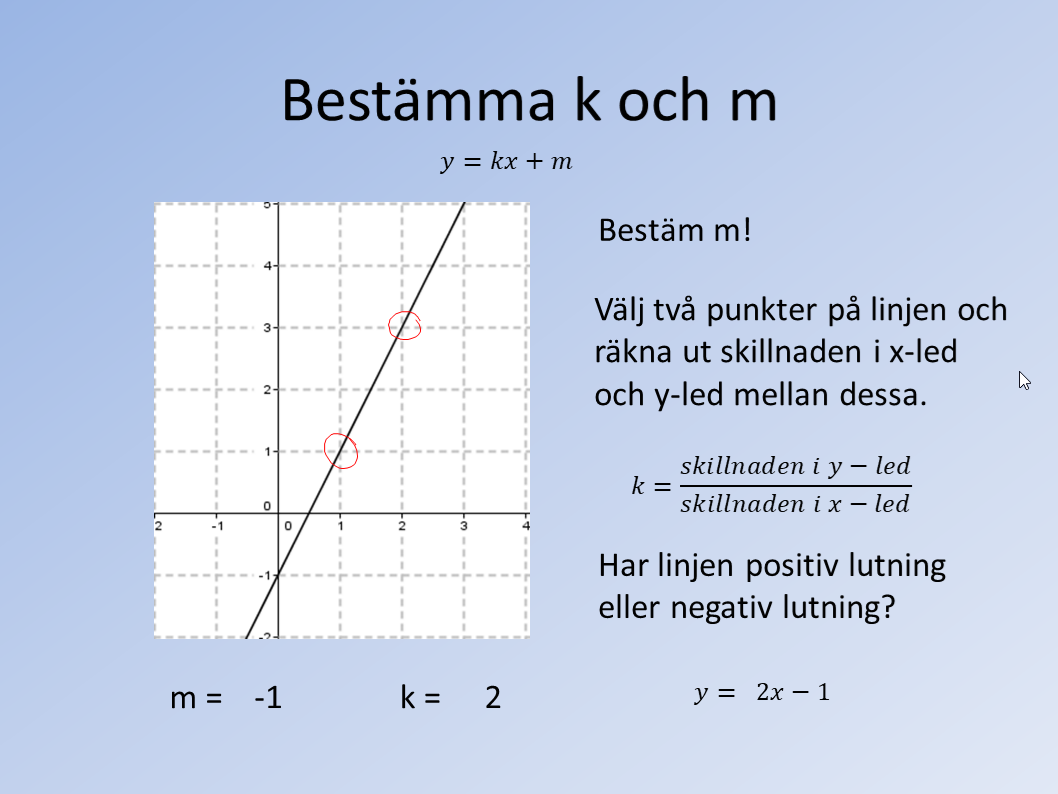
Calculate on the formula y = kx + m on the equation for one line that goes between the points (1,1-1) and (4,2)
viscid thistle
I have no idea how to solve this
viscid thistle
I mean I could get k kinda easy right
viscid thistle
like it would just be y/x
clever inlet
(y2 - y1) / (x2 - x1)
clever inlet
is the first point: (1,1-1) ?
viscid thistle
yes
clever inlet
wouldn't that just be (1,0)?
viscid thistle
?????????
viscid thistle
a) k = Δy/Δx = 2−(−1)
4 −1 = 3/3
=1⇒ y = x +m
−1=1+m⇔m = −2⇒ y = x −2
straight out of the answers sheet so it might be weird
viscid thistle
yeah but I can no way solve this on a calculator lol
viscid thistle
syntax all the way
timid plank
this doesn't seem pre-calc to me 🤔
timid plank
yes the k value is 3/3 = 1
viscid thistle
how do I figure out m
timid plank
^
clever inlet
you know k, and since you have point
you can plug in x and y
and then you just solve for m
clever inlet
you know x
viscid thistle
yeah
clever inlet
actually wait
viscid thistle
1
clever inlet
i don't think either points have y = 3
viscid thistle
huh
clever inlet
you need to use a single point
viscid thistle
yeah (1,-1) and (4,2)
clever inlet
let's use (1, -1) cause i think that's easier
viscid thistle
okok
viscid thistle
yeah
clever inlet
and x is 1 which you already know
viscid thistle
yes
timid plank
then just basic algebra
clever inlet
(-1) = 1(1) + m
clever inlet
i used it to show the substitution of the know x value
clever inlet
k is a know value
since we determined the slope
(-1)=1(1)+m
or just
-1 = 1 + m
solve that
clever inlet
yes
clever inlet
-1 = 1 + m
viscid thistle
wait no
clever inlet
isolate m by subtracting 1 from both sides
viscid thistle
??
clever inlet
m = -2
clever inlet
yes
viscid thistle
is it just like that?
viscid thistle
so if I do it with (1,5 and (3,-3)
clever inlet
find k first
clever inlet
ok
clever inlet
would it not be -8/2?
viscid thistle
oh yes it would
clever inlet
yep
viscid thistle
y=-4+m
I can figure out y
by taking out the easiest y value out of the points right
clever inlet
it needs to be a single point
clever inlet
so choose: (1,5) or (3,-3)
clever inlet
it doesn't matter which you choose, you'll still get the right answer by the end
so anyway
y = 5
so sub that in
viscid thistle
working out?
clever inlet
you should probably follow a more systematic approach to solving variables
viscid thistle
like how
clever inlet
5=-4+m
add 4 to both sides
m = 9
same answer
but it's more obvious what you are doing
clever inlet
cause especially when you get to more complicated equations
working out starts being really important
 viscid thistle
idk how I would do it in any other way
 still yew
Say I have the function $$\frac{x}{x ^ 2+1}$$, what are the holes?
granite stirrupBOT
late haven
holes are the places the function is undefined
in this case, where $$x = \pm \sqrt{-1} $$
granite stirrupBOT
viscid thistle
@late haven Okay, thats about right, because, Im familiear with undefined areas, just not the term holes, my bad.
Or some some cases
zero divided by zero
We have the function f(x) = 12 - 8x
a) Calculate f(2)
viscid thistle
then how do I solve the equation f(x) = 2
viscid thistle
yeah
clever inlet
f(x) = 12 - 8x
and
f(x) = 2
so f(x) is equal to 2 and 12 - 8x right?
12 - 8x = 2
viscid thistle
I'm confused
clever inlet
basically the output is gonna be 2
and with the function, you need to find x that gives this output
viscid thistle
oh
so like
f(2) gave me the output -4
if I am allowed to use decimals
/fractions
clever inlet
pretty sure you'll need to
viscid thistle
f(1.25) = 2
well thatt was easy
didnt know I wasnt allowed to do fractions in f()
clever inlet
fractions are fine
viscid thistle
Is it true that f(2) < f(-2)
gonna try to solve that 1
if I did that then the number would be negative wouldn't it
viscid thistle
f(-2)
in 12-8x
or would it
negative times negative equals positive but is it really a negative in the first place unless (-8)
viscid thistle
12-(-16)
clever inlet
yeah
viscid thistle
which is 28 isn't it
clever inlet
nice
viscid thistle
Prove the difference f(x) < -2
well we knew that f(x) was -4
so it's just -4 < -2
Give an example on
a) An expression(?) with five terms that can be simplified to 8 - 2x
the answer sheet is wrong apperantly
said my fellow book buddy who had the book before me
but
wouldn't it be like
simple just define what x is
clever inlet
that's kind of an open ended question isn't it?
viscid thistle
I have no idea tbh
b) An fuction so that f(3) = -5
wouldn't it just be done with f(x)=10-5x
clever inlet
sounds like another open ended question
viscid thistle
I mean I get to choose whatever I want
clever inlet
yeah
viscid thistle
as long as it works
clever inlet
yep
viscid thistle
but was I right
Marcus says: The solution to the equation f(x) = 0 is the point where the function y = f(x) crosses the y-axis
Is he right or wrong?
clever inlet
should be x axis
 empty cove
Hello.
Could someone help me to translate a mathematical expression into english.
$$\Delta f(x)=f(x+x\small{0})$$
I just started to study calculus and because my english isn't my native sometimes I strugle to find specific articles and learn english calculus terminology.
granite stirrupBOT
willow bear
did you mean $$f(x + x_0)$$?
granite stirrupBOT
willow bear
anyway, i don't know of a name for that
empty cove
yes.
i meant exaxctly that. but... i did a mistake in formula
$$\Delta f(x_0)=f(x_0+\Delta x)-f(x_0)$$
granite stirrupBOT


 willow bear
=tex \frac{a}{b} + \frac{c}{d} = \frac{ad}{bd} + \frac{bc}{bd} = \frac{ad+bc}{bd}
granite stirrupBOT
 twilit zodiac
thank you very much
viscid thistle
Uh
Solve the difference graphically and then make an algebraic calculation as a check
a) 5x - 1 < 5 - x
b) 7-4x > 2x - 5
I know how to figure out x both graphically and algebraic
but how the hell do I figure out what the difference should be
should it be x > 1 or should it be x < 1
I have no idea how you figure that out
if you can help me out then please @ me.
quartz garnet
What difference?
viscid thistle
a) 5x - 1 < 5 - x
b) 7-4x > 2x - 5
clever inlet
i don't think either question has x > 1 or x < 1
viscid thistle
first one is x > 1